







Abstract
Mobile work challenges organizational records management. This paper reports the results of a study in three case organizations on how the organizations’ records management meets and adapts to the increasing role of mobile work. Data was collected by interviewing mobile workers and record management professionals. Documentary materials were used to analyse official records management policies. The findings revealed that documented organizational policies do not take into account mobile work, and cannot effectively support personal or corporate records management in mobile work. Records management professionals were poorly informed of the extent of mobile work in the organization, and of the special problems related to managing records in mobile work. The overall conclusion is that organizations should pay more attention to the new requirements for records management caused by mobile work.
Keywords
1. Introduction
The goal of records management is to govern the practices of records creation and use in organizations. It means setting policies, assigning responsibilities, establishing guidelines, providing services, designing systems for managing records and merging records management into business processes [1]. Records management is an integrated part of organizational functions and processes [2] and therefore its practitioners operate on several organizational levels to capture organizational memory.
Today, planning records management is increasingly associated with the development of organizational processes and it tries to adopt strategies to meet the challenge of new information technologies (IT). Mobile devices are an important branch of information technology and mobile knowledge work has become common in organizations [3, 4]. There has been a considerable growth in the use of wireless communication technologies to process, transmit and exchange data. These devices include laptop computers, personal digital assistants (PDAs) and other handheld devices for data transfer and communication [5, 6]. An interesting question is: have records management practitioners reacted to the growth of mobile work done outside the static office?
Mobile work can be carried out in different spaces. Vartiainen [7] and Lilischkis [8] have divided physical environments into several categories: home, the main workplace (‘Office’), means of transportation and partners’ premises (‘Other workplaces’), and hotels, cafés, etc. (‘Third workplaces’). The degree of mobility varies at both individual and organizational levels: one moves a lot and another stays in a fixed place. Another view on mobility is mobile business models, which aim at providing benefits of use of mobile and wireless technologies to the companies [9, 10].
The special questions of records management in mobile work are practically an unexplored research topic. We lack knowledge of how records management responds to the challenges of a mobile environment and the needs of mobile workers. Traditional record-keeping methods like centralized classification schemas, metadata schemas, records retention schedules, and implementation of electronic records and document management systems (ERDMSs) have served the objectives of records preservation and use in an office-bound paper world, ignoring work that is carried outside the office. An open question is how well conventional records management policies support work in the mobile setting.
The purpose of the study was to explore how the emergence of mobile work has affected corporate records management. It can be assumed that capturing and saving organizational memory is challenged by ubiquitous technologies and mobile work practices based on them. Records management operates in the field of different mandates [11] and its practices merge in the organization in distinct ways: records management may be differentiated to its own unit or it is run along with the core business by employees themselves. Moreover, records are managed at both organizational and individual levels.
This paper focuses on three questions:
How do organizations’ documented policies for records management take into account mobile work?
How do mobile workers experience organizational records management in their work?
How do records management professionals see the relationships of mobile work and records management?
to answer the questions we collected data from three case organizations by interviewing mobile workers and records management practitioners, and analysing organizations’ documents on records management.
The article is structured in the following way. First, we discuss the recent research focus in the field of electronic records management and earlier contributions of records management and mobile work. Then the questions of mobile work, organizational records management policies and records management practitioners are presented. Finally, we conclude with the discussion of how organizations manage to support mobile workers.
2. Earlier research
Mobile technology has been examined in only a few records management studies and these findings do not form a general view of the relationship between mobile technology and records management. As Weilenmann [5] has stated, office work is seen as the norm. At the office, the worker has access to fax, telephone, desktop computer with calendars, contact information, etc., and in addition, workers are considered as having a static base: their desk, their office or a centre of coordination of some sort. However, mobile spaces present a number of challenges compared with the traditional office. Many of them are related to limited device capabilities, in particular, changing contexts, such as the need to adapt to new environments or unexpected tasks and demands, and limited access to office data network. Carrying multiple devices is likely to impact on the types of information management problems that arise. Moreover, disconnectedness from the organization means that information sources like colleagues, papers, ERDMSs and other information systems are not available while working mobile. In addition, the ‘office of the future’, providing an environment for new ways of working, has gained research attention. However, it has concentrated on the physical rearrangement of offices [7, 12, 13].
This article is one part of a set of research articles dealing records management in mobile settings. The earlier study by Mäkinen and Henttonen [14] pointed out that in organizations there is a natural need for records management in order to share information and organize work. In the mobile setting, the motivation for records management arises from the employees themselves; individuals’ motivations are connected to their work tasks and organizational culture. Mobile work increases the storage places of organizational information since the users create and use their records across multiple devices and locations.
Traditionally, the capture of organizational memory has been tied to office-bound information technology. Bailey [15] suggests that, along with the increasing production of records, different kinds of ERDMSs were developed to collect the corporate memory. Workers were encouraged to save their files in centralized systems because this would help to implement records management policies. Typically ERDMSs have been run in traditional models by servers that were considered as a single, functional unit [16]. However, at the same time, the work has been changing and a large proportion of work is meant to be accomplished outside the office, creating a need for ubiquitous access to information. Business trips mean spending time somewhere else than at the office desk and coping without necessary network connections and systems.
The research focus of electronic records management has mainly been on the traditional office-bound work context [17], the nature of electronic records [18] and the implementation and use of ERDMSs [19–22]. Wilkins et al. [23] reported on ERDMS implementation in Australian local government authority and stated that the creators and users need to work in partnership to ensure the usability of records, for example in remote access. Also Johnston and Bowen [24] studied the city council, which has been able to allow remote access to records by staff who are not in the office. These are a few examples of implementation projects where remote use has been included. Bailey [15] mentions the problems that records management faces owing to its command and control nature and manual process thinking, where decisions made by records management practitioners are expected to be adopted by users without question. Research on the implications of records management in unconventional office work is needed.
In addition to remote access to records, mobile workers encounter several challenges in their personal information management (PIM). It is intended to support the activities we perform in our daily lives through the acquisition, organization, maintenance, retrieval and sharing of information [25–27]. It is often considered a private activity but from the records management viewpoint personal information is seldom private. At some points in our lifecycle, much personal information is shared or should be available within the work community [28]. Records management and personal information management seem to be interrelated concepts offering an interesting perspective to study the special questions of records management in the mobile work context.
Our earlier study also addressed the fact that mobile workers do have problems with their personal information management, but that the methods and tools of records management do not support mobile work [29]. Mobile users are constantly trying to manage the scattered pieces of their information, but organizations do not offer solutions; mobile workers have to resolve these problems by themselves and the information management infrastructure lags far behind the reality of mobile workers. Perotti et al. [4] made similar observations: mobile workers faced difficulties integrating information across multiple devices as well as across various applications. Different versions of the same information can be found in different locations, including paper-based file cabinets, as well as in different applications and media.
Organizations are constantly dealing with ongoing technological change, increased security-related threats, ever-increasing infrastructure-related costs, and the need for improved records management processes [30]. Recently, the emergence of cloud computing has increased the number of channels through which mobile workers can access remote information resources. The most highlighted advantages of the cloud have been potential cost savings [16], but it is also an opportunity to implement shared storage environments outside the office. Nevertheless, the implementation of this new technology as corporate information base has not been extensive since data security is always an important consideration when evaluating the benefits and risks of the cloud [31]. Overseas hosted data is subject to the laws of the host nation, which may make the use of the cloud more complicated [16]. Additionally, often practices lag behind new technology advances made, and common policies need to be settled to ensure proper use [32].
3. Research goals and questions
The goal of the study described in this paper was to portray the challenges of mobile work in the development of organizations’ records management. The question is explored from three viewpoints: (1) organizations’ documented records management policies; (2) mobile workers’ experiences; and (3) records management professionals’ views on mobile work.
The research questions are as follows:
How does mobile work appear in documented records management policies?
How do mobile workers experience organizational records management and its support for their work practices?
How do records management practitioners recognize the special needs of mobile work in the development of records management?
The answers to these questions help to reveal potential gaps and tensions between the goal of records management and the reality of mobile work.
4. Research methodology
A qualitative, case-study approach was used to investigate mobile issues and records management. Studying several cases provides valuable and reliable information and therefore data collection for case studies often relies on many sources of evidence [33]. Documentary information is likely to be relevant to every case study topic, including administrative and other internal documents, but one of the most important sources of case study information is interviews. Most case studies are about human affairs and interviews can provide important insights into a phenomenon [34].
The data consisted of interviews and organizational documentary material that were collected in three Finnish organizations during 2004–2005 and 2009–2010. It was not intenional, but owing to factors external to the research, data collection took place in two parts. The study is not longitudinal and therefore the time interval in the data is not exploited in the analysis. The aim of data acquisition was to gain variation by choosing functionally divergent organizations to the study and temporal diversification supported this goal. Variation in this sense means the differences between organizations in mobile work frequency, sophistication in information technology and time the organization has spent in customizing their records management practices with mobile work setting.
Although the data collection for this paper was phased in two parts with several years between the periods, the aim was not to conduct a longitudinal study. The differences between the organizations and the time delay between collected datasets are expected to increase the variation in the data collected and the validity of the results. The data from public institutions were collected in the first phase and data gathering in the information technology firm was done a few years later. Data collection in two parts is not supposed to cause distortion in analysis since during both data collection periods the use of mobile technology was routine. In the context of the information technology company, mobile work was performed with more developed technological circumstances and equipped devices and, in addition, employees were more experienced to utilize technology. In the information technology company mobile information technology was considerably more advanced and the use was more extensive than in public institutions whose core business was totally different. Therefore, the two public organizations were more likely to be comparable with each other.
In this paper, researched organizations are referred by the term ‘case organizations’. The first case organization, an information technology enterprise, was a provider of software applications. Their business was to implement various types of systems for improving document management and operative processes. The second case organization, a government agency, monitored compliance in pharmacy and health care, where processes and records management are strictly regulated by legislation. The third case organization, a University of Applied Sciences, was a multidisciplinary institution in higher education. In addition to education, it conducted research and development projects.
The three organizations were chosen to scrutinize research questions under varying organizational conditions and to maximize the differences in the phenomenon of interest. The information technology enterprise represents business life and an assumed position in the frontline of information technology development and deployment. The other two organizations, the University of Applied Sciences and the government agency, operate in the public sector, which is governed by legislation. Moreover, the core tasks of these public institutions are different from each other.
The main information sources of this case study were mobile workers. Altogether 23 participants used mobile devices frequently and their work was not tied to a conventional office context. These informants were so-called ‘white collar workers’, meaning, for example, experts, teachers, information technology support staff, project managers and inspectors. For these informants, mobile work meant at least monthly or weekly business trips and the use of mobile devices. A few of them were extremely mobile and spent only a couple days of the month in their static offices.
In addition, two records management professionals were interviewed at the University of Applied Sciences and in the government agency to collect information data on corporate record management practices. The third case organization, the information technology enterprise, did not have a full-time records manager. Each member of this firm was responsible for managing and archiving their own records. Therefore, the interview data on records management professionals’ views do not cover the information technology company.
The theme interviews in this study were open-ended and the number of interviews varied between seven and nine per organization. The interviews covered several areas of mobile work including mobility in general, mobile devices used, records created on mobile devices, advantages of devices, problems faced and organizational culture. All the interviews were recorded and transcribed by the author. The total duration of the interviews was over 27 hours, and the average length of a single interview was 1 hour 10 minutes. Durations varied from 52 minutes to 1 hour 40 minutes. During the interviews in the second organization it turned out that the empirical data was saturated.
In addition to interviews, organizational documents were analysed to gain an insight into organizational records management policies and instructions. Record-keeping instructions including records management schedules, functional classification systems and corporate instructions were available both at the University of Applied Sciences and in the government agency. Both organizations’ strategy papers presented the future objectives and goals on a general level and were one subset of the documentary material. Records management guidelines implement certain policies and specify how the personnel are expected to take care of records. Strategies, data security policies and annual reports completed the documentary view. In the information technology enterprise, all instructions were included in a quality management handbook. In addition, business plan documents were used to extend the analysis. In summary, the documentary data included altogether 441 pages. The summary of the research questions and the subsets of data are presented in Table 1.
Summary of interview and documentary data used to answer the research questions.
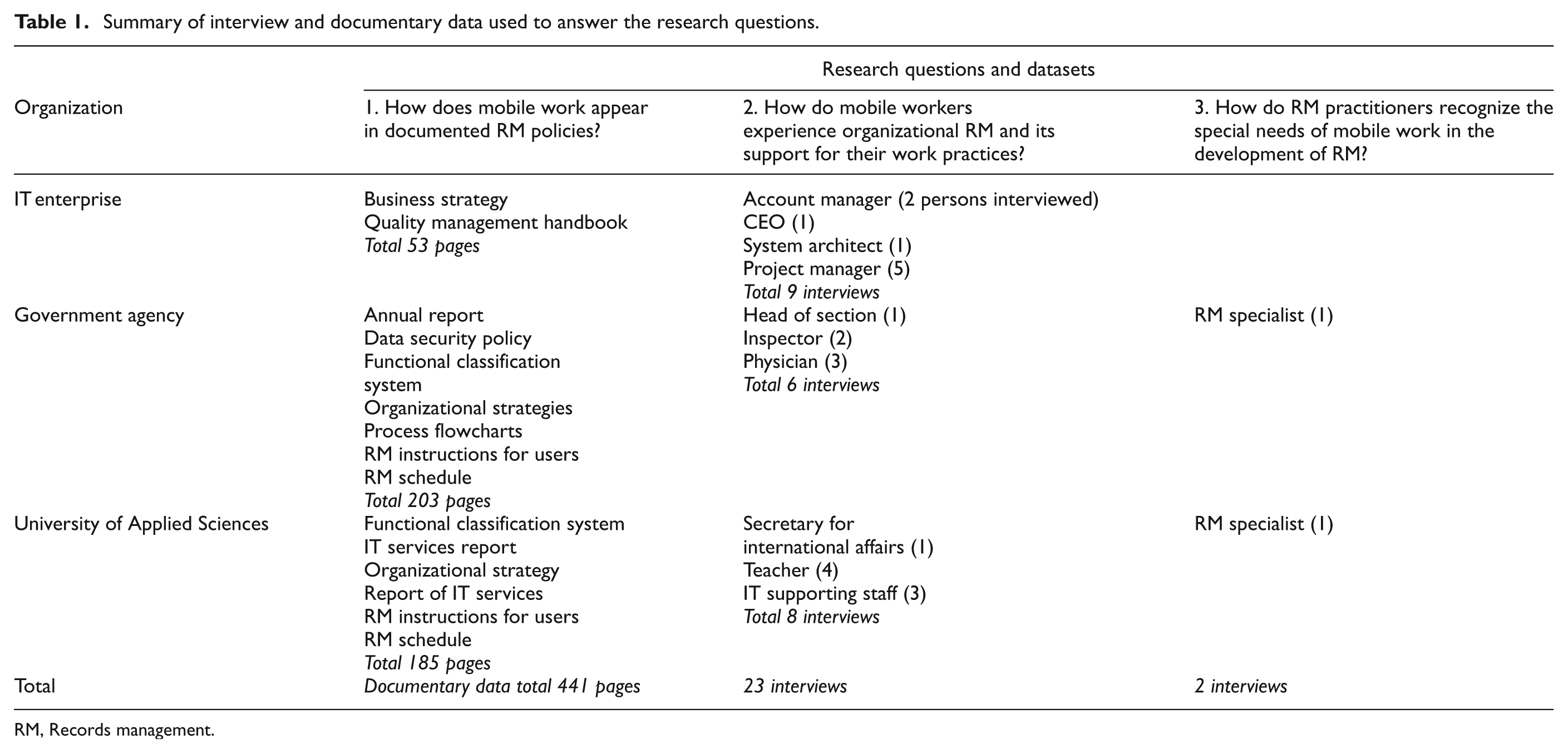
RM, Records management.
The qualitative data were analysed using cross-case analysis, which involves collecting data from several cases. The traditional type of qualitative analysis is the single-case study. In a cross-case study data is gathered to learn as much about the contextual variables as possible. In addition, studying several cases the potential for generalizing beyond the particular case increases. Comparing cases the researcher can establish the range of generality of a finding [35]. Cross-case analysis focuses on sets of individuals within several settings and the actors are investigated in multiple settings. The answers from different people to common questions are grouped together to analyse different perspectives [36, 37].
The data analysis started with grouping the data into a table along with research questions. One unit of analysis could include several sentences or short paragraphs. Each unit of information was coded according to identifying factors (person interviewed and organization, which text material and which organization). The data were read through several times underlining key words and phrases from the interview responses and text material in order to suggest possible dimensions in responses. Then the data were sorted by comparing the information with the next unit of analysis [35, 38].
The next phase was to identify patterns or themes from the tabulated data by cutting and pasting passages. Each unit of information was coded according to category representing emerging themes. Developing categories involves looking for recurring regularities in the data and simplifying the complexity of reality [31, 33]. Categories were formulated from empirical data by searching for similarities, differences, anomalies and uniqueness. These categories were coded and written into the notes. The data were read through in order to refine the categories until no new categories were identified.
5. Findings
5.1. Mobile work in documented records management policies
Documentary sources of the organization were used to analyse records management policies in all three cases. In the information technology company, these included quality management instructions and business plans. Records management schedules, information technology plans and strategies and records management instructions were used to analyse the policy of the government agency and the University of Applied Sciences.
The analysis of the information technology company documentation suggested that information was valuable and understood as a part of the business processes. The corporate quality management handbook contained practical advice encouraging the capture of records into the ERDMS. The system included and was used more like a set of several databases for managing project documents. For example, metadata was not attached to the records and they were not protected in an archiving sense. However, mobile work itself or records created mobile were not mentioned as such, even though mobile work in sales and system development was routine.
In two public organizations, the records management regulations were not integrated part of organizational directions; they were separate from other instructions. Partly for this reason users’ common records management practices like capturing records into the ERDMS, filling metadata fields and classification or considering archiving purposes were lacking. Most of the records management instructions for users gave generic instructions and did not include hands-on and usable advice for the end-user. Mobile work itself or records created ‘on the move’ were not mentioned in any of these public organizations’ documentary data. In addition, the concept of ‘record’ or the difference between ‘official record’ and ‘unofficial record’ was not explained in any of the documentary material. At the University of Applied Sciences, the registry guidelines included advices for capturing records but orders did not specify which records were supposed to be registered and which were not.
In the information technology enterprise, the focus was on information that was crucial for the business activities. Customer relationships were a priority and documenting customer contacts and meetings was part of it. Documentation of work tasks had a significant role in quality management and control. These issues were emphasized in the company’s quality management handbook, especially in the instructions concerning software development documentation. Documenting was essential also when the staff worked and generated records and made decisions away from the office desk. It was recommended to create records directly to the databases or to replicate them in the office if online connections were not available. The project manager was responsible for how and where records were saved, and he/she ensured that people on the project followed the instructions. Notably, the documentation polices in the information technology company were born in and based on the business activity. Instructions for managing records were an integral part of quality management, although the term ‘records management’ was not used in the directions. An interesting detail in the instructions was that they covered the information management of ongoing projects but not the life-cycle management of the records.
At the University of Applied Sciences, information management practices appeared to be more individual and uncontrolled according to the interviews and the document analysis. Work was mobile and independent and there was mobile equipment available, but on the other hand, organization’s records management regulations did not provide tools for managing records on mobile devices. The archiving instructions gave a lot of responsibility and discretionary power to the users. These directions stipulated that individuals were supposed to organize and dispose of records themselves, obeying retention schedules. For example, using ERDMS was voluntary both in the government agency and at the University of Applied Sciences. Only some informants were using a this system, and the reason for this was that mobile facilities and on-line connections outside of the office were not available.
Working groups can decide fairly independently how they store their records, for instance, if the material is in SharePoint only. The group has the freedom to decide itself how it acts with their records. (Records Management Specialist, University of Applied Sciences)
In both public institutions, records management instructions emphasized the responsibility of the individual staff members to manage records properly. This had led to a situation where mobile workers had to solve their practical problems themselves. As mentioned earlier, neither records management instructions in general nor data security policies stated how non-substantial information, like emails or chat messages, should be preserved. Additionally, the instructions lacked information on how to capture records generated offline. Organizational information technology architecture did not support records management in mobile work.
In all three cases there were organizational records management directives but the directives did not pay any attention to the special characteristics of mobile work. Moreover, the mobile users were responsible for management and disposal of their own documents. In the public sector, official regulation did not allow digital processes, which would have been essential in mobile work. This generally prevented developing and having digital processes in the organization, not only in mobile work. Thus, there was a gap between generic instructions and the practice of mobile setting.
5.2. Mobile workers’ perspectives on the organization’s records management
Work practices in the government agency and at the University of Applied Sciences were different from those in the information technology company. Although many workers in the public institutions were mobile, mobile work and its technical equipment were not integrally assimilated into organizational work practices. However, the informants in the IT firm reported that mobility was a natural part of their work and management agreed with this view. Many of the respondents stated that they could not cope without mobile devices and could not imagine their work without mobility.
In the information technology company several informants reported that up-to-date documentation was the only way to follow what assignments had been completed in the ongoing project. The number of informal documents was in some cases considerable. This included, for example, messages and memos on what had been done before and what had been left undone and why. Much information was transmitted in emails, virtual meetings and chat, which were not considered records. These documents were not saved collectively in the ERDMS, even though the staff was committed to using the system regularly. They were familiar with the system because it was one of the company’s products.
In the government agency, the use of mobile technology did not seem to be a part of the organizational work practices. Mobile work was not mentioned in the information technology strategy, but a memo about the information technology services explained how employees could loan laptops. In practice, the need for mobile devices was significant but organizational support for mobile work was inadequate. The respondents generally shared the opinion that there was a lack of equipment (laptops, mobile phones, wireless Internet connections), which made mobile work complicated. Many of them also mentioned that their employers could not understand the need for equipment in mobile work.
In spite of information technology strategy, the government agency did not offer mobile users sufficient information technology infrastructure and devices. In addition, an ERDMS had been implemented, but it was not integrated with work practices and the staff were allowed to ignore it and stay with the paper-based processes. Some of the respondents criticized the usability of the system and stated that loading documents into the system was inconvenient and insecure. Only a minority of the staff saved their materials in the ERDMS because it was seen as new and complex to use. It was also thought that paper records were more useful.
It [saving a document in ERDMS] is voluntary and there are no rules about it. [Different] practices have originated over time. Some stick to the habit of putting all the records into the system. Others instead, do not touch the system at all. (Records Management Specialist, government agency)
Moreover, records management policies varied according to their context. In the government agency, individuals’ personal information management was influenced by the normative obligations of the organization since the main processes in this organization were strictly governed by the national legislation. Many respondents thought that edicts of European Union prevented them from processing and archiving records digitally. The interviewees preferred electronic records processing and archiving but international regulations demanded paper. Partly for this reason, the majority of mobile workers printed out their records and archived them in their own offices.
Then it [the record] is processed on paper as it always has been done. I always print out the records and put them into a binder where the other records of the case are. (Chief Physician, government agency)
The government agency staff did not know who would be organizing and archiving their records and why. During the interviews it became apparent that records management was felt to be an unknown and distant organizational function. In the interviews it emerged that many of the respondents did not know what was going to happen to their records and who would take care of them. Employees were aware of records management instructions even though they did not know them thoroughly. Only a couple of respondents identified retention schedules and mentioned the retention periods of their records.
Then the record is sent to the file room, and there some professional will take care of it and see that it finds its place [in the files]. (Head of Section, government agency)
At the University of Applied Sciences, the respondents were not aware of any records management instructions even though records management practitioner had completed the records management schedule. The instructions were available for users but were general in nature and did not offer concrete guidance. Records management instructions stipulated that individuals were supposed to organize and dispose records themselves obeying retention schedules, but none of the informants mentioned the schedule in the interviews. For example, an interviewee had saved several copies of her records in different storage spaces, including a laptop. When asked if there were enough instructions for information management, the informant felt that there were none. Thus, the users were unaware of the existing directions.
Records are [electronically] filed in a directory somewhere, but of course there are also records which need to be filed on paper, for instance copies of applications and similar. (Manager of International Affairs, University of Applied Sciences)
In the information technology enterprise instead, mobile workers had familiarized themselves with the quality management instructions and knew what to do with their records even though they were not aware of how records were actually filed.
I have to say that I do not even know [about filing], and what happens to the records and in what phase, for example, if they are transferred into an archive. (Account Manager, IT enterprise)
The interviews reflected mobile users’ attitudes towards records management. The majority of respondents in all organizations were unfamiliar with its methods and tools, and many of the respondents had decided to do the appraisal themselves. They did not follow any retention schedules and took the disposal decisions by themselves. One of the interviewees used the term ‘disposable information’ to illustrate the kind of information which had no use value after a short period of time or after the transaction in question had been completed.
There is no need to transfer everything [from the laptop to the home directory in the server]. Part of it is ‘disposable information’ which is not necessarily permanent or useful for later purposes. (Computer Specialist, University of Applied Sciences)
Some interviewees thought that in maintaining organizational memory, individuals must count on each other to manage the documents properly. This was especially stressed in the information technology company when a group of employees worked in the same project.
How do I know for example if the records of a customer project are really available there [in the database] or are they somewhere on the project manager’s laptop? (Account Manager, IT enterprise)
At the University of Applied Sciences, the respondents did not see information management as a common issue. Many of these interviewees thought that the information was their own and they sent files to colleagues via email. The participants at the university also supposed that ‘archiving’ was one’s own responsibility. For them it meant taking backups of the personal files.
I save it in the computer memory and if it is a laptop also on a CD disc. Then I might email it to the people whom it concerns. (Manager of International Affairs, University of Applied Sciences)
The interviewees stressed the access to information sources. For an individual mobile worker, the main issue was to keep the records available and usable for oneself. Those respondents whose work was independent preferred keeping the records mainly themselves and did not download them into the shared system. Notably, at the University of Applied Sciences none of the interviewees mentioned that records should be more often shared in their own organization. In addition, no one mentioned that records might be significant for the university as a public organization. They tended to think that the office computers or laptops were safe places to store materials. These respondents did not see information management as an organizational issue.
The differences between the case organizations may indicate the differences in their main business processes and organizational cultures. In the information technology enterprise, business activities and customer relationship management required information retention and sharing. New customers and projects may later make information reuse necessary. Therefore the mobile workers in the information technology enterprise were committed to saving their records in the ERDMS. On the contrary, in the public sector, obeying the law was the primary concern in the management of information.
An interesting contradiction was that, in the case of the information technology company, the instructions were made by people in the core business management and motivated by its needs. Although the instructions did not specify the records management procedures in mobile work, the staff were committed and able to apply them in their work practices. In contrast, mobile workers in public organizations had not adopted records management instructions in their work practices despite the more ample records management resources and instructions.
5.3. Records management practitioners and the requirements of mobile work
In addition to mobile users, two records management professionals were interviewed to complete our view on the relationship between mobile work and record-keeping. During the analysis, it became apparent that records management staff were poorly informed about the everyday mobile work and its problems. Additionally, records management practitioners were not aware of the extent of the mobile devices and records generated in mobile devices and how they were managed. The prevailing view was that most of the work was done in the office with standard desktop tools, and records management tools and policies supported this stance. Records management was still tied to the idea that work is done in the standardized office environment. There was a gap between mobile workers’ everyday work practices and records management professionals’ knowledge of them.
When you initiated the research, it was a surprise to me that we had here such a number of different kinds of mobile devices. It really surprised me. No one had any conversations with me about this, or provided any information or asked anything related to records management and mobile work. (Records Management Specialist, government agency)
While discussing the problems which mobile work may cause to records management, records management professionals did not refer to issues of information management. Mobile work was regarded as a kind of a separate matter that did not immediately concern records management. The practitioners regarded mobility more as a technological matter of coping with several devices rather than as an information management issue. In general, data security, especially in case of USB flash memories and printed records carried everywhere, were seen as a risk.
I would rather see USB flash memories as a problem because of data security. […] They are a kind of security risk as they could be left anywhere. (Records Management Specialist, University of Applied Sciences)
Records management professionals were also concerned about the handling of confidential material in digital format and had taken actions to improve the situation. This indicated that the professionals were aware of their wider role as organizational information management officers, not only records management.
My colleague has been talking about it and questioned if is safe to send records. This is especially related to email and in that way to other devices. Emailing records is not safe for the sake of confidentiality and data security. (Records Management Specialist, government agency)
As mentioned earlier, the mobile workers regarded the records management function as distant and impersonal and not affecting their everyday life. It was thought that records management’s main duty was to take care of the files and not to help users in their personal information problems. The records management professionals themselves had noticed the same view, and they also thought that this attitude influenced their work in an organization.
Many people shut their ears when filing is mentioned, implying that it is not their business. (Records Management Specialist, University of Applied Sciences)
As noted in Section 5.1, mobile work was not an explicitly specified issue in organizational records management policies. Clearly, there was a great deal of confusion surrounding records management in all three case organizations. Many mobile workers had practically no information about records management policies and how it would affect their work practices. In this context, the mobile workers that were interviewed managed records the way that suited them best. Similarly, records management professionals were not familiar with the practices of mobile work, even though they had thought over the issues relating to it.
6. Discussion
This paper completes our research on how the case organizations’ records management meets and adapts to a new technology-induced challenge: the increasing role of mobile work. Earlier we compared records management ISO standard 15489-1 and mobile workers’ motivations to records management [14]. Our findings also raised the question of mobile workers’ personal information management. Mobile workers struggled with the integration problems of information, and with other challenges that mobility brings into their work [29]. This paper focused on the organizational records management policy and compared it with the mobile knowledge workers’ thoughts on records management practice in the organization. Further, we analysed records management practitioners’ conceptions of the mobile work environment.
The findings illustrate that the relationship between mobile workers and records management is a complex issue. Documented organizational policies did not explicitly take into account mobile work, and could not effectively support personal or corporate records management in mobile work. Our study revealed several unsolved problems in the organizations’ records management policies and practices in coping with the challenge of expanding mobile work. The present study supported the earlier findings that personal information management issues, identifying vital information for the organization and coping with the scattering of information between devices, are everyday challenges in mobile work [29]. In the case organizations the instructions for records management ignored mobile work and did not include specific guidelines for it. This is interesting since a systematic records management policy is required to ensure that the appropriate records will be available. This includes developing and maintaining policies, procedures and methodologies, appointing experts and creating and managing specialized departments [39]. Our findings indicate that records management regulations, especially in the two public organizations, tended to be too generic to be applicable in mobile work.
In the two public organizations, which had a permanent records management unit and expertise in this field, informants were poorly aware of the directives. At the University of Applied Sciences, the mobile workers’ commitment to records management appeared to be weak, which apparently affects negatively the creation of organizational memory. The informants saw records more as personal files than organizational documents. Records management function was more concentrated on the limited administrative processes than the core functions of the education organization, like teaching and research. In the government agency, the mobile workers kept the papers to themselves and were unaware of the organization’s filing procedures. Owing to the nature of the organizations’ core business, they were obliged to save their material since work processes were strictly regulated by legislation.
In general, for any public authority organizations it would be a problem if an individual worker was not committed to or aware of shared records management rules. Presumably, a records management unit may find it difficult to change the existing distinction between administrative records and personal documents.
Records management practices may be built up without the control of an official records management unit. If the practices are built on the needs of the organization’s core business and by informed people in charge of the core business, workers may be more committed to them than to the instructions given by a special unit. The information technology company was an example of this kind of shared and integrated records management practices. This firm did not have a records management policy but seemed to have the most advanced information management practices for mobile work. In this organization, mobile work was very common, mobile technology was part of everyday work tasks and the rules of records management and work practices were based on the requirements of business activity. Information management practices were quite advanced, even though not always thoroughly defined. Without a records management practitioner or unit and without explicit instructions with this title, they had managed to develop a common documentation routine which was based on the core business. Even though corporate regulation did not emphasize specific mobile work issues, the staff seemed to be engaged to capture organizational memory. Even though mobility was not mentioned as such in organizational policies, it seemed to be integrated to work processes to the extent that mobile workers could apply the instructions to work practices.
Further, a twofold unfamiliarity between actor groups was observed. Mobile workers were not aware of the organization’s records management policies and functions, and more crucially, records management professionals were unfamiliar with mobile work practices and its challenges for records management. Foscarini [40] states that actual work practices are often different from the ways in which laws, regulations, internal manuals and individuals themselves articulate how work gets done. In our study, it appeared that the views of individual actors – records management professionals and mobile workers – were far apart. Different professionals do not know each others’ practices well, which hardly promotes the implementation of instructions.
For a mobile worker, the factors motivating records management are closely connected to the need to organize their own work. From their viewpoint records management should not only aim at organizing corporate information resources, but also support their personal information management and work [14]. This study showed that there is a gap between mobile workers’ everyday work practices and the organizational records management function. Organizational records management policies and functions have been developed for office-bound work and mobile work has thoroughly challenged this standpoint. When the use of an information system is dependent on the users’ willingness, the organization will have problems in maintaining its organizational memory. Many mobile workers mentioned that they had developed their own solutions to managing information. Understandably, the expectations of cloud computing and new mobile technologies seem tempting to mobile users.
A limitation of this paper is that it was based only on three case organizations and that the number of informants per organization was small. However, the case organizations operated in different fields of business, which adds variation in the data.
7. Conclusion
This study is a contribution to the exploration of record keeping in non-traditional settings. The purpose of this paper was to gain an understanding of how the challenge of mobile technology is met in records management. The phenomenon was approached by studying three organizations from three perspectives. Different perspectives yielded a rich dataset to depict how records management is perceived by different actors in the organization in the context of mobile work.
The fact that mobile workers regarded records management as a distant function and that many participants lacked knowledge of records management raises the question: should its influence be examined more thoroughly and the profession made more visible and user-centred, especially when cloud computing and free, user-friendly software applications are becoming more and more common? The needs and views of records management professionals and users are in conflict. The practitioners need to make their instructions known to the organization and, further, they need to examine records management practices developed by users in core business processes.
The mobile world has comprehensively changed during the last decade. At the time of data collection cloud computing was not yet under wider discussion and therefore it was not an option in the current case organizations. It can be assumed that it brings limitations to this paper. This research was carried out just on the verge of new mobile technology, before the full emergence of tablets and touch screen smart phones, which are able to process records in a totally new way. This may raise the question of whether these findings already outdated?
Today, tablets include a variety of features that were provided earlier by separate devices. Qwerty keyboard, WLAN and a touch screen make the device a record producer for a mobile officer. These handheld smart devices have been widely adopted and therefore they will impact the way records are generated and managed: independent from physical plugging, information resources are available ‘on the road’. Additionally, mobile users will not be committed to the corporate storage bases since the cloud will resolve many of their earlier information management problems.
This study examined how mobile workers see the position of records management in supporting mobile work. Only a few efforts [41–44] have earlier been made to discuss the impact of new tools on records management practices, but those have concentrated on securing records in the cloud or attempts to archive social media. This indicates that records management as a profession has not paid attention to these new ways of conducting work and the challenges they bring to work practices. Therefore, there is no evidence that this phenomenon is thus far being taken into consideration in records management or that the stances of records managers have changed over the years.
Records management as a profession should pay more attention to unconventional ways of conducting work and identify the problems that users face in their personal information management. Additionally, records management professionals should bear responsibility for providing tools for atypical ways of doing work. In this sense, the impact of records management as an organizational function and how individual actors adopt records management requirements should be further studied.
Footnotes
Acknowledgements
The research was funded by the Finnish Cultural Foundation. I want to thank Professor Eero Sormunen and Dr Pekka Henttonen for commenting and supporting this work.