






Abstract
The objective of search and recommendation is to provide users with documents that are relevant to their needs. Keyword-based search and recommendation approaches suffer from sparsity and semantic ambiguity problems because they correlate users’ needs with documents only via keywords. Thus, for a given query, some documents that are semantically relevant to a user’s needs are not provided if they do not include specific keywords. To address this, some search approaches have used the authority of documents, which is commonly represented using hyperlinks within documents. However, if there are no hyperlinks, it is difficult to exploit the authority for ranking documents. As the links of documents are determined by their owners, the authority derived from links does not consider users’ current needs. In order to resolve these problems, we propose a unified framework for semantic search and recommendation to enrich the semantics of users’ needs and documents with their corresponding concepts and to use personalized authority derived from recommendation approaches. The proposed approach makes it possible to retrieve documents with a high degree of semantic relevance as well as high authority. Through extensive experiments, we show that our approach outperforms conventional search and recommendation approaches.
Keywords
1. Introduction
As the acquisition of documents relevant to users’ needs has become a critical issue, many studies have proposed their own approaches in terms of two aspects: ‘search’ and ‘recommendation’ [1]. Search approaches are to accept queries from users and return relevant documents. Most search approaches exploit exact matching of keywords derived from queries and documents; this approach is referred to as keyword search. In general, the quality of search results in keyword search depends upon the quality of user-specified inputs such as queries. If users are unaccustomed to expressing their needs with precise queries, it may be difficult for keyword search to provide appropriate documents. To complement keyword search, various recommendation approaches have been proposed which are to find documents that conform to users’ preferences (instead of queries) and predict rating scores for documents based on users’ preferences [2].
Owing to their simplicity and efficiency, keywords are widely used in many search and recommendation approaches [3]. However, keyword-based approaches have three problems: sparsity, semantic ambiguity and non-personalized authority. First, as the number of keywords in database increases, the density of documents with respect to the given keywords decreases [4]. For example, for a query, some documents that do not include keywords derived from users’ needs (i.e. queries or preferences) cannot be provided to users even though the documents are semantically relevant to a given user’s needs; this is referred to as the sparsity problem. Second, although documents include the keywords derived from users’ needs, they may not be precisely relevant to a given user’s needs. This is because a keyword can be interpreted in different ways (referred to as a homonym), or different keywords can mean the same thing (referred to as a synonym); this is referred to as the semantic ambiguity problem. To overcome the sparsity and semantic ambiguity problems, some studies have exploited the authority of documents as well as keyword-based relevance [5]. For example, if some candidate documents have the same degree of relevance to a given user’s needs, a document with high authority is top-ranked for the needs. Hyperlinks within documents have been widely used to represent the authority of documents; that is, documents that are frequently referenced (or hyperlinked) by others have high authority. This approach has been validated by the success of Google (http://www.google.com). However, if there are no hyperlinks, it is difficult to derive the authority of documents. Moreover, as the hyperlinks within documents are determined by their owner, the authority derived from the hyperlinks does not consider an active user’s current needs. 1 This means that search approaches using the authority derived from hyperlinks of documents cannot provide users with personalized results; this is referred to here as the non-personalized authority problem.
In order to resolve these problems, we propose a unified framework for semantic search and recommendation. The unified framework utilizes the enriched semantics of active users’ needs and documents. As humans interpret the semantics of specific entities with their domain knowledge, search and recommendation systems also require vast amounts of domain knowledge to understand the semantics of entities [6]. In the proposed framework, the active users’ needs and documents are represented by a set of concepts (derived from domain knowledge) as well as keywords to represent their semantics.
The unified framework offers three improvements over previous methods, summarized as follows:
By using enriched semantics, which are represented by a set of keywords and concepts, sparsity and semantic ambiguity problems are resolved. These problems cannot be avoided in keyword-based approaches because using keywords only cannot represent the semantics of active users’ needs and documents completely. The proposed unified framework complements the semantics of the users’ needs and documents with the concepts of domain knowledge.
The quality of search results can be improved by using personalized authority. As addressed previously, the authority derived from the hyperlinks of documents does not consider active users’ current needs. To resolve the non-personalized authority problem, we exploit the authority derived from recommendation approaches. Thus, the documents that an active user prefers will have higher authority than those that he/she does not prefer.
The proposed framework can decide an appropriate search and recommendation approach according to users’ circumstances. For example, users may be accustomed to expressing their needs with queries in some domains, but not others. Search approaches may be appropriate in the former case, and recommendation approaches may be appropriate in the latter.
To the best of our knowledge, few studies have proposed a unified framework for semantic search and recommendation, utilizing the implicit authority 2 of documents. The remainder of this paper is organized as follows. Section 2 represents a review of previous studies related to semantic search and recommendation. Section 3 describes a unified framework for semantic search and recommendation. Section 4 explains the detailed modelling for entities and their relationships in the proposed framework. Section 5 explains the derivatives in the framework and their probabilistic ranking functions. Section 6 shows the superiority of our approach via various experiments. Section 7 concludes this paper and discusses future work.
2. Related work
In this section, we briefly present some of the previous studies related to semantic search and recommendation.
2.1. Semantic search
Keyword search basically assumes that the inherent semantics of queries and documents are expressed by a few keywords. However, owing to sparsity and semantic ambiguity problems, most documents retrieved in response to queries are irrelevant to users’ needs. Consequently, some approaches analyse the hidden semantics of queries and documents; they are referred to as semantic search. In this work, we classify the semantic search approaches into three categories: logic-based, link-based and concept-based semantic search.
Logic-based semantic search [7, 8] utilizes a domain ontology that defines concepts and their relationships in the domain. As users’ needs can be described precisely with a specific query language (e.g. SPARQL and OWL-QL), semantic ambiguity is not considered a significant problem in logic-based semantic search. However, for ordinary users, acquiring the specific query language is considered a barrier. Furthermore, logic-based semantic search requires an inference engine to manage the given ontology. However, no inference engines are available to manage large ontologies within a reasonable period of time [9].
Link-based semantic search [10–12] tries to find documents that are semantically relevant to active users’ queries through hyperlinks between documents. Link-based semantic search consists of two steps. First, initial documents that contain keywords in the given query are located based on exact matching between the query and documents. Then, semantically relevant documents that are frequently referenced by the initial documents are identified. Link-based semantic search can provide documents that are relevant to the given query even though they do not contain any keywords derived from the query. However, there are two limitations. First, because the first step is based on exact matching, there are still sparsity and semantic ambiguity problems. Second, if the hyperlinks of documents do not exist explicitly, the results are identical to those of keyword search.
Concept-based semantic search [3, 13–15] represents the semantics of documents and users’ queries with concepts. The concepts can be explicitly selected by users or implicitly derived from users’ logs. The definitions of concepts are different depending on the domains (or applications). For example, Lee et al. [13] considered Web categories to be concepts, whereas Xu et al. [3] considered tags to be concepts. However, in general, concepts are assumed to be derived from domain knowledge (e.g. taxonomic knowledge, folksonomy). As users’ queries are correlated with documents via concepts in concept-based semantic search, the problems associated with keyword search (such as sparsity and semantic ambiguity) are resolved to some extent. By representing the user’s query and documents with their corresponding concepts, it is possible to retrieve documents that are semantically relevant to the given query even though the documents do not have any keywords of the query. Furthermore, the semantic ambiguity of keywords can be resolved because the conceptual representation for a given query can play a role in semantically disambiguating the query. Since recent studies on semantic search have focused on improving the quality of concept-based approaches, we refer to concept-based semantic search as ‘semantic search’, hereafter.
2.2. Recommendation
Recommendation can be classified into content-based filtering (CBF) and collaborative filtering (CF) [5]. CBF attempts to find documents similar to those liked by an active user in the past. As CBF has its root in keyword search and adopts many techniques of keyword search, the details of CBF are not discussed further in this paper.
The most successful and popular recommendation systems used in commercial sites are based on CF. CF identifies like-minded users whose preferences are similar to those of the active user. Then, CF recommends documents that those like-minded users prefer. As the techniques used in CF are different from those in search and CBF, the rest of this section reviews the derivatives of CF in detail. Although there are many criteria for classifying CF approaches, they are often classified into user-based collaborative filtering (UCF) and item-based collaborative filtering (ICF) [16, 17].
UCF [18–20] has critical limitations such as a lack of scalability and real-time performance problems; that is, as the computational complexity increases linearly with the number of users, it is difficult to find like-minded users in real time [16]. ICF [21, 22] has been proposed to overcome these limitations. It predicts an active user’s preference for documents based on the degree of relevance between documents, rather than the degree of relevance between users. However, according to Mild and Natter [23], the recommendation quality of UCF is better than that of ICF. This work only considers UCF because our goal is to provide users with more reliable documents.
Despite their success and popularity, UCF and ICF have a critical drawback, which is the sparsity problem. When semantically like-minded users access different documents, it is difficult to determine whether those users have similar preferences. Our work focuses on solving the sparsity problem by associating users’ preferences and documents with their corresponding concepts. The sparsity problem cannot be avoided in CF using similarity measures such as Pearson’s correlation coefficient and cosine similarity [17, 18, 24, 25] because CF exploits exact matching of documents to estimate the degree of relevance between users who accessed those documents.
Several approaches have been proposed to alleviate sparsity problems. Dimensionality reduction [26, 27], which is based on matrix factorization, removes unrepresentative users or documents in order to reduce the dimensionalities of the user-item matrix. However, when certain users or documents are discarded through dimensionality reduction techniques, some useful data for recommendation may be lost and thus degrade the quality of recommendation [28]. In contrast, our approach solves the sparsity problem by increasing the semantic information for users and documents without losing any information. Hybrid approaches combining CBF and CF have been proposed to address this problem [29, 30]. In hybrid approaches, users’ preferences are represented by keywords extracted from documents, whereas in the proposed framework the preferences are represented by a set of concepts extracted from domain knowledge. As a result, it is possible to estimate the degree of semantic relevance between users who accessed different documents. Finally, clustering-based CF approaches [31, 32] recommend documents within a set of small clusters. However, these approaches have expensive clustering costs, and the quality of recommendation is generally low [28].
Recently, Zanardi and Capra [33] and Kim et al. [34] have proposed tagging-based CF approaches to alleviate the sparsity problem. The degree of relevance between an active user and like-minded users is derived by tags annotated by the users. If we regard the tags as concepts for computing similarity between users, the ideas are similar to our approach. However, if an active user does not provide any explicit feedback (e.g. tags), for reasons such as annoyance or hesitation, it is difficult to estimate the degree of relevance between users. Therefore, it is necessary to study how to utilize users’ implicit feedback (e.g. click-through logs) instead of explicit feedback. Chong and David. [35] have proposed a collaborative topic regression model for recommendation, which is based on latent Dirichlet allocation (LDA) [36]. A topic modelling approach such as LDA discovers a set of concepts (or topics) from training set, whereas the proposed framework explicitly derives concepts from domain knowledge. Since the concept space in world knowledge is larger than the one in LDA, we can estimate more reliable degree of semantic relevance between users.
3. Unified framework for semantic search and recommendation
Conventional search and recommendation approaches only exploit a single entity type to represent the semantics of active users’ needs and documents. For example, keyword search only exploits keywords to represent the semantics of active users’ queries and documents, whereas CF exploits like-minded users to represent the semantics of active users’ preferences and documents. As a single entity type cannot represent the semantics of users’ needs and documents completely, it causes several problems, such as sparsity, semantic ambiguity and non-personalized authority of documents in conventional search and recommendation approaches. To enrich the semantics of users’ needs and documents, our work proposes a unified framework for semantic search and recommendation. Because the unified framework exploits heterogeneous entities and their relationships, it enriches the semantics of users’ needs and documents, thereby resolving the sparsity and semantic ambiguity problems.
The rest of this section explains in detail how to resolve the problems in the proposed framework. First, it is difficult to completely represent the semantics of documents and users’ needs with a few keywords. Even though previous semantic search approaches exploit concepts instead of keywords to reduce the sparsity problem, they still focus on the content-based semantics of documents and users’ needs. In our work, we further reduce the sparsity problem by exploiting various semantics derived from heterogeneous relationships. For example, if documents do not contain the concepts derived from users’ needs, they cannot be provided to users in semantic search; that is, semantic search only utilizes containing relationships between concepts and documents. However, in the proposed framework, the documents can be provided to users if the active user (or other like-minded users) frequently accessed the documents; that is, in the proposed framework, accessing relationships between users and documents are also utilized to reduce the sparsity problem.
Second, the semantic ambiguity problem can be easily resolved through concepts derived from domain knowledge. Suppose that an active user who wants Web documents only related to ‘fruits’ submits the query ‘apple’ to a keyword search system. The search system will provide the user with documents related to ‘computers’ as well as ‘fruits’. The documents related to ‘computers’ are irrelevant to the user’s current needs. Similar to the approach proposed by Wolfman [37], the given query ‘apple’ can be expanded with frequently co-occurring keywords in the user’s query log. However, if the expanded keywords cannot remove the semantic ambiguity of the given query, the results may still be irrelevant to the user’s needs. For example, if the expanded keyword is ‘price’, search results derived from ‘apple’ and ‘price’ may still be related to ‘computers’ as well as ‘fruits’. This is because the expanded keyword ‘price’ does not completely disambiguate the semantics of the given needs. By using keywords derived from concepts, it is possible to make the user’s needs obvious. A keyword (e.g. ‘fruit’) representing a concept is used as the expanded query.
Third, some keyword search engines such as Google (http://www.google.com) have shown that the authority of documents helps to provide more accurate results. Most studies of semantic search performed to date have not considered the authority of documents. Although link-based semantic search approaches consider the authority of documents, they are constrained to documents with hyperlinks such as Web documents. As addressed in Section 2.1, if the links of documents do not exist explicitly, it is difficult to derive the authority of documents. Furthermore, as the links of documents are determined by their owner (or creator), the authority derived from the links does not consider a user’s current needs. That is, search approaches using the authority derived from links of documents cannot provide users more personalized results. To derive the personalized authority of documents that do not have any explicit links, we utilize CF approaches. Links between like-minded users can be used to determine the authority of documents, which is referred to as implicit authority. Consequently, the documents that like-minded users prefer are assumed to have higher authority than those preferred by unlike-minded users. Hybrid approaches to semantic search and recommendation can provide users the documents that have a high degree of relevance as well as high authority.
Figure 1 shows four entity types (i.e. users, terms, documents, and concepts) and their relationships in the unified framework. In this work, users represent active users’ needs such as queries and preferences, and terms refer to compound words (or keywords) as well as to single words. An edge represents the many-to-many relationships between two entity types. For example, in Figure 1, a document is related to a set of concepts, and vice versa. Two entities are assumed to be semantically relevant if they are connected by direct or indirect edges. Direct edges are referred to as explicit relationships between two entities, whereas indirect edges are referred to as implicit relationships. The implicit relationships can be derived (or inferred) from explicit relationships. In Sections 3.1 and 4, we describe in detail how to model entities and their relationships.
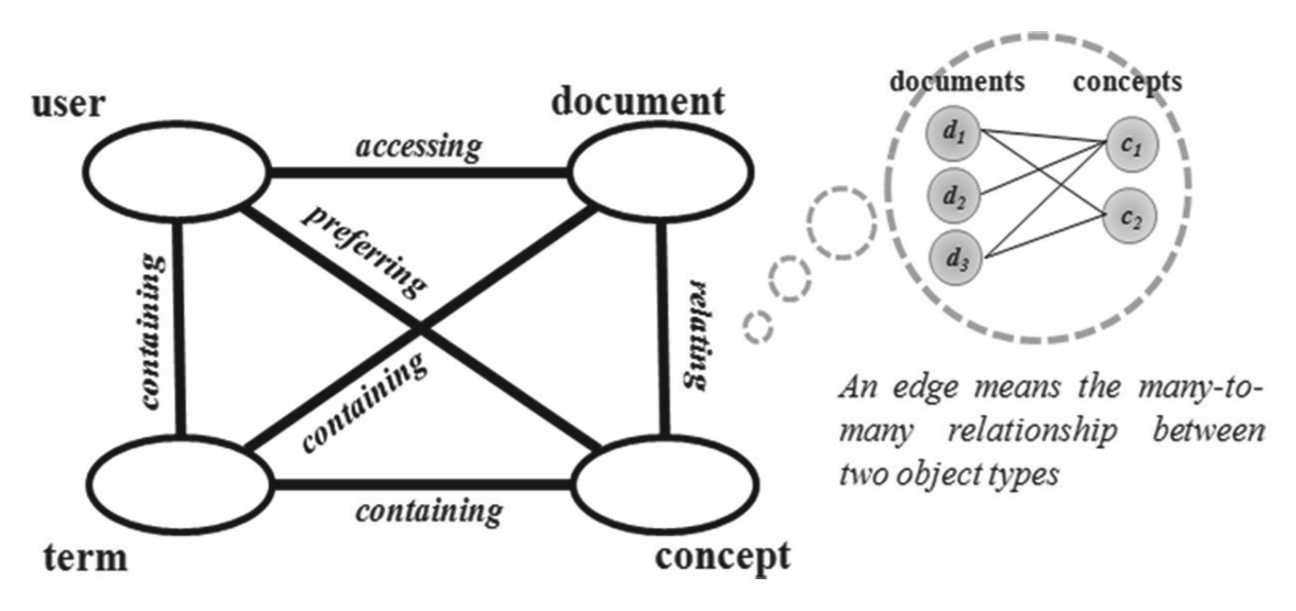
Four entity types and their relationships in the proposed framework.
3.1. Modelling of entities
This section describes the modelling of entities used in the unified framework. Section 3.1.1 explains how to model documents with term vectors. Sections 3.1.2 and 3.1.3 explain how to model users and concepts, respectively.
3.1.1. Documents
Similar to the vector space model [38] that is the most commonly used technique in information retrieval, we represent a document with a set of index terms which are formally described as follows:
Each term weight wi,k is estimated by using the term frequency (TF) and inverse document frequency (IDF), and is normalized to remove the possibility that long documents have higher ranks than short documents.
When estimating term weights, stop words (e.g. articles, prepositions and conjunctions) are removed, and the Porter stemming algorithm [39] can be used to transform inflected words to their root forms.
3.1.2. Users
We assume that a user
In equation (1),
3.1.3. Concepts
According to the formal concept analysis theory [40], a set of entities that belongs to a concept can be used to approximate the semantics of the concept [41].
In equation (2),
4. Modelling of relationships
We utilize a probabilistic approach to model relationships between entities because it provides a clear formalism [38]. That is, entities are represented by their random variables, and their relationships are expressed by conditional probabilities. In this work, we classify the relationships into two groups: explicit relationships and implicit relationships.
4.1. Explicit relationships
As addressed in Section 3, entities such as documents, users, and concepts are based on the relationships with terms (denoted as containing relationships in Figure 1). As containing relationships exist explicitly, they are regarded here as explicit relationships. First, the relationships between users and terms (user–term relationships) represent terms contained in users’ explicit needs (i.e. queries and preferences). This is formally defined as follows:
In equation (3),
In equation (4), the numerator
where the numerator denotes the weight of the kth term in
Finally, there are additional explicit relationships, namely, accessing relationships between users and documents (user–document relationships). The relationships represent documents accessed by users. They can be derived by analysing the click-through counts, which can be defined as follows:
In equation (6),
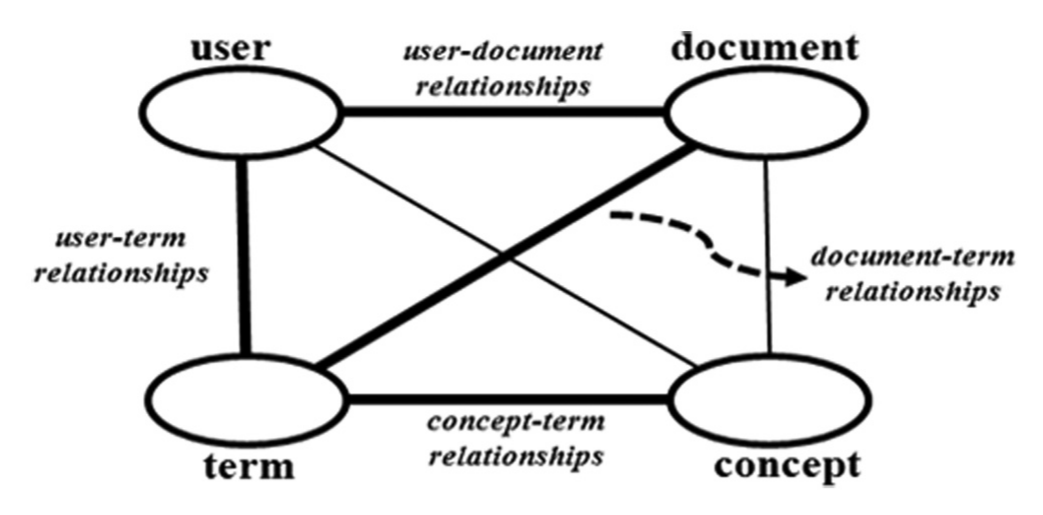
Explicit relationships in unified framework.
4.2. Implicit relationships
The estimation of implicit relationships between two entities can be inferred from explicit relationships with other entities that correlate two entities, which is formalized in Proposition 1.
The prior probabilities of each entity (i.e.
Furthermore, by applying the definition of conditional probability and the law of total probability, the probability
According to the principle of maximum entropy, the joint probability
By applying Bayes’s theorem, the above equation can be rewritten as follows:
The prior probabilities of each entity (i.e.
Finally, the following equation can be derived by combining equations (8) and (9).
In Proposition 1, we assume that probabilities
The user–term relationship in equation (10) is the implicit relationship between a user’s needs and a term while user–term relationship in equation (3) is the explicit relationship between user’s needs and a term. The user–term relationship in equation (10) is derived from explicit relationships with documents. Second, the implicit relationship between a document and a concept (denoted as concept-document relationship) can be defined as follows:
As shown in equation (11), terms (i.e.
As the relationships between documents and concepts are derived from the relationships with terms, equations (11) and (12) are combined. Consequently, equation (12) is rewritten as follows:
In equation (13), documents (i.e.
The implicit relationships explained by equations (10), (11) and (13) are denoted in Figure 3. In the figure, user–term relationships are derived from the relationships between users, documents, and terms ①, and concept–document relationships and concept–user relationships are derived from the relationships denoted by ② and ③, respectively.
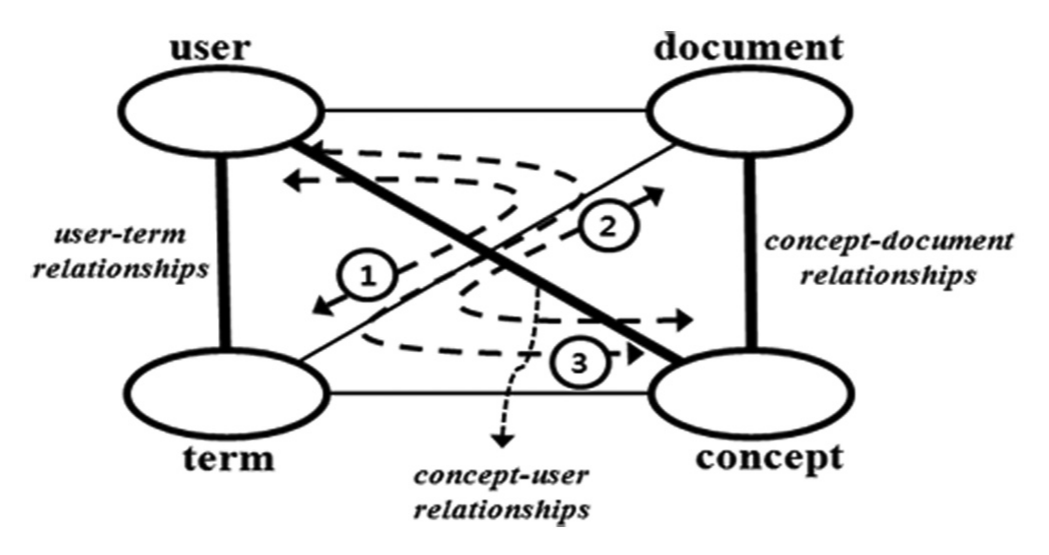
Implicit relationships in the unified framework.
5. Derivatives in the unified framework
Since the proposed framework is intended to unify search and recommendation approaches, it subsumes conventional search and recommendation approaches; that is, conventional approaches are considered special cases in the proposed framework. The following sections explain how to adapt conventional approaches to the proposed framework. In addition, we introduce their probabilistic ranking functions in detail.
5.1. Keyword search
In keyword search, documents containing keywords submitted by an active user are considered search results. As a result, terms are used to correlate a user (i.e. a user’s query) with documents. For example, suppose that a user submits a query (denoted as
In equation (14), the conditional probabilities
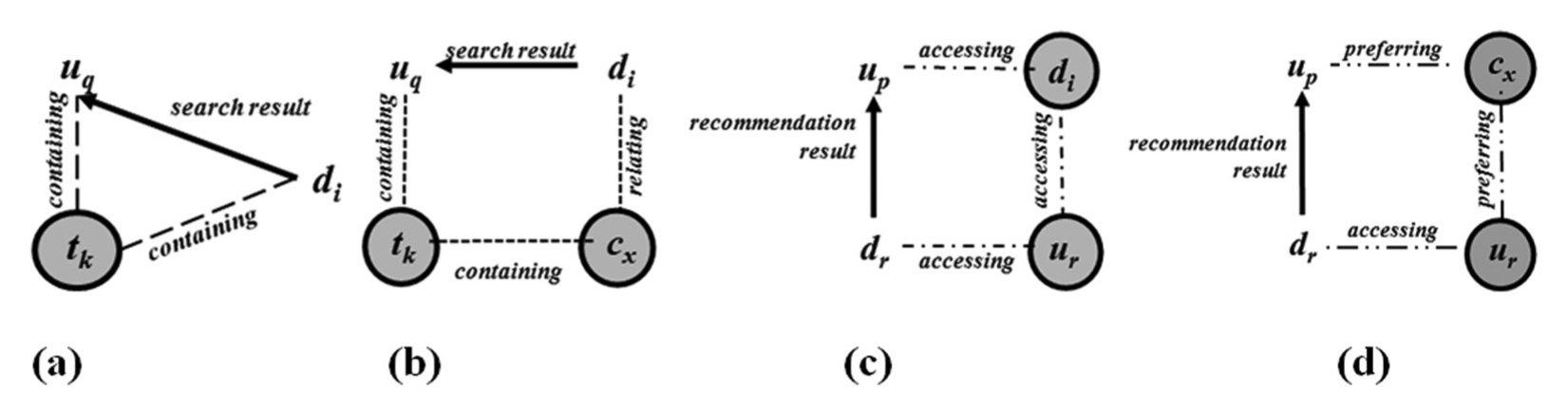
Examples of (a) keyword search, (b) semantic search, (c) conventional collaborative filtering and (d) semantic collaborative filtering.
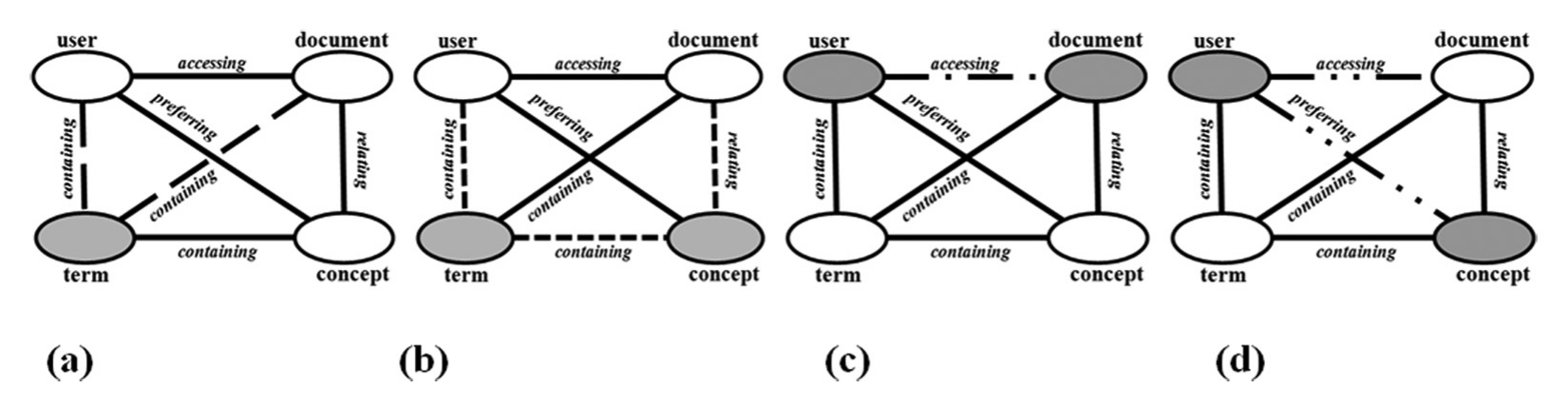
Entity types and their relationships in (a) keyword search, (b) semantic search, (c) conventional collaborative filtering and (d) semantic collaborative filtering
5.2. Semantic search
Semantic search represents the semantics of documents and users’ queries with concepts (not keywords). As documents and concepts are represented by a set of terms, it is possible to estimate the degrees of relevance between documents and concepts (i.e. exploiting relating relationships as shown in Figure 4(b)). Similarly, a user’s query also consists of a set of terms. Therefore, it is possible to estimate the degrees of relevance between terms and concepts (i.e. exploiting containing relationships between terms and concepts as shown in Figure 5(b)).
Figure 5(b) represents user–term relationships, concept–term relationships and concept–document relationships that are used in semantic search. For example, suppose that a user submits a query that contains a term
where the implicit relationships (i.e.
5.3. Conventional collaborative filtering
As addressed in Section 2.2, CCF can be classified into UCF and ICF. However, as the quality of UCF is higher than that of ICF, we focus on UCF in this work. Thus, CCF represents UCF approaches hereafter. In general, CCF consists of two steps [18, 19]. First, it identifies like-minded users whose preferences are similar to those of the given user (i.e. the active user). The users’ preferences can be derived from explicit feedback such as rating scores or implicit feedback such as click-through rates on documents. However, if an active user does not provide any rating scores, it is difficult to compute the degrees of relevance between an active user and like-minded users. Therefore, some CF approaches exploit implicit feedback derived from users’ click-through logs. Second, CF recommends documents that like-minded users have accessed in the past but the active user has not yet accessed.
In the first step, to estimate the degree of relevance between users, CCF exploits exact matching of documents that users accessed. Only users that have accessed the same documents are considered like-minded users. In Figure 4(c), suppose that two users (i.e. an active user with preference
In CCF, the probability of recommending a document
In equation (16),
5.4. Semantic collaborative filtering
To estimate the degree of relevance between users, CCF exploits the exact matching of documents accessed by users. However, this causes the sparsity problem. That is, users are considered unlike-minded users in CCF even though they may be semantically like-minded. To resolve this problem, we map users’ preferences to their corresponding concepts to represent their semantics in semantic collaborative filtering (SCF) [43, 44]. In SCF, like-minded users are identified by exploiting the exact matching of concepts derived from users’ preferences. As a result, it is possible to find like-minded users although they have accessed different documents.
Similar to CCF, SCF also consists of two steps: the first is to identify like-minded users and the second is to recommend documents that like-minded users have accessed in the past. The main difference between CCF and SCF is the method of identifying the like-minded users. CCF exploits the matching of documents that users have accessed, whereas SCF exploits the matching of concepts that users prefer. The concepts are derived from the users’ access logs. In Figure 4(d), suppose that two users (i.e. an active user with preference
5.5. Hybrid approaches to semantic search and recommendation
Because of the generality and flexibility of the proposed framework, conventional search and recommendation approaches can be adapted to it. By unifying search and recommendation approaches, we can utilize the personalized authority of documents.
By modifying the entity types and their relationships, the possible unified approaches for search and recommendation can be classified into 15 approaches, which are shown in Figure 6. To the best of our knowledge, the conventional approaches cover only five of these, which are indicated in Figure 6. Furthermore, owing to the generality of the proposed framework, other semantic search (or recommendation) approaches can be modelled in the framework by modifying the entity types. For example, in context-aware search, context entities can be added to the proposed framework.
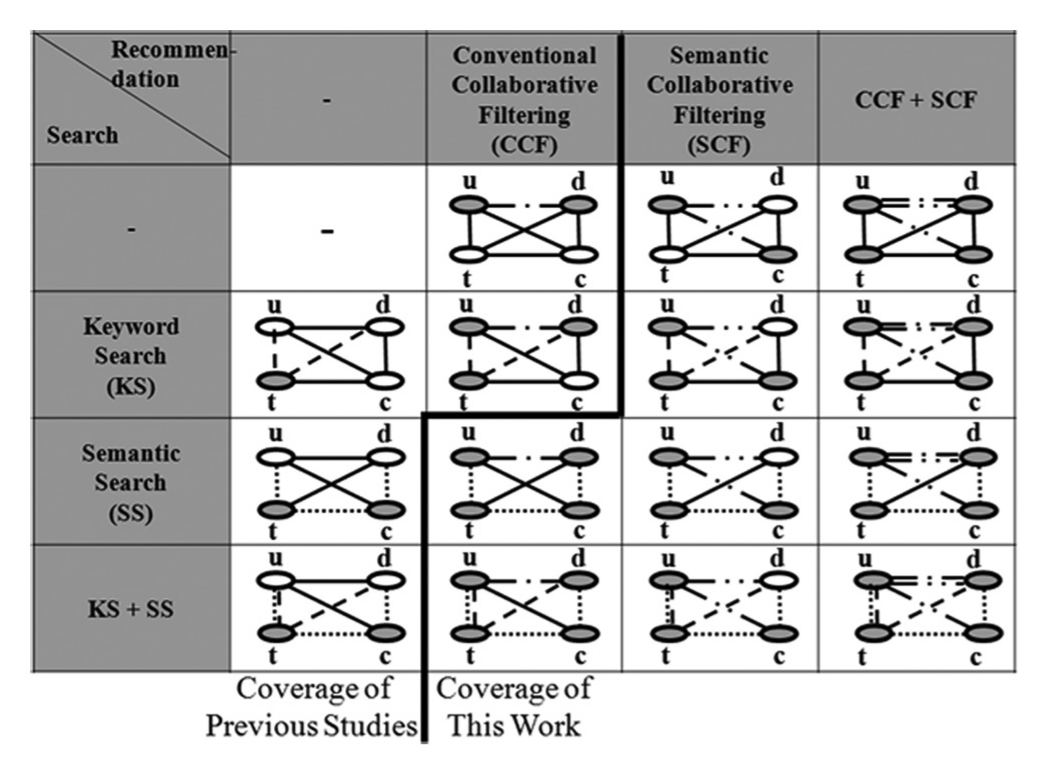
Comparison of coverage for 15 approaches: u, d, t and c represent users, documents, terms and concepts, respectively.
The ranking function for hybridizing search and recommendation can be defined as follows:
where the symbol
6. Experiments
In order to evaluate the proposed framework, we have used two kinds of domain knowledge bases: ODP web directory and Wikipedia. The ODP web directory consists of 49,334 terms and 11,584 concepts whose distance from the domain root concept ‘Top/Arts/Music/’ is within nine. Wikipedia consists of 46,422 terms and 11,768 concepts whose distance from the domain root concept ‘http://en.wikipedia.org/wiki/Music’ is within seven. As relevant concepts are linked to each other through article links in Wikipedia [45], a large number of domain concepts are collected by iteratively visiting the lower concepts adjacent to the upper concepts, starting from the domain root concept. Since hyperlinks in Wikipedia represent various semantic relationships, the crawled concepts might be irrelevant to music. Thus, we have manually eliminated non-taxonomic relationships in the crawled concepts of Wikipedia. In general, a user’s access (i.e. listening) time in the music domain is shorter than those in other domains (e.g. movies and books), and a user may listen to the same track many times [46]. As a result, the volume of a user’s access logs for a certain period will be relatively large. As collecting access logs and analysing users’ preferences in the music domain are easier than in other domains, the music domain has been widely used to confirm the effectiveness of search (or recommendation) systems [47]. A total of 9394 users’ listening logs were crawled from last.fm (http://www.last.fm). Of these, 100 users were assigned as active users to evaluate the proposed search and CF approaches, and the rest users were assigned as the candidates of like-minded users to evaluate CF approaches. This is because, according to Lee et al. [44], CF approaches provide the most accurate recommendation results when the number of like-minded users is between 10 and 15. In the crawled access logs, the number of distinct documents that the active users have accessed is 20 on average. To evaluate the top-10 search (or recommendation) results, we used 50% of the given data as training data. Active users are assumed to perform searching (or recommending) documents, and their information needs are learned from the training set; as a result, they are given the reasonable documents that reflect their needs. For experiments, 22,216 tracks crawled from last.fm were considered documents. Each track consists of several attributes (i.e. title, artist name, album name, genre, artist type, country and description). However, because we consider a document a term vector, the attribute types are ignored in this work. Hence, the proposed approach can be applied to any contents regardless of content types such as music, movie and book, particularly in the Internet or digital library environments.
To evaluate the performance of proposed approaches, many studies have used recall as well as precision. However, as semantic approaches can find documents that do not contain the keywords derived from users’ needs, they have high recall in general. Therefore, many semantic approaches have attempted to enhance the degree of precision rather than recall. In this context, for performance evaluation, we introduce two more reasonable performance measures: precisionk and inverse rank precisionk. Precisionk is defined as follows:
precisionk is used to examine how many documents accessed by a user are retrieved in top-k results. Inverse rank precisionk is to improve mean reciprocal rank [44] as a measure widely used in evaluating information retrieval systems, which is defined as the average of the reciprocal ranks of query responses. Inverse rank precisionk is the weighted reciprocal ranks over a query, which is defined as follows:
As an example to explain the difference between precisionk and inverse rank precisionk, Table 1 shows the correct ranks of documents and the rank of the documents according to a user’s preference in different approaches. The correct ranks are estimated by the user’s click-through counts for documents. If we assume that the approaches return top-three documents to the user, ‘By the way’ and ‘Bad day’ are provided to the user in this example. This is because their ranks are less than or equal to 3 in each approach. As the number of documents that the user accessed in top-three results is 2, the precision3 values of approaches A and B are 2/3 = 0.67.
Ranks of documents according to a user’s preference.
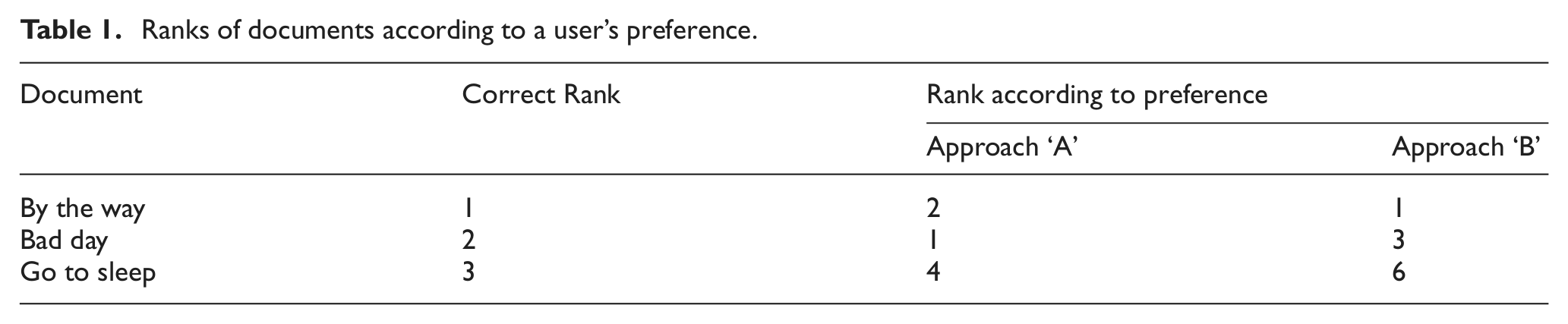
The inverse rank precision3 values of approaches A and B are estimated as follows:
The inverse rank precision3 of the approach A is larger than that of the approach B. Thus, we can say that model A reflects a user’s top-ranked preference better than model B, although they show the same value in a user’s overall preferences. That is, precisionk measures how much the approach considers users’ overall preferences, whereas inverse rank precisionk measures how much the approach considers users’ top-ranked preferences. The closer inverse rank precisionk gets to 1.0, the more the results match users’ top-ranked preferences.
Categorization of search and recommendation approaches for performance comparison.
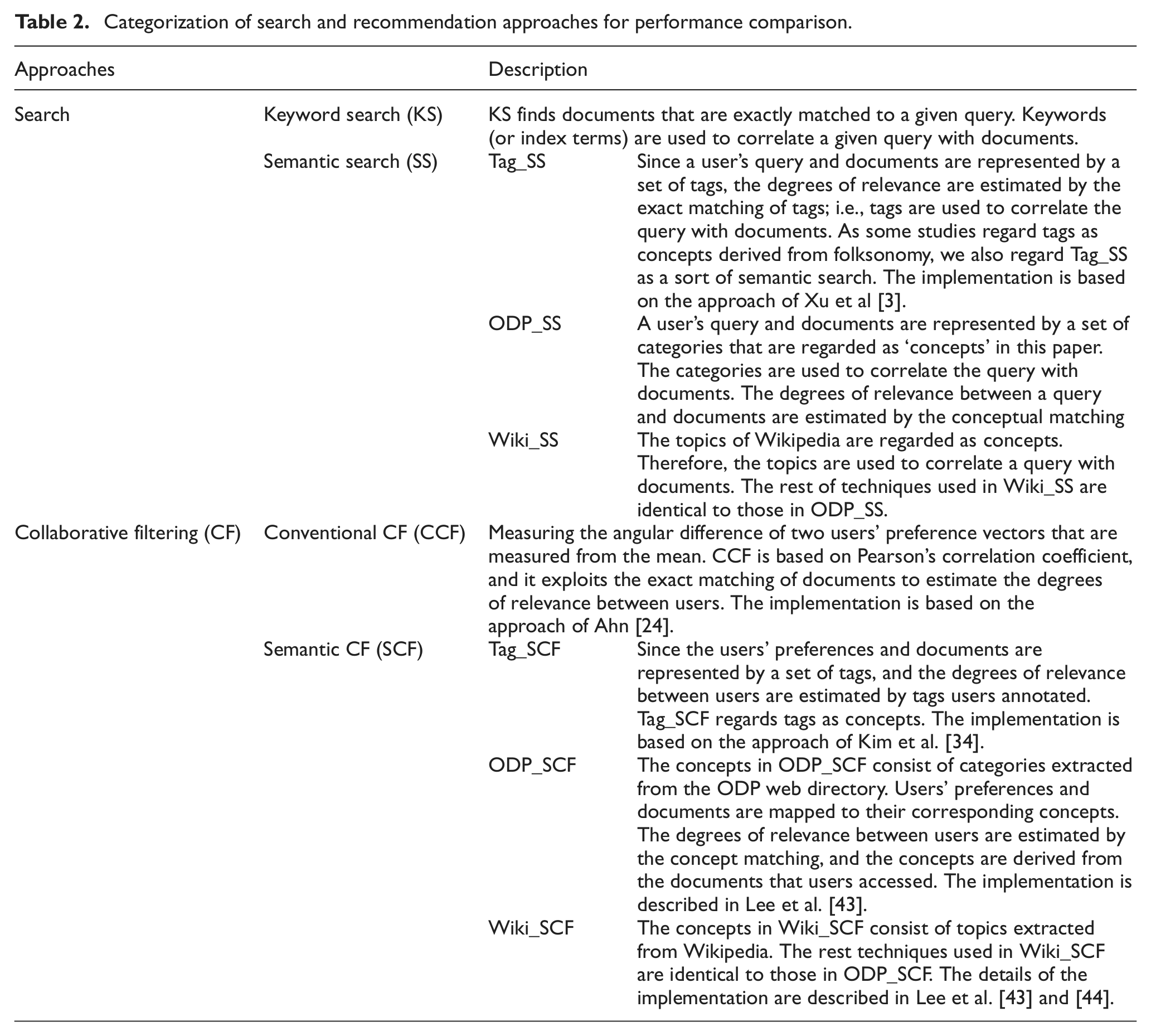
In the following sections, the various properties of the search, CF and hybrid approaches are investigated. Specifically, in experiments on the hybrid approaches, we investigate the effect of the document authority derived from CF. Each test is repeated five times and the mean values are reported (i.e. mean precision10 and mean inverse rank precision10) for more reliable results.
6.1. Search
6.1.1. Comparison of search approaches with varying number of entities
When estimating the relevance between a user’s query and documents, it is critical to determine the number of entities that correlate the user’s query and documents; the overhead (e.g. execution time) increases with an increasing number of entities. For example, in equation (15) for semantic search, the number of concepts increases the overhead for finding documents. As addressed in Section 5, only keywords are used to correlate a user’s query and documents in keyword search. On the other hand, terms and concepts are used to correlate the query and documents in semantic search. According to our statistical analysis, as concept–document relationships are denser than other relationships, it is feasible to observe the effect of the number of concepts mapped to documents, as shown in Figure 7.
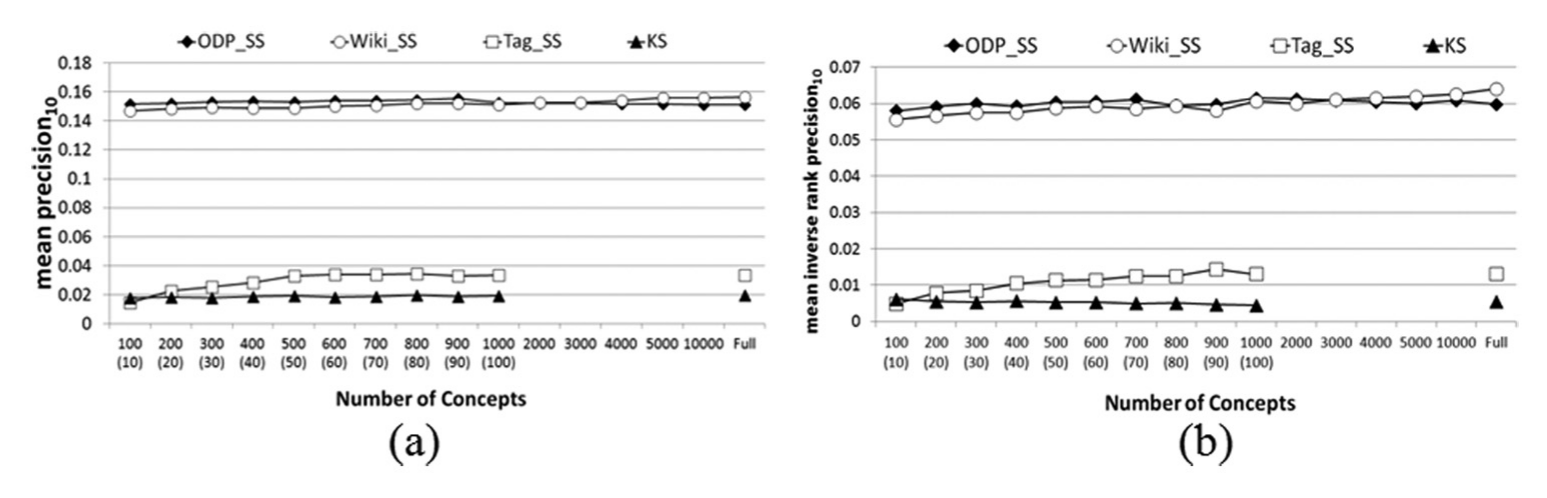
Effect of the number of concepts: (a) mean precision10; and (b) mean inverse rank precision10.
The maximum number of concepts in ODP_SS and Wiki_SS ranges from 100 to 10,000. Furthermore, the maximum number of keywords and tags in KS and Tag_SS ranges from 10 to 100; the values in parentheses on the x-axis represent the number of keywords in KS or the number of tags in Tag_SS. Furthermore, the notation ‘full’ indicates that the maximum number of concepts mapped to documents is not determined. The experiment result indicates that mean precision10 and mean inverse rank precision10 do not significantly increase as the number of concepts mapped to a document increases.
6.1.2. Comparison of search approaches with varying α
As shown in equation (19), we assume that the rank of a document is determined by semantic search as well as keyword search. That is, two entity types are utilized to estimate the degree of relevance between a query and a document, which are keywords and concepts. In the hybrid search approaches, the results derived from keyword search and semantic search are merged to generate a final ranked document list. Figure 8 shows the mean precision10 and mean inverse rank precision10 of various search approaches with varying α. If the weight α is zero, the rank function considers only semantic search for ranking documents. In addition, if the weight α is 1, the function only considers keyword search.
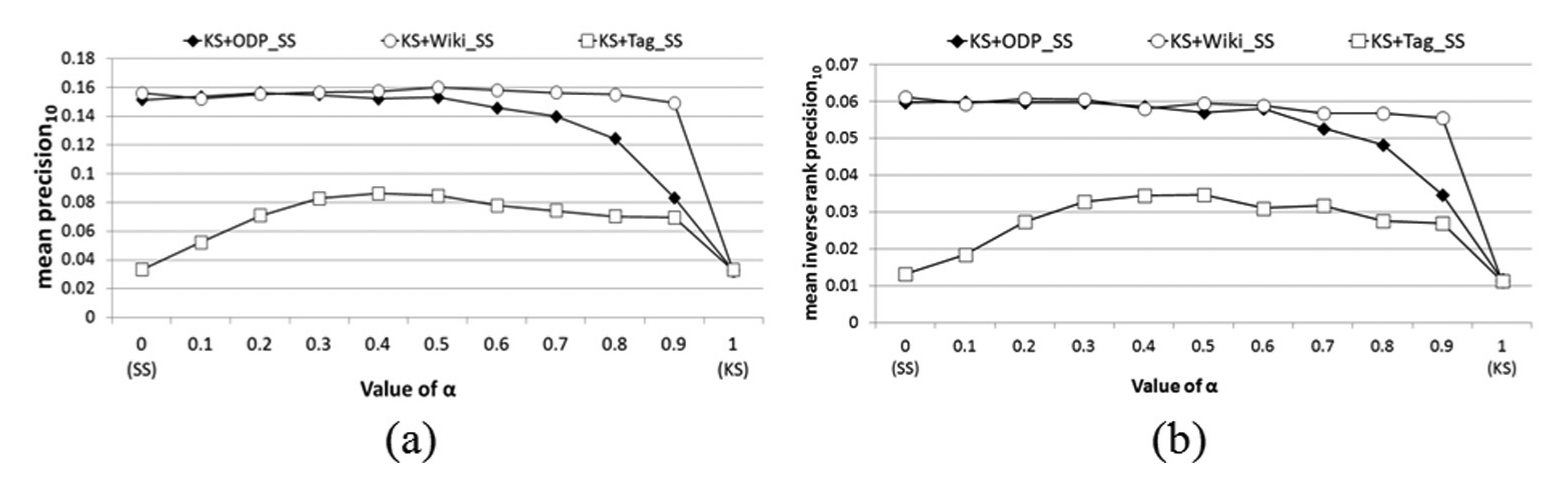
Effect of the weight α: (a) mean precision10; and (b) mean inverse rank precision10.
While the weight α is less than 0.4, mean precision10 and mean inverse rank precision10 in KS+Tag_SS increase sharply compared with those in KS+ODP_ SS and KS+Wiki_SS. This is because the search results in KS are already included in semantic search such as ODP_SS and Wiki_SS. However, as KS has more weight, the values mean precision10 and mean inverse rank precision10 decrease significantly in all search approaches.
6.2. Collaborative filtering
6.2.1. Comparison of CF approaches with varying number of concepts
When representing a user’s preference and documents as the concepts of domain knowledge, it is critical to determine the number of concepts mapped to the user’s preference and documents; that is, the number of concepts for a user’s preference may affect the quality as well as performance. For example, if the number of concepts for a user’s preference increases, it is difficult to find like-minded users and to make a recommendation list in real time. Furthermore, the number of concepts may alter semantically like-minded users. Thus, in this section, we discuss the effects of the number of concepts mapped to a user’s preference.
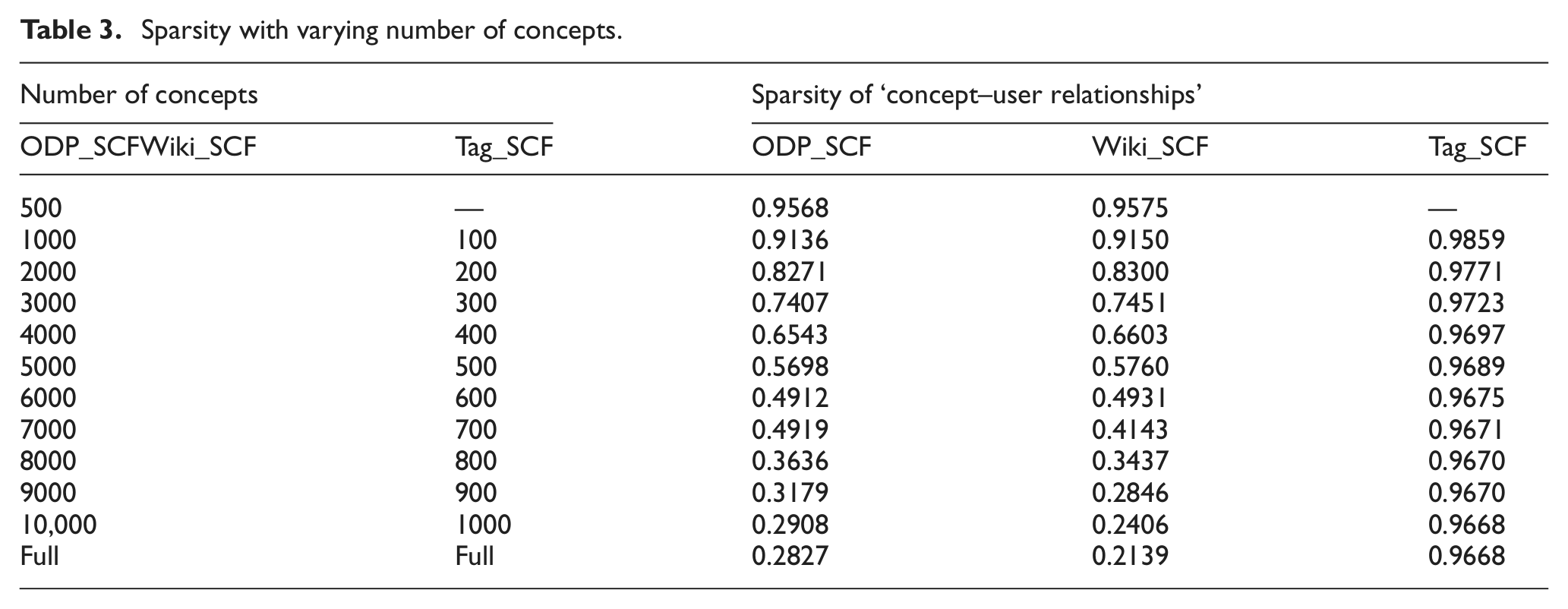
Figure 9 shows the effects of the number of concepts in CF approaches with mean precision10 and mean inverse rank precision10. Particularly, in ODP_SCF and Wiki_SCF, the number of concepts ranges from 500 to 10,000. On the other hand, in Tag_SCF, the number of concepts (i.e. tags) ranges from 100 to 1000; the values in parentheses on the x-axis represent the number of concepts in Tag_SCF. As shown in Figure 9, mean precision10 and mean inverse rank precision10 are saturated when the maximum number of concepts is larger than about 4000 in ODP_SCF and Wiki_SCF. Otherwise, they are proportional to the number of concepts. However, in Tag_SCF, the performance values do not increase significantly with the number of concepts because the degree of sparsity is not significantly improved. The sparsity is measured as the ratio of empty links in the possible links (or relationships) between two entity types. A comparison of sparsity is shown in Table 3.
Sparsity with varying number of concepts.
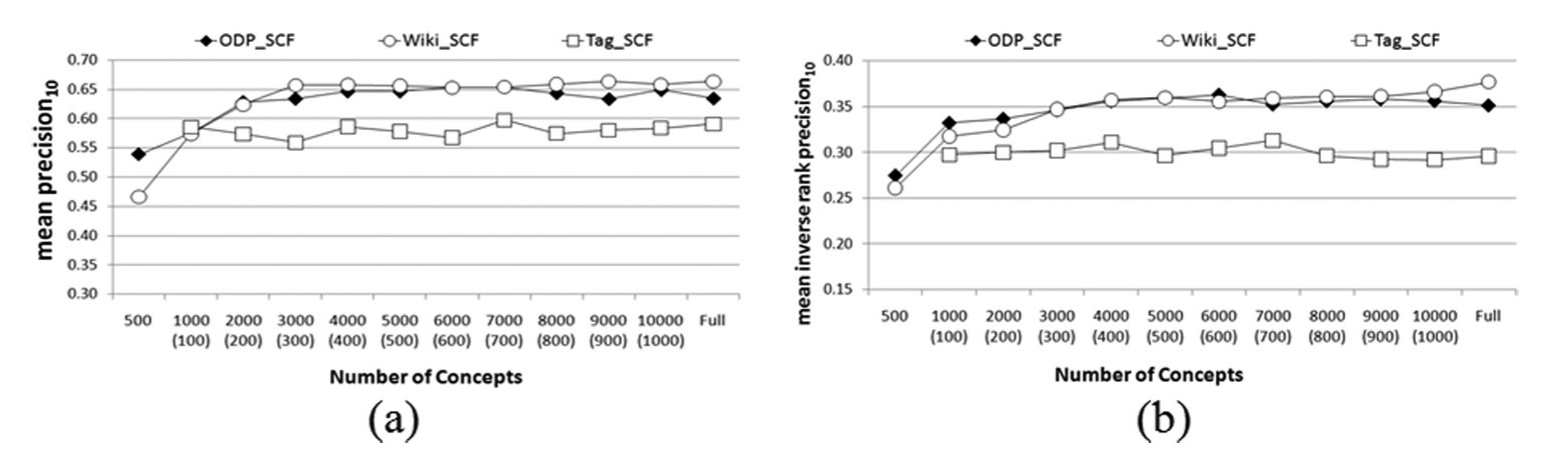
Effect of the number of concepts: (a) mean precision10; and (b) mean inverse rank precision10.
6.2.2. Comparison of CF approaches with varying β
We assume that like-minded users are identified by the matching of documents accessed by users as well as the matching of concepts preferred by the users. CCF estimates the degree of relevance between users via document matching, whereas SCF estimates the degree of relevance via concept matching.
The results derived from CCF and SCF are merged to generate a final document list for an active user, which is expressed by equation (20). Figure 10 shows the mean precision10 and mean inverse rank precision10 of CF approaches with varying β. If the weight is zero, the rank function only utilizes SCF to recommend documents. While the weight is greater than 0.3, mean precision10 and mean inverse rank precision10 decrease in SCF. That is, as CCF has more weight, the results of CCF are considered noise. As addressed in Section 2.2, because CCF has the sparsity problem, its recommendation quality is poorer than that of SCF.
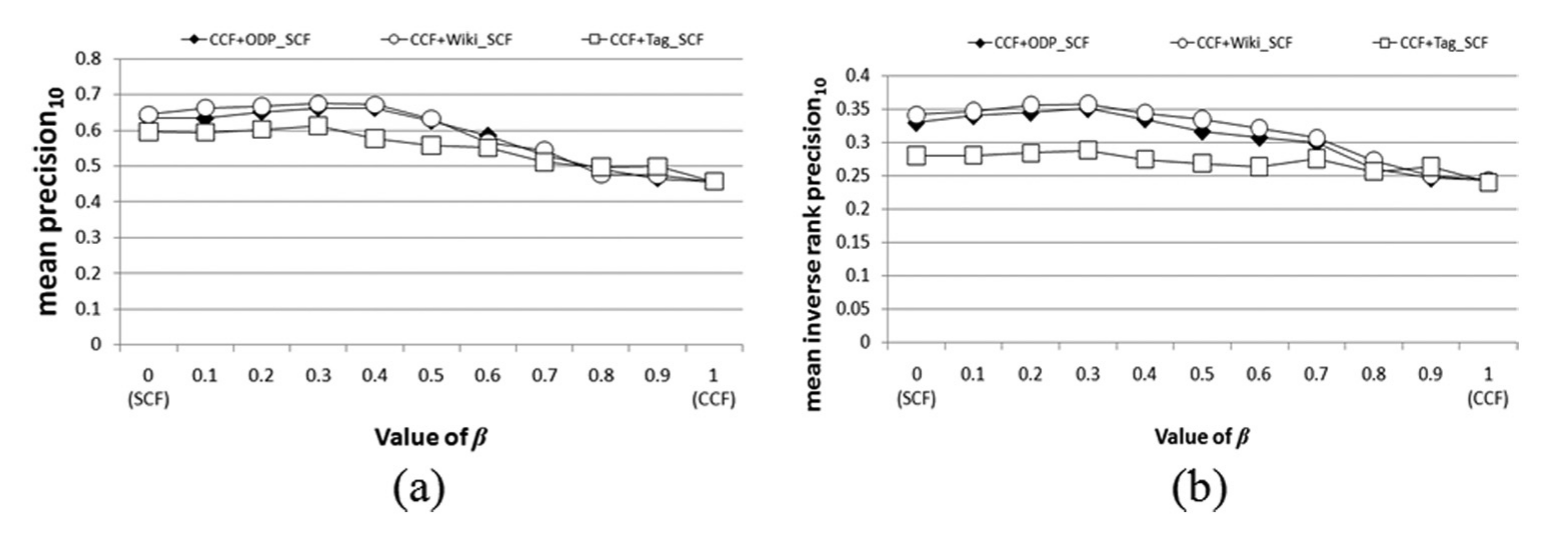
Effect of the weight β: (a) mean precision10; and (b) mean inverse rank precision10.
6.3. Hybridizing search with collaborative filtering
As search approaches exploit the exact matching of entities such as keywords or concepts between a query and a document, the derived degree of relevance is referred to as the content-based relevance. Sometimes, it is difficult to rank documents if they have the same degree of content-based relevance with the given query. Thus, it is necessary to consider the relevance derived from a non-content aspect such as the authority of documents. The authorities of documents are derived from CF in this work. Therefore, in the hybrid approaches, heterogeneous entity types such as users, terms (or keywords), concepts and documents are used to correlate a user’s needs with documents. In this section, we compare hybrid approaches of search and CF according to weight
The semantic search and SCF approaches shown in Figure 11 exploit the topics of Wikipedia as concepts. The results shown in the figure are similar to those of other concepts (such as categories of the ODP web directory and tags of folksonomy). Owing to space limitations, the results are abbreviated in this work. Figure 11 shows the mean precision10 and mean inverse rank precision10 of hybrid approaches with varying weight
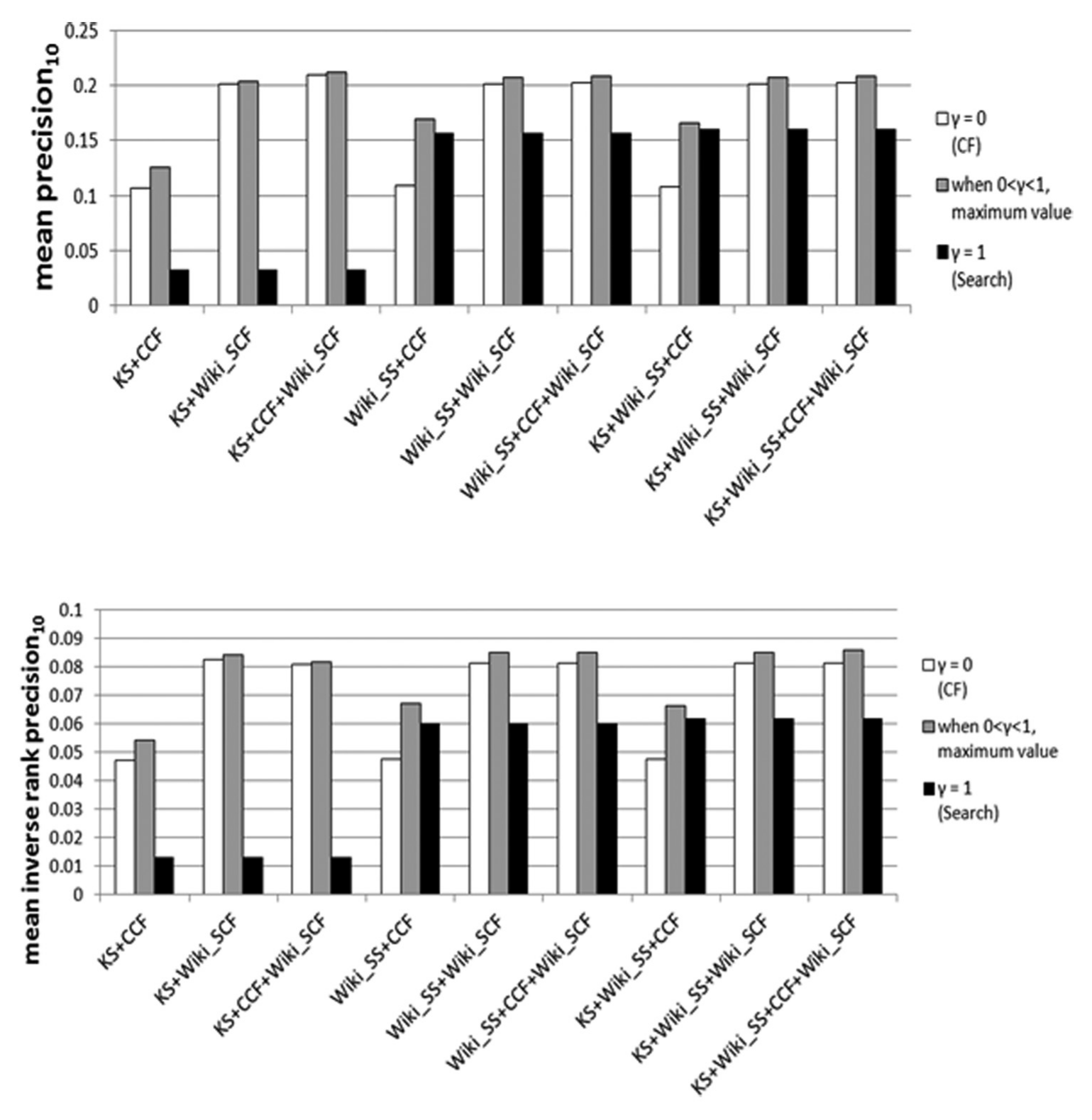
Effect of the weight γ: (a) mean precision10; and (b) mean inverse rank precision10.
The experiment result indicates that the performance of hybrid approaches also improves with an increasing number of entity types. However, the improvement is not significant. There are no significant differences between the results derived from Wiki_SS+Wiki_SCF and KS+ Wiki_SS+CCF+Wiki_SCF. This is because the results of KS and CCF are already included in Wiki_SS and Wiki_SCF. By analysing the sparsity, we observe that the sparsity under a threshold (about 0.6) does not further improve the quality of search approaches. The hybrid approaches, which use the authority of documents derived from CF, have higher mean precision10 and mean inverse rank precision10 values than other approaches.
6.4. Discussion
Through the extensive experiments using the music domain data, we have shown that the quality of search and recommendation approaches can be improved by effectively using heterogeneous entities and their relationships under the probabilistic framework. Normally, to evaluate search (or recommendation) systems trustworthily is not easy and always controversial in the field of information retrieval. In this context, this section describes several considerations for relevance judgment, test data and execution time.
When evaluating search and recommendation methods, one of critical issues is how to correctly judge the relevance between users’ information needs and their actual search results. In general, the relevance judgment is classified into two approaches: user-based judgment [48] and log-based judgment [49]. The user-based judgment approach (which includes nDCG (normalized discounted cumulative gain)) requires a large number of users owing to individual relevance judgments on search results, and thus its corresponding experiments are very costly. Moreover, since the users involved in the experiments recognize that they are being tested, they may bias the experiment results [3]. In contrast, the log-based judgment approach entails lower costs and smaller biases than the user-based judgment approach. However, this approach needs to collect large amounts of query logs for experiments. Actually, since most search engines such as Google and Yahoo! do not release their query logs to protect users’ privacy, it is highly difficult to collect sufficient query log data so as to evaluate search (or recommendation) methods. Therefore, as for relevance judgment, we assume that a user who accessed a particular document is related to the keywords contained in the document. For example, suppose a user listened to a track ‘yesterday’ of ‘the Beatles’, then the user is assumed to be related to the keywords such as ‘British’, ‘class’ and ‘sad’ which are contained in the description of the track; that is, we assume that the user submits a query with such keywords in order to find the track ‘yesterday’ of ‘the Beatles’.
As stated before, a user’s access time in the music domain is short, and users tend to listen to the same track at many times. As a result, the number of a user’s access logs for a certain period is easily made to increase, and analysing a user’s preference in the music domain is not a difficult job. Since the experimental data and results belong only to the music domain, the observation of a threshold of sparsity and the weights of α, β and γ cannot be directly applied to other domains such as movie and book. However, we expect that our experimental observations are starting bases for determining the number of entities and tuning the probabilistic ranking functions.
In representing documents and a user’s information needs, it is very important to determine the number of entities to clearly represent the semantics with several entities. As shown in the experiments, the number of entities mapped to a user’s information needs is more critical than that mapped to documents. As the number of entities increases, the execution time may increase enough to make the system impractical. This can be a challenging problem to be resolved when the proposed framework is applied to real systems; basically, to reduce the execution time, we need to devise a special index structure suitable for a heterogeneous graph.
7. Conclusion
In this paper, we have proposed a probabilistic framework to unify semantic search and recommendation, in which heterogeneous entities such as users, terms, concepts and documents are handled in a probabilistic manner. Its critical issues include how to model the explicit (or implicit) relationships between heterogeneous entities and how to estimate the relevance between a document and a user’s information needs. In our work, we have adopted a probabilistic graph approach for modelling relationships between entities, and thus we could achieve a clear formalism in estimating the relevance. The unified framework offers three improvements over the previous studies owing to its generality and flexibility: (1) first, enriching semantics of documents and users’ needs with keywords and concepts results in resolving the sparsity and semantic ambiguity problems; (2) second, using the personalized authority of documents helps to improve the quality of search results; (3) and third, the proposed framework makes it possible to hybridize search approaches (i.e. keyword search and semantic search) and CF (i.e. CCF and SCF) ones. That is, previous studies can be considered as special cases in the unified framework, and furthermore additional search and recommendation methods can be easily constructed according to a user’s circumstances. Our extensive experiments have shown that the proposed approach outperforms conventional search and CF-based recommendation approaches by resolving their sparsity, semantic ambiguity and non-personalized authority problems. Now, we are trying to further improve the quality of search and recommendation with context information such as time and location.
Footnotes
Acknowledgements
This work was supported by Basic Science Research Program through the National Research Foundation of Korea funded by the Ministry of Education, Science and Technology (grant number: NRF-2010-0025212).