






Abstract
The rise and widespread use of Linked Data has encouraged data providers to publish and link their content in order to classify and organize information in a useful fashion. Interlinking between datasets enhances data navigation and facilitates searching. As a result, the use of interlinking tools as a way of connecting data items to the Linked Open Data cloud has become more prevalent. In this paper, we examine the results obtained by three interlinking tools used to link a large educational collection to the Linked Open Data datasets. The generated output by the interlinking tools, which was later assessed by human experts, illustrates that data publishers can rely on current interlinking approaches and thus adopt them to connect their resources to the Web of Data. Our findings also provide evidence that two of these tools, namely Silk and LIMES, can be considered as the most promising.
1. Introduction
In recent years, the Linked Data approach [1] has facilitated the availability of different kinds of information on the Web of Data. The view that information objects are discovered and shared is very much in line with the goals of the Semantic Web. Needless to say, the core of data accessibility throughout the Web is the links between items. This idea is prominent in literature on Linked Data principles [1]. Indeed, providing links between objects in a dataset, or among the elements in the Linked Open Data (LOD) cloud [2], is based on the assumption that the Web is migrating from a model of isolated data repositories to a Web of interlinked datasets. One advantage of data connectivity using RDF links [3] is the possibility of linking a resource to valuable collections on the LOD cloud. In particular, a data source is enriched when its content is connected to several datasets (e.g. geography, places, and science). A notable example can be found in e-learning. Linking educational resources from different repositories to useful knowledge on the Web enables sharing as well as navigation of learning objects. Searching becomes more effective, as many learning resources are implicitly related to the interests as well as the cultural and technical environment of learners.
Another relevant example can be taken from the agricultural context. A researcher might explore the contents of an organic portal (e.g. organic-edunet.eu) in order to find a specific resource. In one of the result resources, a video on the subject of organic farming catches the researcher’s attention and she thus follows the description in order to investigate its applied methods. The researcher has never come across a specific term (e.g. abonado en verde) as it has been provided in another language and does not yield any more relevant data. As the resources in this portal have been previously interlinked with datasets such as DBpedia, she is able to find more information on the topic, including various translations. Furthermore, the learning resource includes several organic keywords linked to the AGROVOC thesaurus [4], which allows her to be connected to a multilingual resource with around 40,000 terminologies.
To this end, some educational institutions (e.g. University of Muenster, 1 Open University of the UK 2 ) have made their learning resources available as Linked Data, linking them to general or specific information on the LOD cloud. Moreover, several projects, such as Europeana, 3 LinkedUp [5] and Linked Education [6], have embraced the Linked Data approach and aim to link learning (meta)data to educational datasets. The DBpedia 4 dataset is now considered a central hub among the LOD datasets [7] and one of the most significant. It allows the connection of almost any type of data source to 12.6 million objects in 119 different languages [8] as well as other relevant datasets on the Web of Data. To illustrate the issue of data connectivity, one could for example point to a researcher in DBpedia and obtain her list of publications in DBLP 5 or obtain definitions and roots in DBpedia from a vocabulary in a special domain. The foregoing discussion implies that RDF links play an important role in interlinking objects from various data sources.
Creating links between datasets can be done manually, but this is a time-consuming task. Several interlinking tools address this issue by automatically or semi-automatically finding links. Most of these tools search for relationships between various datasets and discover similarities by leveraging a number of matching techniques. While it is mostly agreed amongst dataset owners that interlinking tools are useful in terms of matching concepts to the LOD cloud [6, 9], the question under discussion is how and to what extent data consumers can rely on their outcomes.
In practice, data publishers do not perform interlinking of their resources, relying on human effort when they maintain large amounts of data. On the other hand, they are motivated to leverage interlinking tools to enrich their materials. Selecting an appropriate and up-to-date tool, which meets the desired criteria, can help to achieve this goal. In this paper, some of the most relevant interlinking tools have been evaluated through inspection and analysis of the generated output. Five experts later assessed the results of these tools when we applied them to link a large educational repository to the LOD datasets. The level of consensus among raters was measured by reliability statistics. Both the outcomes and the raters’ responses were reported afterwards. Figure 1 portrays the overall workflow of this study wherein various interlinking tools were used in order to link two datasets while human experts examined the results.

Interlinking and rating process.
The remainder of the paper is organized as follows: Section 2 discusses several studies focused on the use of interlinking tools. Section 3 outlines our selected linking systems, the interlinking process and the data scope in which this study has been carried out. Section 4 presents the experimental results of interlinking and examines the reliability of experts’ reviews on the outcomes. Finally, conclusions and outlook are summarized in Section 5.
2. Background and related work
In order to cover Linked Data principles [1] the web of data requires different kinds of published data sources from various domains to be linked. As manual interlinking large amounts of data is time-consuming and needs a lot of human effort, it is necessary to provide a means to automatically interlink similar concepts. These linking tools create links (e.g. owl:sameAs) among various datasets by identifying similarities between entities. Given a linking configuration in which a user specifies the settings (such as the source and target, entities that should be considered, and the criteria under which two entities are compared), the tools discover similarities and generate the outcomes (consider Figure 1). There are many approaches, which can be used in order to perform data linking, some of which are summarized below:
User Contributed Interlinking (UCI) [10] – proposes a new way of creating semantic links between data items. This tool allows users to add, view or delete links between two data items in a dataset via a friendly user interface.
Games With A Purpose (GWAP) [11] – provides incentives for users to interlink data using different games. The tool gathers information about some pictures and asks the user to annotate images or trace objects in the pictures.
Semi-automatic interlinking [12] – uses an analysis technique in order to link multimedia (meta)data.
RDF-IA [13] – performs matching and fusion of RDF datasets according to user configuration, and generates several outputs between the data items.
Silk Link Discovery Framework [14] – finds similarities within several Linked Data sources by specifying different types of RDF links via SPARQL endpoints or data dumps.
LIMES [15] – discovers similarities between two datasets and automatically gives users suggestions based on metrics.
LODRefine [16] – refines, transforms, and interlinks data in a general context with the LOD datasets.
Recently, several researches have discussed interlinking issues in the Linked Data context. A first comparative study on interlinking tools was reported by Simperl et al. [17], where various linking systems were considered from a theoretical point of view. In this paper, the authors reviewed several interlinking approaches by addressing important aspects such as required input, resulting output, considered domain and used matching techniques. The authors applied a template that included a general as well as a technical description of each tool, allowing a comparison from several perspectives: degree of automation (to what extent the tool needs human input) and human contribution (the way in which users are required to do the interlinking)
A general framework has also been proposed by Scharffe et al. [13] for data interlinking as well as an ontology alignment language which can be used in various linking techniques. After discussing a number of linking systems in the mentioned study, the authors focused on one of the tools to employ it in the proposed framework. In the context of the Ontology Alignment Evaluation Initiative, Ferrara et al. [18] evaluated several instance matching systems and reported their experimental results on a real-world benchmark task over several LOD datasets. In particular, the presented approach combined real-data and automatically generated data to provide a framework that would produce different causes of data heterogeneity. This in turn was used to verify the strengths and weakness of several data linking techniques.
In the educational context, Dietze et al. [6] proposed an approach for linking educational resources based on the Linked Data principles [1] by using existing educational datasets and exploiting the abundance of existing technology-enhanced learning data on the Web. The approach has been implemented in the context of the mEducator project [19]. Furthermore, several Linked Data projects such as LinkedUp [5], Linked Universities [20] and Linked Education [6] are prominent in the educational context and based on state-of-the-art Linked Data principles. Notably, LinkedUp aims at advancing the exploitation of the vast amounts of public and open data available on the Web, in particular those produced by educational institutions and organizations. One of the main objectives of this ongoing project is to provide a complete framework for the evaluation of large-scale open Web data applications, taking into account educational aspects by gathering innovative scenarios of deployed tools.
Datalift [21], as another project in this context, proposes a set of tools for easing the process of dataset publication by converting raw data to Linked Data formats. Having described the data-linking task within the document, the authors divided the interlinking process into several steps, including configuration, pre-processing, matching and post-processing. Afterwards, the contributors overviewed, analysed and classified 11 linking systems in order to select the most appropriate tool for the purpose of their investigation.
In an experimental study [9] two matching techniques were employed to interlink a semi-structural data collection with the LOD datasets. The study also outlined the advantages of conjoining it to the LOD cloud by reporting the number of concepts that could be linked. The authors later discussed the results of the interlinking and the number of links found by each tool.
The foregoing studies and projects have indicated that automated interlinking tools play an important role in the emerging real Linked Data world. However, the evaluation of results generated by interlinking tools has been scarcely investigated when human experts assess the outcomes. The experimentation in this paper was carried out in order to assess if the results generated by interlinking tools were reliable and acceptable from the perspective of various experts. To achieve this goal, we conducted the entire interlinking process for each tool.
3. Experimental setting
The environment of our empirical research under which the interlinking process was carried out established two datasets (one as a source and the other as a target) in each step of our study. Accordingly, as selecting an appropriate linking tool lies at the heart of the discussion of interlinking, a set of criteria for investigating current linking tools as well as an interlinking procedure were outlined.
3.1. Data scope
Various digital repositories have exploited their data over the past 10 years as a way of tackling the problems raised by data proliferation. In particular, the GLOBE 6 collection, with around 1 million diverse learning resources [22], can be undoubtedly considered a must for interlinking purposes. GLOBE, as a federation repository, includes several data other repositories such as ARIADNE 7 and OER Commons, 8 which have manually created metadata and aggregated contents from different sources. The metadata in GLOBE is based upon IEEE LOM [23], a well-known standard for describing e-learning resources, but according to a recent study [22] only 20 elements (out of 40) have been used by the content providers. A closer look at data contained by GLOBE indicates that several metadata elements in IEEE LOM (i.e. General.Identifier, Technical.Location) are mostly customized locally by each repository and thus cannot be considered for interlinking. In a previous study by Rajabi et al. [9], the authors showed that at least the following elements can be applied for linking LOM metadata to the LOD cloud:
coverage – the time, culture, geography or region to which a learning resource applies (‘General.Coverage’ element);
taxonomy – the classification term given to a learning resource (‘Classification.Taxon’ element).
Given the interest in the GLOBE repository, it was possible to harvest around 500,000 metadata files from GLOBE through OAI-PMH, 9 which is a common protocol for metadata harvesting. More data could not be fetched owing to some validation errors (e.g. LOM extension errors) during the harvesting process. The gathered data was imported into a relational database to facilitate a more detailed examination from several perspectives (e.g. statistics, grouping).
Having reviewed the imported data, more than 50% of resources in GLOBE were found to belong to the Compulsory or Higher Education context and the targeted audiences were learners or teachers. More than half (around 55%) of the resources were in English and 99% of the learning objects were open and free to use. English is the most prominent language in GLOBE [24]. Taxonomy and coverage of learning objects are suitable candidates for interlinking [9]. Therefore, the linking elements used as a source in our data scope were limited to English terms of both taxonomy and coverage elements, which were represented in more than one language. On the other hand, two LOD datasets were selected as target points. At the time of this research, around 9000 datasets had been registered in the LOD cloud, 10 of which more than half were derived from global organizations. In a previous study [7], we indicated that the DBpedia dataset plays a significant role in the LOD cloud, acting as a central dataset hub. This dataset features concepts for 10.3 million unique topics [8] and includes structured data about people, places and organizations. All DBpedia contents have been classified into 900,000 English concepts, and are provided according to SKOS, 11 as a common data model for linking knowledge organization systems on the Web of Data. Therefore, we selected DBpedia to link terms from the GLOBE taxonomies to DBpedia concepts. Likewise, the Factbook 12 dataset was applied for linking the coverage element of the GLOBE metadata, as it provides information such as history, people, government and transnational issues for 267 countries.
3.2. Selected tools for interlinking
As mentioned in Section 2, some of interlinking tools leverage matching algorithms to discover similarities between concepts in two datasets via SPARQL Endpoints 13 or RDF dumps. 14 For the research presented in this paper, several linking systems were investigated according to the following criteria (outlined in Table 1):
conformity with Linked Data principles [1];
support for SPARQL Endpoint or RDF dump file;
the extent to which user contribution is needed (manual or automatic);
well-documented and frequently updated tool;
customization flexibility.
Interlinking tools comparison.
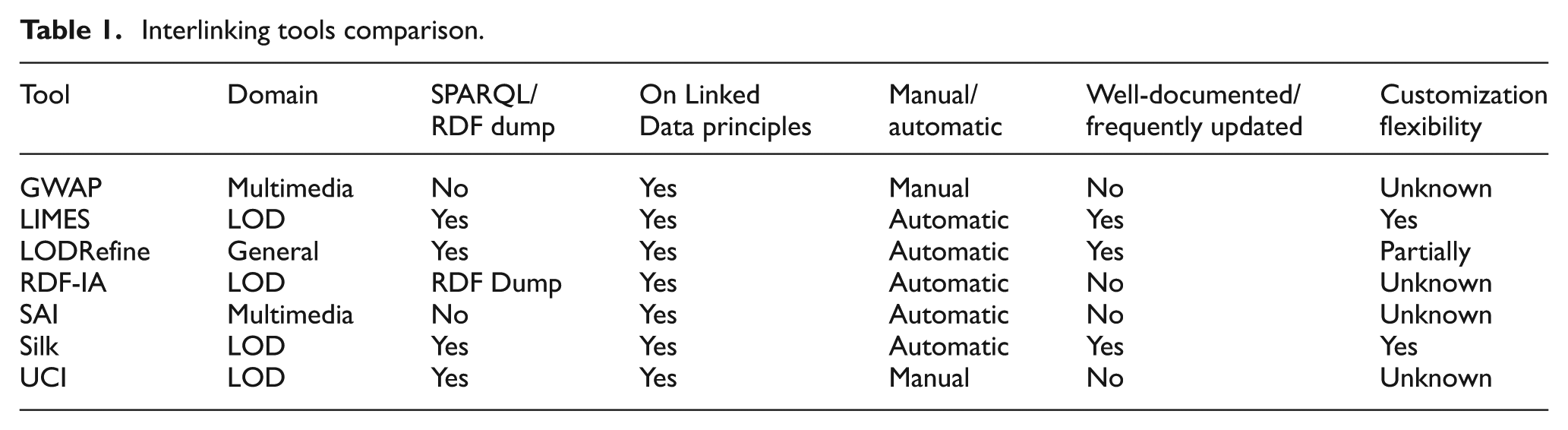
As illustrated in Table 1, Silk, LIMES and LODRefine were found to be the most appropriate linking systems based on the assumed criteria. ‘Unknown’ in the table indicates that authors could not test the flexibility of the tool owing to the lack of documentation and application support from the original providers. Below some of the main features of each tool are briefly discussed.
3.2.1. Silk
Silk [14] is a framework for interlinking between datasets that consists of a tool and a link specification language. When matching two datasets with Silk, the user specifies entities in a configuration file. The tool applies both string matching methods and taxonomical distance similarity in order to allow for diverse data discovery. These similarity metrics are parameterized by the user in a specific format. Silk takes two datasets as input by specifying SPARQL endpoints or RDF dumps and provides as an output ‘sameAs’ triples or any other predicates between the matched entities. This tool is available in three different variants, which address different use cases but use the same discovery engine. Silk Workbench, which is the case we applied for the interlinking, is a web application that guides users through the process of interlinking different data sources and offers a graphical editor to create as well as edit link specifications. As defining good linking heuristics is usually an iterative process, the Silk Workbench helps users to quickly evaluate the generated links. A number of projects, such as DataLift [21], have employed the Silk engine to carry out their interlinking purposes.
3.2.2. LIMES
Link Discovery Framework for Metric Spaces (LIMES) is a framework that implements a linking approach for discovering relationships between entities contained in Linked Data sources [15]. LIMES leverages several mathematical characteristics of metric spaces to compute pessimistic approximations of the similarity of instances. It then uses them to filter out a large amount of those instance pairs that do not satisfy the mapping conditions. Given a source, a target and a link specification, LIMES processes the strings by making use of suffix, prefix and position filtering in a string mapper. The processing results of the string mapper (along with other types of mappers in the system) are filtered as well as merged using time-efficient set and filtering operations. As a result, LIMES generates links between items contained in two Linked Data datasets via SPARQL Endpoint or RDF dump. Using a threshold in the configuration file, the user can set a value for various matching metrics. Two instances are considered as matched and are linked via a relation such as ‘owl:sameAs’ when the similarity between the terms exceeds the defined threshold. Apart from LIMES’ diverse collection of functionalities, a recent study [15] evaluated it as a time-efficient approach, particularly when it is applied to link large data collections.
3.2.3. LODRefine
OpenRefine 15 is a tool that allows data to be loaded, refined and reconciled. LODRefine [16] as an extension of OpenRefine provides additional functionalities particularly suited for dealing with LOD. Generally speaking, LODRefineis not only applied for cleaning and transforming data from one format to another, but it also discovers matched concepts between datasets by linking the data items to the target datasets. Matching is automatically performed in such manner that similar concepts are suggested to users for review and verification. LODRefine also allows users to expand their contents with concepts from the LOD datasets, for example, DBpedia or Freebase [25], once the data has been reconciled. The tool has a graphical user interface through which the user can import, clean and configure the target SPARQL Endpoint, or load the target RDF dumps. Users can also specify the condition under which the interlinking is to be performed. Finally, LODRefine reports the matched concepts and provides several functionalities for filtering the results. One of the advantages of LODRefine that can be highlighted is that it allows users to refine as well as manage data before starting the interlinking process. This is useful when the source includes several messy records (e.g. null, unrelated contents). Refinement of data before interlinking facilitates the process by reducing the number of source concepts.
3.2.4. Interlinking process
In an ideal scenario, a data collection would be linked to a diverse collection of datasets on the Web of Data. However, connecting each concept to an appropriate dataset one by one is too time-consuming, particularly when the number of data items is large and a domain expert has to explore the target dataset to query for the term. To minimize human contribution, data linking systems have facilitated the interlinking process by implementing a number of matching techniques. When testing an interlinking tool, several issues, such as defining the configuration for the linking process, specifying the criteria and post-processing the output, are addressed. As the GLOBE resources were not available as RDF, we had to expose the GLOBE metadata via a SPARQL endpoint. As we mentioned earlier in this study, the harvested metadata was imported into a relational database and afterwards exposed as RDF by making use of a mapping service (e.g. D2RQ 16 ). We also set up a SPARQL Endpoint in order to complete the interlinking process. In the final GLOBE dataset, we discovered approximately 2342 English taxonomies (‘taxon.entry’ in the metadata) distributed amongst 193,000 metadata records. There were also around 5600 coverage values applied by 50,000 GLOBE resources.
When running LIMES, the user sets a configuration file in order to specify the criteria under which items are linked in the two datasets. The tool generates links between items under the specified criteria and provides output which defines whether there was a match or a similar term in order to be verified by users. In Silk, the user specifies both source and target metadata through a graphical user interface, then defines the criteria, and finally the tool generates output. Once the linking process has finished, the user can evaluate the accuracy of the generated links that are close to the similarity threshold. Specifically, the user can verify or reject each record recommended by the tool as two matching concepts.
LIMES and Silk completed the interlinking process by specifying the source and target datasets, type of matching algorithm and other filtering options. Figure 2 illustrates a possible workflow in which a data publisher could configure and run an interlinking tool to connect GLOBE and DBpedia. The threshold in the workflow was set to 0.98 for both tools, which means that two concepts are considered as matched if their similarity for the mentioned metric becomes more than 98%. The used matching algorithm was ‘Levenshtein distance’ [26] as a string metric for measuring the difference between two sequences.

Sample interlinking process (GLOBE to DBpedia).
In the case of LODRefine, the user imports the data into the tool and runs the reconciliation service after specifying the target dataset along with the type of concepts that are being linked. As a result, LODRefine reports the similarities between the concepts and the target links so that users can filter, or run another reconciliation action on the outputs.
4. Linking results evaluation
Figure 3 illustrates the results obtained by three tools (Silk, LIMES and LODRefine) employed to interlink GLOBE metadata and DBpedia categories. As can be seen, Silk and LIMES were able to match more concepts than LODRefine with around 710 and 700 terms (out of 2342), respectively, while the number of results obtained by LODRefine was considerably lower (291). The reason for the significant difference between the output of LODRefine and the other two tools may be because LODRefine does not allow users to select the matching algorithm. Instead users can refine links between the matched records via LODRefine facets (e.g. total tool judgment or according to word similarities). This means that the tool reconciles the results after finding the similarities between entities. Figure 3 illustrates the number of GLOBE records in which the terms were found. In particular, around 119,000 records included 710 terms discovered by Silk. All the DBpedia targets were de-referenceable as well as matched with more than 98% similarity to the GLOBE terms. Analysing the output, most concepts found in GLOBE belonged to various sources and were not restricted to one repository. On the other hand, the target links in DBpedia were distributed in a variety of categories ranging from Mathematics to Human Sciences, as illustrated in Table 2 (as a sample).

Taxonomy interlinking between GLOBE and the DBpedia dataset.
Extract of common outputs generated by all tools selected for experts’ review.

Indeed, the Housing category 17 was the most referenced subject in the DBpedia dataset pointed to by GLOBE concepts and discovered by both Silk and LIMES. On the other hand, LODRefine found the Asphalt category 18 to be the most commonly referenced subject.
When examining the extracted data, we identified almost 40,000 matched records (280 terms) that were common among all three tools. On logical grounds, it is apparent that both Silk and LIMES have more common links than LODRefine with around 696 concepts distributed in around 116,000 records in the GLOBE dataset, as they discovered richer results (Figure 4).

Common links and records among results generated by the selected linking tools.
As each resource in the GLOBE repository can include more than one classification term (according to the IEEE LOM standard), each term was seen in more than one record and thus the number of repetitions (terms frequency among the resources) in the final results was higher than the number of records in GLOBE (see Table 3). The expression ‘B common C’ in the table, for example, states the number of common records discovered by both Silk (B) and LIMES (C).
Interlinking results with repetition in the GLOBE repository.

There are also many links found by one tool that were not discovered by the others. As it is apparent from Figure 5, both LIMES and Silk found almost 400 matched terms (around 92,000 records) more than LODRefine, while the difference between Silk and LIMES was only a few terms. Another noteworthy fact is that B minus C (depicted as B-C in the figure) shows that many links in B (Silk) were not discovered by C (LIMES).

Number of links individually discovered by each tool.
There were also a few items exclusively discovered by one tool which were not identified by the others. For instance, Silk discovered five matched concepts that were observed neither by LIMES nor by LODRefine. Regarding the interlinking between the coverage element of GLOBE and countries contained in Factbook, the results obtained by the interlinking tools were almost the same. All tools could discover around 7900 matched records (out of 55,000) in the Factbook dataset, as depicted in Figure 6. All tools found at least 111 common terms except for Silk, which found an extra two concepts corresponding to seven records.

Coverage element interlinking between the GLOBE repository and the Factbook dataset.
As a consequence of human and quality control, several records were selected from the final list of results and presented to five human experts. A set of criteria was defined under which the samples were chosen:
All sample data was obtained from common matches among the tools.
As GLOBE gathers metadata from various digital repositories, a few records were selected from each repository in order to promote diversity in the data sample collection.
The sample records which were given to the experts included GLOBE concepts and the target datasets. The metadata description related to each term was also extracted in order to help the experts detect any polysemy or ambiguity. Given that assessing each record (which includes source term, target link and description) requires some technical skills and takes time to elicit the target, we picked 25examples of taxonomy interlinking (out of 280) and 25 records corresponding to coverage interlinking (out of 111) for the evaluation (a sample taxonomy list is presented in Table 2). Finally, experts reviewed each term concerning its description and were later asked to respond whether the target link exactly matched the GLOBE term.
Focusing on reliability, all the experts approved the 25 records corresponding to coverage terms found by the tools in Factbook. This means that the coverage value and the country extracted from Factbook were undoubtedly the same from a human perspective. In the case of taxonomies matching and given that there was some disagreement among the experts’ responses, we examined the degree of agreement by making use of inter-rater agreement techniques for evaluating different raters’ opinion on the same subject using the same scale or instrument. To gauge the response reliability, we applied intraclass correlation coefficient [27], one of the most popular reliability statistics to determine the internal consistency of multiple raters in a survey instrument. To this end, we imported the reviewers’ data into SPSS 19 in order to analyse the responses and run the reliability statistics. In intraclass correlation statistics, the accepted value for describing internal consistency is defined by α > 0.6 and the result is a coefficient when the value is >0.9. Accordingly, as Table 4 illustrates, the software output for our data was valid, and the value was 0.905, which shows that the raters strongly agreed on the tools’ output.
Intraclass correlation coefficient

A closer look at the responses given by the experts indicates that they all accepted at least 19 samples out of 25 (76%) as matched terms. Some results were disregarded because either no related information was found or the terms did not match. For example, in two cases the raters mentioned that the metadata description in the GLOBE resources was not sufficient to rate the record as matched. Furthermore, two raters highlighted the lack of information in DBpedia (e.g. http://dbpedia.org/page/Category:Social_geography), which made the judgment difficult. Table 5 illustrates the number of approved taxonomy matching samples assessed by five different experts
Number of accepted matched links rated by each sample (out of 25)

5. Conclusion and outlook
The purpose of this research was to evaluate several existing interlinking tools when applied to linking a specific part of an educational collection to DBpedia and Factbook datasets. Firstly, the study set out to transform an e-learning repository into a Linked Data format and then select the most appropriate LOD dataset to specify the data scope for interlinking. Secondly, the authors investigated various related tools used for dataset interlinking and consequently selected Silk, LIMES and LODRefine, which passed a set of predefined criteria. The linking procedure was carried out over the target datasets and the results were presented to several experts for validation of the results generated by the applications. The findings gathered via human evaluation of the results obtained by the above-mentioned tools have a number of important implications for interlinking:
As can be deduced from the linking results, applying interlinking tools helps data publishers to connect their contents to expedient datasets on the Web of Data, and thus we strongly recommend this approach.
As almost all of the samples extracted by the tools were approved by experts in this research, it would be fair to conclude that using an interlinking tool is an effective way of linking between two datasets or from a data collection to the LOD datasets. As the paper found a high level of agreement among the raters (who mostly confirmed the results), we can confidently confirm that using an interlinking tool is a reliable method of interlinking datasets when the threshold of matching concepts is >0.98.
The moderately low number of results found by one of the tools reported in this study suggests that the use of several interlinking tools does not introduce significant added value for data providers.
A comparison of the three interlinking tools reveals that Silk appears to be the most promising framework in terms of finding the most amounts of valid matches between datasets and providing diverse facilities for result verification.
The difference between the number of results generated by LODRefine and the other tools in the case of Factbook and DBpedia also illustrates that LODRefine is not particularly effective when the scope of the target is wide. In the case of DBpedia, the category dataset alone contains around 995,911 triples while Factbook has only 254 triples for countries. Generally speaking, all the tools fulfill the interlinking task when the scope is narrow, but when applied to broader contexts, Silk and LIMES have more stability.
Another important conclusion that can be derived from this practical effort is the establishment of LIMES as a valid alternative for interlinking. However, LIMES still lacks some of the user facilities offered by Silk.
Further research on interlinking various data collections to other datasets on the Web of Data and the continued study of result validation are desirable to extend our knowledge of interlinking.
Footnotes
Acknowledgements
We would like to acknowledge the continued support of Dr Axel Ngonga and Dr Robert Isele, whose comments helped us to run the interlinking tools.
Funding
The work presented in this paper has been part-funded by the European Commission under the ICT Policy Support Programme CIP-ICT-PSP.2011.2.4-e-learning with project no. 297229, ‘Open Discovery Space (ODS)’, CIP-ICT-PSP.2010.6.2-Multilingual online services with project no. 27099 ‘Organic.Lingua’, and INFRA-2011-1.2.2-Data infrastructures for e-Science with project no. 283770 ‘AGINFRA’.