





Abstract
The Semantic Web is dependent on extensive knowledge management by interlinking resources on the web using matching techniques. This role is played by the progressing domain of ontology matching, by introducing ontology-matching tools. The focus of these matching tools is limited to matching techniques and automation, rather than expressive formal representation of alignments. We propose Mediation Bridge Ontology (MBO), an expressive alignment representation ontology used to store correspondences between matching ontologies matched by our ontology-matching tool, System for Parallel Heterogeneity Resolution (SPHeRe). The MBO utilizes object-oriented design patterns and the proposed ontology-alignment design patterns to provide extendibility and reusability factors to SPHeRe system. We compared our proposed system with existing systems using Coupling Factor, Number of Polymorphic methods and Rate of Change metrics to support extendibility and reusability. These factors contribute to the overall objective of interoperability for knowledge management in the Semantic Web.
1. Introduction
The continuous evolution of heterogeneous data repositories is a major hindrance for Semantic Web infrastructure to facilitate mashup-like information sharing. Ontology matching has made measurable progress to resolve semantic heterogeneities among these heterogeneous data repositories for ontology merging, query answering or data translation [1]. The Ontology Alignment Evaluation Initiative 1 (OAEI), a benchmarking initiative, carries out annual campaigns for the evaluation of the ontology-matching tools [2]. OAEI has evaluated several ontology-matching systems; some of these remained in spotlight for many years. Shvaiko and Euzenat [1] present a survey of some of the recent matching systems based on their operations and matching approaches. A common behaviour among these matching tools is their duration of use that lasts for few years, with them being replaced after this time. The main reasons for their replacement is the difficulty in extending and reusing these systems. The structure of matching systems should be extendible enough to accommodate new algorithms based on novel matching techniques, replace previous algorithms if they are non-effective and utilize a combination of existing techniques to build new techniques. Therefore, incorporating object-oriented design patterns [3] with ontology design patterns in ontology-matching tools defines the longer adaption of such systems.
Ontology Design Patterns (ODP) support pattern-based ontology design [4] and are used to capture common modelling situations, help facilitate ontology development and avoid common mistakes [5]. ODP have evolved from Content Ontology Design Patterns (reusable solutions to recurrent content modelling problems) [6] to Ontology Alignment Design Patterns (used to refine correspondences, by alignment designer or pattern detection algorithm) [7]. Ontology matching algorithms detect simple correspondences by following an alignment format that lacks the expressiveness needed to formalize correspondence [8]. Therefore, an approach is necessary to design and develop an extendible and reusable system that provide expressive capability to formalize correspondences. The proposed Mediation Bridge Ontology (MBO) based approach incorporates object-oriented design patterns combined with ontology-alignment design patterns in our ontology-matching system, System for Parallel Heterogeneity Resolution (SPHeRe) [9].
The proposed MBO ontology is an ontology-alignment representation scheme that enables expressiveness to formalize correspondence by utilizing object-oriented and ontology-alignment design patterns. Existing ontology-matching schemes only focus on matching the ontologies and storing their alignments in a format that only describes source and target concepts. It is necessary to find the alignments using design patterns for providing solutions to the common problems. Also, expressiveness in the storage of correspondence is necessary for multiple reasons. First, expert verifications become easier as the correspondence speaks for itself. The correspondence includes not only the source and target concepts, but also the attributes involved in correspondence, the procedure of the alignments and the confidence value of the alignment. Second, feedback about the matching process and alignment can be easily obtained, which helps in the overall improvement of the system and satisfaction of the users. We developed the SPHeRe ontology-matching system that incorporates bridge algorithms that are stored in expressive alignment representation format in the MBO. Strategy 2 and Mediator 3 design patterns are used from object-oriented design patterns, combined with ontology-alignment patterns called Pattern Relationship Models (PRM). The PRMs are the ontology-alignment patterns that define the expressive formal representation of the correspondences to be stored in the MBO. The proposed system supports collaborative ontology concepts by adding metadata information in alignments stored in the MBO. This helps in achieving extendibility and reusability metrics of the overall SPHeRe system.
Benchmarking and systematic evaluation are still progressing in the area of semantic technologies [2]. To evaluate the proposed system’s extendibility and reusability capabilities, we used a Quality Model for Object Oriented Design approach [10]. The factors that contribute to the lack of longer adaptation of the existing ontology-matching systems are coupling, polymorphism and the rate of change. Therefore, we used Coupling Factor (COF), Number of Polymorphic methods (NOP) and Rate of Change (RoC) to evaluate the system against the existing system to accomplish extendibility and reusability. This work contributes to the overall objective of interoperability among heterogeneous ontologies.
The rest of the paper is structured as follows: Section 2 addresses the methodologies used by existing ontology-matching systems and compares them with the proposed system. The proposed MBO design and development are described in Section 3. Section 4 explains the integrated approach of object-oriented design patterns and ontology-alignment design patterns based on MBO. Section 5 shows the working model of the system and describes the working mechanism of the different bridge algorithms to populate MBO. Section 6 evaluates the proposed system by calculating and comparing values of evaluation metrics with existing systems. Section 7 concludes the paper and provides information about future work.
2. Related work
Design patterns provide solutions to common occurring problems, and ontology domains utilize ontology design patterns to facilitate the ontology development process. One of the potential areas of semantic technologies that is focusing on incorporating design patterns as the solution to semantic heterogeneity problems is ontology matching, which finds similarities between concepts. Peigang Xu et al. [11] proposed a differentor-based similarity matrix creation technique used to integrate different similarity measures. Weights are assigned to various entities of the matching ontologies that are used for aggregation tasks after finding the similarity measures. Another approach proposed Tree Structure Based Ontology Integration [12] methodology, used to integrate ontologies with Document Type Definition-based tree structure development for ontology mappings. This is further utilized by ontology applications for data sharing purposes. These approaches led to the development of ontology-matching tools/systems. OAEI provides a platform to introduce state-of-the art ontology-matching tools, but their adaption for limited years, difficulty in extendibility and reusability and expressive mapping representations define the future directions for ontology-matching tools. Some of these tools and approaches for ontology-alignment patterns are discussed in this section.
We selected some ontology-matching tools for discussion in this section based on their participation and adaption in OAEI, and also some of the existing state-of-the-art systems. Falcon is one of the ontology-matching systems that has shown the best results in the first few years of OAEI campaign [13]. It provides fundamental technologies for finding, aligning and learning ontologies [13] by using a divide-and-conquer approach to target large ontologies generating 1:n alignments as output [1]. Although this system is still effective in generating alignments between ontologies owing to its matching techniques and also the user interface, lack of extendibility and reusability is its major disadvantage. It is extremely difficult to add new matching techniques and algorithms in the system. Agreement Maker is another ontology-matching tool that resolves the extendibility issue by displaying the ontologies, supporting several mapping layers visually and presenting automatically generated mappings for producing the alignments [14, 15]. This system is not scalable for large-scale ontology matching, but provides a flexible and extensible framework with a comprehensive user interface. The scalability issue is resolved in its new framework AgreementMakerLight, which preserves the original Agreement Maker framework with the main focus on computational efficiency and handling very large ontologies [16]. AgreementMakerLight competes with the recent OAEI performers, GOMMA and LogMap, in a large bio-med track, but lacks an approach for expressive mapping representation.
GOMMA [17] provides infrastructure for managing the matching and evolution of ontologies and its impact on mappings. On the other hand, LogMap is an ontology-matching tool that address the scalability issue for large ontology-matching and produces almost clean sets of output mappings [18]. GOMMA and LogMap demonstrates better accuracy as compared with other systems and were equally matched by another matching tool, YAM++. The YAM++ matching tool supports self-configuration, extensibility and extensibility in combining individual matchers [19]. It discovers mappings using information-retrieval techniques and also deals with multilingual ontology-matching problems [20]. Most of the ontology-matching systems focus on automation and accuracy of results and not on expressive alignment representation using ontology-alignment patterns. Šváb-Zamazal et al. [21] presented a generic framework for ontology pattern detection, generation of instructions and ontology transformation from source ontology to target ontology. Scharffe et al. [7] took a step forward by introducing ontology-alignment design pattern representation methods and then created a pattern library to be extended with new patterns. The work also explains the transformation of ontologies using ontology-alignment patterns. To summarize, existing ontology-matching tools and ontology-alignment pattern-based approaches are unable to reflect a comprehensive system that utilizes an object-oriented design pattern combined with ontology-alignment design patterns and storing the correspondences between matched ontologies into a mapping storage and representation repository. Our proposed MBO-based ontology-matching methodology addresses the existing systems issues in our SPHeRe ontology-matching system as an extendible, reusable and expressive mapping representation approach.
3. Mediation Bridge Ontology
Ontology mediation techniques provide the platform for interoperability between heterogeneous ontological descriptions [7]. Mediation is based on the alignments generated between heterogeneous sources, and representation of these alignments plays a vital role in effective interoperability. Little focus is provided on the alignment representation area by the Semantic Web community [22]. An effort towards representing correspondences as a centralized repository was introduced as bridge ontology [23, 24], but it lacked effectiveness, agility and realization. Although it provided the base for alignment representation, it was never the focus, mainly because accuracy of alignments is given higher priority. Effective alignment representation results in: (a) efficient ontology translation; (b) format transformationsl (c) systems mediation and (d) easy expert verification and modification. Therefore, the proposed MBO targets effective alignment representations in its design and development process. The design aspect utilizes object-oriented as well as ontology-alignment design patterns for effective mapping representation in the form of low coupling, high polymorphism and low rate of change. The MBO benefits not only the ontology-alignment storage, but also its use in the transformation process between different heterogeneous formats. The scope of MBO is categorized into three aspects: Generalized Mappings, Customized Mappings and Transformation Logic. Generalized Mappings are the alignments that are generated by matching two ontologies using PRMs. The proposed MBO provides the alignment representation scheme using an ontology design patterns approach keeping in mind the goals expressed for achieving true interoperability. Customized Mappings are alignments that are based on the conformance issues handling of organizations. Organization conformance issues are handled through these mappings by detecting the stale mappings initially in the Generalized Mappings and then replacing them with the new modified mappings. The generalized as well as the customized mappings are converted into transformation logic that is used for conversion among different standard formats. The formal description of these concepts is provided in Section 3.2.
MBO is categorized into two main classes: MediationBridge and PatternClass. MediationBridge is divided into syntactic and structural bridge subclasses: String Matching Bridge, Label Bridge, Synonym Bridge, Polysemous Bridge, Overlap Bridge, Customized Bridge, Children Based Structural Bridge and Property Based Structural Bridge. These bridge classes are used to represent the alignments generated from particular algorithms in their specified format. These are dependent on PatternClass for structuring the output of the alignment process. PatternClass includes MappedSequence, Standard1Class, Standard2Class, Match, MappedClass, ListStandard1 and ListStandard2 subclasses. These are used to provide the structure for representation of the alignment in the MBO. The overall hierarchy of MBO is shown in Figure 1.
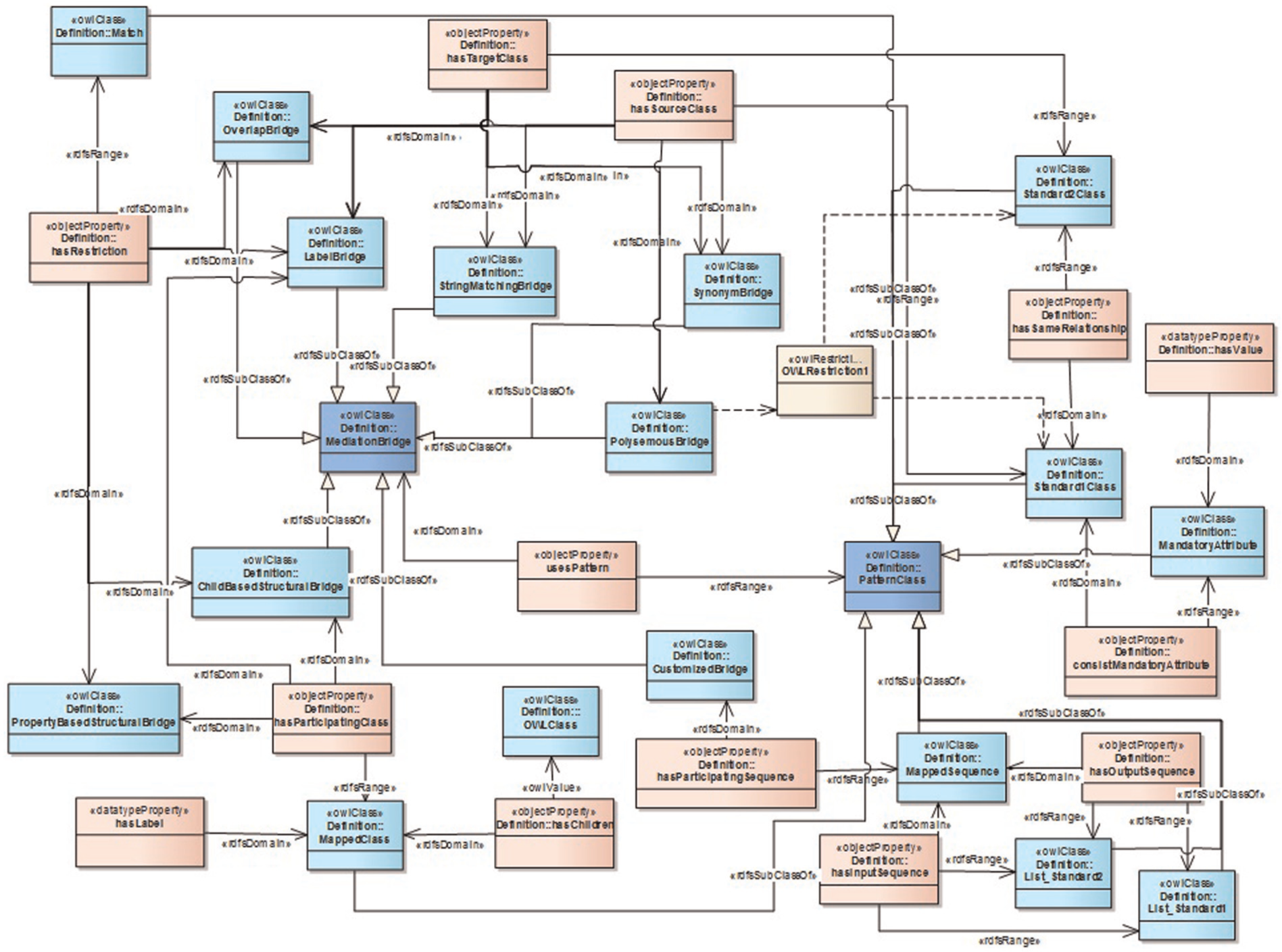
Mediation Bridge Ontology.
These concepts are related to each other using object properties; the triples are shown in Table 1. MediationBridge class is related through the usesPattern object property to PatternClass. Every subclass of MediationBridge uses some pattern classes from the PatternClass subclasses to define its alignment representation. OverlapBridge class is related through hasSourceClass and hasTargetClass object properties to Standard1Class and Standard2Class, respectively. Standard1Class uses hasSameRelationship and consistsMandatoryAttributes object properties to connect with Standard2Class and MandatoryAttribute, respectively. Based on the previous triples, OverlapBridge is related to the Match class using hasRestriction object property. This makes the complete alignment representation for OverlapPRM described in the later section. In the same way, other MediationBridge classes define their pattern to represent alignment in the MBO.
Mediation Bridge Ontology triples

3.1. MBO bridges definition, examples and scenarios
The MBO provides the platform that represents alignments found by different bridge algorithms. These bridge algorithms are defined and explained with real-world examples, and scenarios using medical standard ontologies. We use medical standard ontologies as scenarios for the proposed system. The alignments generated and represented in the MBO can be used for ontology translation, standard format transformation and expert verification based on metadata availability about every alignment. One of the bridge algorithms is String Matching Bridge, which is used for concepts matching to identify similar concepts in the matched ontologies. These are based on string-based matching techniques by considering the sequence of letters of matching concepts. These sequences of letters considered for matching are based on the intuition that, the more similar the strings are, the more likely it is that the concepts will be similar [25]. Edit distance is one of the techniques used for string-based matching techniques [26]. Table 2 shows the examples and medical ontology scenarios of SPHeRe’s bridge algorithms.
Mediation Bridge Ontology concepts, examples, scenarios

Synonym Bridge (Table 2, row 2) represents identical or closely aligned concepts between different ontologies. College and School are two synonym concepts where College ЄOi (O is ontology) and School ЄOj. Drug and Medicine are synonym concepts from SNOMED CT and Mesh standard ontologies as shown in Table 2.
Label Bridge (Table 2, row 3) represents similar concepts based on common information represented as their labels. Car and Automobile are two similar concepts where Car ЄOi and Automobile ЄOj. Car and Automobile both have Machine and Motorcar as their labels. Therefore, their similarity is based on the label match. Cartilage Cell concept of FMA ontology is similar to the Chondrocyte concept of NCI ontology based on a common label as Cartilage Cell.
Overlap Bridge (Table 2, row 4) represents concepts that contain overlapping information that is necessary for data format transformation with information exchange between heterogeneous systems. Project Report and Project Deliverable are two overlapping concepts, containing most of the information common between them. Taking the example of HL7 and openEHR ontologies, OBSERVATION and EVALUATION are overlapping concepts.
Polysemous Bridge (Table 2, row 5) is used to cover the same concepts having different meaning cases during ontology matching. The concept Apple can represent a Fruit and it can also characterize Computer. Therefore, the Apple concept as a Fruit and as a Computer is an illustration of Polysemous bridge. Event concept in SNOMED CT and HL7 has different meaning with same concept name described in Table 2.
CBSB (Table 2, row 6) represents concepts and relations/properties that are similar by comparing similarities between their children. Faculty and Academic Staff are two equivalent concepts based on children matching. In HL7 and openEHR medical standard ontologies, Entity (HL7) and Party (openEHR) are similar based on children matching.
PBSB (Table 2, row 7) represents the concepts that are similar to each other based on their properties. Gun and Tank are two concepts of two separate ontologies similar to each other based on their common properties ‘haveArmour’ and ‘operatedBy’. Similarly, Observation and ObservationResult concepts of HL7 and VMR ontologies are similar to each other based on their properties.
3.2. Formal modelling and representation of MBO
MBO formal modelling using Backus–Naur Form 4 is described in this section. MBO constructs are defined by the generalized and customized mappings which are then represented in logic format for transformation among different standards. The generalized mappings are the focus of this paper and include the alignment information with the ontology-alignment design pattern used for the creation of generalized mappings logic to be used for transformation. The formal definitions of all these concepts as well as the transformation logic based on generalized mappings are presented as follows:


The constructs <CM> and <LogicCM> are related to the customized mappings and are not covered in the scope of this paper; therefore its Backus–Naur Form is not presented. The rules in <LogicCM> are the same as those in the <LogicGM> construct. The detailed description of the ontology-alignment design pattern called PRM is elaborated in the following sections.
4. MBO design patterns
MBO utilizes Strategy Design Pattern and Mediator Pattern to incorporate an object-oriented design approach for agility and reusability of the system. It also used PRM to define a mapping representation format that can be used for easy expert verifications, format transformation and ontology translation purposes. Figure 2 illustrates a class diagram that shows MBO Strategy Design Pattern, MBO Mediator Pattern and PRMs as realization of the MBO in the SPHeRe system. MBO Strategy and Mediator design patterns explain the implementation view of the system design, while PRMs describe MBO ontology patterns as representation of the alignments. We have adopted the concept of Strategy and Mediator design patterns from the object-oriented design community and propose PRM in this research by interrelating them for extendible, flexible and agile system.
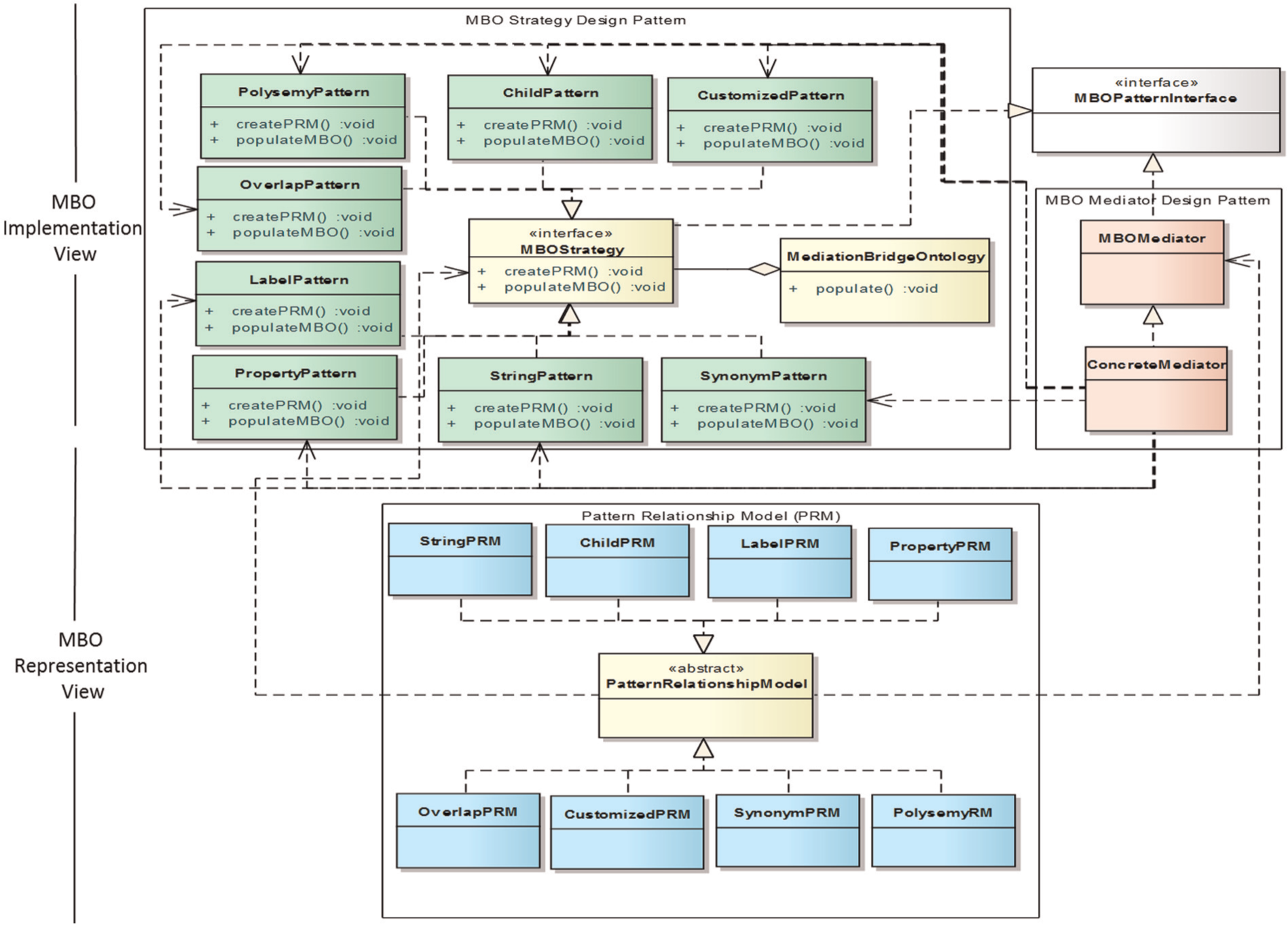
MBO design pattern-oriented implementation and representation views.
4.1. MBO implementation view
4.1.1. MBO Strategy Design Pattern
MBOStrategy– an interface that defines the behaviour of a MediationBridgeOntology.
Concrete Strategies: ChildPattern, PropertyPattern, StringPattern, SynonymPattern, PolysemyPattern, OverlapPattern and LabelPattern; each of these pattern classes calls a specific PRM for execution and then populates that information in the MediationBridgeOntology.
MediationBridgeOntology– this class is the context class that gets alignments information from each pattern and stores it in specified format.
4.1.2. MBO Mediation Design Pattern
MBOMediator– an interface class used for communicating with other objects in well-defined and complex ways.
ConcreteMediator– this class keeps reference of all the colleague objects and is used to transfer the messages between colleague classes such as ChildPattern, PropertyPattern, StringPattern, SynonymPattern, PolysemyPattern, OverlapPattern and LabelPattern.
4.2. MBO representation view (PRM)
Each pattern class in the Strategy Design Pattern uses a particular PRM class, for example, StringPattern class invokes StringPRM class for execution. All of the PRM classes are derived from the PatternRelationshipModel abstract class. Medical ontologies are used for matching purposes and performing experiments; therefore, medical standards are used as scenarios for understanding these PRMs. These PRM realizations are shown with Virtual Medical Record (VMR) and HL7 Clinical Document Architecture (CDA) standards ontologies. Both of the standards are based on the HL7 Reference Information Model [27] that is the root of all the information models and consists of backbone classes, and their specialization and structural attributes for further defining the roles of the classes. HL7 CDA follows a CDA Refined Message Information Model [28] that contains information about document creation and manipulation. VMR is a data model for representing clinical data relevant to CDS by recording patient demographics and clinical history data [29]. The generic pattern structure followed by its realization in VMR and CDA standard ontologies is described in this section. Some of these PRMs (OverlapPRM contents are also included in our paper [30]; we only changed the structure of the text based on the design pattern template) are explained in object-oriented design template below.
4.2.1. Overlap PRM
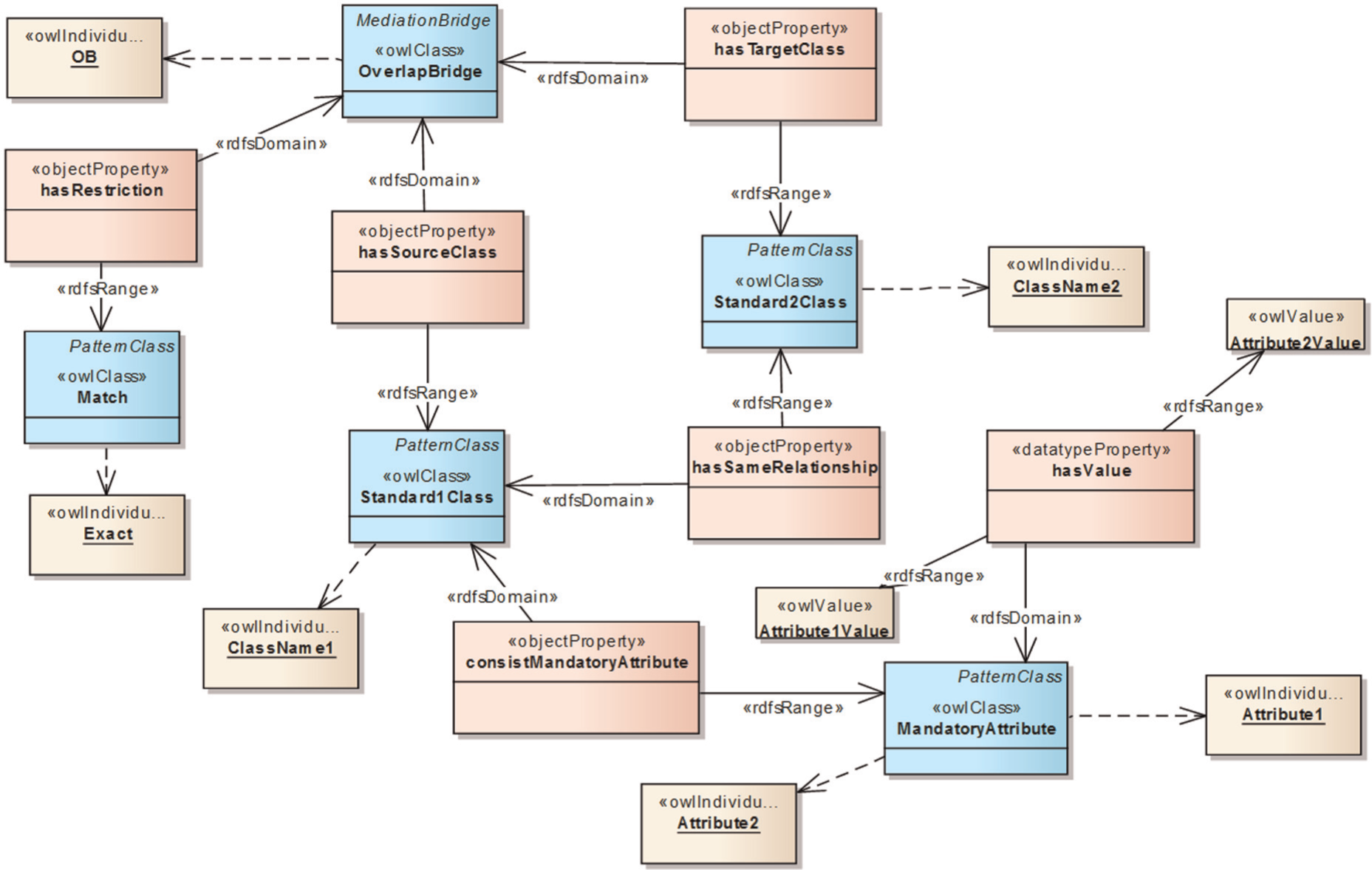
Overlap PRM [30].
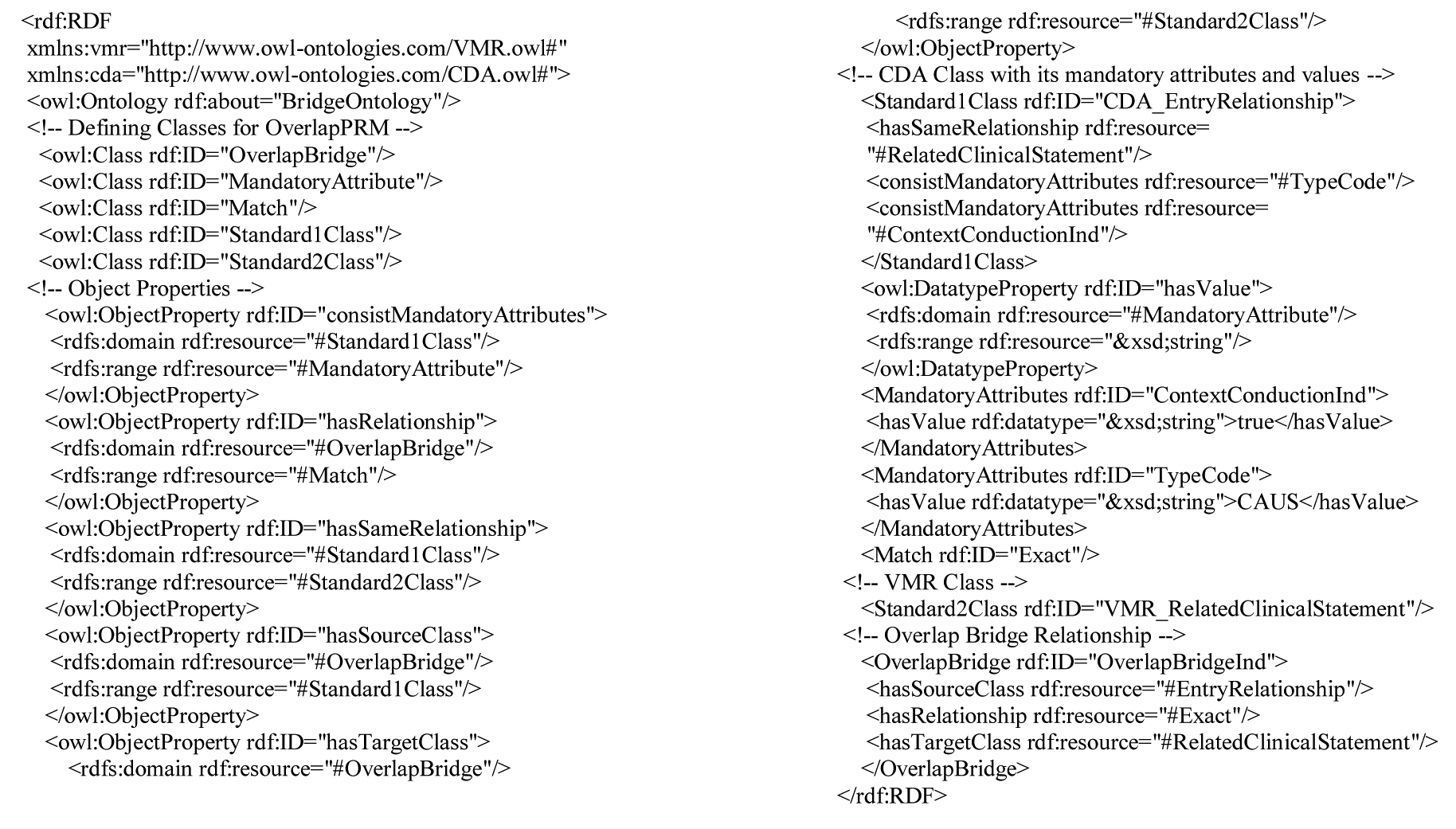
Overlap PRM Example (CDA and VMR) [30].
We explain OverlapPRM with EntryRelationship concept of CDA standard and RelatedClinicalStatement concept of VMR standard as shown in Figure 4. The EntryRelationship class of HL7 CDA has mandatory attributes such as typeCode and contextConductionInd with values CAUS and true, respectively. This information is mapped with the RelatedClinicalStatement class of VMR; therefore translation of RelatedClinicalStatement class is performed with EntryRelationship class and its mandatory attributes and values.
4.2.2. Property PRM
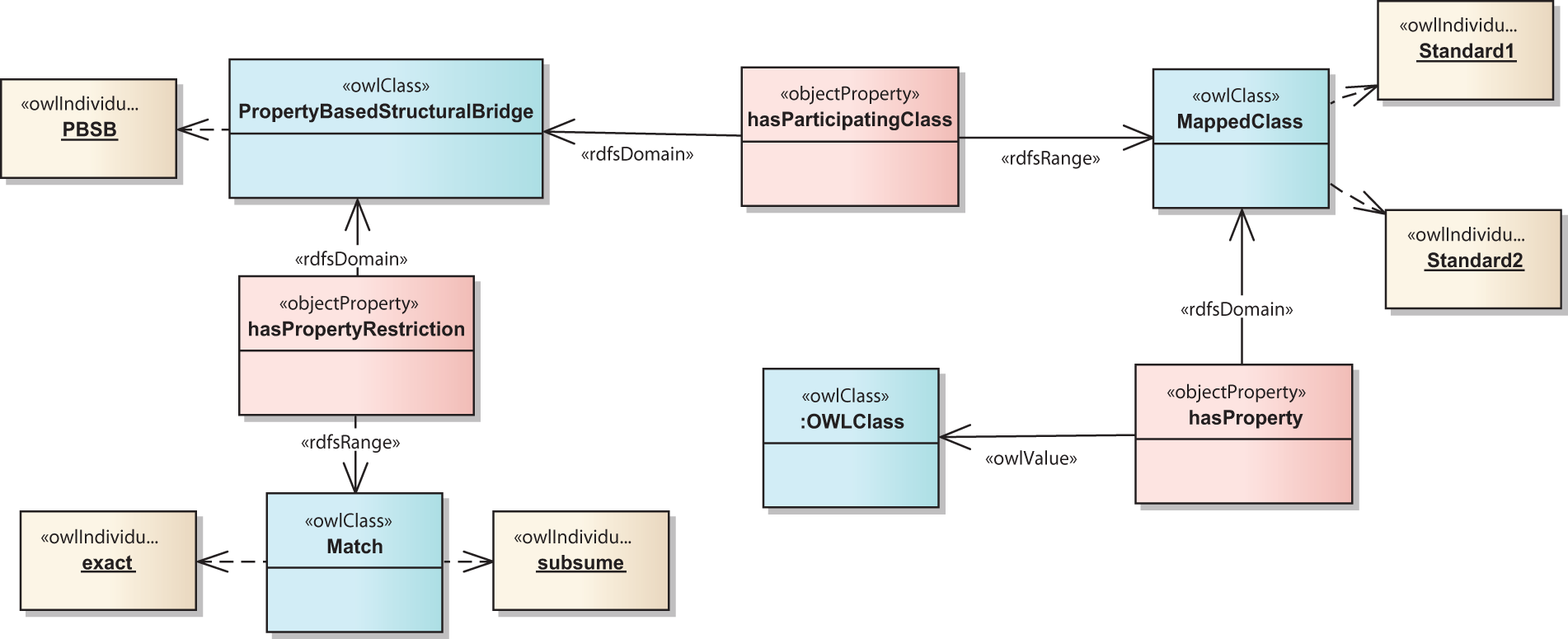
Property PRM.
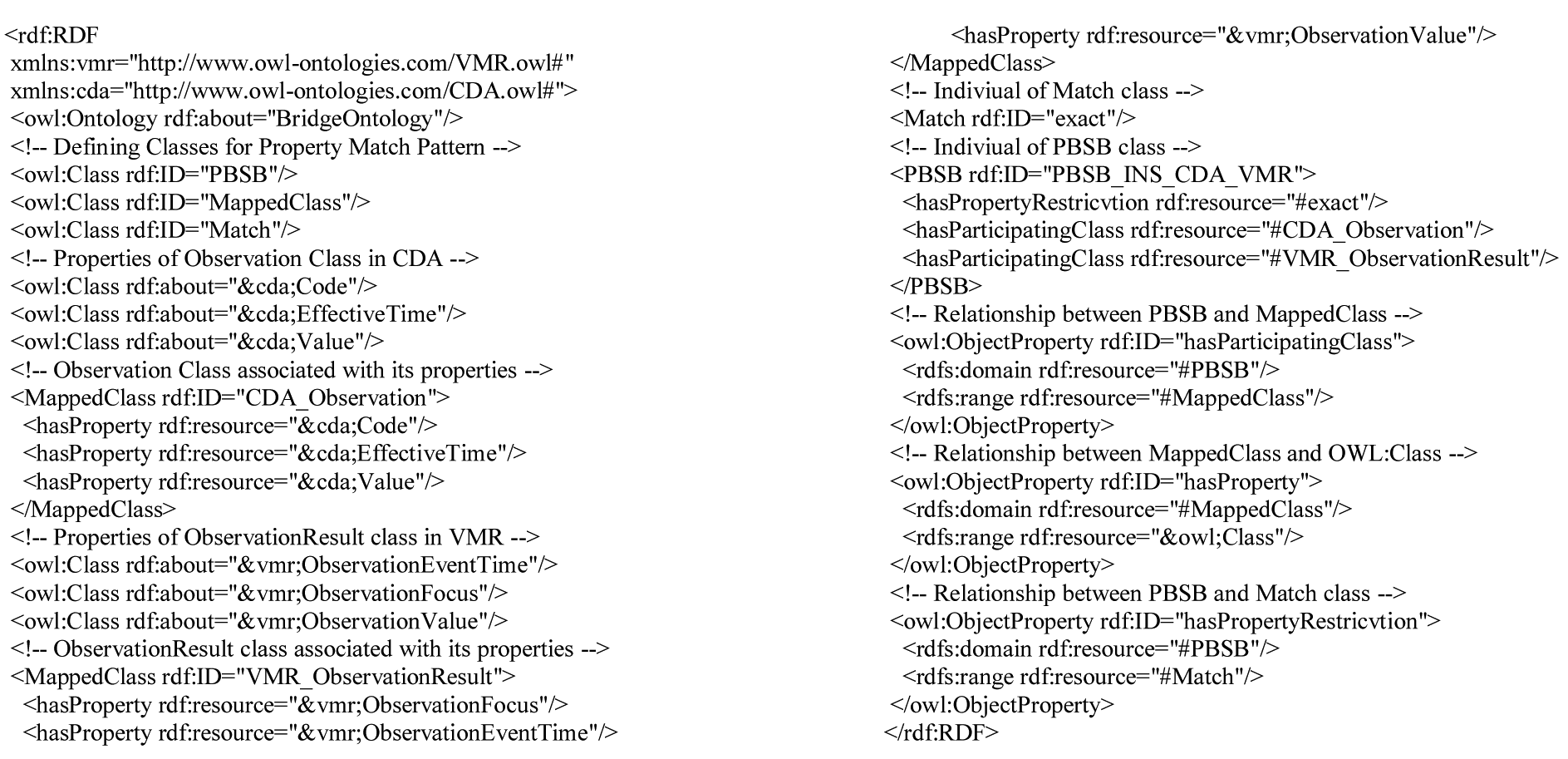
Example: Observation (CDA) and ObservationResult (VMR) property match pattern.
4.3. Parameters for analysing design patterns quality
The proposed system utilizes the pattern design approach by integrating object-oriented design patterns with our proposed ontology-alignment design patterns. This delivers a solution for satisfying th functional, non-functional and alignment representation requirements of an ontology-matching system. Hsueh et al. [31] provide the motivation for adopting part of their object-oriented design pattern quality measure and use their tuple as <IF, IN, Q>:
IF: Functional Requirement Intent defines the functionality of the design pattern. For example, CBSB and PBSB bridge algorithms have the intention to match source and target ontology concepts based on their children and property matching, respectively.
IN: Non-functional Requirement Intent describes the level of attainment of quality attributes. For example, extendibility and reusability in the MBO case.
Q: Quality Focus explains the quality focus between IF and IN.
We are using Strategy and Mediator design patterns that offer reusability and extendibility metrics to our system and provide assistance to ontology-alignment PRM with the the tuple as <S,T,A,EC,MV>:
S: Source Concept that belongs to the matching source ontology.
T: Target Concept that belongs to the matching target ontology.
A: Attribute is supported by the evaluation criteria for matching and is divided into simple or composite attributes. A simple attribute performs matching with single evaluation criteria while composite includes multiple evaluation criteria combines on a single platform.
EC: Evaluation Criteria defines the purpose of the alignment generation between concepts. Each bridge algorithm has particular evaluation criteria to achieve objective.
MV: Matching Value decides about the fulfilment of the evaluation criteria.
The quality focus of the proposed system is on decrease coupling and increase polymorphism to achieve extendibility and reusability, described in detail in Section 6.4.
5. Methodology
Our proposed MBO is part of the ontology-matching system we developed called SPHeRe [9]. The SPHeRe system is based on different bridge algorithms that are represented in a mapping representation format provided by the MBO. Accuracy and performance are the two factors that help in achieving the goals, and these are accomplished by the Matcher Library and Parallel Matching Framework of the SPHeRe working model as shown in Figure 7. The definitions of the concepts used in the proposed architecture are described in Table 3.
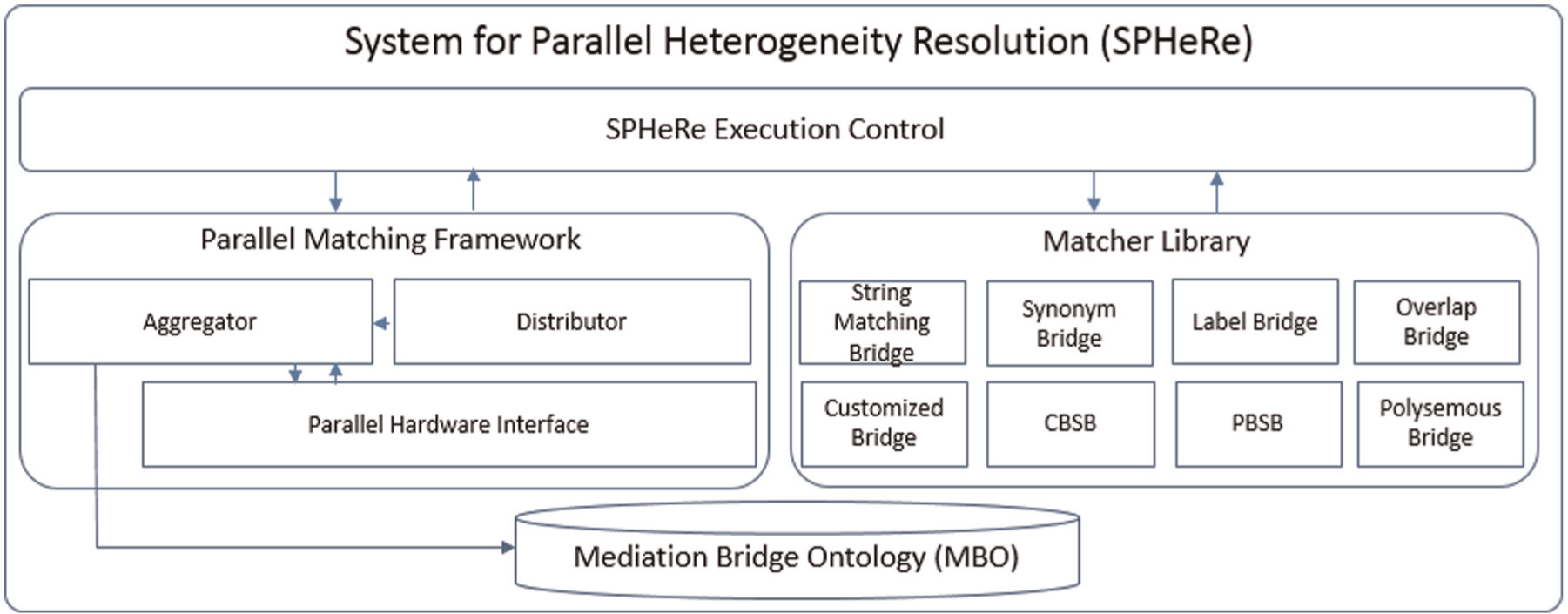
SPHeRe working model.
Concepts and definitions

SPHeRe Execution Control manages the communication with external and internal entities. It is responsible for ontology loading and providing information about execution of bridge algorithms in the Matcher Library to Parallel Matching Framework for parallel execution of the algorithms. Matcher Library consists of bridge algorithms such as String Matching Bridge, Synonym Bridge, Label Bridge, Overlap Bridge, Customized Bridge, CBSB, PBSB and Polysemous Bridge.
Ontology matching being a computationally intensive problem requires adequate computational resources for effective resolution in acceptable time. To generate mappings with performance in perspective, we have implemented a custom high-performance framework, Parallel Matching Framework, to support parallel execution of matching algorithms over multicore and multinode computational resources. To accomplish parallel matching we have implemented two core components, that is, Distributor and Aggregator. Distributor is responsible for the division of matching jobs over parallel hardware depending upon their computational ability. The Parallel Hardware Interface is used by Distributor to exploit the multiple cores available over commodity hardware for parallelism. After the completion of parallel matching, the Aggregator component accumulates the respective results of all matching jobs from all computing nodes. This accumulated result is formalized by Mediation Bridge Ontology, to be further utilized as an alignment. The generated bridge ontology also persists in the repository for future utilization.
The process of SPHeRe working model is described in Figure 8. Initially, source and target ontologies are loaded for the matching process. Both of the ontologies are parsed based on the ontology constructs such as classes, properties, annotations and relationships. The distributor access the primary algorithms initially includes the String Matching, Label and CBSB bridge algorithms as some of their attributes are common. Based on these, ontology constructs are accessed and assigned to the cores for processing. Each core is assigned a specific task to perform in parallel for a particular bridge algorithm and the output is provided to the Aggregator to generate the MBO. In the same way, other algorithms are executed for the generation of mappings and their storage in MBO. Further details of this process working in a parallel environment are available in Amin et al. [9].

Process workflow
6. Evaluation
Existing ontology-matching systems mainly focus on the accuracy of mappings and lack assessment of the external quality factors from the measurement of the internal design properties. We evaluate our proposed system with COF, NOP and RoC metrics by comparing it with existing systems, FALCON and LogMap. We selected FALCON and LogMap for comparison with the proposed system because of factors such as participation in OAEI for several years, corresponding publications availability to understand their approach thoroughly, source code availability (to understand the design and implementation of the system) and also complete system availability (to run ontology-matching tests for observing the output). These systems class diagrams were generated from their source code using Intellij Idea tool, 5 which supports a wide array of refactoring for Java, cross language refactoring and other advanced features [32]. We used a Quality Model approach [10] to quantitatively assess the external factors such as extendibility and reusability as measures of software maintainability.
6.1. Coupling Factor
Coupling Factor is a metric to determine dependencies between the classes. Therefore, the formula to calculate COF is given in equation (1):

where df = total dependency factor and tc = total number of classes.
The SPHeRe system is based on the MBO using object-oriented and ontology design patterns. Therefore, COF value of SPHeRe is less compared with FALCON and LogMap systems. Figure 2 shows the df and tc of the proposed system and the COFSPHeRe is calculated as shown in equation (2):

We compared our system with FALCON ontology-matching system and used its Matcher package to calculate the COF of its different subpackages as shown in Figure 9(a). We observed that FALCON has high coupling as compared with the proposed system. The class diagram of FALCON system’s Package PBM is shown in Figure 9(b) and equation (3) calculates its COF value as 0.127, which is very high compared with the proposed system:

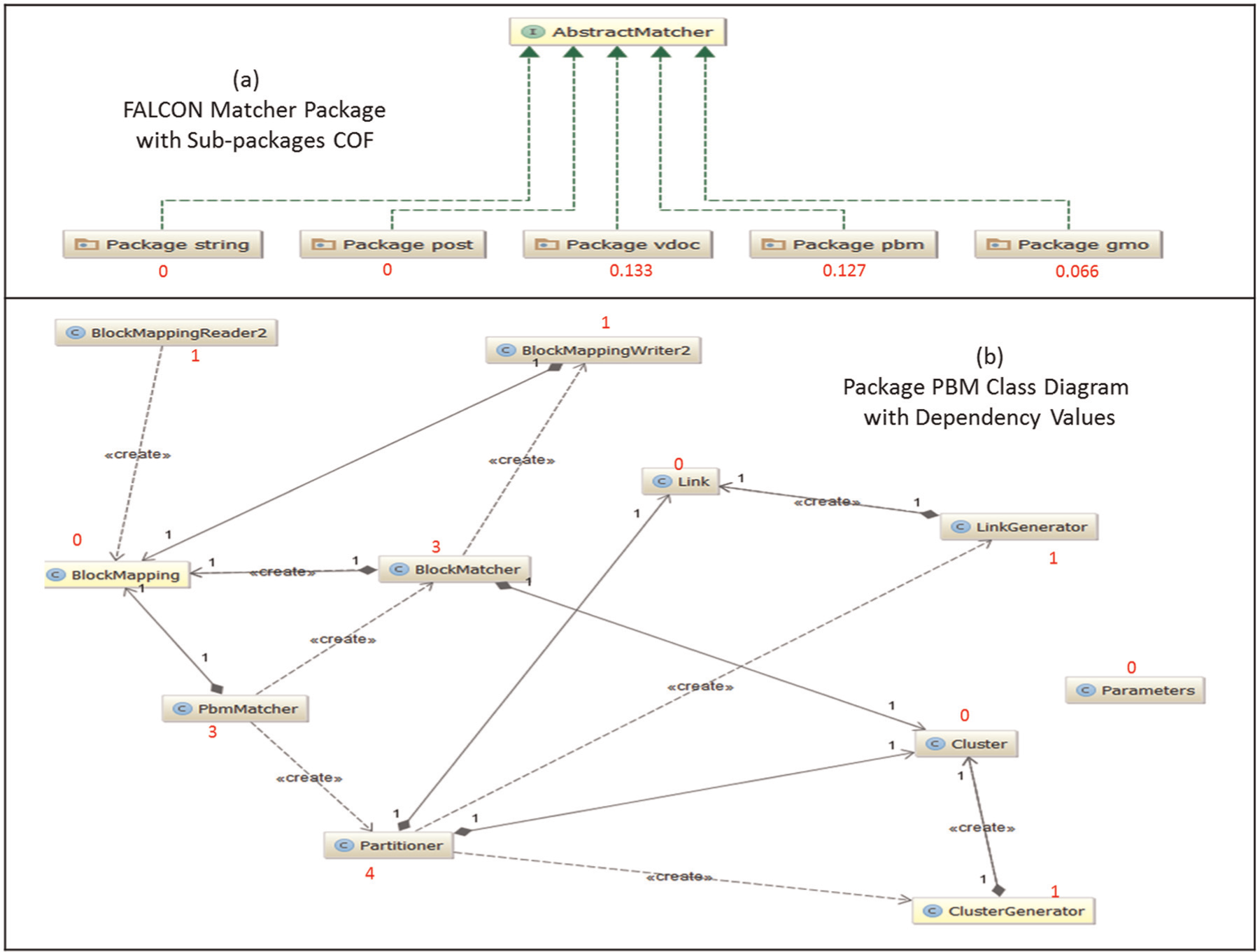
FALCON packages and coupling factor.
The LogMap system overall class diagram consists of approximately 26 packages and classes having too great a dependency on each other, resulting in highly coupled system. We selected two packages (Stemming and Reasoning) for comparison with the proposed system. These package class diagrams are shown in Figure 10. Figure 10(a and b) illustrates the class diagrams of LogMap system’s Stemming and Reasoning packages respectively. The stemming package has more COF as compared with the proposed system while the Reasoning package has a lower COF value as shown in equations (4) and (5), respectively:


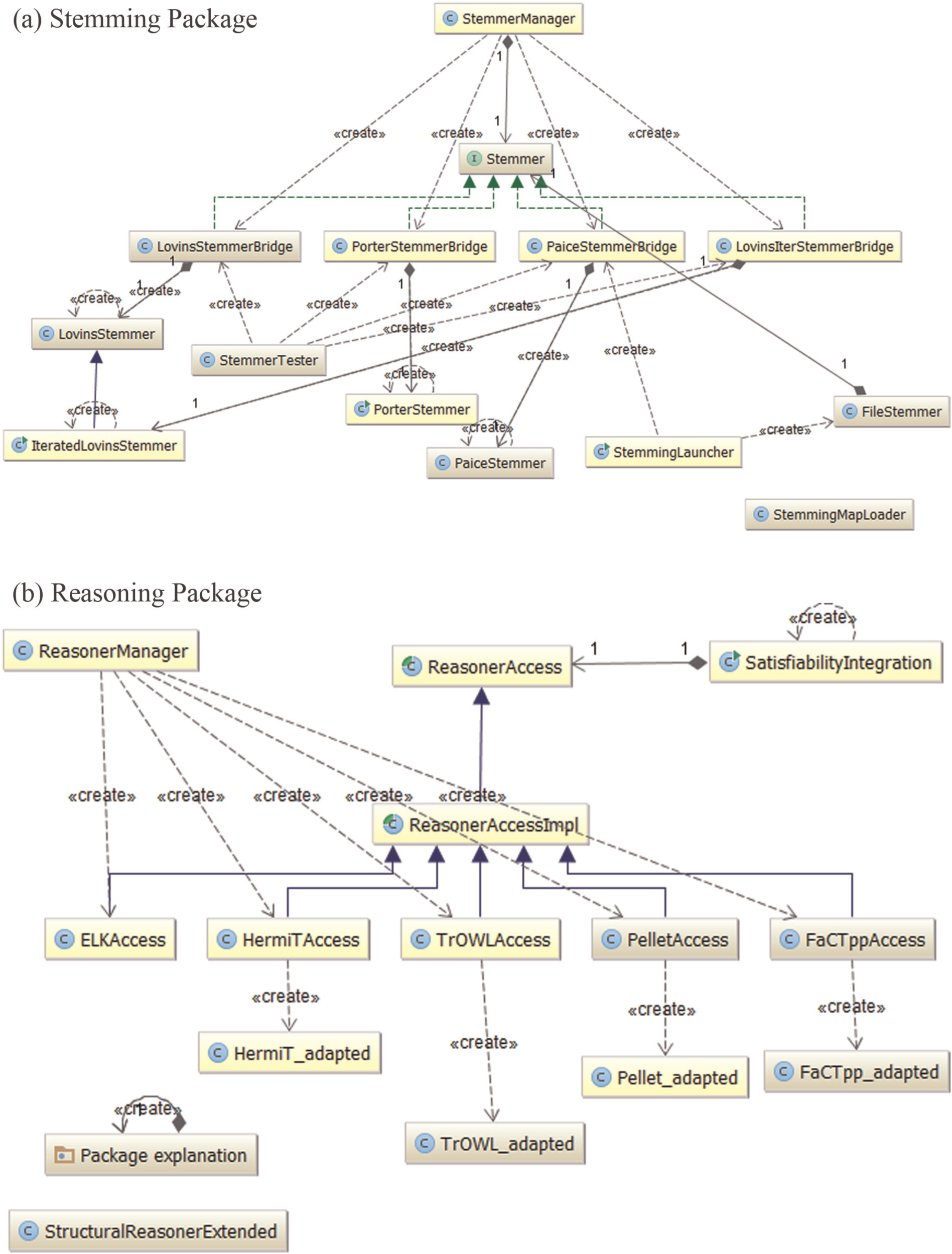
LogMap Class Diagrams: (a) Stemming Package and (b) Reasoning Package.
6.2. Number of polymorphic methods
The number of polymorphic methods in a class diagram determines the value for polymorphism. Therefore, in Figure 2, it can be observed that populateMBO() is the polymorphic method that returns the MBOStrategy instance. Therefore, the NOP in a class diagram is the level of polymorphism, which is 7 in the proposed system, as shown in equation (6). This suggests that the system has more extendibility by implementing only the populateMBO() polymorphic method.

The increase in composition and association of a class diagram results in high coupling and less polymorphism. The FALCON class diagram shows more composition and association relationships whereas the proposed system contains more polymorphic methods in the class diagram. Figure 8(a) shows the extended relationship to the AbstractMatcher class, which suggests that there may be a polymorphic method in the class diagram of FALCON system’s Package PBM, shown in Figure 8(b). Therefore, the maximum polymorphism value for FALCON system is 1, as shown in equation (7), which is less compared with the proposed system. A new bridge algorithm must implement the populateMBO() polymorphic method, thus increasing the polymorphism value. The LogMap system two packages polymorphism value is 5, as shown in equation (8), which is also less than the proposed system:


6.3. Rate of change
The key factor for a successful ontology-matching system is flexibility and extendibility based on new requirements. As new techniques and methodologies continuously evolve in the ontology-matching domain, measurement of RoC based on COF becomes necessary for evaluating the extendibility of the system. Therefore, RoC can be measured by equation (9), based on changes in the COF owing to addition of new classes and dependencies:

For testing the rate of change, we introduced unidirectional dependency of +1 in df and tc, so equations (2) and (3) are transformed to equations (10) and (11), respectively. In the same way LogMap’s equations (4) and (5) are transformed to equations (12) and (13) respectively:


The proposed system’s RoC is considerably less than those for the FALCON and LogMap systems, which shows the extendibility and reusability features of our system and easy adaptation of new changes. Equations (14) and (15) show that the proposed system has the better capacity to accommodate any changes in the system design as compared with the FALCON system. LogMap’s Stemming package has higher RoC while the Reasoning package has less RoC value as compared with the proposed system’s RoC value. The RoC values for these packages are shown in equations (16) and (17):


6.4. Discussion
Extendibility and reusability are the two main metrics for evaluation of the proposed system. These are discussed in relation to polymorphism and coupling of the proposed system measured in the previous subsections.
6.4.1. Extendibility
Extendibility is one of the evaluation metrics of the proposed system. A new bridge algorithm can easily be accommodated in the system design with low coupling, high polymorphism and lower rate of change as explained in previous section. This is achieved by using strategy design pattern with the PRMs. The new bridge algorithm only needs to implement the interface. We consider as a scenario that a new bridge is introduced that is based on instance-based matching, called the Instance Matching Bridge. InstancePRM is connected to the PRM in the MBO representation view that deals with actual representation of the alignment. A class InstancePattern will implement the MBOStrategy interface class and provide its reference information to the ConcreteMediator class. Therefore, its tuple metrics information is as follows:
IF: An algorithm to match source and target concepts based on instance comparison.
IN: InstancePRM and InstancePattern classes to be added in the class diagram to support extendibility. This algorithm resolves specific problems and only needs to implement an interface.
Q: <polymorphism, increased>.
S: Source Concept that belongs to the matching source ontology.
T: Target Concept that belongs to the matching target ontology.
A: Instances of source and target concepts.
EC: Specific number of instance matches that source and target concepts are similar. A threshold value n should be achieved by the number of instances matched.
MV: A value between 0 and 1 that is based on instances matched.
6.4.2. Reusability
A new bridge algorithm can be added to the system that can utilize existing bridge algorithms. Mediation between the new and existing bridges is performed using mediator design pattern and PRMs. For example, a new bridge called Hyponym Bridge is introduced that uses CBSB and PBSB together to find matching concepts. HyponymPRM is connected to PRM in the MBO representation view, and the HyponymPattern class is also introduced to implement the MBOStrategy interface class and provide reference to the ConcreteMediator class. Tuple information is as follows:
IF: An algorithm to match source and target concepts based on existing CBSB and PBSB algorithms.
IN: HyponymPRM and HyponymPattern classes to be added in the class diagram for reusability.
Q: <coupling, decrease>.
S: Source Concept that belongs to the matching source ontology.
T: Target Concept that belongs to the matching target ontology.
A: Children and properties match of the matching concepts.
EC: A specific number of children and properties match for source and target concepts match.
MV: A value between 0 and 1 that is based on CBSB and PBSB results match.
These metrics enable easy integration of new bridge algorithms into the system that prolongs the system lifetime. State of the art matching techniques and new methodologies can be plugged-and-played into the proposed system, without disturbing the design of the system.
7. Conclusion and future work
Expressiveness in formal representation of alignments and the use of object-oriented and ontology-alignment design patterns prolongs the duration of use of ontology-matching systems. The proposed MBO approach uses Strategy and Mediator object-oriented design patterns with ontology-alignment design patterns, PRM, to support the extendibility and reusability aspects of the SPHeRe system. Evolution in matching techniques or the introduction of new bridge algorithms is made convenient by the proposed approach, and therefore is suitable for adoption by the ontology-matching community.
The effectiveness of the alignments stored in the MBO can be measured by evaluating a case study for transformation process between two ontologies of the same domain. Our objective is to match two medical standard-based ontologies with SPHeRe, store the alignments in the MBO and finally use those alignments for transformation from one medical standard ontology to another related to the same domain.
Footnotes
Acknowledgements
This work was supported by a post-doctoral fellowship grant from the Kyung Hee University Korea in 2011 (KHU-20110219).
Funding
This work was supported by a post-doctoral fellowship grant from the Kyung Hee University Korea in 2011 (KHU-20110219).