







Abstract
Agent-based model (ABM) is a branch of artificial intelligence. Its specialty is to construct a complex macro-system model by describing the perception, decision, learning and action of micro-agents. This method is widely used in many fields from natural science to social science. We discuss ABM by collecting relevant academic papers which apply to the field of Library and Information Science (LIS). This article systematically reviews how ABM is applied to the LIS field and argues that ABM can provide an exploratory tool with quantifiability, repeatability, interpretability, contingency, adaptability and other types of advantages. Finally, it is pointed out that this method is a research tool worthy of careful exploration.
1. Introduction
Agent-based model (also called multi-agent system, abbreviated as ABM in this article) is based on the theory of complex adaptive system, and it is an important branch of artificial intelligence research. Because of its more powerful functions, lower cost and better robustness, this method has attracted the attention of researchers in many fields. ABMs are mainly used in the field of computer science in the early stage [1–3]. The well-known ‘life game’ can also be classified as the rudiment of ABMs. Russell and Norvig [4] introduced the concept of rational agent in the classic book of artificial intelligence: a modern approach. In this book, the rational agent is considered as one of the cores of artificial intelligence methods. Its specialty is to portray the complex macro-system model by depicting the perception, decision-making, learning and action of micro-agents. Its main feature is that agents can sense the environment through sensors, carry out a series of simple or complex calculations according to preset rules, and influence the environment through actuators. For a simple example, a robot senses the external environment through infrared, light, temperature or other sensors, and completes the action through the mechanical structure. The whole system of perception, analysis and feedback of the robot can be regarded as a complete agent. Furthermore, human beings can understand the external situation through vision, touch and other senses, and can analyse the situation based on the existing knowledge, and finally can use muscles and bones to complete the action according to their own analysis and judgement. In this process, human beings can be also regarded as independent agents. This means that agents can simulate human behaviour to a certain extent.
Then, ABM has been gradually introduced into the fields of ecological science and geographical science. And even because of its good complex social simulation ability, it has gradually become an important research method of social science [5–7]. Up to now, the application of ABM in Library and Information Science (LIS) has just been emerging, although ABM has made contributions in many fields of social science. In the field of social science, if human individual behaviour is simplified to perception, analysis and execution, individual behaviour can be regarded as a simple agent. For example, in a study of rumour spreading, individual human beings, who stop spreading or continue spreading through distinguishing the true and false, are simplified as an independent agent [8]. On this basis, we can build thousands, millions or even more independent agents to simulate the simple social behaviour of rumour spreading. Furthermore, if the independent agents are given different ‘personalities’ (the probability of continuing to spread information after identifying false messages is different), each individual has different abilities to distinguish the true from the false (the probability of identifying false messages is different), and even more uncertain probability, the complex social behaviour of rumour spreading can be simulated. The traditional simulation uses ‘the probability of an event in a group is P’ to describe the uncertainty, and its probability is the description of the whole group, and its simulation results can only observe the macro-phenomenon of the group; by comparison, ABM can use ‘In a certain group, the probability of Agent-a happening an event is Pa, the probability of Agent-b happening an event is Pb, the probability of Agent-c happening …’. In this kind of study of uncertainty problems, ABM has advantages over traditional simulation. The probability is the description of each individual in the group, and the simulation results can be traced back to the specific characteristics, behaviours and emotions of each individual, which has a good internal interpretation. This characteristic is often called ‘heterogeneity’ that is agents can have a variety of different risk preferences, internal or external attributes, behaviour patterns and so on. And even, ABM allows agents to switch between different behaviour patterns, for achieving dynamic game or evolution. However, it is very difficult to solve this complex multi-objective function in the past simulation research. This is one of the core advantages of ABM compared with the traditional simulation that is it does not need to solve complex functions.
The exploration of ABM for social behaviour is more than that. When agents have learning behaviour, the simulation value of ABM will reach a higher level. In the traditional simulation research, the group can only act according to the preset behaviour pattern, while each agent in the ABM can adjust its own behaviour pattern according to external stimulation or agent interaction. We still take the simulation study of rumour spreading as an example. Each agent will be rewarded and punished for the authenticity of information after spreading information, and then adjust its next information behaviour according to the feedback of reward and punishment (this is similar to machine learning because ABM is one of the core concepts of machine learning). For the social research with ‘human’ as the main body, the learning behaviour of agents is introduced to further improve the complexity of the simulation model. This is one of the key points of ABM and is also the main difference between ABM and traditional simulation. In the past, it is difficult to deal with the ‘social uncertainty’ (this kind of uncertainty also exists in LIS) through the traditional simulation method. The ABM, with its good internal interpretability, puts forward tentative solutions for these difficulties by ‘setting the uncertainty of individual agent’ [9], ‘simulating the whole social environment for many times’ [10], ‘analyzing the simulation results for many times’ [11] and ‘introducing agent learning behavior’ [12]. This article attempts to introduce ABM, explain its application in LIS subfields and discuss what changes ABM will bring to LIS.
2. What has ABM been done in LIS?
In this work, we collected the research papers using ABM in LIS and focused on the journal papers marked as ‘INFORMATION SCIENCE LIBRARY SCIENCE’ in Social Sciences Citation Index. There are many applications in Information Behaviour, Decision-Making, Information Economics, Scientometrics, Knowledge Management, Information System, Smart City and other fields. Nextly, this article will state how ABM is applied in these fields, and analyse its application characteristics in different fields.
2.1. Information behaviour
Information behaviour is a typical part of the LIS field, which usually focuses on the group behaviour on the Internet or public opinion when using ABM. Traditionally, researchers can describe behaviour characteristics of a specific group based on a small amount of data or a large amount of data. Most of their research is explanatory. ABM provides a new perspective, which can simulate group behaviour based on known causality or correlation. For example, Sela et al. [13] studied the network information dissemination by simulating the group information behaviour, and selected the real data of Twitter to conduct empirical research on the simulation. Dang et al. [14] simulated the propagation and diffusion of memes on social media, and discussed the effectiveness of the model with the help of real data. At the same time, ABM is not limited to real data. ABM, as a simulation method, has special advantages, when real data cannot be obtained. For example, Wang and Dong [15] based on the multicultural perspective, simulated the network public opinion space. ABM can also simulate the variables that are difficult to measure, such as culture and public opinion. Havakhor et al. [16] divided agents into seekers, contributors and brokers to study the knowledge diffusion model of social platforms. This kind of simulation experiment can only be completed in virtual space, and cannot be carried out in real social platforms. The preview of this solution is also based on the assumption of the future, and no real data can be obtained. Agent-based cannot be called a distinctive method, if it only stops at traditional simulation. The biggest feature of ABM is that it can focus on individuals and a few outliers. For example, Ross et al. [8] simulated the public opinion model of social networks, and believed that a few core nodes determine the direction of public opinion on the whole Internet, and only a few automatic robots are needed to guide or even overthrow the atmosphere of public opinion. ABM can be competent for this kind of experimental research on a few core nodes. Alvarez-Galvez [17] similarly studied the transmission law of minority opinion in social networks and emphasised the importance of core authority nodes in public opinion. Based on a crisis public relations case, Yu et al. [18] further discussed how the Chinese government can correctly guide public opinions and resolve the crisis. In the past, we can only explain the phenomenon through qualitative research, and ABM adds a quantitative research perspective for us. I believe that this is the biggest advantage of ABM in information behaviour.
2.2. Decision-making and policy science
Decision-making and policy science is also a typical research field in LIS. Manzo [19] believes that ABM is a powerful tool to study rational decision-making behaviour in decision science. Decision-making often needs to face the future. Ahrweiler [20] believes that there is a lack of a deterministic system to predict the effect of policy implementation when modelling policies in complex social systems. However, agent-based simulation provides the possibility for policy modelling. For example, Sun et al. [21] proposed a model of science and technology cooperation based on a variety of open bibliographic databases, and based on the model, simulated the dynamics of science and technology cooperation, and predicted the future science and technology behaviour. Potluri et al. [22] simulated the economic behaviour under the premise of ‘data localisation’, regarded data producers and consumers as agents that can make decisions independently, and analysed the interaction under different states for policy-makers’ reference. Heshmati and Lenz-Cesar [23] discussed various factors affecting innovation cooperation, and simulated innovation incentive policies of enterprise cooperation. This article believes that ABMs have great potential in the support system of decision-makers. In the previous quantitative model, researchers can only see the macro-model abstracted by countless individuals. Agent method can accurately simulate the individual. Bloodgood and Clough [24] think that agent-based has flexibility, emphasises the relationship between participants, and is suitable for simulating transnational events of non-governmental organisations. In addition, ABM can be simulated repeatedly by adjusting parameters. Seagren [25] discussed the political, financial and economic competition based on different policies under the decision-making process of local governments. Generally speaking, agent-based provides a new tool for policy research by predicting individual behaviour and simulating policy implementation.
2.3. Information economics
Information economics is also an important branch of LIS. It is often combined with other fields when using ABM in this field. For example, Kwon et al. [26] extensively collected the consumption behaviour data of online communities, built a behaviour simulation model based on its characteristics, and used real data to empirically test the simulation model. Majd and Hobson [27] combined with information behaviour to propose a multi-agent system model in the field ofe-commerce, trying to identify malicious service or malicious comment agents, and solve the trust problem between users and merchants. Another example is the combination with Decision Science. Gopal et al. [28] simulated the profit and loss results of different strategic directions, faced on business strategy for information technology service providers. The largest amount of research is still focused on economics itself. Giulioni [29] studied the simulation of commodity market trading. They proposed several trading behaviour models, which were integrated into an open-source software to share. Basaure et al. [30] simulated the market dynamics of various mechanisms for the transaction cost and switching cost of mobile communication market. Moreover, ABM can deal with irrational economic behaviour research. Bouayad et al. [31] designed the role of ‘sentinel’ in the audit system as a mutation value to explore the selection and change of other participants in the audit system. More importantly, ABM can also focus on randomness. Lee et al. [32] focused randomness of the customers’ taking taxis behaviour of online service, and made more extensive conclusions when simulating random behaviour under the same model. The ABM has obvious advantages in the research of randomness problems.
2.4. Scientometrics
Scientometrics is a traditional research field in LIS. However, the application of ABM in scientometrics is not common except for some special fields. In the field of scientometrics, due to the support of Web of Science, Engineering Village, Google Academic and other data platforms, the data are more standardised and are easier to obtain, which makes the use of agent-based less. However, if we expand the scope of scientometrics, the research of peer review will be promising. Peer review is another important area in which agent-based can play its role. For a long time, there are many problems in peer review–related research, such as difficulty to obtain data, difficulty to quantify variables, and high randomness of related subjects. Righi and Takacs [33] introduced the ABM into the field of peer review, regarded contributors and reviewers as agents, and set up a reputation-related incentive mechanism. By simulating peer review behaviour, they [33] discussed how to motivate reviewers to complete peer review efficiently. Feliciani et al. [34] constructed several peer-reviewed behaviour models. The author believes that the simulation model can better solve the problems of diversity, complexity, lack of data and cost. Bianchi et al. [35] regarded peer review as a cooperative game. Simulating the cooperative game, they evaluated the impact of different resource allocations on peer review, and then analysed the impact of policy-making on peer review. Grimaldo et al. [36] used ABM to simulate the behaviour of journals receiving high-quality articles, and especially discussed the influence of outliers on peer review and journal word-of-mouth. García’s and Chamorro-Padial’s team [37–39] published papers three times, analysing how editors’ preferences affect contributors in 2015, explaining why assassins and zealots evolutionary appear in peer review in 2019, and discussing the shortcomings of peer review incentive system in 2020. They [39] synthesised various problems in peer review and tried to design a system to encourage high-quality peer review. Kovanis et al. [40,41] regarded scientific publishing and peer review as a complete social system. Simulating its evolution process, they [40,41] compared and simulated several alternative systems of peer review from the aspects of whether it was published immediately, whether it was an online review and whether it was a round of review.
2.5. Knowledge management
In the field of Knowledge Management, ABM is often used to build knowledge networks. Zhao et al. [42] simulated the process of knowledge creation and dissemination by building an enterprise patent cooperation network, but the ‘agent’ in their analysis is only a node or subnet in the cooperation network, which does not have the ability of independent decision-making and is not an agent in the strict sense. Zhao et al. [43] constructed a knowledge network including random initial node distribution, preferential attachment and openness of knowledge network boundaries, and tried to explore the resistance of knowledge network using different forms of malicious attack knowledge network. Zhao et al. [44] also studied four types of resource allocation, which are used to simulate the evolution mechanism of strategic alliance under various knowledge networks. Research related to knowledge will be really difficult if ‘knowledge’ lacks a measurable objective carrier. ABM provides a potential solution for this kind of research works. Żytniewski [45] and Grzonka et al. [46] use the multi-agent modelling method to treat each member on the enterprise knowledge management network as an agent and simulate the decision-making process in the knowledge management network. Lei and Wang [47] simulated the information behaviour of knowledge learning, knowledge sharing and knowledge transfer within the enterprise for enterprise knowledge management. Gilbert et al. [48] constructed a virtual environment of enterprise cooperation and competition, and realised the simulation of enterprise behaviour such as innovation, learning and R & D. At the same time, Qiao et al. [49] divided the identities in knowledge dissemination behaviour into three categories, including seekers, contributors and brokers. Based on three knowledge selection mechanisms and four knowledge network structures, the agent-based simulation of knowledge dissemination was realised. Li et al. [50] studied the dissemination behaviour of tacit knowledge, assigned the concepts of trust and honesty which are difficult to measure, and discussed the mutually beneficial cooperation behaviour of sharing tacit knowledge. Zamzami and Schiffauerova [51] studied the knowledge network in the process of scientist collaboration, and discussed how scientists promote innovation and creation through knowledge sharing and dissemination.
2.6. Information system
In the aspect of information system design and development, agent-based can also play an important role. First, ABM can assist the system to allocate resources dynamically. For example, Wautelet et al. [52] introduced a multi-agent system to dynamically allocate beds in the hospital management information system, which enhanced the utilisation efficiency of resources. Malgonde et al. [53] designed a digital multisided platform using the agent-ABM. And then, they dynamically simulated the specific situation of the network education platform and a two-sided advisor system. They hold that ABM is an important combination of complexity science and information system research. Zhang et al. [54] simulated recommendation system and studied various factors affecting system performance. We argued that the algorithm provides a new attempt, which cannot be achieved in real-world experiments. Second, agent-based is helpful to improve the level of human–computer interaction. For example, Laranjo et al. [55] reviewed the use of agent simulation dialogue in a medical management system, and argued that unconstrained agent-based natural language processing will be an important direction of system development. Anizi et al. [56] introduced ABM in the field of information retrieval, trying to build an Arabic information retrieval platform. Finally, Anthony et al. [57] regarded agent-based as an intelligent development method, and regarded every department in the workflow of their data centre as one or more agents to complete the development of information systems.
2.7. City management
Smart city is a new cross-field, and the application of ABM in this field should not be underestimated. First, ABM can simulate the use, planning and management of land resources. For example, Şalap-Ayça et al. [58] used cellular automata to analyse the relationship between population growth and urban land use. Second, ABM can simulate the behaviour of urban residents and the law of population flow, and provide support for urban management. Bartie and Mackaness [59] discussed how to set urban observation facilities according to the distribution track of vehicles and pedestrians. Third, ABM can be used to discuss complex urban resource allocation and other related issues. For example, Lom and Přibyl [60] proposed a smart city evaluation framework (SMACEF) for smart city based on multi-agent systems. Taking electric vehicles as an example, each subsystem in the city was regarded as an agent, and the dynamic game scenarios of charging facilities, charging vehicles, electricity price and other factors were studied. Zakrajšek and Vodeb [61] used the agent-based modelling method to simulate the complex urban environment, analysed the location of the library, and implemented and tested it in Slovenia. Vermeiren et al. [62] discussed the contradiction between urban expansion and social isolation based on the needs of vulnerable groups in public facilities and services. Fourth, all kinds of epidemics and natural disasters occur from time to time, and emergency management has become a research field that cannot be ignored. Yang et al. [63] used ‘Home Workplace neighborhood’ to simulate social space, and on this basis, explored the evacuation scenarios of private cars and public transport when the hurricane came. Anderson and Dragićević [64] developed new works for NEtworks for ABM Testing, which combines geographic information system, ABM and spatial network representation to simulate complex systems that are not measurable as measurable states. ‘City’, as a specific research object, provides agent activity space and makes ABM well applied.
2.8. Others in LIS
In addition to the above-mentioned areas, there are a few studies that are difficult to classify. For example, Miller and Page [65] introduced ABM for complex systems in Social Sciences, which is helpful for heterogeneous social behaviour research. Lin et al. [66] built a digital model and designed a distributed agent information system for the topography of loess high slope in China. Tobias and Mosler [67] divided individual daily behaviour into multiple steps, and simulated the implementation of different steps to discuss the impact of small changes on daily behaviour. Haki et al. [68] discussed the evolution path of an information system with the method of simulation. They argued that the simulation experiment was helpful to inspire researchers’ ideas. Generally speaking, the application of ABM in LIS is extensive and complex.
3. The application of ABMs in LIS
For the application of ABM, we try to sort out and summarise the above research fields. As shown in Table 1, it can be seen that the applicability of this method is relatively clear:
ABM application in subfields of LIS.
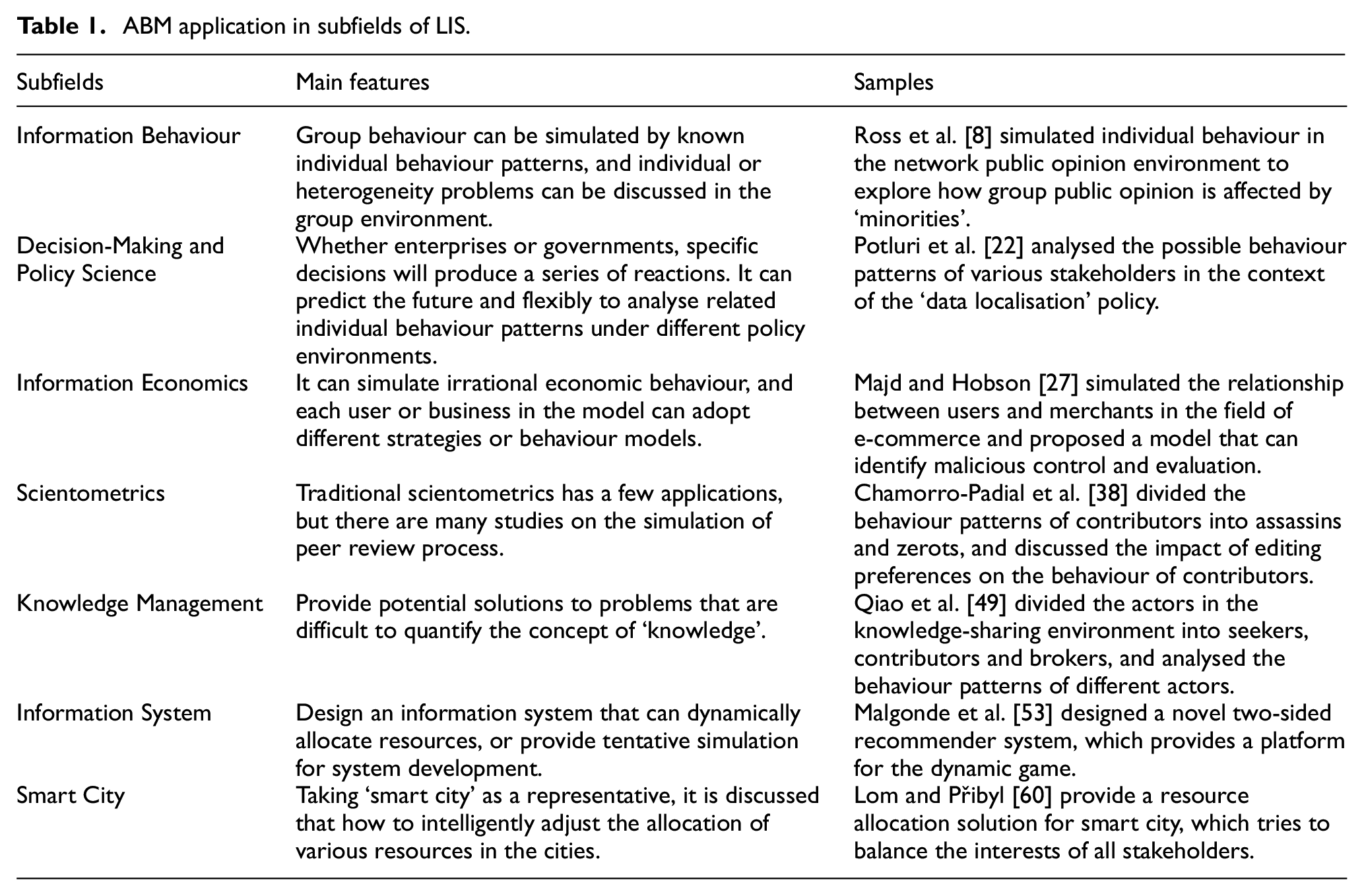
In the field of information behaviour, it is mainly used for group behaviour of online community, or individual information communication mode, to study public opinion.
In the field of decision-making and Policy Science, it is mainly used to simulate the effect of policy implementation repeatedly, predict the future trend based on the current situation, or study the accidental changes, and then assist rational decision-making.
In the field of information economics, it is mainly used to trace the irrational individual economic behaviour, or to study the evolution of long-term and unbalanced market laws, and to build a complex adaptive system.
In the field of scientometrics, it is mainly used for the construction of knowledge network. Due to the good standardisation and high availability of scientific data, there is no specific application direction in the construction of knowledge network. But in the field of scientometrics, there is a special application field peer review. By simulating the behaviour of contributors, reviewers, editors and other stakeholders, this article explores the problems of system design in peer review.
In the field of knowledge management, it is mainly used for enterprises to build their own tacit knowledge network, solve the problem that ‘knowledge’ is difficult to quantify, and study the creation, dissemination, sharing and utilisation of certain problems.
In the field of information systems, it is mainly used to solve the problem of resource allocation in system design and machine learning model training in the process of system development.
In the field of smart city, it is mainly used to solve the allocation of population, land and infrastructure in urban space. This method is often combined with GIS to solve complex non-linear problems.
In the above research areas, most of the problems that ABMs aim at are difficult to quantify, need to repeat social experiments, need to observe micro-individuals, need to capture contingency, need to have adaptability and other types of problems.
4. What are the advantages of ABM?
ABM will flourish in various disciplines [29], and be applied to many research fields of LIS. There are several advantages of ABM (compared with traditional simulation methods), such as Table 2:
Advantage of ABM.
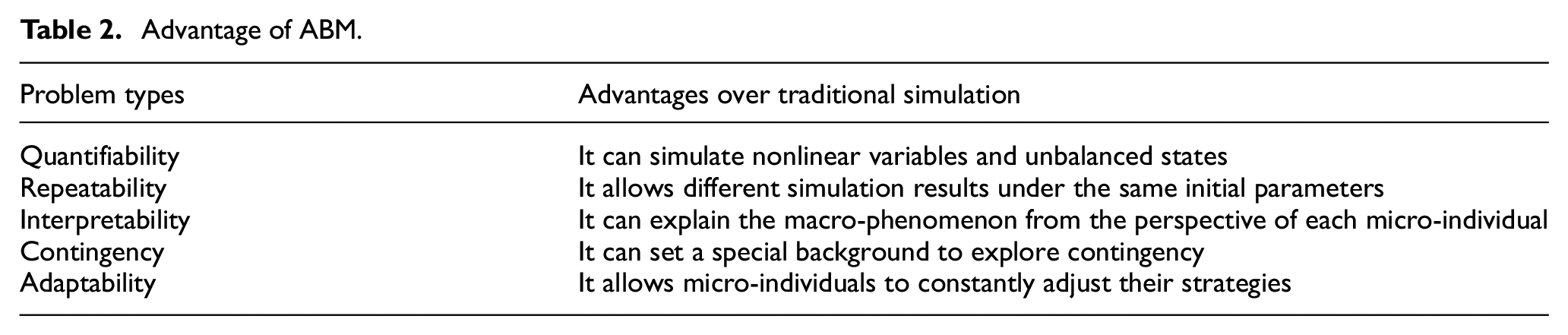
Quantifiability: as a kind of simulation method, agent-based has many common advantages of simulation research. Virtual simulation can provide an experimental condition of natural control variables when researchers are difficult to obtain real data but have to study a practical problem. Gilbert et al. [48] emphasised that the advantage of multi-agent simulation lies in its ability to simulate social experiments that cannot be implemented or are inconvenient to implement in reality. For example, previous social studies (especially economic studies) often need to make the hypothesis of ‘rational person’, and many simulation experiments of ‘limited rationality’ are difficult to quantify. The agents in ABM are a limited rational decision-making unit, which is incomplete in information acquisition and is not only from the interests under decision-making. Involving these difficulties in information behaviour and information economy, agent-based can set parameters to deal with this problem and become an alternative way.
Repeatability: ABM is essentially a data experiment, which is repeatable. For a long time, the experiment based on ‘human’ in social science is complex, and it is difficult to prove the reliability of the conclusion through repeated experiments like natural experiments. ABM can not only research ‘human’ but also verify the conclusion through many experiments. For example, in the research of science and technology policy, because the social process is irreversible, many policies can only have one decision-making opportunity, while agent-based research provides multiple simulation opportunities. In addition, because the agent supports uncertain behaviour (the behaviour of the agent can change with external stimuli, and may adopt different strategies in the face of the same external environment), the same initial parameters can produce different simulation results. It may bring a new observation perspective when we repeat this simulation hundreds of times [11].
Interpretability: the biggest difference between ABM and previous simulation research is that ABM is modelled from bottom to top, which can carry out relatively complex simulations and even observe every detail in the process of model evolution. Researchers can not only pay attention to the macro-trend of simulation evolution but also pay attention to the evolution process of each micro-individual based on multi-agent [69]. For example, in the research of R and D investment and industrial clusters, it is difficult to pay attention to each individual’s specific activities in the past. Multi-agent simulation provides a tool for this observation.
Contingency: the ‘black swan’ event is a difficult problem in any field, but agent-based provides a tool to challenge this kind of difficult problem. The ‘agent’ perspective emphasises the essential characteristics of autonomous behaviour and requires agents to be active responders and planners, rather than purely passive components [70]. When a large number of autonomous agents appear in the model, various unexpected results may appear in the repeated simulation, which provides an exploration basis for the research of small probability events. When the complexity is high enough and there are a large number of probabilistic behaviours among agents, it is possible to get different results based on the same initial parameters. When the experiment is iterated for thousands or even tens of thousands of times, the black swan event will be more controlled. The controlled contingency situation will provide support for our research.
Adaptability: ABM constructs a macro-adaptive system by describing the learning behaviour of micro-agents, and upgrades a complex system to a complex adaptive system, which is an important advantage over traditional simulation [71]. We can think of the whole system as a set of micro-artificial intelligence interactions. Agents can constantly adjust their behaviour according to the changes of external stimuli, to bring the ability to analyse complex phenomena to the model [72]. In a complex adaptive system, agents constantly modify their own attributes or strategies by communicating with each other or accepting external environmental stimuli. This can drive the system to show a certain law (as long as the law is concerned) at the macro-level and on a larger time scale.
All the above characteristics can be summarised as the requirements for the complexity of the simulation system. Agent-based simulation can trace every tiny internal evolution and be compatible with many nonlinear [73], chaotic [74] and unbalanced [75] models. Each agent can respond to external stimuli, and the function model supporting its response can be complex (as long as it can provide enough reasonable reasons). For example, in the past information economics, many studies need to rely on mathematical means such as equation solving or differential derivation. When the complexity exceeds a certain limit, the solution process will become very difficult. However, the ABM does not need a complex solution process, and it only needs statistical analysis of multiple agents in multiple evolutions.
5. Where will ABM develop to?
It should be noted that the ABM is not perfect, and there are many noticeable problems when it is applied in LIS:
The orientation of the method: the relationship between agent-based research and traditional empirical research should be complementary rather than substitutable. Traditional empirical research explores simple causality or correlation by controlling variables. Based on traditional research, agent-based is better at integrating some simple causal relationships into a ‘large system’ with complex causal relationships. In other words, the two are a connecting link. Causality analysis in traditional methods is the cornerstone of ABM, and ABM is based on it to deepen the discussion of complex problems.
Use of data: agent-based research will produce a large amount of data in the process of evolution. It should be noted that, after all, these data are ‘false data’. Researchers still need to fit these ‘false data’ with real data as much as possible, although it is very difficult [14] because many researchers just cannot get the real data [76], they will save the ABM. In any case, it should be clear that simulation experiment is an alternative, rather than the main means, when real data cannot be obtained or the cost of obtaining real data is too high. If there is no real data support, ABM will not be suitable for empirical research on specific assumptions, but more suitable for research on complex theories of predictive research.
Technology burden: ABM is a branch of artificial intelligence simulation, which has certain technical requirements for researchers and readers. At the same time, when it comes to the evolution of complex systems, it also needs to rely on a larger capacity of data storage devices and a higher level of logic capabilities. Although there are relatively convenient development tools such as Netlogo, its access threshold is still not too low. ABM research is not friendly to researchers or readers in the LIS field or even many social science fields. Therefore, it is necessary to help researchers correctly use this method and readers correctly understand this method.
6. Conclusion
ABM is different from the top-down modelling idea, which is a bottom-up modelling method. It brings a new simulation perspective to the research work. At present, the core advantage of ABM lies in the simulation of a complex and uncertain environment. In complex environment simulation, we need to have a certain understanding of the behaviour logic of individual agents. This makes researchers generally need to do agent-based simulation research based on causal research (whether others or their own). This method has high requirements for theoretical reserves and technical ability, especially for the researchers who use this method for the first time. It is a great challenge to use this method to solve practical problems, and we need to avoid misuse and abuse of the method as far as possible. Generally speaking, agent-based is a method worthy of careful promotion and exploration in the face of highly uncertain and complex problems in LIS.
Footnotes
Declaration of conflicting interests
The author(s) declared no potential conflicts of interest with respect to the research, authorship and/or publication of this article.
Funding
The author(s) disclosed receipt of the following financial support for the research, authorship, and/or publication of this article: This article was financially supported by Chinese National Social Science Funding (No: 20&ZD332).
