







Abstract
Gender equality in scientific research has gradually attracted attention from many countries. However, the possible interaction effect of gender on research funding has not been fully disclosed. This study conducts an empirical study to examine the possible influences of gender on research funding and its interaction effect with applicants’ social influences, including their external cumulative advantages (Matthew effect) and internal cognition (halo effect). In total, 1465 research projects from 2015 to 2021 are analysed to examine the proposed hypotheses. The results reveal that there is no gender inequality in the association between the Matthew effect and future research funding. However, the halo effect is easily affected by gender. For male scientists, higher institutional reputation and past research performance lead to higher future research funding. However, female scientists have no such benefits. According to the findings, this study suggests that female scientists should give priority to accumulating their own external resource advantages and participate in academic activities more frequently to activate women’s participation in scientific research and academia.
1. Introduction
In prior studies, scholars have been proven to possess intangible capital and influence. Scholars with outstanding research achievements (e.g. Nobel Prize winners) often receive more attention and attract other scholars to cite their articles [1]. Liao [2,3] further divides this intangible influence into two categories. One is the Matthew effect, which refers to the fact that outstanding scholars have better resources and cumulative advantages in the academic field, so they can apply resources to enlarge their advantages and resources in the future, resulting in a positive cycle. The other is the halo effect, which reflects that people are usually affected by the first impression derived from outstanding scholars. They are recognised for their outstanding academic achievements, so their works are easily affected by reputation and recognised as high-quality research.
However, such intangible influences have not yet been fully exposed. Specifically, the Matthew effect has pointed out that in the same research team, female scientists often receive lesser recognition of their achievements than men [4]. The Matthew effect seems to be affected by gender. In this vein, this study attempts to explore whether the Matthew effect and the halo effect will be moderated by gender in applying research funding. The motivation for choosing research funding is that gender equality under scientific research has gradually attracted attention from many countries, including the Netherlands [5], China [6], Czech Republic [7] and other European countries [8]. These countries have provided policies to encourage women scientists to participate in science, including nurturing female talents, increasing the proportion of women scientists in research projects, encouraging innovation and entrepreneurship, increasing their job opportunities and so on. Among them, research funding plays an important part in these policies; it is also a popular topic which many researchers concerned. Research funding is closely associated with the competitiveness of scholars, institutions and governments [9]. However, the factors that influence approved research funding are complex. To follow this research trend and uncover more unknown associations, this study attempts to explore the gender issue in research funding. The findings of this study are not only helpful for scholars and institutions but also contribute to improving funding policies, thereby increasing participation opportunities for female scientists.
The structure of this study is organised as follows. The following section describes the related literature, including the Matthew effect, the halo effect, research funding and gender inequality. Next, this study proposes a research model from the perspective of gender inequality and explains the procedure of data collection. The study is conducted to predict proposed associations between two effects and future research funding so that the time periods of data collection are entirely separated. Finally, the hypothesised associations are examined by using regression analysis. The findings and implications are explained as well. To meet the research purpose, the specific research questions of this study are as follows:
RQ1. Does gender inequality exist in the impact of the Matthew effect on research funding?
RQ2. Does gender inequality exist in the impact of the halo effect on research funding?
2. Related literature and hypothesis development
2.1. Gender inequality
Social inequality refers to the phenomenon caused by the unfair distribution of resources in society. This phenomenon may be caused by factors such as social hierarchy, race, gender and so on, causing unfair access to resources, rights or power [10]. Taking gender as an example, gender difference refers to the difference in distribution between men and women, such as productivity, performance and wage [11]. However, the persistence of these gender differences might incrementally shape people’s preferences, stereotypes and societal bias [12]. For instance, men in the workplace usually give the impression of being confident, decisive, ambitious and aggressive, while women are considered enthusiastic, passive, emotional and friendly. These are gender stereotypes and bias [13]. As women are chronically underrepresented in many areas, the effects of gender bias accumulate over time, shaping gender inequality [14]. In this study, gender inequality is defined as the uneven distribution of research funding between men and women scientists, following the measurement from past study [7].
Since the 1990s, gender equality has gradually received attention. Women’s social status has gradually become the same as men’s. Although many countries have begun to advocate equality between men and women, thus far, this inequality has not been eliminated. In Canada, there is still gender inequality in obtaining temporary jobs [15]. In addition, gender inequality has been questioned in terms of salary income [16], corporate entrepreneurship [17] and allocation of research funding [18]. Fortunately, education can help eliminate inequality between men and women. In higher education, most educational systems adopt a resistant and critical attitude to social and gender inequality. Therefore, regardless of whether men or women are involved, education will affect their cognition and values and thus increase the perception of gender equality [19]. Nevertheless, education alone cannot promote consensus on gender inequality. It requires the participation and promotion of government and academic institutions to reduce inequality and negative effects in society.
2.2. Research funding
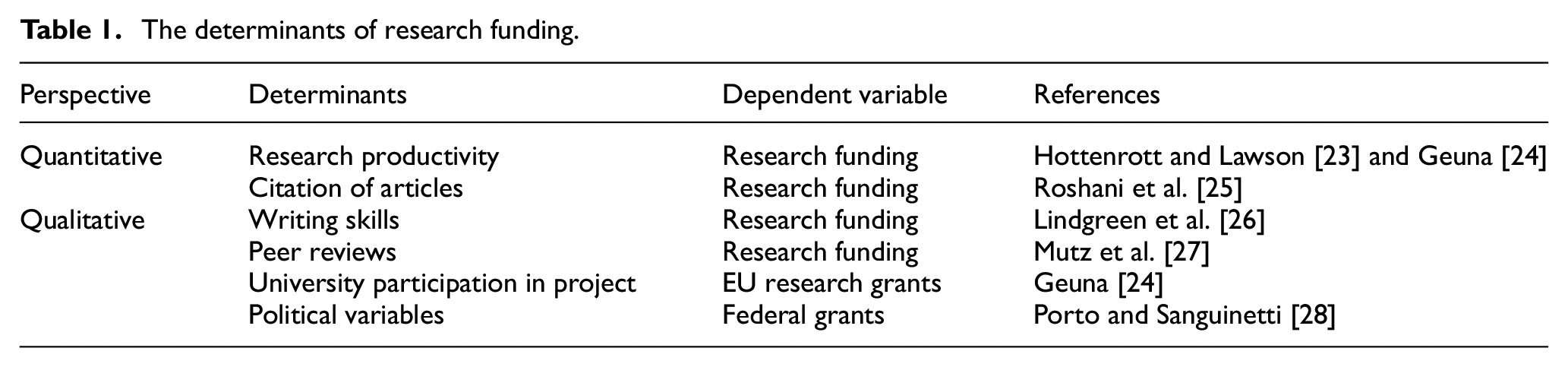
Obtaining more research funding will help improve an individual’s research performance [20] and increase opportunities for industrial cooperation [21] and international research collaboration [22]. Therefore, investment in research funding is related to the competitiveness of scholars, academic institutions and national scientific research [9]. However, the factors that influence approved research funding are complex, including both quantitative and qualitative perspectives. The relevant literature about the determinants of research funding is illustrated in Table 1. To uncover more unknown associations among research funding, the Matthew effect, the halo effect, research funding and gender issue, the detailed hypotheses development are discussed below.
The determinants of research funding.
2.3. Matthew effect in research funding
The Matthew effect is defined as recognition for a reward system that is more easily attributed to scientists already recognised than to lesser known scientists [22]. The concept of the Matthew effect is based on the process of cumulative advantage in science, resulting in a case of ‘the rich get richer’ [29], quoting the Gospel according to St. Matthew: ‘For to all those who have, more will be given, and they will have an abundance; but from those who have nothing, even what they have will be taken away’. Therefore, scientists already funded are more probably to be rewarded with more funding in the future [30]. Evidence of the Matthew effect has been found in economic performance [31], education [32] and scientific performance [22,33].
As mentioned, the concept of the Matthew effect refers to the degree of cumulative advantage. Hence, cumulative resources or advantages in the past are often treated as the manifestation of the Matthew effect, including early career funding and resources. For instance, Bol et al. [34] analyse academic funding programmes in the Netherlands and treat early career academic funding as the anchor of the Matthew effect. Their results show that funding winners accumulate more than two times more funding than nonwinners, indicating that scientists who have previously been successful are more probably to succeed again. Likewise, Liao [3] adopts past research projects and research funding to investigate the impact of the Matthew effect on future research funding. Following these statements, this study also treats the Matthew effect as (1) the number of past research projects and (2) the amount of past research funding.
Most importantly, Rossiter [4] points out that the Matthew effect reflects a phenomenon that scientists who have no scientific history have generally not been recognised, especially women in science. This effect is a bias against acknowledging the achievements of women scientists whose work is attributed to their male colleagues. Fiorentin et al. [35] divide this bias into two barriers, including entry and persistency barriers for funding. They found that both barriers exist in Argentina. Specifically, for entry barriers, female scientists have lower probabilities of being selected for the first time than their male counterparts. For persistency barriers, male scientists are more probably to be granted again when granted before. In addition, Zhou et al. [36] demonstrate substantial differences in cancer research investment awarded by gender. Female scientists clearly and consistently receive less funding than their male counterparts in terms of total investment. Based on these statements above, it may reflect that men tend to easily accumulate more external advantages than women. To further confirm this viewpoint and investigate whether gender inequality exists in the impact of the Matthew effect on research funding, this study predicts the following:
H1. Gender inequality exists in the impact of the Matthew effect on research funding.
H1a. Gender inequality exists in the impact of past research projects on future research funding.
H1b. Gender inequality exists in the impact of past research funding on future research funding.
2.4. Halo effect in research funding
The halo effect is a cognitive bias whereby people form an opinion based on their predisposition [37]. This predisposition may come from overall impression, past impression and global evaluation. The concept is that supervisors seemed unable to rate their subordinates independently on different attributes. Rather, supervisors’ ratings exhibit a consistently high correlation with their overall impression of the subordinate being rated [38]. When supervisors cannot evaluate each attribute in isolation or evaluation attributes are difficult to obtain, the evaluation may be influenced by experience attributes that are easier to recall, resulting in a halo effect [39]. The notion of the halo effect originates in the field of psychology, but its influence has been proven in education [40], business [41,42], marketing [43] and so on.
Based on the discussion above, the halo effect is determined by global evaluation and first impression, and its measurement is usually linked with prestige, reputation and impression by prior performance. Specifically, reputation can be separated on different levels, including the personal level and organisational level. At the personal level, the individual reputation of Nobel laureates is regarded as a manifestation of the halo effect, which is beneficial for obtaining other research awards [44] and attracting research collaboration [45]. At the organisational level, firm reputation and university prestige are also treated as sources of reputation from the halo effect, affecting firm ratings by industry experts [46] and university inventions by sponsors [47]. In addition, based on the definition of the halo effect, the overall evaluation of a person is usually generalised into the impression and past performance of the person. That is, prior performance is measured as part of the halo effect as well [3,48]. Therefore, in the context of research funding, (1) research awards (personal reputation), (2) institutional reputation (organisational reputation) and (3) prior research performance are treated as indicators of the halo effect in this study.
As mentioned in the literature, gender sometimes elicits preconceived impressions and stereotypes. It might underestimate women’s abilities and expertise [49,50]. Indeed, prior studies indicate that the success rate of grant applications is systematically lower for female scientists than for male scientists [5,51]. Either directly or indirectly through decision process or reputation, women are still underrepresented in academia. Perhaps due to such disadvantage, female scientists are more probably to leave academia than men, especially women who are postdoctoral trainees and early in their careers [52]. Since gender stereotypes and the halo effect both come from human perception, this study assumes that there may be an interaction between the two factors. In other words, because of gender inequality, women are often underestimated. The halo effect resulting from the academic achievements of male scientists may be easier to recognise than that of female scientists. Thus, this study predicts the following:
H2. Gender inequality exists in the impact of the halo effect on research funding.
H2a. Gender inequality exists in the impact of research awards on future research funding.
H2b. Gender inequality exists in the impact of institutional reputation on future research funding.
H2c. Gender inequality exists in the impact of past research performance on future research funding.
3. Methodology
3.1. Data sources
The data of this study were collected from two sources. The first source is the talent database and website provided by the Ministry of Science and Technology (MOST) in Taiwan. The MOST is the largest scientific funding agency in Taiwan and evaluates whether to subsidise scientific and technological research. All research applicants must first be registered in the talent database before they apply for research funding. Therefore, this database provides all information about scholars and applicants, including their affiliations, gender, research publications and research awards. In addition, people can query the information of approved research projects through the MOST website. From this website, this study collects project names and the amount of research funding. In total, 1465 research projects are collected in the category of ‘Management Science’.
QS and THE are two important publishers of global university rankings. Considering the completeness of data acquisition, this study adopts the QS website as the second data source. The QS website provides the top 500 university rankings annually, which contains the global overall and subject rankings alongside five independent regional tables. After collecting the affiliations of research applicants from the MOST website, this study also collects the university rankings for their affiliations through the QS website.
3.2. Measures
To predict the causal associations from both effects (the Matthew effect and halo effect) to future research performance, the time periods of the proposed antecedent variables and outcome variable are entirely separated, as shown in Table 2. For example, this study adopts the indicators of both effects collected from 2016 to 2020 to predict their impacts on future research funding in 2021. In other words, this study assumes that the outcome of research funding in 2021 is affected by the antecedent variables in the previous time period 2016–2020. The time periods between antecedent variables and the outcome variable do not overlap. To rigorously and carefully address the research questions, this study adopts long-period data (7 years) to examine the causal associations. The outcome of research funding was 1465 research projects collected from 2015 to 2021. To trace their antecedents, the data of antecedent variables were collected from the previous 5 years. The overall time period is from 2010 to 2020, which is determined according to the year of future research funding (see Table 2).
The time periods of the indicators.
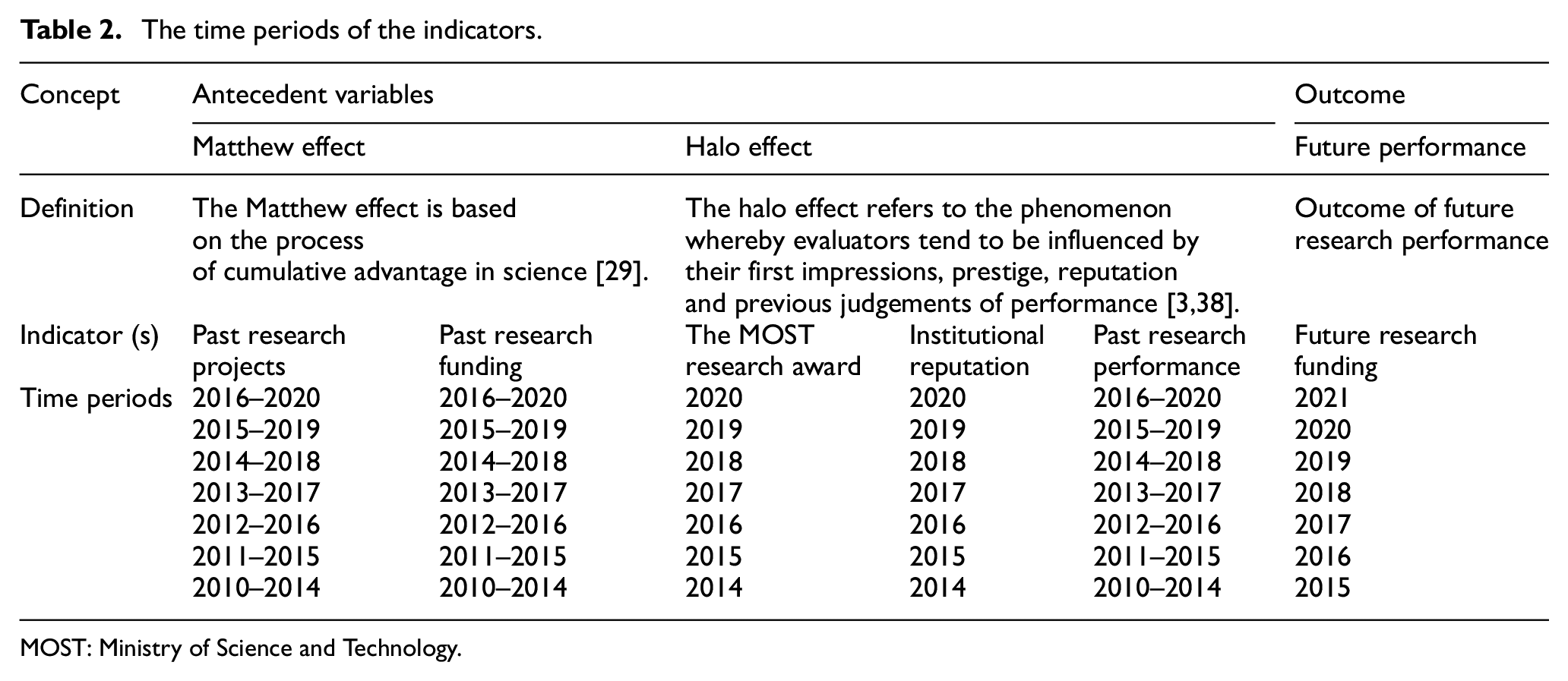
MOST: Ministry of Science and Technology.
As mentioned, most of the indicators are collected from the website and talent database of the MOST. The values of institutional reputation are collected from the QS global university ranking website. Moreover, the values of research awards are calculated by whether applicants had ever won any MOST research awards before the year in which they applied for the research project. The value is either yes or no. The MOST research awards mainly include the ‘Outstanding Research Award’ and the ‘Ta-You Wu memorial awards’ for young scholars under the age of 42. The MOST award is the most iconic research award, and only a few people earn the honour.
Because these indicators are single-item measures (e.g. gender and the amount of research funding), it is not necessary to examine the reliability and validity of these measures [53]. This study uses regression analysis to examine causal associations and make comparisons between male and female applicants. All descriptive statistics, correlation analysis and regression analysis were performed using SPSS software.
4. Results and discussions
4.1. Descriptive statistics
Among the 1465 MOST projects, there were 403 female scientists (27.5%) and 1062 male scientists (72.5%). The proportion of female scientists is still low in Taiwan. Senior scientists with more than 5 years of application experience accounted for 86.8%, while junior scientists accounted for 13.2%. Only 65 scientists (4.4%) won the MOST research awards, while 1400 scientists (95.6%) did not have award records. It also shows the difficulty and rarity of MOST research awards. Table 3 illustrates the descriptive statistics of the research variables. For the reputation of the applicant, only 530 records have the value of QS university ranking, and the rest belong to institutions with no ranking data on the QS website, indicating a ranking outside the global top-rated 1500.
Descriptive statistics.
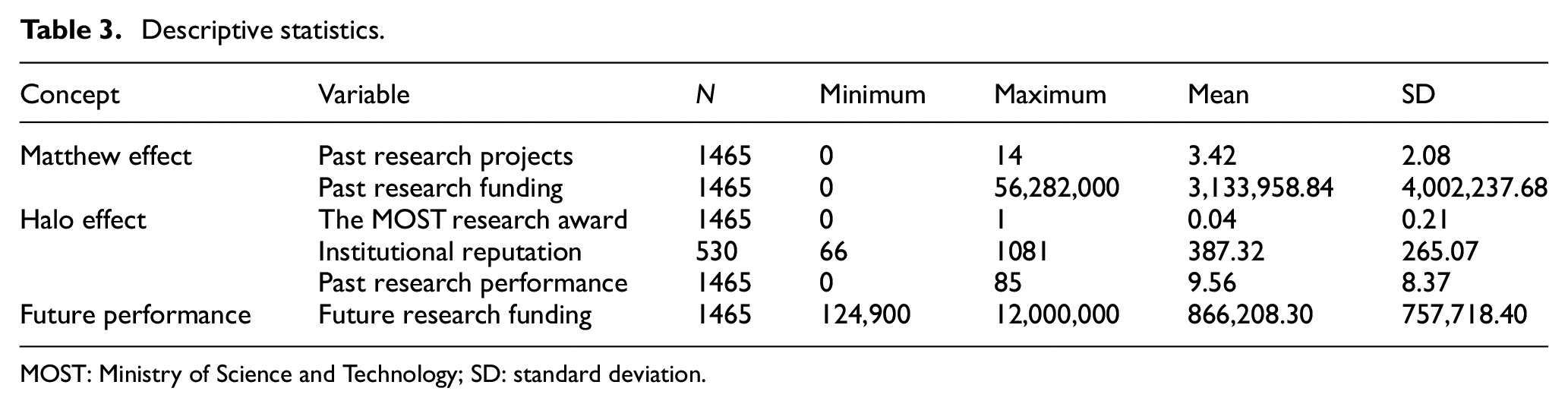
MOST: Ministry of Science and Technology; SD: standard deviation.
4.2. Regression analysis
To answer RQ1 and RQ2, this study not only adopts regression analysis to examine causal associations among the Matthew effect, halo effect and future performance but also compares the results between male and female scientists. Some researchers have pointed out that past application experience is relevant to research performance [3,54]. Hence, the experience of applying for the MOST project is treated as a control variable, and its possible variance explanation on the dependent variable (i.e. future research funding) is excluded when incorporating the selected variables into the regression model. The results of the regression analysis are shown in Table 4.
The results of regression analysis.
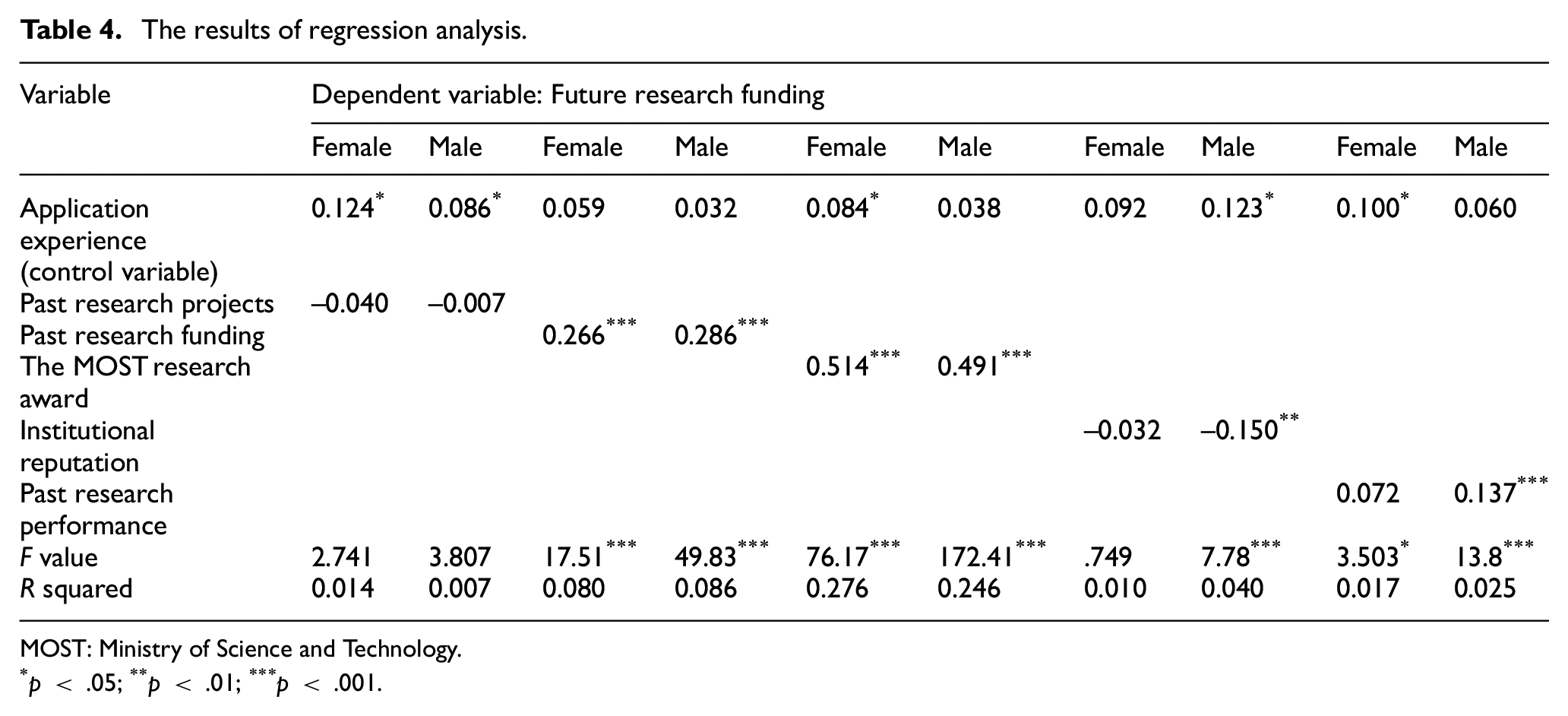
MOST: Ministry of Science and Technology.
p < .05; ** p < .01; *** p < .001.
The results show that past research projects have no significant impact on future research funding, regardless of whether the scientist is female (β = −0.040; p > 0.05) or male (β = −0.007; p > 0.05), indicating that H1a is not supported. The reason why past research projects have no direct effect on future research funding may be that the number itself does not represent the amount of accumulated resources. Perhaps the amount of past research funding can capture the concept of the Matthew effect better than the number of past research projects. Indeed, past research funding positively affects future research funding, even for female (β = 0.266; p < 0.001) and male scientists (β = 0.286; p < 0.001), showing that H1b is not supported. Overall, the findings of both H1a and H1b reveal that there is no gender inequality on the impact of the Matthew effect. One plausible explanation is that the Matthew effect refers to the advantages of external resources accumulated from the past, and such advantages are not easily affected by internal conditions, including factors such as gender and age.
For the indicators of the halo effect, the MOST research award positively affects future research funding. However, this effect was not different between females (β = 0.514; p < 0.001) and males (β = 0.491; p < 0.001), so H2a is not supported. A reasonable rationale is that it is difficult to achieve the MOST research award in academia, and only 4.4% of study subjects won this award. Because of its uniqueness and rarity, it is difficult to challenge the competence of award holders when applying for a research project despite gender bias. Another explanation is that it is a very representative determinant, so it is not interfered with by other factors. In contrast, institutional reputation has a negative impact on future research funding for males (β = −0.150; p < 0.01), while it has no influence for female scientists (β = −0.032; p > 0.05). The H2b is supported. This means that for male scientists, the lower the school ranking number (high-ranked), the higher the funding they receive and the higher the school ranking number (low-ranked), the lower the funding they receive. For female scientists, there is no such benefit. Finally, past research performance is positively related to future research funding for males (β = 0.137; p < 0.001), but this association is not significant for females (β = 0.072; p > 0.05). The H2c is supported as well. In conclusion, in addition to the MOST research award as a representative indicator, the rest of the halo effect indicators (i.e. institutional reputation and past performance) are affected by gender. Hence, the H2 is partially supported.
Overall, this study found that the external advantages accumulated by scientists (the Matthew effect) are not actually affected by gender, but internal cognition or individual impressions (the halo effect) are easily affected by gender inequality, except for research awards. Such a result reveals that the Matthew effect confers a relatively stable advantage and not easily interfered with by other conditions; in contrast, the halo effect is easily affected by people’s impressions, and this advantageous effect is not solid. In addition, consistent with the finding by Liao [3], the halo effect indeed has positive impacts on future research performance. However, this study further discloses that such a beneficial effect or advantage does not exist.
5. Conclusion and future directions
This study aims to examine the phenomenon of gender inequality when applying for research funding. The findings provide some academic and practical contributions. First, prior literature indicates that women tend to be disadvantaged in scientific research [17]. The empirical results of this study confirm that there is indeed inequality between men and women in scientific research funding. The finding enriches our understanding in the existing literature about research policy. For practical implications, this study suggests that the MOST and scientific institutions should treat female scientists better and give them more opportunities to apply for research projects. For example, the MOST or scientific institutions could designate special research grants for female, increase the grant approval rate of women scientists or build up a community of women-friendly scientists. For individual female scientists, this study also recommends that they could participate in academic activities and communities more frequently to activate women’s participation in scientific research and academia.
Second, this study found that gender has an intervening effect on the relationship between the halo effect and future research funding. In other words, the impressions of female scientists (i.e. their institutional reputations and their past research performance) are easily underestimated or ignored. This finding confirms that gender indeed has an interaction with the halo effect. For academic implication, future research can be devoted to exploring more possible interactions or variables. For practical implication, this study recommends that the MOST should anonymise the gender of applicants when committee members evaluate projects, avoiding possible gender bias. In addition, our results are corresponded with the findings by prior studies [3,51]: women’s reputation and past efforts are easily underestimated and ignored. This study suggests that committee members could adopt multiple dimensions or more objective indicators to evaluate research projects, alleviating the negative influences and subjective impression by gender.
Third, the good news is that this study confirms that the Matthew effect (external accumulated advantages) is not actually affected by gender. Prior studies have shown that women have lower probabilities to have funding or resource advantages, but this is only a matter of proportion [35]. Lowering women’s entry barriers and increasing female participation will be beneficial to solve this persistent problem of uneven distribution of resources. Most importantly, the finding of this study reveals that external advantages are relatively stable effects that are not easily influenced by other interfering factors. For practical implication, the MOST or academic institution should provide this kind of resources to support female scientists. For individual female scientists, this study suggests that they should give priority to accumulating their own external resource advantages, such as increasing funding sources, expanding academic networks and taking academic positions.
Finally, the dataset of this study is limited to MOST research projects in Taiwan. The issue of gender inequality is affected by cultures in different countries [55,56]. Different cultures might lead to different consequences. Therefore, future researchers are encouraged to conduct similar studies in different cultures and countries.
Footnotes
Declaration of conflicting interests
The author(s) declared no potential conflicts of interest with respect to the research, authorship and/or publication of this article.
Funding
The author(s) disclosed receipt of the following financial support for the research, authorship, and/or publication of this article: This work was partially supported by the Ministry of Science and Technology, Taiwan (MOST 109-2410-H-030-035-MY2).
