







Abstract
This study aims to investigate the implementation of artificial intelligence (AI) in libraries from 2011 to 2020. This study uses PRISMA guidelines to perform a systematic literature review (SLR). The articles were obtained mainly from the SCOPUS database, with Google Scholar as the supporting database. AI can easily be adopted in libraries, especially for technical services such as classification and cataloguing, library management such as staffing and decision-making, library services such as referencing and information service, and for information literacy. Successful AI adoption is, however, still debatable, because there are many requirements that need to be met, so that it can be inclusively adopted in libraries. There is a lack of research on the application of AI in libraries, especially in the context of its actual implementation. The results of this study offer insights on the implementation of AI in library support services.
Keywords
1. Introduction
Artificial intelligence (AI) is one of the most discussed topics pertaining to development in information technology today, including the field of library science. The development of technology and information has not only simplified work but has also facilitated the improvement of the quality of work. AI technology can be adopted by various organisations, including libraries, to improve the quality and methods of certain kinds of work. Libraries are sources of information and stores various kinds of intellectual property that are in turn obtained from numerous other sources in large numbers. Therefore, they depend on information technology for their functioning. Apart from intellectual property data, libraries also store large user data. Libraries process digital content from many sources, including social media and websites, in the form of text, images, video, sound and numeric data. Thus, they require special applications to process and analyse data effectively, efficiently and reliably, and present the results to their users. These results can be used for decision-making, improving services, and improving the quality of resources, among other purposes.
Activities pertaining to the library are becoming increasingly complex, involving the processing of print content to digital form, in various formats, through different sources. The speed of this content creation is slow if the process relies only on manual skills. Information technology also plays an important role in libraries, and it is consistently adopted by them, in their routine activities, and for decision-making.
The purpose of this study was to fill the research gap pertaining to the application of AI in libraries, using the systematic literature review (SLR) approach. SLR was chosen to obtain a multidimensional picture of the use of AI in libraries. To the best of my knowledge, very few studies have been conducted that comprehensively discuss AI in libraries. Nawaz [1] reviewed literature on the benefits and impact of chatbots, on reference services in college libraries. Massis [44] discussed the potential use of AI in libraries. Furthermore, Jadhav and Shenoy [2] and Gul and Bano [3] reviewed the literature on smart libraries, and information technology (IT) that supports smart libraries, and Tella [4] examined the use of robots in libraries. Based on the review articles which have been discussed above, this article will examine the adoption and urgent need for the application of AI in libraries. This article contributes towards AI application in libraries, to facilitate their efficient functioning.
This study used PICo to construct research questions, namely, those based on Population/ Problem, Interest, and Context. The objectives of this study are (1) to investigate the AI methods used by libraries, (2) to describe the level of AI adoption in libraries and (3) to analyse the urgency of implementing AI in libraries.
2. Literature review
2.1. AI
AI is a group of technologies that allow computers to solve problems, in a more dynamic way than previous methods. In simple language, AI attempts to replicate human intelligence, while carrying out its functions. It is used to support human intelligence and to derive faster and more precise results. AI is used indirectly in various aspects of everyday life, such as the online search technology (e.g. Amazon recommended products), which provide recommendations to potential customers via mobile phones and other media.
AI uses algorithms to develop smart systems. In the journalism industry, research that related the AI algorithm to information ethics, such as privacy, data disclosure and data protection has been conducted [5]. Furthermore, research on the use of algorithms in online environments that will shape users’ online behaviour, decisions and interactions [6], and their trust on chatbot messages and recommendation credibility has been conducted [7]. Algorithm literacy, from the perspective of users [6], determines how users interact with AI services and how they perceive algorithm [8].
2.2. AI methods
Expert systems are viewed as methods that are capable of providing expert-level diagnostic knowledge to solve diagnostic task and formulated by machines rather than through human labour [9]. Expert systems are a part of AI, refer to a computer programme used to solve complex problems, and produce decision-making abilities, like human experts [10].
Machine learning (ML) is a subject in the field of computer science that studies algorithms and techniques for providing automated solutions to complex problems that are hard to programme using conventional programming methods [45]. Research on ML for solving complex problems has been increasing since the 2000s. The reasons for this are as follows: (1) availability of a large amount of data through the Internet, (2) availability of computing power (large storage and memory) and (3) improved algorithms [45]. ML is being widely used to produce insights into structures and patterns of large data and can also be used to predict human behaviour and classification.
2.3. AI phase in an enterprise
Faggella [11] states that AI can be implemented in an enterprise in three phrases, namely, (1) emergence phase, (2) adoption phase and (3) dispersion phase. Together, they are called the Zeitgeist phase. Currently, almost all enterprises have entered the emergence phase, but the speed of moving from emergence to adoption and dispersion, is determined by the readiness of each enterprise. Currently, the leading companies that are using AI are those in the banking, pharmaceutical and defence sectors. America, China and Britain are adopting AI faster than other countries.
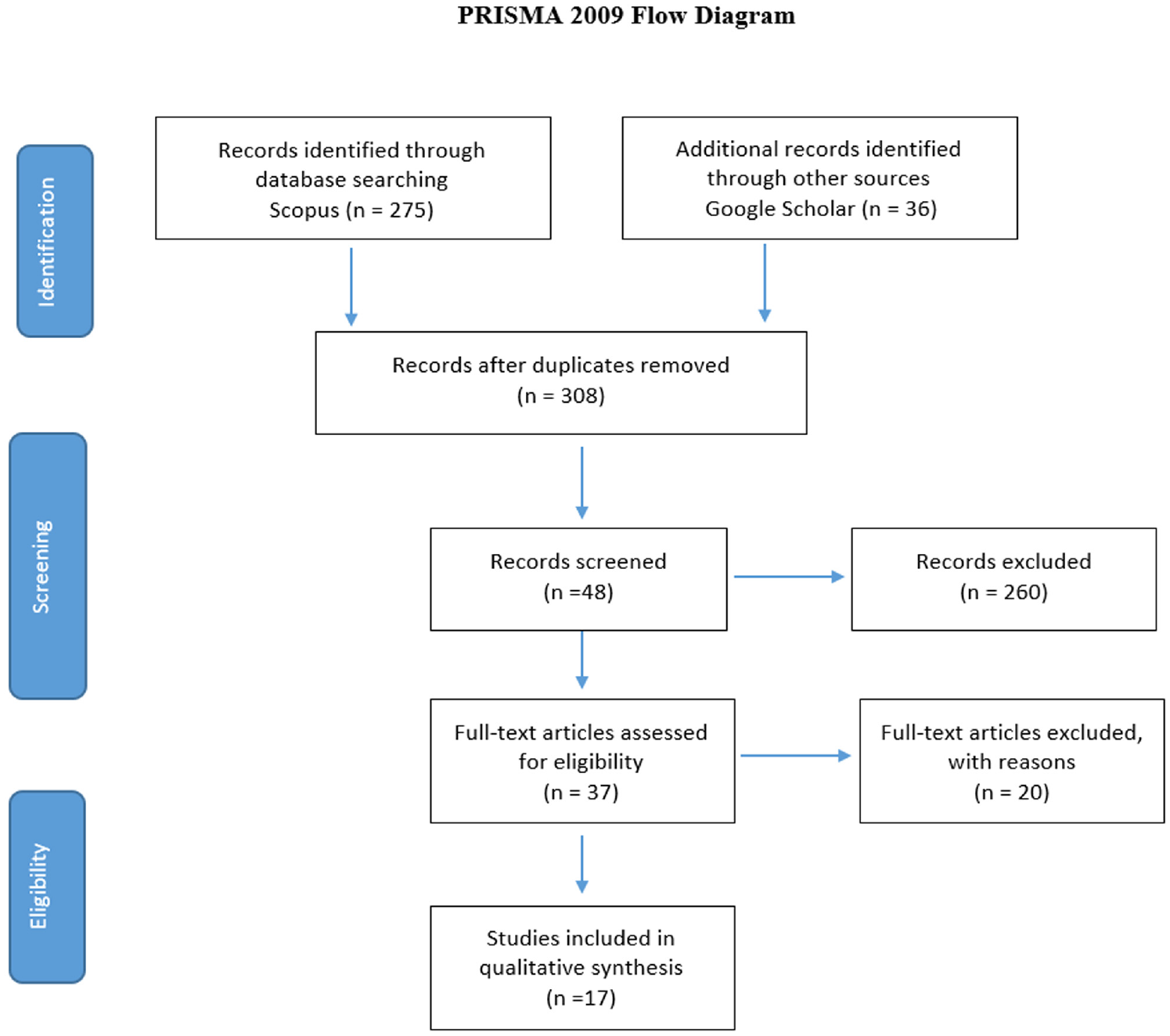
PRISMA 2009 flow diagram[46].
2.3.1. Emergence phase
In this phase, AI is entering the enterprise radar, and the words AI have become a familiar jargon, but it is not yet being applied to business activities. AI is still a buzzword, and it is believed that it can solve the existing problems in the companies. However, AI is rarely being adopted, especially those technologies that require large funds and highly skilled teams. Almost all AI that has been implemented is experimental, and many AI-related events have been introduced, such as seminars and training, which discuss the potential future of AI.
2.3.2. Adoption phase
This phase is more challenging, because enterprises are no longer interested in finding out what AI can do, but in how AI programmes work, and which methods are best for the enterprise. The adopting company needs proof that investing large funds in AI will ensure return on investment (ROI), and to get proof of the ROI, the organisation must adopt technology. This is a decision that is difficult for many companies to make. Larger companies with better funds, data science talent, and volume data are able to pilot AI projects; however, small companies struggle to adopt AI.
2.3.3. Dispersion phase
At this stage, AI is seen as part of the business and becomes one of the solutions. All employees in the organisation take advantage of the AI technology to support their work. AI has become an ordinary technology that is used by everyone and is no longer unique [11].
3. Methodology
In this study, we used the Preferred Reporting Items for Systematic Reviews and Meta-Analysis (PRISMA) protocol, as a guide to carry out an SLR. According to the Cochrane collaboration, a systematic review of a formulated question uses systematic and explicit methods to identify, select and critically appraise relevant research, and to collect and analyse data from studies that are included in it. Statistical methods (meta-analysis) may or may not be used to analyse and summarise the results of the included studies. Meta-analysis refers to the use of statistical techniques in a systematic review to integrate the results of the included studies. PRISMA emerged from a large number of SLR research in the health sector, but it can also be implemented in social SLR research.
PRISMA-P is a protocol used for systematic review that was published in 2015. This protocol is used to ensure transparency in the SLR process. The protocol describes the rationale, hypotheses and methods to be planned in the review process. The protocol must be planned before the review and is used as a guide during the review process [12]. Some studies discuss the use of PRISMA-P for social sciences, and tourism and hospitality [13], as well as behavioural and social sciences [14].
3.1. Resources
For the SLR, articles were obtained from the SCOPUS database, as the main database, with Google Scholar acting as the supporting database. The SCOPUS database was selected because many articles pertaining to libraries have been indexed by SCOPUS. The SCOPUS indexing database contains many article titles from various libraries and information journals. Google scholar only served as a support for obtaining the articles that were not covered by the main database. The search results yielded 275 articles through the SCOPUS database, and 36 articles through Google Scholar titles.
3.2. Keyword search
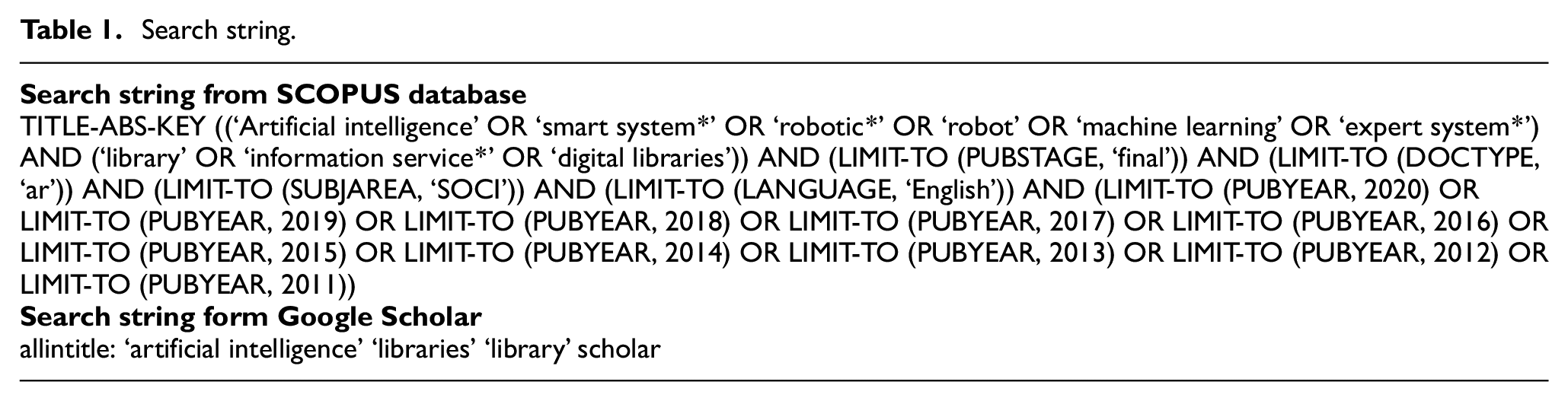
To search for relevant articles on a particular theme, it is important to find the right keywords. Searching on Google Scholar uses a handpick system, where the author looks for articles that are considered relevant to the topic. The keywords that were used in this study are illustrated in the following Table 1.
Search string.
3.3. Eligibility and exclusion criteria
The search results yielded 308 articles, after limiting for those published in the past 10 years (i.e. from 2011 to 2020). The subject was limited to social science because library studies often included under both social sciences and humanities. The researchers also limited scientific articles, and excluded proceedings, reviews, and book chapters.
3.4. Data abstraction and analysis
The articles obtained from both the databases were filtered using at the initial stage, based on the title. Next, we screened the titles of the articles, with each researcher providing an assessment of the titles, to produce those that were deemed appropriate. Furthermore, the abstracts were screened, based on their relevance, and if they had content that would help answer the research questions. In addition, 37 full texts were reviewed, to evaluate the completeness and credibility of the articles, out of which only 17 qualified for further review. The reasons for the exclusion were incompleteness, or lack of clarity in research methods.
This SLR analysis was based on the guidelines offered by the predetermined research questions. The articles were then coded to determine the theme based on the research questions, which included implementation of AI in libraries, AI technology and library services using AI. The above themes were further analysed on the basis of relevant theories, and the results of prior research.
3.5. Data collection
3.5.1. AI implementation in libraries
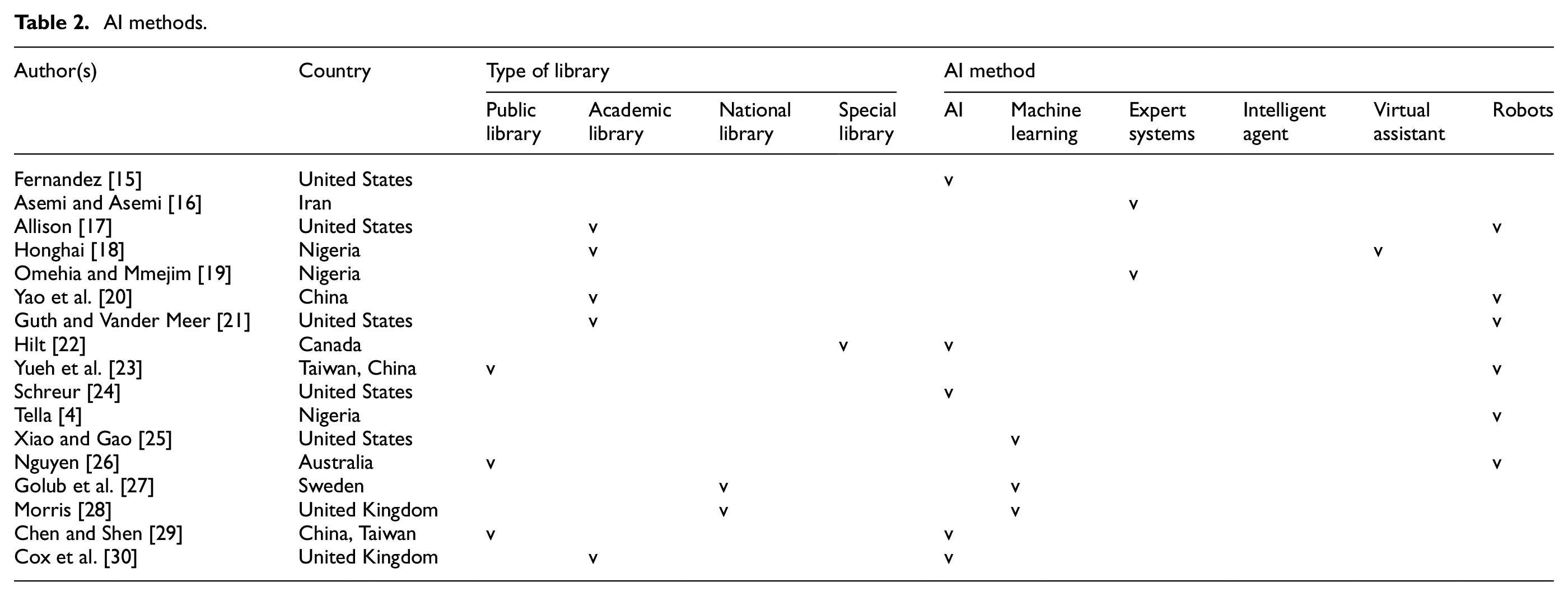
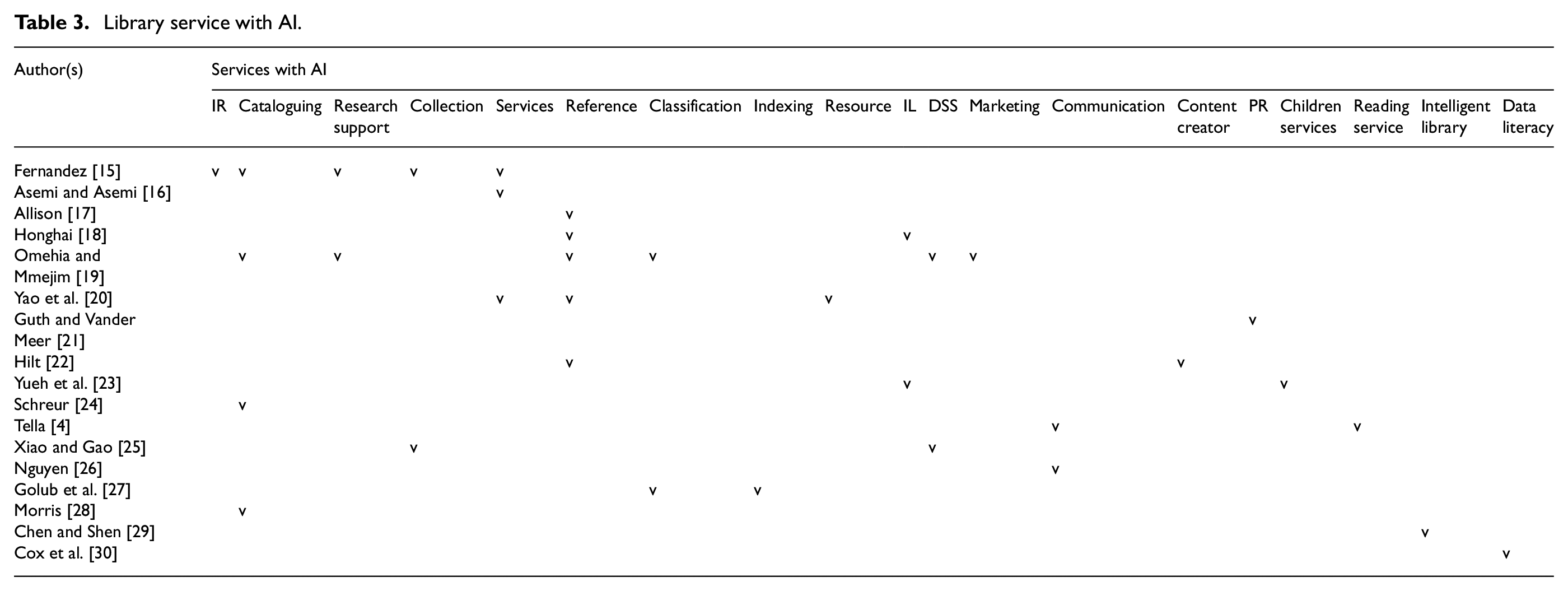
AI initiatives have been recently seen in many publics, university libraries, libraries and national libraries, and has been widely discussed by researchers from various fields. The search results revealed that many higher education libraries have adopted AI, to support research and learning. Academic libraries are widely studied because many academicians and students use and manage them for procuring their research material. Furthermore, with rapid technological developments, the skills of the librarian, in academic libraries, are also developing fast. The details pertaining to the AI methods and services, for academic libraries, are depicted in Tables 2 and 3, respectively.
AI methods.
Library service with AI.
3.5.2. Artificial intelligence
AI applications in libraries can be used to support research, data analysis and documentation [22], even though the use of AI in libraries is in its early stages, and it is still uncertain whether AI can intelligently support research in the legal library or replace the role of lawyers in conducting research. There are still pros and cons pertaining to the use of AI in organisations. Some people believe that AI can replace human work, while others hold the opinion that it will not be able to replicate human uniqueness and creativity [31]. The combination of ML and AI, in the Yewno application, allows users to explore concepts and connections, and understand interdisciplinary subjects using an attractive interface [24]. In research, AI can help explore many data sources, map knowledge, connect concepts, analyse data and provide predictive recommendations on the basis of results, but certain aspects cannot be replaced by AI, like the insight of researchers, and their creativity in developing research results.
In information services and research support, AI has been widely adopted by libraries. One AI application that is widely used for reference services by libraries is Plexus. It answers users’ questions, acts as a referral tool, and helps librarians in carrying out the reference process, provides knowledge about references, and helps in information retrieval pertaining to all subjects, and library users [19]. Besides, it also makes use of the Online Reference Assistance, which can handle low and medium level questions in university libraries utilising video text technology, computer-assisted instruction modules and knowledge-based systems [19]. The use of AI to answer reference questions is still low (i.e. questions such as FAQ), and it is at a medium level for inquiries regarding general information related to libraries and subjects in library collections, made via structured or semi-structured questions. Librarians still have to answer the high-level questions, which require a high level of library expertise [32]. Only questions that do not require in-depth explanations and analyses can be replaced by AI. The first Pixel a chatbot library was introduced in the UNL library, to answer user questions using natural language. The answers given by Pixel were quite short, by matching keywords and keyword combinations with the information contained in the Artificial Intelligence Markup Language (AIML) database. Pixel also provides an experience similar to human conversation (e.g. by providing direct answers quickly) [17]. Setting up a robot that is able to understand human language and interpret it, requires knowledge of the context and background of speech. Robots need to interact with humans as often as possible to answer questions using natural language [33]. Some libraries do not focus on AI or robot development due to its high cost and because it requires IT skills, for which they lack the necessary human resources.
Utilisation of the semantic web, AI and ML allows libraries to make metadata more accessible, not only to the libraries using MARC but also to allow linkage of the data to the semantic web. It allows the wide-scale access of the library metadata [24], with the help of an expert system that has the cataloguing capabilities associated with publisher data.
According to Fernandez [34], it is likely that significant changes will occur in the information retrieval process in the libraries, as well as in the professional information skills, with the use of AI in library searches. As an important tool for searching information, search engines, (among others) function as personal assistants that help, respond to, and anticipate users’ information needs. Furthermore, the use of chatbots allows the use of natural language. AI also facilitates search by personalising information needs and performs extensive searches by establishing a connection with the information, which would be difficult for humans to achieve. Utilising ML algorithms and the information in the catalogue, it is possible to personalise the information [34].
The use of AI can help decision-makers regarding library collections that need to be purchased or terminated based on user interest, by analysing the collections contained in the libraries [34].
3.5.3. ML
ML can be applied innovatively in libraries, to perform analysis and provide recommendations for librarian. Application programming interfaces (APIs) were used to collect data on bestselling books from the New York Times, based on the popularity criterion, within 52 weeks of publication. These data can be used by the library to provide book recommendations, according to user preferences [25]. ML can also be used for classification using the Dewey Decimal Classification (DDC), which uses data from the library catalogue ML to perform automatic classification [27]. In his study [28] also utilised ML techniques to automatically identify the language in the bibliography, using sample data from a catalogue in the British Library. The ML technique involved the use of bibliographic metadata from the British library, including language code data in MARC. This was then used to predict the language that was not included in the language codes in the catalogue, by identifying the titles in the collection.
While processing information during cataloguing and classification, it is also introduced to a classification system, for the automatic cataloguing of the research results, with a matching-based approach between Online Public Access Catalog (OPAC), WorldCat database and MARC Records [35]. ML can facilitate an effective process of classification. Hence, ML is very effective in classifying the name of a person and corporation [36].
3.5.4. Expert systems
Expert systems are systems that can help librarians provide recommendations for information that is available through various sources. In case the user has any questions, expert systems can also be used as a learning medium, for the purpose of referencing. An online reference assistant is also a form of an expert system that can help with 24/7 reference services, with an Answer man programme, that can help answer reference questions at any time [19]. Apart from being used for reference, expert systems can also be used for classification.
3.5.5. Robots and intelligent agent
An AI talking robot – Xiaotu, was introduced at the Tsinghua University Library, China. The use of the Xiaotu robot was promoted on a large scale through social media, to generate curiosity in users. It has interacted with them, more than 50,000 times a month, on average. Xiaotu is the mascot of the Tsinghua University Library, and its usage is demonstrated in exhibitions. The focus of the Xiaotu robot is to provide user-centred service, using Chinese language in its natural form, so that it can be easily understood by the users. The Xiaotu robot is also sentient, and often uses humour while communicating, and creating a more positive image of the librarian. It is easy to share this resource with another library, because of its easy modular architecture. This robot project was initiated by librarian in China. Furthermore, the use of AI for real-time services in referencing is promising [20]. The use of telepresence robots (TR), to establish public relations, can increase the effectiveness of library services. TR also fosters effective communication in libraries [21].
The use of social robots for information literacy, such as robot reading companionship, provides a new experience for users, and they prefer robots as companions. Robots also provide support in verbal and non-verbal communication, and children prefer robots because they are more interesting and engaging [23]. The virtual reality tour guide is a virtual assistant (Siri, Alexa, Google Now, Microsoft Cortana) that can help library users [18].
Intelligent agents, such as Siri and Alexa, assist users to navigate and interact with online information sources, to search, sort filters and create user profiles. Alexa and Siri also help libraries in reference services, by providing answers to structured questions. Robots also help users to explore the library collection. For instance, the chatbot named Emma helps in seeing answers to database questions and displays results, and Sylvie helps in answering reference questions [37].
4. Discussion
Libraries are slow in adopting AI, and many of them are resistant to the emergence of AI technology [38]. Currently, the use of intelligent libraries, to support services, is still superficial, and the quality and content of the services of the library cannot cater to users’ needs. The use of information technology only supports innovation superficially, and it still requires quality services and variety, to cater to the needs of the users [29]. AI has modified people’s view of the concept of libraries, collections and information retrieval, where libraries are now seen as data can that facilitate search using AI and offer other services using chatbots and intelligent agents [30]. In addition to the changes in AI technology, it also leads to changes in the library paradigm. Improving library service in this war requires the readiness of humans, to accept AI.
In the online search process, AI enables the libraries to identify and map patterns and data connections generated by users. The data generated in the online search process is very large, and it is impossible for the librarians to map it manually [34]. Furthermore, chatbots have also been introduced for reference service; it helps the users to find answers to questions about libraries and relevant information sources [17]. The questions that arise are mostly directional and factual. Libraries are increasingly using technology to support services – the academic libraries have added technologies such as 3D printing, literacy training, and course management support. The development of AI technology provides an opportunity to the libraries, that should not be missed. It provides and promotes technical services, to turn libraries into centres for knowledge sharing and collaboration [39]. The use of AI technology yields positive feedback and facilitates the creation of a better experience for both the librarians and the users (e.g. with robotic telepresence services in academic libraries) [21].
From the findings discussed above, it can be inferred that the adoption of AI in libraries is still not optimal. Even after 10 years, the adoption is still at the initial or emergence stage. This is evident in the extent of adoption of AI, which is still at the experimental stage, with respect to AI application, such as the use of ML applications for automatic classification and generation of metadata. AI projects, in the form of chatbots and robots, are being created and implemented in several libraries. The chatbots and robots can communicate with the users in a natural language, imitate human communication (provide humour), and answer low to medium level questions. The research results pertaining to Iran reveal that the recommender system is the most advanced AI method, while natural language processing is the least developed [16]. Meanwhile, many robots or chatbots have been initiated in China, Australia and America, where research funding and technology is more easily available.
Based on the AI-human intelligence relationship matrix, AI development in the library can be categorised into substitute levels. The use of AI technology is still low, with ML and expert systems for classifications still in the training data stage, and the level of accuracy and effectiveness unknown. Robot technology and chatbots are emerging in libraries, which means that technology is being applied, but elements pertaining to human intelligence still need to be improved to enable communication with the natural language of the users. Currently, robots or chatbots are unable to predict what users will ask, and users tend to be careful while talking to robots, and resort to simple language so that the robot can understand them.
The dilemma of libraries in implementing artificial intelligence can be seen as part of the process of accepting an innovation. Components of ideas and objects that can influence society and produce change are indicators of innovation. The use of artificial intelligence that is still not optimal in the library is a form of the degree of risk from the perspective of innovation. According to Rogers [40], the degree of risk will form by itself when the library accepts the presence of innovations that can cause changes in behaviour, or even a system that has been conventionally implemented. Rogers and Shoemaker’s opinions provide an affirmation for libraries that tend to be slow in implementing artificial intelligence, because the presence of AI can create risks that are beyond the control of the actors involved in the library system.
AI can easily be implemented by libraries if it does not involve complex programming language [34]. AI integration into the library system is costly; librarians generally lack the necessary skills to work with technology, because it needs highly developed IT skills, and malfunctioning software cannot be handled due to lack of skills, and will affect data security [19]. Libraries should be transformed and rebuilt (not just physically), to accommodate these changes, and be responsive to outside ideas. These serve as obstacles in the AI adoption process. The advent of robotic technology is not for the purpose of replacing librarians, but to provide them with more time to scale up the new services [4]. There are still many libraries and librarians who feel threatened by the presence of AI, because they feel that they will lose their jobs, as they will be replaced by robots. Robots also make libraries more attractive, provide a certain kind of freshness to the public, increase the level of user confidence in technology, especially among young people including children, and help the older generations to adapt to newer technology [26]. Humanoid robots help children to communicate better. The robots play a supporting role in library management and are not intended to replace the librarians.
AI compatibility refers to the extent to which it provides value and advantages for libraries, and the organisational readiness of the users. Top management support refers to the involvement of top library management, in the AI implementation process. The bigger the organisation, the greater is its ability to implement innovation, because a bigger organisation has greater pressure to compete. Resources refer to the workers, enterprise and IT resources available in the organisation [41]. Environmental readiness refers to how organisations perceive external conditions for AI adoption. Competitive pressure refers to the threat of losing competitive value that motivates organisations to innovate. Government regulatory issues refer to government assistance that facilitates the adoption of AI applications [42].
The implementation of AI in libraries requires careful thought before deciding the kind of AI application to develop, after considering the various factors discussed above. Considering the complexity of the criteria for implementation of AI, the libraries hesitate to incorporate AI technology. The following characteristics of AI need to be considered from a strategic alignment point of view: the versatility of the AI function, and the range of its application. AI is very complex and affects the entire organisation; therefore, it requires the commitment of the top-level management. AI-based systems are data-driven, and the openness and availability of data are an essential requirement. AI-based systems also require large investments, personnel for various roles who have highly developed skills from various areas and a strong IT infrastructure. All employees will have to upscale their abilities and must become AI literate. Employees often fear losing their jobs after the implementation of AI [41]. Of the many challenges of incorporating AI in libraries, librarians are aware of their and the users’ urgent need to have knowledge of AI, and that the application of AI can lead to changes in their profession and the way they work [43]. Libraries are not profit-oriented organisations, and rely on operational funding, which depends on the organisations that support them. Hence, the AI implementation policy is largely dependent on the available financial support. Some libraries initiate AI in independent projects. The implementation of AI in libraries covers only certain services, for example, reference and information literacy services.
Rogers’ Diffusion Theory of Innovation argues that the library is currently at the implementation stage of AI, but has not yet reached the confirmation stage. The stages of diffusion of innovation, according to Rogers [40], are Knowledge; Persuasion; Decision; Implementation; and Confirmation. Libraries and librarians, as actors, respond to the presence of artificial intelligence with knowledge. At this stage, libraries are only familiar with the term artificial intelligence, in general. This stage then proceeds to persuasion, where the library begins to show interest in an innovation called artificial intelligence, and detailed information about the new findings begin to be diffused.
After getting detailed information about artificial intelligence, the library will weigh the advantages and disadvantages received while adopting the innovation. This stage is the starting point for libraries to reject or accept artificial intelligence in their operational system. After making a decision, the library, as an institution driven by the actors in it, will adopt artificial intelligence as a form of library service development. However, based on the findings of the data above, we can see that the implementation of artificial intelligence is comprehensive. This phenomenon indicates that the library has not yet reached the confirmation stage. This means that there have been no unanimous decisions regarding artificial intelligence. The actors behind the library are still in a dilemma regarding whether to use artificial intelligence or reject it due to various considerations. In short, the use of artificial intelligence in libraries is only at the trial stage.
5. Conclusion
AI has been a buzzword for the past decade and is widely discussed by various types of organisations, including libraries. Accepting AI as part of technological development in libraries is inevitable. Libraries are becoming aware of AI and have started including AI-based projects in various types of activities in many countries. There is an urgent need for the adoption of AI by libraries. However, many libraries have still not invested in AI. This may be because existing AI projects have not been tested much, and there is uncertainty regarding the benefits of incorporating the technology in library activities. This is reflected in the level of adoption of AI by libraries, which is generally restricted to one service only. Librarians fear losing their jobs if AI is implemented; hence, it is being used only in a limited manner in libraries. AI is only restricted to automated services and has not been able to substitute human intelligence in services such as answering users’ questions and communicating with them. There is a possibility of wider adoption of AI methods, such as ML, expert systems, natural language processing and big data analysis, among others, in the near future. Libraries can work together with IT vendors to develop AI according to the needs of its users and provide training to the librarians to develop skills pertaining to its use.
This research is limited to the implementation of artificial intelligence in the library. The implementation can be observed using Rogers’ theory of the diffusion of innovation; hence, the perspectives used in this study are limited to the steps taken by the library, to implement AI. These stages are important to observe, to answer the three research questions that have been formulated at the beginning of the study. This research has succeeded in finding the stages that libraries go through when implementing artificial intelligence, and thus, the methods and urgency of implementing artificial intelligence in libraries can be answered. The findings of the data state that currently, libraries are still evaluating the innovation and have not yet reached the confirmation stage. This means that the method of applying AI has not worked perfectly, because it is still at the trial level in libraries.
This research can be developed by focusing on the application of artificial intelligence, especially in libraries. Further studies can explore the acceptance and rejection of AI in greater depth from the librarian’s point of view, as the dominant actor in a library’s operational activities. In addition, future researchers can also pay attention to the confirmation stage that cannot be included in this study, because the library is still at the consideration stage. It becomes important to discuss this in the future to find out whether the library will accept AI completely or reject it.
It is still interesting to conduct research related to AI implementation in libraries, such as the readiness of libraries and evaluation of the ongoing AI based experiments, to seek a solution to the problems being encountered by them. Further research can be conducted to qualitatively analyse user satisfaction while using AI and whether it is effective in solving problems encountered by the libraries. A pertinent research question that can be explored is: to what extent can AI be implemented in a library?
Footnotes
Declaration of conflicting interests
The author(s) declared no potential conflicts of interest with respect to the research, authorship, and/or publication of this article.
Funding
The author(s) disclosed receipt of the following financial support for the research, authorship, and/or publication of this article: This project was funded by the Ministry of Education, Culture, Research, and Technology, Republic of Indonesia. The grant numbers 921/UN3.14/PT/2020.
