






Abstract
Mini program has become an important infrastructure for the Internetisation of traditional brands. Previous studies have mostly explored the design and development of mini program, but little research has been conducted on the mini program dissemination process. Studying the impact of social media marketing on the mini program dissemination process has important theoretical and applicable value for the in-depth discovery of the mini program dissemination mechanism and the marketing strategies improvement for mini program operators. Based on the classical Susceptible–Infected–Recovered (SIR) epidemic dissemination dynamic model and combined with the Sense, Interest and Interactive, Connect and Diffusion, Action and Share user behaviour consumption model, we propose a mini program propagation model considering social media marketing and community structure, and establish a set of differential equations reflecting the mini program propagation rules. The validity of the model and experimental results are verified through the comparison among the simulation, actual data and numerical experimental results. The experimental results show that the improvement of social media marketing can considerably promote the dissemination of mini program. Surprisingly, with the same social media marketing investment, the dissemination effect of mini program in a weak community is better than that in a strong community. The reason for this is that the higher clustering coefficient fails to offset the negative impact of high modularity on marketing information dissemination. Consequently, compared with the marketing needs of the weak community structure, more social media marketing efforts need to be invested in the strong community structure. Improving social media marketing in the early stages of dissemination can maximise the marketing effect. Moreover, the effect of combining of advertising marketing and interactive marketing in social media marketing is better than that of a single marketing strategy.
Keywords
1. Introduction
WeChat mini program is a lightweight application that was launched by WeChat in 2017 that does not require installation or download, is easy to operate and does not need to be unloaded [1]. It is characterised by a low threshold, broad audience, strong social interaction, multiple application scenarios and so on. As a mobile social media platform, WeChat had more than 1.309 billion monthly active users in the third quarter of 2022 [2], which provides a broad space and platform for the development and application of WeChat mini programs. Benefitting from the advantages of the WeChat platform, mini programs have maintained rapid development since they were launched. As of June of 2022, the number of day active users of WeChat mini programs exceeded 500 million, with a total number of more than 7.5 million mini programs that cover more than 200 industries, including e-commerce, tools, entertainment, display and so on. [3]; this means that mini programs will change the construction of the underlying pattern of Internet traffic and become a new infrastructure of China’s Internet platform. Mini programs have become an indispensable tool in people’s lives; in 2022, the related turnover reached 3 trillion yuan. Mini programs are commercial applications that are jointly operated by platform parties, operators and service providers and have huge business prospects. There were nearly 80 mini program entrances, of which 54.5% of the new user traffic was due to users sharing mini programs [3]; sharing is the core activity with the highest proportion of mini program traffic. WeChat mini programs have strong social attributes, which make them easier to spread among users. This type of social platform–based application brings a new diffusion process [4]. From the perspective of mini program operators, the key to the success of mini programs is attracting users and increasing user retention using the advantages of the social attributes of the mini programs themselves. Different marketing strategies will have various effects on the diffusion process. Therefore, our research on the dissemination performance of mini programs under the influence of social media marketing has important management and practical significance for guiding the operation of mini programs.
The dissemination of mini programs occurs within social media platforms, and the dissemination process is similar to the dissemination process of information on social networks, which involves dissemination and sharing between users. Different scholars have proposed a variety of network models to simulate the actual information diffusion process. Among them, the infectious disease model is similar to the diffusion mode in online social networks [5]; thus, this model is widely used to analyse and predict the scopes and trends of various types of diffusion, including information diffusion, public opinion and Internet word-of-mouth diffusion, e-commerce promotion, financial analysis and other fields. Scholars have constructed different improved models according to different diffusion processes. WeChat is a platform with strong social attributes and different community structures. A large number of studies have shown that the community structure has a significant impact on the diffusion process [6–9]. With the emergence of mini programs, the method of communication and exchanges between enterprises and users has changed. Many enterprises regard the promotion of mini programs as an important part of social media marketing. The difference between mini program social media marketing and traditional enterprise marketing is that users not only act as marketing recipients but also participate in marketing activities as disseminators [10]. The existing research on mini program is mostly focused on their development and users’ willingness to use mini programs [11,12]. There are few related studies on mini program dissemination, and there is the absence of discussion on the diffusion mechanism of mini programs and the impact of social marketing on the diffusion process from the perspective of diffusion dynamics.
Based on the above discussion, this article describes the dissemination process of WeChat mini programs by constructing an improved susceptible, infectious or recovered (SIR) model, explores the impacts of the community structure and social media marketing on the dissemination process of mini program, and provides references for mini program operators. This article is arranged as follows. Section 1 is the introduction. Section 2 introduces the literature review of community structure and social marketing. Section 3 proposes an improved SIR model, that is, the mini program dissemination model that considers the community structure and social media marketing and completes the theoretical derivation of the model. Section 4 compares the results of simulation experiments and numerical experiments to verify the accuracy of the proposed model, and then analyses the results of the numerical experiments to discuss the impacts of the community structure and mini program social marketing on the diffusion process in detail. Finally, section 5 summarises this article and proposes operating recommendations for mini program operators.
2. Literature review
This article studies the diffusion and diffusion process of mini programs from the perspective of the community structure and social media marketing. Therefore, this section mainly reviews the related research of the community structure in diffusion and the related research of social media marketing and finally provides a summary.
Based on the three basic infectious disease models, scholars have proposed a large number of improved models to describe different diffusion processes. Social networks in real society have different community structures based on different relationships [13,14]. Some scholars have used clustering coefficients to express the clustering of nodes in a network and to measure the connection tightness of users within the same community [15]. Modularity has been used to measure whether there is a clear community structure in the network and the density of the connections between different communities [16,17]. Liu and Liu [18] used hierarchical clustering technology to group the nodes in a network into communities, uses a modular function to select the best partitions generated and accurately identifies the community structure. Chen et al. [19] proposed a community detection method, which is more effective for identifying the network community structure. Using the infectious disease model, a large number of scholars have verified the conclusion that the community structure has an important impact on the transmission process [6]. Wu et al. [7] proposed a theoretical framework based on the ordinary differential equation (ODE) to analyse the performance of information diffusion and evaluated the impacts of individual behaviours on diffusion in social networks in multiple communities. Wu J used the linear threshold model to study the impact of a multi-community structure on information dissemination and found the best multi-community network modularisation based on social reinforcement. The results show that a multi-community structure can promote information dissemination [17]. Stegehuis et al. [8] believe that the community structure can not only promote the diffusion process but also inhibit the diffusion process on a real network. Nematzadeh et al. [20] used numerical analysis and simulation methods to study the counterintuitive influence of the module structure on information diffusion and verified that a strong community structure can increase local and intercommunity dissemination. Based on system dynamics, Kai [9] found that the sparsity of the community structure in a multi-layer network will affect the diffusion range of information; the sparser the community structure is, the larger the diffusion scale. Combining the community structures of different social networks in reality, Cheng and Zhao [21] proposed an SIR model to analyse the influence on the diffusion of Internet investment products. Zhu H proposed a construction model that can adjust the structure of a microblog community network. The results show that the influence of the community structure on the diffusion of microblog public opinion topics is negative inhibition [22]. Xie R and Zhang [23] proposed an improved SIR model to comparatively analyse information propagation between the blockchain and the traditional network community, and the study shows that negative incentives mechanism can reduce the propagation of uncertain information. In summary, the community structure has an important impact on the process, scope and scale of diffusion in a real network.
In recent years, with the popularity of social media applications, users’ social attributes such as close social relations and strong interaction have had positive impacts on marketing. Research on social media marketing has gradually increased. Social media marketing is a marketing model based on a social relationship network, and its essence is to design a corresponding dynamic dissemination mechanism to promote the diffusion of marketing information and to achieve marketing goals through the social relations network’s impacts on users [24]. Rowley J and Keegan [25] provided a systematic literature review of social media marketing in recent years, the paper critically evaluates its development and value, and proposes a future research agenda. A large number of studies have shown that social media marketing has an important impact on consumer behaviour [26,27]. Compared with traditional marketing, the biggest feature of social media marketing is the use of social platforms to guide users to share and express positive opinions and reduce marketing costs [28]. Beig and Khan [29] believed that content sharing and interaction are identified as two important marketing activities carried out in virtual communities. Gupta et al.’s [30] research showed that consumers’ views on goods, consumption and services shared on social media platforms can influence potential consumers more than the advertising marketing of organised marketing teams. Anjum [31] believed that marketing information can be more recognised by the public after being shared with users. In social media marketing, users are affected not only by conventional marketing, such as advertisements but also by internal influences, such as interactive marketing. Interactive marketing is a two-way marketing method that uses the Internet as media and focuses on the participation of users. Users are not only the receivers of marketing information but also the participants in marketing activities [10]. When users transmit information, they spread marketing information; therefore, this marketing activity can also be seen as a process of marketing information diffusion [32]. Social media marketing encourages users to share relevant marketing information in social networks through interaction so as to attract new users and improve the retention rate of users [24]. Mini programs are a newly developed social media tool in recent years. It is not only an application that can provide users with services but also information disseminated in social networks. The mechanism of how social marketing affects mini programs diffusion is yet to be discovered. This article studies the diffusion mechanism and diffusion performance of mini programs. The above-mentioned impact of the community structure on the diffusion process in information diffusion and social media marketing theories has laid a theoretical foundation for this study.
3. An improved SIR model for WeChat mini program dissemination
The dissemination of information on a social network and the dynamic evolution and diffusion of infectious diseases have similar properties. Combined with the actual spread of mini programs in reality, we divide the users in the WeChat community into four categories to describe the mini program diffusion mechanism more clearly:
Potential (P): a node has not used the mini program and is interested in it. We call it node P for short.
First (F): a node has logged into the mini program user for the first time after receiving information about the mini program. We call it node F for short.
Discard (D): a node no longer uses the mini program after logging into the mini program. We call it node D for short.
Repeated (R): a node continues to use the mini program after logging into the mini program for the first time. We call it node R for short.
The China Internet Network Information Center (CNNIC) proposed the SICAS model, that is, Sense, Interest and Interactive, Connect and Diffusion, Action and Share [33], as shown in Figure 1(a). This behavioural consumption model that matches the user behaviour is the key to improving the cost efficiency of corporate business marketing activities. As shown in Figure 1, we combine the SICAS model and the improved SIR model to describe the user’s behaviour process. In the five stages of the SICAS model, node P enters the action stage through the three processes of sense, interactive and diffusion. In the action stage, nodes have three states F, D and R; then, the nodes in states F and D can proceed to the sharing stage.
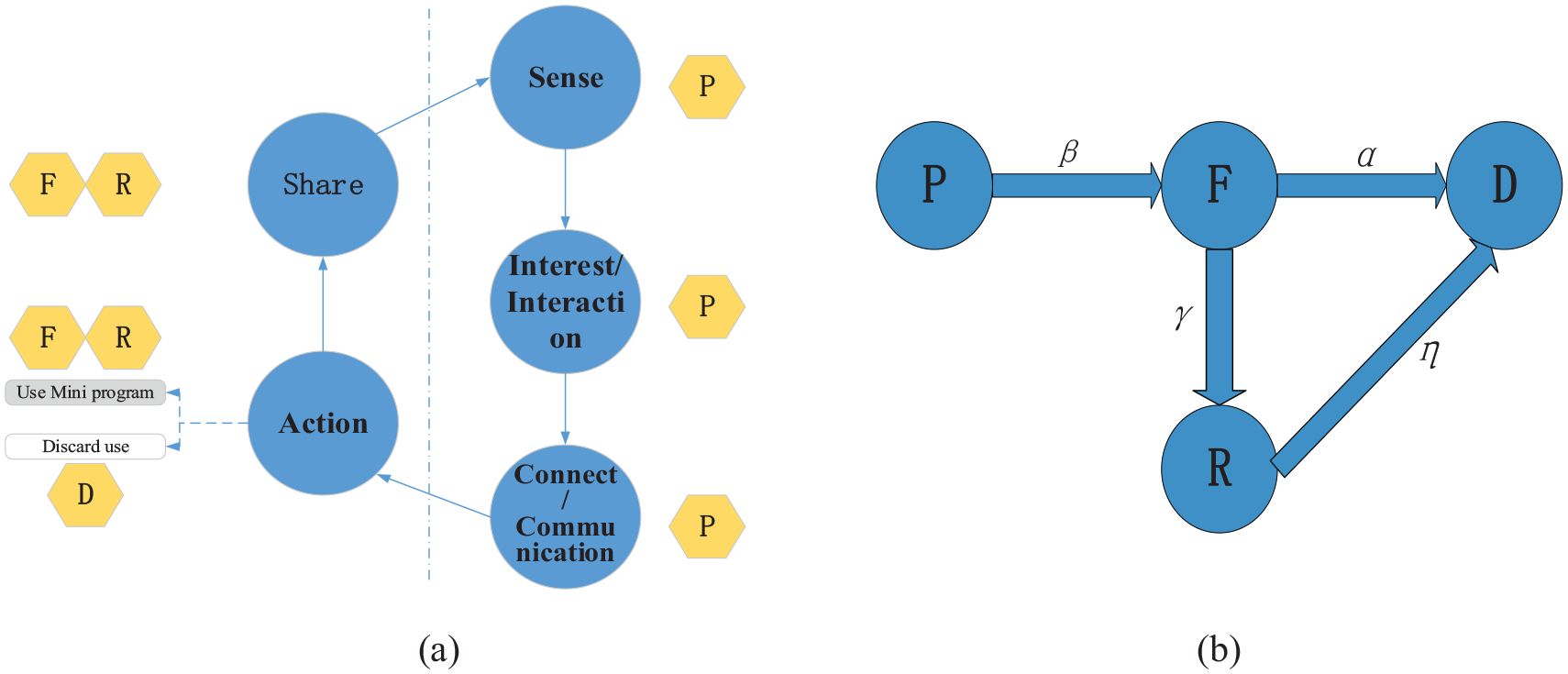
(a) Adapted SICAS model of WeChat mini program users and (b) WeChat mini program diffusion process.
A node’s transition from one state to another within the mini program diffusion process can be represented by the following description:
P → F: node P will transition into node F because it receives a mini program from nodes in F and R with probability
F → D: node F may not want to log into the mini program with a probability
F → R: node F will transition into node R with probability
R → D: node R will transition into node D because it may no longer log into the mini program with a probability
Some of the parameters are explained as follows.
A network is divided into
We refer to
Let
The symbol
According to the above study, in the time interval Δt, our research is based on the assumption that a node P can receive information about the mini program from nodes F and R, and the node can log in for the first time after receiving the information. The probability that a node receives information from at least one user that has the ability to spread mini program is
Similarly, the symbol
We can obtain the expectation on both sides of equation (1) as follows
Then, taking limitations on both sides
According to the law of Robida, the above formula can be simply proven as follows
Similar to equation (1), we have
Similarly, we also have the following ODE equations
Now, we have four equations: equations (11) and (17)–(19). We can obtain the values of all the variables at any point in time.
4. Simulation and numerical results
In this section, we will evaluate the performance of the above model through MATLAB numerical experiments. In the first step, we use Python software to perform a computer simulation and then verify the accuracy of the model by comparing the simulation results with the theoretical results. In the second step, by setting different parameters for the numerical experiments, we analyse the impact of the community structure and mini program social marketing on the diffusion of mini programs.
4.1. Simulation results
We assume that WeChat is divided into five communities, a WeChat user is a node, the total number of users is N = 5000, and that the number of users in each community is 1000. When time T = 0, we assume that there is only one user whose status is F, he can spread marketing information. The other users’ status is P, that is, they have not logged into the mini program. When F status users come into contact with users in the same community or in different communities and disseminate the mini program to them, the mini program will spread in each community. Referring to scholars’ research on social network information dissemination, we set the parameter of moderating variable as
In this study, we consider the changing trend of four types of nodes: P, F, R and D. Figure 2(a) shows the trend of the number of all nodes. The figure shows that the number of node P dropped sharply within a very short period of time when diffusion began. Most users receive the marketing information on the mini program and use it for the first time, changing from state P to state F. The number of F nodes rapidly increases to a peak at the initial stage of diffusion and then decreases to 0. After experiencing a rapid rise to a certain value, the number of user R starts to slow down, and the number of discarded user D begins to slowly rise after experiencing a period of rapid rise.
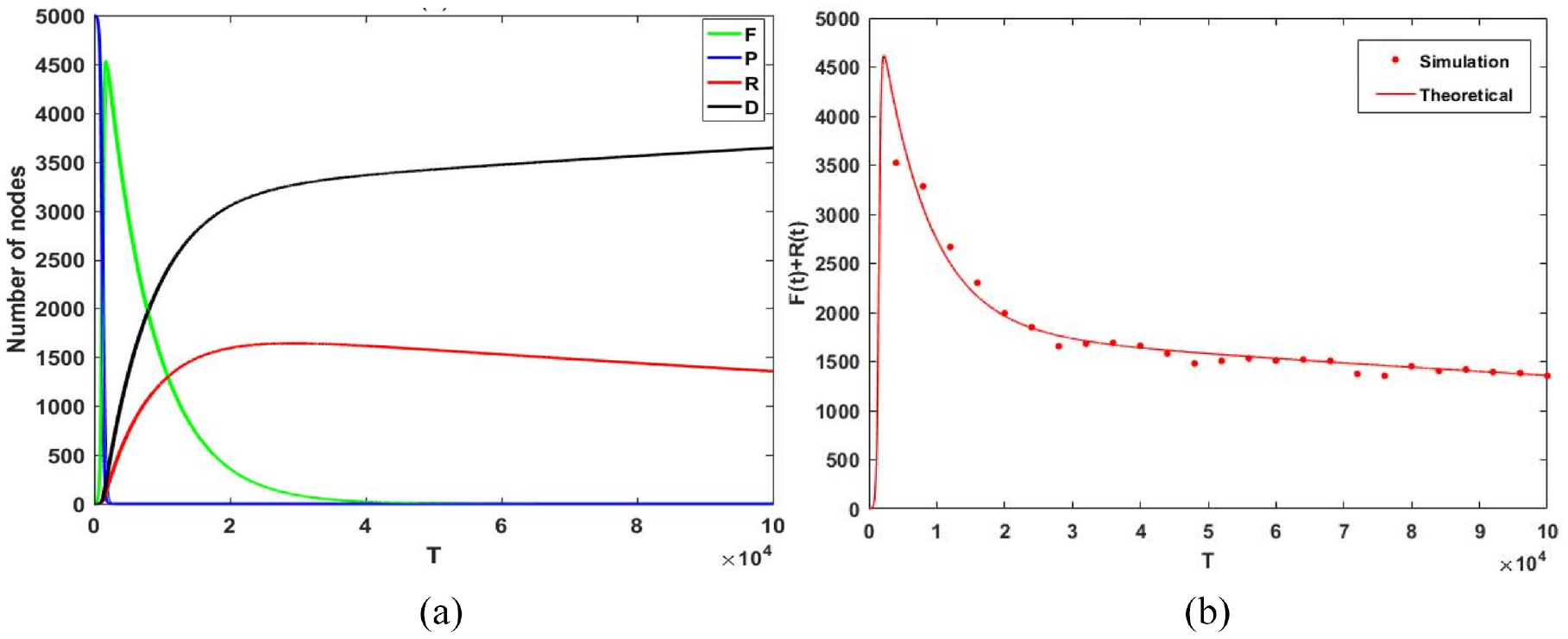
(a) Numbers of nodes in each state and (b) comparison between the simulation results and theoretical solution.
To verify the accuracy of the model, we compare the simulation results obtained by Python with the numerical results calculated by MATLAB. We use the number of sum of F users and R users in the comparison, we set the mini program dissemination time from 0 to 100,000, and the experimental parameters are the same as above. In order to improve the accuracy of the results, we take the average value of the results of 40 iterations as the simulation results, and we calculate the error value is 3.21%, which shows that the above mini program diffusion model is relatively accurate. In view of this, we directly use the theoretical value of the model to analyse the impacts of the influencing factors on the diffusion process of the mini program. The comparison results are shown in Figure 2(b).
4.2. Effect of the community clustering coefficient
In this section, we analyse the influence of the community structure on the diffusion of mini programs. The community clustering coefficient is used to reflect the connection density within a community, and the modularity is used to reflect the connection density between two different communities.
First, we analyse the impact of the clustering coefficient on the diffusion of mini programs. We conduct two groups of experiments and obtain two groups of results. Figure 3(a) shows the diffusion range as the community clustering coefficient changes, and Figure 3(b) shows the diffusion range as the time changes. According to the research in the literature, it is assumed that the community clustering coefficient follows a normal distribution:
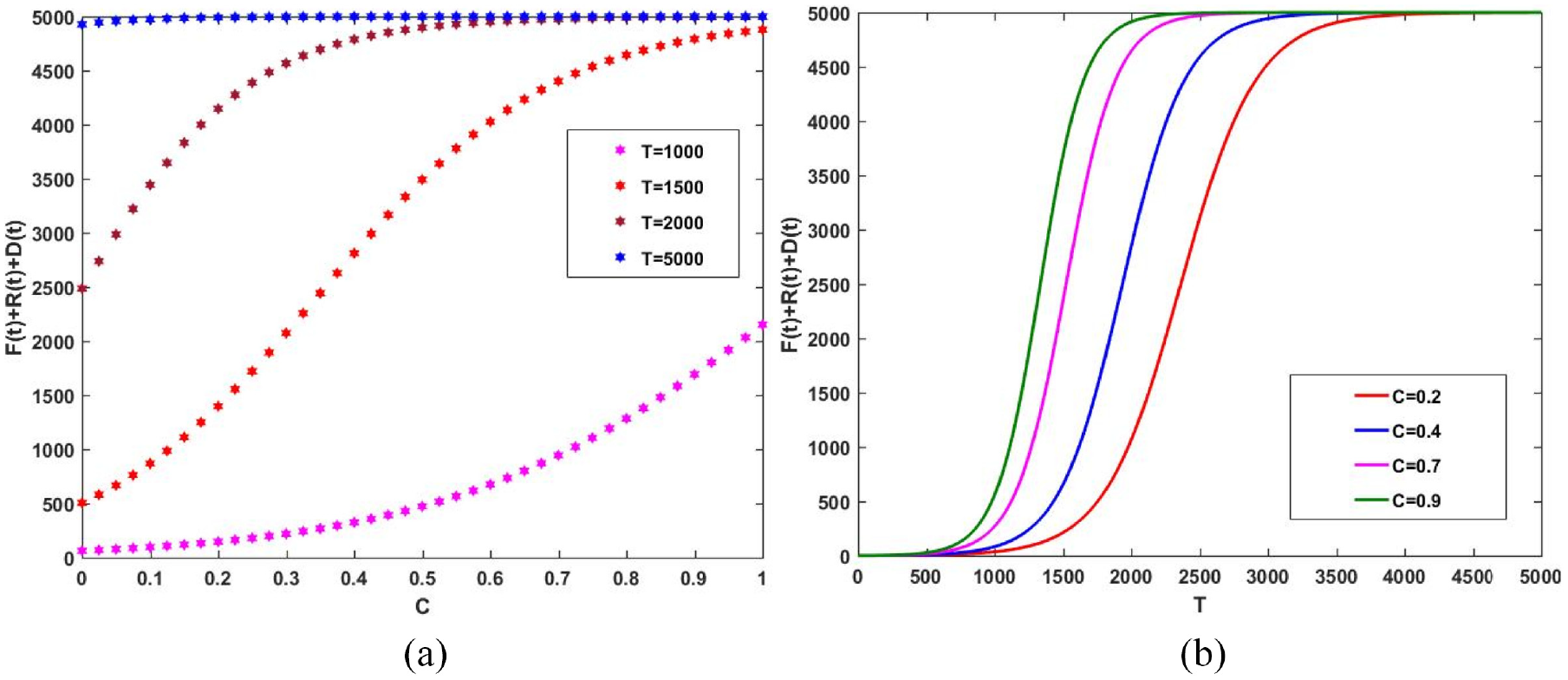
(a) The total numbers of users F, R and D with different maximal lifetimes and (b) the total numbers of users F, R and D with different community clustering coefficients.
We set different diffusion times. When the community clustering coefficient increases from 0 to 1, the diffusion range increases as the community clustering coefficient increases, and the change trend of the diffusion range of mini programs is different. As shown in Figure 3(a), in different time periods, the impact of the community clustering coefficient on the diffusion of the mini program is different. The longer the diffusion time is, the wider the diffusion range. It increases as the community clustering coefficient increases. For example, when
We set different community clustering coefficients. Figure 3(b) shows the diffusion trend of the mini program under different community clustering coefficients when the time increases from 0 to 5000. The figure shows that at the beginning of the spread, the spread of mini program is relatively slow. Then, the diffusion range began to show explosive growth, the spread speed reached the peak, and the diffusion range finally gradually slowed down. When the diffusion time is short, the diffusion range of mini programs increases as the community clustering coefficients increase, and the diffusion speed of different community clustering coefficients varies greatly. The larger the clustering coefficients are, the faster the mini program will spread in the WeChat community. As time passes, the impact weakens. When the time is long enough, the clustering coefficient has almost no impact on the diffusion range of the mini program.
Figure 3(a) and (b) shows that in the early stage of diffusion, the community clustering coefficient has a greater impact on the diffusion range of mini programs, and the diffusion range increases as the community clustering coefficient increases. In the later stage of diffusion, the community clustering coefficient has a smaller impact on the diffusion range. The WeChat community clustering coefficient measures the intensity of the user interaction in the community. The larger the community clustering coefficient is, the higher the density of nodes, the stronger the interaction between users in the community, the greater the probability that users who have not received the marketing information are more probably to receive the mini-program information, the larger the spread range and the faster the spread speed.
Second, we analyse the impact of the modularity on the spread of mini programs. According to the literature, the value range of the network modularity is 0.6–1 [35], and the other parameters are consistent with those in the simulation experiment.
First, we set different diffusion times. When the modularity increases from 0.6 to 1, the diffusion range of mini program diffusion changes differently at different time points. As shown in Figure 4(a), the impact of the modularity on the diffusion presents a more obvious dynamic pattern at different times. When the diffusion time is short, as the modularity value increases, the diffusion range of the mini program decreases. When the diffusion time is long, the impact of the modularity on the diffusion range is small.
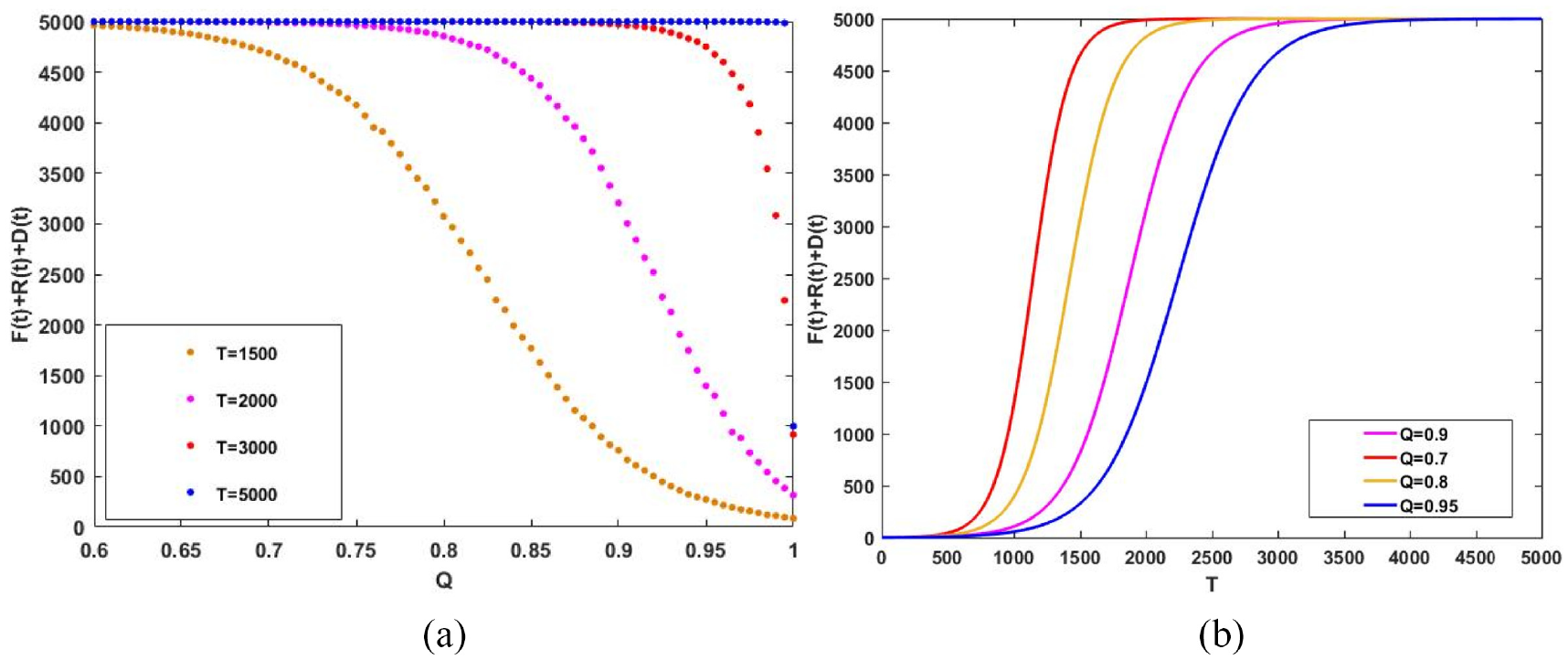
(a) The total numbers of users F, R and D with different maximal lifetimes and (b) the total numbers of users F, R and D with different community modularities.
Second, we set different modularity. Figure 4(b) shows the change trend of the diffusion range of the mini program with different modularity when the time increases from 0 to 5000. After a relatively slow process, the spread experiences explosive growth and finally tends to be flat. When the modularity of the community is small, the outbreak time of the diffusion is earlier and faster. In the early stage of spreading, different modularity has a considerable impact on the scope of diffusion. As time passes, the impact of the modularity on the diffusion range is no longer substantial.
Figure 4(a) and (b) shows that the shorter the diffusion time is, the greater the impact of the modularity on the diffusion range of the mini program. The diffusion range decreases as the modularity increases. When the diffusion time is long enough, the impact of the modularity on the final diffusion range is small. The modularity is an important characteristic indicator reflecting the structure of social networks; it reflects the density of the connections between different communities. When the modularity is high, the node interactions between communities are lower, and members of different communities have a lower probability of spreading mini program to each other; conversely, when the modularity is low, the probability of mini program spreading among different communities is high.
4.3. Effect of mini program marketing
In this section, we discuss the impact of marketing on the dissemination of mini programs. The process of marketing activities can be regarded as a process of marketing information diffusion.
First, we analyse the impact of advertising marketing on the diffusion of mini programs, and we take two groups of experimental results for analysis. The set parameters are as follows: the interactive marketing spread probability
Figure 5(a) shows the change trend of the mini program diffusion range as the advertising marketing spread probability
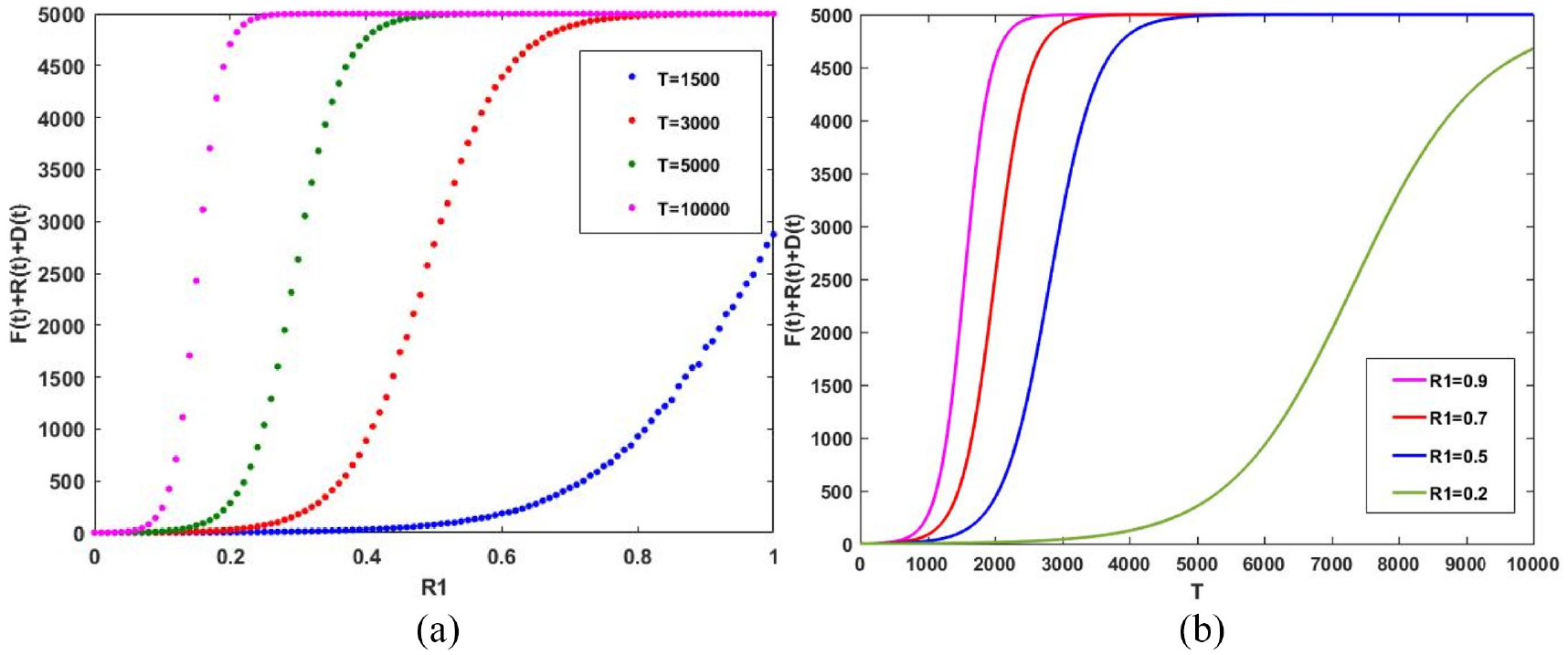
(a) The total numbers of users F, R and D with different maximal lifetimes and (b) the total numbers of users F, R and D with different internal marketing indices.
Figure 5(b) shows the diffusion range changes of different advertising marketing spread probabilities with time. We set the diffusion time
Figure 5(a) and (b) shows that increasing the advertising marketing spread probability in the early stage of diffusion can greatly increase the scope of the spread of mini program marketing information and improve the diffusion speed so as to increase the outbreak time of diffusion. Increasing the advertising marketing spread probability in the late stage of diffusion has little effect on the scope of the spread of mini programs. If the spread probability is relatively low, increasing advertising marketing will have a more considerable impact on the scope of diffusion.
Second, we analyse the impact of interactive marketing on the diffusion process of mini programs. We take two groups of experimental results for the analysis. The set parameters are as follows: advertising marketing
Figure 6(a) shows that the interactive marketing of the mini program has different influences on the final diffusion range with the different diffusion times. The diffusion range of the marketing information of the mini program increases as the spread probability of interactive marketing increases. After reaching a certain value, the impact of the change of the interactive marketing spread probability on the diffusion rage gradually weakens, and the interactive marketing spread probability’s impact has a considerable relationship with the diffusion time. For example, when
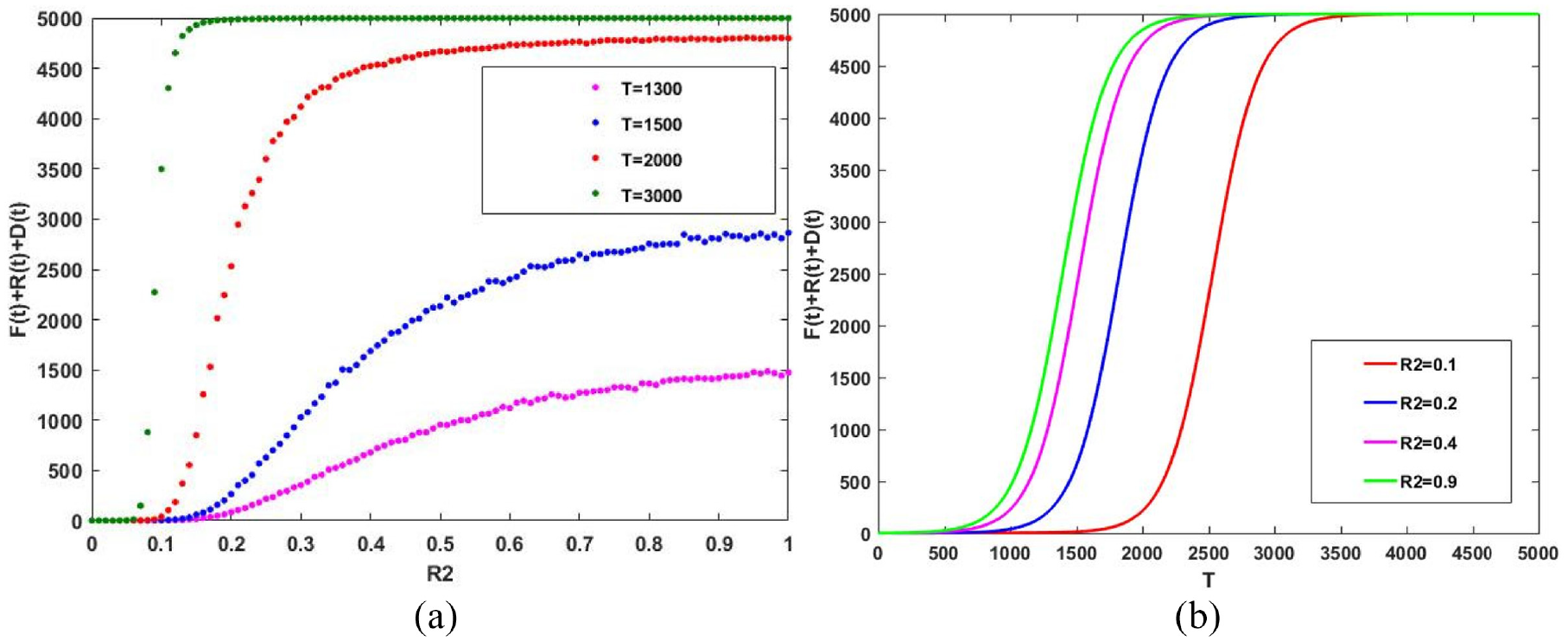
(a) The total numbers of users F, R and D with different maximal lifetimes and (b) the total numbers of users F, R and D with different external marketing indices.
Figure 6(b) shows the marketing information diffusion range as time changes, we set the diffusion time of the mini program as
Figure 6(a) and (b) shows that increasing the spread probability of interactive marketing in the early stage of diffusion can greatly increase the scope and speed of the spread of mini programs and increasing the strength of interactive marketing in the late stage of diffusion has little effect on the scope of the spread of mini programs. Therefore, mini program operators can adopt the strategy of increasing interactive marketing in the early stage of diffusion to accelerate the speed and expand the scope of the diffusion.
4.4. Effect of the community structure and mini program marketing
When the modularity is high and the clustering coefficient value is high, the connectivity density between different communities is low, the connectivity density within the community is high, and the degree of modularity between different communities is high, which is expressed as a strong community structure. In this article,
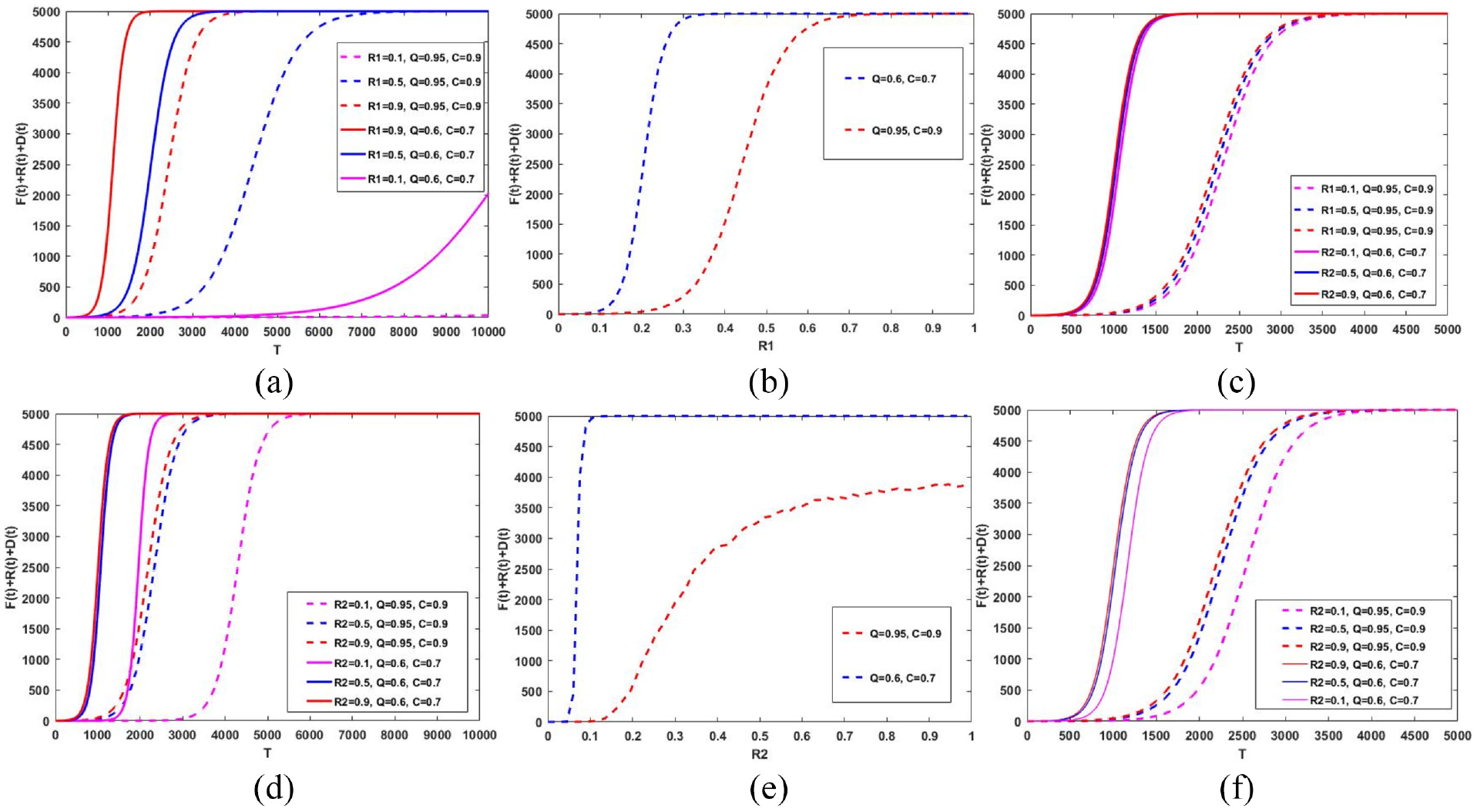
The total numbers of users F, R and D with the community structure and internal marketing index when (a) R2 = 0, (b) R2 = 0 and T = 5000 and (c) R2 = 0.5. The total numbers of users F, R and D with different external marketing indices and community structures when (d) R1 = 0, (e) R1 = 0 and T = 2500 and (f) R1 = 0.5.
First, we analyse the impact of community structure and advertising marketing on the diffusion of mini programs. Figure 7(a) and (b) shows that under the condition of no interactive marketing, with different community structures, the impact of advertising marketing spread probability on the scope of diffusion is different. When the advertising marketing spread probability is larger in communities with weak community structures, the diffusion of mini programs breaks out earlier, spreads faster and the time required to spread to a certain range is shorter. In different community structures, improving advertising marketing can substantially optimise the diffusion effect. When the advertising marketing spread probability increases, the promotion of the marketing information diffusion performance in the weak community structure is slightly better than that in the strong community structure. Figure 7(c) shows that when interactive marketing is strong, increasing the advertising marketing spread probability in a strong community structure and weak community structure has less impact on the diffusion process of mini programs.
Second, we analyse the impact of the community structure and interactive marketing on mini program diffusion. Figure 7(d) and (e) shows that the mini program diffusion performance in a weak community structure is better than that in a strong community structure. When there is no advertising marketing, that is, when the interactive marketing spread probability is large in the weak community structure, the diffusion performance of the mini program is the best. It is necessary to increase the interactive marketing spread probability in different community structures to improve diffusion performance. When increasing the interactive marketing spread probability, the promotion of marketing information dissemination performance in weak community structures is better than that in strong community structures. Figure 7(f) shows that when the advertising marketing spread probability is large, the diffusion performance increases when the mini program increases the interactive marketing spread probability, but the change is small.
As Figure 7 shows, when two kinds of marketing methods are used in the weak community structure at the same time, the mini program marketing information diffusion performance is the best. The reason is that the higher clustering coefficient has a positive impact on propagation, and higher modularity has a negative impact on propagation, but a high clustering coefficient cannot offset the negative impact of high modularity on propagation. When the social media marketing strength in different community structures is increased, the promotion of marketing information diffusion performance in the weak community structure is better than that in the strong community structures. Therefore, mini programs should make greater efforts in social media marketing in strong community structures than in weak community structures. The effect of adopting two marketing strategies at the same time is better than adopting a single marketing strategy, but marketing costs are easily wasted when two marketing methods are excessively used. Therefore, the marketing effect is not optimal when both marketing efforts are large enough. Only a moderate combination can achieve the best diffusion effect.
4.5. Actual data verification
In order to verify the effectiveness of the model in real social networks, we collected real user data from a game mini program. The active users we collected referred to users who have used mini program more than once within a period of time. It is the repeated user in our model, that is, the R user. The mini program is mainly disseminated on the social platform of WeChat. The information collection of the mini program starts from the establishment of the mini program on 1 July 2018 to 30 January 2019. The dissemination time is 217 days, and we set T = 21,700. Because in real life, the operator of the mini program carried out rectification measures on the marketing and content of the mini program on the 140th day, resulting in an increase in the subsequent user retention rate and decrease in user discard rate, so we divide the propagation into two stages, and we adjust it by modifying the value of
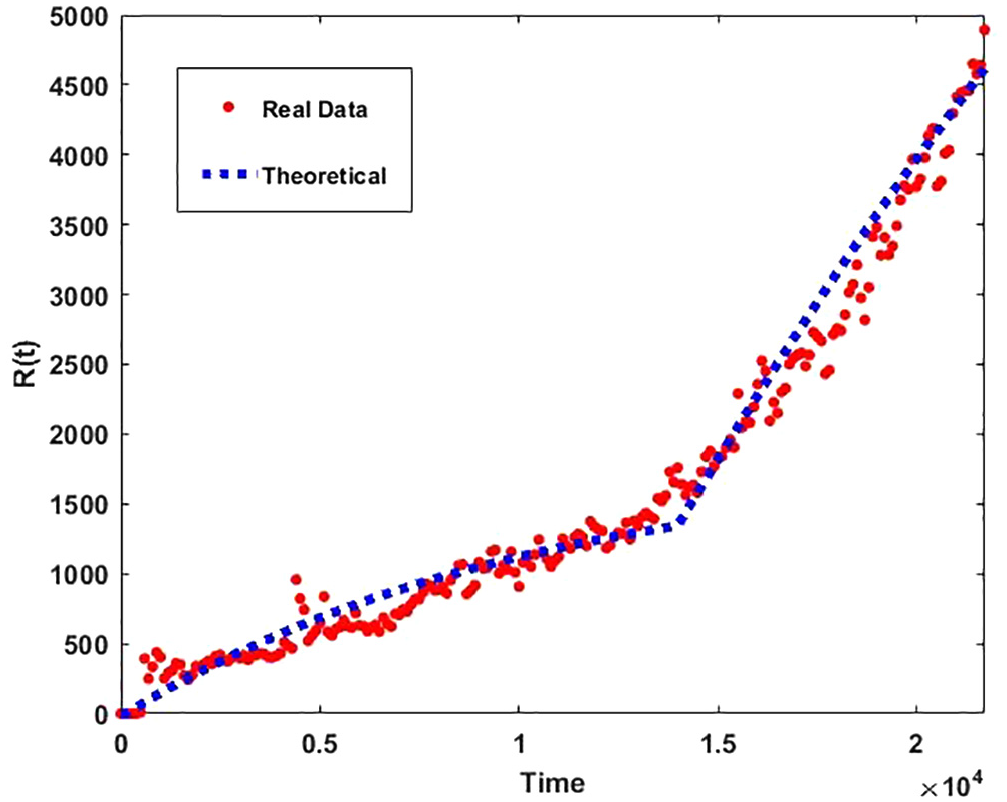
Comparison between the real data and the theoretical result of R(t).
5. Conclusion
In this article, we build an improved SIR model to study the diffusion of mini programs in social networks and verify the accuracy of the constructed model through simulation and numerical experiments. In the model, advertising marketing and interactive marketing are used to describe mini program social media marketing, and modularity and community clustering coefficients are used to describe the community structure of social networks. From the perspective of the theoretical diffusion model, we discuss the impact of social media marketing on the diffusion process of mini programs in different community structures. The main conclusions are summarised as follows:
The higher the community clustering coefficient is, the more active the users in the community are, the faster the spread of mini programs is, and the earlier the spread breaks out. In different communities, the lower the modularity is, the closer the connection between users in different communities is, the wider the diffusion range of mini programs is, and the faster the spread speed is.
The social marketing of mini programs has a great impact in the early stage of diffusion. The greater the strength of advertising marketing and interactive marketing is, the wider the range of diffusion within the same time is, the greater the intensity of advertising marketing and interactive marketing is, the faster the spread speed is, and the shorter the time needed to spread to a certain range is. In the later stage of diffusion, the impact of social media marketing on the diffusion of mini programs is weakened. Therefore, it is particularly important to adopt appropriate marketing activities, such as increasing advertising, public account promotion, and other marketing activities that increase advertising marketing, in the early stage of mini programs and to enact some interactive marketing activities, such as incentive activities, to encourage users to share more mini program marketing information.
Social media marketing has different diffusion effects in different community structures; in the weak community structure, the spread of mini programs is wider and faster. Therefore, in the strong community structure, mini programs need to invest more in social marketing than they do in the weak community. In the early stage of diffusion, the effect of moderately combining the two marketing strategies is better than that of only considering a single marketing strategy. Overusing the two marketing strategies will cause a waste of marketing costs.
We propose an improved SIR model to describe the diffusion process of mini program that takes into account the impact of community structure and social media marketing of mini programs; this study fills the research gap of mini program dissemination in the existing literature. Theoretically, this work contributes to the literature on social media marketing and the transmission of mini program. In fact, this work also provides ideas for mini program operators on how to carry out social media marketing in communities with different community structures. In terms of practical significance, we provide some enlightening suggestions for mini program operators to carry out marketing activities in communities with different strengths of community structure, so that they can conduct marketing at the right time, avoid useless marketing and save marketing costs. This article studies the relationship strength between users from the perspective of community structure. In future research, we can describe the network structure more accurately from other dimensions. At the same time, we only consider two kinds of social media marketing strategies, and in future research, we can subdivide the marketing methods.
Footnotes
Declaration of conflicting interests
The author(s) declared no potential conflicts of interest with respect to the research, authorship and/or publication of this article.
Funding
The author(s) disclosed receipt of the following financial support for the research, authorship and/or publication of this article: This research was supported by the General Program of Natural Science Foundation of China (grant number 61471083), the Humanities and Social Sciences Research Program of the Ministry of Education of China (14YJA630044) and the Dalian Science and Technology Innovation Fund Project (2018J11CY009).

Data availability
In this article, we use two research methods: numerical analysis and simulation, the pictures of the numerical experiment are drawn by MATLAB, and the simulation data are random data generated by Python according to the relevant diffusion mechanism, the actual data are obtained from a game mini program operator.