







Abstract
Institutional repositories (IRs) are increasingly gaining prominence among African academic institutions, and Ghana is no exception. This can largely be attributed to the enduring value of hosting research outputs from institutional and individual depositors. Despite its increasing adoption, there is a growing concern about the sustainability of open access IRs, particularly in Africa. However, most of these factors that threaten the sustainability of IRs on the continent can be mitigated by enacting comprehensive institutional policies. Thus, this study sought to examine the role of institutional policies in the sustainability of IRs in Ghana. A total of 830 respondents comprised of IR managers, library staff, postgraduate students, lecturers and university librarians (management) from five public universities in Ghana took part in this study. Questionnaires, semi-structured interviews and document analysis were the main instruments used for data collection. The study yielded an overall response rate of 92.8%. The study findings revealed that public universities in Ghana have institutional IR policies that guide the operation, usage and management of their IRs. However, these policies were persuasive in nature and mainly focused on content submission and generation issues. The study underscored the IR policy’s importance in addressing content generation, awareness, advocacy and copyright restriction challenges. The study recommends the necessity of IR policies to focus on other factors such as technical requirements, expertise and others to ensure the sustainability of these repositories.
Keywords
1. Introduction
Institutional repositories (IRs) present academic institutions globally with the opportunity to showcase their rich intellectual and scholarly outputs. An IR is the hallmark of a world-class academic institution as it confers institutional prestige and global visibility [1]. Despite the increasing adoption of IRs globally, there is a growing concern about the sustainability of open access IRs [1–3], especially in developing countries. However, most of these factors that threaten the sustainability of IRs on the continent can be mitigated with the enactment of comprehensive institutional policies to guide usage, metadata control, content generation and administering, access, awareness and preservation efforts.
Institutional policies play a crucial role in ensuring the successful implementation of an IR project. Once an institution has set up a repository, practitioners must focus on setting up policies geared towards cultivating success. Existing institutional open access policies may significantly impact the success of an IR initiative, particularly in the very early stages of its development [4]. Most institutional open access policies are persuasive, and they ‘encourage’ submission to open access, and authors can often choose whether to comply or not. This is mainly because there are no solid incentives or mandates for authors [5], and the institution itself lacks the resources and expertise to enforce such directives [6].
A carefully drafted IR policy can provide valuable learning and research opportunities for all IR participants. However, many repositories operate under policies that do not account for the broad and complex needs of the various stakeholder groups [7]. In the absence of clear-cut policies and inducement packages, many academics feel reluctant to provide even bibliographic details of their scholarly output to open access repositories, as they aware that such packages exist elsewhere [5]. An important aspect of policy development is the consideration of the specific needs of an organisation and its key drivers [8]. Alignment with organisational drivers ensures that strategies employed by librarians and IR managers are aligned with organisational needs. Therefore, IR policies must reflect the thinking and resolve the various stakeholder groups’ reservations about the repository’s purpose and scope [7]. This study, therefore, examined the role of institutional policies in ensuring the sustainability of IRs of public universities in Ghana.
2. Contextual setting
Ghana was fully connected to the Internet in 1995 [9]. With a population of 30.79 million, mobile data subscriptions accounted for 76.94% of the population as of March 2022 [10]. About 16.99 million Ghanaians, representing an Internet penetration rate of 34.3%, had used the Internet as of January 2022 [11]. The high increases in mobile penetration rates and Internet usage have primarily been attributed to the alteration of the average Ghanaian’s social, economic and cultural life, especially in education, commerce and entertainment [9,12]. Over the years, university libraries in Ghana are increasingly using information communication technology (ICT) tools to preserve, disseminate and deliver information resources and services to their clients [13–15]. One such tool is IRs. At the commencement of this research, five out of the nine public universities in Ghana had their IRs listed on both the repository of Open Access Repositories and the Directory of Open Access Repositories. The next sections provide a brief description of these universities.
2.1. University of Ghana
Located in Accra, the capital of Ghana, the University of Ghana (UG) is the oldest University in Ghana, established on 11 August 1948. It was initially established as the University College of the Gold Coast with the primary aim of providing and enhancing university education within the Gold Coast. With a student population of about 36,819, the UG is ranked the 20th best University in Africa by the Times Higher Education Ranking of 2020 [16]. As the pioneer of university education in Ghana, the university has made significant investments in upgrading its ICT infrastructure and by 2011 had a fully functional IR. The University’s IR is connected to the Internet at http://ugspace.ug.edu.gh/.
2.2. University of Cape Coast
The University of Cape Coast (UCC) is located in Cape Coast, the colonial capital of Ghana. It was established as a university college in October 1962 and placed under the supervision of the UG until October 1971, when it attained the status of an independent university, with authority to confer its own degrees, diplomas and certificates.
The University is ranked the 4th best university in Africa by the Times Higher Education Ranking of 2022 [17]. Taking after the successes of the KNUST, the UCC, with support from the Consortium of Academic and Research Libraries in Ghana (CARLIGH) and the International Network for the Availability of Scientific Publications (INASP), established its IR in 2011 [18]. The University’s IR is connected to the Internet at https://erl.ucc.edu.gh/dspace/.
2.3. Kwame Nkrumah University of Science and Technology
Located in Kumasi, the Ashanti region of Ghana, Kwame Nkrumah University of Science and Technology (KNUST) was the first University in Ghana to establish a fully functional IR in 2008 [19]. With an initial deposit of 560 postgraduate theses, KNUST’s IR currently hosts 344 conference proceedings, 1996 journal articles, 338 speeches and 8518 thesis and dissertations. The University’s IR is connected to the Internet at http://dspace.knust.edu.gh/.
2.4. University of Education, Winneba
Originally the University College of Education of Winneba, the University of Education, Winneba (UEW) became a fully fledged university on 14 May 2004. With training and technical support from the CARLIGH and the INASP, the UEW established its first IR in 2011 [18]. However, the first server crashed, bringing the project to a halt until 2016 when the project was revived. The University’s IR is connected to the Internet at http://ir.uew.edu.gh/.
2.5. University of Development Studies
Located in Tamale, the capital of the Northern Region of Ghana, the University of Development Studies (UDS) was established in May 1992 under the Provisional National Defence Council Law 279. The UDS’s IR was established in 2011 with training and technical support from the CARLIGH and the INASP. The University’s repository currently hosts 2,225 publications. The IR comprises of theses and dissertations, inaugural lectures, seminars and conference proceedings. The University’s IR is connected to the Internet at http://udsspace.uds.edu.gh/.
3. Research problem
IRs ensure the preservation of organisational intellectual resources, improving access, knowledge dissemination and scholarly communication [19–22]. IRs are multiplying rapidly in academic and research institutions to manage and preserve institutional intellectual resources in non-print formats [21].
Nonetheless, there is a growing concern about the sustainability of these repositories in Ghana. The few studies on the attrition of repositories in Ghana have often focused on set-up costs, software engineering protocols, marketing and promotion [18,23,24]. However, little is known about the influence of institutional policies on the sustainability of IRs. A study by Anyaoku et al. [25] investigating the digital preservation practices of university libraries in sub-Saharan Africa revealed that university libraries in Africa lacked funding and the technical expertise required to effectively and efficiently manage their IRs. A study by Aliyu et al. [26] examining the challenges and prospects of IRs in Nigeria identified constant hardware and software changes, copyright issues, technical support and security as major challenges facing IRs in Nigeria. In a similar study conducted in Ghana, Agyen-Gyasi et al. [19] identified inadequate ICT connectivity and infrastructure, unreliable power supply, inadequate funding, copyright and technical barriers as major challenges that threaten the sustainability of IRs. However, there is limited research on the role of policy in addressing these challenges, particularly within the academic setting [18,23–25]. Therefore, the study looked at the role of IR policies in addressing these challenges.
4. Research questions
RQ1. Are there institutional IR policies that govern the operation of IRs in Ghana?
RQ2. What is the impact of IR policies on the sustainability of IRs in Ghana?
RQ3. What is the level of compliance with IR deposit policies?
5. Theoretical framework
The diffusion of innovation (DOI) is the theoretical perspective that guided the study. Postulated in 1962 by EM Rogers, the DOI theory is based on the notion that technology adoption is fundamentally a function of communication channels and social systems [27]. The DOI theory states that a person’s acceptance of any innovation and his or her adoption, rejection or continued use of an innovation is influenced by its relative advantages, compatibility, complexity, trialability and observability. The DOI theory was used in this study to outline how IRs as a new technological innovation is spreading throughout the Ghanaian scholarly archiving and communication landscape.
Researchers have used the DOI theory extensively to examine the adaptation and use of IRs and other information systems to bring together multiple viewpoints in understanding the factors that promote the acceptability of innovations within the information system environment [24,28–32]. However, despite its wide range of applications, it must be noted there are inherent challenges and ramifications for employing any theory [30,33]. Thus, this study used certain aspects of the DOI theory to serve as a lens to examine the characteristics of existing IRs of public universities in Ghana and to determine the role of institutional policies in the adoption and usage IRs.
6. Literature review
The global advocacy for open access to scientific and scholarly publications has engineered efforts to establish and develop IRs across Africa. According to Abrizah et al. [34], the push to remove all barriers to accessing knowledge has charted the course for establishing open access IRs in Africa. IRs provide African institutions with the opportunity to showcase the rich cultural heritage of the continent as well as the potential to enhance access and sharing of research-based information generated in Africa [35–37]. This has become even more evident as the COVID-19 global pandemic, and its resultant lockdown policies have forced libraries globally to provide remote access to their collections by leveraging their websites, IRs and other computer systems to deal with demand [38–40].
Institutional policies play a crucial role in ensuring the successful implementation of an IR project. According to Callicot et al. [4], once an institution has established a repository, practitioners must focus on setting up policies to cultivate success. A carefully drafted IR policy can provide valuable learning and research opportunities for all IR participants. However, many repositories operate under policies that do not account for the broad and complex needs of the various stakeholder groups [7]. Clearly, this threatens the sustainability of IRs as these policies are supposed to guide usage, metadata control, content generation and administering, access, awareness and preservation efforts. Therefore, IR policies must reflect the thinking and resolve reservations of the various stakeholder groups [7].
An important aspect of policy development is the consideration of the specific needs of an organisation and its key drivers [8]. Alignment with organisational drivers ensures that strategies employed by librarians and IR managers are aligned with organisational needs. Existing institutional open access policies may significantly impact the success of an IR initiative, particularly at the very early stages of its development [7]. Most institutional open access policies are persuasive. They simply ‘encourage’ authors to make submissions and authors can often choose whether to comply or not. This is because there are no solid incentives for authors [5], and institutions lack the resources and expertise to enforce mandatory deposit policies [6]. According to Prabhakar and Rani [5], in the absence of an inducement package, many academics feel reluctant to provide even bibliographic details of their scholarly output to open access repositories, mainly because they are aware that such packages exist elsewhere.
Many institutional policies seek to strike a balance between the rights of individual researchers and their institutions. Public universities, like all other public institutions, are funded by the state and are therefore obligated to make their research findings freely accessible for the public good. However, these institutions are comprised of individual researchers whose right to their publications must be respected to avoid apprehension towards the repository [41,42]. Bergin and Roh [43] examined the electronic thesis and digitisation policies of the University of Massachusetts. They opine that a carefully drafted policy that addresses copyright and accessibility issues is key to ensuring the population of IRs.
According to Riddle [7], a successful IR policy must address concerns around content generation and the library’s role in ensuring access, management and content preservation. Many have suggested a mandatory deposit policy as a panacea to the low participation of researchers in IR projects [7,42]. However, many researchers have reacted negatively to any suggestion of compulsion and have viewed it as an affront to the author’s right of choice of publication outlet, academic freedom and publisher relations [41]. Xia et al. [42] suggested that the passage of mandatory IR policies is not a panacea to obtaining content from faculty and recommends the need to put in place rewards systems for faculty members who deposit in open access repository as part of the tenure process. Since the primary aim of any IR policy is to enhance organisational image and prestige, it is therefore imperative that IR policies outline flexible measures that would ensure increased deposits of the research output of an institution’s ‘highly skilled’ workforce [44–46]. However, content generation is not the only issue that must be addressed by a policy [4]. IR policies must also address the technical, operational and managerial issues to ensure an IR project’s successful implementation and sustainability. Despite the increased recognition of the role of policy in addressing most of challenges associated with the adoption, usage and management of IRs, there is limited research on the role of policy in addressing these challenges within the Ghanaian context. This study looks at the role of IRs policies in addressing these challenges.
7. Methodology
Five public universities in Ghana – namely, the UG, the UCC, the KNUST, the UDS and the UEW – were the focus of this study. The researchers purposively selected these institutions because they had fully fledged functional IRs, and these institutions were also listed in the directory of open access repositories. The study population comprised postgraduate students, faculty members, librarians, IR managers and university librarians.
Due to the broad and complex nature of sustainability issues, the DOI theory was used as a guide to identifying an IR’s characteristics that have policy implications and which, when regulated, can ensure its adoption and continuous use. This, therefore, called for an approach that could capture ‘soft’ views or experiences and verifiable quantitative experiences [47]. In this regard, the study adopted the convergent parallel mixed method design because of its ability to provide a complete understanding of the role of policy in ensuring the sustainability of IRs in Ghana by giving different but complementary data [48]. This made it possible to compare the feedback from the various category of respondents and revealed points of convergence, divergence and contradictions [48].
The estimated population for the study was 20,873 comprising library staff, faculty members, University Librarians, IR managers and students. University Librarians and IR managers were targeted because they are the innovators of IR within public universities in Ghana and are professionally responsible for the establishment and management of the technical and intellectual contents of IRs. Library staff were targeted because they were considered early adopters because of the key role they play in the marketing and dissemination of library resources. Postgraduate students and faculty members were targeted because they are the main users of IRs (i.e. early majority, late majority and laggards).
Eight hundred and twenty library staff, faculty members and students were conveniently sampled for the quantitative aspect of the study. Ten respondents comprising five university librarians and five IR managers were purposively sampled for the qualitative part of the study. University librarians and IR managers were selected for the qualitative phase of the study because they are uniquely positioned to give further clarifications or insights into the patterns or profiles that emerged from the quantitative data. Table 1 shows the sampling distribution of respondents.
Sampling distribution of respondents.
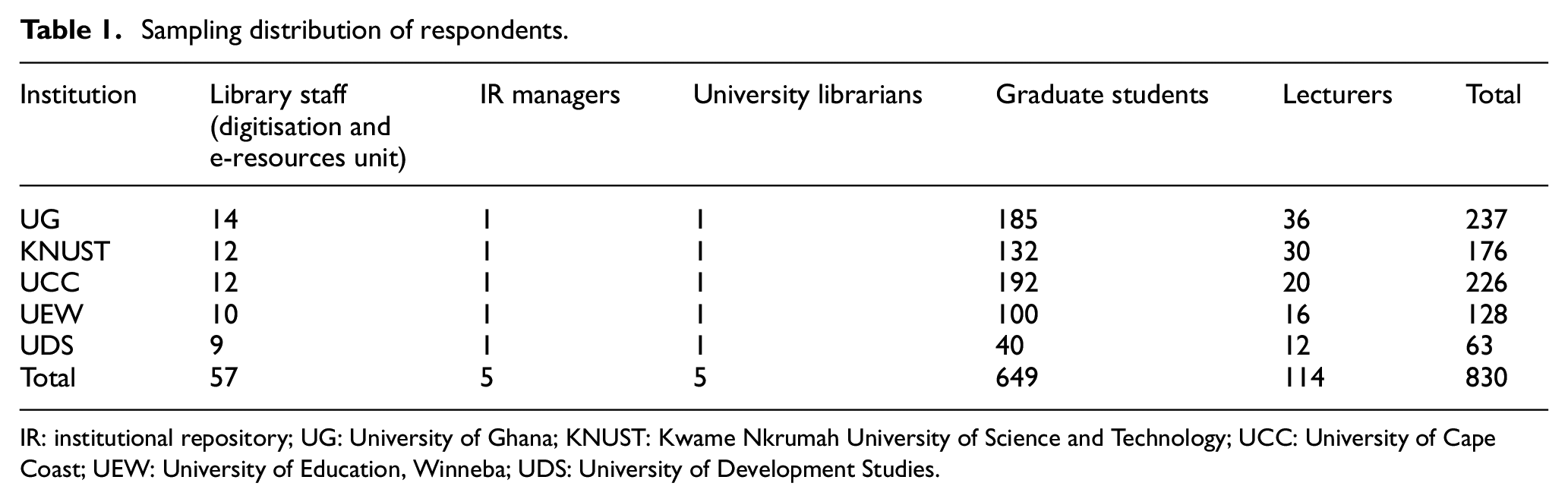
IR: institutional repository; UG: University of Ghana; KNUST: Kwame Nkrumah University of Science and Technology; UCC: University of Cape Coast; UEW: University of Education, Winneba; UDS: University of Development Studies.
8. Research instruments
Self-administered questionnaires and an interview guide were the main instruments used for data collection. Due to the varying backgrounds of the respondents, two sets of questionnaires were prepared. The first group consisted of faculty and students, while the other group was made up of library staff. These instruments were pre-tested with 5 faculty members, 5 librarians and 20 (PhD and MPhil) graduate students. To ensure the content and face validity of the instruments, the researchers sought expert advice from a specialist in measurement and evaluation. The internal consistency reliability of the items was tested using the Cronbach’s alpha (α = 0.86). The researchers considered it acceptable to continue the study instruments’ administration
The data collection was conducted onsite at the libraries of the selected public universities, which provided an opportunity to observe the universities’ IR infrastructure. The research team complied with COVID-19 regulations by wearing a face mask, hand sanitising and keeping a metre distance between the researcher and study participants. The majority of the interviews were conducted via telephone due to COVID-19 restrictions.
The quantitative data collected through questionnaires were analysed descriptively using the Statistical Package for Service Solution (SPSS) software. The interpreted data are presented with the aid of bar graphs, pie charts and frequency distribution tables. The qualitative data collected through the interview guide were analysed using Nvivo software. Both quantitative and qualitative data were collected simultaneously, analysed and presented separately [49]. Thereafter, the data were reviewed to identify points of convergence and divergence [50].
Questionnaires were distributed among 57 library staff responsible for the IR, 649 graduate students and 114 lecturers. Five university librarians were approached for interviews. Three out of the five scheduled interview appointments were successful. Interview appointments were also scheduled with IR managers of the five selected universities. All the five scheduled interview appointments with the IR managers of the selected repositories were honoured. The overall response rate across all study participants was 92.8%. The outcome was considered satisfactory to continue the analysis process [51–53].
9. Findings
9.1. Institutional policies and the operation of IRs in Ghana
The results showed existing IR policies for managing and operating IRs of public universities in Ghana. A total of 702 (96.0%) of the respondents (library staff, graduate students and lecturers) agreed to some extent to the existence of an IR policy within their respective institutions. A detailed analysis of the responses is presented in Figure 1.
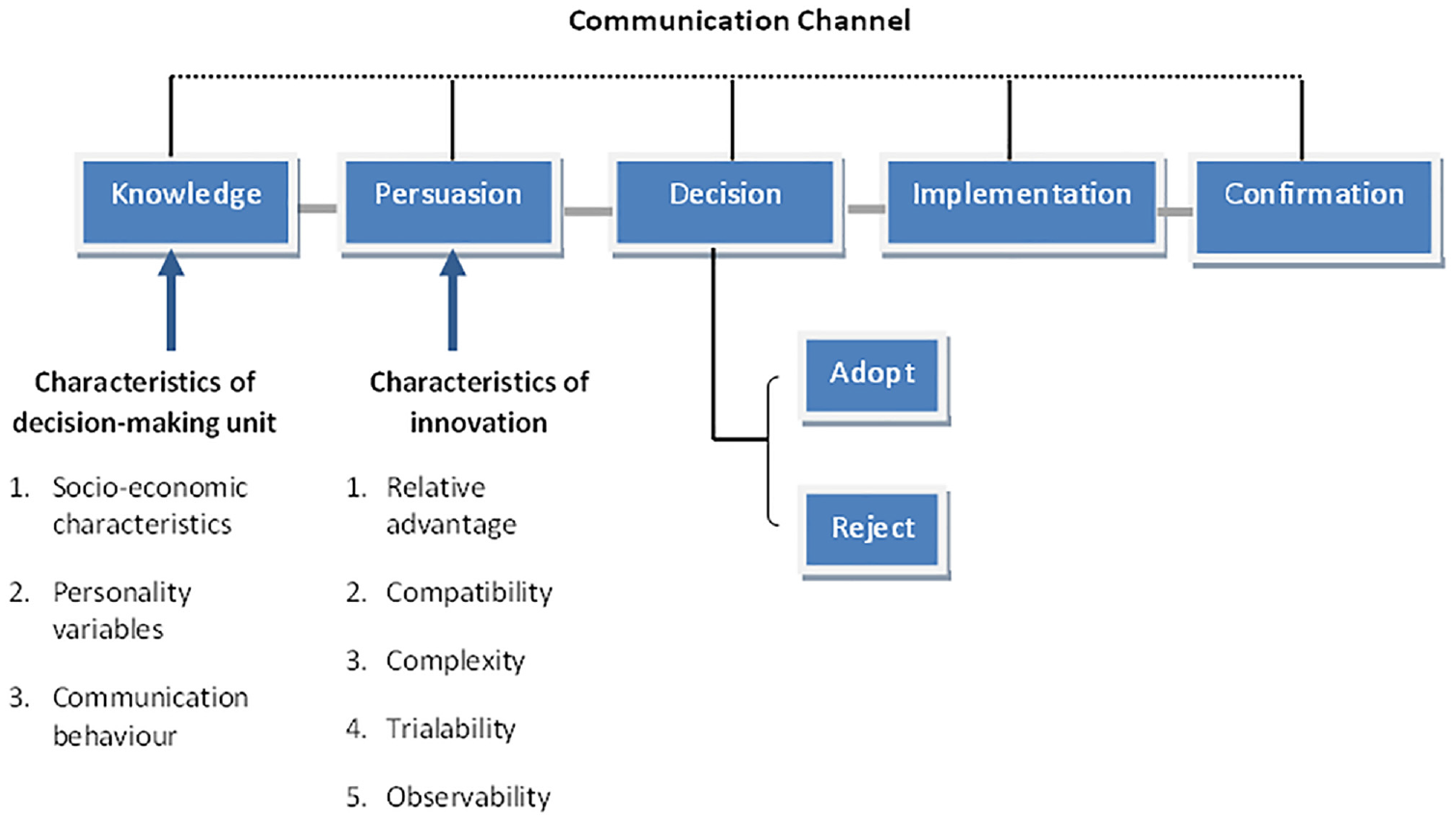
Innovation-decision process.
Similarly, interview responses obtained from IR managers and university librarians confirmed the existence of an IR policy, as observed in the quantitative analysis. The interview data indicated that the IR policies guided usage, metadata control, submission, administering, access and preservation. The following are some of the responses: You know now universities globally are trying to develop IRs and we are bench marking from other earlier universities. So, we understand clearly that the way these things are, they have to be guided by a policy, so we have a policy for the operation and usage of our IR. (University Librarian 3)
9.2. The impact of IR policy on the sustainability of IRs in Ghana
The results, as presented in Table 2, showed that IR policies positively impacted the sustainability of IRs. Five hundred and three respondents (library staff, graduate students and lecturers) agree (mean = 3.76, standard deviation (SD) = 0.93) that the existing IR policies address copyright and accessibility concerns. Similarly, 66.4% of the respondents agree (mean = 3.76, SD = 0.93) that institutional IR policy is key to ensuring the sustainability of IRs.
Impact of IR policy on the sustainability of IRs in Ghana.

Source: Field data, 2021, n = 767.
IR: institutional repository; SD: standard deviation.
Means were calculated from a scale of 5 = strongly agree, 4 = agree, 3 = moderately agree, 2 = disagree and 1 = strongly disagree.
The existence of an IR policy was to guide the operation, usage and management of the IRs. 68.5% of the respondents agree (mean = 3.98, SD = 0.99) that the IR policy directed its function and use, 67.2% of the respondents agree (mean = 3.85, SD = 0.91) that it guided content generation, 66.8% of the respondents agree (mean = 3.87, SD = 0.94) that it guided the management and preservation of IR content. In comparison, 55.3% of the respondents agree (mean = 3.66, SD = 0.98) that an IR policy enhances organisational image and prestige. The overall mean of 3.88 (SD = 0.97) indicates that respondents agree that institutional policies govern the management and operation of their respective IRs.
However, 47.7% of the respondents moderately agree (mean = 3.06, SD = 1.03) with the assertion that IR policy rewards faculty members for depositing content, 60.4% of the respondents moderately agree (mean = 3.48, SD = 1.10) that IR policy mandated the members of the university community to deposit content, while 62.1% of the respondents agree (mean = 3.60, SD = 1.00) that content submission into IRs was voluntary.
The responses regarding the voluntary submissions and copyright concerns as indicated in the quantitative analysis were affirmed during the analysis of the qualitative data. The analysis of the interview responses shows that IR staff and managers do further checks on the documents to check for copyright restrictions before the final archive: Because we are specialized and trained in digital archiving. We do not just deposit, we try as much as possible to access the publisher’s information as to whether their final copy i.e. preprint or post print can be deposited before we finally deposit them. Those that we are not allowed to deposit, all we do is that we just put the bibliographic details of the original sources and any who goes to access the item is the redirected to the original source. (IR Manager 1) First of all, we check the credibility of the journal that published the research. Previously, we were not doing this but now with the advent of predatory journals, we verify to check if the journal that published the research is not predatory. After verify that the journal is not predatory, the next is to check for copyright encumbrances, you could have OA journal that have copyright challenges, if there are not challenges then you upload.
Similarly, a content analysis of the various IR policies showed that the policies address copyright concerns: The author shall search for the publisher’s self-archiving policy or ‘OA policy’. Online in the SHERPA/RoMEO database at http://www.sherpa.ac.uk/romeo.php or in the Australian OAKList database at http://www.oaklist.qutedu.au. If a publisher cannot be found on this site, the publisher shall be contacted directly. (UEWRep, Section 13.2.8-9) When an item is submitted to UCCSpace the author(s) grant(s) a non-exclusive dissemination right to the university. This does not prevent the author(s) from publishing it as a journal article or in any other place because s/he still holders partial copyright of the item. The author has to seek copyright clearance, if necessary, from a publisher that requires that before submitting the item … (UCCSpace,2012, Section 2.3, bullet 1 and 2)
9.3. Level of compliance with IR deposit policies
The results, as presented in Table 3, showed that content submission among faculty members and students was as low as 53.6%, and 64.5%, respectively, had never archived content in an IR.
Respondents’ content submissions.
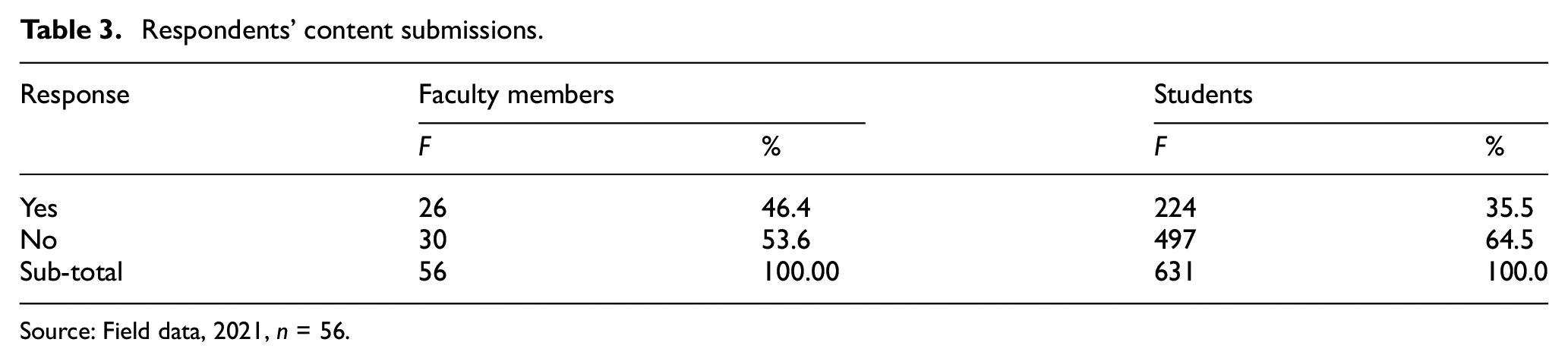
Source: Field data, 2021, n = 56.
Analysis of the interviews responses affirms the results as presented in Table 3 as they indicated the frustrations of IR managers in receiving content particularly from faculty members.
Extracts: You see the issue is about the debate on university laws, statutes and policies. Naturally, university policies are not laws, so you may have a policy but people may not comply with them. Yes, the policy mandates members of the university to deposit their research outputs into the IR but they don’t. And it sometimes difficult since it’s not in the status. (University Librarian 3) It is stated clearly in the policy that everyone must archive but I think that putting in place measure to ensure that people willingly deposit by making it part and parcel of the system is what is lacking. (IR Manager 5) Ok so the policy that is in existence now is a bit passive. In the sense that most of the things that require faculty members to do as far as the IR is concern is not being done. That is why in my earlier submission is stated that it important to have management commitment to push them to do the right thing as far as deposit is concern. (IR Manager 3)
10. Discussion
Institutional policies form the basis for formulating, directing and shaping major organisational decisions and ensuring that organisational members work and act within established boundaries. Therefore, examining the impact of institutional policies on the operation and management of IRs is key to its sustainability.
According to Callicot et al. [4], institutional open access policies may have a significant impact on the success of an IR initiative, particularly at the very early stages of its development. The DOI theory emphasises the importance of persuasion in the adoption or rejection of an innovation. Because of this, the study conceptualised that for IRs to be sustainable, they must conform to existing institutional values and norms to persuade their adoption and continuous use. For public universities in Ghana, most of these institutional norms and values are enshrined in institutional policies and statutes. Given this, the respondents’ knowledge of the existence of an IR policy, compliance levels and the impact of IR policy in persuading the adoption and continuous usage of IRs in Ghana were presented in Figure 2 and Table 2.
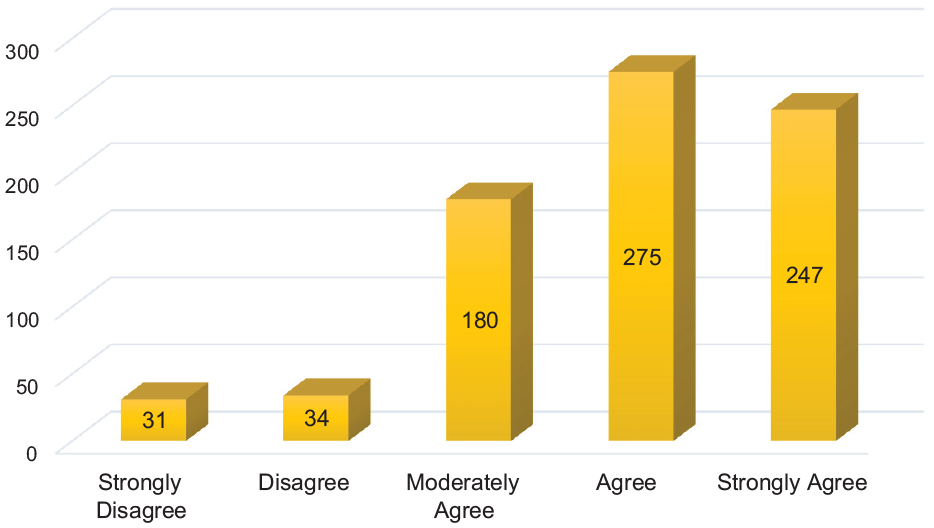
Existence of IR policy.
Generally, 96.0% of the respondents agreed to some extent to the existence of an IR policy that guided the operation, usage and management of IRs in their respective institutions. Expressly, 225 (29.3%) of the respondents strongly agreed with the existence of an institutional IR policy, while 31 (4.04%) respondents strongly disagreed to the existence of an institutional IR policy. This meant that there were existing rules and guidelines for all IR participants. Furthermore, these rules were formulated to ensure that all participants enjoy the benefits of participating in the IR initiative. As shown in Table 2, the results also indicate that 67.2% of the respondents agree (mean = 3.85, SD = 0.91) that the IR policy guided content generation. It confirmed that the policy drafters recognise the critical role of policy in Ghana’s sustainability of IRs.
However, an analysis of the interview responses clearly shows that these policies are persuasive, particularly for faculty members. That is, they generally entreat people to deposit. Regarding the DOI theory, stakeholders will only be persuaded to contribute content to IRs only when they recognise the advantages of archiving content in IRs compared with other archiving platforms. However, it is instructive to note that although institutional IR policies exist, content submission among faculty members is very low. As shown in Table 3, 53.6% of faculty members had never contributed any content to their institutional IR. This has primarily been attributed to the reluctance of many faculty members to submit content to their institution’s IR [53]. The non-existence of ‘incentives’ or ‘motivators’ for the faculty member to deposit [5], copyright or contractual arrangements between authors and funders [54] and the absence of a strict institutional framework and support for ensuring that IRs form an integral part of the institution’s scholarly communication practices or activities [34].
This situation needs the attention of all stakeholders as the primary aim of an IR initiative is to enhance organisational image and prestige. Therefore, measures are imperative to ensure that any academic institution’s most ‘highly skilled’ workforce is persuaded to deposit content into their institutional IRs [5,55]. To achieve this, IR managers and administrators must adopt a two-prong approach. The first approach is to increase awareness and education on the relative advantages of participating in the IR initiative both at the organisational and individual levels. However, it must be noted that awareness and promotion have not always yielded the desired results [18,19,24,28,46].
The second approach is for IR managers and administrators to push for mandatory content submission policies, particularly for faculty members. This could be possible if submitting content to institutional IRs is set as a requirement for promotion and tenure. Nonetheless, this has been contested by others who have expressed contrary opinions and have viewed such mandates as against the author’s right of choice of publication outlet, academic freedom and publisher relations [6,41,42]. It seems that mandates are the only option available to IR managers and librarians as a constant effort at creating awareness, promotion and stressing the need for faculty members to deposit content has not yielded the desired results. This position was aptly expressed by IR Manager 2 during the interview session: ‘… so it was the case that librarians were chasing faculty members to bring their publications but seeing depositions was becoming a problem. The University incorporated the mandatory deposits into the promotional requirement, and this really increased faculty deposits’.
However, the findings revealed that content generation is not the only issue that must be addressed by policy [4]. The reviewed literature also indicated that one critical policy issue that affects faculty members’ decision to participate in contributing content to IRs is the issue of copyright.
As presented in Table 3, 92.9% of faculty members surveyed had indicated a willingness to archive content in an IR in the future. The literature shows clearly that publisher copyright restrictions and author copyright concerns greatly hinder IR participation and content submissions [26,56–58].
An analysis of the participating universities’ existing IR policies seemingly suggests that they address copyright concerns. However, these policies burden authors to seek copyright clearance from publishers when necessary before submitting content, making the submission process cumbersome and tedious, perhaps discouraging deposits. As espoused by the DOI theory, the ease of using innovation is key to its adoption and continuous use.
The interview transcripts revealed that IR personnel checked for copyright restrictions before the final archive. However, this has no expression within the respective IR policies. This, therefore, requires librarians to be more proactive in letting depositors know that they are available to perform copyright restriction checks on their behalf. It is also instructive to note that these policies are silent on funding. This comes from the backdrop that previous studies have increasingly identified funding [19,25,59] as posing a significant threat to the sustainability of IRs. Therefore, these policies must identify reliable funding streams for IR activities, particularly due to the rapidly changing nature of IR systems and technologies.
11. Conclusion
The study showed that institutional IR policies guided the operation, management and submission of content to repositories at public universities in Ghana. It means that some existing rules and guidelines ensure that individuals and universities enjoy the benefits of their participation in the IR initiative. It further confirms that the policy drafters recognise the critical role of policy in Ghana’s sustainability of IRs. However, to ensure the adoption and continuous use of IRs, IR policies must consider the scholarly communication behaviour of the various stakeholder groups as outlined by the DOI theory.
The results also showed that the individual IR policies were persuasive, particularly regarding content submission by faculty members. Due to the passive nature of the IR submission policies, content submission among faculty members was found to be very low. It is instructive to note that 53.6% of faculty members had never contributed any content to their institution’s IR. Moreover, although faculty members are willing to archive content in an IR in the future, critical policy issues such as copyright, tenure and promotion affect faculty members’ decision to contribute content to IRs [26,34,60–62]. Although the IR policies of public universities in Ghana address the issue of copyright, these provisions place the burden on authors to seek copyright clearance from publishers before submitting content. This makes the submission process cumbersome and tedious for faculty members and perhaps discourages deposits. The DOI theory also affirms that an innovation’s simplicity or ease of use is key to its adoption and continuous use. Copyright restriction checks are conducted by IR personnel before documents are finally archived. Therefore, IR policies must reflect these interventions to elicit the trust of authors who might be reluctant to deposit content due to copyright restrictions.
Institutional IR policies of public universities in Ghana are silent on funding sources. This is particularly important as previous studies had identified funding [19,25,59] as posing a significant threat to the sustainability of IRs. Therefore, IR policies must identify funding sources for the upgrade, maintenance and management of IRs. Although existing IR policies provide the needed guidelines, clarity and operational framework for successful implementation and management of IRs, there is a need for policy revision and realignments to ensure the long-term survival and sustainability of IRs in Ghana. In light of the above conclusions, the study recommends the following:
Although public universities in Ghana had IR policies, they did not have a policy implementation strategy. Therefore, IR managers should strive to implement the actions outlined in the institutional IR policies, and the effectiveness of these actions will not be measurable without regular monitoring and evaluation.
To improve content submission among faculty members, the institutions should consider submitting content as one of the requirements for tenure and promotion for faculty members.
The study also showed that institutional IR policies are silent on funding. For that reason, institutions should revise their IR policies and outline funding sources for IR activities, mainly due to the rapidly changing nature of IR systems and technologies. In the interim, due to limited funding, IR managers and administrators should be free to source external funding sources to ensure the smooth operation and management of their IRs for posterity.
Footnotes
Declaration of conflicting interests
The author(s) declared no potential conflicts of interest with respect to the research, authorship and/or publication of this article.
Funding
The author(s) received no financial support for the research, authorship and/or publication of this article.
