







Abstract
Scholarly research is shaped not only by its outputs but also by the lived experiences, identities and practices of the scholars who conduct it. While much of the Science of Science (SoS) literature examines research dynamics through quantitative indicators, far less is known about how scholars themselves describe their academic identities, research processes, engagement with information and publication decisions. This qualitative study addresses this gap by exploring scholars’ perceptions across four disciplinary fields. Through semi-structured interviews with 32 researchers, we examine how they understand their role as scholars, how research ideas emerge and evolve, how they seek and work with information and data and how they evaluate publication venues. The analysis identifies four themes that together illuminate the complex and multidimensional nature of scholarly work, revealing how academic identity, research processes, information engagement and publication choices mutually shape one another. By centring scholars’ voices, this study provides contextualised insights that complement existing quantitative SoS approaches and deepen understanding of the interpersonal, cognitive and institutional factors that shape academic life.
1. Introduction
Throughout their careers, scholars continuously define and shape their academic identity through their experiences, community interactions, interests, and research motivations [1–3]. These identities reflect the interplay between personal pride, challenges and the evolving nature of scholarly roles [4]. A recent meta-analysis [5] showed how academic identity is being (re)shaped by neoliberal norms in higher education, outlining global patterns in how scholars navigate structural pressures and institutional expectations. This research highlights the organisational forces, which our participants also describe in their academic trajectories. Other studies identified ‘profiles’ of academic work and emphasised that identity development is complex, contextual and shaped by disciplinary cultures, social background, gender and career stage [6,7]. Together, this literature frames identity as an ongoing negotiation between personal values and institutional environments.
Research, a cornerstone of the scholar’s identity, is a ‘systematic inquiry made public’ [8]. Yet, each research process begins with a single idea and unfolds through diverse approaches, methodologies and outcomes [9,10]. Research ideas emerge from many sources, including concrete phenomena, daily interactions and prior work [11]. The approaches and methodologies are selected based on that unique idea. Information plays a pivotal role throughout this process, guiding scholars as they build background knowledge and gather the data needed [12–14]. These practices have been examined amid changing information landscapes and digital technologies, with attention to adaptability, new tools and alternative environments, emphasising the importance of tools such as Google Scholar and the integration of social media platforms [15,16]. While research outcomes have diversified, and include novel outputs such as datasets, traditional publication venues remain dominant [17,18], and choosing where to publish continues to be a central concern. Studies show that impact factors, journal reputation and personal values all shape scholars’ choices [19–21]. This is despite increasing criticism related to these metrics [22–26].
The ‘Science of Science’ (SoS) tradition offers the primary framing for this study. Defined as the transdisciplinary study of the structure, evolution and societal context of science, SoS has historically relied on quantitative indicators, such as publication counts and citations, to understand research dynamics [27,28]. However, to fully understand these dynamics, we must also draw upon related sub-disciplines. In this study, SoS serves as the overarching framework that unifies insights from Information Behaviour, which clarifies how scholars engage with knowledge ‘inputs’, and Scholarly Communication, which frames the decision-making behind research ‘outputs’. By integrating these fields, we move beyond the measurement of science to the qualitative understanding of the scientific endeavour itself.
We include this body of work to highlight the gap that motivates our study: quantitative SoS reveals macro patterns in scientific systems yet offers limited insight into how scholars understand their identities, decision-making and everyday research practices. Furthermore, while these domains, identity, the research process, information engagement and publication, are often studied in isolation, they are mutually constitutive. A scholar’s identity shapes how they approach the research process and engage with information; in turn, the practicalities of performing research and the strategic decisions surrounding publication feed back to reshape that professional identity. Therefore, this study aims to examine these elements not as separate silos, but as interconnected components of the scholarly lived experience. By adopting a qualitative SoS perspective, we centre scholars’ voices and provide a complementary view focused on lived experience rather than performance metrics.
Taken together, research on academic identity, research practices, information engagement and SoS each illuminates a facet of scholarly life. Identity studies show how scholars position themselves within institutional and disciplinary structures, research-practice work outlines how ideas form and develop, information-behaviour research explains how scholars use sources and data and SoS situates these activities within wider scientific systems. These literature collectively ground the four themes explored in this study: perceptions of identity, the origins of research ideas, the role of information and data and publication decision-making.
Our work aims to fill the qualitative gap by examining the following:
1) Scholars’ self-concept within the academic sphere and how their academic experiences shape and change their academic identity.
2) The origins of scholars’ ideas and the approaches they employ to transform these ideas into scientific research.
3) Scholars’ interactions with information sources and data, with a focus on their preferences when seeking and utilising information throughout their research.
4) The motivations behind scholars’ choices of publication platforms, their perceptions regarding these choices and the impact of research metrics on these decisions.
2. Literature review
The present study addresses broad, interconnected aspects of scholarly life, including academic identity, research practices, information engagement and publication decision-making. Each represents a substantial research domain spanning fields such as higher education, information behaviour, sociology of science and scholarly communication. Given the scope and diversity of these areas, this literature review does not aim to provide an exhaustive synthesis. Instead, it selectively highlights work most relevant to the themes that emerged from our findings.
2.1. Being a scholar
The term ‘academic identity’ is often amorphous and vague. Inouye and McAlpine [29] defined it as ‘how researchers situate themselves and contribute to their disciplinary field, identifying and being identified as members of the academic community’. Perkins [30] observed that scholars define their identity based on a combination of roles, responsibilities, values and aspirations that shape their professional identity within the academic community. Their self-perception is influenced by their contributions to teaching, research, scholarship and societal impact, reflecting the diverse and dynamic nature of academic identity in higher education. Studies related to academic identity recognised that this identity is often developed during researchers’ graduate studies and is largely formed by the interaction between the students and their advisors [31–33]. Watermeyer and Tomlinson [34] studied the connection between the demand for research performance and identity formation in UK universities. They found that there is a clear divide in how academic identity is portrayed. On one hand, institutions showcase academics as champions of research excellence. On the other hand, academics’ personal identities and what they genuinely value are often overlooked. Scholars’ identity stems from their past experiences and interactions. Åkerlind [35] studied the experiences of scholars as both researchers and teachers, focusing on their academic growth and development, noting an increasing awareness of the potential breadth of impact resulting from developmental changes. Negative experiences such as rejection, stress and burnout were widely observed, especially in recent years. These adverse experiences are in part caused due to the environment of higher education institutions and current pressure to publish, among other factors, and frequently lead to emotions of loneliness and failure [36–38]. While negative experiences have been studied and recognised, positive experiences, particularly those that make scholars feel pride in their work, have been scantly researched. Kuecker and Brambila [39] claimed that scholarship and knowledge creation could be connected to the term ‘craft pride’. Similarly, Utz and Muscanell [40] found that personal achievements shared on ResearchGate generated pride and increased motivation. Prior work shows that academic identity is shaped by institutional pressures, disciplinary norms, advisor relationships and varied academic experiences, evolving through ongoing negotiation between personal values and systemic expectations. Yet only a few studies examined how scholars themselves narrate their identities across disciplines or how these identities intersect with everyday research practices, information behaviours and publication choices.
2.2. Performing scientific research
The research process has been widely examined across fields ranging from philosophy of science to methodological guides and disciplinary case studies [41–43]. Prior studies have explored how academics understand research and its nature [44,45], with a central focus on how ideas are generated. Glueck and Jauch [46] found that researchers draw primarily on their own ideas, past work and prior literature, while other studies show that funding sources and idea origins influence scientific output [47]. Guidance for novice researchers similarly emphasises literature engagement, collegial dialogue and personal interest as key sources of inspiration [11]. The research process is a systematic, rigorous, rule-governed inquiry aimed at understanding aspects of our experience [48,49]. Classic models describe it as progressing through stages, from reviewing literature and formulating questions to selecting methods, gathering data, analysing results and disseminating findings [9,50]. This progression mirrors foundational Information Behaviour models, such as Wilson’s macro-model [51] and Kuhlthau’s Information Search Process [52], which map how information seeking is triggered by uncertainty and evolves alongside the research tasks. Recent scholarship continues to affirm that these information interactions are deeply embedded in the changing scholarly workflow [53].
Birley and Moreland [54] provide a practical guide referring to these various stages. Academic research is therefore structured yet iterative: ideas arise from literature, prior projects, interactions and experience, and trajectories evolve as scholars engage with data and concepts. While disciplinary cultures shape these practices, little work has examined how researchers across fields narrate their processes or describe transitions from idea formation to methodological design and dissemination.
2.3. From data to information
Information is central to scholarly work, guiding how researchers build background knowledge, identify gaps and stay current. Although information-behaviour scholarship spans extensive models and frameworks, this subsection focuses specifically on scholars’ preferred information sources for locating and contextualising prior work, as well as the collection or generation of data that underpins empirical research. WoS, Scopus and Google Scholar are widely used tools for information seeking [55,56]. Google Scholar has been presented in the literature as a predominant information-seeking platform. Wu and Chen [57] and Oh and Colón-Aguirre [58] focused on scholars’ interaction with Google Scholar and observed that they highlight the ease of use and system quality as the main criteria for using Google Scholar. Information-seeking practices vary across meta-disciplines [14,15]. Biomedical researchers rely heavily on PubMed and preprints [15]; social scientists use books, monographs and mixed digital sources [59] and humanities scholars depend on archival materials and curated collections [12]. Recent large-scale studies confirm that disciplinary cultures, from the Humanities to the Hard Sciences, fundamentally dictate how researchers produce, share and reuse data [60]. These disciplinary cultures shape both the tools scholars use and how they assess information sources. Alongside traditional venues, recent research also highlights the rising importance of social media platforms [61,62]. Academic social media, and particularly academia.edu and ResearchGate, are regarded as platforms for information dissemination and retrieval, allowing for social networking and research collaboration [63,64]. While still slowly being adopted as an information source, the X platform (formerly Twitter) is used most by people with a social science or humanities background to retrieve and share real-time information and to develop connections with others. It was also observed that dissemination of articles on the platform increases the exposure both to the scientific community and to the public [65–68]. Research data are the foundation of scholarly insight, and their collection and generation vary widely across disciplines. Scholars work with diverse data types – experimental measurements, interviews, field observations, digitised texts and simulated datasets. Disciplinary traditions strongly shape what counts as data: laboratory sciences rely on instrument-generated outputs, social sciences collect structured human-subject data and humanities scholars increasingly analyse digitised or archival corpora [69,70]. Studies also show that data practices are influenced by local norms, available infrastructures and collaborative workflows. Ethnographic and Science & Technology Studies (STS) demonstrate how tools, resources and team arrangements affect what data are collected and how it is recorded [71]. In computational fields, data are often generated synthetically to create benchmarks or test algorithms [72]. Overall, data are actively produced through disciplinary methods, material conditions and research infrastructures. While prior research underscores the importance of information sources and data in scholarly work, qualitative, cross-disciplinary accounts of how scholars describe these practices remain limited.
2.4. Publication process
Previous studies have examined the factors involved in selecting a publication venue and proposed different models for assessing the value and quality of the venue. Early work by Björk and Holmström [73] and Knight and Steinbach [74] showed that, to a large extent, scholars consider the prestige of the venues as the most important criterion and proposed models for evaluating the value of the venue as well as other criteria for identifying an optimum dissemination venue. Lee et al. [75] categorised factors related to the venue as prestige, readership, peer review, infrastructure and performance. In contrast, Xu et al. [76] proposed four constructs related to the publication process: information acquisition, journal evaluation, submission outcome feedback and the authors’ background. In a similar approach to ours, Ginsburg et al. [77] conducted a qualitative study among medical education researchers seeking to explore their decision-making strategies regarding publication journal selection. They observed that interviewees viewed clinical journals as less desirable for establishing legitimacy in the medical education field and expressed dissatisfaction with peer review. Regazzi and Aytac [20] focused on authors’ perceptions of the quality of academic journals. They performed a qualitative analysis composed of a survey, focus groups and a small set of interviewees. They identified a few factors that, across all methods, were recognised as highly important to scholars when selecting a journal: the journal’s reputation, the impact factor, the readership of the journal, online availability and recommendations from colleagues. Klobas and Clyde [78] surveyed school librarians’ beliefs about publishing in the field and attitudes to research and publication. They identified readership and relevancy to the topic and methods as the two most significant factors in the publication decision. They further identified that most researchers felt that they were both expected and encouraged to publish and research. Lack of time, funds and support for research were perceived as barriers to research and publication. The COVID-19 pandemic significantly disrupted scholarly publishing, leading to faster review cycles, accelerated editorial processes and surges in COVID-related submissions, often at the expense of other research areas [79,80]. These shifts show how external events can alter publication strategies and perceptions of the publishing landscape. Prior work finds that scholars’ venue choices are shaped by factors such as prestige, readership, disciplinary fit, peer recommendations, review quality and financial barriers. Yet far less is known about how scholars themselves explain these decisions, how they balance personal values with institutional pressures or how publication perceptions vary across disciplines and career stages.
3. Research questions
We formulated the following research questions:
How do participants perceive themselves as scholars? What experiences shape their academic behaviour, and what causes them to take pride in their research?
What are the origins of scholars’ ideas, and what processes do they employ to transform them into scientific research?
How do scholars describe their engagement with information sources and data which they use for their scholarly work?
What are the motivations and perceptions of scholars when selecting publication platforms?
4. Methodology
This study used a qualitative design to examine scholars’ research practices and perceptions [81]. Thirty-two semi-structured Zoom interviews were conducted with researchers from four disciplines – Information Science, Computer Science (AI/ML), Medicine (Microbiology/Virology) and Sociology/Anthropology; see Table 1.
Participants’ demographic statistics.
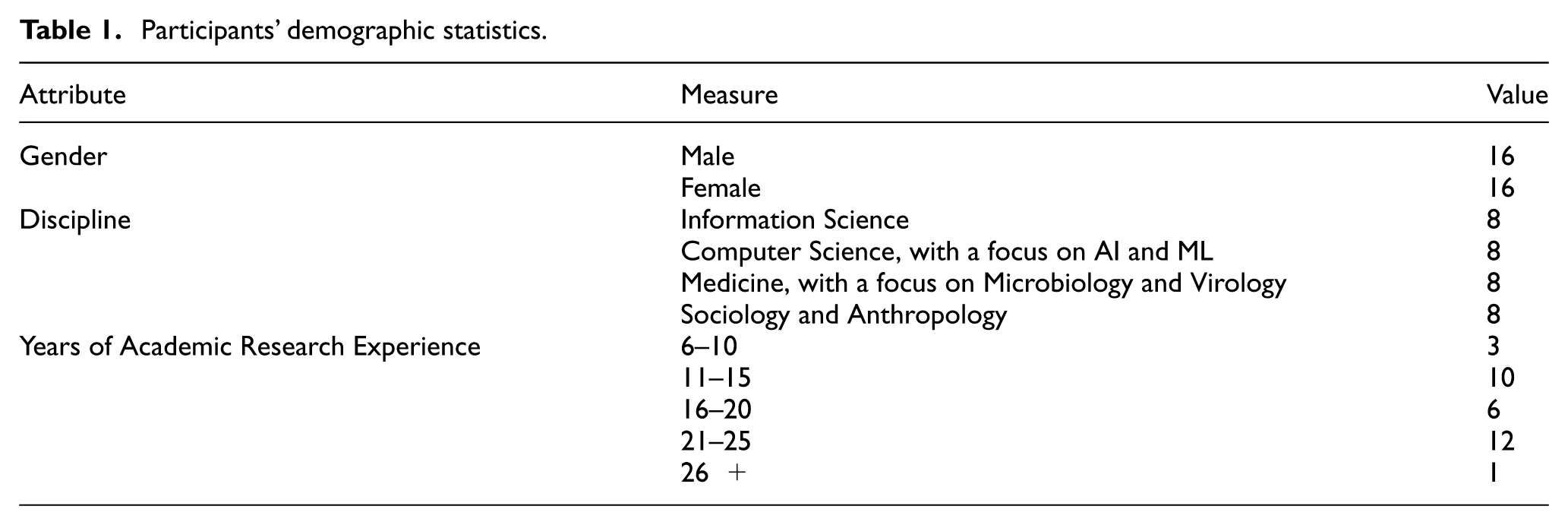
These fields were purposively selected to represent distinct epistemic cultures across the scientific spectrum: Medicine (Life Sciences/Lab-based), Computer Science (Applied/Formal Sciences), Sociology (Social Sciences) and Information Science (Interdisciplinary/Bridge). The Arts and Humanities were excluded from this specific study to maintain a focus on disciplines where journal-based publication is the primary mode of dissemination, allowing for a more direct comparison of publication decision-making within the SoS framework.
Participants were recruited from seven Israeli research universities. ‘Active researchers’ were defined as faculty members holding full-time positions. Potential participants were identified through public departmental directories and contacted via email. Purposive sampling ensured diversity in discipline, gender, institution and academic experience, including both early-career and senior scholars.
The chosen research design was semi-structured interviews, providing a basic framework of themes and questions while allowing flexibility to delve into details and professional perspectives as they emerged during the interviews. This design facilitated exploring new dimensions in understanding researchers’ behaviour and perspectives related to their research and decision-making processes.
Interviews lasted 30–60 min and followed a flexible guide covering five core areas: (1) scholarly identity, (2) the research process and idea generation, (3) information sources and data practices, (4) publication choices and (5) familiarity with research metrics. This structure ensured consistency while allowing follow-up questions and exploration of emerging topics. All interviews were recorded, transcribed, anonymised and assigned pseudonyms. Participants received an explanation of the study’s purpose and ethical assurances, including anonymity and the right to withdraw.
We employed Qualitative Content Analysis (QCA) as a methodological choice. QCA enabled systematic and transparent analysis while allowing us to inductively construct themes from the data.
ATLAS.ti 1 supported coding and theme development. Three initial interviews were independently coded by two researchers, who created and refined a preliminary code list through discussion. The finalised scheme was then applied to the remaining transcripts, with adjustments made when new concepts appeared. Related codes were grouped into broader categories, from which we identified four inductive themes, grounded in participants’ narratives rather than predefined frameworks.
For transparency, the interview guide appears in the appendix as the set of guiding questions used across interviews.
5. Findings
From the introspection of self-identity as scholars to the intricate processes of knowledge acquisition and dissemination, academic researchers traverse diverse landscapes, defined by varying research methodologies, interdisciplinary interactions and evolving modes of scholarly communication. They contend with multifaceted aspects of their roles, from the initial spark of an idea, through the process itself and the selection of publication venues. This journey is intrinsically tied to their information practices, as scholars seek, evaluate and utilise data and knowledge to contribute to the expanding frontiers of human understanding.
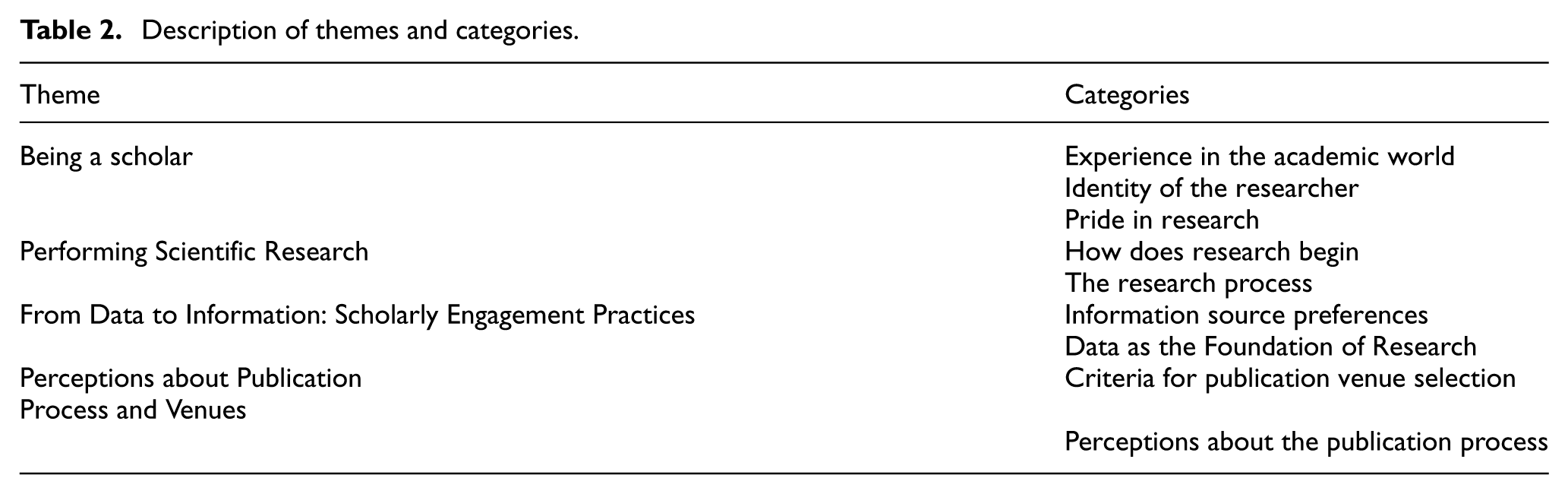
This section describes scholars’ identities and approaches to research from their perspectives. The data collected from the interviews were categorised into four themes as detailed in Table 2. The findings presented throughout this section are intended as illustrative examples of the broader thematic patterns identified in the analysis rather than as statistically representative accounts.
Description of themes and categories.
5.1. Being a scholar
This theme encapsulates the intricate journey of academic scholars, embodying diverse experiences and a perpetual pursuit of knowledge. This identity is not formed in a vacuum; it is constructed through constant engagement with the information environment, where the ability to locate, synthesise and contribute knowledge defines one’s standing in the community. Scholars shape their identity within the scholarly community through years of dedicated research and academic accomplishments. Within this framework, pride emerges from the culmination of efforts, manifested in breakthroughs, insights and innovations that not only define individual scholarly journeys but also contribute to the broader landscape of academic inquiry.
5.1.1. Experience in the academic world
Participants described diverse experiences shaping their lives as scholars, yet several common patterns emerged across disciplines and career stages. Many participants emphasised the challenges inherent in academic work, particularly the pressures that constrain their ability to conduct research at a deliberate pace.
A dominant concern was the pervasive ‘publish or perish’ culture. Scholars felt compelled to produce frequent publications, often at the expense of more ambitious projects. One participant likened the pressure to a ‘giant hammer’, while another noted that it can push researchers towards publishing lower-quality work.
Julia (IS, Senior Scholar) says: ‘If you have to publish a lot of papers all the time, then there are certain processes and certain areas that take longer, so we abandon those for the very quick, talk, talk, talk, feels like, you know, junk food’.
Participants, especially from CS, also described stress linked to the fast pace of their fields. Rapid developments and a constant flow of new publications require continual updating, forcing scholars to constantly monitor information channels to maintain their expert status, creating a highly competitive environment. Several noted that the AI domain, particularly its conference-driven publication culture, is especially demanding and stressful.
Hannah (CS, Mid-Career Scholar) says: ‘In our field, it feels very much like a chase. That is, every couple of days, or every day many new articles are published… Everything runs very quickly and you have to follow constantly. It creates some pressure on all everyone and can also cause problems’.
Alongside these challenges, participants described positive experiences that supported their academic development. Many credited mentors, advisors and colleagues with teaching them how to conduct research, write papers and navigate publication processes – formative guidance that helped them learn ‘how to be part of the academic game’. For some, advisors also modelled strategic approaches to publishing, as Christopher (CS, Early-Career Scholar) recalls: ‘When I was doing my post (doctoral), my PI said “Okay, we’ll submit to Science. In a week, we’ll get a response from Science whether yes or no, with some kind of a response from the editor about why not”. It really isn’t a Science level (paper), and the PI told me “True, but the editors response will tell us how to proceed with this and what should be corrected before submitting it to the next place”’.
These positive encounters helped counterbalance the challenges of academic work and fostered a sense of belonging within research communities. Overall, participants portrayed academic life as a mix of pressures, opportunities and formative relationships that shape how they see themselves as scholars and how they engage with their research and communities.
5.1.2. Identity of the researcher
Participants described their identity as researchers as an ongoing process of self-reflection shaped by their experiences, daily practices and the expectations embedded in the academic environment. A recurring theme was the inherent uncertainty of research. Rather than viewing this unpredictability as a barrier, participants saw it as an intrinsic, often motivating, aspect of scholarly work.
As Kevin (CS, Senior Scholar) describes: ‘There’s no template, that’s part of the reason why I like being a researcher, that there is no structure to how research is done’.
Reflecting the unstructured nature of research, participants often felt ‘all over the place’, juggling multiple, diverse projects at once. They described their work as guided by long-term goals, viewing each project as part of a broader trajectory. Progress was understood as incremental, with small steps gradually moving them towards larger research objectives.
Robert (CS, Senior Scholar) describes: ‘My research perception is this: As a faculty member here, I have many years to work… So, I set long-term goals, and students join me and they work with me on a small interval toward that long-term goal’.
Participants also reflected on how they position themselves within academia, noting that institutional expectations often shape their behaviour, even when these conflict with personal values. Several described the tension between following the unwritten ‘academic game’ and resisting it. While some navigated these norms for pragmatic reasons, others intentionally distanced themselves from them.
George (Sociology, Senior Scholar) is an example: ‘I don’t bother playing the academic game…I don’t work on my prestige. I am where I am, working in my room with my computer, doing my work and time will tell what it will’.
Across their accounts, participants emphasised a desire to pursue research with meaning beyond academia. They valued work with real-world relevance, practical impact or public benefit, seeing such contributions as central to their scholarly identity.
Mary (Medicine, Senior Scholar) describes bridging the gap between science and the public: ‘My heart’s desire is to do basic science. I love doing basic science, but it has to be connected to the clinic and I want to think of medical solutions to assist people’.
These preferences and practices reflected more than operational choices; they illustrated how participants understood their roles as researchers and their place within their disciplinary community. Overall, their accounts show scholarly identity as a dynamic negotiation between intellectual curiosity, personal values and institutional demands. Participants portrayed themselves as navigating uncertainty, balancing multiple commitments and seeking work with purpose beyond disciplinary boundaries, grounding their identity not only in academic achievement but also in the broader relevance of their research.
5.1.3. Pride in research
Participants described many sources of pride in their research, reflecting how they evaluate its value, novelty and impact. Despite disciplinary and career-stage differences, several common themes emerged. Chief among them was the novelty of their contributions. Participants emphasised being the first to identify an insight, create a tool or challenge an assumption in their field, often achieved only after exhaustive engagement with existing literature to verify the gap. Words like ‘novel’, ‘original’, and ‘groundbreaking’ appeared frequently, especially among participants in Medicine.
Oliver (Sociology, Mid-Career Scholar) articulates this clearly:
‘At the end of the day it’s a feeling that it says something new. That you don’t need 10 minutes to explain how it came about from something else, that it really moved the field forward somehow. It really has a contribution. To me, that’s the criterion’.
Participants also expressed pride in research that challenged prevailing assumptions or corrected widely accepted but flawed claims. For them, questioning the consensus was both an intellectual contribution and a form of disciplinary responsibility.
Robert (CS, Senior Scholar) offers such an example: ‘There is a paper in my area everyone quotes which claims that this is not a problem because there is a method which solves the issue. I also, many times, claimed the same. What we have shown in the paper is that the method does not resolve the problem. The solution everyone is using, or assuming that if you use it, the problem is solved- it does not solve it. It simply undermines the foundations of everything that is happening in our own field’.
Participants also took pride in work that reached audiences beyond academia – research that was accessible to the public, useful to practitioners or influential in shaping policy.
Nina (Medicine, Senior Scholar) explains: ‘I think that those (studies) with a clear message and it’s something I can explain to my family and they will understand, or I can explain to the media and the message will be very clear. That is something I’m especially proud of’.
Another source of pride was the enduring value of their work. Participants highlighted projects that remained relevant over time, describing them as ‘classic’ or having ‘stood the test of time’, and viewed such contributions as leaving a lasting mark on their field.
Gloria (IS, Mid-Career Scholar) exemplifies: ‘These papers which I’m describing, they will not grow old. Even in 100 years, if someone will want to research this subject, he will have to relate to them. I mean – they will be important to him. It’s something that leaves a seal. I feel it’s some kind of leaving an impression because it will be relevant for many more years’.
For many participants, pride was also tied to personal milestones. Their doctoral research, often the most sustained and immersive project of their careers, remained a significant point of reference. Participants highlighted the extensive time invested in these projects and their role in laying the foundation for future collaborations, scholarly networks and methodological maturity.
David (Sociology, Early-Career Scholar) says: ‘I think there are two papers from my PhD that compared to other texts I write now days, I invested more thought in, I let them simmer a few years due to the nature of the PhD, and I think the outcome was of higher quality’.
Finally, many participants described a holistic pride in all their research, regardless of external recognition or specific impact. This sentiment framed each project as a valued contribution within a broader scholarly journey.
As Diana (Sociology, Mid-Career Scholar) succinctly expresses: ‘They are all my children’.
Overall, participants’ reflections show that scholarly pride spans novelty, intellectual challenge, real-world influence, longevity and personal growth. Collectively, these accounts illustrate how researchers evaluate their contributions and how pride forms a meaningful part of academic identity.
5.2. Performing scientific research
This theme delves into comprehending the origins, motivations and processes that scholars engage in when conducting research, activities which are fundamentally grounded in the continuous retrieval, evaluation and synthesis of information. Participants were asked about various aspects of their research, with a particular emphasis on the genesis of research ideas, their methodologies and the juncture at which decisions are made regarding the publication of research outputs.
5.2.1. How does research begin?
Participants described many sources of inspiration for new research projects. Despite disciplinary differences, several common pathways emerged. A primary source was active engagement with scholarly literature. Participants noted that systematic monitoring of information channels to stay current or to explore a topic often triggered questions about missing elements, needed improvements or alternative angles, prompting them to identify gaps or opportunities for further study.
As Martin (Medicine, Mid-Career Scholar) explains: ‘So generally, I start, you know, I think, oh, you know, I haven’t seen a study on this and if we had these results we could provide evidence to, you know, change this service, or change the way we deliver vaccines or change the way we monitor programs and- and generally that is the starting point’.
For many participants, new ideas emerge as a continuation of earlier work. Their doctoral studies, postdoctoral projects or initial research directions often evolve into extended lines of inquiry. Participants described this progression as natural and ongoing, with one idea leading to the next in a cascading manner.
Eric (Medicine, Mid-Career Scholar) articulates this continuity: ‘I think most of the work is continuing older projects, either my old projects in my post doc or projects that started when I started my lab, sometimes in a totally different way’.
Interactions with colleagues through conferences, email exchanges or day-to-day encounters were also highlighted as important sources of inspiration.
Nicole (Sociology, Senior Scholar) illustrates an example: ‘The topic of women economic empowerment started by talking with my partner. I was requested to deliver a lecture about some topic, and we started talking about it. Then we said let’s submit a request for a grant’.
Finally, personal interests and everyday experiences can spark research ideas. These inspirations emerge from casual conversations or media consumption.
Nina (Medicine, Senior Scholar) relates to an experience: ‘I can tell (you) that there is one project that grew following a movie I watched, where they observed the diets of athletes, professional athletes, and I suddenly said, I don’t think anyone checked this effect. They spoke of nutritional diets, the effect on muscles and performance, etc., and I said, wow, (it would be) interesting to check how this affects a different aspect. To take something that was examined from a certain aspect and say “how does it affect something else?”’.
As Oliver (Sociology, Mid-Career Scholar) summarises the sentiment shared by many participants: ‘There are many gates to research’.
Together, these perspectives illustrate that research ideas arise from a dynamic interplay of scholarly engagement, professional continuity, interpersonal exchange and personal curiosity. The origin of a research project is rarely linear; rather, it is shaped by both planned and serendipitous encounters that prompt scholars to explore new intellectual directions.
5.2.2. The research process
This category examines how participants describe the practical and conceptual steps of their research, which they consistently framed as reviewing the literature, formulating questions or hypotheses, collecting or generating data, analysing it and producing written outputs. Participants viewed the research process as extensive, iterative and continuous. Despite disciplinary and methodological differences, they shared an understanding of research as cyclical, with each output initiating a new cycle often enriched by insights gained from prior research. Many portrayed their workflow not as a linear sequence but as a spiral, frequently revisiting earlier stages and re-engaging with information sources to validate new findings against the established record as new insights emerge.
Grant (IS, Early-Career Scholar) explains this: ‘I’m starting my research analysis, my data analysis, figuring out what are the main themes, the main issues, the main ideas and then it’s like more of a spiral process because some of the time I’m going back to the literature and the literature review and researching my background’.
When describing specific steps, participants typically began with a literature review. This multifaceted step serves dual purposes: first, identifying gaps in the existing body of knowledge, as discussed in Section 5.3; second, deepening understanding of the conceptual, methodological or empirical context of their topic, a prerequisite for the subsequent steps. From this foundation, participants move to formulating research questions or hypotheses, followed by designing or selecting an appropriate method for data collection or generation, also detailed in Section 5.3. After the data are obtained, scholars proceed with analysis, interpretation and ultimately the writing and dissemination of results. Despite disciplinary differences, participants consistently traced their work through these broad stages.
Hannah (CS, Mid-Career Scholar) details her research process: ‘So, we start with a literature review, to see what does exist. We start with some kind of a baseline solution, maybe the closest thing that currently exists. Identifying how it works, what the problems are? What is missing? in order to better understand what the problem is that we need to solve. And then we start thinking, how can we improve it? Is it the architecture of the model, or the data that we need, or other things like that. And then we work to try to improve until we get to a situation in which we have results, and we formulate them in a paper’.
Michelle (IS, Senior Scholar) outlines a very different research endeavour; however, the procedural steps exhibit remarkable similarities: ‘There is the literature review in order to understand the literature and then there is collection of data, either data that is in a corpus that is downloaded or data that we need participants for and perform some kind of experiment and then comes the actual research step, statistical analysis, visualization… the whole part of the analysis and research of the data and then the writing phase’.
For scholars in experimental fields, the process includes additional layers of design, intervention and measurement; however, the research steps, again, are similar.
Kate (Medicine, Early-Career Scholar) describes her experimental approach: ‘We have studies that conduct experiments on people. They respond to various items We connect all of this, and using statistical methods and epidemiological approaches, try to find not only correlational or circumstantial connections, but a hypothesis-driven approach’.
Taken together, participants’ accounts portray research as a structured yet flexible process, one that is informed by prior work, shaped by emerging insights and continually refined as scholars revisit earlier steps. This process is both rigorous and evolving, guided by ongoing inquiry and discovery.
5.3. From data to information: scholarly engagement practices
Scholars interact with data and information in ways that are interconnected but distinct. In line with common conceptual models in the field, where data represent the raw materials from which information is generated, participants described two complementary practices. First, they rely on information sources to build background knowledge, identify gaps and situate their research within the scholarly discourse. Second, they engage directly with data, collecting or generating the raw inputs that form the empirical foundation of their analyses.
5.3.1. Information source preferences
This category focuses on where scholars seek and use information sources to identify related work and gain insights into current developments within their research fields. Across all disciplines, Google Scholar emerged as the central tool for seeking information. Participants emphasised its intuitive interface, familiarity, broad coverage and ability to aggregate results from multiple platforms, making it their default entry point for locating scholarly material.
Grant (IS, Early-Career Scholar) describes why he uses Google Scholar for information- seeking: ‘Now days, basically, it is all dedicated to Google Scholar. I think it answers any questions I have. I know how to search on Google really, really well, and I really like the interface and the ease of finding articles’.
Supplementary information sources are utilised, albeit to a significantly lesser degree. These encompass the comprehensive indexing services provided by WoS and Scopus, as well as university data repositories. In specific disciplines, scholars turn to more targeted data repositories, such as LISA in IS and Biorxiv and PubMed in Medicine, with PubMed being consistently highlighted by all scholars interviewed in this discipline.
Nina (Medicine, Senior Scholar) explains about these information sources: ‘PubMed is the main approach. I mean conferences, yes, but it is all in PubMed, unless you didn’t get it published. Then, if it’s not published, it’s in BioArXiv in which many are unpublished’.
Journals to which participants subscribe, relevant books they purchase and participation in conferences and workshops are also acknowledged, across all four disciplines, as valuable sources of information.
Scholars are incorporating new and emerging sources to meet their information requirements. AI tools, various archives, podcasts and social media platforms are now integral to their information-seeking strategies. Notably, Twitter (now called X) was frequently cited as a widely used platform among scholars.
Grant (IS, Early-Career Scholar) explains why he uses X: ‘Twitter because I found it very very refreshing, I think that it’s an outstanding tool for being up to date and right on track because people are publishing, and echoing, and tweeting about the most recent papers. I am not talking about the papers they wrote a year ago or something like that. This thing that was published yesterday, today’.
Collectively, participants demonstrated a layered approach to gathering information, combining formal indexing services, domain repositories, curated reading, and emerging digital platforms – to remain informed and to anchor their research within the broader knowledge landscape.
5.3.2. Data as the foundation of research
Within the Data, Information, Knowledge, Wisdom framework (DIKW), data are the raw material from which information and knowledge emerge. Participants echoed this view: information sources helped them map the scholarly landscape, but the data they collected formed the empirical core of their work. They emphasised that data are not just another information type, they are the foundation on which analyses and interpretations rest.
The nature of these data varied widely across disciplines and the specific focus of participants’ ongoing research. Some participants used datasets from existing corpora, digital repositories, social media or public records, while others generated experimental, observational or survey data. Many relied on multiple data types drawn from different sources.
Michelle (IS, Senior Scholar) offers a detailed account:
‘If it’s data for research, then it heavily depends on the research.
Data can come either from participants…or from some kind of corpus, depending on the topic of the research. It can be a corpus that we collect from the web, or sometimes we receive a dataset so we have a ready-made corpus. Sometimes we collect data from social networks’.
George (Sociology, Senior Scholar) highlighted his methodological divide: ‘In quantitative research, I have a database…and in qualitative work I always conduct in-depth interviews’.
Participants described producing the necessary data for their research by creating datasets and simulated data.
Stephanie (CS, Early-Career Scholar) describes how data are generated: ‘Most of the data we use we generate ourselves. It is random data with some parameters relevant to the topic’.
In experimental and applied fields, data collection follows structured protocols aimed at capturing measurable responses or behaviours, often combining physiological metrics, self-reports and controlled environmental conditions.
Kate (Medicine, Early-Career Scholar) describes the complexity of such data collection: ‘We take participants, place them in different environments, collect questionnaires from them in each environment. They respond to various items, they give examples such as hair samples or saliva samples, or heart rate variability, which is a combination’.
Across disciplines, participants viewed data as the essential starting point of their work. Whether gathered from human participants, generated computationally, drawn from digital platforms or taken from existing corpora, data were seen as the raw material for analysis and insight. Despite differing methods, participants consistently described data as the empirical foundation that enables the transformation of observations into meaningful information and, ultimately, new knowledge.
5.4. Perceptions about publication process and venues
An integral aspect of a scholar’s research process revolves around the crucial step of publication, the point where research findings are formally transformed into accessible scholarly information. This stage not only disseminates their findings but also plays a pivotal role in assessing their work and professional advancement. In this thematic exploration, we aimed to gain deeper insights into both the criteria participants use when choosing where to publish and their broader views, positive as well as critical, of the academic publishing landscape.
5.4.1. Criteria for publication venue selection
In this category, participants’ criteria for selecting a publication venue are presented.
Participants described a complex set of considerations guiding their decisions about where to publish. While various factors influence the selection of a publication venue, the most salient was publishing in a venue with a relevant readership. Participants employ terms such as ‘identifying the readership’, specifying the intended audience, evaluating the paper’s contribution and assessing the appropriateness of the venue’s scope for the paper, essentially analysing the information consumption habits of their target community to maximise visibility.
Oliver (Sociology, Mid-Career Scholar) describes what is valuable to him: ‘At the stage that I’m at, I care more about what is important to the article. the discussion I want to contribute to and who the audience is’.
Alongside readership considerations, many participants highlighted the influence of traditional metrics, especially the Impact Factor (IF). When queried about the extent to which the IF influences their decision to publish, Tracy (IS) conveys: ‘On a scale from one to ten, it’s a ten’.
Megan (Medicine, Senior Scholar) makes a similar claim: ‘Impact Factor. Unequivocally, unequivocally, the consideration is always the Impact Factor’.
In contrast, a minority of participants conveyed that, despite their awareness of the IF, they generally attempt to overlook it.
Nathan (Sociology, Mid-Career Scholar) asserts a clear stance on not utilising the IF: ‘I know I’m a bad boy in this aspect. I have never published an article in a journal based on its impact measure’.
Participants framed their choices as shaped not by personal preference but by institutional demands for promotion or evaluation, highlighting a tension between individual values and structural pressures.
Oscar (IS, Senior Scholar) clearly describes the significance of the promotion process in choosing a publication venue: ‘Where to publish, it’s not something that emerges from me. Deciding where to publish ultimately depends on the criteria of the promotion committee or your professional evaluation committee. When you do that, what are they looking at? The department ranking, The Impact Factor and similar things’.
Participants delved into their own prior experiences or those of their colleagues as another influential factor in selecting a publication venue. They shared descriptions of negative experiences, which impacted their willingness to submit to certain venues again. In addition, several participants pointed to the prolonged duration of the review process as a discouraging factor in opting for a particular journal.
Christopher (CS, Early-Career Scholar) relates his negative experience regarding the review period duration, which affected his publication venue selection: ‘I reflect on my past experiences with journals. If a journal appears to be Q1 but everything I submitted to it took six months for the editor to pass to reviewers and I know this will cause delays, I will probably not submit there. I will have less of a motivation to submit there’.
5.4.2. Perceptions about the publishing process
Beyond selection criteria, participants shared broader perceptions of the publishing system as the critical infrastructure that controls the flow, validation and accessibility of scientific information. Many expressed frustrations towards practices they saw as misaligned with scientific values. Some criticised the ‘publish or perish’ environment, arguing that it incentivises work that is attention-grabbing rather than scientifically valuable.
Martin (Medicine, Mid-Career Scholar) relates to the Publish or Perish trend: ‘If you purely talk about the scientific process, first of all, as I said, there’s an incentive not to publish the best science but there’s an incentive to publish the papers that will get the most citations. Which means that these papers are controversial or, you know, will make noise. It’s a little bit like a news outlet, you know. The stories that are boring but important are not going to make the top news’.
Concerns about predatory practices, publication fees and perceived profits by publishers were also prominent. Participants worried about inadvertently choosing illegitimate venues and voiced strong opinions about the fees required for publishing their work.
Julia (IS, Senior Scholar) explains: ‘It makes me worried to pay for publication, I have to say, I have to make sure that this is not a predatory journal’.
Martin (Medicine, Mid-Career Scholar) goes on to bluntly describe this: ‘I think the journals are greedy and they take a lot of money for no reason. I think it’s a ridiculous system. The publishers are really, you know, abusing the system, you know, asking for Seven or Eight thousand dollars when you don’t pay reviewers and you barely pay editors. It’s completely outrageous’.
Participants’ accounts reveal an ambivalent relationship with the publication landscape. They navigate readership, prestige and institutional pressures while simultaneously criticising the inequities, inefficiencies and financial burdens embedded in the system. Their perspectives underscore that selecting a publication venue is not merely a procedural step but a complex negotiation between scholarly values and the realities of contemporary academic publishing.
6. Discussion
This study explores how scholars perceive their academic identity and their research work.
Content analysis reveals four themes: The first theme highlights participants’ identity as scholars. This is shaped by pride, challenges and a commitment to both personal and communal growth. Recent literature similarly emphasises the complexity of academic identity formation, especially among early-career academics (ECAs). Studies show that ECAs employ strategies such as alignment, negotiation and withdrawal [82], that non-Western scholars navigate tensions in Westernised systems [83] and that many researchers experience tensions between authenticity and institutional pressures [84]. These patterns align with our participants’ accounts of continually negotiating personal values and external expectations.
Reflecting back to our first research question, regarding how participants perceive themselves as scholars, participants described a wide spectrum of experiences influencing their academic behaviour. Negative experiences centred on tensions between personal aspirations, the practical challenges associated with institutional and financial demands and problematic encounters with the research and publication process. Similar concerns were observed in prior work [29,85,86]. Positive experiences included mentorship and collegial support that eased their entry into academia and shaped their early development, consistent with studies highlighting the importance of social support for novice researchers [87–89]. Participants also valued collaboration, exploring new research areas, learning as well as interacting through workshops and research communities. Today, as experienced researchers, they actively strive to impart the knowledge gained from these interactions as guidance to their students and colleagues. Overall, the identity of a scholar emerged as a dynamic and evolving amalgamation of individual experiences, academic endeavours and contributions to the broader scholarly community [1,2,90]. These dynamics were also reflected in how participants described pride in their work. The novelty and transformative impact on a broad audience contribute to a deep sense of accomplishment. Long-lasting relevance and enduring impact, symbolised by studies that stand the test of time, are also sources of pride. Participants often cherish their early works, such as their PhD research, as significant milestones that mark the beginning of collaborative efforts and the establishment of their research community. Notably, participants did
The second theme describes the intricate process scholars undergo from the conception of ideas to their transformation into tangible research, addressing our second research question: What are the origins of scholars’ ideas and how are they transformed into research? This journey, marked by methodological diversity and the interplay between theory and empirical work, underscores the dynamic nature of scholarly inquiry. Participants reported a wide range of inspirations for new projects, actively searching for ideas while also encountering them unexpectedly. Prior studies similarly note the importance of peer interactions and engagement with scientific publications in sparking research [47]. Despite working across varied topics, participants followed a common sequence of steps. They viewed research as a continuous cycle, where the conclusions of one project pave the way for the next, with ongoing movement between theoretical reflection and empirical investigation. These observations align with earlier studies describing the iterative and evolving nature of academic research [9].
Our third research question examined how scholars describe their engagement with information sources and data. The findings show that scholars navigate a mix of traditional and emerging sources, reflecting growing adaptability. Prior studies describe a shift from conventional, gatekept systems to hybrid digital environments. For example, early-career researchers increasingly combine institutional repositories with informal channels [91]. This aligns with our participants’ blended use of Google Scholar, field-specific repositories and, for some, social media platforms.
Google Scholar, WoS, and Scopus remain foundational due to their broad coverage and ease of use [92], though black open-access sites are reshaping access patterns [93,94]. Participants also described integrating AI tools and turning to emerging platforms, particularly X, as information sources [61,65]. This dynamic approach reflects scholars’ adaptability, blending conventional and contemporary methods. Our participants’ accounts aligned with this shift, relying on fast, familiar and convenient platforms over more formal systems.
Across disciplines, data were described as the core of research. Participants viewed data not simply as raw material but as the basis of the narrative they aim to uncover. This perspective echoes Borgman’s account of diverse data types and their value across research domains [95] and Leonelli’s observation that data are shaped by disciplinary norms and infrastructures [70]. Participants’ descriptions of generating datasets, constructing corpora or collecting participant-based data reflect these disciplinary contingencies and highlight data’s central role in their methodological choices.
The fourth theme presents the findings related to the participants’ criteria and perceptions regarding publication venue selection, responding to our fourth research question regarding the motivations and perceptions of scholars when selecting publication platforms. Scholars balance readership, impact metric, and personal values, navigating a complex landscape marked by both frustrations and positive affiliations with particular journals and publishers. Audience fit was the most consistent criterion, emphasising considerations like readership, paper contribution and alignment with the venue’s scope. The IF also remained influential for many. Prior studies show that quantitative indicators inform and shape researchers’ everyday practices and professional identities [96,97]. These studies support our findings that readership, venue prestige and the venues that their peers read were the most valued factors. The rise of Open Access and its associated fees add further complexity to decision-making [98]. These diverse factors collectively illustrate scholars’ intricate and thoughtful approach when navigating the publication landscape.
Participants also voiced frustrations about Publish or Perish (PoP) pressures, publication fees, ranking inconsistencies and predatory journals. These concerns mirror recent scholarship: multi-labelled journals can distort rankings and be selectively used to present inflated prestige [22], quartile systems may advantage some fields while disadvantaging others, complicating their use in evaluation and policy [23], and commercial publishers may extract disproportionate profits at the expense of the scientific community [26].
7. Conclusion
Scholarly identity is a multifaceted construct shaped by academic experiences, research activities and personal reflection. It evolves through engagement with literature, collaboration and participation in academic processes. Participants described identity as tied to navigating uncertainty, learning from successes and challenges and contributing meaningfully to their field. It encompasses a commitment to advancing knowledge, a sense of responsibility to their community and the continuous pursuit of intellectual growth.
Understanding the factors that influence this identity offers deeper insight into the scholarly landscape and the forces shaping academic recognition and development.
While this study provides rich cross-disciplinary insights, several limitations should be noted in relation to qualitative standards of rigour. The sample – though diverse in discipline, gender, and career stage – comes solely from Israeli research universities. This does not limit generalisability per se, but affects the transferability of findings to other national or institutional contexts; readers should consider how local academic cultures may shape different experiences.
As with all interview-based research, the analysis reflects the interpretive work of the researchers. To strengthen dependability and credibility, we used systematic qualitative content analysis and multiple coders, documented coding decisions and held intercoder discussions, though other analysts might emphasise different aspects of the data. Our disciplinary backgrounds may also have influenced our interpretations despite ongoing reflexivity.
Future work could improve comparability by examining similar questions in other countries or institutional settings and by incorporating mixed-method designs. Larger and more geographically diverse samples, combined with qualitative and quantitative approaches, would offer a fuller understanding of scholars’ experiences. Building on our findings about perceptions of publication venues, future studies might also investigate how scholars view computational methods for assessing scientific merit.
In addition, the concept of academic pride could be explored more broadly – examining how evolving norms, external metrics and societal impact shape this sense of accomplishment. Research could investigate how pride develops over time, varies across disciplines and intersects with emerging forms of research evaluation, offering a more holistic perspective on scholarly motivation and identity.
Collectively, these themes show how scholars navigate identity, research practices, information use and publication decisions, and how these domains intersect to shape everyday academic life. The findings offer new qualitative insight into the multidimensional nature of scholarly work by centring scholars’ own narratives, an underrepresented perspective in the largely quantitative SoS literature. By examining four disciplinary fields, this study demonstrates how identity tensions, research practices and publication choices are experienced and negotiated across different epistemic cultures.
More broadly, this study offers three key contributions. First, it expands the SoS framework by demonstrating that ‘academic identity’ is not merely a demographic variable but a driving force that dictates research quality and direction, a qualitative nuance often lost in quantitative scientometrics. It enriches the understanding of academic identity by showing how pride, institutional pressures and mentorship shape how scholars see themselves within their communities. Second, it contributes to Information Science by establishing that information engagement is not a peripheral support task but a constitutive element of the scholarly self; scholars do not just ‘find’ information, they construct their professional identity through its consumption and synthesis. It provides a cross-disciplinary account of how research ideas develop and evolve, highlighting the interplay between literature engagement, interpersonal exchanges and serendipitous inspiration. Third, it deepens insight into Scholarly Communication by revealing how scholars balance the internal value of ‘craft pride’ against the external pressures of the ‘prestige economy’, offering a more holistic model of publication decision-making.
Together, these contributions deepen our understanding of the lived experiences underlying research production and academic communication. They offer a qualitative complement to scientometric approaches and can inform institutional policy, researcher support programmes and future studies of evolving academic environments.
Footnotes
Appendix 1
Declaration of conflicting interests
The authors declared no potential conflicts of interest with respect to the research, authorship and/or publication of this article.
Funding
The authors received no financial support for the research, authorship and/or publication of this article.
Ethical considerations
Ethical approval was granted by the Ethics Committee for Research on Humans of the Faculties of Humanities, Bar Ilan University, on June 29, 2020. Approval number – 29062013.
Consent to participate
Respondents gave written consent, to participate, before starting interviews.
Consent for publication
Respondents gave written consent that research findings can be published.
