






Abstract
Samburu pastoralists often express the belief that formal education may be an alternative route out of poverty for poor pastoralists. The roles of parental wealth, livestock inheritance, and education in household wealth and income are investigated for two communities. Parental wealth and primary education, but not amount of livestock inherited, are positively associated with household wealth. Educational attainment is not statistically significantly associated with income. While livestock inheritance does not translate directly into greater wealth, there are structural advantages to membership in a wealthier family. The trade-off between investments in inheritance and herd growth versus formal education is discussed.
Introduction
Wealth among pastoralists, including the Samburu of northern Kenya, largely resides in accumulated livestock. Livestock wealth in the form of cattle, sheep, goats, and camels is the basis of household capital and social identity. The crucial economic role of livestock wealth in pastoral communities is reflected in its utility as the main source of subsistence, as a cushion against drought and other disasters, as initial capital for growth and accumulation of livestock, as bridewealth payment during marriage, and as a source of income generation through sale of animals, milk, and meat (Borgerhoff Mulder et al., 2010).
Growing economic inequality among pastoralists has implications for how they accumulate and benefit from livestock. Samburu pastoralists are no exception as they are one of the poorest and most marginalized groups in Kenya (Central Bureau of Statistics [CBS], 2003). Rising human populations, decreasing access to land, frequent droughts, and growing insecurity result in lower per capita livestock holdings, forcing pastoralists to explore other livelihood options (Adriansen, 2006; Little, Smith, Cellarius, Coppock, & Barrett, 2001). These changes have a long history and are partly the result of colonial and post-colonial policies toward pastoralists attempting to transform them from mobile livestock producers into sedentary producers of meat for the national market (Lesorogol, 2008a). Poorer pastoralists are most disadvantaged, as they lose social standing and networks and have difficulty continuing with a pastoral lifestyle (Tache & Sjaastad, 2010).
Theoretical discussions and emerging empirical evidence suggest that inheritance practices and formal education have implications for poverty and inequality in pastoral communities (Cooper, 2008). Our study uses data from Samburu district in Kenya to shed light on how inheritance and education may or may not provide a viable avenue for wealth accumulation across generations among Samburu pastoralists. We found no statistically significant relationship between the amount of livestock inherited and current wealth, nor current household income and the education attained by the head of household among a sample of Samburu pastoralists. On the other hand, we found that the livestock wealth of father and son are statistically associated. Similarly, the household head’s education (through completion of primary school) is statistically associated with current household wealth in our sample.
Inheritance, Education, and Poverty among the Samburu
Livestock inheritance is central to livestock accumulation among pastoralists. The Samburu are a patrilineal society in which livestock inheritance primarily entails the transfer of livestock from fathers to sons, thus ensuring that property remains in the lineage. Livestock are transferred at numerous points during the life course including at birth, at initiation to warriorhood, prior to marriage, and finally, upon the father’s death. Traditional norms and practices of inheritance enable most men to establish independent households, although practices vary depending on family structures and relationships. While livestock inheritance is primarily a male domain, women are involved in this process more indirectly. When women marry, they generally move from their natal home to their husband’s settlement where they receive livestock from their husband to care for. They have rights to the milk and skin of these animals and they are responsible for much of their daily care, particularly that of young animals. Women’s rights over livestock, however, are limited by cultural norms prohibiting them from transferring livestock outside the family without the husband’s consent. Over time, livestock in the mother’s herd are transferred to their sons thus forming part of their inheritance. Daughters have use rights over some livestock while they remain in their natal household, but upon marriage they generally do not take any livestock with them since they become members of the husband’s lineage and their access to property comes from that line. Clearly, women play an important role as a conduit and caretaker for the livestock that their sons ultimately inherit. They help ensure that livestock flourish for the next generation, upon whom they also depend as they age (see Lesorogol, 2010; Lesorogol, Chowa, & Ansong, 2011, for more details on Samburu inheritance norms and practices).
While pastoralists are often thought of as egalitarian (Salzmann, 1999), there is recent evidence of growing wealth and income inequality among the Samburu (Lesorogol, 2008a, 2008b). Amid these changes, many households are investing in formal education as a means to overcome poverty by building the capabilities of their children for employment outside the pastoral sector. However, there is little empirical evidence regarding the intergenerational transmission of wealth or the possibility of overcoming poverty through education for pastoralists. While one recent study finds strong evidence for intergenerational transmission of wealth among several pastoralist groups (Borgerhoff Mulder et al., 2010), more work has been done analyzing patterns of inheritance and schooling in agricultural systems than in pastoral systems (Gray & Kevane, 1999; Lastarria-Cornhiel, 1997; Quisumbing, Estudillo, & Otsuka, 2004).
There is a growing demand for formal education among pastoralists not only because of the recognition of the importance of education but also because governments and stakeholders have stepped up their promotion of formal education in pastoral communities (Birch, Cavanna, Abkula, & Hujale, 2010). For example, the Government of Kenya developed the Nomadic Education Policy in 2010 to promote literacy and skills acquisition aimed at enabling pastoralists to compete on equal terms with other national population groups without giving up their pastoral livelihoods (Siele, Swift, & Krätli, 2011). However, increased enrollments of children in school (for example, about 50 percent in our study communities) still leaves them behind the national averages for enrollments reported by UNICEF at 74 percent (UNICEF, 2011). A survey by Esilaba (2005) revealed an 80 percent illiteracy rate among Samburu. One obstacle that the promoters of education in pastoral communities have faced is the feeling of many pastoralists that by educating their children they lose out in many ways, including the physical separation of children from families, loss of labor for herding, and abandoning of pastoralist values, attitudes, and way of life (Birch et al., 2010). Our interviews with Samburu pastoralists revealed positive attitudes towards education in general and evidence of growing enrollments of children in school. Informants also understood that investments in education had consequences for herd growth and that it was often necessary to retain some children at home to participate in herding.
Stakeholders have responded to pastoralist concerns by advocating alternative education models and innovative delivery mechanisms that are culturally relevant and do not compromise the livelihoods of pastoralists such as mobile schools, evening classes, and feeder schools to reduce distances to school. Functional literacy programs for adults are also suggested for pastoral communities (Mulu-Mutuku, n.d.).
The goal of these alternative education models is to make the delivery and content of formal education relevant to the needs of pastoralists, but it still does not make the difficult choices that the pastoralists face much easier. The desire to transfer livestock wealth to future generations must be weighed against the possibilities of diversified livelihoods beyond the pastoral sector and the prospects of income from employment that may come with formal education. Thus, there is a trade-off between accumulation for herd growth and investment in education. When pastoralists sell accumulated livestock to pay for education expenses, they reduce the livestock that can be passed on to the next generation. The more children one sends to school, the more school expenses are likely to deplete livestock wealth.
Faced with such a dilemma, pastoralists require better information regarding the outcomes of livestock inheritance and investment in education. Livestock inheritance contributes to livelihood security, yet the risk of losing livestock to disaster is real. Likewise, formal education may improve the chances of obtaining employment outside pastoralism, but it does not guarantee employment (Little, Aboud, & Lenachuru, 2009). It is instructive to have a clearer understanding of the consequences of these decisions on wealth among pastoralists. We contribute to this understanding by investigating whether livestock inheritance, father’s wealth, and formal education are associated with household wealth (measured in livestock holdings) and income in pastoral communities. We address the following questions and hypotheses:
What is the relationship between livestock inheritance and son’s current wealth? Hypothesis1: Sons who receive more livestock inheritance will have more livestock wealth. Results show that this hypothesis did not find support in the Kenya data. What is the relationship between father’s livestock wealth and son’s current livestock wealth? Hypothesis2: Fathers in pastoral communities who have more livestock will have sons with more livestock. Results show that the Kenya data support this hypothesis. What is the relationship between education and current household wealth? Hypothesis3: Pastoralists who have more education will have more livestock than those who have less education. Results show that the Kenya data support this hypothesis. What is the relationship between current household income and the level of education for head of household? Hypothesis4: Pastoralists with more education will earn more income than those with less education. Results show that the Kenya data does not support the hypothesis.
Methods
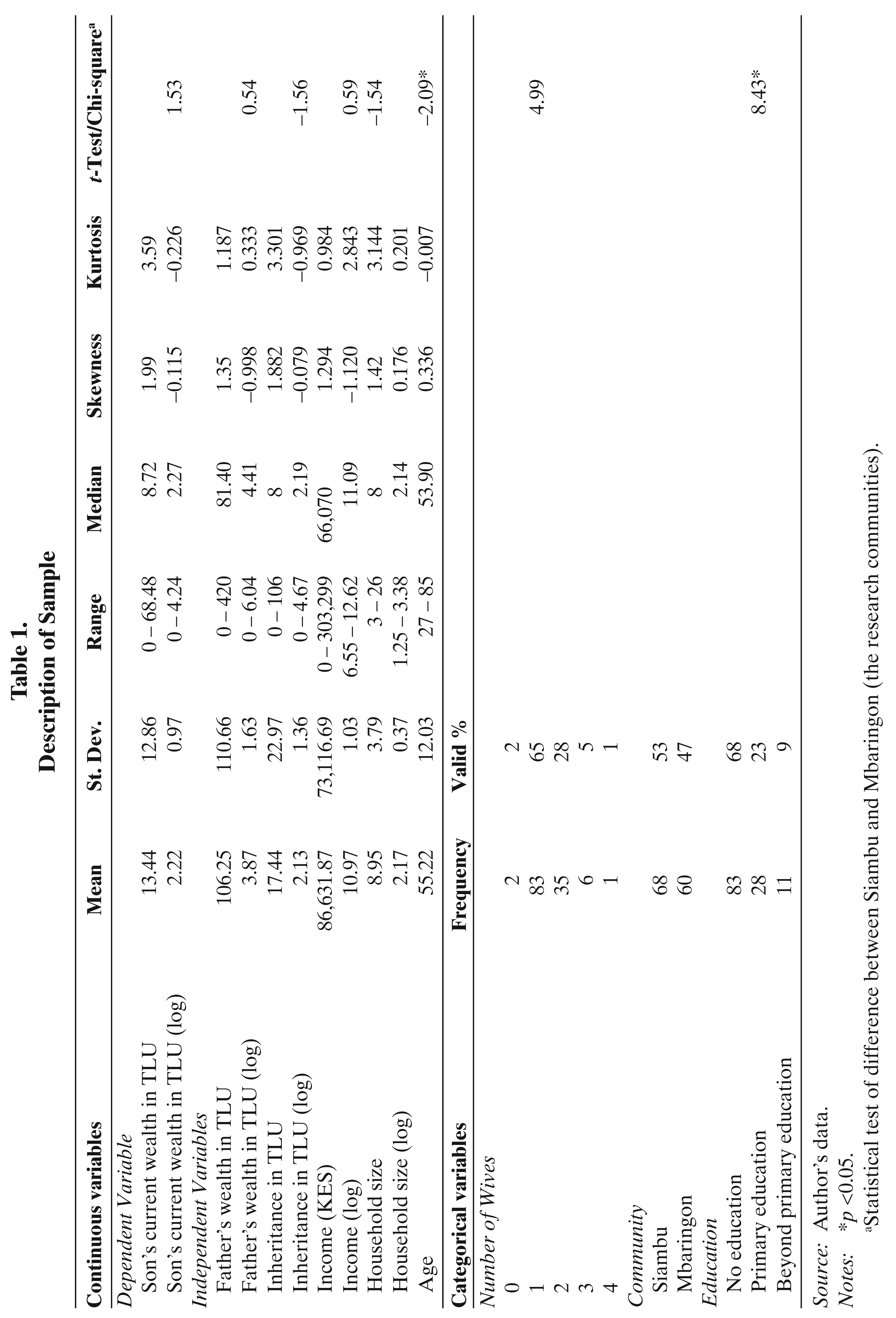
This study used data from a random sample of 200 households in Samburu district, Kenya. The sampling frame is a list of households that were registered in the process of adjudicating group land titles in the 1970s (updated in the 1990s – the sample was selected from the updated lists). One hundred households reside in Mbaringon where communal land tenure (in the form of a group ranch with title granted to all resident households) remains in force. The other 100 households are in Siambu (about 40 km away from Mbaringon) where land was privatized among 240 resident households in the late 1980s. Each household received a virtually equally sized parcel of land of about 23 acres in size. The two communities are culturally very similar, but differ in terms of their property rights to land which has implications for livelihood strategies (for example, more participation in cultivation on private land) and social relations (Lesorogol, 2008a, 2008b). In terms of household economic indicators such as income and wealth, there were no statistically significant differences found in mean values between the two communities in the current survey conducted in 2010 (see Table 1, last column). Both communities exhibit considerable levels of wealth inequality. The wealthiest quintile (top 20 percent in terms of per capita livestock wealth) in both Siambu and Mbaringon own more than 50 percent of the livestock wealth, while the poorest quintile in each place own less than 5 percent.
In order to investigate intergenerational transmission of wealth, we added questions to the survey that has been conducted with this sample in 2000 and 2005. The survey includes information on demographic characteristics (age, gender, marital status), wealth (livestock by type and number), land ownership (in Siambu only), cash income (from 25 different sources including wage labor, trade, livestock and crop sales, land sales and rentals [Siambu only], remittances, and gifts), educational attainment, employment status, expenditures (weekly and annual), crop production, milk production, and 24-hour food intake. The husband and/or wife were interviewed for each survey household, although given the focus on inheritance in this survey, the majority of respondents were men. 1
Since most wealth is transmitted from father to son, we asked men about their inheritance. Transfers of livestock do not occur at one point in time among Samburu. Rather, fathers give gifts of livestock to their sons at many points, especially during significant social transitions such as birth, initiation into warriorhood, and at marriage. Most transfers are inter-vivos, occurring while the father is alive, although a man’s remaining livestock generally go to his oldest son upon his death. 2
In order to best capture information on livestock inheritance, we asked male respondents about the size of their herd when they married (the total herd size minus bridewealth paid to the wife’s family). This is a point at which most men are at a high point in terms of inheritance, since they require livestock to pay bridewealth to the wife’s family as well as set up an independent household. Since this is a significant event in a person’s life, men are likely to have good recall of their situation at that time. We also asked respondents (both spouses) about their fathers’ livestock holdings and household size when they (the respondents) married.
Measures
Demographic characteristics include age, household size, and years of education of the household head. In order to control for differences in household size and composition, household size was converted to Adult Equivalents (AE) calculated based on the following ratio: each adult male = 1; adult female = 0.86; children 0–5 years = 0.52, 6–10 years = 0.85, 11–15 years = 0.96 (Grandin, 1981; Weisell & Dop, 2012). 3
Son’s livestock wealth refers to a son’s current livestock holdings. This variable is measured in Tropical Livestock Units (TLU), an aggregate of the livestock owned by a household multiplied by the relative exchange value of each type of livestock according to current market rates of exchange. Cattle, sheep, and goats were included in the measure with the following values: cow= 1; sheep or goat = 0.12.
Livestock inheritance refers to son’s inherited livestock at marriage. The variable is an aggregate of the cows, sheep, and goats that sons received from their parents up to the time of their marriage. Note that this includes both inter-vivos and postmortem transfers. This variable is converted to TLUs.
Father’s livestock wealth refers to the respondent’s father’s livestock holdings (cows, sheep, and goats) at the time of the son’s (respondents) marriage. As above, this was converted to TLUs.
Income: Total annual household income included sales of livestock, crops, and land (Siambu only); income from leasing land (Siambu only); income from non-livestock sources such as wage labor and trade; gifts and remittances.
Education of household head: The total number of years of formal education of household heads. In the analyses, this variable is categorized into three groups: no education, primary education (1–8 years), and beyond primary education (more than eight years).
Data Analysis
Ordinary Least Squares and Ordinal Logistic regression methods were used to address the research questions. The Ordinary Least Squares regressions allowed us to investigate son’s household wealth as a continuous variable and the Ordinal Logistic regression allowed us to examine five wealth quintiles. Our use of Ordinal Logistic regression was guided by previous research with this sample that demonstrated distinctive livelihood strategies across wealth quintiles. For example, households in wealthier quintiles rely more on livestock sales, while poorer groups depend more on trade and wage labor for income. Thus, it was reasonable to expect that the relationship between inheritance and father’s wealth might differ across quintiles. There are many factors that might potentially affect a respondent’s wealth portfolio. Hence, the regression models controlled for household and individual level factors including income, household size, age, and respondent’s education.
Results
Description of the Sample (Table 1)
The sample consisted of 128 households, 68 from Siambu and 60 from Mbaringon. The average age of heads of households was 55 years (range 33–85 years). Most respondents were married while two were widowers. The average household size was nine (range 3–26). About one-third (34 percent) of the sampled households was polygynous. The average years of education were almost three, but the majority of respondents (68 percent) had no formal education.
The average household Tropical Livestock Units (TLU) was 13.44. Respondents had an average annual household income of 86,631 Kenyan Shillings (KES) or 1,019 US dollars. Respondents’ income ranged from 700 KES (US$ 8.24) to 303,299 KES (US$ 3,568) and the median income was 66,070 KES (US$ 777). Respondents’ fathers’ wealth (at the time of respondent’s marriage) in TLU averaged 106.25 (range 0–420). Respondents reported inheriting an average of 17.44 TLU from their parents varying from zero to 106 TLUs. In the following analyses, variables that were not normally distributed were either transformed or the outliers were eliminated.
Description of Sample
Source: Author’s data.
Notes: *p <0.05.
aStatistical test of difference between Siambu and Mbaringon (the research communities).
Multivariate Results
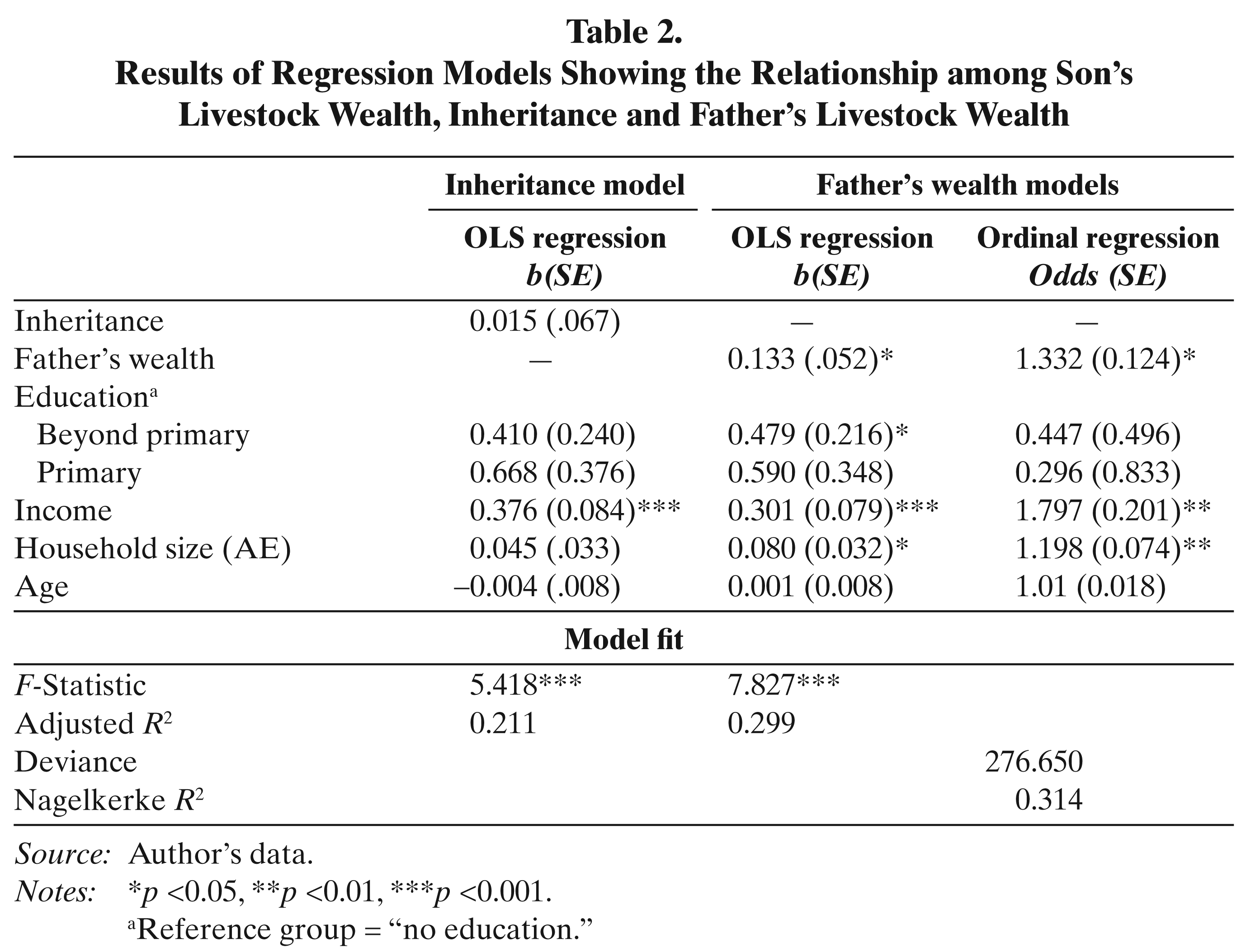
Table 2 presents results of all the significant regression models. In the table, the unstandardized coefficients (b) are presented with the standard errors (SE) in parentheses. Significant relationships are denoted with asterisks. These results only suggest correlational relationships, not causal relationships. The high or low association can be caused by factors not in the regression equation, such as local cultural factors or family history. However, the correlations are measured carefully and the regression results give a better indication than simple cross-sectional bivariate tables by controlling for structural background factors across the sample.
Relationship between Inheritance and Son’s Wealth
The second column of Table 2 presents results of the inheritance model based on the Ordinary Least Squares regression. In the model, inheritance is not statistically significantly associated with son’s wealth (b = 0.015, p = 0.676). Hence, the hypothesis that “Sons who receive more inheritance will have higher livestock wealth” (Hypothesis1) is not supported by the data. Only income is statistically significantly associated with son’s wealth (b = 0.376, p <0.001). This means that a 1 percent increase in son’s income is associated with a 0.38 percent increase in wealth, regardless of inheritance, household size, age, and education. 4 Results of the Inheritance Model for the Ordinal Logistic regression are not presented because the overall model was not significant.
Relationship between Father’s Wealth and Son’s Wealth
Results of the relationship between father’s livestock wealth and son’s livestock wealth are presented in two models in columns 3 and 4. Column 3 presents the results of the Ordinary Least Squares and column 4 presents results of the Ordinal Logistic regression. The Ordinary Least Squares results suggest that father’s livestock wealth (b = 0.133, p <0.05), son’s income (b = 0.301, p <0.001), household size (b = 0.080, p <0.05), and primary education of son (b = 0.479, p <0.05) are statistically significantly associated with son’s livestock wealth. Hence, the hypothesis that “Fathers in pastoral communities who have more livestock will have sons with more livestock” (Hypothesis2) is supported by the data. One percent increase in father’s livestock wealth is associated with a 0.13 percent increase in son’s livestock wealth, while accounting for household size, income, age, and education. Therefore, in response to Research Question 2, there is a statistically significant relationship between father’s wealth and son’s wealth.
Relationship between Son’s Income and Son’s Livestock Wealth
One percent increase in income is associated with a 0.3 percent increase in livestock wealth, while accounting for father’s wealth, household size, age, and education. Son’s livestock wealth increases by 8 percent (that is, 100*b) for one unit increase in household size, while all other variables in the model are held constant. 5 This means larger households with more adults tend to be wealthier. The significant coefficient for primary education means that compared to sons without any education, sons with primary education have an average of 47.9 percent (that is, 100*b) more livestock, regardless of father’s wealth, son’s income, household size, son’s age, and son’s with education beyond primary level. This finding supports hypothesis3: “Pastoralists who have more education will have more livestock than those who have less education.” However, the relationship only holds for primary education, not beyond primary education.
The fourth column in Table 2 presents results for the Father’s Wealth Model which is based on an Ordinal Logistic regression. The model predicts the probability of a respondent falling in the highest wealth quintile. The overall model was significant and the proportional odds assumption of a non-significant chi-square was met (x 2 = 4.014, p = 0.067). Similar to the results of the Ordinary Least Squares regression, father’s wealth (b = 1.332, p <0.05), son’s income (b = 1.797, p <0.01), and household size (b = 1.198, p <0.01) are statistically significantly associated with the highest wealth quintile. For one TLU increase in father’s wealth, the odds of being in the highest wealth quintile is 1.33 times greater than being in a lower quintile, regardless of son’s income, household size, age, and education. For one unit increase in son’s income, the odds of being in the highest wealth quintile compared to a lower quintile are 1.79 times greater regardless of father’s livestock holding, household size, son’s age and education. For one unit increase in household size, the odds of being in the highest wealth quintile compared to a lower quintile are 1.29 times greater, given that father’s livestock holding, son’s income, age and education are held constant.
Results of Regression Models Showing the Relationship among Son’s Livestock Wealth, Inheritance and Father’s Livestock Wealth
Source: Author’s data.
Notes: *p <0.05, **p <0.01, ***p <0.001.
aReference group = “no education.”
Education as an Alternative Pathway Out of Poverty (Income Model)
To test whether education could be an alternative path out of poverty as a result of higher income, we constructed another regression model to examine the relationship between son’s education and son’s income (Income model). The assumption is that education leads to employment which in turn leads to higher income. The overall income model yielded significant results and explained 11 percent of the differences in income: [F(5,111) = 3.648, p <0.01, Adjusted R 2 = 0.111]. Among the independent variables, however, only son’s wealth was statistically significantly associated with income (b = 0.406, p <0.001). Therefore, the data does not support the hypothesis that “Pastoralists who have more education will earn more income than those with less education.”
Discussion
The goal of this article was to investigate inheritance and education as potential pathways out of poverty for pastoralists in Samburu district. We constructed four (Ordinary Least Squares and Ordinal Logistic Regression) models to understand how inheritance is associated with son’s current wealth, and how education is associated with current wealth and income. Although not all of our hypotheses were supported by the analyses, our results do provide insights into the relationships among parental wealth, inheritance, education, and current wealth and income in the next generation.
Impact of Inheritance and Father’s Wealth on Son’s Current Wealth
Although the results do not show a significant direct association between livestock inheritance and current wealth, they do show that parental wealth is positively associated with son’s wealth. One way of interpreting these results is to consider the environment in which Samburu herders operate. This is an environment with a high degree of uncertainty and considerable risk. At the most basic level, rainfall is crucial to survival but it is highly erratic both temporally and spatially. While Samburu have developed many strategies for coping with this uncertainty, some of these strategies, such as mobility, are heavily constrained in the current environment where access to land is much more limited than in the past while human populations continue to grow. 6 Thus, vulnerability to drought-induced livestock losses is high, most recently demonstrated by heavy losses – perhaps upward of 50 percent – incurred during the most recent drought of 2008–2009. Given the boom–bust nature of pastoralism, it is not surprising that the numbers of livestock inherited are not strongly associated with current wealth levels, because these levels are likely to fluctuate over time. Earlier research has shown that there is considerable mobility across wealth quintiles in this population (Lesorogol, 2008b, p. 322). Thus, the lack of a strong association between numbers of livestock inherited and current wealth may not be very surprising.
On the other hand, there is a positive relationship between parental wealth and son’s wealth, and the inverse, parental poverty and son’s poverty. While this finding seems somewhat contradictory to the lack of relationship between inheritance and current wealth, it may signal other dimensions of wealth beyond the direct material transfer of livestock. Borgerhoff Mulder et al. (2010) also find substantial intergenerational correlation in wealth and suggest that this derives from common environments, cooperation, and advantages of scale for larger herds. For example, there may be a social network advantage held by wealthier families. More specifically, such families tend to be large (as revealed in our analyses). With a large family, one has a larger network of agnatic and affinal kin. Having a large social network brings advantages, especially during difficult times like drought when livestock often need to be moved long distances. Having relatives in the distant area generally eases access to pasture. Following drought, people need to rebuild their herds and the first group to be approached is generally members of one’s lineage. Again, having a large family is an advantage. Even during normal times, being part of a larger, wealthier family affords advantages by being able to combine herds to economize on herding labor and access better pastures that may be farther away from the home settlement. It may also be easier for a poorer member of a generally wealthy family to take up residence with a better-off brother or cousin and build up a herd by providing labor in exchange for livestock. While it is certainly the case that there are sons of wealthy men who have become very poor, and vice versa, the overall association of father’s and son’s wealth may indicate a structural advantage that wealthier families enjoy. This interpretation is supported by the previous research on mobility that showed less mobility out of the richest and poorest quintiles compared to the middle ones. For example, in Mbaringon, about 50 percent of households had experienced mobility, but only 25–30 percent had moved out of the poorest quintile, while 35 percent moved out of the richest quintile (Lesorogol, 2008b, p. 322). Some scholars have referred to this kind of phenomenon as a poverty trap, where below a certain threshold it is difficult to rise out of poverty (Carter & Barrett, 2006; Lybbert, Barrett, Desta, & Coppock, 2004). The question raised here is the extent to which social relations influence the likelihood of falling into, or escaping from, such traps.
Impact of Education on Income and Wealth
One of the goals of this study is to begin to explore empirically the extent to which education provides an alternative pathway out of poverty for pastoralists. We found that total annual household income did not vary significantly by the three levels of household head educational attainment. However, descriptive statistics show that the average income of people who have primary education (94,820.37 KES [US$997]) is 10,375.54 KES (US$109) more than people with no education (84,444.82 KES [US$888]) and 4,855.93 KES (US$51) more than those with more than eight years of education (89,964.44 KES [US$946]). However, the difference in income is not statistically significant, after controlling for current livestock wealth levels, household size, and age.
The multivariate results of the study are limited by the fact that the survey respondents are relatively old and therefore, have relatively low educational attainment. It was not until the 1970s and 1980s that formal education became more widely available in Samburu district. In addition, the households were selected from rural areas of the district where employment opportunities are limited. Thus, it would not be surprising if people with more education have left these communities to seek better opportunities in other parts of the district or country. We know that 15 percent of households in the sample do have family members (generally fathers or older sons and daughters) who are employed and are non-resident. 7 Given the growth in educational attainment among the younger generations (people in their 20s and 30s), it would be desirable to expand the sample to include more of this group to obtain more complete empirical evidence.
Although education is generally important for addressing poverty, its relevance varies depending on a number of factors including the type of recipient, nature of education, and the fiscal and economic context (Bernstein, 2007). For example, adult pastoralists may benefit more from job training than general schooling because they need skills that allow them to establish businesses and/or seek employment in the medium to short term. On the other hand, children require general education to build their human capital for future use. Observations of the educational system in Samburu district raise concerns regarding the quality of education. Kenya recently introduced free primary education and enrollments have jumped, including in the study communities. In addition, the World Food Programme operates a school feeding program in Samburu district providing another incentive to attendance. The downsides of these generally favorable policies are overcrowded classrooms, teacher shortage, low quality of education, and continued high dropout rates. While the new policy for education for nomadic peoples holds out some promise of change in the delivery and content of education, these policies are yet to be realized on the ground. Current constraints on the education system may pose a threat to the perceived positive returns to education and more attention should be paid to quality and employment opportunities for graduates.
In principle, as individuals become more educated, the returns to education increase (Aghion, 2002). The challenge here is that jobs in pastoralist communities are not readily available and competition is high for limited job openings in the formal sector (Abdi, 2010). Those pursuing self-employment are constrained by limited availability of startup credit or absence of markets for their business. Those who are unsuccessful in finding jobs or setting up businesses often migrate to the cities to pursue employment opportunities. Since at least the 1970s, a number of Samburu men have migrated to cities such as Nairobi, Nakuru, and more recently Mombasa where they seek jobs as watchmen and casual laborers. These jobs require little to no education, but are not very remunerative, particularly since the cost of living in cities has risen considerably over the years. Good access to employment or prospects for self-employment are necessary concomitants to policies to increase the spread of formal education among pastoralists if the returns of education are to rival those attending livestock production.
Conclusion
Our results suggest that wealth begets wealth, but not simply through the direct intergenerational transfer of livestock in pastoralist communities. It may be that the broader advantages incurred through membership in a wealthier family, as well as luck and herding acumen in an uncertain environment are as important as the initial herd inherited from one’s parents. Regression results show an association of primary education with respondent’s wealth, but it is not possible in these analyses to establish a causal connection. It may be that wealthier individuals were more likely to attend school or that education has contributed to the generation of wealth. The positive finding for primary education provides further justification for stakeholders to continue to advocate for formal education as one part of the strategy to improve the lot of pastoralists. If education is adjusted to be more relevant to pastoralists as envisioned in the new education policy for nomadic groups in Kenya, then it may improve their investment and livelihood options and also enhance knowledge and skills in livestock management. As long as pastoralists have to bear substantial educational cost, they will face choices between building up herds and investing in education. Those who have large households with many children may continue to keep some of them at home to support the household’s livestock herding. Employment opportunities for those with education need to be expanded so that the returns of education will reward the investments made.
Footnotes
Acknowledgements
This research was funded by the Chronic Poverty Research Centre (CPRC) which is funded by UK aid from the UK Department for International Development (DFID). The views expressed are not necessarily those of CPRC or DFID. The authors thank the Kenya government for granting research permission and our research assistants in Kenya for their contributions to this project.