







Abstract
Child labor is a major issue in many parts of the Global South. This study was conducted in the Niger Delta region of Nigeria to examine the level of involvement of children in arable farming activities. Three states in the region were selected for the study, and arable farming households were randomly selected from these states. Out of the selected farming households, 362 children (6–17 years of age) were interviewed. It was found that children were highly involved in most of the farming activities that are considered hazardous. The reasons given by the farming household heads for the engagement of household children in farming activities included cultural, economic, and political factors. Most of the children combined schooling and farming activities. The research data showed that there was no significant relationship in the level of involvement of children in agricultural labor between the three Niger Delta states, but it showed significant difference in the nature of farming activities in which the children were involved. The implications of agricultural development are that these conditions will lead to the transmission of agricultural knowledge, technical, and social skills from generation to generation. It is recommended that (a) a compromise should be reached between schooling and the involvement of children in farming activities; (b) that children should always be made to wear protective gear when they carry out hazardous farming operations; and (c) their involvement and technical education in agricultural skills should give them a future positive interest in agriculture as a career/profession.
Keywords
Introduction
Involvement of children in household farming activities is an ageless phenomenon. Since the later part of the twentieth century, this phenomenon has become a matter of concern (Ofuoku, Idoge, & Ovwigho, 2014). The International Labour Organization (ILO) conceptualizes child labor as any type of work carried out by children below the age of 18 years. The ILO (2012) considers child labor as work that robs children of their dignity and childhood and that is generally injurious to the physical and mental development of the children involved. This applies to work that adversely affects children mentally, physically, socially, and/or morally, and that hinders their schooling by affecting their attendance at school, causing them to drop out of school or forcing them to combine school attendance with lengthy and heavy work (ILO, 2012). Globally, many children are involved in child labor, and it is very common in Nigeria, which is one of the largest developing countries in the world.
The ILO (2004) estimates that there are approximately 250 million children between the ages of 5 and 14 years working in developing nations. The ILO statistics (2012) include children that are involved in agricultural activities either at the household level or at the community level. There is a worldwide estimate that 60 percent of all child laborers in the age range of 5–17 years work in agriculture (Ofuoku et al., 2014). According to the ILO (2010b), this involves more than 129 million boys and girls engaged in agriculture, out of which 67.5 percent are household members who are not paid for their labor (ILO, 2010a).
Agriculture is the major industry in the rural areas of the world. Muhammed and Adeoye (2006) estimate that 75 percent of Nigeria’s population lives in the rural areas. Based on the above information on the percentage of children engaged in agricultural activities, the implication is that child labor is mostly extant in these rural areas. Asamu (2005) and the ILO (2010b) state that children are engaged in various agricultural activities that include livestock rearing, cropping, aquaculture, and artisanal fishing. A lot of hazards are present in agricultural activities that have long- and/or short-term harmful effects on humans. This means it is especially dangerous in areas with low health and safety standards where it can result in injury, and eventually death. Children are highly susceptible to hazards related to herbicides and pesticides as they are known to be careless when handling these agricultural chemicals. Johnson-Michael (2013) opines that children’s exposure to agricultural chemicals adversely affects their endocrine and neurological systems, eyes, kidneys, spleens, and causes childhood cancers. Diarra (2013) buttressed these facts when he stated that pesticide exposure results in anemia, cardiovascular, stomach, and intestinal problems. The ILO (2010b) averred that the adverse effect of child labor often lasts into adulthood.
There are also other negative physical and mental effects of child labor which include fatigue, poor academic performance, academic waste, poor retention, high dropout rates, and numerous deficits in achievement (Muhammed & Adeoye, 2006). Children also encounter field-related accidents which include sustaining injuries from animals, weeding hoes, and cutlasses (Ofuoku et al. 2014). However, transfer of farming knowledge along with technical and social skills is useful for the future, as involvement of the children in farming activities is necessary for their livelihood and food security.
The major factors associated with child labor in agriculture are poverty, inadequate access to education, dearth of agricultural technology, the traditional attitudes of rural communities towards children’s involvement in agriculture, as well as poor access to adult labor resulting in rural–urban migration (ILO, 2014). However, child labor in agriculture has its positive side, especially with some farming operations such as sowing and light harvesting that are not hazardous. According to the ILO (2014), participation of children in agricultural activities promotes intergenerational transfer of knowledge, technical and social skills, as well as children’s future food security, especially in children of 10–17 years.
In Nigeria, most farms are small in scale. Most farmers in Nigeria are smallholder farmers. These farmers employ the labor of the members of their households, who are mostly children. Farmers seldom employ children from other households (IITA, 2002). In such farming households, family labor used is that of their children who fall within the age bracket of 7–15 years (Ofuoku et al., 2014). Ofuoku et al. (2014) found that in most cases these children lose school and reading times to farming activities. As mentioned earlier, the positive outcome of engaging children who are 10–17 years of age in agricultural activities is the enhancement of intergenerational transfer of agricultural knowledge, technical and social skills, and children’s future food security. Children’s future is considered to be critical for the sustenance of our social system and economy. These children will make better future farmers when they combine learning experiences in school with experiences on their family farms.
Various studies have paid attention to the level and nature of children’s involvement in farming activities that put them at risk (Adeoti, Coster, & Gbolagun, 2013). However, there are a few studies that examine the positive consequences of involving children in agricultural activities that relate to such agricultural development, particularly in Nigeria.
Objectives and Methodology of the Study
The major objective of this study was to obtain information on the extent of child labor among arable farming households in the Niger Delta region of Nigeria. Specifically it sought to:
examine the extent of involvement of children in arable farming; identify the reasons for child labor in arable farming households (HHs); examine the schooling patterns of children involved in arable farming HHs; and examine the exposure of these children to the health hazards associated with farming.
This study is based on field research that was carried out in the Niger Delta region of Nigeria in 2017. It is made up of states around the wide delta area of the River Niger in the southern part of Nigeria. These states are: Akwa-Ibom, Bayelsa, Cross-River, Delta, Edo, and Rivers State. Most farmers in this study area are engaged in arable farming and are mainly smallholder farmers. These farmers mostly practice mixed cropping; they cultivate cassava, yams, cocoyams, maize, groundnuts, and vegetable crop farming.
The population for this study included all the arable crop farmers registered with their respective agricultural development programs (ADP) offices. Multistage sampling was utilized in this study. In the first stage, three states were randomly selected among the Niger Delta states. From each of the selected states, farming communities were then randomly selected to get a total of six farming communities.
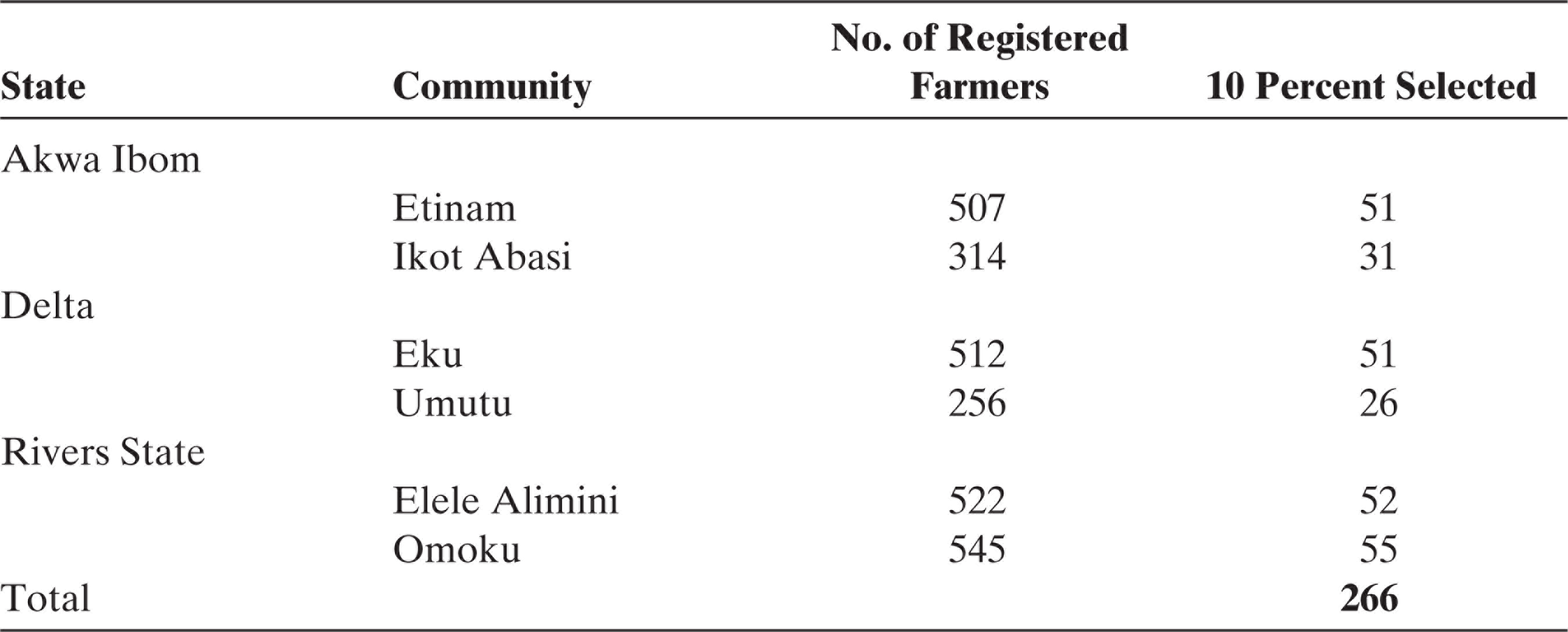
From each farming community, 10 percent of the arable crop farmers were randomly selected from the list of registered farmers accessed from their respective ADP offices, resulting in a sample of 266 farmers (see Table 1). All the children between the ages of 6 and 17 years were chosen from the selected farmers’ households, which produced a sample size of 369 children. These children formed the main respondents in the study. However, seven dropped out, leaving us with a total of 362 respondents. Primary data used for this study were collected from the respondents using a questionnaire and an interview schedule administered by extension agents. The reliability of the instrument was tested with the use of the test-retest method. The results of the correlation computation between the first and second responses showed a high level of correlation between the questionnaire (r = 0.762) and the interview schedule (r = 0.723). Data for the study were analyzed with the use of descriptive statistics methods such as frequency counts, percentages, means of involvement, and an involvement index derived from a 3-point Likert-type scale of “always done,” “rarely done,” and “not done.” The level of involvement of children in child labor in the farm were categorized into low, medium, and high, corresponding to those involved in 1–3 farming operations, 4–6 operations and 7–9 operations, respectively. The involvement score of children in farm operations was computed by means derived from the 3-point Likert-type scale. The total mean was divided by the number of farm operations to get the grand mean (overall involvement score). The hypothesis was tested with the use of analysis of variance (ANOVA).
Selection of Respondents
Results and Discussion
The results in Table 2 indicate that most (72.93%) of the children in arable farming HHS were involved in 7–9 farming operations, 19.06 percent were engaged in 4–6 farming operations, while 8.01 percent were engaged in 1–3 farming operations. Based on these results, it appears that many arable households engage their children below the age of 18 in multiple farming activities. This we expected would impact negatively on their attendance at school. The responses indicated that the level of child labor among farming households in these three states is generally high. This confirms earlier research—see Ofuoku et al. (2014), Adeoti et al. (2013), and ILO (2010b)—which found that most farming households use their children as labor on their farms. These children are frequently exposed to the hazards that are associated with carrying out many farming operations.
Level of Involvement of Children in Farm Operations (n = 362)

Table 3 indicates an involvement score (overall/grand mean) of 2.56. This implies a significant level of involvement of children in arable farming households in farming activities. Children are mostly engaged in farming operations such as sowing, weeding, pesticide, herbicide and chemical fertilizer applications, processing, and harvesting. This means that they are either mostly not involved, or they are rarely involved in field preparation. This is congruent with Ofuoku et al. (2014) and Adeoti et al. (2013) who found that children are involved in the aforementioned farming operations.
Distribution of Children According to Involvement in Farming and Nature of Task (n = 362)
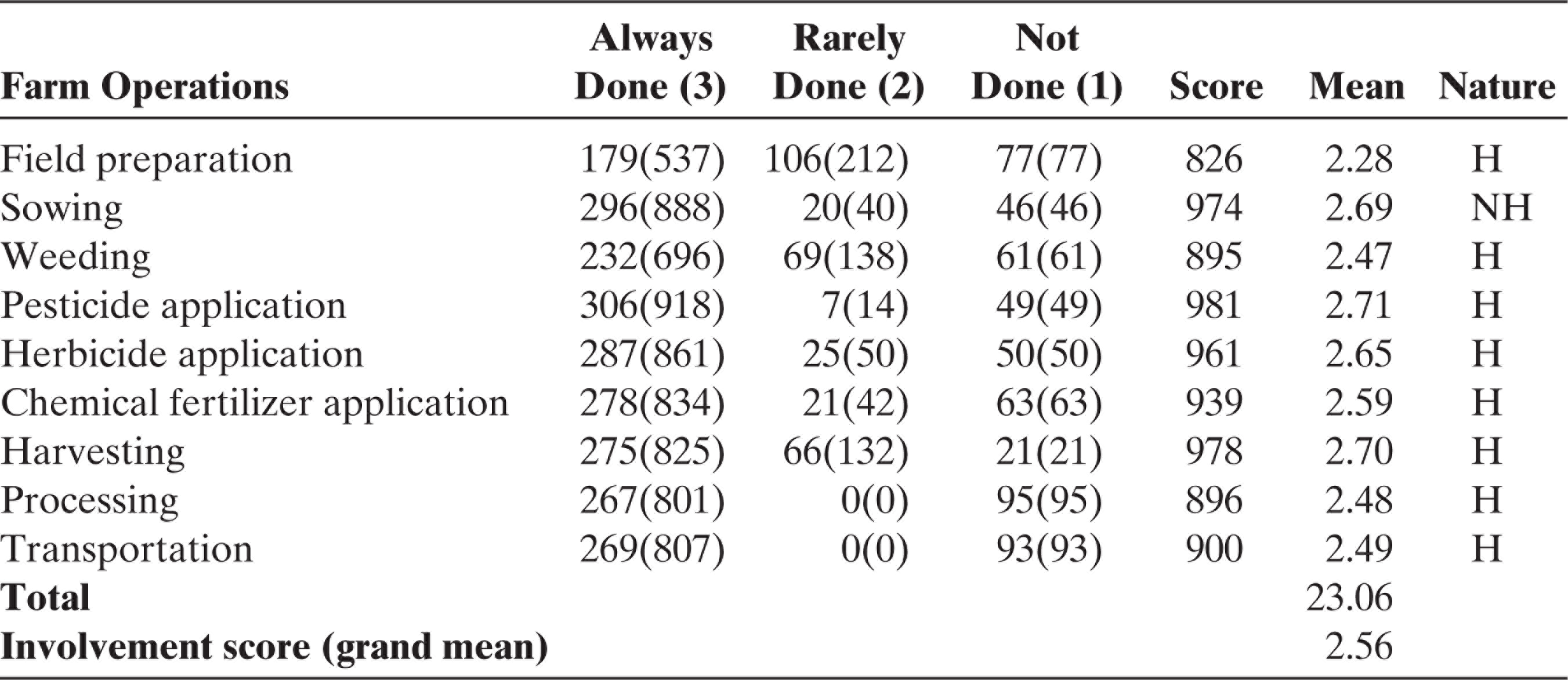
However, most (88.89%) of the farm operations such as land preparation, pesticide, herbicide and chemical fertilizer application, harvesting, processing, and transportation were indicated to be hazardous field preparation. Weeding is also known to be hazardous as children could accidentally sustain injuries from such activities done with hoes and cutlasses. Adeoti et al. (2013) found that exposure of children to sharp farm tools and implements is injurious.
Pesticide, herbicide, and fertilizer application were also found to be injurious. Jackson-Michael (2013) and Adeoti et al. (2013) point to the fact that agro-chemicals have consequential effects that are very alarming as their adverse effects are considered to cause very dangerous and lifelong diseases and deformities in born and unborn children. Children are also known to be very careless and do not care to put on the necessary protective gear.
Factors Contributing to the Involvement of Children in Household Farming Activities
The variables that contributed to the engagement of HH children in farming activities ranged from cultural, economic, and political reasons (Table 4). The cultural factors included transmission of farming skills and knowledge to children, training children to become independent in the future, bringing up children to understand intricacies of life, and transmission of societal norms and values to children. These confirm the findings of Ofuoku et al. (2014) who found similar reasons for involvement of children in labor in Nigeria. The ILO (2012) observed that children’s participation in farming activities is propelled by the traditional disposition of communities and the contribution of a traditional attitude towards involvement of children in farm labor—and these are some of the reasons for child labor. Ofuoku et al. opine that rural dwellers in Nigeria have a traditional belief which encourages the exposure of children to agricultural activities in order to teach them to be independent and have a sound comprehension of the complexities of life. They (farmers) also view children’s involvement in agricultural activities as a means of transmitting the agricultural norms and values of various respective communities to younger generations in order to treasure the norms and values. These include norms and values that encourage hard work, learning to be independent, the act of cooperation in groups, and placing much emphasis on the importance of farming to the family economy.
Distribution of Farmers’ Reasons for Involving Children in HH Farming Activities (n = 266)
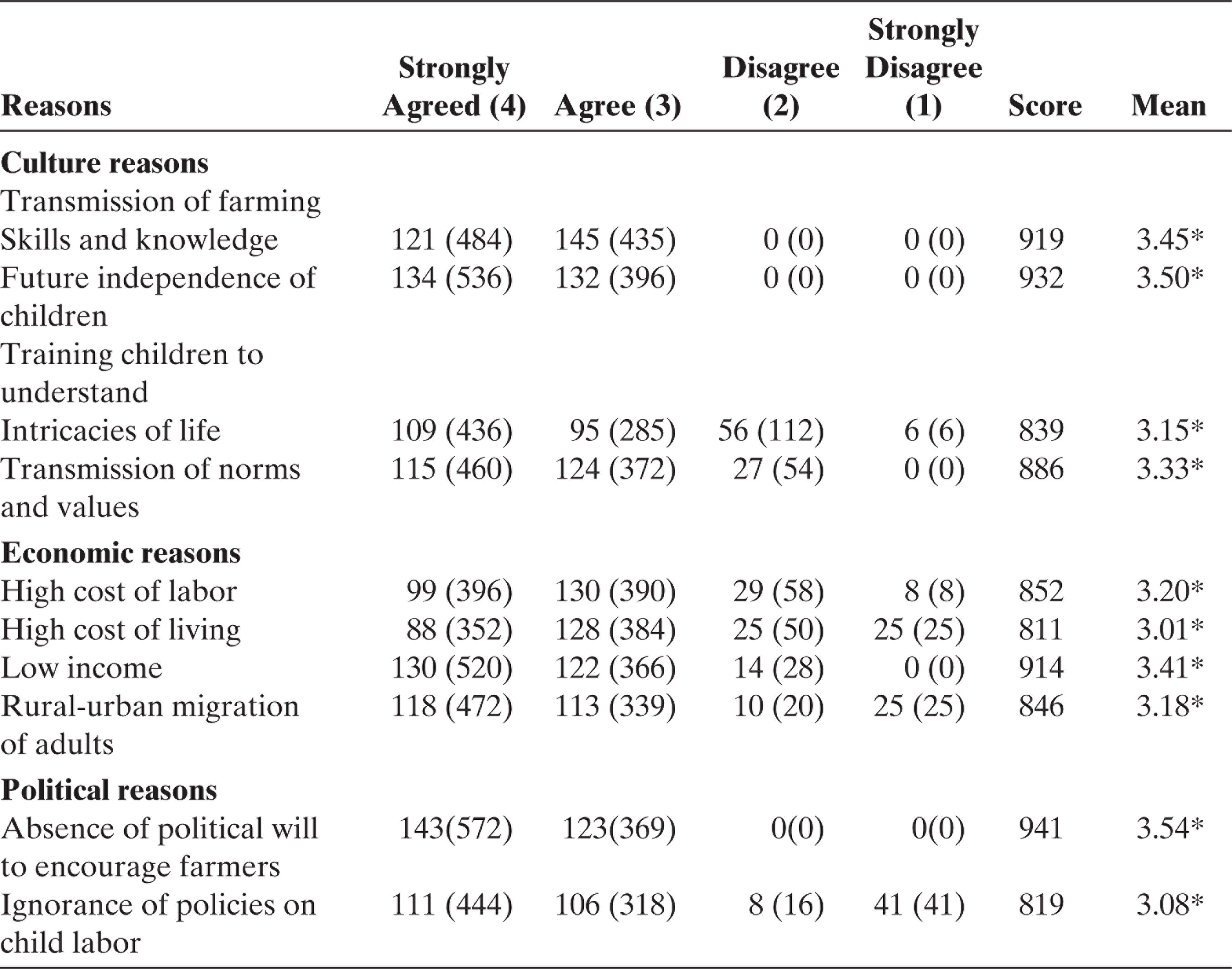
The economic factors indicated as reasons for child labor were high cost of labor, high cost of living, and rural–urban migration of adult members of farmers’ HHs. This is congruent with ILO (2010, 2010b), Ofuoku et al. (2014), and Wakgari (2014) who found one or more of these factors as the push factors of involving HH children in agricultural activities.
Lack of access to adult labor, which forms one of the reasons for child labor in agriculture, implies high cost of labor prompted by emigration of young adults to urban areas for better conditions of living. The rural–urban migration of young adults who formed the labor force in the rural settlements adversely affected plantation agriculture in the Niger Delta region of Nigeria (Ofuoku & Chukwuji, 2012). The farmers viewed low income and high cost of poverty as reasons for poverty since the high cost of rural labor was beyond their reach.
Political variables that led to child labor in arable farming were the absence of political will on the part of political leaders to give educational and technological empowerment to the farmers, the farmers’ ignorance of government policies that are against child labor, and the existence of “political farmers.” The ILO (2010a) points out that limited inclusion of agriculture and family stake in national legislation on labor, limited unionization, and low equality of labor inspectors to reach out to remote rural areas inhibit solution to the problem. According to Ofuoku et al. (2014), most farming HH heads have little or no formal education. This is the reason for their ignorance about legislation on child labor.
Schooling Pattern of Children in Arable Farming
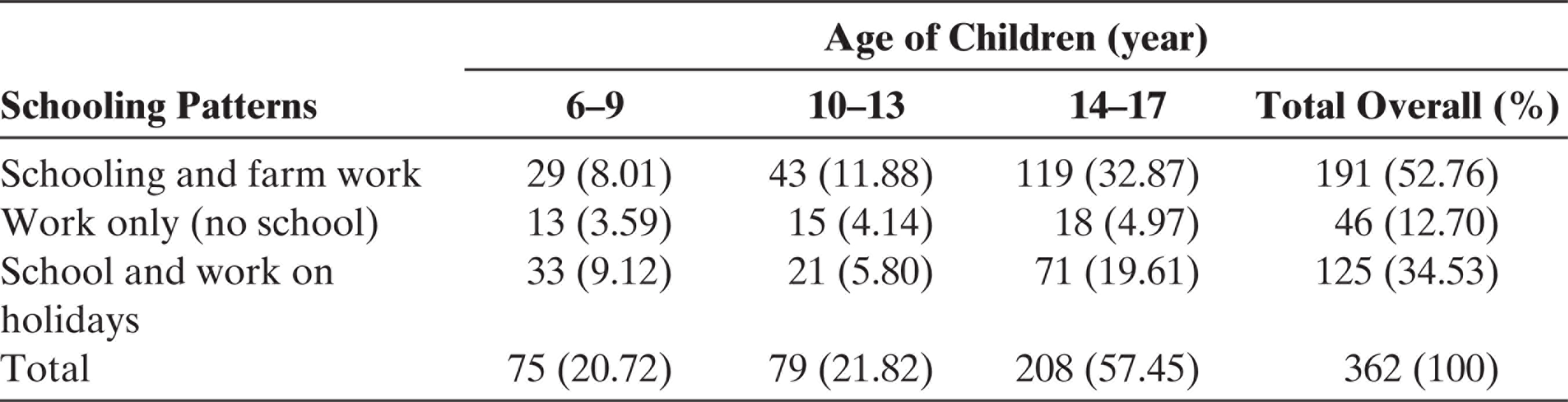
Many (52.7%) of the children attended school and worked on the farm after school (Table 5). The implication is that they go to farm to join their parents after school hours. They also get involved in farm operations by being absent from school for some days or as long as such operations last. However, 12.70 percent of them engage only in farm work without attending schools. From observations, this group of children was from poverty-stricken homes with smallholder farming as their means of livelihood. In such situations, poverty is vicious. Others (34.53%) were involved in farming activities only during holidays. These findings are congruent with various studies by Audu and Adejoh (2010), Adeoti et al. (2013), and Ofuoku et al. (2014). The act of schooling and farming or only farming interferes with the children’s learning opportunities at school. These acts consequently result in poor academic performance, academic wastage, high level of dropout, and deficits in achievement. This confirms the findings of IITA (2002). Some of the very glaring effects of child labor on children are poor performance at school, high dropout rate, academic wastage, poor retention of academic or learned experience, and deficits in achievement.
Schooling Pattern of Children in the Selected Arable Crop Farming Household (n = 362)
However, from the traditional point of view, children work with their families to acquire knowledge and skills that would be needed by them when they attain adulthood (United Nations International Children’s Emergency Fund [UNICEF], 2006). According to the ILO (2010a), involvement of children in agricultural activities enhances intergenerational transmission of social and technical skills and food security of children. During the interview, those who did not attend schools pointed out that they dropped out of school due to a catalogue of several factors, which included poverty, cost of transport from home to school, difficult terrain, and difficulty in combining schooling with farm work on return from school. This was the same reason given by the ILO (2010b) in their study in Fiji. Most of these children had parents who are not formally educated. Education influences human behavior. It is therefore expected that the behavior of HHs with respect to their children on issues that are related to their farming activities, education, and welfare education has critical influence on an individual’s perception and comprehension level (Ofuoku et al., 2012).
Ofuoku et al. (2014) found that, among other factors, economic, political, and cultural factors are related to the decision of farmers involving their culture in farming activities.
Table 6 indicates that there is no significant difference in the level of involvement of children in arable farming activities in the three Niger Delta states selected for this study. The level of children’s participation in arable farming activities in the three states is similar. This is attributed to similar cultural, economic, and political factors that are shared by the farmers.
Analysis of Variance Showing the Difference in the Level of Involvement of Children in Farm Labor Between the States of the Niger Delta Region

NS = Not significant; S = significant.m
Implications for Agricultural Development
Child labor has become a buzz word and a major concern of many world organizations since the later part of the twentieth century. In the rural farming communities of developing nations, it has been in vogue. The involvement of children in farm labor was found to be very high on any index. The children tend to be involved in all kinds of farming activities, and most are hazardous. The reasons given for child labor in arable crop farming households included cultural, economic, and political variables. The cultural factors included: transmission of farming skills and knowledge, training children to become independent in the future and for them to understand the intricacies of life, and the transmission of societal norms and values. The economic variables were high cost of labor prompted by rural–urban migration of adult household members, high cost of living, low income, and rural–urban migration of adult members of arable farming households. The political factors were the lack of political will to encourage farmers by the government and farmers’ ignorance of policies on child labor. Most of the children were engaged in farm labor after school, while some were engaged in farming activities during holidays. However, very few of them were fully engaged in farming activities without schooling.
One of the major problems facing the future of agriculture in Nigeria is children’s lack of interest in agriculture as the first choice of career or profession. Akpantaku (2004) found that only 10 percent of agricultural science students indicated agriculture as their primary choice of career/profession. The ILO (2010a) suggests that children’s involvement in agricultural operations encourages transmission of social and technical skills from one generation to another. As children are involved in arable farming activities, they become used to it as it consequently becomes a part of them. This fact is expected to build their interest in farming. However, the farming parents need to be encouraged by the government so that farming becomes more interesting to the farmers and their children. This will also promote sustainable transmission of social skills, norms and values, and future food security of the children when they attain adulthood.
Encouragement of farmers by exhibiting a strong political will to do this will make farming easier and less costly for the farmers. The lack of political will by governments to encourage farmers will make farmers continue to operate on a low scale and make the purchase of inputs suffer exorbitant prices. The presence of such political will may also discourage young adults from migrating to urban areas, especially if they are also encouraged and given more support to engage in farming activities.
As much as education of the children is important, their future economic livelihoods should not be neglected, especially in the presence of the extant high unemployment rate in most developing countries. They need to learn farming skills and acquire the knowledge to become successful farmers. Through formal education, children may be able to relate what they study in agricultural science as a school subject to the farming activities in their family farms. The knowledge gained in the school and on the farm is expected to enhance their acquisition of expertise in farming activities. To this end, there should be a compromise between schooling of children and transmission of skills, knowledge, norms, and values. There is a need for farmers to engage their children in farming activities during periods when schools are on holidays. There is also a need for farmers to make sure that their children put on protective gears, especially when being engaged in hazardous farming operations. Children have been found to be involved in hazardous farm operations in this study area and also by Ofuoku et al. (2014) in their nation-wide study.
Agricultural development should be focused on sustainable and enhanced agricultural production. If the aforementioned suggestions are put into practice, agricultural transformation will be enhanced as greater interest will be paid by the children to make agriculture a profession/career when they are adults.
Conclusions and Recommendations
Our study clearly indicates that arable farming HHs engage their children extensively in farming activities in the Niger Delta region of Nigeria. There is no significant difference in the level of involvement of children in arable farming activities between the three Niger Delta states included in this study. The children in arable farming HHs in the Niger Delta region are very much involved in a wide array of local farming operations such as, field preparation; sowing; weeding; pesticide, herbicide, and fertilizer application; harvesting; processing; and transportation. Apart from sowing, these farm operations are hazardous.
The arable farming HH heads involve their children in farming activities for reasons that are culturally, economically, and politically inter-related. Our research indicates that most of the children attend school and work on the family farm after school. A few of them are involved in only farming activities, without attendance in school, while some work on the farm only during school holidays.
In consideration of the aforementioned facts, it is therefore recommended that since the transfer of farming knowledge and technical skills to the children in this region is very important, there is a need for a compromise to be reached so that both formal education and farming knowledge and skills can be acquired by the farm children for their future economic well-being and for local food security. To this end, farmers should engage their children in arable farming activities when their children’s schools are on holidays and not open for instruction. Furthermore, these children should always be made to wear protective gear when engaged in hazardous farming activities to protect them from the physical and chemical health hazards that are associated with farming.
Footnotes
Declaration of conflicting interests
The authors declared no potential conflicts of interest with respect to the research, authorship, and/or publication of this article.
Funding
The authors received no financial support for the research, authorship, and/or publication of this article.