







Abstract
Integrating research on careers, flexible work arrangements, and open systems views of organizational change, we investigate how evolution in the broader organizational context interacts with professional career trajectories over time. Interviews were conducted six years apart (1997 and 2003) with 17 major employers in North America and 36 managers and professionals in those firms who were working on a reduced-load basis by choice in 1997. Overall, we found that career patterns are impacted by the dynamic combination of individual-level and contextual factors. Specifically, while changes in core business/client base, internal structure changes, and industry turbulence were associated with higher proportions of returns to full-time work, financial threat was associated with lower levels of return to full-time work. We identified four cross-level dynamics (co-optation, synergy, decoupling, and tug of war) that capture different patterns of interaction between individual work arrangement trajectories and larger trends occurring at the organizational or industry level.
Keywords
Careers have been defined as a window through which we can see how individuals’ choices and constraints over the life course play out and interact with developments in society, organizations, and personal lives (Moen & Han, 2001). Thus, careers must be understood in context, as they are located at the “intersection of societal history and individual biography” (Grandjean, 1981, p. 1057), bridging micro (individual) and macro (organizational and environmental) change perspectives (Mayrhofer, Meyer, & Steyrer, 2007).
A number of theorists have aimed at capturing the complex interrelations occurring between macro changes and individual careers. This goal has become particularly important to adequately describe the changing nature of careers, related to increasing turbulence in the job environment of professional and managerial work (Mayrhofer et al., 2007). To understand contemporary changes in career patterns, some scholars have adopted a psychological and personal agency perspective on career evolution (Cappelli & Hamori, 2007). For example, the concepts of “protean” and “boundaryless” careers (Arthur & Rousseau, 1996; Hall, 2002) both emphasize individual adaptation to an increasingly unstable and unpredictable career environment. Other scholars have taken a macro perspective, and examined how context, such as structure and strategy at the organizational level, or changes at the industry or even societal levels, affect the pattern of managerial careers (Gunz & Jalland, 1996; Gunz, Jalland, & Evans, 1998; Haveman & Cohen, 1994).
Various authors have noted the necessity of integrating both perspectives (Hackman, 2003). Arthur, Inkson, and Pringle (1999), in their description of individual careers in the midst of societal and institutional turmoil in New Zealand, have emphasized the importance of simultaneously examining the career evolution of individual actors and the larger societal environments in which these changes are grounded. Yet too few empirical studies or theories have explicitly attempted to integrate these levels or to identify dynamic processes operating between them over time (Lawrence & Tolbert, 2007).
This article examines career evolution through the lens of reduced-load work arrangements. Reduced-load arrangements are one manifestation of a larger contemporary trend toward increased customization of professional careers, challenging traditional career templates regarding work time norms, timing and rhythm of labor market engagement and leading to more flexible, nonstandard employment relationships (Valcour, Bailyn, & Quijada, 2007). Since reduced-load arrangements are individually crafted and negotiated between a professional and his or her organization, such alternative work arrangements represent an ideal empirical phenomenon in which to observe the intersection of individual-level career changes in ways of working and changing organizational contexts over time. We examine how individuals move in and out of reduced-load work arrangements and customize them, while different kinds of changes are ongoing at the organizational level of analysis, such as reorganizations, financial threats, layoffs, changes in core business or in client base, or larger industry turbulence. Relying on a unique organizational and individual dataset and using qualitative methods, we sought to build theory on different dynamics occurring across levels of analysis over time.
Theoretical Background
Changing career patterns and reduced-load work
Recent decades have been marked by an increasing turbulence in the job security of professional and managerial careers in most industrialized countries (Frenkel, Korczynski, Shire, & Tam, 1999). Concurrently, the demographic profile of these professional careers has shifted to include more women and a majority of employees in dual-earner or single-parent families (Bond, Thompson, Galinsky, & Prottas, 2002). Furthermore, those in traditional professional careers, particularly in large employing organizations, have increasingly been expected to work long hours, sometimes more than 60 or 70 hours a week, as a means to demonstrate loyalty, commitment and productivity and to keep up with rising workloads (Jacobs & Winslow, 2004; Moen & Roehling, 2005).
Valcour and colleagues (2007) develop the concept of customized careers reflecting changing individual work patterns over time in managerial and professional occupations in response to these trends. They suggest that, although employees in North American managerial and professional careers have been traditionally expected to work full-time, be highly involved, and maintain continuous workforce participation throughout the life span, women in particular are forging new career paths or “customized careers” as a means to facilitate successful juggling of work and family commitments. In their view, reduced-load (or professional part-time) work is one example of how professionals are customizing their careers, through deviation from traditional norms of work time.
Reduced-load work is defined as involving a reduction in work load and hours (from what is normally considered full-time) accompanied by a proportional cut in pay. It typically takes the form of three-day or four-day work weeks, though there are many variants of this pattern. Reduced-load work is increasing in use by higher-level technical and professional workers (Meiksins & Whalley, 2002), physicians (Barnett & Gareis, 2000), lawyers (Epstein, Seron, Oglensky, & Saute, 1998), and corporate managers and professionals (Kossek & Lee, 2008). In the United States, reviews of Bureau of Labor Statistics now estimate that one out of five workers is a part-time employee, while in the European Union, this figure ranges from 5 percent in Greece to 39 percent in the Netherlands (Kossek & Michel, 2010). Although not all of these individuals work part-time out of choice, evidence suggests that professional and managerial jobs feature a high preference for reduced hours even when coupled with reduced income, although this effect varies across functions and when other controls such as gender are included (Golden & Gebreselassie, 2007).
Rousseau (2001) refers to these arrangements as idiosyncratic or i-deals, which she defines as situations in which individual employees negotiate with an employer to adapt standard work arrangements to better meet their needs, with the intent that benefits accrue to both the employee and the organization in some way. But current understanding of how reduced-load work or customized careers are impacted by organizational contexts is incomplete. A few studies have begun to identify factors at organizational levels of analysis that influence the success of reduced-load arrangements (Epstein et al., 1998; Lee, MacDermid, & Buck, 2000). For example, Epstein et al. (1998) discuss the powerful effects of professional work norms in the legal profession on the degree to which part-time lawyers thrive. Lee et al. (2000) found systematic differences in organizational “posture” in responding to and facilitating employee requests for reduced-load work. Lawrence and Corwin (2003) have examined the importance of interaction rituals in the local work context in determining the degree of integration of part-time professionals in work units. What none of these studies address is the question of how the careers of reduced-load professionals unfold over time in changing organizational contexts. This perspective is needed to gain a better understanding of the boundaries or limits to theorizing about customized careers.
Organizational environments and their effects on careers
Though less established in the managerial literature, a growing stream of research in the sociology of labor markets has begun to identify mechanisms linking macro factors to individual-level career changes over time. For example, Haveman and Cohen (1994) showed the powerful effect of organizational ecological selection mechanisms occurring at the population level through the founding and dissolution of firms, which explained about half of the career mobility of professionals in the banking industry. Brüderl, Preisendörfer, and Ziegler (1993) have exposed the influence of two organizational-level structural factors, opportunity structure and hierarchical levels, on the upward mobility of workers within an organization. Phillips (2001) has described the “promotion paradox” affecting employees of Silicon Valley law firms: employees in the most successful firms were less likely to be promoted than employees in the less successful firms, a counterintuitive finding. Moss, Salzman, and Tilly (2005) have argued that environmental turbulence (defined as the degree of change and complexity in the environment brought about by globalization, technological and labor market changes, and the rise of new competitors) is likely to reduce employment stability and job security, which in turn would negatively affect individuals’ use of nontraditional work arrangements over time. But firms may respond differently to a similar situation. As Gittell, Cameron, Lim, and Rivas (2006) have shown in the case of airlines, for example, in times of crisis, some firms may revert to massive layoffs while others will try to find ways to keep their workforce while reducing expenses. Thus, the impact that contextual changes will have on individual careers, in general, and on reduced-load arrangements in particular, cannot be predicted easily.
In order to examine career evolution over time, researchers need to examine how macro-level factors interact with individual-level careers, which requires paying attention to dynamics occurring across levels of analysis (Feldman & Ng, 2007; Lawrence & Tolbert, 2007). As noted by Phillips (2001, p. 1060), the open-systems perspective which has become pervasive in our understanding of organizational-level phenomena (Lawrence & Lorsch, 1967; Scott, 1987; Thompson, 1967) has yet to be fully integrated into theories of career evolution. An open system is one which must interact with its external environment in order to survive (Scott, 1987). Together, individuals and organizations comprise dynamic career systems where each part, sometimes consciously, other times implicitly, interprets and acts on environmental changes, disturbances, and uncertainties in order to adapt and survive. The question of how macro-level changes dynamically interact with individual career trajectories has not received enough attention, and too few studies have explicitly taken up the task of systematically collecting data at multiple levels of analysis over time (Feldman & Ng, 2007). We propose that professional careers involving organizational adaptation to customized reduced-load work are an ideal context in which to examine this question. This paper thus begins to address this important gap in the literature, and aims at building theory on the nature of cross-level interactions between individual careers and macro changes by asking the following questions: (1) How do different types of organizational turbulence influence the career patterns of reduced-load professionals over time? (2) What mechanisms can be identified and described that capture different kinds of interaction between individual career change and macro-level organizational changes over time?
Method
Because cross-level interactions have rarely been investigated empirically in the literature on careers, we chose a qualitative methodology, which is well suited to generate new insight and develop nascent theories (Edmondson & McManus, 2007). We chose to study the career trajectories of reduced-load professionals and their employing organizations, because of the likelihood of observing significant individual career changes in a rather short time frame. The sample for this study was a set of 36 cases of reduced-load work in 17 firms; it was drawn from a larger two-phase, multi-level qualitative study of 83 cases of reduced-load work arrangements among professionals in 43 organizations in the US and Canada. The first phase of the study took place in 1996−98 (hereafter identified as Time 1) and involved interviews with reduced-load professionals, their supervisors, a co-worker, and a human resource representative in their employing organizations. The second phase of the study (hereafter identified as Time 2) was carried out about six years later in 2002−04. 1 It focused on tracking changes over time, at both the individual and organizational level, in order to follow the evolution of reduced-load work as an innovation, and to examine the interrelationships between individual trajectories and broad organizational-level changes.
Sample
Professionals working voluntarily on a reduced-load basis were initially recruited using personal and professional contacts with individuals as well as human resource managers and work-life administrators in organizations. About half of the firms approached agreed to participate; those that declined stated that either they had no employees who fit the criteria, or they were not able to do the research necessary to determine whether they had potential participants. Of the professionals approached, 85 percent agreed to participate.
The study was designed in order to maximize variation along several variables, including industry at the organizational level; and at the individual level, age, gender, type and level of position, and success of the arrangement. Maximizing variation along multiple dimensions increases the likelihood of capturing rich contrasts in qualitative observation to support theory building (Patton, 2002). Because the research team sought a heterogeneous sample, the representation of industries and jobs was monitored throughout the recruitment process. Recruitment of participants also targeted achieving a minimum of 10 percent men (as this was their estimated representation in the population of reduced-load professionals: Kropf, 1999). A maximum of four cases were included from any one firm in order to increase the range of organizations in the sample.
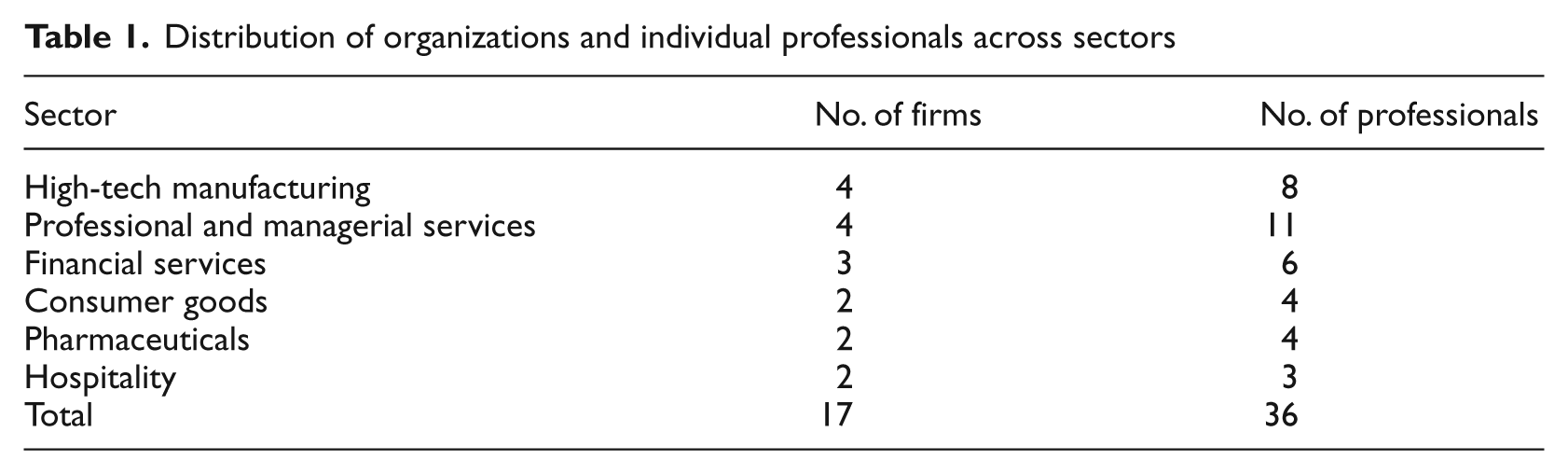
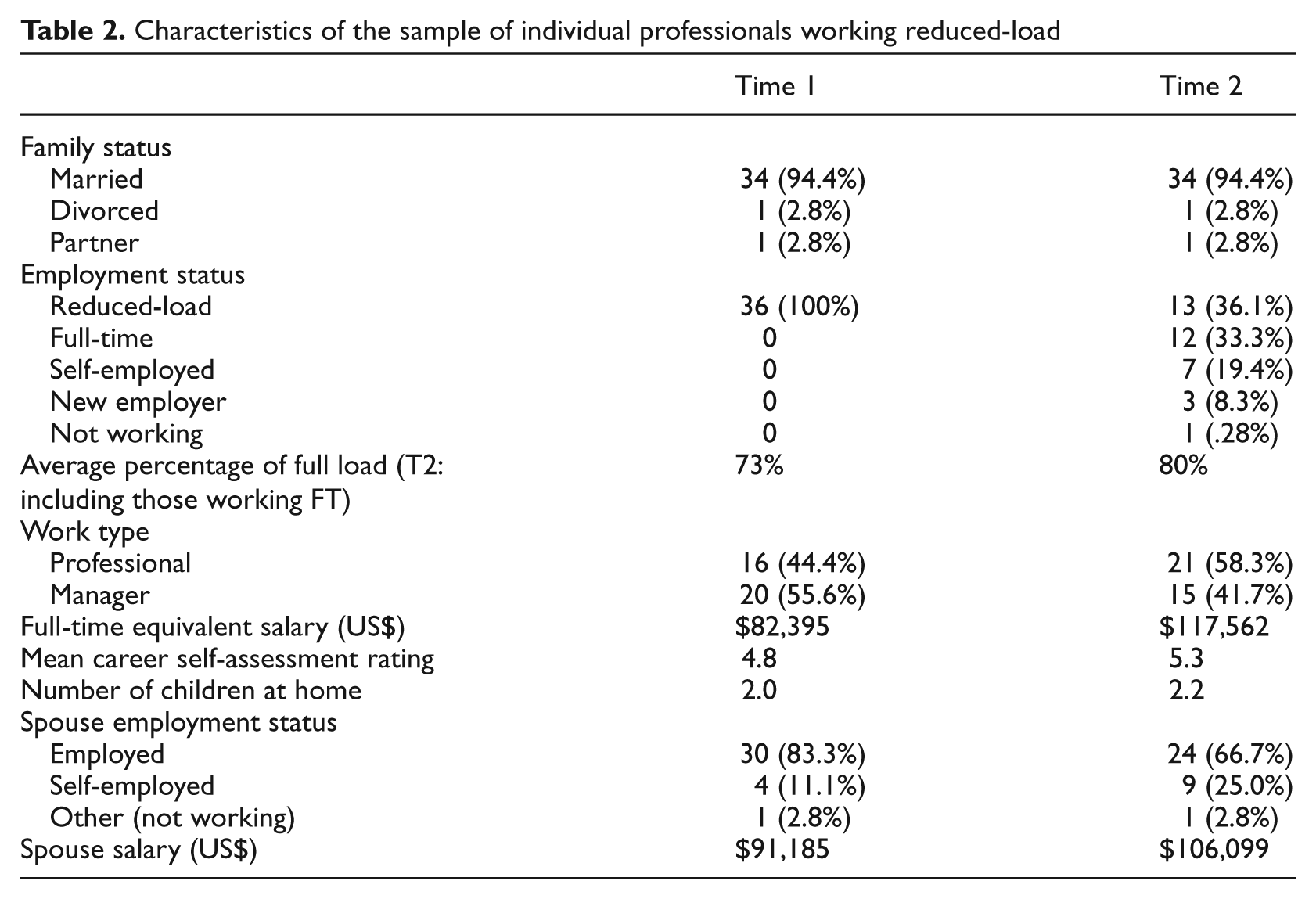
In the second phase of the study (Time 2), we approached 17 of the original 43 firms in order to include organizations from a variety of sectors and to have two or more organizations per sector, and all agreed to participate in the Time 2 wave of data collection. Of the original 40 individual professionals who had been interviewed at Time 1, 39 agreed to be interviewed again. Three cases were excluded from the analysis, because they had voluntarily left their employers within the first year after the initial interview, and their career trajectories were arguably independent of organizational dynamics unfolding with their previous employers. One had retired as planned, and two had moved as a result of a spouse relocation and promotion. Of the 36 remaining participants, 5 were men and 31 were women, average age 45. They worked in a variety of functional areas including research and development, marketing, finance, accounting, human resources, and production/operations; 25 of the 36 were still working for the same employer, or a merged or spinoff version of the original firm; 11 had exited their former employer (three were laid off). Of those who exited, seven were self-employed and continuing to work less than full-time by choice; three had joined a different company, and one was temporarily staying at home. Table 1 shows the distribution of firms and individual cases of reduced-load work across sectors. Table 2 provides additional demographic information on the 36 participants, with comparison data on work and family characteristics at Time 1 and Time 2.
Distribution of organizations and individual professionals across sectors
Characteristics of the sample of individual professionals working reduced-load
Data collection and reduction
Data were gathered in one-on-one confidential interviews, which were audio-taped and transcribed verbatim for analysis. The interviews lasted from 45 minutes to an hour and a half and were semi-structured in format.
Time 1
Individual interviews with the professionals on reduced load, their bosses and co-workers focused on how the work arrangement came about and how well it was working. Interviews with the human resource managers focused on policies and practices related to flexible work arrangements in general, as well as general organizational characteristics. These organizational informants were also probed on the organizational rationale for allowing reduced-load work and the organizational climate or culture that might have bearing on the success of the arrangement.
Time 2
The individual who was working reduced load at Time 1 was interviewed to find out what had transpired with the reduced-load work arrangement and the individual’s life and career over time. In addition, participants were asked to draw a “career timeline” indicating “how things were working” in their career from Time 1 to Time 2 on a scale of 1 to 7. This self-assessment measure was meant to capture subjective career success, as recommended by Heslin (2005). At the organizational level of analysis, four individuals were interviewed per firm: one senior executive, one HR or work-life manager, and two managers experienced in supervising reduced-load professionals. The reason for the four interviews per firm was to collect different views of organizational change from multiple stakeholders and to use recurrent themes across informants to increase reliability and validity of the data. Topics covered in the interviews included: (1) current status of company and global and economic changes affecting strategic business direction; (2) broad internal organizational changes since Time 1; and (3) changes in organizational responsiveness to employee requests for reduced-load work arrangements. An organizational level reflective memo was prepared for each of the 17 companies, providing a synthesis of the views of the various respondents on these topics. Figure 1 details the data sources used in this study at the two points in time of data collection.
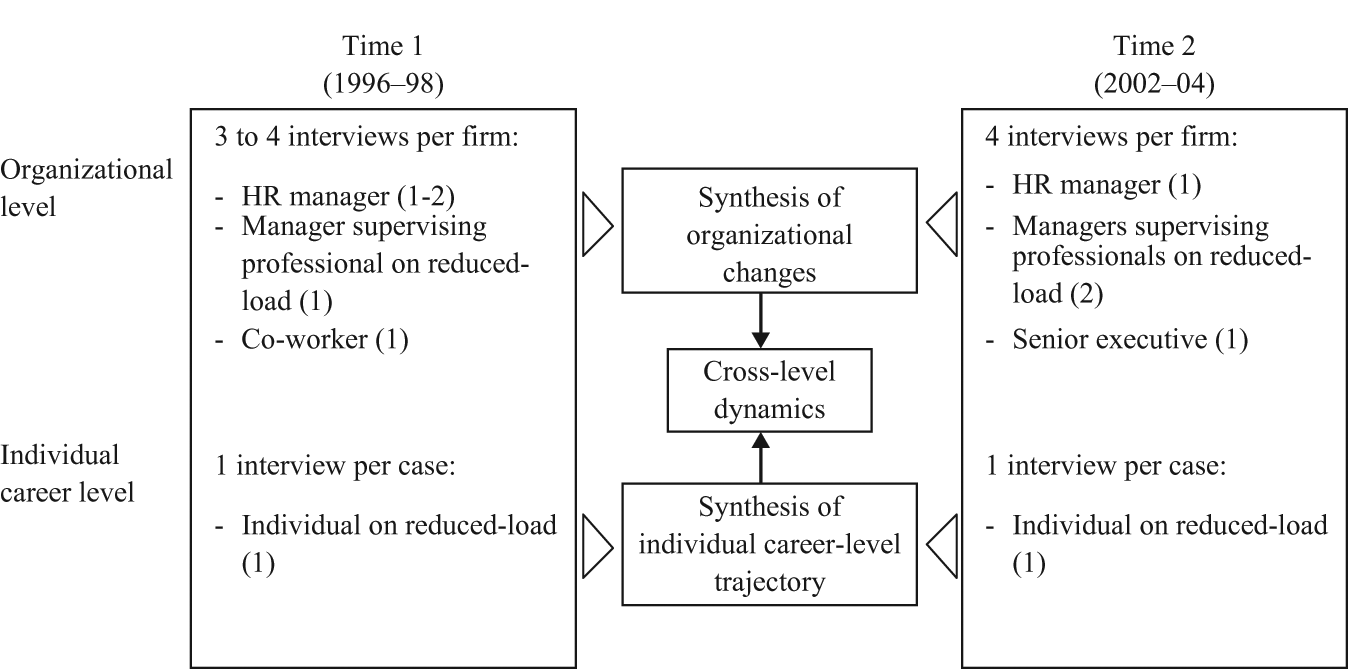
Data sources
Data analysis
We analyzed our data sequentially, starting by a search for patterns at the individual level of analysis and then moving to the organizational level of analysis. In order to compare and contrast the evolution of work arrangements across individual cases, we created a document that laid out job changes and shifts in work load and employment status over the six years. Two patterns emerged: (1) those who persisted in seeking to maintain reduced-load employment – through increases and decreases in load, taking leaves throughout the six years, or sometimes changing employers (called Seeking continuity with reduced load); (2) those whose sequence of job changes involved consistently moving toward working closer to full-time or shifting formally to full-time (called Evolving toward full-time). The first and second co-authors independently categorized all participants as belonging to one of these groups and were in agreement in 100 percent of the cases.
We also created a narrative account (Maguire, Hardy, & Lawrence, 2004) which summarized key personal and family life events over the six-year period. This narrative enabled identification of the most important individual-level continuities and changes that were likely to influence the evolution of reduced-load work arrangements over time.
Next we moved to examination of changes in the sample of organizations over time. The focus here was on (1) changes in strategic business direction and external environment in which the firm was operating; (2) concomitant changes in organizational structure or operations. After initial analysis of these data using axial coding to identify recurrent themes (Miles & Huberman, 1994), each firm over the six years was coded on the basis of whether it did or did not experience each of the following: (1) major industry changes or crisis; (2) change in core business or client base; (3) financial threat leading to layoffs or downsizing; (4) change in ownership or internal organizational structure (merger/acquisition/spinoffs). The first and second authors coded the 17 companies independently on the four types of changes and agreed on 82 percent or 14 of the 17 firms. The authors discussed differences in coding with each dimension of contextual turbulence until they reached agreement.
Finally, we revisited each of the 36 individual cases to systematically search for dynamics operating across levels of analysis. Here we followed an analytical strategy that multi-level theorists call “bracketing”: a greater understanding of a phenomenon of change at one level of analysis can be gained by considering change at a higher level of analysis (Hackman, 2003). We considered each case of reduced-load work evolution and tried to answer the question: To what extent do organizational-level or industry-level changes help us understand the evolution of the work arrangement? Through a process of iterative comparing and contrasting of individual and organizational changes within cases and across cases, the first and second authors generated a set of six cross-level dynamics, which were ultimately collapsed into four. They each focused on cases within a different subset of organizations and drew on direct quotes to defend specific proposed dynamics. Eventually they agreed on four cross-level dynamics identified inductively, which are described below. Next a coding scheme was developed to allow systematic coding of each individual case. The distinctive characteristics of each dynamic were enumerated as shown in Table 3, and the second and third authors then independently coded each of 36 cases using this coding scheme while also drawing on summary information about individuals and the overall rating of the organization in terms of degree of overall turbulence, as described above. The authors agreed on the cross-level dynamics exhibited in 26 out of the 36 cases (72 percent) and subsequently discussed the remaining cases until they could reach agreement.
Description of the cross-level dynamics

Results
Aggregate description of career-level evolution
Two overall patterns of evolution of the individual work arrangement can be contrasted in our sample. Seeking continuity with reduced-load was the most frequently observed pattern (22 cases, 61 percent), where participants continued to work on a reduced-load basis throughout the six years, but experienced a wide range of changes, with shifts in work load and status along the way. Some had to work harder than others to maintain reduced-load arrangements. The original reduced-load work arrangements rarely stayed the same, in terms of position held, percentage of full-time worked, logistics of scheduling, and boundary management. But the arrangement of working fewer hours at lower pay than full-time in a similar position, by choice, continued.
The other observed pattern was described as Evolving toward full-time (14 cases, 39 percent). These professionals left reduced-load work behind at some point in time over the six years. Sometimes it appeared that external forces or shocks “pushed” them to a tipping point. For example, when a spouse lost a job, the reduced-load partner returned to full-time work, since 100 percent of salary was suddenly needed. Other cases involved forces pulling individuals toward full-time (FT) rather than pushing them away from reduced load. These individuals described being drawn into longer hours by the attractiveness of a particular job, a career change, or a promotion being offered that was contingent on a return to full-time hours.
Organizational level changes
To address our first research question on how different forms of contextual change may affect the careers of reduced-load professionals, we analyzed the changes all of our 17 companies went through over the six years separating the data collection waves. Two dominant themes in organizational informants’ observations involved external changes in the firm’s environment. Industry turbulence was noted in three-quarters of the organizations and included comments about general instability in the economy, industry collapses (dot.com, accounting problems, post 9-11 effects, etc.), “volatile and uncertain” competitive landscapes, shifting power relationships with retailers, changes in the structure of industry sales distribution networks, increased government regulation (e.g., Sarbanes-Oxley), and changing public image of an industry. Change in core business of the firm and client base was experienced in one-third of the firms, which meant a major shift in external environment relationships. Examples included changing from a products-based to a service-based company, shifting to a focus on customer relations, or a new focus on international markets.
The other two dominant themes in managers’ discussion of changes over the six years involved internal changes within organizations. Over half of the firms mentioned increased pressure on financial performance and/or layoffs undertaken to relieve financial threats. Over half the firms also experienced internal structural or ownership changes, including mergers and acquisitions, divestiture of under-performing business units, centralization and consolidation of regional and field units into company headquarters, and spinning off companies as independent business units.
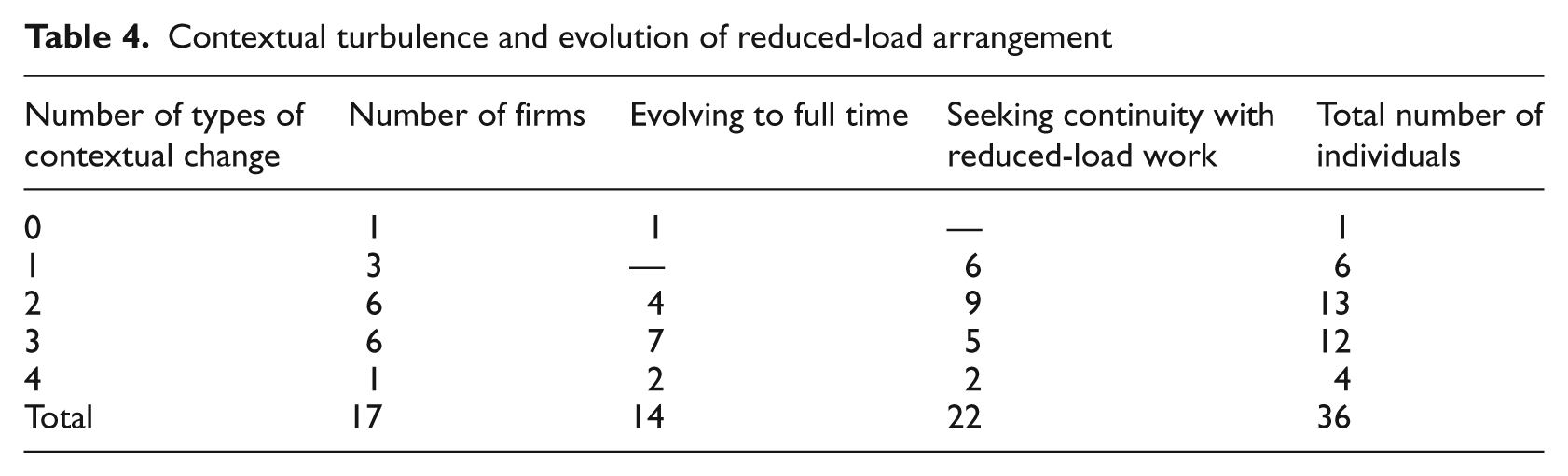
In order to assess the relative impact of contextual turbulence on individuals’ remaining on reduced-load, we started by grouping firms according to the amount of change they had gone through. Table 4 presents in condensed form the career evolution pattern as a function of the number of types of contextual changes, i.e., whether organizations experienced only one, two, three, or four types of changes over the six-year period considered. As evidenced in Table 4, out of the 20 participants in firms with two or less types of contextual changes, 15 remained in reduced-load. However, out of the 16 participants in firms with three or four types of contextual changes, only seven remained in reduced-load, while nine were drawn to full-time. In our sample, individuals working in firms with a high level of contextual change were less likely to remain in reduced-load positions.
Contextual turbulence and evolution of reduced-load arrangement
Next we compared the effects of different types of contextual change on the number of individuals who remained on reduced-load, as shown in Table 5. While change in core business/client base, internal structure or ownership change, and industry turbulence all were associated with higher proportions of returns to full-time, financial threat/layoffs was associated with lower levels of return to full-time.
Evolution of reduced-load arrangement by type of contextual change
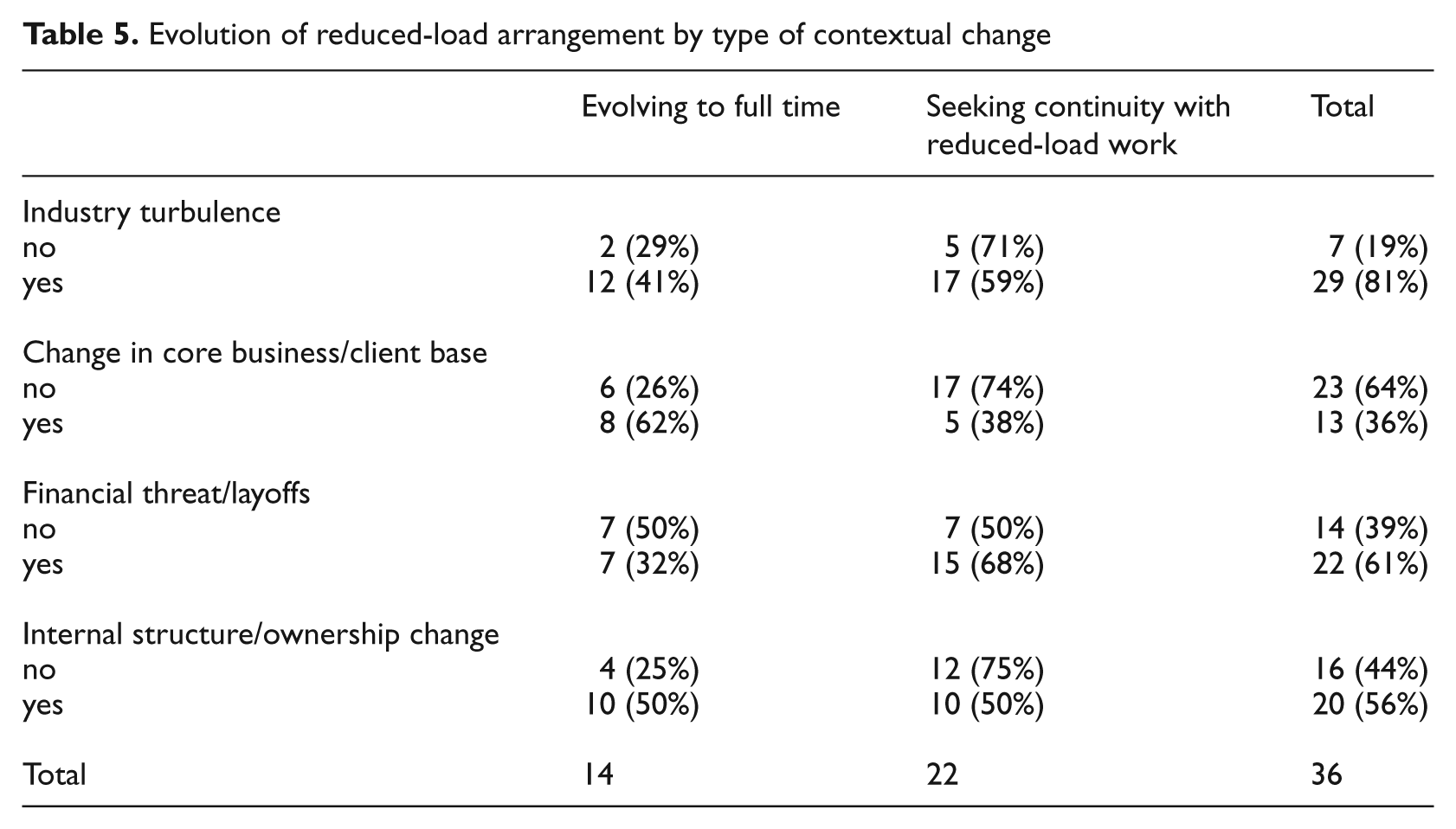
At this point we can draw some preliminary conclusions from examining changes at the organizational level. The range of contextual changes described above in the 17 firms had a constraining impact on the evolution of our 36 individual work arrangements. While a high overall degree of contextual change seemed detrimental to the sustaining of reduced-load work, not all types of contextual change had the same effect. Cases in which the organizational variables had a clear, unilateral effect on work arrangements were rare, and included a layoff for economic reasons, or a reorganization.
But understanding each individual career trajectory required considering how organizational-level changes interacted with significant events and changes in individuals’ personal and family contexts. Such changes were varied, ranging from birth or adoption of a child, family member illness or death, spouse changing employer or career, or personal illness. Again, those personal and family context changes did not have a direct, causal impact on the evolution of the work arrangement. For example, for one participant, a spouse getting laid off or quitting a job could be an impetus to returning to full-time employment; yet for another, it might mean better back-up child care for a variably scheduled reduced-load work week. In most cases, individual-level variables combined in a complex way with organizational context variables, and thus it was important to learn more about the mechanisms of these interactions leading to changes in reduced-load work arrangements.
Dynamics of interaction between organizational context and individual-level changes
Our second overarching research question asked what mechanisms could be identified to capture different kinds of interaction between individual career change and macro-level organizational changes over time. Indeed, reduced-load work arrangements were continuously evolving and were utilized differentially by individuals and organizations, depending on interrelated factors at both levels of analysis. As already shown in Table 3, a set of four dynamics of cross-level interaction were identified inductively: co-optation, synergy, decoupling, and tug of war.
The first dynamic we labeled co-optation, defined as the organization drawing the individuals into organizational change under conditions of low-level personal and family changes. In this pattern, change was initiated at the organizational level, and trickled down to the career level. This dynamic often ultimately played a role in individuals’ decisions to abandon reduced-load work in favor of full-time work. With employees in firms going through a high level of turbulence and increasingly moving toward a high-performance work culture, the individuals moved to full-time partly because of the perceived incongruence between where they were headed in working less and where the organization was headed. They seemed concerned that their reduced-load position might limit their long-term career prospects. In this dynamic, we observed repeated mentions of windows of opportunity opening at the level of the firm, to which the individual felt compelled to respond and adapt. Individuals in this dynamic reported a motivation to modify their work arrangement in order to keep pace with a turbulent work environment.
“Anne” was a fast-track sales manager in a high-tech manufacturing firm when she first negotiated working four days and 80 percent of full-time. Her superb managerial skills enabled her to continue performing at a high level due to her effective coaching of her sales reps. But once she was promoted, still on reduced load, she was given a bigger challenge involving start-up of a new business area within the firm, and she found it more difficult to continue to shine. Yet the firm was going through enormous transformation as a result of global market shifts and industry turbulence, and she wanted to be part of helping to lead the company to new heights. Furthermore, her marriage started to unravel as well, and she decided to return to full-time in order not to lose her position within the firm.
The second interaction pattern that emerged was synergy between organizational trends and personal and family change. In this situation a high level of personal and family changes interacted with medium or low organizational turbulence, creating an opportunity for individuals to align their individual preferences for maintaining reduced hours or returning to full-time with the employer context. For the employees in this group, the decision to work part- or full-time was made possible by favorable contextual conditions at the level of the organization. Some of these firms had experienced difficult challenges and changing conditions in their external business environments (e.g., increased competition and big drop in sales and market share) and yet had been able to sustain commitment to reduced-load work “under fire,” so to speak. In such cases, these reduced-load professionals seemed to experience great freedom in being able to choose to continue working less, customizing their work load over time to fit their personal and family priorities or to return to full-time when an attractive opportunity came along.
Two subsets of synergy were: (1) cases where the arrangement evolved to full-time, as a result of opening windows of opportunity at the organizational level, coinciding with shifts happening at the individual level which made returning to full-time appealing; (2) cases where the reduced-load arrangement was maintained in spite of turbulent change happening at the organizational level, because the type of change (e.g., financial difficulties) facilitated continuation of part-time positions. Some cases of synergy looked serendipitous, while in other cases, the synergy was the result of conscious activities on the part of the individual and/or the organization. For example, a strategic effort to align a career with organizational change was evident in the case of a partner in an accounting firm working 85 percent who managed to generate a revenue stream that was very competitive with her full-time peers. When she saw her client base at risk because of industry turbulence, she decided to relocate to a different office that would benefit both her client base and firm revenues.
“Laura” was working in finance for a large national bank when she first negotiated an 80 percent reduced-load arrangement, which enabled her to spend the time she wanted with two active boys while also contributing to their private school fees. However, she felt somewhat under-utilized and stagnating at work when interviewed at Time 1. Over the next six years there were many changes at work due to a major merger between her employer and another big bank, and she could have easily been among those made redundant by the consolidation of the firms. But her previous bosses, with whom she had had political issues, left the firm, and her new boss gave her some new challenges which she rose to meet with enthusiasm and aplomb that did not go unnoticed. After continuing to impress her boss with her high level of performance, he suggested that she officially convert from reduced-load to full-time without any additional responsibilities, as his observation was that she was clearly doing a full-time job in terms of her contribution and should be compensated accordingly. She was delighted with the recognition, and her boys were now teenagers requiring less day-to-day attention. Subsequently, she was promoted twice and at the time of the second interview was sitting on the corporate leadership team and feeling very engaged and fulfilled at work.
The third interaction dynamic between organizational-level and individual-level changes was labeled decoupling, because there was a shift from the organizational and individual interests being aligned to being divergent as a result of either dramatic changes at the organizational level involving mergers, restructuring, or downsizing or due to personal and family-level changes. Ultimately, all of these individuals left their employers, voluntarily or involuntarily. Some chose to pursue a change in career path or new challenge at work that they wanted, whereas others were forced to pursue new directions after being laid off. Thus, at some point in those cases, the individual and the organization went their separate ways, whether initiated by one side or the other.
One example of decoupling was “Shelley”, a finance manager in a professional services firm that experienced both industry turbulence and restructuring over the six years. At Time 1 she was a high-performing, highly valued manager whose reduced-load work arrangement had worked well. However, a move toward centralization in her region led to elimination of her position. In spite of this non-negotiable outcome, her firm asked her to continue on for nine more months and serve in an interim transition role to be in charge of the coordination and organization of a major move of offices to a new building. Her responsibilities in this position involved decisions and actions with high impact and visibility, and she performed very well and enjoyed the new challenges. Ultimately, her temporary role ended and she was given an attractive severance before leaving her employer of 20 years. She took advantage of the generous severance to take some time off for almost a year, and then subsequently pursued a series of comptroller positions on a contract basis with several small firms where she could work on a reduced-load basis three to four days a week and feel in control of her schedule.
The fourth observed dynamic was a tug of war between the individual and the organization, with the high level of organizational turbulence and a high level of personal and family life changes making it a constant battle for individuals to maintain the reduced-load position. This dynamic was characterized by multiple changes occurring at the organizational and individual levels, with frequent renegotiation of the work arrangement. External and internal organizational change created enormous pressure on individuals to work more hours or to return to full-time. In several cases individuals were working for employers where the business challenges and new strategic directions had put reduced-load work arrangements at risk. In five of these cases the individuals reported a great deal of individual maneuvering and jockeying (e.g., changing departments and bosses, bargaining through outstanding performance and organization cost savings achieved) in order to keep their reduced-load status. For three individuals involved in tug-of-war dynamics, reduced-load work evolved into self-employment or contract work; ultimately, they had to leave their employers to maintain working less than full-time given the personal and family changes they had to respond to. So these individuals struggled to stay with their employers, but lost their battles. Other professionals in the tug-of-war category, who managed to stay, fought to keep some boundaries and maintain a lower work load, but felt that they had to be continuously “on guard” and proactive to look for new locations or bosses where they could move to if things changed or became less hospitable where they were. They kept on asserting their needs, selling their skills, and creating opportunities, educating many a manager along the way about reduced-load work. They persisted in the face of organizational turbulence and held on to their work arrangements, partly because circumstances in their personal lives absolutely required that they keep working less.
“Georgia” was an experienced senior HR manager with a specialization and extensive experience in compensation. She had originally negotiated a 60 percent reduced-load arrangement, partly because her husband had a global position requiring travel up to 50 percent of the year. Although she kept strict boundaries at first around her time in the office, she found her work load creeping up due to being assigned interesting and challenging project work that she wanted to do. And then she got to a point that she realized she could not handle the required hours or the stress associated with the tight deadlines around deliverables. So she took a stress leave and then renegotiated a reduced-load position anew after recovering. She felt that her boss was really sympathetic and trying to help her set limits, but inevitably her work load got out of hand again. She even negotiated a sabbatical from her company, during which she explored alternative employment opportunities while her position was held for her. Again she returned and tried to make the reduced-load work, but finally negotiated a “retirement package” and began working on a consulting basis for a firm wanting specific services. Even when working on a contract basis, she conveyed that it was difficult for her to contain her work load and take on a reasonable amount of work. She resigned and then was rehired as a result of this ongoing tug-of-war process.
Outcomes of the reduced-load arrangements
Table 6 indicates the employment status of participants at Time 2. Those who were still employed on a reduced-load basis with the same employer were in the synergy or tug of war cross-level dynamics. Those who were working full-time with the same employer were either in co-optation or synergy.
Individual outcomes by cross-level dynamic
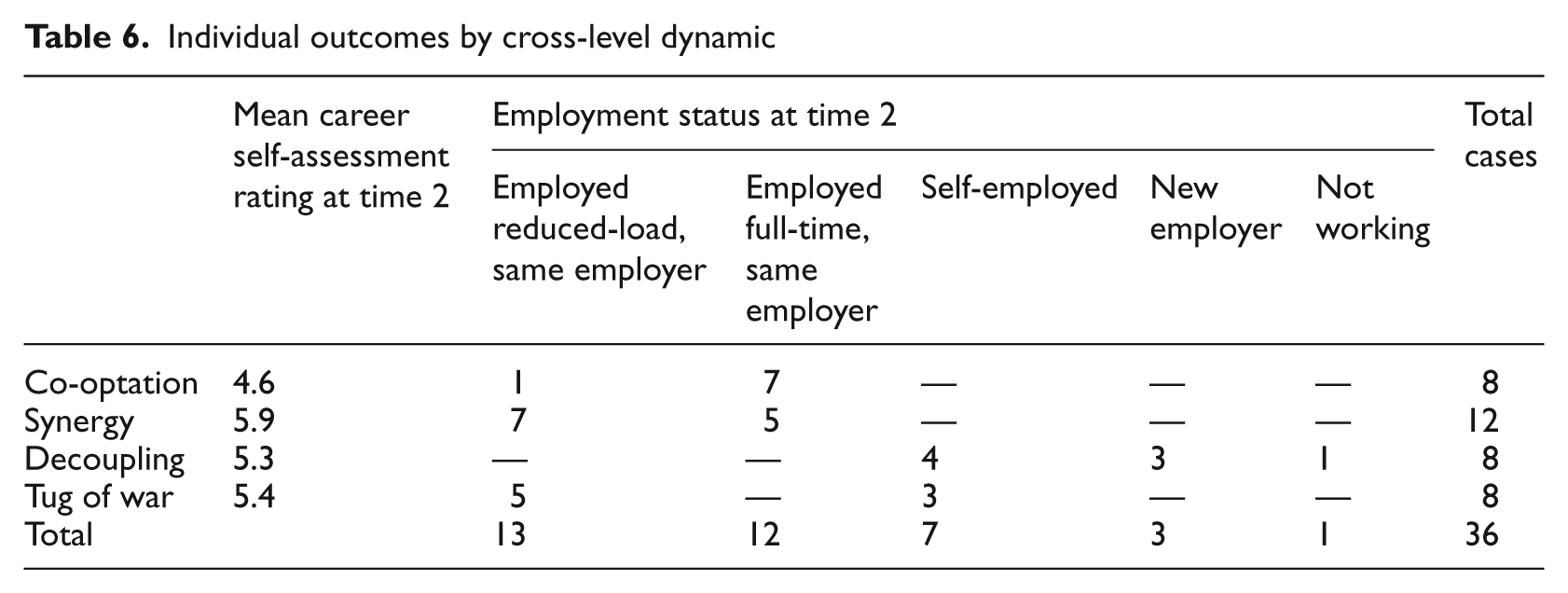
Table 6 also shows the individual outcomes for each dynamic in terms of participants’ self-assessments of how well the career was working at Time 2. Participants in the synergy pattern felt their careers were working best (average rating 5.9), whereas those in co-optation rated their careers as going the least well (average rating 4.6).
Discussion
This study adds to knowledge on how individual career patterns and organizational changes cross and interact, which is not well understood. We took as a theoretical base an open-systems view on careers and organizations, and focused on dynamic interactions occurring between levels of analysis. We used reduced-load work arrangements as a lens to observe career evolution over time, because they exist at the intersection between individual and organizational needs and constraints.
The impact of contextual changes on individual work arrangements
With our first research question, we explored the impact of four types of organizational change on individual career trajectories. We found that the most disruptive type of organizational turbulence for reduced-load arrangements was change in core business or client base. This finding makes sense if we consider the scope of organizational consequences linked to such a change: functional lines are being redrawn, competencies that used to be in demand may suddenly become irrelevant, and new competencies needed. The consequences can be dramatic for individuals whose ability to maintain a reduced-load arrangement often relies on their having carved out a functional niche, based on their specific experience in a given position.
On the other hand, in our sample, financial threat or layoffs were less disruptive for individuals trying to maintain a reduced-load arrangement than the other types of contextual change. Some managers told us that offering reduced-load arrangements allowed them to reduce their headcount without laying people off: two individuals organized in a job share, for example, will only count as one in a financial statement. 2 This finding illustrates that not all organizations respond equally to similar conditions of financial threat: while some firms reduced the availability of and openness to reduced-load positions, others responded in a diametrically opposed way by opening up and normalizing reduced-load work, which was seen as an innovative solution to reduce headcount without reverting to layoffs.
As for the impact of industry turbulence, we suspect that it only becomes disruptive for individual careers when it causes other types of organizational transformations, such as reorganizations or changes in client base. Thus, we suggest that the impact of industry-level turbulence on individual careers is mediated by organizational-level factors such as the degree of internal organizational change required to adapt to external industry transformation.
How individual and organizational changes interact
With our second research question, we looked for mechanisms of interaction between organizational-level changes and individual-level changes. In the present study we have identified four patterns of interaction. In the cases that we labeled co-optation, the organization was drawing the individual into organizational changes. In the pattern labeled synergy, the individual and organization combined to create an evolving work experience that was additive to both relationships. Under decoupling, individual or organizational changes helped spark new career decisions for individuals. The fourth type, tug of war, depicted a constant battle back and forth between individuals and their employers.
Contributions
The study has important implications for current theorizing of customized work patterns. The concept of customized career proposed by Valcour et al. (2007) captures adequately the recurrent process of career adjustment to changing priorities at home and shifting opportunities at work which we observed in our data, but it fails to capture the variability in motivations and processes that lead individuals into such patterns. Hidden behind most theories of individual career customization is the unwarranted assumption that individual preferences or adaptation strategies drive career choices. The cross-level dynamics proposed in this paper allow a finer conceptualization of various ways individual careers may end up taking customized forms, as a result of the complex interaction between individual preferences and organizational circumstances.
Our study also contributes to recasting new ways of working such as customized careers not as an end in themselves, but potentially as a transition or bridge to other career and life moves. The very lack of knowledge about the longevity and stability of career changes and use of new career practices such as reduced-load work arrangements among professionals has hindered systematic study of outcomes associated with it over time, as it is not clear what the dependent variables of interest should be. For example, simply sustaining working on a reduced-load basis for five years might be considered a sign of success in one individual’s personal life situation or in the context of a particular organization. In another case, it might be indicative of failure, as the individual wanted to return to full-time or feels she should have been promoted in that time span, for example.
The study thus highlights the necessity of identifying boundary conditions around the concept of “boundaryless careers.” After a decade of uncritical enthusiasm for this concept (Feldman & Ng, 2007), researchers need to study more closely the conditions that make nontraditional forms of work sustainable in the long run. As was evident in our sample, maintaining such work arrangements can be akin to a constant battle. The cross-level dynamics identified here expand our conceptual repertoire to describe the variation in customized forms of work.
The paper also contributes to the larger literature on labor markets that has examined the intersection between individual careers and contextual changes. The fact that individual careers within organizations are influenced by organizational labor markets, which derive from larger environmental factors, has been clearly established in previous research (Brüderl et al., 1993; Haveman & Cohen, 1994; Phillips, 2001). However, the nature of this influence has tended to be conceptualized in rather simple ways, in terms of constraints versus opportunity. The cross-level dynamics described here add nuance to previous depictions of cross-level influence, by showing (1) that there is no direct coupling between environmental changes and organizational responses, and (2) that individuals engage with contextual changes in different ways.
Limitations and directions for further research
A limitation of our study is the possibility of gender bias as 86 percent of our sample was female. Although this gender ratio is representative of the population of reduced-load professionals, it may constrain the generalizability of the cross-level dynamics to the larger population of professionals who are not working reduced-load. Another limitation of this study is that we focused on companies that were early innovators in adopting reduced-load work. While this was necessary in order to observe the phenomenon of interest, our sample may be biased and not fully representative of the whole population of reduced-load professionals and their employers. However, given the scope and variety of industries included in our sample, we believe that the dynamics observed here reflect general tendencies in the North American economy.
Another limitation is that we collected our data at only two points in time, and we asked our respondents to reconstruct retrospectively what had transpired in the time interval. This means that the account of personal and organizational trajectories may be biased by the post-hoc reconstruction of our informants. Future studies need to collect longitudinal data at multiple time points using more repeated measures as events are unfolding.
Because our sample is not random and its size is relatively small, we could not draw any firm conclusion on the differences observed in the way various types of contextual changes impact individual careers, but only suggested some associations. While our objective was to study a limited number of individual and organizational cases in depth to build theory, future research needs to test more systematically the impact of various forms of contextual change on work patterns using larger samples. Also, future research would fruitfully explore the impact of other organizational factors on work patterns beyond the four types of contextual turbulence studied here, including for example organizational culture or professional culture. In addition to the organizational factors examined in this study, work group level factors and dynamics should be examined in future studies of the contextual influences on individual career dynamics, as recommended by several recent studies (Lawrence & Corwin, 2003; Lee et al., 2002; Litrico & Lee, 2008; McCombs, Barringer, & Bourne, 2004). For example, whether and how group-level dynamics of adaptation can dampen the effect of organizational or industry-level turbulence are important questions. More generally, future research should examine the process through which nontraditional ways of working become “normalized” within organizations.
We noted that participants who were in the synergy pattern were on average more pleased with how their careers were going than those in other patterns of cross-level dynamics. However, there could be other factors contributing to these different assessments. Furthermore, it is important to note that these cross-level dynamics are highly labile, as they represent interaction of changes at the organizational and individual levels. Individuals manifesting a synergy pattern at one point in time could easily shift to decoupling, co-optation, or tug of war down the road.
Finally, it would be important to determine to what extent cross-level patterns are promoted by specific organizational or professional cultures. It may be that some patterns correspond to archetypes of interactions, which are imported and actualized in given situations. For example, future studies could systematically examine cross-level dynamics in various occupations, or in various organizational and cultural contexts beyond North America, as there may be more cultural biases against the sustainability of reduced load in North America than in other cultures with greater societal support for putting limits on the hours of work.
Implications for practice
Organizations and their employees would benefit from seeing the potential offered by alternative work arrangements to allow fluctuations in the level of individual engagement in terms of work hours over several years. We found that reduced-load work can be a long-term employment mechanism, or a temporary arrangement and a pathway to promotion in other cases, to accommodate changes in personal priorities and needs. But reduced-load arrangements can also be used to accommodate fluctuations in organizational priorities and needs, for example, as a retention tool as an alternative to layoffs in times of crisis. From a managerial perspective, the study points to the importance of allowing those multiple uses and forms of reduced-load to coexist within the organization.
Conclusion
Even if they are sustained over a significant period of time, reduced-load arrangements evolve as a function of changing conditions at work and at home. This dynamic, multi-level phenomenon resembles a dance, in which individuals and organizations are partners; one may take the lead for a while, setting the pace and the steps for the other, but this may shift over time. Whether the recurrent patterns of this interaction are transient improvisations or more predictable and scripted in our culture remains open to further investigation. This perspective suggests exciting avenues for future research exploring the dynamic choreography between individual lives and organizational contexts.
Footnotes
Acknowledgements
We are grateful to members of two research teams over six years for their contributions to data collection and analysis and ideas generated in periodic research team meetings: Shelley MacDermid Wadsworth, Carol Schreiber, Margaret Williams, Michelle Buck, Leslie Haugen, Sharon O’Sullivan, Douglas T. Hall, and Connie J. G. Gersick. Shaun Pichler of Michigan State University is thanked for his help with the development of executive feedback reports for these studies. McGill University and Michigan State University are thanked for their institutional support of this research.
We thank the Alfred P. Sloan Foundation (1996–98 and 2002–04) and the Social Sciences and Humanities Council of Canada (1996–99) for financial support making this research possible.