






Abstract
The legalizing of agency work in Germany is used as an illustrative case for exploring and theorizing how contests about regulating organizations’ labor practices are played out through the politics of boundary work. By combining the idea of inter-field relations from the theory of strategic action fields with considerations about boundary work within and between organizational fields, this paper explains the recent proliferation of agency work as the outgrowth of a long-term legalization contest. By taking a historical perspective, it illuminates how the boundary work of (former) incumbents and (new) challengers modulates institutional dynamics. Based on qualitative primary and secondary material, the findings reveal how the politics of boundary work facilitate power reversals in organizational fields by allowing defeated parties to survive in a field’s niches, to cross a field’s boundaries, and to rebuild their intervention capacity as well as by making incumbent coalitions erode over time.
Keywords
Introduction
For most of the 20th century the International Labour Organisation (ILO) upheld a position against private employment agencies, i.e. organizations intermediating jobseekers and employers for profit. In its first general assembly the ILO issued the “Unemployment Convention” (ILO, 1919a), demanding the set-up of “free public employment agencies under the control of a central authority” (Art. 2), and recommended “[to] prohibit[ing] the establishment of employment agencies which (…) carry on their business for profit” (ILO, 1919b). Back then, ILO policymakers regarded privately organized agency work as a source of escalating industrial disputes (Rodgers, Lee, Swepston, & Van Daele, 2009). In line with the ILO’s constitutive principle that “Labour is not a commodity” (ILO, 1944), the ILO renewed this position by demanding the abolishment of private fee-charging agencies (ILO, 1933) and their “progressive abolishment” (ILO, 1949) respectively. In 1997, after almost 80 years, the ILO’s founding ideas were almost forgotten when the ILO convention 181 allowed private employment agencies in principle (ILO, 1997a, 1997b, 1997c). After three decades of lobbying on a global scale and country by country, the private agency industry had won one of its greatest victories (Vosko, 1997).
Today, agency work has become a mass phenomenon across countries and industries; private employment agencies figure among the world’s largest employers (Coe, Johns, & Ward, 2011). And yet surprisingly little is known about how agency work has become socially constructed as such an institutionalized exemplar of today’s world of precarious employment, i.e. employment that is “uncertain, unpredictable, and risky from the point of view of the worker” (Kalleberg, 2009, p. 2). Located at the intersection of organization and work studies (Barley & Kunda, 2001), this paper’s aim is to close this gap at least partially by examining the struggle to legalize agency work fought by private employment agencies (Hatton, 2011; Peck & Theodore, 2002; Smith & Neuwirth, 2009; van Gestel & Hillebrand, 2011) and collective labor (Heery, 2009; Wills, 2009). In that, the following examination of the agency work field reveals the necessity for taking a “both/and view” (Hargrave & Van de Ven, 2009, p. 127) to capture the long-term institutional dynamics in the struggle over how contracting labor is shaped as an organizational practice.
Taking the German experience between 1949 and 2004 as an illustrative case, the paper explores and theorizes how the politics of boundary work modulate long-term institutional dynamics into recurrent contests about a field’s settlement regulating organizational practice. From the findings on how incumbents and challengers perform in the politics of boundary work, i.e. how field incumbents activate, uphold and reinforce internal boundaries as well as protect external boundaries and how challengers redraw, blur and cross boundaries, it is concluded that the debate about institutional dynamics in organizational fields needs to take into account what goes on at a field’s borders. It is here that one might discover how challengers can eventually defeat incumbents and forge a new field settlement. In addition, the paper raises the broader issue of how institutional dynamics are played out when change is contested over long time periods and non-extinctive in nature at the same time. Institutional dynamics are contested when they are “the product of constitutional struggles” (Schneiberg & Soule, 2005, p. 122) that are connected to collective action about societal order. Institutional dynamics are non-extinctive, when incumbents lose and challengers win in one period, but both stay in the game permanently and remain connected to each other through mutual interdependence (for the origins of this idea see Dahrendorf, 1959; Giddens, 1970). Both conditions hold for organizational fields that group around state regulation commodifying labor, money, and natural resources (Polanyi, 2001 [1944]).
The Politics of Boundary Work and Institutional Dynamics
Accounting for field-level institutional dynamics – i.e. the processes of institutionalization and deinstitutionalization by which institutions emerge, consolidate and wither away within organizational fields (e.g. Beckert, 2010; Lawrence, Winn, & Devereaux Jennings, 2001) – a large body of literature engages with fields as being complex (Greenwood, Raynard, Kodeih, Micelotta, & Lounsbury, 2011), pluralistic (Dunn & Jones, 2010) and contested (Purdy & Gray, 2009). Numerous studies have revealed a large variety in patterns and outcomes of institutional dynamics (Meyer, Gaba, & Colwell, 2005; Schneiberg & Soule, 2005): new fields emerge through the theorization of new practices (e.g. Maguire, Hardy & Lawrence, 2004), new organizational forms arise when organizations adopt new logics (e.g. Tracey, Phillips, & Jaris, 2011; van Gestel & Hillebrand, 2011), product evaluation is (re-)constructed by altering institutional logics (e.g. Greenwood, Suddaby, & Hinings, 2002), and products are outlawed through delegitimation (e.g. Hiatt, Sine, & Tolbert, 2009; Maguire & Hardy, 2009). Such changes in organizational fields are brought about by insiders (e.g. Gawer & Phillips, 2013; Yu, 2013), outsiders (e.g. Hoffman, 1999; Maguire & Hardy, 2009; Zietsma & Lawrence, 2010) and actors practicing at the intersections of multiple levels (e.g. Smets, Morris, & Greenwood, 2012; Suddaby, Cooper, & Greenwood, 2007).
Although in this literature boundary work is clearly acknowledged as a distinct form of institutional work, making use of a field’s boundaries to create, change or maintain institutions (e.g. Lawrence & Suddaby, 2006; Zietsma & Lawrence, 2010), the politics of boundary work as modulating long-term institutional dynamics into recurrent contests over organizational practice have received only limited attention. In particular, there is no explicit treatment of how the politics of boundary work are played out by collective actors who engage in a long-term, non-extinctive contest over organizational practice through manipulating and exploiting a field’s internal and external boundaries.
Strategic action fields
For deriving a heuristic analysis of the politics of boundary work in such a setting, here, the notion of boundary work as deployed in Zietsma and Lawrence (2010) is cross-fertilized with the idea of inter-field relations from the theory of strategic action fields (Fligstein & McAdam, 2011, 2012). Examining organizational fields through the analytic lens of strategic action fields allows making long-term processes of political contestation visible. Fligstein and McAdam (2012, p. 9) define a “strategic action field” as a “constructed meso-level social order” that can form around policy issues and organizational practices. These orders typically consist of three elementary actor groups with varying resource endowments: incumbents dominating the field, challengers striving to change a field’s order, and governance units that regulate the field. Incumbents and challengers diverge in orientation and goals due to competing frames of reference, and both groups try to achieve their purposes through collective action. With collective action, Fligstein and McAdam explain what makes conflict endure, even become institutionalized as Dahrendorf (1959) argued, as challenging groups appropriate or create in collective action their organizational vehicles for sustained contestation (Fligstein & McAdam, 2012, p. 21).
Clearly, not all organizational fields are best described as being a strategic action field as there might be fields with either more unified or more opaque governance structures such as those forming around uncontroversial organizational practices or within communities respectively (see Thornton, Ocasio, & Lounsbury, 2012, p. 164). Nonetheless, it is justified to apply the Fligstein and McAdam (2012) lens to those fields forming around “bread and butter” issues that involve the state and the law and are the scene of struggles between deeply rooted but conflictive social expectations on organizations (or political division, for that matter, e.g. Kriesi, 2010). Institutional dynamics in these fields gain a controversial edge when bringing about (new) formal lawmaking as authoritative structuration (Giddens, 1984), which imposes social categories as boundaries between social groups, with profound effects for individuals’ life chances (Lamont & Molnár, 2002; Tilly, 1999, 2004). This is regularly the case in contests about labor law (Deakin, 2006) which was – among others – noted by the late Max Weber: The increasing significance of freedom of contract … implies a relative reduction of that kind of coercion which results from the threat of mandatory and prohibitory norms. … But it is also obvious how advantageous this state of affairs is to those who are economically in the position to make use of the empowerments. (Weber, 1968, p. 730)
The controversial edge is amplified when the regulatory contest is connected to social movements concerned with organizational practices (Schneiberg & Lounsbury, 2008) inasmuch as practices embody a field’s regulatory settlement, i.e. the formal rules applicable beyond a single organization (Vaara & Whittington, 2012, p. 312). Therefore, organizations become arenas of law enforcement, making organizations inclined to politically influence lawmaking outcomes (Edelman & Suchman, 1997; Hargrave & Van de Ven, 2006; King & Pearce, 2010); even up to the point to strive for hegemony (Levy & Scully, 2007) in defining a field’s settlement.
Boundary work
Fligstein and McAdam (2011, 2012) insist that strategic action fields are structurally embedded in other fields, i.e. have ties to (a set of) neighboring fields, and the history of a focal field is influenced by developments in these fields, sometimes even dominated by them. Similar to approaches theorizing the relative permeability of fields to outside influences as conducive for radical change (Greenwood & Hinings, 1996), Fligstein and McAdam give priority to the structural properties of inter-field relationships to explain how inter-field relations contribute to changes within a given field as these convey and mediate exogenous shocks (Fligstein & McAdam, 2011, p. 8). For example, the authors see a high number of ties or a high interaction frequency between fields as conducive to the spread of exogenous shocks shaking a focal field’s order.
As a complement to that the theory of institutional work provides a more detailed view on the agentic part of “field structuration” (DiMaggio & Powell, 1983, p. 148), i.e. how a field’s membership, governance, purposes and cognitive understandings are defined (Suddaby et al., 2007; Zietsma & Lawrence, 2010). Opening up to a practice-based perspective (Barley & Tolbert, 1997; Nicolini, 2012), the politics of boundary work can be conceived as concerned with symbolically constructing and practically enacting boundaries (e.g. Abbott, 1995; Lamont & Molnár, 2002). Boundary work can mean a myriad of different practices such as creating, expanding, reinforcing, crossing, blurring, opening, permeating, undermining or disrupting social boundaries (e.g. Gieryn, 1983; Llewellyn, 1998) between groups, organizations and fields across time periods, spatial orderings or institutional levels. For example, “boundary-work reproduces the organization as an ordered entity” (Llewellyn, 1998, p. 23), but it is also the vehicle for organizational change as organizational boundaries are redrawn, crossed and permeated in attempts to manage the tensions at organizations’ internal-external interfaces (Gawer & Phillips, 2013).
Here, I concentrate on boundary work in and across organizational fields as redrawing the brackets around organizational practices by structuring a field from within, as well as using relations to neighboring fields to create (new) insides and outsides of the focal field, a process that Abbott (1995, p. 872) calls “linking up” or “yoking”. Hence, I understand the politics of boundary work as dealing with how a field’s boundaries are manipulated to attack or defend a field’s settlement for shaping organizational practice. Boundary work within fields, then, is concerned with maintaining or changing a field by manipulating its boundaries from the inside. Boundary work across fields aims to shield or lever a given field settlement by relating the focal field to neighboring or higher-order fields.
Boundary work within strategic action fields
Incumbents maintaining a field’s settlement from within
Even in stable fields, incumbents use their “social skills” (Fligstein, 1997) to maintain a field’s settlement by organizing cohesion among incumbents, and convincingly taking others into account to get their cooperation (Fligstein & McAdam, 2011). For incumbents, this means that there is a dilemma: when is intensifying or weakening field governance best for maintaining a field’s settlement? Intensifying field governance means enhancing incumbents’ decision autonomy and their control of critical resources. Incumbents’ boundary work may then include monopolizing authority and resources, extending their influence to sub-fields or excluding rivals and challengers from field governance (e.g. Gawer & Phillips, 2013). Maintaining a field’s settlement through weakening field governance includes boundary work such as co-opting and compromising with challengers (e.g. Schneiberg & Lounsbury, 2008).
Challengers changing a field’s settlement from within
Challengers engage in changing a field’s settlement by weakening its boundaries from within. According to Fligstein and McAdam (2011), even in mature fields “less powerful actors can learn how to take what the system will give them and improve their positions in the field” (Fligstein & McAdam, 2011, p. 5). In that process, challengers unite peripheral (sub)fields within a field (e.g. Fligstein & McAdam, 2011) as well as question the field’s dominant frames of reference (e.g. Zietsma & Lawrence, 2010). For their part, challengers also face a dilemma when they weaken boundaries from within by altering coalitions (e.g. Santos & Eisenhardt, 2009). As they become co-opted into such coalitions they have to compromise with incumbent factions, provoking splits in the challenging coalition (e.g. Levy & Scully, 2007; Oliver, 1991).
Boundary work across strategic action fields
Incumbents shielding a field’s settlement from outside interference
For incumbents, shielding a field’s settlement from external influence means exerting control over the boundaries with neighboring or higher-order fields (Fligstein & McAdam, 2011). Incumbents might engage in protecting the structural boundaries of the field through building or cutting ties to incumbents or challengers in other fields (e.g. Fligstein & McAdam, 2011) or in shaping a field’s identity by defining the ideational boundaries separating it from the dominant views in other fields (e.g. Gieryn, 1983).
Challengers levering a field’s settlement by connecting to outside developments
For challengers, engaging in boundary work across a given field, first and foremost, provides a chance to escape a focal field’s established order and to find a space for building up or restoring intervention capacity. Beyond that, establishing ties to other fields allows challengers to mobilize resources, ideational support for their cause and potential allies to lever a field’s settlement from the outside (Suddaby et al., 2007), in particular when encapsulated incumbents are vulnerable to external shocks (Seo & Creed, 2002). For example, challengers may find a forum for their otherwise suppressed views. In addition, inter-field relations might benefit challenging groups, enabling them to engage in referencing ideas and developments across fields (Purdy & Gray, 2009).
Institutional dynamics
For institutional dynamics, the politics of boundary work make a field’s settlement contestable, even if it is firmly protected by incumbent coalitions and enshrined within legal rule-setting. This is because contestation and haggling between incumbents and challengers also go beyond a field’s boundaries, making a field’s regulatory status quo into a precariously reproduced settlement in itself (Hargrave & Van de Ven, 2006; Seo & Creed, 2002; Thelen, 2009). In the long term, there is even the possibility of what Fligstein and McAdam (2011, p. 17) call “genuine transformation”, i.e. the overturning of a field’s order by the elevation of the challengers to a position of dominance within the field, making (former) challengers the “new kings”. Over time, then, fields might move back and forth between divergent settlements on regulating organizational practice, depending on the (re)formation of a field’s external boundaries and on the alternation of power positions brought about by field participants’ “jockeying for position” (Fligstein & McAdam, 2011, p. 6). However, how institutional dynamics are modulated into (recurrent) contests about organizational practice by the politics of boundary work is primarily an empirical question about (1) what practices of boundary work within and across fields are actually used by incumbents and challengers respectively, and (2) how these practices influence a focal field’s settlement.
The Field of Agency Work in Germany as a Site for Study
An in-depth empirical examination of the legalization of agency work in Germany offers a unique opportunity to explore the politics of boundary work within and across fields from a long-term perspective: first, the employment relationship is a central institution in all industrial societies (Deakin, 2006; Vosko, 2010) and touches upon deeply rooted, conflicting frames of reference along the capital-labor split about the commodification of labor (e.g. Dahrendorf, 1959; Polanyi, 2001; Wright, 2000). Agency work is part of this division as its private business variant reorganizes the rights and obligations of the employer-worker relationship into three-party work arrangements between client organization, agency and the worker (Capelli & Keller, 2013; Rubery, Marchington, Grimshaw, Carroll, & Pass, 2009). The employment status of agency work is usually grouped under the external, secondary labor market segment (e.g. Doeringer & Piore, 1971) characterized by unstable employment, low qualification levels and low pay as compared to internal, primary labor markets characterized by long-term employment (Ahmadjian & Robinson, 2001; Osterman, 2011).
Second, between 1973 and 2012 temporary agency work increased considerably in Germany from about 28,000 to 880,000 workers (see Figure 1). In the same period, the number of agencies, i.e. firms with a license from the Federal Labor Agency, increased from about 780 to 18,000 and the market penetration rate, i.e. the share of agency workers in relation to dependently employed workers, increased from 0.12 percent to 2.37 % the dependent labor force increased from 23.3 million to 37.4 million workers (incl. German unification). For younger workers and less qualified ones, agency work is an even more relevant labor market reality as, according to different estimates, the total number having at least one assignment as an agency worker per year is 3 to 6 times higher than the average at a single point in time (Büchtemann & Quack, 1990; Ciett, 2014; Manpower, 2013b).

Temporary agency workers and agencies in Germany (1973–2012).
Third, the legalization contest in Germany also pinpoints the impact of inter-field relations on the long-term development from 1949 onwards (see Figure 2). For decades after World War II, the regulations for agency work in the domestic and the transnational fields were congruent, as there was the ILO’s legacy to ban profit-making agencies and the German (quasi-)prohibition of agencies. In strict judicial terms, temporary work had been allowed through the Temporary Agency Work Act (AÜG) in 1972; but up until the mid 1990s the industry remained peripheral in practice, in spite of several federal government attempts to lift the restrictions on temporary agency work (Hassel & Schiller, 2010; Sengenberger, 1984; Vitols, 2004). Hence, Germany stands out as a relative latecomer in the full legalization of agency work. Notably, with the ILO convention 181 allowing private employment agencies in 1997 and two European Court decisions (1991, 1997), the transnational developments preceded the take-off in agency work in post-World War II Germany triggered by the Hartz laws in 2003 (Deinert, 2014; Mitlacher, 2007; Vitols, 2004; Waas, 2003).

Chronology of events.
Data and methods
To investigate how this regulatory change has been affected by the politics of boundary work across and within fields over time, process-oriented data collection and data analysis are required (Langley, 1999; Lawrence et al., 2001) to capture multiple perspectives on that process (McAdam, Tarrow, & Tilly, 2008). Therefore, a variety of data sources is used (see Table 1). For each field, documents have been collected for analyzing regulatory outcomes (e.g. ILO conventions, German Temporary Agency Work Act, collective agreements) and processes (e.g. press releases, campaign materials, industry reports, companies’ annual reports, and publicly available minutes) over time. Conducting a historical case study, these documents are the “primary” source, as only these documents reveal how boundary work across fields has contributed to the long-term changes in the domestic field (see Appendix A for a detailed listing). The documents not only check for informants’ retrospective or interest biases, but are themselves sources regarding the field’s structure, earlier boundary work, and the role played by the field’s governance units.
Data sources.
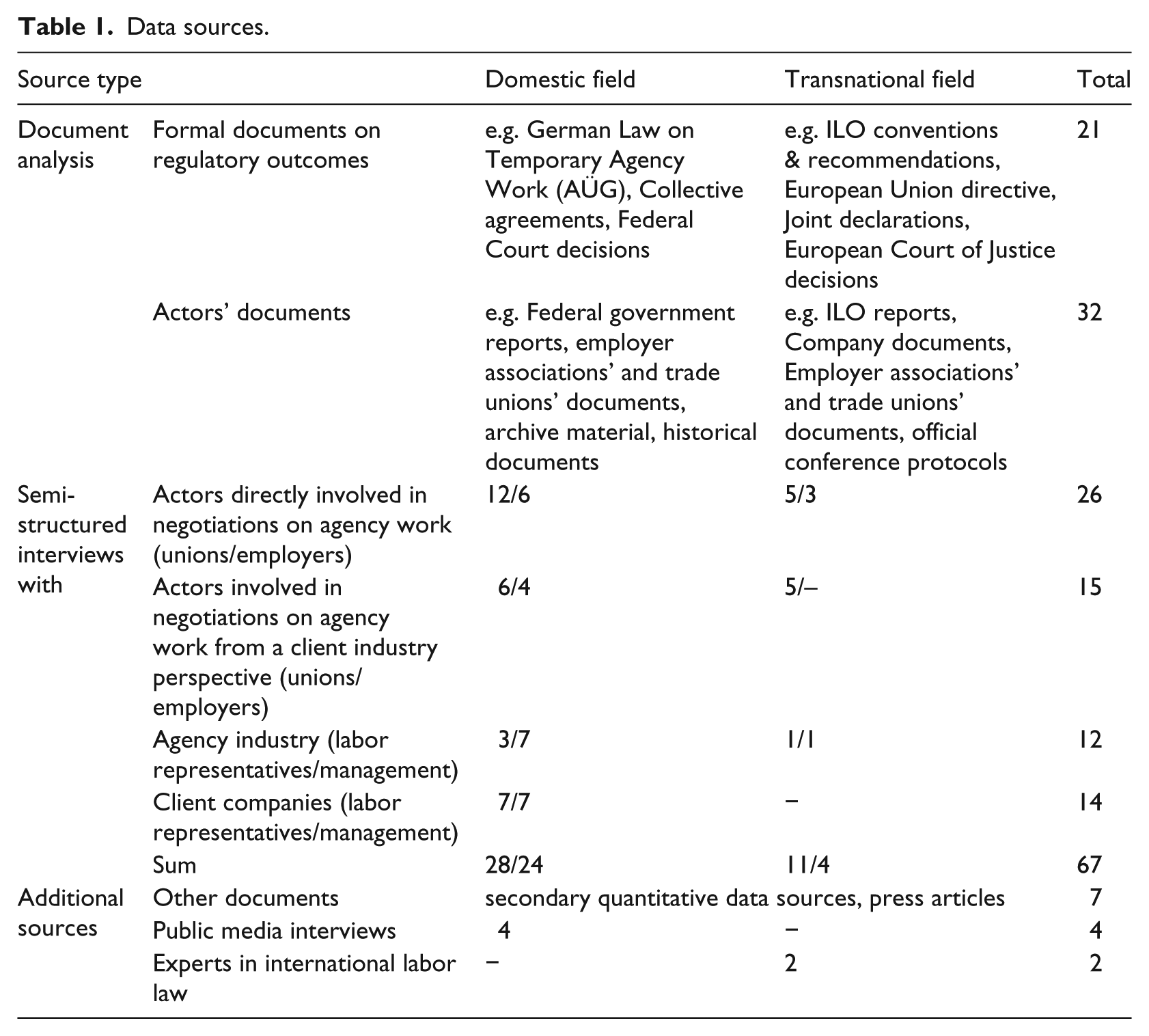
In order to obtain a more complete picture of the nature of boundary work, 67 self-conducted interviews were used with labor (39) and business representatives (28) from the domestic and the transnational field, stemming from two related research projects between 2009 and 2013. All respondents have privileged insight into the field of agency work from various points of view (client firms, agencies, employer associations, worker representatives). Due to their executive management functions and responsibilities as CEOs, employer associations’ and union officials, HR managers or works council heads, many act as boundary spanners, negotiating and coordinating between labor, business and state agencies (Perry & Angle, 1979); and a dozen had been personally involved in key events between 1997 and 2004. Although all these interviews contain retrospective reflections on the field’s historical development to varying degrees, they give a more detailed picture of the boundary work at the time they were conducted. The interviews were on average 40 to 50 minutes long, the shortest under 30, the longest about 80 minutes. The interviews were conducted by one or two researchers, 35 being face-to-face and the rest by telephone. With three exceptions, the interviews could be audio-taped and were transcribed.
Domestic field
For the German field, secondary documents were screened such as studies on the industry’s development, law texts, court decisions, collective agreements, campaign websites, company documents, archive material from the German trade union federation, unions’ and employers’ policy statements, the Federal government’s reports on agency work, and press releases as well as four interviews given by association representatives and politicians in the media. Of the 52 interviews with actors in the German field, 18 interviews were carried out with unions and employer associations directly involved in negotiations about agency work, 10 with unions and employer associations engaged with agency work from a client industry perspective, and 14 interviews with managers and labor representatives from client companies, as well as 10 with management and the workers’ representatives from agencies. Of these interviews, the 28 interviews with the unions and employer associations for both the agency work industry and the client industry qualify as core interviews with key informants, because these respondents engage the most in the politics of boundary work.
Transnational field
For the transnational field, i.e. the European Union (EU) and the ILO, ILO documents were collected (conventions, recommendations, reports and official session protocols) as well as EU-related documents (European Court decisions, research reports on the Social Dialogue), annual reports of the three largest MNCs in the fields, press statements, and policy documents from union federations and the agency associations. Of the 15 interviews two were conducted with a European multinational’s management and the respective worker representation, three with representatives of international employer associations, and 10 with representatives of union federations, of which five were involved directly in transnational negotiations on agency work. In addition, two experts shared their insight who are familiar with the regulatory debate in the transnational field.
Analytic process
For data analysis, thematic coding (Flick, 2006) was applied and carried out in the following steps:
The secondary material was used to identify the fields’ boundaries along the ideas of Fligstein and McAdam (2011). In that process, detailed narrative of about 50 pages was written in order to identify the basic actor constellation of incumbents, challengers and field-governing units based on legislation, collective agreements and court decisions. This analytic step reveals that both fields share a similar actor constellation, in which client corporations, agencies and employer associations representing the view of private business compete with labor representatives such as unions or works councils to influence national lawmaking and international standard-setting.
Then, in an iterative process, two chronological timelines of key events were scaled to help describe the evolution of regulating agency work for both the German and the transnational fields. Here, the interviews were consulted to validate the selection of critical events from secondary documents. Comparing both timelines shows where developments in the two fields run parallel or diverge in sequence, thereby identifying those episodes in which boundary work across fields played a role. Four phases can be identified in the domestic field’s evolution: (a) a period of formation and consolidation of a post-war settlement (1949–66); (b) a period of building up pressure (1967–96) ending with the German union federation’s abandonment of its demand to prohibit agency work in 1996 (DGB, 1996b); (c) a period of power reversal between incumbents and challengers (1997–2004) ending with employment agencies’ full legalization through the Hartz laws; and (d) a period of agency work’s contested legalization lasting up until today. The transnational arena shows a similar periodization with only one notable exception, i.e. the power reversal had already happened between 1990 and 1997 and ended with agencies winning support for their business model through the ILO convention 181.
To systematically filter out the practices of boundary work within and across fields in the various periods, coding started with the secondary data sources first, moving on to the domestic field’s core interviews and from there to the transnational-level interviews. During data coding, a selection of literature was screened to derive a range of meaningful labels. For that, contributions dealing with social boundaries more generally (Abbott, 1995; Fligstein & McAdam, 2011; Tilly, 2004) were used as well as applications of the notion of boundary work to other organizational fields (Gawer & Phillips, 2013; Gieryn, 1983; Llewellyn, 1998; Santos & Eisenhardt, 2009; Zietsma & Lawrence, 2010), and studies examining labor-related fields (e.g. Gray & Kish-Gephardt, 2013; van Gestel & Hillebrand, 2011). In parallel, publicly available reports of expert groups were scrutinized that had been compiled in advance of major regulatory events (e.g. Ciett, 2000) to get a sense of the repertoire of boundary work available to the other domestic field’s actors. By iterating between the empirical material and theoretically guided labeling, 20 first-order codes were identified for describing the practices of boundary work observed (see Figure 3).
Classifying the repertoire of boundary work observed in each period and field was done by compiling iteratively seven second-order themes, whose occurrence was then checked for the identified periods. First, I examined how incumbents and challengers worked on the boundaries within the domestic field, then, how they engaged with each other in the transnational field, also checking for overlapping information across the fields (Blanpain, 1999; ILO, 1997c). Through this step, it has been distilled how the politics of boundary work influenced the regulatory outcome in the agency work field in Germany.

Data structure.
Findings
First, I describe the overall repertoire of boundary work encountered in the field of agency work. I start with incumbents, i.e. the coalition(s) establishing and maintaining the field’s settlement, and then move on to the repertoire of the challengers (see Appendix B for illustrative quotes). Second, I discuss the interplay of these practices over time in order to specify the implications for institutional dynamics more generally. For that, four hypotheses are derived about how the politics of boundary work within and across fields contribute to overturning a field’s settlement. Due to space considerations, I concentrate on the findings for the time period between 1949 and 2004, during which agencies finally succeeded in overturning the post-war settlement; in the concluding section developments after 2004 are briefly discussed.
Incumbents activating, upholding and reinforcing boundaries
Incumbents in the agency work field engaged in three types of boundary work in order to maintain the field’s settlement: activating boundaries, upholding boundaries and reinforcing boundaries ideologically.
Activating boundaries
Incumbents activated a field’s boundaries by three major practices: they reached out to sub-fields to enforce and to broaden the scope of a field’s settlement, they excluded challengers or they exploited division among them. A good example of reaching out to sub-fields is found during the post-war period when the incumbent coalition was very broad, as it included almost all the major political parties in the German parliament of that time, the DGB unions (Vitols, 2004) and the German employer association (BDA, 1952). In 1952, this coalition formed the Bundesanstalt für Arbeit, the federal labor agency responsible for unemployment insurance and public job placement, operating a nationwide network of local agencies. Similarly, during power reversal the new incumbents coupled the deregulation of agency work, again with changes in unemployment benefits and social assistance establishing a workfare order in labor market regulation (Bundesregierung, 2005). Thereby, agency work was legalized in a way that contributed to the creation of a low-wage sector in Germany (Bosch & Weinkopf, 2007; Henkel, 2014; Hundt, 2010).
Excluding outsiders is also observed best in the post-World War II period, when private fee-charging employment agencies were simply prohibited in Germany until 1967 (Schüren, 2012). Beyond that, the Bundesanstalt’s public monopoly remained unchanged between 1952 and 1996, keeping private employment agencies at bay. Exploiting divisions among challengers is observed, for example, when the coalition taking over in power reversal was able to provoke a split between the (new) challengers, formerly part of the dominant coalition, by opening up parallel and informal meetings at which the new legislation was debated without public scrutiny (Hassel & Schiller, 2010).
Upholding boundaries
Confronted by an enduring challenge, incumbents weakened instead of intensified field governance in order to uphold the field’s boundaries by tolerating exceptions and niches within the field, and co-opting and compromising with challengers. One example of tolerating exceptions as a means to accommodate challengers was the Temporary Work Act (AÜG) in 1972, whose enactment was forced upon an unwilling incumbent coalition through a Federal Court of Justice’s decision in 1967. It exempted temporary work agencies from the prohibition on private job placement (Bundesverfassungsgericht, 1967). The law allowed agency work in principle, but the incumbent coalition upheld the field’s boundaries by placing heavy restrictions on the industry. In particular, the law shifted the legal responsibility for an agency’s misconduct onto the client firm, and prohibited synchronization between agency-worker contracts and client assignments (Schiek, 2004; Schüren, 2012). Several instances of incumbents accommodating challengers by co-optation and compromise can be observed during the power reversal between 1997 and 2004. By far the most important example is the exemption clause stating that equal pay and equal treatment could be derogated by a joint agreement (Deutscher Bundestag, 2002, 2011). This forced unions to engage in collective bargaining about sectoral-level agreements with agencies (Bundesverband Zeitarbeit & DGB Tarifgemeinschaft, 2003; Wiedemuth & Dombre, 2008), although these very negotiations compromised the unions’ critique of agency work.
Reinforcing boundaries ideologically
Incumbents also reinforced boundaries by engaging in legitimation struggles with challengers, either through delegitimizing the challenge(r) or through justifying the incumbents’ position ideologically. In the post-war period, alluding to the history of agency work before 1945 was sufficient to delegitimize private employment agencies (Bundes-regierung, 1974; DGB, 1981). In the first decades of the 20th century agency work (“Arbeitsnachweise”) was used by employers in industrial disputes to blacklist union members, organizing lock-outs and “Streikarbeit”, i.e. the deployment of non-union strike-breakers (Kessler, 1907; Tänzler, 1929; VDA, 1917). Justifying the incumbents’ position took place when the new incumbents exploited the scandal of public job placements in 2002 to enact a whole series of regulatory acts that finalized the power reversal in the field. The scandal exposed the inability to organize job placements through the Bundesanstalt in the midst of high unemployment (Hassel & Schiller, 2010; Schmid, 2003).
Incumbents protecting external boundaries
As far as incumbents engaged in protecting the field’s external boundaries, in the field of agency work, incumbents made use of two practices: reaching out to neighboring fields and reaching out to higher-order fields. A good example of reaching out to neighboring fields is given by the post-war field incumbents’ installing of a tripartite structure in almost all related fields such as labor law, social security, vocational training and employment policy (Paster, 2012). By reaching out to higher-order fields incumbents attempted to ensure that their policy is in line with transnational trends. For example, during negotiations about the EU directive on agency work in 2002 – finally adopted in 2008 (Countouris & Horton, 2009; EU, 2008) – the German government made suggestions in line with the new incumbent coalition’s model of regulation (Ahlberg et al., 2008; Jones, 2002).
Challengers redrawing and blurring boundaries
In the field of agency work challengers engaged in two kinds of boundary work in order to change the field’s settlement from within: challengers attempted to redraw boundaries and to weaken or to blur boundaries symbolically.
Redrawing boundaries from within
Challengers redraw the structural boundaries of a field from within by surviving in a field’s niches, by appropriating organizational vehicles, by exploiting incumbent factions and by opening up (sub)fields. Regarding surviving in a field’s niches, the slow expansion of the agency industry at the field’s margins should be mentioned. Although the first agencies in Germany were founded in the 1960s, they remained of negligible size well into the early 1980s (Büchtemann & Quack, 1990). Challenging groups appropriated organizational vehicles to launch an enduring challenge. In the post-war era, agencies started to form their own business associations as early as 1969 (Unternehmensverband für Zeitarbeit e.V., UZA), further consolidated in 1976 when another business association (Bundesverband für Personalleasing) merged with the UZA to form the new Bundesverband Zeitarbeit e.V. (BZA). Exploiting incumbent factions can be observed during the early stages of power reversal, when private employment agencies were successful in striking pioneering company-level collective agreements with single local unions (Adecco & Tarifgemeinschaft der DGB-Gewerkschaften Niedersachsen, 1999; Randstad, ÖTV, & DAG, 2000), thereby compromising the unions’ resistance to the industry. An example of opening up a sub-field was the agencies’ invention of a public-private partnership model of work as a variant of the tactic “marching separately to the same beat” (for an example, Start Zeitarbeit, Handelsblatt, 1995).
Symbolically weakening/blurring boundaries
Efforts to redraw boundaries are accompanied by practices meant to symbolically weaken or blur the field’s boundaries through lobbying and testing extant law. Apart from agencies’ associations constant demand for deregulation of agency work, the agency industry was successful in advertising its business model with a ‘personal face’ for the labor market inclusion of disadvantaged groups rather than providing client firms with a flexible workforce (Ciett, 2000), symbolized by stereotypical female workers like the short-term office assistant or the event catering hostess (for the US templates, Hatton, 2011). Testing extant law in lawsuits can be regarded as one of the most effective tools for challengers in the field of agency work, as revealed by the many instances in which court decisions triggered fundamental changes in the industry (Bundesverfassungsgericht, 1967, 2004; ECJ 1991, 1997).
Challengers crossing boundaries
For challengers in the field of agency work, the crossing of boundaries in order to change the field’s settlement was decisively important; their repertoire of boundary work across fields consisted of cross-field referencing, building up ties, arena switching, circumventing of formal procedures and invading other fields. Challengers in the domestic field referenced changes in the international regulation of agency work as a justification for change in the domestic field. In Germany, the challengers cited the Netherlands to indicate how agency work could be beneficial for labor market performance during the periods of building up pressure and power reversal (Bundesregierung, 2002; IAB, 1997; see also van Gestel & Hillebrand, 2011). Building up ties is observed when challengers established their own international federation(s). The temporary agency industry formed its international federation of private employment agencies (Ciett) in 1967 with affiliates in various countries (Ciett, 2013a). Arena switching is observed when challengers moved with their ambitions to related fields, where they expected less opposition. In the case of temporary work, this is exemplified by agencies’ coordinated lobbying in the transnational field, which finally led to a breakthrough in getting the ILO convention 181 (details below). Another variety was bypassing formal procedures by using alternative platforms and forums at the transnational level to launch challenges to single countries and international organizations (Blanpain, 1999; Ciett, 2000). Invading other fields was carried out by multinationals when they set up subsidiaries in countries at a time when national regulation had not yet been changed. As early as 1965, Manpower established its first subsidiary in Germany, well before the change in legislation allowing agency work in 1972.
Implications for Institutional Dynamics
Changing a field’s settlement by challengers redrawing boundaries
The most important condition for a challenge to arise is the defeated parties staying in the game in the first place. By enacting the “fragments and elements of alternative systems that represent the legacies of constitutional struggles over order and social movements whose settlements or defeats helped fix the path that triumphed” (Schneiberg, 2007, p. 48), the mere survival of defeated actors already alters a field, as it shows (also to other challengers) that there are niches that are not completely under the control of the incumbent coalition. From there, former incumbents contribute to move a stable field settlement into periods of building up pressure and power reversals when they participate in the organizing of a challenge as they appropriate and enact their repertoire of the politics of boundary work. Certainly, there are additional context conditions contributing to a change in a field’s settlement, for example, economic ideologies, waves of restructuring or substantial problems such as high unemployment (Doellgast & Greer, 2007; Palier & Thelen, 2010). However, these context conditions only become effective inasmuch as (new) challengers enact them by means of successful boundary work like appropriating organizational vehicles or building up ties with the transnational field.
In the field of agency work, during the post-war period and during the building up of pressure, work agencies had to stay in the game in a rather hostile regulatory environment. Agencies, for their part, also had to appropriate organizational vehicles by setting up their own associations apart from existing business associations; they had to legitimize their challenge symbolically and lobby the legislator. In this, the agency industry primarily moved from presenting agency work as an instrument of flexibilization to depicting it as a solution to integrate excluded groups without negative effects for other groups in the labor market. In parallel, the agency industry also blurred the symbolic boundaries around its business model, making it ‘opaque’ (Briscoe & Murphy, 2012) and difficult to attack as its appearance oscillated virtually between public-private employment agencies, private job placement, agency work and mere subcontracting. From these considerations I conclude:
A field’s settlement is more likely to be overturned if former incumbents stay in the game and learn how to adapt their boundary work to the new role as a challenger (Proposition 1).
Changing a field’s settlement by challengers crossing boundaries
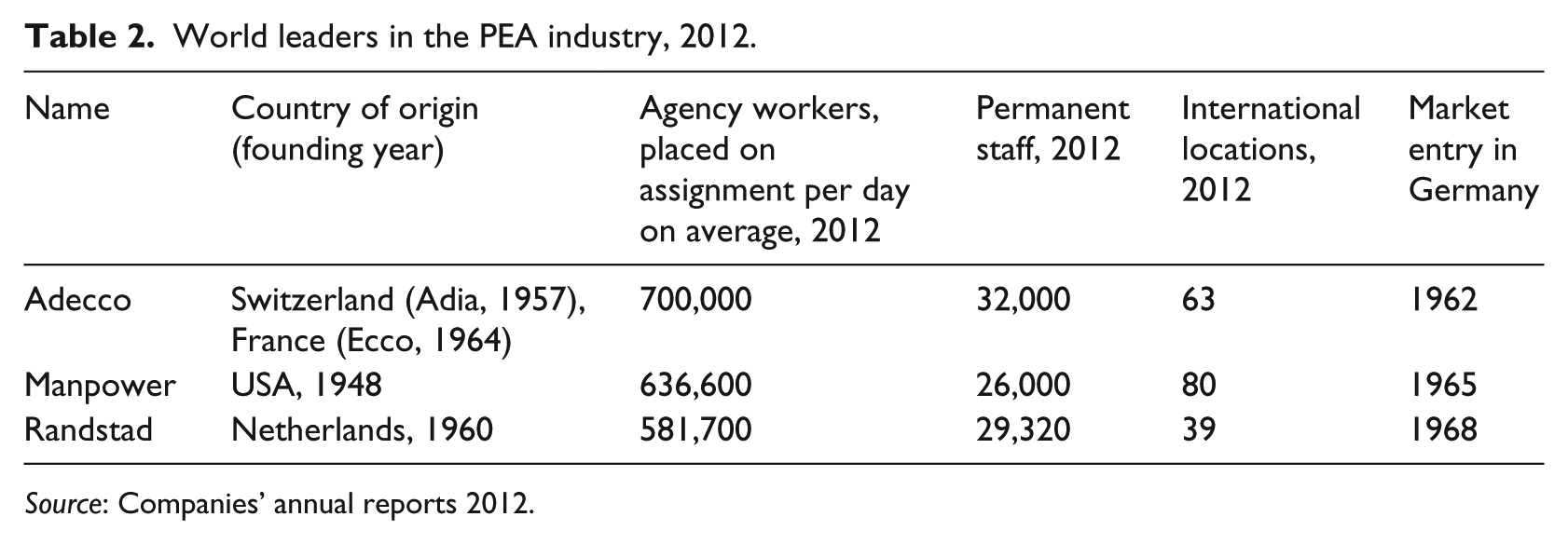
In the long-term struggle over legalizing agency work in Germany, the most important turning points were regularly preceded by successful boundary work across fields by challengers. I found numerous examples of how the agency industry engaged in crossing boundaries to the transnational field (Ciett, 2000, 2012; ILO, 1997c): linking up to the transnational field allowed the infant agency industry to exploit connections to successful pioneers in other domestic fields, above all, to those in the United States (Wenger & Kalleberg, 2006). As Hatton (2011) argues, the seeds of change were planted in the US by a new generation of agencies founded in the late 1940s. These agencies developed early templates for how to justify the business model in a hostile environment, as in the 1940s many US states had strict regulations on agency work (Freeman & Gonos, 2005; Hatton, 2011). Today, one exemplar of this generation, Manpower (founded in 1948), is established among the world’s largest agencies (see Table 2).
World leaders in the PEA industry, 2012.
Source: Companies’ annual reports 2012.
Agencies’ crossing of the boundaries between the domestic and the transnational fields increased the pressure on the post-war settlement from the late 1960s on: the foundation of Ciett in 1967 was triggered by the Swedish government’s request to the ILO to uphold its legacy on private work agencies that year (Vosko, 1997). Before that episode, the agency industry had already established several important bridgeheads in Europe, in countries such as the Netherlands (where Randstad was founded in 1960) and Switzerland (where one of the predecessors of Adecco, i.e. Adia, was founded in 1957), and also in France, the UK and Belgium (Ahlberg et al., 2008). In the German field, the most indicative episode was the Federal Court decision of 1967, in which the German subsidiary of the Swiss company Adia (established in 1962) won a Federal Court decision, which led to the Temporary Agency Work Act (1972). Thereby, an intransigent incumbent coalition was forced to adapt to the challengers’ initiative launched from the outside.
Having already established cross-border ties through informal platforms and debating forums, the agency industry was well prepared to ‘orchestrate’ (Ciett, 2000) its second major cross-border challenge between the early 1990s and 1997 by switching within the transnational arena between the EU and the ILO, first challenging the dominant interpretation of the European law (ECJ, 1991, 1997) and then dominating the policy process around the ILO convention 181 (ILO, 1997c). In this situation, the representatives of the incumbent coalition from Germany had a difficult time making their voice heard in the international regulatory debate (Blanpain, 1999), which had already shifted from the unions’ concerns for workers’ protection to employers’ views favoring labor market flexibility in order to restore manufacturing firms’ competitiveness. In addition, the unions’ repertoire of acting across fields was much less developed and relied on the formal procedures of international labor diplomacy at the ILO and within the EU (Ahlberg et al., 2008; EuroFound, 2006; Håkansson et al., 2009; Vosko, 2010). Those representing the (still) challenging group within Germany could stage their views prominently, like, for example, the HR director of Volkswagen and later head of the reform commission, who had already been a member of the advisory board of Ciett’s project for promoting the industry (Ciett 2000). From this I conclude:
A field’s settlement is more likely to be overturned if challengers are capable of engaging in boundary work across fields over a long period of time (Proposition 2).
Change in a field’s settlement through tensions in incumbents’ internal boundary work
From an incumbent’s perspective, there is a trade-off between activating and reinforcing internal boundaries and the upholding of a field’s boundaries by accommodation and compromise. Whereas in the consolidation of the post-war settlement (1949–66) incumbents predominantly engaged in intensifying field governance up to the point of excluding agency work altogether, they could only stabilize the field’s settlement by accommodating the agencies’ challenge (e.g. the Temporary Agency Work Act, 1972) in the period of building up pressure. Each compromise, however, had repercussions in that it moved the field’s original settlement gradually towards further compromises, exceptions and deregulation (Sengenberger, 1984; Vitols, 2004). Combined with the erosion of the post-war coalition, these exceptions allowed the agency industry to extend its market niche slowly (Bellmann, 2004). In that process, incumbents’ practices began to contradict each other. For example, parallel to increasing unemployment rates in the 1990s and the Federal Court decision of 1994 allowing private job placements, the agency industry invented a public-private partnership model that signaled to unions that agency work would function as a complement to public labor market policy, and that the unions would be included in managing this instrument (DGB, 1996a). In parallel, negative attitudes towards agency work were softening among unions as the agencies signaled a policy to avoid replacing strikers (Bronstein, 1991). In the end, the unions were open to a compromise in order to sustain their overall position within the field. The German unions changed their long-held demand for abolishing agency work in principle (DGB, 1996a, 1996b, 1996c; Wölfle, 2008) and suggested facilitating the legalization of agency work (DGB, 1996a); mere ideological reinforcement of an industry ban (as in DGB, 1981) became contradictory to a compromising practice:
A field’s settlement is more likely to be overturned if incumbent (coalitions) use practices of boundary work within a field that become contradictory over time (Proposition 3).
Change in a field’s settlement through tensions between upholding and protecting boundaries
Protecting external boundaries can also become contradictory to upholding a field’s settlement from within; for example, when incumbents reach out to the transnational field for justification (as with the post-war incumbents’ upholding of the ILO legacy) and are then confronted with the necessity to accommodate challengers who can refer to changes in the transnational field. This holds in particular if the field of reference’s settlement is weakly enforced, as is exemplified by the ILO, which is intellectually and normatively influential, but lacks authority in enforcing its conventions (Rodgers et al., 2009). For example, the early conventions banning agency work were only ratified by 11 (Conv. 34) and 42 (Conv. 96) member states, respectively (ILO, 2009; Vosko, 1997). Given an already weakened incumbent coalition, the German unions’ decision to abandon the demand to prohibit agency work – according to a labor market policy officer involved in representing the DGB in the debates around the ILO convention 181 – anticipated a power reversal in the transnational field, not least because of the European Court decisions liberalizing private employment agencies (ECJ, 1991, 1997). However, as documented in the ILO protocols of that session, initially the German union representatives were among those resisting the new convention (ILO, 1997c). This episode reveals how the upholding of the field’s boundaries in the German field ran into contradiction with a weak performance of incumbents to protect the external boundaries within the transnational arena:
A field’s settlement is more likely to be overturned if incumbent (coalitions) use practices of boundary work within a field that contradict their practices of boundary work across field(s) over time, and vice versa (Proposition 4).
Discussion
The preceding analysis gives an answer to the question about how agency work was constructed as an institutionalized exemplar of precarious work by explaining the legalization of agency work in Germany as a regulatory change, which was brought about by the politics of boundary work. The politics of boundary work come into this inasmuch as a field’s regulatory settlement is upheld through conflict at its boundaries. In the case of agency work, private agencies overturned the German field’s settlement (1) by launching a sustained challenge that involved crossing the field’s national boundaries and (2) by benefiting from incumbents’ weakness caused by contradictions between activating and reinforcing the agency field’s internal boundaries, as well as protecting its external boundaries, on the one hand, and upholding these boundaries internally through co-optation and compromise, on the other.
Albeit being fully aware of the limitations of the preceding analysis of one particular field marked by political division about what is appropriate organizational practice along the capital-labor antinomy, theorizing from the field of agency work allows us to conclude that regulatory change depends on incumbents’ and challengers’ use of their respective repertoire of boundary work to either maintain or overturn a field’s settlement over time. Incumbents activate a field’s boundaries by reaching out to sub-fields, exclude or exploit divisions among challengers, and reinforce boundaries ideologically in legitimation contests with challengers by justifying their incumbent position as well as delegitimizing the challengers. Across fields, incumbents attempt to protect the field’s external boundaries in order to shield it from outside influence by reaching out to neighboring as well as higher-order fields like the transnational field. Challengers, for their part, (1) redraw a field’s boundaries from within by surviving in a field’s niches and appropriating organizational vehicles for collective mobilization, (2) cross boundaries, and (3) symbolically weaken a field’s boundaries (see Figure 4).

The politics of boundary work.
Having explored the practice repertoire in the politics of boundary work within and across fields from a long-term perspective, these findings extend both the strategic action field approach and the theory of institutional work. First, it has been clarified how power reversal between incumbents and challengers is brought about by institutional work at a field’s boundaries. Second, the study reveals that if challengers reflect on inter-field relations, they may appropriately time and sequence boundary work within and across fields. In particular, boundary work across fields precedes those events in which power reversal is brought about in a domestic field, making the challengers’ crossing of a field’s boundaries a kind of tipping point for regulatory change. In other words, boundary work precedes practice work (cf. Zietsma & Lawrence, 2010) by preparing the ground for substantive challenges, in that it opens up a space and redefines the scope for other forms of institutional work.
To illuminate the potentials and limitations of this perspective, two aspects for further theoretical debate and empirical examination are sketched briefly. First, I discuss the perspective’s value for understanding change in organizational fields when this change is non-extinctive in nature, i.e. incumbents lose and challengers win in one period, but both stay in the game permanently because neither side can win completely in the long run. Second, I sketch the perspective’s potential for the debate on how organizations categorize work and workers, opening up a wide area for further research on how societal and organizational change processes are intermediated in the (micro-)politics of boundary work.
The politics of boundary work and non-extinctive change in organizational fields
According to the preceding analysis, incumbent coalitions dominating even the most stable of fields cannot preserve a given settlement for ever. The rules working in favor of the incumbents at one point in time might culminate in their reversal when former challengers take precedence, and vice versa. One important source for such a power reversal is that collective actors might lose one battle but are rarely defeated entirely, so they have the chance to learn from their defeats and find ways – including via the transnational field – to return as successful challengers in later periods (Thelen, 2009). Likewise, the politics of boundary work illuminate how even incumbent coalitions that appear powerful and encompassing in the short and medium term are not capable of preserving a settlement in the long run, because they lose control over the definition of the combat arena, in particular when they are not capable of protecting the field’s external boundaries.
In other words, the politics of boundary work are likely to be more important for institutional dynamics when the process under study is non-extinctive in nature, as the conflicting institutional logics are so deeply embedded that conflict builds up over and over again, albeit with changing actor constellations. This holds true in particular for those organizational fields that group around institutions that decommodify the fictitious commodities of labor, money and natural resources (Kalleberg, 2009; Polanyi, 2001; Streeck, 2009), as institutional dynamics around these – like geophysical plate tectonics – unfold over rather long time periods (Kieser, 1994; Thelen, 2009). However, societal as opposed to geophysical plate tectonics bear the potential to shake up a field’s settlement only as far as the defeated parties are capable of connecting to past legacies and other fields.
It is fair to state that the repeated game situation of non-extinctive institutional change is not well understood in organization theory, because studies focus overwhelmingly on field dynamics in an internally driven equilibrium framework of continuous institutionalization (for exceptions, see Davis & McAdam, 2000; Kieser, 1994; Meyer et al., 2005; Schneiberg & Soule, 2005). This also points to the limitations of this paper. As an analysis of one particular field, the preceding discussion cannot establish the conditions and mechanisms of non-extinctive institutional dynamics completely. For example, what are the identifying properties of non-extinctive institutional dynamics apart from mere survival of defeated collective actors? And how can non-extinctive institutional dynamics be separated from other dynamics like institutional entropy or cycles of continuous institutionalization? Likewise, it remains unclear whether boundary work is played out differently in fields that follow other patterns of institutional change. A few important expectations can be expressed, however. Above all, non-extinctive institutional dynamics are expected to occur when there is a long-term mutual interdependence of a field’s actors and deeply rooted political division between opposing societal logics touching upon social identity and material interest at the same time.
Despite the shortcomings, however, it is suggested that the politics of boundary work can be used as one approach to tackling non-extinctive institutional change by examining more closely when and how institutional dynamics are modulated by continuous controversy enduring over long periods rather than being caused by short-term upheavals (cf. Fligstein & McAdam, 2012). Although the events after the 2004 legalization of agency work require an analysis of their own, they also point in that direction as agency work has remained a controversial issue in Germany (Promberger, 2012). The “new kings”, i.e. the coalition between the agency industry, business leaders, political parties and their allies in the unions, taking over the field in the early 2000s, came under pressure very soon. Not only did the new incumbents have to face immediate mass protests on the streets (“Montagsdemos”, Indymedia, 2004), the pressure also spilled over into the field of electoral politics, where the power constellations changed in the federal elections of 2005 (Dressler, 2012; Müntefering, 2012). In public campaigns, the unions frequently bring to attention the unequal treatment in major client companies, severe rule violations by single agencies, and loopholes in the law (IG Metall, 2012; ver.di, 2011a); as one reaction, a collective minimum wage contract was put into effect by the federal government (BDA, 2010). Also, the unions realized that agency workers can be organized around client companies, i.e. crossing the boundary to the neighboring field (Benassi & Dorigatti, 2014). In 2011 the unions won a change of law that restricted in-house contracting, i.e. large corporations replacing regular workers by engaging agency workers via their own subsidiaries (ver.di, 2011b); and in 2013, in a couple of client industries’ collective agreements, agency workers’ standards were raised through industry-specific wage add-ons (BAP & IGZ, 2013; IG Metall, 2012). Last but not least, the new challengers cross the field’s boundaries by referencing extreme exploitation of agency workers abroad and by rebuilding transnational ties in the issue field of contract labor (Ciett, 2013b; ILO, 2006;). However, still being very new, the transnational (re)positioning of organized labor is hampered in the field of agency work. This is due to a disagreement between those unions trying to establish social dialogue with the industry, i.e. mostly around UNI, the global union federation for private services (Ciett Corporate Members Committee & UNI, 2008; ETUC, 2009; EuroCiett & Uni-Europa, 2007; UNI, 2009), and those unions that still want to reduce the scope of the agency industry as far as possible, i.e. union federations representing workers in the client industries such as IndustriAll, the global federation of manufacturing unions (CGU, 2010; IndustriAll, 2012).
The (micro-)politics of boundary work and the categorization of work(ers)
As field boundaries constitute organizations’ social environment, work on field-level boundaries is linked to the (micro-)politics shaping organizational boundaries. Hence, a study on legalizing agency work at the field level also informs about the construction of distinctions between groups of workers within organizations (Lawrence, Leca, & Zilber, 2013) through the micro-politics of boundary work. Within organizations, categorizing work is enacted in encounters between individuals belonging to different social groups with repercussions for work organization and distribution among these groups (Håkansson & Isidorsson, 2012). Being an agency worker means, first and foremost, being placed in an outsider’s role not easy to overcome, given permanent coworkers’ need for distinction (George, 2003; Purcell, Brook, & Lucas, 2011). As Gray and Kish-Gephart (2013) have argued, in organizations various practices perpetuate these work-related boundaries, thereby imposing a stratification of organizational members into roles and status positions. These categorizations, then, might even appear as objectified organizational practices enshrined in the “routines, policies, and practices that organizations employ to recruit, evaluate, hire, and retain employees” (Stainback, Tomaskovic-Devey, & Skaggs, 2010, p. 230) and legitimized through symbols, rituals and myths obscuring the boundaries’ ideological origin (Bendix, 2001 [1956]). Even more, organizational incumbents, most frequently management, might reach out to the regulatory field to bring about regulatory change in support of their categorizations of workers.
Based on the preceding analysis, it is suggested to include “collective class work” (Gray & Kish-Gephart, 2013, p. 675) from a worker’s perspective more explicitly into the theoretical debate on how boundaries around work are drawn. With respect to categorizing work from a worker’s perspective, collective action becomes a true game changer, in that organized workers can not only issue counter-narratives from below, but also resist management (Spicer & Böhm, 2007) by challenging the employers’ “divide and conquer” strategizing (Kieser, 1994, p. 614). Thereby, workers appropriate the organizational vehicles necessary to alter organizations’ practices and to install the institutionalized safeguards of labor law and industrial relations, which force both actor groups, i.e. employers and organized labor, to negotiate over the categorization of work (e.g. Helfen & Sydow, 2013).
In this sense, it is also fruitful to contrast the legalizing of agency work with studies on the de-institutionalization of permanent employment (Bidwell, 2013; Ahmadjian & Robinson, 2001). The legalizing of agency work certainly intervenes in this de-institutionalization by weakening institutional safeguards supportive of the long-term employment relationship and giving employers a “weapon” to avoid unions (DGB, 2009; Hatton, 2014). And where institutionalized labor relations erode through the introduction of (new) organizational practices to hire labor – as has been expected for Germany (Palier & Thelen, 2010; Streeck, 2009) – future struggles might resemble the labor disputes of an earlier, pre-institutionalization era. However, as long as institutionalized safeguards are not eradicated completely, they might also be deployed by workers to mobilize collectively in order to challenge work categorizations (Heery, 2009; Wills, 2009).
Conclusion
This study on legalizing agency work might inform current debates in organizational theory on institutional complexity (e.g. Delbridge & Edwards, 2013; Greenwood et al., 2011), as well as research on the long-term institutional dynamics caused by collective action (Hargrave & Van de Ven, 2006; Seo & Creed, 2002). However, there are considerable blank areas remaining for further debate and for theoretical as well as empirical clarification of the politics of boundary work. A few of the issues not tackled here due to theoretical selectivity, space considerations or lack of adequate data should be mentioned briefly. First, the politics of boundary work can also come into play in other fields such as financial markets, natural resources, new technology, the judicial system, foreign policy and academia; however, each field is likely to reveal its own peculiarities in the politics of boundary work. Different kinds of boundary work are likely to be found when fields enter into new relations, extant fields merge into one, a field withers away or actors completely new to a field become involved through exogenous shocks or political construction. Second, the politics of boundary work are more visible in legalization contests around controversial practices (Briscoe & Murphy, 2012), as these rarely become completely institutionalized as universally legitimized practices. Nevertheless, the institutionalization of more easily accepted practices could also have been influenced by boundary work, albeit by more subtle cultural forms (Lamont, Beljean, & Clair, 2014). Third, gaps remain regarding the scope and timing of boundary work, as well as the limits and intensity of boundary enforcement, depending on the power modes under which the production of order is organized (Lawrence et al., 2001). This also includes several open questions supplementary to the perspective taken here. For example, heterogeneity in the camps of challengers and incumbents is an open issue for investigation, as it raises questions on how challengers deal with factions within their own ranks and how incumbents discipline their own camp.
Footnotes
Appendix
Exemplary quotes.

| Post-war settlement (1949–1966) | |
|---|---|
| Incumbents’ boundary work | |
| Activating boundaries | Reaching out to sub-fields. “Parliament has committed itself to so-called ‘tripartism’ in all organs of the Federal Agency [for public job placement and unemployment insurance], including the governing bodies of state-level and municipality agencies. These organs consist of an equal number of representatives from employers, workers and public.” (BDA, 1952, p. 166, author’s translation) |
| Reinforcing boundaries ideologically | Delegitimizing challenge(r). “People recall[ed] the dire years of the 1880s, the 1910s and the 1930s, with millions and millions of people out of work and without a decent unemployment benefit. In those decades it was a shocking experience that intermediary agencies tried to make a profit out of the misery by selling the very rare job to the unemployed”. (Blanpain, 1999, p. 9) |
| “The accusation that the employers’ private job placement agencies (‘Arbeitsnachweise’) are a weapon to suppress the working class is not justified, although it has been and still is made. … It is the ever increasing power of the unions … that forces employers to organize in strong associations; and in this sense, the private employment agencies are only a defensive instrument for the employers. In times of industrial dispute these agencies should allow control of striking and locked-out workers. … these agencies should also try to supply the firms under strike with replacement workers for those on strike.” (VDA, 1917, p. 9, author’s translation) | |
| Protecting external boundaries | Reaching out to higher-order fields. “The General Conference recommends that each Member of the ILO take measures to prohibit the establishment of employment agencies which charge fees or which carry on their business for profit. Where such agencies already exist, it is further recommended that they be permitted to operate only under Government licenses, and that all practicable measures be taken to abolish such agencies as soon as possible.” (ILO, 1919b) |
| “Well, you know after the Second World War most countries, most governments were willing to control and to monitor recruitment activities and to actually give a monopoly to public employment services. Therefore they decided in most countries to ban or not to allow private employment agencies to operate. And that’s why the convention 96 was adopted.” (Interview, international association 2, 2010) | |
| Challengers’ boundary work | |
| Redrawing boundaries | Surviving in a field’s niche. “We have actually a very long history. Of course, in the US we started to operate in the 1940s but in some European countries our industry was only allowed to operate in the 1990s or even the year 2000s.” (Interview, international association 2, 2010) |
| “In Germany, we have always been a very strictly regulated industry … We had to be freed through political decisions. … It started with private job placements – which is the other side of the same coin so to speak … where for decades, actually since the 1920s, they had the monopoly of the Reichsanstalt and later the Federal Agency for Labor.” (Interview, agency association 1, 2009, author’s translation) | |
| “Due to the peculiarities of temporary agency work, contracts are not an appropriate device for circumventing public job placement to any great degree. Obviously, the economic space within which agency work could replace the function of public job placement is very limited; it is only economically reasonable when an enterprise cannot go on with its own workforce, i.e. in cases of absenteeism … or sudden, but pressing increases in the work load. For the expectation that agency workers, at the same time, are engaged for longer time periods with clients, continue to be in a legal relationship with the employing agency, and are not subordinated to the supervising authority of the client enterprise where they work, there is no grounding in normal business life experience.” (Bundesverfassungsgericht, 1967, No. 23, author’s translation) | |
| Symbolically weaken/blur boundaries | Testing extant law. “1. Temporary agency work contracts according to the law … are rare. Because of their limited usage, these contracts are already insufficient to circumvent the public monopoly in job placement. Apart from that, these contracts are only relevant for temporary help jobs, but not for permanent workforces. 2. Our survey brought no evidence for temporary agency contracts causing exploitation of agency workers or having the potential to do so. It is clear that client firms have to pay more for outside workers than for their own workers, because otherwise the agency could not earn a profit.” (Bundesverfassungsgericht, 1967, general industry federation’s report to the court, author’s translation) |
|
|
|
| Incumbents’ boundary work | |
| Upholding boundaries | Accommodating by tolerating exceptions. “The Temporary Agency Work Act has given private employment agencies (Leiharbeit) a legal framework after the Federal Court of Justice had decided on April 4, 1967 that the ban on temporary work agencies was unconstitutional … The complete liberalization of private employment agencies soon led to considerable misdoing. It is the major concern of the Temporary Agency Work Act (AÜG) to protect the legal and social status of the agency workers, to confront the misdoing effectively, enable economically reasonable forms of temporary agency work, and keep the market for private employment agencies under observation.” (Bundesregierung, 1974, p. 3, author’s translation) |
| Building up pressure (1967–1996) | |
| Reinforcing boundaries ideologically | Justifying incumbents’ position. “A worker’s personality and human dignity must also be honored in the workplace. A worker’s labour power must not be evaluated as a commodity. Temporary agency work must be prohibited.” (DGB, 1981, p. 6, author’s translation). |
| Protecting external boundaries | Reaching out to higher-order fields. “In the 1994 discussion on the PEAs, there was a fairly significant amount of worker members of the committee that were not interested in revising the convention. Basically, they [e.g. the Germans] didn’t want to revise the convention. … [Only] by the end of the discussion at the conference, … they came to accept that.” (Interview, ITUC representative, 2010) |
| “The German Confederation of Trade Unions (DGB) does not believe that authorizing profit-making private employment agencies would make any significant contribution to solving labour market problems.” (ILO, 1997c, p. 4) | |
| Challengers’ boundary work | |
| Redrawing boundaries | Appropriating organizational vehicles. “1987: Foundation of Interessengemeinschaft Nordbayerischer Zeitarbeitunternehmen e.V. (INZ) with over 330 small and medium-sized member firms.” (AMP e.V., 2007) |
| “The Bundesverband Personalvermittlung e.V. was founded on March 3, 1994 by firms that have been successful in the business of personnel services and temporary work for a long time. The association’s founding had become possible because the legislator had allowed commercial job placement services … ending over 50 years of the Federal Agency for Labor’s public monopoly regarding job placement.” (Bundesverband Personalvermittlung e.V., 2008, author’s translation) | |
| Opening up (sub-)fields. “Well, the business area of personnel service firms … is very, very diverse. Job placement services, private employment agencies, various mixed business models, sub-contracting all exist side by side in that field. From master vendor projects down to pure HR service providers originating from the outsourcing of a client’s personnel departments, e.g. pay administration. Given that range, it is difficult to tell what the typical private employment agency is.” (Interview, agency employer association 2, 2010, author’s translation) | |
| Symbolically weaken/blur boundaries | Testing extant law. “1992 Ciett urged the European Commission to file a complaint against Italy, Spain and Germany after which these countries gradually liberalised their agency work regulations … As an aftermath, several other EU countries legally recognised agency work [Greece, Finland, Sweden, The Netherlands]…” (Ciett, 2013a) |
| Crossing boundaries | Invading. “It has always been a multinational business. As far as you are right, the business is local, and it’s ruled by local national regulations, but the business model is international.”(Interview, multinational agency management, 2010) |
| Arena switching. “1997 Ciett managed to reverse the ILO official position regarding the private employment agency industry: from strict prohibition (Convention no.96) to formal recognition (Convention no.181).” (Ciett, 2013a) | |
| “And even though the convention was there in several countries private employment agencies were actually operating in a gray zone, it was not legal and it was not illegal, it was a bit of a gray zone. And therefore in the middle of the 1990s the ILO decided to re-open the discussion on … private employment services recognizing that there was a need to revise the convention 96.” (Interview, international association 2, 2010) | |
| Referencing across fields. “In the Netherlands, there was this Wassenaar Agreement in the early 1980s and public-private temporary work agencies [like Start, Maatwerk] were also being established there around that time. … And there was a positive development in the Dutch labor market under the Kolk government. … And in 1995 we had the founding of “Start GmbH” in North Rhine-Westphalia as the first form of agency work … that aimed at labor market integration. This was a turning point, as the union federation was directly involved. … And if a large DGB regional section is involved in such a project, you cannot have a policy statement that wants the prohibition of agency work.” (Interview, union3, 2014, author’s translation). | |
| Circumventing formal procedures. “[Private employment agencies] clearly had a lot of influence in this ILO Committee, I mean in the sense that they obviously dealt with the technical person for the committee, who drafted the report that was the basis of the discussion.” (Interview, ITUC representative, 2010) | |
|
|
|
| New incumbents’ boundary work within fields | |
| Activating boundaries | Reaching out to sub-fields. “At the end of 2001, beginning of 2002 a report about faulty job placement statistics in the Federal Agency for Labor was filed to the Federal Ministry of Labour (BRH) from the Federal Court of Auditors. … They immediately informed chancellor’s office took the accusations as perfectly plausible and pushed for quick reforms. … As a reaction to this job placement scandal the federal government announced its two-step plan for customer oriented and competitive labor market services on the 22nd February … First, the Federal Agency lost its capacity to license private job placement services and private placement agencies were allowed to charge fees from job seekers. … The second step … installed the Hartz commission.” (Hassel & Schiller, 2010, pp. 73, 74, author’s translation) |
| “The Federal Government is convinced that temporary agency work goes beyond increasing enterprises’ competitiveness … indeed, and within the framework of socially secured employment relationships, temporary agency work opens up a chance for the unemployed to re-enter the labour market. … For this reason, the law of temporary agency work was made flexible and deregulated considerably.” (Bundesregierung, 2005, p. 8, author’s translation) | |
| Excluding challengers. “Because this working committee (‘reform of unemployment insurance and social assistance’) was a closed circle, the sessions of which were neither documented nor made public, compromises became possible across party affiliations and institutional boundaries. A business foundation provided the (financial) project resources, academic expertise and organized field study trips. The initiative and agenda setting were done by the Federal Ministry of Labour.” (Hassel & Schiller, 2010, p. 64, author’s translation) | |
| Exploiting divisions among challengers. “There are two reasons [for using agency work in client firms]: on the one hand, there is economic pressure to protect core workforces by sub-contracting the ‘non value creating’ activities; and this is also a concern of the unions and the corporate world. On the other hand, there are also simply work assignments that many core workers are not willing to perform.” (Interview, client works council 1, 2012) | |
| Power reversal (1997–2004) | |
| “And these collective agreements with the so-called ‘Christian’ unions have ruined our negotiations with the employers. And employers’ associations seized the opportunity to expose our weakness, limiting our negotiation power vis a-vis the agencies’ associations.” (Interview, union federation 1, 2010, author’s translation) | |
| “The third agencies’ association is a problem for us, that’s true. … They have revived the Christian unions … and signed collective wage agreements that have contributed to our industry’s bad image, because these agreement’s pay levels were systematically lower than ours.” (Interview, agency association 1, 2009, author’s translation) | |
| Reinforcing boundaries ideologically | Justifying incumbents’ position. “Germany represents more than 25 per cent of potential job creation by the private employment agency industry in Europe. However, regulatory constraints keep this potential unfulfilled. Most German private employment agency workers are low-skilled, industrial workers. … Further evolution will require private employment agencies to develop new high value-added services targeted at large companies.” (Ciett, 2000, p. 38) |
| “The German Federal Court of Auditors triggered a textbook wave of scandalization. … Although, as a member of the Hartz Commission, I was not satisfied with the commission’s work in every respect, and definitely not with its implementation bit by bit, without this scandalization they would hardly have progressed one step forward. I don’t regard the Hartz report as a bible, but as a successful and promising plot. That means I see it as a template that politicians and practitioners – like good directors and actors – can change and implement more convincingly than its authors would have imagined.” (Schmid, 2003, p. 291, author’s translation) | |
| “The legislator connects the expectation with the hereby installed, far-reaching reform of private agency work that collective bargaining parties and the enterprises in the temporary agency work industry will develop temporary agency work into a universally accepted business sector of the – by international comparison – highly productive German economy, which will set standards in quality, flexibility and social security …” (Deutscher Bundestag, 2002, p. 24, author’s translation) | |
| “I do not believe that [Chancellor] Schroeder’s reforms would have been possible back then, unless a small group around the BDI and others had pushed him in that direction.” (Public interview, former BDI president, 2014, author’s translation) | |
| Delegitimizing challenge(r). “There is no agency work (‘Leiharbeit’). It is called agency work (‘Leiharbeit’) in law, but we speak of temp(orary) work (‘Zeitarbeit’). Because agency work already sounds negative in wording and we are working with the legislating body to make this word disappear from the law’s text.” (Interview, agency management 3, 2010, author’s translation) | |
| “Against this background, the German Parliament decided on the occasion of passing the third law for modern services in the labor market on the 15th October, 2003 that experiences with the new law of temporary agency work should not be reported together with experiences in fighting illegal and bogus employment.” (Bundesregierung, 2005, p. 4, author’s translation) | |
| Upholding boundaries | Accommodating by co-opting. “Publicly regulated Personnel Service Agencies (“Personalserviceagenturen”) – like temporary work agencies – can only work effectively if the limitations of the Temporary Work Act (AÜG) are got rid of. Therefore, release from these legal restrictions is necessary – under the condition that collective agreements are signed.” (Bundesregierung, 2002, p. 147, author’s translation) |
| “Under the Hartz laws … the Temporary Work Agency Act (AÜG) was crafted so that the whole industry was called upon to make use of this exemption clause and to think about who might be the social partners in concluding collective agreements. Soon, there was conflict about jurisdictions. … What did the DGB unions do? All the unions have come together under the umbrella of their federal association (DGB) to form a joint bargaining commission. And that’s the reason why we have this collective agreement with all the unions … which is unique for German business.” (Interview, agency employer association 3, author’s translation) | |
| New incumbents’ boundary work across fields | |
| Protecting external boundaries | Reaching out to higher-order fields. “Why are we still feeding this holy cow [workers should not be requested to pay for employment placement services]? … So, indeed I think the dictatorial sway of our holy cow can no longer be justified on rational grounds. If the holy cow is not to be slaughtered, it should at least be kept in the zoo.” and “I would go along with [discussant] and say we should slaughter the holy cow: Labour is not a commodity; I don’t know whether this still holds in principle.” (Blanpain, 1999, pp. 9, 11) |
| “Discussant 1 (Belgium): In Germany, you put the risk on the private employment agency. … And you say, you are a temporary worker, but you are going to have an indefinite job with the private employment agency … If I need to organize a reception and I need 50 hosts to receive the guests, what the hell, why should they have a contract for an indefinite period with me? That’s absolutely ridiculous.” Discussant 2 (Germany): “Not with you, but with the agency where you get the people from.” Discussant 1: “That’s what I am saying. Whether the agency should be an employer for someone who is coming to work for half a day. So what we must try to do is to take a fresh look at the problem, to get rid of old ideas.” (Blanpain, 1999, p. 27) | |
| “The EU Commission has officially set up a European social dialogue committee on temporary agency in 2000. UNI-Europa and Eurociett are recognised by the EU Commission as the representative social partners for the temporary agency sector at European level.” (Håkansson et al., 2009, p. 79) | |
| In 2003 the Task Force reviewing the achievement of the European Lisbon Agenda (Kok Report: Jobs, Jobs, Jobs – Creating more employment in Europe) highlighted that “Temporary work agencies should have their place in a modern labour market as new intermediaries that can support flexibility and mobility of firms and workers, while offering security for workers. … Removing obstacles to temporary agency work could significantly support job opportunities and job matching.” (Ciett, 2013) | |
| “Today, temporary agency work takes place … also due to the European Union’s employment strategy, against the background of a new vision …” (Bundesregierung, 2005, p. 8, author’s translation) | |
| “The industry is strongly committed to work hand-in-hand with governments and trade unions to fight abuses and illegal practices arising from untrustworthy, unethical and rogue private employment agencies as all parties have a common interest in doing so.” (BCG & EuroCiett, 2012, p. 13) | |
| After power reversal (2004–) | |
| New challengers’ boundary work within fields | |
| Redrawing boundaries | Surviving in a field’s niche. “There is no social partnership in principle. The first reason is that this needs time to develop. But temporary work agencies are only relevant because of the Hartz reforms. … The second reason is that social partnership affords a certain conviction … I do not see this conviction on the employers’ side. They reject unions, they don’t accept works councils. They just do not want to have all these institutions. … They only need us for their campaigns to promote temporary agencies as a good thing.” (Interview, service union 1, 2010, author’s translation) |
| Symbolically weaken/blur boundaries | Legitimizing challenge in lobbying. “Of course, on our production lines you can observe this very well. There is the large factory building and in it you have five conveyor belts. On every line one out of three workers is an agency worker. They do exactly the same job, there is no difference, they have the same work time, but they only earn half of the normal wage. It’s disgusting. But I must tell you almost all my colleagues and also the permanent workers feel that this is a great injustice.” (Interview, client works council 7, 2012, author’s translation) |
| “That’s true: it is a highly politicized industry. And it will take a very long time for this to change into a more balanced situation. At the moment, the public opinion is still dominated by images like ‘slave labor’ and ‘exploitation’.” (Interview, agency management 4, 2013, author’s translation) | |
| “In addition, one should note that the union strength in industrial disputes is reduced if there is a high proportion of agency workers working in the respective industry. In the case of a strike, it can happen that up to half of the employees continue to work, because they are temp agency workers. This endangers the sound operation of collective bargaining autonomy.” (DGB, 2009, p. 7, author’s translation) | |
| “There is a lot that must be changed … We want … changes in the area of temporary agency work. It cannot stay like it is. We have been cheated by companies that do not pay the same wage for the same work, [and also] by those that subcontract workers by establishing their own work agencies. It’s high time to change that. There must be a minimum wage law …” (Public interview with politician 1, 2012, author’s translation) | |
| Crossing boundaries | Referencing across fields. “In many countries agency work is not controlled sufficiently. Agency workers must pay intermediation fees, don’t get any written contract, clients’ workplaces are not inspected for health and safety problems, state inspections do not occur, in the case of dismissal there are no severance payments. … In addition to that, ‘black sheep’ even go beyond that by engaging in criminal human trafficking in the cross-border posting of workers in countries like Dubai, India, Pakistan. In these cases, agency workers are without official documents, must pay for the arrangement and transport, do not have any days off, etc. etc.”(Interview, global union representative 1, 2010) |
| “We are back to chapter one, paragraph one. The confidence that trade unions accept our existence and accept the fact that we are a worthy contribution to the labor market. As long as they say we are an atypical and precarious form of work, which should be as limited as possible, then we have to work on that discussion first, before we can progress on any other item.” (Interview, international association 2, 2010) | |
Acknowledgements
I am grateful to Kerstin Ahlberg, Chiara Benassi, Ed Cranberry, Olaf Deinert, Dimitris Stevis, Manfred Weiss, Manfred Walser and Ian Greer as well as the anonymous reviewers for their comments on earlier versions of this paper. I thank the convenors and the participants of the subtheme 45 “Pluralism and Patterns in Institutional Trajectories” held at the 29th EGOS Colloquium (July 4–6, 2013), HEC Montréal & Université de Montréal, Canada for helpful comments.
I am also indebted to the Hans-Böckler-Foundation for its generous financial support of the empirical field work on which this paper is based (HBS Grants 2008-141-2; 2011-466-2). Last but not least I thank the people at the DGB archive at FES Bonn and the respondents for sharing valuable insights on the field with me.