







Abstract
In this paper, we illustrate the link between social network structures, dominant cognitive frames on network purpose and the innovative power of a network, through a mixed-method comparative analysis of two knowledge translation networks (KTNs) in the English National Health Service (NHS). Our findings illustrate several challenges for networked forms of organization linked to different manifestations of social networks (centralized/decentralized) and dominant cognitive frames (polarizing/loosely clustered). Our paper contributes a better understanding of how dominant frames on network purpose emerge alongside the development of network structure itself, and explores how this interplay between dominant frames and social networks impacts upon the collaborative work that supports the network’s innovative power.
Keywords
Introduction
Social networks are widely seen as playing a vital role in processes of innovation and change (Castells, 1996; Murray, 2002; Oliver & Liebeskind, 1998; Powell, Koput, & Smith-Doerr, 1996; Swan & Scarbrough, 2005; Yoo, Lyytinen, & Boland, 2009). Networks are especially important in complex arenas such as healthcare, where multiple organizations and professional groups, often with different beliefs, interests and specialist roles, need to work together in order to develop and implement new ideas (Alter & Hage, 1993; Dougherty & Dunne, 2012). Therefore, initiatives aimed at improving innovation through the establishment of new, networked forms of organizing have been abundant, yet with very mixed results in terms of their capacity to produce relevant innovations (Ferlie, Fitzgerald, McGivern, Dopson, & Bennett, 2011; Ferlie, Fitzgerald, Wood, & Hawkins, 2005; Swan, Bresnen, Robertson, Newell, & Dopson, 2010). Much remains to be learned, then, about the ways in which social network dynamics influence a network’s capacity for innovation. In particular, the link between the social structure of a network, how network members frame its activities and the impact this has on the innovative capacity of the network is currently underexplored. This is, in part, because previous research on innovation capacity has treated social structure and cognitive framing in networks as distinct topics.
In one strand of scholarly work, the role of networks in innovation has been explained in terms of their capacity to transfer knowledge across boundaries, for instance among specialist groups (Hansen, 1999; Kijkuit & van den Ende, 2010; Reagans & McEvily, 2003; Tortoriello & Krackhardt, 2010; Tortoriello, Reagans, & McEvily, 2011). This strand emphasizes the structure of social networks and their role as ‘conduits’, or channels, in the sharing and brokering of knowledge across collaborating groups and organizations (Currie & White, 2012; Owen-Smith & Powell, 2004). Here, a network’s ‘innovative power’ – its capacity to generate innovation and change – is seen to stem from the collaboration and knowledge flows among ‘producers’ and ‘consumers’ engendered by the network structure (Owen-Smith & Powell, 2004).
This line of thought is often behind the introduction of many policy-driven networked innovation initiatives (Ferlie & Pettigrew, 1996; McGivern & Dopson, 2010). Networks themselves, however, are viewed as rather passive diffusion channels to be switched (mostly) on. The dynamics of social networks, and the ways in which they come to promote or stifle different kinds of transformation and change remain, in contrast, quite poorly understood. Important to these dynamics are the informal social ties within a network that are seen to engender collaboration across diverse specialist groups. Reflecting this, there is now a significant amount of research that has linked characteristics of these ties (e.g. their density and strength) to the development of collaboration and boundary work required to promote innovation (Borgatti & Cross, 2003; Carlile, 2004; Hansen, 1999; Powell et al., 1996).
Alternatively, reflecting this special issue of Organization Studies, the innovative power of networks can be understood in terms of their transformative force as social actants in shifting flows of power (Clegg, Josserand, Mehra, & Pitsis, 2013). In this view, equally important to the structural aspects of networks are the cognitive frames – or ‘definitions of the situation’ (Goffman, 1974) – that emerge and come to prevail among network members (cf. Baunsgaard & Clegg, 2013). Previous research on innovation, for example, has found that a social structure’s capacity for achieving innovation is dependent on the establishment of shared interpretations across specialist groups (or shared ‘thought worlds’; Carlile, 2004; Dougherty, 1992). Frames matter to a network’s innovative power because cognition and action are closely and reciprocally intertwined as individuals and groups enact their sensemaking and see possibilities for change (Huff, 1990; Goffman, 1974; Weick, 1995). Frames invoke working hypotheses and expectations about what is possible and desirable, the sorts of events that will be encountered, and about how work is to be accomplished (Cornelissen & Werner, 2014). Frames may therefore play an important role in shaping the collaboration between groups that is central to innovation (Dougherty, 1992; Leonardi, 2011).
Understanding the role of frames in networked forms of organizing poses distinct challenges, however. Unlike more traditional organizations, in network settings knowledge is widely distributed (Powell, 1991) and power is established, not through hierarchical means, but through informal positions in the social network (Ibarra, 1993; McGivern & Dopson, 2010). In such settings, diverse interests are ‘at stake’ and frames cannot be so readily asserted, communicated or imposed in a top-down fashion (Beckert, 2010; Hardy, Phillips, & Lawrence, 2003). Very little is known, though, about how frames come to dominate in networked forms of organizing and about how the emergence of dominant frames relates to the structure of informal ties. Still less is known about how cognitive frames and social networks, together, empower (or disempower) a network in its pursuit of innovation.
Previous work that has focused on the cognitive aspects of social networks has examined perceptions of the network structures themselves (in terms of who is connected to whom) and their importance for leadership in the network (Balkundi & Kilduff, 2006). It has not addressed what Ibarra, Kilduff and Tsai (2005) have identified as the myriad of ways in which network structure affects cognition, and cognition affects network structure. Moreover, while it has been noted that the development of shared interpretations is central to innovation (Carlile, 2004), a particular theoretical gap exists in terms of understanding how dominant cognitive frames concerning the network’s ‘purpose’ – that is, around its goals, or mission, and how the work is to be accomplished – are related to the social structure of the network and its capacity for innovation and change.
In this paper, we seek to redress this gap by examining the emergence of dominant cognitive frames on network purpose, alongside the social structure of the network, in order to investigate how these, together, shape a network’s capacity for innovation and change. Thus, we seek to extend understanding of the innovative power of networks by relating the framing of the network’s purpose to the social structure of its relational ties. We do this through a comparative study of two different networks established under the same funded policy initiative in the English National Health Service (NHS). These ‘knowledge translation networks’ (KTNs), as we will call them, help bring to the fore our theoretical concern with the interplay between social network structures, the framing of the network’s purpose and the collaborative work conducted by the network in pursuit of innovation. Our research questions, therefore, are:
How do dominant frames around the perceived purpose of a network relate to the social structure of that network?
How do these dominant frames and social network structures, in combination, have an impact upon the enactment of collaboration and the network’s innovative power?
The remainder of the paper develops as follows: in the next section we provide a theoretical overview of networks and frames; in the third section we outline our methods; we describe our fieldwork in the next section, and then we discuss our findings and highlight our contributions. Finally, the last section draws conclusions, implications, and suggests new avenues of research that stem from our study.
Theoretical Background
Given the scarcity of previous literature linking frames to a network’s innovative power, we need to draw from multiple strands in our review. We begin, then, by turning to broader literature on the role of frames and framing in organization studies in order to arrive at definitions of these constructs appropriate to the scope of our study. We then discuss literature that gives us some insights into the links between frames and social networks and their role in the pursuit of innovation in network settings.
Frames and framing
In a wide-ranging literature review, Cornelissen and Werner (2014) reflect on the individual and social processes of frames and framing. The authors show that the constructs of ‘frame’ and ‘framing’ have been applied to many different phenomena, ranging from individual sensemaking (e.g. Weick, 1995) and strategic and technological framing (Kaplan & Tripsas, 2008) to the shaping of expectations by cultural templates (Cornelissen & Werner, 2014). Although this gives frames/framing greater value as an umbrella construct that is capable of capturing different levels of analysis, it also makes it necessary to differentiate carefully in the use of these terms. Cornelissen and Werner (2014) make a valuable distinction between research traditions at different levels of analysis. At the micro level, frames tend to be viewed in terms of the ‘top-down’ accessing of a cognitively-held knowledge structure, derived from experience, that directs and guides information processing: ‘a frame, abstracted from prior experience, is activated to guide the perception of cues and stimuli in real time’ (Cornelissen & Werner, 2014, p. 187). In contrast, at the meso-level of organizations, frames are more typically viewed in terms of a ‘bottom-up’ process of collectively constructing meaning through social interaction and the use of language, including how language is used symbolically to represent particular meaning constructions (Blumer, 1971; Goffman, 1974). Studies at this level are thus concerned less with internal or taken-for-granted cognitive schemas of individual (frames) and more to do with ‘external, strategic processes of evoking meaning’ (framing) (Cornelissen & Werner, 2014, p. 182). Finally, at the macro-level, institutional or field-level frames tend to be viewed as ‘jointly constructed cultural templates’ (Cornelissen & Werner, 2014, p. 183) that have become naturalized or taken for granted as the basis for behaviour and change within the field.
Connecting these levels, we can see that while individual’s frames, as a set of causal beliefs and categories, are seen to reflect personal biography such as functional experience (Kaplan, 2008), they are also susceptible to more widely shared definitions of the situation arising from the institutional and organizational context (Chreim, 2006). Work on social movements, for example, has emphasized that ‘frames are rarely constructed out of whole cloth; instead, they are fabricated from already available repertoires and cultural artifacts’ (Hargrave & Van de Ven, 2006, p. 870).
Precisely because frames/framing mediate both individual and collective action, they have implications for the power structures of organizations. Where particular frames become dominant they help to advance certain interests and views, while suppressing others (Azad & Faraj, 2011; Baunsgaard & Clegg, 2013). However, as Hargrave and Van de Ven (2006) note, ‘a dominant frame is seldom a consensual frame … Frame settlements are temporary truces to political conflict and struggle among opposing coalitions’ (p. 870). Thus, frames can become, more or less overtly, contested, especially where strategic uncertainty creates incongruence between actors’ frames (Kaplan, 2008). Where particular frames ‘resonate’ and are seen as legitimate by organization members, however, they have a greater chance of prevailing and thereby mobilizing action (Kaplan, 2008).
Given their often taken-for-granted character, this political aspect of frames is not always fully addressed in research. Much of the work on frames and framing has emphasized certain groups, be they the experts designing IT systems (Davidson & Pai, 2004) or the senior managers interpreting the competitive environment (Porac, Thomas, & Baden-Fuller, 1989), exercising a privileged form of agency in shaping interpretations of a particular situation. This emphasis can be critiqued for organizational members not as as active agents but as passive respondents to the frames imposed by senior managers or expert groups.
Frames, networks and innovation
Echoing this emphasis in previous work on the frames of dominant groups, previous research linking frames to an organization’s capacity for innovation and change has focused, at the micro-level, on the strategic frames of senior leaders within particular organizations (Baunsgaard & Clegg, 2013; Hodgkinson, Bown, Maule, Glaister, & Pearman, 1999; Kaplan, 2008; Nadkarni & Narayanan, 2007). Here, senior managers are found to be skilled in framing the strategic objectives and change processes that inform members’ understandings of their role or the organization’s position in its environment (Cornelissen & Werner, 2014). Dominant frames are thus seen as creating a capacity for change (or inertia – see Baunsgaard & Clegg, 2013), be that in relation to organizational change programmes (Chreim, 2006), the implementation of technology (Davidson & Pai, 2004) or knowledge transfer between organizations (Burg, Berends, & Raaij, 2014). This previous work has been conducted, however, almost exclusively within hierarchical organization settings, where senior managers exercise significant position power. There is good reason to believe that framing may be more contested in networked innovation settings, where work and expertise are more horizontally distributed. In such settings, power is based more on informal social, communicative ties and derives from network position not just hierarchical role (Daskalaki, 2010; Hardy et al., 2003; Ibarra, 1993; Jones & Hesterly, 1997; Powell, 1991; Swan & Scarbrough, 2005). Here, diverse interests are ‘at stake’ (Hardy et al., 2003) and frames may not be so readily imposed or asserted. At the same time, however, because network members must engage collaboratively in pursuit of goals, the framing of the overall purpose of the network, and the sharing of that frame among actors that are central to the network structure, is likely to exert an important influence upon the nature of that collaboration and, hence, the network’s innovative power.
In network settings, then, we need to attend to interactions between a network’s informal social structure and the emergence of dominant frames. The basic composition of a social network as encompassing individuals and the social ties that enable interaction between them suggests that frames in this setting might operate at both an individual and a network level. At the individual level, the bottom-up research tradition of Blumer and Goffman focuses on individual interpretations of a situation. However, these individual frames are also the product of framing that involves social interactions and language use (Chreim, 2006). Thus individual- and network-level framing efforts are intertwined (Kaplan, 2008).
It follows that our study of the role of frames in shaping the innovative power of networks needs to encompass both individual actors’ interpretations of a situation, as reflected in their personal causal beliefs, and also the active negotiation of meaning within and between particular groups at the network level (Cornelissen & Werner, 2014). Where hierarchical structures may privilege the framing of groups such as management, the more distributed nature of work and power means that we can make no such assumptions about the frames that emerge as dominant in networked forms of organizing. However, since frames have political implications, and may involve contestation and conflicting interests, the question of dominance and unequal relations remains equally relevant. In network settings, though, unequal relations are reflected not in hierarchy but in the distribution of ties and the centrality of agents, positions which confer significant social influence and greater communicative reach (Ibarra, 1993). The question of the dominance of particular frames within a network thus demands attention to the individual frames of these centrally connected actors and in particular how far understandings are shared between them (i.e. the degree of congruence in their frames; Chreim, 2006; Davidson & Pai, 2004). Frames and framing are closely intertwined as ‘purposeful efforts at framing’ are ‘intimately linked to both an actor’s own sensemaking and that of others’, being ‘part of a broader dynamic of negotiating meaning over time’ (Kaplan, 2008, p. 746). To identify dominant frames, therefore, we need to observe not only the discursive construction of network purpose as presented in formal mission statements and the like, but also how these efforts involve engagement with other actors in the organization. This involves exploring the individual as well as the network level of analysis, as we will do in our fieldwork. Next we briefly outline the particular context of our study.
Context for our study
Policy-makers in the healthcare systems of a number of countries have identified a need to develop new collaborative working practices to facilitate ‘knowledge translation’; that is, the process through which research findings can be applied in medical practice (Denis & Lomas, 2003; McAneney, McCann, Prior, Wilde, & Kee, 2010). One approach which has been widely adopted in the UK’s NHS has sought to promote the development of such practices by using public funding to commission collaborative entities in which academic researchers work closely with other stakeholder groups such as healthcare practitioners, patients, industry and policy representatives (i.e. KTNs). However, recent work shows that establishing new collaborative network forms is not in itself sufficient to establish or sustain these novel practices (Addicott, McGivern, & Ferlie, 2006; Bate & Robert, 2002; Currie & Suhomlinova, 2006). Knowledge translation is a concept which remains open to multiple interpretations (Greenhalgh & Wieringa, 2011), but the change in collaborative practices needed to support improved knowledge flows between research and practice represents a challenge to the institutional order of the NHS which is based on deeply embedded professional role divisions (Battilana, 2011). Professional groups in healthcare setting are actively resistant to the development of new collaborative work practices because they encroach upon established professional domains, and disrupt the status order among these groups (Currie & White, 2012).
These contested and equivocal aspects of the central purpose of KTNs in our study thus suggest that their capacity to promote change might rest not only on their development as network structures, but also on their ability to achieve shared interpretations of their mission across the diverse professional groupings and organizations involved. A major focus of our study, then, is on identifying the frames of network purpose that emerged as dominant within these UK KTNs, and how far the enactment of these frames through collaborative work supported their innovative power. Since the dominance of particular frames is also linked to the network centrality of particular actors, our concern with the sharing of interpretations also demanded close attention to the network structures of each KTN. Below we provide details on our data collection and analysis.
Data Collection and Methods
We adopted a mixed-method research design including the integration of interview narratives, secondary documents, a cognitive mapping exercise, correspondence analysis (CA) and social network analysis. The data collection occurred in the period May 2010 to September 2012.
We began to study dominant frames by conducting 98 open-ended interviews (lasting 1.5 hours on average) with individuals across a range of organizational roles from the two KTNs. To understand the genesis of the KTNs, we also actively recruited decision-makers in each network (some central, some not) and were able to talk with each project team lead at least once. The interviews were analysed with Nvivo.
To understand the framing of network purpose in each KTN, and as per our theoretical position, a mixed-methods approach was deemed appropriate as it would enable us to grasp such framing as encompassing both individual cognitive schemas and the use of language (as expressed discursively, for example, in interviews and relevant documentation).
To address individual schemas on network purpose, we sought to avoid the political sensitivity and conformity risk of an explicit question on each KTN’s goals, which might only have yielded a recounting of formal mission statements. Instead, we assembled a list of cognitive constructs relating to factors conducive to the ‘success’ of networked initiatives. The aim was to elicit individuals’ causal beliefs about what constituted and contributed to success as a proxy for their understanding of each network’s purpose. We began with an open coding technique (Miles & Huberman, 1994) to identify key themes to build the constructs that would form the content of the cognitive mapping and social network analysis. Borrowing from Clarkson and Hodgkinson (2005) and Krippendorff (2004), we followed a series of steps to develop cognitive constructs using interview data and analysis of the original bids. These steps include the identification of codes and relevant constructs (performed by two researchers, independently), and in so doing we follow the process described by Markoczy and Goldberg (1995) and Tyler and Gnyawali (2009) (additional details are provided in Appendix 1).
Next, to aid our investigation of agency in social networks and to explore the interplay between network forms and cognition, we assembled two social network datasets for each KTN: (1) an informal social network (one-mode network); and (2) a network of central actors and cognitive constructs (two-mode). 1 The one-mode dataset captures the distribution of knowledge ties across each KTN and allows for the identification of central actors and for the exploration of network form (see Appendix 2). Our interest in central actors is based on the assumption that, in networked organizations, power/agency at the individual level can be conferred from network position rather than position in the formal organizational hierarchy (Cross, Borgatti & Parker, 2002). Central actors are in this case, individuals perceived by their peers as being most important to the knowledge translation work of the KTN and occupied both formal and informal organizational roles (see Appendix 2). The two-mode dataset illustrates how central actors as individual agents mobilize positions towards or against beliefs about what constitutes the success of networked initiatives, which collectively characterizes the dominant frame for each KTN. These social network and framing characterizations make a combined contribution towards the KTN’s capacity for innovation through collaborative work, and thus their innovative power. We further outline the datasets in Appendix 2.
As part of our investigation into the dominant frames that had emerged for each KTN, we conducted a correspondence analysis (CA) of the two-mode central actor-cognitive constructs network using the social network analysis software package Ucinet (Borgatti, Everett, & Freeman, 2002). CA is well suited to two-mode networks because it provides an ‘objective criterion’ for locating multiple actors (in this case, individuals and cognitions) in a ‘spatial arrangement that optimally reveals the relationships among the two sets of entities’ (Wasserman & Faust, 1994, p. 334). CA of two-mode networks thus aids an investigation into the interplay between network structure and individual agency (Borgatti & Everett, 1997; Bourdieu & Passeron, 1990; Breiger, 1974; De Nooy, 2003). In this instance, we derive both agent-level ‘positions’ based on conflict or congruence between individual cognitive schemas, while also presenting the overarching dominant frame that is collectively formed by these agents. The CA routine performs a matrix cross-tabulation to measure the correspondence, or correlation, between rows and columns and extracts a set of orthogonal dimensions or axes (for general discussions of the technique see Greenacre, 2010). In this instance, the new axes produced by the CA operate on continuous scales allowing central actors and cognitive constructs to be plotted in multidimensional space. Displaying these axes visually, as bi-plots, can thus provide insights into the comparative differences between the dominant frames of each KTN. In particular, we can characterize the structure of the dominant frame by comparing whether central actors hold congruent or conflicting beliefs about the factors contributing to the success of the networked initiative. The CA output tables can be found in Appendix 3. Finally, we supplemented these more quantitative methods with a more focused and theme-addressed (Strauss & Corbin, 1998) coding of the interview data. This enabled a bottom-up qualitative analysis of interviews to show how network context, social interaction and sensemaking were influencing dominant frames and the collaborative work and innovative power of the network.
Results and Analysis
Genesis of the knowledge translation networks
‘Blue’ and ‘Neon’ were initiated in response to a UK government call for proposals to improve the translation of medical research into practice by establishing networks that link universities, hospitals and other NHS organizations. The funding for this initiative was distributed through a competitive process in which academic-health partnerships submitted bids to establish networked entities within their own geographic region. While the broad remit for these bids was the same, bidding consortia enjoyed significant flexibility in how they interpreted that remit in the specification of work programmes and participants.
As formally constituted, the KTNs in our study enjoyed an independent, albeit temporary, existence outside the universities and healthcare organizations on which they were based. Although their management structures included a director with a defined management team, work and expertise were highly distributed with activities being conducted through multiple projects or themes; each of which engaged extensively with external collaborators situated in the NHS, local social care departments or other university departments.
The Blue KTN was hosted by a university hospital with a high-profile research reputation. The original bid states that Blue would build on the strengths of its host organization in evidence-based medicine to create a high-quality methodologically branded flagship model for collaborative research for ‘evaluating interventions as they are rolled out in practice’.
In contrast, the original Neon bid was rejected. Neon was hosted by a regional mental health Trust and was one of the few proposals to include a strong mental health theme (a government priority at this time). The opportunity to reapply came with the direction that emphasis on mental health should be retained, but that the new proposal had to be much clearer about how they would provide links across the thematic groups. The subsequent redrafted bid was partly developed in opposition to conventional forms of medical research, which were seen as ‘decoupled from practice’, and incorporated business school and social science ideas (‘organizational and situated learning’), as well as the clinical science ideas around mental health that had dominated the original bid. Neon was thus more inclusive than Blue in the range of academic and professional groups centrally involved. Neon’s purpose was to create a hybrid environment where research and practice could co-evolve: ‘Knowledge exchange to drive implementation of innovation necessarily requires “situated” learning, so that the evidence base for change is linked to clinical practice in real time as problems arise and solutions are found in the process of innovation.’
Dominant frames and central actor cognitions
Using the CA, we reveal how the dominant frames on network purpose were manifested through the cognitions of central actors in each KTN. Labels are provided to bi-plot axes based on the loading of construct scores across multiple dimensions of the solution. For both KTNs, Dimension 1 is defined as ‘translational area’ with research-related elements of knowledge translation at the positive pole of the axis (Blue – fills literature gaps; Neon – mixed methods), and the negative pole being defined by practice-based elements of knowledge translation (constructs – national implementation of findings, compare to (inter)national standards and research and external collaborations). Dimension 2 seems to reflect ‘type of research’, representing a distinction between academic-led research (Blue – academic publishing, longitudinal research, cross-fertilization of knowledge; Neon – academic publishing, mixed-methods research, ongoing review and evaluation) and implementation-led research (Blue – organizational partnerships, governance structure; Neon – applied research, identify barriers to service change, disseminate to practitioners). Dimension 3 is suggestive of ‘translational modes’ with a contrast between internal modes (Blue – cross-fertilization across the initiative; Neon – ongoing review and evaluation, governance structure) and external modes (for both KTNs this involves constructs relating to research dissemination).
Bi-plots A and B account for the most combined variance in the CA solution and we further unpack these in the paper (see Appendix 3). The bi-plots represent visually how the cognitive schemas of central individuals within the same KTN sit relative to one another, and also allow for comparison between KTNs (see Appendix 3 for other bi-plots). Comparatively, the visual scatter of actors and constructs differs for each KTN; depicting a polarizing frame for Blue and a loosely clustered frame for Neon. This comparative observation is also supported by the different levels of explained variance (var(Dim1,2) = 42.2%, 59.1% and var(Dim1,2,3) = 59.8%, 82.9% for Neon and Blue, respectively (see Appendix 3 for details). The explained variance is higher for Blue because more difference, or distinction, between central actor cognitive schema actually helps to construct the CA dimensions, and so results in a more optimal solution.
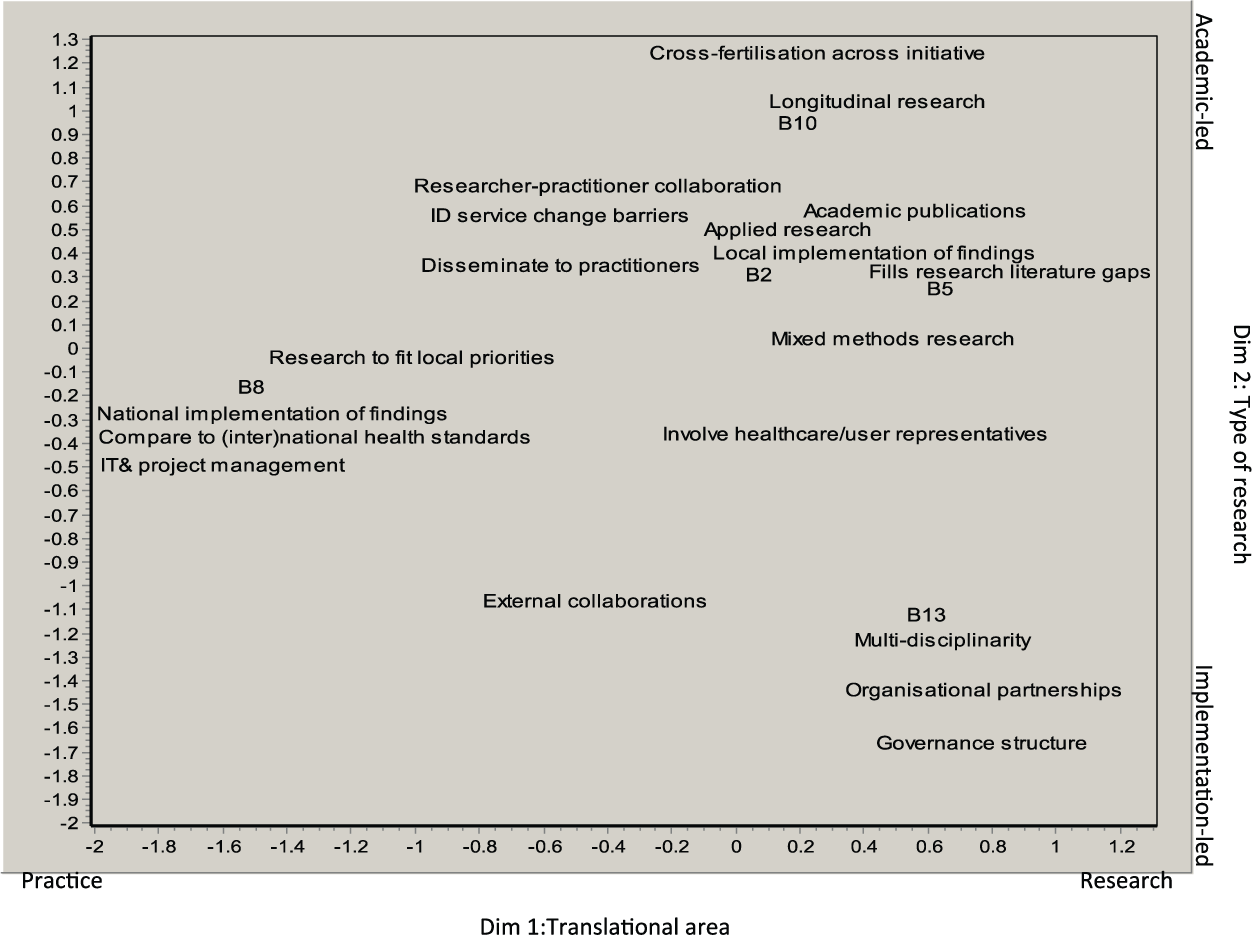
Blue ‘polarizing frame’ anchored around scientific rigour (dimensions 1 & 2, var =59.1%).
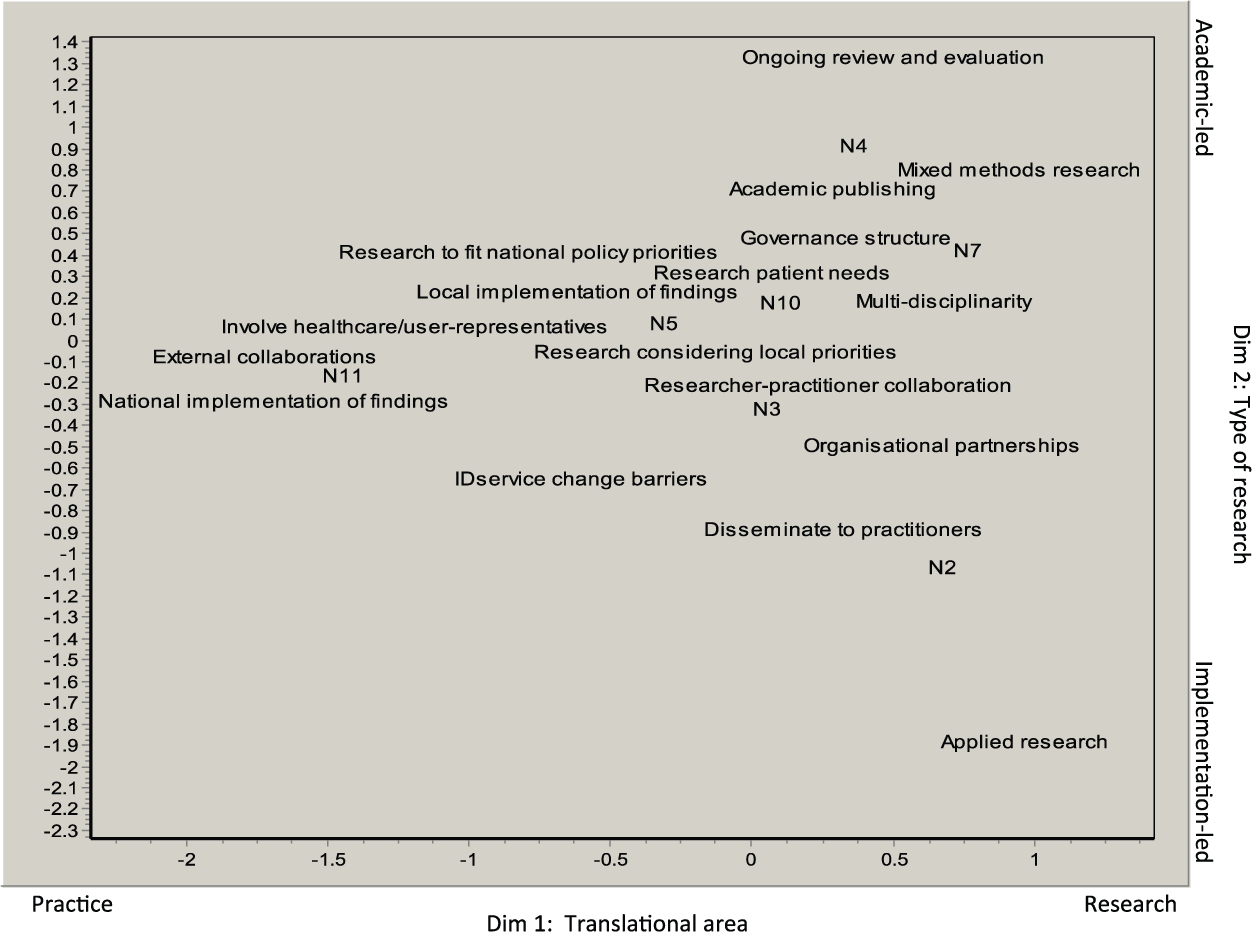
Neon ‘loosely clustered frame’ anchored around co-production (dimensions 1 & 2, var =42.2%).
In bi-plot A, actors and constructs appear to be quite separated and far from the axis origin. These polarized positions in the bi-plot reveal polarity in the Blue dominant cognitive frame. There are two quite isolated actors (actors B8 and B13) and a group of actors in the upper right segment of the graph (B2, B5, B10). Interestingly, formal professional roles appear to underpin this polarity: actors B8 and B13 are more implementation research-oriented, and B2, B5 and B10 are more academic research-oriented. The dominant frame reveals that central actors in Blue have quite different perceptions about what success means for the network and how to achieve it, and that these distinctive positions were based on differences in epistemic background.
Bi-plot B reveals a different scenario for Neon; there is comparatively less distinction between actor positions as we observe a loose clustering of central actors and cognitive constructs. Moreover, actors and constructs are closer to the centre of the axis than in the Blue bi-plot. This indicates that there is some agreement (or congruence) between central actor beliefs about what constitutes the success of their KTN and what factors lead to this success. This suggests a dominant frame on network purpose that is widely shared but weak. Moreover, the position of actors along the bi-plot axes is interesting in that actors do not conform to archetypical profiles in the Neon dominant cognitive frame. For example, a clinical academic researcher (Michael, N11) is more aligned with practice-oriented beliefs than research-oriented beliefs. Conversely, a healthcare practitioner (Paul, N3) is located close to research-type constructs. Overall, Bi-plot B suggests that although there is some common agreement underpinning the Neon KTN (illustrated by clustering of actors and constructs), there is also a considerable amount of interpretive flexibility (because this clustering is loose).
We triangulate the CA findings against our qualitative interview data. We find that Blue central actors were largely in support of scientific evidence-led research and, in particular, using rigorous evidence based on clinical trials research to improve healthcare, but there was conflict between individuals who thought academic publications were critical to knowledge translation, and others who were more implementation oriented. For Kate (clinical academic, B5), ‘publishing in top quality journals’ was ‘absolutely key’ in validating the network and providing credibility when dealing with practitioners because high-impact academic publications would legitimize Blue’s work, and such commendation would then lead to implementation. Kate asserts that methodological rigour is a key strength for Blue, and that she personally, being ‘very well interfaced with other methodologists around the world’, is able to export Blue publications and gain impact internationally. Roy (clinical academic, B2) also believes that Blue can be an agent for change through its academic profile; ‘Yes, it’s [translational research] got to be applicable, it’s got to make a difference to the individual projects that we’re located in, but we also wanted to be able to step back and do some kind of cross-cutting theoretical work and methodological work as well’.
Yet, as the dominant frame illustrates, other central actors diverged from this view believing that academic publications was being pursued at the expense of the potential implementation of the research. In support of the CA, our qualitative analysis reveals that implementation oriented actors Bill (B8) and Claudia (B13), although accepting of Blue KTN’s prioritization of scientific rigour, are less focused on publishing exclusively in academic journals and driven more by the translation of research evidence into practical settings. They believe that publications are not the route to practical change and were critical of this ‘transfer’ strategy: ‘well, exactly, that doesn’t work. That’s a linear assumption of things. I have it, I give it to you, I change your practice […] You can’t even think of translating knowledge into practical settings if you do it at distance, just sending out a paper or evidence that a particular clinical practice can work in a hospital.’ (Claudia, implementation researcher, B13)
So ‘there is the need to engage with people and so visit hospitals, talking to physicians, and show what the findings are’ (Claudia). In addition, Bill is very focused on the ‘overall improvement of the quality of healthcare’ over academic pursuits because ‘ultimately it must be about making better service decisions, making sure you do the right thing to the right person at the right time in whichever context, whether it’s delivery of healthcare or delivery of health improvement’.
They feel that research findings should have an impact on practice: ‘The KTN model is about the ability to change, to embed, to, you know, raise the profile of research, the value of research and all of those things. And some of those processes are done on an individual level, around networking, around talking to people, that type of thing’ (Bill, implementation researcher, B8).
In contrast, consulting our qualitative data for Neon we find that, perhaps because of its hybrid evolution and more diverse representation, Neon’s focus on organizational learning had developed over time through a shared discourse around what was referred to as ‘engaged implementation research’. This involved building collaborative networks between academe and NHS organizations to define, shape and co-produce the actual scope of Neon work. It was predicated on the view that Neon’s partner organizations needed to be involved, not simply as receivers of the outputs of research, but as key stakeholders in framing the research. This was a marked difference from conventional research, seen as ‘Rolls Royce treatment’, because it developed medical interventions without gaining support for their implementation within the NHS. In contrast, research done in Neon ‘would be the vehicle by which we would get a consensus, we could do things that we could all agree on and that mattered. And therefore, because of that it would be implemented’ (Jacob, health science researcher, N7).
Although most Neon members accepted the notion of ‘engaged implementation research’ this was an ambiguous framing of the KTN’s purpose precisely because it was different from conventional medical (i.e. clinical trials) research. Individuals thus developed different interpretations of how to enact it, leading to some ‘firefighting’. Michael (clinical-academic researcher, N11) described Neon work as filling ‘the gap between what we know and what we do’, which involved a discursive process of figuring out answers to big questions, ‘how can we make research and clinical practice work in harmony? How we can demonstrate that we can use research findings to inform practice?’ Still, some individuals worried that without traditional clinical trials research they would not be able to convince others that they have done methodologically sound research as opposed to ‘a series of interesting anecdotes’ (Paul, healthcare practitioner, N3).
Since this framing was novel compared to established research practices, it required more intensive sensemaking at individual project level. Thus in responding to the ambiguity of the dominant frame, many individuals also engaged reflexively with their own practices and professional identities. Some felt that their professional identities and value systems had changed since being part of the Neon network. For example, Michael (N11) describes how he was ‘converted’ from being ‘a trialist’ (i.e. solely focused on clinical trials) to ‘building a new area of expertise in implementation research’. Overall, most individuals agreed that working within Neon gave them the opportunity to do something different from the NHS and/or academe norm and a chance to reflect upon their own professional roles.
In summary, variation in the dominant frames of these KTNs was underpinned by the different configuration of central actor beliefs. The CA and qualitative data indicate that, in general, there was more disagreement between central actors in Blue, than Neon, around network purpose. Conflict in Blue was about how to use rigorous scientific inquiry (which all agreed was important) to satisfy the network’s translational objectives, with disagreements over the value of academic publications. In Neon there was evidence that initial conflict in the sensemaking efforts of groups and individuals gave way to widespread acceptance of the dominant frame on ‘engaged implementation’. In the subsequent sections, we explore first how these dominant frames related to the structure of the KTNs’ social networks and then how the enactment of these frames and structures contributed to their innovative power in terms of the scope and structuring of their collaborative work.
Frames and network structures
Blue evolved a relatively centralized informal network of knowledge-sharing ties (see Figure 1). It had a set of connected actors forming the network ‘core’ (namely, a central management team) with clinical teams feeding in to this core group. Projects were managed as discrete entities, and were given significant autonomy to determine their work topic as long as they conformed to established clinical science methods. Thus, the KTN’s dominant frame of scientific (methodological) rigour was strongly communicated both through a role structure which separated clinical teams from implementation concerns, and through Blue’s centralized social network which helped ensure the spread of the core management teams interpretations and concerns.
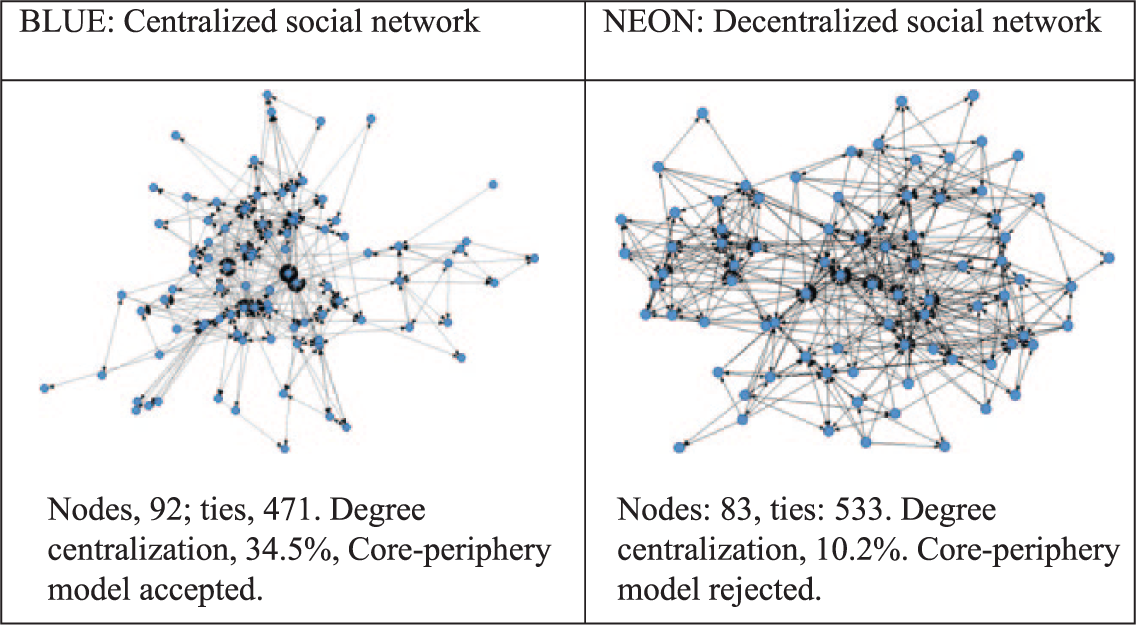
Informal knowledge sharing social network structure for Blue and Neon.
To promote its engaged implementation ethos, Neon had fewer clinical teams than Blue and also included two cross-cutting teams that were designed as mechanisms to coordinate colleagues, people and groups who would not ordinarily work closely together. In the first cross-cutting team, clinical practitioners were assigned to projects as ‘knowledge brokers’ to ensure that the outputs of research were relevant and could be diffused into practice. In the second cross-cutting theme, social scientists with expertise in change management and organizational dynamics worked with clinical themes to ensure that each project took implementation seriously from the design stage of research. In practice, a decentralized social network of informal knowledge-sharing ties evolved and, although Neon had a formally assigned leadership team, there was no core set of actors leading its informal knowledge-sharing network. This more decentralized network structure was consistent with Neon’s mission to ‘do things differently’ by encouraging new networks and collaborations to evolve.
Enactment of the dominant frames
This section draws on our qualitative investigation of the conduct of collaborative work by the KTNs to highlight the way in which frames were enacted in such work, both through network level actions and collaborative activities.
Following the launch of their work programmes, both KTNs made revisions to their managerial arrangements in response to the challenges of enacting their dominant frames. In Blue, where the great majority of projects had been launched speedily and had made good progress, these changes were relatively minor and included the provision of additional resources for cross-cutting activities to provide more linkages between projects.
In Neon, however, there was evidence of greater difficulty in the enactment of ‘engaged implementation’. This involved a wider range of groups taking part in sensemaking efforts on the desired focus of research and on the development of new collaborative practices. As a result, a number of projects were slow to launch and achieve progress. Some researchers wondered how their work could be made ‘more relevant to the NHS’ and believed others continued to work in ‘blissful isolation’ (Paul, healthcare practitioner, N3). Although members were supportive of the dominant frame, its ambiguity was aggravated by Neon’s more decentralized social network. Members expressed concerns about a lack of purpose, and a sense that overcoming the divide between research and practice ‘would not spontaneously happen by putting people in the same room’ (Paul). In response, a more centralized management approach was introduced at Neon. This included a series of ‘vision workshops’ that emphasized the need to focus collaboration on issues that were relevant to practitioners, and more importantly, to involve practitioners in all aspects of the research and an advisory board was established to review projects based on their relevance for NHS practitioners rather than simply their scientific merits. Reflecting on the challenge of enacting the network’s purpose, one of the senior management team commented that in this ‘novel and unique organization…it took us 3 years to work out what we were really doing’. He argued, however, that over time this culminated in a ‘very real cultural change’ and the transfer of Neon values across NHS partner organizations. Below, we present a set of vignettes illustrative of the collaborative work undertaken by Blue and Neon.
Blue vignettes
Vignette 1: Dissemination of research
Blue’s scientific research was to be produced for rather than with external organizations. Project teams were thus encouraged to create a collaborative environment that proved the capacity to make an ‘applied’ research impact in healthcare service delivery, in line with the idea of translational research. A typical example was a presentation given by a project team at a local Trust, which sought to highlight the relationship between the research being done in ‘research settings’ (at Blue) and the implications for practitioners. The practitioners at first were rather dismissive of the idea that research could be relevant to practice, but the presentation stimulated greater interest on their part.
Vignette 2: Identification of relevant evidence for new practices
One project team’s research paper, based on a clinical study, highlighted the utility of a database that was to record patients’ clinical history on electronic file. This information was found to be very helpful in ER (Emergency Room) situations, where it could be used to quickly review a patient’s health history and formulate diagnoses. This database was subsequently introduced more widely by partner organizations on the basis of its identified benefits.
Vignette 3: Policy impact of evidenc
A Blue study of acute cholecystectomy (gall bladder removal) in a partner NHS organization developed evidence on its relative benefits over elective surgery, which influenced national policy and practice in this area.
Neon vignettes
Vignette 4: Reframing the problem
A Neon study of the ‘problem’ of overly frequent attendees at GP (General Practitioner) surgeries engaged a number of collaborating groups including the GPs themselves. It found that the problem was not the result of the patients having undiagnosed mental health problems (as researchers had originally thought was the case based on existing evidence), but was actually perpetuated by the GPs putting patients with hard-to-diagnose issues on a particular pathway that demanded they were constantly monitored (hence their frequent attendance). Thus, by bringing people together, the project could ‘reframe the problem’ whereas doing a conventional literature review would only ‘repeat what everybody else had thought’ (Jacob, health science researcher, N7).
Vignette 5: Changes in practice
This project focused on the evidence regarding the health effects of ‘early supported discharge’ of stroke patients. By bringing together both the clinicians and database administrators involved, the project was able to develop a more tailored and accurate database of patient information to be used in the hospital (whereas conventional medical research would simply have developed their own database for the research and so would have ignored the practical realities of implementing early discharge because of inadequate records). This resulted in changes in practice among discharge coordinators, and allowed new clinical procedures to be developed.
Vignette 6: Embedding impact
This Neon project was focused on getting children in school who had low concentration levels to change their habits through a physical activity programme. Specifically, the children participated in regular circuit training sessions, supported by a trainer and a number of facilitators. The results after 4 months were very good – children in the intervention group had reduced body mass index (BMI), had higher self-reported activity and higher perceived self-efficacy. The research team then moved to try and embed this programme into the school system by linking it to the national measurement programme (a programme where schools have to report on BMI levels of their pupils in an attempt to fight childhood obesity). This engagement would not have occurred if the project had not been part of Neon – they would have rather just ‘proved it worked and then moved on’ (Project Lead).
In Table 1 we summarize our comparative analysis of the networks’ capacity for innovation (innovative power) by linking the enactment of different dominant cognitive frames and network structures with the vignettes outlining the collaborative activity in each KTN.
Comparative analysis – Dominant frames in two KTNs.
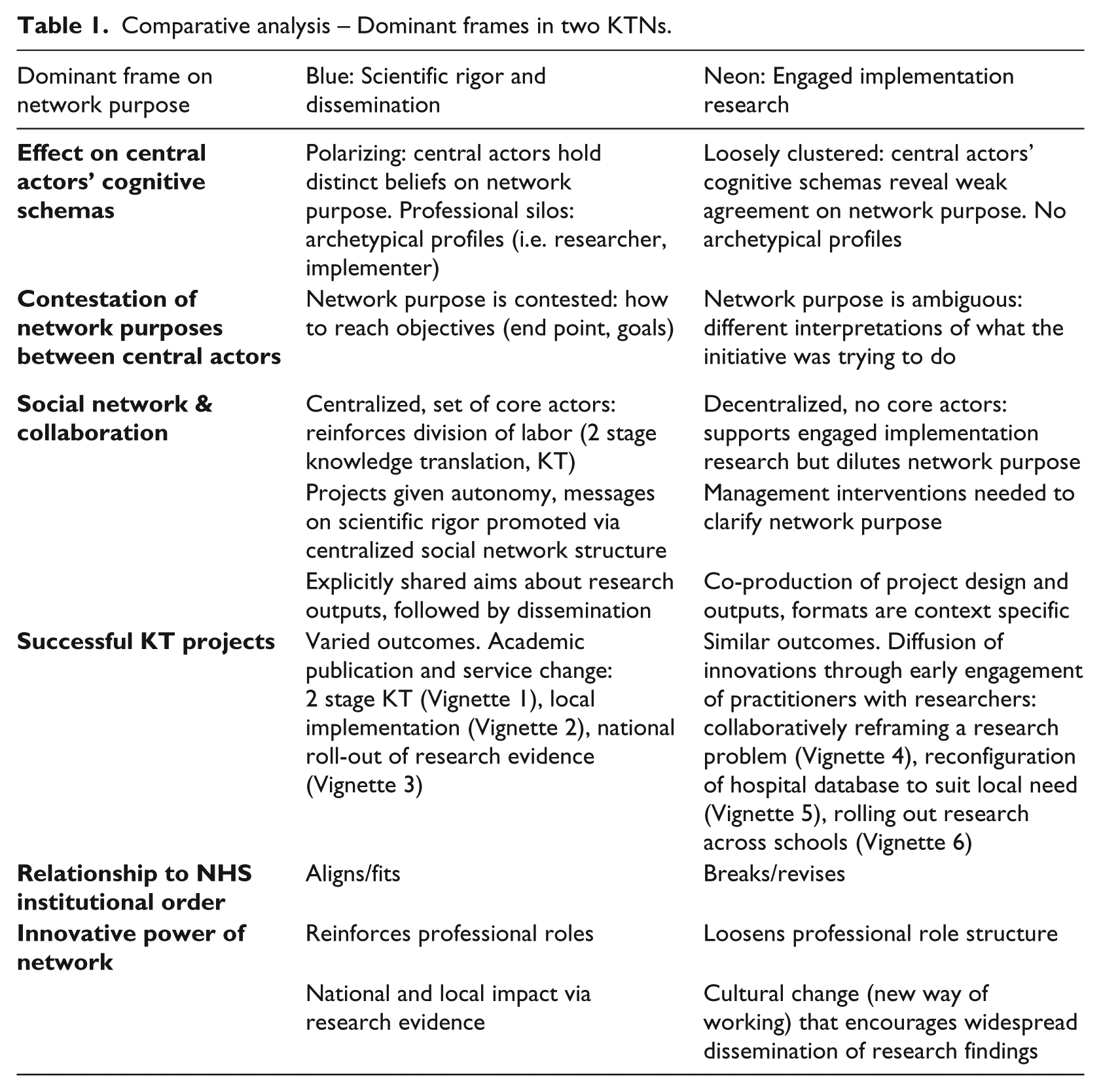
In the empirical analysis we have illustrated the intertwining of network structures with the dominant framing of network purpose, making use of vignettes. It is, therefore, evident that collective frames of each KTN become dominant based on the network structure and the cognitive frames of individual central actors. These social network and framing characterizations make a combined contribution towards the KTN’s collaborative work and thus their innovative power, as we will point out next, in the discussion section.
Discussion
Our study suggests that the interplay between dominant frames and social networks has important implications for the innovative power of networks in terms of their capacity to produce new forms of collaboration and change. This is discussed further in relation to our focal research questions.
Dominant frames and social network structures
Our first research question explored how dominant frames around the perceived purpose of a network relate to its social structure. In this regard, our findings illustrate complementarity between social network structures and dominant frames in each empirical case: a relatively centralized network structure being complemented by the dominant frame of ‘research rigour’ at Blue, and a comparatively more decentralized network being accompanied by the frame of ‘engaged implementation research’ at Neon. This complementarity is a product of multiple aspects of the interplay between cognition and social networks.
While emerging alongside the social network, the dominant frames on network purpose appeared to have a formative effect on the development network structures and roles sets. The Blue bid, for example, involved defining the network’s purpose in terms of research rigour. This framing was subsequently reflected in the management approach adopted for organizing work across the KTN: a classic ‘hub and spoke’ structure common to R&D settings where work is distributed across multiple, discrete projects. Collaborative roles were, in turn, defined in relatively conventional ways, with clear demarcations between research and implementation roles. In contrast to the research rigour frame at Blue, the Neon KTN embraced a more innovative self-conception around engaged implementation that involved the co-production of research. This more interpretively flexible framing of the KTN’s purpose was both inclusive of the range of central actors involved and consistent with the more diverse perspective of these actors. It was duly reflected in a management approach that promoted greater interaction between projects and cross-cutting themes. Collaborative roles, likewise, were defined to encompass the co-production of research and practical applications.
Our findings highlight the distinction between dominant network frames and individual frames, which typically reflect (but are not determined by) a person’s functional role (Kaplan, 2008). In Blue, individual cognitive schemas were polarized around the dominant frame, reflecting the strict division between research and implementation. In contrast, Neon’s decentralized social network and dominant frame of engaged implementation was expressed in more cross-cutting activity and innovative role specifications (such as knowledge brokers). This placed greater emphasis on the development of new ties across established professional boundaries.
A further aspect of the intertwining of frames and network structures was apparent in our findings on the implications of centralized versus decentralized network structures on the communication of framing efforts. This supports the findings in other studies, by suggesting that the distribution of social ties in networked forms of organization has important implications for the coordination and control of network activities (Baldassarri & Diani, 2007; Tichy, Tushman, & Fombrun, 1979; Turk, 1977) and also for the interpretation of such collaborative activities (D’Andreta, Scarbrough, & Evans, 2013). However, it also highlights the cognitive implications of these communicative patterns not only for coordination but also for possibilities of action perceived by network members.
Frames and the innovative power of the network
Our second research question focused on how dominant frames and social networks, in combination, impact upon the enactment of collaboration and the networks’ innovative power. Here, we found that the complementarity between frames and social networks in each of our cases produced significantly different effects on their innovative power.
At Blue, a centralized social network and a clearly defined dominant frame seems to have enabled network members to readily enact their understandings of network purpose. Collaboration, however, was focused within rather than across projects, and based on established professional roles. As reflected in our vignettes, this enactment of the dominant frame meant that Blue projects used rigorous scientific research as a platform for the dissemination of multiple outputs (including academic recognition and service improvement, impact within local NHS Trusts and policy evidence), but their collaborative efforts tended to reproduce the divisions between the domains of research and practice.
In contrast, Neon’s decentralized social network and dominant frame of engaged implementation was expressed in more cross-cutting activity and innovative role specifications. This placed greater emphasis on the development of new ties across established boundaries. This combination of social networks and dominant frame meant that Neon had greater potential for ‘divergent change’ (Battilana, 2011). New ‘hybrid’ roles such as knowledge brokers were being developed and new mechanisms for the review of research (advisory boards) were initiated. Network members, however, experienced greater ambiguity in their interpretations of network purpose, and found it more difficult to enact the dominant frame. This was reflected in the lengthier time taken to launch and develop projects, and the subsequent management intervention to re-emphasize the network’s purpose.
Our findings on the different forms of innovative power developed by these networks cannot be explained in terms of individual- and network-level phenomena alone but needs to be situated within an institutional context. Thus the initial, formative frames adopted in each case can be seen as reflective of each KTN’s positioning within the context of the English NHS. As Chreim (2006) notes, ‘frames elaborated in organizations … are seldom self-contained: they have a resonance with, or are derived, at least in part, from the wider institutional environment’ (p. 1265). In our study, we show how Blue emerged from a prestigious, research-oriented medical school, and could credibly adopt a frame centred on high-quality research. In contrast, the Neon KTN originated in the domain of mental health – a lower-status field of clinical science – and in a less prestigious medical school. To gain funding then, the Neon KTN could not rely on its established status as a research provider, and was encouraged to develop its more innovative approach centred on engaged implementation. As Battilana (2011) notes in her study of the NHS, ‘low status organizations are more likely to introduce new practices that diverge from the existing institutions and high status organizations are more likely to mobilize resources to maintain the status quo’ (p. 821).
However, the influence of the institutional context in our study applies not only to the initial willingness to undertake a more ‘divergent’ form of innovation, but also to the effective framing and enactment of that purpose. Here, we observed a clear difference between the dominant frames in our two cases. The dominant frame of research rigour at Blue was enacted so readily because it resonated with an established institutional order enshrining deep divisions between the arenas of research and practice (Ferlie et al., 2005), and in which a professionalized role structure predominated (Battilana, 2011). In the case of Neon, however, the frame of engaged implementation research not only seems to have lacked resonance with the wider institutional environment, but actually exhibited ‘dissonance’ with that environment.
The role of network agency
Our findings also shed light on the agency of the social networks in our cases, in terms of the capacity of the social network itself to act, above and beyond the aggregation of individual or group efforts. Here, network agency was influenced by the alignment between dominant frames and network structures. Individuals who are central to a social network can collectively contribute to the framing of network purpose and project work but they can also engage in resistance. The cognitive schemas of central actors were to an extent embodied by the network structures (centralized versus decentralized) which emerged around them, translating their understandings of network purpose into the network configurations best suited to enacting them through the medium of social ties and collaborative roles. Our findings thus suggest that the social network provides a social arena in which individuals become aligned with or resist the dominant frame as they ‘refine … a collective interpretation through a process of discussion and argument’ (Joas, 2000, p. 67).
The scope for dominant frames within such networks to become sources of institutional change through ‘frame blending’ produces a ‘hybrid or more abstract frame that comprises elements and structure from each input frame, as well as often a unique meaning of its own’ (Cornelissen & Werner, 2014, p. 191). Some evidence of this potential for change emerges from our Neon case where some individual actors, through their collaborative work across professional boundaries, undergo a process of reflexivity and are ‘converted’ to engaged implementation research. The discursive interplay between social networks and cognition seen in this case may enable cognitive orientations, for example around collaborative work, to become coherent and legitimate suggestions for action, thus allowing the network to harness its potential to create change (Beckert, 2010).
Our study thus makes a number of contributions to existing understandings of the cognitive aspects of social networks and their capacities for change. As noted at the beginning of the paper, previous studies of social networks have emphasized their structural features as the source of their innovative power. By enabling diverse forms of knowledge to be combined, network ties and brokering are seen as critical to various forms of innovation and change (cf. Cross & Sproull, 2004; Sasidharan, Santhanam, Brass, & Sambamurthy, 2012). In our study of two networked initiatives, these structural features do emerge as significant factors in their capacity to bring about change. What also emerges from our study, however, is that these features operated in combination with the dominant frames in each KTN, defining the possibility for, and the actual realization of, their innovative power. As our comparative analysis shows, the shared interpretations mobilized among network members towards particular forms of collaboration contributed, collectively, to a frame supporting convergent innovation in one case (Blue), and a more divergent form in another (Neon).
In addition, our study makes a contribution to the literature on framing by highlighting an aspect of frames that has not been a focus of previous work. As discussed above, our comparative analysis of Blue and Neon found a paradox in the enactment of their dominant frames. At Neon there was greater congruence and less conflict among central actors with respect to the dominant frame. Yet, interpreting and enacting this frame proved to be more problematic than at Blue where the dominant frame was actually associated with more polarized positions amongst central actors. This paradox can be explained in terms of the ambiguity of the frame (Weick, 1995), and its lack of fit with the institutional order.
The paradox of the more congruent frame at Neon, then, suggests that consideration of dominant frames in networks and organizations needs to take account not only of their appropriation or resistance by individuals (Chreim, 2006), but also of attributes affecting their enactment. Previous work has tended to emphasize that a frame’s acceptance and enactment depends on the degree of its congruence with organization members’ schemas or frames (Gilbert, 2006; Kaplan, 2008; Labianca, Brass, & Gray, 2000). However, our study suggests that, in terms of enactment, it may also be useful to differentiate between a ‘weak frame’ that is ambiguous but widely accepted, and a ‘strong frame’ which is more clearly understood. In our study, we found that a weak frame that achieves widespread, but limited, acceptance (as in the case of Neon), perhaps because of its ambiguity, may be more difficult to enact than a strong frame (as in Blue), even if the latter is associated with more polarized responses among individuals.
Finally, we make a methodological contribution in this paper. We analyse the characterization of a network’s cognitive frame (ties between actors and their cognitions), alongside a more traditional social network analysis (ties between actors), and supplement this with qualitative data to study the structure and content of social networks. Our mixed-method approach differs from studies seeking to map discrete stages of network change that rely only on social network metrics as a tool for analysis (Blaschke, Schoeneborn, & Seidl, 2012). Moreover, our focus on a network’s cognitive frame can also be distinguished from the study of ‘cognitive social structures’ based on individuals’ perceptions of who is connected to whom (Balkundi & Kilduff, 2006; Krackhardt, 1987). Our methodological contribution therefore rests on our ability to apply mixed-methods data to study the social ties underpinning a network’s collaborative work, in tandem with the cognitions that frame that network’s purpose, using qualitative data to unpack this interplay. As such, our paper advances a better understanding of how dominant frames of network purpose emerge alongside the network structure itself, and explores how this interplay between dominant frames and social networks has an impact upon the collaborative work that supports the network’s innovative power.
Conclusions and Implications
Whereas previous studies have emphasized the structural features of networks as the source of their innovative power, this paper has analysed the dominant cognitive frames on network purpose that emerged alongside social network structures for two networked forms of organization. While structural features are certainly important, our findings show how these operate in combination with dominant frames to impact the possibilities envisaged and the collaborative work undertaken by network members and, in so doing, shape the network’s capacity to bring about innovation and change. Networked forms of organizing are increasingly being adopted, not only in healthcare but in other domains, to secure policy, social or business goals. Our findings on dominant frames are likely to be relevant, then, to a broader range of settings, especially in those where the development of shared interpretations and purpose among network members is an important aspect of a network’s transformative capacity.
The possible theoretical implications of this work raise some important questions for further research. Although we find cognitive frames and network structure complementing each other in our cases, future research might be able to offer greater insight into how this complementarity actually emerges by, for example, using a combination of social network and cognitive mapping data at different points in time over the life cycle of a network.
Research that extends the notion of frames and framing into other social network contexts (e.g. commercial settings) would also help to develop a deeper understanding of the innovative power of such networks by bringing the relationship between dominant frames and network structures into sharper relief. In particular, comparative research that situates these dynamics between frames and social network structures within different institutional contexts would allow us to more fully grasp their implications for network agency. This could, for example, move us beyond the idea of ‘resonance’ with an institutionalized social order to more fully explore, in addition, the implications of ‘dissonance’ and its consequences for a network’s transformative capacity.
Footnotes
Appendix 1
Appendix 2
Appendix 3
Funding
This work was supported by the National Institute for Health Research Health Services and Delivery Research (09/1809/1075) and granted full ethical approval from the West Midlands Research Ethics Committee (10/H1208/30). The views and opinions expressed herein are those of the authors and do not necessarily reflect those of the SDO/HS&DR programme, NIHR, NHS or the Department of Health.