







Abstract
Knowledge sharing is central to reducing inequality and alleviating poverty. However, communities in settings of extreme poverty are often bounded by distinct perspectives and understandings that hinder knowledge sharing. Furthermore, social fault lines may create internal boundaries that impede interaction, further complicating knowledge sharing. Despite these challenges, some knowledge sharing efforts are successful. The purpose of this study is to better understand how knowledge sharing overcomes boundaries in settings of extreme inequality and poverty. Using qualitative data from rural India, we find that boundary work performed by boundary spanners overcomes external and internal boundaries by creating space for action, observation, and reflection in the recipient community. These actions, or syncretizing mechanisms, transform newly introduced knowledge, which then facilitates further boundary work, resulting in community transformation. Under certain circumstances, we see how boundary work and syncretism can lead to significant knowledge and recipient transformation. Thus, we seek to contribute to the literature by more fully exploring the transformative power of knowledge sharing within contexts of extreme poverty, and by explaining the process by which it occurs.
Keywords
Introduction
Knowledge sharing is central to reducing inequality and alleviating poverty (e.g., Collier, 2002) because it provides economic and social opportunities, and a pathway out of poverty and exclusion (e.g., Larsen & Lilleør, 2014). However, significant challenges inhibit successful knowledge sharing in settings of extreme social inequality and poverty. Communities in such settings are characterized by both external and internal boundaries that make knowledge sharing difficult. External boundaries arise from shared perspectives that include common narratives, shared assumptions, and implicit causal models that constitute a ‘deep knowledge’ of community practice (Boland & Tenkasi, 1995; Majchrzak, More, & Faraj, 2012; Seidel & O’Mahony, 2014). While these shared perspectives and practices may facilitate communication within the community, they create barriers to sharing knowledge across communities (Bechky, 2003; Carlile, 2002, 2004). Internal boundaries arise from exclusive social norms and practices that create barriers to knowledge sharing and integration within the community (Lamont & Molnár, 2002; Mair, Wolf, & Seelos, 2016).
Despite the considerable challenges, knowledge sharing efforts in settings of extreme social inequality and poverty are sometimes successful (e.g., Banerjee, Duflo, Glennester, & Kinnan, 2015). Thus, the broad purpose of this paper is to explore how boundaries can be overcome during knowledge sharing in such settings. The extant literature provides a foundation for this effort, as the topic of navigating boundaries to share knowledge has attracted considerable attention (e.g., Bechky, 2003; Carlile, 2002, 2004; Lamont & Molnár, 2002). One important stream has explored how boundary objects create a common context to facilitate knowledge sharing across communities’ external boundaries (Bechky, 2003; Star & Griesemer, 1989). Such exchanges may result in knowledge transformation as distinct perspectives are brought to bear and differences are negotiated (Boland & Tenkasi, 1995; Carlile, 2002).
A second stream of literature highlights the effect of internal community boundaries on knowledge sharing. This research is concerned with the influence of technology and knowledge on organizational structure (Barley, 1986; Edmondson, Bohmer, & Pisano 2001; Orlikowski, 1996). A core insight from this work is that as new knowledge and technology are introduced, the existing social boundaries and the actions of key actors play a consequential role in shaping organizational change (Robey & Sahay, 1996). For example, Barley (1986) details how a new technology and knowledge (the CT scanner and attendant practices) had an important influence on organizational structure. This study demonstrates how one hospital was able to render internal boundaries less salient and integrate new knowledge and technology, while another hospital was not. This work suggests that internal boundaries may be overcome as recipient communities are transformed, and that such transformations are heavily dependent on how boundary work unfolds.
The insights from these research streams create an opportunity to better understand knowledge sharing in the context of extreme social inequality and poverty. While the literature on boundary objects highlights the importance of knowledge transformation during knowledge sharing, the literature on knowledge, technology, and organizational structure highlights the importance of recipient community transformation during knowledge sharing. Because communities in extreme poverty often face both external boundaries originating from distinct community perspectives, as well as internal boundaries originating from social norms and practices, both types of transformation are relevant to knowledge sharing efforts through boundary work or ‘the attempts of actors to create, shape, and disrupt boundaries’ (Zietsma & Lawrence, 2010, p. 190; see also Gieryn, 1983). Thus, we ask: How does boundary work facilitate knowledge and recipient transformation during knowledge sharing in the context of social inequality and poverty?
To explore this question we use data from extensive fieldwork on a knowledge sharing effort among rural Indian farmers. We studied the efforts of a non-governmental organization, Videotech, 1 that worked with local NGO partners to identify, record, and share agriculture practices with the potential to dramatically increase yields. Though these new practices could potentially lead to valuable outcomes for rural farmers, existing perspectives and social norms created powerful boundaries that complicated knowledge sharing efforts. Our findings suggest that boundary work, which included the introduction of boundary objects, more inclusive norms, and increased discussion, had an important influence on knowledge sharing. Our findings illustrate an overall process for how boundary work creates space for action, observation, and reflection by members of the recipient community. We refer to these activities as syncretizing mechanisms and discuss how they transform knowledge, which facilitates further boundary work and helps transform the recipient community over time. Our findings suggest that knowledge and recipient transformation are deeply intertwined in such settings and, thus, are integrally related to knowledge sharing.
Our study seeks to make three primary contributions. First, we describe the process by which knowledge sharing leads to knowledge and recipient transformation in settings of extreme social inequality and poverty. In doing so, we synthesize insights from two distinct streams of literature and highlight the interrelation of knowledge and recipient transformation. Second, we introduce the concept of syncretizing mechanisms, describe their relationship to boundary work, and clarify the conditions under which their operation is most likely. Finally, we seek to contribute to practice by calling attention to the role of boundary workers in facilitating transformation, particularly in the context of extreme social inequality and poverty.
Knowledge sharing across boundaries in the context of extreme social inequality and poverty
Knowledge sharing is critical for alleviating poverty and reducing inequality (Collier, 2002). For example, sharing the dramatic advances in agricultural techniques among the world’s poor has become a major priority for public and private organizations (Larsen & Lilleør, 2014; World Bank, 2008). Communities in the context of poverty involved in agrarian activities can be understood as knowledge communities, as they consist of a group of individuals engaged in common activities and that share perspectives and social practices allowing for communication and participation (Thompson, 2005). Knowledge sharing efforts among these communities face significant challenges because the internal and external boundaries that support the community structure can also hinder knowledge sharing efforts.
External boundaries arise from the unique perspectives and understandings that characterize the community (cf. Boland & Tenkasi, 1995). These shared perspectives develop over time as community members build common narratives and reflect on their experience within a common context (Bechky, 2003; Seidel & O’Mahony, 2014; Wenger, 1998). Shared perspectives include assumptions, implicit causal models, and interests that constitute a ‘deep knowledge’ of community practice (Majchrzak et al., 2012). These characteristics, which facilitate knowledge sharing within a community, may lead to interpretation challenges and attribution errors across communities (Carlile, 2002), particularly with tacit knowledge among communities with diverging interests (Carlile, 2004). In the context of poverty and social inequality, shared perspectives may create significant external boundaries that impede knowledge sharing. For example, rural Indian communities often share perspectives grounded in fate and a mistrust of outsiders (Cotterill, Sidanius, Bhardwaj, & Kumar, 2014; Das, 2013). However, perspectives rooted in fate may conflict with knowledge being shared from outside sources (Reichenbach, 1988), thus creating important external barriers to knowledge sharing.
In addition to external boundaries grounded in shared perspectives, knowledge communities also share important social characteristics, including language, identity, and specific social practices (Seidel & O’Mahony, 2014; Thompson, 2005). These social practices and norms may privilege some community members while simultaneously excluding others from full participation (Tilly, 1998). Symbolic resources and exclusive social practices fortify such internal boundaries (Lamont & Molnár, 2002). These boundaries are especially rigid in the context of poverty and social inequality, particularly when there is a high degree of disparity in power between community members (e.g., Mair et al., 2016). In such cases, crossing internal community boundaries may be extraordinarily difficult (Lamont & Molnár, 2002). Because effective knowledge sharing generally requires broad community participation, internal community boundaries engendered by social inequality can create significant obstacles to sharing and integrating new knowledge.
Again, rural India provides an illustration of how internal boundaries affect knowledge sharing. Both the caste system and gender inequality pose significant barriers to knowledge sharing. The caste system forms the basis of social stratification in India, particularly in rural areas (Thorat, Negi, Mahamallik, & Senapati, 2009). For example, caste determines a person’s occupation, making it difficult for members of lower and scheduled castes (SC) to break the cycle of exploitation and exclusion (Thorat et al., 2009). Gender is another social fault-line in India. The dominant cultural norms of projecting men as protectors and breadwinners construct women as their life-long dependants (Kabeer 2005). Men make most of the decisions in and outside of the family, and women’s household work is often devalued. In rural areas, men relegate women to the agriculture work they perceive as less skilled and tedious – e.g., sowing, transplanting, weeding, and harvesting (Kaur & Sharma, 1991). When knowledge sharing requires participation and interaction across caste or gender lines, such internal boundaries can create significant barriers.
Overcoming boundaries during knowledge sharing
Despite the difficulties, sharing knowledge across community boundaries is valuable to organizations and to society more broadly (Lainer-Vos, 2013; Majchrzak et al., 2012). Thus, how knowledge sharing occurs is the subject of a considerable research (Bechky, 2003; Carlile, 2002, 2004; Lamont & Molnár, 2002). Two distinct streams of research have important implications for the success of knowledge sharing across boundaries in the context of social inequality and poverty. The first explores the role of boundary objects in facilitating knowledge transformation (e.g., Bechky, 2003; Carlile, 2004), while the second examines how knowledge recipients are transformed as they integrate new knowledge (e.g., Barley, 1986; Edmondson et al., 2001).
Boundary objects are an important tool for sharing knowledge across external boundaries (Bechky, 2003; Carlile, 2002, 2004; Lainer-Vos 2013). Boundary objects are tools and practices that can be shared across communities and that create a common context where members of different communities can interact and communicate (Bechky, 2003; Carlile, 2002). Boundary objects include visual representations or tangible objects that play a variety of roles, such as guiding inquiry, enabling coordination, highlighting differing assumptions, and facilitating negotiation (Carlile, 2002). Extant literature frequently describes the role of boundary objects in facilitating knowledge transformation as different perspectives and knowledge are brought to bear (Bechky, 2003; Carlile, 2002). The transformation of knowledge through the integration of external and local knowledge is often portrayed as the ideal outcome of knowledge sharing in the context of poverty and inequality (Easterly, 2006).
The second research stream explores how knowledge sharing influences internal community boundaries by transforming the recipient community (Barley, 1986; Edmondson et al., 2001; Robey & Sahay, 1996). This research explores how knowledge sharing may require people to re-examine their assumptions, beliefs, and social practices (Skilton & Dooley, 2010), potentially resulting in the realignment of internal boundaries. For example, Barley (1986) details how the introduction of new technology and knowledge related to a CT scanner resulted in significant changes in the hospital’s social order. Similarly, Edmondson and colleagues (2001) examine how the successful implementation of new surgical techniques transformed the surgical team’s perspectives and practices. This work suggests that the transformation of the recipient communities overcomes internal barriers to knowledge sharing. A consistent theme in this work, however, is that the existing social context and the actions of participants dramatically influence how the transformations play out (Barley, 1986; Orlikowski, 1996). Thus, it is essential to understand the role of boundary workers, or those who take actions that alter the nature of extant boundaries and the social context. Such recipient transformation may also be desirable as a means of reducing inequality (cf. Mair et al., 2016).
Taken together, this research underscores the importance of transformation during knowledge sharing across boundaries. However, we know little about the process by which such transformations occur, particularly in the context of poverty. Thus, this study explores how boundary work enables both knowledge and recipient transformation during knowledge sharing.
Methods
Research setting
To understand the process of knowledge and recipient transformation, we carried out a qualitative study in the poorest districts of Madhya Pradesh in central India. In Madhya Pradesh about 23.41 million people living below the poverty line (Government of India, 2013), and about 71% of the population is engaged in agriculture as their primary livelihood (GOI, 2013). However, most farmers struggle to supply their families with sufficient food, as most live in rural areas (72.4%) and subsist on tiny, underproductive farm plots (GOI, 2013). Limited and uneven access to agricultural knowledge exacerbates these challenges, leading farmers to use outdated and inadequate farming practices. Given this, sharing useful agricultural practices among farmers has been a major goal of the governmental and non-governmental sectors, though high costs and overall low adoption rates hamper its impact (Adhiguru, Birthal, & Kumar, 2009; Glendenning, Babu, & Asenso-Okyere, 2010).
The challenges of knowledge sharing in Madhya Pradesh take place against a complex social backdrop. Communities are bounded externally by shared perspectives, such as a belief in karma (fate) and a mistrust of outsiders (Cotterill et al., 2014; Das, 2013). Additionally, internal boundaries, primarily around gender and caste, also make knowledge sharing difficult. The caste system divides society into four main groups, as well as scheduled castes (SC) and scheduled tribes (ST), which fall outside the system and are considered to be of very low status. The clear caste boundaries manifest in a variety of ways. For example, caste determines residency, with lower castes living the farthest from the village centre. SC members, in particular, are isolated from society because they are considered ‘impure’. They are excluded from entering higher caste households, venturing into upper caste hamlets, and sharing the same well/water sources. Violations of these norms can result in violent reprisals (e.g., Das, 2013). Gender is also a significant internal boundary. Men are generally reluctant to include women in meaningful ways in village life, such as community decision making, engagement in paid economic activities, or even interacting across gender lines (Nussbaum, 2000). Women often work in unpaid, labour-intensive subsistence farming, whereas men work in technological intensive activities and cash crop farming (e.g., Alex, 2013).
In this challenging context, Videotech, a non-governmental organization based in New Delhi, is dedicated to increasing knowledge sharing among poor rural farmers across India and other developing countries. Videotech specializes in the knowledge sharing process, but relies on local NGO partners to provide agricultural expertise and to run local operations. The local NGOs bring various capacities. For example, some NGOs have more experience with women’s empowerment and others focus more on agricultural issues.
The local NGOs identify existing agricultural practices with the potential to dramatically improve production and/or cut costs, but also within the capacity of local farmers to implement. Videotech and its local NGO partners use video recorders to capture the novel agricultural knowledge and then the local NGO organizes screenings through the help of a moderator from the local communities. In most cases, the local NGO selects male moderators from the upper caste; however, some NGOs in some locations also select moderators of different genders and castes. Prior to a screening, the NGO moderator announces that a screening is to take place. These events typically take place at night, when the visibility from small, rechargeable projectors is best, and are attended by small gatherings of the local community, which we refer to as recipient groups.
These recipient groups are formed within community boundaries, but sometimes cut across internal gender or caste boundaries, as depicted in Figure 1. The actual layout of the screening event depends on the societal context of the village and the NGO moderator’s boundary work in establishing norms for the recipient group. Figure 2 shows six typical layouts for the video, with different combinations of gender and caste. In each of these scenarios, the viewers’ economic and social status determined their distance from the screen, unless the moderator introduced more inclusive social norms. The videos were screened for at least two years to a maximum of eight years in the villages covered, and on average the NGOs generally worked in the communities for four years.
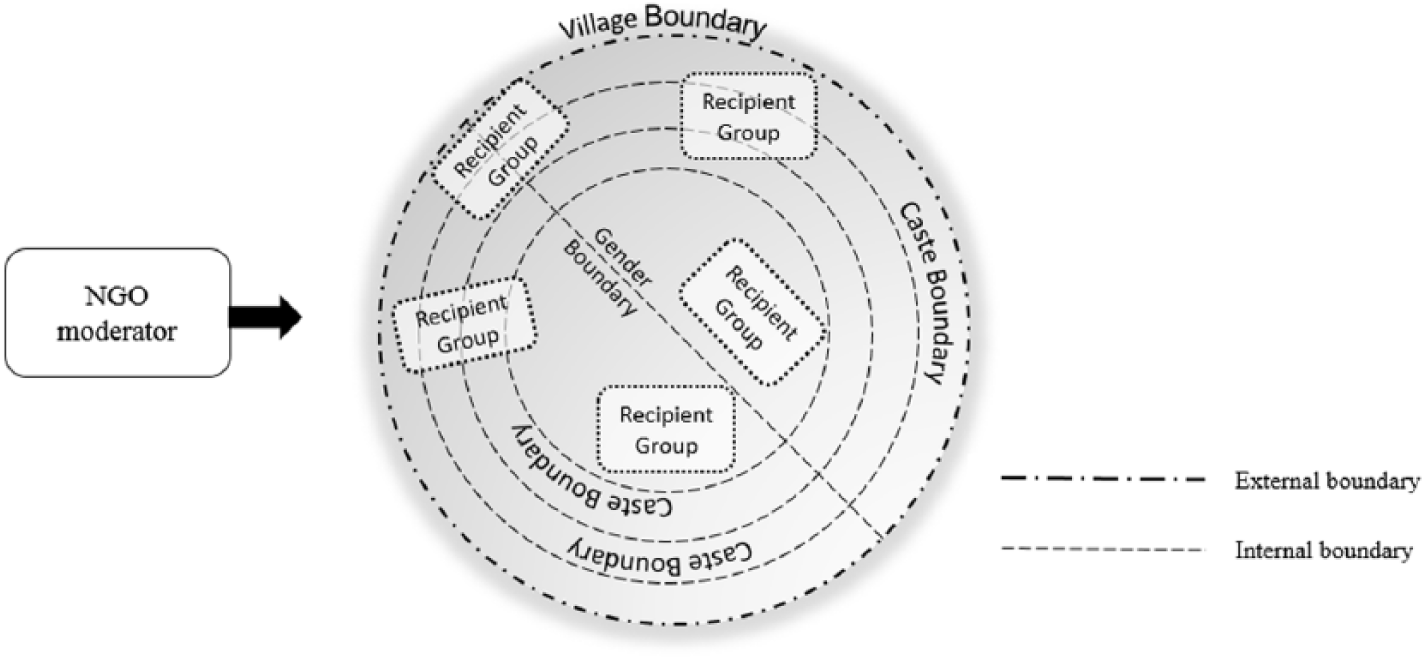
Community boundaries and recipient group.
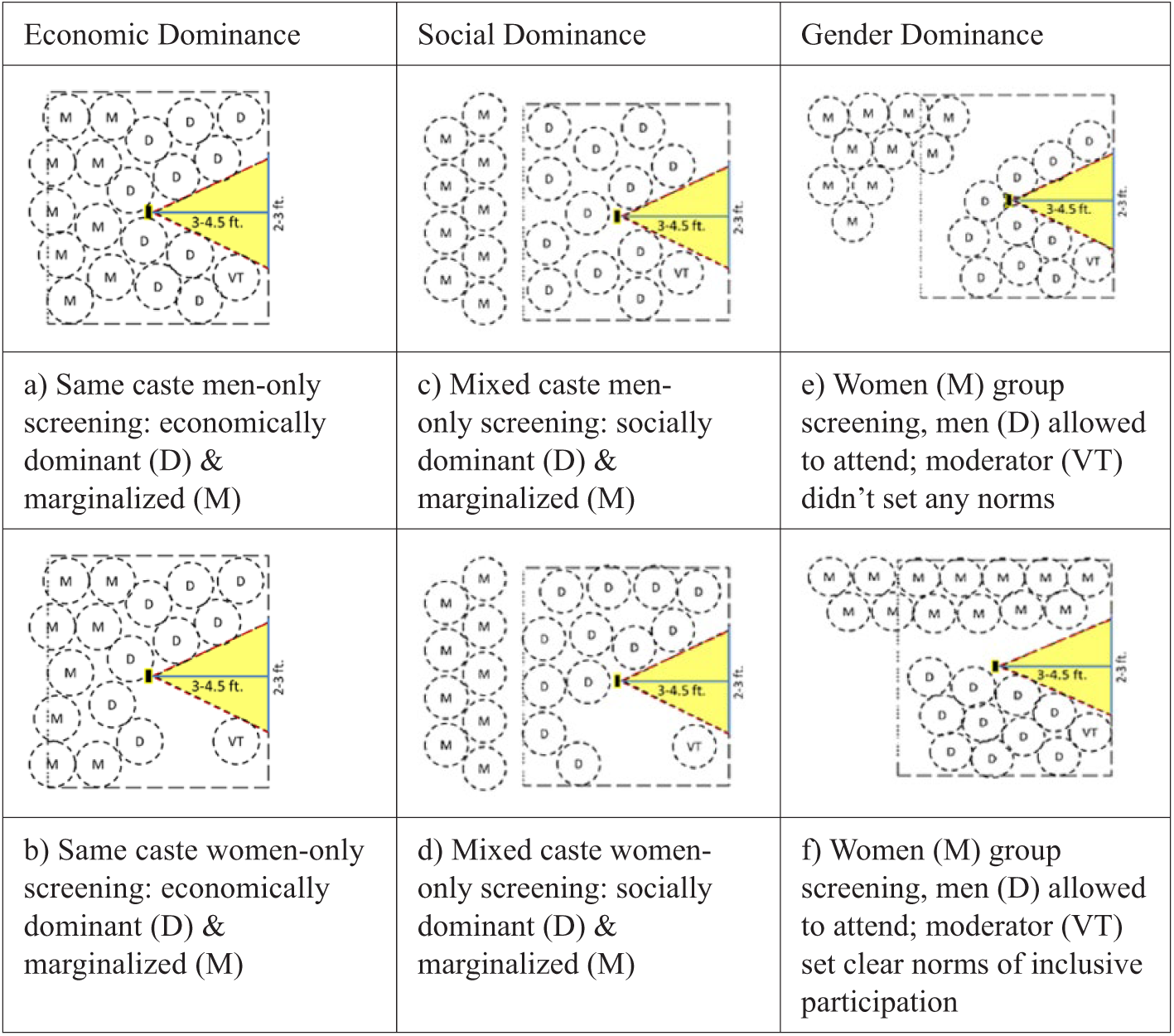
Screening layouts.
This context presented a particularly valuable opportunity to understand how knowledge and recipient transformation occur. By studying knowledge sharing in rural India’s salient and rigid gender and caste roles (Pattenden, 2011), we saw how knowledge crossed significant boundaries. Furthermore, this knowledge sharing was easily observed because it took place in a public forum. Finally, the study of knowledge sharing in a rural Indian environment is important in its own right, as it has profound implications for issues such as poverty alleviation and also represents an area that is relatively less understood by organizational scholars (George, McGahan, & Prabhu, 2012).
Data collection and analytic approach
Our research focused on how knowledge sharing through video screenings impacts knowledge and recipient transformation, though we did not have an a priori understanding of how this might occur. Thus, we approached our research with a grounded theory approach in which we iterated between data and theory (Glaser & Strauss, 1967). The extended iteration allowed us to explore new connections and ideas as they presented themselves. Our methodology also allowed us to explore nuances and complexities in the local environment.
The data for this study were part of a larger data collection effort that involved five years of fieldwork and several hundred interviews. Our data collection efforts included observation, semi-structured interviews, group interviews, and examination of archival data (Creswell, 2012). The various methods triangulated our findings and reduced bias due to social desirability or the limitations of a single perspective (Fendt & Sachs, 2008). For this study, we focused on the video screenings and related events. We observed 127 screenings and recorded these events when permitted by Videotech. We took extensive notes during the events. Immediately before and after the event, we conducted interviews with participants to capture their perspectives on what had occurred. In order to assess the outcomes of the knowledge sharing events, we observed the adoption of practices, and also talked to the village members, the NGO moderators, and other observers. We repeated these observations and interviews over time. During 10 different trips we conducted 229 individual interviews with the farmers, 92 group interviews with the communities, and 85 interviews with the moderators. In the interviews, we followed a semi-structured format in which we followed a basic framework for interview topics, but also pursued interesting threads in the conversation (Denzin & Lincoln, 2000; McCracken, 1988). We were particularly concerned with capturing the perspectives of lower status groups and individuals and made efforts to ensure that their voices were heard throughout the data collection process. We also observed video production, video screenings, agricultural practices, and meetings of Videotech and the local NGO staff to capture their perspectives.
The first and third authors conducted interviews in Hindi and local dialects. The second author conducted interviews in English with head office managers of Videotech and the partner NGO or through a translator (or with the help of other co-authors) in the villages. Individual and group interviews were recorded, transcribed into Hindi or local dialect, and then translated into English.
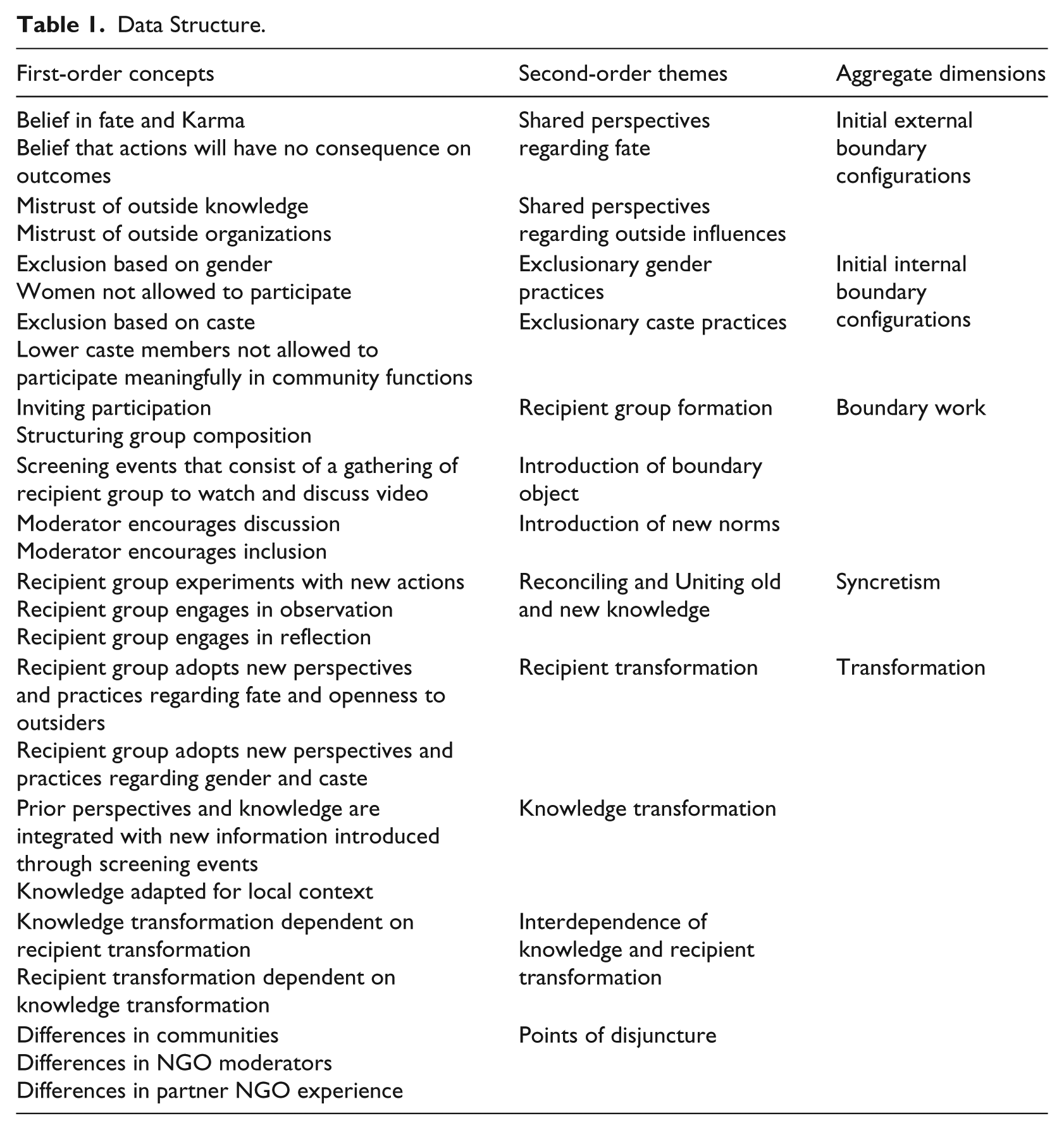
Guided by our ongoing data collection, two co-authors used an ‘open-coding’ approach to identify distinct concepts that repeated in quotes and observations from our data (Creswell, 2012). Data analysis was carried out by using NVivo, version 8. Following the conventions outlined by Gioia, Corley, and Hamilton (2013), we used this initial round of coding to identify first-order themes. In identifying first-order themes, we paid particular attention to the actions taken by the NGO moderators and community members to integrate new knowledge. Each first-order theme is grounded directly in quotes and observations from our data. Over time, we iteratively refined and grouped these themes until we arrived at a consensus (Miles & Huberman, 1994), resulting in the identification of second-order dimensions. We repeated this iterative process between data and theory to identify aggregate dimensions, which provided the basis for our overall process model of recipient transformation (Gioia et al., 2013). Table 1 depicts the resulting data structure.
Data Structure.
Findings
Videotech partnered with local NGOs in order to share useful agricultural knowledge across rural India. However, external and internal boundaries made knowledge sharing difficult. To overcome such barriers, moderators from local NGOs engaged in boundary work, which included forming recipient groups, introducing video screenings, and setting rules that encouraged inclusion and discussion. In turn, this boundary work created space for recipient groups to engage in syncretism – or the reconciliation and unification of differing beliefs. We found that boundary work and syncretism were deeply interrelated. Boundary work created space for syncretism to occur and syncretism legitimated further boundary work. Together, they aided in knowledge and recipient transformation, as depicted in Figure 3.
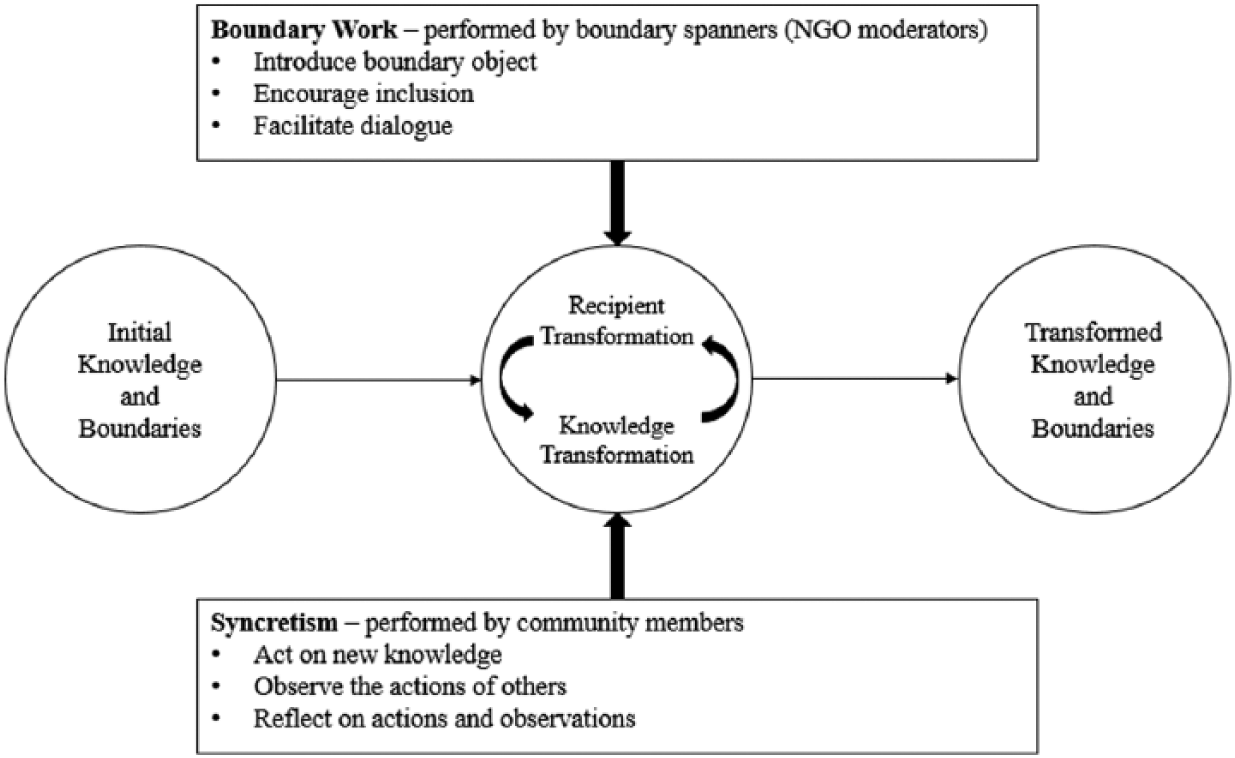
Process model of recipient transformation.
Initial boundary configurations
While the recipient groups varied in their characteristics, we did find several overarching similarities in their external and internal boundaries that affected knowledge sharing. External boundaries were rooted in perspectives shared across the community, and community members frequently expressed these in narratives (Boland & Tenkasi, 1995). One example was a belief that fate or Karma determines destiny. Two farmers stated:
Nothing ever goes as we plan. Last year with my daughters, I worked day and night. What we received in return? Nothing. All my crop got destroyed due to untimely rain. That is our fate. – region C This is our Karma. I cannot escape it. I am paying for whatever I did in my previous births. There is no easy way to salvation. I have to bear all the pains in this birth for my past mistakes. Then only can I achieve salvation. If that means my crops might fail repeatedly then so be it. How can I change that? – region D
Belief in fate was consequential for knowledge sharing as it could undermine the motivation to try new things. Community members with this perspective believed their actions would have little impact on agricultural outcomes, and they were reluctant to expend extra effort on experimenting with new knowledge.
Another external boundary was mistrust of outside knowledge. This mistrust, understandable in an environment with a history of elitist, external domination, created significant difficulties for knowledge sharing. For example, a male farmer expressed this (though in an interview three years later, he was more optimistic):
It is not about this company or that company. Everyone want to fool us, and exploit our ignorance. They sell things which are not useful to us. They give information that help them sell their product whether we need them or not. I have become skeptical of these outsiders and their information. – region A
These shared perspectives, which enhanced communication within the village, created critical barriers to accepting knowledge from outside the village.
Internal boundaries of gender and caste structure also created barriers to knowledge sharing (Agarwal, 2001; Benería, 1995; Kabeer, 2005). Male community members often held strong beliefs of their dominance in the community, and they limited female community members to prescribed domestic and field labour. Consequently, male farmers were often vocal in their desire to exclude female participation in video screenings:
Women should stay at home. They should not roam around in the night. This is not good for family. Anyway, they are not intelligent and will not be able to grasp anything. – region B They have no brains. It will be waste of time to show them video. They will not get anything. – region A They are not literate. They cannot understand what is being shown. Ultimately, we are the ones who have to explain to them. – region B
Women, on the other hand, expressed a desire to view the screenings. However, they understood the social constraints that prevented full access to this knowledge:
I do want to watch these videos. I know they are very useful. I am unable to watch as [videos] are screened in the evening. I have so much work to do in the evening. Various household chores. Cook food for everyone… You name it. How can I watch video in the evening when there is so much work to do? It is expected that I be the one who will do all this work. – region A
These exclusionary practices formed a social boundary to potentially hinder knowledge sharing, particularly when new knowledge required input from women.
The recipient communities’ caste system (Das, 2013) also had important implications for knowledge sharing. The caste system prescribed specific roles for community members, and deviations were inappropriate or unacceptable. For example, members of less dominant castes were limited in their participation in community gatherings. In discussing this exclusion, two upper caste members explained:
No, they [weaker caste] cannot attend the screening in our house. If [Videotech’s partner] want them to see videos they [partner] can form their [weaker caste] own group. Our village tradition does not allow us to mix with them. – region A It is not common. They [SC] do not attend screening with us. You know this is village and we have some rules. If they want to attend screening, we ask them not to step inside house. They can stay outside house. They can see and listen from there. Some of them come to see video but not very often. – region B
Members of lower caste groups also reported this exclusion:
It is not easy for us to attend screening. In this village they [dominant caste] do not treat us well. Some of us tried initially but were not allowed to watch the video. We complained to [Videotech’s partner] then screening was shifted to Choupal (common area). They [dominant caste] sit near the [projector] and we are made to stand very far. We can hardly listen and see anything. So we stopped attending. – region D
Consistent with literature on rural India (Reichenbach, 1988; Riaz & Qureshi, 2017), we found that communities’ perspectives and practices created important boundaries around and within the village. Despite the challenges, a more inclusive recipient group had many potential advantages. For example, women held knowledge on implementation of new practices because they were the primary field labourers while men understood the market implications of decisions, such as costs of inputs and the potential to increase sales. Only in inclusive recipient groups could new knowledge be truly reconciled and integrated into local practice.
Boundary work
While external and internal boundaries made knowledge sharing difficult, local NGOs worked with moderators to form recipient groups, introduce video screenings, and implement more inclusive norms. In some areas, moderators invited anyone who was interested to attend screenings. This resulted in screening events dominated by male upper caste community members. However, in regions that were ultimately more successful in knowledge sharing, moderators were more intentional in creating inclusive groups. We observed that moderators in such regions focused on fostering inclusion and encouraging dialogue.
We observed, in general, that NGO moderators worked hard to foster inclusion during video screenings and introduced a number of practices to alter social norms. For example, one NGO created women-only groups, and conducted screenings just for them. The NGO actively encouraged women to ask questions and discuss their experience freely, rendering the screenings a ‘safe space’ where marginalized community members could freely communicate (cf. Kellogg, 2009). Once it became clear that women could fully participate, the NGO moderator requested that they bring one male member of their family if they felt comfortable. This created mixed-gender groups; however, the women were allowed to ask questions first, before men were given the chance. Over time this restriction was withdrawn. These moderator actions created new social norms during the screening. Their efforts were a form of boundary work that shaped external and internal boundaries to enable knowledge sharing (cf. Gieryn, 1983; Zietsma & Lawrence, 2010).
In other areas, NGO moderators encouraged inclusive social norms for castes. For example, moderators encouraged lower caste groups to attend screenings with upper caste groups and to ask questions. These efforts were not easy, but they did increase interaction. A regional head of a local NGO explained:
When I look back it appears that encouraging villagers to have group members from all the communities [social groups] was a good decision… It wasn’t easy to include different castes. It was much more difficult to get them discuss with each other… For the first year or so this created some friction within the group and sometimes in the village. As time passed and with enormous efforts from our moderators… this actually resulted in having more social interactions among various communities [social groups]. In some villages or rather a few villages, they now celebrate festivals together, visit each other more frequently. In some cases, we also observed that lower caste and upper caste members sit together not for screening only but for their day-to-day interactions. – regional head, region D
Additionally, the moderators encouraged discussion among participants during video screenings. To do this, the moderator asked questions, provided time for responses, mediated dialogue, and set ground rules for participation. This approach helped to clarify details of the video, and made the contents accessible to community members who had to sit farther back, as described by a moderator:
Not all farmers can hear or see video. This is true when there are many of them. I ask farmers who are sitting close to projector, what did they see? What is not clear to them? Once they start discussion, other farmers who were away from projector start asking more questions. – region A
Enhancing discussion sometimes meant discouraging dominant group members from speaking so that varied ideas from all members could be heard.
In summary, the NGO moderators acted as boundary spanners as they were able to negotiate across different boundaries and engage in their boundary work. Overall, the video screening events served as boundary objects as they were plastic enough to be adapted to local circumstances, while rigid enough to preserve core characteristics across distinct locations (Star & Griesemer, 1989). The boundary work created the space necessary for knowledge transformation.
Syncretism
Group members engaged in three central activities in response to screening events – action, observation, and reflection. Together, we refer to action, observation, and reflection as syncretizing mechanisms as they were the central means by which recipient group members worked to unify and reconcile their prior perspectives and practices with the new perspectives and practices introduced through video screenings. These syncretizing mechanisms were interrelated and iterative and could proceed in any sequence. Collectively, they represented a powerful mechanism for change.
Video screening events were intended to inspire action among community members. Indeed, the simple act of joining a recipient group and attending was challenging and important, as a female farmer described:
I was very hesitant – you can also say scared. It is not common for women in our communities to speak in the presence of men. I almost refused to be part of women screening group in which men will be allowed to attend. Then I talked to [another woman who has accepted to be member of this group] and gained courage. I thought ‘Let me give it a try. If it doesn’t work I can stop attending.’ – region C
Screenings inspired other actions, too. Some, like this male farmer, chose to implement new practices:
I liked the idea of cultivating vegetables. I used to grow gram [chickpea]. Never tried anything else. I discussed with other farmers. None of them were ready to change their traditional crop. I decided to go ahead alone. – region B
These actions cut against the grain of existing community perspectives or social boundaries. For example, including women or lower caste community members contradicted community norms. Thus, the video screenings inspired a variety of actions among recipients and helped loosen the grip of existing perspectives and practices.
Observation was also a key activity in the recipient groups. Not every group member chose to act after a screening, but many observed as others experimented with new perspectives and practices. In some villages, observation involved a high degree of coordination. In one village, the farmers coordinated their efforts so that each farmer implemented one new practice. They then shared their observations with each other to facilitate rapid learning:
We do not have very big farmland. Most of us have about two bigha [0.32 hectares; 0.80 acres]. We cannot try many practices [simultaneously] in our small land… In this village we are like a big family, related to each other. We have same family name. Some of us are even related. If you ask someone his father, grandfather and so on, you will find some of us have same grandfather or great-grandfather. No one in this village is of different caste… We trust each other. We do not hide anything… So each one of us tried a different practice. Observed how each one is doing… Helped each other, and learned from each other. – village head, region B.
In other cases, observation proceeded in a more ad hoc fashion. Overall, observation provided a relatively low-cost means for understanding new perspectives and social practices.
Finally, the screening events provided important opportunities for reflection as recipient groups considered their experiences against the new knowledge. Reflection occurred frequently during the screening events themselves. For example, group members often engaged in deep discussion, as described by a moderator:
When we introduce a new practice, not just a new variety of crop they already grow but something they have not done before. This kind of videos sometime results in very rich discussion. Farmers want to see video repeatedly, I mean go back and forth, or stop video at particular point and discuss. This is very interesting to them. They like it. Sometimes our battery get exhausted and we say sorry folks we will come again. – region B
Reflection also occurred in other settings – before and after screenings and by groups and individuals:
I am not used to speaking in public. In a group I mostly keep quiet… I talk to women sitting nearby me during the screening. After the screening when I come back home, I talk to my mother-in-law and sometimes to my husband… Mostly I keep thinking about what I usually do in field and what was shown in the video. Sometimes I just talk to myself… These videos make me aware of what I have been doing. Not always correctly… – female farmer, region C We gather in this place [central open space] every night… We spend much more time on the nights of screening. We discuss whether this new practice [that was screened] is really going to help us…. I mean, not everyone is equally interested but somehow we all end up discussing about the screening. – village head, region D
In summary, action, observation, and reflection acted as syncretizing mechanisms through which community members unified and reconciled existing beliefs and practices with new ideas. The extent to which the NGO moderator could introduce new social practices and provide space for syncretism to occur relates to their impact. The relationship between syncretism and NGO moderator actions evolved: as moderator actions could create more space for syncretism, syncretism could create space for further moderator actions.
The interdependence of boundary work and syncretism
While boundary work by NGO moderators could spark syncretism, the transformation process also depended on the complex interplay between boundary work and syncretism over time. Initially, the NGO moderator could influence social practice only in small ways. However, the extent to which these practices created space for syncretism and transformation allowed the NGO moderator to take further actions. Thus, the relationship between syncretizing mechanisms and boundary work evolved over time. Real change often required years of effort, as this moderator noted:
It took more than two years. It became easier once we were able to convince them and demonstrate the advantages of having both male and female farmers in the screening. Now in these villages it has become the norm to have groups where women are the primary member and their family members are observers. – region C
The following example illustrates the interdependence between boundary work and syncretism. Videotech worked with NGO partners to produce a six-minute video explaining how to test seed germination rates. We attended screenings of this video in several villages in region D. In this video, a farmer explained how to test wheat seed for germination rates. While the video clarified many aspects of the process, the frequency of sprinkling water was not mentioned. In village A, 15 women and 9 men attended the screening, but the moderator had not engaged in meaningful boundary work to promote the inclusion of women. The following excerpt shows how traditional internal boundaries determined participation when a female participant asked how frequently water should be sprinkled on the gunny bag. Women are indicated with a ‘w’ and men with a ‘m:’
How frequently should we sprinkle water on gunny bag?
You must water it every few hours. It is a simple common sense, you must know this. [Then turned towards moderator] How will seed testing help us earn more?
I think that seems a bit too much. I don’t know about wheat germination but I attended another session. It was for gram (chickpea). In that film the farmer mentioned that we should sprinkle water every day. Preferably in the morning.
We can leave this watering business to women, they will do it. Let us ask him [moderator] whether this can help us get more wheat.
[w2] but if we do…
[m3, towards w2, in raised voice]Don’t interrupt, let men talk first. What is the use of learning how to do something that is not beneficial? If we cannot make more money then why bother?
Uncle, this is their group. Let them ask questions. Everybody will have time to ask. [towards w2] So what you were trying to ask?
[Several men laughed, and a few commented] She has no clue. Babuji, we don’t have much time, why waste it on stupid questions?
[w2 did not respond to moderator’s request. Moderator then checks if any other women want to ask anything and encourages them to ask questions. However, none of them show any interest in asking questions. Some men kept making fun of them, and incessant laughs and comments continued.]
[m4 to moderator] Do you know what are the benefits of seed testing? Will this result in high productivity? More yield?
The moderator explained various benefits of the seed testing, though the video covered most of them. From here onward, only the men discussed. The women stayed silent. The entire discussion centred on monetary benefits rather than on how to do it. After 20 minutes of discussion, the moderator concluded the screening.
In this setting, there was very little opportunity for syncretism. Men asked questions that aligned with their traditional perspectives and women were excluded. Neither observation nor meaningful reflection occurred. Action, at least among the women, also seemed fairly unlikely, as there was no opportunity to discuss potential approaches. Because of this, there was little space for syncretizing mechanisms to play out, thus stymieing knowledge or recipient transformation.
In contrast, we observed a screening in region C where a different process unfolded. The video was exactly the same as mentioned above; however, it was made in the local dialect and showed a local female farmer. The screening was conducted for a women-only group, but male family members were allowed to participate. There were 12 women and 10 men. Here, the NGO moderator had engaged in significant boundary work regarding women’s roles over a long period of time. The moderator had established the norm that women primarily asked questions during screenings, though men would have an opportunity to discuss or ask questions if they felt that something important was missing. This boundary work created much more space for syncretism, as seen in the following discussion:
How deep should you push the seeds? She [farmer in the video] is placing them just below the surface.
I think it will be fine if you just push it underneath the soil (surface). This should be no different than what you normally do in your field. Only difference may be, I think, in this test you just want to see whether all the seeds germinate. So it doesn’t matter even if they are not pushed to proper depth.
When we are sowing in the field, we sow seeds well beneath the surface. This way plants get some support. Here we are only interested in checking how many of the seeds germinate. You can just push them gently.
[There were some discussions, where women talked to someone sitting next to them, mostly about how many seeds they should use and what should be the distance between two seeds within a row and that between two rows. The screening proceeded further.]
After completion of video, a woman participant
How much water should we use and how frequently should we sprinkle water on the soil?
In the video, [name of the woman farmer in the video] was sprinkling water on the top of gunny bag and not directly on the soil. This is important. Otherwise some of your seeds will be drained out of soil and soak in the water. That way they may not germinate. I am not sure how frequently you should water them.
I think you may need to water it multiple times a day if not every few hours.
I don’t think watering every few hours is a good idea.
I know. I think I heard from [name of w7 who was not present at the screening], she tested her seeds. Not sure if this was for gram or maize. She used to sprinkle water every second day.
It depends on the soil you use for seed (germination) test. Sandy soil that you have [points towards w6] requires frequent sprinkling. Maybe twice or thrice a day. [Name of w7] has better soil [looks at w3], she may need to sprinkle water only once a day or maybe once in two days.
[This conversation about frequency went for about another 10 minutes before it turned to quantity of water to be used for each sprinkling.]
How much water should I sprinkle? Should I just moisten the gunny bag covering the soil? Or should I completely saturate soil with water?
[It was not clear from the video how much water should be used; however, those who were sitting near the screening wall could make a reasonable guess that the farmer in the video used the amount of water that would be enough to soak the gunny bag and reach the soil beneath but will not drench or flood the soil below.]
Use as much water as you can. Any extra water will seep out.
You should use water carefully; if you use too much water then you run a risk of spoiling your seeds. Testing is not different from actual sowing.
The farmer in the video was simply sprinkling a few drops, she was careful in sprinkling water across the gunny bag. She was not just pouring water in one spot.
[This led to some back-and-forth among the farmers. The discussion then changed topics to the economic utility of the method.]
In this setting, syncretizing mechanisms played out more fully. The recipient group members engaged in a rich discussion to reflect on how the new information in the video related to existing observations and understandings. The potential for action was also greater, as members had the opportunity to share thoughts and insights and encourage one another. However, this syncretism depended on prior boundary work that broke down existing gender boundaries. Women were able to contribute meaningfully to syncretism.
Recipient and knowledge transformation
In some villages, boundary work and syncretism resulted in important knowledge and recipient transformation. Recipient groups were transformed as they integrated new perspectives and softened some of the internal boundaries by changing the norms of interaction. Knowledge transformation occurred when it was recombined with existing community knowledge.
Recipient transformation
Recipient groups were transformed as their perspectives and practices changed. Through syncretism, some recipients became more open to ideas from outside the community. As their willingness to entertain new ideas and hear about new practices increased, their fatalistic views slowly shifted. They began to believe their actions could make a meaningful difference in the productivity of their crops, as this farmer stated:
I had very simple approach. I used to leave everything to God. Why should I worry about anything? It is ultimately in HIS hand. If he doesn’t want, I will not be able to grow anything. Therefore, beyond throwing seeds in my field, I never used to do anything more… Through these videos I have learned that I can do many things to increase yield. Now I believe that my actions can lead to better results. This realization was very important. – region D
The nature of boundaries around and within the recipient groups also changed in some areas. For example, ideas of equality began to take root as male farmers viewed the contributions of women during video screenings in a more positive light. One male farmer described his change in attitude:
I will not say that things have changed a lot. They remain same in many aspects… I must admit that I now believe that women can enhance the discussion around screenings. Five years ago when screenings started I used to believe that women have nothing to add to discussion and they should not be included in the screening. Now I support their inclusion. Actually, I promote their inclusion in the group. – region C
Similarly, recipient transformations softened external boundaries as community members became more open to outside knowledge:
In the past, whenever any company [organization] came to our village, they always pretend first to help us. Whatever help they provided was not useful to us. Then they start selling their product. In our village no one trust these companies [organizations]… In general we are suspicious of any outside information. Naturally when [Videotech’s partner] came to our village, we didn’t welcome them. Now after five years and after seeing hundreds of their video, many of us have changed our views. We still do not adopt new practices immediately but we are open to watching them and to listening to them. – region D
Two female farmers in different villages also provided examples of recipient transformation by explaining how norms changed in regard to women’s engagement:
[Moderator] knew many of us as well as men in this village. He encouraged us to ask questions. We were a bit hesitant – many of us were very shy. Men used to do all the talking. [Moderator] used to constantly remind them that this is women’s group and they should be allowed to talk. Over time, encouraged by [moderator], women started talking and asking questions. Even today we are not completely comfortable talking in presence of men, but many of us regularly participate in the discussions. – region D We had very tough time initially. As usual women do all the household chores. Also work on the farms. Finding time for the screening sessions was difficult. My husband was not at all supportive of my attending these sessions. Other men in the village also used to taunt us. Make fun of us. Then [videotech’s partner] decided to add separate sessions for men, as well. They used to show exactly same video to women group and men group… We started discussing the video at our home… My husband now seeks my opinion before implementing any new practice. I cannot say this is very common. But I talked to several group members and some of them had similar experience. – region D
As a result of boundary work, the perspectives and social practices began to shift in some areas over time. While these changes occurred within recipient groups, inclusive norms and more open perspectives began to spill over to the broader community. For example, in region C, women who had attended screening sessions for several years marched 20 km to protest at a government office after their land was illegally confiscated. The government officials were surprised because they assumed women from such a small village would not defend themselves. However, because of their altered perspectives and practices, the women were more willing to engage in collective action. Similarly, in region D, lower caste members were able to raise issues around inequality that they previously had accepted as their fate. For example, after several years of screenings, lower caste members insisted on having representation on the village committee that was responsible for buying farming inputs. After months of haggling, the village committee that was previously only represented by upper caste members agreed to include lower caste members and later nominated one of them as secretary.
Knowledge transformation
Similarly, knowledge transformed to meet local needs as a result of boundary work. Vermicomposting – creating compost through the cultivation of worms – provides an example of knowledge transformation. We observed vermicomposting screenings in three different regions. In region A, it was screened to men-only groups and the discussion focused primarily on the economic implications, with no questions about implementation. In region B, a similar screening (adapted for the local dialect) was shown to women-only groups. Here, the discussion centred on implementation, with little focus on the economics. In both cases, vermicomposting knowledge was never transformed with local knowledge, and these practices were never implemented. However, in other villages in region B, vermicomposting videos were shown to mixed-gender groups. In these cases, men and women contributed their perspectives and interpretations of the new information. As NGO moderators introduced new practices and perspectives over time, the group engaged in syncretizing mechanisms. The result of this cumulative effort was successful knowledge transformation and the implementation of these practices.
In some cases, knowledge transformation included adaptations to make the knowledge more appropriate and valuable for the local context:
You can see this everywhere. They see the videos. Then they go to their field and realize they cannot do exactly as shown in the video. Most of the time because they do not have the material exactly as shown in the videos but also sometimes they realize that they need to make minor changes to fit the learning to their own situation. – moderator, region A
Points of disjuncture
Why does boundary work result in recipient and knowledge transformation in some cases but not others? Our findings point to several possible points of disjuncture. First, prior social differences of communities could either facilitate or impede change. For example, in areas with higher tribal populations, gender norms were easier to break, as the initial gender perspectives and boundaries were less rigid. An elderly woman from a tribal region said:
Our ancestors, and even some of us, used to live in forests. We had to help each other. Men, women, children every one used to work side by side. In last 30–40 years we have started farming. Most of our women work alongside with their men. In upper caste, women mostly stay at home or work in field by themselves. – elderly woman, scheduled tribe, region C
In other areas, gender and caste barriers proved insurmountable. For example, it was difficult to form mixed-gender or mixed-caste groups in areas with a higher concentration of upper caste members or hyper-animosity among castes:
We were unable to form any women-only group, nor we could convince men to include a few women in their groups. This area has large population of Rajput and Thakur, who are known to be very conservative when it comes to participation of women in social interactions especially in presence of men. – Moderator, Region A. The villages I cover are very sensitive. There have been many incidences of violence by upper caste members on the lower caste members. Even initiating a dialogue about inclusion of lower caste members in the video screening groups can create a difficult situation for me. Initially I explored some options, but I quickly gave up. – moderator, region A
In this way, the initial social context influenced the extent of knowledge and recipient transformation. In general, we observed that caste boundaries were harder to overcome than within-caste gender boundaries (though these issues were often interrelated). One potential explanation is that overcoming gender boundaries directly benefitted each household (in terms of transforming valuable knowledge), while the dominant caste perceived it against their interest to let a lower caste access new practices. It was also important to note that within-caste gender boundaries were less rigid for the lower versus the upper castes.
Second, differences among NGO moderators could alter the process of change. For example, while a rarity, women and lower caste moderators from outside the village were effective in addressing gender and caste issues, provided they were accepted by the recipient group. NGO moderators from upper castes could apply different symbolic resources during boundary work (cf. Lamont & Molnár, 2002). In some cases, such moderators simply reinforced existing caste norms. However, in other cases, these caste members were highly effective in exerting their social influence when introducing new practices to promote change.
Finally, the experience and skill of the local NGO influenced the process. Some partner NGOs had extensive experience in specific regions or with specific issues. For example, the partner NGO in region C had extensive experience in creating women’s groups to increase women’s empowerment. They applied this experience to the screening events, and were effective in introducing new social practices.
Discussion
Sharing knowledge in the context of social inequality and poverty is of critical importance, but is often challenging given internal and external community boundaries (Collier, 2002; Larsen & Lilleør, 2014; Mair et al., 2016). This paper articulates the process of knowledge sharing in the context of inequality and poverty. We found that successful knowledge sharing depended on both boundary work, that softened boundaries and created space for knowledge transformation, and syncretism, that helped reconcile differing perspectives. Moreover, we found a reciprocal, dynamic relationship between boundary work and syncretism that resulted in knowledge and recipient transformation. However, we also found evidence that the initial social structure, the characteristics of the boundary spanner, and the experience of the organization initiating knowledge sharing influenced the process to potentially disrupt or facilitate opportunities for transformation.
Theoretical implications
Extant literature provides an important foundation for our study (e.g., Majchrzak et al., 2012; Slavova & Metiu, 2015). This work calls attention to the ways in which knowledge transformation can facilitate knowledge sharing across external boundaries (e.g., Bechky, 2003) and how knowledge can transform the internal boundaries of organizational and social structure (e.g., Barley, 1986). Building on this research, our study suggests that knowledge sharing may provide an important impetus for social change. However, successful knowledge sharing involves coordinated interaction between boundary spanners and the recipient community, ultimately depending on the complex interplay between boundary work and syncretism, or the reconciliation of different perspectives and knowledge. Elucidating this process speaks to a larger body of work that has sometimes questioned the value of knowledge sharing as a tool of development. While existing literature has sometimes criticized knowledge sharing efforts as ineffective (e.g., Easterly, 2006), our study helps clarify the circumstances and processes that facilitate positive outcomes.
Our study also contributes to the literature by synthesizing insights from literature on knowledge sharing across boundaries (e.g., Carlile, 2004) and literature on the relationship between knowledge, technology, and organizational change (e.g., Robey & Sahay, 1996). Both streams of literature deal with the problem of sharing knowledge across community boundaries. However, they suggest two fundamentally distinct approaches for overcoming these obstacles. The literature on knowledge sharing across boundaries focuses on how communities can communicate, coordinate, and negotiate their differences. In contrast, the literature on knowledge and organizational change focuses on how the community itself can change, thus reducing the differences themselves. Our findings suggest that these distinct processes are highly interdependent – recipient transformation creates additional space for knowledge transformation and vice versa.
The integration of knowledge and recipient transformation is important for several reasons. First, existing literature describes boundary objects as serving to re-contextualize knowledge and evoke the loci of practice for each community (Bechky, 2003). As such, boundary objects are viewed as a medium to bring various perspectives to bear, which can then serve as a negotiation point for contributing communities (Carlile, 2004). In contrast, our findings indicate that boundary objects are only part of the story (albeit an important part). Boundary objects are embedded in boundary work, which can create space for syncretism to occur. Viewed in this light, part of the function of boundary objects and boundary work is to create ‘safe spaces’ where knowledge and social transformation can occur (cf. Kellogg, 2009). While action, observation, and reflection can occur anywhere, the social structure in our study generally constrained the ability to socially and inclusively enact such mechanisms. However, in the safe spaces boundary work created, syncretism occurred as the community collectively acted, observed, and reflected. So we see how boundary objects (and boundary work in general) influence ‘iterative sensemaking of questioning existing attitudes, behaviors, assumptions, and values and exploring alternatives’ (Reinecke & Ansari, 2015, p. 638). Such reflexivity has the potential to lead to ‘interpretive shifts’ or changes in understandings of the world (Reinecke & Ansari; 2015). Viewing boundary objects in a more integrated manner allows for a more nuanced perspective of what boundary objects do and the mechanisms through which they operate.
A second important implication of the integration of knowledge and recipient transformation is the overall structure of the process. When the primary goal of knowledge sharing is knowledge transformation, interaction may most fruitfully occur at the periphery between communities, within ‘indeterminate spaces’ where negotiation and sense-making can occur (Lainer-Vos, 2013). In such cases, knowledge transformation occurs as boundary workers or other community representatives cross boundaries to interact with disparate communities to share knowledge on a particular problem. In such cases, interactions between communities will end when the problem is resolved (Carlile, 2002). In contrast, when knowledge and recipient transformation are intertwined, the process may best play out in the centre of the recipient group as boundary workers engage people through boundary objects to introduce new perspectives and social practices. Creating safe spaces in the centre of community life facilitates syncretism, community participation, and meaningful community change. The process is recursive and enduring, as the community evolves its perspectives and social practices over time.
Our study also suggests that the outcomes from knowledge and recipient transformation may be more profound than the literature sometimes suggests. For example, boundary objects are often portrayed as being used to solve particular problems, with minimal influence on communities where knowledge originates. For example, Carlile (2002) describes how members of design engineering, manufacturing engineering, and production crossed community boundaries to design an onboard vapour recovery valve. While they used boundary objects to transform knowledge and solve a specific problem, Carlile’s account suggests little enduring change to the communities themselves. In contrast, the integration of knowledge and recipient transformation may result in dramatic changes to community knowledge, perspectives, and practices. These changes endure beyond knowledge sharing. Communities that have enacted changes may be much more willing to continue learning from outside sources.
Finally, this study further integrates insights on power and social exclusion with knowledge sharing theory (Contu & Willmott, 2003). Our contribution relates to how social exclusion influences knowledge sharing through technology. A rich body of work details social norms and exclusion in rural, developing world contexts (Craig & Porter, 2003). There is a strong tradition in this literature that explores how certain groups are excluded from broader participation in society because they lack access to technology, which influences their ability to receive new knowledge (Cushman, McLean, Zheng, & Walsham, 2008). This study seeks to extend these insights and integrate them more fully with knowledge sharing theory by exploring the specific implications of social exclusion. Unlike previous work, our study shows that social exclusion influences knowledge sharing, even when the community has physical access to digital infrastructure (cf. Duncombe & Heeks, 2002; Venkatesan, Eversole, & Robinson, 2004). Instead, practices by high status groups, such as exclusion, criticism, and social norms, can prevent other groups from meaningful participation (cf. Metiu, 2006). We hope that such insights lay the groundwork for a more systematic theory of social exclusion and knowledge sharing in a developing country context.
The unique context of our study warrants a discussion of theoretical boundaries and generalizability. This study took place in an environment with extreme resource scarcity, strong social norms, and limited access to knowledge. Thus, our findings most appropriately generalize to similar situations. However, while some of the specifics are most salient in the developing world, the insights may apply to other settings where relatively autonomous recipient communities are expected to share and integrate knowledge. For example, joint ventures might create a scenario where distinct communities of practice come into contact with the goal of extensive learning (cf. Lane, Salk, & Lyles, 2001). In such cases, knowledge and recipient transformation may be critical in facilitating knowledge sharing. In contrast, we would expect that knowledge and recipient transformation might apply less in settings where the integration of knowledge to solve a specific problem supersedes broad-based knowledge sharing.
Our study suggests several potential avenues for future research. First, we encourage future researchers to build on existing organizational theories to better understand how specific programmes may contribute to solving social challenges. Our study suggests that knowledge sharing may provide a pathway for social change under certain circumstances. Similarly, Mair et al. (2016) found that a programme designed to improve water and sanitation in a similar context could also facilitate social change through the ‘scaffolding’ of mobilizing resources, stabilizing new structures, and concealing true organizational goals. Both of our studies suggest the complex interplay between structure and action in accomplishing social change.
We encourage future research to clarify the structural, organizational, and behavioural antecedents that facilitate social change. For example, future research might explore how knowledge and recipient transformation are complementary and in what ways they act as substitutes. Future research could also disentangle the effectiveness and trade-offs of different pathways toward social and organizational change. For example, researchers might ask, how do features of the social context influence the temporal relationship between boundary work and action, observation, and reflection? Such research would have important implications across a variety of contexts, including outsourcing, globally distributed teams, and social entrepreneurship.
Finally, we believe that our study has important practical implications for knowledge sharing. Our study highlights how those sharing knowledge must carefully consider the characteristics of the recipient community. When recipient community perspectives and social practices vary from those of the source, the actor initiating knowledge sharing may need to engage in efforts to transform the recipient community rather than transfer new practices. Such an approach has implications for the structure of knowledge sharing efforts. One obvious example of this is the choice of transmission channel. In our study, communal video screenings provided a fruitful opportunity for engagement and discussion, both of which were critical for community transformation. Other technologies may provide fewer opportunities. Mobile technology, in particular, is much more individualized, thus lessening the opportunity for discussion. While we believe that mobile platforms offer great promise in terms of increasing access to knowledge, we encourage practitioners to carefully consider the trade-offs in terms of community transformation. A second practical implication of our study is how practitioners influence the success of knowledge transfer by engaging in specific practices. Of particular importance were the ground rules that the local NGOs implemented for discussion. In some regions, NGOs were much more successful in facilitating rich discussion that spurred permanent community changes. While we saw little evidence that the NGOs changed the broader social context in the short time-span of a few years, our study suggests that small changes in practice can have dramatic effects on the success of knowledge sharing across social groups. In conclusion, our study explores knowledge sharing in the context of inequality and poverty. We explore how boundary work and syncretism can transform knowledge and the recipient community. While the process is complex and fragile, such efforts may present an important path for social and economic transformation in some of the poorest areas of the world.
Footnotes
Funding
This research was supported by Research Grants Council of Hong Kong (GRF Grants: PolyU 548210 to the first author and PolyU 549211 to the first and the third author), travel funding from the Higgin Kim Business Program at Miami University (to the second author), and IDRC Doctoral Research Award (# 107473-99906075-074 to the third author).