







Abstract
Studies on organizational paradoxes often explain paradox salience exogenously, as a state of latency awaiting detection. Based on social systems theory, this process study develops an explanation of paradox salience and latency beyond an actor’s cognitive ability to think paradoxically. Such an explanation lies endogenously within the interactions of actors coping with paradox. Analysing the discussions of a hospital executive board during a change initiative reveals how factual, social and temporal references surface and submerge contradictory tensions. The proposed model for visibilizing and invisibilizing paradox explains salience and latency – even if individuals are aware of paradox – as integral to coping with paradox. As a paradox invisibilizes in an interaction it resurfaces somewhere along the line and thereby transforms within an organization.
There are clinics that put their own interests first and not those of the whole hospital. This complicates matters because you can’t confront them with this truth. (Pablo, head of emergency care unit)
Pablo’s statement points to the empirical challenge of addressing the organizing paradox of differentiation and integration (Jarzabkowski, Lê, & van de Ven, 2013; Lawrence & Lorsch, 1967) in a hospital’s executive board – even if its members are aware of that paradox. I explore this empirical challenge because detecting and handling paradox promotes organizational success (Jarzabkowski et al., 2013; Jay, 2013; Lewis, 2000; Lewis & Smith, 2014; Smith, 2014; Smith & Lewis, 2011).
However, the literature often explains paradox salience – i.e. the indication of persistent, contradictory and interdependent tensions (Smith & Lewis, 2011) – as a result of paradoxical thinking under conditions of plurality, change or resource restrictions (Knight & Paroutis, 2017; Miron-Spektor, Ingram, Keller, Smith, & Lewis, 2017; Smith & Tushman, 2005; Westenholz, 1993). This hitherto prevalent view considers paradox latency, the state of contradictory tensions lying dormant before their detection, as a condition to be overcome.
Paradoxical thinking is a cognitive approach that tends to overlook how moments of interaction, such as executive board discussions, are related to surfacing or submerging contradictory tensions (Putnam, 1986).
In contrast, this process study (Hernes, 2008; Hernes & Weik, 2007; Nayak & Chia, 2011) assumes that paradox is socially constructed (Abdallah, Denis, & Langley, 2011; Clegg, Vieira da Cunha, & Pina e Cunha, 2002; Jarzabkowski & Lê, 2017; Jay, 2013; Luescher & Lewis, 2008; Luescher, Lewis, & Ingram, 2006; Putnam, Fairhurst, & Banghart, 2016). Its main question is: how do contradictory tensions become salient and latent during interactions?
I explain paradox salience and latency based on how actors discuss issues involving contradictory tensions. This explanation is endogenous to interaction (Hernes & Weik, 2007), whereas the cognitive explanation is exogenous and rests on actors’ ability to think paradoxically.
With a view to practice, my endogenous approach suggests expanding the handling of paradoxes from fostering paradoxical thinking to considering actors’ specific interactions (see Luescher & Lewis, 2008). With a view to theorizing, exploring interactions helps explain how and why contradictory tensions become salient and latent even if individuals are aware of paradox. While some authors are beginning to detect interactions that surface contradictory tensions (Jarzabkowski & Lê, 2017), we still consider latency as a static condition. Studying specific moments of interaction helps overcome this inconsistency within the paradox literature.
The above research question can be approached through Luhmann’s (2000) social systems theory (SST). SST is said to be ‘fruitful’ for understanding paradox (Seidl & Becker, 2006, p. 25) because it ‘accentuates the challenges of managing paradox’ (Luescher et al., 2006, pp. 491f.). SST assumes that organizations are inherently paradoxical and hence continuously visibilize and invisibilize paradoxes to avoid blockage (Knudsen, 2005; Nassehi, 2005; Schoeneborn, 2011). As in the paradox lens (Smith & Lewis, 2011), visibilizing means indicating perceived tensions, thereby making paradox a topic in a specific interaction. Invisibilizing means that these tensions disappear from that interaction (Abdallah et al., 2011; Clegg et al., 2002). Detecting the factual, social and temporal references of an interaction (Andersen, 2003) helps develop an endogenous explanation of how and why an issue surfaces or subsides without drawing on individuals’ paradoxical thinking.
The empirical focus of this study is the meetings of a hospital’s executive board. In this pluralistic setting (Denis, Langley, & Rouleau, 2007), contradictory tensions are said to become salient (Jay, 2013). This is especially the case when discussions concern restructuring, such as the integration of two hospitals (Jarzabkowski et al., 2013). My data and the process model (see Figure 2) show how contradictory tensions appear and disappear from the board’s attention. The model reveals that paradox latency is integral to specific interactions, for instance, those in which actors address and cope with issues that are associated with contradictory tensions. During such moments, the paradox can transform, subside and resurface later and elsewhere, thereby also transforming the contradictory tensions (Andersen, 2003). This processual view offers an alternative to those authors who suggest that salient paradoxes remain stable and create a dynamic through their mutual relationships (Jarzabkowski et al., 2013; Smith & Lewis, 2011).
In sum, I argue that it is not only how we think about paradox but also whether our thoughts enter interaction and thereby expand the micro-foundations of paradox (Bednarek, Paroutis, & Sillince, 2017; Knight & Paroutis, 2017; Miron-Spektor et al., 2017).
The next section considers paradox salience and latency. The methods section describes the case and the data analysis. The results section contains three instances of visibilizing and invisibilizing paradox. The discussion summarizes the analysis in form of a process model (see Figure 2). The conclusion highlights the contributions and limitations of this paper.
Paradox Salience and Latency
A paradox consists of ‘contradictory yet interrelated elements that exist simultaneously and persist over time’ (Smith & Lewis, 2011, p. 382). Paradoxes emerge when organizations draw distinctions (Ford & Backoff, 1988), and thereby create different subsystems (e.g. departments or clinics). In order to achieve overall success, the subsystems are relatively independent and interdependent (Lewis & Smith, 2014). They seem coherently rational on their own, yet ‘absurd and irrational when appearing simultaneously’ (Lewis, 2000, p. 760). Examples include linking a social mission and financial goals (Jay, 2013), exploration and exploitation (Smith & Tushman, 2005), or different professions (e.g. nursing, medicine and management) (Glouberman & Mintzberg, 2001). Different yet adjacent subsystems represent the poles of differentiation and integration (Ford & Backoff, 1988; Jarzabkowski et al., 2013; Lawrence & Lorsch, 1967). This organizing paradox is integral to organizations (Smith & Lewis, 2011).
Many studies have explored ways of coping with salient paradoxes. The resulting models – paradoxical inquiry (Luescher & Lewis, 2008), sensemaking (Jay, 2013, p. 147), dynamic equilibrium (Smith & Lewis, 2011, p. 389), or mutually constituting paradoxes (Jarzabkowski et al., 2013, p. 255) – consider paradox latency mainly as an initial condition. Thus, ‘contradictory tensions … [lie] dormant’ (Jarzabkowski & Lê, 2017, p. 5) or remain latent (Lewis & Smith, 2014; Smith, 2014; Smith & Lewis, 2011).
A common explanation of paradox latency or salience is paradoxical thinking, i.e. the ‘cognitive abilities to recognize opposites, question and reflect on them, and shift mental sets’ (Putnam et al., 2016, p. 60). According to the cognitive approach, paradoxes result from individual construction (Ford & Backoff, 1988). Actors are said to perceive plurality, change or resource restrictions (Smith & Lewis, 2011), to highlight differences (Lewis & Smith, 2014, p. 7) and to apply paradoxical thinking and language in order to frame tensions as paradox (Bednarek et al., 2017). Fostering paradox salience requires learning paradoxical thinking (Westenholz, 1993), developing a paradoxical mindset (Miron-Spektor et al., 2017), enhancing such cognition in teams (Smith & Tushman, 2005), and diffusing salient paradoxes (Knight & Paroutis, 2017; Smith, 2014).
However, the cognitive approach is unable to satisfactorily explain how paradoxes become latent, among other reasons, because it considers latency as a condition to be overcome. It also struggles to explain why individuals are sometimes unable to address a paradox even if they are aware of it (e.g. Pablo at the beginning of this paper).
One main reason for these limitations is that the cognitive approach overlooks interactional dynamics, i.e. those moments in which individuals cope with issues that contain contradictory tensions. Recent studies only show how actors (e.g., leaders) disseminate their paradoxical thinking to others (e.g. their subordinates) (Knight & Paroutis, 2017) without, however, exploring the interactions through which ‘leaders can engage subordinates’ (Smith, 2014, p. 1618). Engaging others suggests that individual paradoxical thinking does not easily surface in moments of interaction. This challenge results endogenously from interaction, whereas the paradoxical thinking of individual actors is exogenous to interaction (see Hernes & Weik, 2007).
Disregarding moments of interaction implies that once individuals detect paradoxes, these tend to remain salient and turn into ‘stable entities with certain attributes [the poles and their relation]’ (Hernes & Weik, 2007, p. 256). As a consequence, the dynamics of paradoxes are said to result from their interaction and mutual reinforcement (Jarzabkowski et al., 2013; Smith & Lewis, 2011). However, paradoxes themselves remain stable and within sight of organizational members. Paradoxical thinking alone can only detect how individuals become aware of paradoxes, but not how paradoxes become latent.
An endogenous approach considers latency and salience integral to coping with paradox (Abdallah et al., 2011; Clegg et al., 2002). It assumes that paradoxes are socially constructed (Putnam et al., 2016) and the ‘product of communicative relationship’ (Putnam, 1986, p. 154). Paradox is (re-)produced locally in specific moments of interaction (Clegg et al., 2002; Jarzabkowski & Lê, 2017). One example is a top management team’s collective sense-making to surface contradictory tensions of environmental cues and to frame them as paradox (Jay, 2013). More specifically, interaction patterns (Luescher et al., 2006, p. 498) like paradoxical inquiry (Luescher & Lewis, 2008) or humour (Jarzabkowski & Lê, 2017) have been found to promote the social construction of paradox during interactions on challenging issues.
However, these studies still consider latency as a condition to be overcome. They speak of ‘lying dormant’ (Jarzabkowski & Lê, 2017, p. 437), being latent (Jay, 2013, p. 140 and figure 1, p. 147), or ‘latent dynamics’ (Luescher & Lewis, 2008, p. 223). They still explain latency exogenously while advancing an endogenous explanation of surfacing paradox.
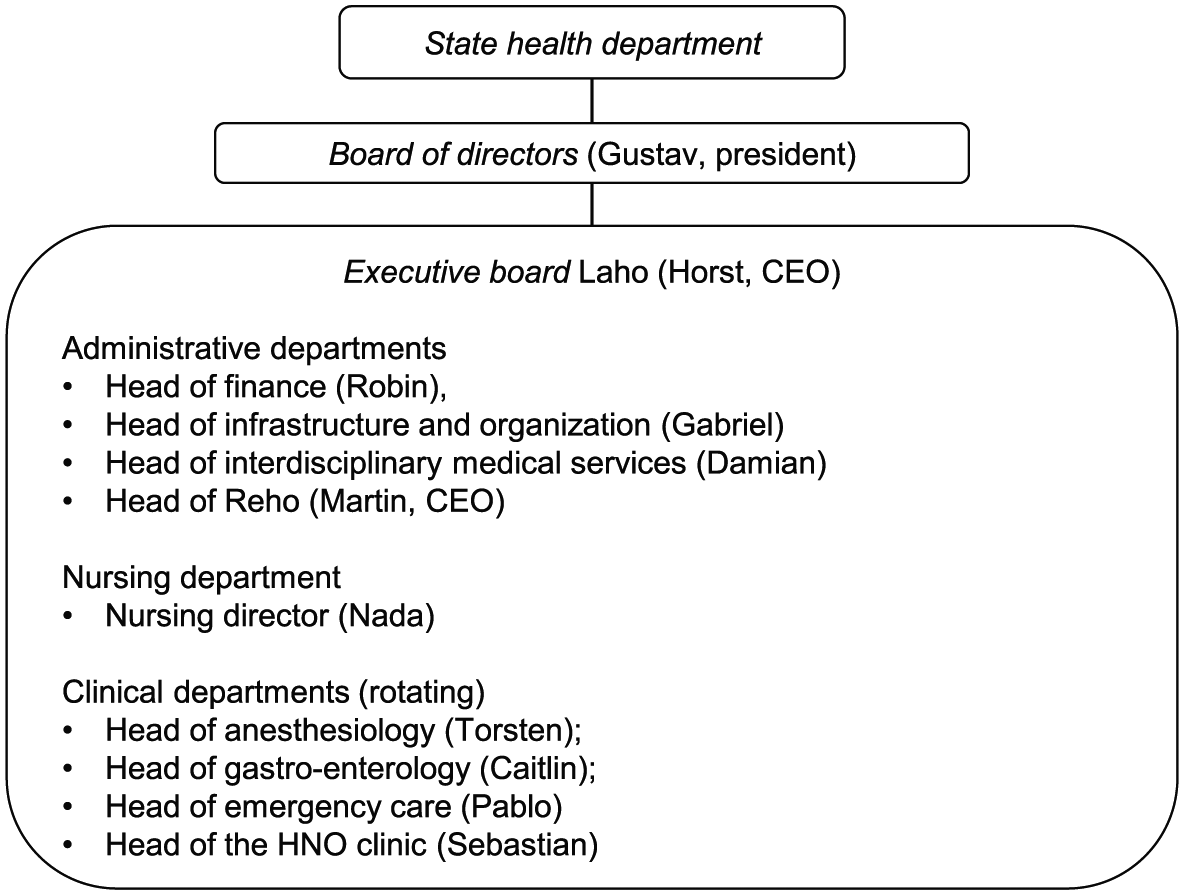
Laho’s executive board (with names of members).
To tackle this inconsistency, it is timely to explain both paradox salience and latency endogenously, and thus to expand the current explanatory scope from paradoxical thinking to specific interactions, which ‘often escape the monitoring of organizational actors’ (Putnam, 1986, p. 162). Latency, if approached endogenously, becomes integral to coping with contradictory tensions (Clegg et al., 2002, p. 488). This happens, for example, when managers promote unity within difference ‘so that contradictions or paradoxes … appear to be dissolved or overcome’ (Abdallah et al., 2011, p. 335). Nevertheless, we still know little about how contradictory tensions surface and subside in moments of interaction, e.g. during a board meeting (Putnam et al., 2016, p. 15).
A social systems theory lens on paradox
Exploring paradox latency endogenously implies a process perspective. This assumes that organizing and paradox are continuously becoming (Tsoukas & Chia, 2002), moreover in specific moments (Hernes, 2008; Nayak & Chia, 2011), which interrelate and bring forth processes that recursively reproduce themselves through these connections. These, in turn, develop into expectable stabilizing structures, e.g. rules of interaction or organization (Hernes & Weik, 2007).
Among the different process theories, Luhmann’s (2000) social systems theory (SST) responds to the call to consider the organizing paradox as socially constructed (Jarzabkowski & Lê, 2017, p. 458). SST is well suited to an endogenous approach for three reasons:
First, SST argues that organizations are inherently paradoxical. Organizations consist of moments of interaction and endure over time (Luhmann, 2000). SST explores how organizations handle this inherent paradox without self-destructing (Knudsen, 2005). Organizations are ‘fundamentally rooted in local interaction’ (Schoeneborn, 2011, p. 668) and SST highlights organizing in the moment (Hernes, 2008): ‘they [organizations] exist only at the moment an operation is actually taking place’ (Luhmann, 2005, p. 87). These moments (e.g. board meetings) are the unit of analysis for exploring latency and salience as process (Fachin & Langley, 2017).
Second, SST seeks an endogenous explanation of the surfacing and submerging of paradox in specific moments. It distinguishes individuals, their thoughts, actions and communications on the one hand, and their social interactions on the other (Borch, 2011, p. 46). For SST, the former provide a relevant environment for the latter: thus, individuals contribute utterances (as actions or communications) and find themselves participating in interactions. Whether and how individual utterances are taken up in interaction depends on how they refer to previous utterances or evoke future ones during interaction (Hernes & Weik, 2007; Nassehi, 2005). By highlighting this recursive reproduction of process (Hernes & Bakken, 2003), SST approaches unfolding interaction endogenously.
Third, SST thus calls for tracing how utterances refer to one another (including avoidance or non-referring) (Seidl & Becker, 2006). Such referencing induces specific structures, which emerge from repeated references. Repeated references create mutually held expectations (Feldman & Orlikowski, 2011; Luhmann, 2000). These are structures that pattern whether and how an issue becomes a topic during communication. Luhmann (2000, p. 145) suggests focusing on these structures, which frame an issue in certain ways through the references used (Luhmann, 1991).
Andersen (2003) provides a corresponding framework consisting of three types of references: first, factual references point to ‘the nature of the case,’ e.g. environmental affordances or the market situation. Factual references help frame an issue as a dilemma, thus prompting actors to choose between contradictory tensions. Proposing a choice visibilizes the paradox. Choosing one of the tensions invisibilizes the paradox at that moment, but invites oscillation between the poles over time (Poole & van de Ven, 1989).
Second, social references, e.g. internal or external stakeholder demands, might also induce a dilemma or a paradox (Jay, 2013). To cope with paradox, appointing a decision-maker (e.g. an individual, a department or a project team) shifts the issue from interaction onto this actor, and thereby invisibilizes it. Tensions might resurface with the appointed decision-maker and might be transformed into the paradoxes of performing or belonging (Andersen, 2003; Jarzabkowski et al., 2013).
Third, temporal references concern deadlines. Tightening deadlines tends to necessitate making a choice about an issue with contradictory tensions, e.g. the poles of differentiation and integration constituting the organizing paradox studied in this paper. Loosening deadlines allows for postponing the issue at this moment (Denis, Dompierre, Langley, & Rouleau, 2011). The issue dissolves for the time being and disappears from interaction. It might, however, resurface later.
This framework helps investigate how contradictory tensions visibilize and invisibilize during interaction, e.g. a board meeting (Schoeneborn, 2011).
Methods and Case Setting
How exactly the process of visibilizing and invisibilizing unfolds is an empirical question (Nassehi, 2005, p. 182). This paper uses a single in-depth case study like previous studies on paradox (Jarzabkowski & Lê, 2017; Jay, 2013; Luescher & Lewis, 2008). This approach is fruitful because references in interactions concern topics, actors, events and mutual expectations that are specific to a certain setting (Luhmann, 2000, p. 131).
Case setting: Integrating Reho into Laho
Laho is a leading regional hospital in eastern Switzerland and overseen by cantonal authorities. Its five medical departments (home to 32 clinics), administrative units and nursing make Laho a pluralistic organization, whose relatively autonomous actors pursue diverse strategic interests (Denis et al., 2007). Thus, Laho provides an ideal setting for studying paradox (Lewis & Smith, 2014).
The poles of differentiation and integration intersect in Laho’s executive board (see Figure 1) (Ford & Backoff, 1988; Jarzabkowski et al., 2013; Jay, 2013; Lawrence & Lorsch, 1967).
The board consists of the representatives of the hospital’s nine departments. It includes the heads of four clinical departments (Caitlin, Torsten, Pablo and Sebastian), the director of nursing (Nada), the head of infrastructure (Gabriel), the head of finance (Robin) and Reho’s CEO (Martin). Horst, Laho’s CEO, presides over the executive board while the president of the board of directors (Gustav) regularly participates in board meetings.
At the time, a major topic of debate among board members was the initiative to integrate Reho, a nearby regional hospital, into Laho. This restructuring initiative touches on the organizing paradox of integration and differentiation (Jarzabkowski et al., 2013). The initiative began in the late 1990s, when the cantonal government suggested closing Reho to reduce public spending. The government withdrew the plan after demonstrations in Reho’s hometown. Subsequently, the two CEOs, Martin and Horst, prepared for closer cooperation. Meanwhile, the cantonal government divided the canton’s hospitals into four regions, one of which comprised Reho and Laho. Officially launched by the cantonal government in 2003, the various clinics and nursing departments pursued integration more or less independently. Integrating Reho and Laho was frequently discussed at executive board meetings. In 2007, the hospital officially announced its successful integration.
Data sources
The researchers gained in-depth access to Laho in 2004. The executive board invited the author and his colleagues to accompany several initiatives as non-participant observers. The research team explored the hospital’s organization and management in the field until December 2007. Supervised by the author and his supervising professor, the researchers aligned methods for conducting and documenting observations, interviews, archival analyses and feedback workshops. This helped them generate a rich database. They agreed that team members could use the data for their own theses and publications. Collaboration enabled all the researchers to become involved in the field without being present during the entire period of investigation.
The key data of this paper are the board’s discussions on the hospital integration. These observations were transcribed by the author and various research colleagues (as non-participant observers). Further observations helped gain in-depth understanding of the setting. Besides observing various project meetings, the author also observed interactions in the surgery, internal medicine and nursing departments. Interactions ranged from team meetings to leadership constellations. The surgery and internal medicine wards at both hospitals were shadowed for five weeks. The author participated in the shadowing and in 85 of the 159 observations, whose detailed records were transformed into memos shortly afterwards. For privacy reasons, audio- or video-taping was not permitted.
The author conducted 125 of the 181 semi-structured interviews, of which those with executive board members are central to this paper. The other interviews served to understand the setting and to validate insights. Each interview lasted one to two hours, was audio-taped and fully transcribed. The interview population included all hierarchical levels of the observed units. Interviews with key informants were repeated several times.
Archival data contained 274 items, including concept papers and presentations, meeting agendas, minutes and email correspondence, publicly available data of annual reports and media coverage.
Feedback workshops enabled us to validate the emerging insights and provided data on our research partners’ reflections, which were documented in detail. The author participated in all 44 workshops, which involved all hierarchical levels and observed units, including the executive board.
The four data sources made it possible to triangulate the emerging insights and to avoid any potential retrospective researcher bias. The data exemplify our team’s sustained access to Laho in the period 2004–2007.
Data analysis
Empirical focus on the organizing paradox
Although the interviewed executive board members reported their awareness of the organizing paradox, they struggled to address this phenomenon in their meetings. They referred to the organizing paradox as ‘garden thinking’, a metaphor that denotes its differentiation pole: ‘Everyone cultivates their own garden: the surgeons, the internists and the administration’ (Nada, head of nursing). In addition to using a label common throughout Swiss hospitals and elsewhere (Denis, Lamothe, & Langley, 2001, p. 835), board members assumed that garden thinking was integral to their hospital: ‘The clinics run themselves’ (Horst, CEO); ‘You can’t tell the clinics or departments what to do’ (Robin, head of finance). At the same time, the executive board members argued the importance of integration. Gustav, the president of the board of directors, claimed: ‘we need to enhance interdisciplinary cooperation’. John, head of surgery, agreed: ‘Many clinic heads can’t yet imagine that we would be better of collectively.’ Sarah, responsible for developing hospital strategy, summed up matters: ‘It’s clear that breaking down the walls between the clinics and looking at the whole organization is going to be essential.’
Despite their individual awareness, respondents struggled to address the organizing paradox, as Pablo, head of emergency care, observed at the beginning of this paper. Robin, head of finance, underscored this point: ‘It would be really, really helpful to genuinely engage in an open discursive struggle and to put the truth on the table within the executive board. But instead you’ve got to watch what you say.’ Gustav, president of the board of directors, added: ‘Damn, so much is done informally around here.’
Analysing the board discussions
To better understand these insights into the organizing paradox, the issues discussed at the board meetings were catalogued based on the collected meeting agendas, minutes and observational data.
First, and to select board interactions, issues referring to a single clinic or department and ones not prompting discussion (e.g. uncommented working group reports or document approvals) were excluded. The remaining issues were examined for linguistic clues of contrast, conflict or debate (Jarzabkowski & Lê, 2017; Lewis, 2000). The resulting interaction dataset reveals those moments in which practitioners express their concerns about ‘garden thinking’.
Second, these interactions were considered instances (Fachin & Langley, 2017). The beginning of such instances was defined as the moment when the issue entered the discussion and their end as the moment when interaction shifted to the next issue.
Third, the endings of the various instances were compared. Two common endings involved shifting an issue with contradictory tensions to a private conversation or a project. A third, though less frequent response, was to leave the issue untreated. In all three cases, such issues disappeared from the board’s attention for the time being, as underscored by omitting the issues from the meeting minutes. The disappearance of issues indicates that the paradox invisibilized after surfacing within board interactions and shifted to a less disturbing place (Luhmann, 2000; Nassehi, 2005).
Fourth, validation with interview data indicated that projects or private conversations typically served as less disturbing places for contradictory tensions. While the third response, ‘diluting the issue’, was hardly evident in our interview and archival data, it has been mentioned in other studies (Denis et al., 2011; Lozeau, Langley, & Denis, 2002). We also observed this third ending when the executive board discussed the CEO’s forthcoming succession during a feedback workshop.
Fifth, short interactions were analysed with the help of Andersen’s analytical framework (2003). Every utterance was related to a factual, social or temporal reference through keywords because board discussions could not be audio- or video-taped for privacy reasons. Referencing revealed a pattern of visibilizing and invisibilizing contradictory tensions through eliciting an issue’s complexity. Complexity indicated the multiple pressures in the external environment as well as organizational members’ multiple perspectives and interests (Toubiana, Oliver, & Bradshaw, 2017, p. 1014).
Sixth, this pattern was revised into the current version by analysing longer board discussions. References were subsumed under different functions: ‘raising the issue’, ‘substantiating the issue’, ‘transforming the issue’ and ‘shifting the issue’ (see Table 5). Interviews confirmed these insights in that ‘garden thinking’ resonated with raising, substantiating and transforming an issue. Utterances that were used to dampen conflict expressed a particular mutual expectation, which respondents called ‘the strive for harmony’ (Torsten, head of anaesthesiology), in order to avoid open conflict.
Seventh, the general database allowed tracing the issues forward in time, in order to discern where a particular issue and its associated contradictory tensions resurfaced. All of the presented issues reappeared later, as well as in different settings, and thereby also transformed the organizing paradox (Andersen, 2003).
Results: (In-)Visibilizing Contradictory Tensions
The following three instances illustrate how contradictory tensions enter and disappear from board discussions, and thus visibilize and invisibilize the paradox of differentiation and integration. Their order reflects the organizing paradox: inter-hospital relations (instance 1), inter-professional relations (instance 2) and clinic–board relations (instance 3).
Instance 1: Subsuming the issue under a project
The first instance shows how a conflictual issue is subsumed under a project. The issue was Reho’s status within Laho’s organizational structure. This being departmental (see Figure 1), Reho did not fit in easily.
From the outset, the two hospital CEOs (Martin and Horst) agreed on a set of principles for conducting integration as equal partners. Laho, however, was much larger and the canton’s principal hospital. It provided more specialized medical services, similar to those of a university hospital. In comparison, Reho was a small regional primary care hospital. Laho’s nursing and medical professionals therefore assumed that Reho would adapt to Laho. Martin, Reho’s CEO and co-head of its internal medicine department, was worried that Reho would lose its status if, for example, its emergency care unit were operated by Laho: ‘Without emergency care, we are not a primary care hospital anymore.’
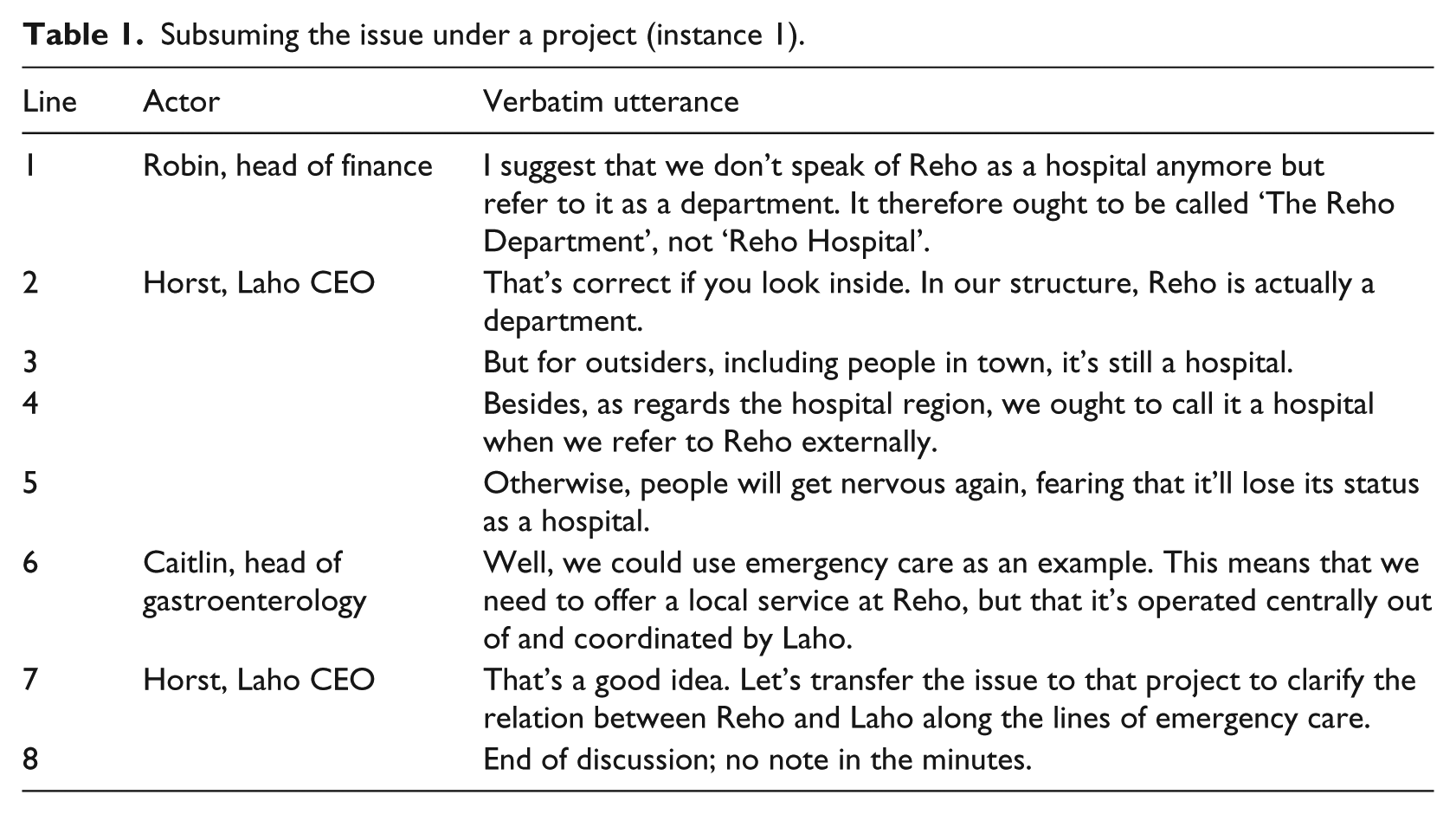
In Table 1, the executive board briefly discusses Reho’s status after Robin, the head of finance, raises the issue during Horst’s (Laho’s CEO) presentation on the hospital integration initiative.
Subsuming the issue under a project (instance 1).
Discerning the paradox of differentiation and integration
Robin raised the issue of clarifying Reho’s status within the overall organizational structure. For the finance department, organizational structure is important for accounting purposes, especially for distinguishing costs and revenues by unit.
This issue expresses the organizing paradox of differentiation and integration. Integrating Reho into Laho’s departmental structure, with its emphasis on professions (see Figure 1), resonated with differentiation. Integrating the different departments was considered the task of the executive board: ‘The daily challenge of running a hospital is to ensure the relation between the part and the whole’ (Damian, head of interdisciplinary medical services).
Visibilizing and invisibilizing contradictory tensions
Analysis of the conversation in Table 1 shows that, after raising the issue by making a factual reference to Laho’s organizational structure (‘department,’ line 1), Robin suggests that Reho be considered part of Laho. Horst agrees (line 2) and thus dampens potential conflict. He also introduces the distinction between ‘inside’ (line 2) and ‘outside’ (line 3). The external context enters into the equation in the form of two social references (‘people in town’, line 3; the political context, i.e. the ‘hospital region’, line 4). These references are combined both with a temporal reference to the past (‘again’, line 5) and with the potential future risk (‘nervous’ and ‘fearing’, line 5). The board members are all aware of the public demonstrations and petitions that followed the government’s proposal in 1998 to close Reho. At this point, the distinction between inside and outside frames the issue differently and elicits its complexity. The question of Reho’s structure appears undecidable at this point. In response, Caitlin offers a way out by suggesting the analogy with the emergency care unit (line 6). This factual reference helps handle the issue in a both-and manner. Taking this cue, Horst transforms it into a social reference by shifting the issue to a project, i.e. the reorganization of Laho’s and Reho’s emergency care (line 7). Uncontested either by the board or by Martin, Reho’s CEO, the discussion about Reho’s status ends without the board’s decision – to shift the issue into the future – being recorded in the minutes. At the time, moving the issue forward and into another, seemingly less disturbing, setting (i.e. a project) serves Horst’s pursuit of a ‘quiet’ integration: ‘Look, the politicians are praising us for the integration, because there are no more public complaints; the doctors remained quiet and are satisfied now.’
The brief discussion ends and the issue (i.e. Reho’s status) disappears from the board’s attention at this moment, thus invisibilizing the contradictory tensions surrounding Reho’s status.
Tracing the issue and subsumption under a project
Laho’s status was resolved at the end of 2006, when Laho announced that Reho’s integration had been completed. The new organizational chart now featured Reho as a Laho department. Laho’s public announcement called the integration strategy ‘one hospital – two sites’. It thus addressed the internal and the external demands arising from subsuming Reho’s status under the emergency care project.
Until then, the contradictory tensions surrounding Reho’s status had resurfaced in other projects part of the hospital integration. Nada commented: A lot of ‘good-will’ project groups are fiddling around with things, but so far the executive board hasn’t clearly defined what the overall organization should look like, nor how the departments, clinics and executive board are going to be related.
Thus, invisibilizing the issue and the contradictory tensions from the board’s attention meant that other parts of the integration had to reconsider Reho’s position(ing) within the new whole.
Interviewees confirmed that subsuming an issue under a project was typical at Laho. For example, Damian, head of interdisciplinary medical services, reported: ‘To avoid disruptions, we intend to subsume process orientation under an information technology initiative.’ Horst, Laho’s CEO, repeated this pattern by subsuming the initiative under the legal requirement to limit junior doctors’ working hours.
The board visibilizes and invisibilizes the issue, typically subsumed under a project, as follows: it is raised with a factual reference that proposes a choice, responded to with a conflict-dampening utterance and followed by a social reference that introduces a new distinction. This distinction frames the issue differently and thereby transforms it. This framing is also combined with a temporal reference and raises the issue’s complexity. The issue appears undecidable. Here, shifting the issue begins by suggesting a factual reference. This becomes a social reference, which in turn assigns the issue to another setting and to the future. The paradox of differentiation and integration disappears from the board discussion after raising the issue of Reho’s status within Laho.
Instance 2: Shifting the issue to private conversation
The second instance exhibits a similar pattern and shows how perceived contradictory tensions between board members shift ‘to a private conversation’. The issue is Martin and Nada’s decision to replace Reho’s nursing director with one of Laho’s head nurses.
As part of the hospital integration, Laho’s nursing department integrated Reho’s by adapting its professional standards and organization to Laho’s nursing practices. To this end, Nada tasked Rachel, a Laho head nurse, with taking charge of Reho’s wards. After four months, Nada was now aiming to appoint Rachel as Reho’s nursing director. Martin (Reho’s CEO and co-head of internal medicine) had appointed and worked with her predecessor.
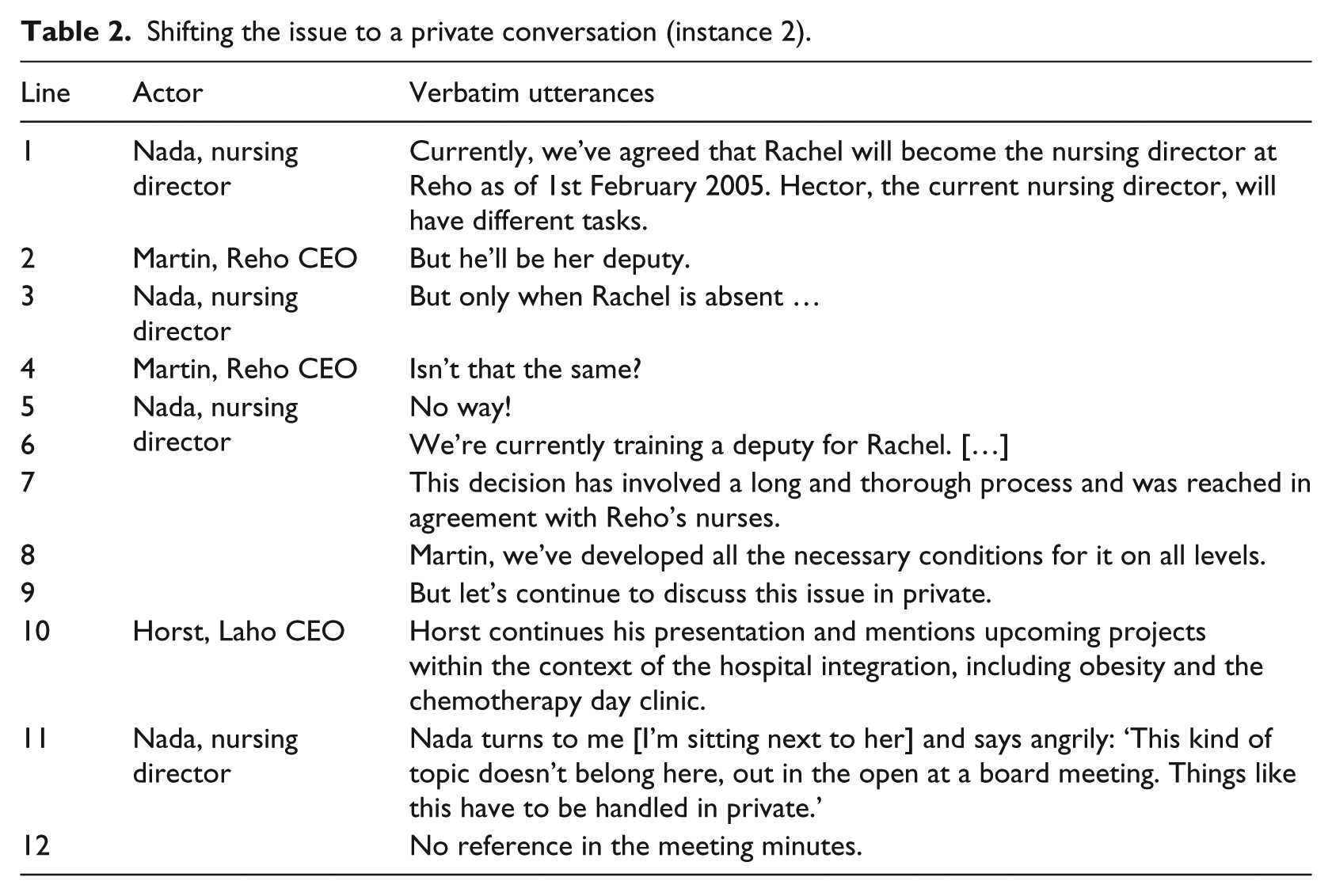
Before the board meeting, Martin and Nada reached an agreement that was announced and accepted by Reho’s nursing staff in early November: ‘This change has been in the air; I think it might not be so bad after all,’ Jill, a Reho nurse, told the author as we left the meeting. The exchange in Table 2 shows how this issue enters and disappears from the board’s attention.
Shifting the issue to a private conversation (instance 2).
Discerning the paradox of differentiation and integration
Compared to the first instance, the second one concerns an issue that involves two dimensions of contradictory tensions. First, and as previously, the issue brings to the fore the unspecified relationship between Reho and Laho. The question is whether a member of Laho can call for a decision concerning Reho’s executive staff.
Second, the issue also touches on the relationship between nursing and the various medical departments. Reho’s nursing department was traditionally subordinate to the medical profession and dependent on its requests, unlike Laho’s, where nursing considered itself equal to the clinics. Replacing the nursing director therefore also concerns inter-professional relations.
Visibilizing and invisibilizing contradictory tensions
In instance 2 (see Table 2), the contradictory tensions surface without any conflict-dampening utterances (see instance 1). Commenting on Horst’s presentation, Nada (line 1) first makes a factual reference by informing the board about the staffing decision while leaving Hector’s future tasks unspecified. Martin (lines 2, 4) questions the prior agreement with factual references by inquiring about his employee’s actual tasks and role. Nada responds angrily (lines 3, 5). Contradictory tensions surface, also when Nada announces the new ‘deputy’ (line 6; social reference). Nada’s response substantiates the agreed replacement with a social and temporal reference (‘good process’), in order to indicate its complex emergence. Here, ‘good’ means including the nursing staff (line 7) and all hierarchical levels (line 8). Similar to instance 1, Nada thus introduces a new distinction by including the nursing department. This reference evokes the issue’s complexity, by stating that the prior agreement had prompted further activities, including its announcement to Reho’s staff. To avoid further discussion, Nada suggests continuing the conversation in private (line 9). This move is implicitly accepted by Horst, who continues his presentation, and by Martin, who remains silent. Immediately afterwards, Nada explains that holding private conversations is a common way of handling conflicts at Laho (line 11). When interviewed, Torsten, head of anaesthesiology, explains both the other board members’ silence and their practice of discussing differences of opinion in private conversations. The ‘desire for harmony,’ he observes, is a mutual expectation: ‘There is a strong desire for harmony. Here at Laho, you try to avoid interfering with someone else’s domain … That’s also part of garden thinking.’ As in instance 1, this discussion also ends without entering the minutes.
The issue and its contradictory tensions disappear from the board’s attention by being shifted to a private conversation. The paradox of differentiation and integration, then, invisibilizes not only Reho’s status but also the relation between nursing and internal medicine.
The pattern is similar to that observed in instance 1. The issue in question is raised and followed up with factual references, to substantiate a certain perspective, and with social references, to introduce a new distinction and to reframe the issue. The issue appears complex and involves tensions between the participants. Thus, shifting the issue to a private conversation is tacitly accepted. This enables the issue and its tensions to be shifted into the future and to a ‘less disturbing place’. Unlike in instance 1, no utterance dampens the conflict in this case.
Tracing the issue and shifting issues to private conversations
Although Hector was officially replaced in February 2005, he stayed on and did not leave Reho until the end of the year. During this period, the contradictory tensions resurfaced in the collaboration between the nursing department (headed by Rachel) and internal medicine (headed by Martin). Martin complained: ‘The fact that I first have to talk to her [Rachel] before being able to approach the wards didn’t exist here before. We now have to follow the chain of command, which doesn’t help’. Rachel confirmed: ‘I’ve got to be so careful that the doctors don’t just order my people around. You’ve got to be alert all the time and sometimes even pick a fight.’
Shifting conflictual issues from a board meeting to a private conversation appears to be typical at Laho. Gustav, the president of the board of directors, noted: ‘Personally, I believe that the clinics discuss things among themselves, in private, one-on-one conversations. … You can’t really see how that works in detail.’ Similarly, Pablo, head of emergency care, described the process of gaining support for recruiting a new head of his clinic: ‘It took a lot of talking to every single head of clinic for an hour or two each.’ Horst, Laho’s CEO, confirmed that private conversations were held to handle ‘hot issues’: ‘You really only stand a chance if you first talk to every head of clinic in private. If you approach them jointly, you get a collective “no.”’
Shifting potentially ‘hot’ issues (Horst) to private conversations is typical at Laho. The above discussion includes brief engagement with a contentious issue. The board members escalate the conflict before the discussion ends by shifting the matter to a private conversation, i.e. a less disturbing place. The issue disappears from the board’s attention, yet without its members engaging with the paradox of differentiation and integration, whether in terms of inter-hospital or inter-professional relations.
Instance 3: Diluting the issue
The third instance illustrates how an issue and its contradictory tensions are diluted. The issue – surgery’s intention to establish obesity as a new treatment area at Reho – is abandoned without being assigned to another setting. This instance adds a third dimension to the organizing paradox of differentiation and integration: clinic–board relations.
After the hospital integration was officially launched in 2003, Laho’s surgeons took over Reho’s corresponding clinic. Apparently John, Laho’s head surgeon, approached Reho’s CEO (Martin) in a private conversation in order to plan new treatment areas (e.g. obesity). In addition to surgical therapies, obesity focused strongly on non-invasive treatment and therapeutic measures, in order to help patients balance their weight.
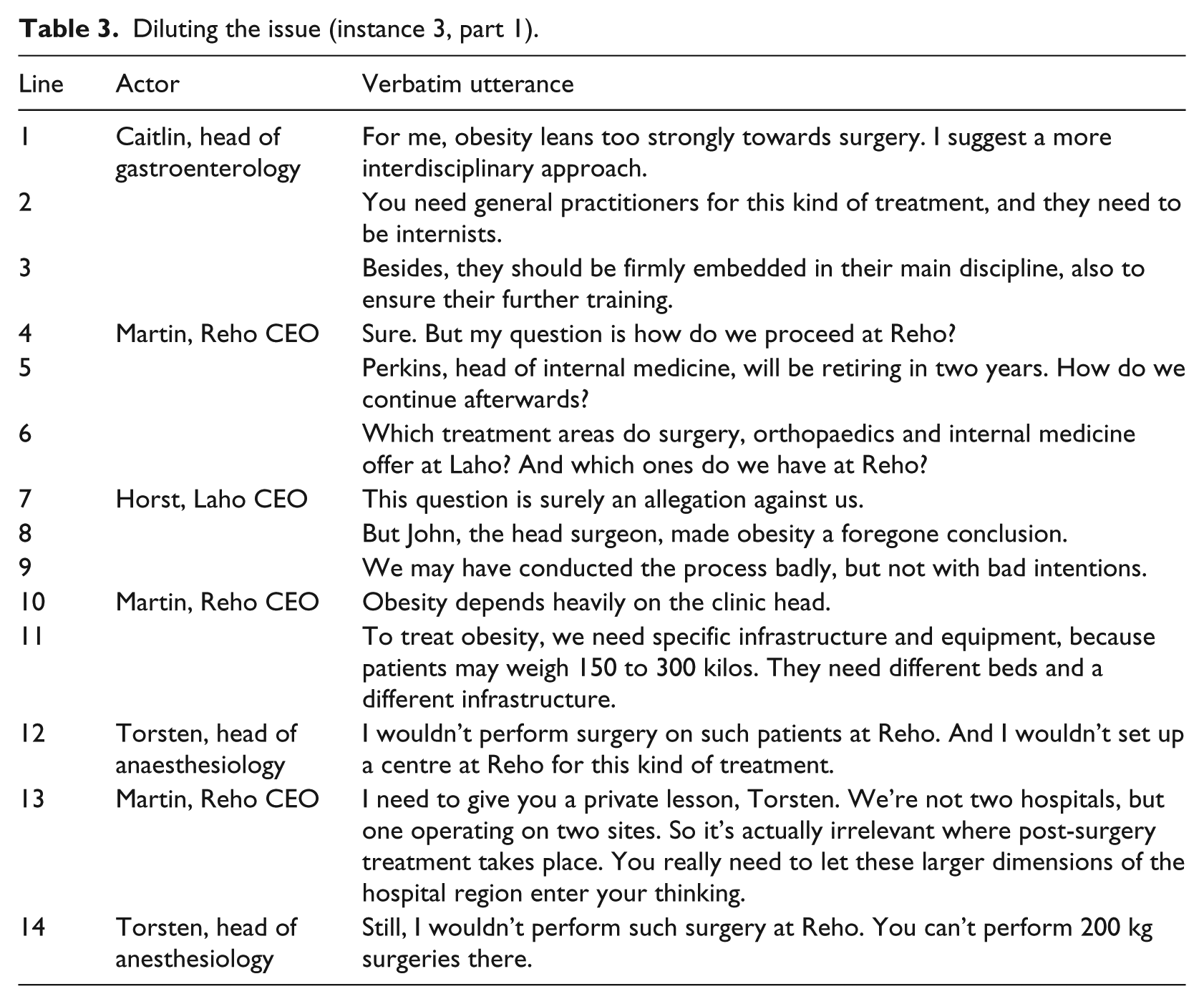
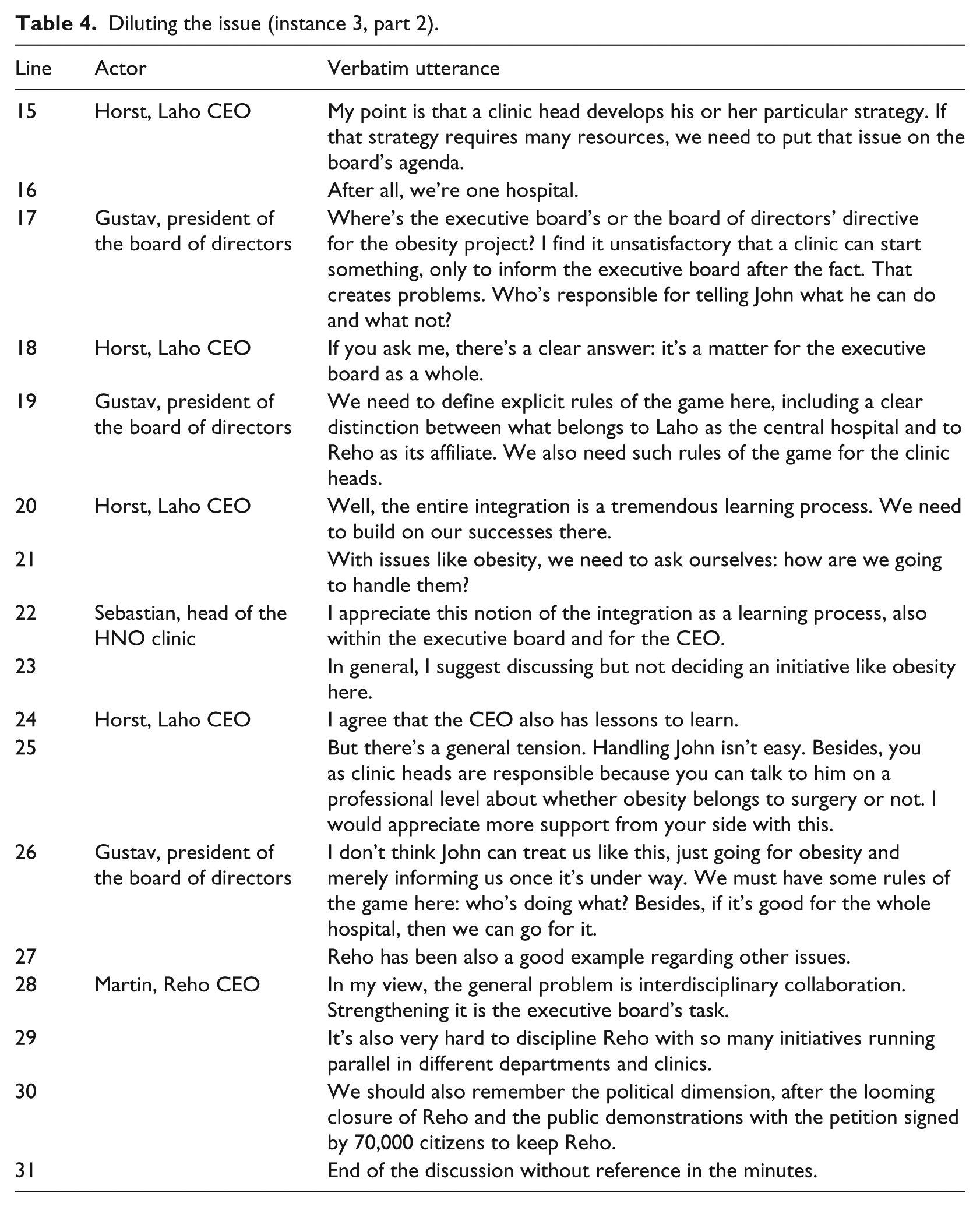
The following discussion (see Tables 3 and 4) began after Horst had presented new developments at Reho. For the sake of clarity, the instance is divided into two parts. Part 1 (Table 3) shows how the three dimensions of the organizing paradox are raised. Part 2 (Table 4) mainly concerns the third dimension, whose discussion ended inconclusively, and thus invisibilized the previously surfaced tensions.
Diluting the issue (instance 3, part 1).
Diluting the issue (instance 3, part 2).
Discerning the paradox of differentiation and integration
The first part of the instance links the three dimensions of the organizing paradox to the issue of obesity: at the beginning, Caitlin (lines 2–3) observes that inter-clinic relations – the first dimension of the paradox – should be more ‘interdisciplinary’. She underscores this point with a factual reference to treating obese patients (line 2) and then substantiates this dimension with other factual references (line 3). Martin’s responses include both temporal (line 5) and social references (line 6). He thereby transforms the issue to be framed within Reho–Laho relations – thus raising the second dimension of the paradox – and increases the issue’s complexity. Horst’s reply (line 7) adds the third dimension by criticizing the surgery clinic (line 8) while defending himself as CEO (line 9).
What follows is a heated back-and-forth between two distinctions (lines 10–14): whereas Torsten argues on the medical level (treating obese patients), Martin responds from the perspective of Reho’s future. Both substantiate their position with factual references.
After this escalation, the discussion continues and focuses on the third dimension, clinic–board relations (Table 4).
Visibilizing and invisibilizing contradictory tensions
Horst raises this dimension (line 15) and adds a social reference to dampen conflict (line 16). Gustav transforms the dimension of clinic–board relations (lines 17–19) by requesting more explicit decision-making to foreground Laho as a whole and by including a social reference to the executive board as a decision-maker. Horst agrees (line 18) and Gustav further underlines his proposal (line 19). After referring to the past (‘learning’) and to the present (‘successes’), i.e. conflict-dampening social and temporal references, he returns to the dimension of clinic–hospital relations (line 21). Sebastian (line 23) contests this view by emphasizing clinic autonomy, also after de-escalating tension (lines 22, 20). When Horst, assisted by Gustav (line 26), returns to the ‘general tension’ (line 25) over rethinking clinic–board relations, he adds the distinction between medical and non-medical board members by requesting support for dealing with clinic heads like John. The other board members do not respond. Although Martin acknowledges the issue (line 28), he opposes Gustav’s proposal (line 29). Martin’s social references to Reho’s external context and his temporal references to the previous crisis end the discussion by claiming that changing the status quo is impossible (line 30). The contradictory tensions of the organizing paradox disappear from the board’s discussion without entering the minutes.
In part 2 of the interaction, the board leaves the previously contested terrain and concentrates on clinic–board relations. The issue, once raised, transforms twice (the demand for rules of the game and the distinction between medical and non-medical board members). This places the paradox within the board, accompanied by several utterances intended to dampen the conflict. But the issue remains unresolved. Since the board acknowledges its ownership of the third dimension, no social reference is made to assign the issue to another setting. The interaction ends by returning to the second dimension of Reho–Laho relations and by evoking the past crisis. The issue and the associated dimensions of the organizing paradox move into an unspecified future and remain unrecorded in the minutes.
Tracing and temporarily diluting issues
In a later interview, Nada explained that involving the executive board in an initiative like obesity would jeopardize such a project: Obesity wouldn’t go ahead if it were discussed by the executive board. There, things need to be discussed extensively and that can kill motivation. … It’s going to work now. We’ll earn revenue and then nobody will say anything anymore.
The surgery clinic launched the Reho obesity centre in spring 2005. It recruited an internist to handle those treatment activities that lay beyond the expertise of Reho’s surgeons, for whom John negotiated further training at Laho’s internal medicine clinic. Overall Reho–Laho relations were resolved later (see instance 1).
Clinic–board relations continued to resurface variously and with other issues. One was Laho’s strategic development; the author observed a project team’s presentation of 23 separate clinic strategies without displaying their interdependency or integration into a hospital-wide strategy. Discussing this fragmentation, the board followed a similar pattern and ended by assigning the integration of the differentiated strategy proposals to the project team (see instance 1). Second, clinic–board relations emerged as an issue during the feedback workshop with the executive board, in which the author and his colleagues presented their observations about decision-making at Laho. After validating their own practice, Horst invited his fellow board members to develop an explicit procedure for his succession, an attempt that petered out after considerable group work. Third, clinic–board relations resurfaced during interviews, similar to the private conversation in instance 2. Gustav, Horst and other respondents mentioned the difficulties in addressing contradictory tensions within the board (see methods section). At the same time, others appeared to accept the current practice of handling issues outside the board in barely transparent ways. When queried about this practice, Nada, for example, responded: ‘But for the time being it still works somehow.’ Similarly, Sebastian (line 23) noted that bypassing the executive board provided a workable way of coping with the paradox of integration and differentiation.
Discussion: (In-)Visibilizing Paradox
The previous section has illustrated various board interactions in terms of their different endings: subsuming an issue under a project, shifting it to a private conversation or diluting it.
The following summary analysis considers the references occurring across these instances. The references are condensed into a process model (see Figure 2) of visibilizing and invisibilizing contradictory tensions in moments of interaction.
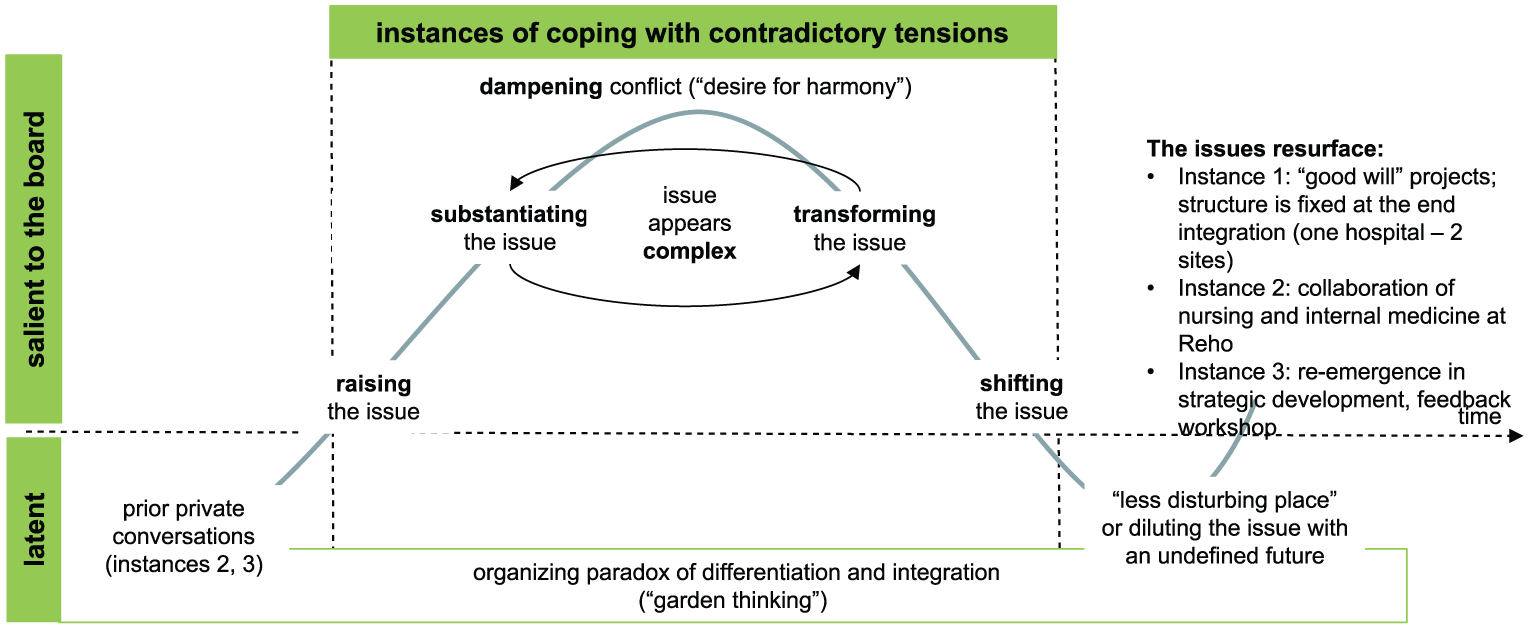
Invisibilizing paradox in the executive board.
The three instances contain a multitude of factual, social and temporal references. Notably, these are more entangled than conceptual studies have suggested (Andersen, 2003; Nassehi, 2005). Table 5 displays each instance as one column, but differentiates these into sub-columns according to the three types of references. These references are compared in terms of their ‘use’, whose description is then summarized as ‘moves’ during interaction.
References, use and labels of interactions.
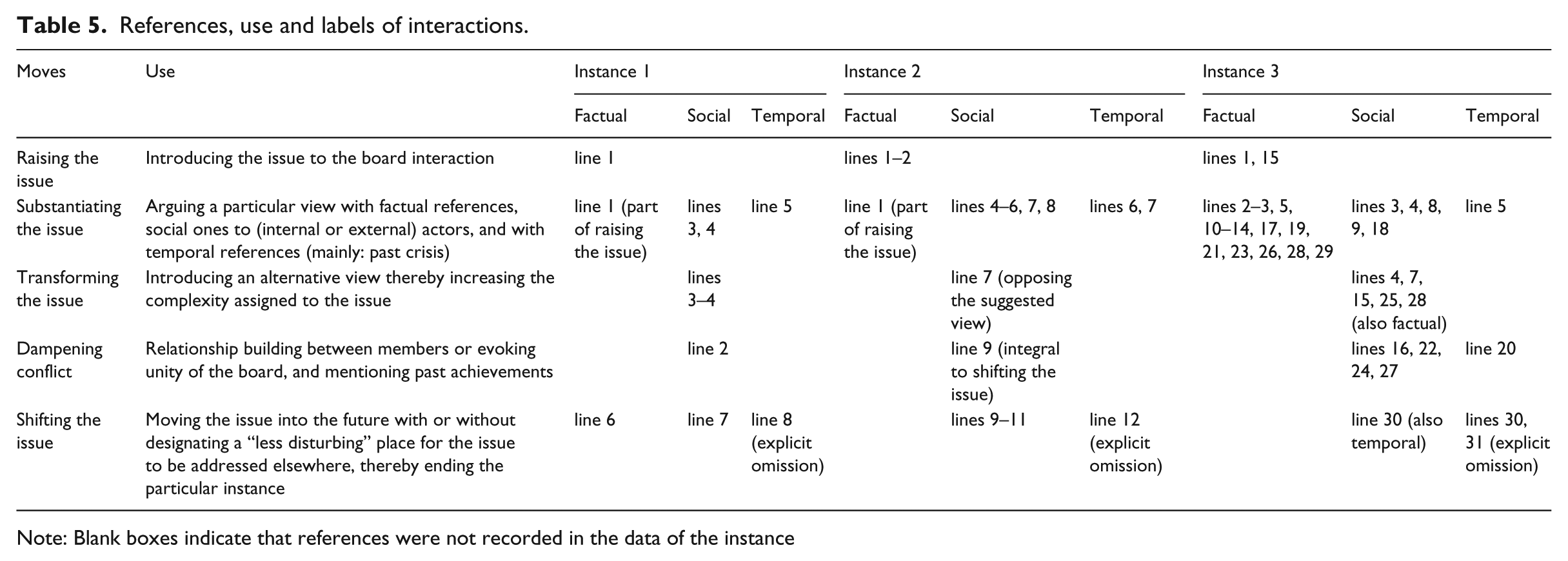
Note: Blank boxes indicate that references were not recorded in the data of the instance
‘Raising the issue’ occurs mainly through factual references, which introduce the issue to board interactions (see Andersen, 2003; Knudsen, 2005). ‘Raising the issue’ opens up or invites contingency into interaction (Vásquez, Schoeneborn, & Sergi, 2016).
Next, discussion participants argue their views on the issue. Using factual, social and temporal references, they ‘substantiate the issue’. Examples include organizational structure (instance 1), a deputy head’s responsibilities (instance 2) or patient treatment (instance 3).
In response, other participants introduce an alternative view, thereby ‘transforming the issue’ (see Andersen, 2003). Bringing in social references of external or internal actors, their alleged perspectives help establish the alternative view and then substantiate the issue (as observed above). For example, participants add the community’s expected perception of the structural issue (instance 1); or that of the internal organizational unit (instance 2); or several dimensions of the organizing paradox (instance 3). Overall, transforming the issue evokes its complexity. Transformation enlarges the different perspectives on an issue and thus also its meanings (Vásquez et al., 2016). The highlighted difference surfaces paradox.
If, as in instance 3, participants oscillate between two views, they ‘dampen conflict’. They mainly use social references, e.g. agreement or unity (instances 1, 3), but also temporal references to past achievements and learning (instance 3). While dampening conflict limits escalation, it may also invite invisibilizing paradox when unity dissolves differences (Abdallah et al., 2011).
Towards the end of the instances, the issue and its views leave the board interaction. I call this ‘shifting the issue’. In instances 1 and 2, this occurs through designating a ‘less disturbing place’ in order to address the issue in the future (Nassehi, 2005). Failing such designation, the issue dilutes in that moment (instance 3). Nevertheless, a less disturbing place may become available later to the board, e.g. when discussing Laho’s strategic development.
The temporal dimension remains unspecified in all instances. This lack of specificity is underpinned by omitting a corresponding reference in the minutes. This omission enables the issue to be postponed (Denis et al., 2011). By shifting the issue, its contradictory tensions remain open, i.e. no particular way of handling it is determined (Vásquez et al., 2016). Instead of engaging with an issue’s contradictory tensions, the social and temporal references shift it to a less disturbing place and into the future.
The issue later resurfaces in different settings (Andersen, 2003) and transforms along with its contradictory tensions, for instance, into ‘goodwill projects’ involving unclarified roles (instance 1), into collaboration tensions (instance 2), or into fragmented strategy making and untransparent CEO succession (instance 3). Tensions are also addressed in our research interviews, which implies that the respective issues might also move forward to other private conversations (see also instances 2 and 3).
The model in Figure 2 summarizes the analysis by displaying the moves as they occur during interaction (grey line), including the oscillation between an issue’s different framings and its tensions.
The model depicts how contradictory tensions visibilize and invisibilize in moments of interaction (central column). Beyond these instances, the resurfacing of issues illustrates that this process is continuous (Luhmann, 2000) and transforms issues and contradictory tensions (Andersen, 2003, p. 249). It also suggests that coping with paradox is an ongoing part of organizing, which includes visibilizing and invisibilizing tensions (Nassehi, 2005). Therefore, paradox salience and latency are less a condition to be overcome or to be established, respectively, than integral to the process of handling paradox in the moment of interaction.
This endogenous process model of board interactions contains three observations regarding paradox latency, even if individuals are aware of the organizing paradox.
Most visibly, participants focus on the issue, but not on the organizing paradox (see also Jarzabkowski & Lê, 2017). In comparison, when supported by action researchers, other teams have addressed paradox (Jay, 2013; Luescher & Lewis, 2008). The actors in my case respond to the issue’s complexity or ‘mess’ rather than (factually) envisioning a workable solution (Luescher & Lewis, 2008, p. 227). Further, they prefer to shift the issue to a less disturbing place outside the board (social reference) or to the future (temporal reference). Either way, the issue therefore disappears from the board’s attention, thus invisibilizing the contradictory tensions at this moment.
One reason for invisibilizing paradox in these moments is that explicitly addressing paradox surfaces the board’s own practice of handling issues. Making this self-reference visible and thereby contingent (Nassehi, 2005) risks destabilization or blockage (Knudsen, 2005). Shifting the issue circumvents the challenge of considering one’s practice (as in instance 3) while enabling continuance. In comparison, actors in other studies assign their respective issues to the external environment (Jay, 2013), other departments (Jarzabkowski & Lê, 2017) or the upper echelons (Luescher & Lewis, 2008). Such a social reference to another actor cancels out self-referentiality.
The board members in our case, moreover, struggle to address the organizing paradox because the specific ways of coping with contradictory tensions as depicted in the process model (see Figure 2) escapes participants’ monitoring during interaction (Putnam, 1986). These interactions draw on and enact the three observed mutual expectations: ‘garden thinking’, the ‘desire for harmony’ and ‘shifting the issue’. For the actors, an issue with contradictory tensions ‘doesn’t belong here’ (Nada, instance 2) or should not be ‘decided here’ (Sebastian, instance 3). These mutual expectations help invisibilize the organizing paradox. In other settings, mutual expectations encourage actors to socially construct paradox (Jarzabkowski & Lê, 2017). Either way, such structures reproduce themselves (Feldman & Orlikowski, 2011).
Contributions to the Paradox Lens
The above analysis explains paradox latency and salience endogenously as a process, even if the involved actors are aware of paradox. These insights make three contributions to the paradox lens.
First, the proposed model illuminates the interaction through which actors cope with and invisibilize contradictory tensions. In line with the paradox literature, my analysis illustrates that paradoxes are unresolvable, integral to organizing (Smith & Lewis, 2011) and thus imply continual coping (Ford & Backoff, 1988). My endogenous approach shows how and why coping with paradox visibilizes and invisibilizes contradictory tensions in moments of interaction (Abdallah et al., 2011; Clegg et al., 2002). Thus, coping with paradox is not only about achieving salience and overcoming latency (Knight & Paroutis, 2017). Rather, it is a continual process of visibilizing and invisibilizing to ensure that an organization continues to operate without being blocked by paradox (Luhmann, 2000).
Second, this endogenous explanation complements and moves beyond the existing, exogenous ones. By drawing on actors’ cognition (Miron-Spektor et al., 2017; Smith & Tushman, 2005; Westenholz, 1993), exogenous approaches downplay the interactions through which paradoxes become salient and latent. Illuminating the specific interactions – the references deployed to reproduce mutual expectations – reveals that invisibilizing is integral to coping with contradictory tensions, even if actors are aware of and think in terms of paradox (Bednarek et al., 2017; Knight & Paroutis, 2017; Miron-Spektor et al., 2017; Smith, 2014). Whether and how these thoughts enter interactions depends on interaction itself.
The third contribution relates to the social construction of paradox (Jarzabkowski & Lê, 2017; Luescher et al., 2006). Coping with paradoxes in situ, in the here and now, transforms the paradox not only in a given moment, but also when it resurfaces there and then (Andersen, 2003). In other words, paradox follows paradox as the organization copes with tensions and moves forward one moment after another. In comparison, the literature implies that paradoxes remain stable and salient once detected (Jarzabkowski et al., 2013; Jay, 2013; Luescher & Lewis, 2008; Smith & Lewis, 2011). The salient paradox is then diffused (Knight & Paroutis, 2017; Smith, 2014). At the same time, it is considered to be dynamically related to other paradoxes (Jarzabkowski et al., 2013; Smith & Lewis, 2011). The organizing paradox, viewed endogenously, transforms into another paradox, e.g. a paradox of performance, when the organizing paradox is shifted to actors as decision-makers. In sum, not only organization is becoming, but also paradox – when approached endogenously as process (Hernes & Weik, 2007).
The suggested contributions to the paradox lens open up several avenues for future research: first, future work could systematically include invisibilizing as part of coping with paradox into existing models (Jarzabkowski et al., 2013; Jay, 2013; Luescher & Lewis, 2008; Smith & Lewis, 2011). Moreover, though beyond the scope of this study, future research could revisit the conditions of plurality, change and resource restrictions. While these are said to promote paradox salience (Lewis & Smith, 2014), they can also be associated with invisibilizing paradox.
Second, future studies could trace paradox and how specific tensions move through the organization in greater detail. Beyond the executive board, future studies could show where, when and how contradictory tensions surface (Andersen, 2003; Nassehi, 2005).
Third, my data are limited to verbal utterances, due to lacking permission to audio- or video-tape board interactions. More nuanced data would allow a more fine-grained analysis of active and passive participation during interactions.
Fourth, this study raises the methodological question of observing latency. This is a second-order observation of how a social system operates, which is a first-order observation (Luhmann, 1991). The second-order observation aims to illuminate what is latent within the first-order observation. The second-order observation, however, is itself an observation and therefore also blind to its own operating in that moment, for instance, when ‘garden thinking’ serves to subsequently interpret interactions. We need to further elaborate on observer dependence, as other scholars have done previously (Jarzabkowski & Lê, 2017; Jay, 2013; Luescher & Lewis, 2008), because paradoxes are ‘a means of generating observations, rather than a description of reality “out there”’ (Knudsen, 2005, p. 111).
This paper has explored the visibilizing and invisibilizing of contradictory tensions in order to explain paradox latency and salience endogenously as a process. Both phenomena are integral to coping with issues and the associated contradictory tensions arising during specific interactions. Studying the references deployed during interactions enables a processual explanation of paradox salience and latency, even if the participating individuals are aware of the paradox. In conclusion, the challenge is not just how we think about a problem (Miron-Spektor et al., 2017), but how we interact when coping with paradox. Our interactions shape whether and how our thinking enters conversations.
Footnotes
Acknowledgements
I am very grateful to my colleagues and to Johannes Rüegg-Stürm for our collaborative empirical research. I would also like to thank my editor, Robin Holt, and the two reviewers for their supportive and critical insights. In addition, my thanks go to the organizers – Ann Langley and Hari Tsoukas – and the participants of the annual International Symposium on Process Studies (PROS) for their helpful comments on previous versions of this paper.
Funding
This research received no specific grant from any funding agency in the public, commercial, or not-for-profit sectors.