






Abstract
Despite the adoption of collaborative buildings and office spaces to improve collaboration, the expected benefits of spatial interventions often fail to materialize. In a study of an ostensibly ‘collaborative building’, we identified strategies that employees use to avoid collaborating (i.e. ‘focusing on existing collaborations’, ‘reinforcing group boundaries’, ‘enacting legacy policies’ and ‘minimizing social interactions’). These strategies combined to minimize serendipitous encounters, which led to the avoidance of new collaborations. Our findings address a theoretical tension in the literature as to whether proximity facilitates or inhibits collaboration. We also show that, while it is often difficult to facilitate serendipitous encounters in an ostensibly collaborative building, serendipity nonetheless plays a central role in the development of new collaborative partnerships.
Collaboration, the organic development of shared projects between people based on trust and personal relationships, is central to the function of organizations (Adler, Kwon, & Heckscher, 2008; Bouty, 2000). Collaboration is especially valuable because it enables people with diverse perspectives to share information and resources (Bouty, 2000) and thus to solve complex problems and promote innovation (Ahuja, 2000). Given the benefits of collaboration, it is not surprising that organizations are investing in the design and use of physical spaces such as collaborative buildings and offices (e.g. Bernstein & Turban, 2018; Dale, 2005). Such buildings are designed for collaboration based on the belief that physical proximity facilitates collaboration within and across organizational boundaries by supporting collaborative interactions and increasing chance encounters (Boutellier, Ullman, Schreiber, & Naef, 2008; Kabo, 2016).
Yet, the expected benefits of spatial interventions on collaboration often fail to materialize (e.g. Bernstein & Turban, 2018; Dale, 2005; Värlander, 2012). Studies show that ostensibly collaborative open-plan offices and buildings can trigger conflict (Ayoko & Härtel, 2003), promote territorial behaviours (Ashkanasy, Ayoko, & Jehn, 2014; Ayoko, Ashkanasy, & Jehn, 2014; Brown, Lawrence, & Robinson, 2005) and undermine collegiality (Morrison & Macky, 2017). This opens up a core puzzle for understanding collaborative buildings and spaces. Although physical proximity between employees in collaborative buildings is intended to facilitate collaboration (Bernstein & Turban, 2018), employees may engage in strategies to avoid finding new collaborators (e.g. Dale, 2005; Hirst & Humphreys, 2013; Van Marrewijk & Van den Ende, 2018). In this research, we address this important puzzle by exploring how employees avoid collaboration in a building designed to facilitate collaboration.
Our research involves an inductive qualitative study of a collaborative building that co-located 1000 scientists and support staff from three different government organizations. Based on a combination of observations and interviews, we show that employees avoided finding new collaborators by engaging in four strategies: (1) focusing on existing collaborations; (2) reinforcing group boundaries; (3) enacting legacy policies; and (4) minimizing social interactions. Together these strategies allow employees to avoid developing new collaborations by minimizing the serendipitous encounters that would otherwise enable potential new collaborators to meet.
We argue that our work makes two important theoretical contributions to the literature on collaboration, physical proximity and serendipity. First, our findings address a theoretical difference in the literature on collaboration and physical proximity about whether proximity facilitates or inhibits collaboration. We do this by showing how employees’ responses to physical proximity (rather than proximity itself) facilitates or inhibits collaboration. Second, our findings highlight the importance of serendipity in the development of new collaborative partnerships while also demonstrating how difficult it is to encourage serendipitous encounters. Specifically, we outline a process that shows how employees’ enacted strategies reduce mechanisms (i.e. ‘chance’, ‘search’, ‘flexibility’ and the ‘obligation to interact’) that are important for serendipitous encounters.
Theoretical Background
Facilitating collaboration
Fostering successful collaboration is notoriously difficult (Bridwell-Mitchell, 2016; Van Marrewijk, Ybema, Smits, Clegg, & Pitsis, 2016). In contrast to teamwork relationships that are based on formal task interdependencies and driven by organizational goals (Kozlowski & Ilgen, 2006) or buyer–supplier relationships that are based on hierarchy (Hardy, Lawrence, & Grant, 2005), collaborators choose to work together towards a self-defined goal (Phillips, Lawrence, & Hardy, 2000). The autonomy inherent in collaboration creates challenges because collaborators bring diverse perspectives, goals and levels of power into collaboration (Phillips et al., 2000). To overcome these challenges, the literature highlights three main factors that facilitate collaboration.
First, collaborators must harmonize or capitalize on differences between members (Huq, Reay, & Chreim, 2017; Majchrzak, More, & Faraj, 2012; Baunsgaard & Clegg, 2013). To succeed, collaborators with diverse backgrounds, status and experiences need to make the most of their different ways of framing and addressing problems (Phillips et al., 2000). As Baunsgaard and Clegg (2013) show, collaborators need to ensure that particular disciplines (e.g. engineering) do not dominate collaborative discussions to the exclusion of others (e.g. sales and marketing). Collaboration is successful when collaborators strengthen weaker perspectives and encourage productive debate with a focus on outcomes (Huq et al., 2017). This may involve day-to-day talk and interactions that facilitate a collective purpose or identity (Hardy et al., 2005; Van Marrewijk et al., 2016). It is also possible, however, for members to collaborate while maintaining separate identities, values and beliefs (Reay & Hinings, 2009) so long as they adopt collective strategies to traverse these differences (Majchrzak et al., 2012).
Second, chance encounters – in the form of brief, unplanned face-to-face interactions – can facilitate new and established collaborations (Boutellier et al., 2008; Kabo, 2016). Chance encounters help new collaborators meet by allowing employees lacking an existing organizational relationship to interact and develop trust (Kabo, 2016; Nilsson & Mattes, 2015). This then becomes a critical first step in the development of new collaborative relationships (Kreiner & Schultz, 1993). In this regard, Kabo, Cotton-Nessler, Hwang, Levenstein and Owen-Smith (2014) show that the propensity to meet new collaborators increases when R&D investigators traverse paths with greater overlap.
Third, physical (e.g. breakrooms, office layouts) and relational spaces (e.g. afternoon rounds at a hospital) can facilitate collaborations by supporting collaborative interactions (Bridwell-Mitchell, 2016; Kellogg, 2009). Space enables interactions that produce collective understandings (Bridwell-Mitchell, 2016), drive collective changes in policies and practices (Kellogg, 2009) and allow knowledge to be combined and extended (Dolfsma & van der Eijk, 2015; Feller, Parhankangas, Smeds, & Jaatinen, 2013). Moreover, the design of buildings facilitates chance encounters by channelling employees into common areas where there is a high possibility of encountering others (Boutellier et al., 2008; Toker & Gray, 2008).
Although the collaboration literature (see Bridwell-Mitchell, 2016; Feller et al., 2013) highlights the positive role of physical proximity as a facilitator of chance encounters and collaboration, the literature on physical proximity and serendipity (e.g. Bernstein & Turban, 2018; Värlander, 2012) suggests that the positive impact of physical proximity on collaboration can fail to materialize. To understand this puzzle better, we turn to this literature.
Physical proximity, serendipity and collaboration
Researchers (e.g. Allen, 1977; Knoben & Oerlemans, 2006) who study physical proximity – defined as the geographic gap between two employees in terms of the distance they need to travel to engage in a face-to-face interaction – remain divided on the question of whether proximity facilitates (e.g. Kabo et al., 2014; Reagans, 2011) or inhibits collaboration (e.g. Ayoko & Härtel, 2003; Morrison & Macky, 2017). Consistent with collaboration research on chance encounters, one group of physical proximity researchers (see McCoy, 2005; Monge, Rothman, Eisenberg, Miller, & Kirste, 1985; Reagans, 2011) suggest that physical proximity fosters the formation of collaborative relationships by generating an obligation to interact cued by the sensory presence of another body (Argyle & Dean, 1965; Edenius & Yakhlef, 2007). This means that even employees who may not want to interact find it difficult to avoid the social obligation to engage in a chance encounter when in the presence of others (Edenius & Yakhlef, 2007). In particular, some researchers (e.g. Kabo, 2016; Monge et al., 1985) are so convinced by the strong relationship between physical proximity and the obligation to interact that they use physical proximity as a proxy for interaction. In this regard, Allen (1977) identify a direct relationship between the distance engineers sit from one another and the frequency of face-to-face communication.
In contrast, a second group of researchers (Bernstein & Turban, 2018; Hatch, 1987; Morrison & Macky, 2017) argue that physical proximity inhibits collaboration by causing employees to socially withdraw. For example, in their study of employees who moved from enclosed to open offices to promote collaboration, Bernstein and Turban (2018) identify a 70% decrease in face-to-face interaction. Rather than promoting chance encounters, too much proximity, such as in a crowded open-plan office, can trigger conflict (Ayoko & Härtel, 2003), facilitate territorial behaviours (Ashkanasy et al., 2014; Brown et al., 2005) and undermine collegiality (Morrison & Macky, 2017). In this respect, physical proximity may fail to promote collaboration when employees feel disengaged from their organization (Hirst, 2011), fail to communicate and identify with their colleagues (Wilson, O’Leary, Metiu, & Jett, 2008) or when they desire privacy (Bernstein, 2012).
Although the literature offers some initial hints about why physically proximate employees may avoid chance encounters, existing studies provide little insight into how such employees might overcome the obligation to interact to avoid fostering new collaborative partnerships. In this regard, scholars who study buildings intended to promote modernization (Hirst & Humphreys, 2013), flexible work (Hirst, 2011; Värlander, 2012) and transparency (Bernstein, 2012) note the strategies employees use to subvert the intended use of these physical spaces. Yet, these studies provide limited insights into the strategies involved in avoiding collaboration in the context of buildings intended for collaboration.
The literature on serendipity, in particular, holds potential to shed greater light on the relationship between physical proximity and collaboration. Serendipity – defined as a ‘search, with unintended discovery’ (Dew, 2009, p. 735) – relates to the combination of prior knowledge, purposeful action and favourable accident that facilitates new discoveries. Serendipity scholars take seriously Louis Pasteur’s observation that ‘chance favors the prepared mind’ (cited in Liu & de Rond, 2016, p. 432) when explaining scientific discoveries such as Goodyear’s discovery of rubber vulcanization and Fleming’s discovery of penicillin (Merton, 2004). In contrast to scholars who emphasize the role of chance encounters and social obligation in fostering collaboration (Boutellier et al., 2008; Kreiner & Schultz, 1993), insights from the serendipity literature hint at an equal role for chance in the form of ‘favourable accidents’ and search in the form of ‘directed effort’ (Dew, 2009, p. 736).
In this respect, employees can actively facilitate serendipitous discoveries (and perhaps encounters) through a display of flexibility such as remaining open to new experiences, actively searching for information, paying attention to their environment, challenging the status quo and capitalizing on their social networks to make the most of surprises (Cunha, Clegg, & Mendonça, 2010; Dew, 2009; Graebner, 2004). Moreover, organizations can enhance serendipity by creating work conditions that combine constraint and freedom (e.g. 15% of time to experiment with new ideas; see Garud, Gehman, & Kumaraswamy, 2011) and through practices such as role rotation, and team-working that expose employees to diverse perspectives (Cunha et al., 2010). The above indicates that pure chance may not be enough to explain the link between physical proximity and collaboration and that active efforts to foster collaboration (e.g. search, flexibility) may be equally important.
In sum, the literature on collaboration, physical proximity and serendipity suggests that although physical proximity between employees can facilitate collaboration in some circumstances, employees may also try to avoid collaborating in collaborative buildings (e.g. Dale; 2005, Van Marrewijk & Van den Ende, 2018; Värlander, 2012). Yet, we lack a nuanced understanding of the strategies that employees use to overcome the obligation to interact and avoid chance encounters that we would expect to facilitate new collaborative partnerships under conditions of physical proximity. To address this important puzzle, we seek to answer the following research question: How can employees avoid collaboration in a building designed to facilitate collaboration?
Methods
The research setting: a building intended specifically to facilitate collaboration
We conducted this research two years after employees moved into a government facility in Australia, which we refer to as ‘The Collaborative Building’. The building (which serves as a suitable example for illustrating the difficulties of engineering collaboration through a spatial intervention) brought together scientists from three government organizations as part of a plan to build statewide economic capacity in biotechnology. The state government decided that moving employees from seventeen sites into a single building (with capacity for 1000 employees) would enable collaboration through pooling resources, sharing laboratory space and minimizing project duplication. The architect’s website claims that the architect’s intention was to create a ‘building without walls’ 1 and to ‘stimulate closer working relationships between researchers from different organizations and scientific disciplines, encouraging new scientific discoveries and technologies’. The conceptualization of the building as a space for collaboration was also discussed by architects and managers in a visioning workshop held during the planning phases of the building. An important part of this vision involved creating a building to promote informal interactions, for example by ‘integrating interaction spaces with meeting spaces and coffee shops [to foster] serendipitous meetings’ (visioning document).
The interior of the building incorporates glass walls to maintain visual connections across the three wings of the building. From the ground floor, it is possible to look up and to see the kitchen areas (known as ‘interaction areas’) that adjoin the wings on four levels. The interaction areas open out onto two open-plan offices on the ground floor and six open-plan offices on levels 1, 2 and 3 (refer to Figure 1 for a partial floor plan of the building). Employees from different workgroups and organizations shared open-plan offices and interaction areas as part of government and managerial efforts to promote encounters and collaborations across boundaries.

Partial Floor Plan of the Collaborative Building.
The building hosts select workgroups from three government organizations that we refer to by the pseudonyms ‘BioScience’, ‘EnviroScience’ and ‘EdgeScience’. BioScience focuses on applied research and employs around 2000 people; EnviroScience deals with scientific engagement and legislative compliance and employs some 3000 people. EdgeScience covers cutting-edge, basic research and employs approximately 6500 people. The workgroups from each of these organizations comprise environmental research scientists and their administrative support staff including scientists, science technicians, social scientists, managers, administrators and professional officers (e.g. human relations officers, occupational health and safety officers).
Data collection
This study is a part of a large government-funded research programme about open-plan offices (see Ashkanasy et al., 2014; Monaghan & Ayoko, 2019). The authors were all involved in the conceptualization of the study, the development of interview questions and interpretation of findings. We used observations and interviews to collect our data, which was focused on individual experiences. During the three months of observations, the first author conducted 30 days of observations in the building. She sat in an open-plan office (see point ‘a’ in Figure 1) for seven to nine hours each day, recording notes about employees’ conversations, movements and body language. She also engaged in informal conversations in the open-plan offices, shared kitchen areas and laboratories. During the later stages of data collection, and consistent with Creswell and Miller’s (2010) notion of member checking, the first author spoke with employees about her emerging interpretations (i.e. to ensure consistency with their understandings). Importantly, she noted that employees from different organizations rarely interacted despite opportunities for chance encounters in open-plan offices and interaction areas.
After two weeks of observation, the first author conducted an initial set of interviews about employees’ experiences of open-plan offices. She started by interviewing the facilities manager for the whole building (M1), the business services manager for EnviroScience (M2) and employees from BioScience (the organization that provided us with permission to conduct our research). These interviews provided background information about the aims of the building, including the use of open-plan offices and interaction areas to promote chance encounters and collaboration.
We selected interviewees through ‘snowball sampling’, which involved asking participants for referrals to other potential participants (Robinson, 2013, p. 37) who might offer a different perspective on working in open-plan offices. Together with the initial observations, the preliminary interviews showed that, contrary to our initial expectations, collaboration between employees from different groups in the building was rare. This unexpected observation motivated us to re-orientate our study (see Alvesson & Kärreman, 2007) to explore how employees in an ostensibly ‘collaborative building’ avoided finding new collaborators. In light of this revised focus, we extended the original interview guide to emphasize collaboration and sought permission to interview employees from the other two organizations (EnviroScience and EdgeScience). Interview questions included ‘Can you please describe your experience working in the building?’ ‘Have you collaborated with new people since moving to the building? If so, how did this collaboration happen?’
In the next stage of the study, and again using the snowball method, the first author sought referrals to employees from different organizations with different experiences of collaboration in the building. She mainly interviewed scientists, social scientists and managers who could speak about their own experiences of (not) seeking new collaborators in the building. She also interviewed science technicians, administrative officers and professional staff who could provide insight into formal barriers to collaboration.
The first author continued the interviews until she recognized that key themes were repetitive (Strauss & Corbin, 1990). This stage was reached after 40 interviews. As an additional check for saturation, all authors reviewed the data after analysis was complete and noted that we had identified all of the themes discussed in this article by the seventeenth interview. Our final sample included twenty-seven employees from BioScience, eight from EnviroScience and five from EdgeScience. These employees were located across twelve of the twenty open-plan offices in the building (see Table 1).
Interviewees.

A = administrator, M = manager, P = professional officer, S = scientist, ST = science technician, SS = social scientist.
During data collection, the first author identified informal groups who frequently interacted in social contexts (e.g. administration and science workgroups from BioScience who worked together at their previous site and regularly met for morning tea). All three authors discussed initial interpretations and realized that barriers to new collaborations existed between informal groups within the same organization as well as across formal organizational boundaries. As the barriers to new collaboration were between informal groups, we focused on explaining how employees from informal groups avoided starting new collaborations.
Data analysis
We analysed our data inductively, moving between the data, emerging themes and the literature (Locke, 2001). With our research question in mind, we engaged in open coding (Locke, 2001), which involved reading the interview transcripts and fieldnotes to identify specific actions employees took to avoid collaborating. After multiple discussions and iterations, we grouped together data that related to eight first-order concepts (see Figure 2).

Structure of Data Analysis.
We then engaged in axial coding, which involved consolidating the eight actions into second-order themes in the form of four strategies employees used to avoid collaborating (Strauss & Corbin, 1990). The four strategies involved employees: (1) focusing on existing collaborations; (2) reinforcing group boundaries; (3) enacting legacy policies; and (4) minimizing social interactions.
In the final stage of analysis, we engaged in selective coding to compare and combine themes into higher-order dimensions (Strauss & Corbin, 1990). To identify the mechanisms that linked the four strategies to the outcome of avoiding collaboration, we compared the few instances of employees who had developed new collaborations with the majority who had not. We also reflected on the literature describing chance encounters as an essential first step to the development of new collaborations (e.g. Kabo et al., 2014; Kreiner & Schultz, 1993; Nilsson & Mattes, 2015), and the combined role of chance, search and flexibility in promoting serendipitous discoveries (e.g. Cunha et al., 2010; Dew, 2009). This literature enabled us to understand how the four strategies led employees to avoid collaboration by minimizing serendipitous encounters. In contrast to the existing literature on collaboration and physical proximity (e.g. Boutellier et al., 2008; Kreiner & Schultz, 1993; McCoy, 2005), we use the term ‘serendipitous encounter’ rather than ‘chance encounter’ to show that employees avoided encounters in the building not only by minimizing chance, but also by reducing other elements of serendipity (i.e. search, flexibility and the obligation to interact).
Findings: Strategies for Avoiding Collaboration in a Collaborative Building
Despite the vision of the Collaborative Building as a space for new collaborative partnerships, at the time of our research (two years after the organizations moved to building), this was not evident. We identified four strategies that employees adopted to avoid developing new collaborations: (1) focusing on existing collaborations; (2) reinforcing boundaries between groups; (3) enacting legacy policies; and (4) minimizing social interactions (see Table 2 for more details).
The Four Strategies: Additional Data.
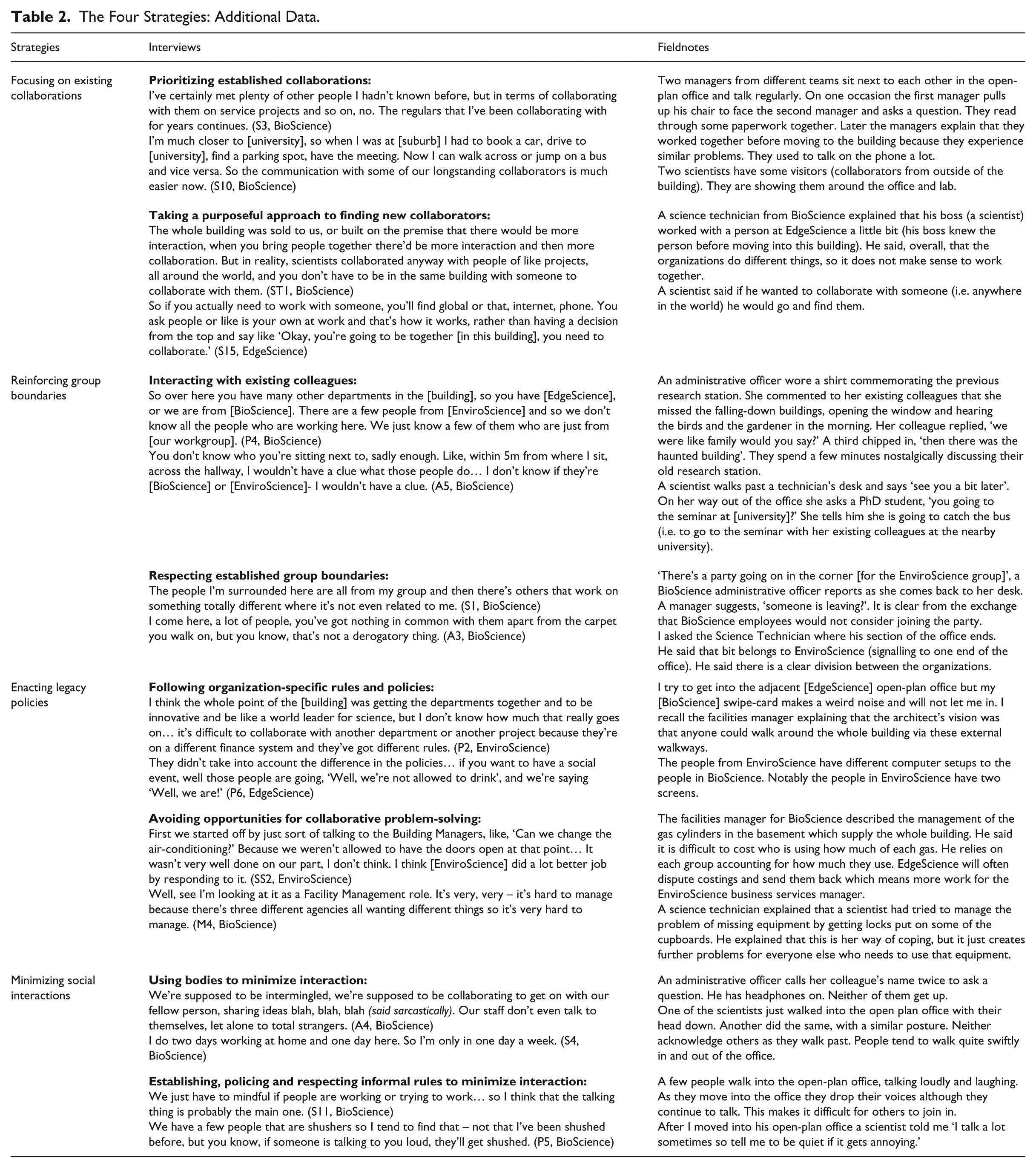
Focusing on existing collaborations
The first strategy involved employees prioritizing established collaborations. For example, in an informal conversation a scientist argued that he had no need to work with new people because, ‘If I think about the people I collaborate with, I have probably reached the maximum limit before I came to this building’ (fieldnotes). When it came to ongoing projects, ‘there’s not really an opportunity to bring in new people to do something radically different’ (M3, BioScience). The collaborative building also made it easier to work with existing external collaborators, as a manager described: There was actually, already a lot of [scientific] collaboration going on…there was already a lot of stuff that we were doing with [EdgeScience], but a lot of them were based at [the nearby university], so it just took that little bit of extra effort to get there. But now [scientists] are here or they’re coming across from [the nearby university] all the time. (M2, EnviroScience)
Owing to the ease of access to existing collaborators and lack of time to commit to new collaborations, employees prioritized existing over new collaborations.
Consistent with their focus on existing collaborations, employees took a purposeful approach to finding new collaborators and rejected the role of chance encounters. A scientist suggested: Collaboration usually relies on a level of trust and that has to be built over time. So just throwing a whole pile of people in a building … the idea that [scientists] would just sit down and strike up a conversation with someone is not … it’s just not going to happen. (S13, EdgeScience).
Rather than simply working with people in the same building, scientists typically sought experts through their existing network of colleagues: Over lunch, a scientist complains about how administrators try to organize scientific collaboration where a large group of people sit around with butchers’ paper and try to come up with ideas. He said that if he could arrange it differently he would choose three or so people who were experts and give them a month to come up with something. (fieldnotes)
Based on a purposeful view of collaboration, distance appeared not to be a barrier to doing science because employees could easily connect with experts all over the world through email and video conferencing. Although the building meant that it might be easier to set up an on-the-spot meeting with an expert, ‘you can do that to anyone at [the adjacent university], or you can send an email to anyone in the world’ (S11, BioScience). In choosing to focus on existing and purposeful collaborations, employees gave less attention to starting new collaborations, especially when they perceived that others in the building lacked relevant expertise.
Reinforcing group boundaries
The second strategy employees used to avoid developing new collaborations involved reinforcing boundaries between groups. We observed that, rather than sitting with employees they had never met, a group of scientists and administrative officers from the same site (now split over two open-plan offices) continued to meet daily for lunch and morning tea: At morning tea the group sits in the usual spot at the usual end of the table. Four of the administrative staff tend to stay the longest, and other people come and go. Not many of the scientific staff from the other office are there today. (fieldnotes)
A science technician explained, ‘it’s funny, we thought, “Ah, we’ll go somewhere else,” not “Oh we’ll join these people” … because we had already formed our social bonds and we needed an area to keep everyone together’ (ST1, BioScience). A similar pattern emerged at a Social Club event: There were mostly EdgeScience staff there to start with. Some of the younger people from BioScience showed up. They all knew each other and hung out together. They seemed to all know one of the scientists from EdgeScience, but not too many of the other EdgeScience people. (fieldnotes)
One scientist described this situation as, ‘You can still go to any Social Club function and you’ll find that most of the [EdgeScience] people are in one group and most of the other agencies are still in their groups’ (S13, EdgeScience). By continuing to interact with colleagues they used to work with, employees reinforced established group boundaries and limited opportunities for collaboration with employees from other groups in the building.
Additionally employees respected established group boundaries by avoiding interactions with other groups. We observed little evidence of managers attempting to break down social boundaries between groups. A manager from EnviroScience explained that, although groups with similar research areas from EnviroScience and BioScience shared an open-plan office, ‘they never talk … because they don’t have managers which are [sic] networking, basically and they’re not seeing where the similarities come in’ (M2, EnviroScience). Employees also noted ‘invisible barriers’ (A5, BioScience) between groups in the building and the first author quickly felt subject to normative pressures to avoid breaching those barriers: At lunchtime a scientist from EnviroScience asked if I had someone to sit with. I said that I usually sit with the BioScience people but that I would come and sit with him. I felt a little bad for not sitting with the BioScience people and hoped they still accepted me as part of their group. (fieldnotes)
Moreover, a scientist said that ‘people stick to their floor and would be seen as a little strange if they did otherwise’ (fieldnotes). In the end, by respecting group boundaries, employees limited the possibilities to meet potential new collaborators from different workgroups and organizations in the building.
Enacting legacy policies
The third strategy employees used to avoid developing new collaborations involved following organization-specific rules and policies that were a legacy of their previous research site. Although one of the intentions of the building was to allow employees the autonomy to work across traditional group and organizational boundaries (Visioning Workshop Overview document), in practice employees’ behaviour was ‘very rigid and not spontaneous’ (S13, EdgeScience). The building’s facilities manager described the issues associated with multiple organizations sharing the building: They all work to their corporate instruction… and that’s not necessarily within this building, so [EdgeScience] might have a policy across the country and [BioScience and EnviroScience]… have their corporate [policy] … and so sometimes they don’t quite marry up for what suits this building … they’re all doing their own thing in the interests of their own agencies. (M1, EnviroScience)
In addition, employees continued to use contact directories, financial systems and communication systems linked to their own organizations. Regarding financial model, a manager from EnviroScience argued that ‘because we do operate in such different ways, I think there’s no reason to interact with some of that stuff’ (M2, EnviroScience). Rather than using their autonomy to interact and develop new policies suitable for interacting in building, employees continued to enact the legacy policies associated with their own organizations and minimize prospects for new collaborations.
By choosing to enact legacy policies, employees also avoided opportunities for collaborative problem solving when shared problems emerged in the building. For example, although the problem of sharing intellectual property was flagged during a ‘visioning workshop’ when the building was in its planning phase (Visioning Workshop Overview document), we observed little evidence of collaborative solutions to this problem. Instead, employees carefully guarded the intellectual property associated with their own organization: A science technician and some students are applying an experimental treatment in a basement laboratory. Only select BioScience employees have access to the lab. The science technician explained that some of the experiments have to be kept a bit secret because they are linked to BioScience projects. This made collaboration with EnviroScience and EdgeScience difficult. (fieldnotes)
By following existing policies when confronted with shared issues (e.g. managing intellectual property), employees created barriers to collaboration.
Minimizing social interactions
In the final strategy, employees avoided new collaborations by minimizing social interactions. They did this by using their bodies to signal their unwillingness to interact, mostly by avoiding eye contact with others. For example, we observed two scientists walk past each other in the open-plan office without exchanging glances (fieldnotes). Employees also adopted postures that made it difficult for others to catch their attention: There is someone at one of the kitchen areas standing up and another person sitting alone at a small table. The person is reading something. They are both on their own. (fieldnotes)
Employees tended to ‘stay to themselves and their own area, do their work and then go home’ (ST1, BioScience) or ‘have their headphones on’ (S15, EdgeScience) in order to limit interaction with others. By using body language to signal an unwillingness to interact, employees actively avoided social interactions in the building.
Employees also minimized social interactions by establishing, policing and respecting informal rules that restricted interactions in the open-plan offices. For example, a professional staff member described an instance where an employee took steps to establish or police norms that restricted interaction: She was quite open in coming forward about her concerns about noise to her colleagues… the whole space just lost its kind of open-plan interactive experience that we were supposedly being provided – everyone was just deathly quiet. (P7, EdgeScience)
In general, employees respected each other’s requests for quiet by keeping their interaction with others in the open-plan office to a minimum: An administrative officer from another office stops by the kitchenette in the open-plan office to briefly discuss a tax invoice with a scientist. She remarks that the office is like a library and that she feels awkward talking to people because it is so quiet. (fieldnotes)
By adopting strategies to minimize social interactions, employees avoided forming new collaborations in the building.
A process for avoiding collaboration in a collaborative building
In Figure 3, we outline a process to show the mechanisms via which the four strategies led employees to avoid collaborating in a collaborative building. Our findings indicate that employees who enacted the four strategies in response to physical proximity in the collaborative building avoided collaboration by minimizing serendipitous encounters. We also show that each strategy minimized serendipitous encounters through a different mechanism. To demonstrate the importance of serendipity (i.e. the combination of search, chance and flexibility) in avoiding collaboration, we contrast the experience of the majority of employees who avoided collaboration with two examples of new collaborations: (1) a research-impact collaboration between social scientists from EnviroScience and scientists from EdgeScience, and (2) a high-performance computing collaboration between animal scientists from BioScience and computer scientists from EnviroScience. In contrast to employees who had formed new collaborative partnerships, we show that employees who avoided new collaborations minimized serendipitous encounters by responding to physical proximity with strategies that reduced chance, search, flexibility and the obligation to interact (see Table 3).

Process for Avoiding Collaboration in a Collaborative Building.
Mechanisms Linking the Four Strategies to Serendipitous Encounters: Additional Data.
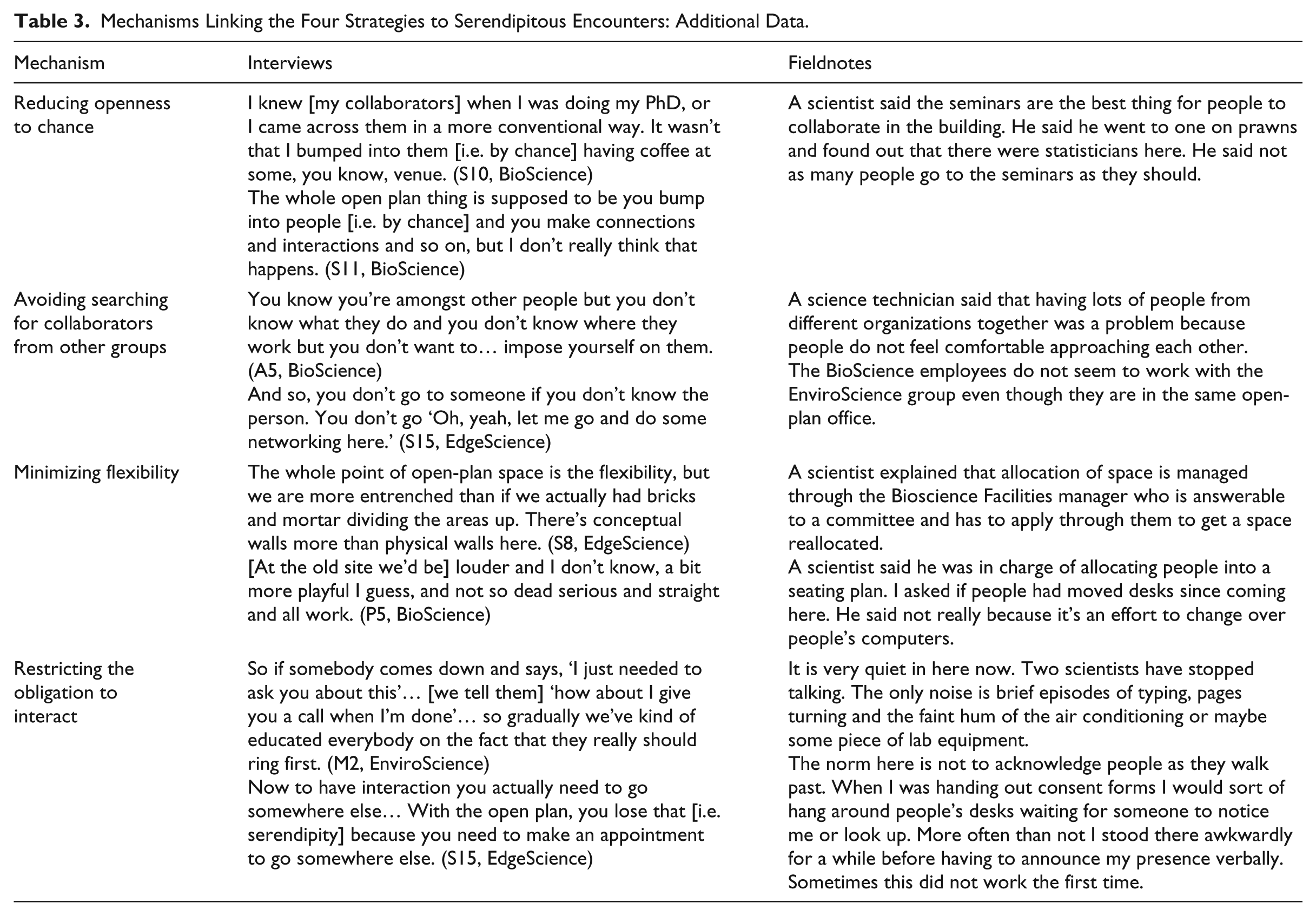
First, employees who enacted the strategy of focusing on existing collaborations minimized serendipitous encounters through the mechanism of reducing their openness to chance when finding new collaborators. For example, a scientist scoffed at the idea that he might run into someone on the stairway and say ‘let’s do science together’ (fieldnotes). By emphasizing a purposeful view of collaboration employees closed themselves off to the possibility of a ‘chance meeting with someone in a huge building’ because they felt that ‘we make those connections anyway’ (S11, BioScience). Also reducing their openness to chance, we observed that employees used spaces intended to promote serendipitous encounters (i.e. the building’s café and interaction areas) as venues for formal meetings with existing colleagues, rather than as a space to meet new people: One of the science groups is having a meeting in the café. An administrative officer explains that they meet every Tuesday at 9.30am. (fieldnotes)
By focusing on existing collaborations, employees prioritized purposeful over chance interactions and minimized the extent to which they experienced serendipitous encounters.
In contrast, employees involved in the research impact and high-performance computing projects emphasized the importance of chance in promoting the serendipitous encounters that sparked these new collaborations. For example, one of the social scientists explained how they met their collaborators through a ‘chance conversation’ (SS3, EnviroScience). His colleague further suggested that new collaborators could be found through ‘incidental crossing of paths … with a stranger or someone that you know’ (SS1, EnviroScience). Moreover, another scientist involved in the high-performance computing collaboration described a ‘random interaction’ where her colleague ‘ran into a guy in the lift (elevator) … [who spoke about] high performance computing and then he told us because he knows that’s the kind of stuff we do’ (S6, BioScience). The scientist emphasized that this interaction occurred, ‘by chance because normally I just take the stairs’ (S7, BioScience). These examples suggest that employees who did not focus on existing collaboration remained open to chance occurrences and tended to experience the serendipitous encounters that led to new collaborations.
Second, employees who engaged in the strategy of reinforcing group boundaries minimized the serendipitous encounters that lead to new collaborations through the mechanism of avoiding searching for collaborators from other groups in the building. For example, by only attending seminars by colleagues from their own workgroups, scientists avoided searching for possible collaborators from other workgroups and minimized the possibility of a serendipitous encounter: A scientist suggested that he did not participate in the seminars in the building because most of them were not really relevant. He said people were more comfortable presenting rough work to an internal, known audience. (fieldnotes)
The strategy of reinforcing group boundaries also led employees to avoid search even when opportunities arose. For example, we observed a group of scientists and administration staff from BioScience meet for morning tea at their usual time and usual table. Rather than introducing themselves to a group from EdgeScience who were already sitting at the table, the group from BioScience dragged over a table so they could sit separately (fieldnotes). This action reinforced group boundaries, minimized search and avoided potential serendipitous encounters with new collaborators.
In contrast, employees in the research impact and high-performance computing collaborations avoided reinforcing group boundaries and experienced serendipitous encounters because they actively searched for collaborators outside their own group. One of the social scientists explained: The way that the building is set out, shared lunch spaces… allow for opportunities to get to know people from different departments…There’s a few occasions where I’ve told people about my role and… we’ve talked about possible projects… They certainly wouldn’t have occurred if you don’t talk to people. (SS4, EnviroScience)
Also highlighting the importance of search, one of the animal scientists described how the new collaboration with EnviroScience came about because he initiated a conversation in the elevator, ‘about computers and we have this interest in common and slowly, slowly we get to know each other and they help us to do our work’ (S7, BioScience). This scientist further explained that he had to overcome efforts by others to reinforce group boundaries and that he was ‘considered like a little bit like a traitor because I’m eating with the other guys’ (S7, BioScience). A social scientist echoed this sentiment, explaining that his colleagues had ‘attempted to sort of come and join the conversations [with other groups], but didn’t feel very included’ (SS3, EnviroScience). Thus, it was employees who were willing to ‘say hello and say find out what you do’ (SS3, EnviroScience) who experienced serendipitous encounters and formed new collaborations in the building.
Third, employees who engaged in the strategy of enacting legacy policies minimized serendipitous encounters through the mechanism of minimizing flexibility. Rather than engaging in serendipitous encounters to form new collaborations, interactions became ‘more bureaucratic’ (M1, EnviroScience) because ‘there’s so many bloody contracts and agreements in place to make it work’ (M5, BioScience). Employees relied on managers to solve problems rather than demonstrating the flexibility to find a new solution through informal interactions among colleagues: A manager mentioned that someone who sat next to some blinds had asked her to write a policy about what he should do if another person who sat next to him wanted to open or close the blinds. (fieldnotes)
Furthermore, employees’ propensity to enact legacy policies rather than address issues through serendipitous encounters meant that employees from each organization conducted their own investigation of shared air quality issues in the building. During these investigations, ‘[BioScience] didn’t see fit to tell [EdgeScience] or the joint management committee or [EnviroScience] that there were issues with their staff’ (S8, EdgeScience). As one of the social scientists described: [There] wasn’t that openness you would have thought it would have been sensible for this sort of place. So it’s at odds with what the design concept was, about fostering interaction and good communication. (SS3, EnviroScience)
By enacting legacy policies, employees limited their flexibility and thus minimized serendipitous encounters with other groups.
In contrast, employees who avoided enacting legacy policies demonstrated the flexibility to foster serendipitous encounters and spark new collaborations. For example, one of the social scientists explained how flexibility stimulated serendipitous encounters: [Flexibility involves] taking yourself out of what your project is and that confines at what you’re focused on, having conversations with other people, being exposed to other things that are going on… [In contrast employees who enact legacy policies] stay very focused… very task orientated… and don’t accept distraction, that can extend right through to social interaction as well, which then limits the exchange of ideas. (SS3, EnviroScience)
By displaying flexibility rather than exacting legacy policies, the animal scientists working on the high-performance computer project sought to ‘contact people from other fields and… get a particular problem looked at from a different angle’ (S8, BioScience). For these scientists, a flexible mindset facilitated serendipitous encounters because ‘[when] you can interact with other people and other groups… [it enables you to] bounce ideas from other people which may then lead to you thinking of another idea’ (S6, BioScience). Those employees who avoided enacting legacy policies were able to demonstrate the flexibility required to facilitate serendipitous encounters and initiate new collaborations.
Finally, by minimizing social interactions, employees minimized the serendipitous encounters that could lead to new collaborations through the mechanism of restricting the obligation to interact. Through their body language and the enactment of informal rules, employees fostered a shared understanding that interaction was not obligated and in fact should be avoided: In an informal conversation, a scientist explained that when people moved in here they all talked to each other, but then the noise began to annoy people so they stopped talking and now work very quietly. He said it might be counterintuitive but putting more people together in one room has meant they interact less. When people come into the office they walk in and don’t make eye contact. (fieldnotes)
As a result, many open-plan offices in the building were quiet spaces where employees lowered their voices and avoided the interactions required to initiate serendipitous encounters. A professional staff member made it clear that employees were expected to avoid rather than engage in interactions through her comment that ‘everyone makes equal effort to make everything very quiet’ (P4, BioScience). By minimizing social interactions, employees created an environment where employees did not feel obliged to interact. This made it difficult for employees to engage in serendipitous encounters, which should have been the first step to forming a new collaboration in the building (see Boutellier et al., 2008; Kabo, 2016).
In contrast, employees who experienced the serendipitous encounters that lead to new collaborations overcame restrictions to the obligation to interact by socializing with others in the building. For example, a social scientist (SS3, EnviroScience) explained that the serendipitous encounter that led to the new collaboration with EdgeScience occurred because his colleagues were ‘prepared to be social and [say] “Are you new here?” or whatever and introducing ourselves’. He further noted that, ‘if you’re not inclined that way [i.e. sociable], the structure of the building doesn’t necessarily help you to do that’. His colleague elaborated, ‘I like the interaction areas… you do bump into people’ (SS2, EnviroScience). Moreover, a scientist involved in the high-performance computer collaboration (S7, BioScience) suggested that ‘the common areas are made so that the people that are social end up meeting each other… if you like socializing there are plenty of opportunity [sic] to do that’. Thus, employees who ignored norms that minimized social interactions experienced the serendipitous encounters that fostered new collaborations.
In summary, employees reduced their openness to chance by focusing on existing collaborations, avoided searching for collaborators from other groups by reinforcing group boundaries, minimized flexibility by enacting legacy policies and restricted the obligation to interact by minimizing social interactions. Together, the four strategies resulted in the outcome of avoiding collaboration because they prevented employees experiencing the mechanisms of chance, search, flexibility and the obligation to interact that in combination led to serendipitous encounters.
Discussion
In this research, we explore the puzzle of how employees avoid collaboration in a building specifically intended for collaboration. In contrast to existing research that focused on why employees might avoid collaboration (Bernstein, 2012; Hirst, 2011; Wilson et al., 2008), we focus instead on how employees who are physically proximate avoid the chance encounters and the social obligation to interact that are usually triggered by physical proximity. Specifically, we outline a process via which employees’ responses to physical proximity minimize the serendipitous encounters that would otherwise provide opportunities for new collaborations to emerge. These findings thus offer an alternative to the conventional view among collaboration researchers that physical spaces facilitate collaboration (e.g. Bridwell-Mitchell, 2016; Feller et al., 2013; Kellogg, 2009). Moreover, by identifying strategies that reduce search, chance, flexibility and the obligation to interact, our findings highlight the difficulties associated with fostering serendipitous encounters and new collaborations as well as showing why collaborative buildings do not always facilitate collaboration. In the following, we outline two important contributions of our research and two boundary conditions.
Our first contribution is to address a theoretical difference in the collaboration and physical proximity literature. While collaboration scholars argue that physical proximity can facilitate collaboration (e.g. Bridwell-Mitchell, 2016; Feller et al., 2013; Kabo, 2016), in the physical proximity literature there is a lack of consensus on the link (Ashkanasy et al., 2014). Some researchers argue that physical proximity obliges interaction (e.g. Kabo, 2016; Monge et al., 1985), while others suggest that too much proximity can undermine collaboration – either by fostering conflict (e.g. Ashkanasy et al., 2014; Ayoko & Härtel, 2003) or by prompting employees to socially withdraw (Bernstein & Turban, 2018; Morrison & Macky, 2017). We contribute to the research into this tension by pointing to employees’ responses to physical proximity, rather than physical proximity itself as the facilitator (or inhibitor) of collaboration. Thus, our findings challenge the assumption that physical proximity inherently enables collaboration (Dolfsma & van der Eijk, 2015; Feller et al., 2013; Toker & Gray, 2008).
In contrast to researchers who focus on chance as the key enabler of encounters in collaborative buildings (Boutellier et al., 2008; Toker & Gray, 2008), we show that a combination of chance, search, flexibility and the obligation to interact are all required. Employees reduce the element of chance involved in generating new collaborations when they respond to physical proximity by focusing on existing collaborations. Although other researchers (see Bridwell-Mitchell, 2016; Kellogg, 2009) have argued that physical proximity helps employees develop a common purpose and drives collective changes in policies and practices, we show that employees who inhibit their flexibility by enacting legacy policies cement old practices. Moreover, instead of helping employees to capitalize on their differences (e.g. Huq et al., 2017; Majchrzak et al., 2012; Vad Baunsgaard & Clegg, 2013), the strategy of reinforcing group boundaries means that physical proximity highlights (rather than helps to overcome) the differences between groups. Together, our findings extend the work of researchers who argue that physical proximity inhibits interactions by causing employees to socially withdraw (e.g. Ashkanasy et al., 2014; Bernstein & Turban, 2018; Morrison & Macky, 2017). We show that employees can remove the obligation to interact by using body language and informal rules to minimize serendipitous encounters. These actions serve to reduce opportunities for social interaction that might otherwise lead to new collaborations.
Although the focus of our study looks at how employees avoid collaborating under conditions of physical proximity, our findings also speak to research as to why physical proximity inhibits collaboration. Scholars have argued that disengagement from the organization (Hirst, 2011), a lack of communication and identification (Wilson et al., 2008) and a desire for privacy (Bernstein, 2012) explain why employees avoid collaborating under conditions of physical proximity. We extend this literature by providing a fresh reason as to why employees avoid collaborating, namely a lack of individual motivation to collaborate. In turn this leads employees to limit their openness to the role of chance in forming new collaborations, to avoid searching for interactions with people from other groups, to minimize flexibility in response to shared problems and to restrict the obligation to interact. Unless employees have reasons or incentives to form new collaborations (e.g. a job role requiring new collaboration or an enjoyment of meeting new people), spatial interventions alone are unlikely to be successful.
The second contribution of our study is to highlight the importance of serendipity in the development of new collaborations while also demonstrating the complexity in encouraging serendipitous encounters. Although much of the extant literature focuses on the serendipitous discoveries in terms of scientific breakthrough or innovations (e.g. Garud et al., 2011; Liu & de Rond, 2016; Merton, 2004), we suggest that finding a new collaborator is a form of serendipitous discovery. This perspective contrasts with collaboration researchers who focus on the role of chance, accident and spontaneity in the formation of new collaborations (Boutellier et al., 2008; Kabo et al., 2014; Kreiner & Schultz, 1993). Instead, we provide insights into the combination of chance, search and flexibility required to foster new collaborations.
The literature on serendipity points to chance, favourable action and luck in shaping serendipity (Dew, 2009; Liu & de Rond, 2016). We extend this perspective by showing how employees can actively minimize chance (and thus serendipity) by choosing to focus on existing collaborations. More specifically, when employees maintain a view of collaboration as a purposeful activity, they close themselves off to creating and noticing chance occurrences that could lead to serendipitous encounters with potential new collaborators.
With regard to search, the serendipity literature outlines individual actions that foster serendipity such as actively seeking information, paying attention to the environment, and capitalizing on social networks (Cunha et al., 2010; Dew, 2009; Graebner, 2004). In contrast, we emphasize the strategies that employees take to avoid search and reduce serendipity. We show that the strategy of reinforcing group boundaries reduces the element of search required to facilitate serendipitous interactions with new employees.
When it comes to flexibility, researchers have highlighted organizational practices that generate serendipity by facilitating flexibility (Graebner, 2004). Yet, our findings show that employees’ responses to organizational efforts to foster flexibility can fail if employees choose to enact legacy policies that reinforce existing practices and minimize serendipitous encounters. Overall, our findings suggest that a combination of organizational efforts and individual openness are required to promote serendipitous encounters in organizations.
Concerning the boundary conditions of our research, we expect that the strategies employees use to avoid serendipitous encounters and new collaborations are likely to apply to other office environments, although the prevalence of each strategy may vary. Future researchers might wish to explore whether strategies to avoid collaborations are less prevalent among employees who regularly work on new collaborative projects as part of highly interdependent teams (e.g. marketers or engineers), and more prevalent in contexts where employees engage in longer-term collaborations (e.g. academics). In this regard, our findings hint at the differences between professional groups (particularly scientists and managers) when it comes to why individuals engage in strategies to avoid new collaborations. For example, managers tend to suggest that time constraints are the main reason why they focus on existing collaborations, while scientists raise the need to build long-term trust with disciplinary experts. Future research could further interrogate professional differences and task interdependence in response to collaborative buildings and spaces.
The second boundary condition is that the strategies we observe may not persist if employees finalize existing collaborations and choose to search for new collaborators in the building. Like other research on proximity in office environments (Boutellier et al., 2008; Kabo et al., 2014; Toker & Gray, 2008), we focus on patterns of interactions over a short time, in our case three months. A study that tracks the formation of collaborative relationships over multiple years would reveal whether patterns of avoiding collaboration extend into the long term. Such research will also show whether a shift in focus from existing to new collaborations fosters more serendipitous encounters and more collaboration or whether the strategies of continuing to focus on existing collaborations, reinforcing group boundaries, enacting legacy policies and minimizing social interactions limit the development of new collaborations in the long term.
Conclusions
In conclusion, we believe that our research provides insights into the reasons why collaborative buildings and office spaces do not always promote collaboration by exploring a tension in the literature about whether physical proximity promotes or inhibits collaboration. Our qualitative study of how employees avoid collaborating in a collaborative building enabled us to show four strategies that employees use to avoid starting new collaborations under conditions of physical proximity. These strategies allow employees to avoid collaboration by minimizing serendipitous encounters through the mechanisms of reducing search, chance, flexibility and the obligation to interact. Our findings thus provide original insights into how employees’ responses to physical proximity shape their collaborative behaviours, as well as the difficulties associated with fostering serendipity and collaboration in organizations.
Footnotes
Acknowledgements
We thank our editor, Trish Reay, and three anonymous reviewers at Organization Studies for guiding us to strengthen the core argument and contributions of this article. We are grateful to April Wright for her patient and generous advice throughout the review process, Alfons van Marrewijk and Mike Pratt for their constructive feedback on early drafts and Matthew Harris for his help with Figure 1. We presented earlier versions of this article at the Cognition in the Rough Workshop at the 2013 Academy of Management Annual Meeting and the 2015 Asia-Pacific Researchers in Organisation Studies Conference.
Funding
This research was supported by an Australian Postgraduate Award and Australian Research Council Grant # DP110102525 on employee wellbeing and productivity: the role of territoriality, conflict and emotions.
