







Abstract
Assemblages are the actors, artefacts or practices that are intertwined with and co-produce theories. Despite being at the core of the performativity process, assemblages have been overlooked in recent performativity studies. Thus, this study examines how assemblages are changed by theories during performativity. It builds on the case of the historical development of the Blue Ocean Strategy: a management theory that proposes the creation of new market spaces, rather than competing within existing ones. The study shows a process model in which the theory changes the assemblages that change reality and enlarges its scope in turn. It offers implications both for performativity and for practice.
Introduction
Performativity studies focus on how theories – i.e. ‘analytical systems that link different concepts in order to explain or predict empirical phenomena’ (Martí & Gond, 2018, p. 489) – bring social reality into being (Callon, 1998; MacKenzie, Muniesa, & Siu, 2007; Martí & Gond, 2018). A ‘performativity turn’ arose in management studies in the late 1990s (Gond, Cabantous, Harding, & Learmonth, 2016). Since then, studies have aimed to understand how management theories come into being (e.g. Beunza & Ferraro, 2018; D’Adderio & Pollock, 2014). For instance, Jung and Shin (2018) recently demonstrated the role of business education in the performativity of management theories.
As Cabantous and Sergi (2018) put it, research on performativity is trapped in the identification of performative processes that are too linear, for instance, by exposing causal explanations (e.g. Martí & Gond, 2018, 2019) or exploring the boundary conditions of performativity (e.g. Felin & Foss, 2009). It leads theories to be treated as ‘objectified entities [. . .] distinct from their context’ (D’Adderio, Glaser, & Pollock, 2019, p. 676). This treatment constitutes a ‘conceptual slippage’ (p. 459) to the science and technology studies in which performativity studies are anchored (Gond et al., 2016). In fact, research on performativity is grounded on a relational ontology according to which entities are brought into being by relying on material and discursive practices: ‘Theories do not exist in isolation but are performed within a broader assemblage that connect actors, artefacts, and practices’ (D’Adderio et al., 2019, p. 676) where assemblages are the material elements and human beings that are intertwined with and co-produce theories (Callon, 2007; Gherardi, 2015). They are a ‘necessary and integral prerequisite for [their] performative realization’ (D’Adderio et al., 2019, p. 676).
To embrace performativity to its full extent and to explore how theories come into being, I argue that it is necessary to study the process of performativity from the perspective of the assemblages. While assemblages have been shown to change during the process of performativity (e.g. Beunza & Ferraro, 2018; D’Adderio & Pollock, 2014), such perspectives have been overlooked. Thus, this article focuses on the following research question: How do assemblages change when theories become performative?
Following the call to study the ‘laboratory lives’ of management theories (Latour & Woolgar, 1979 in Whittington, 2004, p. 66) and to retrace the activities of the creators and promoters of recent influential theories (Vaara & Whittington, 2012), this study considers the Blue Ocean Strategy 1 as a unique case study of a management theory that turned into a business reality that proposes the creation of new market spaces, rather than competing within existing ones. Relying on interviews conducted with individuals who performed the theory and on documentary data retracing its historical development, the case reveals a process model in which assemblages are changed by the theory, change reality and enlarge its scope in turn.
Thus, this research offers implications for performativity studies by improving our understanding of how theories are used by practitioners and of how the scope of reality increases during performativity and, more generally speaking, by increasing our knowledge of the process of performativity. It also offers implications for practice.
The article develops as follows. The first section provides the conceptual background by defining the core concepts of performativity and developing the roles of the assemblages during performativity. The second section describes the theory of the Blue Ocean Strategy and introduces the data and methods deployed to investigate how the assemblages change during performativity. The investigation presented in the third part retraces the process model of the changes in the assemblages within the context of the performativity of the theory. Finally, the concluding part discusses the changes in the assemblages and the implications for performativity studies and for practice.
Conceptual Background
Performativity of management theories
The concept of performativity stems from Austin (1962), who coined the term ‘performative’ to describe utterances ‘in which to say something is to do something; or in which by saying something, we are doing something’ (Austin, 1962, p. 12, italics in original). Scholars of science and technology studies borrowed the linguistic term and applied it to the study of theories: theories do not simply mirror – or describe – reality but can represent reality only by intervening in and transforming it (Hacking, 1983; Law & Urry, 2004). Thus, performativity focuses on how theories shape reality (Callon, 1998).
Performativity has been described as a sequential process (Martí & Gond, 2018). A theory first reaches generic performativity when an aspect of the theory is used by participants in practical processes (MacKenzie, 2007). This occurs through experimentations, where a theory challenges the established way of doing things (Martí & Gond, 2018). A theory then achieves effective performativity when the practical use of one of its aspects has an effect on the corresponding processes (MacKenzie, 2007). The theory identifies anomalies, defined as violations of widely shared expectations (Martí & Gond, 2018). Finally, a theory reaches Barnesian performativity, meaning that one effect of the use of an aspect of the theory in practice is to make the practical processes more closely resemble their depiction by the theory (MacKenzie, 2007). This type of performativity is, however, empirically rare (Cabantous, Gond, & Johnson-Cramer, 2010). Here, the theory creates a shift in practice (Martí & Gond, 2018).
The assemblages in the performativity process
Assemblage are a central feature of Callon’s views of performativity (D’Adderio et al., 2019). Indeed, given the importance of material elements and human beings in the performativity of theories, research has emphasized the roles of the assemblages in performativity. They are the actors, artefacts and practices, which are carefully adjusted to one another to realize a theory for forming a (socio-material) assemblage (Latour, 2005), also called a (socio-technical) agencement (Çalışkan & Callon, 2010; Callon, 2007), referencing the French word agencement, which means ‘in connection with’ (Gherardi, 2015). Assemblages (or agencements) have the capacity to act and to give meaning to action (Gherardi, 2015). They co-produce theories and are thus intertwined with them (Callon, 2007; D’Adderio et al., 2019; Glaser, 2017). Their role relies on either framing or translation.
Framing
Assemblages embody a first role in the performativity process by participating in framing reality. Since theories rely on assemblages to survive, when theories move to other realities, they must undergo transformation to overcome what Callon (2007) called performative struggles: theories encounter and trigger resistance because the assemblages that would have enabled their survival are not present. These struggles lead to the generation of an iterative cycle. During framing, theories shape reality because their assemblage is present. Then, overflows appear. They are materialized by a difference between theories and reality. In the case developed by D’Adderio and Pollock (2014), they were manifested in ‘errors’ in the system due to the inability of the assemblages to perform reality. Thus, elements of the assemblages must be replicated, be modified or disappear. When there is again convergence between theories and reality, it is the phase of reframing during which theories shape reality again.
The iterative cycle of framing is enacted through experiments that occur within purified places, such as laboratories where researchers direct experiments and rely on specific assemblages; within platforms, where the contexts of application are simulated and the assemblages differ; or in situ, where experiments are again directed by practitioners with new assemblages (Muniesa & Callon, 2007).
Translation
Assemblages also participate in performativity through the mechanisms of translation theory (Beunza & Ferraro, 2018; Callon, 2007). Translation theory refers to the pursuit of interests or specific interpretations (Callon & Latour, 1981). It frequently involves micropolitical dynamics, such as acts of persuasion, power plays and strategic manoeuvres (Aggeri, 2017; Beunza & Ferraro, 2018; Ferraro, Pfeffer, & Sutton, 2009). It highlights specific roles for the assemblages.
Theories first enrol assemblages, either human beings or material elements, by redefining their interests. They become allies and can speak in the name of other allies (Callon, 1986). For instance, Beunza and Ferraro (2018) showed how an executive performed a shift in his organization’s strategy by enrolling the top management team, competitors and NGOs. Theories then consolidate assemblages. The assemblage of different allies becomes an obligatory passage point that channels all interests and through which all actors must pass (Callon, 1986). Such a role was developed in Cabantous et al.’s (2010) study, in which decision theory was re-labelled decision analysis to consolidate the assemblages and aggregate consulting and trade associations.
Overall, this conceptual background sheds light on the importance of the assemblages to understand how theories perform reality, given the roles that they play in the process. More is needed, however, to understand how assemblages participate in performativity. Specifically, framing shows a transformation of the assemblages, enrolling a redefinition of their interests and consolidation can involve their re-labelling (cf. Beunza & Ferraro, 2018; Cabantous et al., 2010; D’Adderio & Pollock, 2014). How do these changes occur? Answering this question helps to embrace performativity to its full extent and improves in turn our understanding of the process of performativity. For this purpose, I investigated the case of the Blue Ocean Strategy, as developed in the next section.
Methods
Case setting: Blue Ocean Strategy as a central theory in management
The blue ocean strategy emerged in the 1990s concomitantly with theories such as re-engineering, balanced scorecard and disruptive innovation. This theory, which was first referred to as value innovation (Kim & Mauborgne, 1997) and then renamed blue ocean strategy (Kim & Mauborgne, 2004), aims at breaking with the logic of the competitive strategy, according to which market structures have a direct influence on a firm’s strategy, in turn affecting its market performance. According to the theory, in a blue ocean market, boundaries and industry structures are not given and can be reconstructed based on the actions and beliefs of industry players (Kim & Mauborgne, 2005, pp. 209–12, appendix B). The blue ocean strategy is thus a metaphor that represents the new market space where competition is irrelevant (while red oceans are filled with bloody competition). To develop a blue ocean strategy, practitioners should simultaneously pursue a strategy of differentiation and low cost that will open a new market space and create new demand to attract non-customers to the market (see Table 1).
Red Ocean Strategy versus Blue Ocean Strategy.
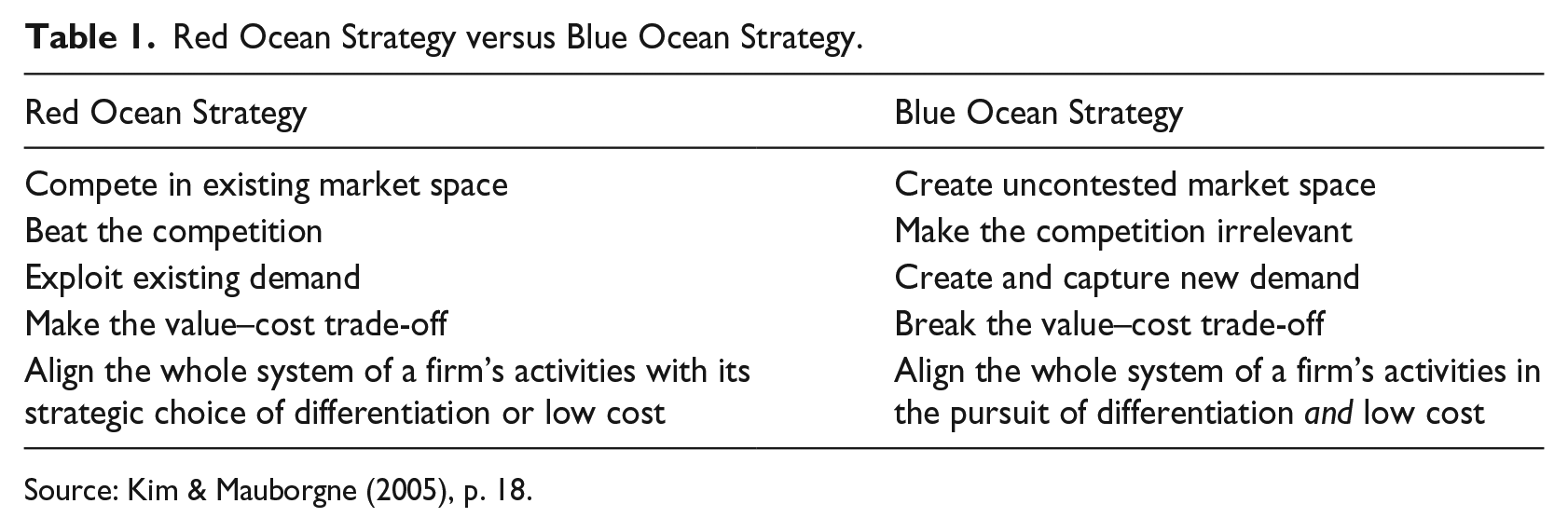
Source: Kim & Mauborgne (2005), p. 18.
The blue ocean strategy is accompanied by a methodology consisting of a set of a dozen analytical frameworks and tools. For instance, the Value Curve aims to represent a company’s relative performance within a given industry. The theory has been highly diffused in practice. For instance, the book co-authored by two INSEAD professors, W. Chan Kim and Renée Mauborgne, has sold more than 4 million copies since 2005. The phrase ‘Blue Ocean’ is also understood as having ‘entered the business vernacular’ (Ignatius, 2014, p. 16). Indeed, W. Chan Kim and Renée Mauborgne have been ranked in 2019 the first management thinkers in the world according to the Thinkers50 ranking.
Data collection
I drew upon two sources of data – interviews and documents – to understand how the assemblages of the Blue Ocean Strategy changed during performativity.
Interviews
I relied on 14 interviews conducted with 13 individuals who were key proponents in performing the theory, including faculty members (F), consultants (C) and an editor from Harvard Business Publishing (P1; the publisher of the 2005 book). The interviews were all transcribed, except for one interview, during which I took notes. The interviews lasted 69 minutes, on average (see Appendix 1), were semi-structured and focused on the chronology of the performativity of the Blue Ocean Strategy. More specifically, I asked about the personal involvement of the informants in performing the theory and inquired about their knowledge of the theory – especially regarding time periods during which they were not part of the performativity process (cf. MacKenzie & Millo, 2003, p. 111, note 7). The informants described the assemblages of which they were aware, whether material (e.g. analytical frameworks and strategy tools, consulting projects, teaching activities, case developments) or human (i.e. faculty members, consultants). They also described their perceptions of the evolution of the theory over time and its use in reality. For instance, the editor (P1) could describe at length the role played by Harvard Business Review (HBR) articles and books, the evolution of the theory within these two media and her perception of the scope of the use of the theory. She was, however, less knowledgeable about other assemblages. Complementarities between the interviewees were therefore crucial to gaining a deep understanding of the case.
Asking informants to recall how a theory has emerged, the changes in specific assemblages or how the informants individually participated in the process could have some benefits. For instance, the case involved issues of confidentiality and economics. One faculty member (F4) explained why he can now share his insights with me: ‘At that time, as the book was published, this particular example was under the confidentiality agreement, so the name was not disclosed. But now it’s already expired.’ The interval of time between the sequence of events and the interviews allowed the interviewees to speak more freely about certain issues. However, this time lapse might also have some drawbacks, such as retrospective sensemaking (Weick, 1995). Furthermore, the conduct of the interviewees might have been idealized and I relied on a limited number of interviews. Since these elements constitute inherent limits to unique case study methods, I also collected documents (MacKenzie & Millo, 2003).
Documentary data
I first used documents for triangulation purposes or for increased accuracy of the chronology of the case. For instance, I used academic publications from W. Chan Kim and Renée Mauborgne to familiarize myself with the institution to which they belonged at the time of publication, and I collected the Blue Ocean Strategy newsletters since 2013, as well as press releases, to obtain a record of events related to the theory (see Appendix 2).
Documents were also useful for understanding the roles played by material devices during performativity. I collected assemblages that have been central to performativity, such as the books published in 2005 (Blue Ocean Strategy), 2015 (the 10th anniversary edition) and 2017 (Blue Ocean Shift) and the 10 articles on Blue Ocean Strategy published in the HBR between 1992 and 2015. 2 I also collected elements of broader assemblages. For instance, since teaching involves an assemblage of different elements, I collected the elements that I could access, including class syllabi and booklets advertising the programme at INSEAD, the business school where W. Chan Kim and Renée Mauborgne have been since 1991. Similarly, for consulting assignments, I collected material elements linked to consulting projects, such as PowerPoint slides or public documents. Finally, since the interviewees talked to me about the centrality of Operation Centurion, which took place at Philips between 1990 and 1996, I collected information about this consulting project (e.g. Karsten, Keulen, Kroeze, & Peters, 2009).
Finally, the documents helped me to understand the evolution of the theory by investigating the evolution of its definitions and labels (e.g. HBR articles, consulting documents) and its use in practice (e.g. consulting slides, newsletters).
Data analysis
Given the limited understanding of how the assemblages change during performativity process, I relied upon grounded theoretical methods (Strauss & Corbin, 1990) and analysed the data following a four-step process.
The Blue Ocean Strategy chronology
I first immersed myself in the interviews and documents to obtain an understanding of how the performativity of the Blue Ocean Strategy occurred. For this purpose, I reconstructed the theory’s critical events (Garud & Rappa, 1994), leading to the search for specific dates in press releases and other documents. I developed a comprehensive history that I validated with a key informant (C1) (see Appendix 3). While I noted throughout the performativity process an evolution in the theory and in the reality being performed, I also found that the assemblages were affected by the performativity of the theory. For instance, I was surprised how the consultants and academics have internalized the theory, which was particularly visible through their enthusiasm towards the theory. For instance, a faculty member (F2) explained that, when he discovered it, he ‘ran around the campus, saying “this is really good stuff”’. I also found it intriguing that the assemblages have not been constant over time: some, such as the consulting project that launched the theory, have vanished, and others, such as the Blue Ocean Strategy Institute in 2007, have appeared during the process. Since I found these changes in the assemblages very intriguing, I engaged in deeper analysis.
Identification of changes
In line with the Gioia methodology (Gioia, Corley, & Hamilton, 2013), I open coded the interview transcripts and documentary data, focusing not only on the changes of the assemblages but also on the evolution of the reality being transformed to capture the changes of the assemblages in context. By digging into the interview transcripts and the documents, I found different mechanisms related to the material devices and human beings involved in the performativity process. I coded them using interviewees’ words or phrases when possible (Strauss & Corbin, 1990). For instance, the interviewees described to me how the theory caused people to project themselves. Thus, I labelled one first-order category, ‘Capturing the imagination of people’, in reference to a phrase used by both a consultant (C7) and a faculty member (F1). I followed the same procedure regarding the changes in reality being performed. By cycling through the codes and comparing them, I finally identified recurring codes that I collapsed into 21 first-order categories.
Development of aggregate themes
I searched for relationships between first-order categories to understand the key ways in which the assemblages change when the theory performs reality. I identified nine more themes, of which six are related to the assemblages and three to the reality. For instance, regarding the themes related to the assemblages, I was struck by the energy placed in the putting together of the assemblages through the development of a toolkit, the accumulation of experiences within firms to ‘ma[k]e sure the theory behind it works’ (F3), and the organization of feedback sessions to discuss strategy tools and consulting activities to improve them. Thus, I formed the second-order theme ‘Rearranging the assemblages’ based on the first categories of ‘Crafting a toolkit’, ‘Accumulating experiences’ and ‘Favouring mutual learning’.
Next, I linked the phenomena that emerged from the case by integrating the second-order themes into aggregate theoretical dimensions. I collapsed the themes related to the reality into the dimension ‘Scope of reality’ since this phrase captures well how the reality enlarged over time. For the themes related to the assemblages, I differentiated the changes in the assemblages due to the theory from the changes in the reality effected by the assemblages. For instance, I collapsed the themes ‘Appropriating the assemblages’, ‘Rearranging the assemblages’ and ‘Establishing the assemblages’ into ‘Theory changing the assemblages’, as all of these themes describe how the theory has modified the assemblages. This condensing led to the constitution of three aggregate theoretical dimensions.
Development of a process model
At the same time as I identified these dimensions, I explored their temporal trajectory to develop a process model and drew on temporal bracketing to separate the Blue Ocean Strategy case into distinct phases (Langley, 1999). For this purpose, I circumscribed the time periods following the evolution of the theory, which can be apprehended by its different labels over time. I found that the business idea, although it lacked clarity, arose between 1990 and 1997. Then, when the theory was called Value Innovation during the period of 1997–2002, it became a defined notion. Finally, the third phase comprises the 2002–2017 period, from the decision to call the theory Blue Ocean Strategy to the publication of Blue Ocean Shift.
Following these three phases, I found that the scope of reality broadened from a circumscribed use of the theory to a business application covering different sub-disciplines of management and ‘almost every country in the world’ (Blue Ocean Strategy website). Regarding the assemblages, I found that new assemblages appear during each identified phase, and there is an evolution in the changes related to the assemblages. Regarding the appearance of new assemblages, I observed, for instance, that the second phase corresponds to the publication of the HBR articles and that the third phase corresponds to the publication of books and the establishment of an institute. I found that changes in the assemblages, for instance, occur by ‘Appropriating the assemblages’ during the first phase, ‘Rearranging the assemblages’ during the second phase and ‘Establishing the assemblages’ during the third phase.
To assess this temporal bracketing, I systematically checked that all of the codes referring to the assemblages present during only one phase were linked only to the themes referring to the same period. For instance, since the Centurion project took place during only the first phase, all of the codes referring to the project should refer to the themes ‘Appropriating the assemblages’ and ‘Generating interest’. Although I conducted my interviews following a chronological order, the informants often linked together events occurring at different times, made general statements without specifying a time dimension or used the name ‘Blue Ocean Strategy’ or ‘Value Innovation’ to refer to the theory before it was renamed (e.g. illustrative quotes A1, A2 or B2 in Table 2). Consequently, assessing this temporal bracketing involved returning to the full transcript to understand the context from which the codes were extracted, changing the first-order category of a few codes and specifying the labels of others. This procedure strengthened the analysis since I found no code that contradicted this temporal trajectory. This process also showed that the appearance of new assemblages generated the temporal evolution of the performativity process. At the end of this analytical procedure, I organized the second-order themes related to the assemblages following the same three phases previously identified.
Dimensions, Themes, Categories and Quotes.
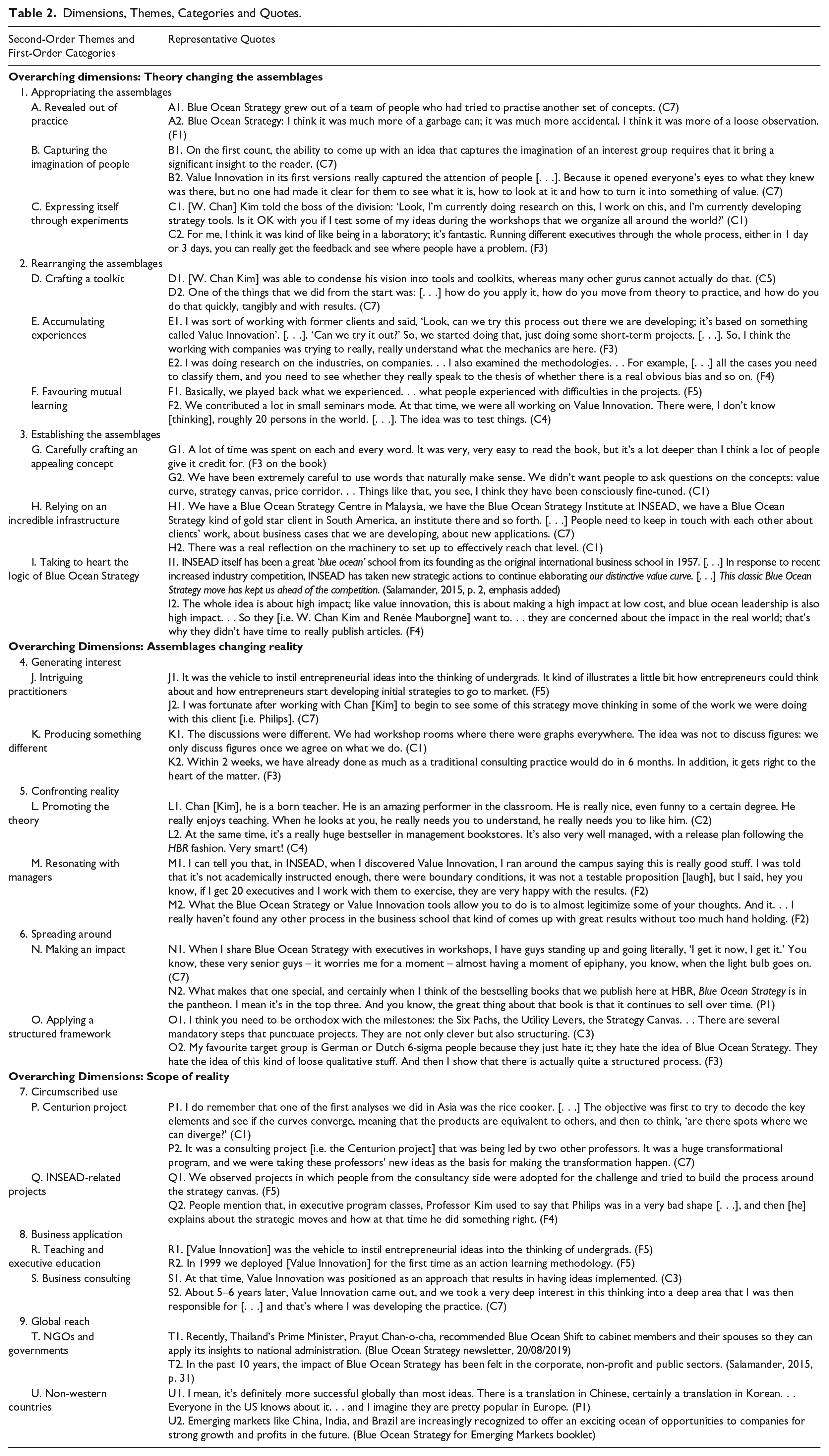
Finally, I used the nine second-order themes to build provisional models. I refined them over multiple iterations, going back from time to time to the data, until I achieved the final process model (Hampel & Tracey, 2016). This step completed the research journey from the collection of data on the performativity of the Blue Ocean Strategy to the theoretical constructs that I developed to explain the changes in assemblages during performativity (see Figure 1 for the data structure and Table 2 for additional quotes).
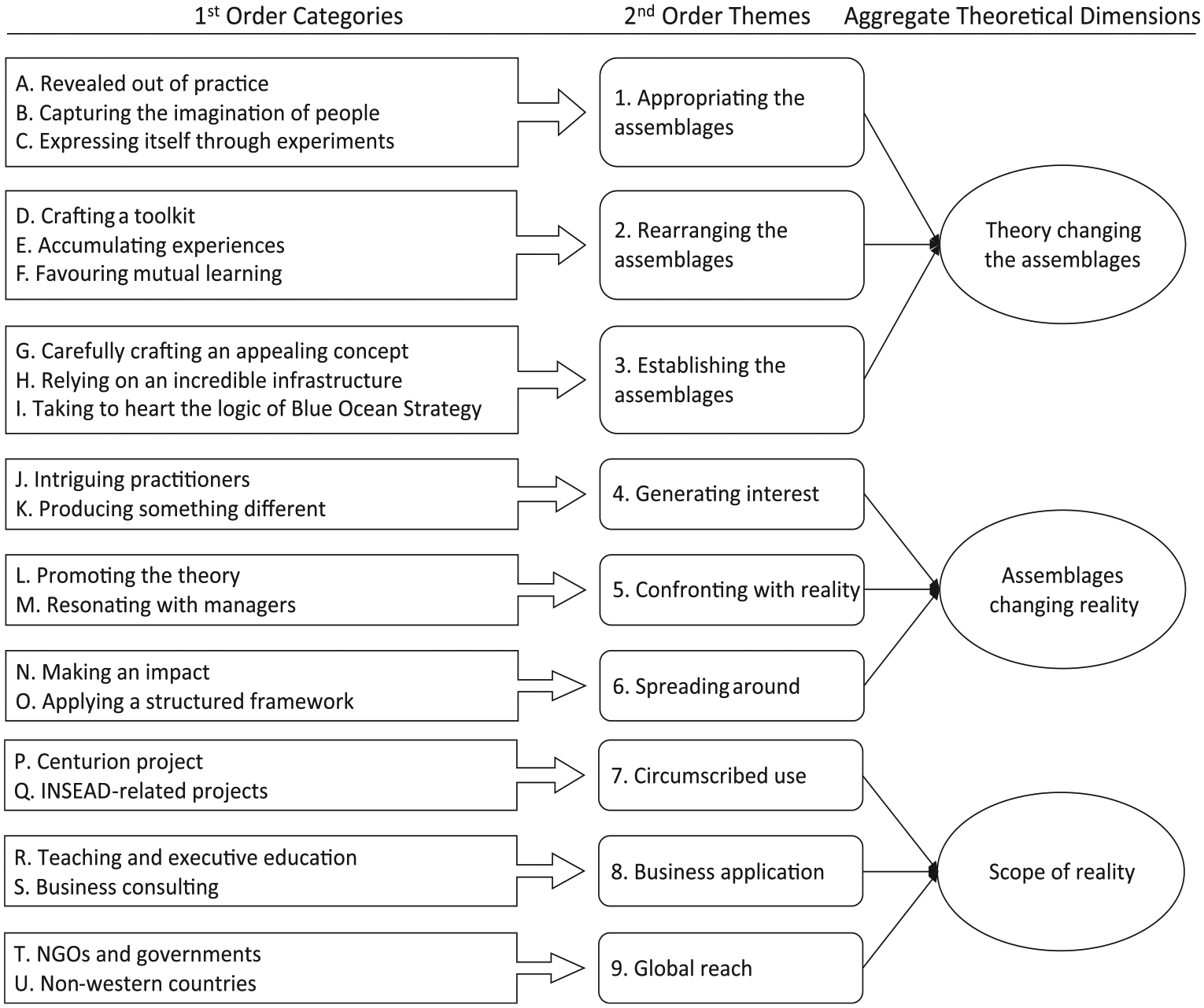
Data structure.
The Changes in the Assemblages During the Performativity of the Blue Ocean Strategy
The changes in the assemblages during performativity follow three phases, beginning with an idea that appropriates projects to generate interest within a circumscribed use, then the notion of Value Innovation that rearranges HBR articles to confront business reality and, finally, the metaphor of the Blue Ocean Strategy, which establishes a book, an institute and centres to spread around the theory throughout the world.
Phase 1: The idea of breaking with the competition generates a circumscribed use of the theory (1990–1997)
The theory of the Blue Ocean Strategy appeared in 1990, when C.K. Prahalad, a professor at the University of Michigan Ross School of Business, was asked by Jan Timmer, the CEO of the Dutch electronics company Philips, to lead a transformation project for the organization of which Timmer had just assumed leadership. They called the consulting project Operation Centurion, in reference to the centenary that Philips would celebrate in the coming year. At that time, Philips ‘stood at “death’s door”’ (Karsten et al., 2009, p. 73), and Prahalad and Timmer had no other choice than to transform Philips.
During the time of the consulting project (1990–1996), the idea of ‘breaking with the competition’ appeared within the Centurion sessions headed by W. Chan Kim, an associate professor at INSEAD and one of C. K. Prahalad’s previous colleagues at Michigan whom Prahalad had invited to work on the consulting project. While the theory emerged as an idea, it appropriated the assemblages.
Appropriating the assemblages
The analysis suggests that the theory appropriated the assemblages, indicating that the idea came into being within specific business practices, including Centurion sessions, teaching and consulting projects. It occurred following three mechanisms: being revealed out of practice; capturing the imagination of people; and expressing itself through experiments. A faculty member (F1) explained that the theory was discovered through the consulting practice of the Centurion sessions: ‘It was more like an academic who came, who looked at what the consultants were doing, and he kind of created an elegant structure to talk about it, to explain it.’ The faculty member (F1) described how W. Chan Kim framed the exchanges taking place within the Centurion sessions based on the experience of the consultants, their knowledge of strategy tools and the specific needs of the clients. The theory originated from the melding of these assemblages.
The idea also captured the imagination of Philips employees, as one consultant (C1) recalled: ‘Blue Ocean, it’s purely qualitative. On the ideation phase, it’s qualitative. [During the Centurion project], it generated discussions that were drastically different.’ According to the consultant (C1), this time was the first time that employees of Philips discussed not figures but strategy; for the very first time, some employees from low hierarchical levels were also invited to discuss the strategy of their firm. This idea of doing something different made the employees very enthusiastic and generated discussions.
Finally, the appropriation occurred through experiments (Callon, 2007; Muniesa & Callon, 2007). The Centurion sessions and the teaching and other consulting activities that developed concomitantly functioned as a laboratory in which the consultants or executives framed different realities by experimenting with strategy tools and frameworks. A faculty member (F5) remembered the benefits of the early teaching of the theory as follows: ‘Over a timeframe of 3–4 years, we basically gathered the experience of, let’s say, 20–30 projects, where we could see how participants learned to deal with it [i.e. the theory].’
Through several reframings, the idea appropriated the assemblages. For instance, the method of comparing a firm’s value curve with the curves of its competitors developed, and the idea of focusing on non-customers emerged. These three mechanisms led in turn to the generation of an interest in practice.
Generating interest
I found that the assemblages generated interest in practice since their ideas intrigued practitioners and represented something that the practitioners found different from what they already knew. The practitioners were intrigued by the different consulting projects and teachings that aimed at breaking with the competition, as one consultant (C1) explained: ‘As there was the Philips project, and Philips gained millions in cash, people were interested in reproducing the project. People wanted to meet the professors.’ For the consultant, one of the reasons for the immediate interest in the theory was its economic success. For others, the idea that came out was interesting or simply worked (see Table 2).
The practitioners also understood that the assemblages had generated something different from before. For instance, a faculty member (F5) explained the benefits of the early teaching of the idea of breaking with the competition as follows:
People don’t learn by reading consultancy reports or market research reports. If you get them into a field exercise which allows them to explore non-customer space, I promise you, they’re gonna find things which they haven’t seen for a long time.
The faculty member (F5) argued that practitioners found the idea refreshing. The establishment of different assemblages brought something new to the Centurion project and to the other related projects taking place at INSEAD.
Circumscribed use
At this phase of performativity, the use of the theory was circumscribed to a limited area that comprised the Centurion project, as well as some related teaching and consulting. Freedman (1996) explained the benefits of this limited scope for the case of the Centurion project: ‘Centurion meetings provide an excellent platform for collective learning and active learning. [. . .] Similarly, the 22 corporate task forces provide a vehicle for involving hundreds of people in searching for new approaches’ (p. 610). Indeed, the functioning of Centurion meetings improved the learning by multiplying experiments. As developed above, these meetings, as well as executive programmes and other INSEAD-related projects, made possible the appropriation of the theory by the assemblages that, in turn, generated some interest among practitioners.
It was not until a new assemblage was enrolled within the performativity of the theory that the scope of reality increased. One consultant (C1) explained how it happened:
When entering the plane, [W. Chan] Kim told me, ‘Fundamentally, it’s the first time I have written an article for Harvard [i.e. HBR]. I’ve only written articles for academics. Can you read my paper? Your feedback is important to me because you are better used to working with businessmen than I am. I want them to understand what I write. There are two main issues: Do they understand? Do you think they will understand? Does it make sense? And do you think it could be useful to them?’
As the quote shows, the theory enrolled HBR articles. It led to changes in the performativity process, as developed in the next sub-section.
Phase 2: Value Innovation to reach business settings (1997–2002)
As the Centurion project was coming to its end, W. Chan Kim began writing a practitioner-oriented article with the help of his colleague Renée Mauborgne. The aim of the article was to define the idea that had previously emerged. The resulting HBR article, ‘Value Innovation: The strategic logic of high growth’ (Kim & Mauborgne, 1997), gave the theory its first name and definition: the simultaneous pursuit of differentiation and low cost. During this phase, the theory rearranged the assemblages that confronted reality in turn. From circumscribed use, the theory expanded to different business settings.
Rearranging the assemblages
The theory rearranged the assemblages since HBR articles, strategy tools, new consulting projects and teaching activities overtook the former assemblages. These activities allowed for the crafting of a toolkit, the accumulation of experiences and also favoured mutual learning. The teaching and consulting activities led to the use of many strategy tools, as one consultant (C4) explained:
There is a whole part of Value Innovation, which is. . . a packaging of strategy and marketing cases with the creation of tools. [. . .] Actually, the great thing that W. Chan Kim and Renée Mauborgne did. . . they directly moved from practical cases to dissemination tools.
The strategy tools were crafted in such a way that their consolidation constituted a toolkit useful to practitioners. Using all of the strategy tools together, practitioners could identify how their organizations compete within their market, recognize non-customers, and find ways to attract these non-customers by simultaneously pursuing a strategy of differentiation and low cost.
The assemblages were also rearranged through the accumulation of experiences. One consultant (C1) explained how this change occurred:
During that time, which was the period of publication of the second [HBR] article, for approximately 3 years, with Mauborgne, we did a number of heavy projects, real initiatives of Value Innovation – you know, it was the name at that time – in which we fine-tuned the process, which is explained in the book.
As presented by the consultant, the accumulation of experiences facilitated the understanding of how different assemblages could interact and finally define a process. Experiences were also accumulated by relying on historical case studies, teaching activities, and so on (see Table 2).
Finally, the interaction between the different assemblages was made possible by relying on mutual learning. For instance, the academic–consulting interface was particularly fertile, as one consultant (C1) explained:
From time to time, I took part in half-day meetings for debriefs. In a few projects, [W. Chan Kim and Renée Mauborgne] didn’t want to follow or didn’t have the time to follow. They would say, ‘if you found something, please debrief’. Then, during the debrief, I would say ‘on this subject, here is what I found’.
By favouring mutual learning, the assemblages adjusted to one another and rearranged themselves. This reframing, in addition to the crafting of a toolkit and the accumulation of experiences, improved the confrontation of the assemblages with reality.
Confronting reality
The assemblages confronted reality, meaning that they faced and responded to practitioners’ demands. This process occurred by promoting the theory and causing the theory to resonate with managers. The role that Renée Mauborgne played provides an example of how the promotion of the theory occurred, as explained by one consultant (C2):
Renée [Mauborgne], she is brilliant with the media. She writes very well. [. . .]. And she is telegenic; she gets along well with the media. She is the one who goes to see Bloomberg, and she is the one who goes to see CNN.
In fact, exactly as Renée Mauborgne did, other assemblages, such as consultants, HBR articles, strategy tools or faculty members, were able to enrol businessmen and corporations through their teaching, publishing or consulting activities.
Second, the confrontation with reality occurred by causing the theory to resonate with managers. For instance, one faculty member (F1) explained the following: ‘Once you start to teach, and then you have certain tools and certain kinds of ideas, you want to find a story that you can use to illustrate. So the cases look kind of like illustrations.’ Like the case studies, other assemblages, including strategy tools and HBR articles, contributed to causing the notion of Value Innovation to resonate with managers and enrolling them. It led to the theory being applied to the business setting.
Business application
At this stage of performativity, the theory was used for business, through either teaching or consulting assignments. Regarding the former, a faculty member (F5) explained that, at INSEAD, they ‘kind of thought that [Value Innovation] might be very interesting to use in the executive education environment as a project platform in between modules’. Teaching thus contributed to the theory reaching executives.
Regarding the consulting application, Figure 2 displays a slide extracted from a consulting PowerPoint presentation from 1999, showing the theory in use. The consultants assessed that ‘[t]he theory can be turned into practice’, since it provided ‘many insights’ for clients. In other words, it reached some form of performativity.
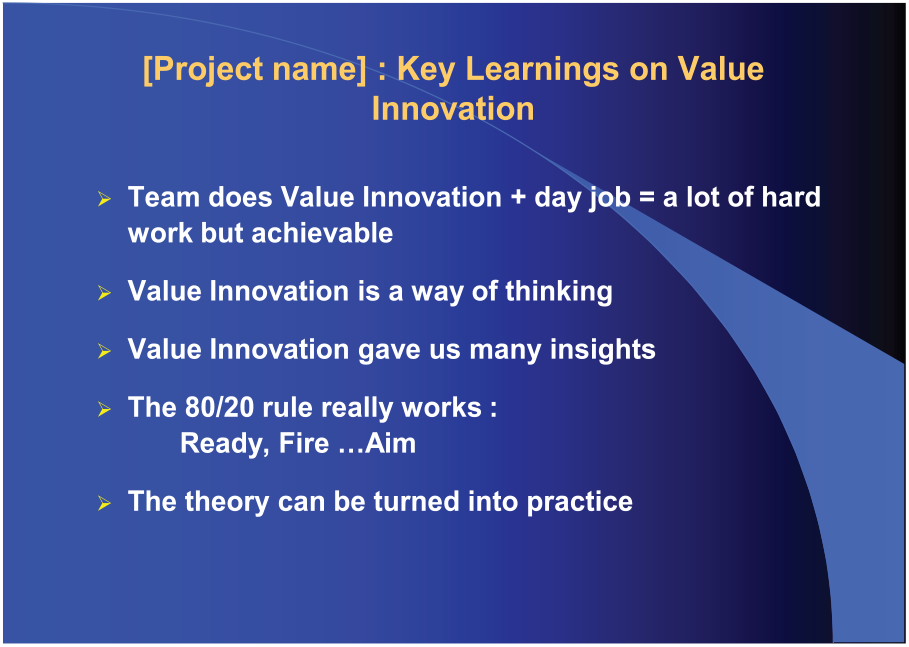
PowerPoint slide 6 (of 9) of a consulting presentation from 1999 entitled ‘Value Innovation: Implementation at [Project name]’.
All in all, this second phase is crucial for the performativity of the Blue Ocean Strategy since it led to the application of Value Innovation to the business setting. However, the performativity reached a turning point in 2002 during the annual conference of the Strategic Management Society, the preeminent academic society dedicated to the field of strategy, as the HBR Editor (P1) of the upcoming book remembered:
The authors [i.e. W. Chan Kim and Renée Mauborgne] were speaking, and [. . .] the word Blue Ocean Strategy came out of their mouths. . . and that’s the first time anyone heard Blue Ocean Strategy. And the minute they said that, all the lights went on in my head. I said, ‘that is the title of the book, all the concepts are going to get rolled up underneath this big umbrella of Blue Ocean Strategy.’ (emphasis added)
At this time, all of the concepts (e.g. Value Innovation, non-customers) and strategy tools (e.g. Value Curve) lacked clear linkages with one another. As the publisher explained, it is the book that created a cohesive construct, as developed in phase 3.
Phase 3: Blue Ocean Strategy as a cohesive construct that spread around the world (2002–2017)
It was not until 2004 that an HBR article announced that the theory would be published as a book with the name Blue Ocean Strategy (Kim & Mauborgne, 2004). In 2007, the Blue Ocean Strategy Institute and Blue Ocean Strategy Centres were established to supplement the previous assemblages, developing, respectively, pedagogical and consulting activities. They caused the theory to spread around and offer a global reach.
Establishing the assemblages
The analysis shows that the theory established the assemblages by coherently consolidating its different elements. This process occurred through the careful crafting of an appealing concept by relying on an incredible infrastructure and by taking to heart the logics of the theory. The establishment of the assemblages first involved the careful crafting of an appealing concept. For instance, a consultant (C5) explained the benefits of the book published in 2005:
I think, in some sense, the emphasis of Blue Ocean Strategy on easy reading, on easy digestion was a big advantage; it was a key factor [. . .]. It reads almost like a story book, which is the strength of it. Therefore, not having a lot of scientific data behind it may be helped because the emphasis was on making it easy to understand.
The consultant explained that the writing of the book induced a focus on easy reading at the expense of strong scientific backing. This trade-off was achieved by working on labels, illustrative examples, and so on (see Table 2 for illustrations). This work was made possible by what the publisher of the book (P1) called an ‘incredible infrastructure’:
This was brilliant because most authors write the manuscript, send the manuscript to the publisher, the publisher publishes it, and then the authors go home. They don’t do anything to get out there and really promote and market the book. Chan [Kim] and Renée [Mauborgne] had this incredible infrastructure. It took them years to do it, but they did it, and it was a critical factor for the sale of the book.
As the publisher explained, academics from INSEAD and the consultants who were enrolled by the theory both participated in establishing the book in terms of writing and promotion. They also established pedagogical and consulting activities within the Institute and the Centres established in 2007.
Finally, the assemblages perceived themselves through the lens of the theory. One consultant (C7) described this phenomenon as follows:
Every little step of the way, we thought about high impact. In a sense, we’ve taken to heart the logic of Blue Ocean Strategy in what we do. We want high value at low cost for our clients. And so, if you do Blue Ocean Strategy with us, it’s not a half a dollar McKinsey project, but it’s a third of that for brand new businesses and companies. (emphasis added)
In this example, the consultant justified the activities related to the Blue Ocean Strategy using one definition related to the theory. In other cases, people (consultants, faculty members), material devices (strategy tools, booklets) or institutions (the Institute, the Centres, INSEAD) defined themselves or others based on elements of the theory’s definition or simply using the phrase ‘blue ocean strategy’ (see Table 2). By taking to heart the logic of the theory, they internalized it. Thus, they spread the theory around.
Spreading around
The analysis shows that the assemblages spread the theory around by making an impact and applying a structured framework. While the emphasis was previously placed on promoting the theory, the new assemblages went one step further during this phase by impacting practice. A faculty member (F1) explained this mechanism by referring to the book published in 2005:
When I think of Blue Ocean Strategy, what is interesting and what makes it also powerful are the notions of the metaphor and the title. I think that a lot of people bought the book, and a lot of people remember the words ‘Blue Ocean Strategy’, and it has become part of the language.
The establishment of the assemblage led to the use of the theory in common language. Similarly, the theory changed the mindsets of practitioners. In other words, it impacted practice.
The new assemblages also allowed for the application of a structured framework by managers. One consultant (C7) referred to the benefits accomplished by the consulting assignments based on the Blue Ocean Strategy:
It’s not a ‘blue sky, let’s go have a picnic under a big maple tree and hope for a unicorn to fall. . .’ [laughs]. You know, it is rigorous, it is structured, it is analytical, you work with data, a lot of data. . .
The structure of the framework is perceived to improve the impact in practice. Another example relates to Blue Ocean Shift (Kim & Mauborgne, 2017). This book offers a five-step methodology to help practitioners ‘use’ the theory; it is illustrated with real-life examples of companies and contains practical advice for application. Both the impact on practice and the application of a structured framework contributed to reaching a global audience.
Global reach
Beyond use in traditional business settings, the theory has reached non-western countries and has been used for governmental projects and NGOs. For instance, a faculty member (F4) explained, ‘Professor Kim is doing some advisory work for national governments’, in reference to his involvement in different Asian countries beginning in 2005. In fact, a faculty member (F5) summarized the reach of the theory as follows:
We’ve never found an environment where it doesn’t work. We used it for NGOs, in a non-profit environment, we used it for internal functions like HR. We built outsourcing centres for insurance using this logic. . . We’ve done all types of stuff. It works. So far, it works everywhere.
While it would be difficult to assess whether the theory actually ‘works everywhere’, this quote indicates that the theory has performed in non-business settings and achieved global relevance.
Discussion and Conclusion
Changes in the assemblages during performativity
The case of the Blue Ocean Strategy developed a process model that emphasizes how the theory changed the assemblages and then shows how they changed reality and enlarged its scope in turn. As Figure 3 illustrates, the theory first appropriates some assemblages that generate interest within a circumscribed use. During this phase, the theory enrols a limited number of assemblages that would allow for its survival, and it relies on cycles of framing–overflow–reframing. Then, the mechanisms differ. Relying on new assemblages, the theory rearranges them to confront business settings. The roles of the assemblages include framing, enrolling and consolidating. Finally, during the third phase, the theory establishes new assemblages to offer a global reach. Since previous efforts were not sufficient, assemblages mainly aim at consolidating previous ones.
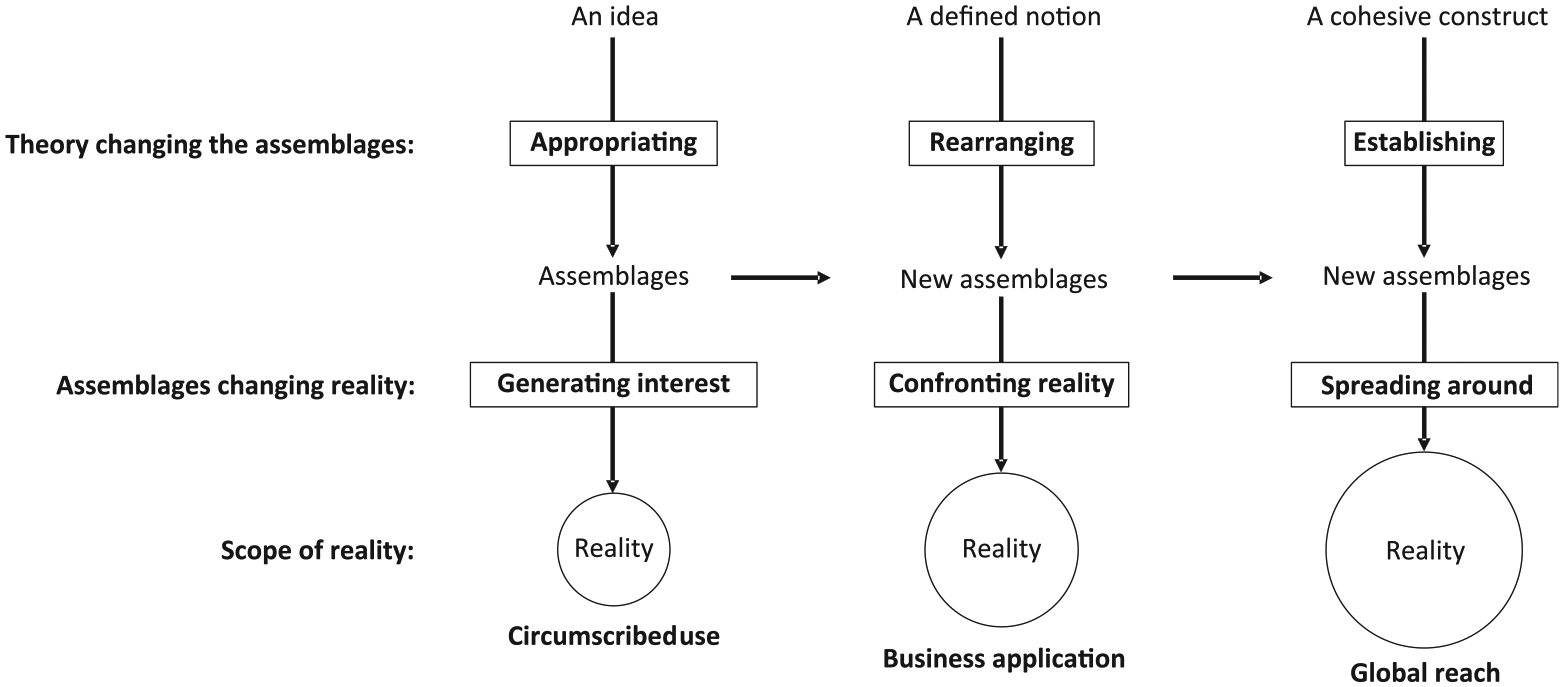
Process model of the changes of the assemblages during performativity.
All in all, this process model shows that performativity relies on successive new assemblages that build on each other. They mainly play the roles of framing and enrolling during early phases and of enrolling and consolidating in later ones. They contribute to enrolling a broader reality over time. These findings have implications for performativity studies and for practice.
Implications for performativity studies
The use of theories by practitioners
Considering the counter-perspective of studies focusing on how practitioners use theories (Astley & Zammuto, 1992; Ferraro, Pfeffer, & Sutton, 2005), this study theorizes the process through which theories are made meaningful to practitioners. Thus, rather than showing that theories are used in instrumental, conceptual or symbolic ways (Astley & Zammuto, 1992), the case of the Blue Ocean Strategy shows that the appropriation process is more complex. For instance, performing the Blue Ocean Strategy involved enrolling strategy tools for instrumental use, as well as well-known institutions such as INSEAD, that helped gain legitimacy and led to the framing of different concepts that have been used by practitioners. Thus, the performativity perspective emphasizes that, to be appropriated, a theory transforms the assemblages in all of these different dimensions.
In fact, rather than creating ambiguity (Astley & Zammuto, 1992), this study shows that theories create interest, which facilitates their appropriation: For instance, the metaphor of the Blue Ocean Strategy was particularly helpful in transferring the meaning of theory to reality (Ferraro et al., 2005). Following Kieser, Nicolai and Seidl (2015), this study calls for further studies adopting a performativity stance to engage with how management knowledge transcends research and practice (see also Bartunek, 2019).
The scope of reality
This study also answers the call to understand how theories are performed on larger scales and in more settings over time (Ferraro et al., 2005). Indeed, previous research has already shown that the scope of reality was not fixed and increased over time. Furthermore, thinking in terms of the scope of reality being performed could respond to why some theories are perceived as being ‘true’ and others ‘false’ (Martí & Gond, 2018, 2019). This study adds to this current literature by showing how the scope increases. The capacity of a theory to increase its scope – and to become ‘true’ in more contexts – lies in its ability to find assemblages that it can frame, enrol and consolidate to appropriate, rearrange and establish them. This process raises questions regarding why some assemblages can better contribute to performing reality than others, and it calls for further research on the study of the properties of the assemblages.
The process of performativity
Finally, this study reaffirms the importance of assemblages for the study of the process of performativity (Cabantous & Sergi, 2018; D’Adderio et al., 2019). It shows that framing- and translation-related roles are embodied within a processual perspective since they cause the assemblages to be appropriated, rearranged and established over time. This study also highlights the power of theories as shown elsewhere (e.g. Ghoshal, 2005). Not only do they lead to a change in reality, but they also change the assemblages in different ways over time. For instance, the case of the Blue Ocean Strategy even showed that it caused the assemblages to take to heart the logic of the theory. This finding offers implications for researchers in performativity engaged in debates over the role of theories in management practice (e.g. Spicer, Alvesson, & Kärreman, 2009, regarding critical management studies).
This study also contributes to better understanding how performativity improves over time. Whereas Martí and Gond (2018) explained the evolution of the type of performativity by differentiating three stages during which new ways of acting create effects in the world that reinforce these ways of acting, this study adds to this process. It shows that new phases of performativity require new assemblages. While Martí and Gond (2018) mentioned one mechanism of performativity, which consists of changing material devices through experiments, this study adds other mechanisms aimed at appropriating, rearranging and establishing the assemblages over time. All in all, given the complementarities of these two studies in terms of focus (assemblage vs. performativity level), this study calls for more research linking the changes in the assemblages and the level of performativity.
Implications for practice
This article offers several implications for practice. First, it shows that management concepts have substantial transformational power: they change business practices, affect frameworks and strategy tools, and influence the academics and practitioners who participate in the creation of the concepts. Second, constructing a concept that transforms business practices is a long and chaotic process that does not rely on quick-fix solutions or previously defined recipes (see Appendix 3 for the timeline of the Blue Ocean Strategy). Third, there is no difference between academics and practitioners regarding making a theory reality; they contribute equally to the theory through their distinctive skills and activities. Similarly, artefacts – and particularly strategy tools – are just as important as people for making a concept reality.
Footnotes
Appendix
The Blue Ocean Strategy chronology.
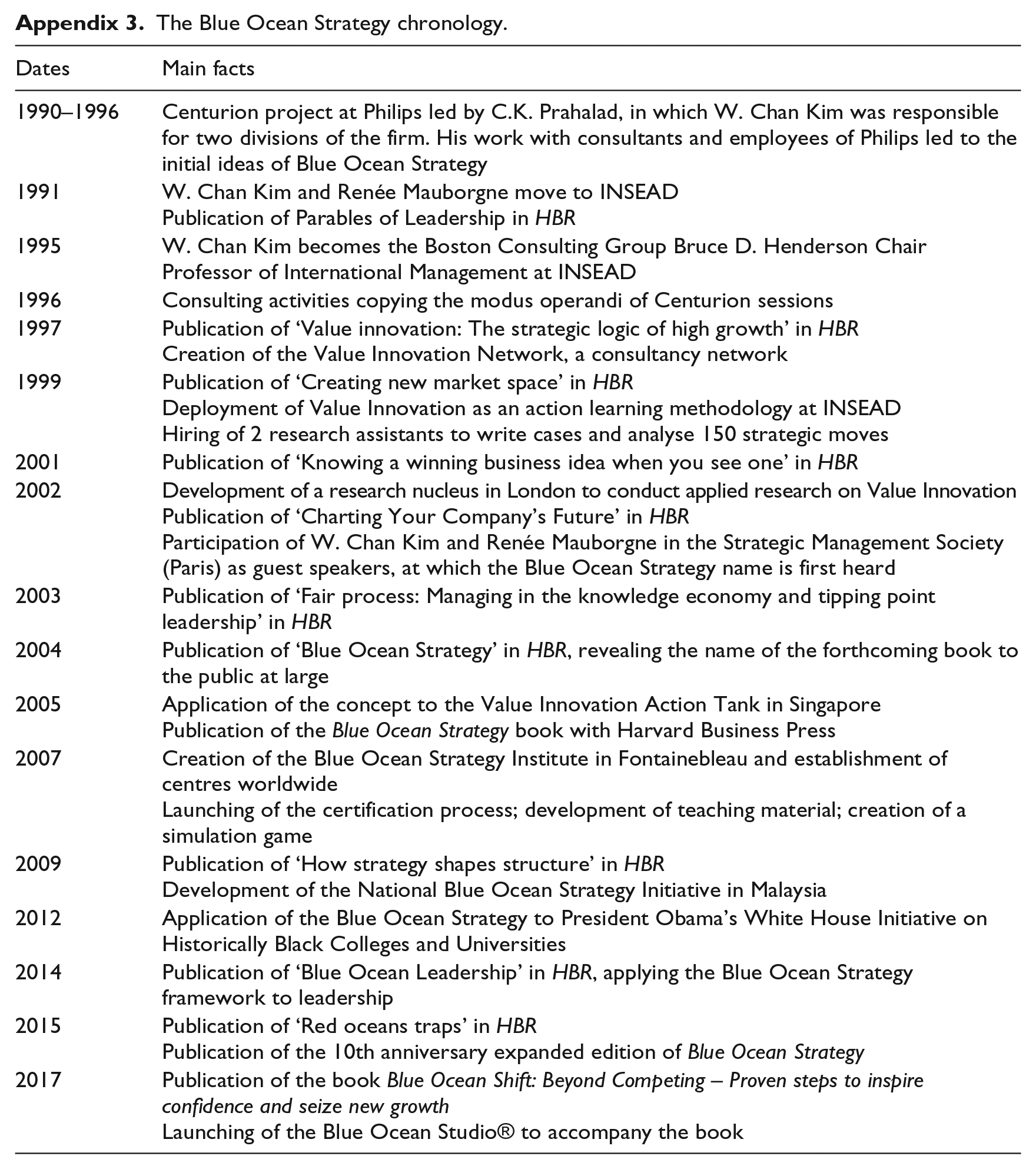
| Dates | Main facts |
|---|---|
| 1990–1996 | Centurion project at Philips led by C.K. Prahalad, in which W. Chan Kim was responsible for two divisions of the firm. His work with consultants and employees of Philips led to the initial ideas of Blue Ocean Strategy |
| 1991 | W. Chan Kim and Renée Mauborgne move to INSEAD Publication of Parables of Leadership in HBR |
| 1995 | W. Chan Kim becomes the Boston Consulting Group Bruce D. Henderson Chair Professor of International Management at INSEAD |
| 1996 | Consulting activities copying the modus operandi of Centurion sessions |
| 1997 | Publication of ‘Value innovation: The strategic logic of high growth’ in HBR
Creation of the Value Innovation Network, a consultancy network |
| 1999 | Publication of ‘Creating new market space’ in HBR
Deployment of Value Innovation as an action learning methodology at INSEAD Hiring of 2 research assistants to write cases and analyse 150 strategic moves |
| 2001 | Publication of ‘Knowing a winning business idea when you see one’ in HBR |
| 2002 | Development of a research nucleus in London to conduct applied research on Value Innovation Publication of ‘Charting Your Company’s Future’ in HBR Participation of W. Chan Kim and Renée Mauborgne in the Strategic Management Society (Paris) as guest speakers, at which the Blue Ocean Strategy name is first heard |
| 2003 | Publication of ‘Fair process: Managing in the knowledge economy and tipping point leadership’ in HBR |
| 2004 | Publication of ‘Blue Ocean Strategy’ in HBR, revealing the name of the forthcoming book to the public at large |
| 2005 | Application of the concept to the Value Innovation Action Tank in Singapore Publication of the Blue Ocean Strategy book with Harvard Business Press |
| 2007 | Creation of the Blue Ocean Strategy Institute in Fontainebleau and establishment of centres worldwide Launching of the certification process; development of teaching material; creation of a simulation game |
| 2009 | Publication of ‘How strategy shapes structure’ in HBR
Development of the National Blue Ocean Strategy Initiative in Malaysia |
| 2012 | Application of the Blue Ocean Strategy to President Obama’s White House Initiative on Historically Black Colleges and Universities |
| 2014 | Publication of ‘Blue Ocean Leadership’ in HBR, applying the Blue Ocean Strategy framework to leadership |
| 2015 | Publication of ‘Red oceans traps’ in HBR
Publication of the 10th anniversary expanded edition of Blue Ocean Strategy |
| 2017 | Publication of the book Blue Ocean Shift: Beyond Competing – Proven steps to inspire confidence and seize new growth
Launching of the Blue Ocean Studio® to accompany the book |
Acknowledgements
I would like to thank Senior Editor John Sillince and the two anonymous reviewers for their thoughtful comments and feedback. Special thanks to Veronique Ambrosini, Céline Berrier-Lucas, Vivien Blanchet, Laure Cabantous, Jean-Pascal Gond, Gérard Koenig and Violetta Splitter. I also benefited from presenting previous versions of this article during my PhD viva, workshops and conferences. I am especially thankful for feedback from Franck Aggeri, Magali Ayache, Sébastien Damart, Stéphanie Dameron, Benoît Demil, Jean-Philippe Denis, Adam Dewitte, Anthony Gour, Xavier Lecocq, Philippe Mouricou, Anouk Mukherjee, Bernard Ramanantsoa, Vanessa Warnier and my colleagues at ISG Lab. I also thank the Academy of Management which named a previous version of this article as ‘2017 William H. Newman Award Finalist’. Finally, I thank all my interviewees for their time.
Funding
The author received no financial support for the research, authorship, and/or publication of this article.
