







Abstract
In this article we adopt Barad’s theory of agential realism to explore how power and performativity are simultaneously processual and ontologically entangled. We use the hyphenated term power-performativity to mobilize an exploration of how power is not an ‘outcome’ or ‘effect’ of, but an inseparable flow within, the processes of performativity through which the world is continuously becoming. This moves us beyond the traditional, anthropocentric take on the relationship between power and performativity which emphasizes human agency and linear cause-effect, toward an alternative understanding of organizational phenomena as always enacted through myriad intra-acting more-than-human actants. To empirically mobilize this approach, we explore power-performativity within online healthcare, enacted through personal online healthcare communities (POHCs). We explore multiple ‘diffraction gratings’ through which particular outcomes of online healthcare come to matter, while others are prevented from mattering. In doing so, we posit the suitability of Barad’s agential realism for further explorations of the dynamics of power and performativity in modes of organizing and organizational life and offer tools for how these may be done.
Keywords
Introduction
I propose a posthumanist performative approach to understanding technoscientific and other naturalcultural practices that specifically acknowledges and takes account of matter’s dynamism. The move toward performative alternatives to representationalism shifts the focus from questions of correspondence between descriptions and reality (e.g. do they mirror nature or culture?) to matters of practices, doings, and actions. Such an approach also brings to the forefront important questions of ontology, materiality, and agency.
This quote provides an entrée into the posthumanist framework of Karen Barad’s ‘agential realism’ (AR): a theoretical framework heavily informed by quantum physics that we suggest is particularly apt for exploring power and performativity as entangled processes (rather than interrelated, yet entitatively separate). As this Special Issue’s call for papers states, understanding the interplay of these themes (power and performativity) holds significant potential insights for organizational process studies. As we see it, Barad’s AR offers valuable conceptual devices for empirically investigating this relationship. Critically, through adopting these devices, we contribute to ongoing attempts to articulate the relationship between power and performativity as one of ontological entanglement, going beyond the dominant anthropocentric understanding of these themes in the management and organization studies’ (MOS) literature which has typically examined them as separate phenomena.
Much of the MOS literature on power has transitioned from a static, possessive view, to one in which power is seen as a process, constantly unfolding (Fleming & Spicer, 2014; Foucault, 1978; Leclercq-Vandelannoitte, 2011; Raffnsøe, Mennicken, & Miller, 2019). Notably, in this literature there is a preoccupation with the linguistic over material dimensions. Similarly, the MOS literature on performativity has also situated the world as perpetually coming-into-being through always-emerging processes (Cabantous & Gond, 2010; Gond, Cabantous, Harding, & Learmonth, 2016; Harding, Ford, & Lee, 2017; Introna, 2013). Yet again, this literature typically emphasizes the importance of language (e.g. by discussing the concept of ‘speech acts’; Butler, 1993) and the centrality of the human in these processes. As of yet, however, power and performativity have rarely been discussed in tandem. And, when they are, power is positioned as an effect of, or a phenomenon distinct from, performativity (Gond & Nyberg, 2017; Harding et al., 2017; Wilhoit & Kisselburgh, 2019).
Using Barad’s AR framework to conceptualize power and performativity, we build upon the above heritage by explicitly contributing an understanding of power and performativity as existing in an entangled manner, decentring the human and language, allowing the role of more-than-human matter in processes of worldly becoming (materialization) to be taken more seriously (Ford, Harding, Gilmore, & Richardson, 2017; Gond & Nyberg, 2017; Harding et al., 2017; Orlikowski & Scott, 2008; Orlikowski & Scott, 2015). This contribution has three major consequences for understanding organizing. In short: (1) rather than focusing on isolated human actors, it compels attention toward the more-than-human practices that are the source of agentic potential and therefore facilitate the world’s open-ended becoming. For Barad this means that (2) we have to revisit our ideas of cause and effect as linear and temporally separated phenomena, which ultimately suggests that (3) we need to reimagine what it means to be responsible, extending responsibility (but not ethical responsibility) to the more-than-human as well.
In the remainder of the paper, we continue with a brief overview of power and performativity in the MOS literature, before introducing the key Baradian terms we see as useful for explicating the nature of our alternative concept of power-performativity. Following this, we outline the qualitative methodological approach taken to generate our empirical data on the use of personal online health communities (POHCs): a new technology in the healthcare sector that allows patients and healthcare professionals to interact online to discuss a patient’s health. Given that POHC technologies are often introduced in the highly hierarchical doctor–patient relationship with the intention of increasing patient control and empowerment (ParkinsonNet, 2012; Schwamm, 2014), this case brings the issues of power and performativity to the fore. Details of our theoretically informed examination of this data follow, with specific care being paid to demonstrate how Barad’s AR concepts enable the emergence of our insights regarding the entangled nature of power and performativity at play in the becoming of online care. The article then concludes with a discussion of how our theoretical contributions are fortified by the three earlier outlined consequences of the concept of power-performativity and how these might provide tools for further studies on organizational power and performativity.
Power and Performativity
Power and performativity in MOS
This article builds on a long history of writing on power and performativity. In MOS specifically, writing on the concept of power has drawn heavily on the work of Foucault (Fleming & Spicer, 2014; Hardy & Clegg, 2006; Raffnsøe et al., 2019), who influentially argued for a processual rather than possessive view (Foucault, 1978). That is, power is not in the hands of individuals to be yielded at their whim, but rather an ongoing process, where norms and discourses need to constantly be remade in action, with the potential for change (or reproduction) emerging over time (Raffnsøe et al., 2019). In a similar vein, the concept of performativity, largely influenced by Butler (Harding et al., 2017; Hodgson, 2005; Tyler & Cohen, 2010), has been a conceptual point of entry for theorizing and exploring the processual nature of phenomena, conceptualizing organizations and their members as dynamic ‘becomings’ rather than static ‘beings’ (Diedrich et al., 2013; Fleming & Banerjee, 2015; Gond et al., 2016; Learmonth, Harding, Gond, & Cabantous, 2016; Nyberg, 2009; Orlikowski, 2005; Simpson, Buchan, & Sillince, 2018). For instance, Harding et al. (2017) show the ‘becoming’ of resistance enacted through managers in entanglement with materialities, while others focus on the way organizational practices emerge through entanglements with technology (Nyberg, 2009; Orlikowski & Scott, 2014).
These insights on the processual nature of organizing and power, particularly informed by Foucault and Butler, have been enormously influential to our work and that of Barad. Our aim is to add further nuance to their insights by going beyond an emphasis on discursive dynamics. While Foucault and Butler certainly make varying degrees of reference to matter and materiality, their emphasis on discursive dynamics means that the MOS literature stemming from their scholarship has continued to situate material factors as ‘consequences’ or ‘outcomes’ of social processes. Although Butler in particular has been undoubtedly influential in highlighting the presence of matter and materiality in processes of performativity (Butler, 1993, 2015), she does not provide the tools to analyse exactly how it may in fact play an active role in such processes (Jagger, 2015; Niesche & Gowlett, 2019). Similarly, Foucault’s focus on materiality, or lack thereof, has been hotly debated (Dale, 2005) but general consensus suggests that, for Foucault, materiality is part of discourse (i.e. discourse is partly material) (McNay, 1993), subsuming materiality under discourse, rather than locating it as its entangled equal.
Ultimately, this creates a human-centric analysis of organizing, approaching matter and processes of mattering along the lines of an anthropocentric hierarchy of life (and non-life). Humans, as the sole creators of discourse, are at the pinnacle, with nonhuman lifeforms and objects prioritized by their centrality, or usefulness, to these processes of discourse creation. In turn, analyses of processes of power or performativity remain based on the assumption that human (usually linguistic) action is the driving force behind these processes, and hence the worthiest unit of analysis. Although critiques of human-centricity exist in reference to subject positions, space and technology in the MOS literature (Hultin & Introna, 2018; Hultin & Mähring, 2017; Knox, O’Doherty, Vurdubakis, & Westrup, 2008; Orlikowski & Scott, 2014), we believe Barad’s work can help to further expand attention to, and understanding of, the more-than-human, more-than-discursive processes of power and performativity in the becoming of organizing and organizations. Furthermore, as previously noted, attention to both these concepts within singular studies has been sporadic. And in cases when they have been discussed in conjunction, power has usually been located as an effect of performativity (Harding et al., 2017; Nyberg, 2009; Wilhoit & Kisselburgh, 2019). Conversely, through the lens of AR, these concepts are revealed to be entangled (hence, hereon referred to as power-performativity). To explicate this entanglement, we now turn to Barad’s work.
Agential realism: An entangled, posthumanist view on power and performativity
In making our case as to the latent value of Barad’s work for other MOS scholars, we are faced with the challenge of negotiating the highly technical and complex nature of her concepts and the language employed to expound them. To date, those in the social sciences/MOS who have engaged with her work have largely resorted to critiquing it for being too vague and complex (Leonardi, 2013). As junior scholars, we are more than aware of, and in partial agreement with such critiques. Reading Barad’s work is, at times, electrifying - we have both experienced flows of energy through our bodies when reading key passages of her work. However, it can also be paralysing – disorientation and feelings of overwhelm frequently accompany any attempt to apply it to our own work. Yet despite this we have continued to be seduced by her way of thinking about the world. To support the reading of the remainder of this article, we wish to start by presenting Table 1 which contains an overview of some of Barad’s main concepts (alphabetically ordered) with key quotes from her 2007 book. Accompanying these definitions are our own attempts to translate them into simpler language, potentially increasing a shared understanding among MOS scholars 1 .
Overview of Barad’s main concepts (all page numbers refer to Barad’s 2007 book).
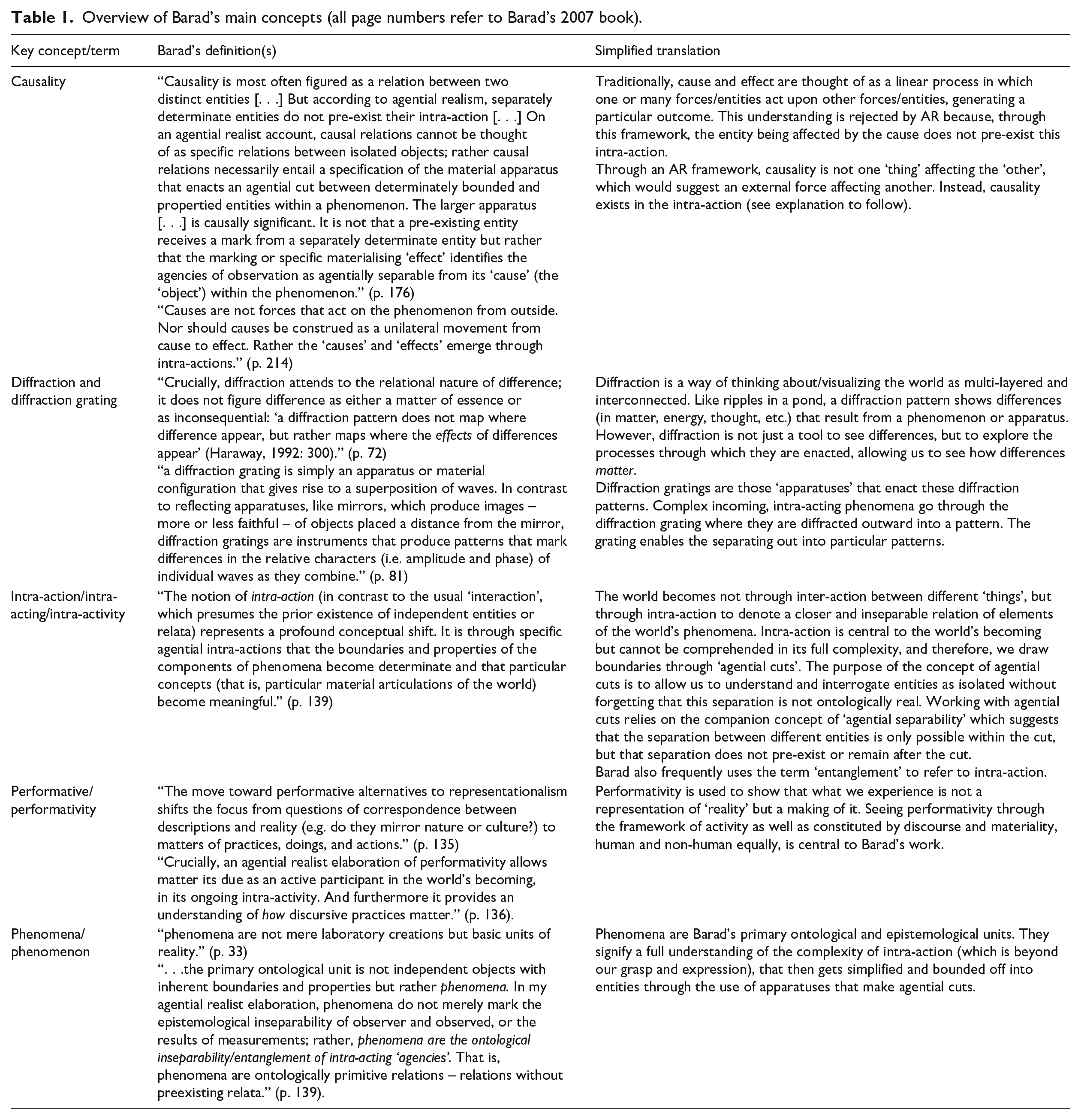
As you may have noted, the term ‘power’ is conspicuously absent from Table 1. This is due to the fact that while AR holds significant potential for conceptualizing power, Barad does not explore this element in depth. This has been a source of criticism (T. Bennett & Joyce, 2010; Edwards & Fenwick, 2015). We suggest, however, that a more explicit understanding of her implied perspective on power emerges when attention is paid to some of her core concepts. Below, we outline the concepts of ‘diffraction’ and ‘exteriority-within’ on which we focus in particular in our analytical exploration of power-performativity. First, however, we would like to come to a common understanding of the AR framework that surrounds these two concepts.
AR’s framework is built on the idea of ‘intra-action’. Whereas the term inter-action ‘presumes the prior existence of independent entities/relata’ (Barad, 2003, p. 815), intra-action speaks to the idea that existence is conditional on processes of relating. Everything is produced moment to moment, through the performativity enacted within processes of intra-action. While it is common in process studies to work with an appreciation that ‘everything is related’, the radicality of Barad’s ontology stems from the way she understands the nature of related ‘things’ (entities, processes, practices, ideas). For Barad, all ‘things’ are absolutely inseparable from the processes of actively coming-into-being that they emerge through, which in turn involve countless further such processes/entities. This degree of entanglement might seem to make it impossible to distinguish one ‘thing’ from another. However, as Barad clarifies, the entanglement inferred by the concept of intra-action does not deny that boundaries exist between entities. Rather, it reworks our understanding of the nature of these boundaries, such that a boundary is not an a priori, material distinction that bounds one thing off from another, but something that is made, sustained and eroded through processes of intra-action. In other words, the boundaries that define materially different ‘individual’ entities are made inside of processes of intra-action, offering a prime example of the Baradian notion of ‘exteriority-within’ (developed further below). As such, boundaries only ever reflect entities’ agential, never ontological, separability. That is, a boundary acts as an ‘agential cut’ to enact a temporary, ‘contingent resolution of the ontological inseparability within the phenomenon’ (Barad, 2007, p. 348, original emphasis).
The concept of intra-action therefore decidedly broadens the scope of who, or what, is involved in the world’s becoming. Beyond significantly decentring the human, AR actively challenges the dominant understanding of what it is to be a human. Far from the ‘unitary, coherent and autonomous individuals who are separate and separable from social relations and organizations’ (Collinson, 2003, p. 527) that populate management literature, people, like all other worldly phenomena, are co-constituted through a milieu of known and unknowable intra-actions. In turn, we are but one of the countless intra-acting entities that performatively enact organizational life. Hence, the AR perspective demands an expanded scope of attention inclusive of all modes of matter-in-relation. Working with AR is, therefore, an endeavour that ‘acknowledges and takes account of matter’s dynamism’ (Barad, 2007, p. 135), wherein matter is worthy of attention whether or not it is ‘human’ or under discernible anthropocentric influence. This theoretical commitment refuses to let us forget, even momentarily, that not only are humans never in total control of the world’s processes and phenomena, neither are they a requirement for ‘things’ to happen (Gherardi, 2018).
Developing power-performativity
Having briefly overviewed the AR framework, we now turn specifically to the concepts of ‘diffraction’ and ‘exteriority-within’ to further develop our proposed concept of power-performativity. Barad’s conception of diffraction – inspired by feminist authors such as Trinh T. Minh-ha and Donna Haraway, and furthered via her expertise as a physicist – is useful for tracing how and what differences are made, and the effects of those differences. It draws attention to the creation and repercussions of boundaries, which in and of themselves she acknowledges as being perpetually enacted through processes of intra-action. Like a wave hitting a seawall, the effects of encounter not only affect the entities obviously and immediately involved, but also splay out on new trajectories of difference-creation, and so on, for eternity.
Using this concept of diffraction as an entry into exploring power-performativity also requires introducing the terms ‘diffraction grating’ and ‘diffraction pattern’. In short, Barad posits that intra-acting phenomena pass through so-called ‘diffraction gratings’ (a concept from physics that we can think of as any kind of apparatus, for instance, words, books, bodies, meetings, discussion, measuring devices, etc.). The diffraction grating splays out (i.e. diffracts) the effects of the phenomenon with which it intra-acts, revealing specific diffraction patterns that one can then analyse. The term ‘diffraction patterns’ is, therefore, a shorthand way of talking about the effects of phenomena-in-encounter, overlapping and moulding together in particular ways, offering a way of partially tracing these intra-actions (which is the best that can be hoped for in the face of such complexity). As opposed to thinking about observable phenomena as fixed ‘bounded’ entities that ‘reflect’ reality, diffraction offers a way of ‘seeing’ them as momentary snapshots of the perpetual, processual materialization of reality. Diffraction, thus, is a useful concept to explain the significance of power-performativity, as it aids in identifying and analysing the difference that a performative moment makes. We argue that in attempting to trace the creation of differences through diffractive patterns, and interrogating which differences are made to matter (in both senses of the word), we can see how power is always entangled with the performativity. Important here is that power is not located in, or as the effect of, performativity, but as part of the performative process (it plays an integral role in enacting the diffractive pattern).
In respect to organizations, we can see, for example, the introduction of a new technology as a diffraction grating (itself made up of multiple intra-acting entities including code, computers, humans, software, desks, internet, policies, etc.) constantly enacting diffraction patterns (e.g. new practices and policies and their flow-on effects). It is through mobilizing the concept of diffraction gratings, as Østerlund, Crowston and Jackson (2020) have also done, that we can attempt to trace these patterns. Barad suggests these diffraction patterns ‘[show] up only for those who will do the hard work of tracing the quantum entanglements’ (Barad, 2014, pp. 180–181), which in turn requires attention to the diffraction gratings through which they are intra-actively enacted.
Using diffraction as an ontological basis, and diffraction gratings as an epistemological guide, we are able to reconceptualize power as entangled with performative process: the performativity of intra-actions is the marking and making of what matters, and hence an enactment of power. Previously, performativity has been seen as creating resistance or agency, where humans are awarded the ‘power to’ (e.g. resist) or the ‘power over’ (e.g. control) as a result of a performative process (Fleming & Spicer, 2014; Gond & Nyberg, 2017; Harding et al., 2017). Even with the acknowledgement of non-human actants (Wilhoit & Kisselburgh, 2019), these studies suggest power as resulting from performativity, locating these forces as interrelated, yet nevertheless external to each other. However, because diffraction’s focus is on the reverberations of intra-actions and the patterns they enact, rather than dismissing them as ‘externalities’ beyond the scope of the researcher’s interest, it affords an understanding of power as an ‘exteriority-within’ process of performativity, and vice versa. To explore this empirically, we now turn to our research context.
Research Context: Personal Online Healthcare Communities
As a technological communication platform, a personal online healthcare community (POHC) provides a place in which chronically ill patients can discuss issues with their healthcare professionals. The POHCs examined were part of a pilot project set up by ParkinsonNet, a Dutch organization that aims to improve care for patients with Parkinson’s disease. This was one of multiple projects they established in the hope of getting patients more involved, informed and therefore empowered in regard to their treatment, and for keeping healthcare professionals more involved and up to date with patients’ care (ParkinsonNet, 2012). The POHCs consist of a number of functions, with our focus being specifically on the ‘virtual meeting’ menu option, where patients or healthcare professionals can start an online meeting – similar to a real-time email conversation – and invite specific participants. Similar to face-to-face consultations, this virtual meeting space allows for back-and-forth interactions between patient and healthcare professional(s).
Data collection
Data collection occurred through Laura’s observations of 14 patients’ POHCs, with all processes approved by the appropriate medical ethics committee. Laura was added after first conducting an interview with the patients (this interview data is not included in this article). By being added to patients’ ‘virtual teams’, she was able to read all the existing posts and was notified of all new postings. Observations of each POHC lasted between 16 and 32 months resulting in a total of 691 postings. Every couple of months screenshots of the online communities were saved as PDF documents, with a redaction tool utilized to erase any reference to patients’ names or images to safeguard anonymity. This article draws upon data from the POHCs of patients Luke and Dorothy (both assigned pseudonyms). These specific cases were selected for three reasons. First, almost the entirety of these patients’ conversations with their healthcare professionals were conducted online. Sometimes, other patients’ healthcare professionals would choose to move the conversation offline because they, for unstated reasons, preferred discussing things over the phone or in person. Second, though empirical generalizability is not our concern, their POHCs are reflective of many of the other patients’ communities that contained similar, yet often less detailed, conversations. Third, they offer insightful comparisons when it comes to exploring the entanglement of power and performativity on the POHCs.
Data analysis
The goal of our data analysis process was to undertake a theoretically informed empirical exploration of the dynamics of power-performativity in the context of patients’ simultaneously ‘virtual’ and ‘real’ care provision. In the process we hoped to illustrate the value of AR’s main concepts for understanding these entangled forces. It is important to note that the online conversations constituting the data were all in Dutch. Given that translation inevitably entails a loss of meaning, the analysis was undertaken by Laura in Dutch before translating its findings into English. This consequent translation was focused more on replicating meaning than the literal translation of each word. The initial phases of analysis were informed by Laura’s interest in patients’ bodies: specifically, their positionality in the POHCs, and the performative dimensions of power embedded in the online processes of providing care to these bodies. Using the ATLAS.ti coding program Laura highlighted relevant quotes on patients’ POHCs with reference to bodily dimensions including symptoms or more implicit mentions in reference to ‘other’ bodies. During this process she was simultaneously immersed in the academic literature on bodies. Beginning with Foucault (1978, 1988), the inferences to materiality within the data led to exploring the work of Butler (1993) and ultimately Barad (2007). It was in noticing the lack of an explicit vocabulary in Barad’s work for interrogating the processes of power embedded in the articulation of more-than-human performative processes evident in the data that the theoretical contribution of this article emerged.
It was at this time that Olivia joined the author team, to progress the analysis based on her prior experience with translating the complexity of Barad’s work to empirics (Davies & Riach, 2018). Guided by both our reviewers’ comments and Barad’s work, the next phase of the analysis looked specifically for diffraction gratings, understanding these as key to understanding performative processes of ‘mattering’. We interrogate the diffraction patterns they enacted in our data, and in doing so illuminate processes of power-performativity.
To come to a posthumanist analysis of our data, we followed the valuable guidance of Hultin (2019) to not focus on what actors do, but on what provides them the ability to act in certain ways. Through this process, we acknowledged our own intra-action with the data collection, analysis and writing process, our bodies and labour intra-acting with theory, the useful guidance of reviewers, editors and other colleagues, participants, technologies and other less knowable more-than-human actants, temporarily delineating us as ‘authors’. In analysing our empirics we were cognizant that we were not gaining access to a ‘reality’ out there but were part of the diffraction gratings enacting the emergent findings. In playing a role in the becoming of the observed phenomena, we garnered firsthand experience of Barad’s assertion that objectivity, ‘instead of being about offering an undistorted mirror image of the world [as per a reflective approach], is about accountability [. . .] and responsibility to the entanglements of which we are a part’ which she made in an interview with Dolphijn and van der Tuin (2012, p. 52).
The Becoming of Online Healthcare
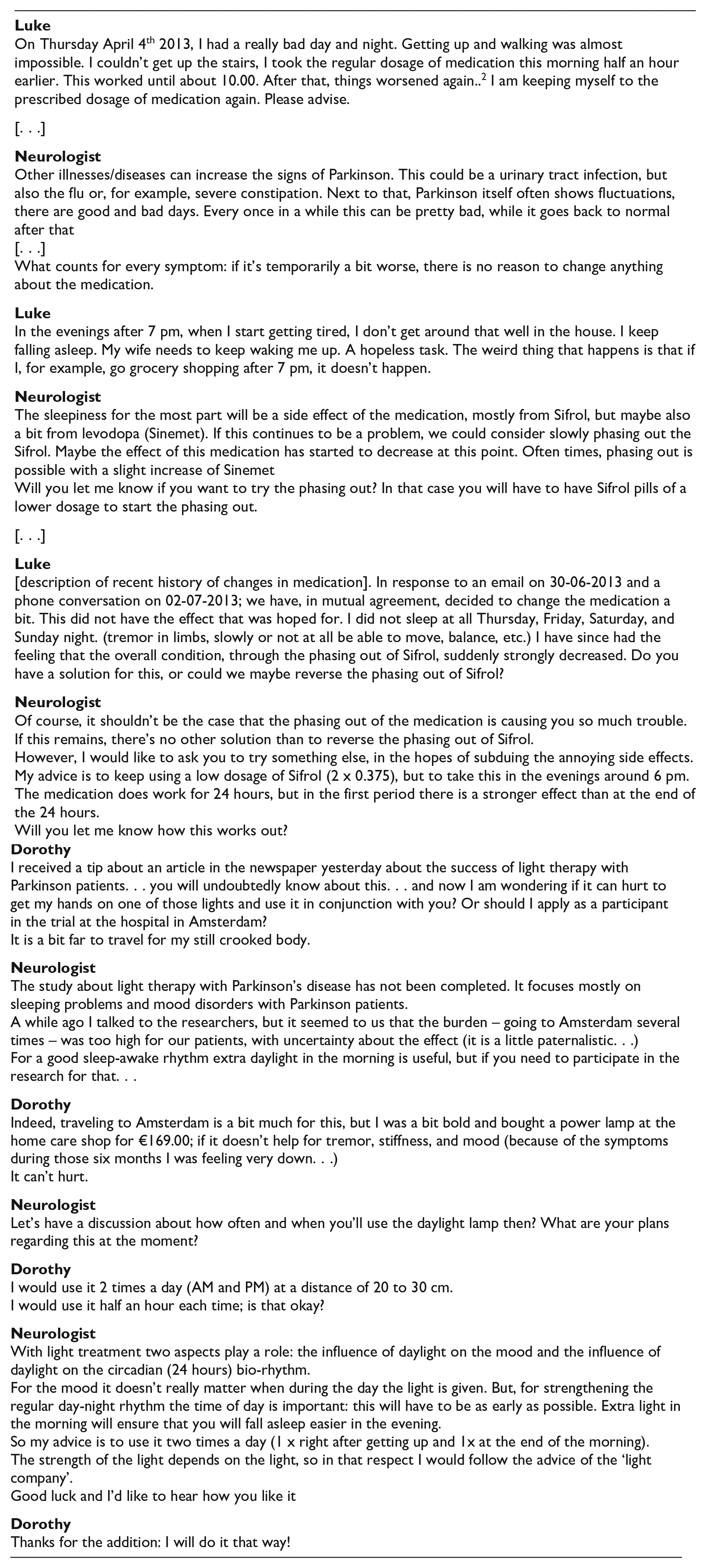
At the time of data collection Luke was 73 and had been diagnosed with Parkinson’s eight years prior. Within the Parkinson’s doctor–patient relationship, questions of when to start medication, which medication to take, how much and at which stage of the disease progression are important considerations (Lees, Hardy, & Revesz, 2009). In the early stages of the disease, Luke had decided not to take medication, instead beginning six months after his diagnosis. During Laura’s interview with him, Luke described how a year and a half prior he started noticing that the pills he was taking were not effective anymore. These experiences with his medication were also expressed on his POHC as illustrated in the below excerpt which is part of an ongoing conversation with his neurologist to find the right medication regime to enhance his day-to-day quality of life. In the case of Dorothy – who at the time of data collection was 67 years old and had been diagnosed 13 years prior – medication had also been a mainstay of her treatment plan from early in her diagnosis. However, she also engaged in other therapies including occupational and physical therapy. As her POHC excerpt illustrates, she also experimented with less conventional treatments. For brevity and considerations of space, both excerpts are somewhat shortened (by taking out greetings and endings).
Diffractions, diffraction gratings, and diffraction patterns
Below, we examine a number of diffraction gratings and their concomitant diffraction patterns. Through this analysis we seek to empirically illustrate our thesis on how power-performativity operates. We go through multiple examples to practise the analysis of power-performativity both for ourselves as well as our audience. We use the term diffraction grating multiple times to describe a multitude of apparatuses and practices that constitute online care. These diffraction gratings are themselves temporarily enacted as part of intra-acting phenomena and generally relate to common (online) care processes such as diagnosis and treatment. These gratings enact separations and therefore diffraction patterns that we, in turn, focus our analysis on.
As outlined above, diffraction gratings are epistemological tools: activities, instruments, forces and other actants that enact specific diffractive patterns through the process of intra-action (see our simplified visualization below, noting the porosity of boundaries, reflecting the way in which the intra-acting phenomena identified are agentially, but not entitatively, separable). These patterns ‘enact what matters and what is excluded from mattering’ (Barad, 2007, p. 148). As such, to track and understand how differences get made (that is, to follow the diffraction patterns that afford particular modes of healthcare, and therefore bodies, to matter, and prevent others from emerging), it is useful to begin with an interrogation of the nature of the diffraction grating(s) in question. We have tried to visualize how diffraction gratings operate by showing, in an inevitably rudimentary fashion, how phenomena such as expert training, medical tests, bodily matter and various technologies intra-act through or with a diffraction grating, allowing particular healthcare ‘outcomes’ (artificially bounded moments in wider, ongoing diffraction patterns) to emerge (see Figure 1).
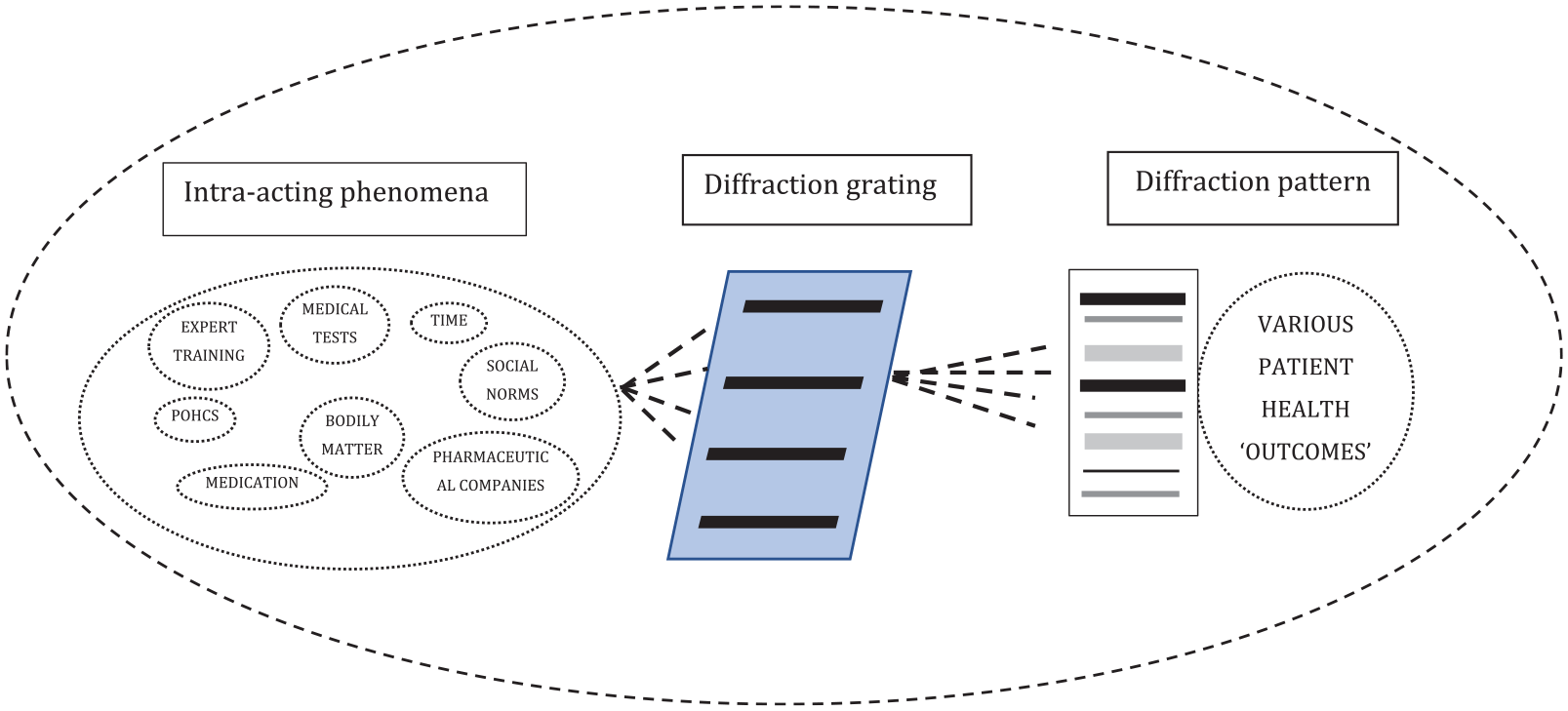
Sphere of intra-actions and diffractions in focus.
We start with analszing how the conversations on the POHCs show the diffraction grating enacting the prioritization of certain symptoms over others. As the medical literature makes clear, Parkinson’s disease comes with a variety of symptoms: most common are tremors, low mood or depression, slow movement and stiffness (Lees et al., 2009). From an AR perspective, the emergence of specific symptoms, and their coexistence, is the expression of various phenomena intra-acting with(in) the human body. For instance, we see how for Dorothy the phenomenon of daylight is ontologically connected to the way her symptoms/body materializes, just as the phenomenon of time of day is a factor for Luke.
Given this multifaceted nature of Dorothy’s and Luke’s symptoms, and their entanglement with factors that are traditionally considered ‘outside’ of what constitutes a symptom, the doctor’s role in diagnosis was of particular interest to us. Specifically, we draw attention to the way in which he inferred the ontological separation of different components and types of symptoms, leading to some mattering more than others. At that moment, all these complex intra-acting phenomena (of medical knowledge, tests, technology, bodily matter, medication, etc.) passed through a diffraction grating that then splayed out into a diffraction pattern. One way this diffraction pattern is visible is through the neurologist’s characterization of distinct symptoms as having distinct catalysts. Specifically, we can see how the diffraction grating separated out those symptoms that can be ‘measured’ or spoken of in quantitative terms – and therefore considered objective – from symptoms that were unable to be discerned or quantified through medically or scientifically approved methods and are consequently considered subjective. In both cases, the neurologist’s response focused on physical symptoms (e.g. movement, sleep, constipation) as opposed to mental symptoms (e.g. emotions, feelings, mood). It is important to note, however, that it was not only the medical practitioners who engaged in the enactment of this diffractive pattern. A host of actants (medical literature, education, Western norms of separation between body and mind) were intra-acting here, including the patient. As can be seen in Luke’s case, Luke also considers the ‘objective’ body to be of more importance in the diagnosis process than the ‘subjective’ mind, and in turn this held consequences for the way in which his body materialized. In his communication with the neurologist around his experience of living with Parkinson’s, he emphasizes the symptoms impacting him physically: I did not sleep at all Thursday, Friday, Saturday, and Sunday night. (tremor in limbs, slowly or not at all be able to move, balance, etc.) I have since had the feeling that the overall condition, through the phasing out of Sifrol, suddenly strongly decreased?
By contrast, we see that on Dorothy’s POHC there is both a far broader spectrum of actants and factors that are important to her symptoms, and that her posts are less inclined to privilege body over mind. She is very open about her mental state and makes explicit how this is inextricable from her physical symptoms. For instance, she writes of her light lamp and the light it produces, ‘if it doesn’t help for tremor, stiffness, and mood (because of the symptoms during those six months I was feeling very down. . .) It can’t hurt’. In listing both the ‘objective’ ‘physical’ and ‘subjective’ ‘mental’ symptoms the lamp’s light might beneficially affect, and highlighting how they were entangled, she eschews the traditional Cartesian mind/body cut. The light – a non-traditional actant in the medical regime – therefore can be seen as playing an active role in the more-than-human diffraction patterns enacting her (suffering) body.
As well as the light, we note the role of a further non-human actant, the POHC itself, in this diffraction grating. The inclusion of Dorothy’s mental symptoms in the enacted diffractive pattern is partly traceable to the POHC allowing physical (and even temporal) distance between patient and medical professional. Dorothy used the perceived distance to her advantage, with the technology enabling her action (buying the light) before receiving a response from a healthcare professional. That is, her entanglement with the POHC saw her enacted as a proactive (and even cheeky) patient, taking the initiative to buy the lamp before she received the blessing of her doctor. Beyond the POHC, a host of further intra-acting more-than-human phenomena were also involved in the enactment of her symptoms, including the knowledge she held from previously working in the healthcare sector and her relatively privileged social status, allowing her access to a national newspaper discussing scientific research. The POHC and conflux of other intra-acting phenomena co-constituting the diffractive grating enacted a diffractive pattern that included her own knowledge as ‘making a difference’. Dorothy’s case, therefore, can be seen as troubling the traditional doctor–patient hierarchy in healthcare provision, empirically strengthening our position that power is never static, predetermined, nor purely social (as opposed to material), and never able to be disentangled from the performative capacities through which it emerges.
To provide further illustrations of this point, we zoom in on processes of treatment. Parkinson’s comes with a diverse range of treatment options, with one of the more experimental (or ‘alternative’) of these options being light therapy. As previously noted, while Dorothy approached the light’s therapeutic potential through a more holistic lens, the doctor steered the conversation toward the effect the light would have on the body’s biorhythm. As a result, Dorothy’s body was diffractively enacted into something of a ‘predictable body’ (i.e. its biorhythm, ‘naturally’ dictating when it is ready to eat or sleep), where cause and effect are separated and known a priori. Moreover, this predictable body was conceptualized as separate to, rather than entangled with, this and other modes of treatment. The neurologist employed language that confidently separated out the effects of the treatment, either on mood or on biorhythm, from the remainder of the intra-acting forces at play. A clear cause and effect relationship was presented, and in doing so, Dorothy’s body was precluded from being understood (‘made to matter’) in a way that appreciated her physicality as being entangled with her mood, the light and other elements co-constituting her body. What mattered most, from this medicalized perspective, was the physiological element of treatment. AR allows us to argue that this distinction is neither a neutral practice, nor an ontologically real boundary. Within the performativity of the patients’ bodies, there is an expectation of a particular effect, and in turn a particular materialization of the body, which we see, for example, when the neurologist writes ‘Of course, it shouldn’t. . .’ when discussing Luke’s body. In identifying this diffractive pattern, we see how difference is both made and how it matters. This expectation is itself a performative act entangled with power, therefore situating this power as an ‘exteriority-within’ the process of performativity, rather than an outcome of it.
This exteriority-within is also clearly evidenced in the discussions of effects and side effects when it comes to Luke’s medication. The diffraction grating enacted the neurologist as having the ability to make this distinction, with the POHC playing a notable role in that it allowed for the careful logging of symptoms. For instance, the neurologist suggests that “’he sleepiness for the most part will be a side effect of the medication, mostly from Sifrol, but maybe also a bit from levodopa (Sinemet).’ This distinction between intended and side-effects is power-laden. It relegates the ‘side-effect’, which is just as material as the intended effect of the medication. to the periphery. This practice of arbitrarily drawing boundaries between different effects (which we see with pharmaceutics in general, when they are accompanied by a long list of potential side-effects) enacts a diffractive pattern where some reactions are ‘normal’ for a medicated body and others are not. This extends to the way in which we saw other modes of illness also spoken of as isolated from the ‘ideal’ body baseline. As a result of this power-performativity, Luke’s body changed from a sick Parkinson’s patient’s body, to a normal Parkinson’s patient’s body, when the neurologist, through intra-acting with the various technologies that constitute the POHC, responded to Luke’s expressions of discomfort with the assurance that ‘good’ and ‘bad’ days are a ‘normal’ part of having Parkinson’s disease.
Through these examples, we hope to have made some small headway into developing the concept of power-performativity and the value of working with its companion concepts of diffraction and exteriority-within. This conceptual triad allowed us to identify the diffraction patterns of prioritizing particular symptoms, deferring to objective over subjective ways of knowing, and the separation of effects from side-effects, all of which speak to the way in which power is always part of the performativity of online healthcare and the ‘outcomes’ that materialize through it. As such, power is not located in ‘outcomes’ or ‘effects’ but in the performativity itself. Importantly, these concepts capture the way in which such processes are far from being enacted solely by human actants. Many actants are involved in this power-performativity with possibilities for different enactments occurring all the time. In tracing this limited selection of the myriad diffraction patterns that emerged through the diffraction grating (which included, among others, intra-acting medication, light therapy, medical trials, medical knowledge, aching bodies, typing hands etc.), we showed how patients’ bodies are made to matter in specific ways and how actants were provided with the ability to act. This mattering affects healthcare outcomes as sick bodies shift to normal, mentally despairing bodies shift to physically faulty bodies and so on. Using the term power-performativity thus speaks to the way in which the performativity of these entanglements ‘carries’ power, dictating what does and does not matter, not as an external force, nor as an outcome of performativity, but as an exteriority-within.
Discussion
In the previous pages, we have sought to outline a posthumanist perspective of power-performativity in the context of POHCs, afforded through Barad’s AR. Specifically, we suggested how her conceptual repertoire, including diffraction patterns and gratings, and exteriority-within, offers a way of both thinking and talking about power and performativity as a more-than-human entanglement. As noted in our introduction, the concepts of power and performativity are rarely discussed in concert in MOS, and when they are (most prominently by Wilhoit and Kisselburgh, 2019) power is seen as the effect or outcome of performativity. Conversely, the central argument we have attempted to put forward in this article through our main conceptual contribution of power-performativity is that such a view is too simplistic. We evidenced this through examining how diffraction gratings, and resultant patterns of care they enacted, materialized bodies in particular ways to the preclusion of others. In doing so we empirically illustrated the relationship of power and performativity as one characterized as exteriority-within – the absolute ontological entanglement of two agentially discernible concepts. Power does not constitute an effect of the performativity but is actively part of the enactment of care. As a secondary contribution, we have also illustrated how the organizational phenomenon of online healthcare emerges through particular diffraction gratings in intra-action with, among other phenomena, expert knowledge, bodily knowledge, technology, humans, time, space and medication. In identifying these gratings as key empirical launching pads for interrogating the power-performativity at play in the provision of healthcare, we contribute to an appreciation of the more-than-human, more-than-discursive nature of these processes. This is important for creating a richer understanding of the intricacies of how patient care and ‘outcomes’ come to materialize, and, just as importantly, how other ways of living with or treating Parkinson’s disease are prevented from mattering (Hultin & Introna, 2018; Knox et al., 2008).
As a final secondary contribution, we join the existing MOS literature that has used AR (D’Adderio & Pollock, 2014; Ford et al., 2017; Harding et al., 2017; Hultin & Introna, 2018; Nyberg, 2009; Orlikowski, 2007; Orlikowski & Scott, 2015). We have tried to show how, despite its complexity, Barad’s work has potential for empirical application in understanding organizational phenomena. In particular, we build a case as to the usefulness of the concepts of diffraction (gratings and patterns) and exteriority-within for explorations of power (or, power-performativity) in organizational contexts.
While we sought to provide an overview of the theoretically informed methodological approach we employed, we recognize the need for further, richer detail if the potential of AR and, particularly, power-performativity is to be further realized in MOS. To this end, the following discussion is dedicated to furthering our thoughts and reflections on this matter, particularly when it comes do ‘doing’ this kind of research as opposed to merely ‘thinking about’ it; an endeavour explicitly called for by this Special Issue.
Power-performativity: A diffractive perspective
We have suggested that previous, processual understandings of power and performativity have not yet sufficiently decentred language or the human, nor the entangled nature of these concept. By contrast, the concept of power-performativity invites specific attention to these dimensions. This diffractive perspective develops further insights into the organizing and emergence of online care (and organizing in general) as always-becoming due to a complex array of intra-acting phenomena. This requires an analysis that does not prioritize human over other modes of matter, or technology over medical convention, for instance, but instead sees these phenomena as constantly intra-acting and intra-dependent on one another for their continual becoming. Power is therefore embedded in these intra-actions just as much as is performativity.
We suggest three consequences of working with power-performativity through Barad’s framework, fortifying the contributions of this article: (1) attention toward the more-than-human practices that are the source of agentic potential; (2) cause and effect as a process of exteriority-within; and (3) a rethinking of responsibility. Through these three points we offer some initial, practical guidance for doing a power-performativity study, acknowledging that our contributions merely represent a point of departure for further development in this space.
Practices as the foundation of open-ended becoming and agency
In our analysis, the ongoing becoming of online healthcare was ever present, drawing our attention to the ‘doing’ of online healthcare. As such, our study adds weight to previous work suggesting agency’s embeddedness in organizational practices (Nyberg, 2009; Wilhoit & Kisselburgh, 2019). For example, Luke’s body materialized as ‘sick’ as well as ‘normal’ throughout the conversation on the POHC. His care was constantly enacted through different diffraction gratings, which in turn were never singular nor static in their nature. As such, we can see that the transition from ‘sick’ to ‘normal’ was not merely an expression of different interpretations or representations of the same static body. Rather, it enacted different bodies altogether. The neurologist’s assurance not only relabelled Luke’s symptoms but recalibrated them in a physical sense. Luke’s experience of his body went from something that required immediate care to something that was no longer worrisome. Such changes, in part created by the assurances of a medical professional, can carry a host of psychobiological consequences for the way in which patients’ bodies continue becoming (Meissner, Kohls, & Colloca, 2011; Petrie & Rief, 2019). Mol (2002) has referred to this phenomenon as the ‘body multiple’, where different bodies connect to form a whole that is constantly evolving. At the same time, each materialization of a body also means another is temporarily excluded. This way of thinking in terms of becoming means that there is an infinite amount of possibilities of materializing, although these possibilities themselves change over time, and are never available all at once.
An important consequence of this is a recognition that agency is not located solely in the hands of humans, but rather distributed (or perhaps we should say, diffracted) throughout the more-than-human entities in intra-action that facilitate the processes of materialization. Agency is not a permanent quality possessed only by humans or ‘individual’ entities of any kind. As such, our AR conceptualization of power-performativity contributes to an understanding of agency as an ephemeral, distributive force that emerges and dissipates in different degrees and modes (diffraction patterns) according to the particular ways in which entities in relations of exteriority-within intra-act. This means that an entity’s agency cannot pre-exist its (intra)activity with another entity/entities. To conduct a study of power-performativity, then, requires constantly paying attention to the more-than-human becoming of phenomena as well as the multitude of actants (who are only ever agentially, not entitatively, distinct) involved in this becoming, resisting the urge to ascribe agency just to human actants. As Barad (2014) herself has said, this requires ‘hard work’, where attention is better put to practices, action, or ‘flow’ (Hultin, 2019). Furthermore, it requires accounting for our own involvement in the diffraction patterns we enact by observing, analysing and writing the work as researchers.
Reconceptualizing cause and effect
The second consequence of working with power-performativity relates to our perception and interpretation of causal relations. Conversations on the POHCs often revolved around determining cause and effect, while also hierarchically separating effects as either intended – and therefore of central concern – or unintended – and therefore peripheral, bordering on immaterial. Such causal thinking enacted boundaries between medication and body, healthy and sick ‘parts’ of the body, and even made distinctions between normal, abnormal and non-existent effects. In doing so, these diffractive patterns limited how bodies could be experienced and understood, thus materializing regimented bodies that have supposedly knowable causes and effects to those with sufficient expertise.
Yet, through an AR framework, we can see that cause and effect are never isolatable from each other, nor is a cause ever singular. Rather, effects are made within a plethora of intra-actions and hence never sit outside the processes through which they are enacted. This reveals the overly simplistic and reductionist nature of the assertion that contributing factors to a particular effect can be identified through some kind of post hoc reverse engineering or, on the other hand, that an effect can be anticipated with guaranteed accuracy through a priori calculations. This does not do justice to the complexity of bodies, technology and healthcare. Hence, when we looked at the materialized bodies on the POHCs – the constant intra-acting of technology, knowledges, feelings, medication, and symptoms – we were conscious that we were examining a temporary phenomenon that in itself contained causality but was never solely a cause or an effect in itself.
For process researchers, the upshot of this is a demand to avoid linear causal thinking where one ‘thing’ leads to another. It also means taking more seriously how non-human actants are part of processes enacting phenomena. Jane Bennett’s work is helpful here, warning against using what she refers to as ‘efficient causality’ (trying to rank the influence of certain actants and seeing them as causes or effects). Instead, she prefers the term ‘emergent causality’, where one focuses ‘on the process as itself an actant, as itself in possession of degrees of agentic capacity’ (J. Bennett, 2010, p. 33), leaving space for the ephemeral fluidity of effect and cause to be considered.
Rethinking responsibility
The two prior conceptual reframings raise the question of responsibility, an issue that is particularly present in a healthcare environment (Mol et al., 2010). If we argue that humans are not the sole possessors of the ability to act, and that cause and effect are not easily delineated, where do we then locate responsibility if something goes wrong? Or should Luke just take responsibility and be as proactive as Dorothy is? Again, Jane Bennett’s (2010) work is useful, specifically her writing on ethics in more-than-human contexts. She argues for a broadened understanding and scope of responsibility which moves away from a narrow and simplistic focus on the individual (an ontologically false concept) and considers the more-than-human nature of our reality. This reframing solves the scapegoating that seems to pervade organizations when something ‘goes wrong’, where simplistic calls are made for someone to blame, rather than addressing larger, intraconnected, systemic issues. At the same time, this does not absolve humans from ethical responsibility. Rather, as both Bennett and Barad argue, it just widens the scope of where we look to assign responsibility and, in doing so, brings us closer to a fairer approach to attributions of blame and/or praise.
Of course, this shift demands a significant change to how most of us have been socialized into thinking about what it is to be responsible. Critically, it involves an awareness of the way in which agentic potential lies not just ‘in’ phenomena, but also in less intelligible intra-actions. It is through these processes that conditions determining what matters and what is excluded from mattering emerge. To do so will entail methodological innovation. For instance, in this study we were fortunate that the virtual spaces of the POHCs offered a permanent record of the bounded intra-actions of interest. Yet, in the ‘real’ world such questions of determining what is and is not going to be used as data, and the convenience of having data in the form of a repeatedly accessible text, is often not afforded. We see the recording of data through video as a highly promising method for this kind of research (Hassard, Burns, Hyde, & Burns, 2018).
Concluding thoughts
Karen Barad’s work has, at times, been criticized for being too complicated or impractical for understanding the social world. However, as we noted in the beginning of the article, this has not stopped us from being drawn to her work. In fact, a large part of our attraction to her scholarship is this almost impermeable quality, in the sense that it seems to offer a more honest contemplation of the complicated nature of our sociomaterial world. We have found guidance for dealing with our own daily struggles to grapple with issues of inequality, discrimination and climate change captured in Barad’s expansive theory of the world’s eternal process of coming-into-being, in a way that we have found nowhere else. We are drawn not only to her appreciation, and detailed explication, of the entanglement of these (and other) phenomena, but also to her recognition of and apparent peace with the fact that its complexity is beyond human grasp or control. This is in stark contradiction to the capitalist logics that dominate much MOS scholarship, assuming the human as the sole actor ultimately accountable for the success or failure of certain organizational outcomes. As such, though using AR infinitely complicates our study of organizing, this is what we enjoy and appreciate about it. It forces us to think about things that other approaches could never imagine, like the way in which power and performativity are entangled and more-than-human forces.
Footnotes
Acknowledgements
We would like to acknowledge the contribution of Laura’s doctoral supervisors, Prof. Yvonne Benschop, Prof. Allard van Riel, and Dr. Inge Bleijenbergh. They provided feedback on this work (that stems from her thesis data) in its very early stages. Importantly, they gave her the confidence and freedom to pursue engaging with Barad’s work.
We would also like to thank the members of the Critical Reorientations on Organisations and Society (CROS) research group at Monash University, who have provided feedback on elements of this article during our meetings. A specific thanks to Prof. Gavin Jack and Prof. Kathleen Riach who have looked at this article multiple times and provided invaluable ideas and support.
Funding
The author(s) received no financial support for the research, authorship, and/or publication of this article.
