







Abstract
Organizational scholars are increasingly interested in understanding how ideas travel across an organizational field. While most studies focus on how travelling ideas translate into organizational practices, we lack insights into the broader issue of how ideas translate as they move among heterogeneous actors across the field. To explore this multidirectional travelling of ideas, we build on the notion of translation ecology to capture the ongoing interactions among field members as they are involved in translation work within and outside adopting organizations. To develop our argument, we draw from a longitudinal, 20-year case study of a public sector digital transformation programme in Denmark through which ideas about mobile technology use for caregivers spread across the entire homecare field. By following the mobile technology initiative over time, we show how ideas travelled in multiple directions as adopting organizations and other influential field actors participated in and contributed to diverse practices across organizations. Based on our analyses, we identify three distinct forms of multidirectional idea travelling – reinforcing, complementing and polarizing – and describe how they together shape the morphing of ideas as they move among heterogeneous actors in a translation ecology. As a result, we advance knowledge about multidirectional idea travelling as an under-theorized and important perspective in the translation literature.
Keywords
Introduction
This research is motivated by the continuing interest among organization scholars to understand how ideas travel (Czarniawska & Joerges, 1996) across organizational fields and contribute to shaping organizational practices (Abrahamson, 1996; Czarniawska & Joerges, 1996; Westphal, Gulati, & Shortell, 1997; Perkmann & Spicer, 2008; Ansari, Fiss, & Zajac, 2010; O’Mahoney, 2016; Sahlin & Wedlin, 2017; Westney & Piekkari, 2020). Ideas such as total quality management, corporate social responsibility and lean management have been investigated extensively, and numerous useful approaches have helped us understand how ideas travel across fields and the implications this has for organization and management research and practice (van Grinsven, Heusinkveld, & Cornelissen, 2016), including management fashion (Abrahamson, 1996), diffusion of innovations (Rogers, 2003), institutional entrepreneurship (Battilana, Leca, & Boxenbaum, 2009) and institutional work (Lawrence & Suddaby, 2006). As recently noted by Lawrence (2017), idea travelling research ‘is distinctive in its focus on how ideas and practices move across social and geographical boundaries’ (p. 1773). In particular, scholarship within Scandinavian Institutionalism has investigated the spread of ideas across an organizational field and how these ideas are tailored to specific organizational settings (Czarniawska & Joerges, 1996; Wedlin & Sahlin, 2017). As such, ideas do not merely diffuse but are iteratively translated as they move from one organization to another, often making them more appropriate for specific contexts (Czarniawska & Sevón, 2005).
Appreciating these developments as foundational for understanding idea travelling dynamics, our current conceptualization remains selective since most studies focus on how ideas translate into organizational practices without offering a nuanced account of how ideas translate as they travel among heterogeneous actors across the field (Heusinkveld, 2013; Wæraas & Nielsen, 2016). Although the metaphor of travel has taken us a long way forward in reconceptualizing how ideas move from one context to another, current studies tend to emphasize idea travelling as translation journeys from departures where ideas originate to destinations where ideas are adopted. This is unfortunate because it limits our understanding of how and why idea travelling is often haphazard and scattered and how everyday practical knowledge may have important consequences as local translations may turn into general packages that travel further across the field. Not surprisingly, there have therefore been several appeals for scholars to move away from understanding idea travelling unilaterally as moving from supply side actors – such as management gurus, business schools and consultancies – to adopting organizations (Powell & Colyvas, 2008; Heusinkveld, 2013; Nielsen, Mathiassen & Newell, 2014). Although the seminal ‘travel of ideas’ model by Czarniawska and Joerges (1996) recognizes the embedding of ideas and disembedding of ideas on equal footing, the former aspect is prioritized in their theorizing and most subsequent empirical work (Boxenbaum & Pedersen, 2009; Rövik, 2016). As such, most studies focus on how ideas are modified as they enter specific organizational settings to become meaningful and tailored to local values.
While the translation of ideas into organizational contexts in this way is covered well empirically and conceptually in extant research, we set out to explore idea travelling as an inherently multidirectional endeavour guided by the following research question: How do ideas translate as they move among heterogeneous actors across an organizational field? Hence, our study concentrates on how existing ideas travel across an organizational field, rather than how new ideas are created and diffuse. To inform our discourse on multidirectional travelling of ideas, we draw on the notion of translation ecology in which diverse actors are continuously involved in idea translation within and across organizational contexts (Sahlin & Wedlin, 2017). We illustrate the concepts using an empirical study of a public sector digital transformation initiative in Denmark where ideas about mobile technology use for caregivers spread across the entire homecare field. Through a longitudinal investigation, we show the detailed ways in which the translation ecology expanded over time as a multitude of ideas about mobile technology use travelled among actors across the homecare field. By conceptually and empirically concentrating on the ongoing interactions among heterogeneous members of a field involved in translation work, we offer a nuanced account of the ‘forgotten parts’ of idea travelling. As a result, we introduce theoretically based categorizations of three distinct forms of multidirectional idea travelling – reinforcing, complementing and polarizing – and describe how they together shape the morphing of ideas as they move among heterogeneous actors in a translation ecology.
We proceed with a literature review of how scholarship has portrayed and investigated the dynamics of idea travelling and translation across a field. Next, we highlight some shortcomings of this research, and propose a translation ecology approach as an appealing starting point for understanding multidirectional travelling of ideas. We then draw from a longitudinal case study to ground and further develop our theorizing. We conclude by discussing our main contributions.
Idea Travelling and Translation
The ‘travelling of ideas’ metaphor and the related notion of ‘translation’ derive from Scandinavian institutionalism as originally articulated in the book Translating Organizational Change by Czarniawska and Sevón (1996). Since its early formulations, it has extended to organization research globally (Tracey, Dalpiaz, & Phillips, 2018; Zilber, 2006) and become accepted as a distinct theoretical approach in organization and institutional research (Claus, Greenwood, & Mgoo, 2021; Gill et al., 2020; Greenwood, Oliver, Sahlin, & Suddaby, 2008; Lawrence, 2017; Mueller & Whittle, 2011; Spyridonidis, Currie, Heusinkveld, Strauss, & Sturdy, 2014). Although there are other versions of translation theory (Wæraas & Nielsen, 2016), we limit our scope here to the Scandinavian approach.
Inspired by Latour (1986), translation research suggests that knowledge underpinning new ideas, innovations and technologies does not remain stable when circulating in space and time. As explained by Czarniawska and Joerges (1996): ‘Ideas are turned into things, then things into ideas, then ideas into things again, transferred from their time and place of origin and materialized again elsewhere.’ Hence, translation in organization research is about transformation and change (Czarniawska & Sevón, 2005) and defined as the effort to embed ideas, originally developed elsewhere, in a new context such as a field or an organization (Radaelli & Sitton-Kent, 2016). From this perspective, ideas do not diffuse in a friction-free manner but through processes often characterized by tensions and interest conflicts (Frenkel, 2005). As such, translation scholars have shown how the same idea produces different versions and different outcomes (Czarniawska & Sevón, 1996; Sahlin-Andersson, 1996), and they have provided detailed insights into how a range of ideas such as diversity management (Boxenbaum, 2006), lean management (Morris & Lancaster, 2006) and interdisciplinary teamwork (Reay et al., 2013) are popularized within a field and what happens when they enter adopting organizations.
Translation scholars have adopted the notion of organizational field 1 from institutional theory (DiMaggio & Powell, 1983), emphasizing that adopting organizations are inherently connected to their member field as they adapt and possibly institutionalize ideas travelling across the field (Czarniawska & Sevón, 1996). A field is constituted by heterogeneous actors that ‘involve themselves with one another in an effort to develop collective understandings regarding matters that are consequential for organizational and field-level activities’ (Wooten & Hoffman 2017, p. 64). In this way, a field refers to a set of actors that share the same meaning systems or are formed by the same regulatory processes (Scott, 1995), including government agencies, consultants, business schools, vendors, media, research institutions and interest organizations (DiMaggio & Powell, 1983) ‘that imposes a coercive, normative or mimetic influence’ (Wooten & Hoffman, 2017, p. 56) on organizations’ adoption of ideas.
There are two important streams of translation literatures within Scandinavian institutionalism. The first focuses on the role of ‘idea carriers’ (Sahlin-Andersson & Engwall, 2002) such as consultants, business schools, management gurus, technology suppliers and business media in the circulation and translation of ideas. These actors package and contextualize ideas to fit certain fields – e.g. lean management in healthcare (Protzman et al., 2010) – as they produce and distribute books, management ‘recipes’ and best practices through written and oral presentations (Rövik, 2002; Sahlin-Andersson, 1996). Overall, this stream of research focuses on the introduction of a new idea to a field, not its subsequent change based on influences from, for instance, organizational translations.
The second stream – which is the most dominant – adopts an organization perspective to explicate how ideas transform into practices within local contexts (Cassell & Lee, 2017; Czarniawska, 2009; Czarniawska & Joerges, 1996; Gond & Boxenbaum, 2013; Hultin, Introna, & Mähring, 2020; Linneberg, Madsen, & Nielsen, 2019; Morris & Lancaster, 2006; Øygarden & Mikkelsen, 2020; Reay et al., 2013; van Grinsven, Sturdy, Heusinkveld, 2019; Vossen & van Gestel, 2019; Waeraas & Sataoen, 2014; Waldorff, 2013). A range of studies have investigated how ideas manifest in multiple ways within organizations as managers, HR officers and frontline staff adapt and modify ideas to fit particular contexts. Morris and Lancaster (2006) reveal how lean management ideas travelled into the United Kingdom construction industry and translated from policies into different practices and work methods in specific organizations. Similarly, Reay et al. (2013) show how the concept of ‘interdisciplinary teamwork’ transformed into frontline practices in Canadian healthcare organizations. Recently, based on a review of current translation literature, Rövik (2016) illustrated how travelling ideas may change as they enter an organization on a continuum from reproduction, with no or very few changes of the original idea, to radical change that implicates a comprehensive transformation. Accordingly, Rövik (2016) outlined a typology of three translation activities – reproducing, modifying and transforming – and four associated translation rules – copy, addition, omission and alteration – to describe how ideas translate as a direct copy (replicating an idea originated elsewhere), added to (adding new elements to the idea), omitted from (toning down or removing certain aspects of the idea) or radically transformed (strongly adapting the idea) in order to increase contextual fit in specific organizational settings.
Although translation research in these ways offers an appealing vocabulary for understanding how ideas are continually changing as they travel, it has some limitations. Translation studies have mainly concentrated on the adopting organization and the intra-organizational processes through which traveling ideas are implemented (Boxenbaum & Pedersen, 2009; Rövik, 2016). As such, most studies report idea travelling as a one-way movement into organizations, manifesting as what Rövik (2016) refers to as ‘contextualization bias’ in current research (p. 292). Benders, van Grinsven and Ingvaldsen (2019) describe this movement in the following way: ‘Management ideas are initially created and framed by business schools, academics or consultants, who distil recipes for success and attach those to particular labels. The labels and the associated ideas then enter “adopting” organizations’ (p. 274). In contrast, translation research has remained relatively silent in terms of how translated ideas in adopting organizations in turn influence ideas travelling across the field (Rövik, 2016, p. 292). Yet, some studies have started to take this focus. An example is the study by van Veen, Bezemer and Karsten (2011) which exposes the active role of managers in influencing the spread of a Dutch management concept. The spread of this idea could only be explained by ‘stressing the importance of collective actions of enthusiastic managers’ (p. 160). Similarly, the study by Nielsen et al. (2014) demonstrates how digital-enabled innovations translated into organizational practices, with feedback effects on other field actors as a way to legitimate the innovation as a ready-to-use concept. As such, translation scholars acknowledge the influence of heterogeneous actors in idea travelling, including interactions between adopting organizations and a variety of other influential field actors; but, to date, most empirical examples are focused on how organizations adopt and implement travelling ideas.
Idea translation ecologies
To establish a theoretical repertoire on multidirectional idea travelling, we draw on the notion of translation ecology that has started to gain traction among translation scholars (Wedlin & Sahlin, 2017; Westney & Piekkari, 2020). Wedlin and Sahlin (2017) stress how travelling ideas are hardly ever translated in isolation but rather in ‘ecologies of translation’ (p. 103), and they encourage scholars to examine relationships among members of an organizational field as a multitude of actors, activities and ideas involved in ‘continuous translation processes both within and outside the organizational context’ (Wedlin & Sahlin, 2017, p. 103). In this perspective, the focus is not on individual translations of a particular idea, but rather on interactions among actors as variants of ideas wind their ways through a field and its member organizations. As such, idea travelling occurs within a translation ecosystem of continuously interacting translators, translations and idea variants (Wedlin & Sahlin, 2017; Westney & Piekkari, 2020). The notion of translation ecology is well-aligned with our understanding of an organizational field (cf. DiMaggio & Powell, 1983; Wooten & Hoffman 2017), giving sensitivity to the interactions among heterogeneous actors and activities in unfolding translation processes that morph ideas as they move between contexts.
In a recent study, Westney and Piekkari (2020) used the translation ecology approach in a historical case study of the movement of Japanese management practices to a United States context. They stress the role of language in translation processes and found that an important feature of the evolving translation ecosystem was the movement of ideas through interactions between academics and consultants in the translation ecosystem producing general models. Such insights into interactions in idea translation among different actors and between specific, situated translations and generalized, packaged versions brings us closer to our interests. Hence, although the translation ecology perspective is quite new and has only been applied in a few empirical studies (Westney & Piekkari, 2020), it appears as a well-suited conceptual foundation for improving our understanding of the multidirectional travelling of ideas. In essence, we do not see idea travelling as chronological, with ideas first created and legitimized by influential field actors such as gurus and consultancies, then spreading, and lastly translated into concrete action within adopting organizations. Instead, we move away from such linear thinking by introducing and theorizing the notion of multidirectional idea travelling.
Method
To develop a multidirectional perspective on idea travelling, we draw from a longitudinal case study (Yin, 2014) of a Danish public sector digital transformation initiative through which mobile technology use, despite contestation, was spread and used by caregivers across municipal homecare organizations. We followed the initiative for more than 20 years from 1999 when homecare organizations started to adopt mobile technology, to 2019, when mobile technologies were used by caregivers across all homecare organizations. This approach allowed us to develop rich insights into how ideas about mobile technology use travelled among adopting organizations and other influential field actors such as technology suppliers, interest groups and governmental agencies. As such, this research design is well suited to advance knowledge about the multidirectional nature of idea travelling across an entire field.
Homecare is a recognized and highly regulated area of the Danish public sector, in which each of the 98 municipalities play a key role in the delivery of services to elder citizens. Besides the municipalities responsible for delivering homecare services, field members include governmental agencies, interest groups, consulting firms, technology suppliers, media, research communities, private service providers and homecare clients, as visualized in Figure 1. In this way, the homecare field is constituted by heterogeneous actors with differing interests (Nielsen & Andersen, 2006).
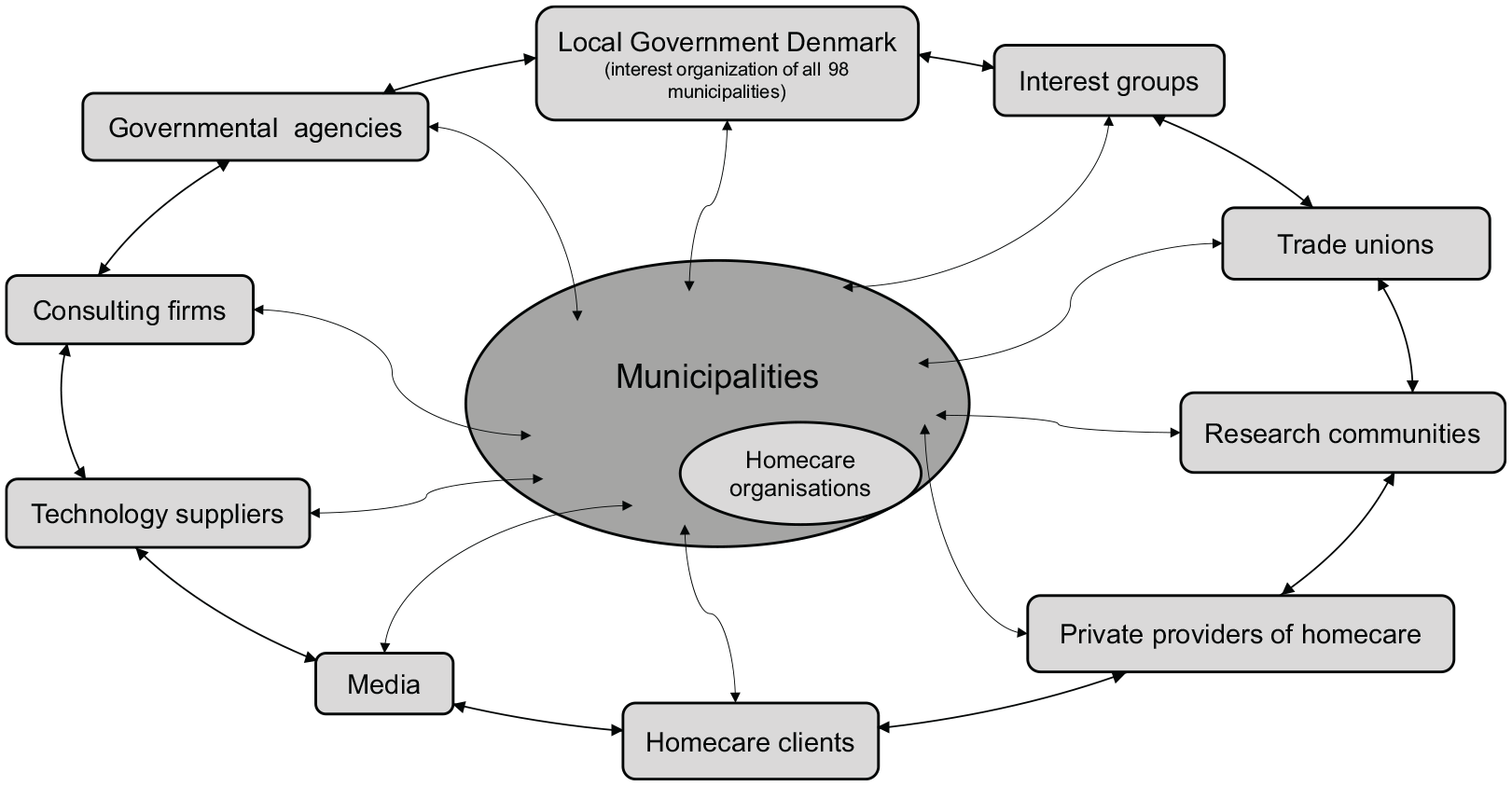
Heterogeneous Actors in the Danish Homecare Field.
Homecare has a long history in Denmark with the first legislation introduced in 1949 and with services increasing extensively during the 1970s and 1980s (Nielsen & Andersen, 2006). Welfare provision is highly decentralized with municipalities legally obliged to support older people in need of help (clients), including personal (e.g. getting dressed and bathing) and practical services (e.g. laundering and cleaning) provided in the homes of elder citizens (Jensen & Lolle, 2013). The services are primarily tax financed and provided by municipal caregivers at no charge. Although there have been some initiatives to outsource services to private providers, homecare services are mainly delivered by municipal homecare organizations to facilitate elder people staying as long as possible in their own homes (Jensen & Lolle, 2013). Despite cuts in recent years, Denmark is considered one of the leading countries in homecare service provision with approximately 12 percent of the 65+ population (125,000) receiving homecare services by more than 40,000 employed caregivers.
Since the turn of the millennium, the use of digital technologies has changed substantially, not least through increased use of mobile devices such as personal digital assistants (PDAs), smartphones and tablets. These technologies enable caregivers to access client information stored in electronic patient record (EPR) systems at the point-of-care. They also offer options for registration of services provided, wireless update of patient records and work schedules, telephone calls and text messages. Whereas governmental homecare strategies emphasize digitalization, the approach to and choices of technology is decentralized to the municipalities.
Data sources
To ensure rich data and facilitate detailed analysis of multidirectional idea travelling across a field, we designed our investigation as an embedded case study (Scholz & Tietje, 2002) and collected data from adopting organizations as well as from other influential field actors (Table 1). Moreover, we followed the recommendation from Yin (2014) to include multiple sources of data, qualitative as well as quantitative, with two surveys, 52 semi-structured interviews, and rich documentary material (see Appendix).
Data Sources.
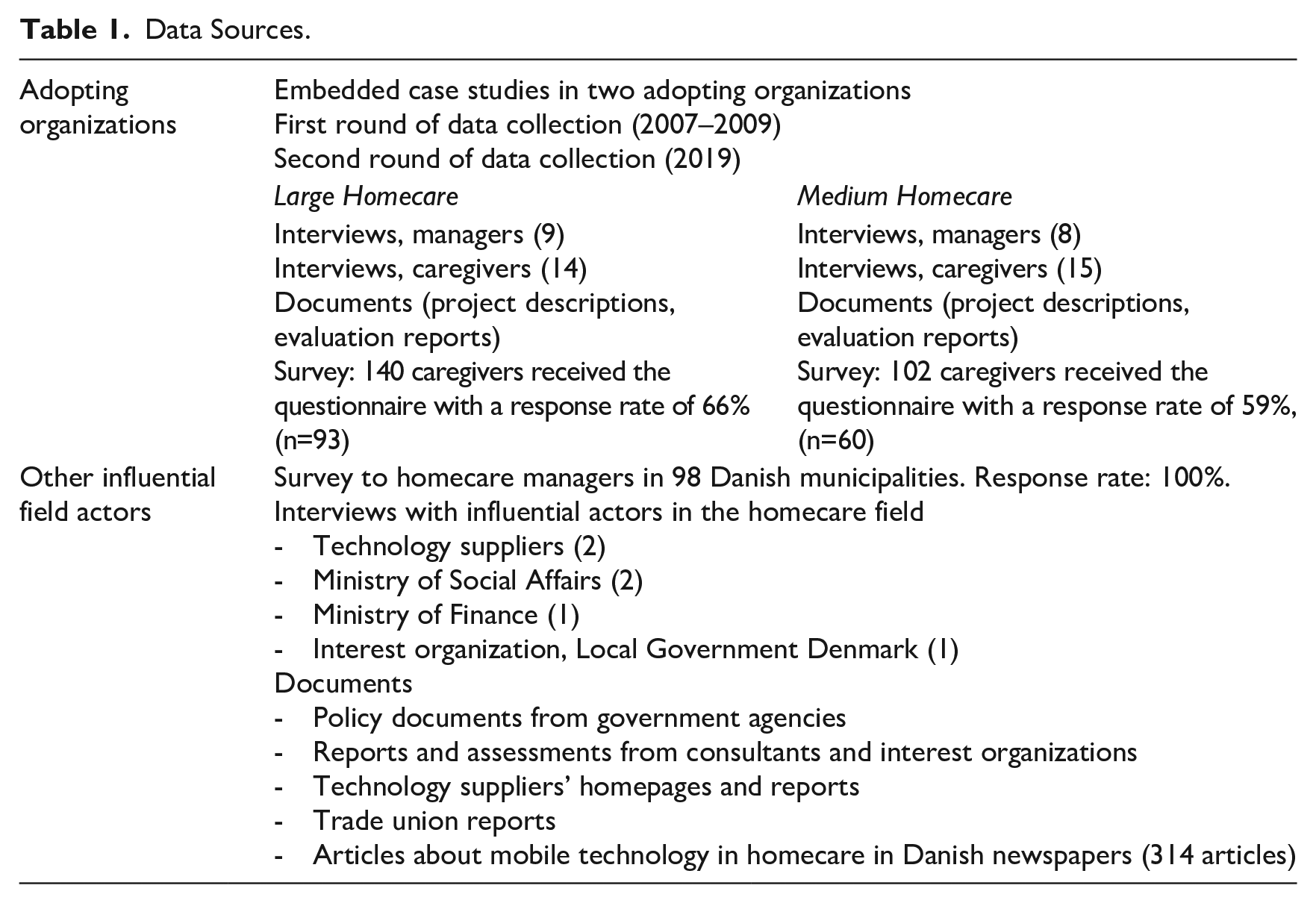
In terms of data on adopting organizations, we selected two homecare organizations that are considered frontrunners in mobile technology adoption based on the anticipation that they could provide rich insights relevant to our research topic (Flyvbjerg, 2011). The two organizations were often mentioned in the survey as sources of inspiration by other homecare organizations, and they were early adopters with extensive experience in using mobile technology. Large Homecare is located in the capital area with more than 600,000 inhabitants in the municipality and 3,000 caregivers providing services for approximately 20,000 clients. This organization decided to implement mobile technology (PDAs) in 2001. Medium Homecare is located in the middle of Denmark with a municipality size of nearly 59,000 inhabitants and 500 caregivers serving approximately 2,200 clients. This organization started to implement mobile technology in 2005.
For both organizations, our analysis was based on available documents, interviews with managers and caregivers, and a survey to caregivers using mobile technology. In a first round of data collection (2007–2009), 8 managers (4 in each organization) and 17 caregivers (8 and 9 in the two organizations) participated in semi-structured interviews. The interview guide encompassed questions that allowed the interviewees to express how they considered the early phases of mobile technology implementation, including the formal decision to adopt, sources of inspiration, how they experienced the implementation process, how and to what extent ideas about mobile technology transformed into daily work practices, resistance to change, and how these organizations inspired other field actors. We also conducted a survey of caregivers concentrating on how they perceived mobile technology and how they used the technology in work practices. In total, 242 caregivers across the two organizations received a survey with a response rate of 63% (n=153). A second round of data collection took place in 2019 in which we conducted follow-up interviews in the two organizations to understand changes during the preceding ten years. Similar to the first round, we conducted interviews with 9 managers and 12 caregivers across the two homecare organizations. In this round, questions covered changes in mobile technology strategy, use and perceptions over time, and how the organizations took part in promoting mobile technology across the field.
To supplement data from the two adopting organizations, we rely on a survey targeting all 98 municipal homecare organizations. We interviewed managers by telephone in 2008, achieving a 100% response rate. We used the survey data to map the adoption patterns of mobile technology across the homecare organizations. Another aim was to get a sense of adopting organizations’ interaction with the homecare field as we asked them to prioritize sources of inspiration for adopting (Table 2). As such, the survey provided important background information for exploring multidirectional idea travelling. Additionally, we interviewed influential field actors who promoted ideas about mobile technology in homecare. We interviewed two suppliers of mobile technology solutions and four representatives from governmental agencies who headed an important national demonstration project (CareMobile) that shaped the use of mobile technology in homecare. We also analysed newspaper articles and other documents relevant for investigating idea travelling across the field.
Sources of Inspiration for Adopting Mobile Technology in Danish Homecare.
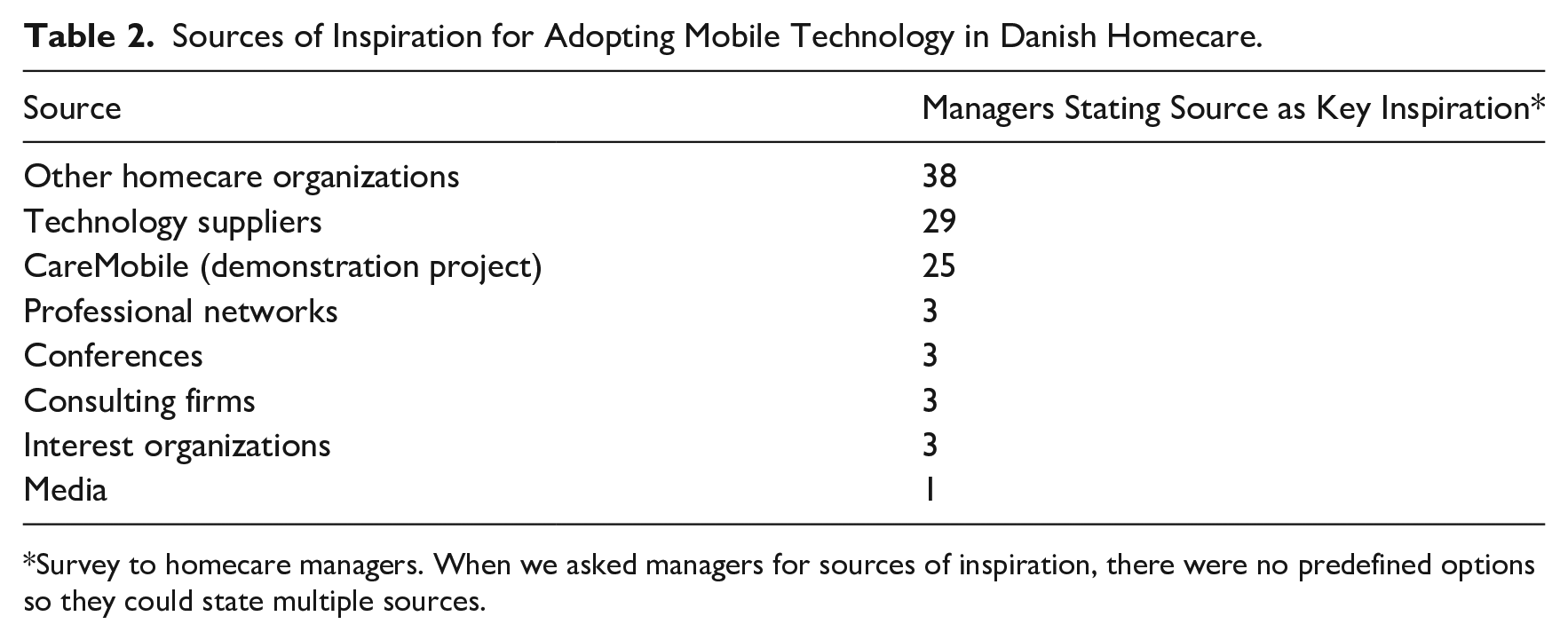
Survey to homecare managers. When we asked managers for sources of inspiration, there were no predefined options so they could state multiple sources.
Data analysis
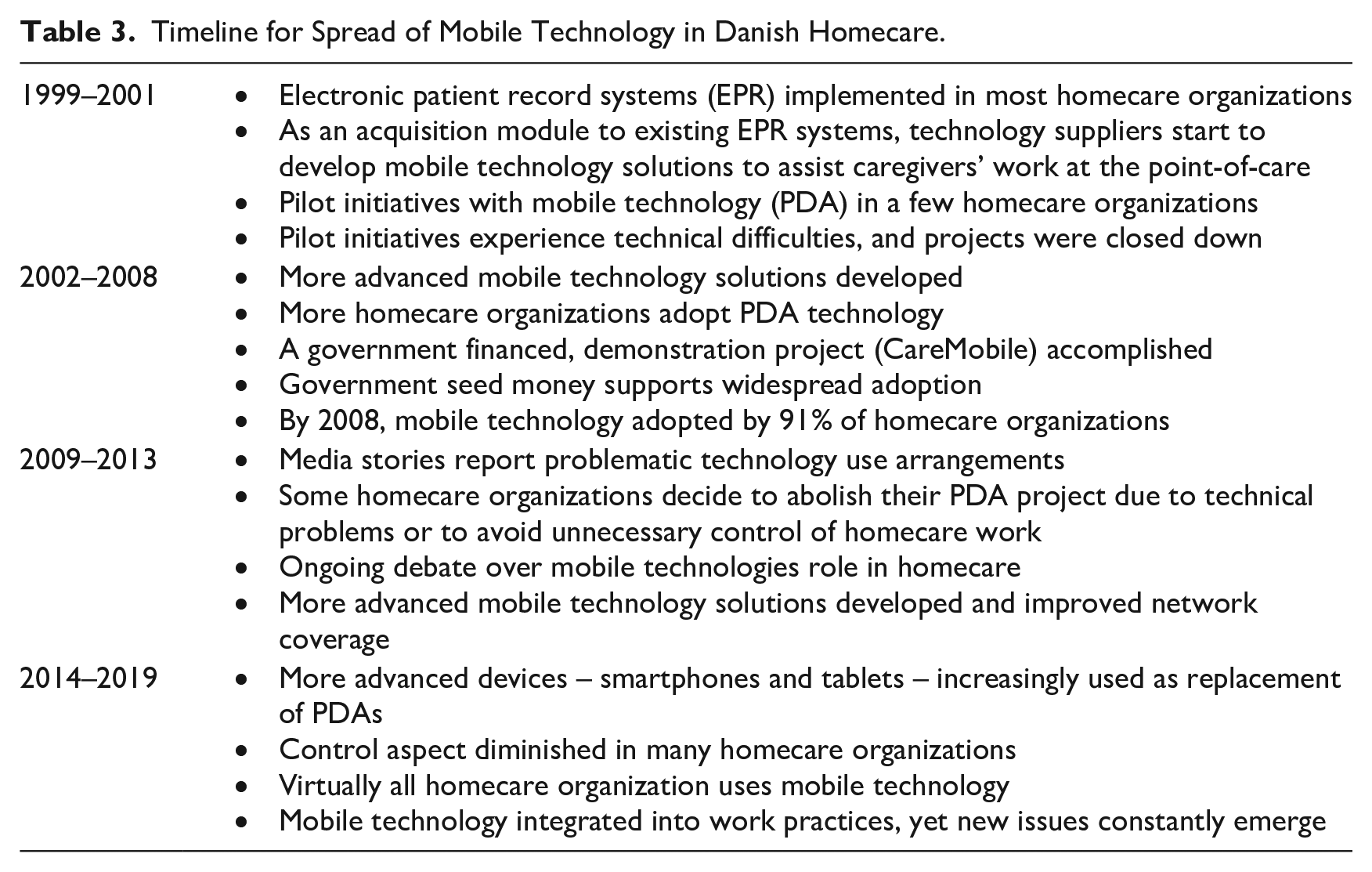
We analysed our data following principles for thematic analysis (Silverman, 2011). First, we used our data to construct a time line and case story of the spread of mobile technology since the early efforts to introduce the technology to homecare organizations (Table 3). Second, we analysed the multidirectional nature of idea travelling, as ideas about mobile technology use travelled among adopting organizations and other influential field actors. Within this ecology of translations, we identified the key players and began to map how ideas about mobile technology travelled and morphed among them. Throughout, we kept the multidirectional focus in mind, but to help structure our rich data we initially analysed how ideas about mobile technology use were adopted and turned into diverse practices across homecare organizations. We then described the paths through which ideas travelled from adopting organizations to, and among, other influential actors such as technology suppliers, government agencies and other adopting organizations. Third, we subjected these findings to a fine-grained analysis of evidence of the multidirectional nature of idea travelling.
Timeline for Spread of Mobile Technology in Danish Homecare.
To provide a comprehensive account of multidirectional idea travelling across the field and within the two case organizations, we structured our empirical account into three parts. First, we present how the translation ecology was formed as a multitude of actors gradually engaged in translation work to facilitate widespread adoption of mobile technology across the field. Second, we zoom in on the microcosms of the translation ecology to focus on variations in how two case organizations translated ideas into practice as they were inspired by other actors and simultaneously developed ‘local versions’ that in turn moved further into the field. Third, we zoom out again to consider how idea travelling and ongoing translations in the evolving translation ecology led to contestation and renewal in mobile technology use. During the analysis, we iterated recurrently between exiting theoretical insights – of idea travelling, translation and translation ecology – and our empirical data, to make new discoveries on multidirectional idea travelling. In particular, we derive three distinct forms of multidirectional idea travelling – reinforcing, complementing and polarizing – that together help us understand the morphing of ideas in a translation ecology.
Results
The formation of the translation ecology
While it is often impossible to precisely identify the origin of any idea (Czarniawska & Joerges, 1996), the travelling of ideas about mobile technology across the Danish homecare field began slowly in the late 1990s as experiments with mobile technology use occurred as a response to a national agenda on homecare modernization (D1 2 ) and as part of a broader global trend on mobile health. At that time, some technology suppliers developed new solutions and carried out pilot experiments in a few homecare organizations as smaller groups of caregivers tested mobile devices (PDAs) to make it possible to remotely access a database with comprehensive client information at the point of care (D2). In this early stage of idea travelling, translation efforts in pioneering homecare organizations experienced many technical difficulties, but their feedback inspired technology suppliers to develop more advanced solutions (D3) which in turn reinforced ideas about mobile technology as central to advancing homecare management and services (D4). Further, these examples started to gain media attention as newspapers offered success stories by describing the development as a ‘homecare digital revolution’ where ‘mobile technology can modernize Danish homecare and attract a new generation of technology minded young employees’ (D5). As such, early idea travelling represented general ideas about the ‘innovative capacity’ of mobile technology (D2) with no comprehensive guidelines for their translation into work practices.
While competing suppliers continued to develop more advanced solutions, it was a government financed, demonstration project (CareMobile), initiated in 2003 and evaluated in 2005, that successfully developed the business case for mobile technology implementation (D6). The CareMobile project represented an important reinforcing activity that further legitimized mobile technology in the field, and served as inspiration for adoption in many homecare organizations (Table 2). The CareMobile project was initiated and managed in collaboration between the Ministry of Social Affairs, Ministry of Finance, and Local Government Denmark (interest organization for Danish municipalities). The project included six suppliers as well as six pilot homecare organizations (D7). In this way, the CareMobile initiative represented a partnership arrangement between government agencies, technology suppliers and adopting organizations to stimulate collective action by expanding the translation ecology surrounding the technology. A representative from the Ministry of Social Affairs explained: It was a close collaboration between us, six homecare organizations and six technology suppliers to make this succeed. The CareMobile project was basically about measuring the effects of mobile technology use in order to establish a solid foundation for the other homecare organizations in Denmark.
Through participation in the demonstration project, pioneering homecare organizations took an active part in reinforcing the mobile technology idea by providing important input to government agencies about benefits, challenges and key lessons in translating mobile technology ideas into work practices. Accordingly, translation efforts in the participating homecare organizations delivered input for ‘the mobile technology business case’ (D6), and the final evaluation of the CareMobile project highlighted mobile technology as a ‘mature’ and ‘productivity enhancing technology’ (D7). Thus, CareMobile symbolized the importance of using mobile technology to advance homecare service delivery with a focus on ‘cost saving and efficiency’ (interview, representative from the Ministry of Finance).
By 2005, only a small number of homecare organizations had invested in mobile technology. However, during the following years interactions among the heterogeneous field actors and adoption by homecare organizations increased rapidly. This acceleration started in 2006 when the Danish government in the wake of the CareMobile initiative chose to support the implementation with approximately €45 million. A total of 82% of the municipalities were granted government seed money (D8), and our survey shows that 66% of the homecare organizations that adopted mobile technology considered government seed money to be of crucial importance for their adoption. By 2008, mobile technology was adopted by more than 90% of homecare organizations with government funding playing an important role in reinforcing the idea of using mobile technology to improve services.
This widespread adoption of mobile technology was further enabled by complementing activities as the different translations by adopting organizations started to travel across the field and inspired other organizations to engage with mobile technology. In fact, ‘other homecare organizations’ was the most often mentioned source of inspiration for adoption (Table 3). As such, multiple ideas about mobile technology use travelled among adopting organizations and other influential field actors. As a case in point, the two studied organizations – Large Homecare and Medium Homecare – represented different organization specific ‘versions’ of mobile technology use that started to travel. As illustrated below, these two organizations helped reinforce the general idea of mobile technology as crucial to advancing homecare services while at the same time engaging mobile technology very differently, guided by distinct strategies and value systems. Examples like these from homecare organizations established best practices and inspired other homecare organizations. In turn, such organization-specific translations were communicated in the field through reports (D9) and digitalization awards (D10) making mobile technology relevant to a large range of homecare organizations.
The microcosms of the translation ecology
While the homecare field at large experienced a hasty spread of mobile technology as organizations adopted rather similar technologies (PDAs), the translation into practice varied considerably in management strategies and use arrangements. In turn, such organization specific translations influenced ideas about mobile technology that were already travelling across the field. In the following, we unfold these dynamics by zooming in on translation efforts in the two case organizations.
Large Homecare represents the first large-scale mobile technology implementation effort in Danish homecare. In 2002, management decided that all caregivers ‘must use PDA technology in conducting daily visits to clients’ (D11). This decision was followed by a five-year implementation process in which PDA technology was gradually, and through collaboration with a technology supplier, applied across the entire organization.
Thanks to CSC Scandihealth [supplier], 3,500 caregivers, nurses and other employees have been equipped with handheld computers (PDAs), which they use when visiting elderly people in their own homes (D12).
This interaction between CSC Scandihealth and Large Homecare included not only a one-way movement of ideas from the supplier to the adopting organization. In addition, Large Homecare provided feedback to the supplier to help develop better solutions and reinforce adoption by other organizations. In the collaboration with CSC Scandihealth, Large Homecare conducted a number of requirements specification analyses during 2001 and 2002 to complement existing solutions in response to organizational needs. These analyses led to several requirements and suggestions for complementary features, including ‘the development of user interfaces for caregivers’ time-registration’ (D13, p. 176). The organization also held a series of workshops in which caregiver representatives participated in the development of ‘a simple and easily understandable user interface’ (D14). Such translations of general solutions in adopting organizations were then ‘incorporated into the IT system by CSC Scandihealth’ (D13, p. 176) and helped improve the product and reinforce its adoption in other organizations.
In this way, interactions between local translation practices in organizations such as Large Homecare and other influential field actors, such as technology suppliers, became crucial in building legitimacy and reinforcing ideas on the usefulness of mobile technology in homecare. To facilitate idea travelling, we also observed how Large Homecare presented their ‘version’ of mobile technology at conferences and on websites. A manager noted: ‘We have been at the forefront when it comes to using handheld computers (PDAs) and we have often presented our experiences to those interested’. As an award winner in a government competition (The Digitalization Prize), the mobile technology initiative in Large Homecare was highlighted as a ‘real pioneering project that many can learn from’ (D10). Managers in Large Homecare embraced the innovative capacity of mobile technology (D15) and in this way reinforced the general idea of improving homecare through these technologies. At the same time, the organization complemented this general idea with a specific focus on improving transparency and time control in homecare practices. Management stressed that ‘time management and transparency in delivered homecare services is important’ to guarantee that ‘the elderly get the help they are entitled to’ (D15), and ‘time control is critical as exceeding with five minutes per visit corresponds to exceeding the budget with 17 million Euros per year’ (D16). This focus was well-aligned with how the chosen supplier represented its solution: ‘Our mobile solution is designed for employees with a greater need for documentation and registration’ (D3). Accordingly, Large Homecare considered mobile technology as a tool that could ensure accurate information about delivered homecare services (D15). The consequential modifications of mobile technologies into a specific focus on time management had a decisive impact on the way caregivers used mobile technology for documentation and time registration.
While caregivers in general found the PDA easy to use and considered it ‘brilliant’ to have access to data on ‘clients’ health condition at the point-of-care’ (interview, caregiver), they also perceived PDAs as a device that helped the management team control and tightly monitor their work. As such, the management decision to translate PDAs into a system of monitoring and time management led to tensions and disagreements. By 2007, 61% of the caregivers who answered our survey agreed or strongly agreed that PDAs increased control of their work – by comparison, it was 32% in Medium Homecare. Some caregivers drew parallels to the ‘big brother’ society and surveillance. Indeed, the criticism continued and moved from employee statements to higher in the organizational hierarchy, as stated by the municipality Mayor for Health and Care: We need to reconsider how we manage homecare, and look at whether the PDA is the right solution. I visited our homecare organization, and here I realized that there are some things that are not smart about how we manage and how caregivers work with PDAs (D17).
By 2013, Large Homecare had reformulated its management strategy through a ‘codex for trust’ to facilitate ‘increased job satisfaction through more focus on trust, professionalism and the elimination of inappropriate workflows’ (D18). Following this new strategy, it was decided to drop the task of using mobile devices for time registration of each home visit ‘to avoid unnecessary bureaucracy and meaningless registration’ (D19). By 2019, a caregiver reflected on the change: ‘Back then, the keyword was time control. We never talk about that today.’ Another caregiver added: ‘Management nowadays is much more confident we are doing what we should.’ As such, the translation of mobile technology underwent significant changes from supporting a system of control to supporting a more trust-based system.
Medium Homecare implemented PDA technology in 2005 (D20), and relied on a system with online connectivity, including telephone and text messages opportunities, to offer caregivers ‘cutting-edge technology’ (interview, manager). The management considered mobile technology as ‘the solution of the future’ thereby reproducing general ideas about the innovative capacity of these technologies. In turn, Medium Homecare complemented this general idea with a particular focus on mobile technology as a solution to improve the organization’s communication and image. A manager explained: ‘We had a political leadership that was quick to say: Yes! This will improve our image and status, we buy it.’ While other homecare organizations concentrated on ‘cost savings and time control’, this ‘is not the case here’ (interview, manager).
Medium Homecare was inspired by ‘pilot projects in other homecare organizations’ (D21) and a supplier – Ramboll – who had developed a new platform for mobile technology use with online connectivity (D22). A manager noted: Our neighbouring municipality received much criticism for their mobile technology project, which was seen as a control system. We chose a different path. We got inspiration from another homecare organization, which had the same supplier as us.
The modifications of general mobile technology ideas into better communication and an improved image had a crucial influence on how mobile technology served caregivers in their internal communication with colleagues and frontline managers, and in the external communication with hospitals or general practitioners. Medium Homecare decided on a documentation practice in which the unpopular, from a caregiver perspective, time registration of homecare visits was not implemented. As expressed by one manager, ‘our politicians have no intention of detailed time control’, which continued to be the strategy as described by a manager in a 2019 follow-up interview: Indeed, the mobile technology system we have adopted could be used as a system of control and monitoring of homecare work but we have never used that opportunity.
Medium Homecare took part in the reinforcement of mobile technology ideas across the homecare field as they communicated their experiences at conferences and in ‘our network of other homecare managers’ (interview, manager). In addition, public reports communicated evidence from Medium Homecare presenting key lessons from their mobile technology initiative, in which ‘the trust angle’ and ‘the opt-out of registration of each homecare visit’ were stressed (D23). As such, the Medium Homecare ‘version’ of mobile technology complemented other ideas circulating in the homecare field such as those emphasizing cost savings (CareMobile project) and time control (e.g. Large Homecare).
By zooming-in on translation efforts in Large Homecare and Medium Homecare we observed how general ideas associated with mobile technology were reinforced, for instance the perception of the technology as having ‘innovative capacity’ and being ‘today’s technology’. At the same time, organization-specific versions were evident as the two organizations chose different suppliers with different mobile technology features; they viewed the transformative power of mobile technology in different ways; they had different challenges; and they used the technology differently. In this way, there was considerable variation in translations across organizations, and these complementary ‘local translations’ travelled around the homecare field. As part of this idea travelling, we also observed how Large Homecare changed their approach to mobile technology that initially supported a system of control but later turned into supporting a more trust-based system. While Medium Homecare from the start acknowledged the control-based use of mobile technology as counterproductive and decided for a system based on trust, it was much later in the process that Large Homecare changed their approach to a more trust-based one. In this way, the large organization took inspiration from translations in other organizations to develop their own trust-based model.
The evolving translation ecology
While the idea of mobile technology use in homecare was predominantly characterized by enthusiasm and optimism during the early stages (D2, D4, D5, D6), it increasingly became the subject of debate. As such, polarizing tendencies became evident as controversies between interests shaped the travelling of ideas about mobile technology. In particular, after the hasty spread of the technology from 2006 to 2008 a more critical discourse surrounded mobile technology. Media stories described problematic use arrangements across a range of organizations under headlines such as ‘The potential of PDA technology was overstated’ (D24) and ‘Caregivers controlled by computers’ (D25). Similarly, the trade union representing the caregivers expressed a critical view on mobile technology use: A major problem is detailed time registration. In many homecare organizations, caregivers have to register when you come and go at clients’ home. Many of our members say that it is perceived as unnecessary control. (D23, p. 5)
Such articulations were fuelled by the diverse organizational translations and associated problems – such as in Large Homecare – and they were expressions of tensions between caregivers and managers. Some homecare organizations even decided to abolish the use of PDAs due to technical problems or to avoid unnecessary control of work: The PDA initiative is a closed chapter in our organization. Many of the caregivers are delighted. They have seen that the PDA served as control on what they were doing. (D26)
Despite such attempts to de-legitimize the value of mobile technology, suppliers and government agencies continued to support mobile technology as a reflection of polarizing tendencies in the later stages of the idea travelling process. During the same period, the number of suppliers consolidated from six to four, including acquisition of a couple of smaller firms by larger, more successful ones. These suppliers continued to develop more advanced systems, and devices such as smartphones and tablets were increasingly introduced as a replacement for PDAs. In addition, improved network coverage (4G) created better conditions for mobile technology implementation. After 2014, some homecare organizations who had abandoned their PDA projects reintroduced mobile technology in the form of smartphones or tablets (D27). Other organizations – such as Large Homecare – toned down their focus on time control and monitoring and promoted an alternative trust-based approach. Again, other organizations started to use tablet technology – in connection with Skype for business or similar systems – to supplement or replace physical homecare visits with online communication, i.e. virtual homecare (D28). Accordingly, polarizing tendencies in the field did not lead to a collapse of ‘the mobile technology project’. Instead, tensions and disagreements together with improved technological solutions paved the way for new mobile technology ideas across the field. By 2019 when our study ended, mobile technology solutions were integrated into homecare work practices in virtually all homecare organizations, yet new possibilities and issues constantly emerged due to technology development and new requirements for documentation of provided homecare services.
Discussion
While translation scholars have examined in detail the way in which ideas travel into organizational contexts (Cassell & Lee, 2017; Morris & Lancaster, 2006; Rövik, 2011; Vossen & van Gestel, 2019), our approach shifts the focus to how ideas translate as they move among heterogeneous actors across an organizational field. As such, we offer a comprehensive account of the dynamics of idea travelling that embraces a multidirectional perspective. In the following, we elaborate and discuss the new theoretical insights that this account contributes to the translation literature.
Evolution of translation ecologies
As a basis for our theorizing, we have provided evidence from a longitudinal, embedded case study that demonstrates the multidirectional nature of idea travelling. Overall, our analysis reveals how the translation ecology formed and evolved over time as multiple ideas about mobile technology travelled across the Danish homecare field with variations in mobile technology strategies and use arrangements in specific organizations. There were different ideas – or templates – circulating as government sponsored a demonstration project, a number of technology suppliers promoted their solutions, and homecare organizations translated these into specific practices that they found useful to appropriate in their contexts. Technology suppliers collaborated with individual organizations who adopted some technology solutions in early stages, followed by government support. Through these interactions, ideas distributed across several technology suppliers and adopting organizations and produced new customizations, which in turn inspired technology suppliers to further develop and modify their solutions and other organizations to initiate adoption into their practices. In this way, adopting organizations such as Large Homecare and Medium Homecare were not only concerned with their own organization-specific translation efforts. They also played important roles in shaping idea travelling across the field, as their ideas about mobile technology use moved to other actors in the translation ecology, e.g. through presentations of experiences at conferences and by working with their supplier to enhance and innovate solutions.
These findings demonstrate how ideas do not simply travel from influential field actors such as gurus or consultancies to adopting organizations ‘in successive, chronological translation processes’ (cf. Nielsen, Wæraas, & Dahl, 2020, p. 239). Rather, morphing of ideas happens when they travel recursively among heterogeneous actors in a translation ecology. In the mobile technology case, we saw how a multitude of translators (e.g. adopting organizations, government agencies, media, professional organizations) and ideas (e.g, solutions, information sharing, policies, reporting) connected in a translation ecology that spanned ongoing translation work as ideas in different forms travelled among actors with heterogeneous roles and interests. Through these interactions, we saw how specific ideas expanded and contracted over time, as illustrated by the fluctuations between control-based and trust-based customizations within and across home care organizations over time. Essentially, a multidirectional idea travelling approach (a) moves away from linear thinking of idea translation, and (b) shifts the focus from translating work within adopting organizations to interactions among translations of heterogeneous actors connected in a translation ecology. Hence, multidirectional idea travelling stresses not only how ideas from multiple actors travel to and are translated by individual adopting organizations through ‘many-to-one’ interactions, but more importantly how translations become the underlying engine that drives idea travelling in ‘many-to-many’ interactions.
As such, our study is insightful in relation to the emerging research agenda on translation ecologies (Wedlin & Sahlin, 2017) by providing empirical and conceptual knowledge of how ideas expand and contract as they travel within a translation ecology of continuously interacting idea variants, translators and translations. In a translation ecology, expansion happens when the number of actors that adopt an idea increases, as we observed in general during the early stages of the mobile technology case, as well as in later stages where trust-based ideas became more widespread. However, a translation ecology is also characterized by contraction when specific ideas get less traction or are pushed to the background based on translation experiences, as we observed with the control-based idea in Large Homecare. We also emphasize that a particular translation ecology is likely constituted by a subset of field actors. In the mobile technology case, not all field actors were actively engaged in translation work. For instance, interviews with key actors in the homecare field, and analysis of media reports, showed that research communities did not play an important role, although one might have expected research centres and universities to be involved as translators and idea carriers.
Forms of multidirectional idea travelling
Based on evidence of multidirectional idea travelling in the presented case, we identify three distinct forms of multidirectional idea travelling – reinforcing, complementing and polarizing – as summarized in Table 4. We suggest that these forms mutually shape the morphing of ideas as they move among heterogeneous actors in a translation ecology.
Mutidirectional Idea Travelling.
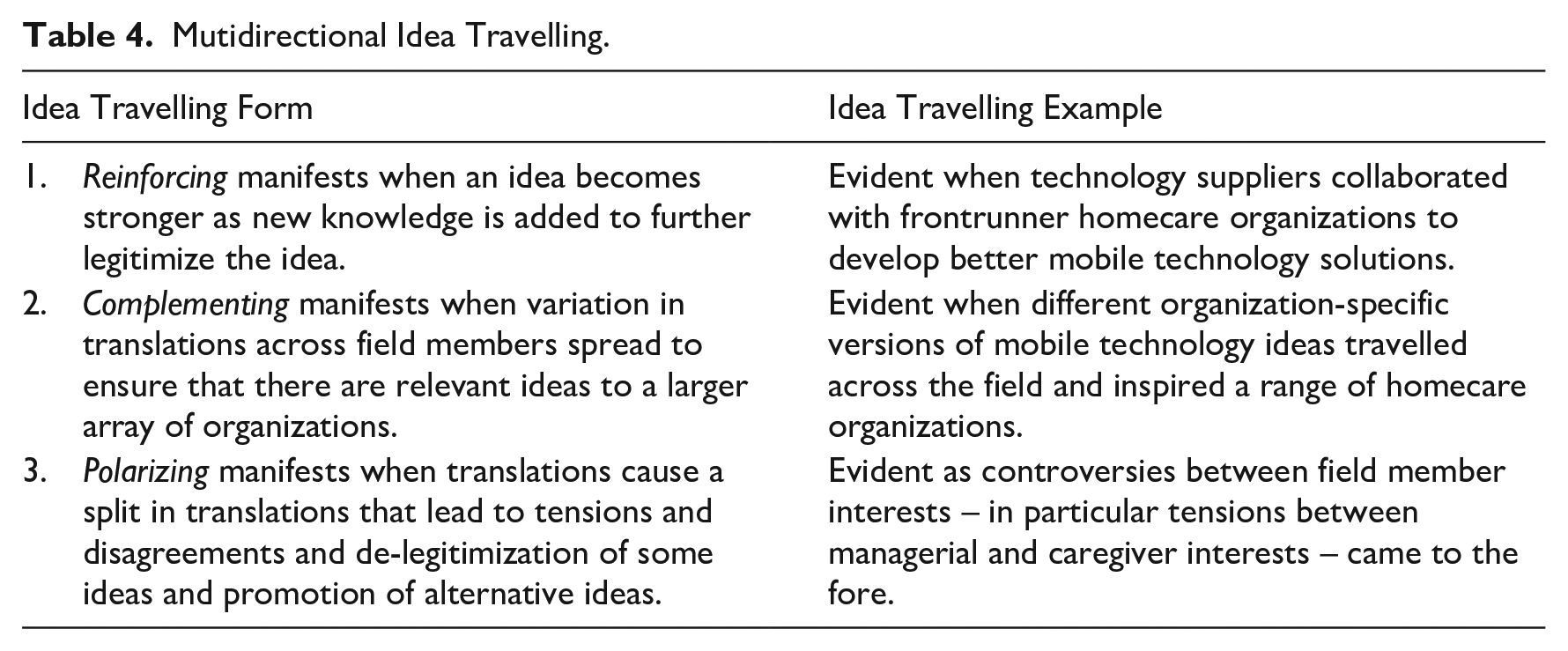
Reinforcing occurs when an idea expands as new knowledge is added to further legitimize an idea, for instance as a shared understanding of the innovative capacity of mobile technology emerged and spread through collaboration between technology suppliers and frontrunner homecare organizations in the presented case. Complementing occurs when variation in translations across field members spread to ensure that there are ideas relevant to a larger array of organizations across a field, as we observed in the mobile technology case when different versions of mobile technology travelled across the field, e.g. control-based and trust-based versions, and inspired other organizations. While reinforcing and complementing can help identify where and when ideas facilitate new ways of working and expand within and across organizations, polarizing can help identify where and when established ideas may become counterproductive and lead to their contraction. In the mobile technology case, polarizing was helpful in identifying organizational translations that had been contested, criticized and abandoned by some adopting organizations. However, polarizing may also lead to new, revitalized ideas. As such, polarizing can pull an idea apart and make it disappear, or it can produce new versions of the idea that are different but accepted, so the idea continues to be relevant to organizations across a field. Hence, polarizing is not inevitably a dysfunctional form of multidirectional travelling that managers should avoid. Rather, it is an important and intrinsic part of idea travelling that should be emphasized by organizational scholars and leveraged by managers and employees involved in translation ecologies.
While our conceptualization of reinforcing, complementing and polarizing idea travelling relates to current translation research, it adds significant new insights. The concepts relate to Rövik’s (2016) notions of reproducing, modifying and transforming in the sense that they reflect how ideas change as they travel on a continuum from few changes to comprehensive transformation. Yet, Rövik (2016) concentrates on idea translation within adopting organizations, whereas our conceptualization takes a broad perspective on the whole idea translation ecology to emphasize how ideas translate as they travel among heterogeneous actors across an organizational field. Additionally, by including the notion of polarizing idea travelling, we provide important insights into how politics may influence idea travelling, which is downplayed in Rövik’s conceptualization (Wæraas & Nielsen, 2016).
Concluding Remarks
We have attempted to decipher a persistent and intriguing theoretical puzzle within translation research
Footnotes
Appendix
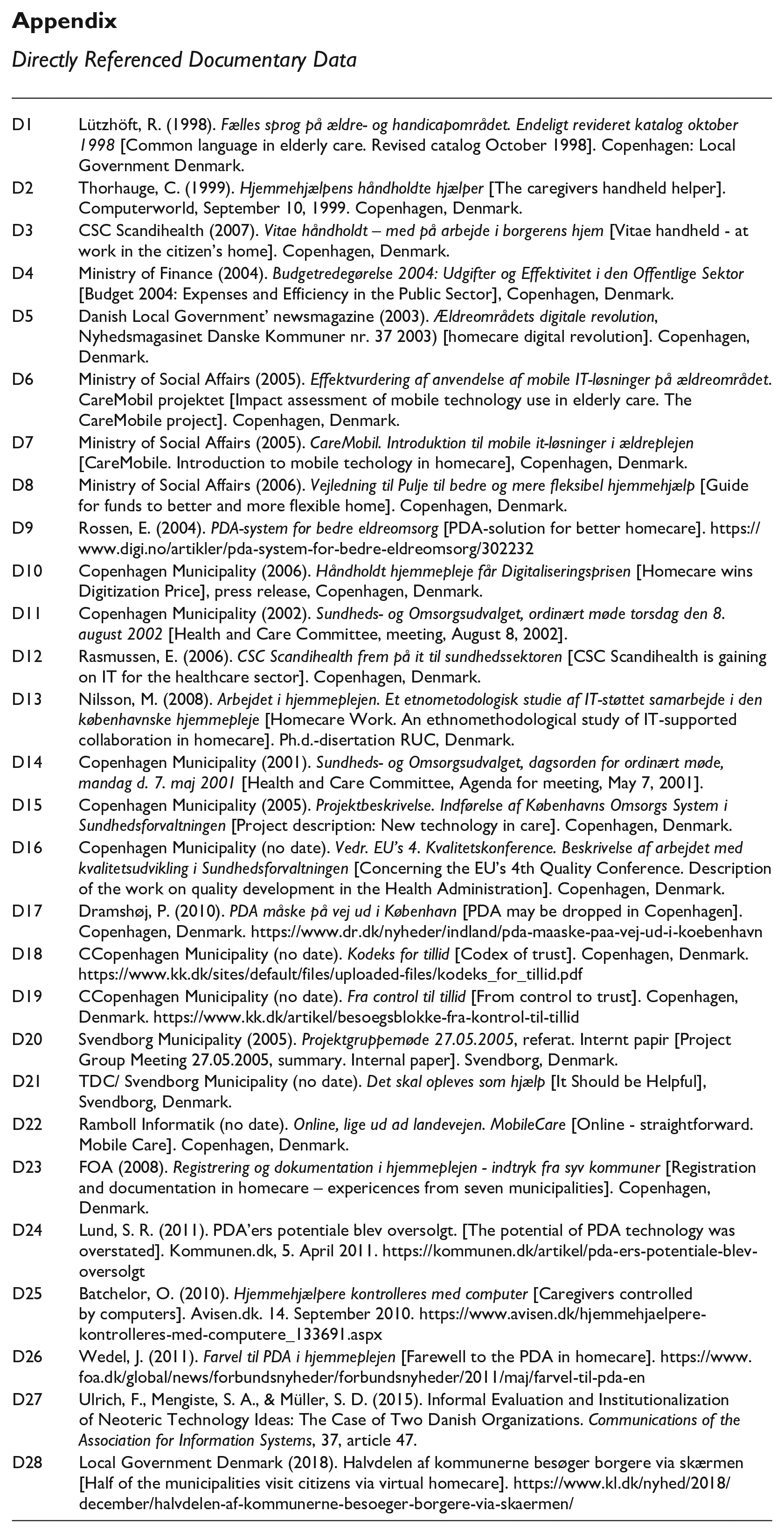
Directly Referenced Documentary Data
| D1 | Lützhöft, R. (1998). Fælles sprog på ældre- og handicapområdet. Endeligt revideret katalog oktober 1998 [Common language in elderly care. Revised catalog October 1998]. Copenhagen: Local Government Denmark. |
| D2 | Thorhauge, C. (1999). Hjemmehjælpens håndholdte hjælper [The caregivers handheld helper]. Computerworld, September 10, 1999. Copenhagen, Denmark. |
| D3 | CSC Scandihealth (2007). Vitae håndholdt – med på arbejde i borgerens hjem [Vitae handheld - at work in the citizen’s home]. Copenhagen, Denmark. |
| D4 | Ministry of Finance (2004). Budgetredegørelse 2004: Udgifter og Effektivitet i den Offentlige Sektor [Budget 2004: Expenses and Efficiency in the Public Sector], Copenhagen, Denmark. |
| D5 | Danish Local Government’ newsmagazine (2003). Ældreområdets digitale revolution, Nyhedsmagasinet Danske Kommuner nr. 37 2003) [homecare digital revolution]. Copenhagen, Denmark. |
| D6 | Ministry of Social Affairs (2005). Effektvurdering af anvendelse af mobile IT-løsninger på ældreområdet. CareMobil projektet [Impact assessment of mobile technology use in elderly care. The CareMobile project]. Copenhagen, Denmark. |
| D7 | Ministry of Social Affairs (2005). CareMobil. Introduktion til mobile it-løsninger i ældreplejen [CareMobile. Introduction to mobile techology in homecare], Copenhagen, Denmark. |
| D8 | Ministry of Social Affairs (2006). Vejledning til Pulje til bedre og mere fleksibel hjemmehjælp [Guide for funds to better and more flexible home]. Copenhagen, Denmark. |
| D9 | Rossen, E. (2004). PDA-system for bedre eldreomsorg [PDA-solution for better homecare]. https://www.digi.no/artikler/pda-system-for-bedre-eldreomsorg/302232 |
| D10 | Copenhagen Municipality (2006). Håndholdt hjemmepleje får Digitaliseringsprisen [Homecare wins Digitization Price], press release, Copenhagen, Denmark. |
| D11 | Copenhagen Municipality (2002). Sundheds- og Omsorgsudvalget, ordinært møde torsdag den 8. august 2002 [Health and Care Committee, meeting, August 8, 2002]. |
| D12 | Rasmussen, E. (2006). CSC Scandihealth frem på it til sundhedssektoren [CSC Scandihealth is gaining on IT for the healthcare sector]. Copenhagen, Denmark. |
| D13 | Nilsson, M. (2008). Arbejdet i hjemmeplejen. Et etnometodologisk studie af IT-støttet samarbejde i den københavnske hjemmepleje [Homecare Work. An ethnomethodological study of IT-supported collaboration in homecare]. Ph.d.-disertation RUC, Denmark. |
| D14 | Copenhagen Municipality (2001). Sundheds- og Omsorgsudvalget, dagsorden for ordinært møde, mandag d. 7. maj 2001 [Health and Care Committee, Agenda for meeting, May 7, 2001]. |
| D15 | Copenhagen Municipality (2005). Projektbeskrivelse. Indførelse af Københavns Omsorgs System i Sundhedsforvaltningen [Project description: New technology in care]. Copenhagen, Denmark. |
| D16 | Copenhagen Municipality (no date). Vedr. EU’s 4. Kvalitetskonference. Beskrivelse af arbejdet med kvalitetsudvikling i Sundhedsforvaltningen [Concerning the EU’s 4th Quality Conference. Description of the work on quality development in the Health Administration]. Copenhagen, Denmark. |
| D17 | Dramshøj, P. (2010). PDA måske på vej ud i København [PDA may be dropped in Copenhagen]. Copenhagen, Denmark. https://www.dr.dk/nyheder/indland/pda-maaske-paa-vej-ud-i-koebenhavn |
| D18 | CCopenhagen Municipality (no date). Kodeks for tillid [Codex of trust]. Copenhagen, Denmark. https://www.kk.dk/sites/default/files/uploaded-files/kodeks_for_tillid.pdf |
| D19 | CCopenhagen Municipality (no date). Fra control til tillid [From control to trust]. Copenhagen, Denmark. https://www.kk.dk/artikel/besoegsblokke-fra-kontrol-til-tillid |
| D20 | Svendborg Municipality (2005). Projektgruppemøde 27.05.2005, referat. Internt papir [Project Group Meeting 27.05.2005, summary. Internal paper]. Svendborg, Denmark. |
| D21 | TDC/ Svendborg Municipality (no date). Det skal opleves som hjælp [It Should be Helpful], Svendborg, Denmark. |
| D22 | Ramboll Informatik (no date). Online, lige ud ad landevejen. MobileCare [Online - straightforward. Mobile Care]. Copenhagen, Denmark. |
| D23 | FOA (2008). Registrering og dokumentation i hjemmeplejen - indtryk fra syv kommuner [Registration and documentation in homecare – expericences from seven municipalities]. Copenhagen, Denmark. |
| D24 | Lund, S. R. (2011). PDA’ers potentiale blev oversolgt. [The potential of PDA technology was overstated]. Kommunen.dk, 5. April 2011. https://kommunen.dk/artikel/pda-ers-potentiale-blev-oversolgt |
| D25 | Batchelor, O. (2010). Hjemmehjælpere kontrolleres med computer [Caregivers controlled by computers]. Avisen.dk. 14. September 2010. https://www.avisen.dk/hjemmehjaelpere-kontrolleres-med-computere_133691.aspx |
| D26 | Wedel, J. (2011). Farvel til PDA i hjemmeplejen [Farewell to the PDA in homecare]. https://www.foa.dk/global/news/forbundsnyheder/forbundsnyheder/2011/maj/farvel-til-pda-en |
| D27 | Ulrich, F., Mengiste, S. A., & Müller, S. D. (2015). Informal Evaluation and Institutionalization of Neoteric Technology Ideas: The Case of Two Danish Organizations. Communications of the Association for Information Systems, 37, article 47. |
| D28 | Local Government Denmark (2018). Halvdelen af kommunerne besøger borgere via skærmen [Half of the municipalities visit citizens via virtual homecare]. https://www.kl.dk/nyhed/2018/december/halvdelen-af-kommunerne-besoeger-borgere-via-skaermen/ |
Acknowledgements
We are grateful to our senior editor Trish Reay and three anonymous reviewers for their guidance, suggestions and support. We would also like to thank assistant professor Mette Strange Noesgaard, Aalborg University, for assistance at the interview round in 2019.
Funding
The author(s) received no financial support for the research, authorship, and/or publication of this article.
