







Abstract
The convergence of bureaucratic systems in higher education is fueled by a variety of actors. However, academics in their roles as researchers are typically conceptualized as recipients or resisters. In this paper we study an instance of non-convergence—the slow, scattered, and sparse emergence of ethics review procedures for social science in Europe—and identify the role of researchers in movement towards convergence. We examine the actors, pressures, and actions that lead to the emergence of ethics review procedures for social science research in three theoretically sampled countries—Denmark, Finland, and France. Contrary to established theory we do not observe change emanating from states, professional associations, or intermediary organizations. Instead, we show that pockets of researchers sought out, created, and expanded ethics review procedures for social science. We conceptualize these researchers as vanguard actors: members of a profession who seek out practices that will allow them to continue their work in a changing environment and expand it to include new audiences, methodologies, phenomena, resources, and collaborators. In establishing new practices that ensure the viability of their work, vanguard actors are a distributed, unintentional, bottom-up engine of practice change. We contribute to the literature on the convergence of forms and practices in higher education by showing how vanguard actors are distributed points of action that organize movement towards convergence as they engage in their daily research work. We enlarge understandings of professions and stratification by showing how practicing members, operating as vanguard actors, create profession-level changes in practices. Finally, we complicate critical conversations about ethics review procedures in social sciences by calling attention to the heterogeneity of researchers, including those who understand ethics review procedures to be a resource.
Keywords
Introduction
Higher education is a global, competitive industry (Frank & Meyer, 2007; Knight, 2014; Tröhler, 2023). National systems and individual institutions echo discourses of “world class education” and “education as an economic engine” (Ansmann & Seyfried, 2022). Even in Europe, where universities are “socially buffered and historically grounded institutions,” there is a “a growing emphasis on management, organization, and quality and less emphasis on student access to higher education” (Ramirez & Tiplic, 2014, p. 440; cf. Paradeise & Thoenig, 2013; Stensaker, 2007). Going beyond the harmonization intentions of the Bologna Process, European nations and higher education institutions have adjusted their operations to comply with myriad global quality assurance, accreditation, and standardization processes that facilitate the recruitment and mobility of students and academics across programs and campuses (Zapp & Ramirez, 2019).
A variety of actors fuel the growth and convergence of bureaucratic systems in higher education. A network of international organizations—largely staffed by academics who have left teaching and research to operate as “administrative elites” (Freidson, 1985)—promotes the convergence in discourse, design, and governance (Zapp & Ramirez, 2019). As these efforts increasingly inform the strategies and governance of universities, there is more demand for “managerial elites” (Fleming, 2021; Waring, 2014) and “higher education professionals” (de Jong & del Junco, 2024; Schneijderberg & Merkator, 2012) within universities. Administrative and managerial elites inhabit a variety of command posts (Zald & Lounsbury, 2010) from which they create and implement accountability infrastructures (Huising & Silbey, 2021).
Such infrastructures distill organizational activities into auditable objects (Power, 2007). For example, efforts to increase the social relevance of research may be converted into a performance goal, measured through impact case studies (Power, 2015). Managing growing, complex, and financially driven organizations, managerial elites and higher education professionals oversee the standardization of processes in higher education (Kehm, 2015), anticipating and responding to accountability pressures from private and public accreditors (Power, 1997, 2007). In the process, universities have shifted from being enabling bureaucracies to coercive bureaucracies (Fleming, 2021).
Academics who perform the daily work of the profession—teaching and research—express dissatisfaction with these changes, describing them as “unmeasured, uncosted, unproductive efforts” that arise from managerialism ideologies purported to enhance efficiency (McCabe, 2023, p. 1356). Evaluative frameworks, standardized programs, and their bureaucratic demands on academics homogenize their research and identities (Pardo-Guerra, 2022), making them more fragile and insecure (Bristow et al., 2017; Knights & Clarke, 2014). Although universities traditionally operated as loosely coupled systems in which academics worked at arm’s length from managerial and state interference (Musselin, 2021), it is unclear whether this arrangement will persist given institutional and competitive pressures (Finkielsztein & Wagner, 2023). Those who do the daily work of teaching and research in universities are increasingly entangled in bureaucratic demands that reorient academic work toward managerial priorities (Collini, 2017).
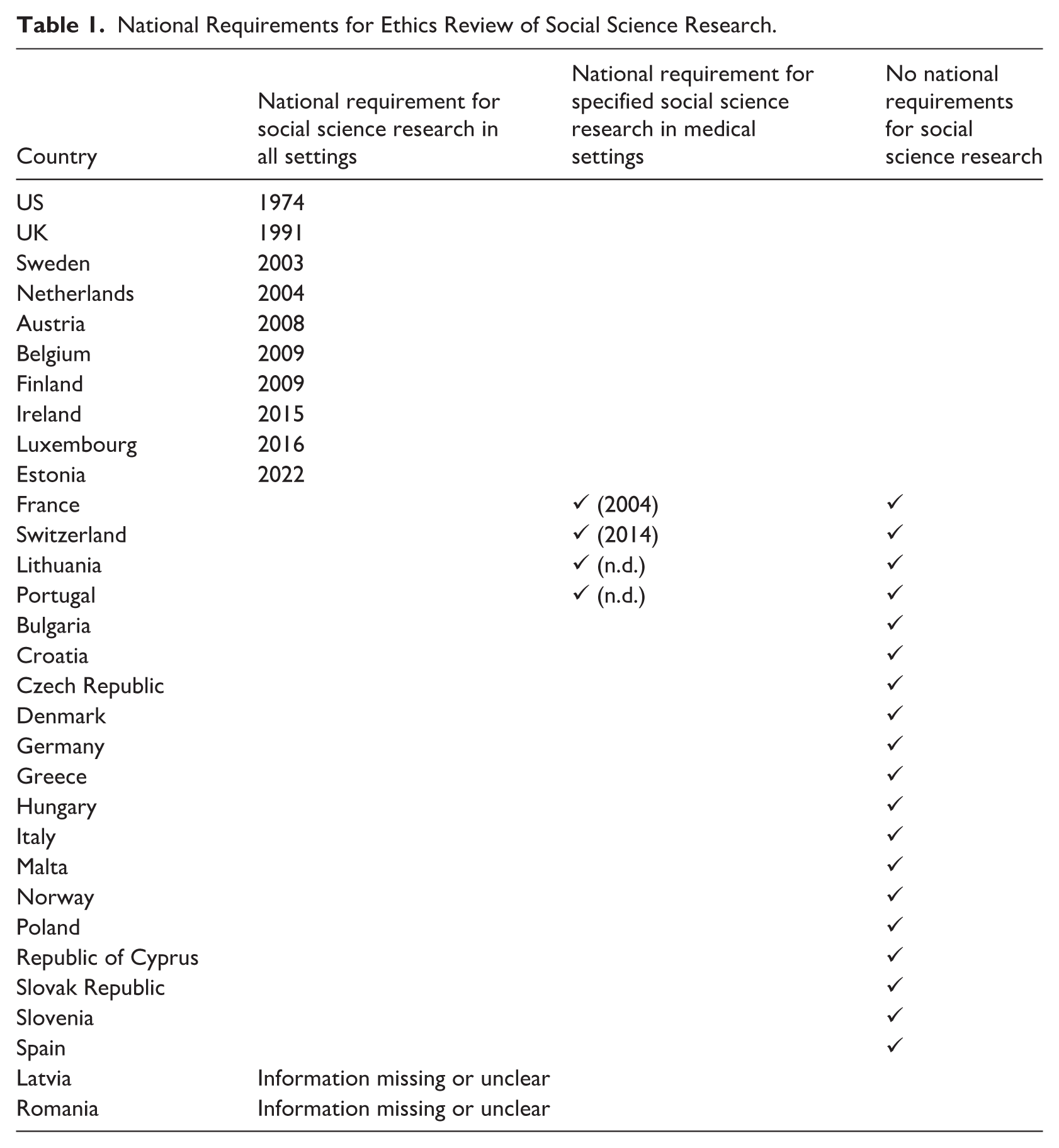
Yet national systems of higher education do show evidence of diversity in operations, leading some to argue that rhetorics of convergence are overstated (e.g., Hauptman Komotar, 2022). An instance that we examine in this paper is the adoption of ethics review procedures for social science research. In the Anglosphere, social science research involving human subjects began requiring review in the early 1990s. Social scientists submit research protocols involving human subjects to institutional committees that review whether the benefits of the research outweigh any risks to the participants and ensure the use of informed consent procedures. Such procedures and committees did not begin to emerge in continental Europe until the early 2000s, and today, varieties of ethics review procedures are proliferating yet the vast majority of countries do not require that social science research involving human subjects receive review (see Table 1).
National Requirements for Ethics Review of Social Science Research.
The diverse pace, temporality, and geography of the emergence of ethics review procedures does not follow the pattern of convergence usually observed in higher education and is therefore theoretically surprising and empirically puzzling. In this paper, we examine the slow, scattered, and sparse emergence of ethics review for social science research in Europe, asking under what conditions and through which forces—actor groups and actions—does movement toward convergence occur. Through four phases of data collection and analysis, we theoretically sampled (Trost, 1986) three countries—Denmark, Finland, and France—and used an inductive cross-case comparative method (Glaser & Strauss, 1967) to examine the actors, actions, and pressures that led to the emergence of ethics review procedures for social science research.
Contrary to established theory, we do not observe isomorphic forces emanating from states, professional associations, or intermediary organizations in response to competitive or institutional pressures (Meyer & Rowan, 1977; Ramirez & Meyer, 2013). Further, we do not observe a wave of change that brings comprehensive requirements or uniform expectations of ethics review procedures for social scientists (Babb, 2020; Bell & Wray-Bliss, 2009). Instead, we show that ethics review procedures for social science emerge due to pockets of social scientists, acting in their role as researchers. The researchers who seek out, create, and expand ethics research procedures require this practice to continue or expand their work with vulnerable populations, laboratory and field experimental methods, and international journals, funders, and collaborators. Their efforts to make this procedure available stem from their daily work and ambitions as a researcher. For these researchers, ethics review is an important practice as it facilitates their research program. Once made available, the ethics review procedures are refined and circulated within the national context. Overall, we show how the researchers, through distributed, fragmented efforts and without intention, may contribute to convergence processes.
We conceptualize these social scientists as vanguard actors. Vanguard actors are members of a profession who seek out practices that will allow them to continue their work in a changing environment and expand it to include new audiences, methodologies, phenomena, resources, and collaborators. The effort to seek out these practices is made by members of the profession who are aware of the changing environment or who wish to expand their work into new territories. For vanguard actors practices that facilitate their work are experienced as a resource (Feldman, 2004; Sewell, 1992). Without the acquisition of new practices, the expansion of their work is limited. Vanguard actors generate awareness of the need for new practices in their profession without the immediate or direct intentions of changing the work of others. They may establish the practice or depend on allies to do so. Once the practice is established, vanguard actors work to refine and share the practice with other members of the profession. Vanguard actors are bottom-up engines of practice change within a profession.
Our study offers three contributions. First, we contribute to the literature on the internationalization or convergence of forms and practices in higher education (Ramirez, 2010; Ramirez & Meyer; 2013; Zapp & Ramirez, 2019). Vanguard actors function as distributed points of action that organize and fuel movement towards convergence as they engage in their daily research work. Absent direct convergence pressures, these researchers take initiative to develop resources for themselves. Second, we contribute to a growing body of research that examines how professions alter and maintain practices in response to changing conditions. Extant research demonstrates how administrative and knowledge elites shape the profession (Anteby, 2010; Evans, 2021; Freidson, 1985; Howard-Grenville et al., 2017; Waring, 2014). We show how practicing members of the profession, mobilized to continue and expand their daily work, operate as a fragmented, ground-level, and unintentional source of change. Third, we contribute to ongoing critical conversations about ethics review procedures in social sciences (Babb, 2020; Boden et al., 2009; Carr, 2015; Hammersley, 2009) by calling attention to the heterogeneity of research needs in social sciences which includes ethics review procedures.
Theoretical Background
Professions have a complex relationship with bureaucracy. Professions seek to self-govern and control an area of work through abstract, proprietary knowledge, and related techniques and tools (Abbott, 1988). Professions eschew external bureaucratic interference—hierarchical authority, functional expertise, and formalized rules and processes—in their governance and work (Huising & Pakarinen, 2025). However, they use such systems within their profession to protect their authority and autonomy (Freidson, 2001; Larson, 1977; Noordegraaf, 2011). Efforts to create stability and manage change within a profession have typically emerged from various strata of elite members (Waring, 2014).
Professions are an “organized social entity. . . [not an] aggregate of individual practitioners” (Freidson, 1985, p. 22). Each profession is stratified in the sense that members divide responsibility for maintaining and advancing the profession. Freidson (1985, p. 22) conceptualized two elites within a profession: (i) an administrative elite that “performs special roles in professional associations and institutions and engages in critical negotiations with legislators and government officials in shaping laws and administrative procedures as well as with the governing boards” and (ii) a knowledge elite that “establishes, advances, and communicates the body of knowledge and skill claimed by the profession.” These two elites, he argued, operate to protect the profession, anticipating or foreclosing external interference or threats to the profession. Administrative and knowledge elites are a source of both stability and change for “rank-and-file practitioners” Freidson (1985) who do the core work of the profession (e.g., physicians who treat patients).
The role of administrative elites in guiding their profession through institutional changes and challenges is well documented (Ackroyd & Muzio, 2007; Anteby, 2010; Zald & Lounsbury, 2010). For example, in his study of the commerce in cadavers in the United States for medical education and research, Anteby (2010) found that senior anatomists managing academic donation programs acted as administrative elites proactively defending professional jurisdiction by gatekeeping the roster of legitimate practices. These elites played a central role in distinguishing legitimate professional work from morally questionable market practices, thus protecting the profession from the interference of external actors. Administrative elites negotiate regulatory change (Halliday & Carruthers, 1996), scandal (Kaynak & Rahman, 2024), and national policy reform (Felder et al., 2018) in efforts to protect the practices of the profession.
Knowledge elites are another source of change for a profession, keeping working knowledge in step with changing conditions. For example, chemists who were concerned by the environmental effects of their work, developed the approach of green chemistry (Howard-Grenville et al., 2017). Elite chemists created the knowledge resources fundamental to changing professional norms. Similarly, Evans (2021) revealed how scientists managed moral legitimacy threats through the expansion of their expertise, integrating moral considerations into their scientific discourse and demonstrating moral responsibility to the public. In these cases, distinguished members of the profession recognized and addressed changes in their environments and generated new knowledge to protect the profession’s jurisdictional claims. These studies collectively highlight how knowledge elites proactively initiate change from within, leveraging their authority, networks, and moral commitments to adapt the profession’s expertise and defend their jurisdictional claims.
Scholars have expanded Freidson’s (1984, 1985) argument, demarcating additional strata within professions (Adams, 2017; Mcdonald et al., 2009; Waring, 2014). Waring (2014) describes the emergence of managerial elites. The managerial elite are members of the profession who take on executive, managerial, and supervisory roles invested with the authority to organize and evaluate the work of members of their profession (Alvehus, 2021; Waring & Bishop, 2013). This elite stratum is responsible for representing managerial interests and finding ways to integrate these into the work of the profession (Noordegraaf, 2011; Waring & Currie, 2009). The work of the managerial elite also often involves anticipating or responding to regulatory and accountability pressures that might otherwise destabilize professional jurisdiction (Power, 2007; Waring, 2007). Managerial elites, operating at the intersection of professional expertise and managerial authority, may work to defend professional jurisdiction but actively reshape it to meet changing organizational and societal expectations.
While elite members of the profession are often considered key in driving field-level changes in the profession, practitioners—members of the profession’s rank-and-file or practitioner stratum—are most often observed resisting institutional and organizational efforts to change their daily practices (Wright et al., 2021). Institutional pressures are often ignored, contested, or only selectively implemented to preserve professional control over knowledge and practice (Goodrick & Reay, 2011; Kellogg, 2009; Nigam et al., 2016). Waring and Currie (2009), for example, found that doctors challenged reforms associated with clinical governance by subtly reasserting control over clinical knowledge and decision-making processes. Moreover, in their daily practice members of the profession selectively comply with or contest managerial rules, maintaining informal norms of discretion and autonomy (Kellogg, 2009). Within organizations, practicing members of a profession may incorporate institutional and organizational demands into their practices, but in ways that preserve professional control. Technologies intended to automate or standardize professional work are frequently repurposed by practicing members seeking to preserve their jurisdictional claims (Agreli et al., 2021). Members of profession strategically interpret regulations to accommodate their daily work (Evans & Silbey, 2022). Heterogeneity in the rank and file’s preferences may serve to accommodate changing environmental demands (Koljonen & Chan, 2024).
Observations of the stratification of professions focus on the role of the elite strata in driving change in the profession. Practicing, rank-and-file members of the profession are studied as recipients of change and are overlooked as a potential source of change in the profession (see Bourmault and Anteby, 2023 for an exception). This paper explores this possibility and extends the insight that stratification is a source of change by examining how rank-and-file members contribute to the emergence of ethics review procedures in social science. Our research shows how practitioners of the profession rather than administrative, knowledge, and managerial elites can act as a source of change in the profession.
Research Context
Ethics review procedures evaluate whether a planned research project complies with guidelines intended to protect human subjects. A research ethics committee (REC), ethics review board (ERB), or an institutional review board (IRB), composed of academic peers and possibly members of the public (Heimer & Petty, 2010; Stark, 2019), review research proposals to ensure that research subjects, or legal guardians, provide “informed consent.” This means “that subjects understand what a study entails and freely agree to participate without coercion” (Heimer & Petty, 2010, p. 612) and that the data is collected, reported, and stored to uphold confidentiality agreements.
The committee reviews proposed project plans including the purpose of the research, the recruitment of subjects, the methodology, the potential harms and benefits, confidentiality procedures, and the informed consent process. They assess the proposal’s plan to protect human subjects, and the risks and benefits of the research. Research evaluated as low risk, such as interviewing, surveying, or observing competent adults, may be categorized as “exempt” and not subject to review (Schrag, 2010).
The first ethics review system was created in the 1950s within the US Public Health Service (later the National Institute of Health) to oversee biomedical research. Federal legislation made ethics review mandatory for most biomedical and psychological research in the US in the 1960s, due to public awareness of abuse of research subjects (Babb et al., 2017). A “wave of federal enforcement actions” (Babb et al., 2017, p. 4) suspended federal funding of research at several research facilities due to lax oversight of research involving human subjects in the 1990s. Research institutions reacted by expanding ethics review beyond biomedical and psychological research to all research that involved human subjects. A similar expansion of ethics review took place in the UK during the 1990s and early 2000s (Bell & Wray-Bliss, 2009; Boden et al., 2009; Coomber, 2002; Hedgecoe, 2008).
Review of social science research was uncommon in continental Europe until the 2000s (see Table 1). As of May 2024, eight countries (Sweden, the Netherlands, Austria, Belgium, Ireland, Luxembourg, Estonia, and Finland) have national requirements for ethics review of social science research. Four countries (France, Switzerland, Lithuania, and Portugal), have national requirements for designated social science research conducted in medical settings.
While national research councils across Europe and the European Union have published codes related to ethics, professional conduct, and research integrity since 2000 (EU, 2011, 2017; European Science Foundation, 2000), these national documents focus on how researchers should conduct themselves within their community rather than outlining procedures for ethics review (e.g., Denmark, 2014; Netherlands, 2018). The idea that ethics review procedures might be needed for social science research emerged in Europe in the 2000s when EU funding, under framework programs 6 and 7, required proposed projects involving human subjects and personal data to indicate approval by an ethics review committee. Despite this, most efforts, including the European Network of Research Ethics Committees (EUREC) established in 2005, focus on biomedical research.
Research Methods
Data collection and analysis
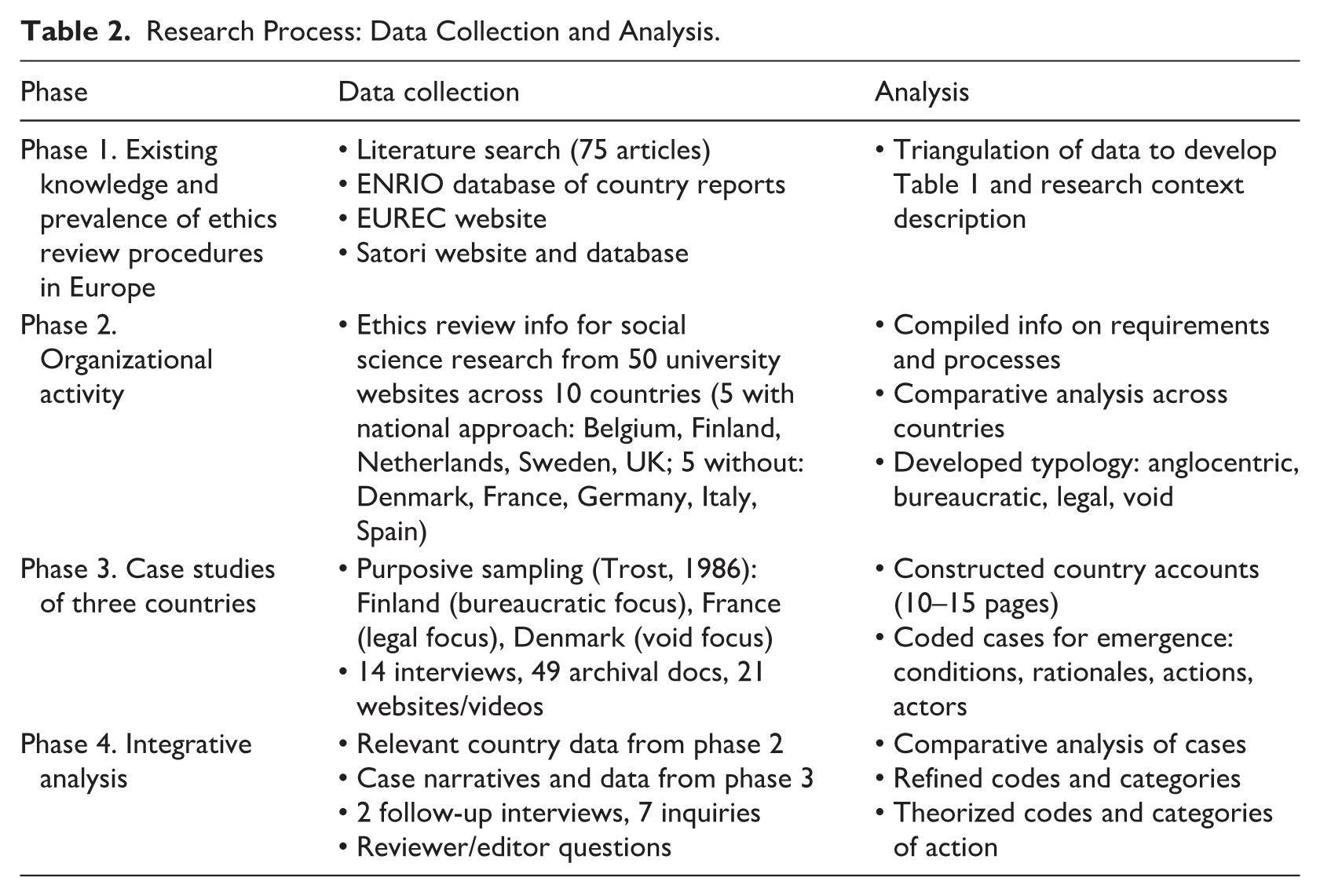
To understand how ethics reviews of social science research emerged across Europe, we used a logic of discovery (Golden-Biddle, 2020) and a cross-case comparative method. We collected and analyzed the data in four phases, starting in an open-ended way to understand the phenomenon and becoming more focused as our knowledge of the phenomenon grew. We describe each of the phases and provide a summary in Table 2.
Research Process: Data Collection and Analysis.
Phase 1. Existing knowledge and prevalence of ethics review procedures in Europe
We read published work on ethics review in Europe (retrieved 75 articles) which focused on ethics review of biomedical research (see Boden et al., 2009; Israel & Hay, 2006). Next, we triangulated archival sources—the ENRIO database of country reports, the EUREC website, and the Satori website and database—to identify ethics review requirements for the social sciences across countries, generating Table 1. Where the requirements were unclear, we contacted country experts listed in these databases. We learned that, in some countries, national research bodies and other agencies representing the state have developed national requirements (e.g., guidelines, regulations, licenses) for ethics review. However, many countries did not require ethics review for social science research or were ambiguous in their demands, and in some of those contexts, local university initiatives had emerged.
Phase 2. Organizational activity
Next, we zoomed in on how ethics review in social sciences was organized across countries at the organizational level. We collected data from university websites in ten European countries, selecting five countries with nationally coordinated and integrated models (Belgium, Finland, Netherlands, Sweden, and UK) and five countries with local models for ethics review (Denmark, France, Germany, Italy, and Spain). For each country, we did a broad search, but to ensure the scope of data collection was manageable, we selected five universities per country to see (a) how many of them had information on ethics review procedures on their websites and (b) how similar this information was across universities in any given country. In countries such as Denmark and Finland, we were able to analyze all the country’s largest universities, while in countries such as Germany and France, we selected research institutions with the largest social science faculties, including standalone business schools. From the university websites, we gathered information such as whether an ethics review was required, motives for establishing ethics reviews (e.g., funding requirements, journal requirements, ethical concerns, scandals), mandate of the committee (e.g., provision of statements for journals, funders, with or without license), the composition of ethics review committees, targeted researchers and students, and key actors, bodies, and documents.
With this data, we analyzed practices within and across countries. Through an extended, iterative comparative analysis, we created typologies of approaches to ethics review in the social sciences across these countries using the dimensions listed above. The Anglocentric typology, built on the UK model, covered the approaches of the Netherlands and to some extent Belgium. The national bureaucratic typology in which the national advisory actors had a central role in coordinating an approach independent of the Anglo model covered the case of Finland. The legal typology in which law was the central means through which ethics review procedures were shaped covered the case of Sweden and France. The void typology includes Denmark, Germany, Spain, and Italy where procedures emerge from within local institutions, reflecting a fragmented landscape in which approaches to ethics review vary across universities, disciplines, or even individual departments.
Phase 3. Case studies of three countries
Wanting to go beyond the Anglo model, which has received significant attention (e.g., Babb, 2020), we focused on the last three typologies. We returned to our analysis of the 10 countries and the theoretically important differences observed across the typologies to sample cases (Trost, 1986). We selected one country from each typology—bureaucratic (Finland), legal (France), and void (Denmark)—to study in depth. This approach was intended to ensure that the diversity of the three models was represented and explored.
Our analysis of the three countries followed a comparative case design (Yin, 2009). In each, we gathered archival data on the historical and legal trajectory of ethics reviews in the medical and social sciences at the national level. We also gathered archival data from the national associations overseeing research integrity and ethics. From these sources, we traced the emergence and existence of ethics review in social sciences. In addition, we conducted 14 interviews. 1 Our interviewees can be divided into three categories: practicing researchers (social scientists), managerial elites (e.g., secretary of a research ethics committee, legal professional), and administrative elites (e.g., representative of a national research body) (Freidson, 1985; Waring, 2014).
Based on these data, we constructed 10-to-15-page accounts of the history of ethics review of social science review in each country. We analyzed the three cases by reading and discussing all the narrative accounts, questioning the accounts, and requesting more clarification and details. After we clarified the details of each case, we coded each account separately and then together, detailing ethics review procedures and their emergence, including conditions, rationales, actions, and actors.
Phase 4. Integrative analysis
In the final phase, we engaged in comparative analysis, drawing on our data for each case from phases 2 and 3. We were alert to the fact that social scientists in their role as researchers were central to the emergence of ethics review procedures in each country. Reviewer feedback prompted us to return to the data to systematically identify the roles of all actor groups and the actions they took in relation to the emergence of ethics review procedures in the social sciences.
This deeper engagement with the data across the cases led us to identify a shared sequence of phases though unfolding at different times in each national context through which ethics review procedures emerged. We examined each phase with attention to the actors involved (e.g., social scientists, administrators), the actions taken, the triggers for those actions, and their consequences. From this analysis, we identified four phases: creation of national infrastructures, seeking resources, creating resources, and expanding resources. Comparing across cases, we identified and clarified the role of pockets of social science researchers—members of the practitioner stratum of the profession—as critical drivers of the change. Drawing on the data, we developed an understanding of their actions, what triggered their actions, and how this created a process of change.
Findings
We describe and theorize how ethics review procedures for the social sciences emerged in three contexts—Finland, France, and Denmark—shaped respectively by bureaucratic, legalistic, and void dynamics, and occurring over different time horizons. Despite these differences, we identify the role of researchers in each country who sought out, developed, and diffused ethics review procedures for their own research. We show that these researchers acted because of the type of research they do (studies in medical settings, experimental studies, or research with children or other vulnerable populations), and their pursuit of international collaborations, funds, or journals.
We conceptualize the researchers who pursued the establishment of ethics review procedures as vanguard actors. Vanguard actors are members of a profession who seek out new practices that will allow them to continue their work in a changing environment or to extend their work to new audiences, methodologies, phenomena, funders, and collaborators. Where continuation or expansion requires new practices, vanguard actors seek out existing resources or create new resources to develop the needed practice. In doing so, vanguard actors generate awareness of the need for new practices in their profession without the immediate or direct intention of changing the work of others. The development of a new practice and the awareness created around it may serve as material for broader practice change within the profession. Below we describe the context in which researchers sought out a new practice and three vanguard actions—seeking, creating, and expanding resources—that made ethics review procedures for social science available in each of these countries.
Creation of national infrastructures
Ethical concerns about reproductive technologies and related biomedical research, and national conversations about general research integrity (misconduct, data veracity, collegial relations, and so on), led to the establishment of organizations, committees, and laws (summarized in Table 3). These national organizational and policy infrastructures focused on research ethics in biomedical research exclusively. We describe the creation of these infrastructures, noting their exclusionary character, as the context in which social science research sought out ethics review for their research.
Creation of National Infrastructures.
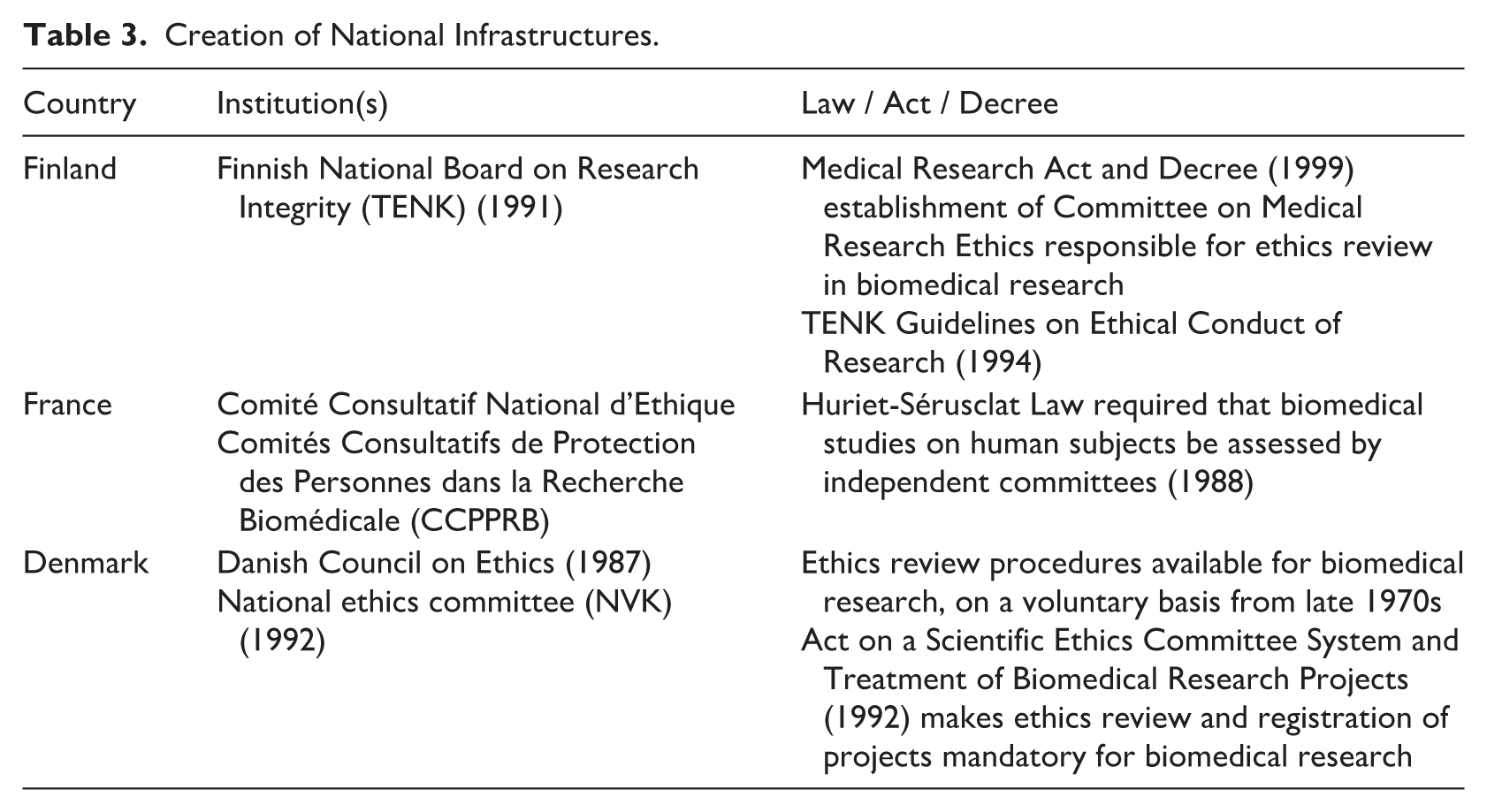
The Academy of Finland promoted research ethics as a key science policy concern in the early 1980s (Löppönen & Vuorio, 2013). Members of the Finnish government also expressed concern about social and ethical issues relating to genetic and reproductive technologies. Consequently, in 1988, the Ministry of Education asked the Academy of Finland to compile a report on current research ethics processes in universities and how they could be improved. This led to the establishment of the National Advisory Board on Research Ethics (TENK) in 1991, now the Finnish National Board on Research Integrity. In 1994, TENK published guidelines for the ethical conduct of research, focusing on the prevention of research misconduct. Concerns about human subjects in biomedical research emerged at that time and the Committee on Medical Research Ethics was formed under the Medical Research Act and Decree in 1999. This committee, working with the regional hospital district ethics committees, oversaw medical research involving humans, evaluated research protocols, and sought to guarantee the safety of clinical research participants. This national infrastructure, as we will show, was central in the discussion of ethics review in social sciences.
In France attention to research ethics emerged from advances in biotechnology, particularly reproductive technologies, in the 1970s. Hospital ethics committees emerged from a political and professional movement (Mino et al., 2008). These local, physician-led efforts were eclipsed by national, legislative efforts. In 1983 Président Mitterand created the Comité Consultatif National d’Ethique (CCNE), an independent advisory council on bioethics, following the birth of the first French baby by in vitro fertilization. Legislation was developed in parallel with the Huriet-Sérusclat Law (1988) requiring that biomedical studies on human subjects be assessed by independent Comités Consultatifs de Protection des Personnes dans la Recherche Biomédicale (CCPPRB). Under this law, clinical biological and medical research was subject to ethics review procedures by the CCPPRB 2 ; however, “non-clinical” research including clinical cognitive, social psychology and other social science research was not subject to review (Peyrin, 2022).
In Denmark voluntary ethics review procedures for biomedical research were established in 1977. 3 The Danish Council on Ethics was established in 1987 to advise the government on biotechnology, consult with voluntary ethics review committees, and assess the need for laws governing biomedical research involving human subjects. 4 Beginning in 1992, biomedical research involving “live-born human beings” required ethics review under the “Act on a Scientific Ethics Committee System and Treatment of Biomedical Research Projects.” This act resulted in the establishment of a national ethics committee (NVK), and six regional committees where ethical approval of biomedical research projects could be sought. Beyond ethics review in biomedical settings, concerns about research ethics led to the creation of a national board to handle cases of scientific misconduct. In 1997, the Act on Scientific Advisory Services targeted scientific misconduct, and stipulated establishing national disciplinary committees for different research areas, including social sciences and humanities.
Across countries the policy infrastructure—organizations, committees, laws, and guidelines—emerged to protect human subjects in the context of biomedical research and technologies. The creation of ethics review procedures for biomedical research occurred across the three countries in the late 1980s and through the late 1990s. Additionally, broader concerns about research conduct and misconduct generated guidelines and procedures in Finland and Denmark. This would emerge later in France. 5 Social science research was excluded from consideration. This became the main trigger for social scientists in their role as researchers to call for advice and resources, the first of three vanguard actions.
Seeking resources
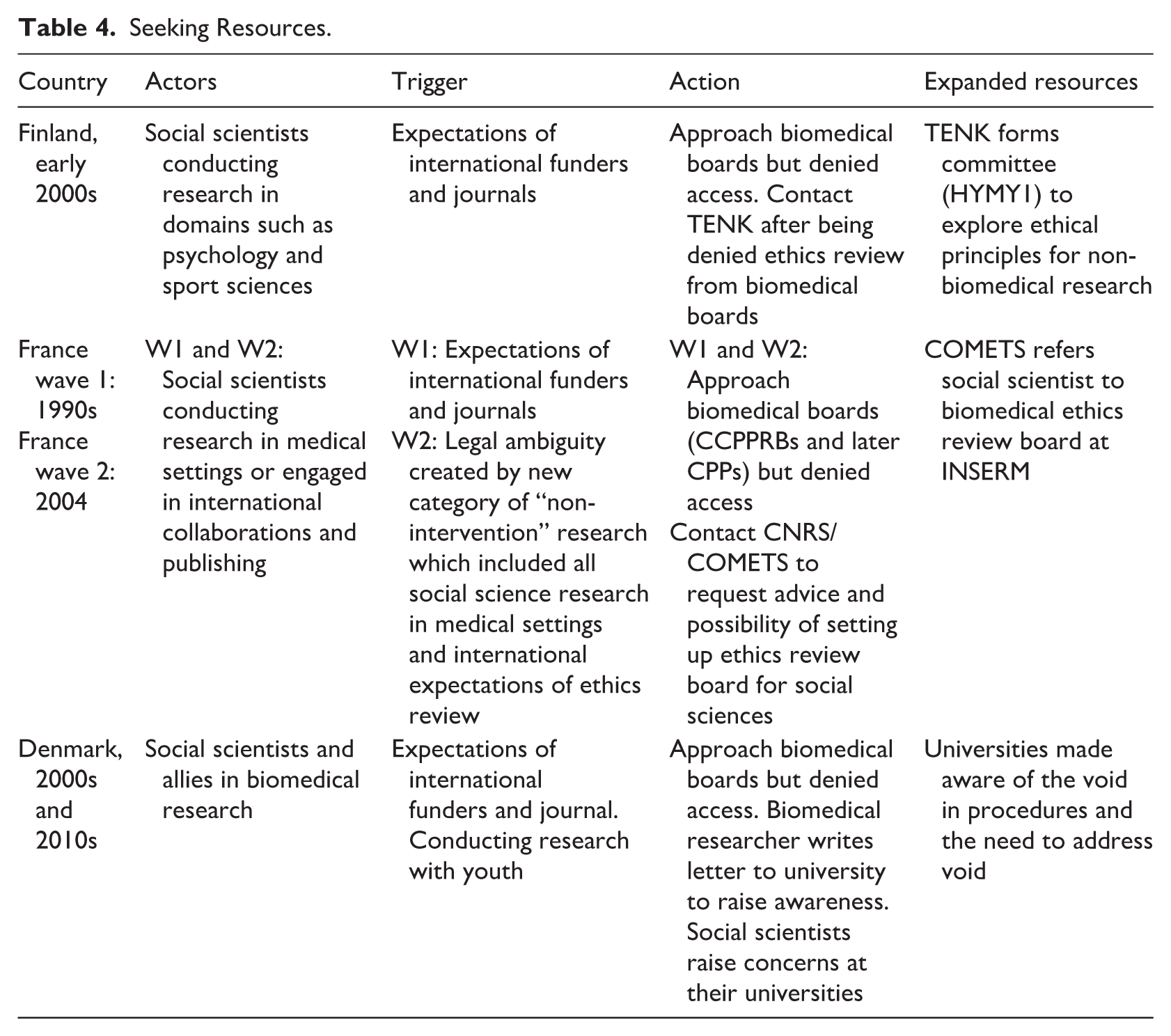
Researchers across contexts sought out ethics review from biomedical boards or searched for advice, systems, and places where they might receive such reviews. They became aware of the need for this practice through funding agencies or journals, and because they wanted to conduct research with youth populations or in medical settings. As social scientists became aware that their research might require such review, they began asking about and searching for where they might access review. They did this by contacting national-level research organizations or university-level bodies to ask for advice about and access to ethics review. Table 4 summarizes each case, showing similarity in actors who sought ethics review procedures and their actions and variation in the triggers and consequences of seeking resources.
Seeking Resources.
In tracing the actions of vanguard actors, we refer to the practice of ethics review as a resource. Although ethics review procedures may be perceived or experienced by many researchers as a bureaucratic nuisance or managerial interference, they operate as a resource for vanguard actors because they facilitate their research, including ensuring vulnerable populations are treated with respect and due process, providing access to journals and collaborations, and facilitating access to funding. As Sewell (1992, p. 9) argues, “resources are anything that can serve as a source of power in social interactions.” Similarly, Feldman (2004) argues that rules and routines can operate as resources or constraints, depending on what actors are trying to achieve in a given context.
In the early 2000s, academics in various fields (e.g., psychology, sports science) began contacting the Finnish National Board on Research Integrity (TENK), reporting that their journals were requesting ethics reviews. A researcher explained: The demand [for ethics review procedures] started from the fact that regional committees on medical research ethics just said no. And then [TENK] got inquiries from researchers, like psychologists, sports scientists, and others, asking what they should do now, as they needed something [ethics review] that wasn’t available.
The ethics review committees for medical research refused to provide reviews for these researchers, who then contacted TENK and said that “something should be done”—new procedures were needed.
Because of the growing attention to research ethics issues in social sciences, TENK established a working group (HYMY1)—researchers in the social scientists and humanities—to discuss ethical principles for non-biomedical research. In 2006, the group wrote an edited book titled Ethics in Human Sciences, aimed at promoting discussion of ethical issues in social sciences. A researcher and a member of the working group explained that the book and related conversations made ethics review procedures salient, although the book was “completely separate from drafting any rules.” Instead, its purpose was to investigate “how researchers themselves perceive ethics questions” in their contexts of research and hence understand what kinds of ethics review resources were needed and sought out. TENK responded, mandating a second working group (HYMY2) in 2009 to continue work on ethics procedures.
In France, social scientists sought direction and resources from national bodies in two waves. In the first wave, researchers sought ethics review in the early 1990s, approaching the existing regional boards set up for biomedical research (CCPPRBs) but social science was considered “out of scope” (Derbez, 2023, p. 47). The next stop for researchers who were seeking ethics review, for reasons of international collaborations or publishing, was the interdisciplinary ethics advisory body—COMETS—created by the National Centre for Scientific Research (CNRS) in 1994. COMETS was mandated to reflect on issues of research integrity and ethics and not be an “operational ethics committee responsible for accrediting projects.” 6 When approached by social scientists for ethics review procedures, COMETS referred them to the ethics review committee for biomedical research at the National Institute for Health and Medical Research (INSERM) (Interview, former COMETS member). Thus, in the early 1990s, requests for ethics review by social scientists were routed to biomedical boards. Although extensive organizational and legal infrastructure existed for biomedical research, nothing like this existed for social science research.
A second wave of seeking resources began in 2004 when revisions were made to the Huriet-Sérusclat Law. The law, altered in response to a series of public health scandals, redefined biomedical research, creating a new category of research—non-intervention biomedical research. 7 Non-intervention research included any research in medical settings not involving changes in treatment, including observational studies and other data collection in medical settings. Social science research was categorized as non-intervention. However, this raised questions about whether all social science research was non-intervention in character. The revisions of this law created a “legislative vacuum” or void for those doing social science research in medical settings (Fournier, 2012). Although French law excluded this research from requiring ethics review, researchers in “working in disciplines related to those of biomedicine, such as clinical and experimental psychology, ergonomics, or humanoid robotics, as well as researchers in the social sciences of health, found it difficult to fund or promote their work internationally” (Derbez, 2023, p. 47). Further, the CCPPRBs (renamed as CPP in 2004) continued to consider what was now legally termed “non-intervention” research out of scope. The only option for ethics review was to use biomedical ethics review boards such as INSERM within the national research institute infrastructure.
In Denmark, researchers also raised questions about the need for ethics review procedures and were turned away by biomedical boards. These issues were raised at the university level, rather than at a national level as observed in Finland and France. At Southern University of Denmark (SDU), researchers began searching for resources for social science research in the mid-2000s. A group of researchers who had received EU funding required ethics review but their research was considered out of scope for biomedical boards. They contacted the ministry but were told: “social science does not have ethical problems to be considered” (interview, researcher, SDU). A professor of medicine, who was engaged with biomedical ethics, learned about this exclusion from the biomedical boards when her child was asked to complete a survey on self-harm and suicide, without parental consent. The issue was escalated within the university when the professor/parent investigated the situation and discovered the lack of procedures for social science. The reason the study was not reviewed by the biomedical ethics review committee was that it was “sociologists, not psychiatrists, [who] conducted it.” Consequently, the professor/parent explained, “A group of colleagues and I discussed this intensely and decided to write a letter to the University management and call for a broad ethics committee, and so we did.” Researchers at other Danish universities, for example Aarhus and Aalborg universities, who were applying for grants with, in particular, the European Research Council, started to call for ethics reviews.
Across contexts, researchers sought ethics review from the only available source—biomedical boards—and were turned away. The existing infrastructure excluded them. Researchers then turned to national bodies for advice and resources. In the case of Finland, TENK responded by setting up a new committee to investigate this issue. In France, researchers were directed to the ethics review board with a biomedical research center. In Denmark, researchers began to raise their exclusion at the university level. The researchers who sought resources were those doing experimental work, working with vulnerable populations, or managing the expectations of international funders and journals. They actively sought out ethics review for their work and, on finding they did not have access to such review, pushed for systems or procedures that would include them.
Creating resources
Because vanguard actors sought but were denied access to existing resources, new resources had to be created. Across countries the responses of organizations within the policy infrastructure influenced who created these resources and how. In Finland, where TENK responded to the calls of researchers, administrators pushed universities to create ethics review boards, minimizing the role of vanguard actors in resource creation. In France and in Denmark, where researchers faced legal and bureaucratic voids, they created ethics review boards. Thus, where efforts to seek resources did not elicit a response, vanguard actors created the resources they needed—ethics review procedures—to do their work. We summarize these findings in Table 5. While vanguard actors drove the creation of ethics review procedures in France and Denmark, we will show in the next section that vanguard actors in all three countries are important to the expansion of ethics review.
Creating Resources.
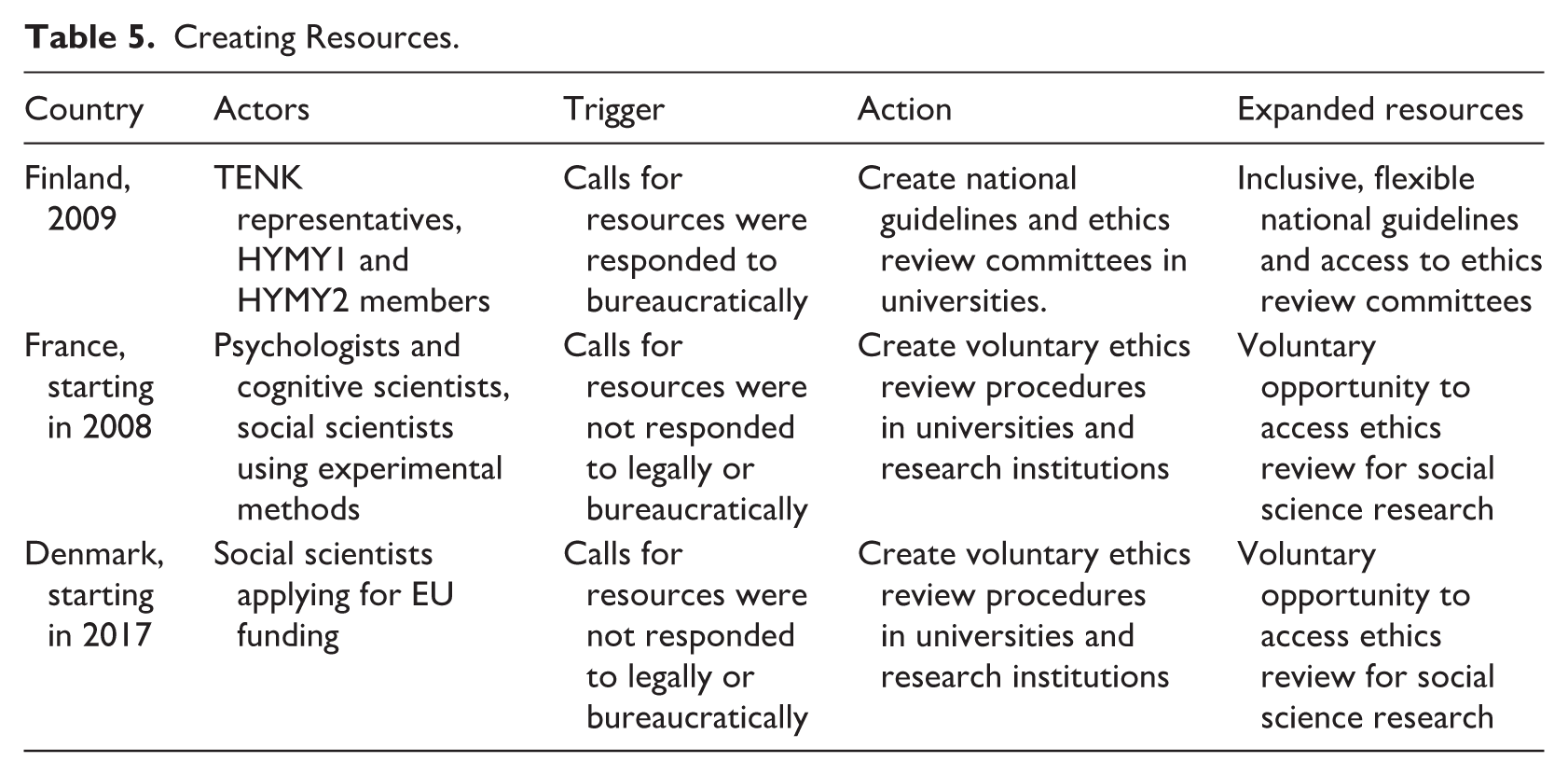
In Finland TENK tasked HYMY2, a group comprised of social scientists and humanists, to develop national guidelines for ethics review. HYMY2 sought feedback from researchers which resulted in broad guidelines that identified which research should undergo ethics review and leaving responsibility for determining whether to seek review to the individual researcher. A TENK representative noted that the guidelines were “among the first in Europe and probably among the first in the world specifically related to human sciences, not medical human sciences.” The guidelines began with the notion “Science should be practiced primarily with the help of the scientific community’s own critical review and joint ethical rules” (National Advisory Board on Research Ethics, 2009, p. 2). A researcher explained: “These TENK guidelines are all about self-regulation, so they are not necessarily required by law. However, they do specify the cases in which ethics review should be sought.” The guidelines also included a statement that universities and research organizations committed to complying with the guidelines would establish “human sciences ethics committees” for their researchers. The HYMY2 working group secured commitment from the academic community, which was formalized when rectors pledged that their organizations would comply with the guidelines and establish ethics review committees. TENK’s annual reports indicate that the guidelines, along with committees, have been largely adopted across universities (TENK annual report, 2010, p. 2). In the case of Finland, academics working as administrative elites (Freidson, 1985) on the TENK HYMY2 committee created ethics review procedures for social science.
In France, social science researchers created their own ethics review boards in response to the legal void created by the revisions to the Huriet-Sérusclat Law (2004) and in anticipation of a new law. The discussion and drafting which began in 2009 produced the Jardé Law (passed in 2012 and amended in 2018). It was initiated to reconsider the boundaries of non-intervention research in medical and health research. In this legal context, researchers conducting cognitive and psychological research in medical settings took action. In 2008, the Laboratiore de Psychologie et NeuroCognition)—affiliated with the CNRS and Universite Genoble Alpes and Universitie Savoie Mont-Blanc)—established the first ethics review committee. 8 This laboratory-level effort then expanded to the Cognition Research Consortium at Grenoble in 2010. The Consortium, under the auspices of the University of Grenoble Alpes, conducted ethics reviews for research excluded from the Huriet-Sérusclat Law and, therefore, not eligible for review by one of the regional Committees of Protection of Persons (CPPs).
Consortium members—researchers—emphasized the importance of protecting human subjects, training students, responding “to journals, which require the approval of an ethics committee to publish the work”, supporting “a project submission to an organization (ANR [French Research Agency], Europe) or simply on the initiative of a team keen to obtain an ethical opinion on its scientific approach” (CERGA, 2023, para 1). These first ethics review procedures established by researchers were an effort to fill the legal vacuum, address external demands for ethics review, train students and protect research subjects. 9 As the conversation about legal changes evolved, researchers working in biomedical settings across approximately a dozen institutions developed ethics review procedures. This was prescient as the Jardé Law (2018) defined three categories of research in biomedical settings, all of which require ethics approval. 10
Researchers working outside of biomedical settings, particularly psychologists and economists doing laboratory experiments, also created ethics review procedures. In addition to expectations from international collaborators and journals, researchers in these fields were increasingly exposed to and trained in contexts that “were familiar with ethics review,” explained a researcher, noting that “the international recruitment and experience make a difference also because [. . .] in other countries, they have experienced ethics committees and so they are more familiar with that.” As French institutions opened up, the absence of national requirements created concerns. A researcher who created an ethics review procedure explained: I am convinced that we need to be able to provide this service to researchers and this guarantee to our subjects. So, this is the first reason that we need to prove that what we are doing is clean. The second reason is more practical. Our journals in [discipline] now require ethics approval.
This researcher considered the ethics review procedure to be a service or resource and noted ethical and practical reasons for providing this service. By 2018, researchers in France had created ethics review procedures in over twenty universities and institutions. 11
Similar to France, ethics review procedures were created by researchers in Denmark primarily because of expectations of research funders. Researchers at the University of Copenhagen created the first social science ethics review committee in 2017 in response to the ethics review requirements of EU funding. The mandate of the committee was narrow—to provide approval only when required by a funder particularly the EU (internal document, Copenhagen University, 2016). Reviews to meet journal requirements were not done because researchers on the committee considered it an ethical drift to “rubber stamp” research as ethical “post-hoc” (interview, researcher). Consequently, the ethics review process was a resource for researchers seeking EU funding.
Researchers across universities in Denmark began creating ethics review procedures in response to various pressures. In 2018, pressure from researchers at The University of Southern Denmark resulted in the establishment of a university-wide ethics committee. In contrast to Copenhagen, the committee provided ethics review needed for funding and journals. Furthermore, the committee became registered with the Office for Human Research Protections in the US and thus provided licensed reviews. Similar to Copenhagen, ethics review for social science research remained voluntary. The researcher who chaired the committee explained, “It is essential that ethics review remains a voluntary option; it is a cultural change that requires time to take root within the organization.” Researchers at other Danish universities recognized the demands from funders and journals and created ethics review procedures in 2019 and 2020 at Aarhus University, Aalborg University, and Copenhagen Business School. The Dean of Research at Copenhagen Business School explained that the committee: “is intended to help researchers who need a quality stamp for either a paper or an application” (CBS, 2020).
In Finland, the creation of ethics review procedures emerged from a nationally coordinated effort, spearheaded by HYMY2, which produced widely adopted guidelines and ethics review procedures. In France and Denmark, where the legal and bureaucratic infrastructure was unresponsive, researchers engaged in distributed and fragmented efforts to create ethics review procedures. In France and Denmark researchers created ethics procedures to have access to the resources they needed as researchers. In France, researchers were faced with legal uncertainty about non-intervention research as well as international collaboration, funding, and publishing expectations. In Denmark, researchers were faced with international collaboration, funding, and publishing expectations. In both cases, pockets of researchers created ethics review procedures to meet the demands on their work.
Expanding resources
The resources created were further expanded by vanguard actors for other social science researchers. By expanding we refer to two actions: enlarging the resources and diffusing the resources. Enlarging ethics review procedures involved vanguard actors adjusting them to suit their particular research subject communities and institutional settings. Diffusing ethics review procedures involved vanguard actors sharing them with other researchers so that they could adopt them as is or also engage in processes of augmentation and enlargement for their context. Thus, researchers continued to evolve the created resources to their needs and contexts and shared these resources with others. We summarize this vanguard action in Table 6.
Expanding Resources.
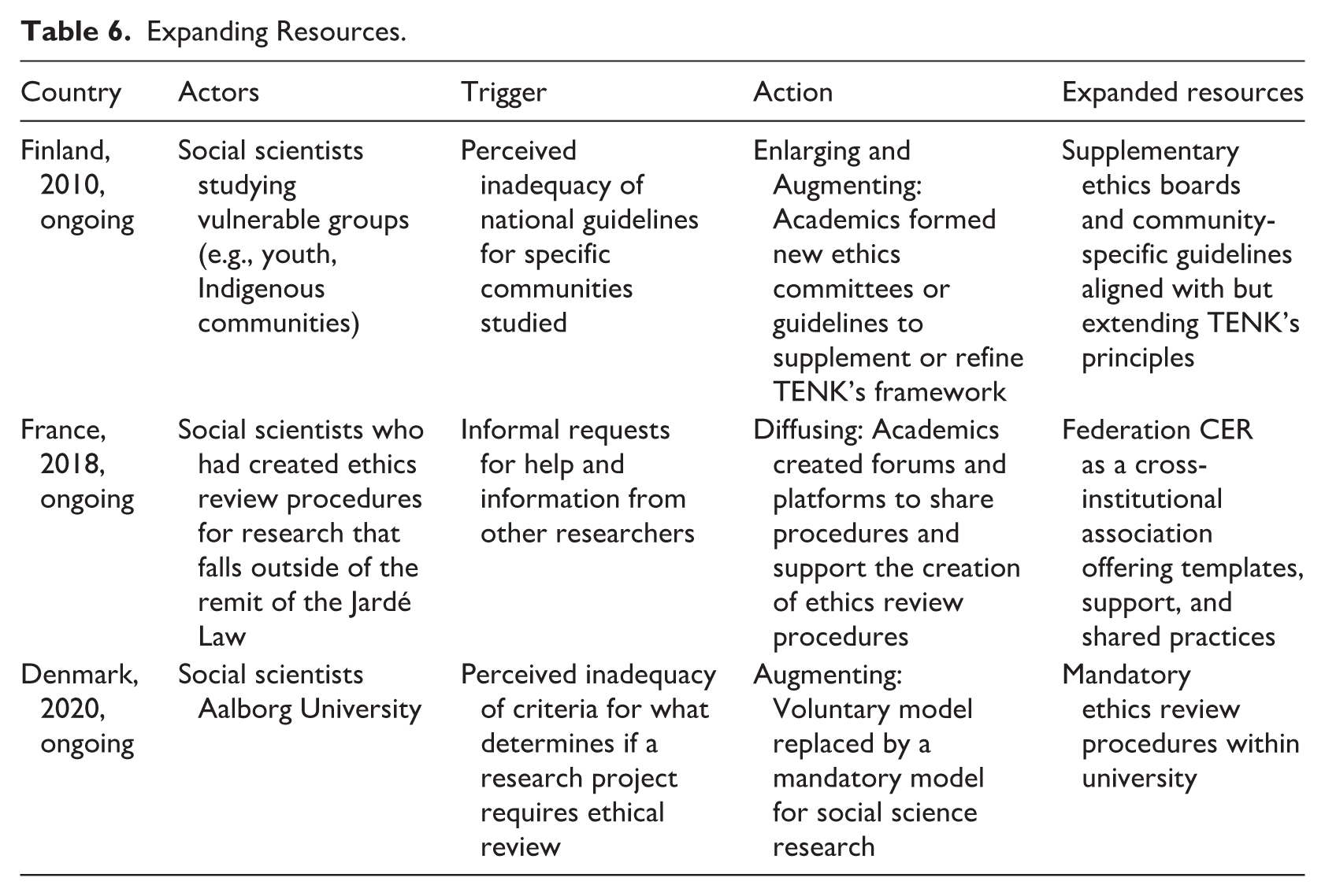
In Finland, researchers enlarged the resources created by TENK. In 2015, the Finnish Youth Research Network expanded the national level guidelines published by starting their own “Ethics Committee of Youth and Childhood Studies.” Researchers highlighted the unique ethical issues related to studying children and youth, including the right to age-appropriate treatment and being heard. The network also organized to make ethics review procedures available beyond those researchers who worked in organizations or in roles in which they did not have access to university ethics review procedures (e.g., Ombudsman for Children, the Finnish Association on Intellectual and Developmental Disabilities, the Central Union for Child Welfare).
Another example of vanguard actors expanding ethics review procedures involves researchers working with Sámi communities who recognized the ethical complexities of engaging Indigenous populations. They noted the issues of language, cultural sensitivity, and local traditions were insufficiently addressed in TENK’s guidelines. A working group consisting of academics studying the Sámi communities as well as representatives from the Sámi Parliament of Finland and the Sámi Education Institute, developed new guidelines specific for this research context over a period of six years. These expansion actions stemmed from the long-standing need of the Sámi researchers and the Sámi community to consider Indigenous rights and improve certain shortcomings in research practice. The working group’s intention was that universities and research institutions utilize the guidelines in teaching ethical conduct in research methods. However, there was also a recognition that effective ethics review procedures would require good knowledge of Sámi culture, meaning that certain research designs might require review by representatives of the Sámi community.
Researchers who study youth and the Sámi community in Finland expanded the ethics review procedures created by TENK to the communities they study, noting that ethics review of social science research done with these communities require additional and specialized approaches. These actions of expansion occurred in relation to their concerns about protecting the populations they study. Driven by research-related concerns, those doing research related to these populations took given resources and enlarged them in service of their work.
In France, researchers diffused the ethics review procedures they created to other social scientists. These informal efforts became more organized and accessible through the creation of the Federation CER (Comité d’éthique de la recherche in France) in 2018. The Federation is the coalescence of the efforts of researchers distributed across universities, who created ethics review procedures. A centralized resource, it offers information and models of ethics review procedures for research that does not legally require review. Even though French law may not require ethics review, research across “disciplines of Human Sciences, Ergonomics or Humanoid Robotics, requires an ethical opinion outside of what is covered by the Jardé law.” 12
The Federation positions itself purely as a resource—“to be useful”—for those who “wish to request an ethics review of their protocol or are looking to contact the ERC (Ethics Review Committee) at their university or institution,” “researchers planning to create an ERC at their university or institution,”
13
or researchers on ERCs (Ethics Review Committees). There are several notable aspects of this description including its focus on being useful, being useful to researchers, and being at the researchers’ request. The Federation CER’s website indicates researchers in France are still seeking ethics review as links are provided for researchers who seek an ethics review and want to create an ethics review process at their institution. The Federation CER provides numerous resources for those discovering and grappling with ethics review outside of the Jardé law, indicating that individual social scientists and groups of social scientists are in the position of creating ethics review procedures. These efforts were followed by the establishment of other research boards that fell outside the remit of the Jardé law but involved intervention with human subjects. For example, the Université de Lyon, which implemented an ethics review committee in the early 2020s because of the need to validate protocols for non-interventional research involving human subjects (i.e., studies that are not subject to existing regulations) is becoming increasingly urgent. This is both in response to requests from funding agencies and publishers and because laboratories are becoming increasingly concerned about ethical practices.
14
In Denmark, expansion took the form of transforming ethics review from a voluntary service to a requirement. Senior management at Aalborg University envisioned a voluntary ethics review procedures similar to other Danish universities. However, a working group, led by a professor of research ethics, enlarged the review procedure by making it mandatory. The chair of the committee explained: It seems strange that you can have two researchers working on the same project; the one getting funding must have ethical approval. The criterion must be that if a research project raises research ethical questions [. . .] we proposed to the University management that all projects doing so must undergo review [. . .] The University management accepted that, and they gave us the mandate to now undertake this. (interview)
Further, the mandate of these required reviews went well beyond the protection of human subjects to examine the ethical qualities, purpose, and conduct of the research.
Vanguard actors expanded the ethics review procedures that had emerged in their country by extending them to take into account specified communities studied or by diffusing them within the country. In Finland, researchers complemented national guidelines by developing tailored procedures, such as youth and Indigenous specific ethics committees, that addressed gaps in coverage while still adhering to national frameworks. In France, researchers formed associations, such as the Federation CER, which facilitated sharing review procedures across institutions. In Denmark, expansion efforts emerged more selectively, with some researchers broadening the scope and requirement of ethics review procedures. These acts of expansion show researchers going beyond seeking out and creating resources, revealing how they actively enlarged and diffused ethics review procedures.
Coda: Compliance with General Data Protection Regulation
The EU’s General Data Protection Regulation (GDPR, 2018) requires organizations that collect personal data to employ a data protection officer and enact precautionary data protection measures. Across the cases, we observed how the regulation of data entwined with but stopped short of protecting human subjects, for example through asking questions about data storage, risk assessment involved in processing personal data, and options for opting out of the research project. Although GDPR addresses consent for data processing, it does not consider risks and benefits of the research and how these risks and benefits are distributed across subjects. The focus is what and how much data is collected and the preparation of documents such as “data management plan” and “data protection impact assessment.” As countries produce national mandates related to GDPR, how researchers handle personal data has been an important focus. For example, France has foregone human subjects’ protection in social science research for more than four decades. Yet, it is through GDPR that informed consent for data processing has now become formally required. This shift is reflected in guidelines such as CNRS’s 2021 Humanities and Social Sciences and the Protection of Personal Data in the Context of Open Science. 15 Informed consent for data processing remains though distinct from protecting human subjects. Thus, compliance with GDPR does not ensure protection of human subjects; however, that distinction seems to be lost.
Discussion
Despite observations of “a remarkably high level of convergence” in terms of what counts as a good university, which rankings matter, and how research is managed (Ramirez & Meyer, 2013, p. 257), this study examines an instance of divergence in higher education. Contrary to mounting evidence of isomorphic organizational forms and academic practices (Meyer & Rowan, 1977; Ramirez & Meyer, 2013), we examine the sparse, temporally distributed, and geographically diffuse emergence of ethics review procedures for social science research in Europe. We show how social scientists in their roles as researchers sought out, created—with and without support from national institutions – and expanded the availability of ethics review procedures. Researchers in Finland, France, and Denmark called for and expanded ethics review procedures in their role as researchers conducting research. In France and Denmark, social science researchers also created ethics review procedures for themselves and their colleagues. In Finland ethics review procedures were created through a national bureaucracy that responded to researchers’ calls for this resource and then researchers expanded these procedures.
We conceptualize the researchers who instigated, created, and expanded ethics review procedures as vanguard actors. Vanguard actors are members of a profession whose daily work pushes them to identify practices that will facilitate the continuation and expansion of their work into new territories including, for example, new audiences, methodologies, phenomena, resources, and collaborators. Without the acquisition of new practices, which are perceived of and experienced as resources, the expansion of their work is constrained. In our settings, researchers working at the frontier of their profession in terms of studying vulnerable populations, using experimental methods (field and laboratory), and pursuing international collaborations, funding, and journals encountered the need for ethics review procedures for their research. Across these varied situations researchers were made aware of or became concerned about the absence of ethics review procedures and how their unavailability might prevent the current and future expansion of their work. Their focus was on creating ethics review processes for themselves and for other social scientists who might need them.
Vanguard actors are not propelled by a broader mission or desire to create change at the level of the profession. They are members of the profession who, because of the focus of their work, are attuned to evolving changes in the environment that threaten the maintenance and expansion of these work activities. These vanguard members seek new practices that facilitate and expand their work. Other examples of vanguard actors include researchers who in pursuing their research interests created practices for interdisciplinarity (Nelson, 2015), public sociology (Vaughan, 2006), and science communication (McGregor, 2022). As these practices emerge, vanguard members continue to evolve and share the practices, making them known and available to other members of the profession. While vanguard actors focus on sustaining their own work, such efforts can unintentionally generate wider change in the practice of the profession.
Contributions
Vanguard actors as convergence mechanisms in higher education
Bureaucratic forms and practices diffuse widely in higher education in part because they are signals of reliability (Ramirez & Meyer, 2013; Sahlin, 2014) that “maintain appearances and validate an organization” (Meyer & Rowan, 1977, p. 355). The construction of “a global higher education regime,” made visible through the convergence of forms and practices, is mostly attributed to states, networks of international organizations, and quality assurance and accreditation agencies (e.g., Zapp & Ramirez, 2019). Prior literature identifies elite members of the profession—administrative elites (Ramirez, 2010) or managerial elites (Collini, 2017; Fleming, 2021; Power, 2015)—as drivers of convergence in higher education. Our study demonstrates the importance of the practitioner stratum of the profession—the “rank and file members” (Freidson, 1985). We show that practicing members of the profession may express an interest in practices that facilitate their work in a changing context or allow them to expand their work, thus can also be a mechanism through which practices are developed and diffused, and convergence unintentionally evolves.
Our study identifies vanguard actors as engines of change that set processes of convergence into motion. Although vanguard actors do not aspire to contribute to broader change, their efforts to continue and expand their work may inadvertently feed motion toward convergent change. The practices vanguard actors initiate to resource their daily work may eventually become bureaucratic constraints as they have in the Anglo context (e.g., Babb, 2020). Managerial elites may also formalize and transform the initiatives of vanguard actors further into elements of the profession’s accountability regime (Power, 2015), where a new ethical elite stratum could emerge.
Stratification and change in professions
Our findings contribute to a growing body of research that examines how professions alter and manage their practices in response to external threats or changing conditions via heterogeneity in membership (e.g., Anteby, 2010; Evans, 2021; Howard-Grenville et al., 2017). While this research observes heterogeneity within a profession, it is not understood as organized through processes of stratification. Previous research demonstrates how administrative and knowledge elites create and implement policies and practices as a response to external and internal challenges (Freidson, 1985). Managerial elites emerged to oversee professions employed in large bureaucratic organizations (Waring, 2014) and to anticipate and respond to regulatory, reputational, and financial pressures on the profession (Power, 2007, 2015). Institutional theorists study these strata as agents that create and carry change within professions and across fields (e.g., Scott, 2008; Zald & Lounsbury, 2010). These strata of the profession are complemented by the mass of rank-and-file members of the profession who are subject to policies of the administrative elite (Anteby, 2010; Waring, 2014), draw on knowledge created by knowledge elite (Evans, 2021; Howard-Grenville et al., 2017), and work daily within the managerial elite (Wilhelm et al., 2019; Wright et al., 2021). The practicing members of the profession are understood as recipients or resistors of change within organizations (Huising, 2014; Kellogg, 2009).
While rank-and-file members of a profession create local organizational change (e.g., Kellogg, 2011; Wilhelm et al., 2019), this stratum of the profession is rarely observed generating change in the profession. Our study shows how rank-and-file or practicing members of a profession can be a source of change beyond one organization. As vanguard actors set out to secure practices that facilitate the continuance and expansion of their work, they set in motion processes, created resources, and expanded these resources with the potential to change practices within the profession. Vanguard actors do not pursue new practices in the spirit of changing the profession or creating larger-scale change. Their pursuit—its focus and trajectory—is motivated by the continuance and expansion of their work.
Thus, this study suggests that vanguard actors—practicing members of a profession whose daily work creates the need for additional practices that will allow them to continue their work or expand their work into new territories—are an important, unrecognized source of change. We suspect that vanguard actors are likely to emerge in contexts where limited resources and infrastructures are required to develop new practices. While this is the case for ethics review procedures in the social sciences, changes that require significant resources and infrastructures may not be as successfully established and diffused by vanguard actors. Practices advanced by vanguard actors may subsequently be stabilized within audit infrastructures (Power, 2007, 2015), which allow them to diffuse further, but their origins remain practitioner led.
The role of ethics review procedures
Scholars have taken a critical stance toward ethics review procedures, including their management and implications for social science research in the US and UK (Boden et al., 2009; Carr, 2015; Hammersley, 2009). Ethics review procedures are argued to create excessive scrutiny and regulation that constrain qualitative research and hamper the conduct of research and academic freedom (e.g., Hammersley, 2009). The broadening of ethical regulation to all human-subject research is also argued to stifle critical and politically sensitive research (Coomber, 2002; Schrag, 2010). Ethics review procedures may privilege certain epistemologies, such as positivism, while marginalizing more reflexive, emancipatory, or critical approaches (Bell & Wray-Bliss, 2009). Despite these concerns and symbolic efforts (Alvesson & Stephens, 2024), our findings show that researchers may seek out, create, and diffuse ethics review procedures.
Contrary to critical perspectives, we observe that pockets of researchers experience the absence of ethics review processes as a constraint on their work. Not only did vanguard actors seek out and create ethics review procedures, but they also enlarged, augmented, and diffused them. Our findings suggest that those who criticize these procedures may not experience the same constraints on their work. Where dominant work activities do not foreground informed consent of research subjects, making ethics review procedures salient, they may appear to be unnecessary and constraining. Thus, our study reveals how contestation and endorsement of these procedures co-exist. This resonates with prior studies of how academics both contest and leverage the same measures for their work (e.g., rankings, citations) (Biagioli & Lippman, 2020; Pardo-Guerra, 2022).
Practical implications
Our findings offer practical insight into the ongoing development of ethics review procedures for the social sciences in Europe. We show that the design and operation of ethics review boards for the social sciences in Europe are varied, flexible, and in progress, indicating the opportunity to deliberately design procedures that protect human subjects while respecting the autonomy and authority of academics. The evolution of ethics review procedures in the Anglosphere should serve as a tale of warning (e.g., Babb, 2020), encouraging social scientists to proactively design procedures that are pragmatic, balancing the protection of human subjects with the continuance of research. Using models of collegial governance and using case-based discretion are ways that ethics review procedures can remain within the control of researchers. However, for this to happen, researchers will need to devote time and attention to developing peer-based monitoring and approval processes, which may increase their workload.
Future research
We expect that the demand for ethics review procedures will continue to grow. The spread of ethics review procedures may be accelerated by resource networks and the growth of the research ethics profession within higher education. Our study suggests that these are promising lines of study. Further, we do not know how these procedures manifest in practice. Studies of the implementation and operation of ethics review boards in social sciences are also needed. Finally, our study highlights the existing variation in ethics review procedures across countries. Understanding how factors such as language, intellectual history and traditions, and local circuits of power buffer the social sciences from globalizing forces is important work. As political change blows across Europe and threats to the project of a unified Europe intensify, the role of social scientists in understanding the national in relation to the international grows only more important.
Footnotes

Funding
The authors received no financial support for the research, authorship, and/or publication of this article.
Declaration of conflicting interests
The authors declared no potential conflicts of interest with respect to the research, authorship, and/or publication of this article.