






Abstract
Discursive constructionism has gained popularity in recent years as an approach to researching complex and nuanced organizational concepts that are predominantly produced and sustained through communication. The complexity of communication, however, presents methodological challenges. Whilst a wide range of methods fall under the category of ‘discourse analysis’, there is a tendency for them to address a specific level of discourse – i.e., micro/meso-level small ‘d’ discourse or grand/mega-level big ‘D’ Discourse – resulting in a fragmented field and a dearth of methods capable of addressing the interrelation of the various levels of discourse. In this paper, discursive construction analysis (DCA) is presented as a methodology that addresses some of the limitations resulting from the fragmentation of discourse analysis. Through the application of Foucault’s concept of the ‘tactical polyvalence of discourses’ this methodology enables the researcher to take into account the actors’ ‘tactical’ suppression and promotion of grand/mega-level discourses whilst interrelating a consideration of discursively enacted power dynamics at micro/meso levels. Furthermore, this approach has been designed to allow for an analysis of the spoken and unspoken elements of language use. The DCA methodology is illustrated through a step-by-step worked example which demonstrates aspects of the discursive construction of ‘collective leadership’ within an independent UK law firm as a stimulus for researchers conducting similar projects.
Keywords
Introduction
The central role of discourse in processes of organizing is now widely accepted across management and organization studies (Cooren et al., 2011) and continues to grow in popularity (Izak et al., 2024). Through discourse, actors produce what counts as strategy, leadership, culture, change, even identity as well as many other organizational phenomena (Fairhurst & Putnam, 2004), revealing the symbolic and communicative processes that shape organizational life (Hardy et al., 2000). Furthermore, the use of language illuminates power relations, showing how certain ways of talking become dominant whilst others are marginalised, thereby shaping whose voices and knowledge are legitimised within organizations (Mumby, 2011). As Putnam et al. (2016) highlight, discourse analysis reveals tensions, paradoxes, and resistance embedded in everyday organizational talk and texts, offering insights into how organizational members navigate conflicting demands and meanings.
This area of study, however, is complex and controversial, with ongoing debate surrounding the meaning of ‘discourse’ (e.g., Alvesson & Kärreman, 2011a, 2011b, 2013; Hardy & Grant, 2012; Iedema, 2011; Mumby, 2011) and a variety of methods catering for a range of perspectives. This has resulted in the field becoming fragmented, with methods being developed to analyse specific aspects of discourse according to particular ontological and epistemological orientations and a dearth of methods capable of analysing the interrelation between varieties of discourse (Chouliaraki & Fairclough, 2010; van Dijk, 2015). The methodology presented in this article seeks to address these challenges. We sought to develop an integrated methodology capable of analysing the discursive construction of complex organizational phenomena by exploring the interrelation between categories or levels of discourse, both spoken and unspoken, and the discursively enacted power dynamics therein.
Throughout the paper we use Potter and Wetherell’s (1987) classification of levels of discourse. Micro-level discourses refer to the use of language in a specific micro context (e.g., a specific meeting or conversation), whereas meso-level discourse is less concerned with detailed semantic considerations, focussing instead on patterns and generalisations that may be drawn from interactions (typically a series of interactions). Grand levels of discourse are concerned with the use of language to construct cultural norms and values at a group level (such as the organization), and mega-level discourses refer to the same use of language but at higher levels still (such as national, societal, or even international levels). This framework provided the foundation for Alvesson and Kärreman’s (2000) highly influential article in which they used Gee’s (1990) distinction between small ‘d’ (micro/meso-level) and big ‘D’ (grand/mega-level) discourses to categorise ‘varieties of discourse’.
We use the term ‘levels’ of discourse to refer to Potter and Wetherell’s (1987) four levels, whilst ‘categories’ of discourse refers to Alvesson and Kärreman’s (2000) distinction between ‘discourse’ and ‘Discourse’. The more general term ‘discourse’ refers to all forms of spoken and written interaction (Gilbert & Mulkay, 1984). Whilst this is a narrower definition than adopted by some, the methodology presented in this paper could be integrated into broader framings of discourse, as outlined further in the discussion.
Discursive construction analysis (DCA) integrates elements from a variety of methods, each designed for the analysis of a specific category of discourse. Whilst this creates some ontological and epistemological challenges and requires adaptation of the underlying methods, the pragmatic approach presented here allows researchers the opportunity to reveal insights beyond those likely with traditional methods of discourse analysis.
In the next section we outline issues arising from fragmented approaches to discourse analysis and highlight key areas we sought to address. We then discuss the methodological underpinnings and development of DCA before presenting a step-by-step guide with worked examples. The paper concludes with a consideration of the strengths, limitations and implications of this approach to analysing discourse(s) in and about organizations.
Problematizing the fragmentation of discourse analysis
Whilst no single method can capture the complexity of discourse (Fairhurst & Putnam, 2004), the categorization and subsequent fragmentation of discourse analysis constrains our ability to explore the multilevel nature of language and its effects within organizations (Fairhurst & Putnam, 2019). The importance of considering multiple levels/categories of discourse has been well documented (e.g. Ainasworth & Hardy, 2004; Clifton, 2014; Fairhurst, 2007; Fairhurst & Cooren, 2004), yet the incommensurability of certain paradigms means that integrating methods is not straightforward.
Researchers seeking to investigate the discursive construction of social phenomena in a holistic sense face a significant challenge in the dearth of methods available (Chouliaraki & Fairclough, 2010; van Dijk, 2015). Critical discourse analysis (CDA) is a notable exception and is arguably the approach that places greatest emphasis on the importance of considering the multiple levels at which discourses operate (e.g. Fairclough, 1992, 1995; Phillips & Oswick, 2012). A common misperception, however, is that CDA is a unified approach; it is not. CDA covers the full range of methods available under the umbrella term of ‘discourse analysis’ (van Dijk, 2015, 2013; Wodak & Meyer, 2016). What differentiates CDA from other forms of discourse analysis is the foregrounding of ‘the interrogation of the hegemonic and contested nature of discourse(s) with respect to privileged and marginalized accounts and perspectives’ (Phillips & Oswick, 2012, p. 457). The political orientation of CDA has resulted in researchers tending to focus on specific types of Discourses (Phillips & Oswick, 2012; van Dijk, 2015), particularly those associated with the abuse of power, the oppression of weaker parties, and the privilege of the powerful. CDA methods are consequently designed primarily to explore the suppression or domination of opposing discourses (Zima, 2023).
The fragmentation of discourse analysis has resulted in some significant limitations in established methods, as outlined below.
The polyvalence of big ‘D’ Discourse
The concept of big ‘D’ Discourse is largely based on Foucault’s use of the term ‘discourse’ (Alvesson & Kärreman, 2000; Fairhurst, 2007). Some of Foucault’s work, particularly earlier publications, emphasised the agency of (what in this paper is referred to as) Discourse and underemphasised the actors’ agency over Discourse (Alvesson & Kärreman, 2011a; Newton, 1998). This has been a particularly pertinent and, we argue, limiting characteristic of CDA. The focus within CDA on specific types of Discourse that constrain and oppress has led to scholars suggesting that the concept of Discourse is ‘too grandiose and too muscular’ (Alvesson & Kärreman, 2000, p. 1145). Discourse has been explained in the compelling yet ultimately misleading analogy that it is ‘the very foundation on which organizational life is built’ (Fairhurst & Cooren, 2004, p. 132).
Foucault’s view of discourse was anything but a stable foundation. Discourse, in Foucault’s own words, is ‘a series of discontinuous segments [. . .] neither uniform, nor stable’ (Foucault, 1976/2020, p. 100). Furthermore, Foucault (1976/2020) specifically warned against placing greater emphasis on dominant Discourse(s) or those aligning with a particular argument/perspective, cautioning scholars that a multitude of Discourses operate simultaneously (some spoken, some unspoken) in what he termed ‘the tactical polyvalence of discourses.’
To understand the discursive construction of social phenomena, we should allow for the instability of the effects of Discourses. As Foucault (1976/2020) explained, Discourse may constrain an actor in one context and empower them in another. They may support an ideology, silencing opposing Discourses whilst simultaneously providing a basis through silence to undermine or resist it. A methodology capable of a holistic consideration of the interrelation of the varieties of discourse should reveal the agency of actors in what Foucault termed the ‘tactical’ use of discourse. In other words, if we are interested in how social phenomena are discursively constructed, then we need to seriously consider the agency of all actors (Gøtzsche-Astrup & Villadsen, 2025).
Within organization studies, an appreciation of the polyvalence of discourse and the potential for all actors to influence Discourses (to varying extents depending on power dynamics) could have significant implications for our understanding of discursively constructed phenomena. An overemphasis on the role of ‘the leader’ in areas such as leadership, culture, and strategy has been increasingly called into question (e.g. Haslam et al., 2024; Smircich, 1983). As such the ability for scholars to engage with the complexity and nuance of Discourse not only is in keeping with trends in the field but has the potential to offer insights that tend to be overlooked in more traditional methods.
The unspoken side of discourse
Linked closely to Foucault’s concept of the ‘polyvalence of discourse’ are the relevance and complexity of the unspoken side of discourse (Foucault, 1976/2020, 1980). Whilst the unspoken has certainly not been ignored in discourse analysis it has been met with mixed levels of enthusiasm and studied sparingly at distinct levels. Some have argued that the unspoken side of discourse cannot be linguistically investigated (e.g. Blommaert, 2005), whilst others have argued that the unspoken should only be studied when there is ‘an arguable alternative of presence’ (Schrӧter & Taylor, 2018, p. 6). Such perspectives, however, are incommensurable with Foucault’s conceptualization of discourse in which there are always a multitude of alternative presences, a plethora of Discourses operating simultaneously all around us, some of which actors draw on, many of which remain unspoken. In the fine-grained analysis of discourse associated with conversation analysis absence is ubiquitous, from the subtle pauses in an actor’s speech to determining which actors dominate the interaction and which remain silent.
The unspoken at grand/mega levels (Discourses) have primarily been the remit of deconstructive methods (e.g. Derrida, 1976, 1982; Dirsmith et al., 2005; Stenner, 1993). Discourses such as misogyny (e.g. Calás & Smircich, 1991), racism (e.g. Liu & Baker, 2016), and homophobia (e.g. Walton, 2004) have been found to lurk beneath the surface of what may have seemed innocuous use of language. However, the focus of these studies tends to be on a specific pre-identified Discourse rather than on how multiple Discourses are brought into existence whilst others are suppressed or taken for granted.
As Zerubavel (2006) notes, silence is not simply the choice of the actor to speak or not to speak; social norms, culture, and the influence of others might all determine the likelihood or absence of speech. In discursively constructed organizational phenomena – which arguably includes the very constitution of organizations (e.g. Cooren et al., 2011; J. R. Taylor & Van Every, 2000) – the study of what is said may only be the tip of the iceberg. Analysing the interrelated levels of unspoken discourse, however, is beyond on the scope of most existing methods.
Discursively enacted power dynamics
The significance of silence across the various levels of discourse within organizations highlights the relevance of discursively enacted power dynamics – a phenomenon often simplified in existing methods (Negm, 2015). Souza et al. (2025) recently highlighted the importance of such processes through the application of Foucault’s concept of ‘parrhesia’, showing that consideration of a discursive construction requires an understanding of the extent to which actors are empowered to speak freely (parrhesia). Since in most organizational settings power is not distributed equally (Izak et al., 2022; Souza et al., 2025) the extent to which actors contribute to the discursive construction of the phenomena under investigation might be considered to operate on a scale from the ‘monologic’ (domination of communication by the elite) to the ‘dialogic’ (equally distributed authority in regard to communication). Whilst there may be few organizations at either end of the spectrum it is important to understand the variance in between (Izak et al., 2022).
Discursive power dynamics, as enacted through Discourses, are a central focus in CDA yet typically consider how a ‘powerful elite’ exert control over ‘weaker’ members of the organization (Zima, 2023). Conversation analysts Stevanovic and Peräkylä (2012, 2014) use the concepts of status, stance, epistemic, and deontic authority – linked to considerations such frequency of speech and turn taking (Fairhurst & Cooren, 2004) – to create a framework for exploring discursively enacted power dynamics with a focus on discourse. With a handful of notable exceptions (e.g. Clifton, 2019, 2024b; Schnurr et al., 2021; Van de Mieroop et al., 2020) the use of such concepts within organization studies is limited and, as such, the framework warrants an introduction. Put simply, status refers to an individual’s position within an organization’s hierarchy (job title, formal responsibilities, etc.). Stance refers to the individual’s informal standing in relation to other members of the organization; it is not about the power appointed to an individual but others’ perception of the individual’s power. Epistemic authority is the authority to express statements of knowledge. Deontic authority is the authority to determine the actions of others (and oneself).
The emphasis on power within many discourse analysis methods has been a considerable strength of the field, yet existing methods tend to focus on power in either discourse or Discourse, with the interrelation between the two categories often overlooked.
Summary of the extant methods
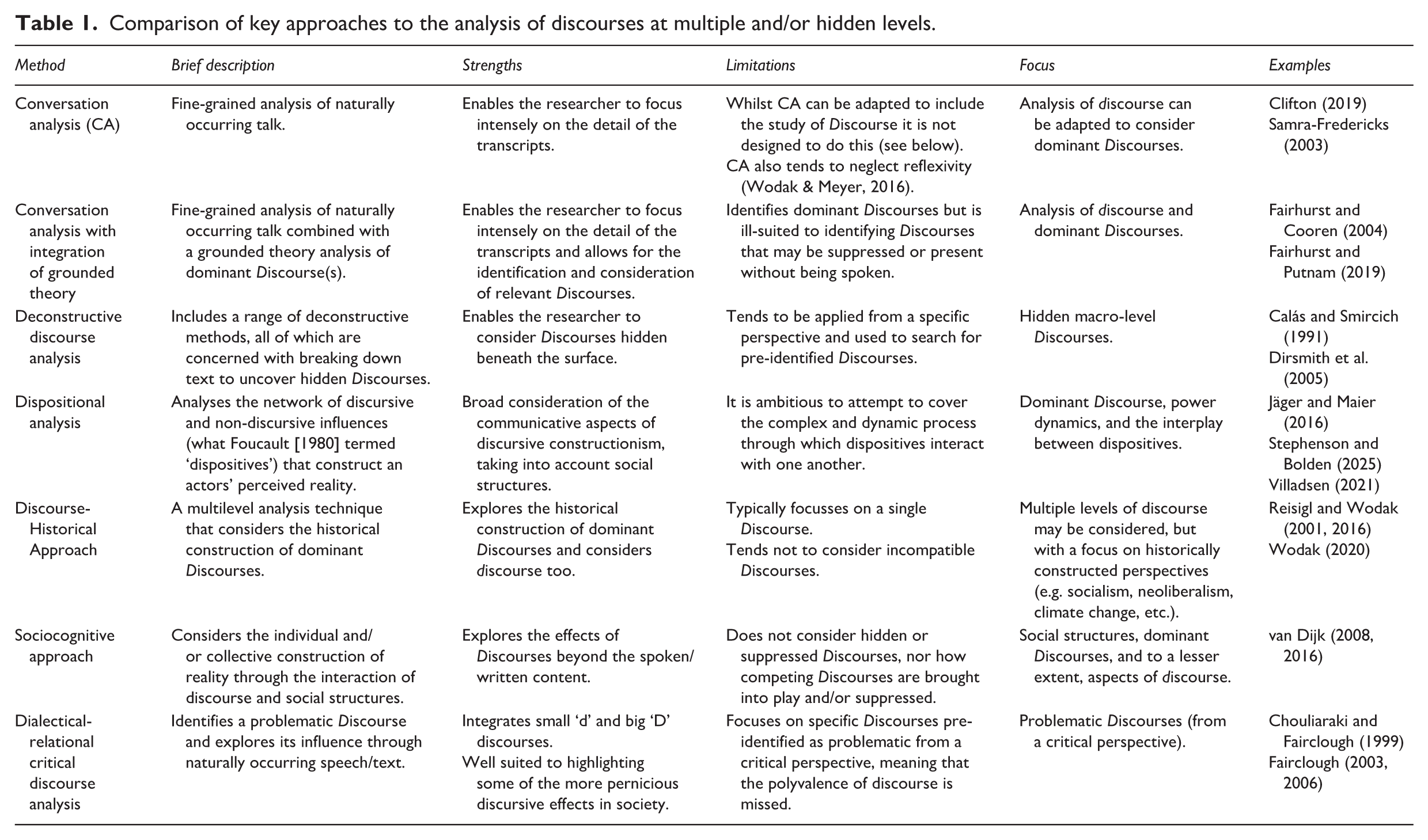
Table 1, based on the authors’ interpretation of the literature, provides a summary of the main strengths, limitations, and focus of key approaches to analysing D/discourse at multiple and/or hidden levels within and beyond organizations. As this table demonstrates, none of these methods is individually capable of considering the multitude of Discourses operating in any given context, or the ‘polyvalence of discourse’, nor the interrelation of the levels of discourse. Accordingly, aspects of discourse such as the unspoken and discursively enacted power dynamics are rarely considered across the many levels at which they operate.
Comparison of key approaches to the analysis of discourses at multiple and/or hidden levels.
Methodological underpinnings of discursive construction analysis
This paper outlines the development and application of discursive construction analysis, a methodology designed to analyse spoken and written interactions (whether through the analysis of video or textual data). DCA has been developed to explore the interrelation between the multiple levels at which discourse operates. To achieve this DCA moves past considerations of either the dominant or hidden Discourses and enables the researcher to explore the ways in which actors manipulate D/discourse through the discursive enactment of power dynamics.
Whilst integrated methodologies for discourse analysis have long been called for (e.g., Chouliaraki & Fairclough, 2010; van Dijk, 2015), concerns have been raised over the implementation of methods outside the intended epistemology (Greckhamer & Koro-Ljungberg, 2005). The absence of epistemological anchoring associated with specialist approaches to discourse analysis was a notable challenge in the development of DCA and may be considered an insurmountable limitation to scholars deeply wedded to a particular paradigm. For those adopting a more pragmatic approach, DCA (as the name implies) is based on a constructionist ontology bridging the interpretivist/critical divide incorporating elements of postmodernism and poststructuralism. In this respect fundamental incompatibilities (such as those between objective and subjective approaches) were avoided. However, adaptations to some of the methodologies which underpin DCA were required to overcome inconsistencies as summarised in the previous section and below.
The methodological underpinnings of DCA are explained in this section before we present a worked example of empirical research employing a DCA approach in the next section. The first challenge we address is the need to analyse the interrelation between micro and meso levels of discourse (collectively referred to as discourse). This is achieved through an integration of conversation analysis (micro-level discourse) and thematic discourse analysis (meso-level discourse) which, as we shall explain, allows the researcher to develop findings commensurate with an analysis of the role of Discourse in subsequent stages of the analysis. The analysis of grand and mega-level discourses (Discourses) draws on integration and adaptation of reflexive thematic analysis with a particular emphasis on reflexivity – not only as an important aspect of the analysis of Discourse but as a key component of the overall methodology and particularly important for integrationist methodologies (Fairhurst & Putnam, 2019). A final consideration underpinning the methodology is analysis of unspoken Discourses, to which we integrate an adaptation of thematic decomposition.
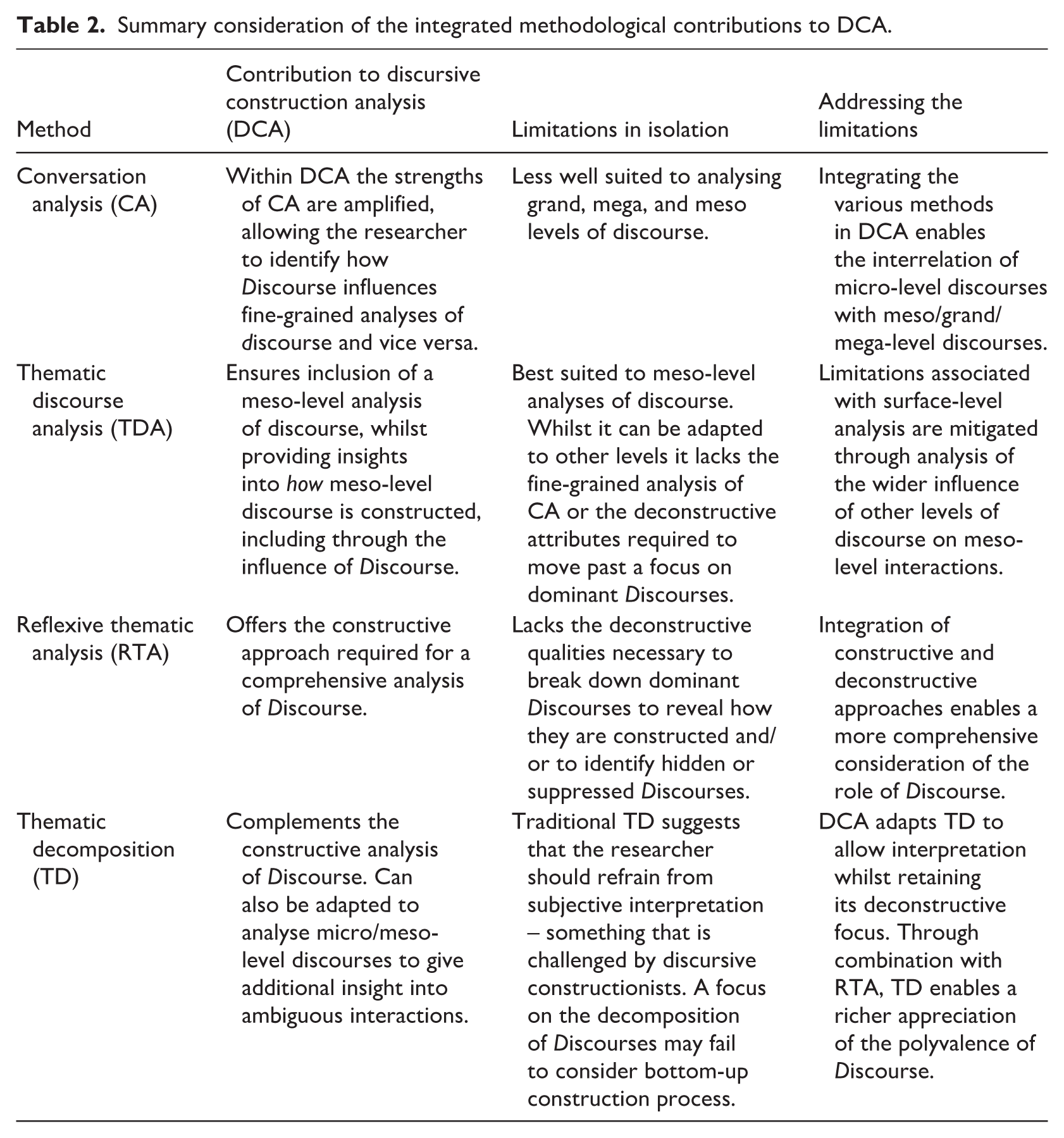
Table 2 summarises the contributions of the four methods on which DCA draws, demonstrating that combining and adapting these techniques not only addresses their limitations but also provides a methodology that is more than the sum of its parts.
Summary consideration of the integrated methodological contributions to DCA.
The integration of conversation analysis and thematic discourse analysis
In addressing the analysis of discourse, we drew primarily on two methods: conversation analysis to address micro-level discourses and thematic discourse analysis to analyse meso-level discourses.
The use of conversation analysis within organization studies to explore the interactions of multiple actors has been well established (e.g., Clifton, 2012, 2019; Van De Mieroop, 2020). One of the main advantages of conversation analysis is that it is not only an empirical study of language in its context (I. Clarke et al., 2012; Izak et al., 2024) but it also looks for the meaning behind the language (Clifton, 2019; Fairhurst, 2007; Grant et al., 2004). Conversation analysis, whilst well suited to the study of discursively constructed phenomena at a micro level, however, has some notable limitations regarding the study of Discourse (Fairhurst, 2007; Fairhurst & Putnam, 2019). Whilst there are some notable exceptions, where scholars have adapted conversation analysis to include consideration of additional levels of discourse (e.g., Clifton, 2019; Fairhurst & Cooren, 2004; Van De Mieroop et al., 2020), this may be a reflection of the ability for conversation analysis to integrate with other methods (Izak et al., 2024) rather than its suitability for analysing higher levels of discourse per se.
To address the analysis of meso-level discourse, we turned to thematic discourse analysis (Braun & Clarke, 2021a). The integration of thematic discourse analysis allows for a multidimensional analysis of the data (G. W. Taylor & Ussher, 2001), helping the researcher consider multiple perspectives through the assignment of themes to groups of actors and types of discourse (for example, the types of challenges, supportive statements, techniques for manipulating power dynamics) as well as constructing themes to explain the ways that D/discourses affect one another. A critique of thematic discourse analysis is that it can be descriptive, analysing discourse at a surface level without addressing how the actors use language (Potter & Wetherell, 1987). By integrating it with conversation analysis, however, it becomes possible to explore the actors’ meaning behind the language and the significance of speech anomalies (pauses, broken sentences, changes in pitch/volume) and, perhaps most importantly, to consider power dynamics, all of which help to overcome the limitations.
One of the fundamental requirements of DCA was that the methodology should be able to consider the influence of power in discursively constructed phenomena within organizations. By implementing the concepts of stance and status (Stevanovic & Peräkylä, 2012, 2014) to analyse discursively enacted power dynamics in discourse the researcher is better able to understand not only the actors’ assertions and suppression of authority but the relevance of such power dynamics in relation to the use of Discourse at other stages of the analysis. The identification of power dynamics through a fine-grained analysis of language is a key part of the DCA methodology, although our understanding is significantly enhanced when we combine the analysis of power dynamics using discourse with the analysis of Discourse, as we will illustrate in the worked example.
The integration of reflexive thematic analysis and the emphasis on reflexivity
There have been numerous attempts to analyse multiple levels of discourse through the combination or adaptation of methods. One of the more successful methodological integrations was Fairhurst and Cooren’s (2004) conversation analysis of the transcript of a police distress call, which employed aspects of grounded theory to consider the interrelation between discourse at a micro level and Discourse at an organizational (or grand) level. This approach to discourse analysis was later formally presented as a methodology by Fairhurst and Putnam (2019).
Whilst grounded theory can undoubtedly enhance discourse analysis, integrating it into a discursive constructionist methodology presents epistemological challenges. Grounded theory seeks to establish an overarching theory (Glaser & Strauss, 1967), which may not suit researchers who value the complex, contextual nature of their subject and view theory-building as unnecessary or undesirable (Alvesson & Sköldberg, 2018). The stringent criteria applied in the name of ‘rigour’ limit grounded theory’s compatibility with alternative approaches (Braun & Clarke, 2006; A. E. Clarke et al., 2018). Moreover, most grounded theory variants assume an objective truth hidden in the data for the researcher to uncover (Braun & Clarke, 2006; Charmaz, 2014), which is ill-suited to a discursive constructionist ontology. DCA therefore integrates reflexive thematic analysis to analyse the construction of Discourse at both grand and mega levels. This approach allows the researcher considerable flexibility (Braun & Clarke, 2019, 2021b; Braun et al., 2022), which, as Terry (2016, p. 104) argued, ‘makes it ideally suited to [. . .] a pluralistic analytic approach.’
Braun and Clarke (2021b) have noted that despite their approach to thematic analysis advocating a reflexive approach in which findings are considered to be shaped by the researcher and their ontological/epistemological standing, this is often absent or underdeveloped in practice. In recent work, they clearly differentiate their ‘reflexive’ approach to thematic analysis from ‘coding reliability’ and ‘codebook’ approaches, the former of which is rooted in a postpositivist tradition and the latter, whilst theoretically flexible, is less suited to constructionist approaches. They stress that a reflexive approach to thematic analysis is an organic and iterative process that relies on the interpretive abilities of the researcher(s) to identify codes within the data and, through this, to actively generate thematic categories which remain open and evolving until the process is complete.
DCA is based on the perspective that reflexivity involves paying attention to ‘the way different kinds of linguistic, social, political and theoretical elements are woven together in the process of knowledge development, during which empirical material is constructed, interpreted and written’ (Alvesson & Sköldberg, 2018, pp. 10–11). As such, DCA requires an unravelling of the Discourses embodied by the researcher (Kühner et al., 2016) and actively considering the taken-for-granted assumptions that constitute the researcher’s perceived reality. As we will demonstrate in the step-by-step guide to DCA below, the reflexive dimension allows the researcher to consider the interrelation of the various levels at which discourses operate, in addition to providing insight into their own impact on the research.
Braun and Clarke (2022), amongst others (e.g., Charmaz, 2014; Kempster & Stewart, 2010), recommend that researchers keep a reflexive journal throughout the research process. Journal keeping develops first-person skills (Coghlan, 2019) and enables the researcher to acknowledge their part in the construction of the findings (Ybema et al., 2019). A reflexive journal is a staple of the DCA methodology, encouraging a reflexive approach not just in the analysis of the construction of Discourse through thematic analysis but in the analysis of all levels of discourse throughout the DCA process.
Through reflexive thematic analysis the researcher can analyse the construction of Discourse, gaining an understanding of how Discourses are constructed by the actors. By integrating this analysis with the aforementioned framework for analysing discursive power dynamics (Stevanovic & Peräkylä, 2012, 2014), DCA allows for analysis of the influence of power dynamics, enacted at a meso level, on the construction of Discourse (i.e. to identify which actors have the capability to construct, support, and develop Discourses and to what extent). In this regard DCA enables the researcher to overcome the omission (noted above in many methods analysing Discourse) to consider the agency of the actors on the Discourse.
The findings from reflexive thematic analysis can also be integrated into the analysis of discourse and vice versa. Applying the identified Discourses to the conversation analysis allows the researcher to determine the influence of Discourse on how the actors manipulate and construct power dynamics. This is particularly relevant in relation to the manipulation of stance, where actors may utilise Discourse to strengthen their arguments or to identify instances in which an inappropriate Discourse may weaken an assertion. It also enables analysis of how various Discourses are received by individual actors, allowing the researcher to go beyond the generalised effects of Discourses to consider the different effects they may have on individuals.
Whilst reflexive thematic analysis is well suited to the analysis of Discourse and integrates well with the other methodologies, it is limited in its ability to uncover suppressed Discourses. As Foucault (1976/2020, p. 100) wrote in relation to analysing the polyvalence of Discourse, it is the ‘distribution that we must reconstruct, with the things said and those concealed, the enunciations required and those forbidden’. To enable this level of analysis, critical and postmodernist scholars (amongst others) have used deconstructive methods (e.g., Derrida, 1976, 1982) to uncover hidden Discourses, and it is to this level of analysis we now turn.
The integration of thematic decomposition
To balance the limitations of the bottom-up process of reflexive thematic analysis, DCA integrates a method rarely used in organization studies and yet ideally suited to post-structural and constructionist approaches (Braun & Clarke, 2021a). Thematic decomposition is a top-down approach to analysis that enables the researcher to break themes into their constituent parts. Thematic decomposition should be differentiated from deconstruction (e.g. Derrida, 1976, 1982) and its derivative within the thematic analysis family: thematic deconstruction (e.g. Dirsmith et al., 2005). Deconstruction typically involves a critical approach to destabilize hierarchical structures in language, challenge conventional interpretations, and highlight ambiguity (Howell, 2013), often seeking to identify a pre-identified theme within the data. Calás and Smircich (1991), for example, sought to identify instances of misogyny and sexism within the texts analysed in their study rather than to explore the texts for any potentially hidden themes/Discourses.
Integrating aspects of thematic decomposition into DCA allows the researcher to deconstruct surface-level Discourses, offering a top-down analysis of Discourse. It also allows the researcher to deconstruct text to identify hidden or suppressed Discourses and, as with reflexive thematic analysis, the framework for considering discursive power dynamics when analysing micro-level discourse can be integrated into an analysis of the suppression of Discourses to enable the researcher to explore the influence of power dynamics in the suppression of Discourse (Mumby & Stohl, 1991). Hence, thematic decomposition can be (although it has not typically been) applied to the analysis of both discourse and Discourse.
In summary, it is the integration of reflexive thematic analysis and thematic decomposition that, when adapted to include the analysis of discursively enacted power dynamics at a micro/meso level, allows the researcher to analyse the actors’ manipulation of the polyvalence of Discourses. In the context of DCA, it should be noted that some adaptations have been made to the traditional variant of thematic decomposition to overcome epistemological inconsistencies. Whilst thematic decomposition typically asserts that the researcher should refrain from interpretation (Stenner, 1993), we reject this as a positivist fallacy and argue that any reading of a transcript results in an element of interpretation. The integration of thematic decomposition in DCA allows for interpretation, but with an emphasis on the importance of the researcher critically reflecting on their interpretations.
In summary, DCA is a method for analysing discourse, combining and adapting elements of conversation analysis, thematic discourse analysis, reflexive thematic analysis, and thematic decomposition. DCA is not, however, simply the combination of these methods; it allows for an analysis of the interrelation of the various levels of discourse in the discursive construction of social phenomena by adapting and interrelating the underpinning methods. This is explained further in the next section and demonstrated in a worked example of the empirical application of DCA below.
A step-by-step guide to discursive construction analysis
Having discussed the underpinnings of the methodology, we now present a step-by-step guide to implementing DCA, followed by worked examples.
As Kelly (2014) noted, the volume of data confronting the researcher considering naturally occurring phenomena is often overwhelming, something especially true in longitudinal studies. Given that discursively constructed phenomena are often ambiguous, Sutherland (2018) has argued that it is important that the researcher defines the phenomenon being investigated in order to clearly identify instances of it. We would add that definitions are also helpful for readers to be aware of the specific perspective being adopted by the researcher. DCA begins with the identification of instances of the phenomenon being studied within the transcripts to be analysed. That said, naturally occurring instances of a given phenomenon tend not to conform exactly to predefined definitions. In such cases, the researcher is forced to make judgment calls about whether an ambiguous interaction meets the definition of the phenomenon and should be included in the analysis. When this occurs, an entry should be made in the reflexive diary to record the thought process involved. This will enable the researcher to better maintain consistency in defining the subject matter of their research, consider the findings in light of the decisions made along the way, and consider how they might have been affected.
We have broken down the DCA process into its component parts, although it should be noted that this is an iterative process. DCA comprises separate analyses of small ‘d’ (micro/meso-level discourse) and big ‘D’ (grand/mega-level discourse) with distinct processes for each. These two analyses, however, should be conducted iteratively and repeatedly to integrate the analysis of the interrelation between the various levels of discourse detailed below (see Figure 1). In this respect, whether the researcher prefers to start with an analysis of discourse or Discourse is a matter of preference (although the implications of the choice may be worthy of inclusion in the reflexive consideration of the researcher’s impact on the analysis).
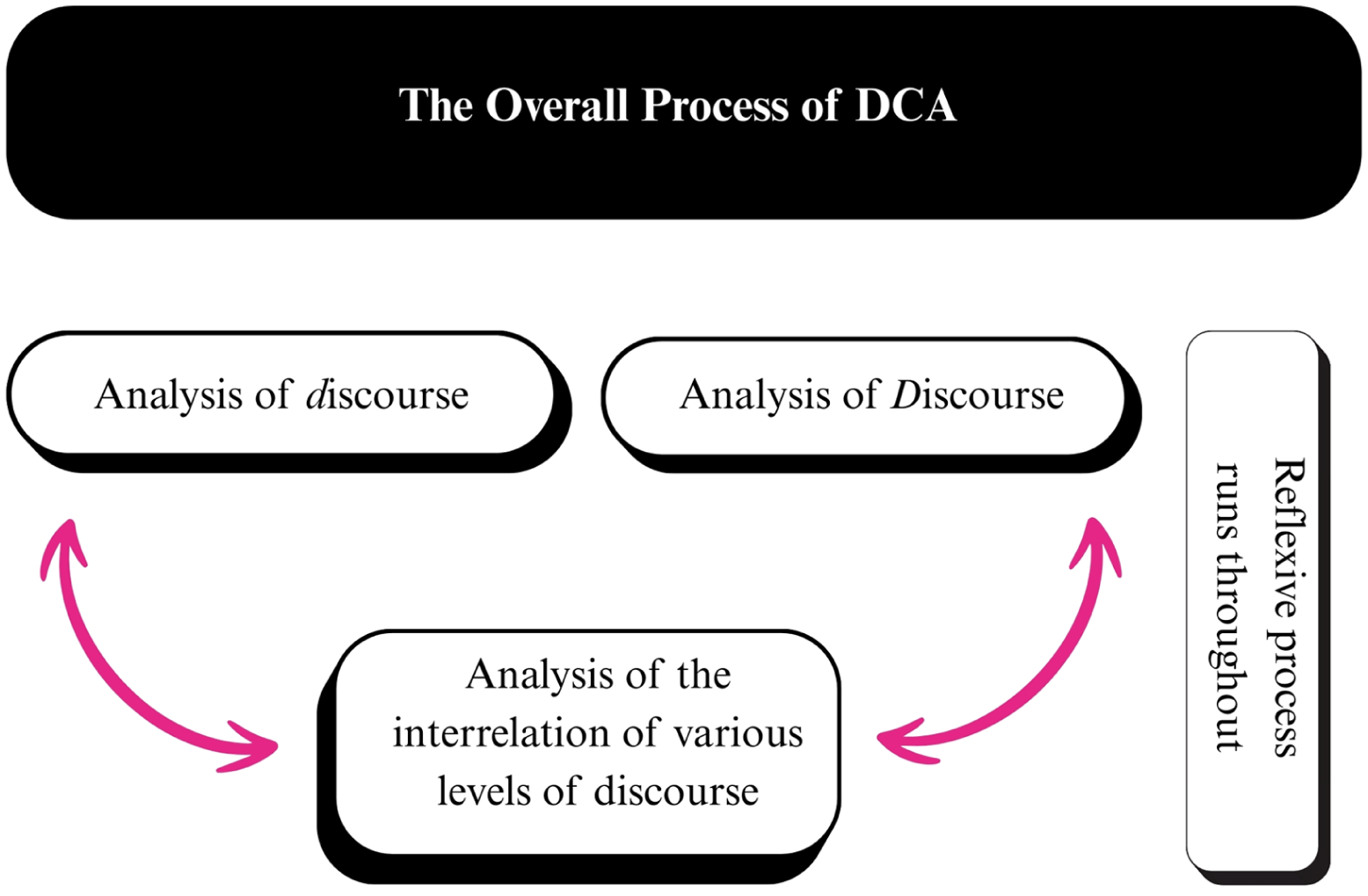
An illustration of the overall DCA Process.
Analysis of small ‘d’ discourse
The discourse analysis stage is a five-step process in which the researcher identifies and closely analyses the specific instances of the phenomenon arising within the transcript (see Figure 2).
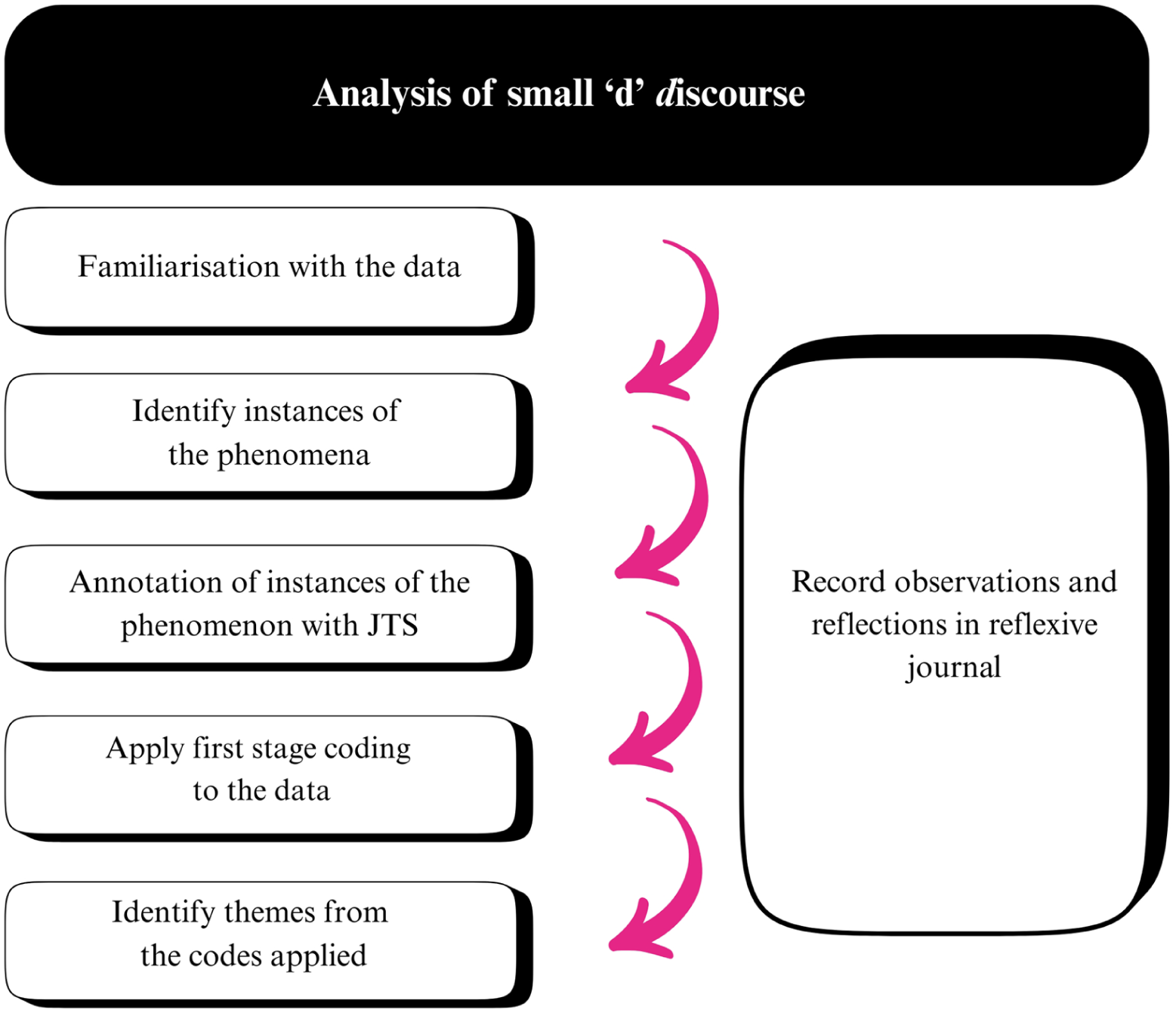
Analysis of small ‘d’ discourse.
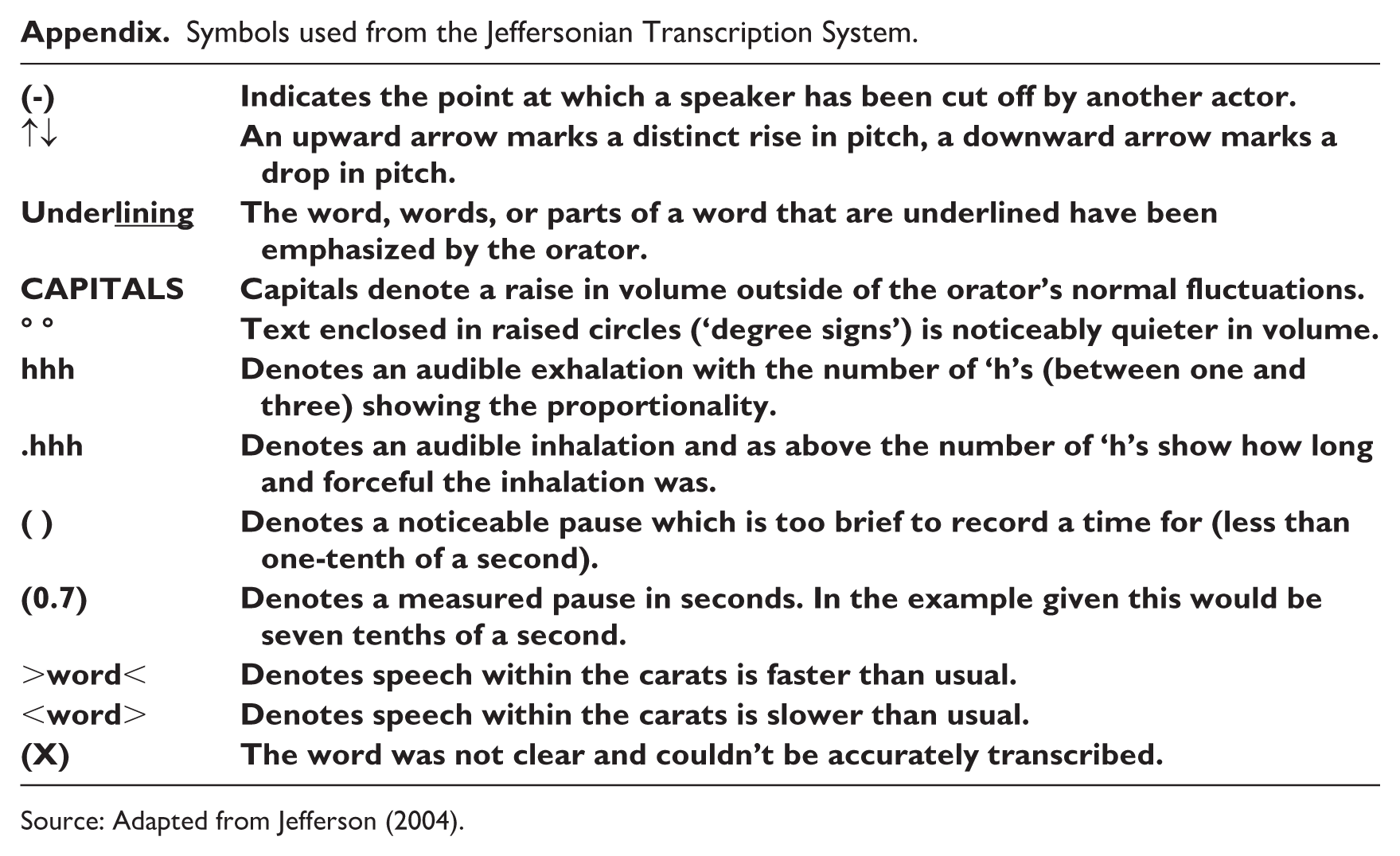
In the first step, the researcher carefully watches or listens to the recordings repeatedly to ensure familiarity with the data and accuracy within the transcripts. In the second step, the researcher looks for instances of the phenomenon or concept, using a definition that enables consistency (as outlined above) in identifying clear starting and ending points to instances within the transcript, whilst noting any challenges or ambiguities arising from this process in a reflexive journal. The third step involves a fine-grained analysis of each instance of the phenomenon or concept using an abbreviated version of the Jeffersonian Transcription System (JTS) (Jefferson, 2004) – see appendix for a glossary of transcript symbols. This allows the researcher to replay recordings of the instances identified in step 2 and consider details such as the length of the actors’ pauses and their pitch, volume, tone, etc., as well as nonverbal communications if a video recording is analysed. This is in addition to the standard considerations of a conversation analysis, such as openings and closings, turn-taking, adjacency pairs, topic shifts, and disclaimers and alignments (see Fairhurst & Cooren, 2004 for a guide to the latter categories). The fine-grained analysis conducted in step 3 also allows the researcher to investigate the use of power dynamics through the conceptual framework of stance, status, epistemic, and deontic authority (see the worked example of the analysis of Excerpt 2 below). Step 4 adopts aspects of a thematic discourse analysis, identifying general themes through descriptive coding. Step 5 involves identifying themes from the first-stage codes.
Analysis of big ‘D’ Discourse
Turning now to the analysis of Discourses, the steps outlined are more of an oscillating process as the researcher moves between an identification of the Discourses and their constituent parts (a bottom-up approach based on reflexive thematic analysis) and breaking down the identified Discourses into their component parts (based on thematic decomposition). Whilst the steps to this part of the analysis are detailed below, the reader is encouraged to consider Figure 3, which accompanies these steps, and to be flexible in the application of the steps. The researcher is free to move between steps in a nonsequential way and to analyse the Discourses in their research as best suits the nature of the study.
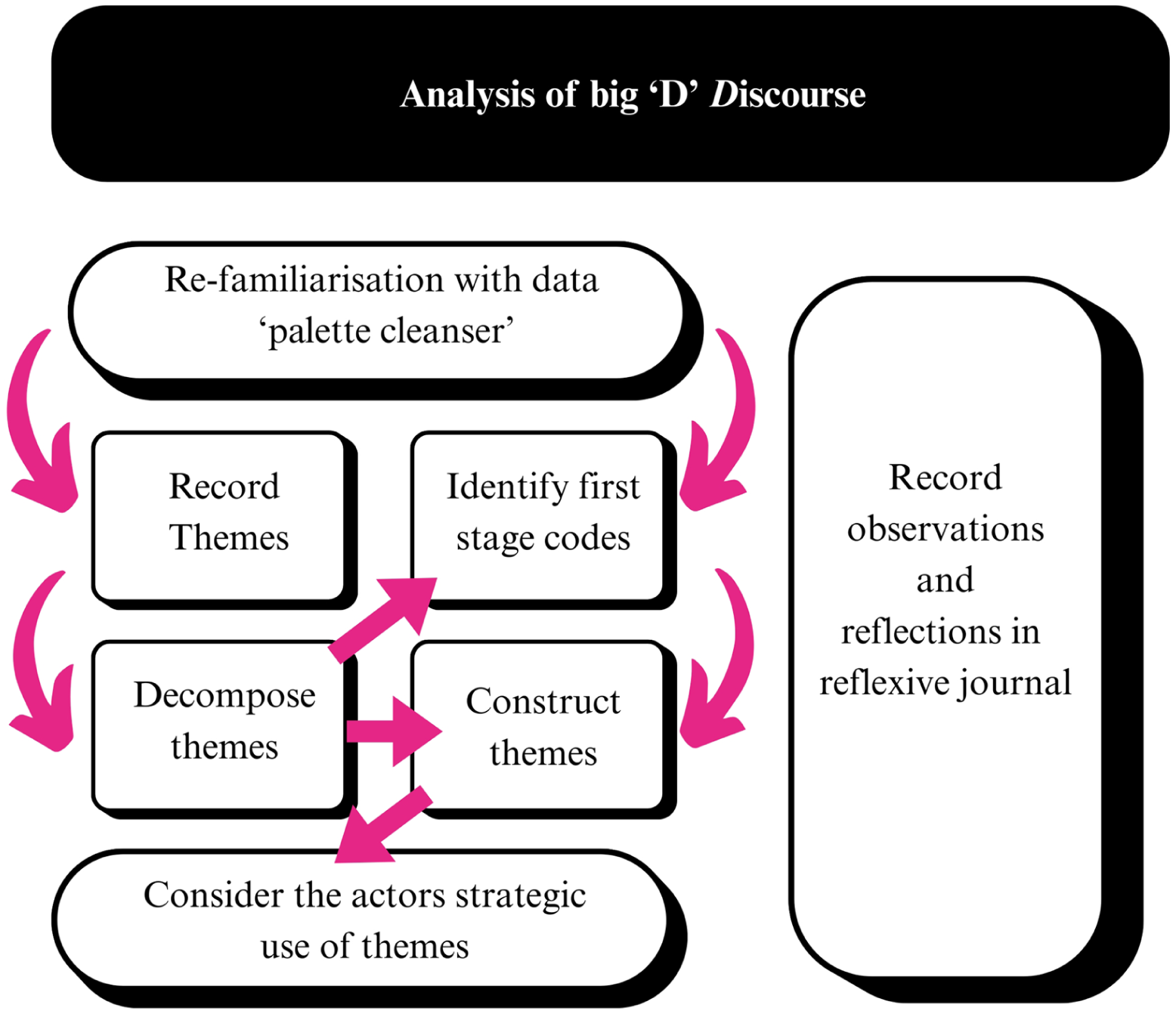
Analysis of big ‘D’ Discourse.
The Discourse analysis begins with the researcher (re)gaining familiarity with the data. This step may be described through the analogy of a ‘palette cleanser’ – an opportunity to consider the transcript afresh without the annotations of the discourse analysis and with a view to identifying the prevalent Discourses. (Please note that in the context of the reflexive thematic analysis and thematic decomposition we refer to Discourses as ‘themes’.)
The next step involves identifying themes and first-stage codes. Braun and Clarke (2006, 2021a, 2021b) identify the second and third steps of a reflexive thematic analysis as being (respectively) the identification of first-stage codes and then the identification of themes (based on the first-stage codes). In the DCA methodology, we propose that the researcher record both first-stage codes and themes concurrently, as some themes will be more easily identified than the codes that make them up.
Once themes have been generated (whether through the grouping of first-stage codes or by identification from initial consideration of the data), the researcher engages in a process of thematic decomposition to look for instances that may contribute to the theme. The researcher can then move back and forth, deconstructing and reconstructing the themes to ensure a thorough analysis.
Where the study involves multiple transcripts or datasets the researcher should revisit previously analysed transcripts to check whether newly identified Discourses may have been suppressed in previously analysed transcripts (and equally whether previously identified Discourses are suppressed in the newer transcripts). This requires a more dynamic engagement with transcripts than typical sequential approaches to coding and analysis. Thus, DCA allows the researcher the opportunity to identify Discourses that may otherwise be overlooked as they are overshadowed by a dominant Discourse(s) and to consider the reasons a Discourse may be prominent in one context and suppressed in another.
Once the researcher feels that themes have been adequately captured within the transcript being analysed, they can consider how the themes relate to one another, their relative strengths, their impacts on participants, how they are challenged, and how they are strengthened. The researcher may also consider how Discourses may be interpreted or valued differently by different participants and the consequential effects.
Throughout the process, thoughts on the analysis may be recorded in the reflexive journal, especially noting instances of uncertainty of interpretation (see the worked example below for an illustration) or where there may be ambiguity or alternatives to the themes or first-stage codes recorded.
Analysing the interrelation of various levels of discourse
As the researcher develops an understanding, through the preceding analyses of big ‘D’ and small ‘d’ discourse, DCA allows for an additional analysis to consider the relationship between the various levels of discourse. The analysis conducted here should feed back to the analysis processes involved in the analysis of small ‘d’ and big ‘D’ discourses, creating an iterative process through which insights gained from each analysis can be considered in relation to the others. In this respect, DCA is particularly well suited to longitudinal studies as it provides the researcher the opportunity to consider the interrelation of the various levels of discourses across a variety of contexts within or across various organizational settings.
Through the iterative analysis process, the researcher can, for example, consider the relevance of power dynamics on the use of Discourses (and vice versa) by applying the analysis of micro/meso-level discourse to the analysis of Discourse. Box 1 provides a (non-exhaustive) list of examples of how the interrelation between levels of discourse may be considered.
Box 1. Examples of areas which may be considered when analysing the interrelations of the various levels of discourse
The ways in which Discourses may be used to support (or detract from) themes identified in the analysis of discourse.
The ways in which Discourses are used strategically to manipulate power dynamics.
How an individual’s power (stance/status) affects their ability to manipulate Discourses.
How participants’ discourse influences the prominence of the Discourses in various contexts.
How might the discourse in a given context be affected by Discourses that remain unspoken?
When applied in a longitudinal setting, DCA enables the researcher to analyse what is expressed in some contexts but not in others. The researcher can thus address a common challenge in communication studies: considering the relevance of what has not been said (e.g. Izak et al., 2024). Considering the effect of Discourses present in some contexts and not others on communication at the micro/meso level allows for insightful comparisons to be made. As demonstrated in the worked example below, the researcher may also be able to identify the effects of previously identified Discourses that have not been explicitly used.
Reflexivity in DCA
As mentioned above, the researcher should keep a reflexive journal throughout the analysis process. There is no limit to the ways this journal can be used, but in the context of DCA, suggestions are outlined in Box 2.
Box 2. Illustrative factors to note in the reflexive journal
Ambiguities in the identification of instances of a phenomenon arising.
Interpretations of participants’ meaning, intent, strategy, etc.
The implications of abnormalities in speech patterns.
Noting the potential ways in which Discourses may relate to one another in various contexts.
Ambiguities or uncertainties regarding any area of the analysis (with a view to returning to these instances once more data has been analysed).
Reflecting on the interpretations of the researcher(s) allows consideration and acknowledgement of potential effects of bias. Whilst the reflexive process is an ‘interpretation of the interpretation’ (Alvesson & Sköldberg, 2018, p. 11), this should not be a purely introspective process in which the researcher isolates him/herself from the subject of the research, reflecting on their reflections ad infinitum (Baker, 1990). The reflexive component of DCA should hence be seen as a way of uncovering what has not been said, rather than an end in itself. Alvesson and Sköldberg’s (2018) distinction between deconstructive reflexivity and re-constructive (or rethinking) reflexivity is helpful here. The deconstructive aspect of reflexivity involves identifying the preconceptions or taken-for-granted assumptions the researcher may have applied to the interpretation. This is specifically addressed in DCA through the inclusion of thematic decomposition as a deconstructive analysis technique. Once deconstructed, the researcher can reconstruct the interpretation to consider alternatives and/or multiple interpretations in the light of further analysis of the actors’ interactions. (Worked example 3 below provides an illustration of this process.)
Worked examples
To illustrate how analysis of the interrelation of various levels of discourse presents new insights, we have provided three worked examples from research conducted within an independent law firm in the UK (Stephenson, 2024). The research involved analysis of video recordings of meetings within the organization over a 12-month period. Since the research sought to investigate the actors’ collective discursive construction of leadership over a longitudinal study, the complexity of language use soon became apparent, as did the limitations of the individual methods identified above. DCA was developed to enable the researcher to consider the interrelation of the varieties of discourse and to understand the effects of both the spoken and what quickly became apparent to be the significance of the unspoken. The following examples illustrate how a deeper, more nuanced understanding of the actors’ interactions can be achieved through DCA.
Worked example 1
The first example demonstrates the analysis of the interrelation between micro, meso, and grand levels of discourse, with the grand discourse (Discourse) remaining unspoken. This highlights the capability of DCA to reveal insights that could be missed through more traditional methods.
In Excerpt 1, participant ‘O’, the organization’s human resources manager, opens a meeting scheduled to relay feedback to supervisors from trainee solicitors about their supervision. The supervisors are present; trainees are not.
Box 3. Excerpt 1
The analysis of discourse highlighted unusual patterns in the speech of the participant (compared with several other instances recorded). The JTS annotations from the conversation analysis show the frequency of pauses and broken sentences (micro-level analysis). During the thematic discourse analysis (meso-level analysis), a theme of ‘nervousness/discomfort’ was recorded. The cause, however, was not apparent.
Analysis of the Discourse across other transcripts revealed a Discourse of ‘Superiority’, a sub-theme of which specifically related to the superiority of supervisors over trainee solicitors. Re-analysing the excerpt during the analysis of the interrelations of the various levels of discourse, it became apparent that although the ‘Superiority’ Discourse was not explicitly brought into being through the speech of the actors present, its effect was still present. O appears to have been uncomfortable and/or nervous about presenting critical feedback to his/her peers as it contradicts a well-established Discourse in the organization (and industry), even though the Discourse in question had not been explicitly invoked.
Worked example 2
Excerpt 2 provides an example of the construction of discursively enacted power dynamics, specifically in this case, the manipulation of an actor’s stance (their power in relation to other members of the organization as perceived by their peers, as opposed to status, which relates to a formal position on the organizational hierarchy). As with the first worked example, the analysis considers the interrelation of various levels of discourse analysed.
Box 4. Excerpt 2
It may surprise the reader to learn that N was one of the directors of the organization and B was their subordinate. B was a manager, a head of a department, but nevertheless distinctly lower on the hierarchy than N. This excerpt provides a clear example of the importance of stance in organizational power dynamics. B has effectively raised their stance to an incongruent level with their status, and through this aspect of DCA we can identify some of the strategies used to achieve this and to relate them to the various levels of discourse analysed.
B begins by complementing a member of N’s team (drawing on a ‘Caring’ Discourse in their recognition of another’s achievement), N dismisses the compliment, but B responds to reassert it (a meso-level exchange). B shows no sign of accepting N’s dismissal. In this organization, a ‘Caring’ Discourse was a prominent theme and highly valued by many of the directors on the board (including N); B uses this to their advantage to increase their stance. B builds their stance by ‘posing an argument as a question’ (a meso-level theme identified in the analysis of discourse). Rather than risk pushing the incongruity between stance and status too far, B opts to present their argument as a question. B makes clear that Data Processing Agreements (DPA) and Data Subject Access Requests (DSAR) do not need qualified solicitors to work on them and that employing a paralegal would be a cheaper option for the organization. (This relates to a Discourse identified in the analysis as ‘Professional: Financial’ that promotes financial gain for the organization as sound professional practice.) B receives support for the argument and builds their stance further, even going so far as to interrupt N to question the expression of intended volumes (noted in the micro-level of analysis of discourse). B then questions whether the DSAR work will result in additional revenue (or is included in the subscription – similar to a retainer – that the clients take) before asserting the epistemic authority to declare the result ‘good’.
The example highlights the interrelation between the various levels of discourse and the importance of a holistic consideration of the various levels of discourse to understanding the nuances of the interaction.
Worked example 3
A significant strength of DCA is that it allows the researcher to analyse the construction and deconstruction of discourse. The third worked example highlights the importance of constructive, deconstructive, and reconstructive processes in revealing new insights.
Participant N responded to a presentation from Participant S as shown in Box 4. To give context to this exchange, N and S were of equal standing on the organization’s hierarchy, both board members – N was a senior solicitor (also known as a ‘fee-earner’), and S was the director of marketing.
Box 5. Excerpt 3
The initial micro-level analysis of the interaction was interpreted as N providing support for the arguments presented by S and appreciation for the contribution. However, the researcher noted in the reflexive journal that something appeared amiss, and further analysis was carried out once more data had been analysed from interactions between the two participants. The body language of S (a slight raise of the eyebrows and purse of the lips) suggested that the response was not as well received as one might have expected having observed hours of recordings of these two participants. Furthermore, the phrase ‘beavering away at in the background’ has connotations with work of less importance – suggesting the potential that N may have been drawing on a Discourse (identified later in the research) relating to the superiority of ‘fee-earners’ over other members of the organization. In the reconstructive phase of the reflection, the researcher suggests an alternative understanding of the exchange, based on the analysis of far more data than warrants consideration for the example. The interaction was ultimately interpreted that N’s speech may have been intentionally condescending and a strategic effort to improve their stance in the meeting at the expense of S.
Assessing the strengths, limitations, and future direction of discursive construction analysis
DCA has a plethora of potential areas of application in organization studies, including but not limited to the traditional areas in which discourse analysis has been applied effectively. In these contexts, DCA can be applied as a standalone method to encourage consideration of the interrelation of the varieties of discourse in the construction of social phenomena. Importantly, DCA enables a researcher to consider the unspoken effects of Discourse, which can offer insights beyond the capabilities of those methods focussing exclusively on recorded language use. Methodologies capable of delving beneath the surface of language offer researchers the opportunity to move beyond the tip of the iceberg, and as research has demonstrated, in many contexts the significance of the unspoken is difficult to overstate (e.g. Schrӧter, 2013; Schrӧter & Taylor, 2018; Zerubavel, 2006).
A particularly exciting prospect for DCA, though, is its potential for integration with methods and frameworks that investigate the role of language within a wider sectoral and societal context, such as Brown’s (2005) comparison of the Board of Banking Supervision’s report on the collapse of Barings Bank with alternative accounts of these events and MacLean et al.’s (2018) analysis of historical accounts of the evolution of Procter and Gamble (P&G) from 1950 to 2009. The pragmatic underpinnings of DCA were established to allow for it to be flexibly applied to various datasets. An unintended but fortunate side effect, however, is that this makes it well suited to being included as a component in wider integrationist methodologies.
Discourse is a core component in our understanding of the construction of social phenomena, but in many methods, it is just one of a range of factors under consideration. Maupin et al. (2020) proposed the integration of discourse analysis in analysis of dynamic, context-specific, and multilevel phenomena. In doing so, they made clear that both big and small ‘d’ discourses should be considered. Maupin et al. (2020) were specifically referring to leadership (when considered as a collective phenomenon); however, depending on one’s perspective, many social phenomena in the context of organization studies could also be considered dynamic, context-specific, and operating on multiple levels including power dynamics (e.g. Foldy & Ospina, 2023), organizational culture (e.g. Smircich, 1983), and even organizations themselves (e.g. Fairhurst & Putnam, 2004).
Foucault’s conceptual framework of dispositives (Foucault, 1980) considers discourse to be a component part of the construction of social phenomena but by no means the sole component. Dispositional analysis, as the analysis of dispositives has come to be known (e.g. Jäger & Maier, 2016; Villadsen, 2021), therefore requires consideration of discourse based on Foucault’s conceptualisation, a method capable of the analysis of the polyvalence of discourse. Multimodal discourse analysis (Jancsary et al., 2016; Machin & Mayr, 2023) adopts a wider definition of discourse to include visuals, sound, gesture, movement, spatial design, etc. Language however, at all levels, remains an important component of the discursive construction of social phenomena within multimodal discourse analysis, as does the power dynamics between actors (Jancsary et al., 2016). In these examples, and many others, DCA provides a potential contribution to the analysis of written and spoken language that can be integrated into the wider framework. The researcher can add further layers to explore, for example, the role of sociomateriality (e.g. Clifton, 2024a; Cooren, 2020) or a ventriloquial analysis to explore the influences that cause an actor to use the language they use (e.g. Cooren, 2010; Meier & Carroll, 2023).
DCA, then, is certainly not presented as a comprehensive methodology capable of considering all forms of communication in the construction of social phenomena. The primary strength of DCA lies in its ability to explore the interrelation of various levels of discourse within and about organizations (e.g. Fairclough, 1992, 1995). As Stephenson and Bolden’s (2025) dispositional analysis of the collapse of the bio-tech company Theranos illustrates, organizational actors both influence and are influenced by a wide range of factors beyond their own organization, such as sector and societal norms and values, legal structures and processes, press and social commentators, and the wider economic context, to name but a few. Limiting analysis to specific levels of discourse within a particular organization clearly constrains the potential to identify the contribution of external influences. This is a particularly important omission when considering business ethics, including unethical leadership, culture and oppressive power dynamics.
As the worked examples illustrate, the DCA approach adds a degree of depth and nuance to the analysis of discourse. DCA enables the researcher to consider the polyvalence of Discourse not just at a macro level (the primary focus of Foucault’s writing) but through the actors’ manipulation of Discourse at a micro/meso level and to consider how discursively enacted power dynamics influence this process. Furthermore, DCA enables the researcher to examine differing uses of Discourses in a variety of contexts when applied to longitudinal analyses (as was shown to be of particular importance, for example, in the longitudinal analysis of change by Heracleous & Barrett, 2001). Through the longitudinal application of DCA, the researcher can analyse both spoken Discourses in a given context alongside the absence of previously identified Discourses (i.e. considering both what is said and what is not said) to better appreciate the tactical use of language by actors to construct social phenomena.
Whilst DCA encourages the researcher to go beyond spoken Discourses to consider the effects of the unspoken, it is a notable limitation of DCA that providing a comprehensive explanation of unspoken discourse appears to be an insurmountable challenge. As Ybema et al. (2019) pointed out, the positionality of the researcher(s) influences the construction of findings and, although DCA places a particularly strong emphasis on reflexivity, there are certain risks that are worth highlighting. Ethnocentrism may hinder a researcher’s ability to identify dominant Discourses within their own culture and/or misinterpret the meaning of Discourses within cultures with which they are unfamiliar. This, of course, is a risk with any social research and contributes to calls for a move from etic to emic investigations of organizational/national culture (Schedlitzki et al., 2017). For the researcher applying DCA to an etic investigation, it may be beneficial to combine DCA with participant interviews to explore existing cultural influences, the levels at which they operate, and the extent to which participants perceive them to be influencing the subject matter.
Even in familiar environments, research suggests we will likely miss things. This involves not just overlooking taken-for-granted assumptions, but as Empson (2020) pointed out in her analysis of a professional services firm coping with a financial crisis, many of those who thought they were amongst the firm’s most senior leaders were excluded (without being aware of it) from an exclusive inner core of decision makers.
A DCA approach may, for these reasons, benefit from inter-rater reliability that could be gained by involving multiple researchers. This would, however, require a greater deal of coordination than in analysis techniques involving a single level of analysis.
Conclusion
In this paper, we have outlined a process for discursive construction analysis, a methodology designed to integrate the fine-grained analysis of micro-level discourse, the thematic analysis of meso-level discourse, and the ability to simultaneously apply constructive and deconstructive analysis to explore the polyvalence of Discourse at both macro and micro/meso levels. Whilst the DCA methodology was originally designed for an investigation into the discursive construction of collective leadership, it could be applied to virtually any field in which discursive constructionism is appropriate. With regards to management and organization studies, the applicability of DCA to research on leadership, power, and organizational culture has been demonstrated through the examples provided. Further examples of the potential value/application of discursive construction techniques include Samra-Fredericks’ (2003) study on strategy-as-practice, Sonenshein’s (2010) research on narratives of organizational change, and Bullini-Orlandi’s (2017) investigation of identity construction amongst female entrepreneurs. This is far from an exhaustive list, and we hope that DCA will find application in a wide range of fields. Further, we hope that the development of DCA will encourage scholars seeking to research phenomena for which suitable methods appear lacking to develop new methods and analysis techniques, eschewing the assumption that less established methods are in any way less credible.
Footnotes
Appendix
Symbols used from the Jeffersonian Transcription System.
|
|
|
|
|
|
|
|
|
|
|
|
|
|
|
|
|
|
|
|
|
|
|
|
|
|
|
|
|
|
|
|
|
|
|
|
Source: Adapted from Jefferson (2004).
Acknowledgements
The authors would like to thank Dennis Jancsary, the editorial team and the three anonymous reviewers for the detailed and constructive review process which has strengthened the paper greatly. We would also like to acknowledge the contributions from Professor Harriet Shortt to the development of the methodology in its early stages.

Ethical considerations
Full ethics approval was granted by the University of the West of England on 16 February 2022.
Consent to Participate
Written informed consent has been obtained for all participants.
Funding
The authors received no financial support for the research, authorship, and/or publication of this article.
Declaration of conflicting interests
The authors declared no potential conflicts of interest with respect to the research, authorship, and/or publication of this article.
Data availability statement
All data is securely stored and available.