






Abstract
This article provides an analytic framework for exploring spatial imaginaries in organizational contexts. Using the concept of spatial imaginaries and undertaking a topologic inquiry, it examines a significant national organization, the Scottish Parliament, and its material home, the parliament building in Edinburgh. It theorizes spatial imaginaries as politically charged, collectively developed, and yet unruly flows of meaning that both shape and destabilize organizational spaces. The study explores the performative power of spatial imaginaries and argues that the trajectories they set for organizational action are beguiling and confounding. Illuminating the performativity of spatial imaginaries enhances the theorizing of the processual nature of spatial phenomena and the excessive qualities of organizational space. It concludes that spatial imaginaries are constitutive of organizational spaces and of organizing and are folded into politics, power, and the possibilities for organizational change.
Keywords
Introduction
The vaulted ceilings in the Main Hall, the stilled-restless curves of the leaf-shaped roofs, the ellipse of the Chamber, the pulled arches of the committee rooms and skewing undulations of their tables, the smooth haunches of the Canongate wall, the irregular form of the Miralles desk in the Library, the slinkiness of the oak chairs, and the shadowy silhouettes of Edinburgh rooftops—you’ll struggle to find a straight line in the whole place says one building maintenance officer, dolefully. Yet, he is somehow pleased about this. You are moving forward but shifting sideways, and suddenly down, ascending and now on the inside-outside. You come to the end of a corridor, and just round the bend at the last minute a doorway reveals itself. The building conjures both déjà vu and the possibility of the new. It provides established pathways, yet it develops kinks and curls, a space open to further twists and disorientation.
In this article we take organization studies’ interest in imaginaries (Komporozos-Athanasiou & Fotaki, 2015) and place it into the spatial turn. Using the concept of spatial imaginaries, we examine a significant national organization, the Scottish Parliament, and its material home, the parliament building in Edinburgh. We show that even with such a strikingly material architectural form—with its concrete, oak beams, and blast-proof doors—spatially, it is a site of constant deformation and unruliness. Organization theory has come to focus on the performativity of space—how it sets trajectories for organizational action. To add to this discussion and responding to calls for exercises in topologic imagination (Beyes & Holt, 2020; Beyes et al., 2024), our study explores the performative power of spatial imaginaries, and we illustrate that their trajectories are beguiling and confounding. Rather than providing neat tramlines for action, we argue that the performativity of spatial imaginaries is much more twisty. Our topologic study contributes the insight that the excessiveness of organizational space stems in part from the unruliness of spatial imaginaries whose flows and foldings animate organizational action and shape and unsettle the processes of organizing through the ongoing negotiation of shifting spatial assemblages.
We engage with the spatial turn in organization theory (Beyes & Steyaert, 2012; Beyes & Holt, 2020) to consider how the organization of a parliament is made through the work of spatial imaginaries. We theorize spatial imaginaries as politically charged, collectively developed, and yet unruly flows of meaning that both shape and destabilize organizational spaces. These flows of meaning infuse politics, power, and the possibilities for change. We explore this concept as a basis for elaborating on the “spatial poetics” (Beyes & Holt, 2020, p. 2) of organizational life. Drawing on our ethnographic study, we contribute a topologic sense of how space in the parliament building is continually produced and disrupted through the imaginational work of people who participate in its daily business and how this is done in a somewhat garbled dialogue with wider spatial, historical, and cultural contexts. We show how the richness of spatial imaginaries is generative of the spaces of organizing.
Rather than typify the parliament as a bounded space, the concept of spatial imaginaries helps us to show instead how it is constituted in relation to other spaces and times in an uncontained and nonlinear fashion. Topologic inquiry enables us to appreciate spatial dynamics that involve both a momentum of curving ahead and beyond and yet a folding and bending backwards, cobbling and screwing with our sense of space and time. We analyze how built spaces are charged by volatile spatial imaginaries that carry the potential to both form and deform, to orientate and upend.
We ask the question, “How do spatial imaginaries of the building produce organizational space and shape processes of organizing?” Our analysis allows us to make three contributions to organization studies. First, we put forward the concept of spatial imaginaries, to advance organization studies’ interest in how “what is not physically there and visible” (Giovannoni & Quattrone, 2018, p. 850) nonetheless plays an important part in making organization possible. Second, we examine the performativity of spatial imaginaries and show that their trajectories are not neat and predictable; instead, spatial imaginaries fold into one another in an ongoing, confusing, and upending process. Third, we highlight how the unsettled nature of spatial imaginaries mediates the everyday practices of organizational members and generates opportunities for change.
Theoretical Location
The spatial turn in organization studies (Beyes & Steyaert, 2012) explores the interweaving of space and organization. Organizing is a spatial exercise because the processes of organization are always sited. A relational and performative understanding of space has gained prominence in organization studies, often drawing on the work of Massey (1999, 2005) and her conceptualization of space “as a product of relations, as integral to the possibility of multiplicity, and as open” (Massey, 1999, p. 1). Space is no longer conceived as an inert container but as a multiplicity that is actively produced and shaped through social practices, material arrangements, and affective experiences (Crevani, 2019; Knox et al., 2015). Organization itself is understood as a performative accomplishment, enacted within specific spatial contexts (Cooren, 2006; Crevani, 2019). Organizing is placed, but in sites of contestation, in ways that are productive of organizational life. Contestation stems from the multiplicity of spaces. The multiplicity, and excessiveness, of space calls for research approaches that embrace spatial poetics and recognize that space is beyond representation (Beyes & Holt, 2020).
Engaging with this turn and acknowledging the plurality of intellectual antecedents that organization scholars have used to explore spatial matters, we pick up on several thematic strands of work in organization studies. First, we take momentum from studies that are interested in the immanent forces of the spatial, including the influence of what is not physically present and visible and whose power flows from beyond physical and temporal boundaries. For example, Daskalaki and Kokkinidis (2017) looked at the movements of translocal solidarity mobilizations in Greece, showing how these emerging socio-spatialities of resistance become constitutive of a broader reconfiguration of sociopolitical agencies and generate alternative ways of working and organizing. Giovannoni and Quattrone’s (2018) study of Siena Cathedral highlighted the materiality of absence as a present and productive organizational force. Quattrone et al. (2021, p. 1207) pointed to the potential for work that looks “beyond the visible” and that attends to “the negotiation of immaterial imaginaries, visions and fictions” and considers their organizing properties and how they shape individual and collective actions. Knox et al. (2015), in their analysis of an international airport, showed how remembering (e.g., past terror attacks) and the imagining of future events generate organizing action and become grounded in spaces, processes, and objects. Beyes and Steyaert (2013) examined the uncanniness of organizational space and how it is haunted by a strange intensity of histories, cultural richness, and unsettling affective forces, and work by Pors (2016) and Orr (2023) has shown the public-sector milieu to be a troubled space, charged with affective senses of lost futures and managers as haunted, liminal figures.
A second strand of scholarship we engage with is work that shows spaces as processual, relational, and always becoming. The plurality and always-becoming nature of space were taken up by Nash (2018), who crafted an embodied, immersive account of the multiple ways in which London is experienced as a workplace and the meanings that City workers ascribe to it. Borch et al. (2015, p. 1088) examined the relationship between finance traders’ bodies and trading settings such as open-outcry pits and showed how market rhythms entail a risk of being “caught up in the flow and swept away.” Beyes and Steyaert (2012, p. 47) used the work of video artist Bill Viola to motivate “a rethinking of space as processual and performative, open-ended and multiple, practiced and of the everyday.” They argued against a language of stasis, closure, and representation and for approaches that are alive to “movements and flows; instincts, affects, atmospheres and auras; relations, knots and assemblages” (Beyes & Steyaert, 2012, p. 47).
The third strand is intwined with the first two. We engage with topologic approaches that have furthered organization studies’ interest in the open-ended nature of the spatial. Processual and relational understandings of space lend themselves to work that conceptualizes organizational space as topologic (Ratner, 2019). Topology was originally a mathematical concept that examined how objects can become deformed and yet preserve continuity. Topologic studies have progressed in cultural theory (Lury et al., 2012), human geography (Allen, 2011), and urban studies (Hoffman & Thatcher, 2017). A topologic approach has been described both as complementary to processual studies of space (Beyes et al., 2024; Ratner, 2019) and as “a jolt to our settled topographic imaginations” (Allen, 2011, p. 284). It stems from processual and nonrepresentational understandings of the spatial and “foregrounds” the imaginary because “it is the imaginary that is the most spatial of our faculties” (Lash, 2012, p. 262).
Topologic inquiry works with logics of deformation and is based on an understanding that space is only ever partly determined. For example, Ratner (2019) shadowed school managers in Denmark and interrogated an episode where a meeting was interrupted by a complaint about trespassing, moped-riding school children. The study revealed the interruption as a route into the “unfolding topological deformation of organizational space” (Ratner, 2019, p. 1514). O’Doherty (2013, p. 217) played with order and disorder in his walk through the streets of Manchester, excavating its “dormant energies” and highlighting its no-go-zones, still points, and circles within circles. Redmalm and Skoglund (2020) provided an ethnographic study of a Hungarian information technology company and its involvement with Budapest’s Pride Parade, a Roma settlement, and a mission to support Syrian refugees. They identified zones of indistinction where organizational boundaries dissolved and seemingly contradictory values of idealism and economic gain came together. They showed how employees were involved in the “continuous passing in and out of formal and informal spheres, work and non-work, and personal and company values” (Redmalm & Skoglund, 2020, p. 951), shaping their subjectivities as socially engaged actors working for an ethical company. For studies of organizing, using topologic thinking allows for connections, patterns, and stability, but also transformation and flux, helping to analyze how situational and relational transformations are ongoing amid elements of constancy (O’Doherty, 2013; Ratner, 2019).
Spatial Imaginaries
In our study, we extended the topologic interest in the always-becoming nature of space and the dynamism of immanent forces by highlighting the performative role of spatial imaginaries in the production of organizational space. We put the concept of spatial imaginaries, more widely used in urban studies, environmental planning, and human geography, into dialogue with the spatial turn in organization studies. We put existing knowledge about spatial imaginaries in dialogue with our data to develop a framework for analyzing organizational space.
Spatial imaginaries are distinct from social imaginaries (e.g., Taylor, 2004) because they are specifically related to spatiality—social imaginaries need not be. A spatial imaginary is a shared or collective understanding of a particular space and that shapes and is shaped through lived experiences, perceptions, and conceptions of space itself (Watkins, 2015). As collective understandings of space, spatial imaginaries are more than just mental maps or representations; they actively structure and co-constitute social practices and have material effects on the world.
Most often, social scientists have conceived of spatial imaginaries as representational discourses about places and spaces (Cornwell & Atia, 2012; Davis, 2011; Kothari, 2006; Radcliffe, 1996; Said, 2003). For Said (2003) spatial imaginaries were socially created ways of representing and narrating places and spaces. Spatial imaginaries as representational discourse refers to how spaces and places come to be understood and represented through the ways they are talked about.
In contrast to those who view spatial imaginaries as representational, we align ourselves with writers who conceptualize spatial imaginaries as beyond representational discourse (Pilkey, 2013; Puar, 2006; Watkins, 2015). An appreciation of the significance of embodied performances by social actors in material settings has shaped an alternative appreciation of spatial imaginaries as performative discourses. In this view, spatial imaginaries encompass stories and talking about places and spaces, but they “transcend language as embodied performance by people in the material world” (Watkins, 2015, p. 509, emphasis in the original). They concern how people act and feel and not just how they think. Spatial imaginaries are performative in that they involve discourses about places and spaces animated by embodied performances by people in material settings.
Through embodied material practices, people act into and through spatial imaginaries. For example, spatial imaginaries shape social understandings and political decisions, and indeed, space is often the “very object of political mobilization” (Boudreau, 2007, p. 2608). Spatial imaginaries are embedded in processes of political struggle (Lawhon et al., 2023; Mehmood & Cousins, 2024). Fox (2020) examined how contrasting socialist and capitalist urban imaginaries informed citizens’ perceptions of urban space and the role of government in what had been a totalitarian planned city in eastern Germany. Paprocki (2020) showed how the erasure of rural spaces and their imaginaries has been pivotal in imagining the future of the urban in Bangladesh and India. Bakker and Ryan (2021) analyzed how spatial imaginaries of development in Sierra Leone are entwined with imaginaries of Whiteness and coloniality. Amid such struggles, the stabilization of political spaces is only ever temporary. In such work, spatial imaginaries emerge as deeper than representational discourse. This insight provides an opportunity to advance organization studies’ interest in spatial performativity through exploring the performative power of spatial imaginaries.
From this review, we identify two further elements of spatial imaginaries: figures and othering. Attention to figures helps us to engage with the materiality of built space. Imaginaries are sustained by the creation of figure and images that are both visible and affective, where affect is understood as a political concept (Castoriadis, 1997). Such figures include material objects, artifacts, and physical materials that give meaning to imaginaries (Cantó-Milà & Seebach, 2015, p. 202). Figures act as a stimulus for narrating the meaning of a place (Watkins, 2015). For example, Millington (2013) showed how journalistic photographs of crumbling and abandoned buildings in Detroit shape a spatial imaginary of the city as a place of urban decline, and by contrast, Golubchikov (2010) identified the use of architectural projects to generate a spatial imaginary of St. Petersburg as a booming world city.
The third element we highlight in the literature is othering. The performativity of spatial imaginaries stems from how they help to naturalize their themes and ideas through their circulation and embodiment—through what people do in relation to them. A spatial imaginary has become naturalized when it is “generally treated as true, real, or common sense” (Watkins, 2015, p. 511). This process also entails the othering of alternative ideas or understandings of a place and its social realities and emphasizes ideas of distinctiveness, superiority, desirability, and difference. Differences can relate to interpretations of socioeconomic developments (Massey, 1999), neighborhoods such as Barcelona’s Chinatown (Ealham, 2005), subnational regions (Boudreau, 2007), or nation-states (Martin & Simon, 2008). They erect boundaries between us and them, the familiar and unfamiliar, the desirable and undesirable.
In summary, we align ourselves with writers who conceptualize spatial imaginaries as beyond representational discourse and emphasize their performative function (Pilkey, 2013; Puar, 2006; Watkins, 2015). We connect this literature with the spatial turn in organization studies and, in particular, interest in the performativity of organizational space and the processes underpinning its production. Doing so is important because homing in on the performative role of spatial imaginaries helps to theorize their organizational force. Most especially, we show that a plurality of spatial imaginaries works in a fluid simultaneity, the negotiation of which drives the configuration of different sociopolitical agencies and possibilities. Attention to these ongoing negotiations enables us to better appreciate what is at stake, ethico-politically, in the production of organizational space.
In what follows, we undertake analytic work using core elements of existing knowledge about spatial imaginaries. Specifically, we focus on the interacting dynamics of three features drawn from the preceding literature review: discourse, othering, and figures. As we will explain, our data analysis also led us to identify a fourth element, that of emulation, which we see as being in close, and conflicting, relation with othering. We define emulation as a form of imitative rivalry. We return to its significance and potential contribution to spatial research in organization studies in the final section.
Methodology
We harness a topologic approach as “a set of techniques for abstraction in order to highlight, register, or inform specifically spatial structures encountered in the course of ethnographic investigations” (Gros et al., 2019). We are interested in highlighting how organizational space is topologically shifting and “where the furniture of everyday organizational life is moved around” (Ratner, 2019, p. 1525). Topologic thinking helps us discern the twistings of the relations between absence and presence (Lury et al., 2012) show how distant others and events elsewhere can be pulled within close reach and can be “folded into the here and now of everyday life” (Allen, 2011, p. 283). It draws researchers toward attending to spatial misshapenness and disorientation, to the transgression of spatiotemporal boundaries, and to the idea of forces that are overflowing (Petani, 2019).
Empirical Setting
The Scottish Parliament is a devolved parliament in the United Kingdom. The Parliament is a democratically elected body comprising 129 politicians known as Members of the Scottish Parliament (MSPs). The Parliament can legislate in all areas that are not reserved to Westminster. The original Parliament of Scotland existed from the early 13th century until the Acts of Union in 1707. The Scottish electorate voted for devolution in a 1997 referendum, and the powers of the new Parliament were specified in the Scotland Act of 1998.
The parliament is located at the foot of Edinburgh’s Royal Mile, in the shadow of Salisbury Crags. It opened in 2004 in controversial circumstances due to a large overspend (10 times the original cost) that was the subject of a public inquiry. It was awarded the Stirling Prize in 2005. Enric Miralles, the lead architect, envisioned it as a building “growing out of the land” and claimed inspiration from the immediate landscape and flower paintings of Charles Rennie Mackintosh and upturned boats on the Scottish coastline (Miralles et al., 1998, p. 2). Oak and sycamore are used throughout, and Kemnay granite and Caithness stone provide much of the flooring. There are three water features in front of the oak and concrete facade of the main entrance, designed to reflect the lochans in Holyrood Park, whereas many of the roofs are turfed, and a central group is designed in leaf shapes.
The complex incorporates a series of interconnected buildings. These include the Canongate building and the 17th century grade A listed Queensberry House, as well as the Main Hall, with three vaulted ceilings, that houses the visitor center, permanent exhibitions, a public café, and creche. Above this sits the oak-beamed Debating Chamber, laid out in an ellipse, with oak and sycamore desks, tall laminated-glass panels, and the public gallery. The Media Tower is adjacent to the Chamber, separated by the corridor of black and white Italian marble tiles, intended as an echo of the Assembly Hall that housed the parliament during construction of the Holyrood building. Three further towers are home to committee rooms and office accommodation for ministers and staff (Figures 1–9).
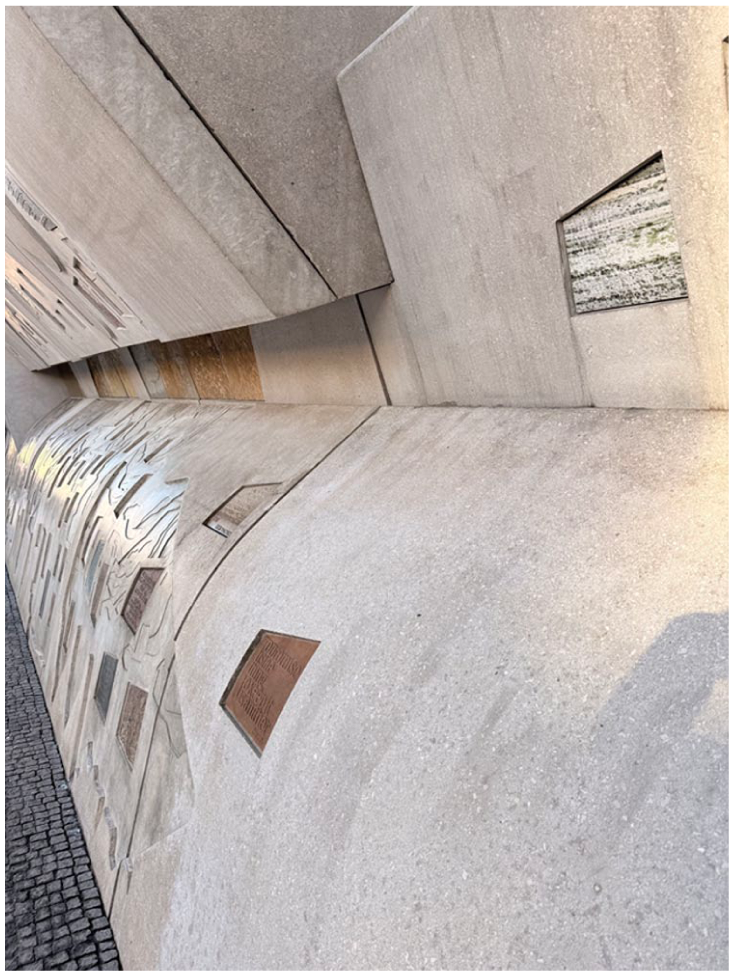
Canongate wall with embedded literary quotations.
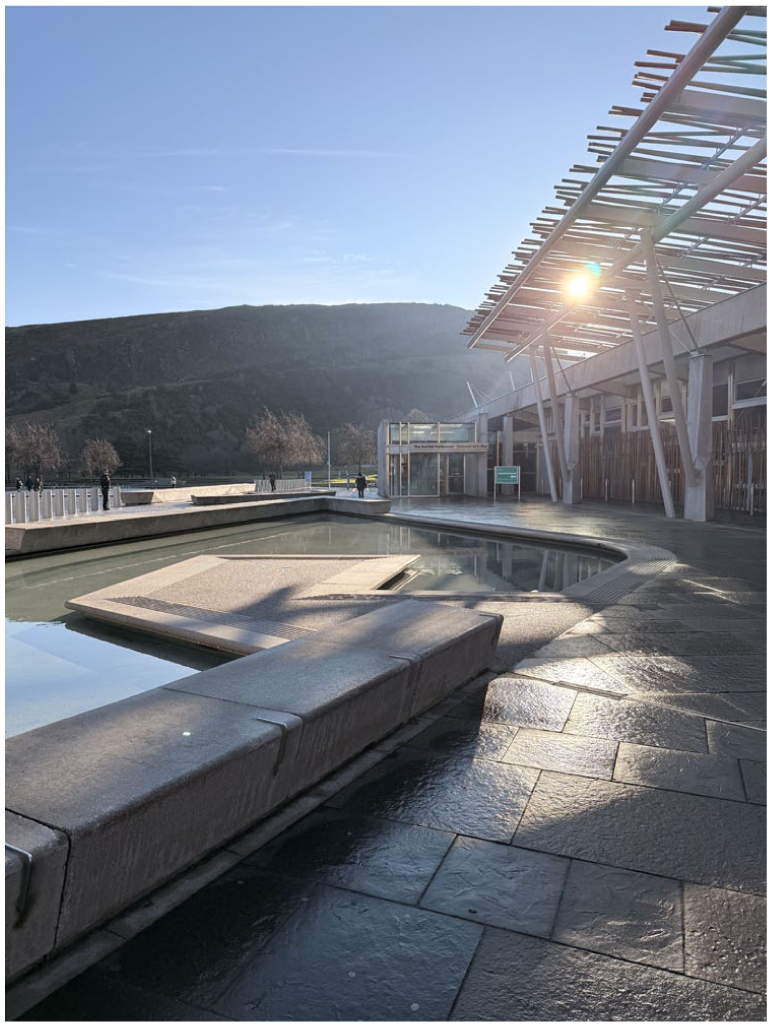
Precincts: public entrance, water feature, and backdrop of Salisbury Crags.
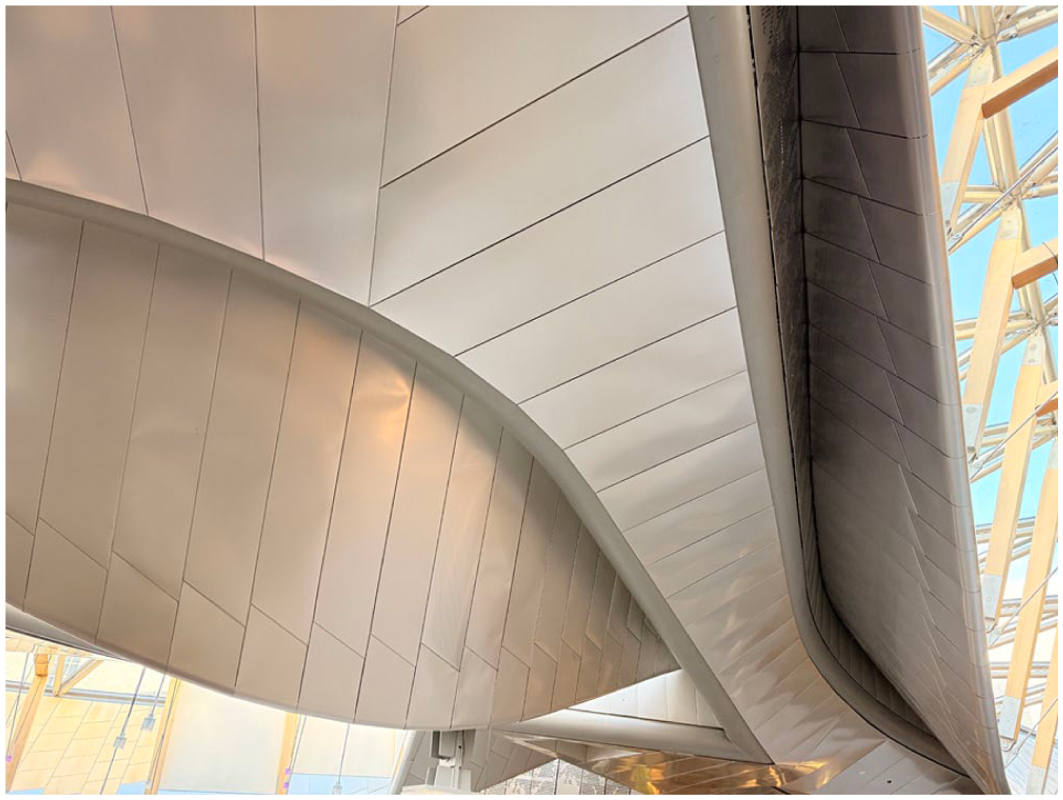
Leaf-shaped roof from below, within Garden Lobby.
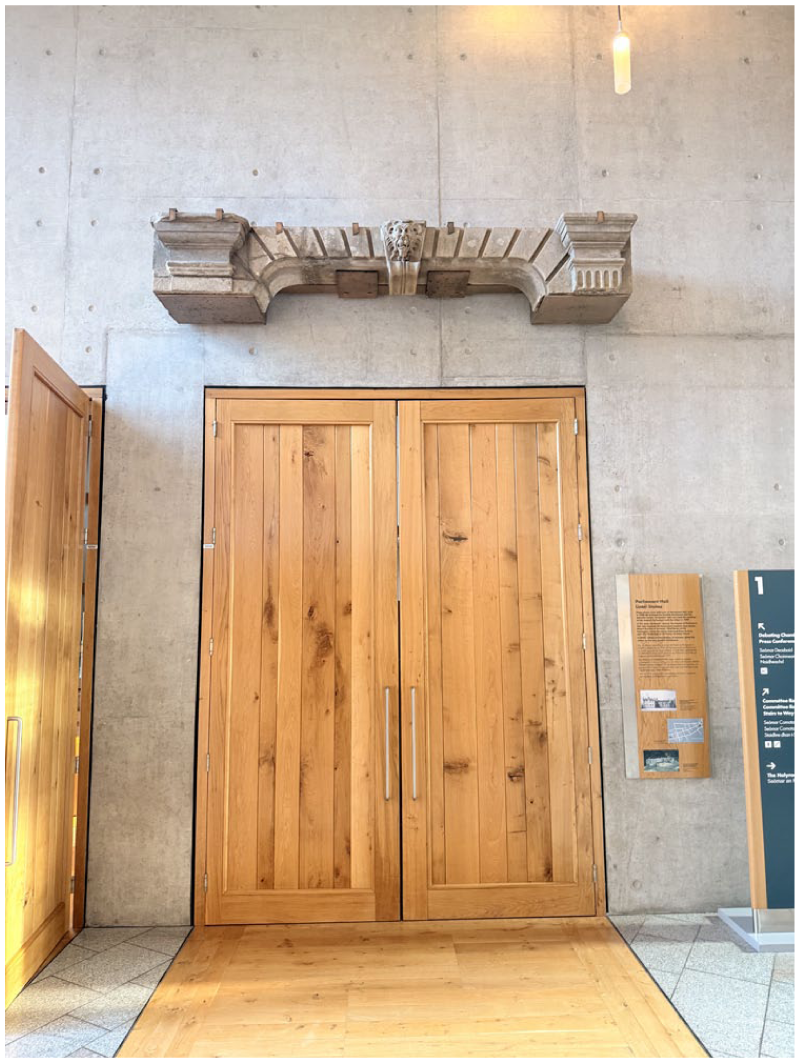
Arniston Stones above the entrance to the Chamber.
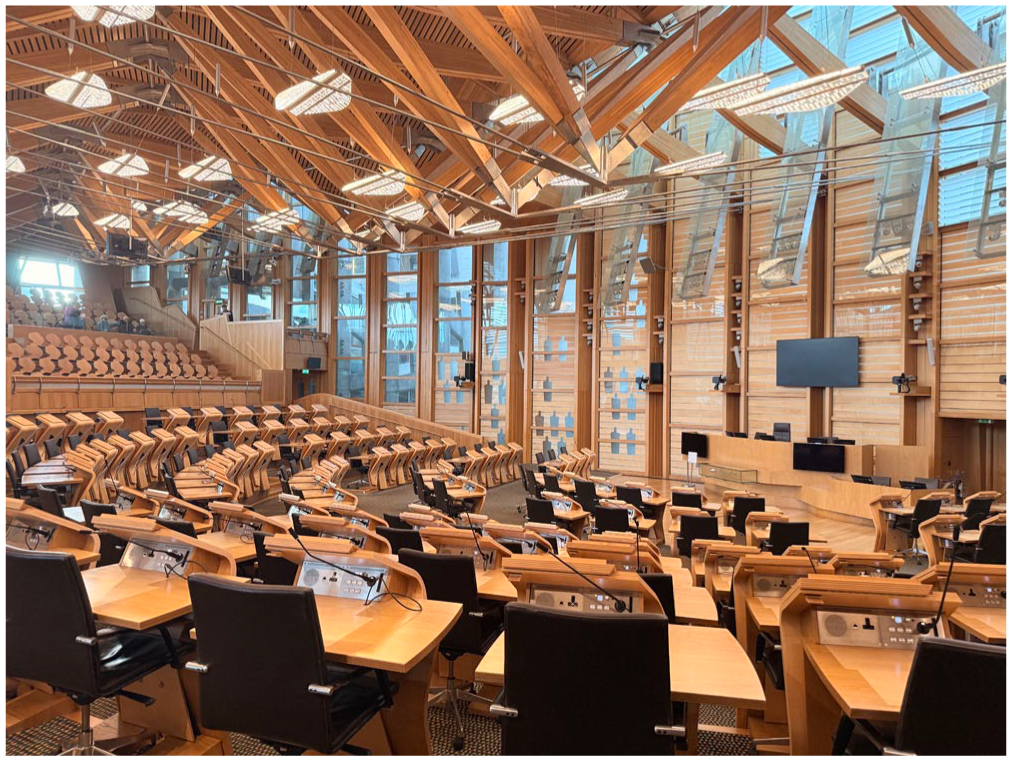
Chamber with visitors’ gallery to the rear left.
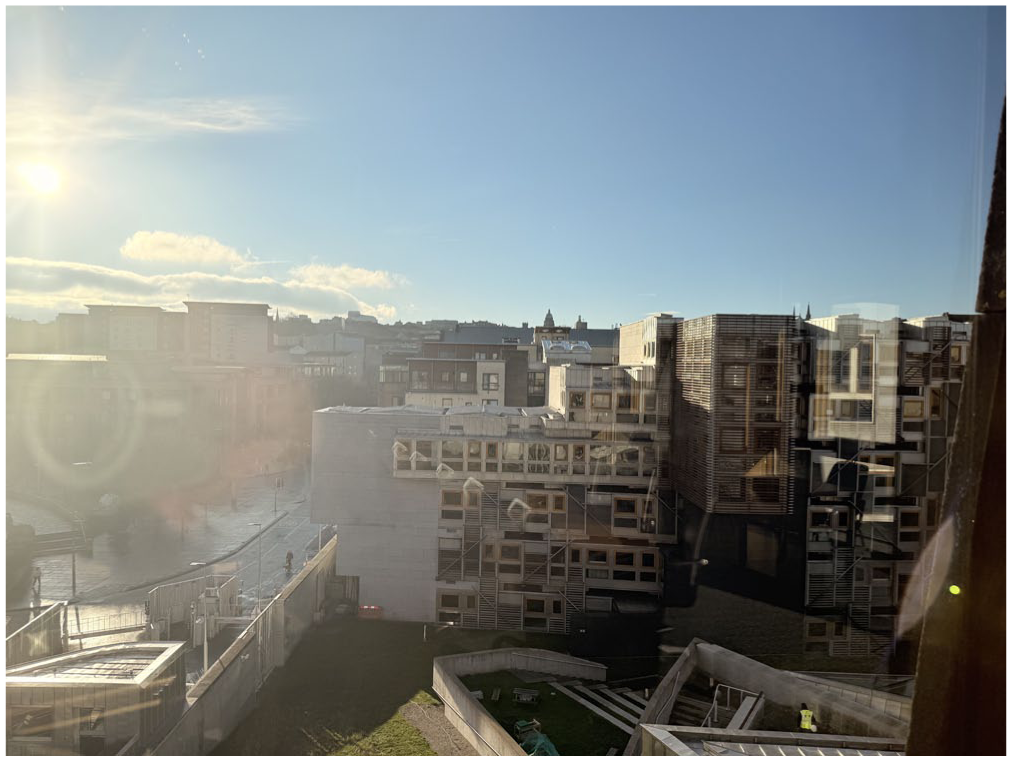
View from Committee Room 6, with the MSP block and Edinburgh skyline.
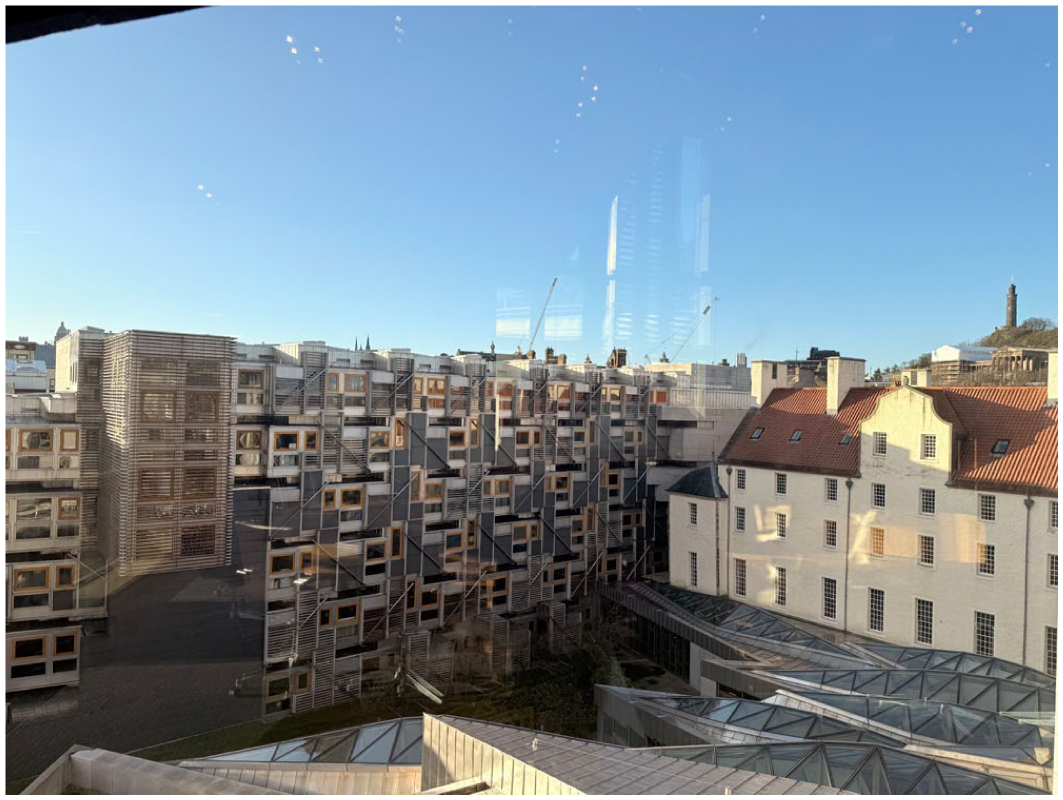
MSP block, Queensbury House (right), and leaf-shaped roofs.
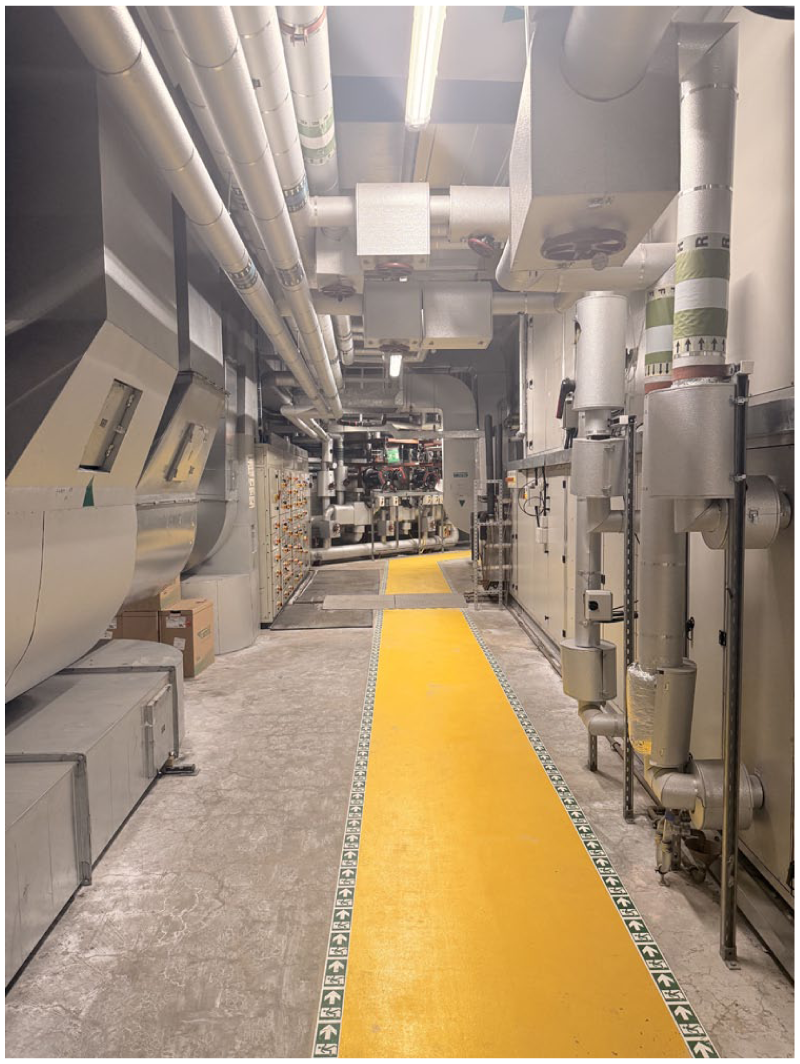
Subterranean plant room.
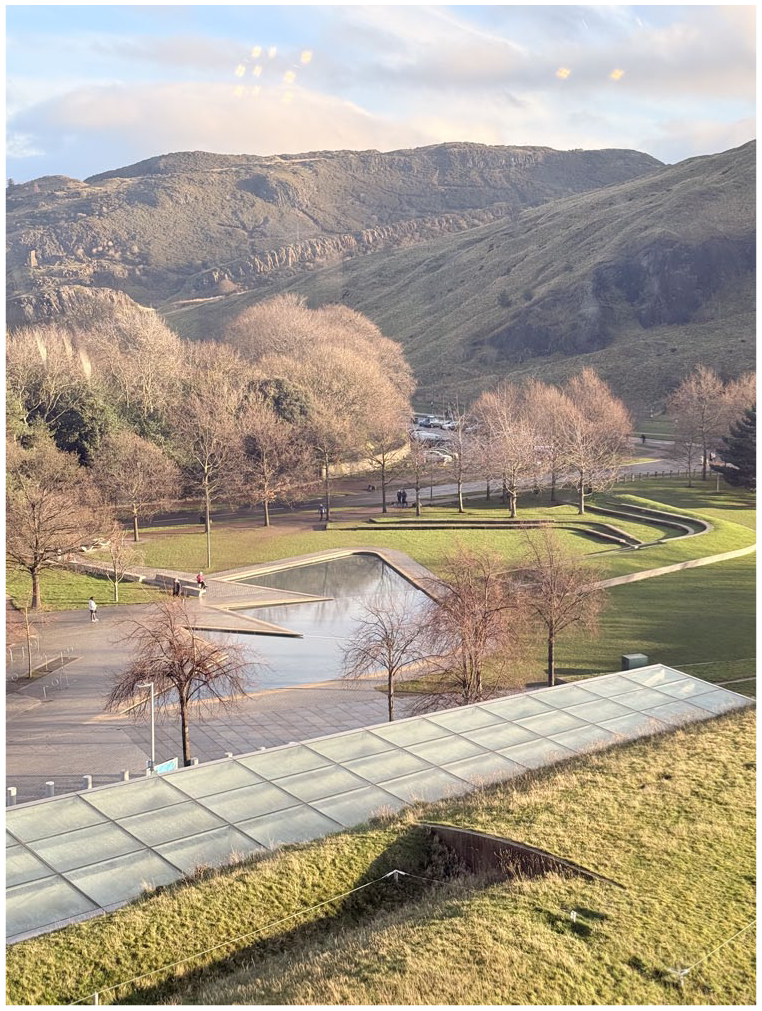
Public precincts “emerging from the landscape.”
The MSP building is six stories high at the north end and four stories high at the south end. Each office has a precast concrete vaulted ceiling and Miralles’ abstract design feature, bespoke furniture, and a contemplation space. Its facade features shapes often said to be taken from Raeburn’s (1795) painting the Skating Minister. The Garden Lobby connects these buildings to other areas of the parliament. It is an informal meeting space for building users and is a through route from MSP offices to the Debating Chamber and committee rooms as well as connecting to Queensberry House, the Canongate building, and the two restaurants. Some areas are open to the public, after going through airport-style security. Much of the rest of the estate is accessible only to passholders.
Data Sources
Our study of the building was enabled by the Scottish Parliament following security vetting. The fieldwork spanned 6 months before the pandemic and 1 year of the lockdown when we continued our research remotely, and we returned when the building was fully open again. We drew on four research sources: standard interviews, walking interviews, field observations, and document analysis.
We jointly conducted 21 standard, semi-structured interviews with various stakeholders in the Scottish Parliament. These included members of parliamentary staff (e.g., clerks, senior leaders, managers, and officers from a spread of functions) and politicians. Two of the four MSPs we interviewed were part of the “Class of ’99”; that is, they were there from the beginning of the parliament. We asked the interviewees to describe their experiences of working in the building, the emotions that the organizational spaces evoked, and how the spaces affected them. In total, 19 hours of interviews—lasting from 40 to 90 minutes—were recorded, transcribed, and analyzed. During the pandemic, interviews (n = 7) were conducted via MS Teams.
In keeping with the idea of “thinking of space as a form of generative wandering” (Beyes & Holt, 2020, p. 4), we also conducted eight walking interviews as a reflexive method (Sachs Olsen & Juhlin, 2021). The participants chose the route, were invited to think of places that “exert a pull” (Stewart, 2007, p. 4), and were able to convey their sense of what matters to them. Walking interviews are based on the premise that the act of walking and talking provides richer insights into sensory and embodied experiences and use the potential of walking to “help open up the unseen and unsensed in our ordinary modes of inhabitation” (O’Doherty, 2013, p. 214). We also spent large parts of our research days wandering through the building, unaccompanied by insiders, at first trying to get our bearings in a space in which the curving walls, sprawling footprint, and assemblage of parts and styles felt disorienting and disordered. These were efforts to attune ourselves to the atmospheres (Borch, 2010). The stairwell voids and two levels of basements, as well as eerie parts of the buildings such as the largely unoccupied spaces of the media tower or offices during nonbusiness days, could lead to an illicit feeling (despite our plastic lanyards) as we stalked the place.
Methodologically, studying spatial imaginaries as representational discourse or semiotic orders restricts empirical work to linguistic sources. Instead, a performative understanding leads researchers to look at how spatial imaginaries are embodied in material practices and how discourses come to be reiterated or changed through embodiment. We spent 15 full days plus 10 shorter visits as nonparticipant observers in the Scottish Parliament. We engaged in a wide range of activities, including listening to debates in the public gallery of the Debating Chamber, sitting in shared spaces (such as the restaurant and café), undertaking a public tour; mingling during a major public demonstration in the parliament precinct, and observing the work and interactions in the Garden Lobby. We engaged in informal conversations with building users—either asking for additional explanations or eliciting their reflections. The intensive observation of participants and the practices they engaged in in situ was especially suitable for a study focused on organizational spaces. We developed an observation schedule, which included categories relating to the embodied and spatial dimensions of practices within parliament. We also observed spaces surrounding the parliamentary estate. We made detailed written records of observations and casual conversations and generated more than 90 extensive fieldnotes.
Documents were analyzed with a view to gaining insights into the history of the parliament and the history of the building. Examples include documents produced by campaigns for Scottish devolution, plans produced by the architectural firms involved, speeches by significant political figures, footage of the official opening, documents relating to the public inquiry into the overspend on the project, and media coverage. We also discussed poetry written about the building, reflecting on images or motifs that might help shape our analytic themes.
Data Analysis
In moving between data and theory, the analysis of our transcripts and fieldnotes involved standard, systematic inductive and abductive processes. We were interested in how our research participants talked about the parliament in general and the building, including their experience of it as a place of work, relations, negotiation, and organizational effort. We approached our transcripts with a keen interest in passages where interviewees reflected on their everyday experiences of working in the building, including the spaces and places that have the most resonance for them. We focused on passages where participants spoke of affective relations; of norms, ethos, and values; of negotiation or struggle; of traces and influences of the past; and of ideas of the modern or the future and where they seemed to be describing the mutual inscription of the material and the sociopolitical. We also paid attention to accounts of the creation of the parliament and were able to speak to people who were around in the early weeks and years of the institution. Accounting for a spatial imaginary involves examining “its different embodiments, materialisations . . . the relation between them, and, more importantly, the concrete effect of these relations” (Vásquez, 2016, p. 351). Our analytic strategy involved working with three characteristics of spatial imaginaries drawn from our review of the literature: discourses, othering, and figures. We analyzed our data with these related concepts in mind and used them to (de-)construct four spatial imaginaries of the parliament. As our analysis proceeded, we also became aware of a fourth element, seemingly not to the fore in the existing literature on spatial imaginaries—emulation. In this further phase, we dwelled in instances when participants spoke of incorporating artifacts or imitating practices of from elsewhere that they approved. We weaved this new category into our analytic themes, examined the relations between them, and considered the practical and organizational effects of those relations (Vásquez, 2016).
Working independently and then coming together to compare notes, interpretations, and puzzles, we used an open coding system and identified a range of provisionally significant themes (such as “openness,” “not Westminster,” “different,” “modern,” “familiar,” “nature,” “Scotland,” “egalitarian,” “non-hierarchical,” “clashing,” “atmospheric,” “problems,” “special,” “dissent and criticism,” “negotiation,” “relations,” “Miralles,” “Dewar,” “the past,” and so on), which we then iteratively combined or collapsed into broader analytic categories—the aggregate dimensions (Gioia et al., 2013)—that became the basis for constructing and interrogating our four imaginaries.
As the four imaginaries took shape, we returned to the interview data, looking for dissenting or critical voices. Doing so helped us appreciate the instability of spatial imaginaries. We also revisited our fieldnotes to sense check our analysis and arguments. We leaned into the spirit of spatial poetics by looking again at our observational data in general and in particular artworks and poetry relevant to the building. Our interpretive approach as researchers was accomplished through an adaptive and recursive process in which inquiry, data generation, and analysis were intertwined (Van Maanen et al., 2007). Overall, our endeavor was to avoid reification, the implication of stasis, and the settled and instead be open to affects and atmospheres, events and intensities, and movements and flows. The spatial turn called for “reaching out into what is distant and bringing it close, or finding it remains enigmatic and free of ‘proper’ understanding” (Beyes & Holt, 2020, p. 2). Thinking spatially involves sensitivity to the excessiveness of space and an engagement with spatial poetics—the atmospheres and auras—of the sites of organizing. Rather than looking for ideas of the settled and the solid, such inquiry attends to the affective, the atmospheric, what is in the air, and to how these carry responsibility for the disorienting qualities of the spatial. In the next section we set out the shape of four spatial imaginaries at work in our study: historical, modern, landscape, and openness and egalitarianism.
Findings
Historical Imaginary
The historical imaginary intimates the deep rootedness of the institution. It is steeped in imagery and figures of the past, suggesting how the institution is inscribed with history, imbricated in the folds of time. This imaginary emphasizes the connection with four centuries of the Parliament of Scotland and implies a continuation of an ancient tradition of Scottish governance. Despite an interruption of nearly 300 years, the idea of a parliament in Scotland has endured and takes strength from its long lineage. Rather than casting the parliament as a new institution, it positions it as ingrained in the polity, its legitimacy and status beyond doubt. Instead of a parliament that is yet to mature or even to find its feet, this imaginary conveys the idea of a parliament that has served its time and seen a few things across the span of Scottish history. The imaginary connects with a discourse of legitimacy and authority. It also speaks to work on organizational memory and scholarship that engages with organizations as haunted spaces teeming with absent presences.
This imaginary celebrates founding protagonists such as Donald Dewar
1
and Enric Miralles,
2
who loom large in tales of the building, the explanations of design and layout, of how things came to be the way they are. It draws on the texts of classic Scottish literature—Burns, Scott, and MacCaig—and is buttressed by the historical imagery provided by contemporary poets commissioned to celebrate the building and who continue this lineage. Processes of both emulation and othering are at work—recurring references to the earlier parliament with the implication that the current parliament is simply an extension of a much older one. The old Scottish Parliament is associated with elitism, corruption, and bribery (Goodare, 1995), something that was sometimes glossed over by our interviewees. The use of old artifacts in the building sometimes produced odd juxtapositions with the modern design. For example, the Arniston Stones are sandstone lintels from the old Parliament of Scotland built in 1640 that feature prominently above the MSP entrance to the Chamber and serve as a material connection with the past. When first elected, MSPs walk under the stones, as a senior manager involved in this design decision explained to us: The idea was that you have to walk under those to get to the debating chamber. We just thought there was something amazing about connecting the old and the new. I think [that] we wanted very deliberately to reflect the fact that there are those who feel very strongly that this is not the first Scottish parliament . . . to kind of echo this idea of being a young parliament in an old democracy.
Some of the ghost stories that are told to illustrate the longevity of some spaces (such as Queensbury House) in the building can have a slightly contrived feel, tales designed to spook and to knowingly remind people that parts of the building itself have a long history, not a very good one, like the story of the Queensberry House cannibal who in the act of rage ate a kitchen boy. The kitchen pit where the child was cooked still features as part of the MSP bar and was shown to us as link with the not so glorious history. However, such figures and images were persistently offered up in our research interviews, perhaps suggesting an element of insecurity about being a young parliament or the need to buttress the institution with the trappings of time, history, and durability.
The link with the past is also evident in the strong embeddedness in the post-volcanic landscape and draws on the intertextual elements of the landscape imaginary, especially when it draws on geologic echoes or the roofscapes and alleyways of Edinburgh’s old town. The figures enable the parliament to take on the patina of age. It stands in tension with the modern imaginary and its celebration of the contemporary, its pride in shedding the weight of (through othering) gothic traditions in favor of lightness, newness, and an array of signs of innovation.
We heard a range of stories that played up a sense of oldness of the building and its environment, such as the uncovering of ancient artifacts during the preparatory works for the site. Queensbury House often was identified as exemplifying the history of the parliament building, in fact the only part of the parliament complex that has an old history, and as reflecting the architect’s choice to incorporate this within the final aesthetic: It has developed over the centuries, so there was a first building . . . here in the 1600s, latterly used as a hospital, but it’s been an army barracks during the Napoleonic War, so it’s had quite a chequered history. . . . Miralles loved all this you know and he was very keen to expose the stone. So in all the rooms you have this kind of plasterboard finish and then the stone finish kind of showing the history of the building.
Connections with the historical past also featured in many of the narratives used in more set-piece occasions. The opening speech in the new parliament asserted that the parliament was “reconvening”—an explicit connection being made with the old Parliament of Scotland. The emulating power of this narrative thread was explained to us by one MSP in this way: Margaret Ewing, the very first member who spoke in this parliament, said the Scottish parliament adjourned in 1707 is now reconvened, and she was making very explicit it’s still Scotland’s parliament, it’s the same thing. . . . We adjourned and now we have reconvened and she was tying those two things together. And when I heard those words, they gave me a real lump in my throat.
Or, as Edwin Morgan (2004) put it in his poem (referenced in this article’s title) for the opening of the Scottish Parliament: Dear friends, dear lawgivers, dear parliamentarians, you are picking up a thread of pride and self-esteem that has been almost but not quite, oh no, not quite, not ever broken or forgotten. When you convene you will be reconvening.
And yet, despite the evocations of ancient history, new history is made every day, like the inscription on concrete made by a builder in our fieldnotes: In here, the lower basement has a spaceship feel. No one finds my Sigourney Weaver/Ripley joke especially (or at all) funny. The technicians look pale and like they’ve been locked in there for years, applying their wrenches to machine parts. It feels cramped. The wee loft hatches and cupboard-like doors are nonetheless 3-inch-thick solid oak. The concrete finishes are rougher, the joints more uneven, and there is a fair bit of dripping and staining. On a basement stairwell “DOUGHBALL WIZ HERE” is fingered in drying concrete, with an arrow to show where. The small voice of a builder. In the depths—history, agency, protest. (Fieldnotes, 2020)
Modern Imaginary
This imaginary frames the parliament as modern, relevant, and innovative. It harbors a critique of other, old-fashioned political institutions, exemplified most especially by the Westminster parliament. Being modern is linked to democratic principles and values. It is an imaginary that looks forward to a better way of being a parliament. Its discourse enshrines the idea that the creation of the institution is the start of a journey, a new beginning, and a process of becoming. Its creation was a “dawn of new hope” (Scottish Constitutional Convention, 1995, p. 19).
From the outset, the specification for the new building enshrined ideas of the modern. The Fraser Inquiry (2004, p. 39) recorded that “Donald Dewar felt that a new building would help to symbolise the new approach which was being taken to Government in Scotland.” Encompassing discourses of efficiency, quality, and fitness for the future, a section of the white paper described: The building the Scottish Parliament occupies must be of such a quality, durability and civic importance as to reflect the Parliament’s status and operational needs. . . . it must promote modern and efficient ways of working and good environmental practice. . . . Quality and value for money are also key considerations.
The symbolic value of the building itself in signaling modernity also was emphasized by one of our MSP interviewees: “Certainly like it would be much more difficult to say we are this modern, forward-looking parliament if we were in, I don’t know, the old court buildings or something like that or the old city chambers or something.”
The imaginary is based on the idea of the parliament as a means to a number of more important ends. In this way, the creation of the parliament and the process of devolution that led to it were to represent a move away from (an othering of) an outdated, supplicatory position of the Scottish polity in the U.K. state (Balfour, 2005). The inception of the parliament should enable a wider modernization and renewal of politics. It ought to result in a more connected and representative decision-making body and facilitate the revitalization of the country politically, economically, and culturally. It is an imaginary of progress and improvement, of the betterment of the country.
The modern imaginary conveys an image of a forward-looking institution, whose actors are encouraged to feel unbound by the weight of inappropriate traditions. The imaginary invites comparisons with (and emulation of) other modern equivalents and institutional role models, often beyond the United Kingdom, a tendency—it was frequently underlined by research participants—illustrated by the choice of a Catalan architect whose design promised boldness. The imaginary also has echoes of managerial discourses of quality and efficiency, whether in processes or governance or in the materials and design of the building. High standards must be maintained in both cases. The building, like the institution, must be modern but also durable.
It celebrates the potential for collaboration, the elliptical design of the chamber emphatically signaling a disapproval of adversarial relations. The light and airy feel of many of its spaces, the aesthetic of the building materials, and the choice of modern contemporary artists and installations throughout the building are further reference points in the modern imaginary. These figures are a prompt to actors to carry themselves in a far-sighted progressive way, one of the original MSPs told us. They provide reminders to look for ways of doing things that are appropriate to the age. It is an imaginary that encourages self-confidence and pride. Look at our Scottish oak, our Kennoway granite, our decision to design a different, surprising kind of building, our commitment to doing things differently and to hauling the weight of parliamentary traditions and public expectations into a new era. Onward from here.
The choice of artworks also contributes to a feeling of a modern institution, achieved in part through the othering of the Palace of Westminster. As one manager observed: The parliament is very different in its look with regards to all of the glass and the wood, and the modern art. Now if you walk into Westminster, the first thing you’re faced with is a marble statue of Churchill. . . . you have that quite oppressive feeling of old grandeur. The parliament is more for, for want of a better word, modern and on trend. . . . They use very modern artists, very Scottish artists. . . . It’s not an old institution.
We heard many accounts that suggested that part of being modern involves a rejection of the pomp and circumstance (“what we call flummery,” said one senior manager) associated with Westminster. As a former presiding officer told us: “Some people like pomp and ceremony. I don’t. I like respect. I absolutely think position should be respected, . . . but it doesn’t mean that I want to wear a big fancy cape.”
We also were told of visits to other parliaments to seek ideas at the design stage and of how some exemplars were seen as more modern than others. The ideas related not only to the pomp and circumstance but also to the shape of the chamber. The othering of Westminster and the desire to emulate “modern” parliaments recurred throughout our interviews: Dewar and the corporate body wanted a modern European-style chamber that would be horseshoe or kind of semi-circular, because that was less confrontational than at Westminster, where you have two rows of green benches that are two sword lengths apart, that is deliberately adversarial. So the parliament here was meant to be a different way of politics, a kind of new way of politics, and be more European.
And yet, said one long-serving MSP: The chamber’s quite a difficult place because people disappear in behind those desks. The worst place in the world is to be where the First Minister is. I’ve been a government minister. You’ve got your own people at your back, you’ve got people to the left and right, but none of them are properly in your vision. So you’re speaking into a void.
Not everything that is modern increases efficiency and comfort. Irregular shapes of the rooms do not lend themselves to the installation of standard heating systems. Contemplation pods in the MSP offices are used only by a squash of visiting schoolchildren because busy MSPs do hardly any contemplating in them. Some of the modern stuff is dating too quickly. A yellow no-slippage sign is next to a bin repurposed as a catcher of the water ingress meandering down from the concrete ceiling. There are weaknesses in the plastic membrane underneath the cladding. We can see foot scuffs on the wooden sills of the floor-length windows and floorboards sanded back one more time but pared to bare bones. There is no access hatch underneath the granite floor to get to the critical plant equipment. “A gift from the architect,” said one building officer ruefully. The gallows humor has it that they are heavily committed to good maintenance—and early retirements—before it becomes a problem. With time, we, as researcher, were slowly beginning to see the flaws in the vision of the modern—that just maybe modern life is rubbish. Our fieldnotes captured this sentiment: By now the building has some familiar smells. Sharp notes of varnish and French polish. The wet whiff of coffee. In someone’s office, above the kitchens, it’s cooking oil. A metallic tang from plant equipment in the lower basement. The Garden Lobby kiosk is stocked with little essentials. Lotions, personal sprays, capsules, pills, pick me ups, fight ‘em offs. Refrigerated chocolate for those in the know. (Fieldnotes, 2022)
Landscape Imaginary
The landscape imaginary suggests the sense of the building emerging from the Scottish landscape and Edinburgh topography. Miralles’ Building Concept Design narrates that “the Parliament sits in the land because it belongs to the Scottish land. . . . The building should originate from the sloping base of Arthur’s seat and arrive into the city almost out of the rock.” The discourse of the landscape imaginary serves to naturalize the building, and in doing so, it also further establishes the institution, subtly but steadfastly defusing controversy about its right to exist or its legitimacy in the polity. The building and institution take strength from the ruggedness, beauty, and geology of its surroundings. The building is a complement to the very fabric of place and a healthy part of the ecosystem. Its politicians are in much of service to the country as the bees and butterflies that populate and pollenate the crags and hills of the local environment. The institution is as natural as the volcanic hill that it sits at the foot of or the flaming yellow gorse that grows on it.
The imaginary is figured by the artwork, building materials, and hand-drawn lines of the building. The extensive use of granite and oak and the leaf-shaped buildings in the center of the complex suggest the parliamentary estate extending from the landscape, a sense helped by the turfing of many external structures and the use of rooftop gardens. Three water features, in front of the oak and concrete frontage of the main entrance, add to the idea of the building merging with its environs and echo the nearby Holyrood Park. Oak and lime trees in the grounds rhyme with those at the perimeter of the adjacent Holyrood Palace. Rowan trees, a symbol of good luck, are planted in various points around the building, including a single solitary tree near the public entrance. Wood is used extensively on the exterior of the building, including solid-oak poles on the upper pergola at the public entrance and outside the windows of the MSP block. In materials, design, and landscaping, the building is a rejection (or othering) of classical architecture and high church gothic preferred by other parliaments that seek to generate awe and subservience. Instead, the contours of the building are as mundanely beautiful as the landscape.
The landscape imaginary connects with the historical imaginary because it suggests the deep roots of the parliament—it is planted deeply in the very landscape of the country. It suggests something that has grown from an ancient land, conveying a sense of maturity and age. It is not an add-on, at odds with the country. Instead, it nourishes, and is nourished by, its surroundings. The naturalizing effects of the imaginary neutralize critique of the merits of the institution. To question the existence of the parliament is as pointless as querying the purpose of Arthur’s Seat or the Edinburgh weather.
This emulation of the look and feel of the landscape was widely understood by interviewees as being a central element of the architect’s vision for the building. As one senior manager who worked closely with Miralles and the project team recalled: His key statement at the time [is] that the parliament sits in the land and that Scotland is a land and not a series of cities. . . . Miralles saw the building coming out of the land, and he was able to convince the panel that the building should be organic and rise out of the land. It represents the people of Scotland.
Although the poetic tone of the landscape imaginary mainly resonated in the accounts, we also heard more light-hearted tales of how Miralles’ design was chosen. An officer who worked closely with the design competition process offered the following tale: So the story goes that some of the unsuccessful practices came along with your all singing, all dancing, balsa wood architectural model—this is the building—this is what it’s going to look like! Whereas Miralles came in with his carrier bags from the airport duty-free, and he brought out these basic wood bits and pieces, and as he was positioning these individual models, he was building up a model of the site and then finally he reached into his carrier bag and he brought out a branch of a tree complete with leaves, and he lay [it] . . . down. And . . . it was all very you know, all very different from the others, and of course it caught the imagination of the panel.
Awareness of the architectural vision and the connections with the landscape is not part of some dry knowledge but is also infused with affect. In this way, one MSP invoked Miralles’s vision of the landscape and related that to the affect of spending time in the building, particularly the Garden Lobby: I’ve now been working in that building for 16 years. I still get a buzz every time I walk into that Garden Lobby. . . . I leave on the Thursday, come back on the Tuesday and I walk in, I just get a buzz. . . . You know Miralles said that he wanted the parliament to rise out of the landscape and be part of that landscape. I think he achieved it because being in that Garden Lobby [it] feels like you’re outside.
But what is this? “Where I sit, all I can see is a skylight, so I can see the sky, but I can’t see any of that beautiful landscape. One of the frustrating things particularly in winter we just don’t see any natural light all day because you arrive in the dark and then you leave in the dark.”
Coble, a sculpture by Finlay (1996), hangs on the wall of the staircase on route to the Public Gallery. It is an abstract sculpture of a coble, a flat-bottomed fishing boat made from overlapping planks. Its immediate cheeriness perhaps obscures more subversive messages. Its title is a pun on the word cobble, as in cobble together or build clumsily. Its registration number, slightly distorted, traces it to England, a boat named Sedulous (“diligent or without guile”). It might suggest the idea of stuff democracy, nationhood, the building itself—being cobbled together. The work upturns the idea of fixedness and speaks to a sense of changes to come. Our fieldnotes again reflect this unsettled nature of materials thrown together and the relationality and permeability of spatial assemblages: Opposite the Queensbury House entrance used by VIPs, the damp course of the roughcast modern tenement is burst and stained. Its ground floor converted into a store, “Holyrood Gift Shop. Cashmere–Harris Tweed–Clans–Souvenirs.” A large selection of fridge magnets: thistles, castles, Nessie. Pound shop energy, if not prices. It adjoins an audio-visual hire shop with temporary signage. Both are viewed from the window of the First Minister. No need perhaps to employ someone to whisper memento mori. Local commerce goes on where it can, as it might, finding corners and nooks, reconfiguring Canongate in the face of the neighbour. (Fieldnotes, 2022)
Imaginary of Openness and Egalitarianism
The discourse of openness and egalitarianism in the fourth spatial imaginary is overtly values based. The twin principles of openness and egalitarianism influence roles, relationships, and conduct in the institution. Openness is connected to the democratic principles of scrutiny, transparency, participation, and accountability. It implies that it is an institution with nothing to hide. After all, sunlight is the best disinfectant. The discourse of openness implicates both staff and politicians. Openness is a basis for conducting the full range of parliamentary business. It invites an expectation of being held accountable for decisions as well as for underlying processes and general conduct.
Among our interviewees, the building was very widely said to have a welcoming ethos, open to visitors, and that this is achieved in part through the design of key areas such as public spaces, the Chamber, the flow of building users through the Garden Lobby, and the permanent presence of the media. As one long-serving manager told us: I love the openness of the lobby where you come in as a member of the public. Miralles deliberately made the ceilings quite low because he didn’t want to create a kind of overpowering cathedral atmosphere. So that was again quite a deliberate contrast . . . with a lot of parliaments that have got huge edifices and small doors and you go in and you suddenly find yourself in this place where you’re clearly not supposed to be. The idea was to draw you in, and it was meant to be amazing but on a more human scale.
The idea of egalitarianism promotes equality and the principle that organizational actors deserve equal rights and respect. It means the avoidance of steep hierarchies between elected politicians and the permanent staff of the institution. It implies cooperative relations, the acknowledgment of interdependencies in the effective accomplishment of the work of the parliament, and the idea that employees and MSPs are involved in a joint democratic enterprise. It is an imaginary that celebrates ideas of the collective, parity of relations, and fairness. It draws from the work of the Scottish Constitutional Convention, which set about the task of prefiguring the new parliament and articulating its governing values and principles.
Openness is figured in the proximity of the public to politicians in the Chamber, the provision of creche facilities and cafés for visitors, its education and outreach programs, stories celebrating the use of the pools in the outdoor precincts by frolicking children on warm summer days. The widespread use of glass interior walls also symbolizes transparency. The images of egalitarianism include descriptions of how in the everyday communal areas of the building the politicians have no preferential rights over staff or visitors. For example, the shared canteen-style restaurant is a place where people queue together irrespective of role or position. The imaginary foregrounds the idea of everyday social and professional intermingling. It encourages ideas of mutual respect and is a critique of other parliaments where hierarchies are more pronounced and staff occupy perhaps more deferential roles in relation to the support of politicians. In particular, it is figured by celebrated contrasts with the steep hierarchies of Westminster. Images of the Garden Lobby highlight a flow of interactions rather than the creation of formal barriers or spaces that segregate categories of building users.
The imaginary of openness is connected to the modern imaginary because to be a modern parliament is to be open, transparent and accessible, and egalitarian in your internal relations. Aspects of this imaginary are in tension with the historical imaginary, not least when it calls to mind the exclusive, feudal Parliament of Scotland stemming from the Late Middle Ages.
The theme of openness was taken up by Morgan (2004), first in his poem’s declamatory beginning—“Open the doors! Light of the day, shine in. . . . Open the doors and begin”—and in a bridge where he speaks of citizens’ aspirations for the new parliament—“They want it to be filled with thinking persons as open and adventurous as its architecture.” It is also a discourse that was emphasized in the work of the Constitutional Convention, which framed the expectation of “a culture of openness which will enable the people of Scotland to see how decisions are being taken in their name, and why. . . . We deserve something better than the secretive, centralised, self-serving super-state that the UK has become” (Scottish Constitutional Convention, 1995, p. 15).
The design of the Chamber, and its use of windows, also features as a recurring symbol of the parliament’s openness. One official recalls Miralles’s account of his reasoning in this way: I remember him explaining why he wanted big windows in the debating chamber. The broadcast people love no windows at all, or at least they like them blacked out to have consistent light. And Miralles wanted these great panoramic windows and absolutely wanted the parliamentarians to see the outside world and that would remind them about why they were there. . . . And even with the way the seats are designed they’re meant to create the idea that you are being watched and that’s very deliberate.
The parliament provides office accommodation to journalists and media in the Press Tower. Cameras and reporters are a common sight in the Garden Lobby. These arrangements are spoken of with pride as part of a commitment to openness. As one senior manager told us: There’s nothing that you will keep secret in this place because the media work side-by-side with you and that is just utterly healthy, but it’s also good for people. It challenges me, it challenges politicians, it challenges all of us that whatever it is you’re working on, there has to be openness and transparency. . . . The design of the building means that you can’t really hide.
But openness and visibility also bring problems in the workplace. Glass walls in meeting rooms do not allow for sensitive conversations. There is little privacy: It’s very hard to make a personal phone call in the building, and if you’re trying to tell someone bad news or phone the doctor, you literally have to go outside or hang about in the Garden Lobby and hope you don’t encounter a tour group.
The tension between the openness and vulnerability was captured by some colorful commentaries by institutional actors captured in our fieldnotes on a day of political demonstrations: Committee Room 6, directly above the Chamber, gives a vantage on the public protest. The public are very much on the outside. “They will definitely be using our building as a toilet,” one security manager predicted. “They’ll be scouting the precincts and benches for a poo. No question about it.” From here you can look down on the concrete, the walls, the layers of separation. The car park of police vans and unmarked transits. The railings. A new security entrance was constructed to provide a blast-proof corridor following the terror attack on Glasgow Airport. It has decorative bamboo poles on its roof, recently scaled by an intruder. “Aye, the best climbing frame in Scotland,” observed one staffer. (Fieldnotes, Brexit Day, January 31, 2020)
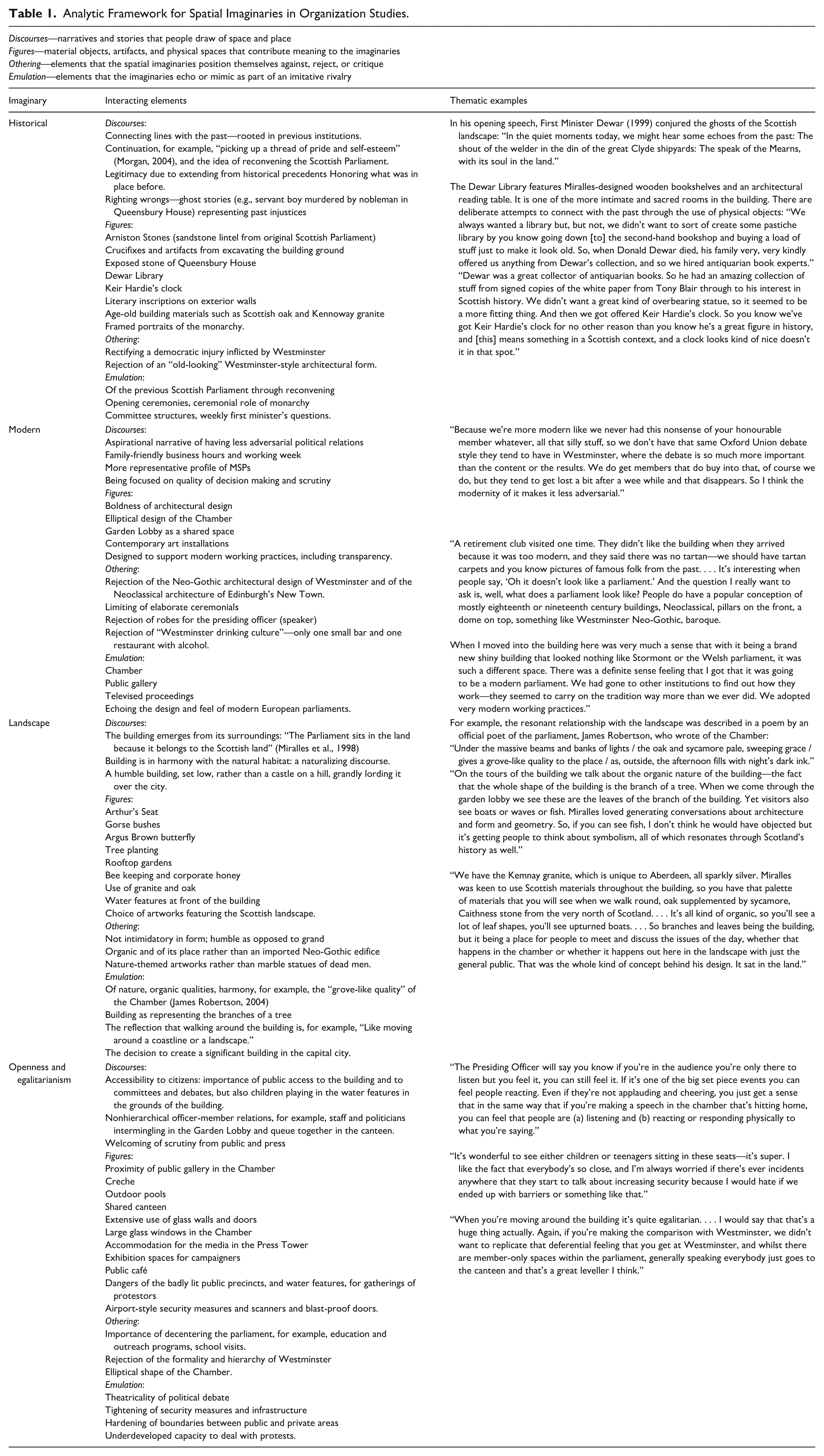
Table 1 shows the constituent elements of our analytic framework for spatial imaginaries in organization studies and provides processual and thematic examples.
Analytic Framework for Spatial Imaginaries in Organization Studies.
Discussion
We started our paper with a research question: “How do spatial imaginaries of the building produce organizational space and shape processes of organizing?” The task of examining these dynamics is especially worthwhile in the case of political buildings to show how contestation and struggle are baked into the bricks (Wasserman & Frenkel, 2011). In dialogue with spatio-organizational scholarship, we moved beyond prior work on spatial imaginaries in urban studies, environmental planning, and human geography to generate an analytic framework for examining the production of organizational space. Our spatial imaginaries, which we theorize as politically charged, collectively developed, and yet unruly flows of meaning that both shape and destabilize organizational spaces, underscore the organizing force of imaginational work in circulating, never-fully-resolved understandings of the significance of places.
Our analysis provides an appreciation of the simultaneity of different spatial imaginaries. As a contribution to building theory about the processes underpinning the production of space and therefore in relation to our research question, attention to spatial imaginaries allows us to understand such processual moments not as a series of linear stages—or breakdowns to be restored (Lok & De Rond, 2013)—but as sinuous, strangely twisting, and slyly insistent patterns of thinking that constitute organizational space through their flexing and unflexing.
One reading of the performativity of these spatial imaginaries points to some simple instrumentalities, suggesting how they provide legitimating resources for an institution that had a difficult beginning. In such a reading, the naturalizing impacts of the landscape imaginary are useful for rebuffing people skeptical of the need for a Scottish Parliament. The historical imaginary craftily emplaces the institution within the long span of time. And the literary quotations figured on the Canongate Wall stamp the parliament with beguiling stories of place and nation, and the historical imaginary emplots the parliament as part of a progress story in which the parliament is a milestone.
However, our analysis problematizes simple readings of the performativity of spatial imaginaries and emphasizes their unstable and turbid qualities. The analytic power of spatial imaginaries attunes organizational scholars to their mutability and the inconstancy of their trajectories. There are tensions as much as complementarities between and across the flows of these imaginaries. Openness supports the idea of being a modern parliament and yet clashes with the idea of being old. There are conflicts between openness and security. People may honor the building through recognizing it as an important site for political protest yet be caught short in its precincts. Even the materiality of security measures can fence in as well as keep out or be repurposed by intruders as a climbing frame.
Spatial imaginaries disrupt sense as much as make it. An appreciation of mixity and flux (Massey, 2005) tells us that spatial imaginaries, with the multiplicity of their trajectories, can only ever be understood as involving the construction of temporary, provisional stabilizations. For example, the landscape imaginary might provide a framing that enlists the rocks and plants, the sky and light, in pursuit of anthropomorphic values such as political identity. The large windows offer panoramas but also suck the surroundings inward. The openness and transparency of the building are resonant with an appealing idea of modernism, but modernism also speaks of efficiency, bureaucracy, and faceless decision making. Some interviewees enthused about there being “nowhere to hide,” but visibility can give you headaches and a trip to the kiosk for tablets. Glass walls can be cage-like (Gabriel, 2005) and gendered (Hirst & Schwabenland, 2018). Openness can become petrified as an architectural feature. Sheets of glass and windows letting in the light—the evidence of transparency—rather offer openness as a work in progress that needs to be continually practiced. A democratic institution so rooted in place presents the danger of being closed to digital innovation or to peripatetic activities, reinforcing a power relationship in which the people must come to the parliament rather than its politicians reaching out to them. What is modern at one point in time may become old-fashioned and antiquated soon after, as embodied by the bleary subterranean workers hammering at the groaning basement heating system. And what is traditional can suddenly be seen as fashionable and trendy.
Engaging with ideas of spatial openness and flux troubles the accounts we heard of how a building should feel, should be read. Showing the messiness of imaginaries—and how imaginaries disrupt sense as much as lend it—lets us see their limitations for conferring stable meanings to spaces. Through exploring spatial imaginaries as beyond representational discourse, our study problematizes the notion of imaginaries as resources that can be neatly harnessed for organizational or political projects (Beckert, 2016). Our analysis emphasizes ideas of processual becoming, multiplicity, excessiveness, and fluidity. Spatial imaginaries are less stable than they first appear. It is this unruliness that keeps open the space for something new. In the context of this study, something new could include, for example, a lapse into nostalgia, a lurch into a fortress mentality, or a leap into renewed decentralization efforts. These processual movements—the foldings and twistings—account for the confounding qualities of organizational space and let us understand that organizational actors are caught up in the everyday, deeply political negotiation of different sociopolitical configurations. These negotiations, which result in only ever-temporary stabilizations, generate alternative ways of working and organizing.
Finally, our research has moved beyond existing work on spatial imaginaries to provide a clear basis for exploring the construct specifically in an organization studies context. We generated three defining elements of spatial imaginaries drawn from the literature—discourse, figures, and othering. However, we introduced a fourth element—emulation—that adds an important analytic dimension to the understanding of spatial imaginaries in organizations, (and one that conflicts with the dynamics of othering). The Oxford English Dictionary defines emulation as “to copy or imitate with the object of equalling or excelling. . . . To vie with, rival, equal, or closely approach in any quality.” We acknowledge parallel terms in organization studies, such as mimesis and mirroring. Emulation is a form of imitative rivalry. We introduce emulation as a political term that conveys qualities of the uncanny aspects of spatial imaginaries that are both somehow familiar and also strange.
The historical spatial imaginary helps us to see how discourses of continuation and reconvening are reinforced by the othering of Westminster as source of historical injustice. And yet, emulation is evident in the adoption of opening ceremonies, the role given to monarchy, and the set piece of First Minister’s Questions, all of which are familiar enough from Westminster. With the modern spatial imaginary, the discourses of being less adversarial, and more family friendly, rely on Westminster as a point of reference and the othering of its silk robes, drinking culture, and braying Members of Parliament. Even here, though, there is emulation in relation to the centrality of action in the Chamber, the maintenance of a public gallery, and the inclusion of television cameras. The discourse of the building sitting humbly, organically, in the Edinburgh landscape entails the othering of Westminster’s grander Neo-Gothic edifice and its marble statues of dead men. Even so, there is an attachment to material symbols, call backs to history, and the conjuring of the founding first minister (Donald Dewar) and the visionary architect (Enric Miralles), both deceased. The discourses of openness and egalitarianism are intensified by the othering of the formality and hierarchies of Westminster, and yet, emulation occurs through the theatricality of political debate, the tightening of security, and the hardening of boundaries between public and restricted areas.
In our study, the tension between othering and emulation is persistent. It creates a contradictory dynamic that offers a powerful theoretical explanation for why spatial imaginaries are so twisty and confounding. The interplay of othering and emulation enhances the theoretical basis for understanding spatial imaginaries in organizing and the “thrown togetherness” (Massey, 2005, p. 140) of space and for appreciating the demands and significance of the ongoing negotiation of shifting spatial assemblages.
Conclusion
We studied a building by attending to the strange flux of collective spatial imaginaries. The parliament is a political institution subject to the scrutiny and expectations of wider publics, vested with images of nationhood and ideals of democracy, and provides a rich basis for analytic engagement with flows of meaning that both extend and draw from ideas and discourses beyond organizational boundaries and that are diffused across space and time.
We developed spatio-organizational thought, which explores the ways in which organizing stems from unruly flows of meaning—enigmatic imaginational work that helps explain the intrinsic flux of organizing. Engaging with the concept of spatial imaginaries advances scholarly engagement with spatial poetics. In this case, we explored how spatial imaginaries swirl and wind through—co-constituting—our site of inquiry. Spatial imaginaries provide a rich basis for accounting for the fluidity and restlessness of space and an always-on-the-move sense of multiplicity. For organization studies, illuminating the performativity of spatial imaginaries enhances the theorizing of the processual nature of spatial phenomena and the excessiveness of organizational space.
Our work responds to calls for exercises in topologic imagination (Beyes & Holt, 2020; Beyes et al., 2024) and for processual and performative studies of space (Ratner, 2019; Vásquez, 2016). In doing so, it further encourages inquiry into the processes that generate organizational spaces and a shift from earlier work that accentuated a dichotomy between concrete and abstract spaces, or physical spaces and people’s lived experiences (work that has been critiqued by, for example, Beyes & Holt, 2020; Giovannoni & Quattrone, 2018). It further problematizes the reification of space and representational accounts and, to use a spatial metaphor, pushes scholarship toward further inquiry into the processes underpinning spatial production.
Our study of spatial imaginaries serves not as a modeling of parliamentary space but as an exercise in writing space and a way of highlighting a basis for its production that has been underexplored in organization studies. Our exploration of spatial imaginaries disturbs the dualism between external and internal—the idea that organization refers to an entity in an external environment. Instead, our study shows the continuous flow and intermingling of spatial forces and attunes scholars to ideas of the cyclic nature of organizational change, in which different states transition into each other, in foldings of continuity and change. This knowledge is important because understanding seemingly distinct concepts and formations as being part of a nonlinear flow of movement enables us to appreciate the interconnectedness and simultaneity of elements that might otherwise be viewed as separate, binary, or dichotomous. Organizationally, seemingly distinct elements are part of an intertwining, a productive, on the move simultaneity.
Imaginaries speak to spatial poetics because they are animated by the reverberations of events, figures, and daydreams that involve enfoldings of the past and present, including organizational spaces and times that are seemingly elsewhere (Daskalaki & Kokkinidis, 2017; Giovannoni & Quattrone, 2018; Nash, 2018; Quattrone et al., 2021; Ratner, 2019). The appeal of spatial imaginaries lies in their somewhat cloudy or gauzy qualities rather than their fixedness or strict classificatory power. They are populated by figures who can now only be imagined—architects, dead political leaders, and long-gone grassroots campaigners—as well as by the workaday chat of colleagues. They are made material, and for so long as they linger, they bring provisional, performative trajectories that, while stable enough for everyday work to go on, are never fixed, never entirely reliable, and never fully orientable, making provisional and unstable the ways in which they are materially acted on. Becoming attuned to spatial imaginaries invites researchers to dwell within spatial elusiveness—the confounding qualities of the spatial. It is an approach that is alive to spatial poetics—to imaginaries that are as nebulous as dreams and yet that still reverberate.
Spatial imaginaries imbue the folding and unfolding production of organizational spaces with affective flows of meaning. Their performative power motivates organizational action in ways that are neither neutral nor abstract (Vásquez, 2016). Their power has material, practical, and political consequences for organizational life, including notions of what the organization should be like (and unlike), which discourses lend it shape, who should be involved in it its work, and how its members should act in relation to continuity and change. Theorizing spatial imaginaries as a plurality highlights the fluidity and changing qualities of space and how politics is intrinsic to the performativity of these imaginaries. Attention to spatial imaginaries therefore draws into relief ethical-political issues and what is at stake in different or alternative configurings of organizational space. Critical questions that emerge include which values drive collective efforts (and which do not); who feels at home, or like an outsider, in a space; and who and what are to be emulated and who and what are othered. We conclude that spatial imaginaries are constitutive of organizational spaces and of organizing and are folded into politics, power, and the possibilities for organizational change.
Footnotes
Acknowledgements
We acknowledge the support of the Scottish Parliament Academic Fellowship scheme. Thank you to Professor Timon Beyes, associate editor, for his developmental stewardship of this paper throughout the review process. Sincere thanks also to the three excellent reviewers, and to Russ Vince.

Funding
The authors disclosed receipt of the following financial support for the research, authorship, and/or publication of this article: The reseach was supported by the Scottish Parliament Academic Fellowship scheme.
Declaration of Conflicting Interests
The authors declared no potential conflicts of interest with respect to the research, authorship, and/or publication of this article.