







Abstract
Emerson declared the nineteenth century’s ‘speculative genius’ to be ‘a sort of living Hamlet’. But the century that was virtually obsessed with Shakespeare’s melancholy Dane was no less fascinated by Julius Caesar. This fascination was directed at the historical Caesar, of course, but it drew on and was shaped by Shakespeare’s Roman tragedy. This paper explores two German engagements with the Caesar myth: the hugely successful productions of Julius Caesar by the famous touring theatre company of the Duke of Saxe-Meiningen and Friedrich Nietzsche’s Shakespearean reflexions in Ecce Homo.
The politics of a myth
Does it make sense to speak of a ‘Caesar myth’ today? One might look for Caesar in contemporary culture. What comes most readily to mind in this European context is the comic book Julius Caesar from Astérix the Gaul. Alternating between megalomania and frustration, he serves as the regular butt of the antics of the heroes, Astérix and Obélix, who send him into tantrums of impotent rage by dealing bumps and bruises to his clueless legions. The exploits of the indestructible Gallic duo have in themselves become a popular myth of sorts, a narrative of resolute independence pitted against a seemingly irresistible hegemonic power. Their success all over Europe and conspicuous lack of success in the US may be due, as the Cambridge Latinist Mary Beard argues, to the fact that Astérix is ‘indomitably European. The legacy of the Roman Empire provides a context within popular culture for the different countries of Europe to talk with, and about, each other, and about their shared history and myths’. 1 ‘Across Europe’, Beard writes, ‘the story of Astérix has … encouraged many people to think harder about the history and prehistory that it reflects and the myths it embodies’. 2 Yet even the most ardent advocate of the legacy of Rome would hardly claim that these myths, including the myth of Caesar, are a major cultural force today.
In the nineteenth century, however, the Caesar myth was precisely that: a major cultural, and indeed political, force. The century of Byron and Heine, Hugo and Mickiewicz, Hegel and Nietzsche developed an unparalleled fascination with Caesar, an almost cultic adoration of him, the greatest of men, ‘l’homme de l’humanité’, as Jules Michelet called him. 3 Friedrich Gundolf, author of the now eminently unreadable Shakespeare and the German Spirit (1911), also published an eminently readable study of Caesar in the Nineteenth Century. 4 In the making of the nineteenth-century myth of Julius Caesar two strands, he says, converge and reinforce each other, though not without tension. One was the cult of heroic singularity, a trans-moral celebration of genius; the other, a cult of collective freedom, the utopia of a liberated humanity. For Hugo and Heine, Carducci, Landor and Swinburne, the two strands were mutually dependent. In the name of Caesar, Gundolf writes, these poets ‘demand … the liberated person for the sake of liberated humanity and vice versa’. 5 Democrats and patriots all, they were, at the same time, ‘passionate individualists, hero-worshippers and enemies of philistinism’. 6
How much, or rather, how little, this has to do with the actual personality or politics of the historical Julius Caesar, needs hardly be pointed out. It is unmistakably history having been transformed into myth. This myth finds its apogee in the Caesar adoration of Nietzsche. Nietzsche’s Caesar, in Peter Baehr’s apt summary, is ‘the man of titanic inner strength, discipline, and plenitude, … the genius of self-control, self-overcoming, exemplar of Roman warrior values, antithesis of the priestly, plebeian, life-abnegating values’ of Christianity that had ‘vanquished and tamed the Roman world’.
7
In recent history, Nietzsche says, when the French Revolution collapsed under the weight of vindictive popular instincts something wholly unexpected happened: the ancient classical ideal appeared incarnate and in unprecedented splendor …. Like the last signpost to an alternative route Napoleon appeared, most isolated and anachronistic of men, the embodiment of the noble ideal … Napoleon, that synthesis of the inhuman and the superhuman [diese Synthese von Unmensch und Übermensch].
8
The merging of images was not just aesthetic and literary; it was also political. As Karl Marx wrote in 1852: At the very time when men appear engaged, in revolutionizing things and themselves, in bringing about what never was before, at such very epochs of revolutionary crises do they anxiously conjure up into their service the spirits of the past, assume their names, their battle cries, their costumes to enact a new historic scene …. Thus did Luther masquerade as the Apostle Paul; thus did the revolution of 1789–1814 drape itself alternately as Roman Republic and as Roman Empire ….
11
Farcical or not, the new emperor’s rise to power was recognized by contemporary observers as a fundamentally new form of politics resulting in a fundamentally new form of rule for which a new term was needed. That term was ‘Caesarism’. Coined around 1850, 13 its yoking of the modern to the ancient captured what the old opposition between legitimist monarchy and classical republicanism in the vein of Machiavelli and Montesquieu lacked: the combination of populism and autocracy, mass democracy and dictatorial rule as it emerged with Bonaparte. More often than not, the term registered conservative, liberal or republican discontent with this new phenomenon. And not infrequently, a rejection of Caesarism went hand in hand with unreserved admiration for Caesar. This is the case of Theodor Mommsen, whose monumental Roman History, awarded with the Nobel Prize in Literature in 1902, probably did more than any other single work of historiography to propagate a glowingly positive image of Caesar. ‘Caesar’s work’, Mommsen wrote, ‘was necessary and salutary’ under the conditions of his time, whilst modern Caesarism ‘is at once a caricature and a usurpation’, the term, ‘a clumsy and vulgar use of analogy’. 14
Shakespeare’s Caesar
How does Shakespeare come into all of these? His portrayal of Caesar is, after all, rather ambivalent. He certainly does not glorify the man. The Tragedy of Julius Caesar thus does not sit easily with the nineteenth-century Caesar myth, even though, or indeed precisely because, it speaks powerfully to the issue of political myth-making. It not so much bolsters the myth as demonstrates its formation by political actors and historical contingencies. The play both demystifies the Caesar myth and shows its irresistible power. It exposes the rift as well as the link between the destructible man and the indestructible spirit which, in Brutus’ words, ‘walks abroad, and turns our swords / In our own proper entrails’. 15
Acceptable as this is for us today, it posed a real problem for nineteenth-century idolaters of Caesar, especially when they also happened to be Bardolators. It raised the painful question how the greatest of poets could have failed to do justice to the greatest of men. Was he incapable of seeing this greatness? Shakespeare, incapable? Unthinkable!
Critics were faced with a genuine conundrum. Henry Hudson, editor of The Harvard Shakespeare, openly confessed to perplexity. As represented in Shakespeare’s play, he writes, ‘Caesar is indeed little better than a grand strutting piece of puff-paste … than which nothing could be further from the truth of the man’.
16
After detailing this ‘truth of the man’ in a paean to his supreme qualities à la Mommsen, Hudson concludes: Now I feel morally certain that the Poet understood all this perfectly. … And I sometimes regret that he did not render him as he evidently saw him, inasmuch as he alone perhaps of all men who ever wrote could have given an adequate expression of that colossal man. This seeming contradiction between Caesar as known and Caesar as rendered by him is what, more than anything else in the drama, perplexes me.
17
It is but a weak justification of Shakespeare’s conception to urge, as have several critics, that, having taken the life of Brutus as his main subject, he had the right to show only the weak side of Caesar, his vanity, his ambition to reign, and his insolence, in order to furnish a motive for the conspiracy. The decision to tell but part of the truth does not excuse him who makes the decision.
19
Caesar as opposed to Cato – and afterwards as opposed to Brutus – is the many-sided genius who loves life and action and power, in contradistinction to the narrow Puritan who hates such emancipated spirits, partly on principle, partly from instinct. … It was because of Shakespeare’s lack of historical and classical culture that the incomparable grandeur of the figure of Caesar left him unmoved.
20
becoming enfeebled in those last days of his life; he was superstitious and frightened, he had lost all foresight and firmness of purpose …. And yet, when the conspirators put a violent end to this poor exhausted spirit … the Republic gained absolutely nothing: the Emperor is no more, but the empire is begun – Caesar is dead, long live Caesar! … It is not the spirit of any one man, but the spirit of a new era about to begin – the spirit of Caesarism – that fills Shakespeare’s play ….
22
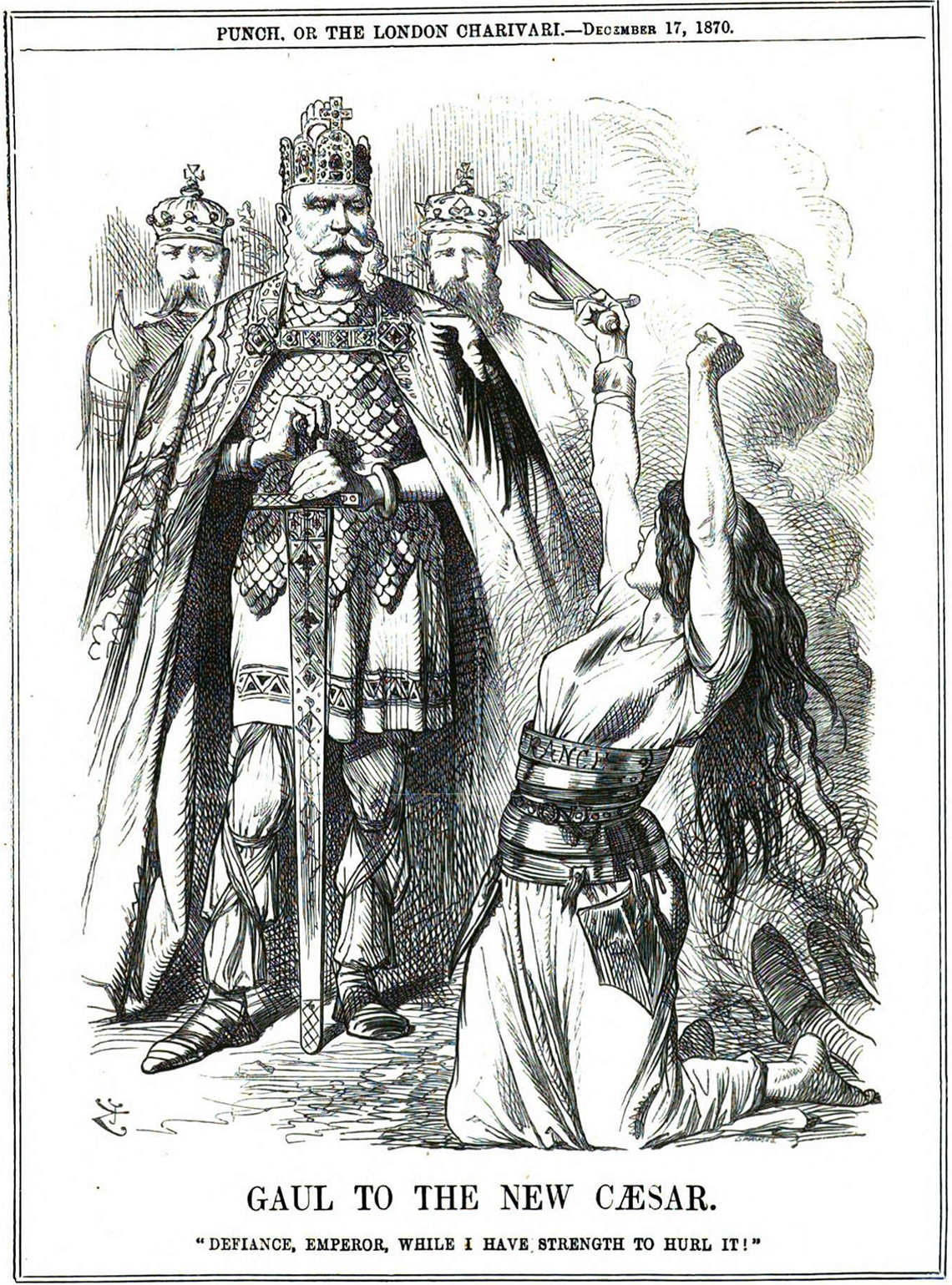
Punch, Dec. 17 1870. Courtesy of Heidelberg University Library.
The duke and the philosopher
How was Shakespeare’s Roman tragedy absorbed into the realm of the ‘New Caesar’? My answer in the remainder of this paper will be highly selective. I will look at just two exemplary, though radically dissimilar, figures. The first we meet at the primal scene of Germany’s Second Empire, the proclamation of the king of Prussia as Kaiser Wilhelm I in the Hall of Mirrors at Versailles. In the first and largest version of Anton von Werner’s famous painting, he is barely visible in the throng of princes backing the – actually reluctant – King of Prussia in his assumption of imperial honours (see Figure 2). 23 Little was it to be expected that from this duke’s anorexic sliver of territory a kind of theatrical superpower would arise, one of the prime cultural assets of the newly imperial nation. 24
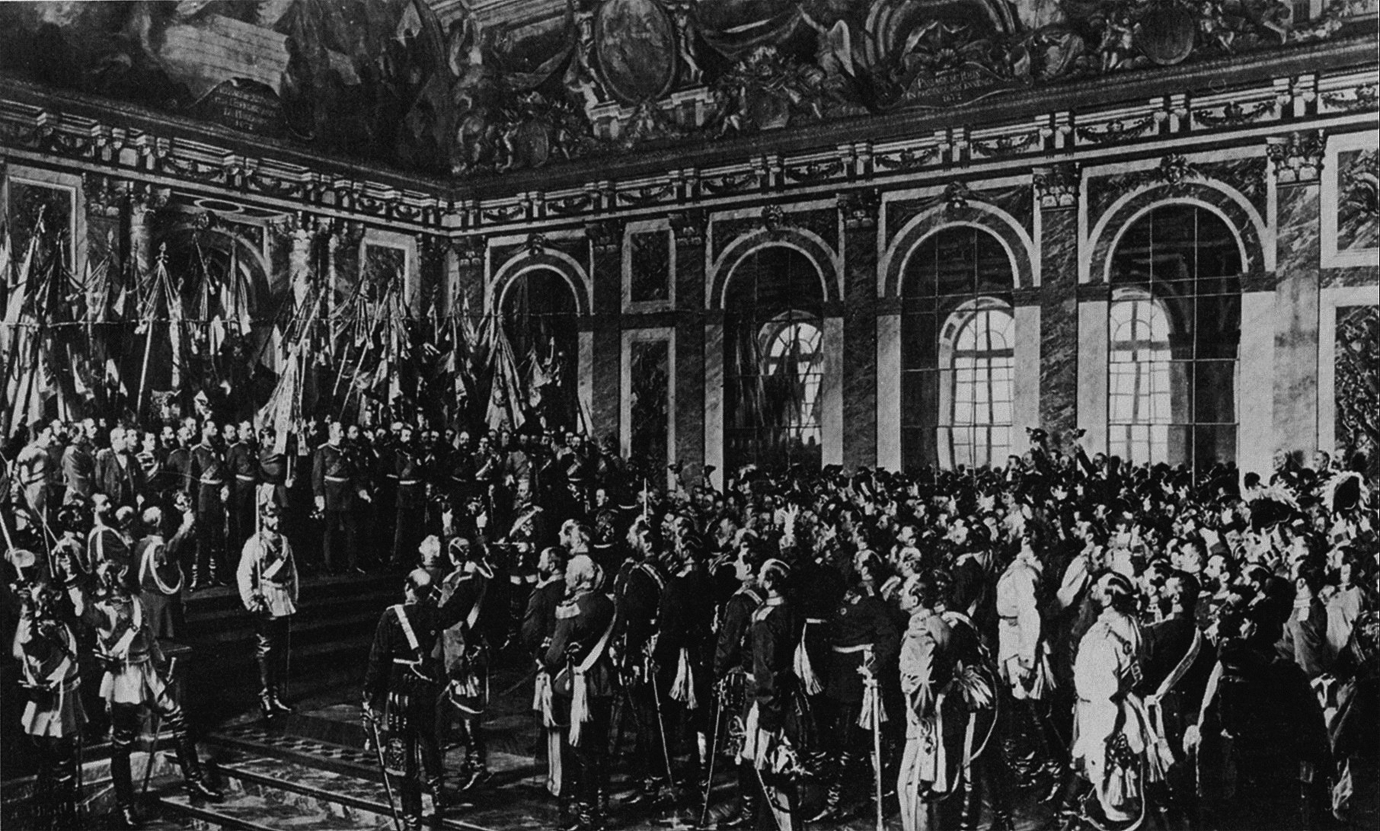
Anton von Werner, Die Proklamierung des Deutschen Kaiserreiches, 1877 (The Proclamation of the German Empire), Berlin Stadtschloss (destroyed 1945).
Duke George II of Saxe-Meiningen was an outspoken supporter of national unification under Prussian leadership, one of a small group of German princelings who had favoured the reintroduction of the imperial crown well before 1870.
25
His long reign, which had begun in 1866, ended just 3 days short of the assassination at Sarajevo in 1914. His obituary in Shakespeare Jahrbuch calls him: one of the paladins of Kaiser Wilhelm I who marched with him when in hard battle the unity of the nation was won and secured; and he marched on, when the great work was accomplished, at the head of an army of artists to herald by bloodless triumphs and conquests our national glory … to all nations.
26
he has done his duty and not without a grain of chivalry. It was he who, on the evening of Sedan, looked in an ambulance for that regiment of ours which had fired at his general staff and said gallantly to one of our wounded captains: ‘If your soldiers had aimed better this morning I would not have the honour of shaking your hand this evening’.
27
is very industrious, very energetic, ceaselessly perfecting all its instruments: the military instrument, which it has developed into a marvellous mechanism, and its instruments of art and theatre, which have become like breech-loading needle guns suited to every further development and enabling entirely new levels of range and effectiveness.
31
German art has become as incontestable as the German military machine. Every interpretation of a major work of German art is, like those ‘model performances’ at Bayreuth, an indisputable manifestation of German power.
32
The flagship production of this enterprise was Julius Caesar. Premiered in the Meiningen Court Theatre in 1867, the first series of performances in Berlin opened in 1874, creating an instant sensation. Julius Caesar became the company’s pièce de résistance, the single most frequently performed play on their tours all over Europe, with a total of 330 performances. It was the production which the Meiningen Players tended (and intended) to be judged by, the production that was seen to epitomize their style. Visually, this style hardly deviated from, but rather endorsed and perfected, the contemporary norm. A talented draughtsman, George II was steeped in the historicism of his day, most opulently represented by the huge crowded canvases of Hans Makart or by Charles Kean’s antiquarian stagings of Shakespeare which the Duke had seen on visits to London. There is thus nothing all that extraordinary in his stage designs for Julius Caesar nor in the fact that he secured the expertise of Pietro Visconti, director of the Archaeological Institute in Rome, to get them historically right. 38 The set reproduced as much as possible the actual look and layout of the Forum, and because it was partly under construction in 44 BC, it included a much-noted heap of bricks.
Meticulously as the scenery, costumes and props were designed, they hardly account for the production’s most unique quality. And neither do the actors who took the major roles. They certainly looked their parts (see Figure 3). 39 But their style of delivery was often criticized as stilted. ‘Few of them’, a German critic remarked, ‘know how to speak naturally’. 40 ‘In the Meininger production’, the Russian dramatist Ostrovsky quipped, ‘Caesar himself becomes part of the décor’. 41 What made the Meiningen Players unique was the dynamism of their ensemble play. This, the Duke declared, was the core of theatrical art, ‘What the stage must visualize above all else is movement, the irresistible progress of the action’. 42 And, speaking from his military experience, he said, ‘In a battle everyone is constantly running’. 43
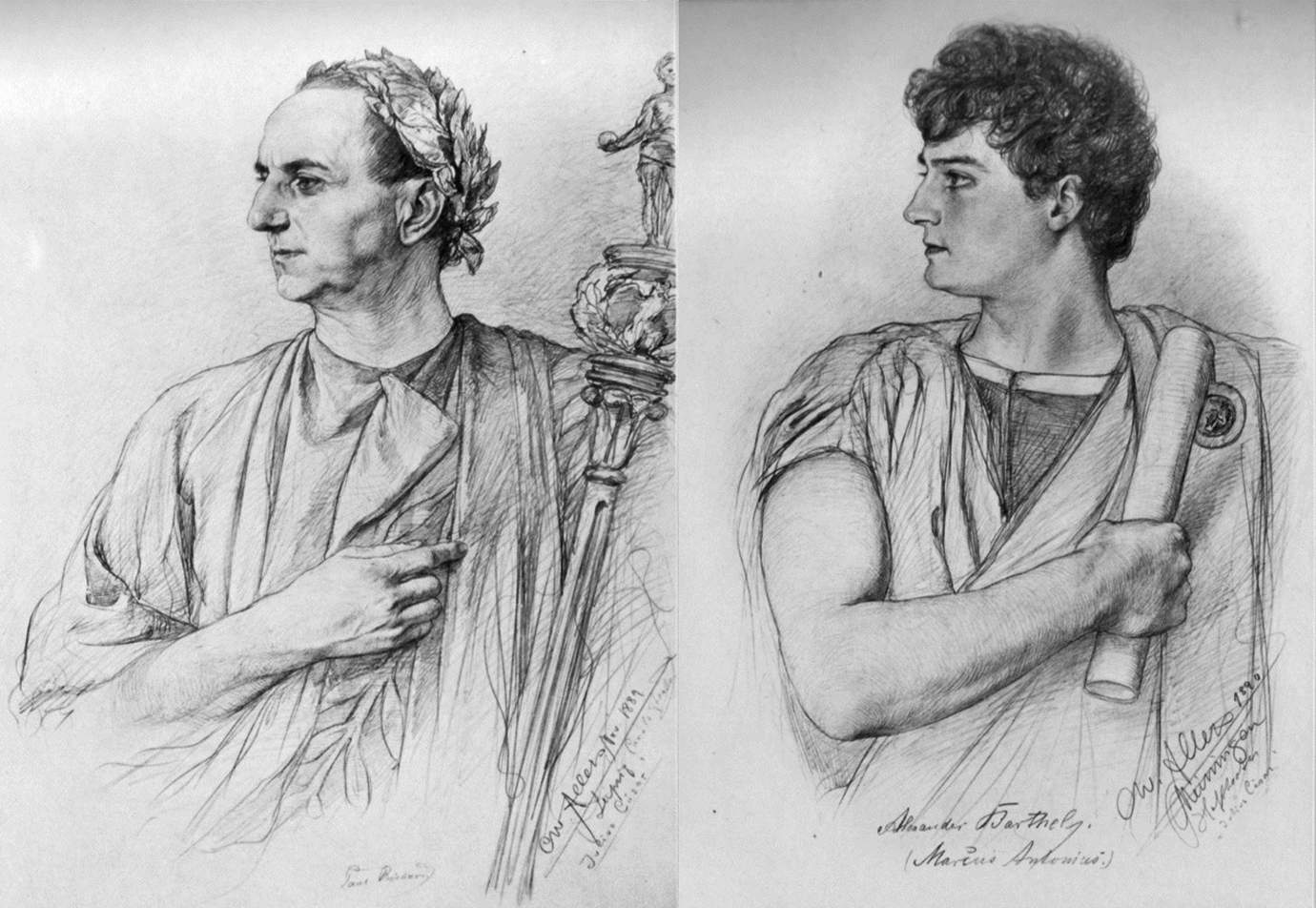
Christian Wilhelm Allers, Die Meininger (Hamburg: Dahlström, 1890).
Nowhere could this dynamism be more impressively realized than in the Forum scene (see Figure 4). Here is a report of a Brussels performance in 1888:
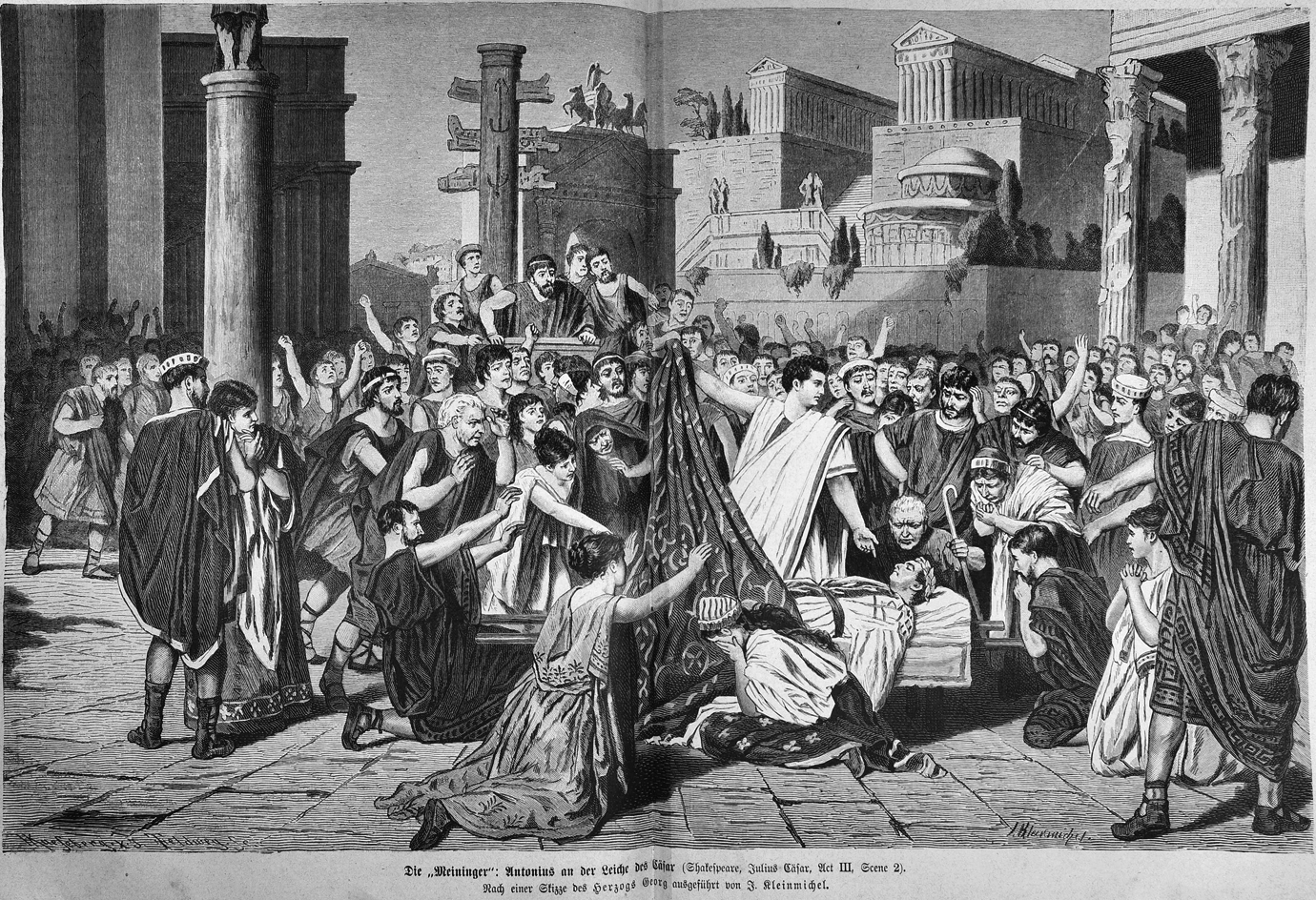
‘Die “Meininger”: Antonius an der Leiche des Cäsar.’ Die Gartenlaube. Illustrirtes Familienblatt, 236 (1879).
The threatening murmur of the Roman people, their attention in following the words of the orators at the rostrum, the mobility of their expression[s] are miraculously well conveyed. This was no longer just an accompaniment, intended to support the main actor and make him stand out … ; it was, as Shakespeare wanted it, a totally new actor, fierce, formidable, bursting violently into the foreground – the crowd, as one knows it, in its anger and its triumph … At the voice of Brutus, the cunning speech of Antony, the symphony exploded into noise and terror and the actors paled, melted, disappeared into this gigantic chorus which carried the tragedy to unexpected heights. Anyone who has ever taken part in a public meeting where the voice of a demagogue has stirred and incited the masses must be struck … by the truth of this scene.
44
Whether praised or criticized, the crowd scenes were the undisputed highlights of all Meiningen productions, most of all their Julius Caesar. Which is actually rather remarkable. The most celebrated theatrical export from the realm of the New Caesar presented a version of Shakespeare’s Roman tragedy in which the power of Caesar was eclipsed by the power of the people. No paean to the great architect of Empire, it paid tribute to the many-headed monster. It took a director with more than just directorial power to create this spectacle of mass action. It took the ‘sovereign direction’, as Claretie puts it, of a ruler who had lost his sovereignty to the New Caesar but who could still supplement the Roman ranks at Philippi with real soldiers from his Meiningen regiment. 47 The crowd scenes were the supreme products of the Duke’s ‘Absolutism’, an absolutism displaced from the political to the aesthetic sphere. Ironically, what this residue of ducal power supremely succeeded in staging was the very force that sealed the fate of traditional monarchy and gave rise to the populist neo-Caesars of modernity.
If the Duke of Meiningen’s theatre company represented the official culture of Wilhelminian Germany, Friedrich Nietzsche typifies its most radical antithesis. Where Hegel had seen the world spirit (Weltgeist) reaching its telos in the Prussian state, Nietzsche radically detached himself from that state and its self-important philistinism. In 1888, he wrote, ‘“German spirit”: for the past eighteen years a contradiction in terms’.
48
Contemptuous of the New Caesar, Nietzsche was all the more admiring of the old one. In the increasingly sharp cultural–political polemics of Nietzsche’s last phase, Caesar becomes the emblematic antagonist of the herd, the great singular figure towering above the levelling morality of the many, the paragon of an unabashedly aristocratic, anti-liberal ethics of freedom: The human being who has become free – and how much more the spirit who has become free – spits on the contemptible type of well-being dreamed of by shop-keepers, Christians, cows, females, Englishmen, and other democrats. The free man is a warrior.… The highest type of free men should be sought where the highest resistance is constantly overcome … ; most beautiful type: Julius Caesar.
49
When I seek my highest formula for Shakespeare I find it always in that he conceived the type of Caesar. One cannot guess at things like this – one is it or one is not. The great poet creates only out of his own reality – to the point at which he is afterwards unable to endure his own …. When I have taken a glance at my Zarathustra I walk up and down my room for half an hour unable to master an unendurable spasm of sobbing. – I know of no more heartrending reading than Shakespeare: what must a man have suffered to need to be a buffoon to this extent! – Is Hamlet understood? It is not doubt, it is certainty which makes mad …. But to feel in this way one must be profound, abyss, philosopher …. We all fear truth …. And, to confess it: I am instinctively certain that Lord Bacon is the originator, the self-tormentor of this uncanniest species of literature: what do I care about the pitiable chatter of American shallow-pates and muddle-heads? But the power for the mightiest reality of vision is not only compatible with the mightiest power for action, for the monstrous in action, for crime – it even presupposes it …. We do not know nearly enough about Lord Bacon, the first realist in every great sense of the word, to know what he did, what he wanted, what he experienced within himself ….
51
The very enigma of Bacon, about whom ‘we do not know nearly enough’, makes this ‘first great realist’ an ideal alter ego for the radically realistic anti-messiah of Ecce Homo whose exposure of Christianity ‘breaks the history of mankind into two parts’. 53 Nietzsche appropriates a biographical phantasm for his own phantasmal self-image as an historical force majeure. The poet-philosopher must be able to conjure in himself the mindset, the drives and the energy of the conquering man of action. But this would still be just ‘guessing’, imagining oneself as Caesar rather than being him. The bolder, less ‘reasonable’ reading transfers the poet-philosopher from the role of a reflector or recorder to that of an agent of history. This ambition is much closer in spirit to the euphoric bravado of the opening announcement of Ecce Homo: ‘Seeing that I must shortly approach mankind with the heaviest demand that has ever been made on it, it seems to me indispensable to say who I am’. 54
What was that ‘most difficult demand’ with which the ill and isolated, largely unread author proposed to shake the world? There is no telling. ‘I will do such things –’ exclaims the powerless King Lear on the brink of madness, ‘What they are, yet I know not; but they shall be / The terrors of the earth’. 55 The beginning of Ecce Homo suggests that the writer’s imminent feat will be more than just another piece of writing. This would explain both the crucial role attributed to Caesar in ‘my highest formula for Shakespeare’ and the apparition of Lord Bacon as the true begetter, behind the mask of ‘Shakespeare’, of both Caesar and the heart-rending buffoonery of Hamlet.
At issue for Nietzsche is the type, the perpetual idea or myth of Caesar that set in motion not just a dynasty but a whole history of Western governance down to the investiture of the Prussian king as the first Kaiser, or Caesar, of Germany’s ‘Second Reich’ in 1871. What the Shakespearean reflection in Ecce Homo seeks to sketch out is a synthesis of art and politics through an intricate meshing of iconic identities. Thus Caesar defines the ‘highest formula’ for Shakespeare, while Hamlet, the supposedly truest expression of Shakespeare’s self, is his Zarathustra. Thus also Shakespeare must be Bacon, the poet not only a philosopher but a man of action.
Absorbing Shakespeare’s Caesar into the myth of his own self-becoming, Nietzsche makes this composite poet-philosopher-general-statesman-criminal the herald of what he calls ‘grand politics’:
56
For when truth steps into battle with the lie of millennia we shall have convulsions, an earthquake spasm, a transposition of valley and mountain such as has never been dreamed of. The concept politics has then become completely absorbed into a war of spirits, all the power-structures of the old society have been blown into the air – they one and all reposed on the lie: there will be wars such as there have never yet been on earth. Only after me will there be grand politics on earth.
57
Footnotes
Declaration of Conflicting Interests
The author declared no potential conflicts of interest with respect to the research, authorship, and/or publication of this article.
Funding
The author received no financial support for the research, authorship, and/or publication of this article.