







Abstract
This paper analyses the impact of the traditional Japanese Noh play Tamura on Akira Kurosawa's film adaptation of Macbeth, Throne of Blood. It examines the presence of Noh elements in the banquet scene, where a solo dance from Tamura is performed, and explores the connection between Tamura's conclusion and the film's final scene, in which the protagonist Washizu is bombarded with arrows. By identifying the banquet scene's dancer with the rebel leader and examining its implications, this study provides a nuanced analysis of the film's ending.
Keywords
Akira Kurosawa (1910−1998) is widely known to have incorporated elements of traditional Japanese Noh theatre into his film adaptation of Shakespeare's Macbeth, Throne of Blood (1957). He revealed in various interviews, for instance, that he showed the Noh masks called Heida and Shakumi to Toshiro Mifune and Isuzu Yamada respectively to help them prepare for the roles of Washizu and Asaji (the counterparts of Macbeth and Lady Macbeth). 1 He also stated that he replaced the three witches of Macbeth with an old female ogre from the Noh play Kurozuka, a character he considers closest to the Western witch in Japanese culture. 2 Moreover, the film's atmosphere clearly embodies that of Noh theatre from its opening scene, where the chant of verse lines, intoned in a manner similar to that of the Noh chorus, accompanies the footage of Kumonosujo (Spiderweb) Castle's ruins on the screen. Viewers can also detect the influence of Noh theatre in Asaji's demeanour, characterised by her quiet walking and the rustling of her kimono. However, most scholars have merely noted the film's general Noh-like atmosphere created by these elements, or accepted Kurosawa's comments about his borrowing of Noh theatre at face value, without fully acknowledging its significance. This paper aims to investigate the film's more specific implementation of Noh theatre, such as Kurosawa's integration of Macbeth and the Noh play Tamura, and to illuminate the intricate worldview that he seeks to communicate to the audience.
Noh elements in the banquet scene
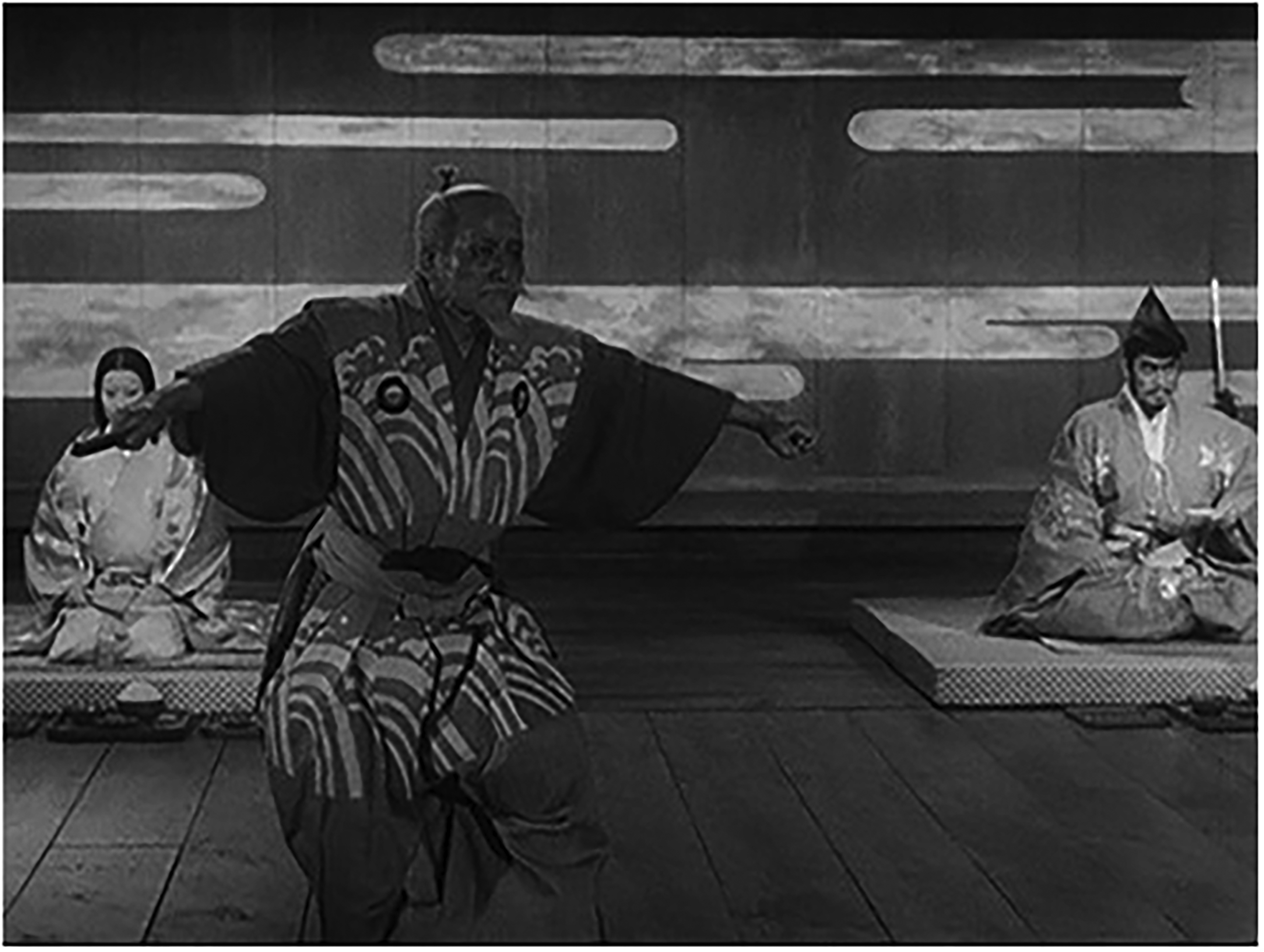
In Throne of Blood, the banquet scene, corresponding to Act 3 Scene 4 of Macbeth, 3 commences with a general's performance of the protagonist's dance and speech (shimai) extracted from the Noh play Tamura (See Figure 1). After some time, he pauses the dance and recites lines of verse. Towards the end of the speech, however, Washizu abruptly interrupts the recitation and exclaims, “That's enough! No more dancing!” 4
Throne of Blood (© TOHO CO., LTD.).
Several critics, such as Yasuko Gunji, Donald Richie, and Keiko I. McDonald, have already identified elements of a Noh performance in the banquet scene. 5 In particular, Gunji, one of the earliest critics to recognise Kurosawa's skilful use of Noh theatre, notes that the large wall behind Washizu and Asaji, upon which white paint spreads horizontally like clouds, resembles the back wall (kagamiita) of the Noh stage, which features a painting of an old pine tree (oimatsu). Additionally, she observes that the ghost of Miki (Banquo), illuminated in a pallid hue and seated in front of a pillar, bears a resemblance to the supporting character (waki) in a Noh performance, who sits on the floor next to the corner pillar with the left knee raised, while the main character (shite) performs a dance or recitation in the centre of the stage.
One important aspect of the scene's resemblance to a Noh performance that critics have overlooked is the seating arrangement of the banquet participants. In a Noh performance, the chorus sits in one or two rows at stage left with their hands on their hips and their fans in front of them when they are not chanting. (When chanting, they hold their fans in their right hand, with the tip touching the floor.) In Throne of Blood's banquet scene, Washizu's generals are similarly seated on the floor with their hands on their hips and their fans in front of them, arranged in two rows to the left and right of Washizu and Asaji. Although the chorus is never arranged in two opposing rows in Noh performances, the film preserves the Noh-like atmosphere by only showing one row at a time on the screen. If we view the scene as a Noh performance, Washizu and Asaji occupy the positions of the musicians who play the Japanese flute and drums, seated in front of the back wall.
However, the established order of the banquet, as suggested by the Noh mise-en-scène, is frequently disrupted to heavily ironic effect. Washizu, seated in the position of the musician, not only interrupts the general's dance from Tamura but, upon seeing the ghost of Miki seated near the pillar in the waki position (as Gunji observes), he abruptly moves to the middle of the hall, or ‘stage’, as if to assume the role of the shite. This is an inversion of the conventional arrangement of ghosts and the living in a Noh play: In many Noh plays, the waki, often portrayed as a Buddhist priest and seated at stage left, listens to the ghost (the shite) in the centre stage and alleviates his or her distressed state of mind. Also, Washizu's reaction to the ghost – coming to the centre of the stage, running towards the back wall, and shouting at him – contradicts the essence of Noh performance, which relies on extremely subdued motions and vocal projections to convey emotions. By introducing and then ruining the design of a ritualistic Noh performance in the banquet scene, Kurosawa effectively portrays the collapse of Washizu's political control.
Kurosawa inherited this effect from Shakespeare's Macbeth. The banquet's ceremonial nature, which reflects the order Macbeth desires for his reign, is suggested right from the beginning with Macbeth's line, ‘You know your own degrees, sit down’ (3.4.1). However, ironically, the banquet's symbolic nature emphasises the disorder that Macbeth brings to society, primarily through his own agitated reaction to Banquo's ghost. Lady Macbeth succinctly summarises the chaotic state of the end of the banquet by saying, ‘At once, goodnight. / Stand not upon the order of your going, / But go at once’ (116–18). 6 Kurosawa's incorporation of the Noh performance design into the scene elevates the ritualistic nature of the banquet in the original play, thereby enhancing the visual and symbolic impact of the collapse of its order on the viewers. This fusion of two traditional dramatic forms from the East and West in a film is a masterful example of Kurosawa's cinematic artistry.
Throne of Blood and Tamura
Several aspects of the content of the Noh play Tamura are also significant, but have received little critical attention, possibly because the published screenplay, English translation, and film subtitles do not refer to the play by name. In addition, the fact that it is performed by an unnamed character may have contributed to the lack of critical attention. Tamura narrates a legendary episode in which General Sakanoueno-Tamuramaro (758–811), at the request of Emperor Heizei, embarks on an expedition to the Suzuka District and suppresses evil demons who have rebelled against the emperor. The Noh dance shown in the film performs the moment when Tamuramaro confronts the traitors. The dancer recites the following speech in which Tamuramaro recalls an old tale about the legendary traitor Chikata and his four ogres: Ogres, listen carefully! There was a similar instance long ago: the ogres who served the traitor Chikata deserted him and left him ruined, due to the fear of Heaven's retribution for their rebellion. Mount Suzuka is even nearer to the Emperor's palace!
To my knowledge, Titanilla Mátrai is the only critic to examine the link between the play and the film. Although she dedicates only two pages to it in her eighteen-page article on Kurosawa's use of Noh plays in Throne of Blood, her article highlights two critical elements of Kurosawa's handling of Tamura in the film. Mátrai first points out that the dancer compels Washizu to recognise his treacherous behaviour by reciting Tamuramaro's lines to the traitor, as quoted above, much like Hamlet does to Claudius with ‘The Mousetrap’, and anticipate divine retribution for his wrongdoing. 7 Mátrai even suggests that the dancer's action of raising the fan during the dance may be a reprimand directed at his own master.
Mátrai's second observation is that the images of Tamura resurface at the end of the film. Shortly after the point in the Noh play where Washizu interrupts the dance and the recitation, Senju-kannon, a Buddhist deity with a thousand hands to whom Tamuramaro prays before the war, suddenly appears in the sky above the battlefield and defeats the rebels by shooting an arrow from each of his hands. 8 We can see a reprise of this event in Washizu's final scene, in which he is shot dead by his own soldiers with countless arrows. Mátrai emphasises the difference in perspective between the two: the narrative of Tamura focuses on the subject who shoots a thousand arrows, while the film centres on the object of the arrows.
Oddly enough, Mátrai's account overlooks several ironies Tamura brings to the film. Both the Noh play and the film explore betrayal or treachery as their central theme, but one irony is that the Heida mask which Kurosawa showed Mifune before filming was the one used by the shite actor who plays Tamuramaro. Despite Washizu's resemblance to the heroic Tamuramaro, his actions and their outcomes are wholly opposite. Another irony is that the arrows in the last scene of the film do not come from the hands of a deity, but from common soldiers who betray Washizu, who had himself killed his own master. These departures from Tamura highlight the film's theme of betrayal.
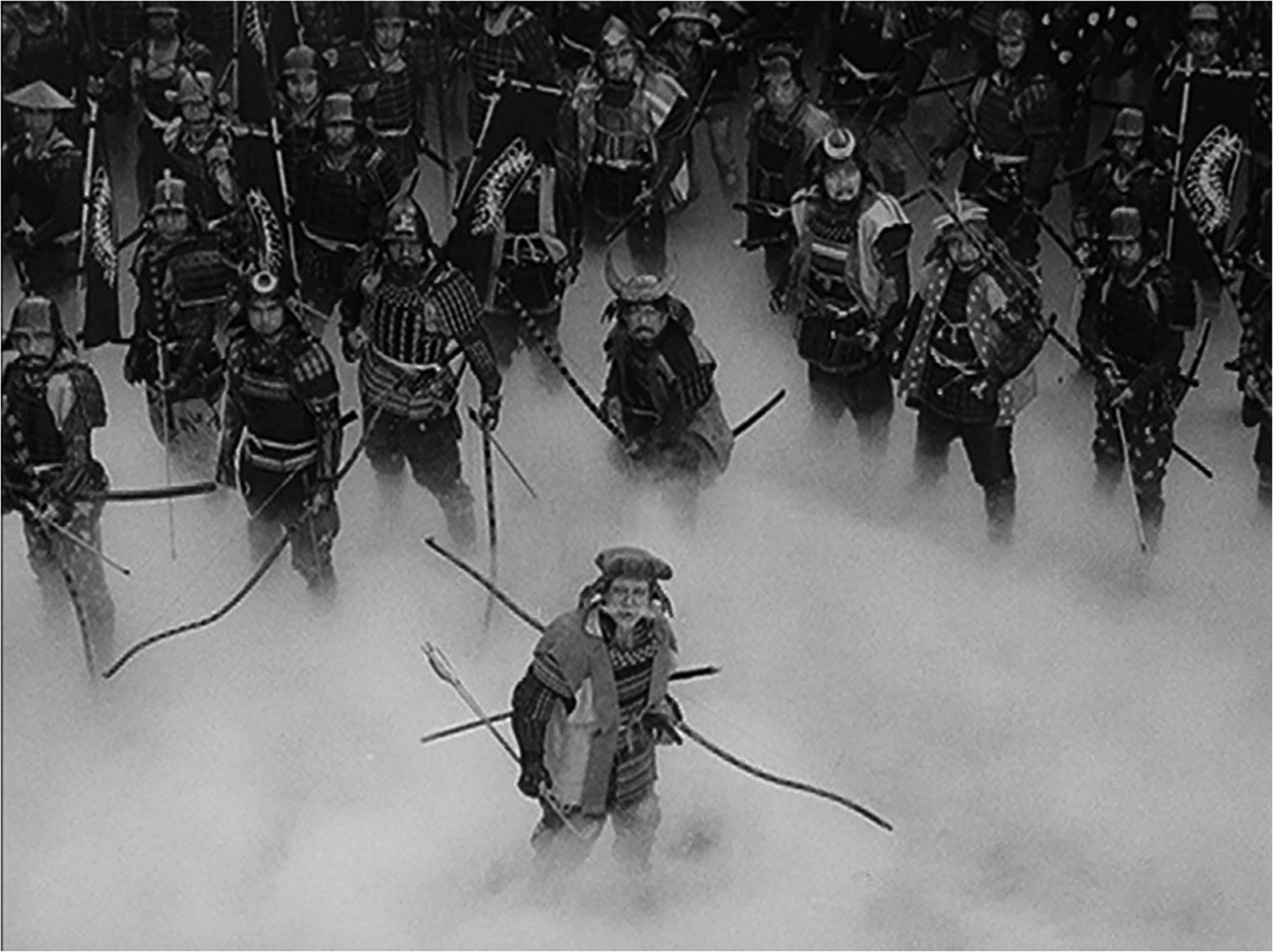
Mátrai also does not identify the leader of the final revolt in the film, who is positioned at the front of the rebellious army (see Figure 2). When Washizu levels the accusation, ‘You dogs! Traitors! It's high treason to murder your lord!’, the leader responds by shouting, ‘Who murdered our former lord?’ The screenplay only identifies him as ‘Voice’, and no critical attention has been paid to this character. However, based on his distinguishing features such as his white beard and long moustache, it is likely that he is one of Washizu's generals who sat with him in the headquarters in the castle's grand hall and stood behind him on the high tower a little earlier in the film. Therefore, at first glance, he may seem just another opportunistic traitor in the film, but upon closer examination, he emerges as a more complex character.
Throne of Blood (© TOHO CO., LTD.).
In fact, this white-bearded and long-moustached general appears at the very beginning of the film, though inconspicuously in a long shot. In the scene where Tsuzuki (Duncan) is waiting for a war report, accompanied by his generals, who are seated in two groups on his right and left, the same general is seated closest to Tsuzuki in the first row of the group on his right, opposite Noriyasu, who leads the army against Washizu at the end of the film. It is apparent that he was a trusted confidant of his former lord. The speech prefix in the scenario merely refers to him as an ‘old general’. He delivers three speeches there, including the line ‘Give treatment to his [the messenger's] wound’, which seems to demonstrate his benevolent nature.
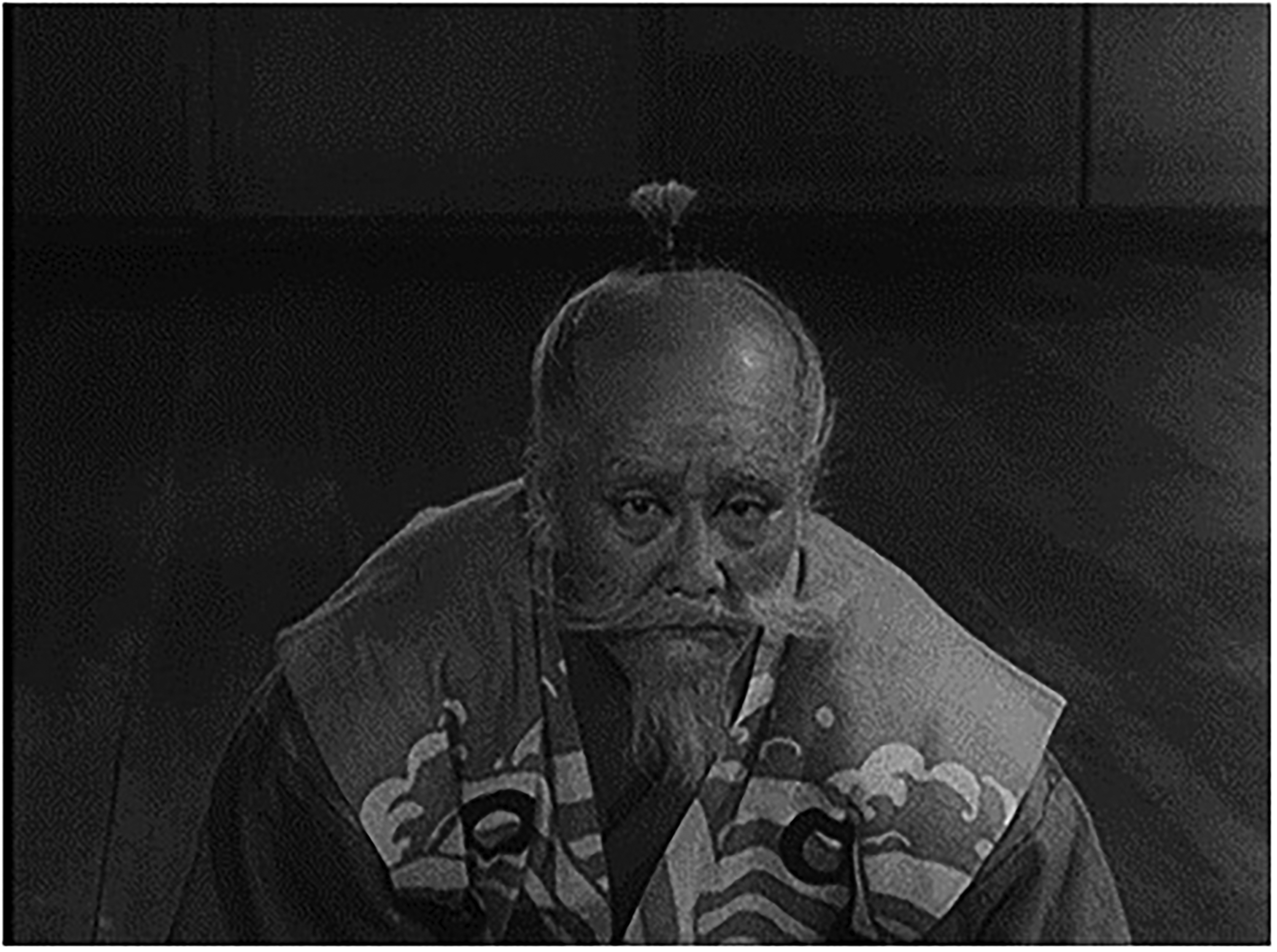
Significantly, he is also the person who performs the dance from Tamura during the banquet. The screenplay only identifies the dancer as ‘one of the generals’ in the speech prefix, 9 but his distinct appearance with a white beard and long moustache is unmistakable. In fact, his face is shown in close-up shots as he returns to his seat after Washizu interrupts the performance (see Figure 3). This is a rare treatment in the film, which mostly relies on full-shots. While the actor Kuninori Koudou (sometimes called Kokuten Koudou) is credited only as one of the ‘Generals’ in The Complete Works of Akira Kurosawa's Memorandum Section, it seems that he portrays these unnamed characters as variations of the same ‘General’. 10
Throne of Blood (© TOHO CO., LTD.).
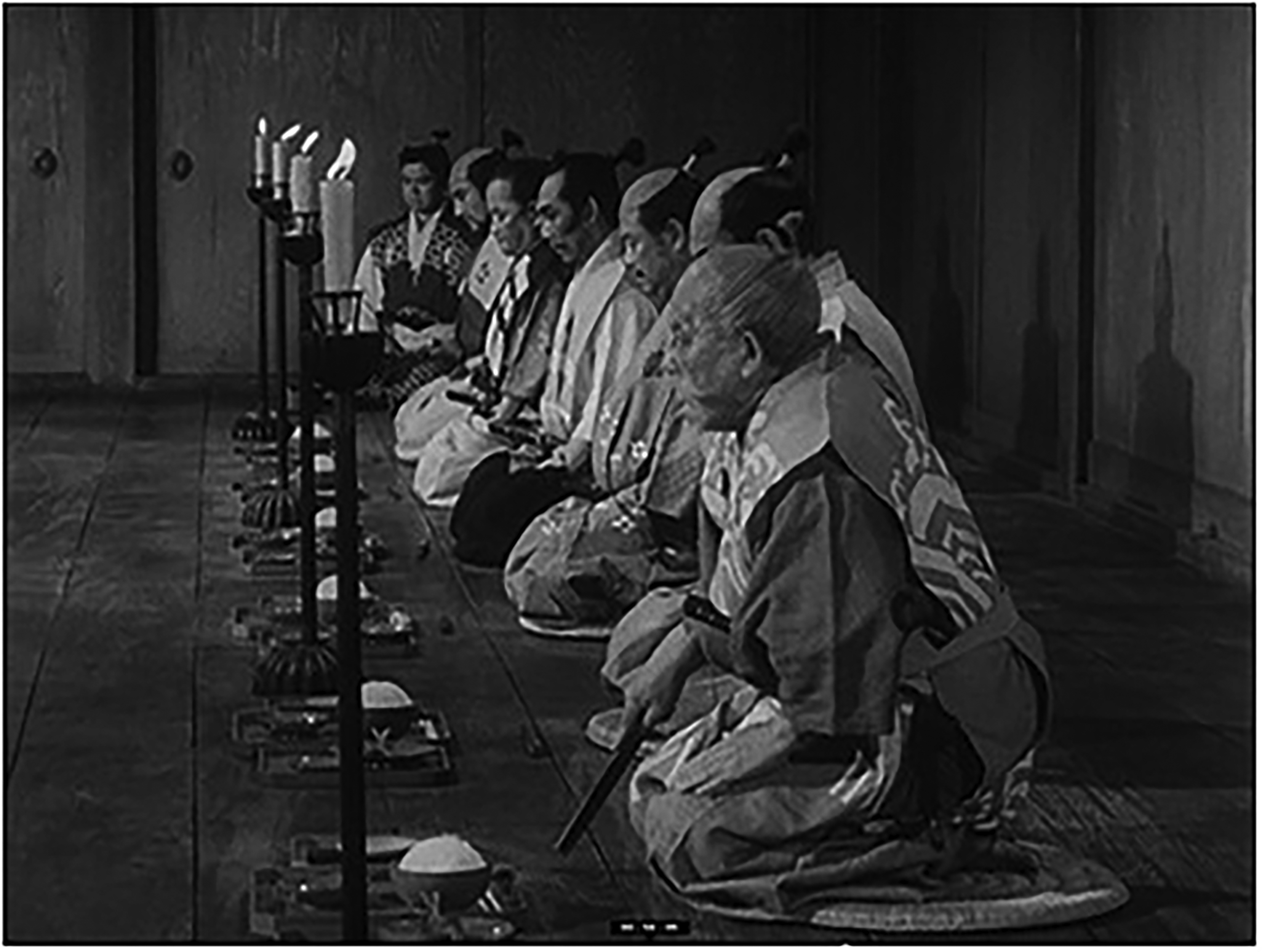
Given its theme of a deity defeating a traitor, the play Tamura was chosen for the banquet performance by this old general, not by Washizu himself, who has assassinated his own master. As previously noted, Mátrai observes that one shot appears to show the old general accusing Washizu of treachery during the performance. 11 However, while there is a shot where he raises his fan upwards and Washizu is visible in the background, they are not facing each other at that moment. I believe a more significant indication of the old general's defiance towards Washizu occurs when, after deeply bowing in apology and returning to his seat, he points the tip of his fan downwards (See Figure 4). Holding his fan in his right hand with its tip touching the floor, he assumes a posture reminiscent of that of Noh chorus members reciting their lines. This suggests that even after the interruption, he continues to perform the play to recite, though silently, the ensuing section for the chorus in which the Buddhist deity shoots a thousand arrows at the traitors and destroys them. It might sound far-fetched to suggest that Kurosawa is depicting such a detail of a character's imagination but we must note another instance of the general's imagined Noh performance: the loud and upbeat Noh music that viewers hear during the dance sequence at the start of the scene is revealed to be playing in his mind, as evidenced by the absence of musicians during the banquet.
Throne of Blood (© TOHO CO., LTD.).
Thus, the Noh performance can be interpreted as a manifestation of the old general's unwavering loyalty to his former lord and his mistrust of Washizu, and the last revolt as his enactment of the section of Tamura that was left unperformed at the banquet. At the climax of the film, he orders the soldiers to rain countless arrows on the traitor, as if to realise what the Buddhist deity does in the Noh play, and ultimately ends Washizu's tyrannical reign. It is noteworthy that he stands in thick mist, creating the appearance of a deity or otherworldly being on a cloud (see Figure 2). 12 What is intriguing in this respect is that his facial characteristics – the white beard and long moustache – resemble a Noh mask called Asakurajo, which represents an elderly common man who is often revealed to be the ghost of a legendary warrior in the progress of the Noh play. This also mirrors the old general's role in the film: he remains unobtrusive throughout most of the narrative but plays a crucial part in the end.
Susan Blakeley Klein, analysing the film from the perspective of the typical themes of Noh plays, observes that Throne of Blood is notably darker than many of them because of the absence of benevolent figures such as Buddhist deities or priests who can assuage the disturbed mind. 13 The darkness conveyed in this adaptation appears to exceed that of Shakespeare's original play too, as the characters here seldom implore divine intervention 14 or make references to the therapeutic qualities of medicine, be it figurative or literal. 15 However, as mentioned above, the old general's role and the potential embodiment of holy power add a heroic dimension to the film's otherwise bleak narrative.
Righteous rebellion, or obsession with life?
Nevertheless, the film concludes with a chorus that underscores humanity's blind obsession with life. Behold the ruins of the dream of the blind obsession with life.
16
Even now, it seems as if the restless spirits that once inhabited it still linger within. This is the path of shura [a strife-ridden existence] that springs from an unyielding fixation on the pursuit of life. And yet, this way of living has remained unchanged since ancient times to the present.
This obviously indicates Washizu's way of living, but it can also cast shadow on the old general and Noriyasu's defeat of Washizu, raising the question whether their revenge against a tyrant/traitor is another form of the human obsession with life, and asking what actions are appropriate in such a political crisis. This interpretation might make more sense to those who associate the final episode of the film with the end of Macbeth, which suggests that another war ensues between the victors and Banquo's descendant.
However, it is also true that in Kurosawa's adaptation, such an outcome is not certain. Yoshiteru (Fleance), who, according to the spectre's prophecy, will become a king in the future or whose descendant will, is portrayed as a sensible character who challenges his father's belief in the prophecy of the spectre in the film. Unlike Fleance, Yoshiteru participates in the final battle and cooperates with Kunimaru (Malcolm), suggesting a slightly brighter future than in Macbeth. It is also worth noting that Yoshiteru is not related to any historical figure in the way Fleance is to James I, and the fulfilment of the prophecy about his (or his descendant's) future enthronement is not guaranteed.
Those who are as blindly obsessed with life as Washizu are perhaps the common soldiers who betray him and shoot arrows at him. They seem to be motivated solely by their survival instinct, rather than loyalty to their former lord Tsuzuki or any political or moral belief. They raise a cheerful battle cry with Washizu when he declares his invincibility earlier in the war, but immediately desert him upon receiving news of the ‘movement of the forest’. In this respect, they resemble the ogres referred to in Tamura, who initially side with the traitor Chikata but desert him in the end – a marked contrast to the deity who shoots arrows at the traitors at the end of the Noh play.
Earlier in the film, their opportunistic nature is indeed hinted at in a scene in which some common soldiers gather to gossip about Washizu's turbulent situation after the banquet. 2nd Soldier: I heard a story from a man at the water tower the other day. He saw a crowd of rats swimming across the moat and fleeing from the castle.
3rd Soldier: It is said that from ancient times, rats abandon a house before anyone else when it burns. 17
Evidently, they wonder whether they should take a cue from the rats, and they do so in the end. Kurosawa not only portrays the insatiable ambition of high-status characters like Washizu, but also the lack of faith among unnamed commoners in the film.
This representation of commoners is linked to Kurosawa's treatment of another Noh play, Kurozuka, through his transformation of the ogre of the play into the film's spectre. As mentioned at the start of this article, Kurosawa stated in an interview that he found the former to be the only counterpart of witches in Western culture. The filmmaker retains the visual motif of spinning a wheel, but has altered the nature of the ogre. In Kurozuka, while taking this action, the ogre expresses her distress to the Buddhist priest and his attendants regarding the world's cruel treatment and the loss of her youth,
18
and then the Buddhist priest advises her to relinquish those emotions and instead adhere to the Buddha's teachings, as he considers her words to reveal an excessive attachment to life. In contrast, the spectre in the film spins a wheel and references Buddhist concepts, such as the Five Desires or Five Defilements, but does not relate them to her own circumstances, instead critiquing humanity in relation to those concepts: How despicable, how despicable, to be given life in the world of humans, only to torment themselves and pine away like a mere insect. How despicable, how despicable, a flower's life is brief and soon decays into rotting flesh. Humans burn themselves in the flames of their Five Desires, immerse themselves in the water of the Five Defilements, and accumulate sin upon sin. At the end of their delusion, the rotting flesh transforms into a flower, and even foul odours emit a fragrance. How fascinating the life of a human is. How fascinating, how fascinating.
In Buddhist terms, the ‘Five Desires’ relate to humans’ senses of sight, hearing, smell, taste, and touch; and the ‘Five Defilements’ are (1) the defilement of the age with the proliferation of wars, famines, and plagues; (2) evil thoughts; (3) the flourishing of greed, anger, and stupidity; (4) the spiritual decline of people owing to their deteriorated understanding of Buddha's teaching; and (5) the shortened human lifespan. 19 The Five Defilements, as most evidently in the Fourth Defilement, refer to people's states of mind, especially their general spiritual degradation. As common soldiers have not as yet been featured in the film, the spectre (or/and Kurosawa himself) implicitly challenges viewers to reflect upon themselves, unlike the three witches in Macbeth or the female ogre in Kurozuka.
Considering this, it is also worth noting that at the beginning and end of the film, the chorus directly addresses viewers through the imperative ‘behold’ and refers to their reality with the phrase ‘the present’ in the line ‘this way of living has remained unchanged since ancient times to the present’. That is to say, the ‘dream of a blind obsession with life’ the chorus alludes to can extend beyond the fictional world of feudal lords and warriors to encompass viewers as well. The criticism has sometimes been made that Throne of Blood lacks the emotional connection between the viewers and the protagonist that is present in the original play, or that Kurosawa escapes into mere aestheticism by adapting Shakespeare's play and Noh theatre into a film: what he really achieves here is, rather, to prompt viewers to reflect, in a subtle manner behind the design of Noh theatre, on their possible reactions to political crises, and their own outlook on life.
To conclude, Kurosawa's inclusion of the dance from the Noh play Tamura not only establishes the Noh theatre design of the banquet scene, which ironically symbolises the disorder and chaos that Washizu brings to society, but also serves multiple other functions. It is particularly significant that Tamura resurfaces at the end of the film, and this connection between the two scenes enables the film to represent the stories of both Washizu and the nameless old general: the contrast between Washizu and Tamuramaro highlights the former's betrayal, while the old general's dance and enactment of the final episode of Tamura offers a heroic story that balances the film's bleakness. However, the final chorus suggests that even this episode, especially the common soldiers’ opportunistic action, reflects the blind human obsession with life, whereby Throne of Blood flickers between optimistic and pessimistic worldviews. This sceptic view of commoners or masses is also evident in Kurosawa's transformation of Kurozuka's ogre into the spectre in the film. It is worth noting that the theme of the relationship between free will and fate, present in Macbeth, is weakened in the film by omitting the episodes related to Macduff. Through its treatment of Macbeth and intricate uses of Noh theatre, Throne of Blood provokes viewers to contemplate how to navigate their own lives, particularly during times of political upheaval, rather than inducing philosophical rumination on fate. Hisao Oshima observes that the film reflects on Japan's context in 1957, alluding to World War II and the country's realisation that blindly following military leaders led to its ruin. 20 The introspection required of viewers would have been particularly poignant to the Japanese people during the post-war reconstruction era, but the themes and questions of the film remain relevant in the present turbulent century, continuing to resonate with audiences today.
Footnotes
Acknowledgements
This article is an expanded and updated version of a section from my chapter (Chapter 3) of Henyousuru Sheikusupia, a book I co-authored in Japanese with Yumiko Hirono (Tokyo: Chikuma Shobo, 2023). The original section appeared on pp. 199–203 and 210–18.
Declaration of conflicting interests
The author(s) declared no potential conflicts of interest with respect to the research, authorship, and/or publication of this article.
Funding
The author(s) received no financial support for the research, authorship, and/or publication of this article.
