






Abstract
A common thread woven throughout the Stratford Festival's 2023 Shakespeare plays was inflexibility of thinking, and its consequences. Director Kimberley Rampersad's King Lear captured the irascibility of a monarch in decline through Paul Gross's performance of the title role. Lear's rigid insistence upon his three daughters’ public testimonies of filial adoration spurred him to reject his one true and faithful child, Cordelia (Tara Sky): her refusal to submit to the pageantry of his request became her downfall, and his. In Richard II, adapted by Brad Fraser and directed by Jillian Keiley, Richard (Stephen Jackman-Torkoff) indulged to excess in a disco-era hedonistic lifestyle despite, the production suggested, its connection with the AIDS virus and the moral implications of depleting banished cousin Henry Bolingbroke's (Jordin Hall) rightful inheritance. Richard's (Jackman-Torkoff) blinkered self-interest led, also, to ruin. Furthermore, Austin Eckert's Claudio in Much Ado about Nothing, with additional text by Erin Shields and directed by Chris Abraham, stranded his honest fiancée Hero (Allison Edwards-Crewe) at the altar due to unfounded rumour; his brash renunciation slandered Edwards-Crewe's innocent Hero and cost – it appeared – her life. Shields's textual additions also scrutinised sexual limitations and double standards imposed upon women by the patriarchy, vocalised largely by Edwards-Crewe's Hero. In extension, the rivalry between Beatrice (Maev Beaty) and Benedick (Graham Abbey) denied these two characters the opportunity to love and be loved by a kindred spirit – at least, until their friends intervened. Furthermore, inflexibility of thinking was present tangibly in Peter Pasyk's Love's Labour's Lost: King Ferdinand's (Hall) dictate that he and his followers repudiate feminine charms for three years of solitary study proved too demanding, as they all, hilariously, fell prey to the lure of the French court's women. Finally, Macbeth, played by Wug the goblin (actor unnamed) in Rebecca Northan and Bruce Horak's Goblin:Macbeth, directed by Northan, became fixated on his own rise to power to the detriment of his health, conscience, social standing, sanity, and eventually his very survival. The unequivocally negative consequences of inflexibility of thinking, as these productions illustrate, provide an admonition against reductive close-mindedness and bigotry only too topical in the contemporary era – one plagued by violent political tribalism and extremism.
Inflexibility of thinking emerged in director Rampersad's Lear in a variety of ways: most evidently, through the protagonist himself. Clad in severe black leather studded viciously with metal, Lear's (Gross) self-aggrandising demand for laudation initiated a fatal rift in his family. Sky's Cordelia, dressed in Marian blue, equally stubbornly refused to accede, rather exiling herself from her father's love. Lear's reliance on his two unfaithful daughters, Déjah Dixon-Green's yellow-robed Regan and Shannon Taylor's red-donning Goneril, faltered as they drained his coffers and denied him power, leading eventually to Gross's Lear's break with reality on the heath. The resulting schism precluded Cordelia's death, and then his own from grief over her loss.
Rampersad's choice to cast Gross as the ageing Lear seemed unusual: despite the actor's rich 45-year career in film, television, and stage, Gross's clean-cut boyishness could not be camouflaged, even under the snowy tresses and beard he sported. Canadian audiences likely struggle to disassociate Gross from his role as dashing, upright ‘Mountie’ (member of the equestrian Royal Canadian Mounted Police) in Due South, a television series that ran from 1994–1999. Although Gross had assumed a leading tragic role once at the Festival previously, playing Hamlet in the year 2000; and although acting should inherently afford its proponents opportunities for self-reinvention through role-playing, it was too challenging, ostensibly, to reimagine the spry Gross as an egotistical, failing, geriatric royal, ‘a poor, infirm, weak and despised old man’ (3.2.19).
Perhaps it was Gross's youthfulness that inspired his rather jocular interpretation of Lear. Seemingly at every opportunity, Gross's Lear courted chuckles through delivery or physicality. For instance, in the opening scene, Lear's ludic ‘while we / Unburdened crawl toward death’ (1.1.38–9) garnered laughter from the audience, as did his baffled ‘Am I in France?’ (4.6.69) near the play's end. Hearkening back to the 2022 season, his jesting seemed reminiscent of Colm Feore's wry Richard III. However, occasionally Gross's levity occluded his lines’ lyricism and gravity. For instance, his self-flagellation in repeatedly striking his head when lamenting ‘O Lear, Lear, Lear!’ (1.4.232) came across as too modern – too much resembling a ‘face-palm’ gesture – and too flippant considering his renunciation of his daughter Goneril. Later, his mock apology in absentia to Taylor's Goneril, witnessed by Dixon-Green's Regan, took on a snivelling air that detracted from his exquisite suffering. Most notably excessive was his jesting with the looking-glass and feather in the death scene. This usually poignant and wrenching moment in which a distraught Lear sought in vain for any sign of life in his daughter Cordelia's limp body lost its opportunity for pathos through Gross's clowning, unfortunately.
Nevertheless, Gross delivered an impressive performance, wringing out woeful lines in a marathon of grief. His realisation of his erroneous judgement – and its dire consequences – blossomed with the line to his daughters, ‘We’ll no more meet’ (2.2.385). Gross's physicality served him well in the storm scenes – his strongest – in which he stripped himself of his shirt and threatened the heavens, ‘Pour on, I will endure’ (3.4.18).
The other cast members supported Gross's Lear admirably. Dixon-Green's Regan was poised, emanating confidence and, in later scenes, military prowess. Costume designer Michelle Bohn's intensification of shades and angular lines for Dixon-Green's apparel as the play progressed reflected the character's increasingly violent behaviour; the same held true for Taylor's Goneril, while Sky's Cordelia's gowns grew lighter in shade. However, all three daughters carried swords by the play's end, signalling their growing antagonism. Dixon-Green's most scathing rejoinder occurred when Cornwall (Rylan Wilkie) suggested they put Kent (David W. Keeley) in the stocks ‘till noon’ (2.2.124): her reply, ‘Till noon? – till night, my lord, and all night too’ (125), was chilling. Michael Blake's Edmund created pathos and comedy, being especially skilled at accessing his upper register, while André Sills's Edgar was brilliant, particularly in the mist-bedewed ‘poor Tom’ scenes.

King Lear (Paul Gross, centre), with members of the company, in King Lear, Stratford Festival. Photo by David Hou.
Certain elements of the performance and staging might benefit from polishing, however. Anthony Santiago's Gloucester, performed admirably, could have used more blood in the eye-gouging scene. Some of supervising fight director Geoff Scovell's stage combat fell rather flat, as when Lear's slap was visibly unconnected with his target, Oswald (Devin MacKinnon). Similarly, the battle between the two brothers (Sills and Blake) at the finale, breathtaking when their weapons were dropped, was occasionally clunky – perhaps due to the odd conglomeration of sword versus axe and shield. Furthermore, Sky's Cordelia seemed consumed by metre at the play's beginning, while Taylor's Goneril distractingly shook her head when speaking; both improved as the play progressed, with Taylor fully inhabiting her character's woe, weeping and gasping at her father's curses. Clearer elocution could have assisted David W. Keeley's Kent. Finally, Gross's ‘O, reason not the need!’ (2.2.430) could have been more emphatic.
Regrettably, there was a disconnect between set designer Judith Bowden's austere stage and some of the production's blocking: at several points, either the central pillar or the columns supporting the balcony obscured the audience's view of the actors, even in the central orchestra area. Dixon-Green's Regan, for instance, was only partially visible behind a balcony column in the opening, while the same held true for Taylor's Goneril in her scene with Oswald. While this sort of staging may have been intentional, emphasising the skulking, surreptitious nature of certain characters, it appeared odd and disjunctive rather than purposeful. Some of these issues resolved themselves with the felling, to spectacular effect, of the central post in the storm scene; at this juncture the post represented a tree struck by lightning, and it rested aslant across the stage throughout the remainder of the play. Nevertheless, a more considered dialogue between stage design and blocking would have been preferable.
Rampersad's Lear, though beset by stylistic impediments, proffered a fresh take on Shakespeare's tragedy that accessed the play's more comedic elements – largely on account of the sprightly protagonist. Nevertheless, stubbornness and inflexibility of thinking seduced Gross's Lear and Sky's Cordelia to their doom.
A second examination of the consequences of inflexibility of thinking surfaced in director Jillian Keiley's ethereal Richard II. Set in queer spaces in the post-Stonewall New York of the late 1970s and early 1980s, and adapted by playwright Brad Fraser, the production capitalised on the play's implied homoerotic relations between the monarch and male courtiers. Jackman-Torkoff's flamboyantly queer Richard submerged the court in a lifestyle of excess: fantastical fashions dripping with finery, frequenting of bath houses, and song and dance and riotousness commandeered their time. This rich indulgence plummeted Jackman-Torkoff's Richard headlong into debt, usurpation, public rejection, possibly disease, and ultimately, death.
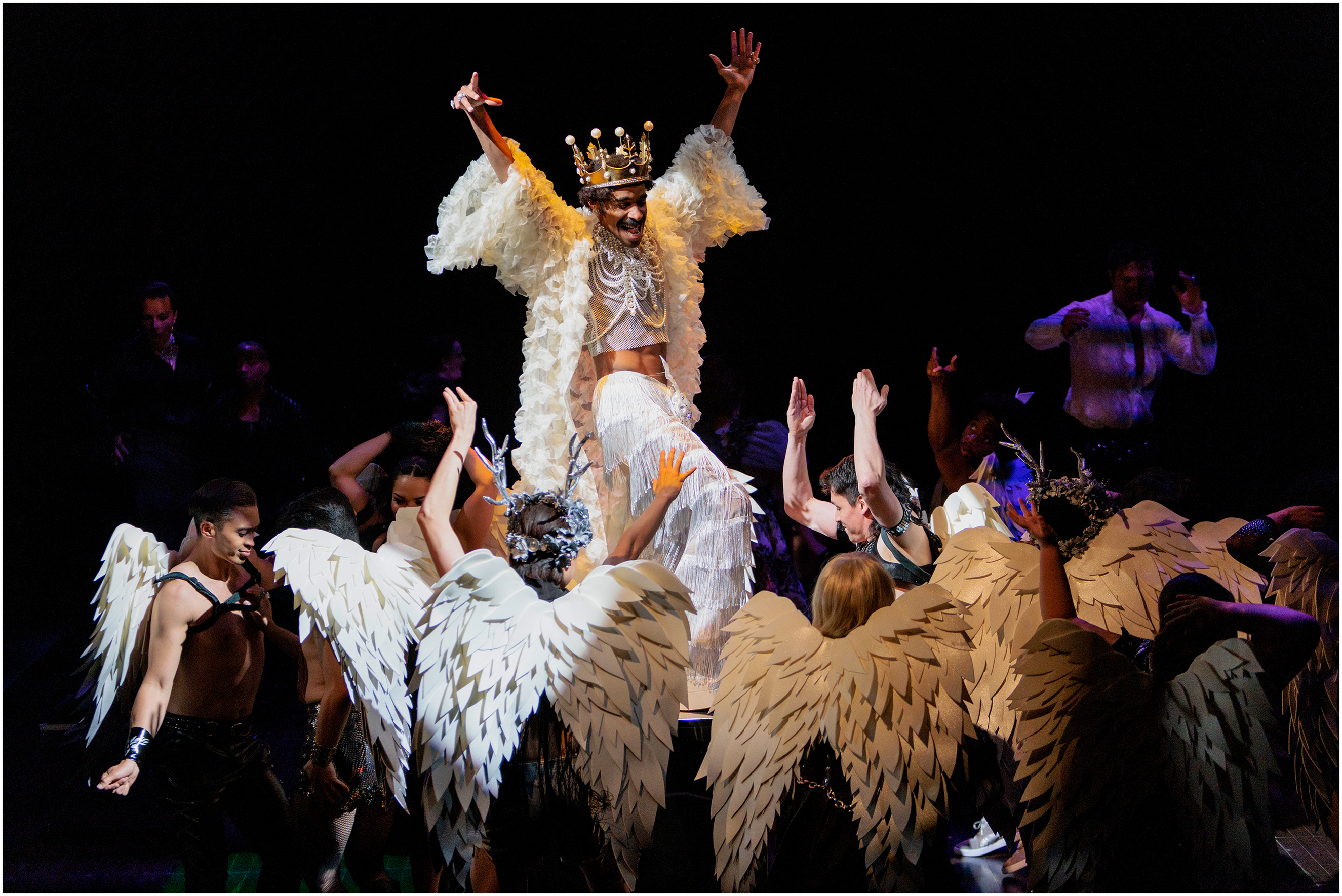
Richard II (Stephen Jackman-Torkoff, centre), with members of the company, in Richard II, Stratford Festival. Photo by David Hou.
The text was largely faithful to the original, with some additions, such as the description of the male courtiers as the ‘brotherhood of the dark unknown Priapus’, and the explanation regarding Lord Willoughby's (Charlie Gallant) contraction of HIV / AIDS: ‘This new disease is a punishment’. Lines plucked from various parts of Shakespeare's other works punctuated the play, such as the ‘Graze on my lips’ (233) passage from Venus and Adonis; the ‘Is not that strange?’ (4.1.266–7) line from Much Ado about Nothing to describe Richard and Aumerle's (Emilio Vieira) love; the expression of gratitude from Twelfth Night, ‘I can no other answer make but thanks’ (3.3.14); Ross's (Matthew Kabwe) maxim, ‘A friend should bear his friend's infirmities’ (4.2.140), taken from Julius Caesar; and the dying Willoughby's (Gallant) passionate recitation of ‘Sonnet 147’, ‘My love is a fever’ (1). While Fraser's extratextual non-Shakespearean additions seemed logical to describe the presence of AIDS in the play, the Shakespearean emendations seemed less essential; apparently, their function was an intensification of the relationship between Jackman-Torkoff's Richard and Vieira's Aumerle.
Keiley's production also appended a chorus of angel dancers sporting gorgeous, feathered wings and black leather BDSM (bondage, discipline, dominance, and submission) wear. The director's notes explain that the Wilton Diptych, a painting depicting Richard II kneeling before Mary, the infant Jesus, and a cluster of angels sporting the monarch's stag emblem, inspired this addition. It was used as Richard II's personal altar piece. Richard's line, ‘Then if angels fight, / Weak men must fall’ (3.2.57–8) textually justified their presence also. The angels, Keiley explained, represented ‘the manifestation of power itself’ (5) in the play: while they celebrated Richard's sovereignty in earlier scenes and guarded the monarch before the deposition, it was the angels who transferred the crown to Bolingbroke's (Hall) head, passing it aloft along a catwalk from one to the other, before parading Jackman-Torkoff's Richard through the streets half-naked. The dancers deserved accolades for their breathtaking abilities and stamina, recalling the chorus dancers of Keiley's 2017 production of Euripides’ Bakkhai.
Jackman-Torkoff's performance as Richard – the Festival's first assumption of the role by a Black actor, and one who is nonbinary – was one of virtuosity. Jackman-Torkoff's lithe, toned Richard embodied Black queerness physically through gesture, such as bringing their hands to their mouth and giggling (not to mention costume designer Bretta Gerecke's luscious feathers, furs, fringe, pearls, and platforms), and also vocally through a lilting delivery and use of the upper register. Their trite ‘So much for that’ (2.1.156) following John of Gaunt's (David Collins) death created titters in the audience, as did their patronising ‘Up, cousin, up’ (3.3.192) when mocking Hall's Bolingbroke's usurpation. Jackman-Torkoff created pathos as well through eloquent lyricism and use of lower register, such as Richard's poignant realisation that Death ‘with a little pin / Bores though his castle wall’ (3.2.165–6), and the snide ‘Give Richard leave to live till Richard die’ (3.3.173). One could have heard a pin drop in the death scene, in which lover and in this production assassin Aumerle approached Richard from behind with a gun drawn. Jackman-Torkoff's Christic offering of self with arms spread solidified Richard's role as lover rather than fighter.
Spectacle was the dominant element in this production. Particularly memorable was the hot tub scene, one in which Jackman-Torkoff's Richard and Vieira's Aumerle lounged opposite each other in a vessel created by mirrored risers enveloped in strips of cloth. The wisps of steam emanating from the water's surface and sound designer Don Ellis's lapping of water were extremely convincing. Clearly, intimacy director Aria Evans had worked assiduously with the entire cast, and especially with Jackman-Torkoff and Vieira in this highly sexualised scene. Furthermore, the transformation of the knightly combat into a fistfight between Hall's Bolingbroke and Tyrone Savage's husky Mowbray was a clever one and well executed, overseen by supervising fight director Geoff Scovell. The head-smash and sound effects were quite realistic. The mimed hanging of Andrew Robinson's genderqueer Bushy and John Wamsley's delicate Green was also staged impressively with creaking sound effects simulating taut ropes. While the musical theatre and dance sequences seemed rather excessive and lengthy at times, as in the bath house scene, they did capture the protagonist's libertinism effectively.
The one flagrant issue with the staging was the blocking in the death scene. As with Lear, the sightlines were compromised, even from a centre stage vantage: it was difficult to see the interaction between Aumerle and Richard, to tell whether they were slow-dancing, kissing, or wrestling, or all three. This issue would have been prevented had Jackman-Torkoff's prison been further upstage.
Nevertheless, the cast demonstrated impressive ease with one another and total immersion into glitzy disco-era New York. Michael Spencer-Davis was masterful as York, a man willing to testify against his own son to protect the monarch; Debbie Patterson playing the Duchess of York shone in her ‘Hast thou groaned for him / As I have done thou wouldst be more pitiful’ (5.2.102–3) speech. It was innovative to use the angels to assist Patterson to a kneeling position from her wheelchair. While Hall's Bolingbroke seemed to focus excessively on metre at times, Kabwe's sturdy Ross offered a natural delivery. Finally, Hannah Wigglesworth's Queen Isabel could have employed more emphasis and slowed her lines for impact, though these elements improved as the production progressed. She excelled when using her lower register, as in the lines ‘thou little better thing than earth’ (3.4.79) and ‘wither he goes, thither let me go’ (5.1.85).
Spurred on to destruction by an hedonistic lifestyle, Jackman-Torkoff's Richard demonstrated the consequences of solipsistic inflexibility. This visually stunning production revitalised arguably Shakespeare's most poetic history play, delving into its queer potential in a glorious display of opulence.
A third production that incorporated the theme of the inflexibility of thinking was Abraham's Much Ado. Fixated by hearsay of his fiancée's infidelity, Eckert's Claudio descended to violence, pushing Edwards-Crewe's Hero down a flight of stairs at their botched nuptial ceremony. His unwillingness to solicit her perspective catalysed her heartbreak, tarnished reputation, despair, and to observers, her death. The severity of patriarchal double standards served as a second and related form of inflexibility of thinking – an issue both Beaty's Beatrice and Edwards-Crewe's Hero critiqued in playwright Erin Shields's textual additions. Beaty lamented, ‘It's exhausting to be innocent’ in the play's opening; Edwards-Crewe proffered a more concentrated, vituperative critique of double standards. In the latter passage the character Hero defended herself and posited the possibility that she had had a previous lover, going into details made cringeworthy as her father, Patrick McManus's Leonato, looked on. While these additions resolved some of the discomfort a twenty-first century audience might feel when watching the play, the rapid recapitulation of Eckert's Claudio and insistence that Hero was better than him and that he was ‘learning’ seemed contrived and simply too contemporary. Finally, the longstanding rivalry between Beaty's Beatrice and Abbey's Benedick prevented them from acknowledging their compatibility and mutual attraction; in comic fashion, however, unity prevailed when the characters’ friends orchestrated a reconciliation between the two.
Set in a sun-drenched Messina populated with succulents, stone benches and statuary, warm earth tones, and orange trees, designer Julie Fox's stage boasted a central tree towering nearly to the Festival Theatre's ceiling. This tree served as a perch for both Benedick and Beatrice, respectively, during the gulling scenes. Abbey clambered up the tree at his friends’ approach, only to fall out of it and ensconce himself behind a potted plant, to great hilarity. Beaty's gulling scene involved her character becoming entrapped by and subsequently swinging on a gate as her hair snagged on it, hiding under a table that surreptitiously moved when she crawled, and finally ended with her dangling precipitously from the balcony after climbing the tree. The more diminutive Seville orange trees mobilised action also, as when Eckert's Claudio hid his tears by speaking to a tree rather than to André Sills's assured Don Pedro, cleverly weaving in Beatrice's punning description of Claudio as ‘civil as an orange, and something of that jealous complexion’ (2.1.255-6).
Beaty's rust-clad Beatrice was wry, witty, and bawdy, bleating goat-like after insisting that she would ‘rather lie in the woollen’ (26) than marry a bearded man. Beaty utilised both slapstick and wordplay to her advantage: when Abbey's Benedick flaunted his naked torso, attempting to impress her, she pinched his nipples and scathingly repurposed Shakespeare's line, ‘You have no stomach, signor’ (2.3.225). Extra-textually, Beaty's Beatrice rationalised Benedick's (Abbey) exhibitionism by interjecting, ‘Ah … this is because there are so many women in the audience’. Her use of vocal fry made her character seem both relatable and jaded. Furthermore, Beaty's Beatrice uniquely offered glimmerings of her own loneliness and inner conflict, as when she wiped tears away following the announcement of Hero's (Edwards-Crewe) engagement. Her ‘Kill Claudio’ (4.1.287) and ‘O that I were a man’ (300–1) speeches solicited chills.
Abbey's Benedick was equally adept at physical comedy, interacting with audience members sporadically with high-fives and requests: his tumble down the stairs upon Don Pedro's (Sills) declaration that ‘Beatrice was in love with Signor Benedick’ (2.3.85–6) was especially realistic. At points, his volume could have been louder and his line, ‘Is not that strange?’ (4.1.266–7) was rather lost due to audience interference; his head-shaking in the same scene seemed a bit stagey also, and his leg lifts while lamenting Claudio's (Eckert) love unnecessary. In such a sexually liberated version of the play, the lost double entendre in Abbey's conviction that his character would ‘die in [Beatrice's] lap’ (5.2.86) was surprising.
To improve, pausing for audience reaction would benefit Jakob Ehman's Borachio and Sills's Don Pedro; Josue Laboucane's Dogberry should emphasise the malaprops in his lines further; and Eckert's Claudio would do better to access loss and sorrow more, though his audience engagement was excellent.
Impressive performances included Michael Blake's deadpan Don John, a cold, calculating figure who methodically extinguished a fly between his fingers, as well as MacManus's Leonato, whose comic timing was excellent.
Despite the production's unwieldy additions, Abraham's Much Ado frolicked with levity and capitalised on the positive outcomes of reconsidering inflexibility.
Pasyk's wildly popular modernised Love's Labour's Lost was a fourth production to incorporate the theme of inflexibility of thinking, ostensibly through the celibacy vows of Hall's Ferdinand, Savage's Berowne, Chanakya Mukherjee's Dumaine, and Chris Mejaki's Longaville. Truncated to less than two hours, this often-cumbersome play sparkled with vivacity. Julie Fox's charming topiary garden set revealed a turf floor upon which the audience trod and ivy-covered walls. Comical adjustments to the play include the young men overhearing the camped-out women playing ‘Truth or Dare’ and shouting, ‘Let's go skinny dipping!’; Gordon S. Miller's lisping, spitting Don Armado, resulting in his greeting, ‘Men of piss [peace]’ (5.1.32); and the men's seductive masque, with all clad in false beards and firefighters’ muscle shirts, hard hats, braces, and goggles, and dancing with a hose the length of the stage.
Hall's Ferdinand was confident and authoritative, as was Celia Aloma's Princess of France; Savage's Berowne was animated and appropriately cynical. There was tangible chemistry between Wahsontí:io Kirby's Costard and Wigglesworth's Jaquenetta, and Jane Spidell's deadpan Dull delighted. While Miller's Armado's flamboyance became a bit grating, Christo Graham's sidekick Moth evinced a penchant for clowning, notably as the diaper-clad infant Hercules in the pageant of the Nine Worthies. Spencer-Davis demonstrated a marvellous sense of timing as Holofernes; it was a shame that costume designer Sim Suzer chose, repugnantly, to sprinkle his academic robed-shoulders with dandruff.
With such an energetic, cohesive cast and staging, the production offered few opportunities for polishing. However, realism was an issue at points: Berowne's ‘entrapment’ by a locked gate was not entirely convincing, and composer and sound designer Thomas Ryder Payne's rain sound effect marking the death of Aloma's Princess's father resembled more a tap running than drops falling. Throwing himself into Dumaine's role more passionately would benefit Mukherjee; relatedly, occasionally Elizabeth Adams's Katharine did not seem to be entirely in character. Finally, the masking of the women under mosquito-net hats, rain-jackets, and rubber boots suffered from the significantly shorter stature of Qianna MacGilchrist.
Regardless, Pasyk's production was a resounding success, denoting the comical consequences of attempting – and failing – to evade love.
Finally, director Northan's interactive and improvisatory Goblin:Macbeth, part of the Meighen Forum, delineated the tragic consequences of unfettered ambition – though in a surprisingly comical way. Involving only three unnamed actors who assumed the roles of goblins Wug, Cragva, and Moog, plus the stage manager Lili Beaudoin, the play explored a goblin's first encounter with the Macbeth text. The goblins entered the Studio Theatre lobby through the front doors, complained vociferously about an art installation (which they later dismantled and used as Birnam Wood), and led the audience to their seats. They discovered Shakespeare's complete works – ‘the good book’, they attested – and decided, in a display of stunning virtuosity, to perform Macbeth because ‘it is the shortest and has the most blood’.
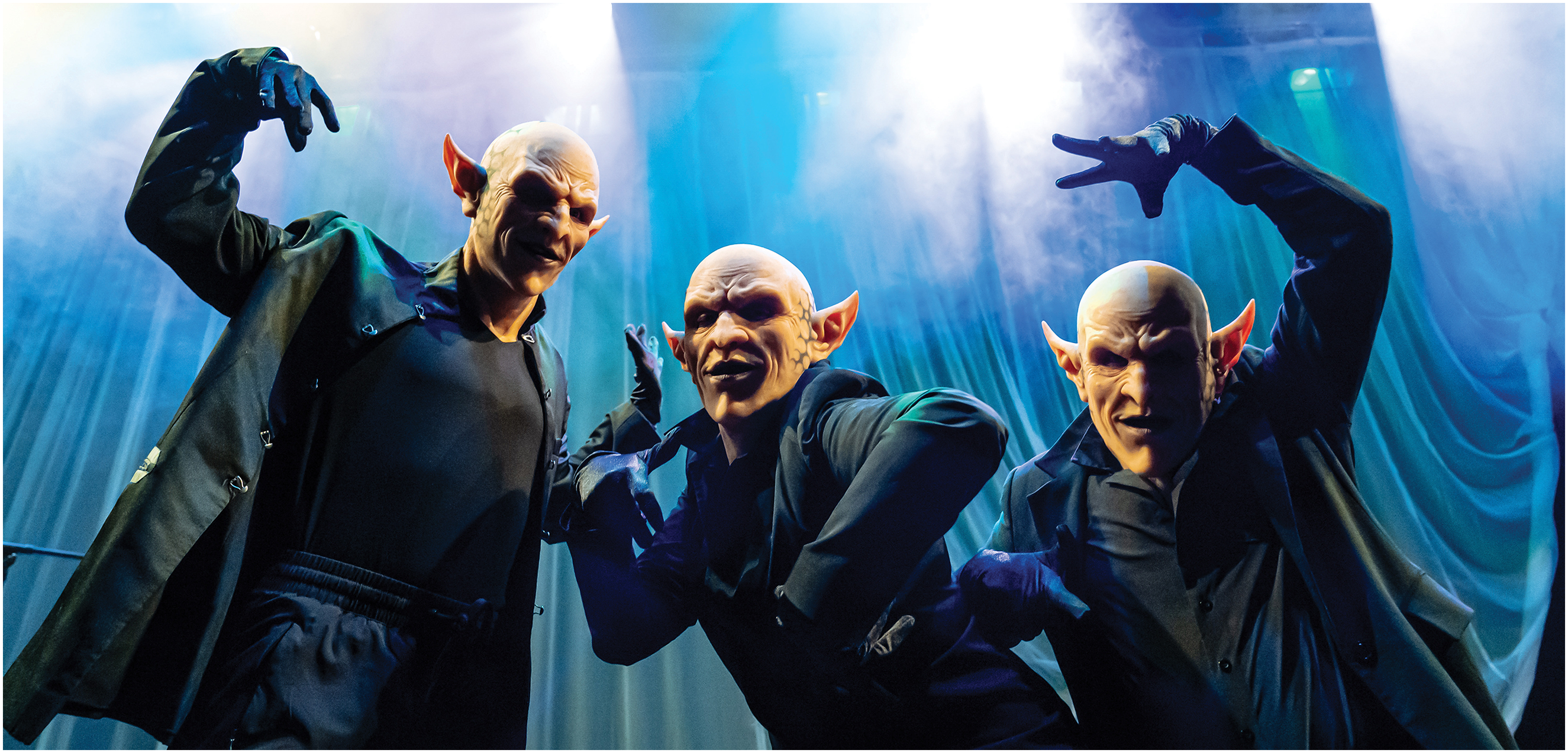
The three goblins in Goblin:Macbeth, Stratford Festival. Photo by Tim Nguyen.
Throughout, the actors involved audience members at random, hassling latecomers, asking questions, and seeking volunteers. The woman who shut off a portable speaker became their worshipped ‘witch’, while another who disappeared reputedly provided the daggers’ blood. They mocked the text – ‘Oh my … was that all one sentence? Where are you supposed to BREATHE?’ – and interjected throughout, such as when Macbeth reprimanded the Murderer, ‘You had one job’.
The actor playing Wug proffered a phenomenal performance as Macbeth, his delivery resonant and his commentary wry. His otherwise musical vocal range was rather strained in the dagger scene – unsurprisingly, as he shifted parts vertiginously and shouldered the play's central role. The actor playing Cragva was equally dynamic: her ‘So much more the man’ (1.7.51) as Lady Macbeth was simply thrilling, her enjambment was beautiful, and as Macduff her unarmed dispatching of Wug's Macbeth by snapping his neck elicited gasps. Comparatively, the actor representing Moog assumed a minor role, playing instruments upstage and embodying Fleance. All three actors navigated Composite Effects’ magnificent yet restrictive goblin prosthetics with aplomb, using body language and vocals over facial expressions to convey meaning.
Employing goblins as Macbeth's performers was questionable: witches seem a more congruent choice. Furthermore, use of the f-word may have been excessive for some audience members. Nevertheless, Goblin:Macbeth's macabre humour fostered a refreshing interpretation of one of Shakespeare's most famous tragedies, highlighting the brutal consequences of ambition-driven inflexibility of thought.
In a world beset by bigotry and factionalism, this season's Stratford Festival plays reinforced the all-too-often negative consequences that inflexibility of thought generates.