






Abstract

Why can't she behave? Those familiar with Cole Porter's golden-age Broadway musical will remember that its rejiggering of The Taming of the Shrew plot by Bella and Samuel Spewack (penned in 1948), a collaborating couple with first-hand experience of marital discord themselves, their script inspired by yet another clashing couple's performing a 1935 revival of the same Shakespeare's play) takes the metatheatrical possibilities of Shrew to new heights, particularly its induction scenes. Not only does the musical mount a sumptuous if scaled-down rendition of Shakespeare's original play set in Padua; it also creates a fully-fledged framing story that includes some Mafia-style thugs and dramatises the ‘real’ lives of its actor couples, whose present-day romances mirror Kate and Petruchio's and Bianca and Lucentio's while remaining true to a late-1940s flavour. Effectively, Christopher Sly's induction scenes expand wholesale to become half of the script and less equivocally related to the main action's plot and protagonists, as if Tom Stoppard's Rosencrantz & Guildenstern were fully witting participants in the play action unfolding around them. Set within the Barbican's cavernous theatre, Brutalism is transformed into a beautiful set-piece of Renaissance splendour, a chocolate box jewel within a concrete frame (set design by Michael Yeargan).
Kiss Me, Kate never lets the audience forget we are watching a musical production of a musical production of Shrew – before the 1940s action begins, set in Baltimore, our view is of the backstage, with a spiral metal staircase rising up to the catwalk level, allowing us a full perspective of the actors and stage director (he remains downstage right most of the time) milling about, warming up, sweeping the stage, running through cues for Shrew. A few scenes in, the stage manager instructs that the house lights, on thus far in the auditorium, be shut off, and throughout the performance, we see offstage actors hanging around to smoke. Kate, or her shrewish alter ego, Lilli Vanessi (Stephanie J. Block), is late for the curtain call rehearsal. Finally she swans in, a fashion plate for Dior's New Look (this style gets a shout-out later) in a cobalt-blue peplum jacket and a long skirt (costume design by Catherine Zuber). Lilli pauses to belt Petruchio in the stomach (because she can?). Her ex-husband ‘Petruchio’/Fred Graham (Adrian Dunbar) recovers enough to give the actors, ‘his family’, a pre-show pep talk before the cast's joyous warmup number, not yet the beginning of Shrew, accompanied by a full orchestra (Figure 1).
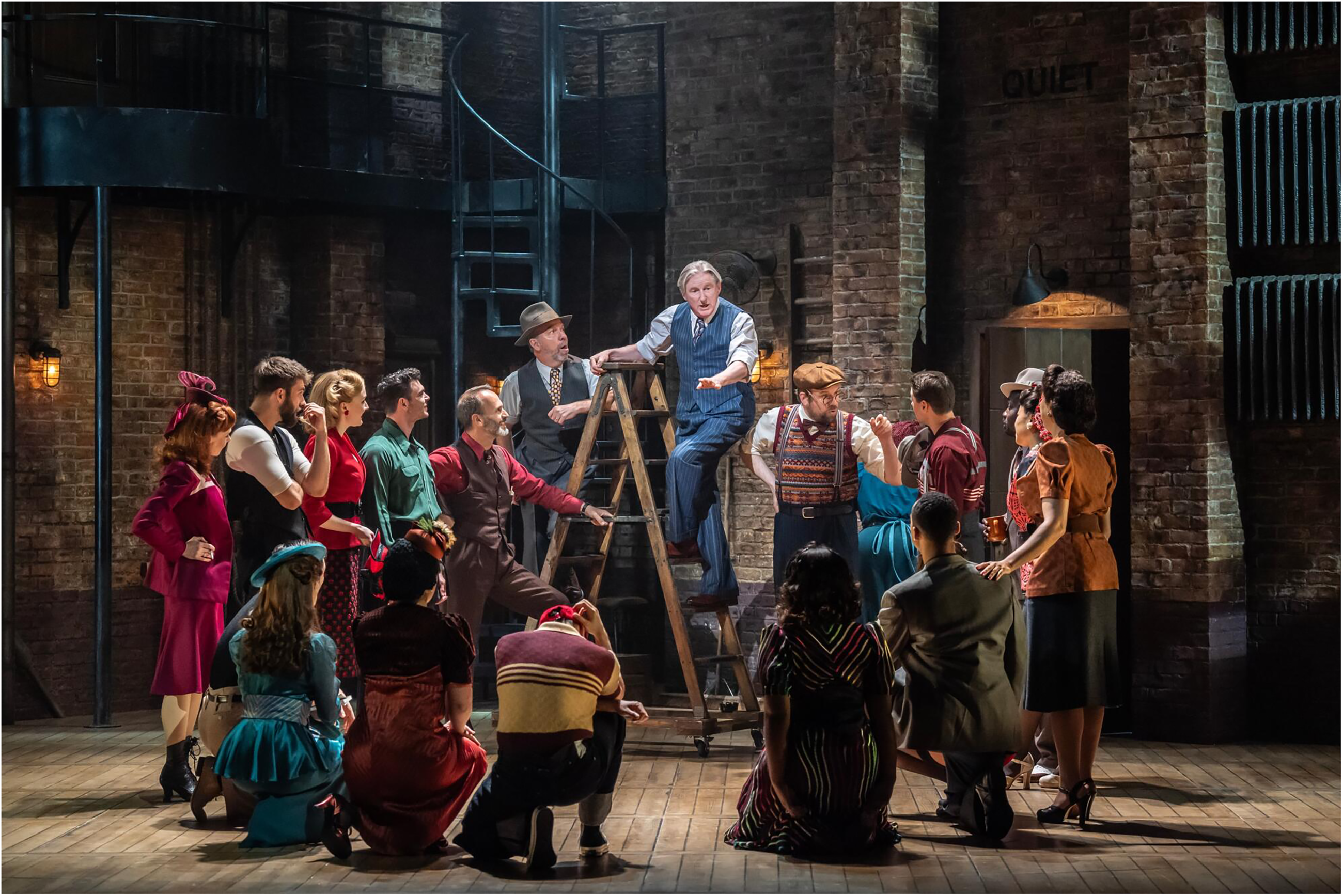
Petruchio/Fred Graham (Adrian Dunbar) with company, in Kiss Me Kate, Barbican Theatre. Photograph by Johan Persson.
The stage revolves around (a four-sided cube, with different rooms, sometimes Shrew's Renaissance set) to land us at the theatre company's back door, where Bianca/Lois Lane (Georgina Onuourah and Lucentio/Bill Calhoun (Nigel Lindsay) sing their regrets about Bill's gambling, ‘Why Can't You Behave?’ when he confesses he has signed Fred's name to an IOU to local gangsters. The stage pivots to Lilli's and Fred's adjoining dressing rooms (divided so that we see both halves), where she, in a pink satin negligée, takes a phone call from the American president (later, we learn her fiancé is tipped to be ‘Truman's’ running mate). In the upstairs dressing rooms, we see the costume managers preparing Renaissance-era gear for Shrew. Reunited to perform the lead roles in Shrew, Fred and Lilli discuss their divorce amicably (Fred good-humouredly claims, ‘April is the cruellest month’), trading fond memories of their prior starring roles while waltzing to ‘Wunderbar’. As Fred prepares to go onstage, some Chicago-style, Brooklyn-accented mobsters (Nigel Lindsay and Hammed Animashaun) pay him a visit to remind him about his ‘autograph’ on the IOU, wishing him, ‘break a leg’. More misprision ensues when the same flowers Fred typically sent Lilli for their anniversary (now intended for Lois instead) accidentally get delivered to Lilli, who is thrilled to ponder rekindling their romance. Still ‘So in Love’, she claims to longer want to abuse Fred – at which he sardonically observes, watching Lilli tuck the card addressed to another into Kate's costume, ‘you will’.
Even before Lilli discovers the error, furious shrieking and bellowing issue from within a house's upstairs balcony: introduced to Kate, we have arrived in Italy: the stage revolves again to reveal a beautifully painted watercolour scene of a town square. Other changes of Shrew's locations and scenes are projected onto the stage curtain, including, oddly, Venice. Petruchio breaks up a spat among the suitors and beats up Gremio (Jordan Crouch), announcing he comes to Padua to ‘wive it happily if wealthily, mad you-ah’. Warming up with a brisk round of hurling flowerpots at Bianca's suitors (every ‘Tom, Dick, or Harry’ line up to plead their suits in a very athletic dance number while Bianca tap dances and scats some lyrics), Kate appears wielding a broomstick to sing declaratively, ‘I Hate Men’. Just then, discovering onstage – while in her Kate persona – the card addressed to Lois, Lilli/Kate exhorts the audience to join her in the vituperative chorus, finding new motivation for her role as ‘cursed’ Kate. Storming through the revolving set's ‘offstage’ rooms, she finds Fred/Petruchio acting onstage and refuses his contrite sotto voce pleading her to ‘behave’. Their quarrel becomes real (furniture is a casualty), and he attempts to spank her; hitting Fred below the belt figuratively this time, Lilli insults his lesser stardom and performance venues, shouting ‘Croydon is not London!’ to the audience's delight.
Fred's problems multiply because he cannot placate Lilli enough to stay on in her role as Kate, with the bookies now returning to collect their funds. Alternately affable and apologetically menacing, these are mobsters surprisingly well informed about the Stanislavsky method, so Fred makes the pair stage producers, grasping at straws to find a way to prevent Lilli from quitting and shutting down their production of Shrew. They are gratified to take up their new position, genially waving Lilli back onstage at gunpoint to resume her role, ‘the show must go on.’ Later, they reassure everyone, ‘guns don't kill people – we do!’
Go on 3.1 does, the ‘producers’ dragging Kate onstage and stealing the thunder from Petruchio's sartorial faux pas, wearing comically ill-fitting skirts and head scarves, resplendent with sock suspenders. Lilli's struggling is visibly restrained by her escorts, accounting for her acquiescence to the wedding. Petruchio cracks a whip (he has been practising with this conventional Shrew stage prop), causing the skittish mobsters to fire their guns, and a melée ensues, prefacing a full-on ensemble musical number ‘Too Darn Hot’. Backstage, dressed down to their Elizabethan-role skivvies, the female chorus wear red corsets and farthingale frames, while the Shrew-proper scenes are beautifully, even lavishly costumed, reminiscent of Franco Zeffirelli's period-set film. Fred breaks character as Petruchio to complain ruefully to us (previewing his 4.1 ‘kindness’ speech) that his cast are trying to put on a play about women being tamed when it is 1948, which, he says, is funny given that Lilli is the ‘fierce one’. Our gangster duo earnestly listen, chewing gum in the wings, and helpfully explain to us that an ‘anachronism’ is just ‘like a Colt 45 going off in a sixteenth-century play’.
Shifting to Petruchio's house, we see another stylised drawing of a Tudor house with long black ceiling beams, where, we realise, along with Petruchio's suppression of Kate's wants, Fred's ‘taming school’ involves previewing Lilli's imminent marriage to the impossibly staid military General Harrison Howell (Peter Davison), now a vice-presidential candidate, and leaving her glamourous theatre career for dull Washington, DC, which will be ‘full of Republicans’. Dunbar is markedly less ‘politic’ than weary and mildly contrite. After Petruchio's speech instructing us this is the way to ‘kill a wife with kindness’ and being kicked out of Kate's bedroom to sleep on a long wooden dining table, he woefully queries us, ‘Where Is the Life That Late I Led?’ to which he answers himself, ‘Totally dead!’ (Figure 2).

Lilli Vanessi/Kate (Stephanie J. Block) and Petruchio/Fred Graham (Adrian Dunbar) in Kiss Me, Kate, Barbican Theatre. Photograph by Johan Persson.
Turning our attention to another couple's prior life led, the audience learns through an exchange at the theatre's backstage door that the General has had a previous liaison with Lois; likewise, Bill overhears them and, echoing her own earlier ‘Why Can't You Behave?’ now confronts her for her indiscretion (the partner to his gambling problem). Lois cheerfully but cheekily proclaims that she is ‘Always True to You (in My Fashion).’ Bill responds to this later, in a Fred Astaire-worthy tap-dancing number, declaring his love for Lois/‘Bianca’ as much as his fondness for ‘Sanka’. Thus, Lucentio's love at first sight for Bianca in Shrew resolves as Lois and Bill's acknowledgment of their mutual flaws, after a few bumps. The General does not fare so well, however; while Lilli's doubts surface about their relationship thanks to Fred's ‘taming’, any sympathy for him gets erased by his willingness to revive his affair with Lois.
From here on, the plot rapidly draws to its bias. Relishing their newfound Elizabethan acting careers as ungainly extras, the hit men get news they have lost their assignment – their bosses have murdered each other; Bill's/Fred's debt is discharged. The ‘producers’ regretfully agree to leave their new roles and costumes behind if they ‘get to keep the hats’, informing Lilli that Fred still loves her (this is soon corroborated by Lilli's overhearing his declaration before her apparent departure from the theatre). Prompted repeatedly to stall for time as Lilli's understudy and the whole crew ostensibly prepare for Act 5 of Shrew, the gangster duo gamely step in front of the stage curtain for a hilarious rendition of ‘Brush Up Your Shakespeare’, or impromptu dating advice sung to the audience with some notable rhymes: ‘Just declaim a few lines from Othella / And they’ll think you’re a heckuva fella’. After our pair take us on a musical tour of as many titles in Shakespeare's canon as they can summon up, we’re returned to another sumptuously costumed scene in Padua, Baptista's candle-lit house, for the 5.2 wedding celebrations.
Rather than an understudy, Lilli herself comes back to perform Kate's closing speech: simultaneously a tacit recognition of Fred's earlier disclosure, thus acquiescence to re-embark upon a marriage as well as a traditionally rendered ‘submission’ speech for Shrew's newlyweds, she concludes with a kneeling curtsy. The closing ensemble number, ‘Kiss Me, Kate’, is thus a sigh of relief rather than a command, bringing back our pinstriped thugs wearing their Elizabethan hat consolation prizes. Accordingly, for all the cleverly layered metatheatricality of the 1948 play that intertwines the onstage and offstage drama and makes it more palatable for latter-day audiences, it takes much of the potential sting out of Shrew's original text by (re)framing Kate's speech as a grand gesture to a deservedly repentant husband who has learned, while offstage, now to appreciate his life lately led, not yet totally dead. For a play to be taught to behave, we have to brush up our Shakespeare.