







Abstract
Social Psychology Quarterly retracts the article “The Norm-activating Power of Celebrity: The Dynamics of Success and Influence,” by Siegwart Lindenberg, Janneke F. Joly, and Diederik A. Stapel, which appeared in the March 2011 issue (74(1):98–120; DOI: 10.1177/0190272511398208). This retraction stems from the results of an investigation into the work of Diederik A. Stapel (https://www.commissielevelt.nl/noort-committee/publications-examined/), which finds strong evidence of fraud in the dataset supplied by Stapel. His coauthors had no knowledge of his actions and were not involved in the production of the fraudulent data.
On the basis of previous evidence, we reasoned that even if people do not identify with celebrities, these celebrities can influence their behavior by activating bundles of social norms. Activating a norm means making both content and “oughtness” of the norm more directly relevant for behavior. We further reasoned that in order to have this norm-activating effect, celebrities have to have prestige. The question is whether they need to be seen as successful in order to have this effect. In four experimental studies, we examined the effects of a normative message presented by a celebrity on the activation of a target norm and of related and unrelated norms. As predicted, the normative message activated both target and related norms and did not activate unrelated norms. Also as expected, this ability to activate norms vanished entirely when the celebrities were tarnished by waning success. This result also shows that “success” and “lack of success” of a celebrity can be the result of relatively minor differences in media reporting. As expected, the norm-activating effect of celebrities was not mediated by self-reported measures of seeing celebrities as role models or of identifying with them. Implications for the impact of someone’s environment on norm conformity beyond positive and negative sanctions are discussed.
Keywords
Role models can influence people’s attitudes and behavior (Bandura 1977). A special category of possible role models is celebrities (Ferris 2007). So far, the influence of a celebrity has mainly been ascribed to an effect of identification of the audience with this celebrity. However, we do not really know whether the social influence of celebrities is not much wider than that, including also those in the audience who do not identify with them. Sociologically, this possibility would be especially relevant for celebrities’ influence on social norms. Norms that individuals hold need to be activated in order to influence behavior (Cialdini, Kallgren, and Reno 1991). We know from prior research that significant others can activate norms better than people like you and me (“generalized others”; see Stapel, Joly, and Lindenberg 2010). Celebrities are potentially significant others for their audience and thus potentially also very influential. But can they have such an influence on the activation of norms of just about anybody, i.e. also on people who do not particularly identify with them? If so, what does it depend on? These are the central questions of the present study.
Celebrities are publicly well-known, congenial (as opposed to infamous) people in the realm of popular culture (sports, entertainment, and fashion; see Giles 2000). In societies in which mass media purposefully help create celebrities, this category of people has acquired particular importance as possible sources of influence (Gamson 1994; Lines 2001; Meyer and Gamson 1995; Moeran 2003; Schickel 1985). Cooley (1918) in his analysis of “fame” emphasized that people afford special recognition to those who in some way represent ideals and who, in turn, have “the power to awaken latent possibility and enable us to be what we could not be without it” (Cooley 1918:112). By now, there has been much attention to this potential influence, especially under the heading of “celebrity endorsing” of goods and services (Erdogan 1999) and political candidates (Pease and Brewer 2008). Yet this celebrity influence is also used for public service with normative messages regarding issues such as philanthropy and the environment (Thrall et al. 2008), voter turnout (Austin et al. 2008), health care (Larson, Woloshin, Schwartz, and Welch 2005), and AIDS prevention. For example, in 1991 the basketball star “Magic” Johnson disclosed that he had been infected with HIV. He appealed to young people to change their attitudes about HIV/AIDS, to learn from his mistakes, and to reduce their high-risk sexual behavior. Seemingly this had considerable effect (see Brown and Basil 1995).
Much of the research on the social influence of celebrities is about role models in the sense that they can bring about changes in attitudes and beliefs in the audience. This effect is mostly explained by identification with the celebrity figure. Kelman’s work on persuasion (Kelman 1961, 2006) has been paradigmatic for many of these explanations (Basil 1996). The basic idea is that people who identify with a celebrity want to be like the celebrity and thus are prone to adapt the celebrity’s attitudes, beliefs, and behavior. In short, fans can be influenced by celebrities if they identify with them. However, there is also evidence that in addition to this type of “hot” effect involving identification, there may also exist a “cool” effect of celebrity, one that does not relate to changes in attitudes and behavior but to something less dramatic and more basic for day-to-day behavior for a much larger group than the fans: the activation of mental constructs, which prominently includes the activation of goals and norms (see Kruglanski et al. 2002; Stapel et al. 2010). Why is it so important to pay close attention to this process of activation?
The answer is that behavior heavily depends on which constructs are activated. It is influenced by what, at a given moment, we think of, what we pay attention to, what is inhibited, what we remember, etc. (Bargh and Gollwitzer 1994). People cannot have everything on their mind at the same time. There is limited cognitive capacity and thus “competition” for this limited space. Of what we know and want, only a small selection will be activated at any given time. For example, we may be perfectly able to plan our finances with an eye to the long term. Exposure to sensual information (such as sexually tinted photographs), however, can at that moment activate hedonic goals to such an extent that even our financial transactions are governed by a short-term orientation (see for example Van den Bergh, Dewitte, and Warlop 2008). Thus, an important form of social influence is one that activates constructs. Krugman (1965) early on pointed to the possibility that the success of advertisements does not lie so much in persuasion but in changes in the salience of concepts. For such changes to occur, no involvement or identification with the source of influence is necessary.
Gamson (1994) in his famous book on celebrity also points out that the majority of people are not strongly identified with celebrities but are “spectators” who are influenced by them. Celebrities can have a psychological presence in people, leading to imaginary relationships (Caughey 1984) and “para-social” interactions (Brown and Basil 1996; Horton and Wohl 1956), many of which do not lead to attitude change but to a momentary reinforcement of what people already believe. For example, the success of celebrity endorsements seems to be influenced by their fit with cultural values that people already hold (Choi, Lee, and Kim 2005); an important celebrity endorsement effect is brand loyalty (Bush, Martin, and Bush 2004); and endorsements of political opinions often seem to reinforce opinions already held (Jackson and Darrow 2005). Conversely, research on health behavior shows that people often know they should be tested (e.g., for a specific form of cancer) and yet still need to be pushed to do it, in part by celebrities (Larson et al. 2005).
Norms can effectively guide behavior, but in order to do so, they too need to be activated (Cialdini et al. 1991). For sociology, it would be particularly important to know whether celebrities can also activate social norms in people who do not particularly identify with them, because if true, their influence reaches even much further than their circle of fans. In the remainder of this article, we will develop a number of hypotheses concerning the influence of celebrities on the activation of norms and test these hypotheses with a number of controlled experiments.
Oughtness and Activation
The Oughtness of Social Norms
There are many definitions of social norms, but one of them can be taken to be dominant in sociology: social norms are informally enforced rules about which there is at least some consensus (see Horne 2001:5). Norms may also be formally enforced (e.g., by the police), but it belongs to the defining characteristic of social norms that they are informally enforced. If people are in a position to do so, they also negatively react to norm transgressions in which they are not directly involved. This is what makes social norms so special for sociologists. There are cases in which people experience group pressure to enforce norms they do not believe in (see Willer, Kuwabara, and Macy 2009), but by and large, informal enforcement presupposes that norms are activated and that people experience a degree of “oughtness” with regard to these norms (see Hechter and Opp 2001:404ff.; Falk, Fehr, and Fischbacher 2005). A feeling of oughtness of a social norm is made possible by the internalization of that norm and it implies three important elements.
First, oughtness conveys a sense of importance, meaning that in competition with contrary considerations, the particular norm is not to be taken lightly. For example, even with something as trivial as the norm to shake hands, there may be contrary considerations for not doing it (for example, one does not want to touch the sweaty hand of the other), but these considerations must be quite weighty to contravene the importance of the norm. Second, oughtness implies that one disapproves of others acting in ways that transgress the norm. The core motivation for informal enforcement derives from the oughtness of the norm itself. Third, oughtness suggests that one feels obliged to follow the norm oneself. Thus the core motivation for informal enforcement is also directed toward oneself. The stronger the sense of oughtness, the more directly relevant a social norm will be for action. Parsons long ago already identified these elements (see for example Parson and Shils 1951:14ff), and they are also recognized in some prominent contemporary psychological approaches (see Sehkar and Stich 2006).
The Activation of Oughtness
The activation of internalized norms at a given moment means basically the activation of the content of the social norm together with its oughtness. Internalized social norms are likely to have some degree of chronic activation, but often the level of activation is not high enough to determine behavior in the face of strong contrary considerations (Lindenberg and Steg 2007). Anticipation of sanctions for not conforming (such as social disapproval, gossip, ostracism) can increase the level of activation and the willingness to conform to norms, as can anticipation of rewards (such as social approval, “warm glow,” a feeling to belong). However, often cues in the social context that are unrelated to punishments and rewards can activate social norms to such an extent that they become directly relevant for action (Horne 2003; Salomon and Robinson 2008). Rutkowski and his colleagues (1983) demonstrated this in an experiment on helping behavior (see also Cialdini et al. 1991).
The level of activation of a norm together with its oughtness is thus directly relevant for action. This process need not be conscious at all. In fact, this effect can be quite automatic and brought about by very subtle cues (see Joly, Stapel, and Lindenberg 2008). Celebrities who endorse a particular social norm may represent such a cue. By thus increasing the level of oughtness of social norms, and not just the activation of some personal standards held by the audience, the celebrities might have a truly social influence. How may it work?
Celebrities are Special
Congenial strangers (say, people in the street) can activate social norms (and their oughtness) to some degree because people generally care about the normative expectations of others (see Joly et al. 2008). But some people are special. Stapel, Joly, and Lindenberg (2010) showed that people who are considered special can activate the oughtness of norms more than people in general. Celebrities in good standing generally have prestige, and we know from many studies that prestige makes people special, gives them extra significance, and thereby increases the weight of their opinions. The power of prestige to make somebody’s evaluations relevant for others has been long recognized.
Ross (1919) identified prestige as an important source of social influence. Yet much early research on this link between prestige and social influence focused on judgment and political opinions rather than social norms. For example Lorge (1936) in his classic study on “prestige suggestion” concluded that “when attention is called to some quotation from a source regarded highly by a person, there is a tendency for the ‘confirming reaction’ to ‘O.K.’ the quotation” (401; see also Moos and Coslin 1952; Zohner 1970). Prestige effects have also been shown to affect behavior (see for example Hofling et al. 1966; Milgram 2004). Andersen and Cole (1990) found that representations of others who have become significant are richer and better connected, and these features (including expectations) are more quickly retrieved than features of non-significant others. Thus special others capture our attention and other cognitive processes more easily than non-significant others. This effect even holds for their sheer psychological presence—just thinking of such people will activate a mental construct (including the social norms) that is perceived to be endorsed by them (Shah 2003). Of course, prestige is not the only way to make a person special. There are other sources that have the same effect, such as attachment (Bowlby 1988), identification (Kelman 1961), intimacy (Barry and Wentzel 2006; McAdams and Powers 1981), and being an authority or an expert (Rosenberg 1973).
Are celebrities prestigious by definition? We suggest that their prestige and thereby their power to increase the oughtness of norms can vary. Goode (1978), who in his book The Celebration of Heroes devoted much attention to the workings of prestige, points to the importance of success as a source of prestige. To be a winner, to have rare talents, to achieve an above-normal level of performance are sources of prestige (see also Roucek 1960). These qualities can, of course, also depend on the impression conveyed by the media. In this sense, celebrity can be manufactured (see Gamson 1994). Klapp (1962), in his book on types and typing, points to “the winners” and “splendid performers” as two types of heroes that would fit what Goode considers prestigious celebrities. “To inspire people, he (the hero) should be considerably better than the ordinary” (Klapp 1962:123). So if the hero becomes ordinary (in the eyes of the audience), this inspiring quality is lost. Atkin and Block (1983) find that untarnished celebrities score high on success-related attributes like “strong, effective, interesting, and important.” Ferris (2007), who has studied celebrities, also singles out success as their main source of prestige.
Although celebrities are typically successful people, their success is not fixed. Lines (2001:289) points to a general experience expressed by a sports magazine, saying, “sport stars are fashion items, in favor when they win, out when they lose.” A celebrity’s success can rapidly change when, for example, fashion changes or athletic records are broken. This fits well with Weber’s ([1921]1978) argument that throughout history the charisma of a leader has depended much on his or her being successful. Lack of success is thus damaging if it relates to the quality or qualities that make somebody a celebrity.
This damaging effect of lack of success is not the same as general negative information. For example, Till and Shimp (1998) found that negative information about real celebrity cyclists and drunken driving did not affect their ability to successfully endorse a particular bicycle brand. Money, Shimp, and Sakano (2006) found a similar result, except that immoral behavior unrelated to the celebrity’s success did have a negative impact when it hurt others. Such modest effects of peripheral negative information sharply contrast with situations where failure and success are clearly related to someone’s celebrity status. Take the example of Michael Jordan’s 1995 return to the NBA (Chicago Bulls) after a brief retirement in 1994 to play minor league baseball (failure). As a basketball superstar, Jordan had frequently served as a celebrity endorser for a variety of goods. But his performance as a minor-league baseball player, despite much media attention, was judged mediocre (failure again) (see Halberstam 1999; Kellner 2003). When it was announced in 1995 that the Chicago Bulls sought and secured Jordan’s return to the NBA (success), the combined market value of the products he endorsed soared by approximately 1 billion dollars, which can be attributed to this success effect (see Mathur, Mathur, and Rangan 1997). Although these are not norm activation effects, they relate to the loss and gain of prestige by celebrities and thus their influence (McCracken 1989). And if this conjecture about the dependence of prestige on success is correct, then it should be the case that celebrities only activate a social norm and its oughtness when they are perceived to be successful.
How far might this influence go? In contrast to special people (such as parents) who stand for particular norms or norms in general, celebrities must first endorse a particular norm in order to be associated with it. We suggest that by also endorsing a more general goal, they may also increase the oughtness of norms related to the goal even without explicitly endorsing them. For example, if celebrities endorse the no littering norm, they may also activate a more general cleanliness goal and norms that serve cleanliness, such as washing one’s hands. If true, this goal effect would greatly increase the potential influence of celebrities on norm activation by spreading the activation to a network of goal-related norms.
In sum, we suggest that celebrities can increase the oughtness of a norm they endorse and of norms that are related to the endorsed norm via a common goal. This ability should not depend on identification of the audience with the celebrity. Rather, we argue that the prestige-generating power of success makes celebrities special and gives them the power to exert normative influence. Figure 1 depicts this mechanism. To our knowledge, this mechanism has not yet been tested empirically under controlled conditions. In the remainder of this paper, we will do just that with a series of four experiments. We will also test the conjecture that led up to our study in the first place: that this mechanism does not require a form of identification of the audience with the celebrity.
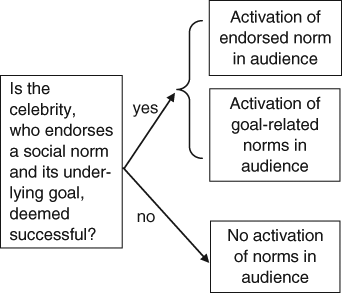
Suggested Effects of Celebrities on the Activation of Social Norms
Research Overview
Celebrities can be assumed to be perceived as successful (and thus prestigious) unless their successfulness is tarnished by negative information. A sense of presence can be created by, among other things, vivid pictures (Lombard and Ditton 1997). In Studies 1a and 1b, we investigate our basic conjecture about the norm-activating ability of untarnished celebrities by using photographs. 1 We do so by investigating whether the endorsement of a particular normative message (target norm) by the depiction of an untarnished celebrity activates this norm, which we measure with the three components of oughtness discussed above. If this is indeed a prestige effect as described above, the oughtness of norms that are related to the target norm by a common goal (a goal that is also conveyed in the normative message) should also increase when the untarnished celebrity endorses the norm. The first study (1a) uses a real-life male celebrity. In order to test the robustness of such effects, we replicate our first study with a real-life female celebrity (Study 1b). Because the effect we want to study concerns the activation of social norms the individual already holds and not an act of persuasion to commit oneself to new norms, we use social norms that are well established in the population of our participants. We also predict that the norm activation effect is brought about by the celebrity’s endorsement and not by the celebrity him- or herself, that is, not by a particular association of the celebrity with the content of the norm or the goal of cleanliness. To test this, we include a condition in which just the picture of the celebrity is shown, without a normative message. Finally, we expect that the activation effect will spread to norms that are related to the goal linked to the target norm (in this case, norms related to cleanliness). For testing this hypothesis, we include next to the target norm (don’t litter) a group of strongly related norms and a group of unrelated norms (see below).
In Studies 2a and 2b we explicitly examine the role of success. We do so by manipulating the perceived level of success of the same celebrities used in Studies 1a and 1b to test our expectation that only successful celebrities raise the level of oughtness of the target norm and of related norms, whereas unsuccessful celebrities do not have this effect. Again, in order to test the robustness of the results, we replicate our study of the male celebrity (2a) with a female celebrity (Study 2b). In addition, we test our hypothesis that the norm activation effect of celebrities is not mediated by subjects seeing the celebrity as a role model or identifying with him or her. The two celebrities we use are well known in this population without being (to our knowledge) particularly idolized. To check on this assumption, we ask participants in Study 2 the degree to which they (1) see the particular celebrity as a role model and (2) identify with the celebrity. We expect that success will make participants see the celebrity somewhat more as a role model and identify somewhat more with him or her than will lack of success. However, even in the success condition, we anticipate that the effect of a successful celebrity on the activation of norms will not depend on seeing the celebrity as a role model or identifying with him or her. We also test the possibility that, in contrast to our expectation, the successful or unsuccessful celebrity activates norms even without endorsing them. Finally, in all four experiments the participants were debriefed upon completion of the questionnaire and given the chance to express their possible suspicion about the goals of the experiment. None of the participants were aware of the aim of the study or the hypotheses that were tested.
Studies 1a and 1b
Method
Participants and design
Seventy-two students (35 male, 37 female) participated in Study 1a, and eighty-four (37 male and 46 female) in Study 1b for a partial course requirement at the University of Groningen. Participants were randomly assigned to one of three conditions of a simple factorial design involving different presentations of celebrity information. In the control condition, participants were not exposed to a picture or to a message. In the neutral condition, a picture of the celebrity without a message was added as an extra control to check whether it is true that the celebrity him- or herself is not associated with the no-littering norm. In the message condition, participants were exposed to the normative “do not litter” message together with the picture.
Procedure and materials
The first page of the questionnaire showed one of three images: a blank page, the neutral picture, or the picture and normative message. The neutral picture showed only the celebrity, and nothing referred to a normative message. 2 Participants did not receive any instructions concerning the pictures. The normative message showed a national celebrity throwing trash in a trashcan, thus demonstrating the desired normative behavior. The male celebrity in Study 1a is a speed skater. Speed skating is a very popular spectator sport in the Netherlands. The celebrity wears a speed-skating outfit and stands in a typical speed-skating position. The female celebrity in Study 1b is a television personality and a model. She wears tight jeans and a T-shirt. In both normative messages, the target norm is communicated by the words, “It is just as easy to throw it in the trashcan” and—to stress the underlying goal—“The Netherlands clean” (translated from Dutch). In addition, there are statements that suggest the celebrities are saying they have popular support for their normative message. The speed skater seems to say, “We are on schedule for a cleaner country” (translated from Dutch), and the television celebrity seems to say, “The Dutch have conquered their fear of the trashcan” (translated from Dutch), referring to a television program in which she challenges people to conquer their worst fears. This suggestion of popular support for not littering makes use of an insight by Cialdini et al. (1991) that norms will be more easily activated if there is also an indication that other people engage in behavior conforming to the norm (i.e., the “descriptive norm” effect). In addition, the celebrity’s behavior and the statements attributed to them explicitly connect the celebrity to the normative message, even though the content of the message has nothing to do with what made these people celebrities in the first place.
Level of oughtness of a norm
Following the first page of the questionnaire, the level of oughtness of the target norm (do not litter) and of nine other norms was assessed. All norms had comparable levels of abstraction and were selected on the basis of the results of a pretest. In the pretest 15 students of the University of Groningen volunteered to rate 55 different norms on their perceived importance (1 = important norm, 3 = unimportant norm). Because we study norm activation rather than persuasion, we used norms that were already established and would therefore vary only situationally in the level of activation. Thus we selected norms that were rated as “important norms” by all participants in the pretest. Doing so prevents the possibility that the effect is due to other related but different processes such as a pure “descriptive norm” effect (Cialdini et al. 1991), a “rational imitation” effect (Gergely and Csibra 2005), or a particular way of common knowledge generation in which the audience would infer the existence of a group norm by the fact that celebrities endorse them (Chwe 2003).
Norms (other than the target norm) that serve a cleanliness goal (including environmental concerns about keeping the earth clean of pesticides or plastic waste) were taken to be strongly related to the target norm on the basis of a pilot study. 3 The four strongly related norms used are (1) buy biologically produced products such as milk, meat, eggs, and vegetables (bio products), (2) sweep your sidewalk clean when there are leaves or snow on the sidewalk (sidewalk), (3) bring a shopping bag to the supermarket so you do not need a plastic bag from the supermarket (shopping bag), and (4) blow your nose instead of snorting (nose). Norms that do not serve a cleanliness goal, or “unrelated norms,” stemmed from the same pilot study. The five unrelated norms used are (1) do not bicycle through a red traffic light (traffic light); (2) do not make vulgar gestures to people in the street (vulgar gestures); (3) do not occupy a seat with your luggage in a crowded bus or train (seat); (4) be on time for appointments (on time); and (5) do not curse or swear (swear).
In order to measure the level of oughtness of the norm, the three components of oughtness described above were assessed. Participants were asked to indicate for each norm how important they feel the norm is (1= very unimportant, 7 = very important), how they evaluate people who transgress the norm (1 = very negative, 7 = very positive, reverse coded), and whether they themselves conform to the norm (1 = never, 7 = always). With regard to the latter question, we ask a seemingly factual question rather than the feeling of obligation in order to minimize the chance of socially desirable answers. A higher feeling of obligation to conform to the norm should also increase the subjective impression that one conforms to the norm.
Results: Study 1a (Male Celebrity)
First, the scores on the three questions that measured the level of oughtness were aggregated into a single index for level of oughtness, so that a higher score meant a higher level of oughtness of a norm (all Cronbach’s α > .70, except for shopping bag, traffic light, and on time, with alphas of .62, .63, and .52, respectively). To restrict the amount of analyses reported here and to simplify the presentation of the results, we summed the oughtness scores in each group of norms. There is the oughtness score for the target norm (α = .72), then there is the score for the norms that are “strongly related” by their link to the cleanliness goal (consisting of the bio products, sidewalk cleaning, shopping bag, and nose norms, α = .66). Finally, there is the score for “unrelated norms,” (consisting of the traffic light, vulgar gestures, seat, on time, and swear norms, α = .33). Even though, not surprisingly, the alpha was very low for the combination of the unrelated norms, this categorization is justifiable because in all the analyses reported here, the pattern of effects on each separate norm was similar to the pattern of effects on the corresponding scale.
Second, in a multivariate analysis of variance (MANOVA) with Picture as independent nominal variable (with control, neutral, and message as values), we tested whether Picture influenced the level of oughtness of the target norm and other norms. The MANOVA revealed a significant multivariate effect of Picture on the level of oughtness, F (6, 134) = 4.15, p < .01, and significant univariate effects of Picture on the target norm, F (2, 69) = 10.59, p < .01, and strongly related norms, F (2, 69) = 5.48, p < .01, but not on the unrelated norms (F < 1). Next, we tested whether the level of oughtness is higher in the message condition than in the neutral or control conditions, and we checked whether, as expected, the celebrity endorsement effect generalized to the strongly related norms (see Table 1).
Mean (SD) Level of Oughtness of the Target Norm, Strongly Related Norms, and the Unrelated Norms as a Function of Picture.
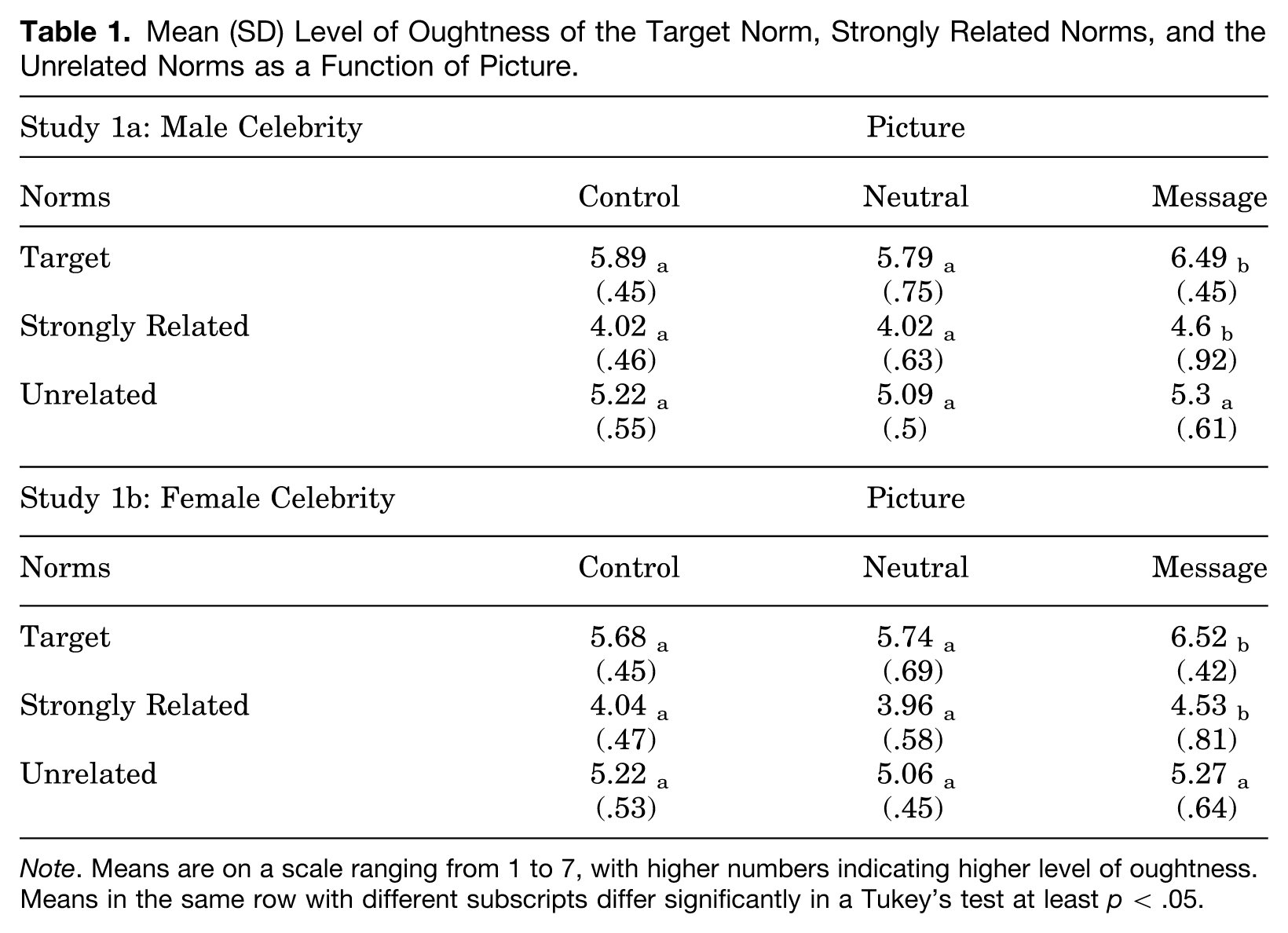
Note. Means are on a scale ranging from 1 to 7, with higher numbers indicating higher level of oughtness. Means in the same row with different subscripts differ significantly in a Tukey’s test at least p < .05.
Target norm
As was expected, the level of oughtness of the target norm was significantly higher in the message condition (M = 6.49, SD = 0.45) compared to the neutral (M = 5.79, SD = 0.75), and control conditions (M = 5.89, SD = 0.45, ps < .01, see Table 1). This indicates that the norm endorsement by a celebrity was effective in raising the level of oughtness of the target norm. The celebrity itself (without the norm endorsement) had no effect on level of oughtness of the target norm.
Strongly related norms
As expected by the prestige effect, the level of oughtness of the strongly related norms was also significantly higher in the message condition (M = 4.6, SD = 0.92) compared to the neutral (M = 4.02, SD = 0.63), and control conditions (M = 4.02, SD = 0.46, ps < .02, see Table 1). These results indicate that the celebrity endorsement effects indeed spread to the strongly related norms and, also as predicted, not to unrelated norms. MANOVA also revealed no significant main effect of gender, nor a significant interaction effect of gender with Picture.
Results: Study 1b (Female Celebrity)
The analytical steps and the pattern of results in Study 1b are similar to those in Study 1a. We first summed the level of oughtness scores into single indexes for the target norm, strongly related norms, and unrelated norms (alphas .57, .60, and .33, respectively). The pattern of effects on each norm was similar to the pattern of effects on the corresponding scale. The means are presented in Table 1. In the second step the MANOVA with Picture as independent variable revealed a significant multivariate effect of Picture, F (6, 156) = 7.56, p < .01, and significant univariate effects of Picture on the target norm, F (2, 80) = 21.57, p < .01 and strongly related norms, F (2, 80) = 6.48, p < .01), but not on the unrelated norms (F < 1). Next, we tested whether the level of oughtness of the target norm was higher in the message condition than in the neutral or control conditions, and explored whether the effect of the message spread to strongly related norms (see Table 1).
Target norm
As was expected, the level of oughtness of the target norm was significantly higher in the message condition (M = 6.52, SD = 0.42) relative to the neutral (M = 5.74, SD = 0.69) and control conditions (M = 5.68, SD = 0.45, ps < .01, see Table 1). This indicates that again not the picture of the celebrity alone but only the picture together with the endorsement was effective in raising the level of oughtness of the target norm.
Strongly related norms
As we had expected, the celebrity endorsement effect spread to the strongly related norms and, also as expected, not to unrelated norms (see Table 1). The level of oughtness of the strongly related norms was significantly higher in the message condition (M = 4.53, SD = 0.81), compared to the neutral (M = 3.96, SD = 0.58) and control conditions (M = 4.04, SD = 0.47, ps < .02).
With regard to gender, MANOVA revealed no main effect on level of oughtness (all p > 0.3), and the interaction effect for target norm was also not significant. However, there was a significant interaction of gender by picture condition for strongly related norms (p < 0.01). This latter interaction effect is entirely due to a higher mean for women as compared to men in the neutral condition (i.e., the condition showing only a picture of the female celebrity without any message). Thus gender, again, had no influence on the effect of the normative message by the celebrity.
Discussion
The results support the hypothesis that a normative message presented by a celebrity is effective in raising the level of oughtness of a target norm. Furthermore, as expected by the prestige effect, the celebrity endorsement effect spread to strongly related norms (such as “buy biologically produced products” and “blow your nose”) and raised their level of oughtness. The spreading of the celebrity endorsement effect to norms that are goal-related to the target norm offers support for the assumption that celebrities’ effect on norm activation goes well beyond a particular target norm. It is also clear that celebrities do not increase the level of oughtness just by being celebrities. They have to be associated with (i.e., be seen to endorse) a particular norm in order to have this effect.
The fact that both Study 1a and 1b revealed the same pattern of effects strengthens our confidence in the validity and robustness of the results. The results surfaced not because of unique characteristics of the celebrities such as gender or career. Both celebrities are in fact successful people and who presumably enjoy prestige and therefore are special. If the celebrities are tarnished by lack of success, we expect them to lose prestige and thus not to have a positive effect on norm activation. To test this expectation, we varied the perceived level of success of the celebrities in Study 2a (male celebrity) and 2b (female celebrity).
Studies 2a and 2b
The aim of Studies 2a and 2b is to test whether celebrity endorsement effects on norm activation depend on the celebrity’s perceived success. For a successful celebrity we expect to replicate the findings of Study 1a and 1b, both with regard to the target norm and the strongly related norms. In contrast, we expect that the endorsement of a norm by an unsuccessful celebrity will not activate this norm or related norms. Conversely, we expect, again, that celebrities, even when they are explicitly described as successful, will not activate a norm unless they are seen to endorse this norm. In addition, we will test our hypothesis that the norm activation effect does not depend on seeing the celebrity as a role model or identifying with him or her.
Method
Participants and design
Students of the University of Groningen participated for a partial course requirement in Study 2a (100, of which 51 were male and 49 female), and in Study 2b (102, of which 48 were male and 54 female). Participants were randomly assigned to one of the conditions of a 3 (Picture: control vs. neutral vs. message) x 2 (Success: successful vs. unsuccessful) between subjects design.
Procedure and materials
We used the same pictures as in Study 1a and 1b. Participants did not receive any instructions concerning the pictures. A fictitious newspaper article 4 about the celebrity and the celebrity’s career was placed on the first page of the questionnaire, below the pictures (neutral and message condition), or below a blank space in the control condition. Participants were asked to read the newspaper article carefully. In each article, the celebrity’s name was mentioned five times. The length of the articles varied between 150 and 163 words (M = 158.25). Both articles were factual but differed in the positive or negative interpretation of these facts. They stressed success or waning success and the importance of the celebrity’s weak or strong character as a cause for their success or lack thereof. For example, the male celebrity’s persistence was interpreted as stamina in the “successful” article (“he never gives up”) and stubbornness in the “unsuccessful” article (“he fails to listen to good advice”). The diverse activities (e.g., modeling, singing, presenting on TV and radio) of the female celebrity were interpreted as a sign of her being “ambitious” in the “successful” article and of being “indecisive” in the “unsuccessful” article. All articles were factually correct and believed to be true in a pretest involving ten students.
Next, the level of oughtness was assessed, using the same set of norms as in Studies 1a and 1b. In order to check our assumptions that successful celebrities in our experiment are only weakly perceived as role models and only weakly identified with even when they are successful, we asked participants to indicate whether they saw the celebrity as a role model (“X is a big example for me”) and whether they identified with him or her (“I identity with X”), on a scale from 1 (not at all) to 7 (very much).
Results: Study 2a (Male Celebrity)
The statistical analyses resemble those of Studies 1a and 1b. We first summed the level of oughtness scores into single indexes for the target norm, strongly related norms, and unrelated norms (alphas .67, .65, and .36, respectively). The pattern of effects on each separate norm was similar to the pattern of effects on their corresponding scale. The means are presented in Table 2. Then we performed a MANOVA with Picture and Success as independent variables on level of oughtness to test whether the pictures and the success manipulation influenced the level of oughtness. The MANOVA revealed a significant multivariate interaction effect between Success and Picture, F(6, 182) = 4.17, p < .01, and a significant main effect of Success, F (3, 91) = 4.67, p < .01, but not of Picture (p = .16). On the target norm, the univariate tests revealed a significant interaction between Success and Picture, F (2, 93) = 9.51, p < .01, a main effect of Success, F (1, 93) = 7.28, p < .01, but no main effect of Picture (F < 1). On the strongly related norms, the univariate tests revealed a significant interaction between Success and Picture, F (2, 93) = 6.38, p < .01, a main effect of Success, F (1, 93) = 10.08, p < .01, and of Picture, F (2, 93) = 4.2, p < .02. On the unrelated norms, the univariate tests revealed no significant effects of Success and Picture (ps > .08). Next, we performed planned comparisons on the target norm and the strongly related norms to test whether the level of oughtness is higher in the message condition than in the neutral and control conditions when the celebrity is successful, and not higher when the celebrity is unsuccessful (see Table 2).
Mean (SD) Level of Oughtness of the Target Norm, Strongly Related Norms, and the Unrelated Norms as a Function of Picture and Success.
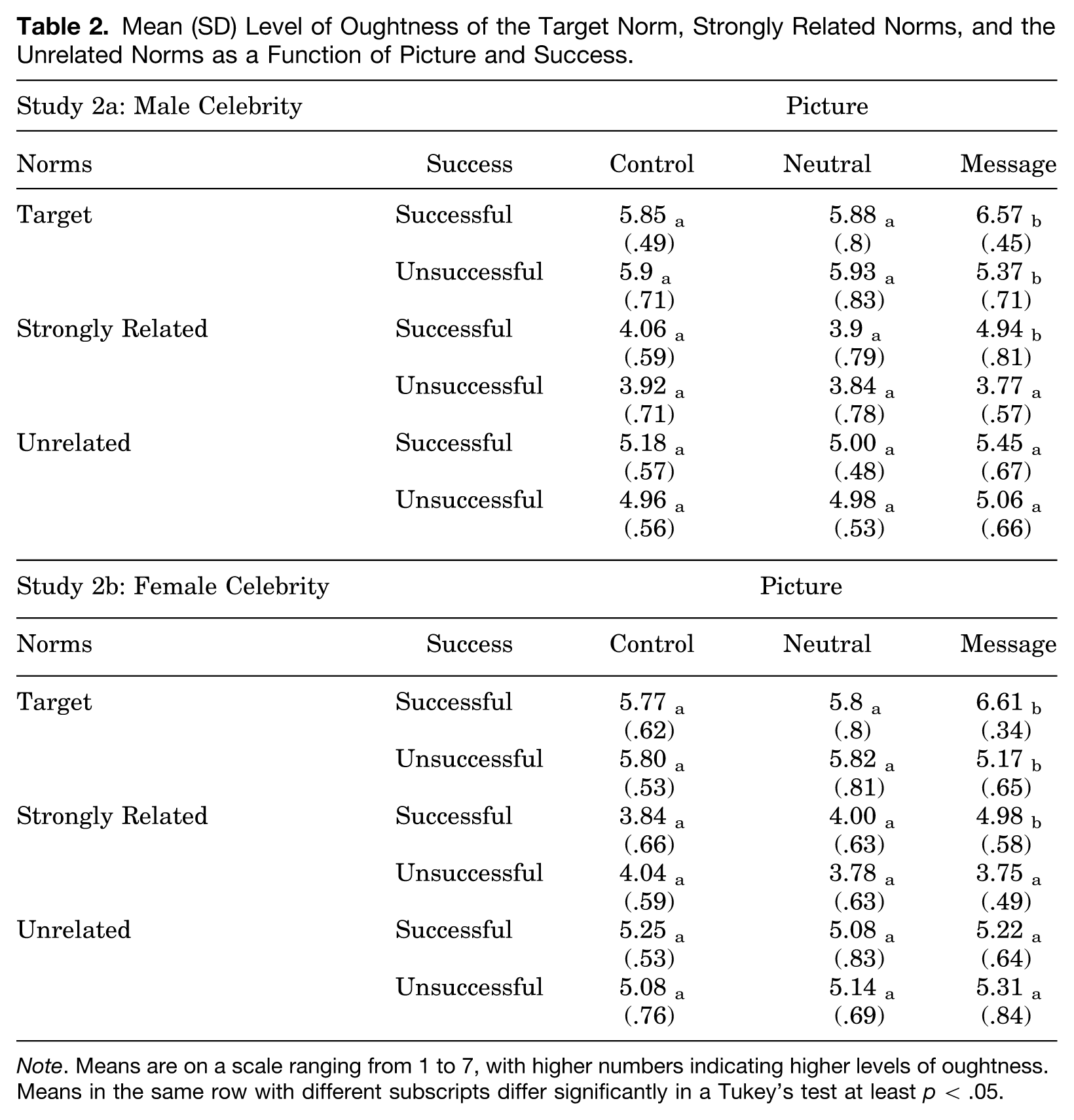
Note. Means are on a scale ranging from 1 to 7, with higher numbers indicating higher levels of oughtness. Means in the same row with different subscripts differ significantly in a Tukey’s test at least p < .05.
Target norm
The results corroborate our expectations. As can be seen in Table 2, when the celebrity is successful, the level of oughtness is higher in the message condition (M = 6.57, SD = 0.45) than in neutral (M = 5.88, SD = 0.80) and control conditions (M = 5.85, SD = 0.49, ps < .05). In contrast, an unsuccessful celebrity did not increase the level of oughtness. To the contrary, the unsuccessful celebrity even lowered the level of oughtness of the target norm (M = 5.37, SD = 0.71, for the message condition) compared to the neutral (M = 5.93, SD = 0.83) and control conditions (M = 5.9, SD = 0.71, ps < .05). These results indicate that fame is not enough. A celebrity (even a successful one) has to endorse a norm in order to increase that norm’s level of oughtness. If the celebrity does endorse a norm, the celebrity needs to be perceived as successful in order to raise the level of oughtness of the endorsed norm. We found, but had not expected, that the unsuccessful celebrity could even lower the level of oughtness.
Strongly related norms
As presented in Table 2, in the successful celebrity conditions, the level of oughtness was significantly higher after exposure to the message (M = 4.94, SD = 0.81) compared to the neutral (M = 3.9, SD = 0.79) and the control conditions (M = 4.06, SD = 0.59, ps < .01). This supports our expectations. The message from the unsuccessful celebrity had, as expected, no effect on strongly related norms, meaning that the level of oughtness did not differ significantly between the message, neutral, and control conditions (Fs < 1). As in Study 1, there was no effect on unrelated norms in any condition.
With regard to gender, MANOVA revealed a marginally significant main effect on the level of oughtness (p < .07), with women having generally a higher level. However, none of the interactions with gender were significant, which means that gender did not moderate the effects of Picture and/or Success.
Identification
With regard to role modeling and identification, it turned out that in both success and failure conditions, the scores were very low (between “not at all” and “somewhat”). However, there was a difference. An ANOVA with Success as independent variable revealed that participants in the successful conditions (M = 2.28, SD = 1.53) perceived the male speed skater somewhat more as a role model (“Rintje Ritsma is a great example for me”) than participants in the unsuccessful conditions (M = 1.62, SD = 0.97), F (1, 98) = 6.68, p < .02. ). The direct identification question (“I identify with Rintje Ritsma”) showed also a small and marginally significant effect of success (M= 1.44, SD 0.79 versus M = 1.26, SD = 0.69; F (1, 98) = 3.09, p < 0.09).
Was the effect of “success” on the level of oughtness possibly mediated by seeing Ritsma as a role model and/or identifying with him? For this to be the case, there has to be a path from the independent variable to the possible mediator (Baron and Kenny 1986), or in our case from the “success by picture” interaction to “role model” and/or “identification.” To check this out, we first created dummy variables for the between-subjects factors Success and Picture and an interaction dummy of Success by Picture. All three dummies were entered into the regression analyses with role model and identification as dependent variable, respectively. None of the dummies showed a significant result (all p > 0.4 for role model and p > 0.5 for identification). We can thus safely conclude that the activation of target norms (or any other norm in the experiment) is not mediated by role model or identification effects.
Results: Study 2b (Female Celebrity)
The analysis and the results in Study 2b are similar to those in Study 2a. We again summed the level of oughtness scores into single indexes for the target norm, strongly related norms, and unrelated norms (alphas .73, .48, and .59, respectively). Again, the pattern of effects on each norm was similar to the pattern of effects on the corresponding scale. The means are presented in Table 2. The Picture × Success MANOVA revealed a significant multivariate interaction effect between Success and Picture, F (6, 184) = 7.14, p < .01, and a significant main effect of Success, F (3, 92) = 6.44, p < .01, and of Picture, F (6, 184) = 2.2, p < .05. On the target norm, the univariate tests also revealed a significant interaction between Success and Picture, F (2, 94) = 14.57, p < .01, a main effect of Success, F (1, 94) = 12.82, p < .01, but not of Picture (F < 1). On the strongly related norms, the univariate tests revealed a significant interaction between Success and Picture, F (2, 94) = 12.45, p < .01, a main effect of Success, F (1, 94) = 11.73, p < .01, and of Picture, F (2, 94) = 6.39, p < .01. Success and Picture did not influence the level of oughtness of the unrelated norms (Fs < 1). Finally, we performed planned comparisons on the target norm and the strongly related norms to test whether the level of oughtness is higher in the message than in the neutral and control condition when the celebrity is successful and not higher when the celebrity is unsuccessful.
Target norm
The pattern of results further supports our expectations (see Table 2). The normative message raises the level of oughtness of the target norm when the celebrity is perceived as successful and not when she was unsuccessful. In fact, the level of oughtness was again lowered when the norm was endorsed by the unsuccessful celebrity. When the celebrity is successful, the level of oughtness of the target norm was significantly higher in the message condition (M = 6.61, SD = 0.34) than in the neutral (M = 5.8, SD = 0.8) and control conditions (M = 5.77, SD = 0.62, ps < .01). When the celebrity was unsuccessful, the level of oughtness was significantly lower in the message condition (M = 5.17, SD = 0.65) than in the neutral (M = 5.82, SD = 0.81) and control conditions (M = 5.8, SD = 0.53, ps < .01).
Strongly related norms
As can be seen in Table 2, the effect of the normative message spread to strongly related norms but, as expected, only if the celebrity was successful. When the celebrity was successful, the level of oughtness was significantly higher in the message condition (M = 4.98, SD = 0.58) than in the neutral (M = 4, SD = 0.63) and control conditions (M = 3.84, SD = 0.66, ps< .01). When the celebrity was unsuccessful, the level of oughtness did not differ significantly between the message, neutral, or control conditions (ps > .76). Similar to Study 2a, the significant other effect only occurs with the successful celebrity. There was again no effect on unrelated norms.
Identification
An ANOVA with Success as independent variable revealed that in both success and failure conditions, the scores for role modeling and identification were very low (close to “not at all”). The direct identification question (“I identify with Fabienne de Vries”) showed no significant difference (for “successful” M = 1.16, SD = 0.42; for “unsuccessful” M = 1.12, SD = 0.63; F (1, 101) = 0.12, p > .7). But for role modeling there was a difference. Participants in the “successful” conditions (M = 1.35, SD = 0.82) perceived the celebrity somewhat more as a role model than participants in the “unsuccessful” conditions (M = 1.08, SD = 0.27) F (1, 98) = 4.84, p < .05. We thus checked again for the possibility that the effect on the level of oughtness was mediated by seeing Fabienne de Vries as a role model. We performed the first step of a mediation analysis (Baron and Kenny 1986), following the same procedure as for Rintje Ritsma. None of the dummies showed a significant result (all p > 0.9 for identification and p > 0.6 for role model). We can thus safely conclude for Fabienne de Vries what we concluded for Rintje Ritsma: that the activation of norms is not mediated by role model or identification effects.
General Discussion
Celebrities are often used to endorse products, services, or even political candidates in order to change people’s attitude and behavior. This ability of celebrities to influence their audience has been explained by people’s identification with the celebrity (Basil 1996; Kelman 2006). Identification is a strong form of commitment, yet many people may not have a strong sense of identification and still see the celebrity as a celebrity and be influenced by him or her. There is some evidence that there is a potentially even more important effect of celebrities that does not need a strong form of commitment to the celebrity: the activation of norms. Curiously, this norm activation effect has not received much separate attention using tests under controlled conditions, yet is important because the internalization of norms is not enough to make them relevant for action. Norms only guide behavior to the degree that, at any given moment, they are activated (Cialdini et al. 1991).
We conceptualized the activation of norms as an increase in the level of oughtness linked to the content of the norm. The classical conception of oughtness in sociology contains three major elements: the subjective importance of the norm; negative reaction to infractions of the norm by others; and feelings of obligation to conform to the norm oneself. Thus a widely influential source for increasing the level of oughtness of social norms can have considerable macro effects on norm conformity and social control.
In daily interactions, norms are most often activated by significant others, such as family members, partners, friends, and authority figures. We reasoned that celebrities become special when they are afforded prestige. In turn, they only have prestige when they are untarnished with regard to success on the dimension relevant to their being celebrities. This reasoning was strongly supported by results from our four experiments.
The first set of experiments tested the norm-activating ability of untarnished celebrities with the combination of the three components of oughtness of social norms as dependent variable. One study focuses on a male celebrity and the other on a female celebrity. The results clearly establish that untarnished celebrities can exert normative influence similar to that of significant others. Such goal effects have been found by others in experiments involving significant others (Shah 2003). In addition to the target norms, the untarnished celebrities activate a set of norms that are related to the goal that is linked to the target norm. This shows that the effect can spread to other norms as well. Note that these effects only occurred when the celebrity endorsed a particular norm. In other words, being exposed to the picture of an untarnished celebrity itself is not enough to activate a social norm that is not generally associated with that celebrity.
The second set of experiments tested the role of success, once again using one male celebrity and one female celebrity. This second set replicated the results of the first set for the successful celebrities and showed that unsuccessful celebrities do not activate the norm. Curiously, unsuccessful celebrities even had a negative influence on the activation of the particular norm they advocated (but not on related norms). This inhibitive effect may be a form of reactance to an influence attempt that is interpreted as an unsolicited piece of advice. Fitzsimons and Lehmann (2004) found such reactance effects. An unsuccessful celebrity may be seen as an illegitimate source of social influence, as if people were saying, “such a person should not even try to influence us.” Having low prestige, such persons are not likely to be special, not even in a negative sense (see Chartrand, Dalton, and Fitzsimons 2007; Lockwood, Jordan, and Kunda 2002). This interpretation is also supported by the fact that in the success condition the norm activation effect spread to related norms, whereas in the tarnished condition, the negative effect of the celebrity’s norm endorsement was limited to the target norm (no littering norm), without spreading to related norms.
Results also confirm the conjecture that the norm-activating impact of celebrities does not need a strong commitment of the audience to the celebrity. In the second set of experiments, participants were asked to what degree they saw the celebrity as a role model and to what degree they identified with the celebrity. Answers to both questions remained very modest (close to “not at all”). Even though they saw the successful celebrity somewhat more as a role model and they identified somewhat more with him or her than in the case of the unsuccessful one, this had no effect on the link between success and the activation of norms.
Although the results from these studies are consistent and strong, several limitations of the data are notable. First, the population on which the hypotheses were tested is restricted to university students. This means that the effects of the particular celebrities used might be different for other age groups. Yet the limitation might not be as restrictive as it might seem at first glance. While it is true that the female celebrity (a television personality and model) used in the experiment would appeal especially to a young crowd, the male celebrity used is a speed skater who represents a sport that is highly appreciated in all age groups in the Netherlands. Another limitation is the fact that we did not explicitly test prestige and its link to making a person special. Still, this link is far from being ad hoc, since it is strongly supported by the extant literature. Finally, it is a possible limitation that the paper only tests changes in the level of oughtness of norms and not also behavior itself. This link to behavior, however, has already been well demonstrated in the literature. In fact, it is this link that generated the central research question for this paper: do celebrities increase the level of oughtness of norms (because this level is important for norms to govern action)?
The results of these studies also point to an additional important lesson: because norms need to be activated to become relevant for action, norm conformity can be influenced by subtle effects. An interesting feature of the experiments is that the celebrity norm-endorsement manipulation was very subtle. The participants were just briefly exposed to a picture of the celebrity with the normative message. Still, that brief exposure produced significant effects.
The success and failure manipulations were also quite subtle. The celebrities are real and well known in the Netherlands for what they have achieved. But seemingly this general knowledge does not suffice to fix their prestige in the minds of the beholders. The newspaper clippings were selective reminders that either stressed the successes (and successful traits) or the waning success (and unsuccessful traits) of these celebrities. The past performance of the skater Ritsma, for example, is formidable and not easy to forget. And yet, being reminded of the news of his declining performance is enough to wipe him out as somebody who can raise the oughtness of norms in the audience. This finding underlines the possibility that celebrity can be manufactured (Gamson 1994), that media can make or break the prestige (and thus the norm-activating ability) of celebrities just by the choice of words describing their doings. Note that the effect of success overshadows any possible descriptive norm effect (Cialdini et al. 1991). The fact that the posters suggested popular support for not littering did not suffice to counteract the negative influence of the celebrity’s lack of success.
All this adds to the mounting evidence concerning subtle effects of the environment on norms that operate via activation beyond the reach of positive and negative sanctions. For example, as already mentioned, the psychological presence of significant others (like parents) activates the willingness to conform to norms in general (Stapel etal. 2010). The sheer presence of people has a norm-activating effect (Joly, Stapel, and Lindenberg 2008) so that empty streets, parking garages, hotel corridors, etc., are environments that dampen norm activation and thus increase the risk of norm violations. Even exposure to the attributes of Saint Nicholas (miter, book, and staff) is enough to activate the social norm “to share alike” (and the subsequent behavior) among Dutch children (Joly and Stapel 2009), emphasizing the fact that symbolic environments can be quite important to the functioning of norms.
Furthermore, what we observe others do also has a strong influence on norm activation (and its opposite, inhibition). For example, when people see others conforming to or violating a norm, this norm will be activated or inhibited in the observers (Cialdini 2003). What is more, when people see others violate a specific norm (as with graffiti on walls), this inhibits in the observers even the general goal to conform to norms (Lindenberg and Steg 2007; Keizer, Lindenberg, and Steg 2008). Perceived neighborhood disorder has also been shown to affect people’s sense of control (Geis and Ross 1998; Christie-Mizell and Erickson 2007), and norm deviance by some employees in organizations seems to generate more norm deviance in others (Robinson and O’Leary-Kelly 1998).
Norm conformity is thus not solely a matter of the right incentives but also of the “right” environment. Celebrities do not only belong to people’s social environment (see Brown and Basil 1995), and their influence as potentially significant others on norm activation can be expected to be even stronger than that of ordinary people (Stapel et al. 2010). Our studies show that celebrity effects on norm activation should join the list of subtle effects on norms. The normative potential of celebrities has not yet been widely recognized and our results may encourage future research on the possible use of these effects for large-scale interventions. In general, sociologists of norms may do well to pay close attention to micro processes and macro conditions of norm activation.
Footnotes
This research and writing was supported by a “Breedtestrategie II” grant of the University of Groningen awarded to the first author and a “Pionier” grant from the Dutch Science Foundation (NWO) awarded to the third author.
1
2
The neutral pictures of the celebrities were retrieved from their webpages (www.rintjeritsma.com and  ); see also footnote 1.
3
The results of a pilot study (n = 182) show that this categorization of norms is in line with how people perceive the relatedness of the norms that were used. The norms shopping bag, sidewalk, and bio products were rated as strongly related to the target norm, whereas traffic light, on time, and swear were rated as unrelated to the target norm. The norms vulgar gestures and nose were rated as both related and unrelated to the target norm.
4
See footnote 1 for online access to materials used in the experiment.