







Abstract
This research applies identity theory to understand the moral self. In identity theory, individuals act on the basis of their identity meanings, and they regulate the meanings of their behavior so that those meanings are consistent with their identity meanings. An inconsistency produces negative emotions and motivates individuals to behave differently to produce outcomes that will better match their identity meanings. A two-part survey and laboratory study were conducted to investigate the application of identity theory to the moral self. The findings are consistent with identity theory predictions. In the survey that addresses past experiences, we find that individuals’ moral identity guides their behavior. When an identity discrepancy emerges between moral identity meanings and perceptions of themselves in a situation, negative feelings are experienced. These same effects are observed when these individuals are placed in an immediate moral dilemma in the laboratory. Overall, the results reveal how identity theory helps explain the individual as a moral entity.
Studying the moral self is timely given the recent economic crisis, the unregulated practices of Wall Street executives, and a culture of consumption and greed. Since the turn of this century, social scientists have been investigating morality, including its evolution (de Waal 2009), cultural basis (Prinz 2007), and neural correlates (Sinnott-Armstrong 2008). Sociologists have been examining the relationship between morality and market society (Fourcade and Healy 2007), the moral order and social stratification (Sayer 2005), and morality and community (Vaisey 2007). With some exceptions (for example, Hitlin 2008; Wilhelm and Bekkers 2010), sociological social psychologists have neglected an analysis of the self as a moral entity, as having concerns about right and wrong. We know that persons rank some issues as more valuable than others (Inglehart and Baker 2000; Schwartz 2006), but we have not developed a theory of the self that takes into account individuals having (more or less) moral goals. Social psychologists can contribute to the science of morality by studying the self as a moral entity and examining individual variations in morality.
We apply identity theory (Stryker [1980]2002; Stryker and Burke 2000) to an analysis of the moral self, with particular emphasis on the control system approach to the identity process (Burke and Stets 2009). This application will help explain the variability in morality across individuals as well as outline the internal operations of the moral self. In the control system approach, a guiding assumption is that humans actively engage in goal-directed action that is always under their evaluation as they interact with the environment. Goal accomplishment involves individuals controlling their perceptions of themselves in situations so that their perceptions are kept near their internal identity standards. Internal identity standards are always arrayed on a continuum of meaning, and for the moral identity, these meanings include being moral at one end of the continuum and immoral at the other. Thus, claiming a moral identity is not restricted to meanings of being a good person; rather, it involves meanings that fall within the full range of being a good and bad person.
When individuals’ perceptions of who they are in situations match their moral identity standard, identity verification results regardless of whether the verification is toward the moral end of the continuum or the immoral end of the continuum. When individuals are unable to control self-perceptions to keep them at the level of their internal identity standard despite whether the meanings are moral or immoral, they will experience negative emotions. The negative emotions will motivate them to behave differently in their environment in order to produce perceptual outcomes that result in a better match with their internal identity standard.
While we seek to further the study of the moral self, we do so by simultaneously working to advance identity theory. In particular, we discuss the control process for a person identity (the moral identity). The person identity has not been given much empirical attention in identity theory (Burke and Stets 2009). Additionally, we examine the person identity using mixed methods. By carrying out a survey study and laboratory study, we investigate how robust the application of identity theory is to the moral self.
In this study, the application of identity theory involves studying morality in everyday situations for undergraduates. In a self-administered survey, we examine students’ reports on a series of recalled situations in which they had a choice between doing what they perceived to be the right thing and the wrong thing. They indicate how they behaved in those situations, how they felt, and their perceptions of others’ reactions to their behavior. We also measure the level of their moral identity. In the second part of the study, conducted several weeks later, we place these same individuals in a moral situation in a laboratory to directly study more immediate moral behavior. Again, we examine their moral behavior, feelings, and perceptions of others’ reactions to their behavior. Before addressing the study results, we first discuss current conceptualizations of the moral self and what identity theory has to offer.
The Moral Self
Psychologists have advanced our understanding of moral functioning, beginning with the moral stage tradition of Piaget ([1932]1965) and later Kohlberg (1981). The stage tradition emphasized moral judgment as progressing developmentally, with higher levels of moral development reflective of more consistent moral behavior because the moral principles that were used were more abstract, general, and universal. Despite this influential theory of moral development, research has not found a strong relationship between more advanced moral development and moral behavior, suggesting that factors other than moral reasoning influence moral action (Blasi 1980). For Blasi, the missing link between moral judgment and moral action is the moral self. Specifically, one’s moral identity is crucial to understanding moral functioning (Blasi 1984). For Blasi, fidelity to the moral self rather than fidelity to moral principles provides the impetus to act morally.
Blasi is considered one of the seminal thinkers on the moral identity in psychology (Lapsley and Narvaez 2004a). For Blasi, an identity is the center of one’s being; it is one’s “essential self” (1984; 1993). Individuals vary on what personal characteristics they claim as essential to themselves. Some may claim competitiveness, kindness, or friendliness as their core attributes. Whatever they claim as essential, this identity orders their life, provides purpose, and influences their lifelong projects. When individuals identify being moral as central or core to themselves, this moral identity is experienced as the “real me,” the authentic self, and the deepest principle that guides the individual. Blasi (1984) recognized that different moral aspects may characterize the moral identity of different individuals. For example, some may see care as essential to their moral identity, while others may see justice as central. Despite this variation, when moral notions are central to an individual, it inspires moral action through responsibility (one sees it necessary to act on what is good or right) and self-consistency (aligning one’s actions to the self as a moral being). Though Blasi had little to say about the role of emotions, he did recognize that feelings such as guilt may emerge if there is inconsistency between what people do and what they feel is their responsibility to do.
Over time, others came to share Blasi’s view of the moral self (Aquino and Reed 2002; Hardy 2006; Reed and Aquino 2003; Reed, Aquino, and Levy 2007). They modified their view that moral cognition was the motivational force that influences moral behavior, as Kohlberg theorized. Moral knowledge, as it is integrated into the self and becomes essential to who one is (as a moral identity), became the key element in influencing moral behavior. Thus the cognitive foundation of morality was retained but was incorporated into the self to more adequately account for moral functioning.
Recently, the centrality of the moral identity has been criticized because it does not always lead to moral behavior. Hardy and Carlo (2005) argue that situational factors may interact with self factors to influence moral behavior. They also suggest that not all moral behavior is intentional and deliberate, as Blasi assumed. Some moral action is more automatic, and a model is needed that takes this automaticity into account (Hardy and Carlo 2005).
In response, Aquino and others offered a social-cognitive approach to morality (Aquino and Freeman 2009; Aquino et al. 2009; Lapsley and Narvaez 2004b). This approach assumes that humans have cognitive limits in their processing of information and therefore develop systems of categorizations or schemas to guide information processing and behavior in situations. Schemas are activated not only by individuals but also by situations.
Aquino and his associates have indicated that when the moral identity is central to the self, it should be activated more strongly and more often, thereby making it chronically accessible. Therefore, moral identity centrality is equated with the chronic accessibility of the moral self-schema. In addition, situational cues may activate or deactivate the chronic accessibility of the moral self-schema. With this in mind, they introduced moral identity salience to refer to the temporary activation of moral identity in consciousness, which is brought to the fore by situational factors. When temporary moral identity salience and moral identity centrality (chronic accessibility) are high, they become available in one’s working self-concept (a subset of self-views that are currently activated in a situation) (Markus and Kunda 1986) for processing. 1
In the social-cognitive model, individuals have multiple identities, but only a few identities can be held at any given time in their working self-concept. When multiple identities conflict within the working self-concept (for example, when both moral identity centrality and a self-interested identity are activated in consciousness, thus making each salient), it can create psychological tension. Here we get another glimpse of the role of emotions for the moral self; the psychological tension produces negative feelings. If the self-interested identity is “cued” in the situation, it will be the identity most likely to be of influence.
Identity theory is similar to the social-cognitive approach in conceptualizing the moral self in two important ways. First, like the social-cognitive model, identity theory views the self as having multiple identities, some of which will be more salient than others (Stryker [1980] 2002). Second, the social-cognitive model conceives of individuals as having a self-schema (such as the moral schema) that becomes accessible for processing in a situation. Similarly, in identity theory, a salient identity operates like a self-schema in that it becomes a filter or lens that directs attention to controlling meanings in a situation that are consistent with the meanings held in the identity standard. However, there are more differences than similarities between the two approaches.
The social-cognitive approach assumes that individuals either have a moral identity or they do not. If they do, the conceptual focus is on explaining variations in the extent to which people live up to it. In identity theory, it is assumed that individuals are located along a moral identity continuum that ranges from being immoral, to moderately moral, to very moral, and that individuals act to verify that position. In other words, an identity is not an all-or-nothing matter. In addition, the social-cognitive approach has no clear way of explaining the internal processes. Identity theory, however, offers a way of understanding the internal operations of the moral self by employing a control system approach that conceptualizes the identity system as a self-regulating, feedback process (Burke and Stets 2009). The control system approach draws upon 50 years of research in cybernetics, information theory, and systems theory. Identity theory follows the seminal work of Powers (1973), whose work also influenced affect control theory, another theory in social psychology (Heise 2007). The self-regulating feedback system is also used in psychological social psychology (Carver and Scheier 1998; Higgins 1989; Swann, Rentfrow, and Guinn 2003). It is even implicit in Blasi’s earlier work in which he discusses the relationship between the moral identity and moral action through self-consistency (matching one’s behavior to one’s identity). It is made more explicit using identity theory. 2
Finally, the control system approach of identity theory links the cognitive, behavioral, and emotional aspects of the moral self within a coherent theoretical structure in a way that the social-cognitive approach does not. We will discuss the cognitive dimension of the moral self—the control of perceptions to match internal, moral identity standard meanings; the behavioral dimension of the moral self—moral action in the service of moral identity standard meanings; and the emotional dimension of the moral self—the experience of emotions in response to behavior and cognitive moral meanings. In both Blasi and Aquino’s writings, we get a hint as to how emotions may emerge when individuals behave in ways that are contrary to their central moral identity. In identity theory, we see the role of emotions developed.
Identity Theory and the Moral Self
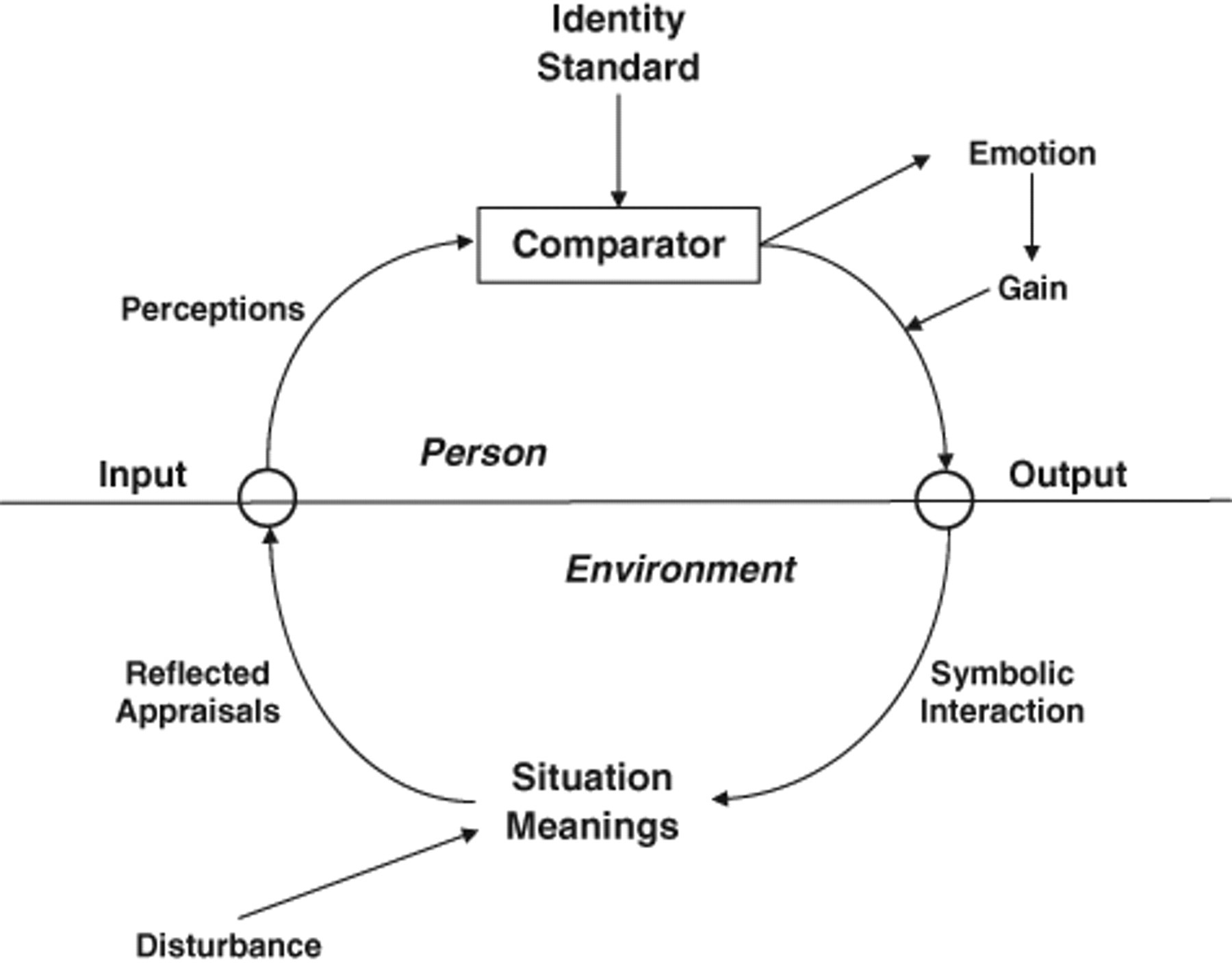
When an identity is activated in a situation, the meanings that define the identity serve as the standard for individuals, and a feedback loop is established (Burke and Stets 2009). As depicted in Figure 1, this loop has five components: (1) the identity standard (the meanings of an identity); (2) output (behavior) in the situation; (3) perceptual input of meanings from the situation, including how persons think others see them (reflected appraisals); (4) a process that compares the perceptual input with the identity standard (the comparator); and (5) emotions that immediately result from the comparison process.
Stigma, Reflected Appraisals, and Recovery Outcomes
The primary goal in the identity system is identity verification. This involves congruency between the meanings in the perceptual input and the meanings in the identity standard. When perceptual input meanings are incongruent with identity standard meanings (identity nonverification), negative emotions result, and output (behavior) is modified in the situation in an attempt to change the input to match the internal standard. Overall, the identity process controls self-meanings within a certain range in much the same way that a thermostat controls temperature. Just as a furnace will turn on when the thermostat registers the room as too cold for the setting, behavior in the identity system will be modified when the comparator registers that input perceptions of meaning do not correspond with identity standard meanings. We explain these identity components in more detail below and apply each of them to the moral self.
Identity Standard
The moral identity is the identity standard in Figure 1. It contains the meanings that an individual associates with the level of morality at which he or she sees him- or herself. In identity theory, an identity is the set of meanings an individual attributes to him- or herself as a person (person identity), role holder (role identity), or group member (social identity) (Burke and Stets 2009). Since being moral is a general or global characteristic not attached to a specific role or group, the moral identity constitutes a person identity. 3 Identity meanings guide behavior. For example, if the moral identity contains meanings of being honest and kind to others, then we expect one to be forthright and helpful to others in situations. Essentially, individuals work at verifying an identity by behaving in a manner consistent with their identity standard meanings.
Earlier work has operationalized two aspects of the moral identity: justice and care (Stets and Carter 2006; Stets et al. 2008). While justice highlights elements of fairness, honesty, and integrity that an individual adopts, care emphasizes kindness and compassion toward others. While these meanings are consistent with discussions regarding the basis of morality (Gilligan 1982; Kohlberg 1981), there is no agreement among researchers as to the full set of meanings that morality may contain. For example, some argue that rather than applying the principle of justice or care to individuals, morality should be understood as a community activity in which people come to a consensus on how to resolve moral problems (a “common morality”) (Walzer 1983). Others identify moral codes that exist cross-culturally, such as autonomy, community, and divinity (Shweder et al. 1997), or harm/care, fairness/reciprocity, ingroup/loyalty, authority/respect, and purity/sanctity (Graham, Haidt, and Nosek 2009).
Given the longstanding focus on justice and care in psychology and the fact that these moral aspects are not strongly related to gender (Jaffee and Hyde 2000), we examine these two moral characteristics in the present research. We do not claim that they capture all aspects of the moral person, only that they are two important and commonly understood meaning sets. We also are not interested in the conditions under which individuals decide whether justice or care is a more adequate basis for moral action. We leave this to future research. Finally, we make no claims that these meanings in Western society are relevant cross-culturally. The meanings for any identity can vary from society to society depending upon the culture. What is important is that whatever meanings comprise the identity standard, once they are activated in a situation, the feedback loop of the identity process is set in motion.
Output
When an identity is activated in a situation, it guides individuals in the direction of behavior that carries meanings consistent with the identity standard meanings (Burke 1980; Burke and Reitzes 1981; Burke and Tully 1977). More specifically, because the meanings of any identity exist on a continuum, the meaning of the behavior should correspond to wherever one’s identity meanings are situated on the continuum. For the moral identity, an individual may see him- or herself as more or less just, caring, and kind. In this study, the higher one’s moral identity, the more just, caring, and kind is the person’s identity, and the greater the likelihood that these moral meanings will be associated with his or her behavior. For example, seeing oneself as more just, caring, and kind should be related to acting in a fair, supportive, and gentle manner in a situation. Thus, we offer the following hypothesis:
Hypothesis 1: The higher a person’s moral identity standard, the less likely the person will engage in immoral behavior.
Moral behavior is different from normative behavior. While normative behavior consists of socially agreed upon practices, moral behavior is consensually based conduct that is imbued with the expectation of doing what is right or good (Turner and Stets 2006). While some behavior may be viewed as both moral and normative, other behavior may be distinctively moral or distinctively normative. For example, when police officers dress themselves in a blue uniform, the behavior is based on custom. It has very little moral content and may be seen as distinctively normative conduct. When a police officer comes to the aid of someone being physically attacked, this response is moral (“one helps another”) as well as normative (“protecting a citizen is part of a police officer’s job”). Behavior that signals stronger moral content would occur if a citizen intervened to protect someone who was being physically attacked. Because we do not expect a citizen to intervene, we view their actions as morally good. While it is hard to find a norm that does not carry at least some moral content, not all normative behavior is moral. For example, conforming to a group’s normative expectations of participating in a lynch mob is immoral. Alternatively, nonconforming behavior such as reporting a wrongdoing in a corporation is moral. Conformity is therefore variable in its relation to moral behavior.
In this study, moral behavior is examined in the laboratory by devising a testing situation in which individuals are tempted to engage in wrongful behavior by cheating. Some will lack the means to do well on the test because of low task ability (the inability to perform well on aptitude tests). Task ability is a characteristic or resource that is not as much subject to control as is an identity, but rather is part of the structure of the self that is partially inherited or fixed. Such self characteristics are analogous to personality traits psychologists discuss, such as the “big five” personality traits (Goldberg 1993). These self characteristics or resources are brought into situations and facilitate (or inhibit) goal attainment. Thus, along with one’s identity, they influence behavior in situations. Further, depending upon how much one has of a resource, it may strengthen or weaken the role that a particular identity plays in goal attainment.
In this research, low task ability may increase the likelihood that one will engage in the immoral behavior of cheating. Those with low task ability may feel that they are not doing as well as others on the test. Nonetheless, cheating may be tempered for those with low task ability and a high moral identity standard, because the meanings of the moral identity may guide them toward the moral behavior of not cheating. Low task ability and a low moral identity standard may make it more likely that individuals will cheat. Alternatively, if they have high task ability, cheating may never be considered because goal attainment is easily accomplished without it. Thus high task ability may never spawn the moral dilemma (to cheat), resulting in no need to activate the moral identity, whatever its level. To control for task ability as well as to examine how task ability interacts with the moral identity, we hypothesize that:
Hypothesis 2: A person will be less likely to engage in immoral behavior (cheating) when the individual has high task ability.
Hypothesis 3: The effect of the moral identity on immoral behavior (cheating) will be stronger for those with low task ability compared to high task ability.
Input
When moral or immoral behavior is enacted, others respond to the meanings of that behavior in the situation. These responses are the bases for reflected appraisals and serve as part of the input in Figure 1. Reflected appraisals are people’s perceptions of how they think others perceive them in a situation. They may be based on the overt actions of others, the expressions they emit, or a combination of the two. For example, a person may see herself as being just and kind (meanings in her moral identity standard). In a situation, she may behave in a way that is consistent with these meanings, such as treating another fairly and being supportive and thoughtful. Others in the situation may react to her behavior both verbally and nonverbally, which tells her that she is seen as behaving in a fair and caring manner (reflected appraisals). 4
Comparator
Perceptions of the meanings of others’ reactions as well as one’s own reactions are continuously fed into the comparator as shown in Figure 1. The comparator compares input meanings relevant to an identity with meanings stored in the identity standard. It produces an “error signal,” which is the difference between input meanings and standard meanings. The identity standard meanings are the “ruler” for measuring input perceptions. In thinking about this numerically, if an identity standard is set at 6 (on a scale of 0–10) for being caring, and the person perceives that others see him as acting “6” in terms of being caring in the situation, there is a perfect match between input and identity standard meanings. In identity terms this is identity verification, which results in the person feeling good. Alternatively, if the individual interprets that others see him as acting “3” or “9” in terms of being caring in the situation, there is a mismatch between input and identity standard meanings, because the feedback falls short of or exceeds the meanings in the identity standard. This difference in either the negative or positive direction is a discrepancy between identity meanings and situational meanings. One’s identity has not been verified in either instance, and the person will feel bad.
Emotion
In Figure 1, emotion signals the degree of correspondence between input meanings and identity standard meanings. Continual identity verification produces positive emotion, and identity nonverification produces negative emotion. Negative emotions will create a greater force, pressure, or drive to reduce the mismatch between input and identity standard meanings. This greater force or pressure is called “loop gain” (Powers 1973). When identity nonverification occurs in either a positive or negative direction, negative feelings increase gain and drive the system in a stronger manner to counteract the disturbance. Behaviorally, this translates into a person working harder to resolve the discrepancy, doing whatever it takes to facilitate congruity. In the case of a discrepancy in a negative direction, this may mean strengthening one’s behavior to convince others that one is who one claims to be; for a discrepancy in a positive direction, it may involve cutting back on what one is doing. For identity verification, positive feelings reduce gain and push the system less forcefully.
Given the above discussion on the input, comparator, and emotion, we offer a final hypothesis:
Hypothesis 4: The greater a person’s moral identity discrepancy, the more likely the individual will experience negative emotions.
In general, when applied to the moral self, the identity process involves persons acting to control perceptions in a situation to keep them at or near their moral identity standard. Individuals’ moral identity standards are arrayed on a continuum from low to high. Thus to say that one has a moral identity is not to say that one has meanings of being a good person, but that one has meanings that exist within a range from being, for example, an uncaring or unjust person to a very caring and very just person. People control their perceptions to keep them at their moral identity meaning standard. Thus, people conceive of themselves in a particular way, and their goal is to live up to this conception rather than to live up to being a “good” person.
When perceptions of who they are in a situation fall short of or exceed their moral identity standard meanings based on the reflected appraisal process, individuals will feel bad. In turn, they will work to modify outputs (behavior) to the social situation in an attempt to change the situation and thus the input (perceptions) to match the internal moral standard. In this way, people may enact moral behavior either because moral identity standard meanings are high (e.g., being caring and just), or because moral identity meanings are inconsistent with the meaning that they are unjust or unkind (and they are counteracting the feedback). Similarly, people may engage in immoral action either because moral identity standard meanings are low or because moral identity meanings are inconsistent with the meaning that they are just or kind (and they are counteracting that). People will experience negative feelings not simply for failing to live up to their moral standard but also for exceeding their moral standard. Individuals will not feel good about feedback that is above their moral standard because the identity process is guided by the cognitive consistency principle rather than the enhancement principle. In identity theory, it is assumed that individuals are motivated to obtain consistent information rather than positive information. 5
We do not test all aspects of the “feedback loop” in this study. Left unexamined in this research is what occurs following reports of particular emotions. Specifically, where identity nonverification occurs, we do not study how individuals eventually achieve identity verification by modifying their behavior in an attempt to change the situation so that perceptions of who they are in a situation match their moral identity standard. Future research needs to attend to this.
We gathered information on over 500 people at a large southwestern university to test other aspects of identity theory with regard to the moral self, including the level of their moral identity standard and the degree to which this influences their behavior and feelings when confronted with a moral dilemma. Because moral issues relevant to students may be different than moral issues relevant to nonstudents or older adults, we examine dilemmas most appropriate for the population under study. We point out that while moral issues may vary across different groups in society, there is nothing in identity theory that indicates that the theory operates differently for different societal groups.
Method
Sample and Design
A total of 545 students participated in this two-part study. Students were from several undergraduate sociology classes at a large southwestern university during the 2007–2008 academic year. For their participation, they earned extra credit in their class and had an opportunity to win $100 in a lottery. In Part 1, they filled out a survey that asked a series of questions about themselves as moral actors. Several weeks later, these same individuals participated in a laboratory study that included a simulated testing situation. The higher their test score, the greater their chance of winning $100 in a lottery. The structure of the testing situation included an opportunity to cheat without evident detection to get a higher score. The delay between Part 1 and Part 2 was implemented to reduce the likelihood that participants would make a connection between the survey and the laboratory study.
Slightly more women (58 percent) than men (42 percent) participated. The average age of the respondents was 21 years old. The race/ethnicity of the sample was diverse: most respondents were Asian (43 percent), followed by Latino/Chicano (22 percent), and white (16 percent). The remaining (roughly 20 percent) represented other ethnicities such as black, biracial, multiracial, and Hawaiian/Pacific Islander. 6
Survey Study: Part 1
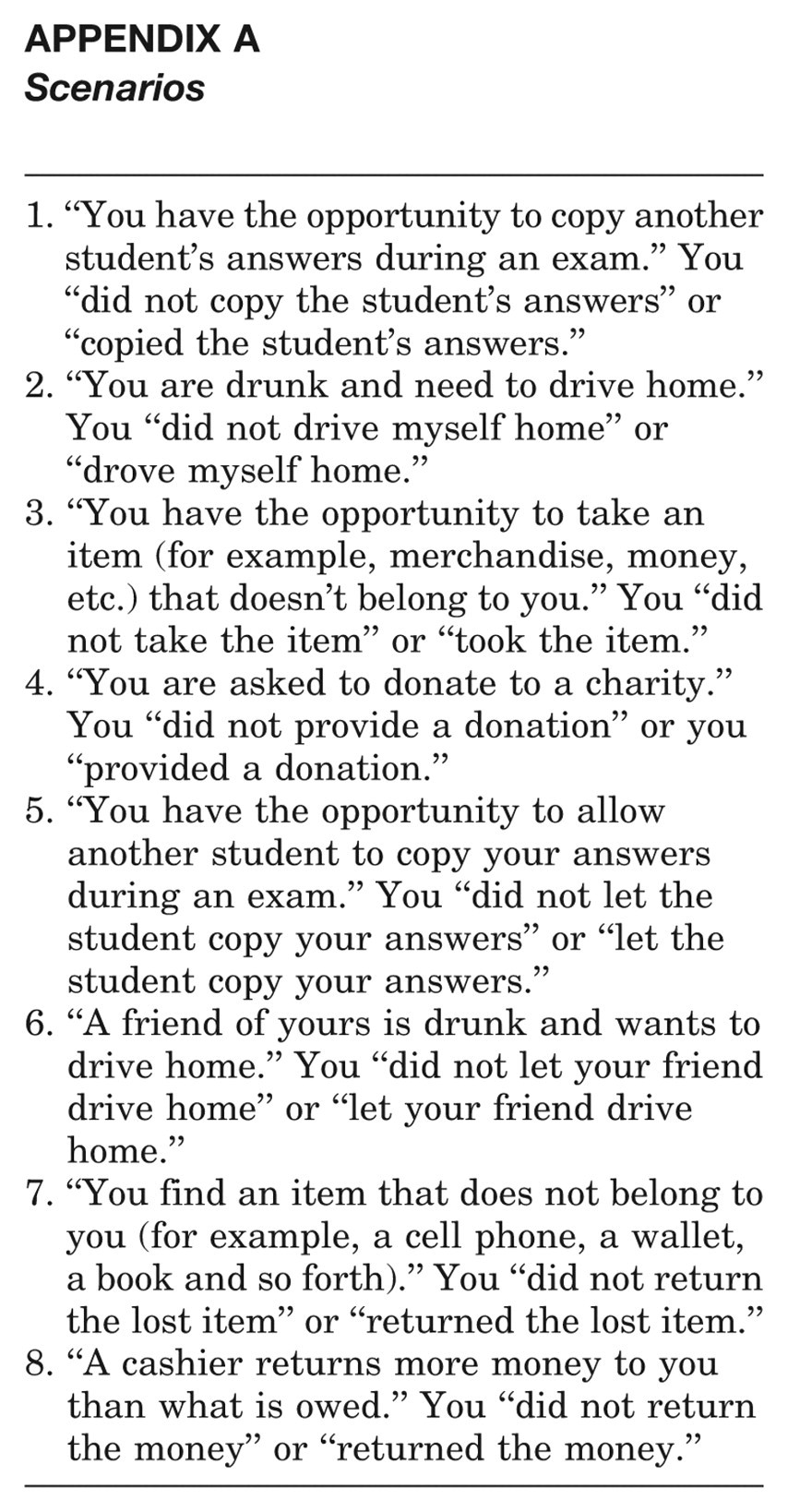
In the survey, participants were asked the degree to which they saw themselves as having a variety of characteristics associated with the dimensions of care and justice. This served to define their moral identity. The survey also measured persons’ behavioral and emotional responses to a variety of situations in which they had had the choice to demonstrate “good” behavior or to do the “right” thing. For ease of recall, respondents were to think of the last time they were in such a situation. They were to report on their behavior in each of the situations and indicate how they felt following their actions (see Appendix A). 7
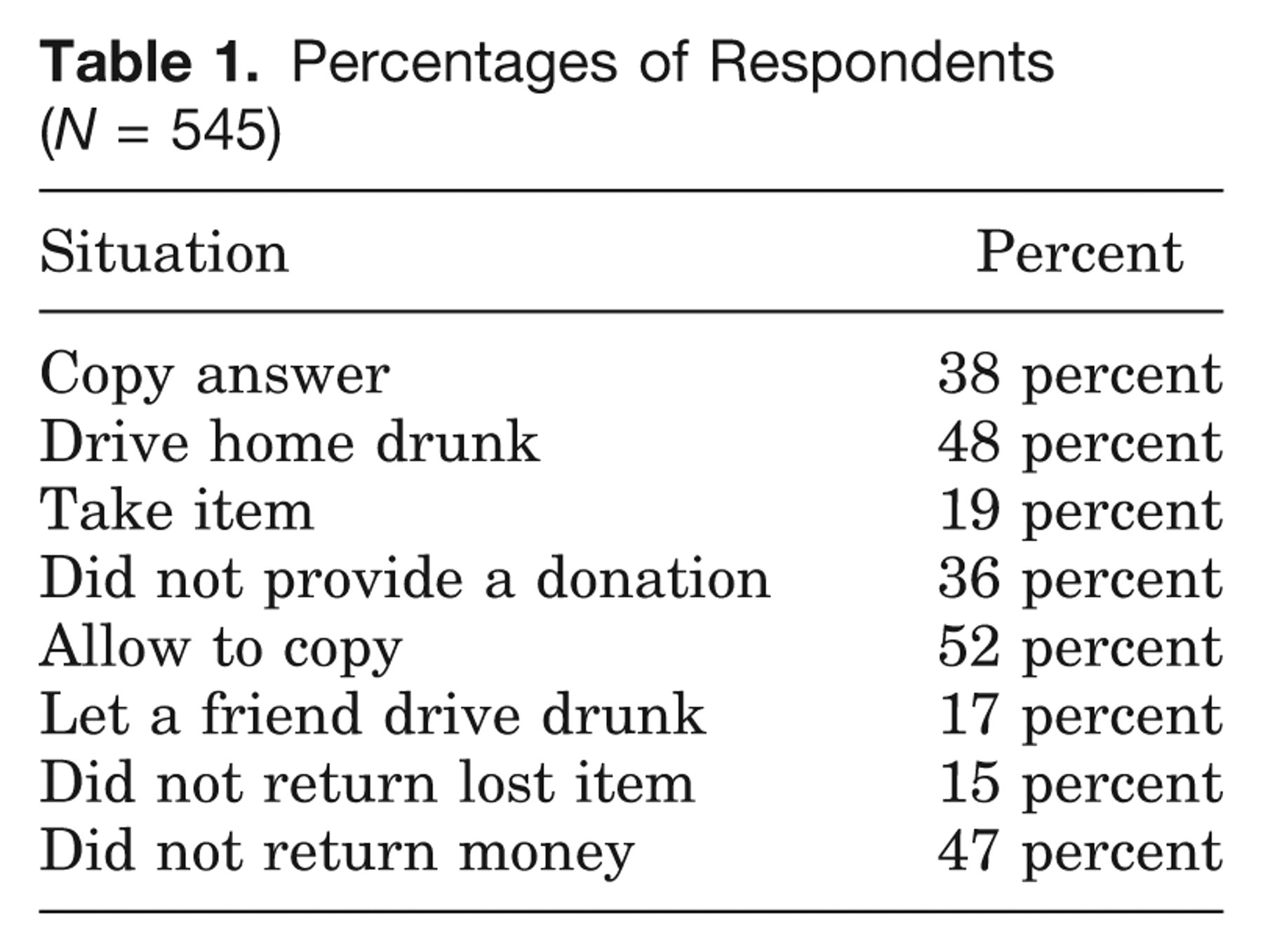
Table 1 reveals that most respondents were unlikely to report immoral behavior. The relatively low percentages across the scenarios suggest that respondents may be portraying themselves in a socially desirable way. To examine this, we analyzed data from Part 2 of the study, in which individuals participated in a laboratory study that simulated a testing situation where they had the opportunity to change their answers to get a higher score on their test. If respondents were answering truthfully in the survey, those who reported that they were more likely to copy a student’s answers in one of the scenarios would be more likely to cheat in our laboratory study. This is what we found. The odds of cheating increased by 30 percent for those who reported copying a student’s answers compared to those who had not reported copying (odds ratio = 1.30, p < .01). While not definitive, these findings provide some evidence that our respondents were not simply answering in a socially desirable manner.
Percentages of Respondents (N = 545)
Using these scenarios was an effective way to get individuals to respond to a common set of experiences. Additionally, since one’s own experiences may produce negative emotions that become repressed (Turner 2006), the scenarios are a useful tool by which individuals can more easily report their feelings. To make certain the scenarios represented situations relevant to individuals, a pretest was administered in 2006 to roughly 150 undergraduates at the same university. The individuals were asked to describe three recent situations they experienced where they had a choice between doing the right thing and doing the wrong thing. They were to describe the situation in some detail, including the choice they decided to make and why. The most frequently listed situations are used in the present study, resulting in situations highly relevant to the population from which we draw our sample. They are not hypothetical or fictitious scenarios but real situations young adults frequently encounter. We do not claim that they represent the full domain of moral situations, or that they are moral situations common to all groups in society. Rather, they are situations students typically identify as moral situations.
Laboratory Study: Part 2
Several weeks following completion of the survey, the same participants arrived at the laboratory. A lab assistant greeted them and ushered them into a room to work on a computer. They were told they would be taking an exam that was testing items for a new version of a college entrance exam similar to the Scholastic Aptitude Test (SAT). The company sponsoring the exam, ScoreHigh, wanted to know how well participants could perform on this new exam. Each participant completed the exam in an isolated room. There were 12 questions on the test (six verbal questions and six math questions). Each question was worth 10 points. After answering each question, a feedback page appeared on the computer screen that reported the participant’s answer, the correct answer, and their total number of points earned to that point in the test.
Before beginning the test, the assistant reminded respondents that they had the opportunity of earning $100 in a lottery for their participation. However, a cover story was created to provide an incentive for participants to cheat. The lab assistant told participants that the company sponsors affiliated with ScoreHigh wanted to extend their appreciation for the participants’ help in determining the success of the exam by entering four additional tickets in the $100 lottery for each person. This increased their odds of winning the lottery. However, if a person’s total points were low relative to those of the other participants, that person would lose some of these extra tickets. If a participant’s points were not in the top 25 percent, the person would lose two tickets. If a participant’s points were not in the top 50 percent, the participant would lose an additional two tickets, or four tickets in total. Thus it was in the participant’s interest to score high on the exam. Participants were told that the scores would be tabulated at the end of the study in order to identify the top, middle, and lower quartiles of scores. In reality, participants’ scores were never tabulated at the end of the study. Before leaving the study, all participants were told that they had an equal chance of winning $100 because each person had earned one lottery ticket for participating in the study.
Before the assistant left the room for the participant to begin taking the exam, the assistant indicated that the exam needed to be checked to see if it was working properly. In reality, there was nothing wrong with the exam. This simply provided an opportunity for the assistant to show the participant how to change his or her answers. 8 The assistant went through a “sample question” with the participant that was already posted on the computer screen. The assistant read the question aloud and then deliberately gave the participant a wrong answer to enter on the computer. On the feedback page, the assistant engaged the participant to “play along with him/her” and “discovered” that the escape key could be used to go back and change one’s response. Upon this discovery, the assistant acted shocked, and informed the participant not to use the escape key for this purpose. The assistant went through two more sample questions with the participant. For one of them, the assistant repeated the use of the escape key to change one’s answer. Following this, the assistant acknowledged to the participant the ability of the program to allow a participant to change his or her answers but indicated to the participant that he or she should not do that. 9
Before the assistant left the room, the person made sure the participant understood how many points each question was worth. The assistant also ensured that a participant knew how many raffle tickets would be taken away if his or her total points were not in the top 25 percent or 50 percent by asking the participant to fill out a short review sheet. If the participant did not answer each question correctly, the assistant returned the review sheet and asked the person to answer the review sheet questions again. After completing the exam and just before ending the study, participants answered a final set of questions including how they thought others would evaluate them on a variety of dimensions, such as being intelligent, moral, and competitive. They also answered a series of questions regarding how they were now feeling.
Before leaving the study, participants were queried as to whether they knew what the study was about. A small number of respondents correctly guessed the purpose of the study. The analyses we present later were estimated separately for those who, after the study, guessed correctly what the research was about, and those who guessed incorrectly as to the nature of the study. There were no statistically significant differences between the two groups in our results. 10
Measures
The moral identity
In Part 1 of the study, respondents were given a list of 12 bipolar characteristics: honest/dishonest, caring/uncaring, unkind/kind, unfair/fair, helpful/not helpful, stingy/generous, compassionate/hardhearted, untruthful/truthful, not hardworking/hardworking, friendly/unfriendly, selfish/selfless, and principled/unprincipled. They were asked to think about how they saw themselves given each characteristic and to identify where they would place themselves between each bipolar characteristic. Responses ranged from 1 to 5, where 1 reflected agreement with one bipolar characteristic, 5 reflected agreement with the other bipolar characteristic, and 3 placed the respondent in between the two bipolar characteristics. Items 2 and 3, 5 through 7, and 10 and 11 measured care, while the remaining items measured justice (Aquino and Reed 2002; Stets and Carter 2006; Walker and Hennig 2004).
Using a bipolar design is consistent with the Burke/Tully method of measuring self-meanings of an identity (Burke and Tully 1977). Like other identity measures such as gender identity (Stets and Burke 1996), student identity (Reitzes and Burke 1980), and environment identity (Stets and Biga 2003), this method attempts to capture the multiple aspects of a dimension to which individuals can respond to themselves as an object.
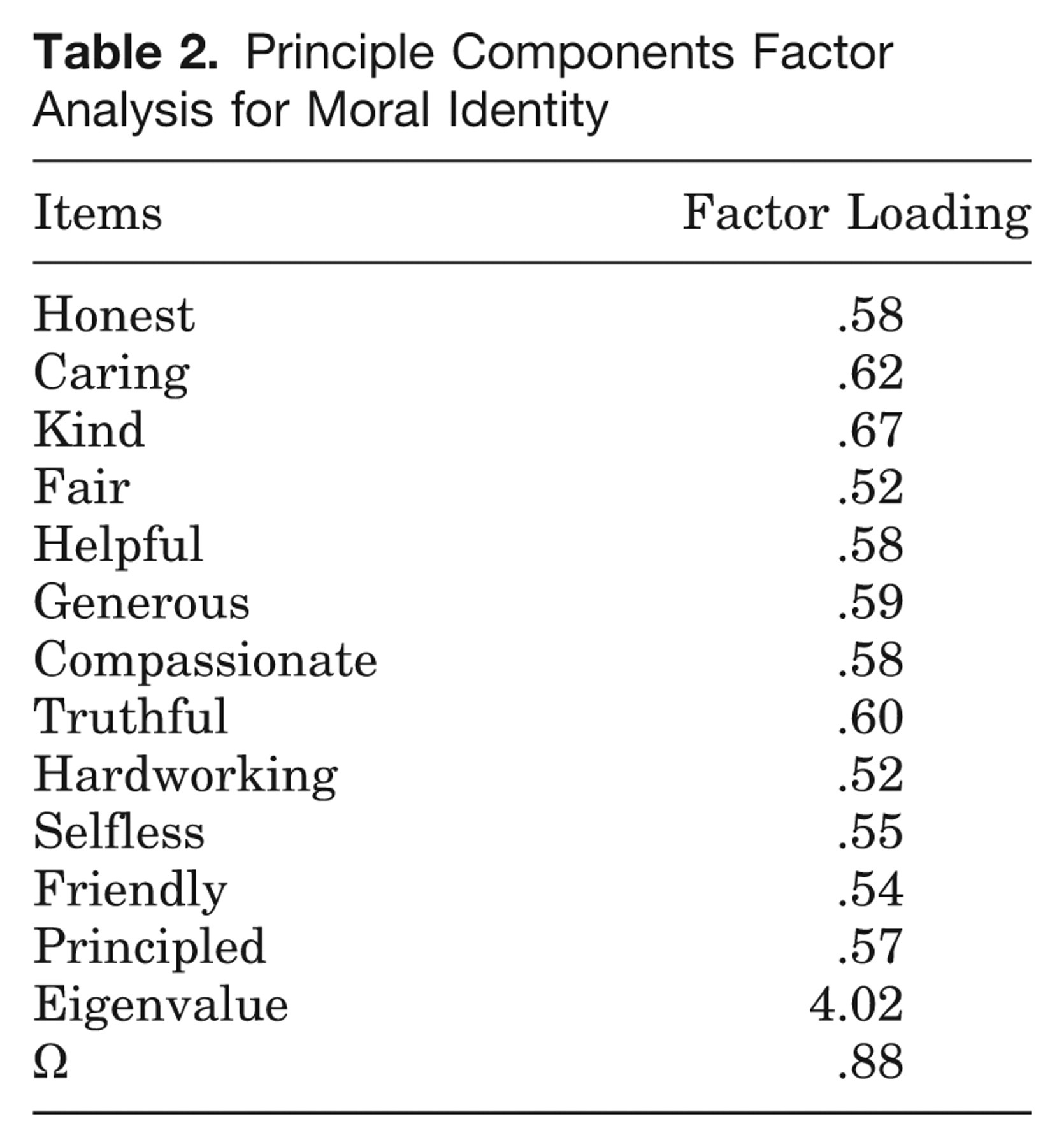
Table 2 presents the principle components factor analysis of the moral identity. The items form a single factor with an omega reliability of .88. Negatively worded characteristics were reverse coded, the items were summed with a high score representing a high moral identity standard, and the scale was standardized (mean = 0; SD = 1). In terms of the original metric, people’s moral identity scores ranged from 3 to 5. Thus, even those with low moral identity standard scores were at the midpoint on the full scale.
Principle Components Factor Analysis for Moral Identity
Task ability
Task ability is the degree to which individuals earn points on their own without cheating. The higher the value on task ability, the more points persons earned on their own. To operationalize whether those with low task ability would be less likely to change their answers when their moral identity was high, we created an interaction term of moral identity multiplied by task ability.
Moral identity discrepancy
The moral identity discrepancy measure is based on people’s perception of others’ meanings of their behavior in a situation (reflected appraisals) as well as their own meanings of their identity standard. Essentially, the meanings of the two are compared to determine the degree of difference (Burke and Stets 2009). Operationally, the moral identity discrepancy measure is people’s moral identity standard minus how moral they think others see them in a situation.
To obtain this, after individuals responded to each of the eight scenarios (Part 1), they reported how they thought others would rate them in each situation on the basis of how they behaved. They indicated how much they thought others saw them as having the following characteristics: being likeable, intelligent, moral, dominant, spiritual, attractive, reliable, loving, and competitive. Their responses to how they thought others saw them as a moral person serves as the reflected appraisal of the moral identity for each of the different scenarios. 11 The other characteristics were filler items to mask our interest in how respondents thought others saw them on the moral dimension. We first standardized the reflected appraisal measure for each situation. We then subtracted participants’ standardized reflected appraisal measure for each situation from their standardized moral identity measure. Each value was then squared so that a departure from 0 in either a negative or positive direction meant an increased discrepancy between the moral identity standard and the reflected appraisals.
In the laboratory study (Part 2), after participants carried out their task and just before leaving, they reported how they thought others would rate them in the lab situation. The same characteristics as earlier are used: being likeable, intelligent, moral, dominant, spiritual, attractive, reliable, loving, and competitive. Again, the filler items help hide our interest in how participants’ thought others saw them as a moral person. This serves as the reflected appraisal of the moral identity in the laboratory study. The reflected appraisal measure in the laboratory was first standardized. Then it was subtracted from participants’ standardized moral identity measure. The value was then squared. A higher value for both the identity discrepancy in the vignettes and in the laboratory means a greater discrepancy in either a positive or negative direction. The measure was then standardized (mean = 0; SD = 1).
Immoral behavior
Respondents’ behavior in each survey vignette was coded 0/1 with 0 reflecting the “right” or “good” behavior, and 1 reflecting the “wrong” or “bad” behavior. Therefore, across the scenarios as presented in the appendix, the following behaviors were coded 1: copied a student’s answers (#1), drove oneself home drunk (#2), took an item (#3), did not provide a donation (#4), let a student copy one’s answers (#5), let one’s friend drive home drunk (#6), did not return a lost item (#7), and did not return money to the cashier (#8). The alternative to each of the above behaviors was coded 0. Respondents’ behavior in the laboratory study is the frequency of changing their answers across the 12 test questions, with a higher value reflecting a higher frequency of cheating.
Emotion
In the survey study, after participants reported how they behaved in each situation, they reported how they felt about their behavior as well as the intensity of the emotion. For ease of responding, they were provided with an “emotion wheel” similar to that used by others, such as Heise and Calhan (1995). Participants were provided with a circle marked with eight emotions. Listed on the wheel was happy, disgusted, fearful, angry, sad, shameful, guilty, and empathic. Happiness, disgust, fear, anger, and sadness are five primary emotions most researchers identify, and shame, guilt, and empathy are three critical secondary emotions that have been examined in the area (Turner and Stets 2005).
Participants were to choose the emotion that best represented how they felt after engaging in their behavior. If they recalled experiencing more than one emotion in the situation, they were to choose the emotion they felt strongest. After identifying an emotion, participants then identified the intensity of their feeling. Response categories were “not at all intense” to “very intense” (coded 0 to 6). This procedure also was employed to measure participants’ emotions following their behavior in the laboratory. They were to identify which of the eight emotions best represented how they were feeling. Again, if more than one emotion was felt, they were to choose the strongest emotion. Then they were to report its intensity.
Identity theory makes predictions of positive and negative emotions but not specific emotions. 12 To create a measure of emotions in both the survey and in the lab, a dichotomous variable was first created where 0 represented positive emotions (happiness or empathy) and 1 represented negative emotions (disgust, fear, anger, sadness, shame, or guilt). This variable was then multiplied by the intensity of the reported emotion (coded 0–6). The resulting continuous variable ranged from 0 to 6, with a higher value reflecting more intense negative emotions and a lower value representing positive emotions (happiness and empathy) or less intense negative emotions.
Analysis
Since participants’ behavior in the survey is coded 0/1, we estimate this equation using logistic regression. We provide the odds ratio for a one-unit change in the independent variable. Departures from an odds ratio of 1 in a positive direction indicate the proportional increase in the odds of engaging in immoral behavior for a one-unit increase in the independent variable. Departures from an odds ratio of 1 in a negative direction indicate the proportional decrease in the odds of engaging in immoral behavior for a one-unit increase in the independent variable. In the laboratory study, the immoral behavior of cheating is censored. Therefore, we estimate cheating using tobit analysis. Since the emotion variable is continuous, we estimate these equations using ordinary least squares (OLS) regression.
The unit of analysis in the survey is an individual’s response to each scenario. Since all participants responded to eight scenarios, there are eight responses per person or 4,360 responses. Given that individuals are responding to multiple scenarios, the error terms for their multiple responses are not independent, and are thus allowed to be correlated. 13 In our final model, in addition to including our identity relevant factors, we include gender, race, and age as control variables. Our results did not change with the inclusion of these demographic variables. 14
Results
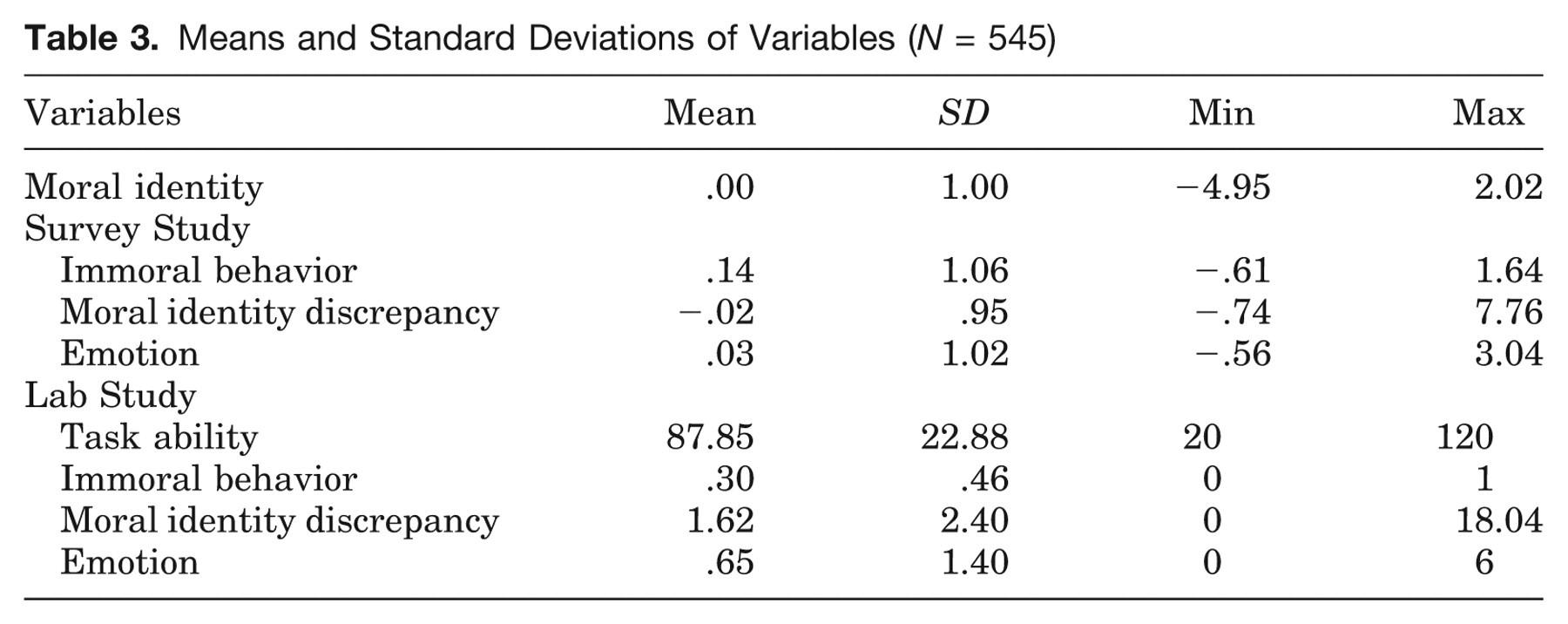
Table 3 presents the means and standard deviations of all variables in the analysis. Tables 4 and 5 provide the zero-order correlations among the variables in the survey and laboratory studies. 15 In the survey study, we find that a higher moral identity is related to a decline in immoral behavior (r = −.15, p < .05) and enacting immoral behavior is significantly associated with negative emotions (r = .46, p < .05). A higher moral identity discrepancy in either a positive or negative direction also is related to negative emotions (r = .21, p < .05). In the laboratory study, higher task ability is linked to a decline in immoral behavior (changing one’s answers on the exam) (r = −.32, p < .05). Higher task ability also is negatively associated with negative emotions (r = −.23, p < .05). However, a higher moral identity is positively associated with negative emotions (r = .16, p < .05).
Means and Standard Deviations of Variables (N = 545)
Correlations: Survey Study (N = 545)
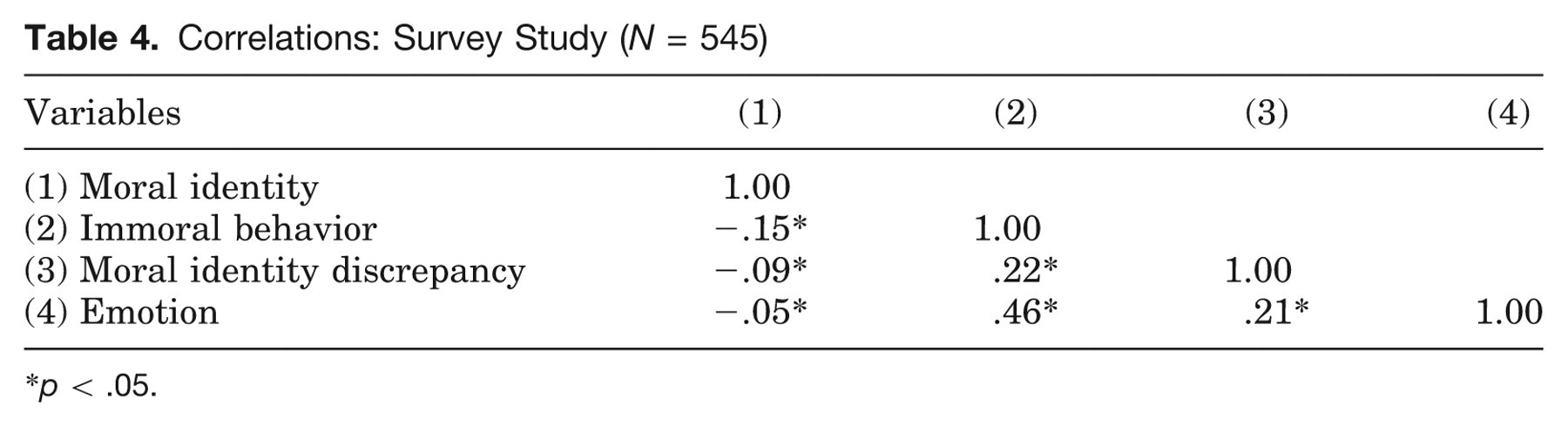
p < .05.
Correlations: Lab Study (N = 545)
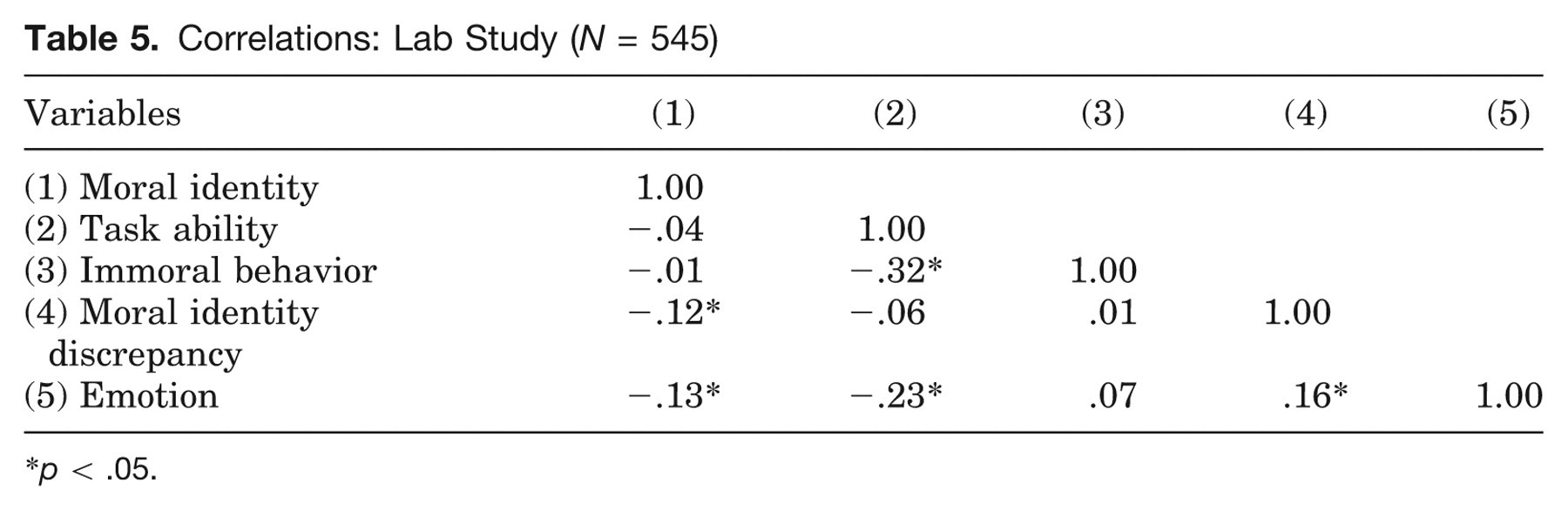
p < .05.
To examine the above relationships more closely, we need to control for the effects of all other variables in our analyses that may be suppressing otherwise real relationships. The best way to examine an outcome in the identity model is to study the separate and unique associations of each factor while holding constant the influence of all other factors. For this, we turn to the results in Table 6, which provide the logistic, tobit, and OLS regressions of behavior and emotions in the survey study and laboratory study. As we mentioned earlier, we are interested in examining whether the results are consistent with the hypotheses derived from identity theory.
Logistic, Tobit, and OLS Regressions of Behavior and Emotion (N = 545)
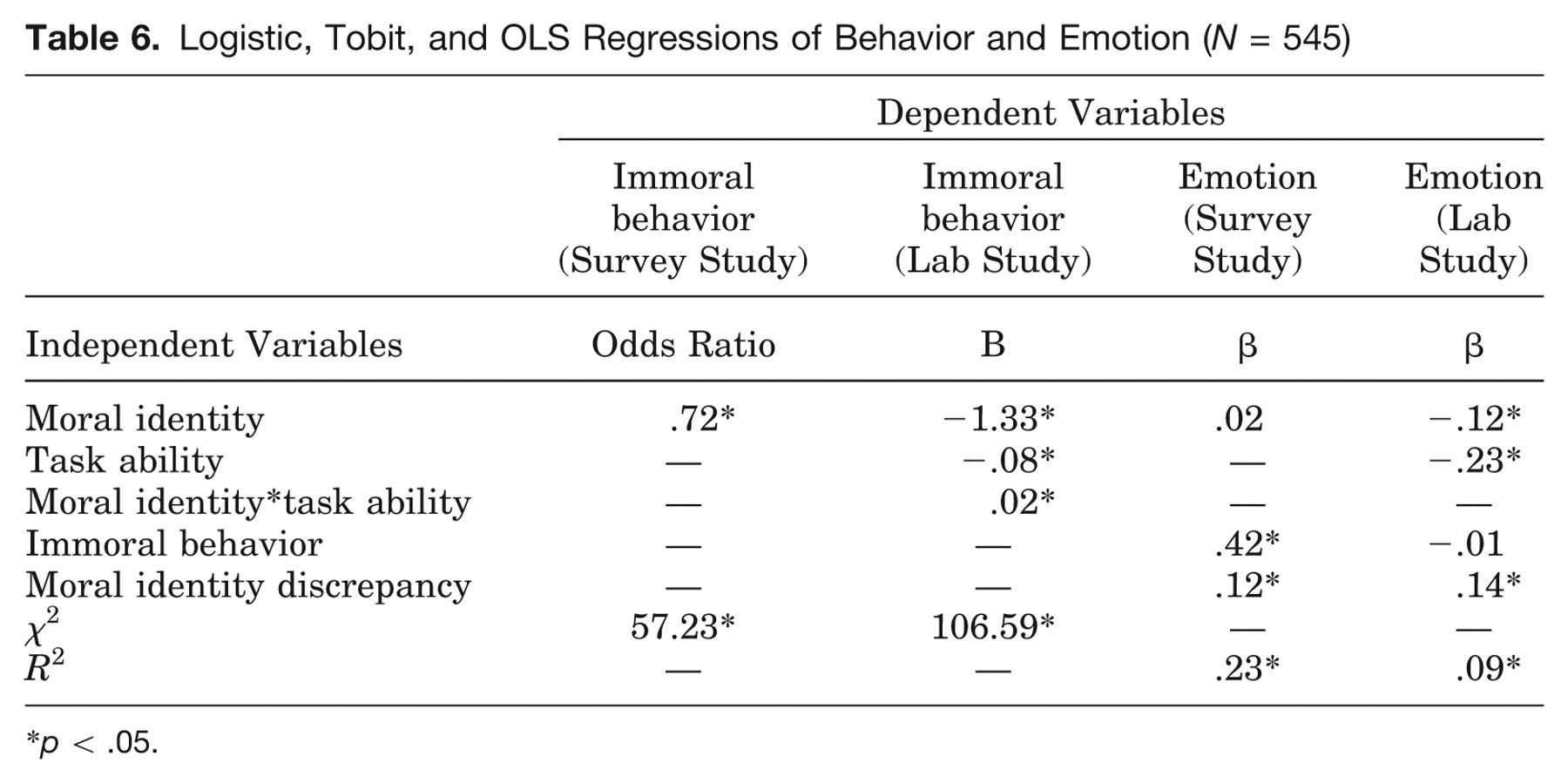
p < .05.
Columns one and two estimate behavior. The higher the moral identity, the less likely it is for the person to report immoral behavior in the survey scenarios. Specifically, the odds of committing an immoral act decrease by 28 percent for each standard deviation increase in the moral identity (odds ratio = .72, p < .05). Additionally, the higher the moral identity, the less likely it is for the person to change his/her answers in the testing situation in the laboratory (b = −1.33, p < .05). Therefore, Hypothesis 1 is supported. A higher moral identity steers individuals toward morally more appropriate behavior. Conversely, a lower moral identity steers people toward morally less appropriate behavior.
Also in column two, we find that a person is less likely to engage in immoral behavior (cheat in the testing situation) when the individual has high task ability compared to low task ability (b = −.08, p < .05). This confirms Hypothesis 2. Further, we find that as a person’s task ability increases, the effect of the moral identity on immoral behavior decreases (b = .02, p < .05). For every point that a person earns on task ability, their moral identity goes up .02. This means that the effect of the moral identity on behavior decreases (−1.33 + .02 = −1.31). To put this in a context, an increase of 60 points in task ability is almost enough to wipe out the effects of the moral identity on cheating behavior. These results support Hypothesis 3.
Columns three and four in Table 6 estimate negative emotions. The results in column three reveal that reports of immoral behavior in the survey situations are positively associated with negative emotions (β = .42, p < .05). Additionally, a moral identity discrepancy in either a positive or negative direction is significantly related to reports of negative emotions (β = .12, p < .05). This latter finding confirms Hypothesis 4. Individuals experience negative emotions when they perceive that others view their moral identity differently than they do.
Column four estimates participants’ emotions in the laboratory study. Consistent with Hypothesis 4, a moral identity discrepancy (β = .14, p < .05) is associated with reports of negative feelings in the laboratory. Those who think that others do not see them in the way they see themselves in terms of morality report more negative feelings compared to those who think that others’ views match their own view. This relationship remains even when controlling for the effects of other factors also associated with one’s negative feeling state, such as task ability (β = −.23, p < .05) and moral identity (β = −.12, p < .05).
Overall, the identity variables we use in this research are consistent in their significant association with morality across the survey and laboratory methodologies. Of particular importance are the effects of the moral identity discrepancy on negative emotions in the survey study and laboratory study. When people claim a relatively high (or low) moral identity but then find that others do not agree that they are behaving in a morally good (or bad) manner, this is associated with bad feelings. They have fallen short of their identity standard. However, the alternative is also true; when people claim a relatively low (or high) moral identity but then find that others see them as far more morally good than their identity standard, this also is related to negative feelings. They have exceeded their identity standard. Theoretically, these negative emotions should create a greater force to reduce the discrepancy, resulting in individuals doing whatever it takes to achieve consistency between how they are perceived in the situation and their moral identity standard meanings. While the identity process is not the only relevant process in understanding morality, it is an important theoretical process.
Discussion
This research was designed to study the self as a moral entity by applying the control system approach of identity theory. The theory provides an explanation for the internal mechanisms that operate when one experiences a moral situation. It takes into account three dimensions of the self: the cognitive dimension (control of self in situation meanings to match identity standard meanings), behavioral dimension (moral behavior that is guided by the moral identity), and emotional dimension (positive and negative feelings that are experienced for identity verification or identity nonverification, respectively). Overall, the identity theory predictions are confirmed for a person identity just as for role identities that have occupied previous research in identity theory. The identity predictions are also robust across different methodologies: both when individuals are asked to reflect upon their past behavior and feelings, and when they are placed in an immediate situation that tempts them to engage in wrongful behavior.
An important advantage of identity theory over previous theorizing on the moral identity—for example, the social-cognitive approach—is that it recognizes that individuals may have an immoral identity, a moderately moral identity, or a very moral identity. Wherever individuals place themselves on the continuum of moral meanings, they will act in accordance with these self-meanings and seek to have these self-meanings verified through feedback from others. Thus it is not that individuals have (or fail to have) a moral identity that is central, as the social-cognitive approach assumes, but rather that individuals have a moral identity that ranges from very low to very high. Individuals then are motivated to verify their position on that meaning dimension.
Our findings are consistent with this conceptualization. Those with a higher moral identity were more likely to report engaging in moral behavior in the recalled scenarios in the survey. They were also less likely to cheat in the lab by changing their answers even when controlling for the incentive to cheat given their low ability to perform well on the task. We also found that compared to those with high task ability, those with low task ability who were more likely to be tempted to cheat were less likely to do so when their moral identity was high. This suggests two things. First, the amount and type of resources that individuals possess may circumvent the moral dimension of some dilemmas. For example, those with high task ability could avoid cheating altogether because they could obtain a high score based on their own abilities. Second, when resources are low, it is better to have a high moral identity standard when a moral dilemma emerges. Indeed, those with low task ability were more likely to engage in moral behavior when they had a high moral identity standard than a low moral identity standard.
When individuals received feedback from others that their behavior did not carry the same meanings as their identity standard meanings, an identity discrepancy occurred, disrupting the smooth and ongoing identity process. This translated into identity nonverification, and people who experienced this reported negative emotions, revealing that something was awry. Our findings evidenced this both in the survey and lab. 16 The next step is that individuals must do something different in the situation in order to facilitate identity verification, though we did not examine these specific strategies in this study.
There are several shortcomings to this research that future work should address. First, in examining the justice and care aspects of morality, we did not study how the meanings of care and justice might guide different behaviors. For example, identity meanings based on care might produce more helping behavior, while identity meanings based on justice might produce behavior that abides by particular rules. Second, we did not examine whether different emotions would emerge from an identity discrepancy, and whether those emotions would be different based on meanings of care compared to justice. For example, an emotion such as shame (negative feelings turned inward) may be more likely to result from identity nonverification based on meanings of care while anger (negative affect turned outward) may be more likely to result from identity nonverification based on meanings of justice. Third, there are other meanings associated with morality than care and justice; we need to identify these meanings, and we need to see how they operate in producing particular behavioral and emotional outcomes. For example, if morality carries meanings of community, then we might expect it to produce cooperative behavior and lead to feelings of shame more frequently when identity nonverification occurs.
Finally, a shortcoming to this research concerns the idea that individuals have multiple identities. For example, a person can see herself as a moral person (person identity), a student (role identity), and member of a sorority (social identity), and the meanings of a person identity may infiltrate the meanings of role and social identities. It is important to examine how multiple identities interact with the moral person and compete for expression (or, alternatively, reinforce the meanings of the moral identity) in situations. Additionally, do situational cues activate a particular identity over other identities an individual claims, or does a salient moral identity act as a filter that directs attention to controlling situational meanings that are consistent with salient moral identity meanings? We think a combination of both processes occurs. While evidence reveals that a salient identity directs behavior that is consistent with identity meanings (Callero 1985; Stryker and Serpe 1982), research also shows that situational meanings can decrease the salience of an identity by setting up constraints as to which identity can be enacted (Serpe 1987; Serpe and Stryker 1987). In the latter case, for example, a recent study on the moral identity showed that the presence of situational cues that encourages a self-interested identity reduces the accessibility of the moral identity, thereby producing selfish as opposed to selfless behavior in the situation (Aquino et al. 2009).
A variety of contextual factors may activate identities other than the moral identity in a situation. Significant others in a situation, such as family members or friends, may encourage the adoption of an alternative identity. For example, if one is at a party and must decide whether to drive home a friend who is drunk, friends at the party may encourage the person to continue having a good time and ignore the drunk friend who is about to leave. In this way, friends may promote a self-interested identity rather than the moral identity. Alternatively, the presence of significant others who remind one of what he or she values may encourage other identities, including the moral identity. For example, if moral exemplars are present in a situation, they may remind individuals to respond in a moral rather than immoral manner (Walker and Hennig 2004). In this way, the effect of the presence of an identity exemplar may offset the situational pressures that may encourage expression of a competing identity. We therefore not only have the issue of how multiple identities interact with one another in a situation, but also how these identities interact with situational factors to facilitate or impede the activation of particular identities. These are just some issues that need to be investigated to help extend the study of morality sociologically and theoretically.
More generally, this research paves the way for contributing to the science of morality by bringing a sociological theory to bear. It also advances the area of social psychology by identifying the internal identity processes that orient (or fail to orient) people to the “good.” Furthermore, it develops identity theory by investigating the internal operations of a person identity using mixed methods. Identity theory provides a rich theoretical direction for future research on the moral individual.
Footnotes
Appendix A
Scenarios
| 1. “You have the opportunity to copy another student’s answers during an exam.” You “did not copy the student’s answers” or “copied the student’s answers.” |
| 2. “You are drunk and need to drive home.” You “did not drive myself home” or “drove myself home.” |
| 3. “You have the opportunity to take an item (for example, merchandise, money, etc.) that doesn’t belong to you.” You “did not take the item” or “took the item.” |
| 4. “You are asked to donate to a charity.” You “did not provide a donation” or you “provided a donation.” |
| 5. “You have the opportunity to allow another student to copy your answers during an exam.” You “did not let the student copy your answers” or “let the student copy your answers.” |
| 6. “A friend of yours is drunk and wants to drive home.” You “did not let your friend drive home” or “let your friend drive home.” |
| 7. “You find an item that does not belong to you (for example, a cell phone, a wallet, a book and so forth).” You “did not return the lost item” or “returned the lost item.” |
| 8. “A cashier returns more money to you than what is owed.” You “did not return the money” or “returned the money.” |
Acknowledgements
We would like to thank members of the Social Psychology Seminar at the University of California, Riverside for the comments on an earlier draft.
1
2
3
A person claiming a moral person identity in a situation may simultaneously hold other identities, such as the role identity of friend, student, or parent, or the social identity of Catholic or Democrat. We discuss the role of multiple identities later.
4
Establishing perceptual input based on reflected appraisals may be limited because it neglects one’s own appraisal (self-appraisal) in the situation ( ). Individuals may ignore reflected appraisals and adopt their own perceptions as feedback, reinterpret reflected appraisals that are nonverifying as verifying, or reinterpret reflected appraisals that are verifying as nonverifying. These alternative strategies need to be investigated in future research.
5
6
These characteristics are similar to the university population from which the sample was drawn. For example, while the sample has slightly more women than men, compared to the distribution at the university (women = 52 percent, men = 48 percent), the other characteristics are comparable to the university population. For example, the average age of students at the university is 21, and the race or ethnic breakdown at the university is 40 percent Asian, 28 percent Latino, 17 percent white, 8 percent black, and 7 percent other.
7
If participants had never experienced the situation, they were to imagine themselves in the situation and respond with what they would do and how they would feel following their actions. We focus only on those respondents who experienced the situation. The following is the percentage of individuals experiencing each situation: Did/did not: copy a student’s answers (72 percent), drive oneself home drunk (49 percent), take an item (67 percent), give to charity (91 percent), allow a student to copy one’s answers (69 percent), let a friend drive home drunk (66 percent), return a lost item (86 percent), and return money to a cashier (81 percent).
9
To determine whether a participant cheated, the computer program created two variables for the “ESC” key. The first variable identified whether the person used the “ESC” key to go back. If the “ESC” key was used, the second variable indicated whether the person used the “ESC” key to review his or her answer without changing it, or to review and change the answer from the one originally recorded. Participants were unaware that the program was able to track their behavior and therefore instances of cheating.
10
These results are available upon request.
11
In another study, respondents were asked to rate each of the 12 bipolar characteristics that comprised the moral identity in terms of how moral they personally considered each item, within their definition of morality (Stets and Carter, Forthcoming). Response categories ranged from 0 = “extremely immoral” to 10 = “extremely moral.” Negatively worded characteristics were reverse coded. The average mean was high (mean = 7.52; SD = 1.2). Since respondents identified these items as strongly characterizing being moral, and because we did not want to tax them by administering the 12 items for each of the eight scenarios, we substituted each of the 12 items with the characteristic of being a moral person.
12
13
To accomplish this, we used the cluster option in Stata, which allows the errors to correlate.
14
These results are available upon request.
15
To correct for Type 1 errors, we used the Bonferroni adjusted significance level.
16
An identity discrepancy is not the only source of negative feelings in situations. For example, our findings in the lab study showed that a low moral identity standard and low task ability were also associated with feeling bad.
This research was supported by a National Science Foundation Grant (SES-0617022) to the first author.