







Abstract
This research investigates how participation in college-based science-training programs increases student intention to pursue a scientific career. Using identity theory, we delineate three levels of social structure and conceptualize science-training programs as proximate social structures. Results from a sample of 892 undergraduate science students are supportive of identity theory and indicate that participation in proximate social structures leads to increased commitment to a science identity, increased salience of a science identity, and increased intention to pursue a scientific career. This study contributes to the literature on identity theory by demonstrating how participation in proximate social structures can lead to subsequent identity processes, thus refining the understanding of how society shapes the self and clarifying how social positioning affects choices for behavior. Additionally, the conceptualization of proximate social structures provides an avenue for applications of identity theory to investigations of other social interventions as well as mechanisms leading to social inequality.
Do persons organize their selves in response to entry into and exit from networks of social relations contingent on maintaining a specific role identity? Does this organization of the self have implications for future behavior in the role? Does placement of persons into networks of social interaction contingent on a specific role identity serve to increase commitment to an identity, the salience of that identity, and the likelihood of behavioral choices related to that identity? The present research investigates these questions in the context of college-based science-training programs. We conceptualize such programs as proximate social structures, defined by identity theory as social networks 1 close to individuals that provide social relationships based on a specific role identity. Using identity theory, 2 we investigate how entry into and exit from such structures affect commitment to identities, how commitment affects the salience of role-related identities, and how salience affects intention for future behaviors in the role.
Identity theory seeks to explain why some individuals choose to participate in particular social roles more often than others and how these choices are shaped by social structural location. Little empirical work, however, has investigated how participation in different levels of social structure shapes identity processes (Stryker, Serpe, and Hunt 2005). The current study is an effort to begin to “fill in” the relationship between structural positioning and individual behavior by linking social structure to identity processes more explicitly than seen in past work.
Theoretical Background: Identity Theory
Identity theory formalizes the basic axiom provided by Mead (1934)—that society shapes self, which in turn shapes social behavior—by specifying the components of that axiom. In identity theory, commitment replaces society, identity salience replaces self, and choice among social roles replaces social behavior. Role identities are that part of the self that persons base on their participation in networks of social relationships and related roles (Stryker 1968, 1980, 2008; Serpe 1987; Stryker and Serpe 1994; Serpe and Stryker 1987; Stryker and Burke 2000; Burke and Stets 2009). Role identities are identities tied specifically to occupancy of a social role; they are differentiated from both social identities based on persons’ self identification as members of a social category (as in, American or women) and person identities that are based on individuals’ view of themselves as having a unique set of characteristics (as in, a good person).
Identity researchers have specified two distinct types of commitment. Affective commitment refers to the sense of belonging and attachment to others in role relationships; it is defined operationally in terms of the costs of losing relationships high on positive affect. Interactional commitment refers to the number or scope of role relationships; it is defined operationally in terms of the costs of losing relationships by virtue of their ubiquity in a person’s life (Stryker 1968, 1980). 3 Following over four decades of work, commitment, given that it reflects relatively stable pattern of social relationships and interaction, is viewed as a social structure closest to interactional behavior (Stryker 1968, 1980, 2007; Stryker and Serpe 1982, 1994; Callero 1985; Serpe 1987, 1991; Serpe and Stryker 1987, 1993, 2011; Stets and Burke 2000; Stryker and Burke 2000; Burke 2004; Stryker et al. 2005; Burke and Stets 2009).
Commitment refers to relatively stable patterns of social relations and interaction, 4 and the theory proposes that these patterns influence how role identities are organized and impact role behavior. Despite appreciating over time reciprocities among the commitment-salience-role behavior variables (Styker and Serpe 1983; Serpe 1987; Serpe and Stryker 2011), commitment is according priority in the theory’s argument because all humans are born into ongoing networks of social relationships. Additionally there is empirical evidence that the over time impact of commitment on salience is stronger than is the impact of salience on commitment (Serpe 1987). Commitment plays a critical role in identity theory: it is an important source of why persons carry particular identities from situation to situation and why these identities are likely to be activated in a variety of situations (Stryker 2008; Owens, Robinson, and Smith-Lovin 2010; Serpe and Stryker 2011).
Identity theory asserts that virtually all persons in modern differentiated societies have multiple identities organized in a hierarchical manner. Identity salience is defined as the relative positioning of a particular identity in this identity hierarchy. Identity salience is predictive of the likelihood that an individual will invoke a given role identity in particular situations or across situations. For instance, if the identity of science student has a higher relative positioning in the individual’s identity salience hierarchy than the identity of golf team member, an individual would be more likely to discuss her science studies rather than her golf game when meeting a person for the first time. Identity theory further asserts that there is a greater likelihood of this individual enacting the identity of science student rather than golfer, perhaps in choosing how to spend a sunny Saturday afternoon. Given that salience is a function of commitment, there is a resultant sense of identity structures that again reflects the rootedness of identities in social relationships.
An implication of identity theory’s conceptualization of self as rooted in social relationships is the possibility of change in self over time. As Serpe and Stryker (1987:46) note, “changes in the nature and level of role relationships are expected to produce commensurate changes over the long haul in both the content and salience ordering of the self”; that is, changes in social relationships are likely to produce changes in self. This conceptualization of the self is distinctly social psychological in suggesting that a person’s social structural location and the relationships he or she develops from this location may be more consequential for social behavior than psychological traits the individual may have (Owens 2003; Stryker 2007; Owens et al. 2011; Serpe and Stryker 2011).
Large, Intermediate, and Proximate Social Structure
Identity theory sees persons as living their lives in relatively small and specialized networks of social relationships through roles that support their participation in such networks. These small networks are nested within a hierarchy of social structures in which large social structures provide boundaries affecting the likelihood that individuals will enter into smaller social structures. Drawing on this view of society as a montage of overlapping social structures of differing sizes, Stryker et al. (2005) propose a refinement of the conception of social structure by differentiating large, intermediate, and proximate social structures, visualizing role identities as the result of a process through which large structures and intermediate structures impact proximate structures.
While the present research does not directly implicate large and intermediate social structures, we believe it important to recognize their importance for the link between the proximate structures and the consequent role-related intentions and behaviors that are the study’s focus. Large social structures are those that typically concern macro-oriented sociologists such as race, class, gender, or nation. A basic premise of sociology is that in most societies these structures serve as social boundaries having important consequences for individual life chances, including the probability of entering particular networks of social relationships (Blau 1977). Intermediate social structures are more localized networks (e.g., neighborhoods, schools, associations) that bring sizable sets of persons together in particular settings. Intermediate social structures are important as social boundaries either increase or decrease the probabilities of social relationships forming. Thus, intermediate structures, like large social structures, serve as important gatekeeping boundaries in determining which individuals have more or less access to which proximate social structures.
Proximate social structures are those closest to persons, such as families, athletic teams, departments within larger corporate or educational structures, or particular social clubs within a school, and represent the contexts within which persons generally enact role identities (Stryker et al. 2005; Serpe and Stryker 2011). Participation in proximate social structures provides persons with social relationships most directly attributable to a specific role identity, and the enactment of the role identity supports their participation in these structures. Our focus here is whether participation in proximate social structures in which interactions play out and identities are enacted is related to levels of commitment to—and to the salience of—the role identity. As noted by Stryker et al. (2005), years of identity theory research has provided empirical support for the links among commitment, salience, and future role performance by demonstrating that identities that increase in commitment also increase in identity salience (Stryker and Serpe 1982, 1994; Callero 1985; Serpe 1987, 1991; Serpe and Stryker 1987, 1993; Nuttbrock and Freudinger 1991; Cassidy and Crew 2001, 2004). As noted, we now move a step back in this process by investigating how placement in networks of social interaction impacts the subsequent identity process.
The specific proximate structures investigated are college-based science-training programs. The fit of this vision of the selective processes joining multiple levels of social organization in impacting the specific identity processes that are the focus of the research reported here is evident. Class, gender, and race/ethnicity (large structures) are all implicated in placing persons in the social locations of specific universities (intermediate structures) that make it more or less likely that they will enter the social relationships and interactions (proximate structures) that can motivate them to pursue or forget pursuing the possibility of scientific occupations and support the determination to do so (Fenske, Porter, and DuBrock 2000; Crisp, Nora, and Taggart 2009). We believe it is important to keep a vision of this overall process from the “top” to “bottom” to make it clear the social psychological parts of the process are not independent of the more encompassing social structural parts of the process and to also make it clear that, vice versa, the more social structural parts of the process culminate in the social psychology of self and identity that can feed back into their more encompassing structural settings (Stryker 1989, 1994; Stryker et al. 2005).
Increasing Participation in Science Education
Since the 1980s, American scientists and policy makers have been increasingly concerned with the state of science, technology, engineering, and mathematics (STEM) education in the United States. These concerns center on whether U.S. colleges and universities are producing the number of STEM graduates needed to address future scientific problems and maintain global leadership in STEM (Hilton et al. 1989; Committee on Women 1991; Jackson 2006; National Institute of Health [NIH] 2006; National Academy of Sciences, National Academy of Engineering, and the National Academy of Mathematics 2007; National Mathematics Advisory Panel 2008).
This concern about the state of STEM education is perpetuated by data showing the science and math achievement scores of U.S. students falling behind both past students and students in other nations. For instance, in 2006, U.S. students ranked thirty-sixth overall and twenty-sixth among industrialized countries on a key indicator of international science performance. This same assessment ranked U.S. students thirty-fourth overall and twenty-fifth among industrialized countries in mathematics achievement (Organization of Economic and Cooperative Development 2007). In addition, test scores in science among U.S. twelfth graders have declined since 1996 (U.S. Department of Education 2006), and the proportion of college majors has shifted away from STEM disciplines relative to other nations in recent decades (Government Accountability Office 2005; National Academy of Sciences et al. 2007; National Center for Educational Statistics 2009).
The process by which students leave scientific education has been described as a leaky pipeline. That is, for students to obtain a scientific degree they must successfully complete a series of steps in their educational career (e.g., graduate from high school, enter college with a science major, maintain interest during college). At any point in this process, the student may “leak” out of the scientific educational pipeline and give up interest in a scientific career (Schultz et al. 2011). There is substantial evidence that minority students are the most likely to leave the science education pipeline during their undergraduate years (Jackson 2006). For instance, in 2006 black and Latino students combined represented about 12 percent of all science undergraduate students. However, these students are more likely to either change majors during their college careers or not graduate from college and represent only about 8 percent of science graduates (National Science Foundation 2006). At the graduate level, black and Latino students represent only about 5 percent of students obtaining doctoral degrees in the sciences and 3 percent of current working doctoral scientists (Science and Engineers Statistical Data System 2008).
The importance of science and technology fields for society has made the improvement in STEM education a key aspect of federal education policy at all levels. In 2004, the Government Accountability Office (GAO) estimated that federal agencies spent some $2.8 billion and funded about 207 STEM education programs (GAO 2005). Central to these efforts at the college level are programs targeted at historically underrepresented minority students (NIH 2006; Maton and Hrabowski 2004). One significant aspect of these policy efforts are minority science-training programs designed to facilitate research experience, critical thinking, and mentorship among minority science students (NIH 2006).
Abundant empirical evidence indicates that peer influence is an important consideration for the development of personal values and beliefs and for shaping students’ identities and that students who interact more often tend to be more similar in their aspirations, study habits, and academic success than students who interact less often (Astin 1993; Tinto 1993; Feldman and Newcomb 1994; Milem 1998; Kaufman 2005; Riegle-Crumb, Farkas, and Muller 2006; Hurtado et al. 2008; Palmer and Gasman 2008; Riegle-Crumb and Callahan 2009). This evidence suggests that the higher rates of attrition from science majors for minority students may be due less to the individual characteristics of these students and more to the relationship between racial background and access to peer group networks. Given the possible “chilly climate” that minority students may encounter in science departments, the availability of a network of other science students may be of added importance for these minority science students (Astin 1993; Chickering and Reiser 1993; Seymour and Hewitt 2000; Swenson, Nordstrom, and Hiester 2008).
Lee (1998, 2002) uses identity theory to guide research into a summer training program for high school science students. His research demonstrates that identity considerations are influential in facilitating continued interest in science education. For example, in an investigation of gender-related differences in interests in science, Lee (1998) finds that female students are likely to see discrepancies between how they perceive themselves and how they perceive other science students and that controlling for these discrepancies accounts for some of the gender differences in interest in science. Lee (1998) also finds support for the identity theory model in contemporaneous effects of commitment and identity salience on science-related activities. Lee’s (1998, 2002) research clearly demonstrates that students who perceive that their own identities are consistent with scientific identities are more likely to maintain an interest in science. We extend Lee’s work here by investigating identity processes in the context of long-term, college-based science-training programs. We conceptualize these programs as proximate social structures within which interactions play out and identities are enacted because these programs put science students into social networks with other science students, and students must maintain a science student role identity to maintain their enrollment in the programs.
Summary and Hypotheses
The current research investigates college-based science-training programs as proximate social structures using identity theory. We argue that involvement in such programs leads students to develop commitment to other science students in the programs. Following identity theory, we expect that increased commitment will lead to increased identity salience of a science student identity. Increased identity salience in turn will lead students to have greater intention to continue their scientific training. Enrollment in science-training programs is dynamic, with students moving in and out of these programs. Thus, our measure of program enrollment is a categorical measure of status change (or non-change) from time 1 to time 2 (see method section). The following seven hypotheses formalize our expectations in terms of differences between groups of students and the effects of commitment on salience and salience on intention:
Hypothesis 1: Students who remain continuously enrolled in a science-training program between time 1 and time 2 will have higher levels of subsequent commitment to a science student identity than students who are never enrolled in a training program.
Hypothesis 2: Students who enter a science-training program between time 1 and time 2 will have higher levels of subsequent commitment to a science student identity than students who are never enrolled in a training program.
Hypothesis 3: Students who leave a science-training program between time 1 and time 2 will not have higher levels of subsequent commitment to a science student than students who are never enrolled in a training program.
Hypothesis 4: Students who enter a science-training program between time 1 and time 2 will have higher levels of subsequent commitment to a science student identity than students who leave a training program.
Hypothesis 5: Students who remain continuously enrolled in a science-training program between time 1 and time 2 will have higher levels of subsequent commitment to a science student identity than students who leave a training program.
Hypothesis 6: Commitment will have positive effects on subsequent identity salience.
Hypothesis 7: Identity salience will have positive impact on intention to pursue a scientific career.
Data and Method
Our data are drawn from four waves of TheScienceStudy, a national panel of NIH minority training enrollees in the United States. TheScienceStudy includes students primarily enrolled in the Research Initiative for Scientific Enhancement (RISE), Minority Access to Research Careers (MARC), Undergraduate Student Training in Academic Research (U*STAR), and Bridges programs (Schultz et al. 2011). Each of these science-training programs focuses on giving minority students the support and experiences needed to succeed as biomedical scientists. NIH funds these programs at the institutional level, and each institution has considerable freedom in how students are recruited and how training programs are otherwise implemented. Although there is substantial variation in the implementation of programs, for instance, MARC programs require a summer research experience and RISE programs do not, the programs each place students in a social network with other science students at their university and specify that students need to maintain a science major to maintain program enrollment. In addition, the goals of each of these programs are to increase the number of minorities who pursue careers in the sciences.
TheScienceStudy sample was recruited through an online screening survey publicized to possible respondents by directors of training programs. Students were recruited from the fall semester of 2005 through the fall semester of 2006. Overall, 1,365 students were selected into the panel. 5 Those selected were asked to complete an online survey once each semester. Response rates (RR) for TheScienceStudy are about 76 percent (RR1; cf., American Association of Public Opinion Research 2006) for each of the data collection times reported here. The present analysis uses data from 2007 to 2009, which for convenience we refer to as times 1 to 4. These surveys were administered during the fall semester of 2007 (wave 1), the spring semester of 2008 (wave 2), the fall semester of 2008 (wave 3), and the spring semester of 2009 (wave 4).
Hypotheses 1 through 5 refer to the effects of a change in program enrollment between time 1 and time 2. To isolate this effect from outside influences and model the temporal aspects of identity theory, we exclude students who experienced a status change after time 2 and those who left college after time 2. Including students who experienced an additional status change (i.e., leaving or enrolling in a program) would allow this change, which is not included in the model, to affect intention to pursue a scientific career at time 4 and bias the impact of the measured status change variable. 6 Similarly, the majority of those students who left college during the study graduated. Including these students, who likely had a variety of experiences after leaving college, could also bias effects of other variables on time 4 intention. Excluding students who left college during the span of our study limits the generalizability of our results somewhat. We cannot speak to the effects of training programs among those students who leave college altogether but only among students who persist in college through the study period. This limitation is related to the nature of our sample, which consists of mainly high-achieving students who are less likely to leave school than are members of the general student population. These criteria resulted in an analytic sample of 892 students. Multiple imputation with SAS PROC MI was used to account for missing data (Allison 2001; Shafer and Graham 2002; SAS Institute 2007), and all reported coefficients and standard errors are combined across five imputed data sets and adjusted for imputation.
TheScienceStudy sample reflects those science students targeted by NIH as likely to drop out of science training. The sample is 71 percent female, 43 percent black, and 38 percent Latino; the remaining 19 percent are about 5 percent Asian, 5 percent white, and 9 percent other race. 7 In addition, 65 percent of sample members are majors in biological sciences, 20 percent are majors in natural science, and 5 percent are majors in math and engineering, while the remaining 10 percent major in social sciences such as psychology. 8 The sample consists of successful students with an average high school GPA of nearly 3.5. 9 The average age of the sample at baseline was 22 years old, and about 21 percent of the sample are first-generation college students. In terms of class standing, the sample at time 1 consists of 12 percent freshman, 27 percent sophomores, 37 percent juniors, and 24 percent seniors. 10
Measures
Student intention to pursue a science-related research career is measured by one item at time 4 asking them to rate their intention of pursuing a science-related research career on a scale of 0 to 10. Clearly, intention is subjective and does not represent a direct measure of future career choice. Given our social psychological approach, it is useful to have a measure that isolates student intentions from other constraints on their ability to attain the goal of scientific career, such as family difficulties or financial constraints. Moreover, evidence from work initiated by the psychologists Ajzen and Fishbein (1969; Fishbein and Ajzen, 2010) on the theory of reasoned action and literally hundreds of research efforts occurring throughout the intervening time support the contention that intention is the “best” predictor of future behavior.
Program enrollment status is indexed by a series of dummy variables indicating how the students’ enrollment status changed from time 1 to time 2. Students who were enrolled in a training program at both time 1 and time 2 are coded 1 on the dummy variable REMAIN, which indicates continuous program enrollment. Students who were not in a training program at time 1 but were enrolled at time 2 were coded 1 on the variable ENTER, which indicates entering a program. Students who were enrolled at time 1 but not at time 2 were coded as 1 on LEAVE, which indicates leaving a training program. Finally, those students who were not enrolled in a training program at time 1 or at time 2 were coded 1 on the variable NEVER, indicating never enrolled in a training program. In the main analyses that follow, students who were never enrolled in a training program serve as the reference group. An important limitation of operationalizing program enrollment in this way is that we do not account for the duration of program enrollment prior to time 1. That is, we cannot distinguish between students who leave programs after several years from those students who leave programs after only a short period. Models estimated using interaction terms for class standing, which might be a proxy for program duration, showed no evidence of varying effects based on class standing.
Measures of identity salience and commitment were adopted from prior work in identity theory (Stryker and Serpe 1982; Serpe 1987; Serpe and Stryker 1987; Stryker and Serpe 1994; Lee 1998, 2002; Stryker et al. 2005). Identity salience is a latent construct measured by four identical manifest indicators at times 1, 2, and 3. In each time, students were asked how likely they are to mention their desire to be a scientist to a coworker, a person of the opposite sex, the friend of a close friend, and a friend of a family member using a scale of 0 to 10. Each of these items is used as an indicator of the latent salience construct, and identical items are allowed to correlate over time. We utilize a measure of identity salience assessed prior to the changes indexed by the enrollment status variables; this aspect of our modeling strategy allows us to be more confident in the effects of enrollment status because including this measure should control for selection bias on identity salience. That is, if students with higher identity salience at time 1 are more likely to enter or remain in a training program, our model should account for this selection process. Unfortunately, we do not have measures of commitment taken at time 1. Therefore, we cannot rule out selection bias coming from differences in initial levels of commitment. However, because identity salience is in important degree a result of commitment, controlling for prior identity salience should make our model more robust with regard to this issue.
Commitment to a science identity is a second-order latent construct composed of the latent constructs of interactional commitment and affective commitment. As noted previously, identity researchers have often specified two distinct types of commitment: affective commitment refers to the loss of relationships high on positive affect, while interactional commitment refers to the loss of relationships significant by virtue of their ubiquity in the individual’s life (Stryker 1968, 1980). Preliminary analyses indicated that among TheScienceStudy sample the latent constructs of affective and interactional commitment were highly correlated (r = .70), thus we decided to model these related constructs as one second-order latent variable. 11 Affective commitment is a latent construct measured by three items at time 2. Affective commitment is assessed by items asking students how much they would miss other science students if they were no longer in contact (0 = not at all to 10 = a great deal), how close they are to other science students (0 = not close at all to 10 = very close), and how important other science students are to them (0 = not at all to 10 = very important). Three items assess interactional commitment at time 2. Students were asked how often they socialize with other science students (1 = daily to 7 = never), how many hours a week they spend with other science students, and how much money they spend socializing with other science students (1 = almost all to 7 = almost none). The final three measures were standardized to a mean of 0 and a standard deviation of 1 before entry into the model. A measurement model of the identity constructs (not shown) displayed a good fit to the data (chi-square = 421, df = 118; chi-square/df = 3.27; Comparative Fit Index [CFI] = .988; standardized root mean square residual [SRMR] = .03).
Mentor status is a dichotomous variable (1 = has mentor, 0 = does not have mentor) assessed at time 2. We control for faculty mentor status because although enrolled students are likely to have faculty mentors, it is also possible for students to have mentors outside the auspices of a training program. Given our focus on social relationships, faculty mentoring is an important control variable that adjusts the estimates of enrollment to be independent of the effects of mentor-student relationships. It is important to note that our measure of mentor status only accounts for the presence of a faculty mentor and does not control for the quality of the mentoring for the student. Additionally, we control gender and race/ethnicity. Black and Latino dummy variables compare black and Latino/a students to all non-black non-Latino students, respectively. Three items control for student major: biological indexes students with majors in the biological sciences, natural indexes students with majors in the natural sciences, and math/eng indexes students who are math or engineering majors; the reference group for student major are students majoring in a social science. Finally, one item lower division (LD) compares freshman and sophomore students to juniors and seniors.
As noted earlier, TheScienceStudy sample comes from universities across the United States. To account for any differences that may be observed due to different climates in these various universities, all models include a fixed effect for university attended. For ease of presentation, these fixed effects are not shown. While there were few significant differences between students at different universities, we include these effects because they resulted in an improvement in the fit of the statistical model. Table 1 shows means and standard deviations, and Table 2 displays zero-order correlations for all study variables across the five imputed data sets.
Means, Standard Deviations, and Descriptions for All Observed Variables (N = 892)
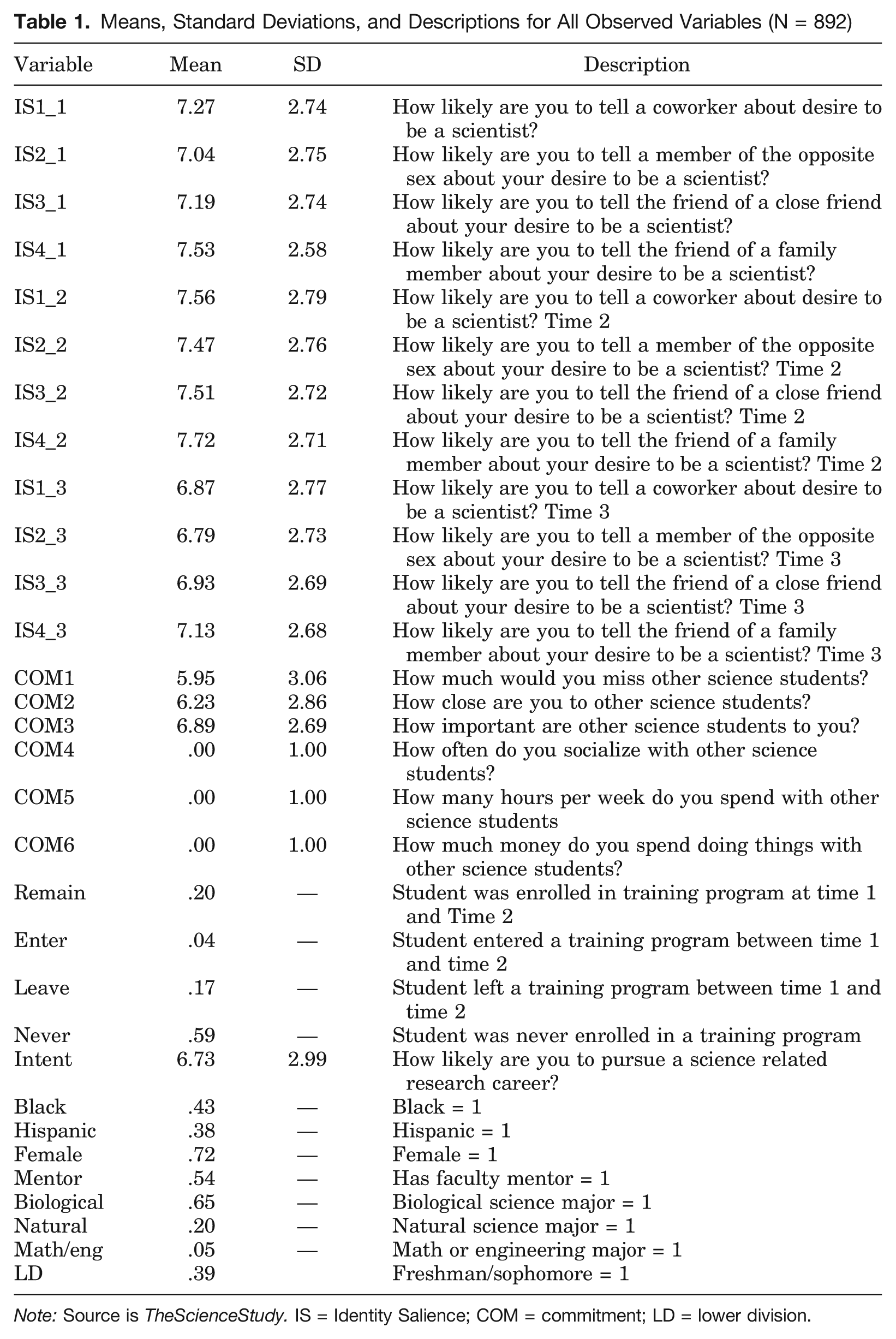
Note: Source is TheScienceStudy. IS = Identity Salience; COM = commitment; LD = lower division.
Zero-Order Correlations for All Observed Variables (N = 892)
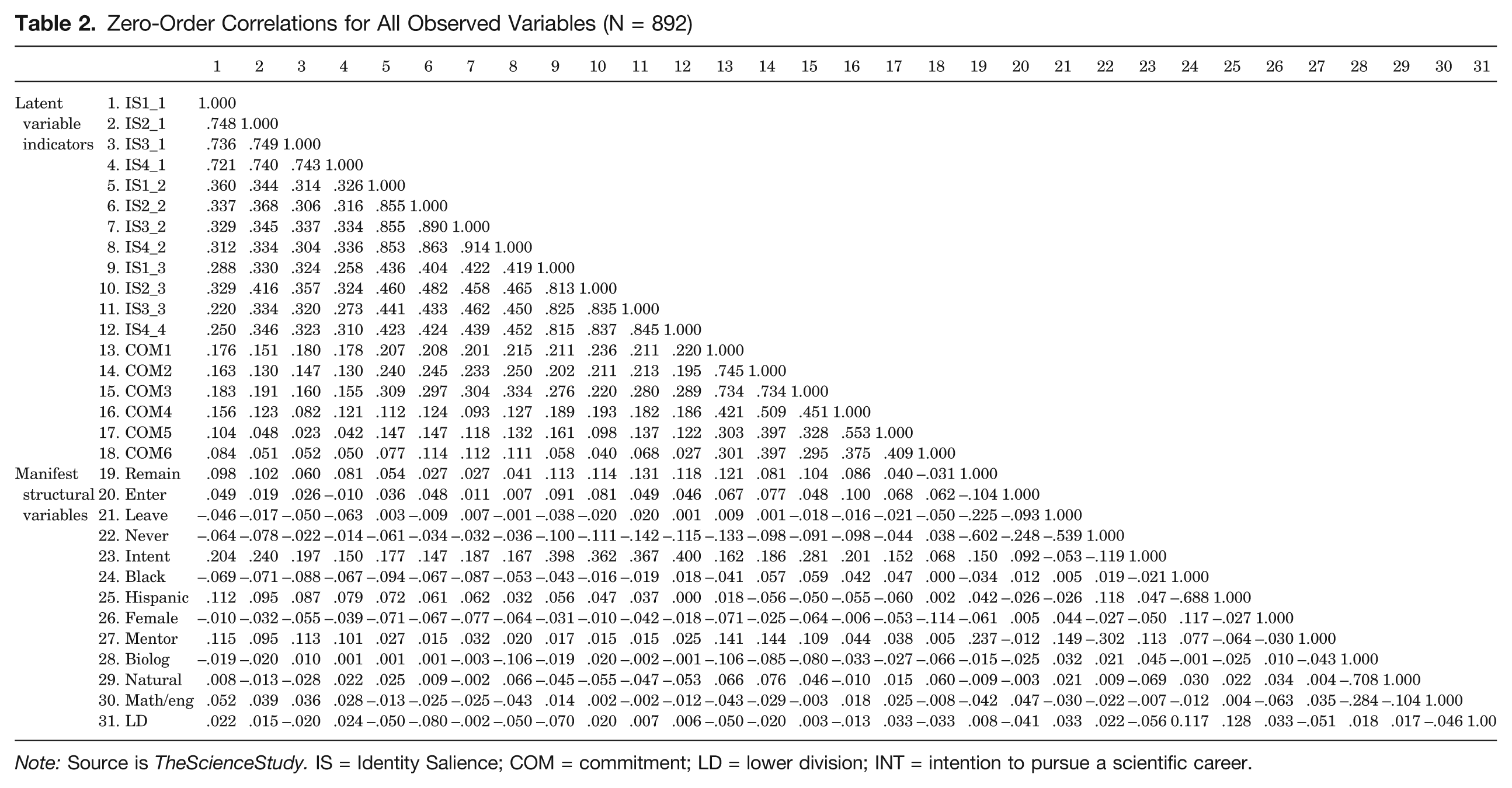
Note: Source is TheScienceStudy. IS = Identity Salience; COM = commitment; LD = lower division; INT = intention to pursue a scientific career.
Modeling Strategy
Given goals of this research, to determine whether change in enrollment status in science training leads to increased intention to persist in science through the mechanisms of commitment and identity salience, we estimate a structural equation model in which the main independent variable, change in enrollment status, predicts subsequent measures of identity salience and commitment. These constructs then predict subsequent intention to pursue a scientific career. In selecting the variables used, we attempt to retain the temporal aspects of the identity theory model, in which commitment serves as the link between program enrollment status and identity salience; this aspect of our strategy explains why, for instance, we do not include additional measures of commitment (e.g., commitment at time 3). Figure 1 presents the structural model estimated.
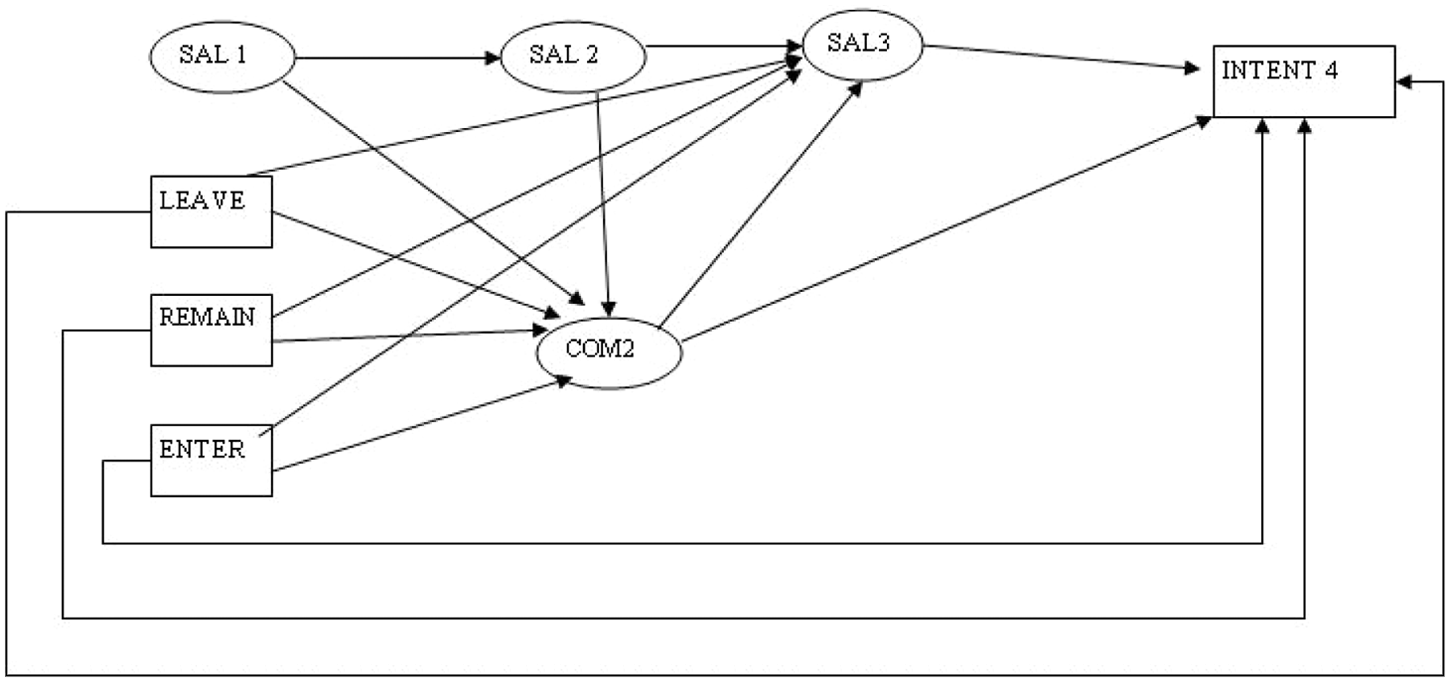
Structural Model of Identity Processes
Figure 1 shows that the variables indexing program enrollment status as well as identity salience measured at time 1 predict commitment at time 2. In Figure 1, students who were never enrolled in training programs serve as the reference group for the enrollment variables, thus the paths from the enrollment variables to commitment compare students in these (REMAIN, ENTER, or LEAVE) categories to students who were never enrolled in a training program and test Hypotheses 1, 2, and 3. Commitment, along with identity salience at time 2, and the enrollment variables predict identity salience at time 3. The paths linking commitment to identity salience tests Hypothesis 6. Finally, commitment, identity salience, and the enrollment variables predict intention to pursue a scientific career at time 4. The path relating identity salience to intention to pursue a scientific career tests Hypothesis 7. In addition, the control variables of gender, race/ethnicity, class standing, mentor status, and major are included as predictors of commitment, time 3 salience, and intention to pursue a scientific career. Supplemental analyses using a different reference category for the enrollment items and testing differences proposed in Hypotheses 4 and 5 are also presented.
Results
Table 3 shows the mean of the intention measure by enrollment status. Table 3 indicates that students who remained enrolled in training programs and students who enter training programs have higher levels of intention than students who were never enrolled in these programs. Additionally, Table 3 indicates that students who left training programs do not differ from students who were never enrolled. The structural equation model that follows seeks to determine if identity processes can help explain these differences in intention.
Mean Level of Intention by Program Enrollment Status (N = 892)
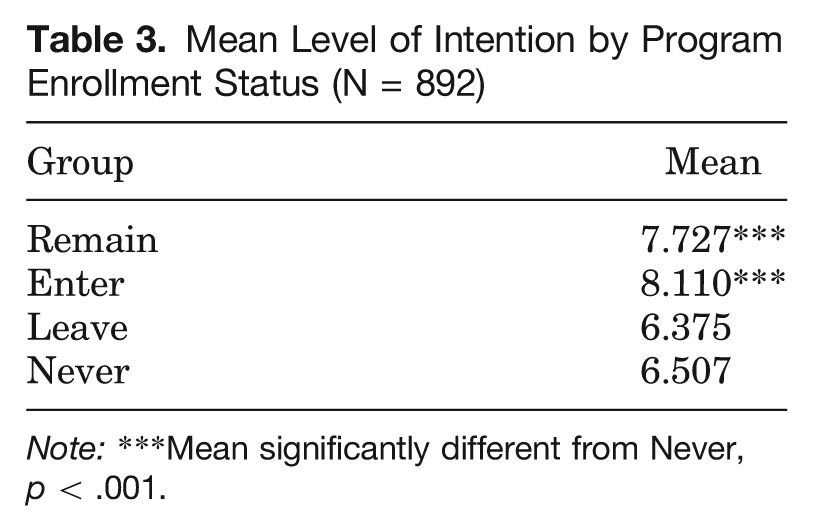
Note: ***Mean significantly different from Never, p < .001.
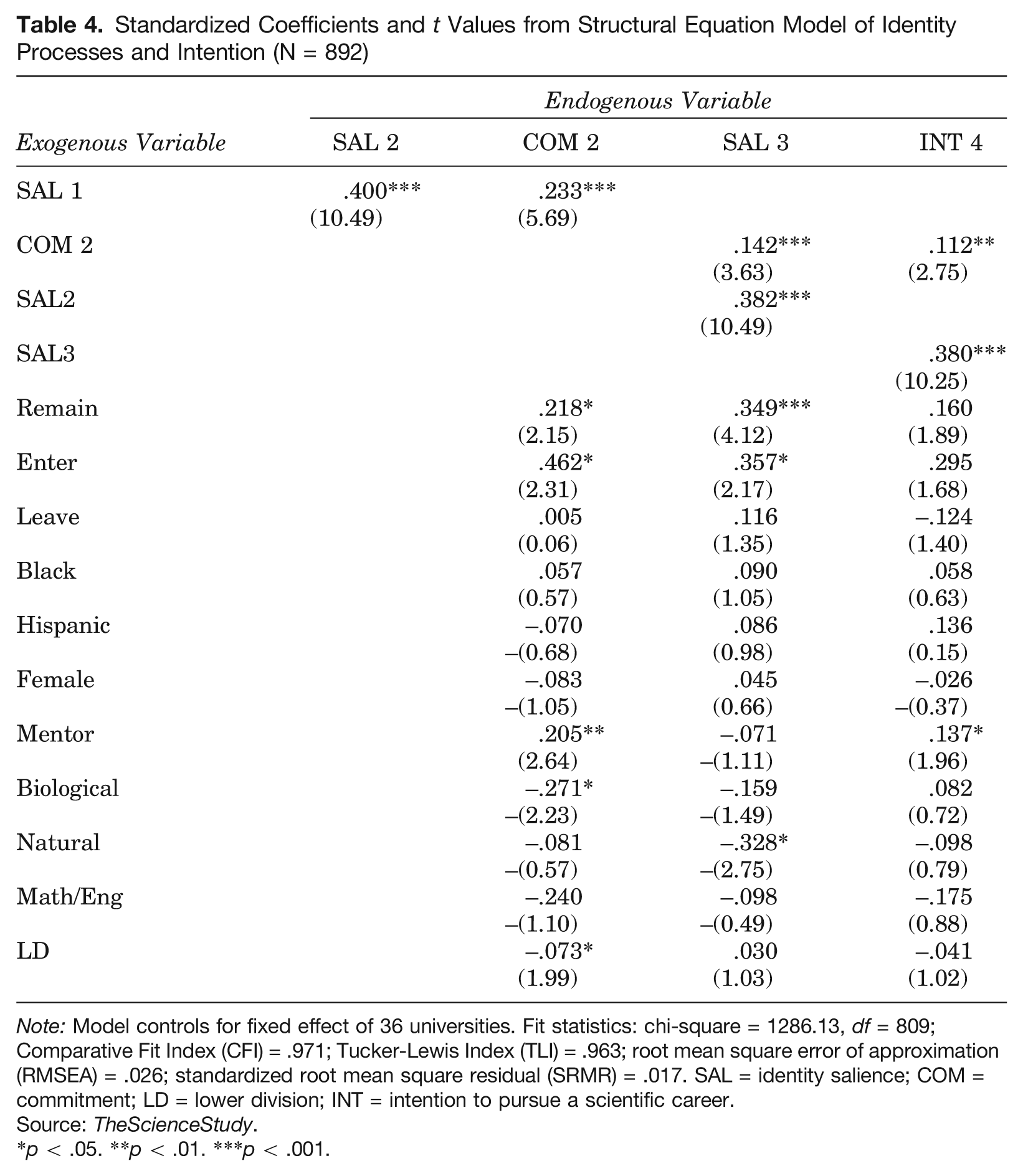
Table 4 shows the results from the structural equation model. As expected, both of the stability coefficients for identity salience are significant and in the expected direction (t1–t2: B = .400, p < .001; t2–t3: B = .382, p < .001). Additionally, identity salience at time 1 has significant positive effects on commitment at time 2 (B = .233, p < .001). While not the focus of our investigation, these effects are consistent with identity theory’s argument that identity salience has positive effects on commitment (Serpe 1987).
Standardized Coefficients and t Values from Structural Equation Model of Identity Processes and Intention (N = 892)
Note: Model controls for fixed effect of 36 universities. Fit statistics: chi-square = 1286.13, df = 809; Comparative Fit Index (CFI) = .971; Tucker-Lewis Index (TLI) = .963; root mean square error of approximation (RMSEA) = .026; standardized root mean square residual (SRMR) = .017. SAL = identity salience; COM = commitment; LD = lower division; INT = intention to pursue a scientific career. Source: TheScienceStudy.
p < .05. **p < .01. ***p < .001.
Turning to our hypothesis tests, the model supports Hypothesis 1: students who remained continuously enrolled in training program between time 1 and time 2 have higher levels of subsequent commitment (B = .218, p < .05) than those students who were never enrolled in training programs. In addition, we see support for Hypothesis 2: students who entered a training program have higher levels of commitment than those students who were never enrolled (B = .462, p < .01). Results in Table 4 also support Hypothesis 3: students who left a training program between time 1 and time 2 do not have higher levels of commitment than students who were never enrolled in a training program.
Results in Table 4 support Hypothesis 6. Commitment to a science identity has significant positive effects on identity salience at time 3 (B = .142, p < .001). Finally, Hypotheses 7 is supported as identity salience has significant positive effects on intention to pursue a scientific career (B = .380, p < .001). This pattern indicates that identity salience, which was in part determined by commitment, leads students to have a greater interest in pursuing a scientific career after college. In addition, the model shows that there are no direct effects of enrollment on intention: the effects of science-training programs on intention are mediated by the identity variables of commitment and identity salience. This pattern of mediation also reduces concerns of selection bias coming from high levels of initial intention. That is, even if high levels of intention lead students to enroll in science-training programs, our results still indicate that program status change is important, in part, because it leads to greater commitment and salience, which in turn lead to higher levels of intention.
Some other findings from Table 4 deserve mention. Program status change has direct effects on identity salience. Students who remain enrolled in science-training programs (B = .349, p < .001) and students who enter training programs (B = .357, p < .05) have higher levels of identity salience at time 3 than students who were never enrolled in these programs. Commitment has direct effects on intention at time 4 (B = .112, p < .001). Students with faculty mentors had higher levels of commitment (B = .205, p < .05) and were more likely to intend to pursue a scientific career (B = .137, p < .05). Finally, we find that individuals enrolled in biological sciences have significantly lower commitment (B = –.271, p < .05) and those enrolled in the natural sciences have lower levels of salience (B = –.328, p < .05) than individuals enrolled in social sciences. Overall, the model presented in Table 3 shows a good fit to the data with fit statistics within acceptable range for a model estimated on a large sample (CFI = .971, Tucker-Lewis Index [TLI] = .963, root mean square error of approximation [RMSEA] = .026, SRMR = .017; cf. Tanaka 1993).
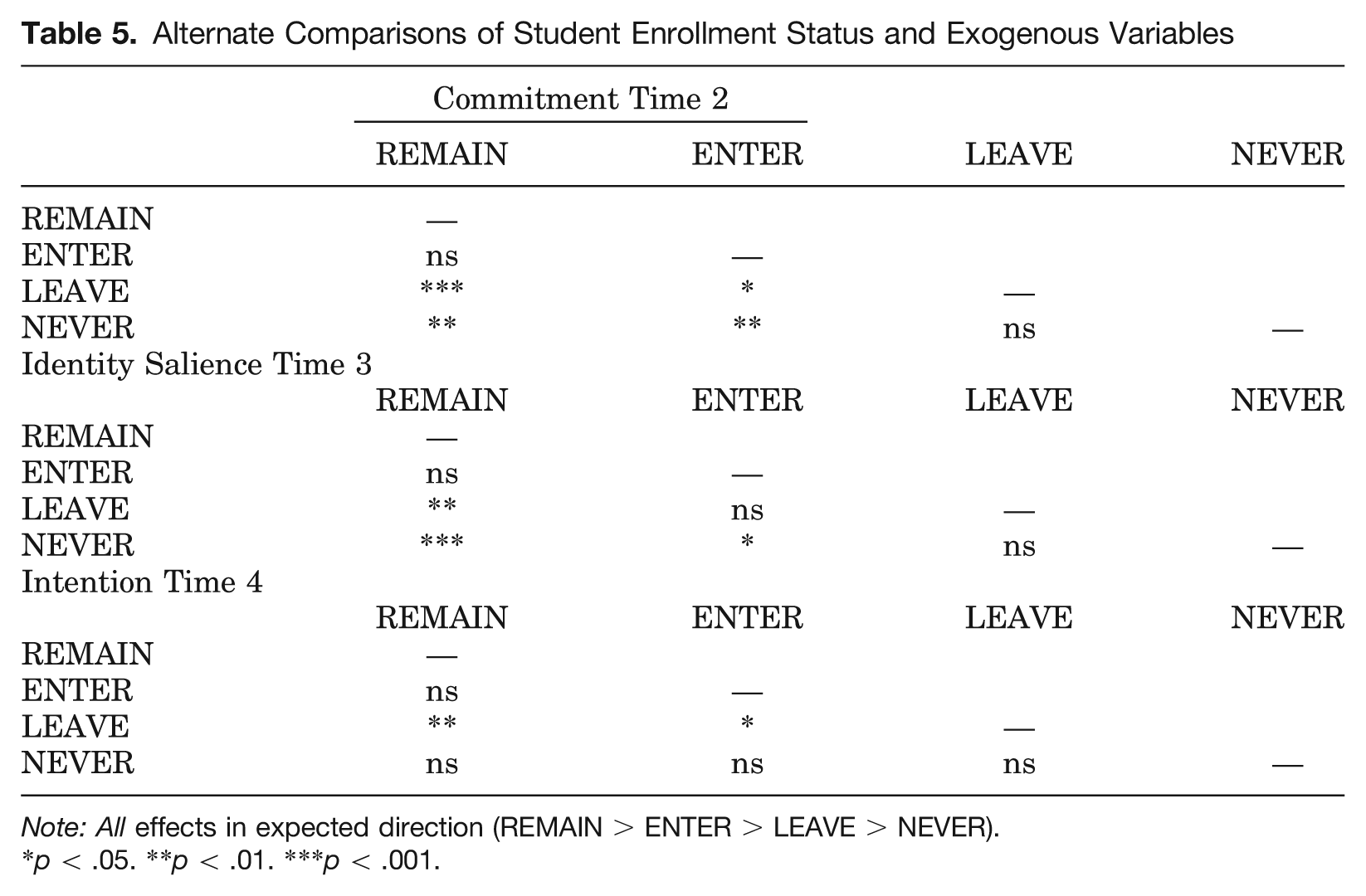
The analysis of enrollment status in Table 4 tested our first three hypotheses comparing those students who were never enrolled in a science-training program to all other students. Table 5 shows the results of additional analyses generated by changing the reference group for the enrollment variable from the model presented previously. These analyses test proposed differences in commitment between students who left programs and students who remained enrolled (Hypothesis 4) and differences between students who left programs and those who entered programs (Hypothesis 5). In addition to these results, we show comparisons for all endogenous variables for each pair of enrollment categories.
Alternate Comparisons of Student Enrollment Status and Exogenous Variables
Note: All effects in expected direction (REMAIN > ENTER > LEAVE > NEVER).
p < .05. **p < .01. ***p < .001.
The first panel in Table 5 shows results that test Hypotheses 4 and 5. Hypothesis 4 is supported; students who remain continuously enrolled in training programs have higher levels of commitment than students who leave science-training programs. Additionally, Hypothesis 5 is supported; students who enter a training program between time 1 and time 2 display higher levels of commitment than students who leave a program during this period. Combined with the results in Table 4, this pattern indicates that students who are either continuously enrolled or enter these programs show higher levels of commitment to a science identity than students who are not enrolled or leave these programs. This pattern provides further support for the identity theory model: persons who are never involved with and persons who leave proximate social structures have lower levels of commitment to the role identity than those who remain involved in or enter these types of structures.
The second panel in Table 5 shows additional comparisons for identity salience. These results indicate that beyond the differences shown in Table 4, those students who remain continuously enrolled in training programs show higher levels of identity salience than those students who left programs. Finally, panel 4 shows results for intention. These results indicate that students who remain in science-training programs and students who enter training programs have higher intention to proceed to scientific careers than those students who leave science-training programs. Students who enter programs and those who are continuously enrolled do not differ in their levels of commitment, salience, or intention.
While we believe that one’s intention to enter a science occupation variable is a reasonable predictor of ultimate behavior in accord with that intention, this may not be the case. This aspect of our research design was necessary because many of the students in our sample remained enrolled in college and thus did not have the opportunity to put their intentions into practice by entering graduate school or entering the scientific workforce. To assess the validity of the intention outcome, we looked at what happened to those students who did graduate after time 4 (n = 500) and how their post-graduation destinations were related to intention at time 4. Figure 2 shows the results of this analysis graphically. From Figure 2, we can see that those students who had either entered graduate school or entered a scientific career had significantly higher intention at time 4 than those students who left the science pipeline. This result gives us greater confidence that our measure of intention is an adequate indicator of student’s post-undergraduate behavior.
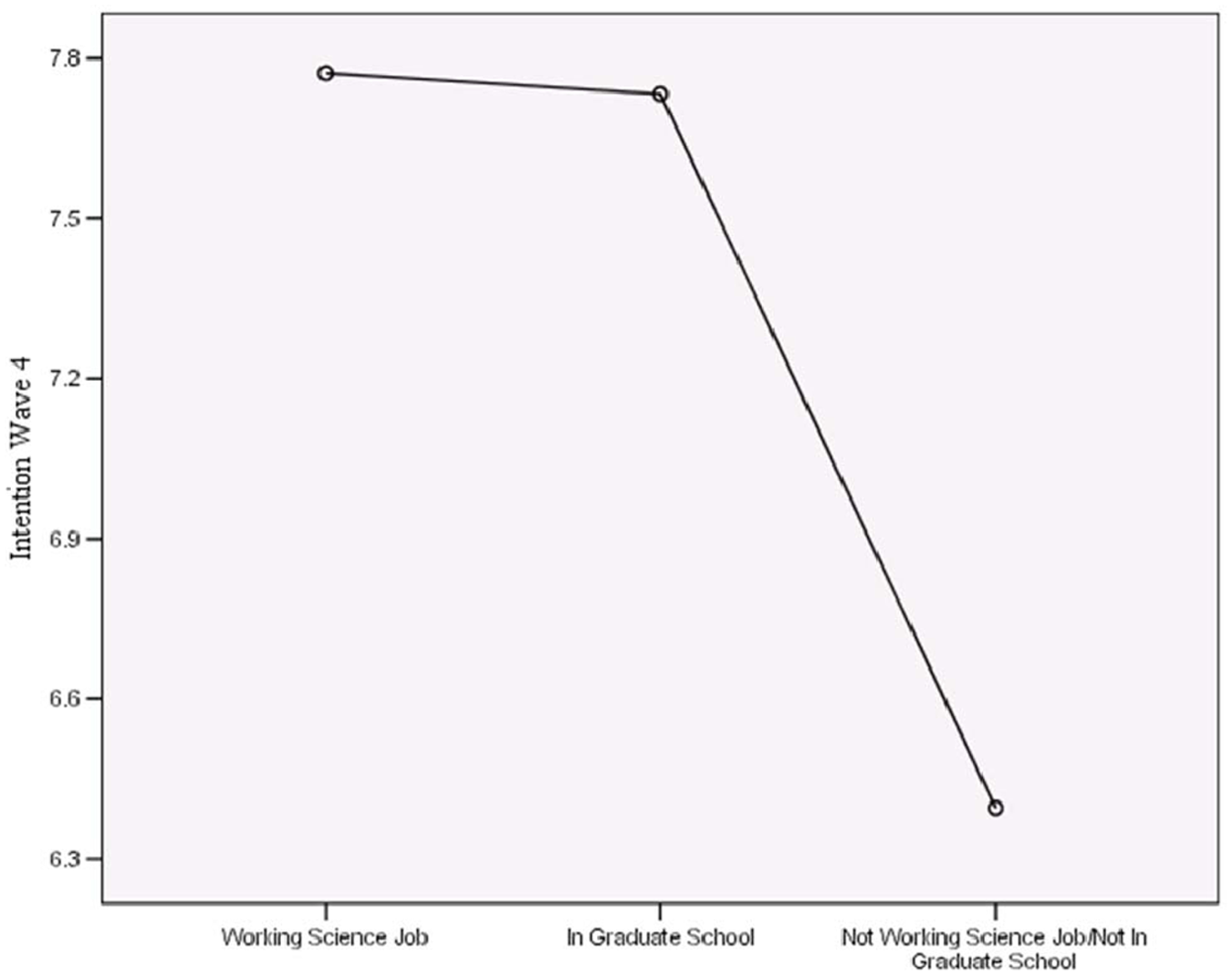
Mean of Intention at Time 4 by Post-Graduation Outcome
Discussion and Conclusions
This study contributes to the literature on identity theory by investigating the relationship between proximate social structures and identity processes. Specifically, we show that participation in such structures is antecedent to commitment to role identities, the salience of role identities, and intention for future behavior in the role. Thus, this research provides additional evidence for the structural aspect of identity theory by demonstrating that entry into proximate social structural positions—here operationalized as science-training programs—affects future behavioral intention through commitment and identity salience. Showing that proximate social structures have important effects on commitment, the research moves identity theory towards a more explicit specification of how society shapes self.
Refinement of social structure as large, intermediate, and proximate social structures sharpens identity theory’s focus on how individual characteristics lead to differentiation in commitment to different role identities. Here we show that individuals who participate in proximate social structures are more likely to develop commitment to the role identity than individuals who have a role identity but do not participate in proximate social structures. This research further describes how society shapes individual choices in behavior. Individuals who participate in proximate social structures develop commitment through this participation; greater commitment increases identity salience; and greater identity salience makes it more likely that persons choose to enact the identity and to maintain their occupancy of roles entailed in the proximate social structures in which they participate.
Proximate social structures serve as a structural link between large and intermediate structures and role identity processes. That is, persons’ positioning in large social structures does not determine role identities directly, instead these positions create variability in opportunities persons have to enter intermediate and proximate structures and thus to enact particular role identities. This refinement of social structure offers a useful way for identity theory to be applied to many types of social inequality. For example, in some research on work and occupations, worker alienation and burnout is associated with ability to network within an organization (cf. Erickson and Ritter 2001; Lorber 1995; Hoff, Whitcomb, and Nelson 2002; Collins 2005). The ability to network is likely related to an individual’s locations within both the large social structure (e.g., an employees’ race, class, or gender) as well as locations in the intermediate and proximate social structures of an organization (e.g., job title, department). Proximate social structures may prove to be a useful tool in describing how social closure mechanisms eventually lead some employees to choose to leave an organization or lead them to lose the motivation to seek promotions and move up the organizational chain. Given the perception that these individuals self-select out of high statuses, social inequality is acquitted of its role in these processes. We suggest that the approach pursued here has promise in showing how individual choices are enabled and constrained by social structural positioning.
Although the science-training programs studied here are specifically designed for minority students, it is likely that in a general sample we would find that individuals in privileged positions in large social structures (e.g., white males) have more access to proximate structural networks conducive to persistence in science education. Future research on major choice and the leaky pipeline should address this issue in general samples of college students. Researching these issues in a general sample would allow for an examination of whether identity theory can help explain variation in drop-out rates and variation in major change during college.
The current research lends support to the identity theory model, but the research is not without limitations. First, the research uses a very specific sample of mostly female and minority science majors. Given that numerous studies indicating that social support from peers is particularly important for such students, future research should examine similar processes in a more general sample. Second, the current study measured commitment to and salience of only one role identity. Although our results are supportive of an identity theory explanation of the link between enrollment in training programs and future behaviors in a scientific role, we rely heavily on theory for this interpretation. That is, given current data limitations, we cannot demonstrate specifically that a science student identity increases relative to other role identities students inevitably have, nor can we conclusively show that the increased salience of a science student identity is not due to decreased salience of other identities not measured here.
An implication of identity theory is that persons will act in ways they perceive as consistent with the meanings they attach to particular role identities (Heise 1979; Stryker 1968, 1980, 2008). Stets and Burke (2005) describe a process of identity verification in which persons in interaction seek to verify an identity standard, or a set of meanings about who one is, by aligning their own actions toward this standard and through attempts to manipulate the reflected appraisals of others (Stets and Burke 2005; Burke and Stets 2009). Although we lack measures of the meanings that students attribute to a science identity, our research is supportive of work in identity theory that focuses on identity verification (cf. Stets and Burke 2005; Burke and Stets 2009). That is, we find it likely that an identity verification process underlies the structural relationships shown here and that student who find their meanings of the science student identity verified in training programs are those students who are most likely to show a commensurate increase in identity salience (cf. Lee 1998, 2002). Future research should continue to investigate the degree to which the interactional and emotional consequences of an identity verification process serve as a link between structural positioning, commitment, and identity salience. In addition, research should investigate how proximal social structures may be arenas in which identity standards are developed: it is likely that students involved in similar training programs are likely to develop similar identity standards concerning the scientist role.
Our findings point to the importance of peer social relationships in keeping students interested in science and serve as a reminder to educators and policy makers alike that education includes more than coursework and the transmission of practical skills. The findings imply that educational programs should seek to create positive social environments in which student relationships can flourish. The finding that commitment and salience predict intentions while controlling for the presence of a faculty mentor underscores the import of student-student relationships formed in these programs. As previously noted, studies by Lee (1998, 2002) have investigated similar issues of identity theory and science and mathematics pre-college summer training programs, and his findings suggest that identity processes are useful in investigating these programs. Our own findings build on his work to demonstrate the efficacy of this approach in the context of longer, college-based training programs.
Future research should investigate whether enrollment in a science-training program affects behavioral outcomes in a science role. Activities during college such as attending conferences and lectures may be manifestations of a science role; an interesting question is the degree to which students in training programs are more likely to engage in such activities. In addition, future research should investigate whether informal student organizations have similar effects on identity processes as more formal interventions. Are the findings presented here unique due to a link between the proximate social structure and the role identity, namely, that students must maintain a science identity to retain membership? Finally, it is possible that investigations of informal social networks in which membership is not directly tied to a particular role identity would find smaller effects than those reported here; however, investigations of informal social networks could find equivalent or even larger effects because their very informality might avoid competitive interactions sometimes present in formal training programs.
Increasing minority science participation is an important social priority for the United States today. The current research adds to a growing body of work that indicates that policy makers should focus their attention not only on student aptitude and preparation, but also on the social and structural characteristics of colleges and universities in an effort to increase minority representation. Science programs are useful in showing all interested students that they belong in the sciences and providing social networks conducive to sustained interest in science.
Footnotes
The author(s) disclosed receipt of the following financial support for the research, authorship, and/or publication of this article: Funding for this research was provided by a grant from the National Institute of General Medical Science (R01-GM075316).
1
Identity theory does not distinguish between the concepts of group and social network, generally using the latter term to include both. However, it limits its attention to networks that are small and involve interpersonal relationships rather than the relationships of organizations, institutions, total societies, and so on.
2
Identity theory offers a testable explanation of observed empirical linkages. As such, it is not and does not pretend to be a general theory of social psychology, nor is it a general theory of symbolic interaction. Rather, it is a derivation from a symbolic interactionist framework that allows a reasonably rigorous test of that derivation (Stryker 1968,  ).
).
3
The earliest work building identity theory conceptualized commitment as a single variable incorporating both interaction and affect. Subsequent empirical studies (Serpe 1987, 1991; ) found that the measure used included two related but relatively independent clusters of items, each of which had its own impact on identity salience, that were then labeled as noted.
4
This does not assert or imply, like for social phenomena in general, that social relationships and interaction do not change, or that change necessarily occurs only slowly, or that change never occurs very quickly.
5
The sample was originally recruited as a matched sample of enrolled and non-enrolled students from the same universities. The matched pool was selected from a larger pool of possible respondents using a “purposeful sub-classification” procedure to produce students similar to the funded students. Students were matched based on race/ethnicity, gender, first-generation student status, GPA, English language status, age, parental education, college type, a pre-study measure of intention to pursue scientific career, transfer status, and enrollment level. Due to the movement into and out of funding programs among all students in the sample, those students initially funded and those students initially in the matched sample are not differentiated in the current analysis. Models estimated that included an indicator of initial status were substantively identical to those presented here and initial status had no significant effects on any endogenous variable.
6
We explored numerous specifications of the time-varying nature of enrollment status. In each case, the results are substantively identical to those presented here. In addition, models estimated including the 164 students that changed statuses again, ignoring the issue of further change, showed the exact same pattern of significant coefficients as those presented here.
7
White students are enrolled in programs based on socioeconomic criteria or are first-generation college students. Models estimated with and without white students yield substantively identical results to those presented here.
8
Models estimated without social science students yielded no substantive differences.
9
We estimated models that controlled for student GPA. GPA was not significant as a predictor of student intention or identity salience. We attribute this result to the limited variance of GPA in our data. In short, the use of TheScienceStudy sample essentially controls for GPA because over 50 percent of students have GPAs between 3.4 and 4.0.
10
The freshmen and sophomore sample members were brought in during the fall 2006 semester. Nevertheless, given that some of these students reported remaining freshman the next year, fall 2007, we estimated models without lower division students, without upper division students, and tested interaction effects by class standing. No significant interactions were found and in each case results were substantively identical to those results reported here.
11
Other studies (often using a different measurement approach) have typically found the correlation between interactional and affective commitment to be near .40 (Stryker and Serpe 1994; Pasley, Futris, and Skinner 2002).
Bios
References
Supplementary Material
Please find the following supplemental material available below.
For Open Access articles published under a Creative Commons License, all supplemental material carries the same license as the article it is associated with.
For non-Open Access articles published, all supplemental material carries a non-exclusive license, and permission requests for re-use of supplemental material or any part of supplemental material shall be sent directly to the copyright owner as specified in the copyright notice associated with the article.
