







Abstract
The extent to which cultural beliefs about gender shape occupation-level wages remains a central yet unresolved question in the study of gender inequality. Human capital theorists predict that gendered beliefs have no direct effect on occupation-level wages. Devaluation theorists argue that occupations associated with women and femininity are systematically devalued and thus underpaid. We test these explanations using data from the American Community Survey, the Occupational Information Network, and an affect control theory (ACT) data set of affective meanings. We use the ACT data set to operationalize occupational gendered cultural sentiments along two distinct dimensions: evaluation (goodness, caring, warmth) and potency (power, strength, competence). Hierarchical linear models show that potency but not evaluation affects occupational income net of individual and occupational controls. Path analyses show that potency has a direct effect net of occupational traits. The gender composition of an occupation indirectly affects occupational income through potency. The cultural meanings of potency/competence associated with masculinity, rather than the devaluation of feminine nurturant occupations, is the primary cultural mechanism linking gender composition and occupational reward.
The concentration of women in lower-wage occupations is a leading cause of the occupational gender wage gap (Blau and Kahn 2016; Gauchat, Kelly, and Wallace 2012; Hsieh et al. 2016; Mandel 2013; Mandel and Semyonov 2014). While the 1970s saw significant decreases in occupational sex segregation, the rate of integration has since plateaued (Blau, Brummund, and Liu 2013; Cohen 2013; Levanon and Grusky 2016). Recent estimates suggest that nearly half of all working women would need to switch occupations for sex segregation to be eliminated (Cotter, Hermsen, and Vanneman 2004; Hegewisch and Tesfaselassie 2019).
The extent to which gendered cultural sentiments—the transsituational meanings tied to occupations associated with femininity and masculinity—influence occupation-level wages remains an important yet unresolved question. Why do the occupations in which women are overrepresented pay less than the occupations in which men are overrepresented? Do cultural meanings about gender influence occupation-level wages, or do differences in occupational wages merely reflect differential job characteristics and requirements? Existing research offers two competing explanations: human capital theory and devaluation theory.
Human capital theorists (e.g., Becker 1985; Polachek 1981; Tam 1997) argue that occupational wages are a gender-neutral function of the labor market. From this perspective, differences in occupation-level wages are driven primarily by the human capital investments that workers make (e.g., education and training) as well as the skills and tasks required on the job. Devaluation theorists (Acker 1989; England 1992, 2010; Reskin and Maroto 2011), in contrast, contend that gendered cultural sentiments shape occupation-level wages. These theorists posit that occupations associated with women and femininity are systematically devalued because of their association with women. Cultural meanings associated with femininity, such as caring, warmth, and nurturance, have a direct negative effect on occupational wages. Despite decades of research, the extent to which gendered cultural sentiments affect occupation-level wages remains an unresolved question.
An innovation of the current study is its inclusion of a direct, multidimensional measure of gendered cultural sentiments. We use cultural meanings measured on the semantic differential scale (Osgood, May, and Milton 1975; Osgood and Tzeng 1990) to assess the gendered cultural sentiments associated with various occupations. This scale, used centrally in affect control theory (ACT; Heise 2007, 2010; MacKinnon and Heise 2010; Smith-Lovin and Heise 1988), quantifies affective meanings along three dimensions: evaluation (good/caring vs. bad/cold), potency (strong/competent vs. weak/incompetent), and activity (lively vs. quiet). Previous research demonstrates that socially constructed notions of femininity and associated traits of goodness, caring, and warmth are reflected in the evaluation dimension and notions of masculinity and associated traits of power, strength, and competence are reflected in the potency dimension (Cuddy, Fiske, and Glick 2008; Heise 2007; Langford and Mackinnon 2000; Rogers, Schröder, and Scholl 2013; Wood and Eagly 2015). Ours is the first study to assess the extent to which cultural beliefs about the evaluation and potency of an occupation are associated with occupation-level income.
We test the relationship between gendered cultural sentiments and occupation-level income by combining and then analyzing data from three different sources: the 2011 American Community Survey (ACS), the U.S. Department of Labor’s Occupational Network (O*NET), and an ACT dictionary of affective meaning—our measure of gendered cultural sentiments. Our analyses begin with descriptive analyses illustrating the associations among occupational gender composition, beliefs about evaluation and potency, and occupational income. We then examine the effects of gendered cultural sentiments on occupational income while controlling for occupational gender composition, skill requirements, and working conditions. Our findings reveal that potency has a direct effect on wages net of occupational gender composition and other occupational traits. Path analyses further reveal that some—but not all—of this potency effect is mediating the effects of human capital. Evaluation, in contrast, has no direct or indirect effect on income. In addition, the gender composition of an occupation indirectly affects income through potency. These results underscore the importance of conceptualizing and modeling gendered cultural sentiments as multidimensional (i.e., attending to both evaluation and potency) and illustrate the complex role they play in the wage-setting process.
Human Capital and Devaluation Theories
Despite significant gains in women’s educational attainment and integration into some high-paying professions, occupations remain highly segregated by sex (Blau and Kahn 2016; Cohen 2013; Levanon and Grusky 2016; Mouw and Kalleberg 2010). The occupations in which women are concentrated tend to pay less and are associated with lower prestige relative to occupations in which men are overrepresented (England, Allison, and Wu 2007; Hegewisch et al. 2010; Hegewisch and Tesfaselassie 2019).
Human capital scholars (Becker 1985; Polachek 1987; Tam 1997) theorize that educational and career trajectories are driven by people’s desire to maximize lifetime earnings, conditioned on expectations for job intermittency—especially regarding family decisions (Polachek 1981; Polachek and Siebert 1993). This perspective posits that since women often bear the main responsibility for housework, childrearing, and elder care (Hook 2010), they often select “mother-friendly” career paths—those perceived as offering flexible, part-time employment; lower depreciation of skill investments when out of work; and lower costs for reentry—in exchange for lower wages and training requirements. Men, in contrast, generally expect fewer career interruptions, seek to maximize their economic rewards, and to do this, invest more in their human capital.
From the perspective of human capital theorists, occupation-level wages are a gender-neutral function of the labor market. Higher wages are needed to incentivize workers to make human capital investments (e.g., education and job training) required for the job. Higher wages are particularly important for encouraging workers to invest in specialized training because, unlike general educational credentials (e.g., diploma or college degree), specialized training is a less portable and thus a riskier investment. Analyzing data from the 1988 Current Population Survey, Tam (1997) found that “objective” occupational features, including required level of specialized training, could account for the occupational wage gap. He concluded that cultural beliefs about gender have no direct effect on occupational wages. A major shortcoming of his study, however, was that it failed to include any measure of gendered cultural sentiments. Regardless, human capital theory predicts that occupational gendered cultural sentiments should have no effect on wages net of human capital controls.
Devaluation theorists acknowledge that human capital investments and job requirements shape wages but counter that cultural beliefs about gender and the larger gender hierarchy from which they emerge play a role as well. Where human capital theorists envision rational individuals weighing future familial responsibilities with potential job characteristics, requirements, and rewards, devaluation theorists highlight the role of gender socialization in shaping educational and career trajectories along with the gendered organizations of work and families (England 2005; Glenn 2010; Risman 2004).
Moreover, devaluation theorists emphasize that gender is not only a system of socially created differences but also a hierarchy in which the social roles allocated to women (including occupations) and skills associated with women and femininity are less rewarded relative to roles and skills associated with men and masculinity (Acker 1989; England 1992; Kilbourne et al. 1994). Devaluation theorists argue that due to the cultural devaluation of women and femininity, occupations associated with women and femininity pay less, on average, compared to occupations associated with men and masculinity, even when controlling for differences in occupational traits and human capital investments. Devaluation theory predicts that cultural perceptions of feminine nurturance associated with an occupation, defined in terms of cultural sentiments reflecting caring and warmth, will have a direct negative effect on wages net of human capital requirements.
Existing research in both traditions, devaluation theory and human capital theory, is limited in three important ways. First, few studies of the occupation-level wage gap include direct measures of gendered cultural beliefs. As noted by Grönlund and Magnusson (2013), most studies showing support for human capital theory, including Tam’s (1997) work, include only one gender-related variable—the proportion of female workers in an occupation—and include no measures of cultural beliefs. Existing research in support of devaluation theory also often lacks a direct measure of cultural meanings and has relied mainly on a residual approach where after controlling for occupational characteristics, the unexplained variance in wages is interpreted as gender devaluation or discrimination. The absence of a variable measuring gendered sentiments about occupations makes causal claims difficult due to issues of omitted variable bias (Gerber and Cheung 2008) and forces proponents of devaluation theory, such as England (2005:383), to acknowledge that “there is no direct evidence that the mechanism is cultural devaluation.”
Those studies that have included measures of gendered cultural beliefs suffer from a different limitation. Most rely on measures developed within the stratification literature, which reflect objective occupational features more so than subjective cultural meaning. Occupational prestige scores, for example, have been used as a measure of feminine meanings to assess cultural beliefs of an occupation’s goodness and value to society (Goldthorpe and Hope 1972; Treiman 1977), but studies show that prestige scores measure education and income more than cultural sentiments (Freeland and Hoey 2018; Hout and DiPrete 2006; Wegener 1992). Kilbourne’s nurturant scale (England and Kilbourne 1988; Kilbourne et al. 1994) has similar limitations. This scale is based on the Dictionary of Occupational Titles’s rating of the extent of face-to-face interaction in an occupation (Berg and Kalleberg 2012). However, these ratings operationalize task responsibilities as reflected in Leidner’s (1993) concept of interactive service work, not cultural beliefs about femininity or masculinity. Service orientation encompasses many related yet theoretically distinct occupational dimensions and is further complicated by the fact that in a postindustrial economy, service work is decreasingly organized by gender. Women now outnumber men in managerial and professional occupations (Bureau of Labor Statistics [BLS] 2019b), and the extent to which occupations involve manual labor is more predictive of gender segregation than is the service orientation of an occupation (Lippa, Preston, and Penner 2014).
A further limitation of existing work is that it employs—both conceptually and methodologically—a unidimensional concept of gendered cultural sentiments, which centralizes femininity and its potential devaluation. As discussed in the following, social psychologists theorize that gendered cultural sentiments, like cultural sentiments more generally, are multidimensional constructs, with evaluation and potency constituting independent dimensions. This conceptualization of gendered cultural beliefs echoes a theme within gender scholarship that positions masculinity and femininity as independent dimensions (Bridges and Pascoe 2014; Connell 2005). Despite widespread consensus on the multidimensional nature of gender, we know little about how these dimensions work together to structure segregation and occupation-level wages.
Scholars agree that a comprehensive analysis of the sources of the gender wage gap requires an integrative framework with direct measures capturing feminine and masculine cultural meanings (Lips 2013; Olson 2013; Tharenou 2013). Direct measures of cultural sentiments allow for testing for the devaluation of femininity—and potentially the overevaluation of masculinity—directly and help disentangle the effects of cultural beliefs from other occupational characteristics (Tharenou 2013). For this multidimensional measure of gendered cultural sentiments, we draw on affect control theory.
Multidimensional Gendered Cultural Sentiments
Our conceptualization and measurement of gendered cultural sentiments stems from affect control theory, a mathematical, general theory of social action that posits that behaviors are produced as people seek to confirm cultural reference meanings (Heise 2007, 2010; MacKinnon and Heise 2010; Smith-Lovin and Heise 1988). Cultural sentiments are operationalized using the semantic differential scale (Heise 2010; Osgood et al. 1975; Osgood and Tzeng 1990), which measures three universal dimensions as evaluation (good/warm/caring vs. bad/cold), potency (powerful vs. weak), and activity (active vs. quiescent) on scales ranging from 4.3 to −4.3, with 0 being neutral. 1 Taken together, these three dimensions form a concept’s EPA (evaluation, potency, activity) rating. The EPA rating for a nurse (2.89, 1.81, .84), for example, suggests that in the contemporary United States, nurses are seen as very good, moderately powerful, and slightly active. Nurses are perceived as less powerful and yet more good than either physicians (2.47, 2.42, .00) or chief executives (.80, 3.16, 1.66). EPA ratings have been used to study both gender (Kroska 2001, 2009; Langford and Mackinnon 2000) and occupations (Freeland and Hoey 2018; MacKinnon and Langford 1994; Moore and Robinson 2006). It has been used to study other sociological topics including emotions (Rogers et al. 2013), meaning construction (Ambrasat et al. 2014), deviance (Schneider 2009; Tsoudis and Smith-Lovin 1998), and religion (Smith-Lovin and Douglass 1992). For a review of ACT research, see MacKinnon and Robinson (2014).
Whether labeled instrumental versus expressive (Parsons and Bales 1955; Spence and Helmreich 1980), agentic versus communal (Bakan 1966; Eagly 1987), potent versus evaluative (Langford and Mackinnon 2000; Rogers et al. 2013), or competent versus warm (Cikara and Fiske 2009), extensive research shows that masculinity is linked to traits of power, competence, and dominance while femininity is associated with goodness, caring, warmth, and nurturance. 2 While evaluation and potency are independent meaning dimensions, hierarchical structures such as gender tend to produce an “ambivalent” or “complementary” relationship. Cultural stereotypes of women represent them as high in evaluation and low in potency (warm but incompetent) or low in evaluation and high in potency (cold but competent; Cikara and Fiske 2009; Glick and Fiske 2001, 2011).
The use of EPA to operationalize this multidimensional structure of gender ideology was first pioneered by Kroska (2000, 2001, 2009), who demonstrated that gender ideology is strongly related to sentiments of evaluation and potency. In examining the relationship between EPA and gendered traits, Langford and Mackinnon (2000) find that net of potency and activity, traits exhibiting higher levels of evaluation are associated with females, while high-potency traits are associated with males net of evaluation and activity.
Using evaluation (net of potency and activity) to operationalize feminine nurturance and potency (net of evaluation and activity) as a proxy for masculine competence while controlling for objective occupational traits yields the following two hypotheses:
Hypothesis 1a: The evaluation rating of an occupation will be positively associated with its proportion of women net of other occupational characteristics.
Hypothesis 1b: The potency rating of an occupation will be negatively associated with its proportion of women net of other occupational characteristics.
Gendered Sentiments and Occupational Rewards
There is a small but solid literature relating the multidimensional conceptualization of gendered cultural sentiments in ACT to task competence. Rogalin, Soboff, and Lovaglia (2007) pioneered this effort, looking explicitly at occupations. They developed independent measures of occupational status (worthiness and value) and occupational power (authority over others and control). They found that evaluation (E) was related most closely to occupational status and potency (P) to occupational power. Later studies by Dippong and Kalkhoff (2015, 2017) looked explicitly at the relationship between E, P, and performance expectations in the status characteristics research tradition (Correll and Ridgeway 2003; Ridgeway 2009, 2011). They found that both E and P predicted expectations of competence, with P being most important in the first study (using a general performance expectations scale) and E being more important in the second study (especially when assessing the competence of status-equal others). Though both E and P may be positively correlated with performance expectations, the magnitude of their effects on performance expectations may be unequal, and this may be consequential for occupational wages. Specifically, if P has a greater positive effect on expectations than does E, then this may contribute to the occupation-level wage gap.
Figure 1 represents the hypothesized relationship between gendered sentiments and income for the three theoretical perspectives tested here. Recall that human capital theory predicts no association between gendered cultural sentiments and occupational wages, theorizing instead that gender differentials are produced entirely by differences in human capital investments (particularly specialized training). Consequently, human capital theory predicts:
Hypothesis 2a: Evaluation of an occupation will not be significantly associated with occupation-level income net of controls for individual and occupational characteristics.
Hypothesis 2b: Potency will not be significantly associated with occupation-level income net of controls for individual and occupational characteristics.
Devaluation theorists, in contrast, predict that occupations associated with women and femininity incur a wage penalty due to their being culturally devalued. Focusing entirely on the devaluation of femininity, this perspective implies that evaluation will negatively affect income. (Potency is not explicitly considered.) This yields the following hypothesis:
Hypothesis 3: Evaluation will be negatively associated with occupation-level income net of controls for individual and occupational characteristics.

Predicted Relationship between Evaluation, Potency, and Occupation-Level Income for Three Theoretical Perspectives
A more multidimensional conception of gender developed within the affect control theory (ACT) tradition conceptualizes gender as implying cultural meanings that have both evaluative and potency connotations. Evaluation and potency might both be valued but for different reasons and to different degrees. Langford and Mackinnon (2000), in particular, discuss two different hierarchies—one focused on evaluation that benefits women and one focused on potency that benefits men. This leads to the following hypotheses:
Hypothesis 4a: Evaluation will be positively associated with occupation-level income net of controls for individual and occupational characteristics.
Hypothesis 4b: Potency will be positively associated with occupation-level income net of individual and occupational characteristics.
Finally, in path analyses, we follow earlier researchers (Friedkin and Johnsen 2003) in predicting that cultural sentiments (EPA) will mediate the effects of social position (gender and human capital) on valued outcomes.
Data and Methods
Data
To test these hypotheses, we combine individual- and occupation-level data from three sources: the 2015 American Community Survey (ACS), the U.S. Department of Labor’s Occupational Information Network (O*NET), and a 2015 dictionary of affective meanings for occupational EPA (evaluation, potency, activity) ratings.
Individual-level data, including income, gender, and background controls, come from the 2015 ACS, accessed through the Integrated Public Use Microdata Series (IPUMS-USA; Ruggles et al. 2010). The ACS is a 1-in-100 national random sample of the U.S. population conducted by the U.S. Census Bureau to monitor demographic and housing trends (U.S. Census Bureau 2019b). The sample for this study is limited to employed, working-age adults aged 18 to 65 with nonmilitary occupation codes.
Occupation-level measures come from the 20.1 release of the O*NET archive released October 2015 (U.S. Department of Labor Statistics 2019b). As a replacement for the Dictionary of Occupational Titles (DOT) used in earlier studies, O*NET provides information on occupational traits, including work environment, tasks, skills, training, and educational requirements (U.S. Department of Labor 2019).
EPA ratings for occupational identities come from the “U.S.A. Online 2015” dictionary of affective meaning (Smith-Lovin et al. 2019). Acting as cultural informants, 2,617 survey participants rated 2,404 social concepts, including 968 identities, 853 behaviors, and 660 modifiers, along the three EPA dimensions, with the mean value for each dimension representing a concept’s EPA profile. 3 Data were collected online between 2014 and 2015 using Amazon’s Mechanical Turk to obtain a diverse sample of adults based on gender (50.5 percent female), age (modal age = 30–39), education (modal education level = high school graduate), and race (85 percent white, 6 percent black/African American, 7 percent Hispanic, 6 percent Asian, 1 percent other race/ethnicity). The mean number of ratings per concept was 114.
The list of occupations included in the dictionary was chosen by means of a three-stage process. First, the 30 core occupations from the General Social Survey (GSS) prestige module were selected (Nakao, Hodge, and Treas 1990). The prestige module, part of the GSS since its creation in 1972, provides an extensively researched, parsimonious, and representative list of occupations. Second, three occupations were selected from each of the 12 major occupational groupings of the 2010 Standard Occupational Classification (SOC) occupational coding schema from the first, middle, and third thirds of the income distribution for each grouping. For greater comparability, occupational identities from previous affective dictionaries were also added if not already included in the first two steps.
Merging Data
The three data sets were merged via occupation. Occupations in O*Net are coded using the 2010 SOC schema (U.S. Department of Labor Statistics 2019a), while the ACS uses a combination of the 2010 SOC and 2010 census coding schemas (BLS 2019a). Occupations were linked by common SOC code if provided in the ACS; otherwise, O*Net SOC codes were matched to ACS census codes using the 2010 SOC to 2010 census crosswalk. 4
We linked EPA ratings of occupations to O*Net occupations in three steps. We first linked the EPA occupations to those that matched the SOC title. For example, the EPA rating of lawyer was matched to the SOC code 23-1011 Lawyers. For those occupations with EPA ratings but no precise match to the SOC title, we used O*Net’s “Sample of Reported Titles” to match the rating and SOC occupation (O*Net Resource Center 2019). For example, stock broker is listed as a title for the occupation 41-3031 Sales Agents, Securities and Commodities. For the remaining occupations, we relied on definitional descriptions of the occupation provided by the U.S. Department of Labor Statistics (2019a). For example, bank managers perform the duties of the occupation 11-3031 Financial Managers, Branch or Department.
For those occupational codes based on multiple, related occupations, such as Accountants and Auditors (12-2011), the rating corresponding to the occupation with the largest percentage of workers was selected, in this case accountant. Similarly, some EPA ratings had gendered occupational titles. We matched these to broader occupational titles, depending on the gender composition of the occupation. For example, waitress was matched to Waiters and Waitresses (35-3031) given the high proportion of female workers. Our analyses exclude military occupations because the ACT dictionary surveyed rank and branch of service but not occupations. In total, we matched the EPA ratings of 191 unique occupational titles to O*Net occupations. The crosswalk of occupational identities and 2010 SOC occupational codes are shown in Appendix A.5,6
Variables
The unit of analysis for this study is the occupation. The primary dependent variable is occupation-level income computed as the natural logarithm of total personal income (total annual pretax income) for each occupation. Our independent variables reflect the complex processes through which gendered sentiments affect occupational wages as theorized by devaluation and human capital theories.
As in previous work, occupational gender composition is computed as the proportion of female workers for each occupation. Cultural sentiments are operationalized using EPA ratings. Specialized vocational training (SVP) is central to human capital theory’s explanation of the occupational wage gap. Consistent with Tam (1997), data on occupational characteristics come from the U.S. Department of Labor’s Occupational Information Network (O*NET). SVP is coded as a five-level scale ranging from occupations that need little or no preparation to occupations that need extensive preparation.
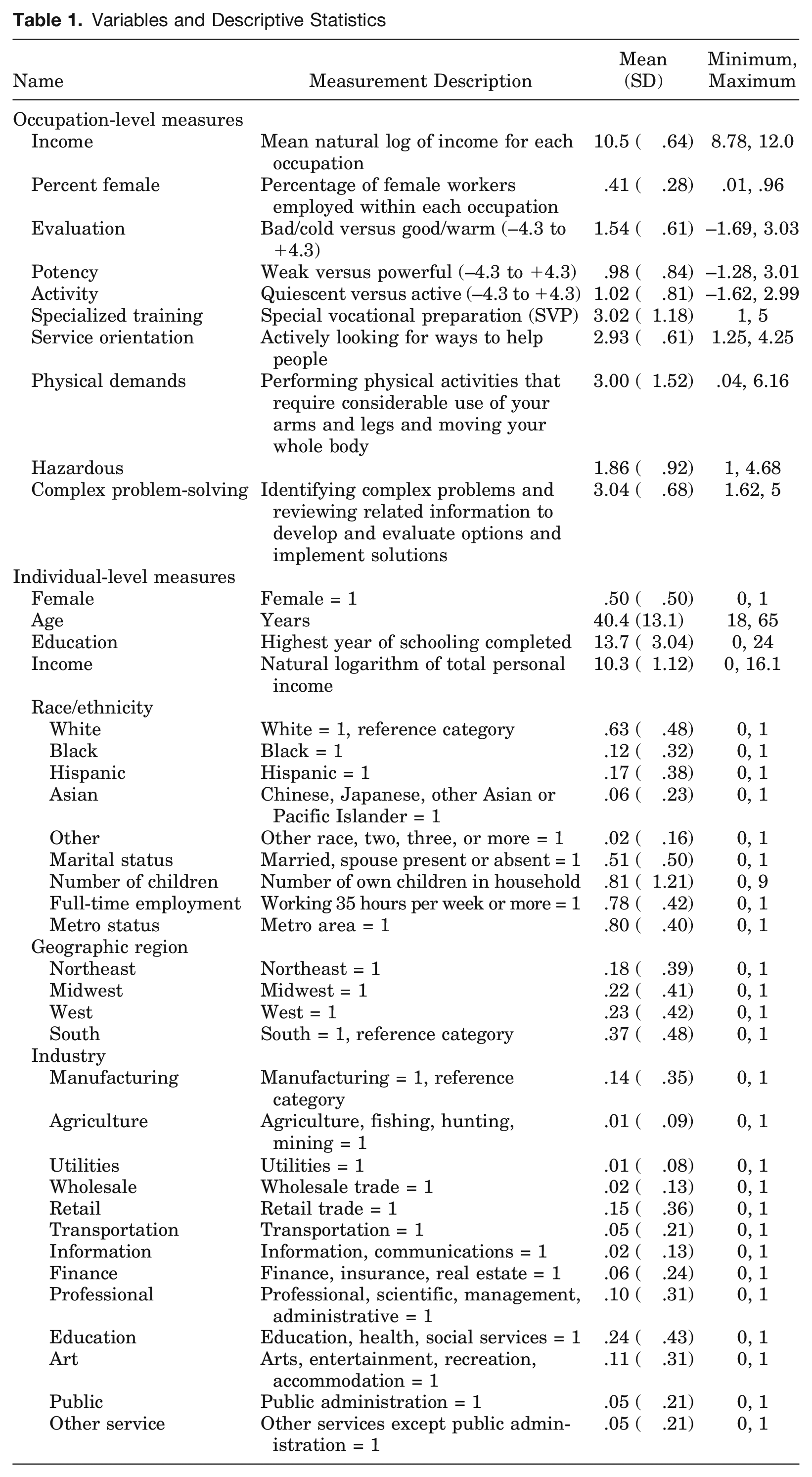
Other occupational measures include complex problem-solving, defined as the skill required for “identifying complex problems and reviewing related information to develop and evaluate options and implement solutions”; service orientation (Kilbourne et al. 1994; Leidner 1993); hazardous work (Viscusi 2014); and physical demands (Liu and Grusky 2013). Individual-level controls include gender, age, education, race/ethnicity, industry, marital status, number of children, employment status, metro status, and geographic region. Descriptive statistics for all measures and coding are shown in Table 1.
Variables and Descriptive Statistics
Methods
Our analysis begins by examining the associations between EPA ratings and occupational income to determine whether evaluation and potency are correlated with pay. We then use linear regression to test the association between EPA ratings and the percentage of women in an occupation while controlling for occupational traits to determine how gender composition affects perceptions of evaluation and potency. Next, we use a series of hierarchical linear models to analyze the relationship between gendered cultural sentiments (EPA ratings) and the occupation-level wage gap while controlling for basic occupational features and variables relevant to human capital theory. Last, we examine the relationship between occupation-level features, including sentiments, occupational traits, and gender, using path analysis to determine how gendered sentiments mediate the relationship between occupational traits and pay.
Results
Table 2 shows mean values of evaluation, potency, activity, income, and percentage of workers with a college degree for 20 of the most prototypically female and male occupations. In comparison to male-dominated occupations, female-dominated occupations exhibit 19 percent higher evaluation, 69 percent lower potency, and 68 percent lower income. This is despite the fact that workers in female-dominated occupations are five times as likely to hold a college degree compared to workers in male-dominated occupations (32 percent vs. 6 percent). On the whole, these results are consistent with devaluation theory’s contention that occupations associated with femininity (high evaluation) lead to lower pay despite the greater human capital requirements. At the same time, these results raise an important question. Namely, is the association between gender composition and pay due to high evaluation (associated with warmth and caring) or other factors such as potency or other occupational characteristics?
Descriptive Statistics for the 20 Occupations with the Highest and Lowest Percentage of Female Workers
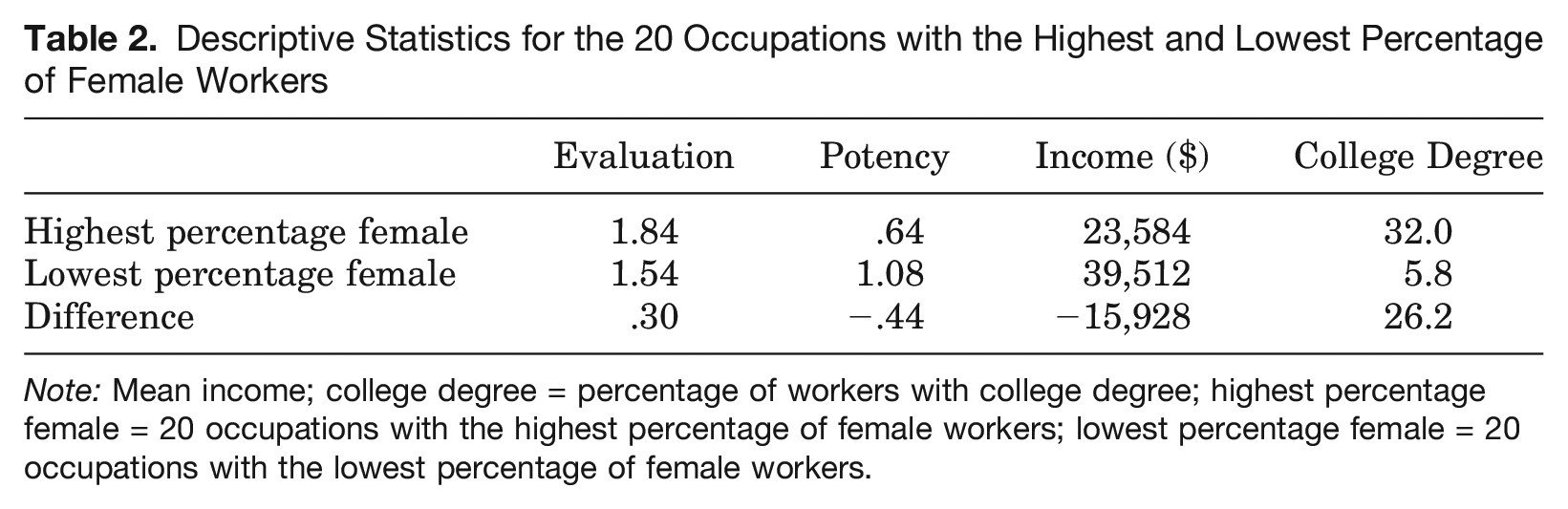
Note: Mean income; college degree = percentage of workers with college degree; highest percentage female = 20 occupations with the highest percentage of female workers; lowest percentage female = 20 occupations with the lowest percentage of female workers.
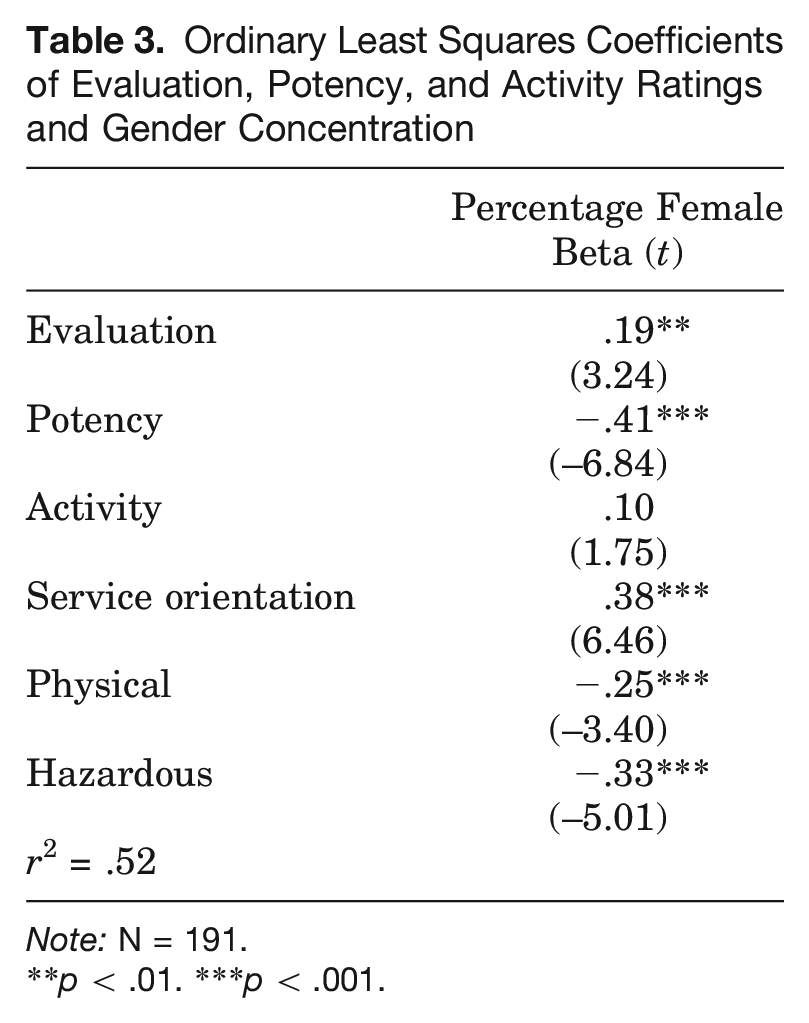
To further examine the relationship between gender concentration and occupational sentiments, we use multivariate linear regression. Our hypotheses predicted that evaluation is positively associated (Hypothesis 1a) and potency negatively associated (Hypothesis 1b) with the proportion of women in an occupation net of basic occupational characteristics. The results, shown in Table 3, confirm both hypotheses. Several items are of note.
Ordinary Least Squares Coefficients of Evaluation, Potency, and Activity Ratings and Gender Concentration
Note: N = 191.
p < .01. ***p < .001.
First, evaluation and potency both significantly predict occupational gender composition, with the standardized coefficient for potency (–.41) twice that of evaluation (.19). This supports the multidimensional conception of gender in affect control theory (ACT), which suggests that the higher potency (e.g., competence) associated with masculinity must be considered in addition to any devaluation of the positively evaluated warmth and caring associated with femininity. Second, the significance of physicality, hazardous work, and service orientation reinforces Charles and Grusky’s (2004) assertion that the manual/nonmanual divide is a central feature of occupational sex segregation. This demonstrates that physicality is not simply the opposite pole of a manual/service dichotomy but rather a distinct occupational dimension that must be modeled separately.
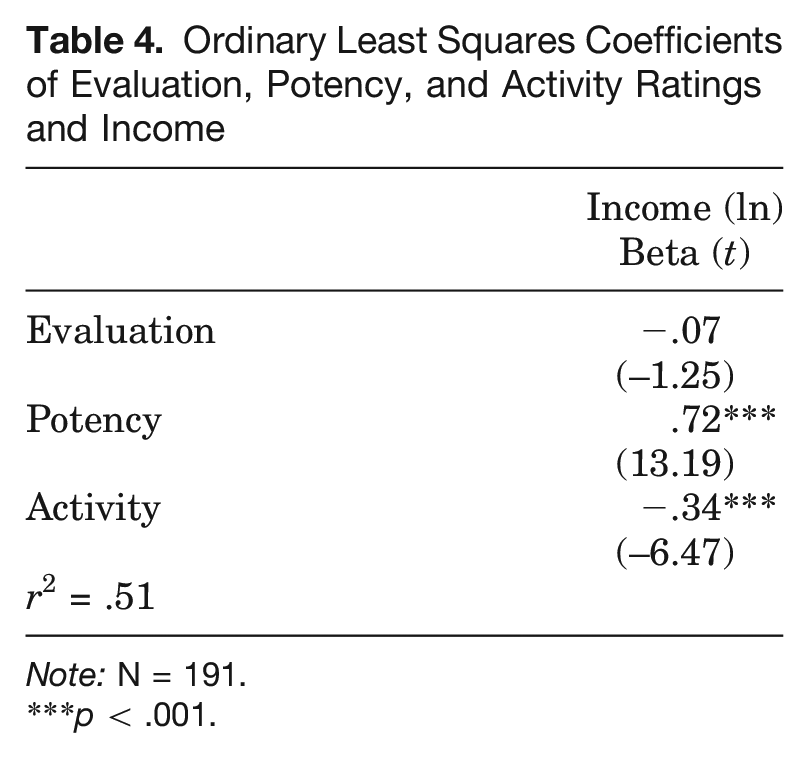
We next consider the relationship between gendered cultural sentiments and occupational income. Table 4 shows the relationship among occupational EPA ratings and occupation-level income for all 191 occupations used in this study. Of note, the relationship between evaluation and income is nonsignificant when potency and activity are controlled. The potency and activity dimensions are both significant predictors of wages, with the coefficient for potency twice as large as that for activity (.72 vs. –.34). Multilevel analyses that include occupational measures and individual-level controls are needed, however, to disentangle the effects of cultural sentiments from their association with other occupational and individual characteristics.
Ordinary Least Squares Coefficients of Evaluation, Potency, and Activity Ratings and Income
Note: N = 191.
p < .001.
Table 5 shows the occupation-level coefficients for a series of hierarchical liner models that reflect basic occupational features (Model 1), human capital theory (Model 2), a cultural meaning model that includes EPA ratings without occupational characteristics (Model 3), and a full model combining all measures (Model 4).
Occupation-Level Coefficients for Hierarchical Linear Regressions Predicting Income
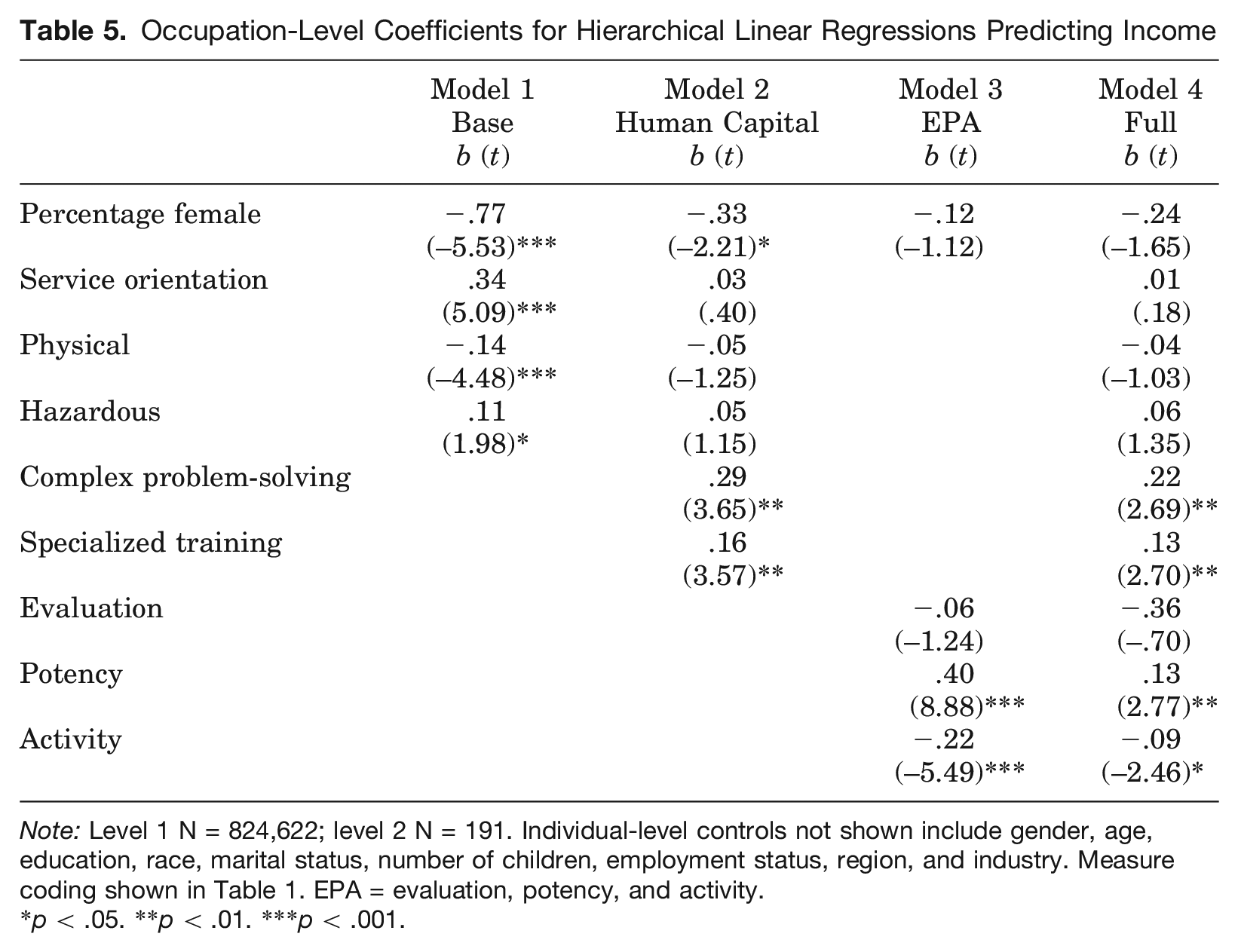
Note: Level 1 N = 824,622; level 2 N = 191. Individual-level controls not shown include gender, age, education, race, marital status, number of children, employment status, region, and industry. Measure coding shown in Table 1. EPA = evaluation, potency, and activity.
p < .05. **p < .01. ***p < .001.
Model 1 shows that the proportion of women in an occupation is a significant and negative predictor of occupation-level wage, net of occupational differences in service orientation, physicality, and hazardous work, and individual controls. This result is consistent with devaluation theory, but importantly, the model includes neither controls for specialized training and complex problem-solving nor controls for occupational gendered cultural sentiments.
Model 2 adds human capital measures for specialized training (vocational preparation) and complex problem-solving requirements. While training and complex problem-solving do predict higher wages, human capital measures do not fully account for the relationship between gender composition and income. This result stands in contrast to Tam’s (1997) findings and may reflect either societal changes (Tam’s data are from 1988), slight differences in occupational codes, or a combination of factors. Specialized training and complex problem-solving do, however, account for basic occupational features (service orientation, physicality, and hazardous conditions), which is consistent with the human capital assertion that pay is primarily a function of differential human capital investments.
Model 3 tests the associations between occupational sentiments and income without human capital measures. Of particular interest are the effects of evaluation and potency, our measures of gendered cultural sentiments. As shown, the effect of potency is positive and significant, whereas evaluation and gender composition are both nonsignificant. Model 3 shows that cultural sentiments (in particular, potency) fully account for the effect of gender composition on income. Potency’s significance and evaluation’s nonsignificance suggest that the overall level of nurturance, warmth, and goodness associated with an occupation is not devalued so much as dismissed in the wage-setting process. It also supports the prediction that cultural beliefs about men’s greater competence and worth (potency) may be a key mechanism linking gender and reward.
Model 4 provides an integrated model that includes basic occupational features, human capital, and cultural sentiments. Both human capital measures (complex problem-solving and specialized training) and potency remain significant, while evaluation and the proportion of women in an occupation are nonsignificant.
The nonsignificance of evaluation is consistent with human capital (Hypothesis 2a) but inconsistent with the hypothesized effect of evaluation for devaluation theory (Hypothesis 3). It also rejects Hypothesis 4a, which suggested that evaluation would be a valued dimension that might generate higher pay. The significant positive effect of potency is inconsistent with human capital theory (Hypothesis 3b) but is consistent with Hypothesis 4b, the assertion that high-status groups benefit from cultural beliefs about their ability, competence, and worth.
These results suggest that the relationship among gendered cultural sentiments, occupational traits, and pay is more complex than currently conceptualized by either human capital or the devaluation perspective. In addition, the results of Table 5 suggest that the effect of potency acts largely by mediating the relationship between occupational traits, including gender concentration and human capital requirements, on income.
We employ path analyses to clarify the relationship among potency, occupational traits, and income. The path model is based on the theorized relationship between occupation-level features and income and is validated using Karlson-Holm-Breen (KHB) decomposition to test for significant mediators (Kohler, Karlson, and Holm 2011). Results of decomposition analyses (available on request) confirm that neither gender nor evaluation are significant mediators, while potency is a significant mediator for complex problem-solving, specialized training, and occupational gender composition on income. The theoretical model is shown in Figure 2, and the analyses based on this model are shown in Table 6.
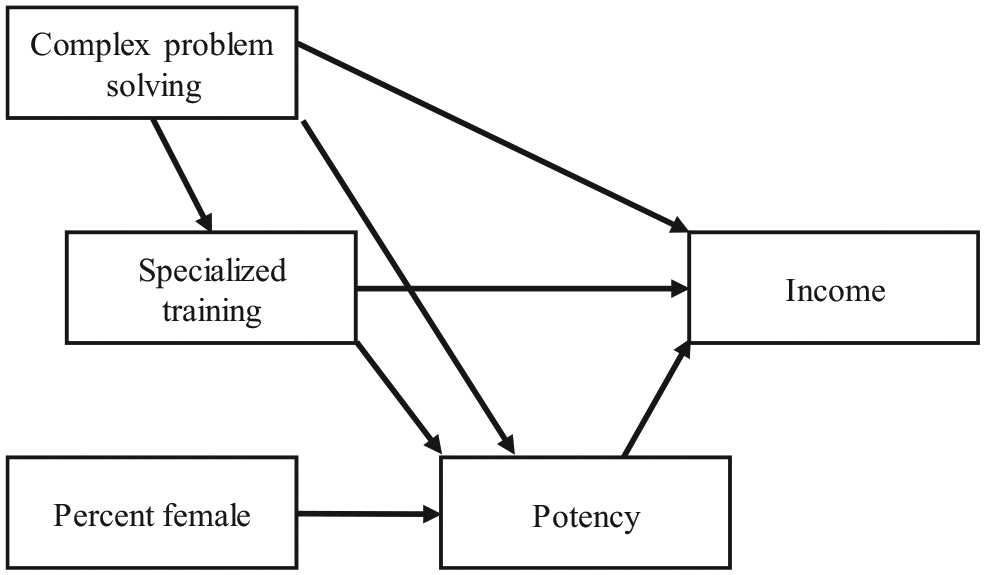
Theoretical Model of Occupational Potency Mediation on Income
Path Analysis Results for Occupational Traits on Income
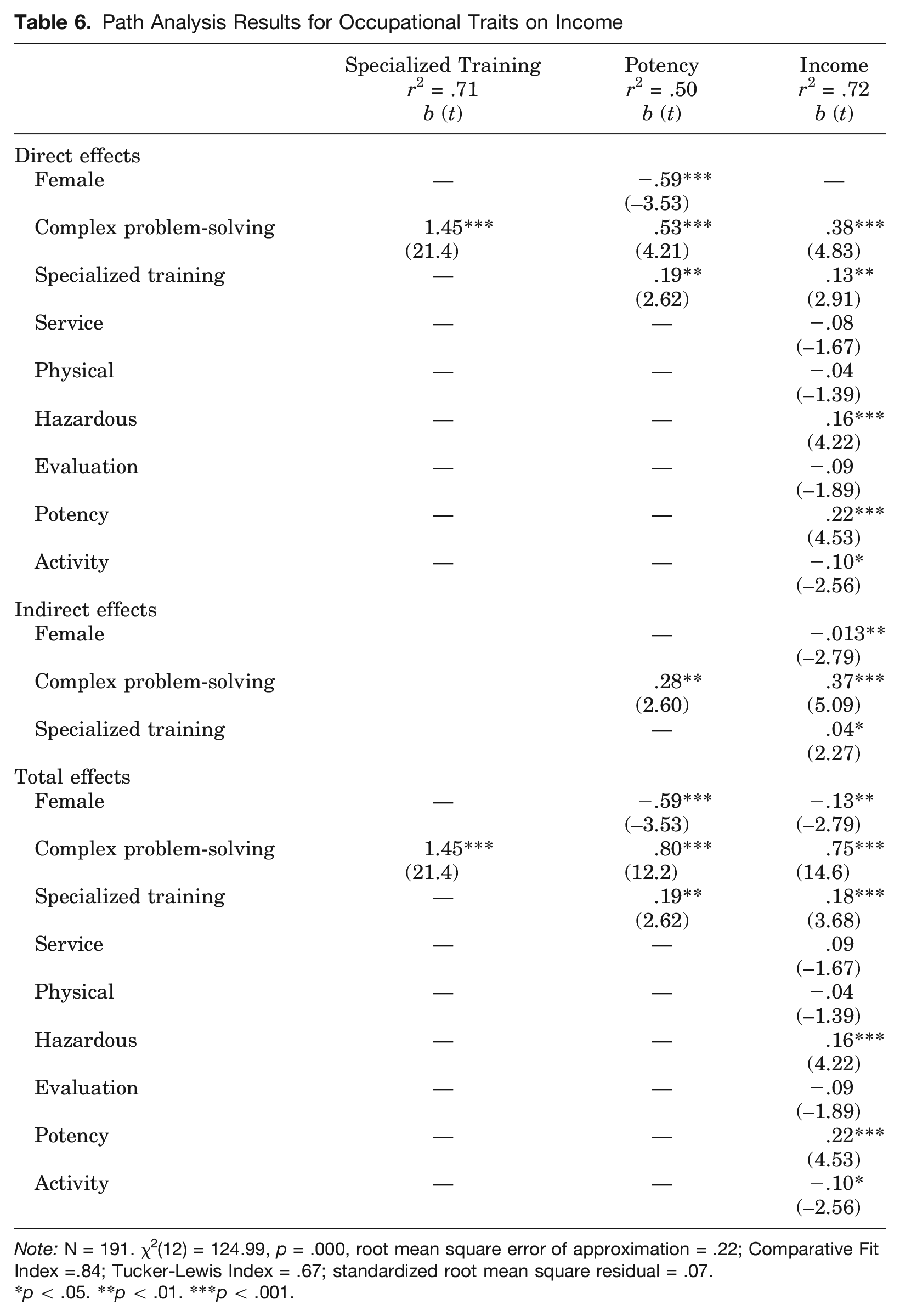
Note: N = 191. χ2(12) = 124.99, p = .000, root mean square error of approximation = .22; Comparative Fit Index =.84; Tucker-Lewis Index = .67; standardized root mean square residual = .07.
p < .05. **p < .01. ***p < .001.
The path model explains a large portion of occupational income variation with a strong r2 of .72. The fit statistics are significant but weak, likely due to the limited number of occupations. 7 Regardless, the results underscore the importance of complex problem-solving and specialized training in wage setting. Both have direct and indirect effects on income. In addition, the results indicate that potency is largely a function of occupational traits both in terms of human capital and gender composition and a significant mediator between these occupational traits and pay. However, even accounting for these features, a direct effect of potency on income remains, demonstrating that the relationship between gendered cultural beliefs and occupational wages is not reducible to differences in human capital.
Last, the results of the path analyses show that occupational gender composition has a significant, indirect negative effect on income through lower potency. While the results do not support a direct hypothesized effect for devaluation of femininity (Hypothesis 3 and Hypothesis 4a), they do show that occupations with a greater concentration of women are seen as less potent, which is associated with lower pay.
Discussion and Conclusion
We began this study with the question of why occupations in which women are overrepresented pay less, on average, compared with occupations in which men are overrepresented. Numerous studies have sought to answer this question, with some showing support for human capital theory (e.g., Becker 1985; Polachek 1981; Tam 1997) and others showing support for devaluation theory (England 2010; Reskin and Maroto 2011). Studies on both sides of the debate are limited. First, few empirical studies include a direct measure of gendered cultural beliefs (e.g., Tam 1997). The few that have included such a measure have generally relied on measures that better reflect occupational features (e.g., income and education) than subjective cultural meanings (Freeland and Hoey 2018; Hout and DiPrete 2006; Wegener 1992). A further limitation is that those studies that have examined gendered cultural beliefs have typically conceptualized gender as a unidimensional construct and have focused—theoretically and empirically—on cultural beliefs about women and femininity.
While existing research had demonstrated significant associations between evaluation and femininity and potency and masculinity (Kroska 2000, 2001, 2003, 2009; Langford and Mackinnon 2000), ours is the first study to examine the relationship between gendered cultural sentiments and pay while controlling for gender composition, individual, and occupational features. Modeling gender in this way—as a multidimensional construct reflecting potency and evaluation—and combining it with advances in quantifying cultural sentiments allowed us to address the major limitations of existing work. We not only modeled gendered cultural sentiments directly but did so with a multidimensional measure consistent with social psychological and gender scholarship (Kroska 2000; Langford and Mackinnon 2000). The results demonstrate the utility of using EPA ratings to model gendered occupational patterns and clarify how cultural beliefs influence the wage-setting process. They also underscore the importance of conceptualizing gendered cultural sentiments as multidimensional.
Gendered Sentiments, Occupational Gender Composition, and Pay
While previous scholarship had linked gender to cultural sentiments of evaluation and potency (Kroska 2000, 2001, 2009; Langford and Mackinnon 2000), no previous study had assessed the relationship between EPA occupational ratings and occupational gender composition. Drawing from previous social psychological research, we predicted that controlling for potency, evaluation would be positively associated with the proportion of women in an occupation (Hypothesis 1a) and potency, controlling for evaluation, would be negatively associated with this outcome (Hypothesis 1b) net of basic occupational features (service orientation, physicality, and hazardous working conditions). Both hypotheses were confirmed, indicating that gendered cultural sentiments are linked to the gendered occupational structure. Our subsequent analyses employed increasingly complex statistical techniques to clarify how gendered beliefs, sex segregation, and individual- and occupation-level characteristics work together to shape wages and the gender gap in pay.
For decades, research on the gender wage gap has been dominated by two perspectives: human capital theory and devaluation theory. Human capital theory predicted no direct effect of cultural sentiments on wages (Hypothesis 2a, Hypothesis 2b), and devaluation theory predicted that evaluation would have a significant negative effect on wages (Hypothesis 3). To this debate we introduced a multidimensional conceptualization of gender based on the affect control theory (ACT) tradition. We theorized that evaluation and potency would have significant positive effects on income, controlling for occupational characteristics (Hypothesis 4a, Hypothesis 4b). We tested these competing hypotheses using a direct and multidimensional measure of gendered cultural sentiments.
While our results support human capital theory’s assertation that evaluation has no direct negative effect (Hypothesis 2a), they disconfirm Hypothesis 2b and human capital theory more generally as potency did show a significant positive effect on income, even net of occupational characteristics. The broad claim of devaluation theory—that cultural beliefs about gender matter for wages—is supported but not in the way that devaluation theorists have previously argued. In contrast to Hypothesis 3, evaluation showed no significant association with wages, while potency showed a significant positive effect on occupational wages.
The multidimensional understanding of gender we employ adds new insights to the debate about the sources of the gender wage gap. Evaluation does not significantly predict income (rejecting Hypothesis 4a), but potency shows a strong and significant association with increased income, consistent with Hypothesis 4b. These results are consistent with research by MacKinnon and Langford (1994), who found that potency—but not evaluation—predicted occupational prestige, a measure significantly correlated to income.
To disentangle the effects of gendered cultural sentiments from other occupational characteristics, we conducted a series of hierarchical linear models (Table 5). The results are most consistent with a multidimensional conceptualization of gender, gendered sentiments, operationalized by evaluation and potency. In particular, potency (reflecting cultural meanings associated with competence and instrumentality) was found to influence rewards for men and women independent of objective occupational traits. We used path analyses to further examine how potency mediates the relationship between occupational traits (complex problem-solving, specialized training, gender) and income. Our results show that potency is largely a function of occupational traits but nonetheless has a significant independent effect on income net of these traits. In addition, occupational gender composition does not have a direct effect on income but works indirectly through potency.
Gendered Cultural Sentiments as Multidimensional
Ours is the first study to model occupational wages with a direct measure of gendered sentiments. In previous research, devaluation scholars had relied on a “residual approach,” in which earnings were modeled using theoretically relevant controls, and residual composition effects were assumed to be a product of devaluation. Our analyses reveal the value of including a direct measure of gendered sentiments in research on the gender pay gap. They also reveal the benefit of conceptualizing gendered cultural sentiments as multidimensional rather than unidimensional.
The analyses presented here show that beliefs about occupational potency are more important than beliefs about occupational evaluation for determining wages. The theoretical shift here is important and is similar to what some feminist scholars have argued in other research traditions: Masculinity and femininity are related, but one is not reducible to the absence of the other. Furthermore, the processes through which men and masculinity are systematically advantaged are just as central to the social production of gender as those processes that systematically devalue women and femininity. Net of occupational features, job requirements, and skills, occupations associated with masculinity (i.e., those high in potency) are given a cultural boost that translates into higher wages.
There is a third contribution of our study. Previous social psychological studies that have included measures of cultural beliefs typically focus on subjective outcomes such as fairness or equity (e.g., Auspurg, Hinz, and Sauer 2017; Fişek and Hysom 2008), but whether and how sentiments affect real-world wages net of controls in occupational contexts had not been demonstrated directly. Our study is the first to demonstrate that cultural sentiments have direct and indirect effects on real occupational wage differences while also controlling for other occupational and individual factors.
Limitations
Further research is needed to clarify the processes through which gendered meanings are created and maintained and through which they change. We have shown that the gendered cultural meanings associated with occupations are distinct from occupational sex composition as well as objective job characteristics. However, additional research is needed to determine the processes through which occupations come to be associated with particular levels of potency and evaluation. While our focus has been cultural meanings as they relate to the gendered occupational structure, future research is needed to assess how cultural sentiments relate to other aspects of the occupational structure and other systems of inequality.
A further limitation of our study is our use of cross-sectional data, which limits our ability to make causal claims. Research using longitudinal data is needed to better assess the direction of causality. While the concentration of women may influence the structure of cultural sentiments as predicted by devaluation theory, the opposite may be true as well: Cultural sentiments may influence occupational sorting. In all likelihood, a combination of both processes is at work. Similarly, while we model income as the outcome of occupational characteristics, high income may influence sentiments, creating a feedback loop over time. Nonetheless, our cross-sectional results do have implications for causal claims. Our finding that potency rather than evaluation is most directly related to wages is inconsistent with devaluation theory’s central claim that evaluative traits associated with femininity is driving lower wages. At minimum, devaluation theory and human capital theory must be revised to grapple with the link between occupational potency and pay.
In clarifying how and to what extent cultural beliefs influence occupational wages, this study furthers our understanding of gender inequality and the mechanisms through which it is maintained. If, as human capital theory suggests, gendered cultural sentiments play no role in shaping occupation-level wages, then the problem of the gender wage-gap can be resolved by taking steps to entice women and men into gender atypical occupations and at the level of policy and institutions, taking steps to ensure that individuals can more easily combine work and family responsibilities. Our results show that gendered cultural sentiments are associated with occupational pay, however. Therefore, changes in the meanings associated with occupations and/or gender are also needed if gender equality is to be achieved. If gendered cultural sentiments—particularly those related to potency—are associated with wages above and beyond occupational characteristics and human capital and regardless of the underlying gender composition of the occupation, then those who work in occupations associated with ideals of masculinity will be paid more than those working in occupations associated with femininity. To the extent that wages are shaped by gendered cultural beliefs, a focus on the material and cultural aspects of the gender structure (Risman 2018) are needed to fully address the gender wage gap.
Supplemental Material
Appendix_A_FOR_TYPE – Supplemental material for Bridging the Gender Wage Gap: Gendered Cultural Sentiments, Sex Segregation, and Occupation-Level Wages.
Supplemental material, Appendix_A_FOR_TYPE for Bridging the Gender Wage Gap: Gendered Cultural Sentiments, Sex Segregation, and Occupation-Level Wages. by Robert E. Freeland and Catherine E. Harnois in Social Psychology Quarterly
Footnotes
Acknowledgements
We extend our sincere appreciation to the anonymous reviewers and journal editors who generously provided extensive and constructive feedback that guided the revisions of this study. We would like to thank Lynn Smith-Lovin, Barbara Risman, Cathy Zimmer, and Renee Luthra.
Funding
Funding for this project was provided by the Office of Naval Research (ONR N00014-09-1-0556, PI: Lynn Smith-Lovin and Dawn T. Robinson) and Army Research Office (ARO W911NF-15-1-0180 PI: Dawn T. Robinson and Lynn Smith-Lovin).
1
2
The activity dimension is not central to this study for two reasons. First, Kemper and Collins (1990) contend that activity acts as a modifier signifying degrees of aggregation but that occupations, as a category of identities, exhibit similar levels of institutionalization and aggregation. Second, activity is correlated with occupational physical requirements that are operationalized separately. Activity also has been shown to be relatively unrelated to status and performance expectations (Dippong and Kalkoff 2015, 2017; Rogalin, Soboff, and Lovaglia 2007).
5
6
Appendix A can be found with the online version of this paper at  .
.
7
Kenny, Kaniskan, and McCoach (2015) demonstrate that fit statistics can be problematic for models with similar degrees of freedom.
Bios
References
Supplementary Material
Please find the following supplemental material available below.
For Open Access articles published under a Creative Commons License, all supplemental material carries the same license as the article it is associated with.
For non-Open Access articles published, all supplemental material carries a non-exclusive license, and permission requests for re-use of supplemental material or any part of supplemental material shall be sent directly to the copyright owner as specified in the copyright notice associated with the article.
