







Abstract
A critical lever in the fight against poverty is to improve attitudes toward those living in poverty. Attempting to understand the factors that impact these attitudes, we ask: Does believing that meritocracy exists (descriptive meritocracy) sustain negative attitudes? Using cross-sectional (N = 301) and experimental (N = 439) methods, we found that belief in the United States as a meritocracy is associated with blaming people living in poverty and predicts negative attitudes toward them. Replicating and extending these findings, we experimentally manipulated beliefs in meritocracy and blame. Weakening American Dream beliefs predicted improved attitudes toward those in poverty. Understanding the nuanced role of belief systems in attitudes toward those in poverty provides strategies for promoting more positive thoughts and feelings.
The stark wealth disparity in the United States of America is jarring; it is one of the world’s wealthiest countries, yet millions live in poverty. A recent United Nations Human Rights investigation labeled the United States “the most unequal developed nation,” with more than 40 million people living in poverty and over half of them living in extreme or absolute poverty (Alston 2018). This unprecedented economic inequality is maintained and intensified by factors in a variety of domains of social life (Piketty, Saez, and Zucman 2017). It results, in part, from negative attitudes toward those in poverty and associated economic policies—from taxes to health care—that advantage those from wealthy backgrounds over those from impoverished circumstances (e.g., Christandl 2013; Hunt and Bullock 2016; Lott 2002). Initiatives aimed at reducing poverty face uphill battles against powerful psychological processes in the service of maintaining and defending the economic status quo. The inequality maintenance model of social class identifies five such interrelated processes where ideologies of meritocracy play a prominent role (Piff, Kraus, and Keltner 2018).
Meritocracy is an ideology that maintains that outcomes in a society, from jobs to wealth, are distributed based on one’s individual merit, including effort, work ethic, experience, and abilities. The principle that people have equal opportunities to succeed is a fundamental element of the American dominant stratification ideology, also referred to as the American Dream (Huber and Form 1973; Son Hing et al. 2011). Importantly, there are both descriptive and prescriptive facets to beliefs about meritocracy, with descriptive meritocracy referring to people’s beliefs that success and positive outcomes actually do accrue to those most worthy, which is distinct from prescriptive meritocracy beliefs in a justice principle maintaining that outcomes should be allocated based on merit (Son Hing et al. 2011). Believing that meritocracy actually exists legitimizes hierarchy in society. That is, descriptive meritocracy predicts greater support for the status quo, such as legitimizing income inequality, and is associated with preference for group-based inequality and hierarchy (Jost and Banaji 1994; Jost et al. 2003; Pratto et al. 1994). With descriptive meritocracy, status differences between people reflect individual deservingness such that financial success and social status are markers of one’s abilities, effort, and motivation (Jost et al. 2003; Jost and Hunyady 2005). Believing that economic standings in society are just and deserved outcomes of a meritocratic process is a powerful way people legitimize rising inequality (Kluegel and Smith 1981); indeed, believing in meritocracy goes hand in hand with economic inequality (Mijs 2019).
In the current work, we explore the role of descriptive meritocracy beliefs in leading to prejudice toward those living in poverty by focusing on blame attributions. According to this meritocratic logic, those who have not succeeded in society are often blamed for failing to ascend to a higher social status and seen as deserving their low status. Indeed, the central tenet of meritocracy—that everyone has a chance to succeed if they put in hard work—suggests that those who do not rise should be held responsible. Optimistic perceptions of economic mobility promote the belief that the American economic system is fair (Heiserman, Simpson, and Willer 2020), which fosters the belief that members of disadvantaged groups have the opportunity to change their economic status but fail to do so due to their own lack of effort or ability. Indeed, the more people endorse merit-based beliefs, the more they blame members of low socioeconomic groups for their disadvantage in society (Cozzarelli, Wilkinson, and Tagler 2001). We suggest that meritocracy beliefs predict not only blame but also attitudes toward those in poverty. A rich literature grounded in attribution theory demonstrates that the more people view individuals as responsible for their devalued social status, the more prejudiced they are toward members of that stigmatized group (Weiner 1995; Weiner, Perry, and Magnusson 1988). Viewing members of lower status groups as responsible for their socioeconomic status contributes to group stereotypes of people living in poverty as incompetent, undisciplined, and unmotivated (Durante, Tablante, and Fiske 2017; Fiske et al. 2002). In sum, meritocracy is inextricably tied with believing those in poverty are to blame for being in poverty, and these beliefs legitimize and foster negative attitudes.
Although there has been significant recent research examining beliefs about meritocracy, social mobility, and economic inequality (e.g., Heiserman et al. 2020; Mijs 2019), since the seminal work by Kluegel and Smith (1986), there has been a surprising lacuna in the literature exploring the relationship between believing in the American Dream and attitudes toward those in poverty as well as an absence of experimental work. Our goal is to fill the gap with this study. First, we aim to demonstrate that belief in meritocracy is associated with blaming those in poverty for being in poverty (Hypothesis 1). Next, we suggest that both belief in meritocracy and blaming those in poverty are associated with negative attitudes (Hypothesis 2) and that blame mediates the relationship between belief in meritocracy and negative attitudes toward those in poverty (Hypothesis 3). We test these hypotheses in a cross-sectional study and then do so by experimentally activating arguments of why the United States is not a meritocracy (antimeritocratic beliefs) relative to a message describing the tenets of descriptive meritocracy or a message unrelated to meritocracy. A chief goal of the experimental study is to attempt to improve attitudes toward those in poverty by weakening beliefs in meritocracy and reducing blame.
Study 1
Method
Participants and procedure
In both studies, we recruited participants from the United States via Mechanical Turk. We sought a minimum sample size of 262 to have .95 power to detect small to medium effects (.20; α = .05; Faul et al. 2007), an estimate consistent with work showing that in typical scenarios, 250 will offer stable estimates in correlational research (Schönbrodt and Perugini 2013). In Study 1, 309 participants completed the study 1 (61.2 percent female; 37.5 percent male; 1 percent other gender). Participants were predominantly white (70.2 percent; 11 percent Asian American; 7.1 percent African American; 6.5 percent Latinx; 1.9 percent Native American; 3.2 percent other/biracial) with a mean age of 39.26 years (SD = 12.98). Participants first responded to the measures of meritocracy and blame; these measures were randomized. Next, participants completed the measure of negative attitudes toward those in poverty, and finally, they completed demographic questions. Demographic questions include two measures of participants’ socioeconomic class: using a ladder from 1 to 10 representing where people stand in the United States, participants indicated where they think they stand relative to others (Adler et al. 2000; Kraus, Piff, and Keltner 2009), and participants reported their income on a 10-point scale ranging from less than $40,0000 to $200,000 and more. Also, we assessed political ideology with a three-item measure assessing political identity on social and economic issues and party affiliation (higher scores represent greater conservatism; α = .88). Four attention check items were embedded in the measures. We included additional measures relevant to other research questions not discussed here. The data set, the analysis code, and materials for both studies are available at OSF: https://osf.io/dfnzr/.
Measures
Participants responded to measures using a scale ranging from 1 = strongly disagree to 7 = strongly agree.
Attention-check items
Participants were asked to give a specific response, such as strongly agree, to four items embedded in the measures. Analyses are similar when removing those who did not accurately respond to attention check items, thus we retain all participants for analyses.
Meritocracy
To assess endorsement of descriptive meritocracy, that success and positive outcomes actually do accrue to those most worthy, participants responded to the 24-item Perceptions of Meritocracy Inventory (PMI; Garcia 2001; α = .94). Sample items include “All people who work hard can improve their position in life” and “Success is possible for anyone who is willing to work hard enough.” Higher scores represent greater endorsement of descriptive meritocracy.
Blame
Blaming poor people for being in poverty was assessed with a seven-item measure (α = .93) developed for this research. Sample items include “It’s people’s own fault if they are poor” and “People wouldn’t become poor if they worked harder throughout their life.” Higher numbers represent greater blame.
Anti-poor attitudes
Negative attitudes toward the poor were measured with a 14-item scale adapted from both Cozzarelli and colleagues’ (2001) scale on attitudes toward the poor and the dislike subscale of the anti-fat attitudes measure (Crandall 1994) that was modified to capture antipathy toward those in poverty. The items reflect negative prejudicial and stereotypical attitudes. Sample items include “I really don’t like poor people much” and “I have a hard time taking poor people too seriously.” The scale was highly reliable (α = .96).
We conducted factor analyses on data from both studies to explore whether the primary constructs—meritocracy, blame, and anti-poor attitudes—are empirically distinct constructs. We used a maximum likelihood approach with an oblique (Promax) rotation and examined the pattern matrix for factor loadings. Analyses confirm that the constructs are empirically distinct (see online supplement for more details).
Results
See Table 1 for means, standard deviations, and correlations between scales.
Scale Means, Standard Deviations, and Intercorrelations
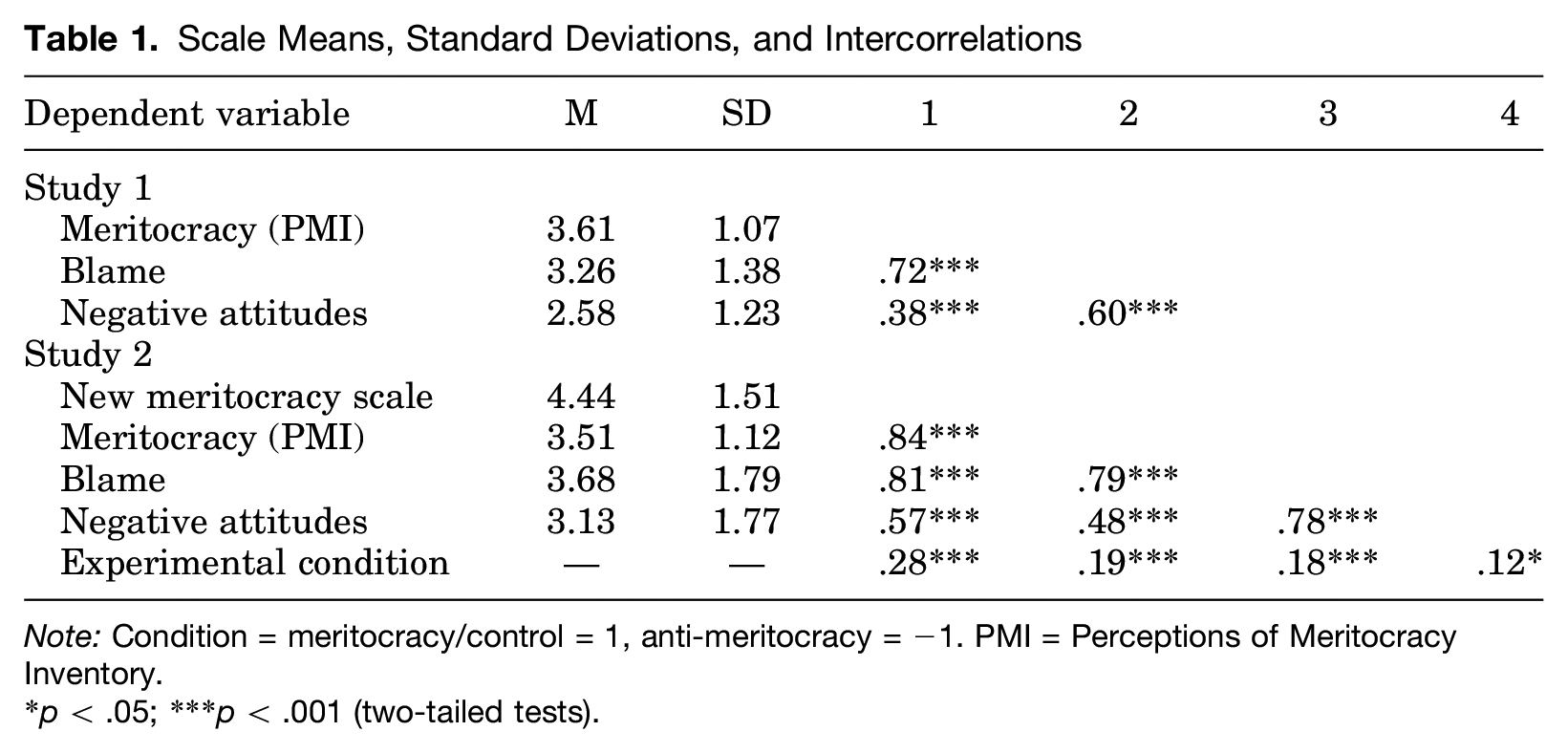
Note: Condition = meritocracy/control = 1, anti-meritocracy = −1. PMI = Perceptions of Meritocracy Inventory.
p < .05; ***p < .001 (two-tailed tests).
Hypothesis 1: Meritocracy beliefs and blame
We began by testing our first prediction that beliefs in the American Dream predict blame toward those in poverty. As expected, greater beliefs in descriptive meritocracy correlated positively with blame toward those in poverty, r(307) = .72, p < .001.
Hypothesis 2: Meritocracy beliefs and negative attitudes toward those in poverty
Next, as expected, greater beliefs in descriptive meritocracy correlated with negative attitudes toward those in poverty, r(307) = .38, p < .001.
Hypothesis 3: The mediating role of blame
To test the mediational prediction, we used Hayes’s (2017) PROCESS macro (see Table 2). This macro uses an ordinary-least-squares-regression-based path analytical framework to analyze statistical models involving moderation, mediation, and their combination. We used Model 4 to assess indirect effects of meritocracy on anti-poor attitudes via blame. Analyses revealed the predicted indirect effects such that stronger beliefs in meritocracy predicted more negative attitudes toward those in poverty indirectly through blame (see Figure 1). Specifically, meritocracy predicted greater blame, and blame, in turn, predicted greater negative attitudes. Although there was a strong total effect of meritocracy beliefs on negative attitudes, with blame in the equation, the direct effect was not significant. The pattern and significance of results are similar when we control for participants’ socioeconomic status (ladder and income range), political ideology, age, gender, and race (nonwhite = 1, white = 0).
Testing the Indirect Effect of Meritocracy on Negative Attitudes toward the Poor via Blame
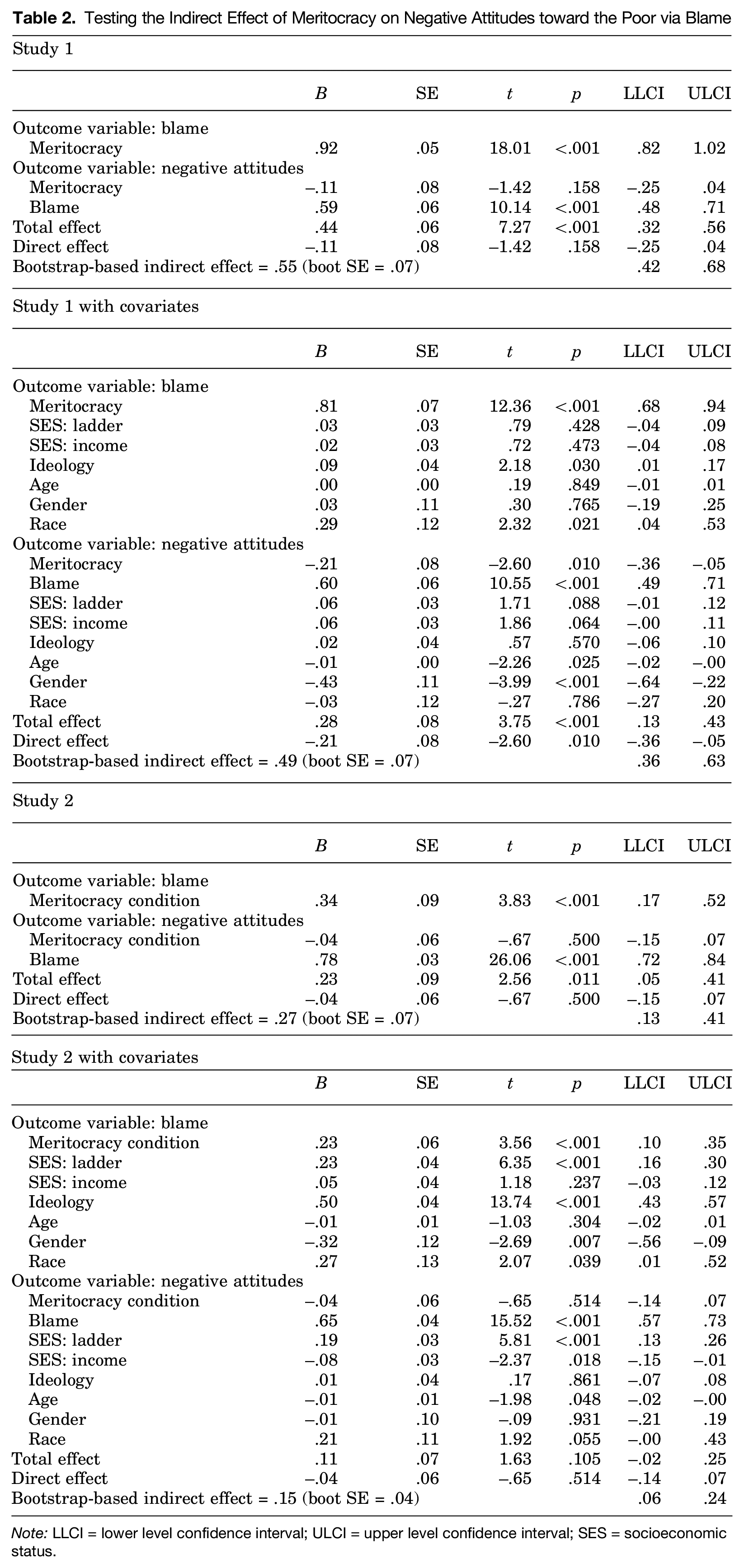
Note: LLCI = lower level confidence interval; ULCI = upper level confidence interval; SES = socioeconomic status.
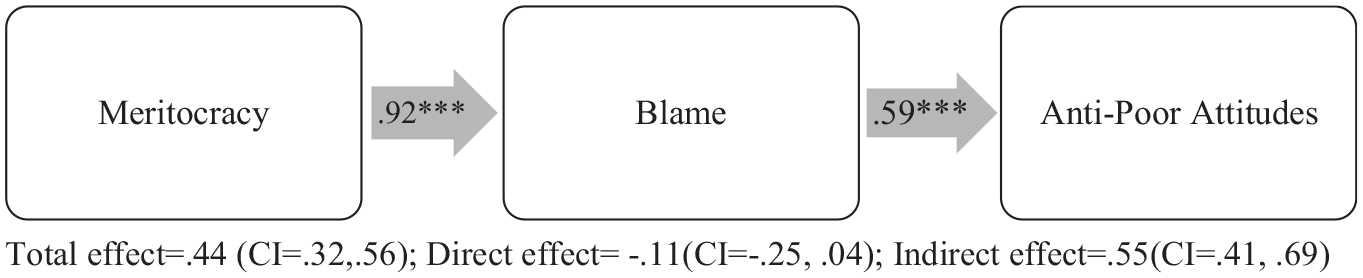
Indirect Effect of Meritocracy on Anti-poor Attitudes through Blame ***P < .001.
Study 2
In this study, we experimentally investigated our research questions with a goal of decreasing beliefs in meritocracy and blame and thus the associated negative attitudes toward those in poverty.
Method and Measures
Participants and procedure
In this study, we determined a minimum sample size for the three-group analysis of variance (ANOVA) designs to be 390, assuming a small-medium effect size (.20; power = .95; α = .05). Four hundred ninety-two participants from Mechanical Turk completed the study. Thirty-three people failed to give an adequate response to the open-ended question (failed to write anything or wrote incoherent descriptions of the reading), and an additional 20 completed the survey in less than one second per item, suggesting insufficient attention (Wood et al. 2017). We report findings using our a priori exclusion criterion with a final sample size of 439 (nMeritocracy = 145; nAntimeritocracy = 141; nControl = 153; 42.8 percent female; 56.9 percent male; .2 percent other gender) participants, who were predominantly white (65.6 percent; 5.0 percent Asian American; 14.8 percent African American; 3.4 percent Latinx; 3.9 percent Native American; 7.3 percent other/biracial) with a mean age of 36.25 years (SD = 10.45).
We randomly assigned participants to one of three conditions: they read a message on descriptive meritocracy, anti-meritocracy, or neutral content. Participants were instructed: “Please carefully read over the following excerpt from a recent article. You will be asked to evaluate the excerpt.” In creating the messages, we modified the reading passages used by Darnon and colleagues (2018). We included four conceptual dimensions of meritocracy (Madeira et al. 2019): the two personal dimensions of effort and internal control and the two structural dimensions of social mobility and equal opportunities. In both conditions discussing meritocracy, the message started: “Meritocracy is a social system in which success and status in life depend primarily on individual talents, abilities, and effort. It is a social system in which people advance on the basis of their hard work and skills.” In the meritocracy condition, the passage argued that America had all of the four elements of meritocracy, whereas in the anti-meritocracy condition, the passage argued against each of the dimensions (see online supplement). In the control condition, we used neutral text describing a frog’s ability to anticipate disasters (Darnon et al. 2018).
Participants were required to spend at least 40 seconds reading and describing the main point of the passage before continuing with the study. We used the open-ended response describing the passage to identify nonsensical responses (Chmielewski and Kucker 2019; Dennis, Goodson, and Pearson 2018). Next, participants completed an additional six-item measure of meritocracy that assessed the four conceptual dimensions that were used to create the passages (Madeira et al. 2019; α = .92) as well as the meritocracy measure used in the previous study (PMI; α = .95). Next, participants responded to the same measures of blame (α = .97) and negative attitudes (α = .98), followed by demographic questions. We again assessed political ideology (α = .91), self-perception regarding social class, and income range (nine-point scale ranging from <$15,000 to >$200,000). We included additional measures relevant to other research questions not discussed here.
Results
See Table 1 for means, standard deviations, and correlations. The correlations show that our first two hypotheses were supported, with descriptive meritocracy relating to both blame and negative attitudes toward those in poverty.
For our manipulation, we ran a multivariate analysis of variance (MANOVA) with both measures of meritocracy and blame as outcomes and experimental condition as the predictor. The overall MANOVA was significant, Wilks’s lambda = .90; F(6, 868) = 7.48, p < .001, η2 p = .05 (see Figure 2). Univariate tests indicate that across conditions, responses to the new meritocracy measure, F(2, 436) = 18.81, p < .001, η2 p = .08; the PMI, F(2, 436) = 7.70, p = .001, η2 p = .03; and blame, F(2, 436) = 7.51, p < .001, η2 p = .03, differed. Least significant difference (LSD) post hoc tests revealed that participants in the anti-meritocracy condition reported lower levels of meritocracy and blame than those in the meritocracy condition (new: p < .001, d = .68; PMI: p = .001, d = .39; blame: p < .001, d = .43) and control condition (new: p < .001, d = .55; PMI: p = .001, d = .40; blame: p = .002, d = .36). Scores in the control and meritocracy conditions were similar (new: p = .254, d = .14, PMI: p = .990, d = .00; blame: p = .552, d = .07).
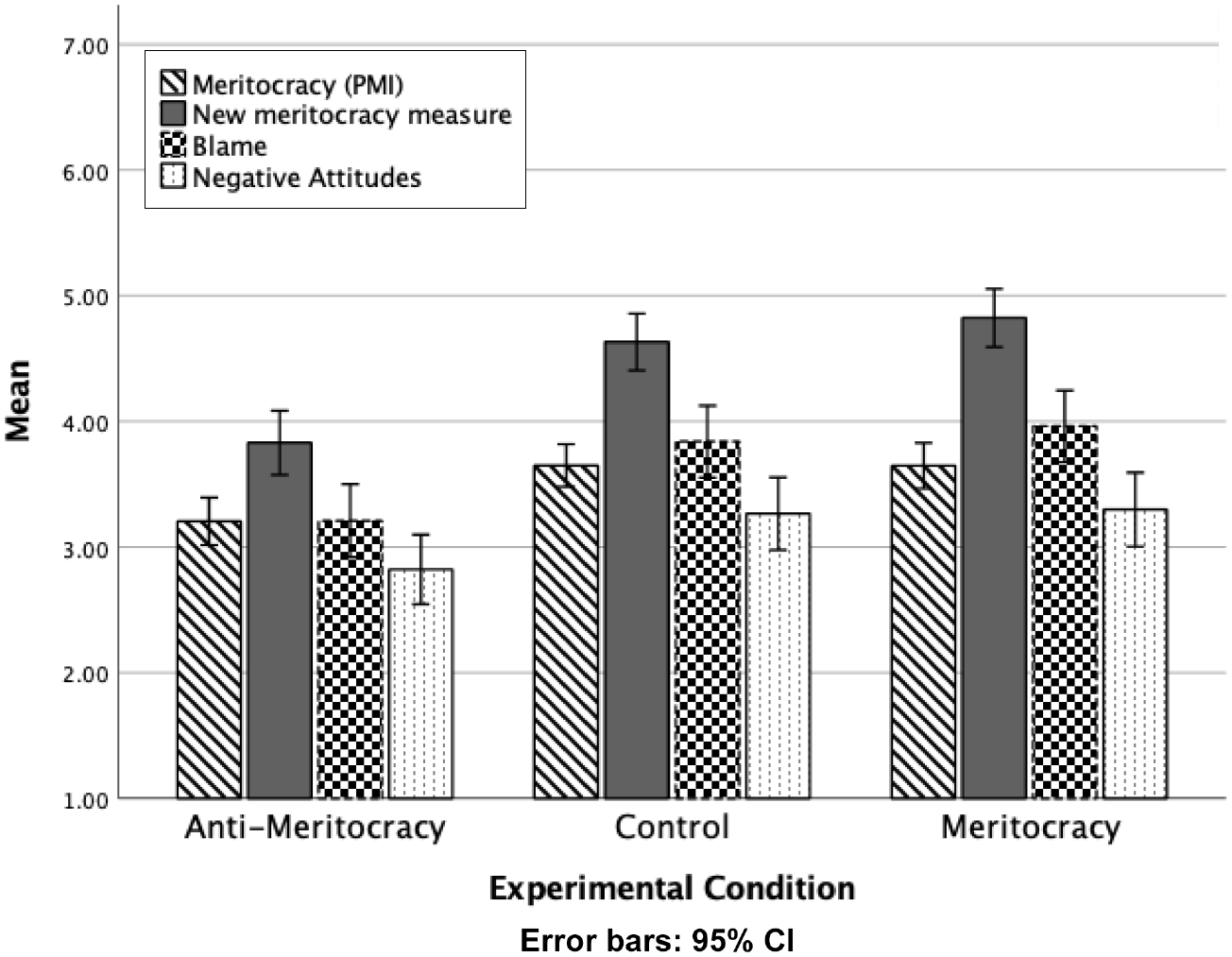
Effect of Experimental Condition on Meritocracy, Blame, and Negative Attitudes
We then examined if the meritocracy condition predicted negative attitudes. We ran an ANOVA with negative attitudes outcomes and experimental condition as the predictor. Results indicated that negative attitudes differed across conditions, F(2, 436) = 3.29, p = .038, η2 p = .02. LSD post hoc tests revealed that participants in the anti-meritocracy condition reported lower levels of negative attitudes than those in the meritocracy (p = .022, d = .28) and control conditions (p = .031, d = .26). Negative attitudes in the control and meritocracy conditions were similarly high (p = .872, d = .02).
Finally, we tested our mediational prediction (see Figure 3). Because responses to measures were similar in the meritocracy and control conditions, we combined them (M/C) and tested the indirect effects of those conditions relative to the anti-meritocracy condition on negative attitudes through blame (M/C = 1, AM = −1). M/C predicted more negative attitudes toward those in poverty, relative to AM, indirectly through blame. Exploring covariates, the indirect effect holds when controlling for participants’ socioeconomic status (ladder and income range), political ideology, age, gender, and race (nonwhite = 1, white = 0; see Table 2 for details).
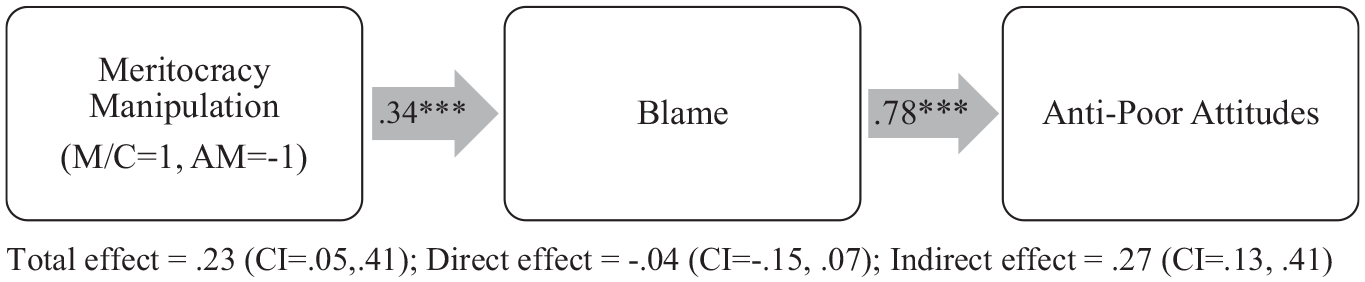
Indirect Effect of Experimental Condition on Anti-poor Attitudes through Blame ***P < .001.
Discussion
An important step in the fight against poverty is to improve attitudes (Davis and Williams 2020). We investigated the role of meritocracy beliefs and the closely allied blame in sustaining negative attitudes and examined messages that might mitigate negative attitudes toward those in poverty. First, correlation results show that stronger beliefs in meritocracy relate to more blame as well as negative attitudes. By focusing on the financially disadvantaged, we extend research showing a link between meritocracy beliefs and negative attitudes toward low-status groups (Son Hing et al. 2011). Additionally, descriptive meritocracy predicts negative attitudes through blaming those in poverty. Our experimental study demonstrated that messages critiquing the existence of meritocracy in the United States can weaken beliefs in descriptive meritocracy and blame, thereby decreasing negative attitudes.
Our work supports a growing literature that points to the critical role that ideologies of merit play in maintaining inequality (Piff et al. 2018). Our work also builds on findings that messages decreasing perceptions of social mobility can decrease meritocratic beliefs and, in turn, rationalization of the status quo (Day and Fiske 2017). We showed that a message arguing that outcomes in society are not based on merit successfully decreased beliefs in meritocracy and the blame placed on economically disadvantaged individuals relative to those in the control and meritocracy conditions. Importantly, the equivalence in outcomes for our control and meritocracy conditions in our experimental work suggests that people’s naturally occurring beliefs about outcome distributions in society are on par with people who just read an article extolling descriptive meritocracy in the United States.
Even as the hollowness and moral hazards of endorsing descriptive meritocracy are exposed, this ideology remains a lynchpin of political messages across parties in the United States. From a practical perspective, understanding the role of descriptive meritocracy beliefs and blame in fostering negative attitudes provides potential strategies for reducing negative attitudes. One approach might leverage the distinction between prescriptive ideals of meritocracy as a justice principle and descriptive beliefs that meritocracy exists (Son Hing et al. 2011). For example, leaders might consider altering their messages to underscore that meritocracy ought to exist, not that it does exist. Or, more directly homing in on a powerful mechanism, politicians and other leaders might work to promote messages that do not justify the current economic conditions or that explicitly send a message that those in poverty are not to blame for their current status by highlighting the multiple systemic forces at play. Although the effectiveness of such interventions are only speculative, they are supported by new data from Piff and colleagues (2020) showing that brief and scalable interventions designed to promote situational attributions for poverty can bolster opposition to inequality and hold promise in addressing economic inequality. Similar short and accessible interventions might also serve to decrease negative attitudes toward those in poverty.
Despite implications, there are some limitations worth noting. First, our results should be interpreted with caution given that we do not employ experimental designs that independently manipulate both the independent variable and mediator (Pirlott and MacKinnon 2016). Second, although some may view Mechanical Turk samples as low quality or lacking in external validity, research suggests that such samples are at least as valid as other online survey respondents and potentially more representative than other convenience samples such as undergraduate students. Additionally, the use of the experimental design in Study 2 helps to address issues related to representative samples as problematic for generalizability (e.g., Coppock, Leeper, and Mullinix, 2018). Finally, by focusing on meritocratic beliefs, this research puts the focus on individuals rather than the institutions and structures that serve to maintain and exacerbate economic differences and poverty (Kraus et al. 2009). Future research should examine how meritocracy beliefs might influence understanding, acknowledgment, or dismissal of structural barriers associated with economic inequality.
Conclusions
In sum, beliefs in the existence of meritocracy, the United States’s dominant ideology upholding the principle that status in society is earned, has important implications for negative attitudes toward those in poverty. Through both cross-sectional and experimental work, we demonstrated that these beliefs promote negative attitudes toward those in poverty in part through blame. Our work shows that descriptive meritocracy is a core facet of the American ethos, although it can be situationally depressed with a message detailing how the United States is not a meritocracy. A better understanding of what influences attitudes toward the poor is critical because these feelings influence important policy decisions at the local and federal levels with profound consequences for those in poverty.
Supplemental Material
sj-docx-1-spq-10.1177_01902725211022319 – Supplemental material for Believing in the American Dream Sustains Negative Attitudes toward Those in Poverty
Supplemental material, sj-docx-1-spq-10.1177_01902725211022319 for Believing in the American Dream Sustains Negative Attitudes toward Those in Poverty by Crystal L. Hoyt, Jeni L. Burnette, Rachel B. Forsyth, Mitchell Parry and Brenten H. DeShields in Social Psychology Quarterly
Footnotes

Supplemental Material
Supplemental material for this article is available online.
1
N varies slightly across analyses due to missing data.
Bios
References
Supplementary Material
Please find the following supplemental material available below.
For Open Access articles published under a Creative Commons License, all supplemental material carries the same license as the article it is associated with.
For non-Open Access articles published, all supplemental material carries a non-exclusive license, and permission requests for re-use of supplemental material or any part of supplemental material shall be sent directly to the copyright owner as specified in the copyright notice associated with the article.
