







Abstract
Research reported in this article examines the impact of race and gender as status characteristics on the selection of teammates for a collectively oriented task. Expectation states research provides the theoretical grounding for the project and for hypotheses tested with choice models. Results suggest that expectation states/status characteristics theory may not apply to the task of teammate selection. We find that race and gender have different effects on the choices made by respondents; race does not function as a status characteristic but, rather, as an identity characteristic in which the ingroup is favored; and respondents, regardless of their own racial identity and gender identity, exhibit a strong bias toward women as teammates.
Keywords
The literature on race and gender inequality focuses on distributions of advantage based on one's racial and gender identity. In social psychology, this research is often grounded in expectation states theory, which is “one of the most systematically investigated and validated theories in social psychology” (Reid 2012:20). Studies on status effects in this literature tend to focus on gender-based status inequality; studies on race are rare but burgeoning, and research on its interaction with gender are virtually nonexistent (Hunt et al. 2013). More generally, Collins (2006) and Crenshaw (1989) note there is a racial colorblindness in gender scholarship and a gender-blindness in race scholarship. Existing social-psychological literature (reviewed later) focuses on how race and gender bias decision-making practices in preformed task groups, resulting in those with disadvantaged states on race and gender occupying lower ranks in the group's power and prestige order. Our research builds on this work by taking one step back to examine group formation, that is, whether race and gender, as status characteristics, impact the selection of teammates for collaborative group work.
We ground our project in the social-psychological literature, specifically, the expectation states research program, which examines how status differences derived from the societal rankings of one's group shape interaction in collectively oriented task groups. As Webster, Whitmeyer, and Rashotte (2004:724) note, “sociologists have long recognized that task-focused interaction in committees, teams, or juries can be shaped by status characteristics of the interactants.” However, there is limited research in this literature on how status generalization could impact the formation of the committees, teams, and so on. By focusing on team formation, our work contributes to studies of inequality through its examination of who is invited to sit at the table rather than who eats what (and how much). The examination of teammate selection bridges macro and micro literatures by exploring how status in the wider society impacts the formation of groups within which social-psychological processes studied by expectation states theory reproduce existing status beliefs and associated behaviors.
Our work examines the impact of diffuse status characteristics, specifically, race and gender, on teammate choice. The next sections describe the theoretical framework of expectation states theory, specifically, status characteristics theory, which grounds our research and the literature on team formation. The theoretical framework has several scope conditions, one of which pertains to the focus of group interaction, namely, on a task that supposedly has objectively correct or better and incorrect or worse outcomes. We are interested in seeing whether status characteristics theory can be extended to the team formation process itself even though it could be argued that viewed as a “task,” team formation does not directly have objectively better or worse outcomes. Indirectly, however, choosing teammates to work with on a task that does supposedly have objectively better/worse outcomes means individuals may want to choose the most competent partners, and therefore, a status generalization process may occur. On the other hand, individuals may choose team members who they think they will get along with and thus form a “good” team, one that works well together. Research on team formation agrees that competence is often an attribute that is assessed regarding a potential partner but suggests some additional considerations that often come into play, the most important of which for our work is homophily (Hinds et al. 2000; Ruef, Aldrich, and Carter 2003). We then describe our data collection procedures, methods of analysis, and discrete choice modeling. Then we follow this section with a presentation of model estimation results on partner choice data gathered by an online vignette study.
Theoretical Framework
Scholars use expectation states theory to explain the distribution of power and prestige (i.e., deference or respect) in collectively oriented task groups of strangers. For a group to be collectively oriented, each team or group member must consider that everyone's contributions are necessary and legitimate to achieve a successful task outcome (Berger, Fişek, and Freese 1976). On collectively oriented teams, persons put their “best foot forward” for the sake of team success rather than for individual glory. The theory asserts that in such teams of individuals with no prior acquaintance, interaction inequalities emerge precisely because of the orientation to group rather than individual success. Inequalities emerge from the formation of expectations based on information provided by status characteristics, which serve as cues to who is more or less likely to make valuable contributions to group success. These cues are activated when groups are composed of strangers who have no special information about one another's competencies.
Two types of status characteristics carry such cues: specific status characteristics and diffuse status characteristics (Berger, Cohen, and Zelditch 1972; Correll and Ridgeway 2003). Both types are composed of different states associated with different performance expectations and degrees of honor, prestige, and social worth. Our work focuses on diffuse status characteristics. Diffuse status characteristics, such as race and gender, are individual attributes accompanied by taken-for-granted cultural and stereotypical beliefs commonly held by most members of a society about the level of competence (or incompetence) of groups defined by the attributes in question (Berger, Ridgeway, and Zelditch 2002). Studies of mixed-gender work groups show gender operates as a diffuse status characteristic with “man” as the advantaged state (Berger and Fişek 2006; Foschi and Buchan 1990; Lucas 2003; Ridgeway 2011; Ridgeway and Correll 2004). In these studies, both men and women form performance expectations that favor men over women due to the belief that they are more competent and able (Berger and Fişek 2006; Brown and Josephs 1999). Other studies demonstrate that race operates as a diffuse status characteristic where both White people and Black people form racially based performance expectations that favor the former over the latter (Biagas and Bianchi 2016; Goar et al. 2013; Goar and Sell 2005; Manago, Sell, and Goar 2019; Thomas-Hunt and Phillips 2010). 1 Such studies confirm expectation states theory's assertion that in the absence of explicit information, people use taken-for-granted stereotypes activated by diffuse status characteristic differences to build expectations about who is more and who is less likely to help the group succeed regardless of their own standing relative to the characteristics.
In this framework, individuals expect better performance from those who rank high on the diffuse characteristic compared to those who rank low, regardless of their own personal rank. An open question, however, is whether different diffuse status characteristics (i.e., race, gender, class, disability, and/or sexuality, etc.) operate identically during group interaction (Webster and Walker 2016). If all are equally relevant to the task (as defined by having identical paths of relevance to task outcomes; see Berger et al. 1976), no formal way exists to distinguish their impact. This means that theoretically and assuming equal relevance, the effect of status information (i.e., cultural assumptions and stereotypical beliefs) from one diffuse characteristic has the same weight as information from another diffuse characteristic on group members’ performance expectations of one other.
The first issue we assess is whether diffuse status characteristics operate identically. That is, does a difference on diffuse characteristic A have the same impact on performance expectations and thus behavior as a difference on diffuse characteristic B, assuming A and B are equally relevant to the formation of task expectations. 2 The second issue we address is whether the process of expectation formation operates identically across groups differentiated by the status dimension. That is, do persons in the favored state and those in the unfavored state of a diffuse status characteristic attribute greater competence to those in the favored state and so form expectations accordingly. Expectation states theory assumes they do. We should note, however, that our ability to definitively sort out these issues is limited in two ways. First, our diffuse status dimensions are race and gender, and expectation states researchers Ridgeway and Kricheli-Katz (2013) note that these dimensions and their intersection may have very different behavioral consequences and social-psychological effects. Their points are consistent with arguments made by many scholars outside expectation states scholarship that these dimensions are not interchangeable and hence, should not be considered identical in operation (Collins 2012). Second, the task for our subjects, selecting teammates for a task group, arguably has a “competence” dimension—it is better to have more competent rather than less competent persons as teammates. But there are other considerations, as we review later, that arise in the selection of teammates that complicate how expectations for performance might form with respect to the selection task. These two factors preclude the view of our work as a straightforward test of status characteristics/expectation states theory.
Scholars have applied status characteristics and expectation states theories to choice and decision-making behaviors in many topics outside a group context: hiring (Skvoretz and Bailey 2016), criminal sentencing (Unnever and Hembroff 1988), team sports (Yuchtman-Yaar and Semyonov 1979), entrepreneurial teams (Ruef et al. 2003), and implicit bias (Melamed et al. 2019). 3 Two studies worth comment examine the effect of status characteristics in a team formation context: those conducted by Kelley, Soboroff, and Lovaglia (2017) and Savage, Dippong, and Melamed (2020).
The first experimental study (Kelley et al. 2017) examines age as a status characteristic in the selection of a teammate from a set of three computer-generated avatars of a White man who appears teenaged, middle-aged, or elderly. The subjects are undergraduate men who identify as European American or Asian American. They select a teammate from the set of three avatars with the understanding that the two they do not pick will form a team against whom the subject and their selected partner would compete. Kelley et al. (2017) find that subjects rate the status value of the middle-aged adult avatars higher and select them significantly more often than the young and old candidates. In the second experimental study, Savage et al. (2020) use education and age of potential competitors to examine how these status characteristics affect a subject's selection of a competitor. Subjects are predominantly undergraduates evenly split between men and women and predominantly identifying as White individuals. Selection is made from three potential competitors (matched on gender of subject with no information about racial identity): someone younger than subjects and less educated (16-year-old with less than high school education), someone older with more education (35-year-old with doctorate), and someone matching their age (±2 years) and education. They find that subjects disproportionately select opponents who occupy the lower states of the age and education status characteristics.
These two studies are interesting because their concerns overlap our concern with how status information impacts the selection of teammates, in Kelley et al. (2017), or opponents, in Savage et al. (2020). We examine race and gender as status characteristics, not age, however, and our design is a vignette experiment implemented in an online survey rather than an experiment. Finally, as we will detail, our instructions do not incorporate reference to a competitive or adversarial component to the later task that respondents will supposedly engage in, either with a selected teammate or against a chosen adversary.
Team Formation
Team formation is sociologically relevant in its own right because teams emerge and are pervasive across social institutions. Studies provide evidence that in health care, government, education, and business settings, teams improve organizational efficiency, productivity, and morale relative to the efficiency, productivity, and morale of individuals who work alone (Guzzo and Dickson 1996; Hamilton, Nickerson, and Owan 2003). Scholars use different terms, such as team assembly, team configuration, team design, and team development, to describe team formation. Nevertheless, researchers primarily define team formation as a social process involving organizational and/or individual decision-making behaviors (Phillips, Weisbuch, and Ambady 2014). This process requires a collection of people to band together and work to complete a task.
Among the mechanisms that are important to team formation, research identifies two that are especially relevant to our research (Guimerà et al. 2005; Hinds et al. 2000; Twyman and Contractor 2019; Wax, DeChurch, and Contractor 2017; Zhu, Hang, and Contractor 2013). They are competence or task ability and homophily or similarity in social important attributes like race and gender. 4 The importance of these two for our research is that both can be used as grounds for selecting others when those others are strangers and differentiated from each other only by visible characteristics like race and gender.
Competence
Ruef et al. (2003), citing status characteristics theory, examine the impact of competence inferred from gender and race on the formation of entrepreneurial teams. They hypothesize that individuals with high standing on gender and race (men and White individuals) are more likely to be sought after for entrepreneurial teams than those of low standing (women and non-White individuals). Using a nationally representative sample of 816 entrepreneurs from the Entrepreneurial Research Consortium's panel and structural event analysis, Ruef et al. (2003) find little to no support for the hypothesis once controls, such as geographic region and industry type, are entered into the analysis. However, the authors find that non-White entrepreneurs significantly favor recruiting other non-White individuals more than do White entrepreneurs and thus are significantly more likely to make homophilous choices. Hinds et al. (2000) investigate if the race, gender, and the interaction of race and gender, as status groups, shape the formation of project teams. Their results show that people have “no particular tendency toward wanting to work with men . . . with whites, . . . or with white men” (Hinds et al. 2000:245).
Homophily
Hinds et al.’s (2000) study also explores homophily as a factor in the formation of project teams, specifically investigating the hypothesis that racial and gender homophily “will be a determinant of” partner-choice and shape team formation. Their rationale is that “homophily increases the ease of communication and improves the predictability of behaviors and values” (Hinds et al. 2000:229). They argue that similar others are favored as teammates as a means to facilitate intrateam dynamics. They find that racial homophily, but not gender homophily, characterizes choice of partner. However, Ruef et al. (2003) find that gender homophily characterizes entrepreneurial teams, that is, the formation of mixed-gender teams is less likely than single-gender ones. While research generally shows evidence of racial homophily in team formation, the evidence is mixed with gender homophily.
In sum, these studies of team formation suggest that although someone might be attractive as a teammate because they are believed to have high task competence, they could also be attractive because they are perceived to be easy to communicate with and more predictable in a team setting. Thus, even if a diffuse status characteristic is activated in the partner choice situation and the scope condition of collective orientation is satisfied, there is no guarantee that it is used only to infer competence. It may also be used to infer communication compatibility, and in that case, its implications are at odds with the inference from competence. Specifically, in the selection of a teammate, race and gender may act as identity characteristics, characteristics in which one's own state is preferred and preferred for task-relevant reasons. An investigation in a more controlled environment is one way to advance an understanding of this issue.
Research Questions
Our research questions revolve around how diffuse status characteristics are used in the selection of teammates for a collectively oriented task. The essential problem for the chooser when faced with a pool of candidates is to use all available information to decide who is more likely to contribute to successful task outcomes and who is less likely to do so. In the absence of specific knowledge about relevant task abilities and consistent with expectation states theory, we expect diffuse status characteristics will be activated when candidates differ on these characteristics and expectations will be formed about who is more likely to contribute successful task outcomes. But, as our review of the team formation literature suggests, task competence and communication compatibility are two independent avenues for better and worse contributions. Furthermore, diffuse status differences may lead to performance expectations for competence that differ from those for compatibility. If so, then a high-status actor who is more attractive on task competence grounds may not have a greater chance of selection if that high-status actor is less attractive on the basis of communication compatibility. Similarly, someone who is less attractive on the basis of direct task competence may nevertheless be preferred on the basis of communication compatibility.
Our research design uses gender and race as differentiating characteristics of potential partners. Our first research question is how race and gender as diffuse status characteristics impact the selection of teammates. Specifically,
Research Question 1: Are alternatives in the putatively high states of the race and gender characteristics (White person and man) more likely to be chosen by respondents, and if so, does a gender difference have the same impact on the chance of selection as a race difference?
Our second question is how the racial and gender identities of respondents impact the selection of teammates. Specifically,
Research Question 2: Do respondents of different racial and gender identities make similar choices of partners, or is there an interaction between the racial and gender identities of the choosers and the racial and gender profiles of the alternatives?
If both race and gender are operating as pure status characteristics, that is, differentiating characteristics in which both those ranking high and those ranking low agree on relative competence, and if competence is the salient assessment to be made, then all respondents should prefer men over women and White persons over Black persons as partners. However, if communication compatibility is the salient assessment, then race and gender could operate as identity characteristics in which partners in one's own status group are preferred. Thus, respondents who are men would prefer men as partners, respondents who are women would prefer women partners, White respondents would prefer White partners, and Black respondents would prefer Black partners.
Data Collection And Methods Of Analysis
Research Design
Our study is a vignette experiment implemented in an online survey, the core phase of which asks subjects to select partners for a future teamwork-based task. The instrument is distributed by Qualtrics using Qualtrics's Panel service, which recruits participants and collects the data. Respondents must be 18 years of age or older; self-identify as a White man, a White woman, a Black man, or a Black woman; and be U.S. born. Recruitment results in 431 eligible participants based on their race, gender, age, and national origin. Of the 431 participants, 110 self-identify as White men, 110 self-identify as White women, 101 self-identify as Black men, and 110 self-identify as Black women.
Case Selection: Scope Conditions
Collective orientation is a fundamental scope condition for expectation states theory. Note that this scope condition applies regardless of the salient basis for contribution evaluation, direct task competence, or communication compatibility. In conventional experimental studies, collective orientation is typically assessed during an exit interview. We assess participants’ collective orientation with two items developed by Driskell, Salas, and Hughes (2010) and similar to the collective orientation measurements of Foschi and Valenzuela (2012):
1. If I participate in a future teamwork study, I think agreeing as a team regarding the correct decision will be more important to me than my own choice.
2. I think while working as a team on the contrast sensitivity task, it would be best to consider other persons’ choices carefully.
The framing of these two statements allows respondents to imagine themselves as qualified participants engaging in a collectively oriented activity requiring teamwork. Response categories range from strong disagreement (coded as 1) to strong agreement (coded as 6). Respondents who indicated any disagreement with either or both items are dropped because they are not deemed to be sufficiently collectively oriented. Of the 431 eligible participants, 88 lack sufficient collective orientation, thus limiting the analysis to 343 participants: 88 White men (25.7 percent), 90 White women (26.2 percent), 75 Black men (21.9 percent), and 90 Black women (26.2 percent). 5
This distribution by race and gender does not differ statistically from the distribution of excluded respondents by race and gender according to a chi-square test.
Dependent Variables
The selections of respondents in groups formed by the cross-classification of race and gender constitute the outcomes of interest. The predictions of interest relate to differences and similarities in the behavior of individuals in these groups with respect to partner choice. That is, does a respondent's group membership impact their choice of partner when the available partners themselves vary along race and gender?
Participants make choices in three different scenarios that vary the number of alternatives (two or three) and the number of teammates to be selected (one out of two, one out of three, or two out of three). Having three different scenarios is intended to provide a comprehensive set of choice data without undue risk of respondent fatigue.
6
Each scenario is represented 12 times, so the respondent provides a total of 36 choices. Within each scenario, the set of alternatives is varied over the unique combinations of four status profiles: White man (WM), White woman (WW), Black man (BM) and Black woman (BW; see Figure 1). In the first scenario, there are six
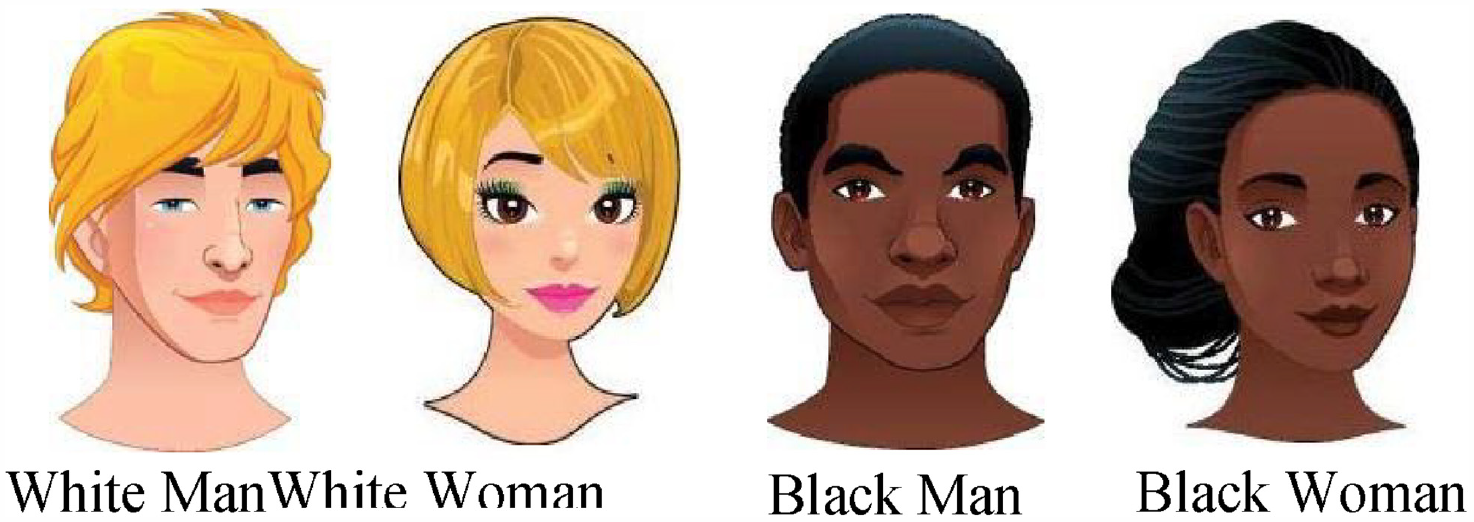
Candidate Status Profiles by Race and Gender
Data Collection
There are five steps to the survey. The first step asks participants to read and sign an informed consent form. Then, in the second step, they provide demographic information and select and name one avatar to represent themselves from a set of 10 avatars that are their same race and gender. Studies show a person's race and gender tend to influence his/her creation (or selection) of an avatar to represent themselves in the digital world (Groom, Bailenson, and Nass 2009; Martey and Consalvo 2011). These avatars total 40 in number and differ from those used to represent possible teammates. 7
In the third step, participants work alone on the “contrast sensitivity” task. The aim is to give them an experiential basis for the idea that in a later session, they would be working together as a team on a similar task. 8 In this task, respondents view slides divided into two areas and are asked to identify which area has more white than black space. They are told that they have 5 seconds to view and determine which area has more white space. A total of 20 slides are presented. By design, there are no right or wrong answers. However, to prime for task orientation, participants are told that the more correct answers they get, the more opportunities they will have of being selected in a $100 Amazon gift card raffle. The purpose of the contrast sensitivity task is to prime respondents to seriously think about the need for competent team members during the next step of the study.
In the fourth step, participants are told that researchers anticipate future studies on how well teams do on the contrast sensitivity task. They are told that in this future research, it is the team score that would count and bring rewards to all team members. The specific instructions are: The second phase of your participation asks you to select one or two persons from a set of potential team members to work on a team version of the “Contrast Sensitivity Test.” In the team version, we intend to conduct (pending funding), your score will be determined by the choices the team makes after teammates share opinions. A great team is one where competent teammates work well together, value one another's ideas and opinions, and so often make better choices than individuals make alone.
Note that in describing what makes a great team, “competent teammates [who] work well together,” the instructions highlight both the competence of individual team members and the fact that they work well together without placing special emphasis on either feature.
Participants are asked to make a selection several times because “it can be difficult to match everyone's choices and some groups may consist of two persons and some of three persons.” They are then presented with a series of choice situations in which they are asked to pick one partner from two alternatives, one partner from three alternatives, or two partners from three alternatives. Participants are told that potential partners are the avatars of other participants who have agreed to participate in the future team-oriented contrast sensitivity task. At the end of this phase, respondents are asked if they would like to participate in the future study and thus, have the avatar they selected in Step 2 included in the pool of potential teammates. Lastly, participants complete a questionnaire on collective orientation, are debriefed on all matters concerning deception, and are given the option to decline the submission of their data.
Methods of Analysis
The choice situations faced by respondents constitute discrete choice tasks and can be analyzed by discrete choice models. A standard reference for these models in sociology is Bruch and Mare's (2012) application to residential preferences. As expressed by Bruch and Mare (2012:113), the attractiveness to respondent

where

and
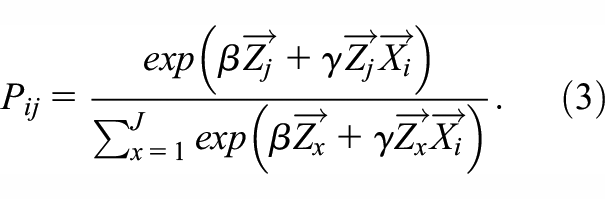
Note that Equation 3 allows for the possibility that the observed characteristics of alternatives may interact with observed characteristics of respondents.
In our context, the relevant characteristics of the alternatives are their race and gender compositions. Specifically, we represent an alternative by its composition in terms of the number of White individuals,
Results
Two general questions of interest guide our analysis. First, is the impact on partner selection of a difference in racial identity identical to the impact of a difference in gender identity? In terms of Equation 1, does the coefficient for the alternative attribute “number of White individuals,”
Table 1 presents the results for the first wave of models. Model 1 simply examines whether
Model Estimates of Effects of Alternative's Race and Gender Counts on Selection Probabilities Main Effects Only and with Interactions with Respondent's Race and Gender
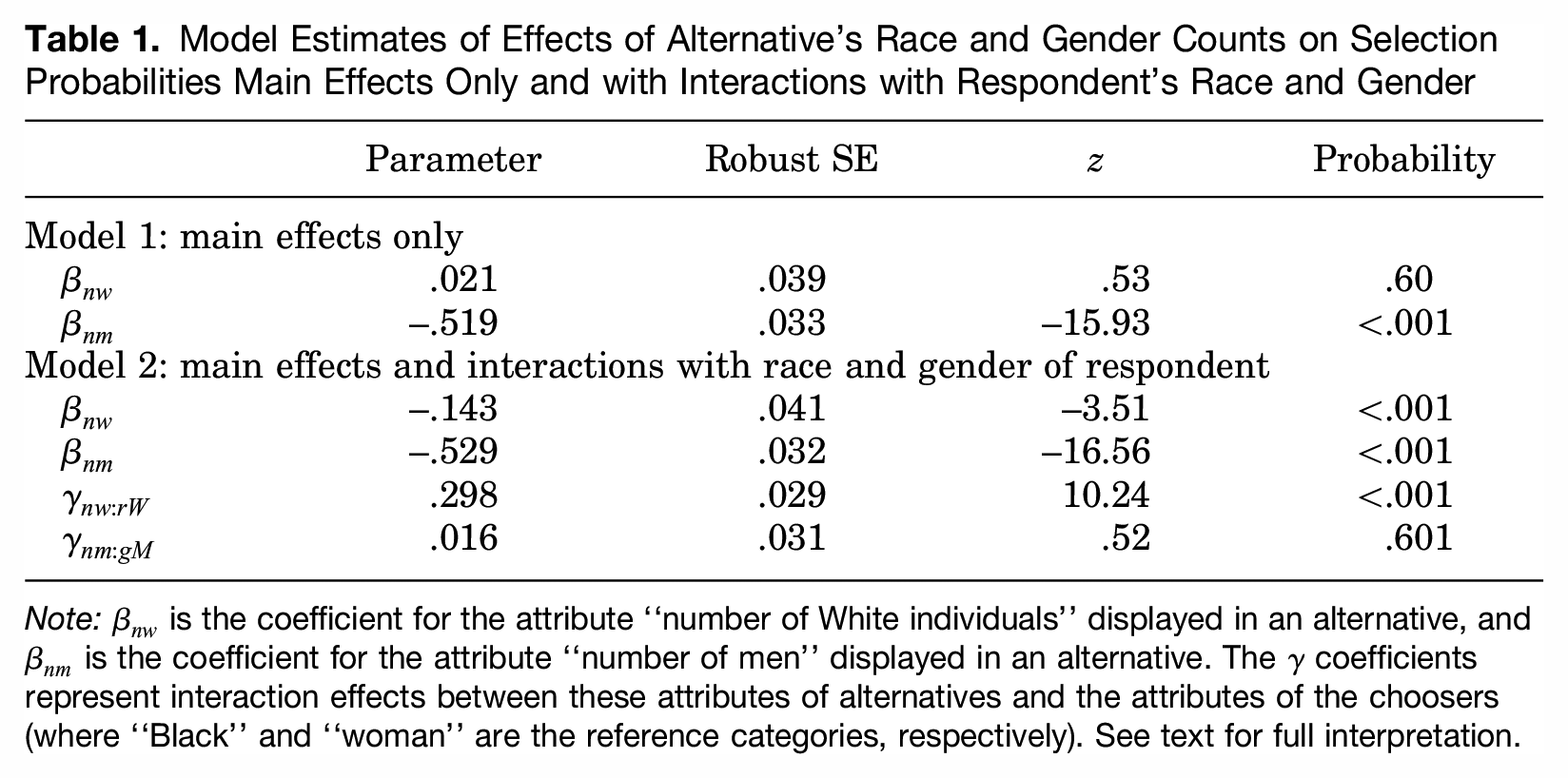
Note:
Model 2 examines whether the effects of
Model 2 offers major qualifications to Model 1 results. In this model,
Table 2 presents calculations of the predicted probabilities of choice for different respondent groups for some typical alternative pools in the first choice situation. We present probabilities because that is the way the model is expressed in Equation 3. But we are also mindful of the advice of Mize (2019:83) regarding the utility of presenting the impact of effects in the “natural metric of the dependent variable.” The differential impact of respondent's racial identity on choice is quite clear: Black respondents are more likely to choose the Black candidate over the White alternative, whereas White respondents are more likely to choose the White alternative over the Black candidate when the two alternatives have the same gender identity.
Predicted Choice Probabilities from Model 2 for Selected Candidate Pools
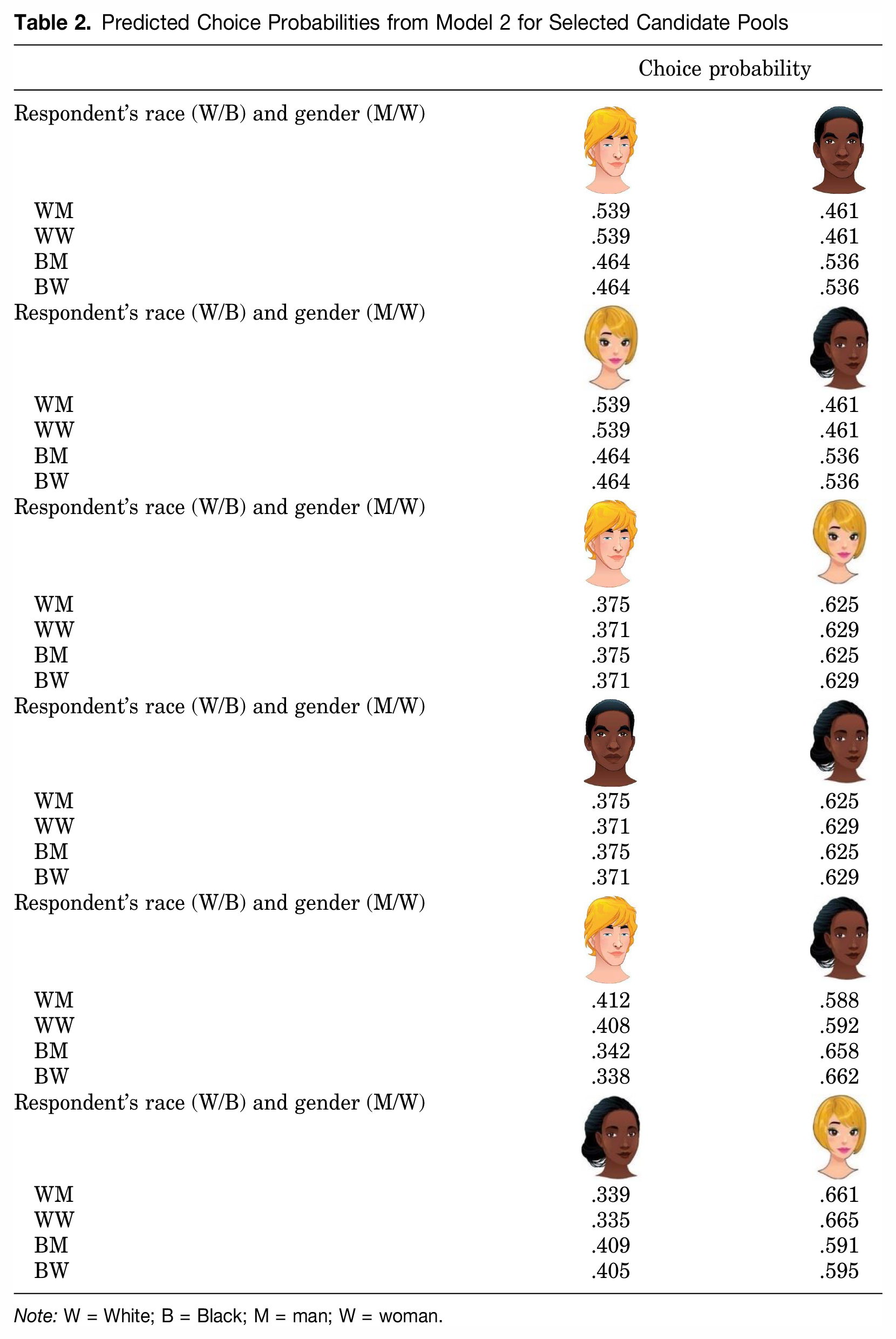
Note: W = White; B = Black; M = man; W = woman.
Equally clear is the consistent preference for women in all respondent groups regardless of the gender identity of the respondent. Table 2 (bottom two panels) demonstrates the relative impact of the racial versus the gender identity of alternatives. For White respondents, the preference for women as teammates can fully counterbalance the preference against Black persons as teammates, making the choice of a Black woman as a teammate more likely than the choice of a White man. For Black respondents, the preference for women as teammates also counterbalances the preference against White individuals as teammates, making the choice of a White woman as a teammate more likely than the choice of a Black man.
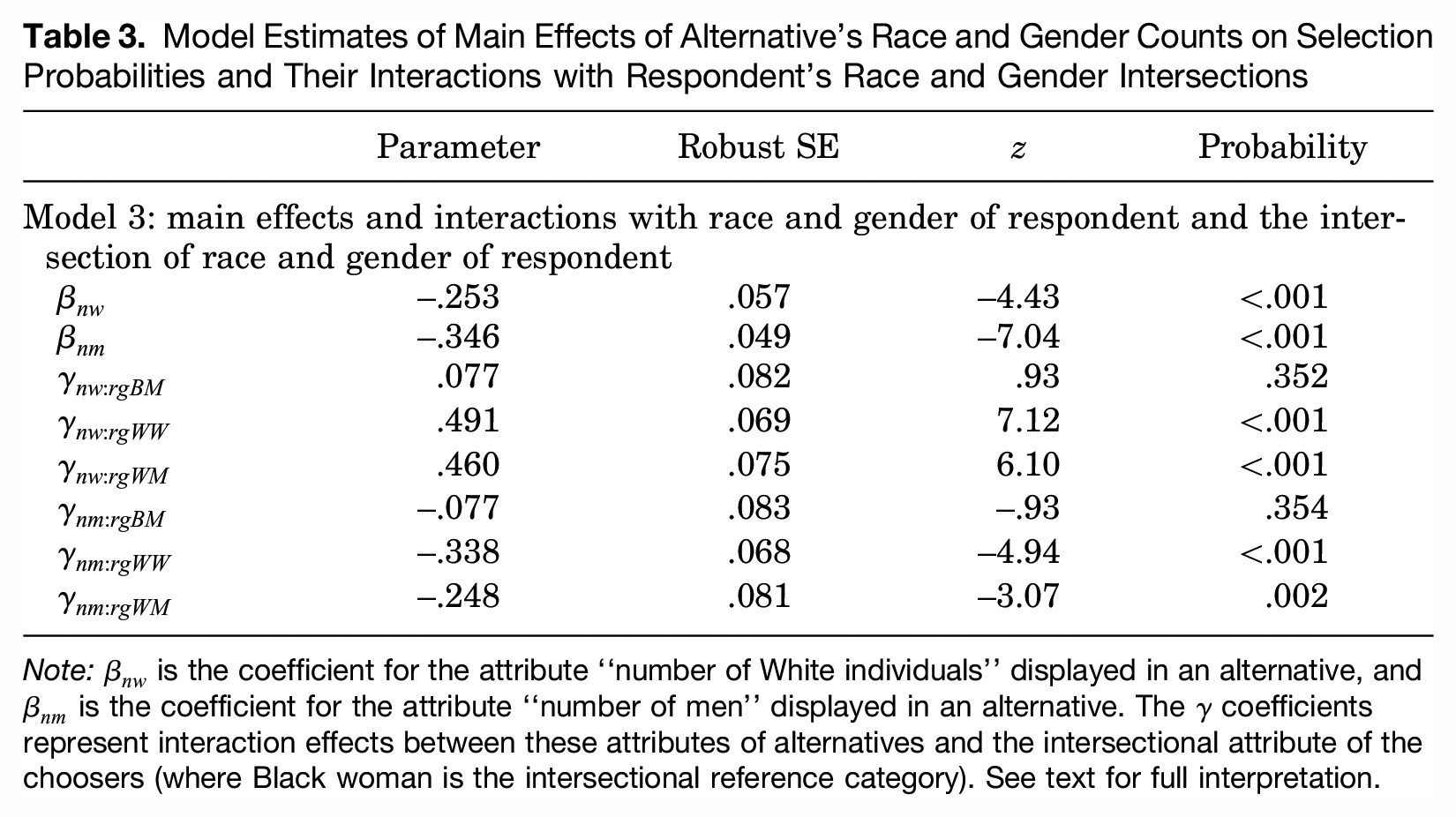
Table 3 explores possible effects of intersectionality between the identities of respondents, that is, effects that differ by the joint categories of racial identity and gender identity beyond those due to each identity alone. With respect to racial identity, Black men do not differ from Black women (the reference category) in the negative evaluation of White individuals as teammates, whereas both White women and White men do differ and in the direction of much more positive evaluation of White individuals as teammates. For these two intersectional categories, the
Model Estimates of Main Effects of Alternative's Race and Gender Counts on Selection Probabilities and Their Interactions with Respondent's Race and Gender Intersections
Note:
Discussion and Conclusion
Our research examines status effects on the selection of teammates from a pool of strangers. The following logic leads us to expect status effects: choosers are motivated to have their team do well (collective orientation); therefore, they will use status cues to infer who is likely to be more competent and who is likely to be less competent at the team task, and thus, they select the more competent as teammates. In accordance with status characteristics theory, when alternative candidates (strangers to the chooser) differ in the states they occupy of a presumed status characteristic, the characteristic is activated and expectations form based on standing on the characteristic. For collectively oriented persons, these expectations should shape the likelihood that a particular candidate is selected as a teammate: those for whom high expectations are held should be selected over those for whom low expectations are held, and this difference should hold regardless of the chooser's own standing on the activated status characteristic.
However, team formation literature presents a complication to such a straightforward application of status characteristics theory. Unlike task success when a group is assembled—a situation where ability to contribute to positive task outcomes is the only critical factor to infer about a teammate—the success of a team depends on two critical factors: the direct task competence of team members and their ability to work smoothly and harmoniously together. The team formation literature suggests the second factor drives the use of homophily as a criterion for teammate selection because basic similarity along important dimensions of social differentiation facilitates communication, understanding, and interaction. Using homophily along diffuse status dimensions to make selections can lead to entirely different choice patterns than using inferred competence from those same dimensions. This is a key difference from work that seeks to integrate status characteristics and self-categorization/social identity theory (Barnum, McLeer, and Markovsky 2016; Kalkhoff and Barnum 2000), which appears to struggle with the same problem, albeit focused on acceptance of influence rather than choice of partner. This research considers the joint effects of differentiation along status and differentiation along ingroup/outgroup on acceptance of influence. However, the ingroup/outgroup distinction is based on a dimension that does not have status value but, rather, corresponds to the experimentally induced “trivial group membership.” In our problem, the diffuse status dimension is simultaneously a highly salient basis for ingroup/outgroup differentiation and the consequent triggering of social-identity-based decision-making.
Our findings clearly show that the task of selecting a teammate to work with on a task to which one is oriented to group success is not driven purely by competence, as inferred from differences on activated status characteristics of race and gender. First, the presumed advantage of White candidates holds only for White respondents. For Black respondents, it is Black candidates that are more likely to be selected. Furthermore, the advantage that White respondents give White candidates is about equal to the advantage that Black respondents give Black candidates. If team formation is viewed as a “task,” race does not operate as a status characteristic but as an identity characteristic where ingroup preferences drive judgment and decision-making practices (D’Souza and Colarelli 2010). Second, the presumed advantage of candidates who are men over those who are women holds for no one whether man or woman. In fact, in all demographic groups, respondents significantly choose women as partners over men.
These results are so different from the standard findings from expectation states experiments because the team formation “task” differs in an important way from the usual task facing respondents in such experiments, where the objective is to contribute to group success via problem-solving interaction with others predetermined for the respondent. In the usual case, collectively oriented respondents must make the best guess as to who will make valuable contributions, and so general competence becomes the central and perhaps the only attribute of relevance to the problem. However, although competence is not unimportant to the selection of a teammate, there is the additional dimension of the selection of someone with whom the respondent feels they can work well. This dimension of compatibility as a basis for selection provides the grounds for selecting ingroup members over outgroup members, presuming that interaction with ingroup members will be smoother and more effective. This argument accounts for the effect of race that we detect on the selection of teammates but not for the effect of gender. The effect of gender is consistent with the idea that on the dimension of compatibility, women are seen as occupying a higher state than men regardless of the gender identity of the respondent. In effect, “competence” on the compatibility dimension lies with women rather than men, and hence, they are preferred as partners.
That race operates as an identity characteristic when deciding who to include and who to exclude from a task group evokes a deep literature on Black-White relations in American society. With respect to White people as holding the advantaged position on race, Bonilla-Silva, Goar, and Embrick (2006) develop a social psychology of “White habitus” to explain White exclusivity in interaction as a form of circumventing negative social-psychological experiences. White habitus involves a cultural and social-psychological conditioning in which a society's racial social structure is reproduced and legitimated. It normalizes and legitimates social closure or exclusion. The social psychology of White habitus largely pertains to the racial socialization of White people that fosters a particular White identity that is situated in whiteness. Whiteness contributes to the social identity of White people because it serves to define individuals, determine behavior, and evaluate status. The practices of racial preferential treatment become repetitive and routine and, eventually, axiomatic.
White racial ideology is developed out of the habitual practices and the geographical segregation of White people from people of color, especially Black people (Bonilla-Silva 2010). According to Bonilla-Silva et al. (2006:248), “when everyday whites reproduce a racist habitus, they help legitimate social closure that discriminates by race.” In other words, White habitus provides the explanation of race-specific status homophily, which enables and justifies the selection by White respondents of other White candidates as teammates. Consequently, White habitus shapes the positive assessment of practices, such as social exclusion/closure, as normal and unproblematic.
The selection patterns of Black respondents demonstrate “reverse-status homophily.” The racial homophily of Black participants’ selection patterns may reflect “racial ‘status’ contestation” and a psychological protection against or avoidance of “stereotype threat.” Selecting teammates who are also Black individuals creates a setting for group interaction in which stereotype threat can be avoided. A mixed-race task group in which race is an activated status characteristic with dominant group's ordering of White people as advantaged creates a setting that has the potential for stereotype threat, defined by Steele (1997: 614) as “a social-psychological threat that arises when one is in a situation or doing something for which a negative stereotype about one's group applies.” Although Steele's work with Aronson (1995) examined academic settings, it applies to collectively oriented task groups where negative stereotypes about the performance of Black group members are activated. When given the chance to select teammates, the activation of such stereotypes can be avoided by Black choosers if one's teammates are also Black individuals.
Women are also aware of the salient stereotypes associated with their diffuse status standing in social settings. Studies suggest that women are mindful of the sexist stereotypes impacting their work and leadership opportunities (Kark and Eagly 2010; Rudman et al. 2012). Consequently, women in leadership positions are susceptible to stereotype threats that may impact their performances in a mixed-gender setting (Crocker, Major, and Steele 1998). Thus, one might expect women to prefer other women as teammates to avoid situations that are conducive to stereotype gender threat. The reason that men would prefer women rather than other men as teammates could also be attributable to gender role stereotypes. As Ridgeway (2011) notes, gender inequality is a distinct form of inequality due to the everyday lived experience that women encounter by sheer virtue of sharing the same living quarters with men, who have been socially deemed as superior, especially in patriarchal societies. In patriarchal societies, women are expected to be accommodating and deferential to men. In the context of a group working on a collective task, men could therefore expect on the basis of gender stereotypes that women compared to other men would be easier to work with and interact with and so be preferred as partners. Thus, when it comes to selection of a teammate, both men and women prefer women but for quite different reasons. 12 Disentangling these interpretations from the one that attributes reverse status value to gender with respect to inferring ability to be a good teammate is a matter for future research.
We believe our project makes three contributions to the literature on inequality. First, although most group process studies focus on the interactional patterns of structural inequality within task and collectively oriented groups, our research addresses the question of possible structural inequality in the formation of such groups or teams. Much research takes the group as a given and examines status effects on behavior in group interaction, whereas we examine status effects on the formation process itself related to how persons select partners as teammates. Second, the research advances the literature with an innovative online research design using digital avatars as symbolic representations of race and gender differences to represent alternative partners. The significance of this design allows for unobtrusive data collection, recruitment of participants at the national level, and the observation of social process occurring in the digital domain. We anticipate this approach becoming more widely used given that people's lives are increasingly governed by digital identities. Lastly, this research advances the group processes literature by bringing expectation states research into direct dialogue with critical scholarship on race and gender. By comparing the impacts of race, gender, and their interaction on partner choice patterns, this work reveals how race and its intersection with gender have an impact on working together, specifically, the people chosen to be teammates.
Finally, our findings appear inconsistent with much of status characteristics theory, perhaps because the team formation process is outside the scope of the theory, at least, outside the theory's scope as the process was implemented in our design. A design that more strongly emphasized that a team would be more successful the more competent were its members at the assigned task may place overriding importance on the selection of competent partners and thus place a premium on assessing that competence using diffuse status characteristic information in the expected way. In this connection, we have the results of Kelley et al. (2017) with age as a diffuse status characteristic, which indicate that choosing a teammate can be shaped by status information under the right circumstances. But if those circumstances are so narrow that team formation “in the wild” often fails to meet them, then we may expect to observe outcomes more in line with our results: assessment of compatibility driving partner selection. In any event, it is clear the process or task of team formation merits additional theoretical and empirical work to better understand the conditions under which status generalization processes arise and influence partner choice.
Supplemental Material
sj-docx-1-spq-10.1177_01902725231210252 – Supplemental material for Working Together: Status Effects of Racial and Gender Identity on Teammate Selection
Supplemental material, sj-docx-1-spq-10.1177_01902725231210252 for Working Together: Status Effects of Racial and Gender Identity on Teammate Selection by Jasm�n Bailey and John Skvoretz in Social Psychology Quarterly
Supplemental Material
sj-docx-2-spq-10.1177_01902725231210252 – Supplemental material for Working Together: Status Effects of Racial and Gender Identity on Teammate Selection
Supplemental material, sj-docx-2-spq-10.1177_01902725231210252 for Working Together: Status Effects of Racial and Gender Identity on Teammate Selection by Jasm�n Bailey and John Skvoretz in Social Psychology Quarterly
Footnotes
Acknowledgements
The corresponding author acknowledges with appreciation the support of Elizabeth Hordge-Freeman, Jeff Lucas, Rashawn Ray, the University of Maryland President's Postdoctoral Fellowship Program, the ASA Minority Fellowship Program, and the McKnight Fellowship Program.
Supplemental Material
Supplemental material for this article is available online.
1
Other notable studies include Unnever and Hembroff (1988), Cohen (1982), and  .
.
2
Equal relevance could be broken if one diffuse characteristic, say A, is explicitly linked to the task and the other, B, is not (Whitmeyer 2003); if possession of the states on one is imputed rather than assigned (Fişek, Berger, and Norman 1995); or if possession of the states on one is through a “weak status cue gestalt” rather than a “strong cue gestalt,” the latter being the typical case ().
3
Other notable studies on outside a group context are Foschi and Valenzuela (2008); Correll, Benard, and Paik (2007); and Steffensmeier, Painter-Davis, and Ulmer (2017).
4
Other mechanisms (familiarity or prior acquaintance, closure or knowledge of ties to common third parties, physical proximity, and affect or liking) unlike these two presume prior acquaintance.
5
Results remain the same if the exclusion criterion is relaxed so respondents are excluded only if they respond inappropriately to the second item; see documentation in Supplemental Material online.
6
7
All images presented in the survey were purchased as “royalty free” stock photos and licensed for reproduction via 123RF.com.
8
Specifically, the instructions are “The first phase of your participation is the ‘Contrast Sensitivity Test.’ You will be shown 20 slides and asked to judge whether each image has more white space or black space. For each slide you will have five seconds to view the image. Your final score will consist of the number of correct responses. The number of correct responses will determine the number of chances you will have in the prize drawing for those who complete the survey. You get one chance if you score below 8, two chances if you score between 8 and 12, and three chances if you score 13 or above. Please press continue when you are ready to view the first slide.” Thus, subjects were unconstrained in any assumption they may have made about the linkage of contrast sensitivity as an ability to other skills and abilities.
9
Results remain essentially the same if we use only data from the first two choice situations in which one person is selected, as recommended by a reviewer; see Supplemental Material online.
10
The coefficient values in Model 1 are significantly different from each other: equating the effects of nw and nm in Model 1 produces a reduced model that fits significantly less well (p < .001) by a likelihood ratio chi-square test.
11
We note two points. First, additional analyses in the senior author's dissertation and comprising material for another manuscript in preparation show these effects to be robust to controls for personal attributes of avatars like skin color or facial expression (the Supplemental Material online includes all the avatar images used to represent potential partners). Second, the Supplemental Material online has the results of a third sensitivity check suggested by reviewers: estimating the models using utilities in STATA that capture the implicit panel design of the data collection instrument. This additional analysis simplifies interpretation because its results indicate no difference among the intersectional respondent groups in their (negative) evaluation of an alternative's number of men.
12
That gender should have a different pattern of effects than race would not surprise :207) who observe that “racial stereotypes tend to be primarily descriptive. . . . In contrast, gender stereotypes contain a strong prescriptive element as well as a descriptive element. . . . Differences in the degree of segregation and the resulting differences in stereotypes affect the level of complexity involved in stereotype processing. . . . Because males and females are less segregated throughout their lives and tend to have more experience with one another than do Whites and Blacks, the stereotypes developed about women tend to be more complex. . . compared to stereotypes about Blacks.”
Bios
References
Supplementary Material
Please find the following supplemental material available below.
For Open Access articles published under a Creative Commons License, all supplemental material carries the same license as the article it is associated with.
For non-Open Access articles published, all supplemental material carries a non-exclusive license, and permission requests for re-use of supplemental material or any part of supplemental material shall be sent directly to the copyright owner as specified in the copyright notice associated with the article.
