







Abstract
The present work takes a multimethod approach to examine young U.S. adults’ engagement across political, religious, and civic activities. Of key interest was how their motivations to engage (internal vs. external), emotions when thinking about the cause (other-focused vs. self-focused), and political ideology related to their past and future engagement. We collected 1,000 survey responses and 30 interview transcripts of young adults ages 18 to 29 to identify patterns in these outcomes. We argue that although motivation of varying sources can drive engagement, the source of young people's motivation (internal vs. external) has critical implications for whether social engagement is short-lived or potentially persists into the future. In addition, the motivational and emotional reactions that the participants had to their engagement varied as a function of their political ideology. Implications for understanding the factors that may strengthen engagement and a deeper consideration of the nature of external motivation are discussed.
The murder of George Floyd, like the killings of so many before him, intensified attention to the Black Lives Matter movement and fueled calls for restorative justice and the dismantling of white supremacy. In the midst of this heightened activism, questions quickly arose about the motivations underlying people's engagement—whether their actions reflected genuine commitment to racial equality or were aimed primarily at enhancing their personal, political, or corporate image. The term “performative activism” emerged to describe action viewed as both likely minimal in impact and focused primarily on improving one's public image. Such activism was contrasted to engagement driven by deeply held personal beliefs and moral dedication to a cause. This distinction between forms of activism, popularized on social media, closely mirrors classic theories of motivation in psychology, which emphasize the degree to which motivation is internalized (Deci and Ryan 1985, 2000; Kelman 1958). This work distinguishes between more internal motivation, reflecting moral conviction and dedication to action, and more external motivation, focused on seeking approval or avoiding punishment (Deci and Ryan 2000; Plant and Devine 1998; Ryan and Connell 1989; Ryan and Deci 2000).
In the present article, we take a multimethod approach to examine the engagement of young adults in the United States across political, religious, and civic activities and the motivations, emotions, and ideologies that influence their involvement in social causes. We combine survey data and interview data to explore patterns across these outcomes. We argue that although different sources of motivation can drive engagement, whether motivation is internal or external has critical implications for whether young people's involvement is short-lived or potentially persists into the future. In addition, we identify the emotional and ideological factors that are associated with these distinct motivational sources and their relationship to engagement.
This work makes three contributions. First, it shows that specific emotions, such as empathy, anger, pride, and guilt, map onto different sources of motivation for engagement, clarifying how emotional experiences can sustain or diminish participation. Second, it demonstrates that political ideology is not merely about values but also shapes the motivational pathways through which emotions are internalized, suggesting that liberals, moderates, and conservatives engage for different reasons. Finally, by combining survey and interview data, we show that internal motivation can stem from both concern for others and experiences of harm that affect oneself or one's ingroup. This challenges the conventional assumption that moral conviction is always outwardly directed and highlights how self- and group-relevant injustice can also ground sustained engagement. Our multimethod approach also raises critical questions about whether and how external motivation may function differently depending on whether one is seeking approval from peers or from one's God or religious community.
Motivation to act for a social cause can come from personal commitment to an issue (i.e., internal motivation) or the desire for social approval (i.e., external motivation; Kunstman et al. 2013; LaCosse and Plant 2020; Plant and Devine 1998, 2009). We define social causes as problems or issues that negatively affect large groups of people in a society and that are widely seen as requiring redress. Research has long shown that moral convictions are strong motivators of political and nonpolitical action across multiple domains (Alberici and Milesi 2016; Sabucedo et al. 2018; Skitka and Morgan 2014; Skitka and Wisneski 2011; van Zomeren, Postmes, and Spears 2012). These moral convictions are strongly related to relevant attitudes and action (Chamberlin and Plant 2023; Does, Derks, and Ellemers 2011; Janoff-Bulman, Sheikh, and Baldacci 2008; LaCosse and Plant 2020; Skitka, Hanson, and Wisneski 2017; Zaal et al. 2017). At the same time, the desire for social approval and interpersonal belonging can be potent motivators of action (Baumeister and Leary 1995). Thus, the desire for belonging and external validation likely drives some people to act for causes that elicit social approval (Becker, Tausch, and Wagner 2011; Tropp and Brown 2004). And yet, behavior motivated by external sources may diminish as public interest in a cause fades.
Decades of motivation research show that both internal and external motivations are likely to result in goal-related action, at least in the short term (Ryan and Deci 2000). Even when people act to gain social approval, they are still engaging in meaningful behavior. The two forms of motivation differ, however, in their implications for long-term engagement: internal motivation, rooted in moral conviction, is more likely to result in persistent effort. Self-determination theory (SDT; Deci and Ryan 2000; Ryan and Deci 2000) provides valuable insight here, positing that motivation ranges along a continuum from extrinsic (driven by external punishment) to intrinsic (driven by personal enjoyment or interest), with more internalized motivation supporting more durable action (Ryan and Connell 1989). Acting on personally important values and morals reflects an identified motivation, a relatively more internalized form, whereas acting to gain others’ approval reflects introjected motivation, a more external form. For simplicity and consistency with prior work on prejudice reduction, we refer to these as “internal” (personal commitment) and “external” (social approval) motivation.
Central to SDT, research shows that the more internalized or self-determined an individual's motivation is, the more persistent and successful their engagement tends to be (Ryan and Deci 2000). This pattern appears across domains: studies of collective action, political participation, and religious involvement all find that internalized motivation predicts higher levels of engagement (Green-Demers, Pelletier, and Ménard 1997; Hardy et al. 2015; Koestner et al. 1996; Rad 2023; Weinstein and Ryan 2010). For instance, relative to environmental action, individuals with more internalized motivation are especially likely to engage in protective behaviors when those behaviors are difficult (Green-Demers et al. 1997).
By contrast, findings on external motivation are mixed. Some studies suggest that reliance on external validation undermines sustained action (Koestner et al. 1996; Yip et al. 2023), whereas others indicate it can reinforce engagement, particularly when paired with internal motivation (Rad 2023; Yip et al. 2024). In political contexts, internal motivation appears to support action indirectly by strengthening identification with one's group and fostering social connection (Pistoni et al. 2023). Taken together, this body of work highlights the consistent benefits of internal motivation for sustained engagement while underscoring the more ambiguous role of external motivation.
Emotional Drivers Of Motivation
In addition to the implications of motivation, we were interested in the emotions that give rise to internal or external motivation for social engagement. To this end, we drew on emotion researchers’ distinction between self-focused (e.g., pride, guilt) and other-focused (e.g., empathy, anger) emotions (Shaver et al. 1987). We argue that the emotion(s) people experience when thinking about a cause help determine whether they act from internal or external motivation. Because internal motivation reflects personal, moral convictions, we predicted that it would be propelled by other-focused emotions, such as empathy for those who suffer and anger at those who perpetuate harm. If people care morally about a cause, then perceiving that the self or others are hurting or feeling anger toward perpetrators of injustice (e.g., selfish companies polluting the environment) should create a motivation to act to resolve the injustice.
Consistent with this theorizing, feelings of empathy have long been linked with helping others to relieve their pain and distress (Batson 1990; Eisenberg, Eggum, and Di Giunta 2010; Mikulincer, Shaver, and Batson 2010). Similarly, other-focused anger can lead people to fight against the wrongs done by others (Becker et al. 2011; van Kleef and Lelieveld 2022).
In contrast, external motivation reflects the desire to gain social approval and is tied to how others view the self. In this case, we anticipated that self-focused emotions, such as pride and guilt, would foster motivation and guide behavior. When action for a cause is seen as likely to produce positive self-regard, it should promote engagement. Indeed, positive self-directed emotions are heightened following collective action (Becker et al. 2011). Ryan and Deci (2000) posited that external motivation promotes behavior intended to augment one's ego. Research on pride found, furthermore, that feeling good about oneself for positive achievements (i.e., authentic pride) leads to social engagement intended to enhance one's self-esteem (Tracy and Robins 2004). Van Zomeren (2021) also argued that when pride affirms one's sense of belonging, it can promote action in support of group membership (e.g., political membership, religious affiliation). Similarly, Tropp and Brown (2004) demonstrated that group connection can foster collective action through personal enhancement (e.g., increasing self-esteem and feeling important). Thus, feelings of pride linked to a cause are likely to fuel external motivation, reflecting social and ego-based concerns.
Political Ideology And Motivation To Engage
In considering who is likely to experience more other-focused or self-focused emotions and thus be more motivated for internal versus external reasons, we considered previous work indicating that political orientation may be important. For example, liberals tend to prioritize moral principles that focus on concern for those experiencing harm or injustice (Kivikangas et al. 2021; Stewart and Morris, 2021). In addition, liberals experience higher levels of compassion and reactive anger than conservatives, on average (Hasson et al. 2018; Kivikangas et al. 2021; Schubach and Thielmann 2024; Stewart and Morris 2021; Zebarjadi et al. 2023).
In contrast, conservatives are particularly sensitive to social acceptance and fear ostracism (Goldberg et al. 2020; Jost et al. 2003). Conservatives also tend to be more likely to conform to social norms and engage when in public, and social norms encourage such behavior out of the desire to seek social approval (Jost, Nosek, and Gosling 2008; Kaikati et al. 2017; Kivikangas et al. 2021; Stewart & Morris, 2021). As a result, we anticipate that liberals are more likely to experience other-focused positive and negative emotions (empathy, anger at wrongdoers), whereas conservatives are more likely to experience positive self-focused emotions (e.g., pride). Liberals, furthermore, are likely to be more internally motivated in their engagement, and conservatives are more likely to be externally motivated in their engagement.
The Current Work
The present article examines the degree to which internal and external motivation drive young adults’ social engagement in political, religious, or civic causes for both past and future intended behavior. Prior work consistently finds a link between more internalized motivation and persistent behavior, but the implications of external motivation are less clear (Koestner et al. 1996; Pistoni et al. 2023; Rad 2023; Yip et al. 2023, 2024). Although we anticipate that both types of motivation will result in engagement in one's primary cause (i.e., the cause engaged in most frequently) in the past, we predicted that only internal motivation would influence intended future engagement.
An additional primary goal of the present work was to explore the emotions associated with internal and external motivation. We propose that other-focused emotions foster internal, personal motivation to engage, whereas self-focused emotions encourage more external, social motivation. Finally, we anticipated that our participants’ political ideology would be associated with their emotional experience and thus, their source of motivation to act. Specifically, we predicted that liberals would experience more other-focused emotions when thinking about their primary cause and an internal motivation to engage. In contrast, conservatives were expected to experience more self-focused emotions about their cause and external motivation to engage.
Methods
All survey and interview procedures were approved by the university's institutional review board.
Participants
Survey sample
One thousand U.S. residents ages 18 to 29 years who matched the census template for gender, race, and ethnicity were recruited via Connect, a CloudResearch platform designed to provide high-quality data from online participants who receive monetary compensation. Participants completed a 35- to 45-minute survey during summer 2024 and received $8.50 in compensation. After providing informed consent, participants completed the survey. Those who failed any of the three attention check items (n = 66) were excluded. The final sample included 934 participants (age: M = 25.34, SD = 7.74). See Table 1 for participant demographics. 1
Survey Participant Demographics (N = 934)
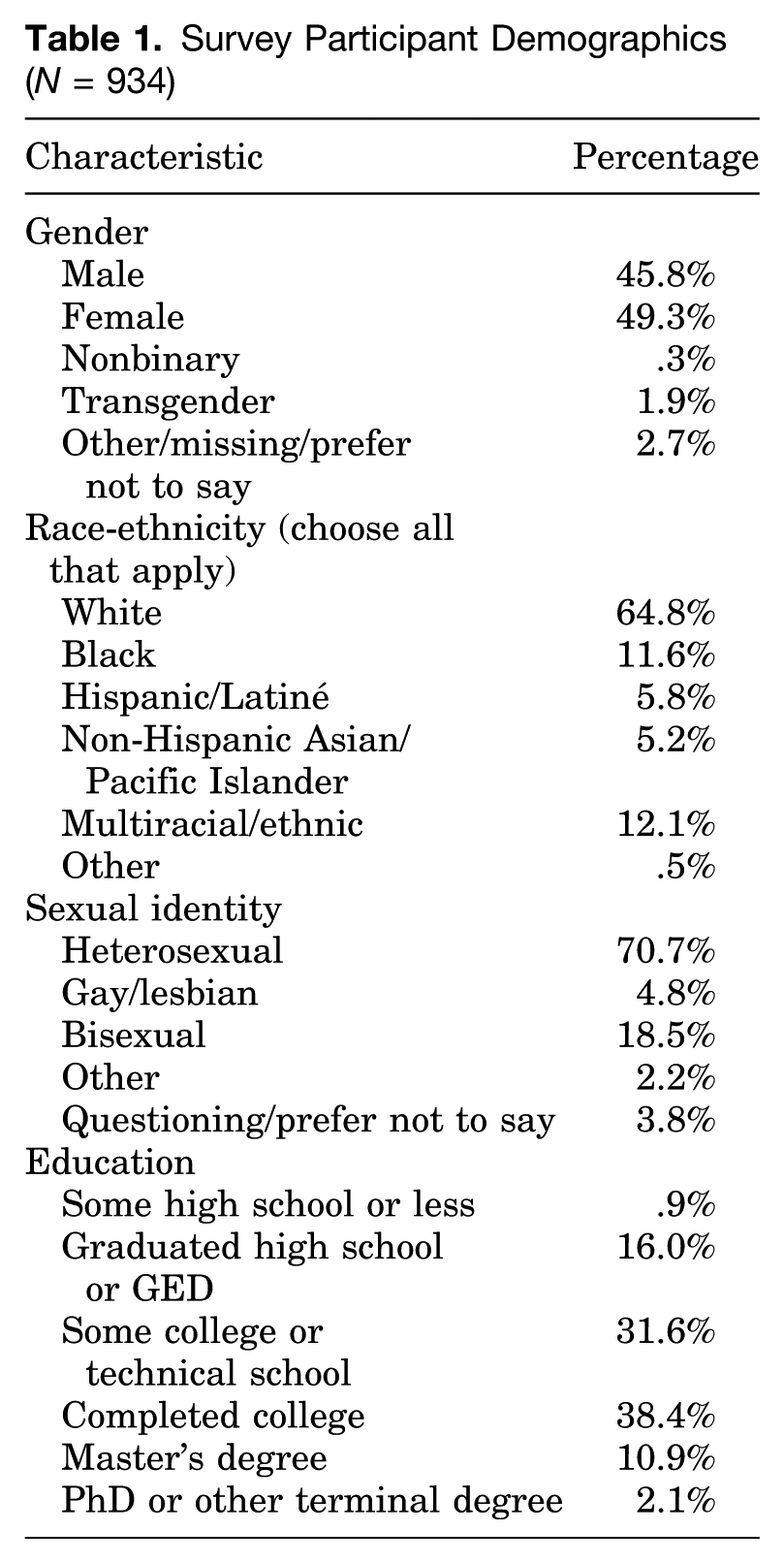
We focused on the social engagement of young adults because both the institutional and generational landscapes are shifting rapidly. This cohort is coming of age amid declining trust in traditional organizations (Putnam 2000; Sobieraj 2005), the rise of digital forms of engagement (Bennett and Segerberg 2012; Earl, Scovill, and Ramo 2022), and changing patterns of religious affiliation (Pew Research Center 2022; Smith and Snell 2009). Their choices about whether (and how) to participate will shape not only their own trajectories but also the future of engagement more broadly (Campbell, Green, and Layman 2021).
Interview sample
At the end of the survey, participants were asked if they would be willing to participate in a follow-up interview. To capture political diversity, we selected ten conservative, ten moderate, and ten liberal participants. Respondents were selected to ensure variation both across and within ideological categories (e.g., moderate vs. very liberal) and demographic diversity. Interviews focused on participants’ motivations and emotions involved in their political, religious, and civic participation. 2 Interviews ranged from 35 minutes to 55 minutes, and participants received $12 for their participation.
Survey Procedure
Participants who consented to participate in the survey 3 completed a series of questions about their past and intended future involvement in political, religious, and civic activities, both online and offline. They were asked to identify the cause or issue most important to them, describe their motivation for engaging in that cause, and report how thinking about the cause made them feel. Finally, participants provided demographic information, including a question about their political orientation, and were thanked and compensated for their time.
Measures
Past engagement
Participants reported their political, religious, and civic engagement during the past year, both online and offline. Political activities were defined as activities aimed at influencing government actions, policy decisions, political opinions, or election outcomes. Religious activities encompassed the broad range of practices, ceremonies, and engagements tied to faith or spirituality. Civic activities included community-oriented involvement aimed at improving social welfare without directly engaging in partisan politics or governmental affairs. We used items from the survey tool created by Theocharis et al. (2023) to assess political engagement. Religious and some of the civic participation items were adapted from the 2020 American National Election Survey and the World Values Survey (2017–2022). Additional survey items were added for completeness. Respondents indicated engagement in 26 different activities online and/or offline in the past 12 months on a scale from one (never) to four (often). Although we anticipated that online and offline activities might emerge as distinct constructs (Bowyer and Kahne 2020; Caren, Ghoshal, and Ribas 2011; Pew Research Center 2023; Vissers et al. 2012), combining them maximized the reliability of the measures. Mean engagement scores were computed separately for political (α = .93), religious (α = .96), and civic (α = .94).
Intended future engagement
Participants answered the same questions but reworded in the future tense to indicate likelihood of engagement in the next 12 months (one = never, four = often). The mean level of engagement offline and online were computed separately for political (α = .95), religious (α = .97), and civic (α = .95) activities. This parallel design allowed us to compare past and anticipated future engagement.
Primary cause
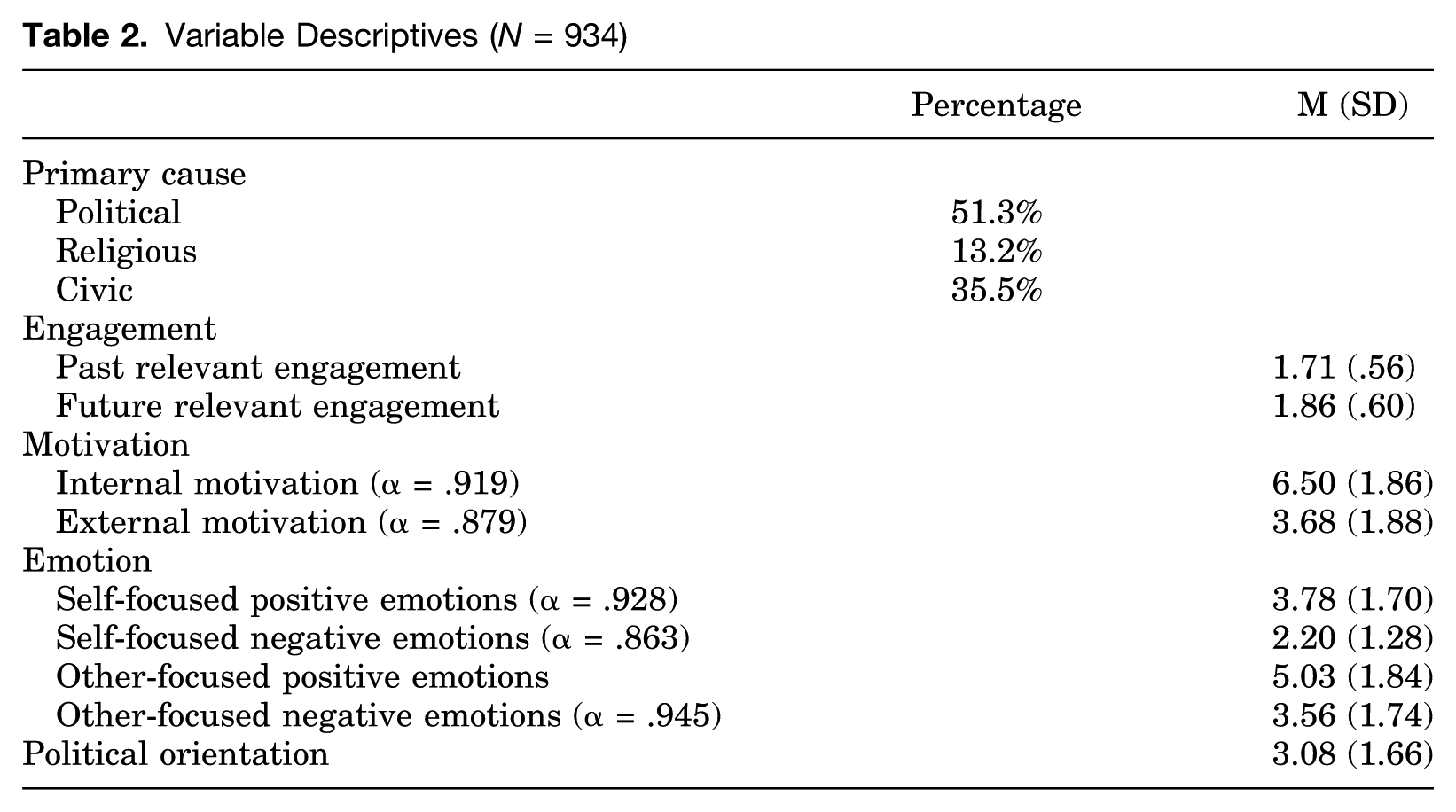
Participants identified the cause or issue that they engaged in most frequently, which we refer to as their primary cause. Although some responses were broad (e.g., religion), most referred to prosocial causes or organizations (e.g., Black Lives Matter, reproductive rights, pro-life). Participants categorized each cause/issue as political, religious, or civic (see Table 2). We used their categorization of the cause/issue and their reported engagement in that category as the reference point for their relevant past behavior and their relevant future behavior. 4 For example, if a participant listed a civic cause as their most frequent cause, their average civic engagement scores were used as a reference point for past and intended future engagement. This approach ensured consistency between participants’ stated primary cause and the domain of engagement used in analyses.
Variable Descriptives (N = 934)
Motivation to act
After noting their primary cause, participants rated 12 motivation items on a scale from one (strongly disagree) to nine (strongly agree). Six items reflected internal/personal motivation (e.g., “I actively promote this cause/issue because it is personally important to me”), and six reflected external/social motivation (e.g., “I actively work on this cause/issue in order to gain approval from others”). Items were adapted from Plant and Devine's (1998) internal/external motivation to respond without prejudice scales and LaCosse et al.’s (2023) measure of anti-racism, reframed to assess motivation for proactive social engagement.
Because this was the first use of these items in this context, we conducted an exploratory factor analysis with an oblimin rotation. This allowed us to examine the structure of the responses, allowing for the possibility that the factors may correlate with each other. Examination of the scree plot indicated that there were two strong factors. The six internal motivation items loaded together on the first factor, which accounted for 41 percent of the variance in responses (“I actively promote this cause/issue because it is personally important to me”). The six external motivation items loaded onto the second factor and accounted for 28 percent of the variance in responses (“I actively work on this cause/issue in order to gain approval from others”). All items loaded strongly (|.65|) on their intended factor and weakly (less than |.25|) on the other, supporting construct validity.
Emotional responses
Participants were asked to reflect on how they feel when thinking about their primary cause. They rated 36 emotions (e.g., guilty, empathetic, happy) on a scale from one (does not apply at all) to seven (applies very much). Because external motivation reflects a self-focus (e.g., “How does my behavior impact me?”), we focused on self-focused positive emotions (e.g., proud, satisfied with myself) and self-focused negative emotions (e.g., guilty, angry at myself). In contrast, internal motivation reflects a focus on others (e.g., “How does my behavior impact others?”), so we examined other-focused positive (e.g., empathetic) and negative (e.g., angry at others, frightened, threatened) emotions. Unfortunately, we only included one item that assessed empathy and compassion, which will be important to examine with multiple items in future work.
Political orientation
At the end of the survey, participants completed a series of demographic questions that included a political orientation question that asked them to indicate where they would put themselves on a 7-point scale from one (very liberal) to seven (very conservative) with four representing “middle of the road.” Responses were collapsed into three categories: liberal (1–3), moderate (4), and conservative (5–7).
Interviews and coding
The interview protocol mirrored the survey, inviting participants to elaborate on their engagement, motivations, and emotions. For example, we asked participants, “Are there any major inspirations for your engagement?,” and we used their survey responses as prompts for additional details. Interviews were recorded via Zoom, transcribed, and deleted in accordance with the approved institutional review board protocol. All respondents are identified with pseudonyms.
Two coders independently analyzed the transcripts for evidence of internal and external motivations. We defined internal motivations as those driven by an individual's genuine concern for or personal investment in a cause, whereas external motivations reflected a desire for social acceptance or approval. Emotion was coded in two stages: first identifying all instances where participants discussed their feelings and then classifying each expression as (1) positive or negative and (2) self- or other-focused. To ensure reliability, two additional researchers checked coding for consistency. Finally, responses were analyzed as a function of gender, race, and political ideology to assess patterns across participant groups.
Results
Quantitative Results
As a first step, we examined whether participants’ motivations to engage predicted their past and intended future behavior. We conducted multiple regression analyses on past engagement and intended future engagement (controlling for past engagement) with internal motivation, external motivation, and their interactions as predictors. For past engagement, both internal motivation, β = .24, t(932) = 7.044, p < .001, and external motivation, β = .33, t(932) = 10.551, p < .001, were significant predictors of greater engagement. As anticipated, however, only internal motivation was related to intended future engagement, β = .14, t(932) = 7.781, p < .001, after controlling for past engagement. Thus, internalized motivation demonstrated a more enduring influence on engagement reaching over time compared to external motivation. This pattern suggests that although both internal and external motivation can generate short-term activity, only internal motivation provides the foundation for sustained engagement.
Next, we examined the relationship between emotional experiences and motivation. We conducted two multiple regression analyses on the internal and external motivation scores with the four emotion indices as predictors. Results confirmed that external motivation was associated with positive self-focused emotions, β = .43, t(933) = 12.418, p < .001, and negative self-focused emotions, β = .23, t(932) = 6.866, p < .001. Neither of the other-focused emotion indices approached significance, ps > .2. As anticipated, internal motivation was associated with both other-focused positive emotions, β = .32, t(933) = 10.74, p < .001, and other-focused negative emotions, β = .32, t(933) = 9.110, p < .001. Interestingly, internal motivation was also associated with lower negative self-directed emotions, β = −.15, t(933) = −4.791, p < .001, and higher positive self-directed emotions, β = .29, t(933) = 8.512, p < .001. Thus, when thinking about their primary cause, internally motivated people felt less guilty but also felt more positively about themselves. Taken together, these results suggest that the emotional repertoires of internally versus externally motivated individuals differ in systematic ways, with internal motivation tied more closely to prosocial emotions and a positive self-view.
We then conducted between-subject analyses of variance on each of our emotion, motivation, and past engagement scales as a function of political orientation (liberal vs. moderate vs. conservative) with Tukey post hoc tests to examine differences between the political ideologies (see Table 3). Liberal participants reported higher levels of empathy, negative other-directed emotions, and internal motivation than moderates and conservatives. Conservatives also reported higher levels of internal motivation than moderates. Additionally, conservatives reported higher levels of positive self-directed emotions, external motivation, and greater past engagement than liberals or moderates. Liberals reported more past engagement than moderates as well. These findings suggest that ideology shapes not only the type of emotions people experience but also the sources of motivation that sustain their engagement, with liberals showing stronger other-focused emotional drivers and conservatives demonstrating more self-focused and approval-related motivations.
Engagement, Motivation, and Emotions as a Function of Political Ideology
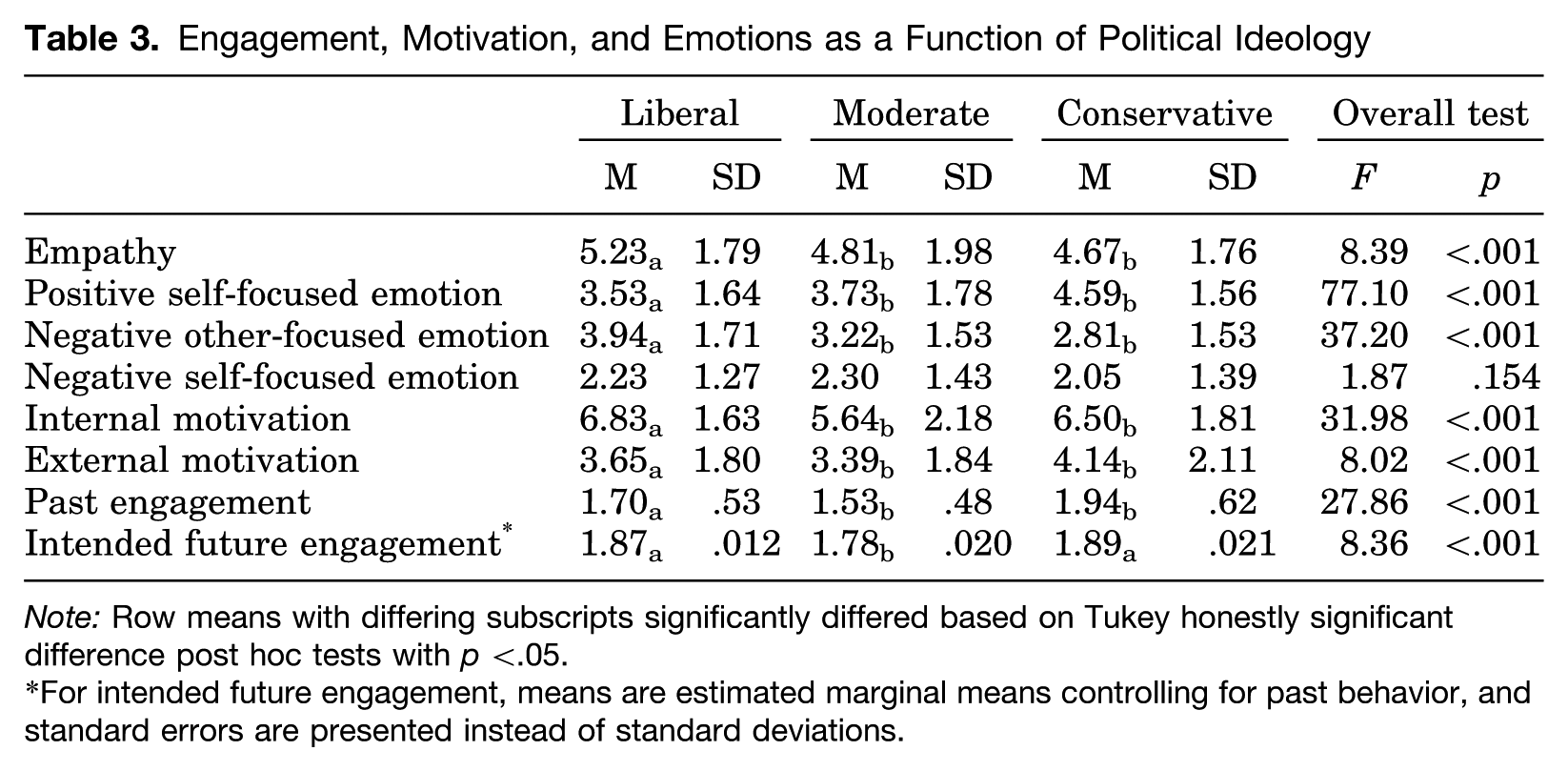
Note: Row means with differing subscripts significantly differed based on Tukey honestly significant difference post hoc tests with p <.05.
For intended future engagement, means are estimated marginal means controlling for past behavior, and standard errors are presented instead of standard deviations.
For future intended engagement, we conducted a regression analysis with past engagement as a covariate and two contrast codes (liberal vs. conservative and moderate vs. conservative) as predictors. The analysis revealed that conservatives anticipated being more engaged in the future than moderates, but liberals and conservatives did not differ in their anticipated future engagement.
Mediation analyses
Because liberals reported higher levels of internal motivation and more other-focused positive (empathy) and negative (anger at others) emotions than conservatives, we examined whether these emotional differences statistically explained liberals’ greater internal motivation. Using Hayes's PROCESS Model 4 with 5,000 bootstraps, we tested whether there were significant indirect effects from political ideology (dummy-coded, with conservative as the reference group 0 and liberal as 1) on internal motivation via empathy and other-directed negative emotions controlling for external motivation and the liberal versus moderate contrast (see Figure 1). The analyses revealed that both empathy (β = .22, 95% confidence interval [CI] = [.11, .34]) and other-directed negative emotions (β = .14, 95% CI = [.07, .22]) were significant mediators. Thus, liberals’ tendency to be more internally motivated was statistically accounted for by their tendency to experience more empathy and other-directed negative emotions when thinking about their cause compared to conservative participants. In other words, liberals appear more internally motivated in part because their engagement is fueled by emotions tied to concern for others and outrage at perceived injustice.
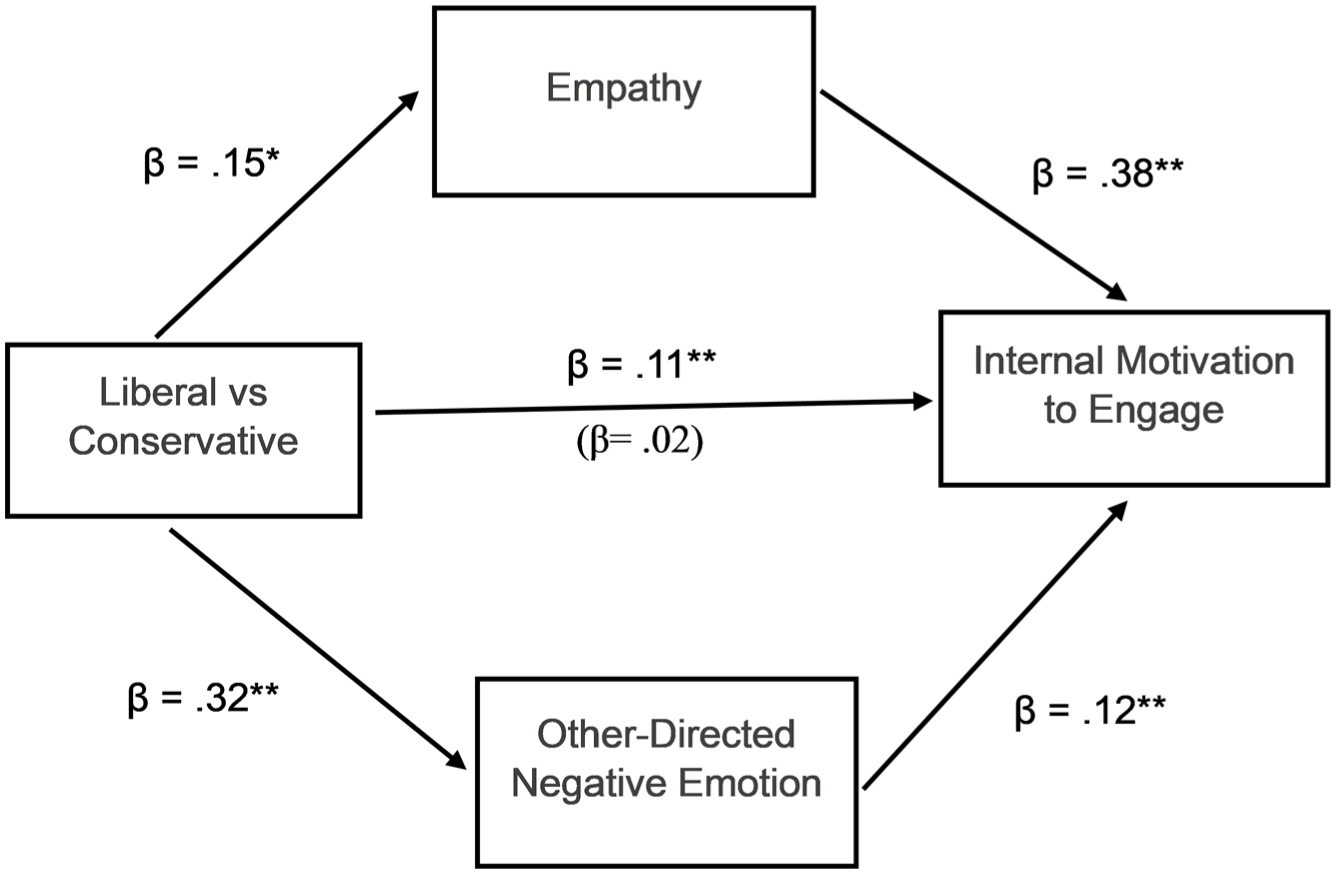
Mediation Analysis of Political Orientation on Internal Motivation.
We also examined whether conservatives’ higher external motivation compared to liberals could be explained by motitheir tendency to feel more positive self-directed emotions (e.g., pride). Using the same bootstrapping approach (now dummy-coded with liberals as the reference group 0) and controlling for internal motivation and the liberal versus moderate contrast, we found a significant indirect effect of self-directed positive emotions (β = .41, 95% CI = [.30, .54]; see Figure 2). These findings suggest that conservatives’ tendency to be more externally motivated was statistically accounted for by their stronger experience of pride when thinking about their cause, accentuating the role of self-focused positive emotions in shaping approval-seeking engagement.
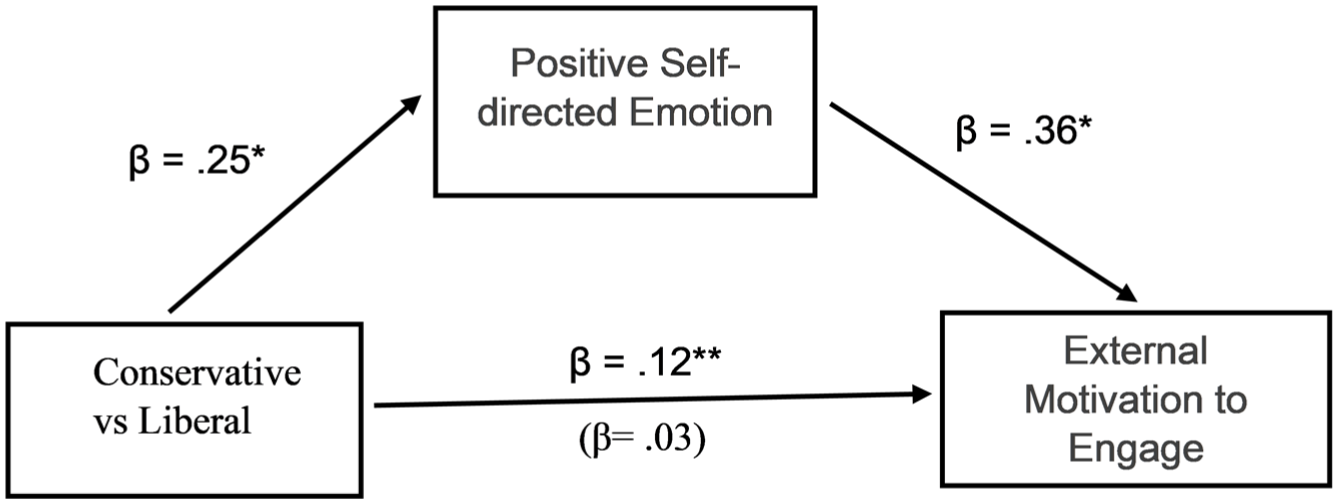
Mediation Analysis of Political Orientation on External Motivation.
Qualitative Results
As noted previously, we conducted interviews with a subset of our participants to help elucidate the relationship between motivation, emotion, ideology, and engagement. Because liberal and conservative participants were more engaged on average than moderates and differed systematically in their survey responses, we focus here on their interviews. These responses underscore the different roles of motivation and emotion across political ideologies and provide insight into the complexities of external motivation not captured by the quantitative analyses. Pseudonyms and demographics are provided in Table 4.
Interview Participants
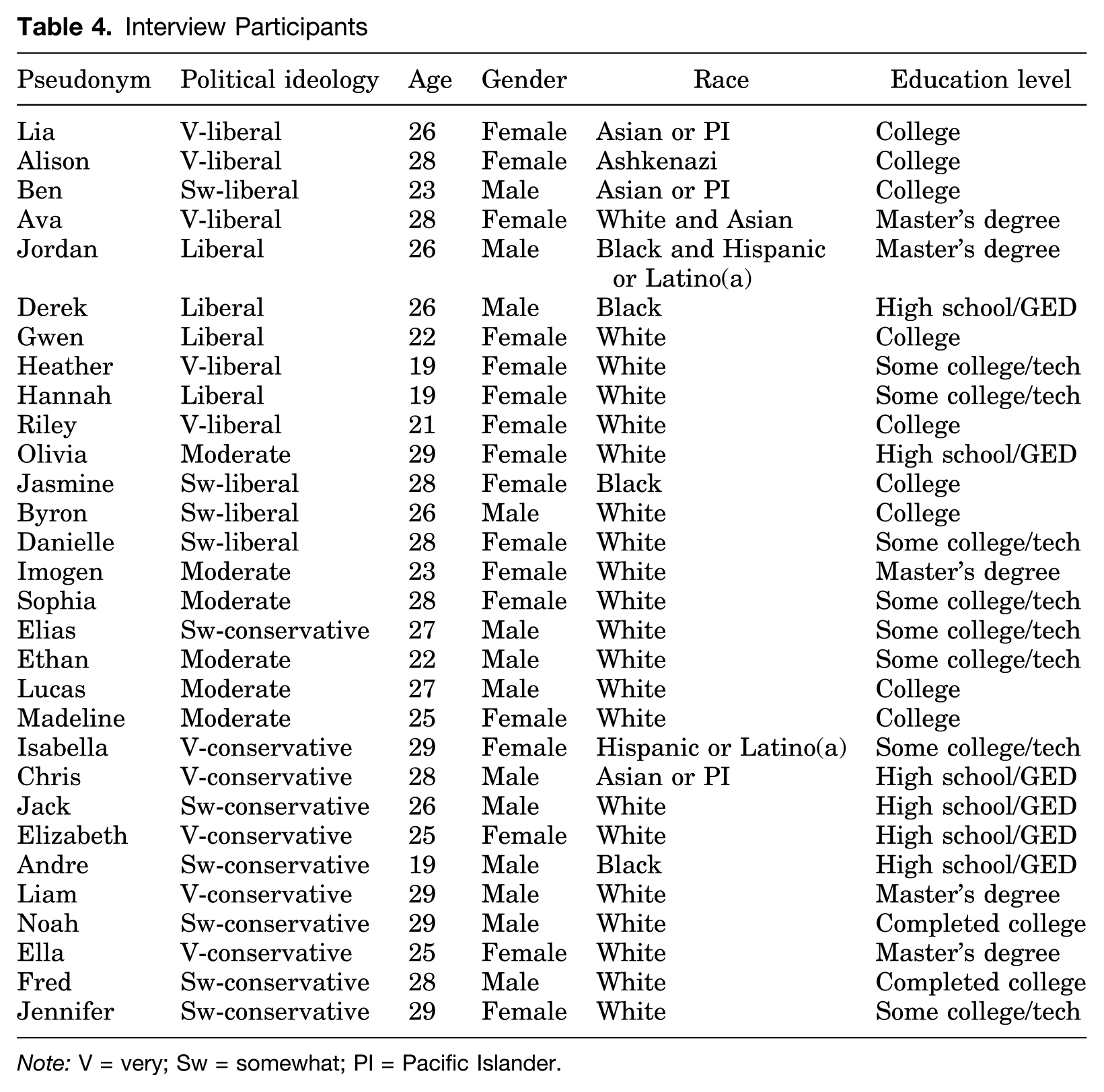
Note: V = very; Sw = somewhat; PI = Pacific Islander.
Liberal Interview Responses: Internally Motivated, Other-oriented Emotions
Consistent with the survey findings, liberal respondents emphasized internal motivation and often rejected social, reputational concerns when discussing their engagement. Ava, for example, viewed political discussions as an opportunity to work on reducing her “people pleasing” tendencies and in describing these efforts, made the importance of internal motivations clear: “I’m just trying to work on myself as not being a people pleaser and kind of being, um, not being able to, like, speak my mind without worrying what others say.” Her response highlights a desire to act from personal conviction rather than social approval.
Some liberals linked their engagement to deeply held moral convictions and critiques of social structures such as capitalism and colonialism, which they believed negatively impacted themselves and others. Ben recalled how learning about economic systems revealed their personal impact: “You know, when you're younger, you don't really think of, like, the impact these things have on you. But as you get older, you realize, okay, these are things that are directly affecting me and my life and my family.” Similarly, Riley talked about how the historical events she had learned about in school helped to establish her sense of right and wrong and shaped her behavior:
I feel like [pause, looks up thinking] you grow up learning about a lot of atrocities, like in school. And you kind of think, “Well, well, if I would have been there, I would have disagreed, I would have 100% disagreed. I would have stood up, I would have said something.” And then stuff like that actually happens in the world today.
These accounts illustrate how liberals framed engagement as a matter of personal values and moral responsibility, echoing the survey finding that their motivation was more internalized.
Many liberals also underscored the rewards of helping others. For example, while talking about volunteering at a local food drive, Jordan said, “I feel like that day was really, really rewarding, because it was like helping out, like a lot of families and a lot of kids, you know, being able to, like, hand out the food.”
When describing the emotions tied to their causes, liberals referred to both positive and negative other-focused emotions. Lia, for instance, described her state of “shock” learning about “historical atrocities” surrounding the Israel and Palestine conflict. Alison, a Jewish participant, directed her “fury” at anti-Semites:
It’s not just fury at unfairness or whatever. It's like fury at a dynamic where you're trying to see other people complexly and they refuse to see you complex. Like, it’s- it's like, [gestures to self] I come from a world where you have to- if you, if you're going to imagine the humanity of everyone, you have to imagine the humanity of [emphasis] everyone. Even if they're billionaires, even if they're oil executives, like you just have to exist in a world where everyone is a person. And that means doing that to people who don't think that you're a person. And it is such an infuriating position to be in.
Alison further distinguished between “anger that fuels you” and “anger that burns you,” noting the need for sustainable emotional energy to continue showing up at rallies. She explained:
There’s two types of anger. There's anger that fuels you, and there's anger that burns you. And you, you can't exist in anger that burns you. You will- you will just completely burn out. Um, so you need a little bit that'll like, [nods enthusiastically] get you to go back to the rally, even though you're like, “No one cares,” but you have to go.
Many liberals echoed this frustration with others’ apathy. Riley described feeling isolated when those around them failed to act:
You see everyone around you silent about it, and you're like, [makes a funny face with their eyes jotting around] Like, am I crazy? Or is this not literally just repeated history that we know is bad? We learned about it in like fourth grade, like we're we know it's wrong.
Taken together, these responses highlight the role of internal motivation, empathy, and morally charged anger in potentially sustaining liberal engagement—even when it means acting against the inaction of peers.
Conservative Interview Responses: External Motivation and Positive Emotion
In contrast to the liberal participants, conservatives were more likely to frame their engagement in terms of social (i.e., external) factors, frequently mentioning the people with whom they wanted to engage. For example, when describing their preferred forms of engagement (e.g., face-to-face), conservatives often qualified these preferences with caveats about avoiding polarizing topics or argumentative individuals. In this way, they sought interactions that were likely to generate approval and affirmation from others. This emphasis on selective social interaction underscores how external validation shaped their engagement choices.
For many conservatives, external motivation was rooted in religious community. Many of the conservative respondents tied their engagement to faith, which blurred the boundary between internal conviction and external reinforcement. For example, Isabella explained how her faith shaped her beliefs and her engagement. She noted that after attending church regularly, she reversed her previously held pro-choice stance and reexamined her relationship to her body. Isabella said, “I don't believe in the ‘my body, my choice’ [position]. I believe it’s- our bodies are unto God, like we're supposed to treat it the way he would want us.” She also discontinued off-label use of birth control to treat a medical condition, believing the practice to be “hypocritical” and “contradictory” to her support of the pro-life cause. Her shift in both belief and behavior (e.g., discontinuing off-label birth control) reflected a reorientation of engagement around her faith and alignment with her religious community.
Conservative respondents also pointed to the broader church community as a powerful influence. Andre described participating in a political campaign he did not personally support because of his church community's involvement. He explained, “In my own church, I was involved in a political campaign that wasn't, it didn't align with my own beliefs, but I did it because I was in support of my community's, um, mayor.” Similarly, Elizabeth likewise emphasized the centrality of church ties, noting that fear of losing her community deterred her from engaging in activities outside its teachings. Recalling an encounter with anti-church protestors, she described the absence of “the Spirit” as a feeling of “darkness” and “emptiness.” She noted:
I could actually feel like this emptiness, and it was just like dark. And I just felt like, really, was like, “What is the point of hope?” I'm like, “There’s no happiness.” And as soon as we're out of those protestors, I could actually feel it come back where just like I felt warm again, I felt happy. And so just in those instances, it reminded me that, you know, if I were to ever leave [the religious community], that could be my life. That could be what I feel, just the darkness, the emptiness, and I'm like, I don't ever want to be without the Spirit.
For Elizabeth, remaining in the church was not only a source of community but also emotional security. These accounts highlight how religious identity and belonging reinforced external forms of motivation among conservatives.
When reflecting on the emotions tied to their engagement, conservative participants often emphasized the satisfaction of seeing tangible results. Elizabeth, for example, explained how giving money to the church “always feels really good,” and she talked about the rewards of tithing. She noted:
It’s always rewarding when you go to a temple or church building and go, I helped build this in a way . . . you can basically say because of us, we were able to be here, and this is able to be built. And so, it's really nice to, you know, have those moments.
Although the positive emotions Elizabeth experienced from being able to witness the fruits of her engagement were sometimes directed toward herself, at other times, they seemed to focus on those who benefited from the action. For example, she described that being able to donate hand-knitted hats to NICU babies felt “amazing” because she could see her “hand in it” but was also able to help meet a community need.
Noah expressed similar pride in his church group's “outward-facing activities.” He explained:
We got to bring a bunch of coats to people, and during the winter, like right before the winter and when you kind of see some instances of people that are not in a great spot. And, and it, it feels like, okay, this is actually making a difference. ’Cause if we're sitting in the monthly meeting just kind of discussing a topic or money or something like that, it doesn't seem all that important. But there all kind of like comes full circle when you actually get to do the good thing and give someone something they need.
Like Elizabeth, Noah described the satisfaction of seeing his hand in the church's various good works, stating, “It’s helpful to, like, see the [fundraising] numbers during the meetings, like, okay, I actually helped raise that money so that we could do those nice things.” Consistent with the survey results, conservatives’ engagement was often tied to positive self-focused emotions such as pride, yet many also emphasized helping others in their community. This blend of self-relevant satisfaction and outward-facing benevolence reflects how external motivation, rooted in religious and social belonging, shaped conservative engagement.
In sum, the interviews underscore clear ideological contrasts in the emotional and motivational foundations of engagement. Liberals tended to emphasize internal motivation rooted in moral conviction, often expressing empathy for those harmed and anger at those perpetuating injustice. Their engagement was framed as personally meaningful and resistant to reputational concerns. Conservatives often described external motivations anchored in religious communities and social belonging, with pride and satisfaction emerging as central emotions. Although conservatives expressed a genuine desire to help others, their engagement was more frequently tied to external approval and community reinforcement.
General Discussion
This study examined how motivation, emotion, and ideology shape young adults’ political, religious, and civic engagement. Across survey and interview data, a consistent pattern emerged: internal motivation, rooted in moral conviction and other-focused emotions such as empathy and anger at injustice, was the strongest predictor of long-term engagement. In contrast, external motivation, driven by self-focused emotions such as pride, was associated only with past engagement. These findings align with self-determination theory (Deci and Ryan 1985, 2000; Ryan and Deci 2000) but extend prior work by mapping specific emotional repertoires onto internal and external motivational sources in the context of social causes.
Ideology also mattered. Liberals were more likely to report other-focused emotions and internal motivation, whereas conservatives were more likely to report pride and external motivation. Yet interviews revealed important nuance: conservative engagement often blended external approval with moral conviction rooted in religion and community. This interplay suggests that external motivation tied to stable audiences, such as God or faith communities, may operate differently from external motivation tied to fleeting social approval. Such nuance helps explain inconsistent prior findings about the role of external motivation in prosocial engagement (Koestner et al. 1996; Pistoni et al. 2023; Rad 2023; Yip et al. 2023, 2024).
Survey analyses confirmed that both internal and external motivation predicted past engagement, but only internal motivation predicted intended future engagement. Emotional patterns supported these distinctions. Internal motivation was linked with both positive and negative other-focused emotions and reduced guilt and heightened positive self-regard. External motivation was tied to self-focused pride and guilt, emphasizing its short-term but not long-term relevance. Mediation analyses further demonstrated that liberals’ higher internal motivation was explained by their greater empathy and anger at injustice, whereas conservatives’ higher external motivation was explained by their stronger experiences of pride.
Qualitative interviews reinforced and complicated these patterns. Liberals described their engagement as a reflection of personal values and moral conviction, often invoking empathy and anger at injustice. Conservatives, in contrast, emphasized social belonging and pride but frequently framed these motivations in a moral and religious context. For many conservatives, faith and community provided both internal commitment and external approval, producing a blend of motivational sources that is not easily captured by conventional distinctions.
Implications and Contributions
This study makes three key contributions. First, it underscores the importance of internal motivation for sustaining short- and long-term engagement (Deci and Ryan 1985, 2000; Ryan and Deci 2000). Across both the survey and interviews, participants’ internal motivation reflected moral commitment to their causes, often fueled by other-focused emotions such as empathy and anger at injustice. These findings support and extend models of collective action that emphasize moral conviction as a driver of engagement (Alberici and Milesi 2016; Sabucedo et al. 2018; Skitka and Morgan 2014; van Zomeren et al. 2012).
Second, the findings highlight the important roles of positive emotions (both self- and other-focused) and negative other-directed emotions for promoting engagement. Although much prior work has emphasized anger and injustice as mobilizers (van Zomeren et al. 2008), our findings suggest that positive emotions also play a central role. Feeling positively about oneself and feeling compassion for others seems to promote engagement via internal motivation, indicating that positive emotions complement moral conviction in sustaining motivation. Historically, these emotions have been underemphasized in models of collective action (van Zomeren 2021), but our data show they are important facilitators of internal motivation.
Third, the study reveals ideological asymmetries in motivation and emotion. Liberals were more likely to act from internalized moral commitments and to experience other-focused emotions, whereas conservatives were more likely to draw on external approval and pride. Yet the qualitative data complicate this picture. Conservative external motivation was often grounded in religious faith and community, suggesting that external motivation is not uniformly fragile. When tied to enduring sources of approval, such as God or religious networks, external motivation may in fact support stable and sustained engagement. This insight helps explain the mixed findings in prior work and raises new questions about how the audience of external motivation shapes its durability.
These findings also have practical implications. Strategies to foster long-term engagement may benefit from messaging that appeals to moral convictions, empathy for those harmed, and anger at injustice while also recognizing the role of pride and belonging. For conservative audiences in particular, linking moral commitment to community and faith may strengthen engagement over time. More broadly, tailoring calls to action to align with audiences’ moral, motivational, and emotional orientations may improve their resonance and effectiveness (Feinberg and Willer 2019).
These findings also have implications for how individuals across social groups organize with and influence one other. There was some evidence from our interview participants that individuals experiencing other-focused emotions may be open to perspectives that they might otherwise dismiss. Recall Alison, who was motivated in part by her fury at anti-Semites yet still wanted to see the anti-Semites for all of their complexity “because if I'm not nice to those awful people, what are we doing?” Despite her anger, Alison wanted to understand individuals who oppose her. In contrast, many of the conservative interviewees seemed concerned about reaching and changing the minds of those with differing opinions rather than understanding the perspective of others. Where self-focused emotions and external motivation seemed to limit openness, other-focused emotions may enhance it—a valuable avenue of future work into social engagement and persuasion across difference.
Finally, the interviews emphasized the importance of social networks and community for people's engagement. This was particularly true for the conservative respondents, who almost universally cited the importance of religious networks for their engagement. Religion not only provided a way for individuals to get involved with politics and their communities but also in some cases encouraged them to put the community priorities above their own. Such a response is reminiscent of Tropp and Brown's (2004) findings that connection with a social group can enhance feelings of importance and pride, which fosters collective action (also see van Zomeren 2021). The intermingling of valuing community and deep faith led to a mixture across external and internal motivation to engage for important causes.
These findings raise the critical issue of whether the target of external motivation has implications for how that motivation drives behavior. That is, for example, does external motivation act differently when one is acting to impress one's friends versus one's God? If people view their God as all seeing, then their external audience may always be present and evaluating, which could influence behavior motivated externally. If one views one's religion as having stable values, furthermore, then external motivation reflecting a desire to gain approval from one's God or religious community may be more stable and unwavering than external motivation reflecting a desire to gain approval from friends or the general public. This distinction highlights the need for future work to differentiate among audiences of external motivation and assess how each influences the persistence of social engagement.
Limitations and Future Directions
Given the novelty of our multimethod examination of the factors related to social engagement among young adults, there are several promising avenues for future research. First, because our data were collected at one time point, we are not able to make causal claims. Longitudinal assessments of these factors would provide important insight into the ways that these motivations develop and evolve over time and in response to world events. It would also be informative to take an experimental approach. For example, future studies could examine whether exposure to different emotional messages shapes the motivational reactions and behaviors of participants.
Future work would also benefit from additional measurement development. Researchers could include more direct behavioral assessments of past and intended future engagement. For example, phone-based data could be used to track the amount of time participants spend on different online applications, offering a more objective measure of online activity. In addition, given the importance of empathy in our findings, it would be helpful to expand on our assessment of empathy to include more emotional items tapping related constructs, such as compassion or sadness for others.
Although the focus of this project was on young adults, it would be interesting to examine whether similar patterns emerge among older adults. Comparing age cohorts would clarify whether the relationships we observed are unique to young adults or extend across the life course. Relatedly, although we combined online and offline engagement in the analyses, distinguishing between the two types of engagement may prove more informative when exploring responses from samples that span a wider range of ages because the balance between online and offline action likely varies by cohort (Caren et al. 2011). Finally, this work was limited to U.S. participants. Cross-national comparisons could test whether political ideology plays a similar role in structuring motivation and emotion in different cultural and political contexts. Such work would extend the generalizability of our findings and provide a richer understanding of how social engagement is shaped across societies.
Conclusions
Drawing on a multimethod approach using both survey responses and interviews, we examined young U.S. adults’ past and future intended engagement in political, religious, and civic activities. Our approach resulted in both theoretical and practical implications. Theoretically, our findings bolstered and expanded on critical tenets of self-determination theory by showing how internal and external motivations operate in the domain of social engagement. Practically, they provided insight into how calls for engagement may be tailored to people's motivations, emotions, and ideological orientations.
We also found that both internal and external motivation resulted in engagement, but there was evidence that only internal motivation was associated with more long-term engagement. In addition, this work revealed the interplay between motivation and emotions regarding social engagement. Specifically, when people's emotional responses to the issues were focused on others, it related to internal motivation, whereas self-focused emotional responses were related to more external motivations. Whereas liberal participants expressed more other-focused emotions and internal motivation, conservative participants’ responses, particularly to the interviews, were more complex and tended to reflect a mixture of responses often connecting to their religious faith.
Finally, this work raises critical questions about whether external motivation functions differently depending on its source. For example, does seeking approval from peers produce the same behavioral outcomes as seeking approval from God or a religious community? If one believes that God is ever-present and evaluating, external motivation may function with a stability that peer-based approval does not. Likewise, religious communities may provide enduring sources of approval that make externally motivated engagement more sustainable than when approval comes from the general public. Such complexities would likely have been missed without the multimethod approach adopted here.
Supplemental Material
sj-docx-1-spq-10.1177_01902725261421210 – Supplemental material for Social Engagement for Oneself and Others: The Roles of Motivation, Emotion, and Political Ideology
Supplemental material, sj-docx-1-spq-10.1177_01902725261421210 for Social Engagement for Oneself and Others: The Roles of Motivation, Emotion, and Political Ideology by E. Ashby Plant, Kyle Rose, Yuki Maynor, Levi Mitzen, Bayla K. Thompson, Deana A. Rohlinger and Grant W. Bailey in Social Psychology Quarterly
Footnotes
Funding
The authors disclosed receipt of the following financial support for the research, authorship, and/or publication of this article: This project was funded by the Florida State University Council for Research and Creativity.

Supplemental Material
Supplemental material for this article is available online.
4
Fewer than 3 percent of the participants indicated that they did not have a primary cause, but all but one of these participants still classified their primary cause and so were included in the analyses. Removal of these participants from the analyses did not affect the results.
Bios
References
Supplementary Material
Please find the following supplemental material available below.
For Open Access articles published under a Creative Commons License, all supplemental material carries the same license as the article it is associated with.
For non-Open Access articles published, all supplemental material carries a non-exclusive license, and permission requests for re-use of supplemental material or any part of supplemental material shall be sent directly to the copyright owner as specified in the copyright notice associated with the article.
