







Abstract
This research examines social class differences in attitudes toward secondhand products. The results of two studies reveal that social class is negatively associated with secondhand product evaluation. Lower (vs. higher) social class individuals are unfavorable toward secondhand products. The degree of concern for face, furthermore, moderates the relationship between social class and attitudes toward secondhand products. Specifically, social class difference is pronounced only when concern for face is low (vs. high) such that lower (vs. higher) class individuals are unfavorable toward secondhand products when they are low in concern for face. Social class differences in attitudes toward secondhand products dissipate when individuals are high in concern for face. This research makes theoretical contributions to secondhand product and social class literature and suggests public policy implications.
Estimated at $36 billion in 2021, the global secondhand market is expected to double to $82 billion over the next five years (Walk-Morris 2022). The resale market is expected to grow eleven times faster than the traditional retail sector by 2025 (Reinhart 2021). Despite the rapid expansion of the resale market, the volume of waste appears to be growing exponentially (Mishra 2025). Secondhand consumption can be appealing to some individuals but not others. Psychological barriers may deter certain individuals from engaging in the resale market. Instead of pressuring these individuals to buy secondhand products, it is important to identify those who are reluctant and to understand the psychological factors that drive their aversion.
Prior research on secondhand product consumption has primarily focused on the motives driving such consumption. For example, individuals may purchase secondhand products when they are excluded from traditional retail channels due to the inability to afford new products (Mukherjee, Datta, and Paul 2020; Williams and Windebank 2002). In addition to economic motivations, individuals may attempt to differentiate themselves from others by seeking secondhand products that are no longer available on the market (Ferraro, Sands, and Brace-Govan 2016; Gregson and Crewe 1997). Moreover, according to a 2022 report from the World Economic Forum, individuals are increasingly adopting sustainable behavior, which includes purchasing secondhand products. Although these findings offer insight into why individuals purchase secondhand products, relatively less attention has been paid to uncovering who favor these products (World Economic Forum 2022).
In this research, we examine who would prefer secondhand products through the lens of social class. Social class influences many aspects of individuals, such as their accessibility toward various resources (Bourdieu 1985), thinking styles, and motivations (Shavitt, Jiang, and Cho 2016). Prior research has already examined how social class influences luxury and counterfeit luxury product consumption. For example, individuals from higher social class evaluated the brand negatively when those from lower social class used counterfeits, and individuals from lower social class showed no such negative response when counterfeits were used by higher social class individuals (Amaral and Loken 2016). However, luxury products are different from nonluxury products, including their status implications (e.g., O’cass and Frost 2002).
We focus on nonluxury secondhand products and examine social class differences in attitudes toward nonluxury secondhand products for several reasons. First, individuals purchase nonluxury (vs. luxury) secondhand products more frequently. For instance, the global secondhand market grew up to $197 billion in 2023 (Schenkman 2024), while the global secondhand luxury market performed only 35 percent of it in comparison (i.e., $34.2 billion) in 2023 (IMARC Group 2024). Second, contradictory predictions on social class differences in nonluxury secondhand products are possible and call for an investigation. For instance, one could argue that lower (vs. higher) social class individuals are more favorable toward secondhand (vs. new) products due to their limited resources. On the other hand, one may also argue the opposite, that lower (vs. higher) social class individuals will be more averse toward secondhand products due to lack of positively valenced motives. In this research, we argue the latter and empirically test the relationship between social class and attitudes toward secondhand products.
Furthermore, we theorize that the degree of concern for face will moderate the relationship between social class and the attitudes toward secondhand products. We posit that lower (vs. higher) social class individuals will be less favorable toward secondhand products when they are low in concern for face. However, such social class differences will not be observed among those high in concern for face such that both lower and higher social class individuals will be unfavorable toward secondhand products. This research makes theoretical contributions not only to secondhand product and social class literature but also to concern for face literature by examining their relationships. It also suggests public policy insights by proposing campaign directions that can help promote the appeal of secondhand products.
Theoretical Background
Social Class
Social class is defined as “one’s position within a socioeconomic hierarchy” (Callaghan, Kraus, and Dovidio 2022). It can be understood as a combination of individuals’ access to material resources (e.g., income, education, and job status) and the self-perceptions of their relative social rank (Kraus, Piff, and Keltner 2011; Kraus et al. 2012). 1 Social class influences the accessibility of opportunities, higher education, and occupational credentials (Bourdieu 1985).
Furthermore, individuals from lower social classes often experience classism, a form of discrimination that involves exclusion, devaluation, and unfair treatment based on their social standing (Lott 2002). It has been shown that classism negatively influences the psychological well-being and academic and social adjustment of working-class college students (Langhout, Rosselli, and Feinstein 2007). In addition, college students from lower objective social classes hold more negative views toward seeking professional help for mental health when they perceive themselves as belonging to a lower social class and experience high levels of class-based discrimination (Choi and Miller 2018).
Lower social class individuals cope with stigma in various ways, including through consumption. For instance, those who perceive themselves as belonging to a lower social class seem to engage in conspicuous consumption due to status anxiety (Mazzocco et al. 2012; Wang et al. 2022). Also, children from low-income families pursue branded fashion items to dissociate themselves from stigmatized class images (Elliott and Leonard 2004).
Altogether, these findings suggest that consumption behaviors vary by social class (e.g., Dubois, Rucker, and Galinsky 2015; Piff et al. 2010; Yoon and Kim 2018). Despite increasing interest in social class, research has yet to compare how individuals from different class backgrounds evaluate secondhand products. Thus, this research examines differences in favorability toward secondhand (vs. new) products by social class.
Secondhand Products
Secondhand products refer to “goods previously owned by others” (Ross, Bolton, and Meloy 2023). Individuals may perceive these products more positively if they are associated with their memories or someone they favor (Belk 1988). However, they can also view secondhand products negatively due to contamination concerns (Kumar and Khandeparkar 2025) and the belief that they can transfer disease or misfortune (Huang, Ackerman, and Sedlovskaya 2017). Specifically, even though secondhand products are as good as new, individuals may negatively react to secondhand products because they elicit negative emotions revolving around perceived contamination (Ackerman and Hu 2017). On the other hand, a recent study revealed that providing product history can enhance individuals’ trust toward the online secondhand clothing retail service (Kim, Woo, and Ramkumar 2021). Because the nature of secondhand products means they have been used by someone else, they may hold less value and be sold at lower prices than new products, which some individuals may favor and others disfavor.
Prior research on secondhand products has mainly examined individuals’ motivation in purchasing them. Economic value is one of the most frequently mentioned drivers because individuals can acquire secondhand items at lower prices (Roux and Guiot 2008; Turunen and Pöyry 2019). Furthermore, hedonic value is considered a driver due to the thrill derived from acquiring these products (Kim et al. 2021). Expressing one's uniqueness also motivates individuals’ secondhand product purchases (Guiot and Roux 2010; Palmer 2005). However, individuals purchasing secondhand products may experience greater uncertainty and perceive less acquisition value when shopping online (Fernando, Sivakumaran, and Suganthi 2018). Finally, individuals may purchase secondhand products due to sustainability concerns (Kim and Jin 2020). Although these findings provide a greater understanding of the motives behind secondhand product purchases, it remains unclear who is more likely to value these products. Therefore, this study examines which group is more inclined to show favorable attitudes toward secondhand products through the lens of social class.
Social Class Differences in Attitudes toward Secondhand Products
Intuitively, one could argue that lower (vs. higher) social class individuals are more likely to favor secondhand (vs. new) products given their limited resources. Indeed, those with limited income are often more likely to purchase secondhand items (Gregson and Crewe 2003). It may even be necessary for impoverished individuals to engage in charity shopping (Gregson, Crewe, and Brooks 2002). Aligning with these findings, individuals with a low (vs. high) income level are more sensitive to price and favorable toward low-price stores for utilitarian consumption (Jones, Chern, and Mustiful 1994; Wakefield and Inman 2003). These findings seem to suggest that lower (vs. higher) social class individuals are likelier to purchase secondhand products due to their restrained resources. However, it is important to note that most of the findings mentioned above are based on case studies of low-income individuals’ secondhand consumption without comparison to high-income individuals and controlling for various confounding variables, and they primarily focus on actual purchasing behavior rather than attitudes toward secondhand products. Therefore, whether lower (vs. higher) social class individuals prefer secondhand (vs. new) products remains unknown.
In this research, we argue that lower (vs. higher) social class individuals will perceive secondhand products more negatively. Several reasons support this argument. First, contrary to common belief, lower social class individuals have strong evaluative criteria. For instance, it has been shown that low-income male individuals emphasize evaluative criteria for non-socially sensitive products and utilitarian criteria (Williams 2002). Second, lower (vs. higher) social class individuals are more risk-averse (Haushofer and Fehr 2014). Considering that secondhand products lack warranties and their qualities are uncertain in most cases, lower (vs. higher) social class individuals are more likely to perceive a great amount of risk in purchasing them and be less likely to purchase them.
Furthermore, it is important to note the social class differences in motives behind secondhand consumption. Individuals from higher (vs. lower) social classes seem to enjoy exploring secondhand products for various reasons. For example, middle-class mothers purchase secondhand products for both ego enhancement and ethical gratification (Waight 2014). According to Steward (2020), thrift store shoppers can be categorized into situational classes based on their motives: “thrift-seekers” and “creativists.” Whereas the former are motivated to find affordable items and deals, the latter view secondhand shopping as a channel for creative expression (Steward 2020). In addition, higher social class individuals tend to show greater environmental concern (Kennedy and Givens 2019), which is one of several well-known motivators for secondhand product consumption (Kim and Jin 2020).
These findings suggest that higher social class individuals are often driven by various positively valenced motives, whereas lower social class individuals are primarily motivated by economic necessity. Therefore, lower social class individuals may hold more negative attitudes toward secondhand products, perceiving them as risky or stigmatized rather than desirable. Building on these, we propose that individuals from lower (vs. higher) social classes will be less favorable toward secondhand products.
The Moderating Effect of Face
Furthermore, we argue that concern for face will moderate the relationship between social class and product type. Face refers to a “positive social value a person effectively claims for himself by his or her self-presentation” (Goffman 1967:5). According to Goffman (1955), the need for face is a fundamental concern in human interactions, and individuals may feel embarrassed or blush when their face is undermined or discredited. Individuals engage in consumption, furthermore, to manage their impressions and avoid social disapproval (Goffman 1959; White and Dahl 2007). These dynamics are also influenced by reinforcing hierarchies of taste and worth, which lead individuals to use products to represent their status and affiliation (Bourdieu 1984).
Individuals often consider how their choices might be evaluated by others (e.g., peers, family members, or broader reference groups) and how they want to be perceived by others in their consumption behavior (Bluvstein Netter and Raghubir 2021; Schniederjans, Atlas, and Starkey 2018). Prior research on concern for face has demonstrated its various impacts on consumption behavior (e.g., Chan and Wan 2009; Chan, Wan, and Sin 2007, 2009). For instance, individuals with high (vs. low) concern for face are more favorable toward CSR (corporate social responsibility) brands (vs. non-CSR brands; Wan, Poon, and Yu 2016). Also, this concern boosts the belief that price represents quality while diminishing the value-for-money orientation (Bao, Zhou, and Su 2003).
To the best of our knowledge, our research is one of the first to document downstream effects of social class differences in concern for face. In this research, we examine how social class and individual level of concern for face interact and influence one's attitudes toward secondhand products. Because lower social class individuals are more attentive to others and care about others (Kraus and Keltner 2009; Piff et al. 2010; Stipek and Ryan 1997), we posit that their attitudes toward secondhand (vs. new) products will remain negative regardless of their level of concern for face.
However, we argue that the reactions of higher social class individuals will differ based on their concern for face. It has been shown that lower social class individuals tend to make choices that reflect the preferences of others, whereas higher social class individuals make choices that serve to express their uniqueness (Stephens, Markus, and Townsend 2007). This finding suggests that higher social class individuals care less about the perceptions of others when they make choices. This does not imply, however, that higher social class individuals are immune to social evaluation. Interaction is central to one's social life, and individuals manage their presentation to save themselves from embarrassment (Goffman 1983). Goffman (1951, 1955) argued that individuals manage impressions in social interactions by employing status symbols (e.g., products, behaviors, and appearances) that allow others to infer one's social standing. These symbols help individuals maintain a positive social identity and avoid embarrassment in the perception of others.
From this perspective, the degree of concern for face may influence attitudes toward secondhand products among higher social class individuals. Those with higher levels of face concern will be more sensitive to how others may view their product choices and perceive secondhand products as threatening to the projected image of the higher social class. Therefore, although higher social class individuals have more freedom of choice, those with heightened concern for face may view secondhand products less favorably due to the social and psychological risks associated with them, such as the possibility of embarrassment or diminished status in the perception of others (Hur 2020; Silva et al. 2021).
Furthermore, individuals with high income may experience social identity threats and thus avoid discount stores or exhibit lower loyalty due to the risk of being linked to the stigmatized group of those with low income when shopping there (Homburg and Ukrainets 2021). Considering that lower social class individuals often purchase secondhand products due to their limited income (Gregson and Crewe 2003), higher social class individuals with a high concern for face may avoid secondhand products to avoid social identity threat and the sense of being associated with a stigmatized group. Thus, we argue that higher social class individuals will respond to secondhand items differently by their level of concern for face. In contrast, lower social class individuals will remain negative toward secondhand products regardless of their concern for face.
We test our hypotheses in two experiments where we employ small household appliances (i.e., a toaster, blender) rather than clothing or other fashion-related products. These items are broadly familiar, functionally similar, and used across a wide range of socioeconomic backgrounds. Unlike clothing or fashion items, which are subject to highly individualized preferences in style, color, and fit (Mo, Sun, and Yang 2021), small appliances are typically evaluated based on objective and standardized performance attributes. This allowed us to control variability in aesthetic or subjective preference across participants. These appliances, furthermore, are not typically used in ways that involve direct or prolonged contact with human body, helping us avoid confounds related to personal hygiene concerns that are often salient in secondhand clothing research.
Study 1
Method
Study 1 examined whether social class is negatively associated with attitudes toward secondhand (vs. new) products. A total of 280 participants (108 women; Mage = 34.24, SD = 8.62; one participant failed to report her age) were recruited via Amazon Mechanical Turk (MTurk), a widely used crowdsourcing platform for social and behavioral science research. MTurk provides researchers with access to a large and demographically diverse participant pool—not limited to college students—and yields data quality comparable to that obtained through traditional methods (Buhrmester, Kwang, and Gosling 2011; Paolacci and Chandler 2014).
Participants were randomly assigned to either secondhand or new product conditions, and they were asked to read a scenario describing a situation where they sought to purchase a blender. Participants were asked to imagine they were in a secondhand shop (or a shop that only carries new products), and the retailer explained the blender was preowned (or brand new). To prevent participants from perceiving the secondhand blender as being contaminated by food, we presented the same images of a brand-new blender in both conditions (see Appendix A for exact descriptions).
After reading the scenario, participants indicated their attitudes toward the product using a 9-point scale (e.g., 1 = bad, 9 = good; 1 = dislike, 9 = like; adapted from Gardner et al. 2014). Then, participants completed the MacArthur Scale of Subjective Social Status, indicating their perceived social standing in the United States on a ladder, with the top representing those with the most money, education, and respected jobs and the bottom representing those with the least (1 = bottom of the ladder, 10 = top of the ladder; Adler et al. 2000). This widely used measure captures individuals’ perceptions of their position within the broader socioeconomic hierarchy. It reflects a multidimensional, subjective conceptualization of social class, encompassing not only income, education, and occupational prestige but also an individual's perceived overall societal standing. Subjective social status has been shown to be a theoretically meaningful and empirically valid proxy for social class, particularly in psychological and behavioral research contexts (Belmi et al., 2020; Kraus et al. 2011; Piff et al. 2010). Finally, they answered a few demographic questions (i.e., age and gender).
Results and Discussion
First, we created an index of product attitudes by averaging three items (Cronbach’s α = .87). Higher scores indicate more favorable attitudes toward the product. Hayes’s (2017) macro was used for the moderation analysis (Process Model 1), where social class was input as an independent variable, product type (0 = new product condition, 1 = secondhand product condition) as a moderator, and product attitudes as a dependent variable. The results revealed that the main effects of social class (b = .36, SE = .05, t = 6.74, p < .001) and secondhand (vs. new) products (b = −1.57, SE = .68, t = −2.30, p = .02) were significant. More importantly, the interaction term between social class and secondhand (vs. new) products was significant (b = .17, SE = .08, t = 2.07, p = .04; see Figure 1). Specifically, lower social class participants (−1 SD) were significantly less favorable to the secondhand (vs. new) blender (Msecondhand = 6.32 vs. Mnew = 6.82; b = –.50, SE = .21, t = −2.38, p = .02). Higher social class participants (+1 SD), however, showed no difference in their attitudes toward the secondhand or new blender (Msecondhand = 8.23 vs. Mnew = 8.11; t < 1). Lower (vs. higher) social class participants, moreover, were less favorable to the secondhand blender (b = .54, SE = .06, t = 8.29, p < .001) and the new blender (b = .36, SE = .05, t = 6.74, p < .001). The results from Study 1 support our hypothesis that lower (vs. higher) social class individuals are less favorable of and devalue secondhand products compared to new products.
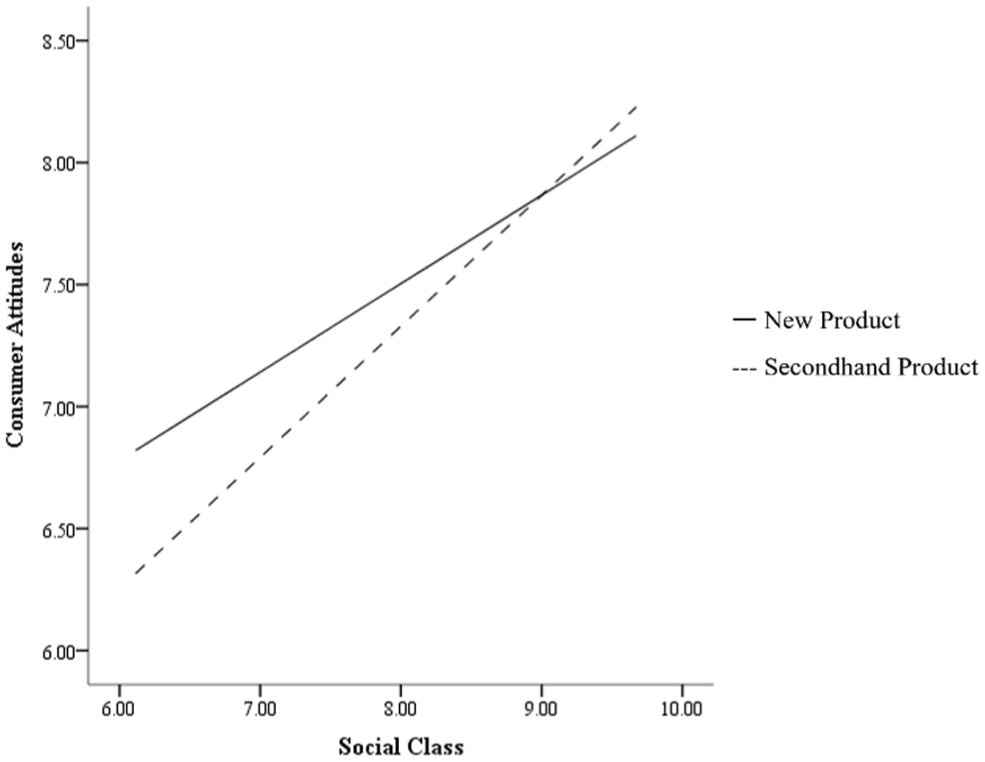
Social class differences in attitudes toward secondhand (vs. new) products (Study 1).
Study 2
Method
Study 2 was conducted to test the moderating effect of concern for face on the relationship between social class and secondhand product attitudes. A total of 280 participants (125 women; Mage = 39.13, SD = 14.21) from MTurk participated in Study 2 in exchange for a small sum of money. Participants were randomly assigned to either secondhand or new product conditions. They were asked to read a scenario describing a situation where they sought to purchase a toaster. In the scenario, participants were asked to imagine they were in a secondhand shop (or a shop that only carries new products), and the retailer explained the toaster was preowned/refurbished (or brand new). Consistent with Study 1, we presented the same images of a brand-new toaster in both conditions to prevent participants from perceiving the secondhand toaster as being contaminated by food (see Appendix B for exact descriptions). After reading the scenario, participants indicated their attitudes toward the product using a 9-point scale (e.g., 1 = bad, 9 = good; 1 = dislike, 9 = like; adapted from Gardner et al. 2014). Then, they indicated their concern over losing face from using the product (e.g., “I care about others’ attitudes toward me”; 1 = strongly disagree, 7 = strongly agree; adapted from Chan et al. 2009). Following this, participants completed the MacArthur Scale of Subjective Social Status, as in Study 1 (1 = bottom of the ladder, 10 = top of the ladder; Adler et al. 2000). Finally, they answered a few demographic questions (i.e., age and gender).
Results and Discussion
First, we created an index of product attitudes by averaging three items (Cronbach’s α = .97). Higher scores indicate more favorable attitudes toward the product. Hayes’s (2017) macro was used for the moderation analysis (Process Model 1), where social class was added as an independent variable, product type (0 = new product condition, 1 = secondhand product condition) as a moderator, and product attitudes as a dependent variable. The results revealed the main effect of social class was not significant (t < 1), while the product type effect (b = −3.16, SE = .85, t = −3.72, p < .001) was significant. Supporting our hypothesis, the interaction term between social class and product type was significant (b = .31, SE = .16, t = 2.02, p = .04; see Figure 2). Specifically, lower social class participants (−1 SD) were significantly less favorable toward the secondhand (vs. new) toaster (Msecondhand = 4.54 vs. Mnew = 6.57; b = −2.04, SE = .36, t = −5.66, p < .001). Likewise, higher social class participants (+1 SD) expressed significantly less favorable attitudes toward the secondhand (vs. new) toaster (Msecondhand = 5.73 vs. Mnew = 6.73; b = −1.00, SE = .36, t = −2.77, p = .01). Importantly, however, lower (vs. higher) social class participants were significantly less favorable toward the secondhand product (b = .36, SE = .11, t = 3.24, p < .01). No such social class difference was observed in attitudes toward the new toaster (t < 1). The results from Study 2 also support our hypothesis and replicate the findings of Study 1.
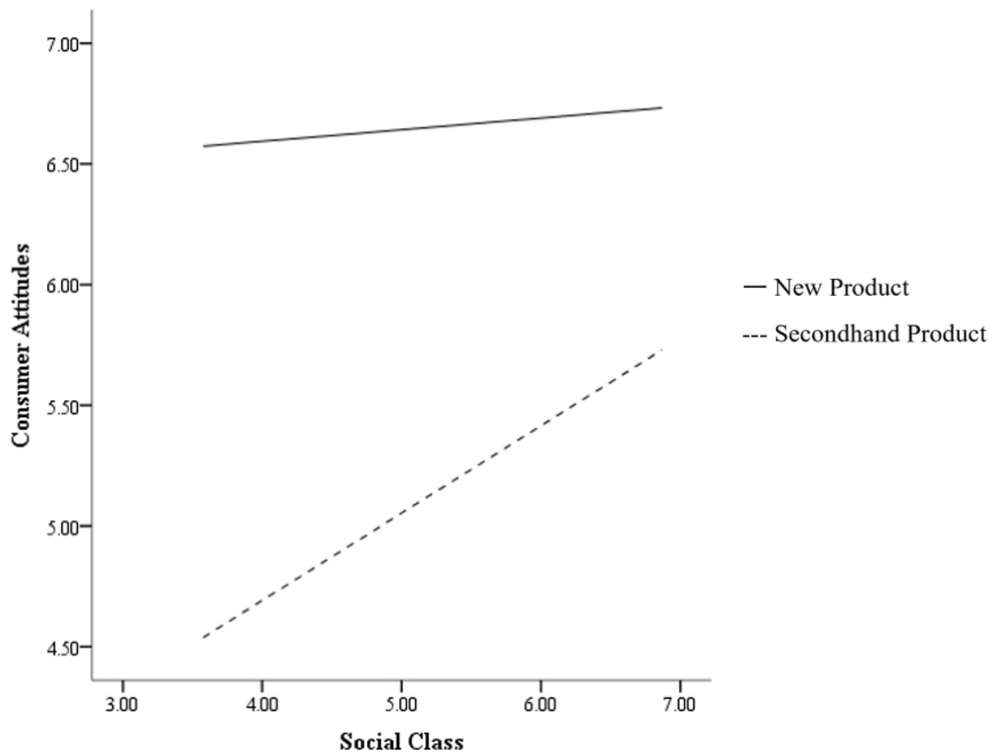
Social class differences in attitudes toward secondhand (vs. new) product (Study 2).
To test the moderating role of concern for face, we created an index by averaging two related items, r(278) = .40, p < .001. We conducted a moderated moderation analysis (Hayes's [2017] Process Model 3, bootstrap = 5,000, confidence interval = 95 percent), where social class (mean-centered) was used as an independent variable, product type (0 = a new product condition, 1 = a secondhand product condition) as a first moderator, and concern for face (mean-centered) as a second moderator. The main effect of social class was not significant (t < 1), while the product type effect was significant (b = −1.54, SE = .25, t = −6.05, p < .001), indicating that participants were more favorable toward a new (vs. secondhand) toaster. In line with our hypothesis, the results revealed a significant two-way interaction between social class and product type (b = .35, SE = .16, t = 2.26, p = .02) and a three-way interaction among social class, product type, and concern for face (b = −.28, SE = .12, t = −2.30, p = .02; see Figure 3).
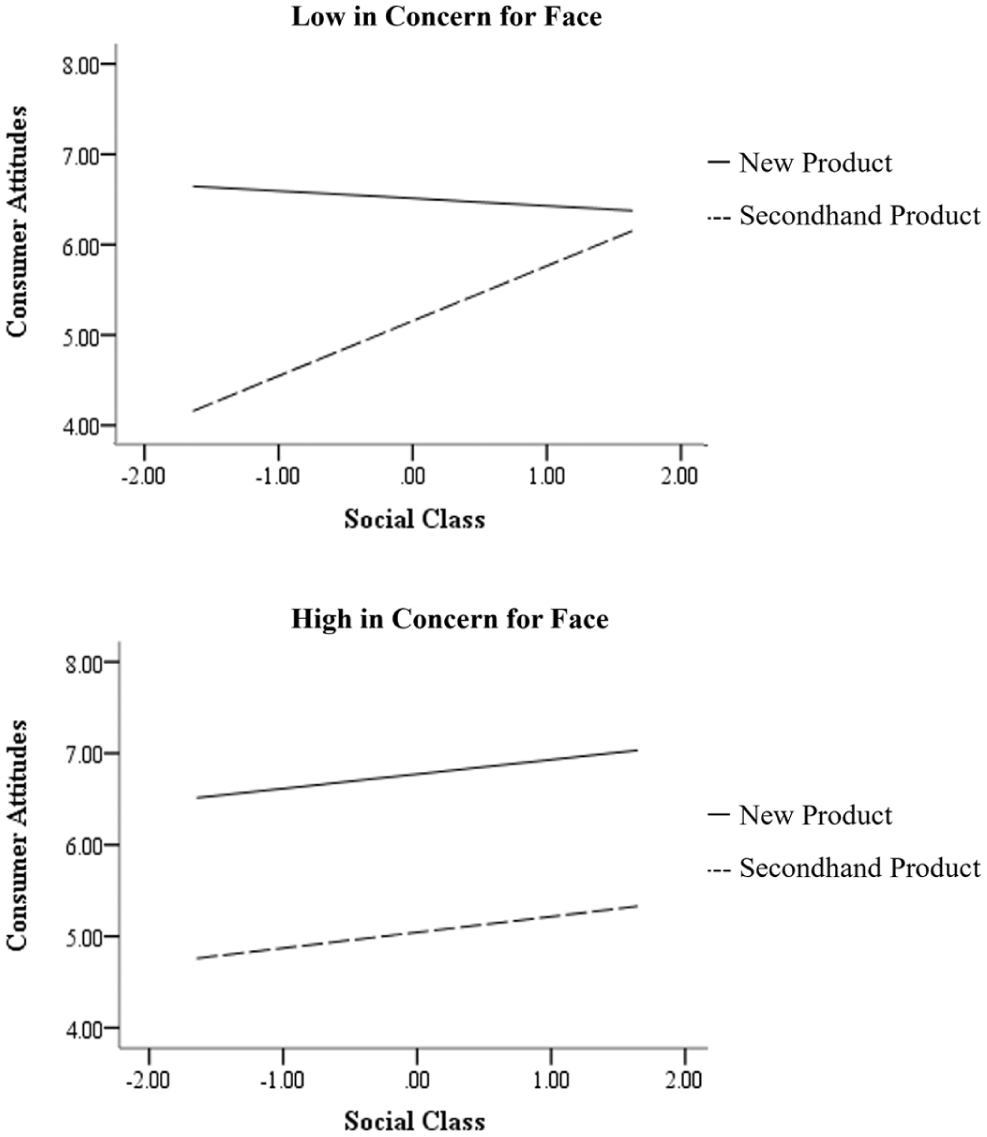
Social class differences in attitudes toward secondhand (vs. new) products by level of concern for face (Study 2).
Specifically, when concern for face was low (−1 SD), the interaction between social class and secondhand products was significant, b = .69, F(1, 272) = 9.80, p < .01. Lower social class participants (−1 SD) were significantly less favorable to secondhand (vs. new) toaster (Msecondhand = 4.16 vs. Mnew = 6.65; b = −2.49, SE = .51, t = −4.88, p < .001), while no such difference was observed among higher social class participants (Msecondhand = 6.15 vs. Mnew = 6.38; t < 1). Moreover, for the secondhand toaster, lower (vs. higher) social class participants exhibited more negative attitudes toward it (b = .61, SE = .16, t = 3.82, p < .001). No social class difference was observed in attitudes toward the new toaster (t < 1). When concern for face was high (+1 SD), there was no significant interaction between social class and product type (F < 1). Both lower (Msecondhand = 4.76 vs. Mnew = 6.51; b = −1.75, SE = .50, t = −3.48, p < .001) and higher social class (Msecondhand = 5.33 vs. Mnew = 7.03; b = −1.71, SE = .50, t = −3.41, p < .001) individuals held more favorable attitudes toward the new (vs. secondhand) product. Furthermore, there was no significant difference in attitudes toward the toaster across social class in either the secondhand (t = 1.21, p = .23) or new product condition (t = 1.05, p = .30).
This three-way interaction pattern suggests that higher social class individuals also devalue secondhand (vs. new) products when their concern for face is strong. Lower social class individuals, however, prefer new products over secondhand products regardless of their level of concern for face.
General Discussion
Theoretical Implications
Theoretically, our contributions are twofold. First, the current research contributes to research on secondhand consumption (Amin and Herjanto 2023; Atik and Ozdamar Ertekin 2023). Prior research on secondhand products has focused heavily on motivation for and barriers to secondhand product purchases (e.g., Roux and Guiot 2008). There is scant research, however, on attitudes toward secondhand products. In other words, prior research has primarily addressed why individuals are more or less likely to purchase secondhand products. It has largely ignored, however, who is more favorable toward secondhand products. This current research is one of the first to examine individuals’ attitudes toward secondhand products through the lens of their cultural backgrounds, contributing to the literature on secondhand products. With two empirical studies, we suggest higher (vs. lower) social class individuals are more favorable toward secondhand products.
Second, we contribute to social class literature by enhancing understanding of social class differences in attitudes toward secondhand products. Recently, researchers have examined social class differences in various consumption behaviors (Lee 2018; Shavitt et al. 2016). Based on prior findings on social class in individuals, contradictory predictions regarding attitudes toward secondhand products are possible. Some argue that lower (vs. higher) social class individuals will perceive used products more positively due to their limited resources (e.g., Gregson et al. 2002). We argue and find, however, that lower (vs. higher) social class individuals consider secondhand products less favorably, stemming from the nature of these products, such as being characterized by high uncertainty and risk (e.g., Rulikova 2020). To the best of our knowledge, this research is one of the first to resolve these conflicting predictions by empirically demonstrating different attitudes toward secondhand products by social class.
It should be noted that we examine social class differences in attitudes toward secondhand products rather than actual purchases. Lower (vs. higher) social class individuals may purchase more secondhand products due to financial constraints and contextual factors, such as prevailing norms. Unfortunately, however, our research suggests that lower social class individuals may be less satisfied with such purchases and hold more negative attitudes toward them. For higher social class individuals, consumption often serves to express individuality and agency, whereas for lower social class individuals, choices may be shaped more by norm-based conformity (Stephens et al. 2007). Surrounded by others who also rely on secondhand consumption out of economic need, lower social class individuals may be purchasing secondhand products unhappily or unwillingly.
Lastly, the current research is one of the first to examine how the individual level of concern for face interacts with the individual's social standing. Our second study demonstrates that social class differences in attitudes toward secondhand products hold only when they are low in concern for face and not when they are high in concern for face. The finding advances our understanding of the effect of concern for face in social psychology contexts. It also highlights that secondhand consumption is not merely an economic choice but a socially meaningful behavior. Moreover, it shows that even higher social class individuals are not immune to stigma; when their concern for face is high, they are less likely to favor secondhand products to avoid being associated with stigmatized groups.
Public Policy Implications
This research offers valuable suggestions for public policy regarding secondhand product consumption. The growing accumulation of used products has become a critical societal concern (Tonti 2024), necessitating effective strategies to promote their reuse. Our findings suggest that policies aimed at changing attitudes toward secondhand products should prioritize reduction of the stigma associated with secondhand products. To this end, policymakers should consider that lower social class individuals may hold unfavorable views toward secondhand products, likely due to the stigma attached to them. It is also important to recognize that responses to secondhand consumption may vary depending on individuals’ concerns about social image and status. When concern for face is high, individuals across social class are less likely to engage in secondhand product consumption.
Therefore, addressing the stigma surrounding secondhand product consumption should be prioritized when promoting sustainable consumption practices. For instance, public or nonprofit organizations can design their campaigns that frame secondhand product buyers as “smart and unique members of society” or “active participants in protecting the environment.” Such reframing can position purchase of secondhand products as socially desirable while enabling individuals to communicate positive identities to others. By understanding the psychological barriers tied to secondhand product consumption, interventions can be designed to reduce stigma, enhance perceived value of secondhand products, and tailor communications to resonate more positively with lower social class individuals and higher social class individuals with high concern for face. This can ultimately increase market inclusivity and personal well-being.
Limitations and Future Research
This research is limited to uncovering who is more or less favorable toward secondhand products through the lens of social class. We encourage future research to empirically examine and test why lower social class individuals view secondhand products negatively (e.g., perceived risk, environmental concerns). To examine the underlying mechanism, qualitative research would be especially helpful in browsing all the possible factors that lead lower (vs. higher) social class individuals to show negativity toward secondhand products. Also, it will be beneficial to identify the factors that can alleviate this negativity toward secondhand products. For instance, highlighting the value of a prestigious brand name along with offering a warranty service may lower psychological barriers. Prior findings suggest that lower social class individuals seem to care more about brand names than higher social class individuals (e.g., Rose, Boush, and Friestad 1998).
It should be noted, furthermore, that we implemented a constant product price and did not examine the role of product price in attitudes toward secondhand products. Thus, future research should examine the role of price in the relationship between social class and individual responses to secondhand products. Additionally, future research can explore strategies to change the negative perceptions of secondhand products among lower social class individuals. For example, presenting secondhand products as vintage can enhance their appeal by emphasizing uniqueness and nostalgia (Schibik, Strutton, and Thompson 2022). Similarly, anthropomorphizing secondhand products—giving them human-like characteristics—may increase their emotional value and attractiveness to individuals (Wan and Aggarwal 2024).
Moreover, our research primarily examined social class differences in electronic products because it emphasized products for which intrinsic features (e.g., quality and durability) are central rather than extrinsic aspects (e.g., design or color). Given the established differences between slow consumption (e.g., electronic products) and fast fashion consumption (e.g., Zarley Watson and Yan 2013), it would be valuable to investigate whether social class differences persist or diminish in the context of fast consumption items or other types of products (e.g., clothes). Also, these products are associated with food preparation, which may elicit latent sanitation or contamination concerns. Although small kitchen appliances entail less intimate contact than clothing or personal care items, it is possible that individuals may still perceive used toasters or blenders as having poor safety or hygienic standards. Although our experimental materials did not include any mention of product condition, wear, or cleanliness, thereby controlling for overt sanitation cues, future research should expand on our findings by using secondhand products that are fully detached from food or hygiene contexts. Using product stimuli such as secondhand household tools (e.g., a wrench) may yield cleaner tests of impression-related motivation without the potential confound of contamination concerns.
Lastly, in future research, it will be important to adopt a more multidimensional approach to social class distinctions. Although the present study measured subjectively perceived social class based on income, education, and occupational status, this approach has limitations in that it does not fully capture noneconomic capital, such as cultural and social capital. Future research should incorporate indicators of cultural capital, such as refined taste or appreciation for the arts, and social capital, including interpersonal relationships and social networks, to explore the structure of social class in a more nuanced manner (Bourdieu 1985). Such an approach can provide deeper insights into how these forms of capital influence individuals’ attitudes toward secondhand products. For example, individuals with high cultural capital may place greater value on vintage or rare secondhand items.
Conclusion
This research empirically examined which social class perceives secondhand products more (or less) favorably. Two studies revealed lower (vs. higher) social class individuals view secondhand products less positively. Also, we found that lower social class individuals view secondhand products adversely regardless of their concern for face. In comparison, higher social class individuals perceive secondhand products significantly less favorably when they have a strong (vs. weak) concern for face. These findings have important public policy implications. Specifically, reducing the psychological barrier (e.g., face concern) associated with secondhand consumption can boost both social inclusion and environmental sustainability. Public campaigns that frame secondhand consumption as a means of signaling positive identity (“smart and unique members of society” or “active participants in protecting the environment”) can help reconfigure its symbolic meaning, making it a more socially acceptable and desirable practice across social class.
Footnotes
Appendix A (Study 1)
Appendix B (Study 2)

Funding
The authors received no financial support for the research, authorship, and/or publication of this article.
Declaration of Conflict Interest
The authors declared no potential conflicts of interest with respect to the research, authorship, and/or publication of this article.
1
The former represents objective measures of social class (Kraus et al. 2012), and the latter represents its subjective measures (e.g., Adler et al. 2000; Kraus, Tan, and Tannenbaum 2013). Both measures are effective in capturing social class (Shavitt, Jiang, and Cho 2016). This research uses subjective social class to operationalize social class.
2
Images of a blender used in the experiment can be shared on request after agreement with the authors.
3
Images of a toaster used in the experiment can be shared on request after agreement with the authors.