







Abstract
Research on the college-to-career transition emphasizes structural inequalities in opportunities and outcomes yet gives limited attention to how emotions are socially patterned during this high-stakes passage. This gap matters because emotion cultures and feeling rules shape both how students experience the search and how they are evaluated by others. We analyze survey data from 2,060 undergraduates at a large public university who were asked to provide words describing how they feel about the job search. These responses were standardized using peer-based ratings to construct an emotional positivity score, a measure that blends lexical openness with comparability. Findings show that stress and anxiety dominated students’ first associations and that positivity most often appeared second, producing layered mixtures of apprehension and excitement. Regression models reveal systematic variation in emotional positivity across demographic backgrounds, academic profiles, majors, and career aspirations. Our results highlight the patterned ways students orient to the job search, demonstrating how social location organizes feeling rules in transitional contexts and extending theories of emotion culture to a critical life course passage.
For many undergraduates, the approach of graduation brings a shift in academic and professional responsibilities alongside a surge of emotion. The job search looms as a high-stakes and highly visible moment in which future earnings, career trajectory, and professional identity all seem to hang in the balance (Ibarra 1999; Kahn 2010; Oreopoulos, von Wachter, and Heisz 2012). This transition is experienced as an emotionally charged performance. Students know that peers, parents, and others often expect enthusiasm and confidence, feelings that may not align with students’ private emotional realities (Cahill 1999). These expectations amplify the tension between internal states and outward displays at a time when young adults are confronting uncertainty about next steps.
Sociologists have examined the college-to-career pipeline extensively, focusing on how structural inequalities, institutional contexts, and cultural expectations shape opportunities and aspirations (Binder, Davis, and Bloom 2016; Rivera 2012; Tomlinson 2017). Research shows that emotions matter for navigating transitions more broadly, guiding how people interpret changing roles and anticipate evaluative encounters (Hochschild 1979; Lively and Weed 2014). Classic work on early professional socialization shows that emotional expectations are built into emerging roles themselves (Cahill 1999), and more recent research demonstrates that emotional norms associated with professional settings may inform how students imagine the steps ahead (Rivera 2015, 2016). These insights highlight the importance of emotional life in transitional contexts, yet we know less about how students themselves describe their feelings before the transition begins and how those feelings might vary across social position.
At the same time, studying emotions in transitional moments presents a methodological challenge. Students may draw on varied feeling words to describe their anticipation, and these vocabularies can reflect the peer and institutional cultures in which they form their expectations. Existing measurement tools offer useful ways to assess emotion, whether through population-based sentiment ratings, closed-ended survey items, or qualitative accounts. Each approach captures part of the picture but leaves some aspects of local meaning less visible. An approach that keeps respondents’ own vocabularies while still supporting systematic comparison can help reveal how emotional orientations are patterned in a setting marked by uncertainty.
This study examines the emotional language undergraduates use when thinking about the job search and evaluates whether the positivity of those expressions varies across demographic and academic characteristics. Our goal is to describe the emotional contours of this anticipated transition and assess how those contours reflect students’ positions within the social hierarchy. Our approach blends the openness of qualitative language with the systematic structure of survey-based tools, allowing students’ own vocabularies to remain visible while still producing a measure that can be compared across individuals. To do so, we draw on open-ended feeling words provided by more than 2,000 undergrads and apply a peer-based rating procedure that preserves students’ lexical choices while allowing those choices to be analyzed as a continuous measure.
The article proceeds in four sections. First, we situate our study within the emotional dynamics of life transitions and the challenges of measuring context-specific emotion language. Second, we describe our methodological approach, including the survey design, scoring procedures, and creation of an emotional positivity score (EPS). Third, we present descriptive and multivariate analyses of students’ feeling words and the social patterning of emotional positivity. Finally, we discuss the implications of these findings for theories of emotion culture, approaches to affect measurement, and students’ experience of the college-to-career transition.
Background
Emotional Orientations in the College-to-Career Transition
The college-to-career transition marks a critical life stage in which young adults begin to look ahead from structured educational environments toward uncertain labor market conditions. Employment outcomes at this juncture can influence long-term earnings, career trajectories, and self-concept (Ibarra 1999; Kahn 2010; Oreopoulos et al. 2012). This period also coincides with emerging adulthood, a period marked by exploration and instability (Arnett 2000), dynamics that heighten the emotional stakes of the transition. Students often approach this shift with a sense of high visibility and high consequence, which makes their affective orientations toward the job search especially consequential.
Emotions are central to navigating this process. Optimism and excitement can bolster persistence and adaptability, and anxiety or discouragement can constrain effort and narrow perceived options (Chen and Lim 2012; Warriner, Kuperman, and Brysbaert 2013). Students also know that emotional orientations influence how candidates are perceived by gatekeepers given that hiring decisions often rest on interpretations of applicants’ affect and demeanor (Rivera 2016). When identities are not verified in evaluative contexts, emotional responses can intensify (Stets and Burke 2025), a pattern that shapes how students feel about the future transition. This explains why students treat the job search as an emotionally charged moment and why their current emotional orientations carry meaning for how they imagine the transition unfolding.
Emotional experiences related to this transition are patterned by students’ social positions and prior experiences. Differences in family income, race, gender, and institutional prestige can influence the opportunities students believe are available and the feelings they hold toward the search (Negraia et al. 2020; Ridgeway 2006). These inequalities structure how confident, anxious, hopeful, or discouraged students feel as they look forward to labor market entry.
The job search is also associated with emotional expectations that students take into account as they think about managing the tension between private feelings and public expectations. Potential employers and close others often expect enthusiasm and confidence, which may not align with students’ internal emotional states (Cahill 1999). Students recognize that they will eventually need to present themselves as ready for professional employment and sustain positive composure under conditions of uncertainty and evaluation (Goffman 1959; Rivera 2015). These expectations raise the emotional stakes of the transition and shape students’ feelings about the move from college to career. To place these dynamics in context, we turn to the social psychology literature that examines how emotions take shape in structured settings.
Theoretical Perspectives on Emotion in Transitional Contexts
Social psychology offers conceptual tools that clarify how emotions take shape within structured environments and why those emotions become especially salient during periods of change. Scholars have shown that emotions do not arise in isolation but are guided by cultural expectations that shape how people interpret, evaluate, and manage their feelings. These expectations are captured through the concepts of emotion culture and feeling rules. Emotion culture consists of the shared understandings that define which emotions are valued in particular settings and how they are expected to be expressed (Grandey and Melloy 2017; Hochschild 1979, [1983] 2012). Feeling rules operate within this broader cultural landscape and provide guidance for what individuals believe they should feel and how they understand the need to display those feelings in concrete situations. These expectations vary across social positions and across stages of the life course. They influence how emotional experiences are formed in preparation for transition and how emotional expressions are evaluated (Lively and Weed 2014; Thoits 1989).
Individuals engage in emotion work when they attempt to bring their internal states and outward expressions into alignment with feeling rules. These efforts can be deliberate or can emerge through more subtle processes of self-regulation. Emotion work becomes especially important when people perceive a gap between how they feel and what they believe they ought to feel. Thoits (1989) emphasizes that emotion norms shape both the expression and the experience of emotions because individuals work to align their feelings with socially prescribed expectations. Rosenberg (1990) adds that individuals reflexively monitor and interpret their affective states in light of cultural rules, consciously evaluating whether their feelings align with expectations. These insights highlight the reflexive dimension of emotional life and show how people internalize cultural norms while evaluating and adjusting how they feel about an upcoming transition.
Transitional contexts heighten emotional demands because they combine unpredictability with shifting expectations and visibility. Glaser and Strauss (1971) conceptualize these moments as status passages in which individuals move into new roles and leave older roles behind. Elder (1994) describes them as turning points in the life course, where identities can shift and trajectories can change. These moments often require individuals to interpret new expectations under conditions of ambiguity. When norms are unstable or contested, the work of managing emotions becomes more intense and more visible (Hochschild [1983] 2012). Summers-Effler (2002) illustrates how collective emotional expectations can become difficult to meet during transitions. These dynamics also create conditions for what Thoits (1990) calls “emotional deviance,” which are instances in which people recognize a divergence between what they actually feel and what they believe they are supposed to feel. Transitional settings frequently produce this kind of tension, making mixed reactions—such as the coexistence of eagerness and apprehension—an expected feature rather than an anomaly. This research shows that major life transitions carry recognizable emotional demands, shaping people's feelings when they consider entering them.
Hiring and early career interactions further illustrate the emotional expectations embedded in professional environments. Rivera (2015) shows that interviewers rely heavily on “gut” impressions of candidates’ demeanor and interpersonal style, often privileging displays of ease and confidence. Rivera and Tilcsik (2016) demonstrate that assessments of composure and expressiveness can be interpreted through gendered and classed lenses. Rivera (2016) further emphasizes how professional culture values emotional steadiness and composure in early career interactions. Although most students are not yet navigating these settings, this work highlights the emotional expectations that structure the environment they will soon enter. Such expectations form part of the broader cultural context toward which students orient as they form emotional reactions to the job search.
Complementary findings in psychological and vocational research shows that emotional states shape job search outcomes by influencing self-regulation, goal clarity, and persistence. Positive states, such as joy, interest, and pride, foster career adaptability, proactive search behavior, resilience, and social ease, turning internal affective states into tangible advantages in labor market navigation (Côté, Saks, and Zikic 2006; Gerli, Bonesso, and Pizzi 2015). Negative states, such as anxiety or discouragement, by contrast, narrow attention and reduce motivation (Crossley and Stanton 2005; Kim and Lee 2022). These perspectives align with sociological insights by showing how emotions influence the strategies people use when facing change.
These theoretical perspectives explain why emotions matter as students anticipate the college-to-career transition and why emotional orientations should vary across students’ social positions and experiences. They show that transitions intensify emotional demands, that shared norms guide how individuals interpret and prepare for feeling displays, and that expectations about emotions impact early career processes. Despite this conceptual clarity, existing research offers limited guidance for how to measure emotional orientations in ways that reflect their social and cultural grounding. The next section examines this challenge and describes the approaches that have shaped our own measurement strategy.
The Measurement Gap in Context-Specific Emotion
Efforts to measure emotion continue to face a core challenge: emotion language is culturally grounded and acquires meaning within the situations that generate and organize emotional expression. Researchers working in these settings would benefit from an approach that preserves respondents’ own lexical choices while also producing measurements that remain comparable across individuals. This challenge has not been resolved by existing approaches, each of which captures only one side of the problem.
Affect control theory (ACT) illustrates this limitation directly. ACT assigns evaluation–potency–activity ratings to concepts in order to describe widely shared cultural sentiment, and these ratings have been foundational for documenting general meaning structures (Heise 1979). Yet ACT's strengths also delimit its scope. Its lexicon is fixed, its evaluation scores reflect population-level norms, and its ratings presume stability of meaning across settings. These features make ACT effective for cultural consensus but less equipped for settings in which meaning becomes locally shaped and situationally activated. Transitional contexts, such as the undergraduate job search, often generate emotional vocabularies rooted in institutional pressures, peer communication, and life-stage uncertainty. Students may use terms that ACT does not rate, and even when ACT includes a term, its evaluation value may differ from the meaning that term carries within this transition. ACT therefore cannot resolve the need for a method that traces how emotional language operates inside the situational and relational dynamics of anticipating a transition.
Other standardized approaches face similar constraints. Large-scale surveys offer comparability, yet their predefined categories flatten the textured vocabularies people use to describe emotional life (Robinson and Clore 2002; Watson, Clark, and Tellegen 1988). Conversely, ethnographic and interview-based approaches provide essential cultural and interpretive insight into emotional life, yet they are not designed to produce standardized metrics from respondents’ lexical choices. Scalable lexical tools, such as the Linguistic Inquiry and Word Count dictionary, code words into broad sentiment categories that sacrifice fine-grained distinctions needed for analyzing socially patterned emotional expression (Pennebaker et al. 2015). Even psycholinguistic norming studies that reveal broad agreement in word valence (Warriner et al. 2013) do not capture how meaning shifts across groups or contexts. Recent evidence that emotional word use varies by social and cultural background underscores this point (Grosse and Streubel 2025).
Transitional contexts heighten these tensions. Life course transitions often activate distinctive feeling rules and context-specific expectations, and these dynamics shape how individuals label and interpret their feelings about the transition. A term may have a stable cultural evaluation value, yet its emotional weight within a transition may be altered by the situation producing it, a point emphasized by sociological work on the relational grounding of emotion (Bericat 2016). Existing tools have limited capacity to detect these shifts because they rely on vocabularies and valence structures defined outside the transition itself.
These unresolved issues point to a gap in how research can compare locally grounded emotion vocabularies in transitional contexts. Existing tools leave some aspects of these vocabularies difficult to analyze in a systematic way. The next section introduces an approach suited to this setting that addresses these limitations while remaining grounded in students’ own terms.
Current Study
This study addresses the measurement gap identified earlier by developing a methodological procedure for generating context-specific emotional valence scores. The aim is to create a measure that remains grounded in the vocabulary students use when they describe an impending transition and that can also be analyzed systematically. ACT provides population-level cultural norms. Surveys restrict respondents to predefined categories. Scalable lexical tools treat words as indicators of broad sentiment classes. The procedure introduced here differs in its focus on the meaning system that takes shape among individuals moving through a shared transition rather than within the cultural mainstream.
The first task is to build a procedure that captures how undergraduates interpret the words they attach to the job search. Students were asked to provide the first and second feeling words that come to mind when they think about searching for jobs after graduation. The full set of responses was rated for positivity by a separate sample of undergraduates at the same institution. These ratings provide an evaluative frame tied to the transition as students understand it rather than to generalized sentiment. A student's emotional positivity score (EPS) is the outcome of this process. It is calculated as the average positivity of the two words they produced. The procedure keeps the vocabulary student-generated, preserves the situational grounding of emotion language, and produces a continuous measure that can be compared across individuals.
The second task is to demonstrate how this measure can be used to analyze variation in emotional orientation toward the job search. EPS is treated as an outcome that may differ across gender, race and ethnicity, class background, academic characteristics, and career expectations. Using EPS in this way allows us to observe how positivity is organized within an undergraduate population navigating a shared transition. This analytic step shows how the measure can be applied to examine the social patterning of emotional orientations.
These steps introduce a procedure that reconstructs a localized affective meaning system and translates it into a form suitable for quantitative analysis. The approach allows researchers to document the emotional landscape surrounding a (future) transition and to assess how that landscape is patterned across groups. It keeps the vocabulary student-generated while producing systematic estimates of emotional orientation, a combination that existing tools do not provide for this context.
Guided by this approach, the study asks two linked questions. The first concerns measurement: How do students describe the job search emotionally, and how positive or negative are the terms they select when evaluated by peers in the same setting? The second concerns variation: How does emotional positivity differ across students with different social backgrounds, academic profiles, and career expectations. These questions allow us to observe the structure of emotional expression associated with the college-to-career transition and to assess whether the emotional climate of the transition varies across groups.
Although this procedure may be useful for studying similar student populations and the college-to-career transition more broadly, its contribution lies in the method used to generate and evaluate a context-sensitive emotional vocabulary. The analytical findings illustrate how the procedure operates in practice and how it reveals patterned variation, but the methodological approach is the study's primary contribution.
Data and Methods
Data Source and Recruitment Strategy
We were interested in examining the relationship between undergraduate students’ beliefs about the achievability of their long-term career aspirations and both the orientation of their career goal and the perceived influences on these career decisions, with career goal referring to the job or industry students saw themselves in five to ten years after graduation. This study uses data from a web-based survey that gathered information from 2,060 undergraduate students at a large public R2 university in the western United States (nominally, “Western University”). The survey solicited demographic information and detailed information about students’ career aspirations.
Western University enrolls more than 35,000 students across liberal arts and professional fields and maintains significant socioeconomic and racial diversity, including a large population of first-generation and transfer students. Participants were recruited through Western University's online research participation platform, which uses Sona Systems to manage human-subjects recruitment. This centralized subject pool enables enrolled undergraduates to participate in institutional review board (IRB)-approved studies in exchange for partial course credit. Recruitment followed a purposive sampling approach aimed at achieving breadth of majors rather than a random draw, consistent with standard practices for departmental subject pools in behavioral and social science research. Following IRB approval, the study description was posted on the Sona portal, and eligible students self-selected into the survey. Participants accessed the Qualtrics survey through a secure link, reviewed the online consent form, and completed the questionnaire for partial course credit.
Key Dependent Variable: Emotional Positivity Score
Participants were asked to reflect on their feelings about searching for jobs after graduation and to provide feeling words in ranked order. The survey prompt read: “When you think about searching for jobs after you graduate, consider the feelings that come to mind. Answer the following as a rank order.” Respondents then listed their first and second feelings. We used this format because transitional emotions are often mixed rather than singular (Thoits 1990) and asking for more than one emotion allows students to articulate both their immediate reaction and any secondary feelings that qualify or accompany it. Having respondents provide their feelings sequentially made it possible to identify the most salient emotions first, followed by any secondary emotions. This open-response format allowed students to draw freely from their own vocabulary rather than selecting from researcher-defined categories. Importantly, the responses included both canonical emotions (e.g., anxious, scared, excited) and evaluative descriptors (e.g., confident, inadequate, creative). Following psychological and sociological convention, including work that treats affective meanings as continuous evaluative dimensions (e.g., Heise 1979), we treat all of these as subjective feelings, focusing on their valence (positive vs. negative) rather than their categorical distinction.
The vocabulary provided was processed to create an EPS for each participant. 1 Some phrases and terms that were too ambiguous (e.g., funny, homeless, money) were removed, closely related terms were merged (e.g., anxious and anxiety), and then each unique word was assigned a positivity value by an independent panel of 100 undergraduate students at the same institution. Panelists rated every distinct word on a 5-point scale, from 1 = extremely negative to 5 = extremely positive. A mean rating was then attached to each term. An individual EPS was calculated for each respondent by averaging the ratings for their two chosen words, producing a continuous measure of emotional positivity (M = 3.02, SD = .77). Higher EPS values indicate a more positive affective outlook on the job search, and lower values capture more negative or anxious perspectives.
This hybrid approach, combining unconstrained lexical elicitation with peer-based valence scoring, addresses the methodological challenge of preserving respondents’ own words while producing a standardized measure. Because the rating panel came from the same undergraduate population, EPS reflects shared cultural norms of valence. In sociological terms, it occupies a middle ground between private feelings and public displays, capturing the words students judge appropriate to disclose in a quasi-public setting. To Hochschild ([1983] 2012), these choices represent the linguistic residue of feeling rules, making EPS especially apt for studying the college-to-career transition where inner states and outward presentations may diverge. Retaining the full list of words and their scores also allows this job-search lexicon to be reused in future studies of similar student populations or extended to new contexts using the same procedure.
By grounding measurement in respondents’ lexical choices, EPS also avoids pitfalls of closed-ended surveys, which risk overestimating positivity, and observational methods, which capture displays but not subjective experience. It allows negative and ambivalent feelings to surface spontaneously, which is significant given evidence that negative affect can hinder job search intensity and outcomes (McKee-Ryan et al. 2005; Wanberg, Kanfer, and Banas 2000). In sum, EPS functions as a methodological bridge: a comparable index created by a replicable procedure that retains the sociological insight that emotion talk is socially patterned and consequential for how students represent their feelings at a critical life juncture.
Independent Variables
The means reported for the variables listed here indicate the proportion of the sample in each category (e.g., a mean of .30 for seniors indicates that 30 percent of respondents were college seniors). A disproportionate number of female students completed the survey, so we weighted our analyses to account for this oversampling: gender (female = 1; M = .50). Other demographic characteristics include the following: race (dummy variables; white M = .45, black M = .05, Latinx M = .26, Asian M = .17, mixed M = .07), age (continuous variable; M = 20.86), religiosity (religious nones = 1; M = .41), and high household income (income over $155,000 = 1; M = .25). 2 Three characteristics operationalized student academic dynamics: year in school (dummy variables; freshman M = .35, sophomore M = .12, junior M = .23; senior M = .30) and student's grade point average (GPA; continuous variable; M = 3.43). Finally, we include a variable indicating that students have had either a career-relevant job, internship, or volunteer opportunity (job prep = 1; M = .55)
Student majors were categorized into 11 possible major categories at Western University: arts (M = .06), business (M = .26), communications (M = .05), education (M = .02), engineering (M = .14), health (M = .11), humanities (M = .03), interdisciplinary (M = .07), social science (M = .12), life and physical science (M = .12), and undeclared (M = .02).
In order to determine the career goal, we first had to categorize the various careers students listed in an open-ended survey question: “List the job and/or industry that you would like to see yourself in five to ten years after graduation.” We turned to O*NET (Occupational Information Network), the occupational classification system maintained by the United States Department of Labor, which has long offered a standard way to categorize occupations in the U.S. economy (Hadden, Kravets, and Muntaner 2004; Levine and Oswald 2012). The researchers independently coded a random sample of 50 students’ listed career goals into one of O*NET’s 23 major two-digit Standard Occupational Classification categories (e.g., 13.0000 Business and Financial Operations). After determining that there was 94 percent interrater reliability in this coding, each student's career goals was coded into one of the following categories: management and entrepreneurship (M = .09), finance and business (M = .17), computing (M = .07), engineering (M = .09), STEM (M = .04), social services (M = .07), legal occupations (M = .09), education (M = .06), arts and media (M = .14), health (M = .13), sales (M = .03), military (M = .02), and “working-class occupations” (M = .02). 3
Analytical Strategy
Data were analyzed in two stages. Our initial analysis focused on both the vocabulary students used and the positivity or negativity of those words. We first counted how often each feeling word appeared and noted the overall balance of positive and negative responses. To capture this visually, we created a heat map that combines frequency and valence: the size of each square reflects how often a word was used, and the color reflects its EPS, with lighter shades more positive and darker shades more negative. The heat map makes it possible to see which words dominated and how the emotional space clustered around negative versus positive feelings. We then complemented this with a ranking of the most common words, which highlights the concentration of responses around a small set of terms. Together, these approaches provide both a broad view of students’ language and a focused look at the emotions that shaped their job-search outlook.
We then used ordinary least squares regression modeling in order to determine the relationship between our independent variables and students’ EPSs. We report standardized instead of unstandardized coefficients in the analytical table (Table 2). Standardized coefficients transform all variables in the model to a common scale, expressed in standard deviation units. This enables us to compare the absolute values of the standardized coefficient.
Analysis and Results
Descriptive Analysis: Feelings Vocabulary and Frequencies
The survey responses revealed a rich array of 200 unique words 4 that students used to describe their feelings about the upcoming job search.
The paired heat maps in Figure 1 show the full vocabulary students used when asked for their first and second feelings about the job search. The first-feeling map is dominated by negative feelings. “Stressed” (371 mentions, EPS = 2.20) and “anxiety” (350 mentions, EPS = 2.15) are the largest blocks, surrounded by related dark-toned words, such as “fear,”“nervous,” and “scared.” These patterns form a dense cluster of apprehension. “Excited” (327 mentions, EPS = 4.52) appears as the most prominent positive counterweight, with smaller but visible contributions from “happy” and “hopeful.” The pattern suggests that although some students initially described the job search with energy and anticipation, the most salient first reactions leaned toward stress and anxiety.
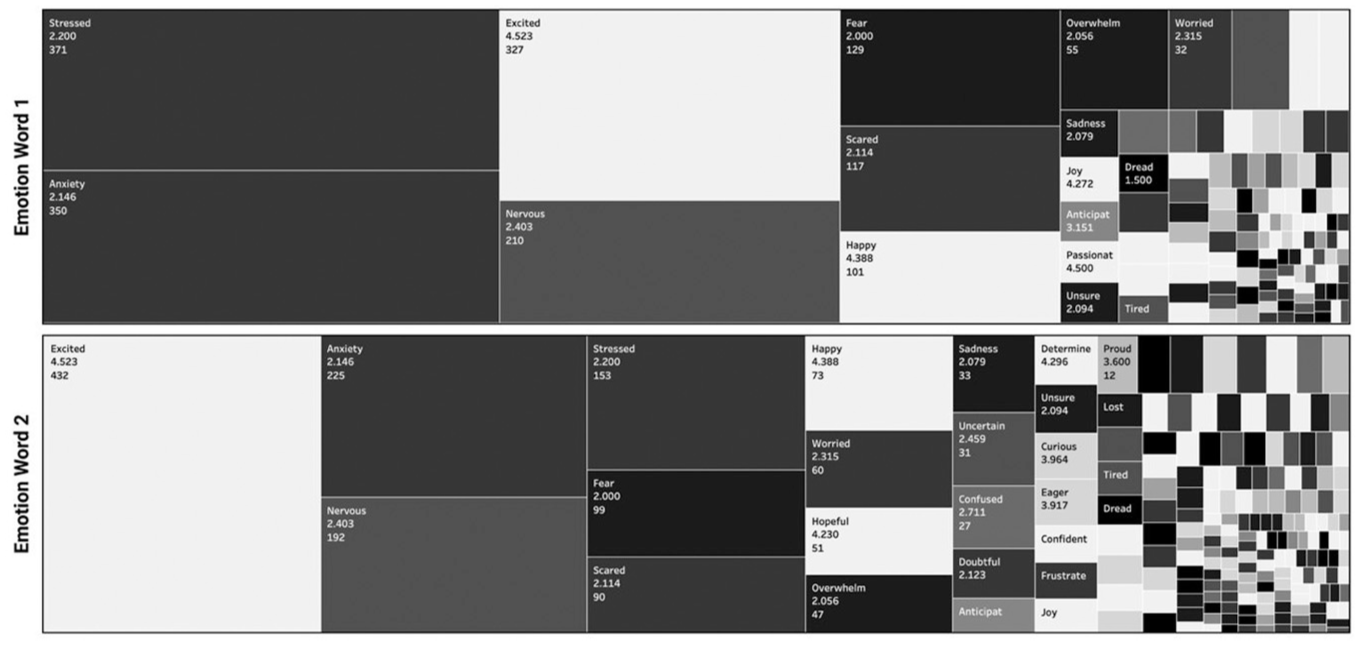
Heat map of feelings words frequency and sentiment..
The second-feeling map reveals a shift. Here, “excited” grows into the single largest term overall (432 mentions), overtaking “stressed” and “anxiety.” Students elaborating with a second word often turned to optimism and determination, adding new lighter shaded terms, such as “hopeful,”“curious,”“determined,”“confident,” and “eager.” Yet negativity remained pervasive: “anxiety” (225 mentions) and “nervous” (192) were still dominant, and smaller clusters of “confused,”“doubtful,” and “frustrated” appeared. Whereas the first map was anchored almost entirely in stress and apprehension with excitement as a counterbalance, the second map shows a more layered landscape: positivity became more visible, but it coexisted alongside both persistent and diversified negativity.
These two maps together illustrate a sequencing of ambivalence. Students’ first words reveal that apprehension—stress, anxiety, fear—was the dominant initial frame. Their second words show both the persistence of those negative feelings and the addition of more varied positive language. The dual maps capture how students balanced the tension between optimism and dread: they did not replace one with the other but layered excitement and hope onto an already anxious vocabulary.
Where the heat maps in Figure 1 provide a panoramic view of this emotional layering, Figure 2 distills the results into the 15 most common words, which together accounted for 81.2 percent of all responses. “Excited” was the most frequent term overall (759 mentions), but its prominence came largely from second mentions; “stressed” and “anxiety” were especially common as first responses. Figure 2 thus reinforces the dynamic seen in the heat maps: anxiety and stress typically surfaced immediately, and excitement was often added as a secondary frame. Notably, there was more diversity in students’ feeling lexicon for the second word than the first, with 60 percent more words used fewer than five times in Word 2 (n = 143) than Word 1 (n = 85). Overall, 65.5 percent of responses were negative, and 34.5 percent were positive, yielding a roughly two-to-one ratio tilted toward negativity.
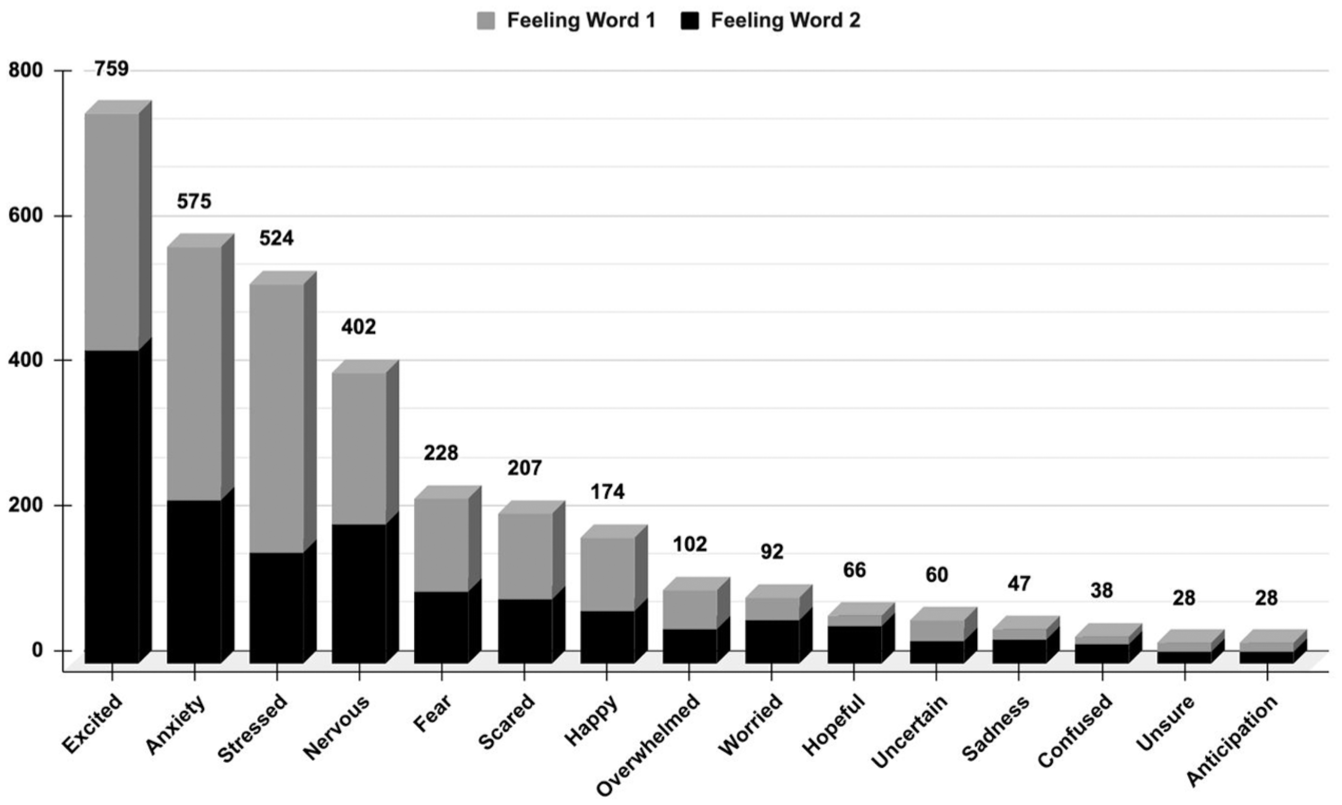
Overall top 15 most common emotion words.
This distribution aligns with students’ mixed patterns of reporting. Nearly half (46 percent) listed both a positive emotion and a negative emotion, 42 percent gave only negative feelings, and just 12 percent gave only positive ones. Taken together, the heat maps and frequency chart reveal both the imbalance and the layering of student feelings: apprehension was common and salient as the first response, and positivity was present but more often appended, illustrating a patterned ambivalence in how students approached the job search.
To move beyond patterns in individual words, we turn to students’ EPSs, a continuous measure of how positive or negative their job-search feelings were on average. Unlike the word-level analysis, which shows clusters of terms and their sequencing, regressions of EPSs allow us to examine whether students from different social backgrounds, majors, and career aspiration groups express systematically higher or lower positivity. In the next section, we present bivariate associations and then multivariate regression models to assess the independent contribution of these predictors to students’ emotional outlook.
Bivariate Analysis
Table 1 presents bivariate associations between student characteristics, majors, career goals, and EPSs. Several patterns emerge.
Emotional Positivity Scores and Bivariate Correlations for Select Variables.
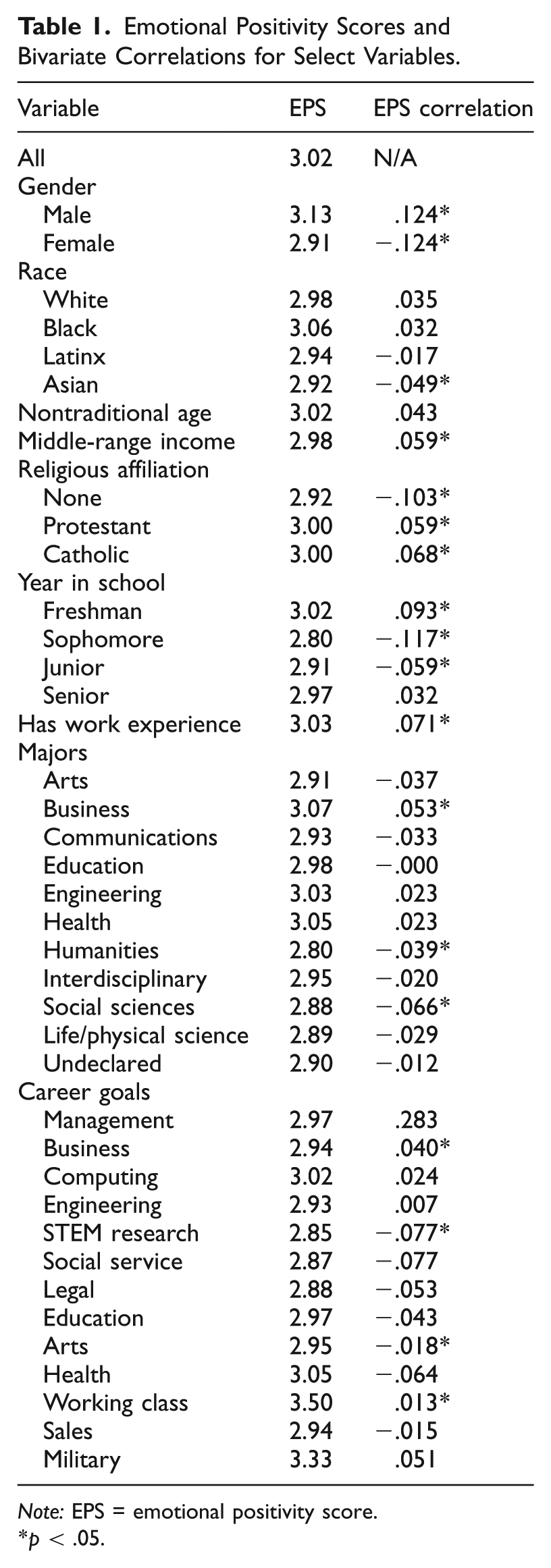
Note: EPS = emotional positivity score.
p < .05.
Demographic factors show strong associations with EPSs. Male students report significantly higher positivity, and female students report lower positivity (B = .124; B = −.124). Of the race variables, only those students identifying as Asian report lower EPSs (B = −.056). white, black, and Latinx students do not appear to differ significantly. Because Asian students were the only group differing significantly here, the multivariate regression will only include “Asian” and use all other racial groups collectively as the reference category. Being a nontraditional age (older than 24) student, although positive and marginally significant (p = .08), does not appear to predict their EPSs. Being from a high-income household, although negative and marginally significant (p = .05), also does not appear to predict students’ EPSs. Students without religious affiliation show significantly lower EPS (B = −.095), and Protestant (B = .055) and Catholic students (B = .057) show slightly higher EPS. Academic stage also matters. Not surprisingly, freshmen report significantly higher positivity (B = .095) as they consider the job search, and sophomores (B = −.014) and juniors (B = −.044) show modestly lower scores; surprisingly, being a senior is not correlated with the EPS. In the multivariate regressions, seniors will serve as the omitted category, allowing the earlier class years to be compared with those closest to the job search itself. Although not listed in Table 1, GPA is positively correlated with job search-related EPSs (B = .067). Students with some practical work experience appear to approach the job search with more optimism (B = .072).
Patterns across majors are mixed. Most of the 11 majors our respondents are pursuing appear to not predict variation in EPSs; only three do. Business majors (B = .053) report higher EPSs, and humanities (B = −.039) and social science majors (B = −.066) majors show significantly lower positivity. We use business majors as the omitted category in our multivariate category because they are both the most common (27 percent) field of study on this campus and serve as a neutral point of comparison given their relatively positive but not extreme association with EPSs.
Students’ long-term career goals also show some variation, but most of the jobs students list as career goals do not predict EPS variation; only three do. Students aspiring to careers in business report higher positivity (B = .040), and students hoping to work in STEM research (B = −.070) and arts and entertainment (B = −.056) report lower positivity. Students planning to pursue working-class careers that tend not to require a college degree report higher EPS (B = .059). These students constitute a small (3 percent) but distinct group in a sample of undergraduates: they are pursuing careers that are structurally outside the college labor market pipeline. Because these occupations are distinct from the other careers, which mostly hinge on having the educational credentials students are pursuing, we will use them as the omitted category in our multivariate analysis. They provide a natural baseline for comparing the emotional outlook of students who plan to leverage their degree into professional work.
Multivariate Analysis
We next turn to multivariate models predicting EPSs, reported in Table 2. Model 1 examines demographic and background characteristics, Model 2 estimates the independent contribution of majors, Model 3 estimates the independent contribution of students’ career goals, and Model 4 incorporates all predictors simultaneously.
Regressions of Variables (Student Characteristics, Majors, and Career Goals) on Emotional Positivity Scores.
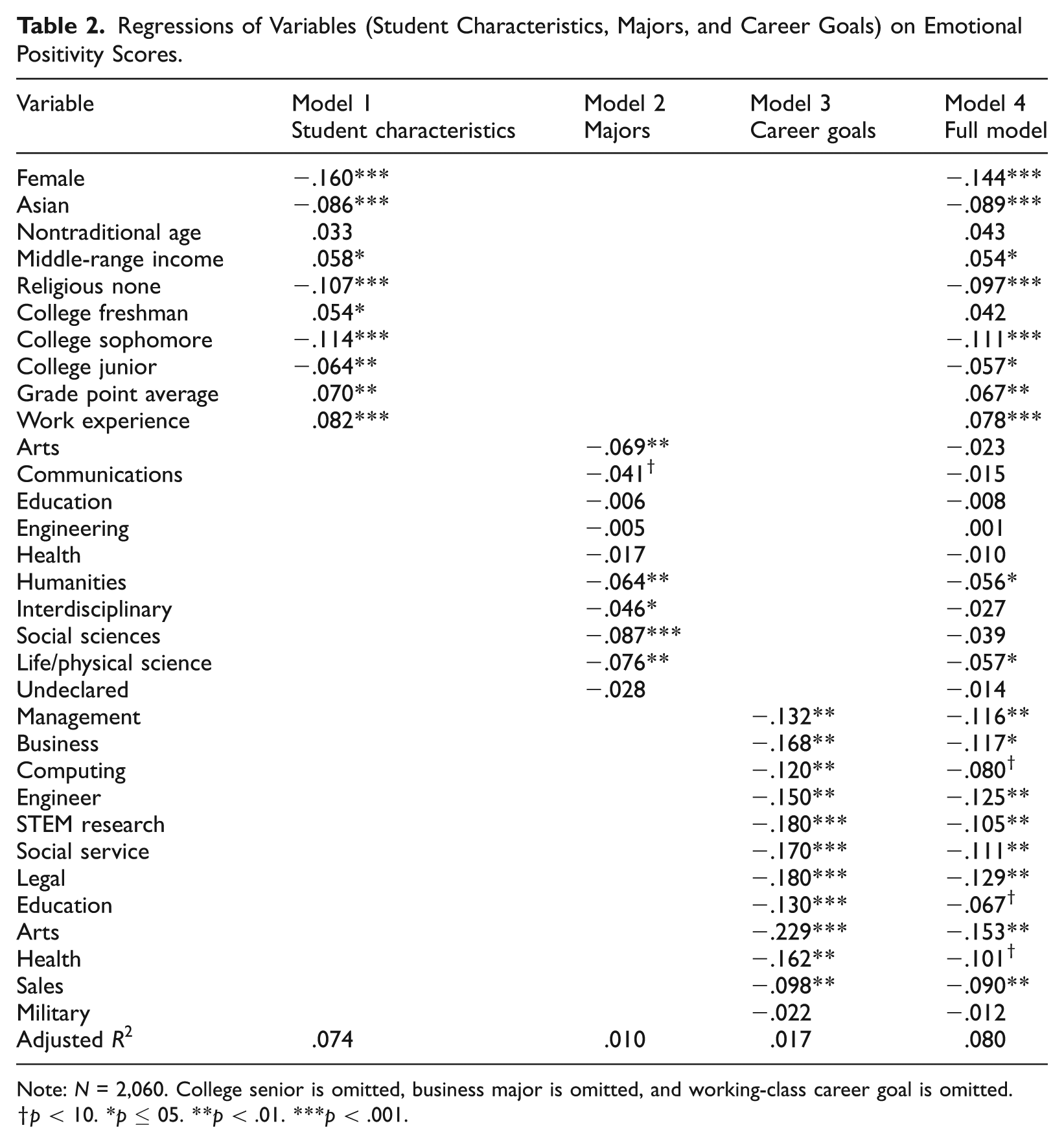
Note: N = 2,060. College senior is omitted, business major is omitted, and working-class career goal is omitted.
p < 10. *p ≤ 05. **p < .01. ***p < .001.
Model 1 shows that several demographic characteristics significantly predict EPS (R2 = .07). Female students report lower positivity (B = −.23, β = −.16, p < .001), as do Asian students (B = −.17, β = −.09, p < .001) and those with no religious affiliation (B = −.16, β = −.10, p < .001). Relative to their senior peers, sophomores (B = −.27, β = −.11, p < .001) and juniors (B = −.11, β = −.06, p < .001) also report lower positivity; freshmen are more positive (B = .08, β = .05, p = .04). Students who report a middle-range household income (i.e., between $52,000 and $155,000) are more positive (B = .08, β = .06, p = .01) than their peers on either side of that range. Both GPA (B = .12, β = .07, p < .001) and work experience (B = .12, β = .08, p < .001) are positively associated with EPSs. The standardized coefficients suggest that gender exerts the strongest effect in this model, followed by sophomore status and religious affiliation; the effects of race, freshman/junior status, income, GPA, and work experience, although statistically significant, are comparatively smaller.
Model 2 shows only the relationship between majors and emotional positivity, explaining about one percent of the variation in EPSs. Compared to business majors (the omitted category), students in arts (B = −.21, β = −.07, p = .004), humanities (B = −.28, β = −.06, p = .005), interdisciplinary (B = −.14, β = −.05, p = .043), social sciences (B = −.20, β = −.09, p < .001), and life/physical science (B = –.18, β = −.08, p ≤ .002) report significantly lower positivity.
Students’ career aspirations are shown in Model 3, which explains 1.6 percent of the variation in EPSs. Compared to working-class careers, all but one career—military-specific occupations (B = −.150, β = −.02, p = .39)—are significant predictors of student positivity. Students aspiring to management (B = −.341, β = −.13, p = .003), business (B = −.33, β = −.17, p = .003), computing (B = −.34, β = −.12, p = .004), engineering (B = −.38, β = −.15, p = .001), STEM research (B = −.69, β = −.18, p < .001), social services (B = −.51, β = −.17, p < .001), legal and protective services (B = −.46, β = −.18, p < .001), arts and entertainment (B = −.42, β = −.13, p < .001), health (B = −.36, β = −.23, p = .001), and sales (B = −.47, β = .10, p < .001) occupations report significantly lower positivity.
Model 4 incorporates all predictors simultaneously, and several relationships remain robust. Female students, Asian students, sophomores and juniors, and students with no religious affiliation continue to report lower EPSs. Middle-income students, students with higher GPAs, and those with work experience remain more positive. Among majors, humanities and life/physical science continue to predict lower EPSs. In this full model, arts majors, interdisciplinary majors, and social science majors (all of which were significant in Model 2) no longer appear predictive of EPSs, a shift likely reflecting the combined profile of students in these majors rather than the majors themselves. 5 For career goals, 7 of the 12 careers remain significantly related to lower positivity relative to working-class occupations: management, business, engineering, STEM research, legal, arts, and sales. By contrast, 3 careers—computing, education, and health—were significantly less positive than working-class aspirations in Model 3 but no longer differ in the full model, suggesting that their earlier associations are explained by the demographic and academic characteristics of the students who hold these aspirations.
Ultimately, the full model explains about seven percent (R2 = .080) of the variation in emotional positivity. Although this level of explained variance may appear modest, it is quite reasonable for research on attitudes and emotions, where individual outlooks are shaped by many diffuse factors (Abelson 1985; Funder and Ozer 2019; Ozili 2022). The consistency of effects across student characteristics (in mostly theoretically consistent directions) and the stable contributions from selected majors and career goals indicate that these predictors capture meaningful and systematic variation in emotional positivity.
Discussion
This study examined how undergraduates describe their feelings about the job search and how those emotional orientations may be patterned by social position. The college-to-career transition is not only a material and institutional shift, but it is also an affective one. It is a consequential evaluative moment that shapes opportunities and self-understanding, yet its emotional contours remain underexamined. The transition is informed by feeling rules, yet existing tools often rely on predefined categories or population-level norms that overlook the situational meaning students attach to their emotion words. As a result, we lack a scalable way to capture how students’ own vocabularies reflect the feelings rules of this transition. Our goal was to map the vocabularies students use when thinking about the job search and to determine whether the positivity of those terms varies across demographic and academic characteristics.
To address this measurement challenge, we introduced a procedure that preserves students’ own terminology while producing comparable estimates of emotional tone tied to the transition being studied. Rather than replacing established approaches, this method sought to reconstruct a context-specific affective meaning system that reflects the cultural expectations active in this moment. Guided by this framework, we expected emotional positivity to vary across groups in ways consistent with research showing that feeling rules and emotional expectations are structured by social location.
Our analysis provided several descriptive insights into how students talked about the job search. First, the vocabulary students generated was broadly tilted toward negativity. “Stress” and “anxiety” dominated first mentions, and “excitement” often appeared second. This sequencing suggests that anxious or strained feelings were the most immediate associations, with positive terms added afterward. Nearly half of all respondents paired a negative and a positive emotion in this way, a pattern consistent with research showing that role transitions often generate emotional complexity as individuals navigate shifting expectations (Thoits 1990). In Thoits’s (1990) terms, transitional moments can heighten the sense that one's actual feelings diverge from the feeling one believes are appropriate for the situation, prompting small acts of alignment. The addition of a positive term fits this logic, providing a recognizable signal of optimism even when apprehension remains. This pairing also echoes cultural scripts prevalent in educational and therapeutic settings—such as “rose and thorn” rituals—that encourage balancing negative disclosures with a positive counterpoint. The heat maps and frequency displays reinforced the pattern: negative words dominate the landscape, and positive ones often appear as secondary additions. The prominence of “excited” in that position suggests that students relied on a widely accepted signal of optimism even when uncertainty remained underneath. Feeling rules encourage such displays in evaluative moments (Hochschild 1979), and linguistic research shows that general positive terms often serve as broad, socially acceptable expressions rather than precise descriptions of emotional states (Wierzbicka 1999).
Second, the regression models showed patterned variation in EPSs across groups. Female students, Asian students, and students with no religious affiliation reported lower positivity. Freshmen, students with higher GPAs, and those with work experience reported higher positivity. These differences align with work showing that emotional orientations reflect students’ academic trajectories, social identities, and experiences managing institutional expectations (Cahill 1999; Ridgeway 2006; Rivera 2016). Majors and career goals were also associated with distinct emotional patterns. Students in humanities and life or physical science showed lower positivity than business majors, and those pursuing competitive or highly scrutinized pathways—such as STEM research, law, arts, or management—reported lower positivity than students aiming for working-class occupations. Students anticipating entry into competitive fields expressed more strained orientations, consistent with research showing that high-stakes pathways heighten anxiety through scrutiny and uncertainty (Rivera 2015; Stephens et al. 2012). These patterns are also consistent with the idea that careers perceived as difficult to access generate anticipatory strain because students expect narrower openings and a greater chance of disappointment. In contrast, working-class aspirations may feel more straightforward, producing greater optimism despite weaker alignment with college degrees.
These findings show that the emotional orientations students bring to the job search are not uniform. Negative feelings appear quickly and consistently. Positive expressions appear as a secondary layer added to an anxious baseline. Differences across demographic groups, fields of study, and career goals show that these orientations reflect the social and academic positions students occupy as they approach this transition. The job search is therefore not only an individual emotional experience but also a socially patterned one, shaped by the inequalities embedded in students’ educational and professional pathways.
As with any study, the scope of our claims is shaped by the context and design of the research. The data come from students at a single public research university, which places some limits on generalizability. This institution, however, resembles the modal environment in which most U.S. undergraduates are enrolled: a large, access-oriented, research-active public university serving diverse students and majors. This setting is not an outlier but reflects the modal organizational environment in which students develop early career goals. The emotional vocabularies and feeling rules observed here may reflect the institutional culture, local labor market, or demographic profile of this setting. Given that, it is all the more interesting that patterned differences by gender, race, academic field, and career goals nonetheless emerged so clearly, suggesting that these differences in emotional orientation are not merely campus-specific but rooted in broader social processes.
Another limitation is our inability to make any claims about causality, that is, whether student characteristics lead to rather than are simply associated with more or less positive emotional orientations toward the job search. The current study is a cross-sectional analysis, and the ordered relationships between characteristics such as GPA or work experience and students’ EPSs cannot be established. A longitudinal study would be useful in assessing the timing of these associations, allowing us to determine whether, for example, stronger academic performance produces greater positivity or whether positive orientations themselves help sustain achievement. Nevertheless, we contend that the relationships we observe suggest that the two are likely to be mutually reinforcing.
These methodological boundaries clarify the scope of our claims, but the evidence still offers meaningful insight into the emotional landscape of the college-to-career transition. By drawing on more than 200 student-generated emotion terms, the analysis shows a clear pattern in how students talk about this moment. Apprehension appears first, and an added expression of enthusiasm typically follows. This sequence becomes visible only when students can choose their own vocabulary. Although we cannot measure emotional granularity directly, the difference between distinctive, less common terms—such as “overwhelmed,”“nervous,” or “lost”—and the frequent use of “stressed,”“anxious,” and “excited” suggests that students vary in how precisely they describe their feelings. Research on emotional granularity notes that more differentiated emotion vocabularies can shape how people navigate demanding situations (Nook 2021). Both the sequencing of emotion terms and the differences in emotional specificity highlight the importance of examining how students express emotion when they approach a major transition.
The findings also clarify the emotional culture that surrounds the job search itself. Students describe the tension of anticipating evaluation with a shared structure: they voice apprehension and then add a small signal of optimism. This ordering represents a patterned ambivalence, combining unease with an indication of readiness, and it appears across demographic groups, majors, and career goals. Variation in positivity across these groups shows that emotional orientations track with students’ social positions and academic experiences. Those preparing for highly selective or competitive fields expressed especially strained orientations, highlighting that imagining entry into these roles can feel emotionally demanding.
These patterns also refine understandings of feeling rules in transitional moments. Classic research shows that evaluative settings encourage displays of enthusiasm (Hochschild 1979, [1983] 2012). The emotional structure observed here suggests a more layered expectation: students indicate readiness while still managing apprehension. This pattern echoes Thoits’s (1990) observation that transitions can create emotional tension as people navigate shifting demands. It illustrates how feeling rules take shape when individuals anticipate moving into uncertain roles and how those expectations vary across social and academic hierarchies.
Finally, this study contributes a methodological approach that makes these dynamics visible. Tools built on fixed vocabularies or generalized ratings capture broad cultural patterns but cannot easily detect emotional meanings that form within a specific transition. The EPS procedure addresses this limitation by linking open-ended responses to peer evaluations of valence, producing a locally grounded meaning system that can be analyzed at scale. Having respondents list more than one feeling reveals emotional structures—such as layered ambivalence and uneven emotional orientations—that more standardized tools tend to obscure.
These findings suggest several directions for future research. One concerns the settings in which emotional cultures take shape. Because this study focuses on a single campus, work in other higher education environments could help determine whether similar patterns of layered ambivalence appear elsewhere or whether different institutional contexts foster distinct emotional vocabularies around the job search. A second direction involves linking these emotional orientations to later outcomes. The EPS measure captures how students describe the job search before they begin it, but it does not show how their feelings take shape once they are actually searching for positions. Future work could compare anticipatory emotions with the vocabularies students use while they are preparing résumés, submitting applications, interviewing, or facing rejections and offers. Such comparisons would clarify whether the same words dominate, whether positivity rises or falls, and whether patterned ambivalence persists once the process becomes more concrete. Connecting these emotional orientations—both anticipated and experienced—to job-search behaviors, early employment experiences, and satisfaction in initial roles would help reveal whether emotional outlooks meaningfully shape how students move into work.
A third extension concerns the measurement strategy. The valence patterns produced through EPSs may not align with those generated by tools that rely on fixed vocabularies or population-level ratings, such as ACT or psycholinguistic norming studies. Future research could apply these approaches to the same set of student-generated words to assess where they converge and where they differ. Such comparisons would clarify what is gained by using a context-specific procedure grounded in respondents’ own vocabularies and would help determine when localized valence systems capture emotional meanings that broader tools overlook.
Finally, qualitative research could provide insight into how students develop and use their emotional language in everyday settings. The lexical patterns identified here describe broad tendencies, but they do not reveal how students talk through uncertainty with peers or mentors or how they unpack their sense of their emotions when given more than two words to express them. Interview-based work could illuminate how emotional framing is practiced and interpreted.
This study shows that the college-to-career transition carries its own emotional culture and that a context-specific measure can make that structure visible. The EPS procedure offers a way to see how students interpret an evaluative future and how these interpretations reflect the positions they occupy within academic and social hierarchies. With this tool, researchers can follow how feeling rules take shape in transitional settings, examine how emotional orientations matter for early career decisions, and explore how institutional environments support or constrain students as they move toward desired roles. By making emotional vocabularies empirically accessible, this approach invites new work on how young adults understand the futures they hope to enter and how those futures are rendered imaginable within college life.
Supplemental Material
sj-docx-1-spq-10.1177_01902725261447914 – Supplemental material for Anxious for the Job Hunt: Feeling Rules and Emotional Positivity in College-to-Career Transitions
Supplemental material, sj-docx-1-spq-10.1177_01902725261447914 for Anxious for the Job Hunt: Feeling Rules and Emotional Positivity in College-to-Career Transitions by Daniel B. Davis, Richard N. Pitt and Anna E. Kelley in Social Psychology Quarterly
Footnotes
Acknowledgements
The authors would like to thank the San Diego State University Division of Research and Innovation for student research assistant funding.
Funding
The authors received no financial support for the research, authorship, and/or publication of this article.
Declaration of Conflicting Interests
The authors declared no potential conflicts of interest with respect to the research, authorship, and/or publication of this article.
Supplemental Material
Supplemental material for this article is available online.
1
We use the term “emotional positivity score” rather than “feelings positivity score” for continuity with sociology of emotions research traditions. Our measure, however, includes both canonical emotions and evaluative descriptors, both of which serve to reveal students’ positive, negative, and occasionally ambivalent (e.g., “neutral”) feelings toward the job-search process.
2
We categorized students into economic class tiers using Pew Research Center's ( ) approach, classifying incomes as lower (less than two-thirds of U.S. median), middle (one quarter between two-thirds and double the U.S. median), or upper (greater than double the U.S. median) for a household size of three people.
3
We group O*NET major categories 39 (Personal Care and Service), 43 (Office and Administrative Support), 47 (Construction and Extraction), 49 (Installation, Maintenance, and Repair), and 53 (Transportation and Material Moving) into a “working class” category. Following typology, these represent routine production and in-person service occupations, distinguished from professional/managerial or symbolic-analytic work that are characteristic of the other O*NET categories. We recognize that “working class” is a socially and politically charged label, and we use it here as an analytic shorthand tied to specific occupational categories rather than as a broader identity designation.
5
To probe whether the arts and social science effects were mediated by specific background characteristics, we used a sequential regression strategy, adding each control individually to Model 2 to assess changes in the major coefficients. No single control accounted for the attenuation, but taken together, the full set of demographic and academic characteristics reduced the associations to nonsignificance, indicating that it is the combined profile of students in these fields rather than any one attribute that explains the initially observed differences
Author Biographies
References
Supplementary Material
Please find the following supplemental material available below.
For Open Access articles published under a Creative Commons License, all supplemental material carries the same license as the article it is associated with.
For non-Open Access articles published, all supplemental material carries a non-exclusive license, and permission requests for re-use of supplemental material or any part of supplemental material shall be sent directly to the copyright owner as specified in the copyright notice associated with the article.
