







Abstract
The aim of the present study is to articulate a comparative study of Zeno of Citium and Immanuel Kant. The main reason for the comparative form of the study is that the full extent of the selective affiliations, continuities and discontinuities in the philosophers’ thought with regard to democracy under a cosmopolitan condition, as they define it, has not yet been explored. Studying their political arguments does not entail, in the present study, a historical examination of their ideas. Historical research has, to date, been the norm in the examination of the thought of these thinkers. However, although both thinkers focus both on citizenship as an indispensable condition for democratic governance, a systematic comparison of what citizenship and democracy are as major political concerns in Zeno and Kant remains unquestioned by researchers. The originality of the present research derives, first, from the comparison of both thinkers that has not been critically presented so far. Second, it derives from the critique of the political views of Zeno according to the research conducted in the Gregory Vlastos Archive (that has never been conducted and presented so far) and is followed by tracing symmetries and asymmetries in the works of Kant that extend their arguments on cosmopolitanism to the solidification of democracy and the avoidance of war. As for the focus of the study on Kant, the novelty that is being argued for is the priority attributed to the cosmopolitan agenda as a precondition of a sovereign democratic state instead of the opposite being presented and claimed so far.
Introduction
The aim of the present study is to articulate a comparative study of Zeno of Citium and Immanuel Kant regarding their main political arguments and contributions on the idea that political vindications of citizens and societies cannot be entrenched within state limits and that democracy can be enriched and reinforced through a cosmopolitan process. Zeno focuses on the notion of citizenship in order to tackle the broadening of the political horizon beyond the state-republic, while Kant maintains that democracies can be reinforced through cosmopolitanism which can function in the service of citizenship, the state and transnational politics. I shall attempt to show that, although existing research has so far presented the cosmopolitan notion in Zeno deprived of concrete arguments on the nature of political regimes and portrayed Kant mainly as a defender of the state, both thinkers present articulate arguments on the political aspect of cosmopolitanism that marks a political turn: instead of the state furthering transnational politics of a cosmopolitan character, it is rather the opposite, namely, that the promotion of a cosmopolitan political model for societies can: a. fortify the city or the state in terms of political resilience, b. expand and substantiate citizens’ rights and c. avert wars.
The main reason for the comparative form of the study is that the full extent of the selective affiliations, continuities and discontinuities in the two philosophers’ thought with regard to democracy under a cosmopolitan condition, as they define it, has not yet been explored. 1 Studying their political arguments does not entail, in the present study, a historical examination of their ideas. Historical research to date has been the norm in examining the thought of Zeno and Kant. However, although both thinkers focus on citizenship as an indispensable condition for democratic governance, a systematic comparison of what citizenship and democracy are as major political concerns in Zeno and Kant remains unquestioned by researchers. 2
The originality of the present research derives, first, from the comparison of both thinkers that has not been critically presented so far. Second, it derives from the critique of Zeno’s political views according to research carried out in the Gregory Vlastos Archive 3 (such research has not been conducted and presented until now) and is followed by tracing symmetries and asymmetries in the works of Kant that extend arguments on cosmopolitanism to the solidification of democracy and the avoidance of war. Regarding Zeno, existing research focuses on multiple aspects of his arguments and views. However, the present study focuses on the comments and critique exerted by a major thinker, Gregory Vlastos, who elaborated on Zeno’s arguments with an emphasis on the concept of citizenship and the prospects of a cosmopolitan model for the social world. All Gregory Vlastos’ notes and remarks in private correspondence with major thinkers, along with his notes and studies, are kept in his Archive at the Harry Ransom Center for the Humanities (University of Texas at Austin, U.S.A.). The present work marks the first time Vlastos’ analysis has been presented, criticized in terms of Zeno’s arguments and compared with Kant’s views on the same topic of cosmopolitanism. The reason for studying Vlastos’ assessments is that, despite focusing on Plato’s work, Vlastos deems it essential to compare Plato’s Politeia with Zeno’s homonymous book and draw conclusions as to the novelty and radicalism of Zeno’s interpretation of the cosmopolitan model for citizenship and politics in general.
In terms of the article’s focus on Kant, the novelty being argued for is the priority attributed to the cosmopolitan agenda as a precondition of a sovereign democratic state, rather than the opposite, which has been the dominant claim so far. Both Zeno and Kant develop and ground the argument that it is primarily cosmopolitan politics followed by state politics that solidifies democratic institutions and states, and not the reverse, namely, that the precondition of transnational politics is the reinforcement of state politics. Moreover, Kant considers cosmopolitanism to be the factor that averts wars and consummates peace. The elaboration of both thinkers’ arguments, in their symmetries and asymmetries presented in detail here, functions in the defense of representative democracy and peace, both of which appear as ongoing but still dramatically incomplete projects for the twenty-first century. Such a critique, which has never been grounded on an archival and comparative study, traces the degree to which both thinkers’ theoretical bases and their applicable developments can support the resilience of the democratic state and the sustainability of transnational politics.
The article intends to show that, in both Zeno and Kant, citizenship and democratic governance produce a democratic condition that is hosted, so far in the twenty-first century, within the state; in addition, both factors can potentially produce a cosmopolitan democracy that can function in favour of the existing states. The two thinkers interrelate. They do not converge but interrelate, and the present study demonstrates that, according to their arguments, cosmopolitanism has to be something concrete, not an act of good will; it is a politically visible potential that can improve constitutions and regimes in the direction towards a democracy with no city (polis) or state limits. 4
The systematic critique converges on the following points: (a) Zeno’s work is not confined to political arguments and analysis, and (b) Kant’s discussion of citizenship is reminiscent of Zeno’s but does not imitate the latter’s radicalism.
Therefore, the present study questions the following: i. The extent to which broadening citizenship beyond geographical limits can generate advances towards the solidification of democracy as presented by Zeno; ii. whether the empowerment of citizens’ rights can lead to a cosmopolitan condition of ‘more’ and ‘better’ citizenship as presented in both Zeno and Kant; and iii. whether citizenship in Kant is a foundational concept that serves as a role model for a cosmopolitan democracy.
The study does not focus on the coincidence of terms but traces to what degree there might be notional continuities in respect of how both thinkers understand citizenship and democracy. Both thinkers, with all their different concerns, maintain a common critique: that cosmopolitanism is neither a panacea for political dead-ends, nor even a handy political solution, but might bring with it the merit of expanding citizenship and a cosmopolitan democratic regime. Cosmopolitanism is neither a utopian alternative to the city- or national state nor a justification of every political distortion and supposed vision, nor the catalyst that will bring about enlightenment, but it can potentially criticize the prospects of democracy. The present study examines what the nature of such a critique may be.
The cosmopolitan condition: Zeno and Kant
While cosmopolitanism has been thoroughly debated over the past thirty years, the present study offers a comparative political argument that derives from Zeno’s radicalism in regard to the constitution of political life in society and institutions, and Kant’s political agenda on how to solidify democracy and avoid war. As such, the conceptual novelty argued for here concerns the political nature of cosmopolitanism that can act not only in the service of democracy within and beyond national borders but also as a force that can prevent wars.
Both Zeno and Kant have conceptions of how societies should be organized that go beyond the political, but their symmetrical interest in the political core of cosmopolitanism extends into questioning how societies should be constituted. Zeno’s cosmopolitanism is politically grounded, but his radicalism exceeds the limits of mere political critique and expands into a reorganization of political institutionalism that will renovate societies and social attitudes. In this regard, Zeno’s radical cosmopolitanism is the core asymmetry between his thought and that of Kant, but what is vital in both thinkers’ arguments is the notion that cosmopolitanism is a political project that can act as a legal, cultural or social accelerator of social change.
Zeno’s cosmopolitan conception of politics cannot and does not serve in the present article as a clarification of Kant’s arguments. Instead, it is radical in its politics and to this extent sets a standard that was not met by Kant. However, Zeno’s conception of politics serves the political prospect of cosmopolitanism and creates a clear frame for modern considerations. The cosmopolitan condition in both thinkers has neither a starting conceptual point nor a definite political end or social telos. Cosmopolitan concerns in philosophy appear mainly in three waves: the first emerges with Stoicism, the second with Kant and the third with Habermas’ arguments in the twentieth and the twenty-first century.
The analysis of Zeno’s Republic renders significant traces of arguments on cosmopolitics and what citizenship is within a city-republic, which appear to inaugurate the discussion on transnationalism. Zeno of Citium is often considered to be a radical Stoic 5 whose arguments on politics beyond the city-state, or more precisely the city-republic, made a significant contribution to the critique of politics that can be formed beyond geographical borders. Zeno’s centre of the republic is the citizen and, although citizenship in Zeno is attributed to the virtuous and the wise, ‘… we should regard all men as our fellow-citizens…’. 6
The fragments deriving from the Republic are indeed very few and researchers use them with caution insofar as they can provide a clear argument, but Zeno’s focus on the innovation of institutions under ‘a common law’ 7 gives us an idea of his political concerns. He affiliates citizenship not just with the city-republic but with transnational politics, and to this extent he develops a brand new and radical conception of citizenship. His contribution to universalism and transnationalism was a persistent concern for the ‘citizen of the world’. 8 He formulated a substantial critique of the type of transnational constitution based on universal citizenship, which involves the formation of radical institutions. The study of Zeno’s cosmopolitanism 9 indicates that his main argument was that it is not only within city-boundaries that citizens can affiliate. Zeno’s cosmopolitanism focuses on an ideal city where the wise bear full citizenship and legislative rights. However, there is both the concern for the individual citizen as well as the universal interest in how citizens affiliate themselves with each other beyond the city-republic.
Plutarch gives us a perspective on Zeno’s Republic: The much admired Republic of Zeno … is aimed at this one main point, that our household arrangements should not be based on cities or parishes, each one marked by its own legal system, but we should regard all men as our fellow-citizens … there should be one way of life and order … nurtured by a common law … a philosopher’s well-regulated society.
10
Between the idealistic and the real there stands the potential politeia, namely, the aspiring constitution of a cosmopolitan regime. There are scant fragments of or on Zeno’s Republic, but the above-mentioned notes provide a programmatic sketch of Zeno’s understanding of a politics in process or of a transnational republic in process: as cities or communities appear to reach their legal or social limits, citizenship addresses all people and a common law can potentially provide citizens with a properly ruled social sphere within and beyond the city-republic. Zeno does not abolish or neglect the function of the republic within the city, but he turns his orientation towards the reinforcement of the republic, beyond the city-limits, where citizenship can function to enhance both the city-republic and a cosmopolitan politics that sustains the function of the republic within the city.
A republic beyond the city limits becomes a major concern in Kant if we substitute the term ‘city-republic’ with that of the ‘nation-state’. In the following schema, I depict the core argument of Zeno as lying in his emphasis on how citizenship constitutes the basis of the cosmopolitan perspective.
Zeno’s cosmopolitan argument: The formation of politeia
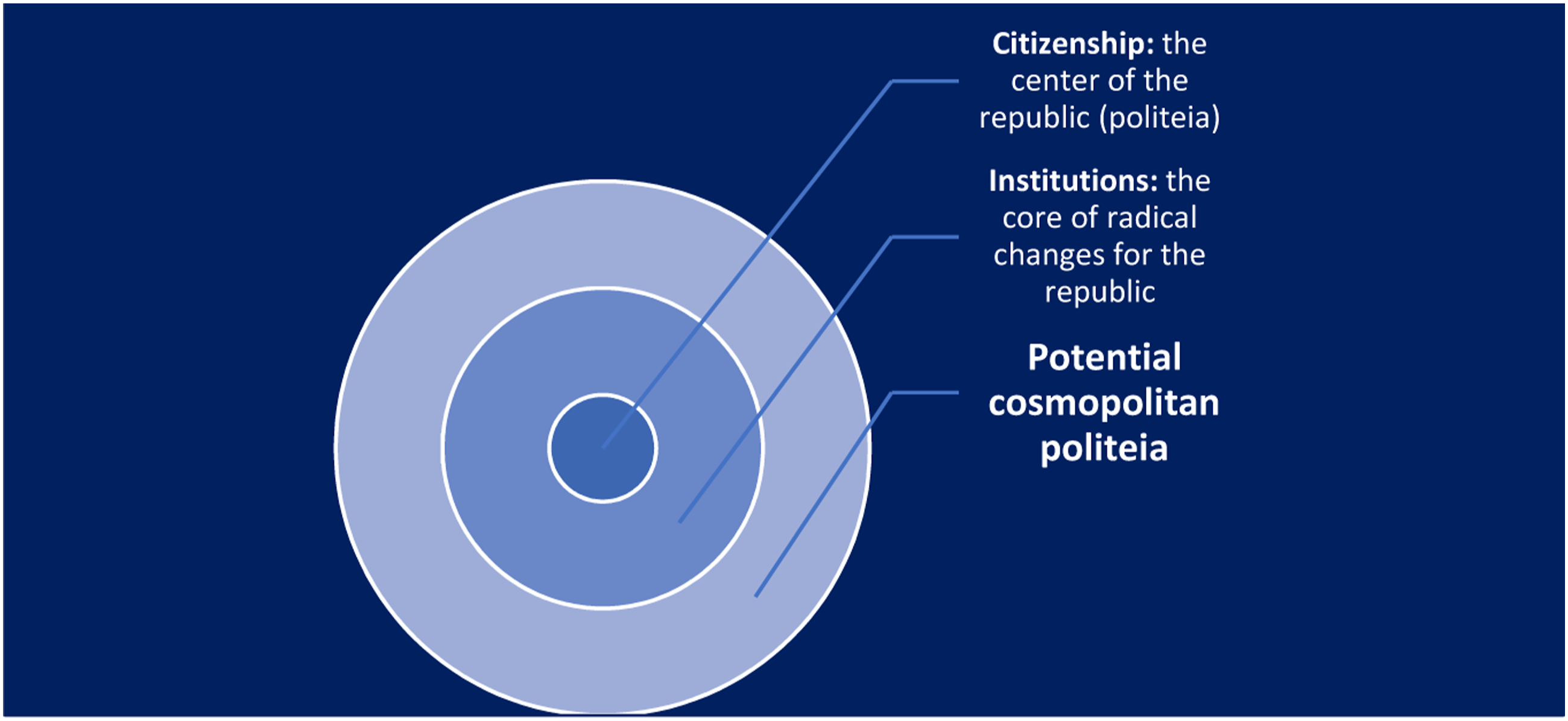
The sage is found widely in the work of Zeno and is not exclusively bound up with politics. The sage appears to favour a cosmopolitan city which can potentially consist of sages and will lead to a cosmopolitan city of citizens of the world. In such a city, there is a different institutional construction, according to Zeno, which is reflected in Kant’s idea of institutionalization towards a republican state within a cosmopolitan era. Zeno’s concept of cosmopolitanism is more than radical; it opens the way to a political order that is not yet to be done, but he is also critical of the contemporary polis, namely, the city-republic and radically in favour of democratization. Political innovation appears indispensable considering the institutional limits of cities’ borders, and it has two main points: the expansion of citizenship beyond city-states and the re-institutionalization of current politics so that a cosmopolitan republic (politeia) is grounded. Zeno emphasizes the reconfiguration of what citizenship might entail politically and the formation of political institutions that can consummate a state of political cosmopolitanism. Zeno’s Republic does not give a concise definition of a new or innovative democratic regime. Nonetheless, it sets centre stage the deepening and enlargement of political regimes and aspires to the grounding of a cosmopolitan republic, where universal citizenship is the common denominator for political innovation.
For both Zeno and Kant, citizenship and politics are not mere instruments in the hands of the establishment which have the purpose of safeguarding social peace and the unaccountable perpetuation of the institutional order.
11
For Gregory Vlastos as well as Anthony Long,
12
humans develop consent and ‘goodness in the proper functioning of reason’. Vlastos makes a remarkable note to an article by Long, writing that what is ‘fundamental to Stoicism’ is the ‘cosmic underpinning for law and society’.
13
It is precisely on this point that Zeno’s consideration within the Stoic frame of thought is presented as a wider deliberation not only towards politics but also towards social concerns and changes that claimed and vindicated radicalism in all forms of human existence, either individual or collective. The cosmopolitan condition in Zeno and Kant derives from the interaction of citizens and the potential cosmopolitanization process they undergo in order to stabilize peace. In Kant’s words, apart from the rights of the citizens of states and international rights, there is also: … [the] cosmopolitan right, to the extent that individuals and states, who are related externally by the mutual exertion of influence on each other, are to be regarded as citizens of a universal state of humankind (ius cosmopoliticum). This classification is not arbitrary but necessary with respect to the idea of perpetual peace.
14
However, Kant’s conception of what citizenship is and how it functions within the republic undergoes many significant variations. It ranges from the maintenance of the power of the peoples in Lectures on Anthropology (1775-6) to the aspects of the representation of citizens in Perpetual Peace (1795). 15 Kant’s main concern – particularly in the previous citation – is primarily with the eradication of warfare, 16 and such a goal is based on the consensus of citizens within a republican state. Particularly in his On the Common Saying, avoiding wars depends on the decision of the people and should not rest on the will of any ruler where ‘… each state must be organized internally such that not the head of state, … but rather the people … ought to have the deciding voice …’. 17
Kant is a good Stoic. He is far less radical but addresses the Stoic concern for universal citizenship by elevating it to form a world republic which he makes accountable to citizens. Kant had not studied Zeno, but he had studied the Roman Stoics from whom his institutionalism likely derives. Kant was not as radical as Zeno, but his universalism bordered on Zeno’s concern for the universal and, thus, cosmopolitan changes that would influence the political sphere. To this degree, Kant can be considered a Stoic with his cosmopolitan and universal interests amounting to political institutionalism that solidifies democracy and concerns itself with the consolidation of universal peace in a cosmopolitan democracy. Kant’s universalism includes three main points: (a) A federation of republican states; (b) the constant concern of universalism of the rights of citizens; and (c) the constitution of a public sphere of citizens of the world. 18 Such concerns analysed by Kant in his Critique of Judgment, and in general in his political writings, point to a thinker who is cautious but open as far as democratic participation and representation are concerned.
Kant’s republicanism is laden with all the anxieties of democratic procedures but does justice to the consummation of a modern political regime with cosmopolitan prospects. Kant famously insisted that the republican constitution grounds its stability on ‘… the agreement of the citizens [that] is required to decide whether or not one ought to wage war’. 19 In Maliks’ brilliant elaboration of Kant’s state, citizens are never entitled simply to act but make their claims through established public procedures 20 that extend beyond the national state to a cosmopolitan democracy. In On the Common Saying, Kant stresses the use of reason – as Zeno does too – for a practical stabilization of the cosmopolitan condition by prioritizing that ‘… from the cosmopolitan point of view, … the assertion still stands: Whatever reason shows is valid in theory, also holds true for practice’. 21
Within Kant’s republic, the use of reason creates ‘citizens of a universal state of humankind’. 22 Kant understands the universal state of humankind as constituting a demos that demands democratic participation and consists of citizens with universal rights. Despite his general caution over democracy as a regime, Kant moves towards republicanism and from there towards democratic ends by advocating a republic of citizens within which universality is reached, 23 and he remains dedicated to the prospect that ‘People, as states, … can and ought to demand of others that they enter … into a constitution, similar to that of a civil one … This would constitute a federation of peoples…’, 24 namely, not only a federation of states but also a federation that is constituted by citizens with universal rights which focus on setting states accountable to citizens.
From Zeno to Kant, the progress of democracy is measured according to how citizens think and generally act under the cosmopolitan condition. The notion of citizenship safeguards, in Kant, as it does in Zeno too, the public use of arguments that can bring about the rational progress of a republic. And although there are wider deliberative considerations in Zeno as to his cosmic radicalism and the influential position of the sages within such cosmic deliberations, there is a merging of horizons in both Zeno and Kant, which produces an argument on the establishment of a republic and what the latter prioritizes. 25 In Idea for a Universal History of 1784, Kant’s cosmopolitan condition secures the function of the modern state because it relies on the recognition of citizenship and prioritizes states’ federation that sets the political coordination of republican states centre stage on a universal scale. In his On the Common Saying of 1793, Kant elaborates on the idea of a cosmopolitan social context and, when attempting to define the civil condition that a republic promotes, he states as a precondition ‘The independence of every member of the commonwealth, as a citizen’. 26 Such independence is attributed to the accountability citizens ask of the modern state as a ruler whereby they constitute and define the social context of a republic. In Kant’s words, ‘The citizen must therefore be authorized, with the approval of the ruler, to publicly make known his opinion about what in the ruler’s decrees seems to be a wrong against the commonwealth’. 27
In his Perpetual Peace of 1795, Kant becomes looser in his argument and instead of arguing for a federal union of states, he develops the idea of a voluntary federation of states and emphasizes the impact of citizens’ representation within a republic, the importance of dialogue and the exchange of rational arguments among the citizens of an active republic. It is little wonder, then, that 2 years later, in the Metaphysics of Morals, his argument gravitates towards the idea of a universal union of states that consists of states of peoples (Völkerstaat). Continuing his emphasis on the citizen and the extent to which he can act politically as a role model for the function of states, Kant calls the federation he proclaims a Völkerstaat, namely, a state of peoples. At this point it is worth noting that attributing to Kant a state of states, when translating the previous term, might be considered a mistake. 28 Kant clearly emphasizes the importance of citizenship and the degree to which it supports and sustains the state and, consequently, a state of peoples.
Kant anchors peace in republics and citizens so that democratic means and ends are safeguarded within novel politics, and on such a point he is redolent of Zeno. 29 Both prioritized the constitution of the republics without compromising the significance of citizenship as a constituent part of the republican regimes. Kant’s Perpetual Peace can be considered as the culmination of a series of arguments in his political writings that amounts to a concise statement of what citizenship ought to be, namely, independence on the part of each person to exercise reason and universal rights within a cosmopolitan politics that allows people to render their authorities accountable. For Kant, citizenship is so pivotal in his presentation of the modern state that he simulates the function of states to the respective of citizens. Under the previous understanding, Kant supports cosmopolitanism as the condition that (a). promotes citizenship; (b). constitutes the presupposition for strong states; and, as a consequence, (c). consummates the polity of a republic. Therefore, Kant’s understanding of the state as a functional republic is filtered through the cosmopolitan condition, where the latter reinforces the state within and at an international level. But the same argumentation is furthered in his later works too.
It is worth comparing Kleingeld’s analysis 30 in which she argues that, in Kant’s mature work (Perpetual Peace and Metaphysics of Morals), the state needs a league of states and the cosmopolitan condition in order to safeguard law enforcement. For Kleingeld, Kant argues for a Völkerbund in Perpetual Peace and not for the abolition of the state. On the contrary, the cosmopolitan condition facilitates the transition to global justice through the federation of states. 31 Kleingeld is right in her article ‘Kant’s Changing Cosmopolitanism’ 32 that for democracy there has to exist a cohesive idea which, in Kant’s argument, focuses on the cosmopolitan condition that provides republics with the guarantee of universality in order to function and avoid wars.
If we wish to see Kant’s oscillation of political thought, we will encounter what I describe as Kant’s pendulum: his political thought oscillates from citizenship to the rights of the citizens and to republican states allying into federations under common norms so as to reach the potential of a cosmopolitan republic. Habermas comments on Kant’s breadth of thought, writing that ‘A republican constitution would guarantee the rule of law (Rechtzustand) internally as well as externally – the autonomy of citizens under self-made laws as well as the elimination of war from the arena of international relations’. 33 In Kant’s own words, ‘The problem of establishing a perfect civil constitution is dependent upon the problem of a law-governed external relation between states and cannot be solved without having first solved the latter’. 34 By no mere coincidence, in the same text Kant acknowledges that strong states and interstate relations safeguard peace, but it is primarily a strong state that safeguards peace by means of national and international law. It is precisely the equity of strong states through strong laws that governs international relations. 35 However, Kant avoids commenting on the fate of international relations and peace when states are not equally strong. He does not explain it explicitly, but that is the reason he introduces and insists on the notion of cosmopolitanism in order to ‘save’ the function of democratic regimes, statism and international law.
Instead of considering state politics as the base and prerequisite for cosmopolitan politics, Kant acknowledges the opposite: that it is the external interstate and transnational function that is the presupposition for solid states and civil constitutions. The following schema conveys the oscillation of Kant’s political thought, which moves and develops from the idea of a universal citizenship to the configuration of a cosmopolitanizing republican regime on a universal scale. Kant does not consider republican politics either within states or on a transnational level as a linear process of cause and effect. There is no initial point and no end in his political arguments. On the contrary, he identifies politics as oscillating within certain republican and thus democratic milestones that bear a cosmopolitan perspective. In Kant’s words ‘… a society would … also require a cosmopolitan whole, that is, a system of all those states which would otherwise be in the position to act to the detriment of each other’. 36 With the latter in view, Kant’s five main points on cosmopolitanism can be seen as the following:
Kant’s pendulum
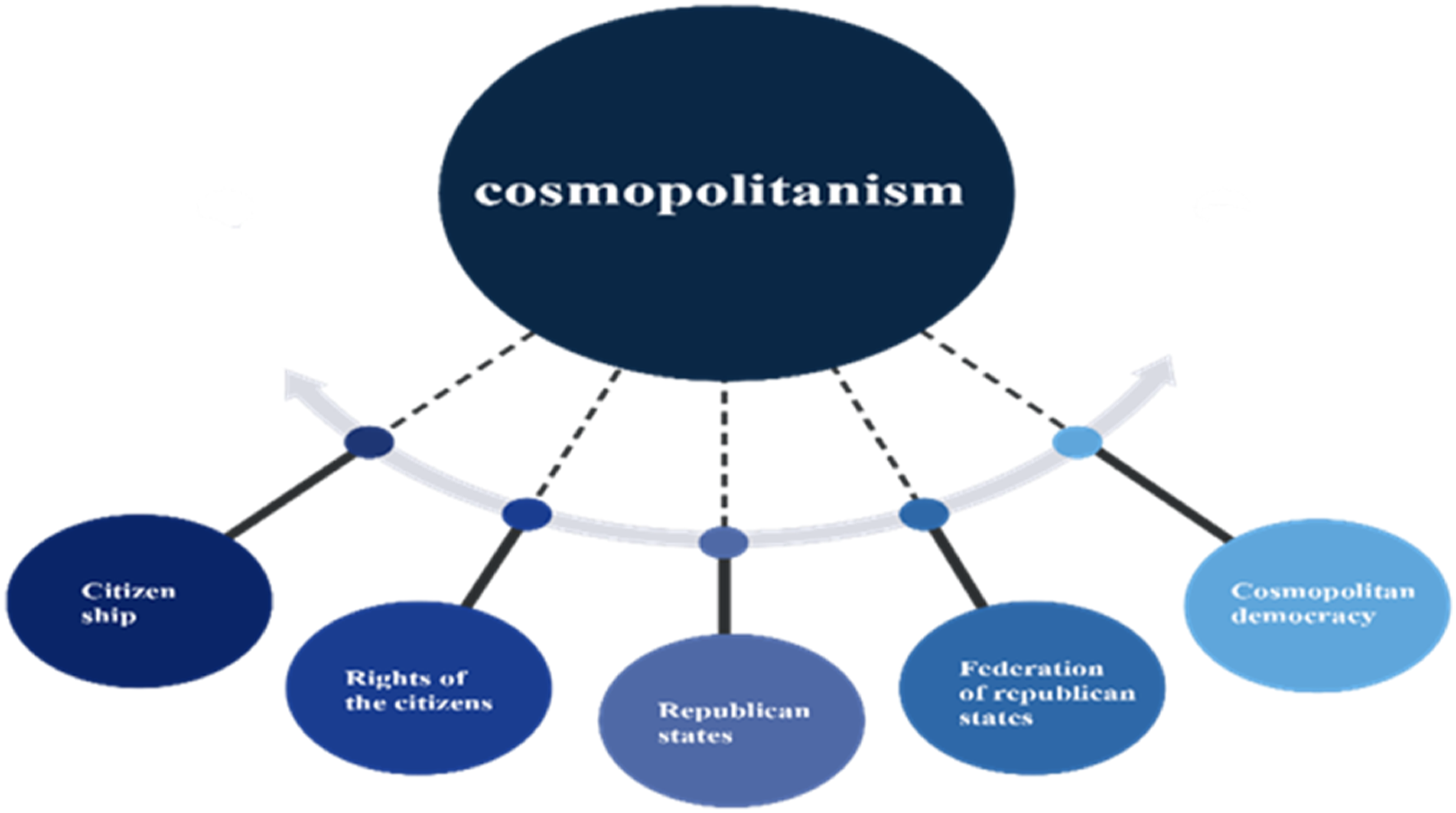
Kant’s pendulum is a concise argument to convince us, the citizens of the world, that human progress is possible by establishing universal peace and political federations of republican states directed towards democratic ends.
37
In Kant’s words: I base my argument upon my inborn duty to influence future generations in such a way that they will make constant progress (and I must assume that progress is possible), and that this duty may be rightfully handed down from one member of the series to the next. History may well give rise to endless doubts about my hopes, and if these doubts could be proved, they might persuade to desist from an apparently futile task. But so long as they do not have the force of certainty I cannot exchange my duty … for a rule of expediency which says that I ought not to attempt the impracticable. … [T]his uncertainty cannot detract from the maxim I have adopted, or from the necessity of assuming for practical purposes that human progress is possible.
In parallel to Zeno’s prioritization of reason as the presupposition for a better and cosmopolitan regime which furthers cosmopolitan citizenship, Kant’s public use of reason emphasizes not the use of reason as such but mainly its public impact. It is worth identifying the same problematics of the public use of reason in Kant too, where ‘Reason itself does not function according to instinct, but rather requires experimentation, practice, and instruction in order to advance gradually from one stage of insight to the next’. 38 In fact, a league of states is demanded by reason in Kant in the same way that citizens exercise the public use of reason in order to influence the state through their exercise of citizens’ rights. Kant presupposes the public use of reason equally by citizens and republican states where citizens make use of reason so that their cosmopolitan rights are also respected and the ‘transition to a global juridical condition’ 39 is possible.
Kleingeld is right in saying that ‘Kant’s theory of constitutional, international, and cosmopolitan right is a purely normative theory. It claims to show what is correct on the basis of principles of reason, not on the basis of principles of prudence’.
40
Kleingeld focuses on the political and not the practical, namely, the moral, philosophy of Kant. Habermas makes a similar step which takes the analysis of Kant’s thought a step further into what the democratic is. In his critique of modern democracy, Habermas remarks that Kant was an advocate neither of a liberal nor of a republican perspective. Indeed, Habermas mostly centres in his critique of democracy the importance that societies and public spheres attribute to public dialogue. In his words: Both the liberal and the republican traditions understand the political participation of citizens in an essentially voluntaristic sense: all should have the same chance to voice their own preferences or their political will in an effective way, be it in pursuit of their private interests (Locke), or in the exercise of their political autonomy (Mill). But if we also ascribe an epistemic function to democratic will-formation, the pursuit of self-interest and the realization of political freedom are supplemented by a further dimension, the public use of reason (Kant). Accordingly, the democratic procedure no longer draws its legitimizing force only, indeed not even predominantly, from political participation and the expression of political will, but rather from the general accessibility of a deliberative process whose structure grounds an expectation of rationally acceptable results.
41
Kant emphasizes the same point using different terms, namely, that the consequences of the public use of reason, dialogue and the exercise of the free exchange of argument pave the way for the political advent of a cosmopolitan democracy where the latter becomes an interactive dialogical process among citizens of the public sphere. It is, first, intersubjective because it allows for multiple political subjects to participate by means of public dialogue. Then it constitutes a process because there is no end achieved; rather, what it furthers is a procedure of opinions and deliberations, which in turn become political praxis and the consummation of citizenship within a universal public sphere.
Conclusions
Cosmopolitan democracy, in the sense of a political condition that grants citizenship and rights through institutionalism, can potentially balance or even function as an instigator of political innovation for both the weak politics of the national state and the unaccountable power of globalization processes.
The twenty-first century has started with less auspicious indications for politics and democracies: the economic crisis of 2007/8 which evolved into multiple economic crises throughout the world; the consequent rise of far-right rhetoric and politics and the war climate that provoked a huge wave of immigration which resulted in a refugee crisis throughout Europe – all of which have only intensified a sense of political instability, despair and the regression to parochial politics.
The collaboration of democracies on a transnational level appears to be not just an option but a necessity. The merits of democracy are many. Some of them are the rule of the majority, the ability to change the world and render the present and future better for societies. But perhaps the most significant characteristic of democracy is in its ability to innovate itself. That is why it has always gone, and still goes, hand in hand with the progressive spirit of modernity: to provide good politics for all.
Apologists for national democracies address social and political necessities to an ever-diminishing extent: their talks seem more like speeches or lamentations on current morality and the rationalization of tasks and duties of an old and parochial regime on the eve of collapse, rather than articulate arguments on democracy.
In the twenty-first century, there are many reasons for one to be a pessimist, and yet, it is still the case that ‘… the critical power to put a stop to violence without reproducing it in new forms can only dwell in the telos of mutual understanding and our orientation to this goal’. 42 The issue of a cosmopolitan democracy should probably be dealt with in the same way that Zeno and Kant attempted to approach it: as an open political alternative to violence and authoritarianism. Their political writings were neither a moralizing defense of democracy nor an instrumental argument that would ‘produce’ an affirmation of cosmopolitanism. Their theses on the cosmopolitan condition intended to bring about the argument of transnationalism that would strengthen both democratic politics and the state and solidify peace for all. The following table condenses their arguments in a comparative mode:
Zeno and Kant in comparison: The cosmopolitan imperative
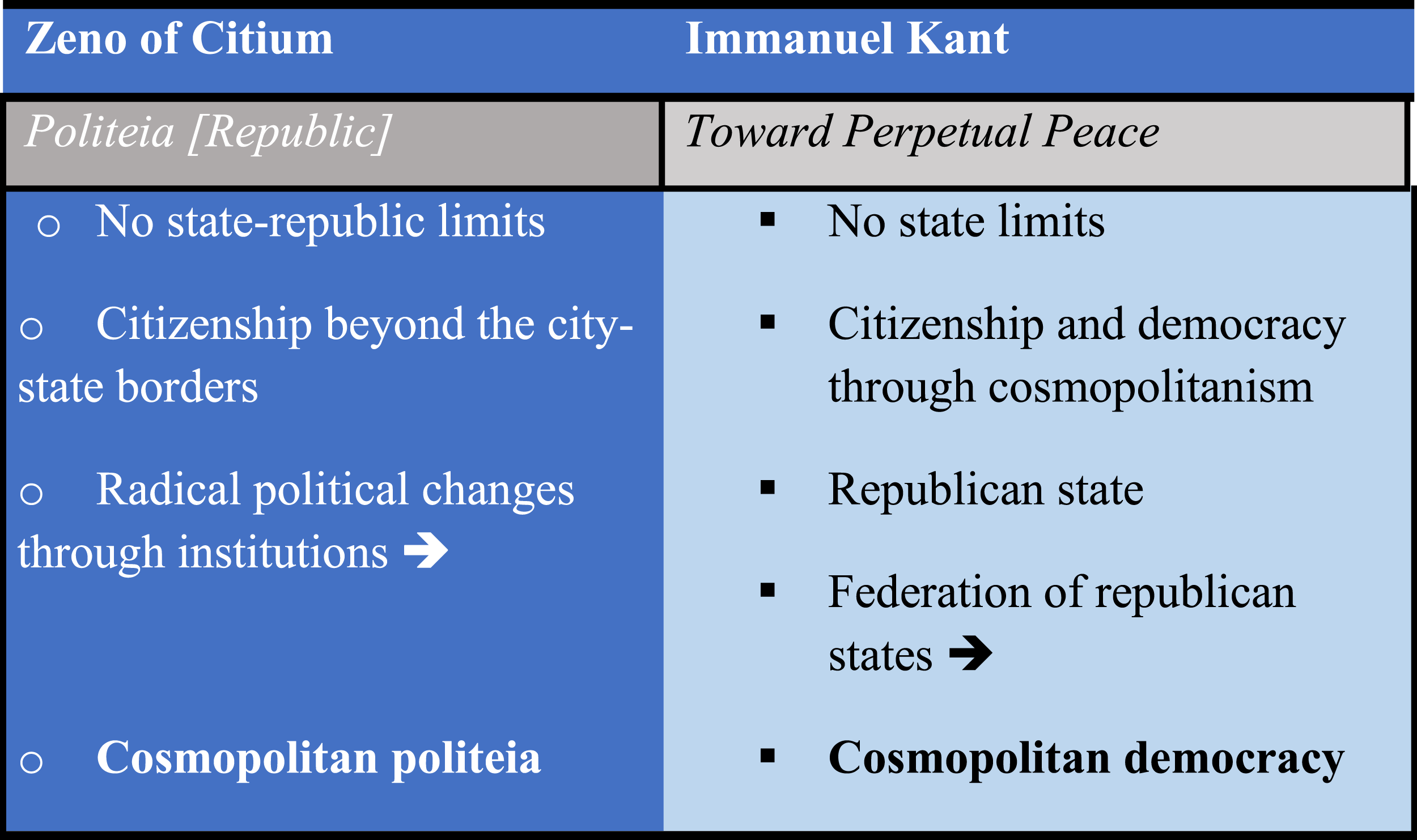
For both Zeno and Kant, their main thesis on cosmopolitanism sought to indicate that it is transnationalism and not the state that facilitates democratic politics and peace, not vice versa. Although much earlier than Kant, Zeno was a devoted radical. However, my focus here has not been to trace the extent to which Kant ‘de-radicalizes’ Zeno’s argument. Perhaps Kant de-radicalizes Zeno’s political perspective of cosmopolitanism because the Stoic cosmopolitanism of Zeno draws on changing the political status of the universe, while Kant wishes to ‘ask’ the world how it intends to avoid wars and stabilize democracy beyond borders.
Although it might seem voluntaristic or apologetic to proclaim a defense of democracy, bringing the issue of cosmopolitan democracy to the fore in the twenty-first century is neither voluntaristic nor apologetic. It acknowledges that the multiple crises that democracies experience today call for a defense of the democratic condition not according to a voluntaristic coercion or an apologetic response but mostly in order to redefine and innovate its content and function.
Democracy remains an unfinished project because it does not filter out the undemocratic or anti-democratic tendencies. The weak democracies, or what Habermas calls the ‘formal democracies’, 43 can easily be replaced by administrative authoritarianism instead of open and participatory regimes of democratic means and ends which remain accountable to a wide public sphere of citizens on a cosmopolitan level. As with all weak democracies that eschew decision-making procedures, today’s regimes have all the external characteristics of democracy: they have committees, conferences, sessions and multiple spheres of institutionalization, namely, they maintain all procedural and formal traits of democratic regimes. However, what is missing is the essence of democracy, namely, dialogue, critique, exchange of arguments, citizenship rights and decisions validated on an institutional level by those who suffer their consequences. What is contradictory in many contemporary democracies of the Western world is the clash between procedures and essence, namely, between formalities and actual traits that further the democratic condition both within and outside institutional procedures.
The twentieth century, probably because of the occurrence of two world wars unprecedented in their destructiveness, gave us the opportunity to reconsider notions such as cosmopolitanism and democracy, both in themselves and in their relationship to each other. What the twentieth century set as its priority on the European continent was the recovery of peace and stability by means of democracy. The critique of existing democratic regimes appeared as the path to rediscovering both democracy and the stabilization of peace in the twenty-first century.
