







Abstract
This study aims to examine the effects of rationality and emotion on voter turnout. By applying the empirical implications of a theoretical models framework, I outline the relationship between rationality, emotion, and turnout and propose two hypotheses about the effects of party differential and emotion differential on turnout. The empirical test using data from American National Election Studies 1996, 2000, 2004, and 2008 shows that both party differential and emotion differential exert significantly positive effects on turnout, which confirms that individual turnout decision is a function of both rationality and emotion. However, this study suggests that rationality plays a more important and consistent role in individual turnout decision than emotion, because the effect of emotion on turnout might be built on the appearance of charismatic candidates.
Keywords
Introduction
Voter turnout is the most common form of political participation in a democracy. Low voter turnout is a threat to democracy because democracy depends on citizen participation in elections to select representatives for public office. If citizens did not participate in elections, it would be impossible to constitute a democratic government. Furthermore, citizen participation in elections allows people to hold elected officials accountable for their policies and actions. Due to the importance of turnout to democracy, scholars have paid a lot of attention to what affects individual turnout decision, and many theoretical advances have been made in the study of turnout. One of the most influential theories of turnout is rational choice theory: that individual turnout decision is a function of individual benefit–cost calculations. That is, when benefits of voting are greater than the costs, people will choose to go out to vote; by contrast, when benefits of voting are less than the costs, people will opt for abstention.
Rational choice theory has played an important role in the analysis of voter turnout ever since Downs’s (1957) seminal work. However, previous studies have called into question individual rationality due to the fact that it is impossible for people to get all information about competing parties, and that it is also difficult for them to digest too much information. On the other hand, over the last few decades, there has been a dramatic increase in the understanding of the role of emotion in mass behavior. Moreover, it is realized now that there is a close link between emotion and political attitudes and behavior. For example, emotion is found to strongly predict individual political preferences (Abelson et al., 1982), evaluations of office-holder performance (Conover and Feldman, 1986), and support for public policy and political action (Huddy et al., 2005; Pagano and Huo, 2007). Despite these advances, there has thus far been relatively little research into the relationship between emotion and turnout. More importantly, it has been unclear whether rationality or emotion, or both, plays a more pivotal role in individual turnout decision.
As a result, this study attempts to investigate the effects of rationality and emotion on turnout and expects to offer a better understanding of the roles of rationality and emotion in individual political engagement. Specifically, this study employs the empirical implications of theoretical models (EITM) framework for unifying formal models and empirical analysis, and expects to produce greater transparency in relating theory to empirical tests.
1
This article is organized as follows. The second section provides a literature review about the relationships between rationality and emotion and turnout. The third section discusses the EITM framework and outlines a set of working hypotheses. The fourth section provides an introduction to the data and measurement for empirical test
Rationality, emotion and turnout
Given the postulate that individuals are self-interested rational maximizers, theorists working under the rational choice rubric have provided important, though often controversial, insights into the study of political behavior. Rational choice theories assume that individual preferences for particular actions are the result of expected utility calculations. Specifically, an individual prefers outcomes with higher utility to those with lower utility and chooses actions to receive more highly valued outcomes. Actions are the means to obtain desired ends and have value only insofar as they affect outcomes (Aldrich, 1993). That is, an action has value only if it affects outcomes, which is known as the instrumental view of rationality. Based on this behavioral assumption, Downs (1957) first develops the calculus of voting model, which states that in deciding whether to vote or abstain, a voter calculates the expected utility of either action and votes if benefits exceed costs. The calculus of voting model can be expressed as the equation R = (PB) – C, where R represents the expected utility of voting and PB represents the benefits from voting. More specifically, P stands for the probability that one’s vote influences the outcome and B stands for the difference in expected utilities from the policies of the two candidates. Finally, C refers to the costs of voting. As a result, if R > 0, it is reasonable to vote; while if R ≤ 0, it is not reasonable. However, because the probability of affecting the outcome (P) is low to non-existent and the benefits of political action (B) are collective goods, PB is likely to be close to zero (Geys, 2006). Therefore, although Downs (1957) and Aldrich (1993) argue that the costs of voting are only minor, in fact, it does not take much for the costs of turning out to exceed the benefits, and any positive cost (C) can render voting an unprofitable venture, which implies that even small costs of voting can make turnout irrational.
If Downs’s analysis is carried to its logical conclusion, it implies that the probability of individual turnout will be close to zero. However, it is obvious that this instrumental view of voting cannot explain the level of real turnout rates. In dealing with this perplexing situation, Downs suggests that rational citizens might turn out simply to support democracy, realizing that the consequence of near-universal abstention will be the destruction of democracy. Hence, Downs adds a term, D, into the model to represent the value of seeing democracy continue. Therefore, the original equation is reformulated into: R = (PB) – C + D. Riker and Ordeshook (1968) attempt to improve the Downsian model by blending some social-psychological ingredients into it. However, they call the D term, “citizen duty,” representing the value of doing one’s duty as a citizen, as well as an array of other values, such as expressing support for the country and the political system. By voting, the citizen fulfills the duty to which he has been socialized and thereby experiences a psychological satisfaction that may outweigh the costs of voting. Furthermore, Fiorina (1976) adds to the D term such concerns as expressing allegiance to a favored candidate or party and calls it an “expressive” component to the vote, for the voter receives that value from voting, regardless of the outcome, whereas he names the part of “(PB) – C” as an “instrumental” component of voting. Although the addition of the D term to the calculus of voting can explain positive turnout levels, various critics have expressed uneasiness with this reformulation. Given that the PB term is likely to be small, R is equal to the difference between D and C (i.e. R = D – C) (Strom, 1975). This implies that turnout is essentially driven by reasons unrelated to the central element of the democratic process (Geys, 2006) and, empirically, most of the action appears to be in the D term (Barry, 1970). Furthermore, if (PB) is insignificant, this model may come perilously close to the realm of tautology, or at least triviality (Fiorina, 1976).
Despite these problems, this model has been tested extensively, and all tests find that the C, D, and B terms are strong predictors of turnout. In terms of the P term, there are mixed findings. Some empirical analyses, especially those using aggregate data, find that the P term is a significant predictor (Barzel and Silberberg, 1973; Settle and Abrams, 1976), but other tests using survey data (Ferejohn and Fiorina, 1974; Foster, 1984) find that it is not related to turnout. In sum, this baseline model provides a valuable theoretical framework for the study of turnout, and starting with this baseline model, I will explain how I integrate rationality and emotion into this model by using the EITM framework in the next section.
Next, I switch attention to the relationship between emotion and turnout. Emotion is commonly defined as mental and physical responses to identifiable stimuli deemed consequential for individual or group objectives, which comprises five constituent processes: an appraisal that a stimulus has potential consequences for one’s goals; physiological change in preparation for action; changes in cognitive activity that aid adaptation; an action tendency; and the conscious experience of an emotion called a “feeling” (Miller, 2011). The role of emotion in politics is pervasive both because emotion enables past experience to be encoded with its evaluative history and because emotion enables contemporary circumstances to be quickly evaluated (Marcus, 2000). Marcus et al. (1993, 2000) are among the first researchers who emphasize the critical role of emotion in political behavior and argue that emotions have an important adaptive function. They distinguish between enthusiasm as a positive emotion and anxiety as a negative emotion, and demonstrate that they are two distinct dynamic emotional responses. Positive emotion as a reaction of the disposition system indicates that the environment is safe and that the individual does not have to take any action. As a consequence, individuals rely on routines and learned behavior. In contrast, negative emotion as a reaction of the surveillance system indicates a possible threat in the environment. In this situation, negative emotion shifts the attention of individuals to the threatening event and prepares subjects for possible action.
Since then, theories about the role of emotion in political behavior have focused primarily on one set of positive emotions (e.g. enthusiasm, hopefulness, pride, etc.) and one set of negative emotions (e.g. anxiety, anger, fear, etc.). Damasio (1994) finds that both positive and negative emotions can impact individual decision-making processes and, in general, there are two classes of theories to explain the effect of emotion on political behavior. Neuroscience-based approaches, including affective intelligence theory, highlight the similarities between anger and anxiety, which respond to threat and novelty, activating the surveillance system (Gray, 1990; Marcus et al., 2000). On the other hand, cognitive appraisal theories tell us that anger triggers risk-seeking behavior and problem-focused coping, while anxiety leads to risk avoidance and emotion-focused coping (Valentino et al., 2011).
It seems that negative emotion plays a more important role in affecting political participation than positive emotion, but previous studies do find different effects of positive and negative emotions on individual political behavior. For example, Marcus (1988) finds that positive emotional response to the candidates is more influential than negative emotional response in predicting individual vote choice in the presidential election; Valentino et al. (2011) show that anger, more than anxiety or enthusiasm, can powerfully motivate campaign participation. 2 Nonetheless, so far, few studies have examined the effect of emotion on turnout. As mentioned previously, previous studies suggest that emotions are characterized on a single continuum ranging from positive to negative and factor analyses of individuals’ reports of their emotions yield a two-factor solution in many studies (Marcus and Mackuen, 1993; Watson and Tellegen, 1985). Despite the advantage of the differentiation between positive and negative emotions for understanding the relationship between emotions and political behavior, such a dual-system model cannot help explain the relationship between emotions and turnout because this model predicts that positive emotions motivate an individual to take actions, whereas negative emotions likely inhibit an individual’s actions (Namkoong et al., 2012). In this study, it means that positive emotions would stimulate people to go to the voting booth, whereas negative emotions would demobilize turnout. 3
Such predictions, however, are valid only when we assume that there is only one target of emotion. If there is another simultaneous emotional target and it is negatively related to the first target, the dual-system model might not predict the perceiver’s behavior properly because an individual could have positive emotions toward one candidate but negative emotions toward another. For instance, Barack Obama and Mitt Romney were the candidates in the 2012 US presidential election. If a voter had negative emotions toward Romney, she may have been less likely to cast a vote according to the dual-system model. Nonetheless, this voter may finally decide to vote because she has positive emotions toward Obama. As a result, when it comes to turnout, it is important to consider the voter’s emotions toward all candidates, which cannot be explained by the dual-system model.
To overcome the limitations of the dual-system model, this study introduces the concept of “emotion differential,” which means the difference in a voter’s favorable emotions toward competing candidates. Moreover, “favorable emotions toward a candidate” is defined as an individual’s emotional state formed favorably toward a candidate and constructed by combining positive and negative emotions toward a candidate. 4 Theoretically, in two-candidate electoral competition, if a voter holds more favorable emotions toward one candidate than the other, she may be likely to vote to support her favorite candidate; by contrast, if a voter emotionally does not prefer any candidate, she may decide to abstain from voting due to her lack of emotional motive.
The preceding discussion briefly outlines the relationship between rationality, emotion, and turnout, and, in general, this study argues that an individual’s decision on turnout depends on whether she perceives any difference in expected utility and emotional preference between competing candidates. In the next section, I employ the EITM framework to propose a theoretical model for this study. Besides, it must be remembered that emotion is not seen as being incompatible with the rational choice model, and the next section will show how I integrate the emotional component into the baseline model of turnout developed by Downs (1957) and Riker and Ordeshook (1968).
The EITM framework
The EITM framework places an emphasis on developing behavioral and applied statistical analogues and linking these analogues. 5 It contains three steps: the first step is to find an appropriate statistical concept to match with the theoretical concept; the second step is to find an analogue to link theoretical and statistical concepts with empirical tests; and the third step is to unify the mutually reinforcing properties of the formal and empirical analogues (see Granato et al., 2010). Therefore, I follow these three steps to propose the EITM framework for this study.
Step 1: Unify theoretical concepts and applied statistical concepts
In light of the discussion in the previous section, it is argued that turnout is a function of rationality and emotion. In other words, rational calculation of benefits and costs of voting and emotional reactions to vote choices (i.e. parties or candidates) play a pivotal role in affecting individual turnout decisions. Therefore, for this study, the theoretical concept is decision-making. Besides, this study focuses on turnout, which is a dichotomous action. Hence, for this study, the applied statistical concept is discrete choice. To sum up, decision theory and discrete choice serve as the EITM relation.
I begin with the baseline model of turnout initiated by Downs (1957) and Riker and Ordeshook (1968). As mentioned previously, the basic idea is that only when personal benefits exceed personal costs does an individual go out to vote. The baseline model for turnout is presented as follows:

where: u(v) is the utility of turnout; P is the probability of affecting outcome; B is the difference in benefit to the voter of one or the other party winning; C is the costs associated with voting; and D is the benefit from expressing oneself, which can refer to expressing one’s compliance with the ethics of voting (i.e. citizen duty) or to expressing a preference among the candidates. Therefore, if u(v) > 0, an individual will choose to vote; however, if u(v) ≤ 0, an individual will abstain from voting.
Some scholars argue that the costs of voting for most voters are in fact very low (Aldrich, 1993; Downs, 1957; Tullock, 2000). In accordance with Riker and Ordeshook (1968), I assume that the cost of voting is constant and thus exclude the C term from equation (1). 6 Besides, in terms of the P term, since I employ survey data to conduct empirical analysis, I follow the conclusion made by Ferejohn and Fiorina (1974) and Foster (1984) that the P term does not matter for turnout and choose to exclude the P term from my formulation. 7 Lastly, emotional reaction to the candidates reflects the “expressive” component of voting, as called by Fiorina (1976), to some degree, though it cannot gauge the part of citizen duty. 8 As a result, I replace the D term with the emotional component (i.e. E) and derive the following utility function: 9

where the definition of B is the same as earlier and E is the voter’s emotional preference for one candidate over the other. However, the benefits of voting (B) can be understood in terms of the “party differential” in the terminology of Downs (1957). That is, each voter would compare her expected utility of having party A (incumbent) in government (i.e. for another term) with the expected utility of having party B (opposition) in government, and this utility differential would determine each voter’s choice at the ballot box. Hence, to estimate the B term, I use the idea of party differential (i.e. Pd) developed by Downs (1957); by contrast, to gauge the E term, I create a new concept called “emotion differential” (i.e. Ed), meaning the difference in a voter’s positive emotions toward competing candidates. As a result, the utility function for this study can be rewritten as follows:

To simplify my argument, I focus on countries with two-party systems and assume that the true value of party differential is a linear function of its observed value,

where β0 is equal to the sum of α1 and α2.
Step 2: Develop behavioral (formal) and applied statistical analogues
The behavioral analogue I use is decision theory (e.g. utility maximization), and, therefore, it is known that when the utility of turnout is positive (i.e. u(v) = B + E > 0), the voter will choose to vote. In contrast, when the utility of turnout is negative or equal to zero (i.e. u(v) = B + E ≤ 0), the voter will abstain from voting. More specifically, it is known that an individual i will go out to vote if:
Bi > 0 and Ei > 0.
Bi > 0 but Ei = 0.
Bi = 0 but Ei > 0.
In other words, only when an individual perceives no differences in expected utility and emotional preference between competing candidates would she choose to abstain from voting. Furthermore, this study assumes that B and E are respectively conditioned on the observed values of party differential (i.e.

Equation 5 is just a conventional setup of the logit model. Because this study assumes turnout as a dichotomous action (i.e. vote or abstain), the applied statistical analogue I use is discrete choice modeling, that is, the binary logit model.
Step 3: Unify and evaluate the analogues
The empirical test follows directly from the theoretical model (i.e. equation 5), and methodological unification occurs when an empirical analogue for discrete choice is used. Specifically, the binary logit model is based on equation 5, and can be expressed as follows:

where γ0 is a constant and γ1 and γ2 are the coefficients of interest for this study. In particular, this study tests the following two hypotheses: H1 (Party differential hypothesis): party differential is positively associated with voter turnout (i.e. γ1 > 0) H2 (Emotion differential hypothesis): emotion differential is positively associated with voter turnout (i.e. γ2 > 0)
Empirical test: Data, measurement, and modeling
To test the hypotheses, I focus my analysis on presidential elections of the US and use the data from American National Election Studies (ANES). 10 Furthermore, I limit my analysis to the past four presidential elections (i.e. 1996, 2000, 2004, and 2008) due to the difference in the measurement scale of emotional reactions to candidates. 11 Besides, since turnout is a dichotomous action, I undertake the analysis of turnout with the use of binary logit models, as mentioned previously. The measurements of variables are as follows.
Voter Turnout: The dependent variable is whether people voted in the presidential election and, therefore, it is a dichotomous variable coded as 1 for those who voted in the 1996, 2000, 2004, and 2008 presidential elections and 0 otherwise.
Party differential: This variable reflects the rational dimension of turnout. With regard to its measurement, I adopt Downs’s suggestion that ideology is a short cut for learning the party’s position on a variety of issues. That is, the ideological positions of parties can be used as a proxy for their policy positions so that voters are able to use the ideological positions of parties to calculate their expected utility of voting. As a consequence, in terms of party differential, I first calculate the absolute difference in ideological positions between the respondent and the Republican Party and between the respondent and the Democratic Party on a seven-point scale, respectively. Then I calculate the absolute difference of both values. Hence, the calculation of party differential can be presented as follows:

where: Ii is voter i’s ideological position; IR is voter i’s perception about the ideological position of the Republican Party; and ID is voter i’s perception about the ideological position of the Democratic Party. If party differential is equal to zero, it implies that both parties make no difference to the respondent.
Emotion differential: This variable demonstrates the emotional dimension of turnout. ANES has asked the respondent to express her feelings toward presidential candidates, that is, whether she feels angry, hopeful, afraid, and proud toward a specific presidential candidate and how often she has this kind of feeling. 12 I first recode each feeling to range from 0 to 4, with the higher values signifying more positive feelings. Then I aggregate the respondent’s feelings toward each presidential candidate ranging from 0 to 16, respectively. 13 Lastly, I calculate the absolute difference of both values. Therefore, the calculation of emotion differential can be presented as follows:

where ERC is the respondent’s positive emotions toward the Republican presidential candidate and EDC is the respondent’s positive emotions toward the Democratic presidential candidate. If emotion differential is equal to zero, it denotes that the respondent has the same emotional preference for both presidential candidates.
Although my main focus is the effects of party differential and emotion differential on voter turnout, my final analytic model includes some conventional variables related to voting participation as controls, such as electoral concern, electoral competitiveness, intensity of party identification, political interest, and demographic factors (i.e. education, income, race, gender, and age).
First of all, previous studies have demonstrated that the extent of concern about the electoral outcome can account for variations in voter turnout (Campbell et al., 1960; Riker and Ordeshook, 1968). Electoral concern is treated as a dummy variable and coded as 1 if the respondent is concerned about the electoral outcome and 0 otherwise. It is expected to find that electoral concern has a positive impact on voter turnout. In other words, a respondent who is concerned about the electoral outcome is more likely to vote in the presidential election.
Second, dominant theories of voter participation predict that close electoral competition is associated with higher turnout (Foster, 1984; Riker and Ordeshook, 1968). Thus, I create a dummy variable, electoral competitiveness, to control for the perceived intensity of the race (1 if the respondents think that the race is tight and 0 otherwise). It is expected to find that electoral competitiveness has a positive influence on voter turnout. That is, a respondent who regards the electoral race as more competitive is more likely to vote in the presidential election.
Third, party attachment has been a powerful predictor of individual voting behavior and past research has shown that those who identify with a specific political party are more likely to vote (Bartels, 2000; Campbell et al., 1960; Green et al., 2002; Timpone, 1998). Hence, I create a continuous variable to measure the respondent’s intensity of party identification, coded to range from 0 to 3, 0 being an independent and 3 being a strong partisan. It is expected to find that a respondent who reports a strong identification with a political party is more likely to vote.
Fourth, evidence suggests that voters with a great interest in politics have higher turnout rates (Campbell et al., 1960; Miller, 1980; Verba et al., 1995). Political interest is coded as a continuous variable ranging from 0 to 2, 0 being that the respondent has no interest in politics and 2 being that the respondent is very interested in politics. Nonetheless, the 2008 ANES Time Series Study used two different questions to gauge the respondent’s political interest, one of them is the standard version of the campaign interest question and the other is a revised one. Half of the respondents are asked by using the standard question and the others are asked by using the revised question. Because the answer to the revised campaign interest question is different from the standard version, having five answer categories – extremely interested, very interested, moderately interested, slightly interested, and not interested at all – instead of the standard three, I recode them to three categories. Consequently, political interest is coded as a continuous variable ranging from 0 to 2, 0 being that the respondent has no interest in political campaign news and 2 being that the respondent is very interested in political campaign news. It is expected to find a positive relationship between political interest and voter turnout. That is, the respondent with a high level of political interest is more likely to vote.
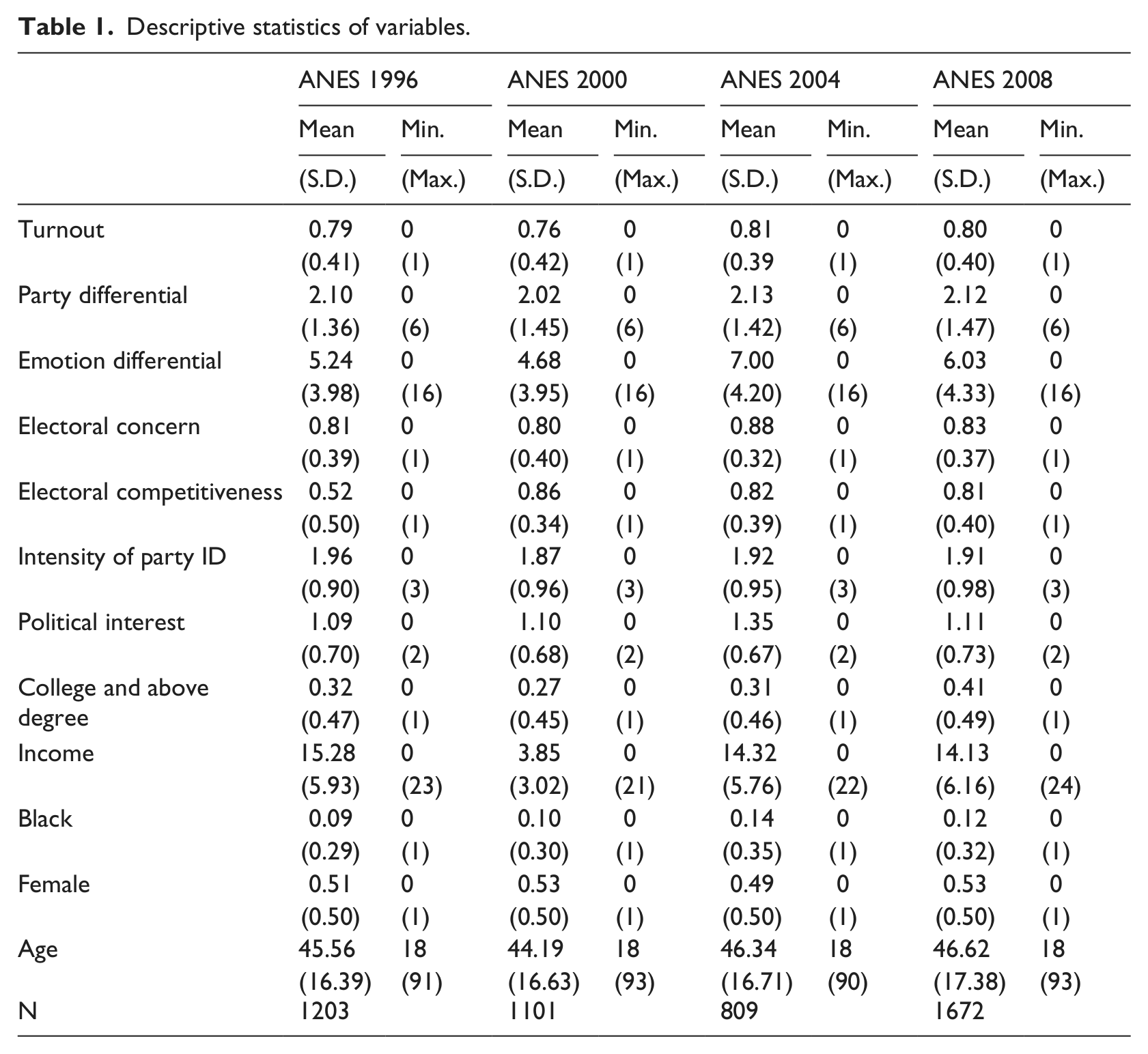
Finally, in terms of demographic variables, some studies have indicated that citizens with more formal education are associated with higher turnout (Shields and Goidel, 1997; Tenn, 2007; Verba et al., 1995). Therefore, I use one dummy variable to measure the respondent’s educational level, with College and above degree coded as 1 for those who are in the corresponding categories and 0 otherwise. In other words, those with an educational level of senior high school and below degree are treated as the reference group. Next, wealthier people are found to vote at higher rates (Leighley and Nagler, 1992; Rosenstone and Hansen, 1993). Accordingly, income is treated as a continuous variable, with higher values meaning that the respondent has more income. Moreover, because the measurement scales of income are different in these four data sets, the value range of income is recoded differently. In addition, race is coded as a dummy variable, Black, with 1 for black people and 0 otherwise; gender is a dummy variable coded as 1 if the respondent is female and 0 otherwise; and the respondent’s age is measured by the number of years since birth. Table 1 reports the descriptive statistics of all variables.
Descriptive statistics of variables.
As a result, to examine the impacts of party differential and emotion differential on voter turnout, I present estimates using the following equation:

Empirical test: Findings
As can be seen in Table 2, party differential is found to exert a significant positive effect on turnout in the past four presidential elections, 1996, 2000, 2004, and 2008. That is, those who perceive the ideological difference between the Republican and Democratic parties are more likely to vote. Besides, as Figure 1 shows, the effect of party differential on turnout has been stable and consistent over time. In general, the difference in probability of turnout between people with the lowest level of party differential and those with the highest level of party differential is approximately 10%, holding all other independent variables at their mean. As Downs argues, the ideological view of a political party can reflect its policy position, and, therefore, voters are able to use ideology as a short cut to calculate the party’s expected utility. Once voters find that there are significant differences in expected utility provided by different political parties, they will increase their probability of turnout so that they are able to vote for the political party that can bring them the best expected utility. In contrast, emotion differential is only found to be positively associated with turnout in the 1996 and 2008 presidential elections. In other words, if the voter has a clear emotional preference for one candidate over the other, she is more likely to go out to vote. More specifically, as Figure 2 shows, the differences in probability of turnout between people with the lowest level of emotion differential and those with the highest level of emotion differential are, respectively, 12% in the 1996 presidential election and 8% in the 2008 presidential election, holding all other independent variables at their mean. A possible explanation for the significant role of emotion in the 1996 and 2008 presidential elections might be that the Democratic Party had charismatic candidates to run for election, that is, Clinton in the 1996 election and Obama in the 2008 election. Both rode their charisma and ensuing popularity to fairly decisive election victories. Charismatic leadership theory postulates that charismatic leaders are able to transform the needs, values, preferences, and aspirations of followers by presenting them with a powerful vision that appeals to people’s emotions and boosts self-worth (Emrich et al., 2001; House et al., 1991). Accordingly, followers tend to form strong emotional attachments and have a high sense of trust and confidence in the charismatic leader (House et al. 1991). Accordingly, it is expected that the appearance of charismatic candidates is more likely to arouse the emotions of voters, which then increases their likelihood of turnout. To sum up, these findings lend some support to my hypotheses that party differential and emotion differential have positive effects on turnout, though the emotion differential hypothesis is not confirmed in the 2000 and 2004 presidential elections.
Binary logit analysis of turnout.
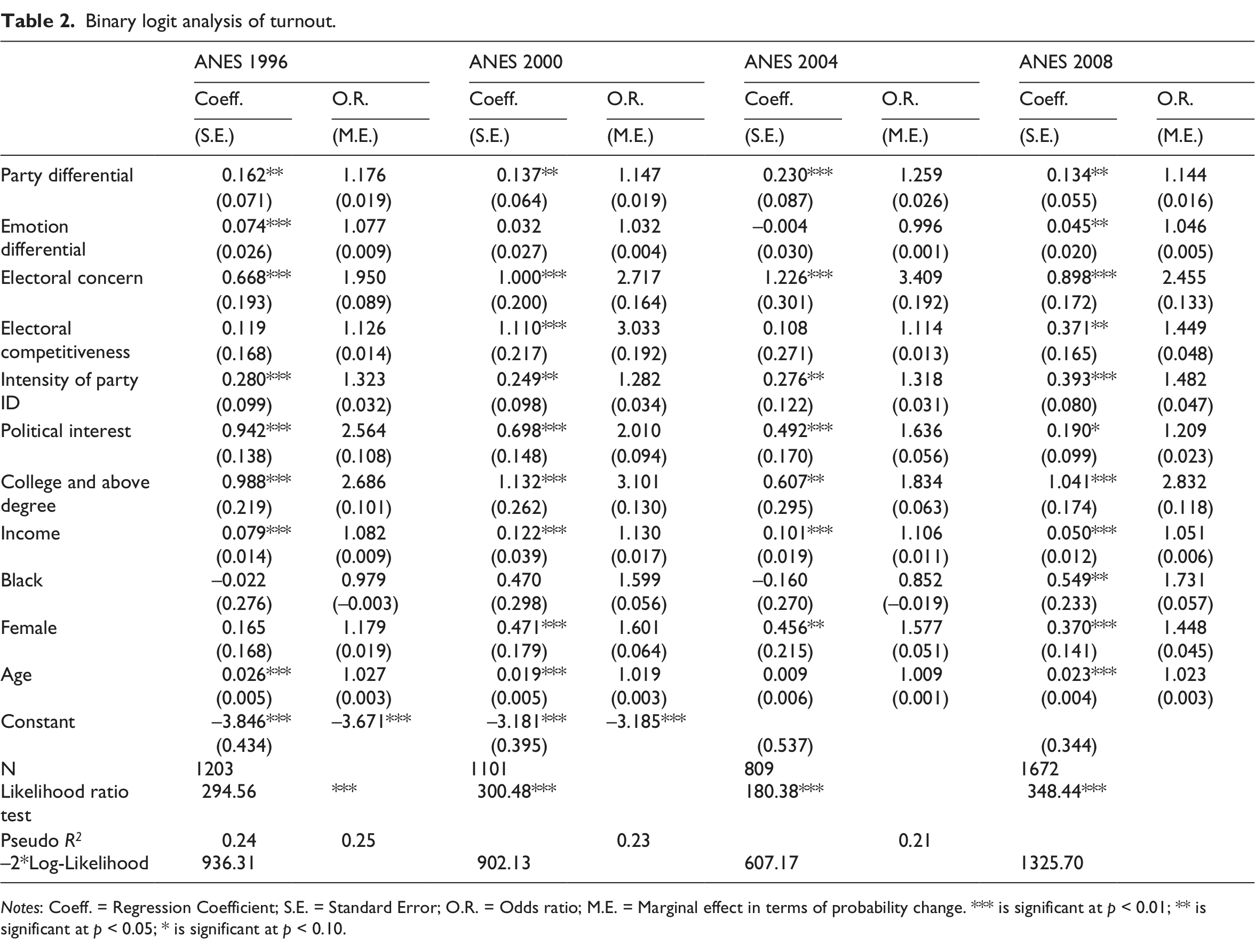
Notes: Coeff. = Regression Coefficient; S.E. = Standard Error; O.R. = Odds ratio; M.E. = Marginal effect in terms of probability change. *** is significant at p < 0.01; ** is significant at p < 0.05; * is significant at p < 0.10.
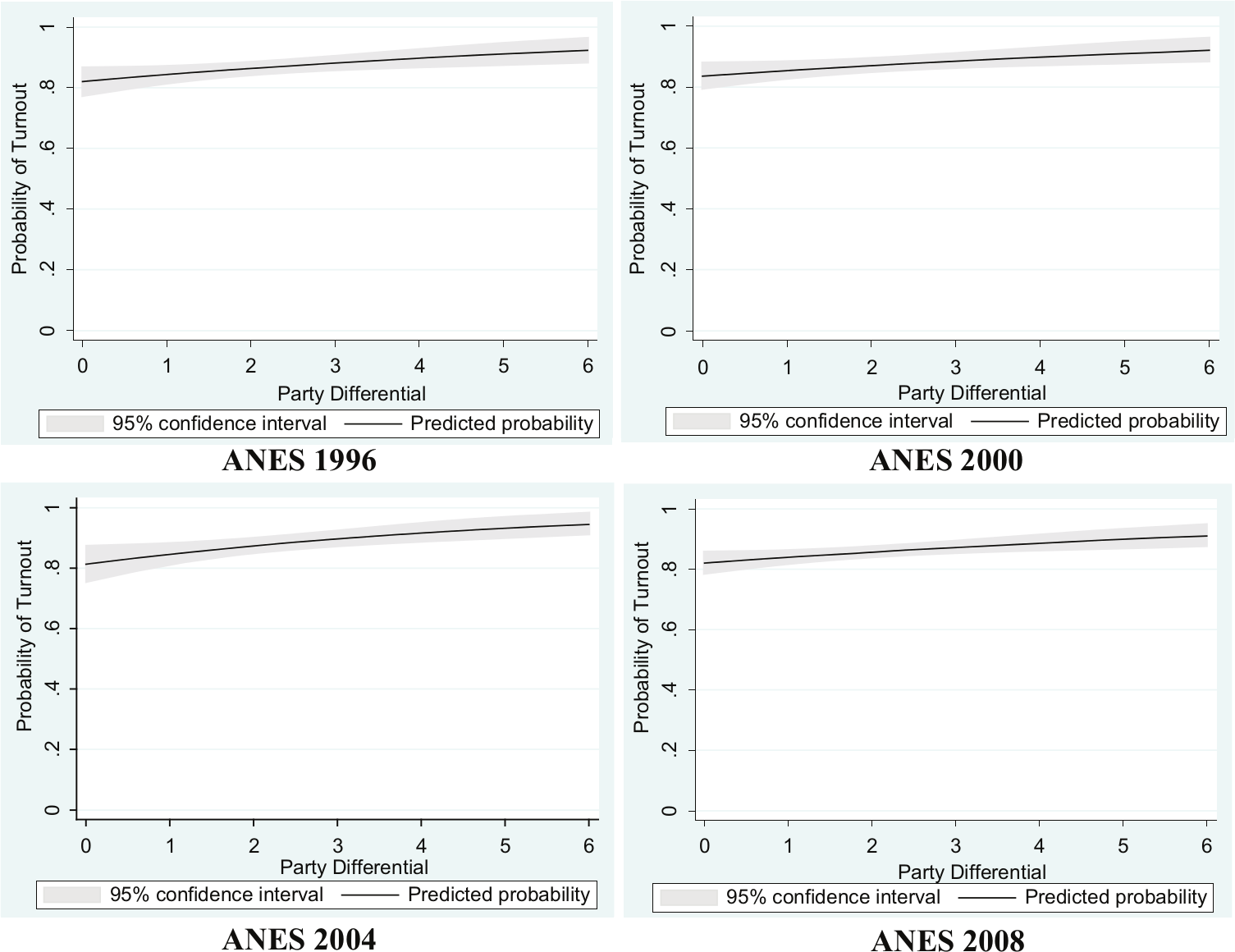
Predicted probability of turnout as party differential varies.
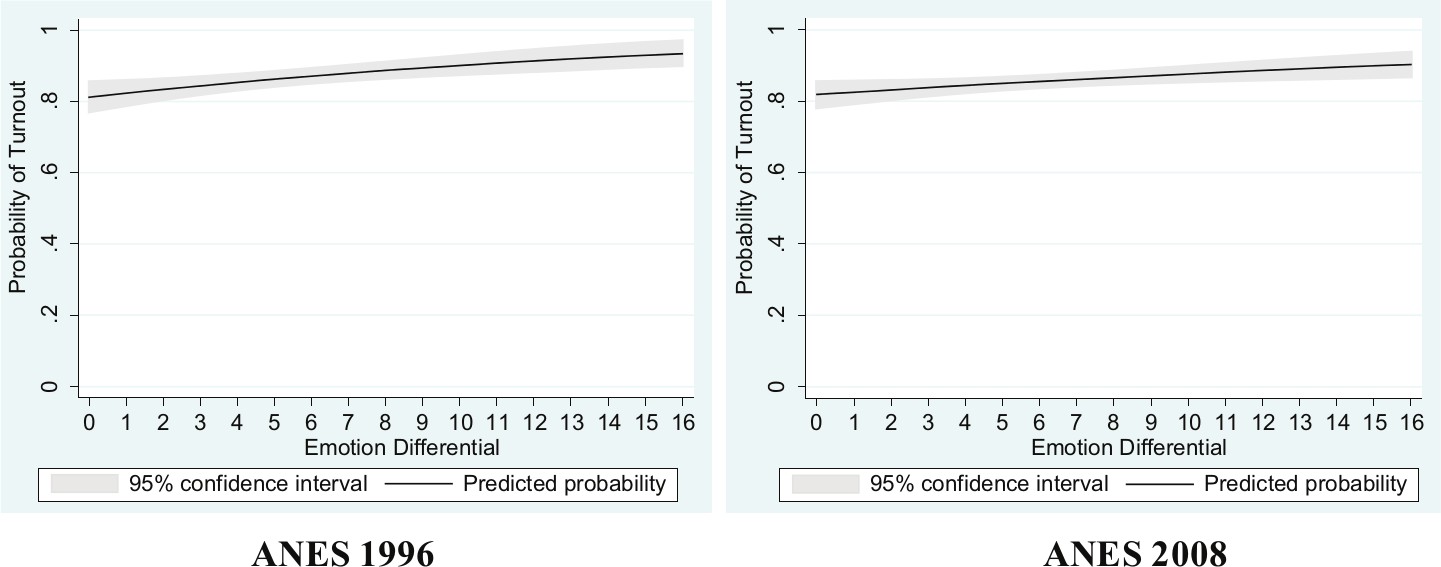
Predicted probability of turnout as emotion differential varies.
With regard to control variables, the results of my analysis are consistent with the findings from previous studies (Brady et al., 1995; Campbell et al., 1960; Lewis-Beck et al., 2008) that electoral concern, electoral competitiveness, intensity of party identification, political interest, and demographic variables (i.e. education, income, gender, and age) have strong predictive power for turnout in the US presidential election. First of all, electoral concern, intensity of party identification, and political interest are positively associated with turnout in these four presidential elections. That is, people who are concerned about the electoral outcome are more likely to vote than their counterparts; individuals with strong party identification are more likely to vote; and as political interest increases, people are more likely to go to the voting booth. Although political interest only achieves marginal statistical significance in the 2008 presidential election (i.e. p = 0.056), it may in part be due to the fact that there are two different measures of political interest in the ANES 2008, which weakens the measurement validity of political interest. Second, political competitiveness only has a significantly positive effect on turnout in the 2000 and 2008 presidential elections. That is, those who think of the presidential race as close are more likely to vote than their counterparts in these two presidential elections. One possible explanation for this result is that the incumbent presidents did not run for re-election in 2000 and 2008 and there was no incumbency advantage for the competing candidates. Consequently, electoral competitiveness stimulates more people to go out and vote for the candidates they favor. Lastly, in terms of demographic factors, the evidence regarding the effects of education and income implies that people with high socio-economic status are more likely to vote and confirms the critical importance of socio-economic status as a determinant of political involvement. In addition, black people are more likely to vote in the 2008 presidential election, no doubt because the appearance of the first black presidential candidate, Obama, activated black people to go to the voting booth. In particular, the probability of turnout for black people increases by approximately 6% compared with their counterparts. Moreover, except for the 1996 presidential election, women are more likely to vote than men, which is consistent with the fact that women have had higher turnout rates than men in the US.
Some may suspect that there are high correlations between party differential and emotion differential, and thus multicollinearity might be a problem. First, I examine the correlation between party differential and emotion differential in these four presidential elections and, as shown in Table 3, there is a weak correlation between them, though the correlation coefficients are always statistically significant. It seems that multicollinearity should not be an issue. To further examine multicollinearity, I perform a diagnostic test for multicollinearity. The result shows that the values of variance inflation factor (VIF) for all variables in the models are smaller than 2, and the mean VIF is 1.21, 14 which implies no violation of multicollinearity. As a result, it appears that multicollinearity does not pose a major threat to my analysis. On the other hand, some may argue that party differential and emotion differential might have an interaction effect on turnout. Thus, I estimate another logit model with the interaction term between party differential and emotion differential. The results show that once the interaction term is included in the model, party differential and emotion differential turn out to be statistically insignificant across all four years and the interaction term simply achieves statistical significance in the ANES 1996. Due to the lack of theoretical guidelines and empirical evidence, I conclude that the interaction term between rationality and emotion has no effect on turnout.
Correlations between party differential and emotion differential.
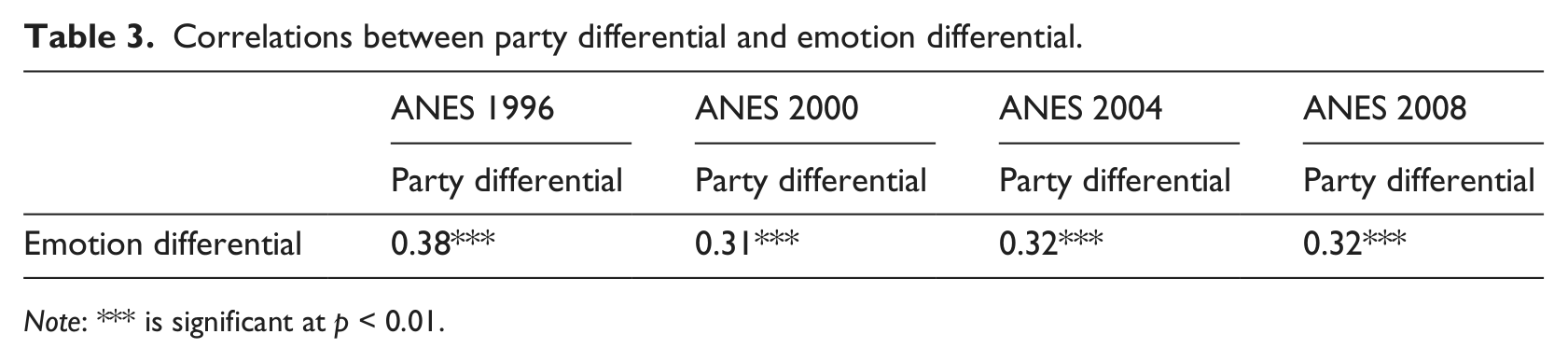
Note: *** is significant at p < 0.01.
In light of the preceding findings, I conclude that individual turnout decisions can be a function of both rationality and emotion. However, rationality plays a more consistent and important role in affecting turnout than emotion. It seems that only when charismatic candidates run for election can emotion stimulate people to turn out and vote. For example, the Democratic Party had the charismatic candidates of Clinton in the 1996 election and Obama in the 2008 election. As a result, the role of emotion in individual turnout decisions might depend on the appearance of charismatic candidates. On the contrary, it is relatively easy for people to tell the difference between competing parties in terms of both policy and ideology and, hence, people can know whether it makes a difference which party wins the election and then make their turnout decisions.
Conclusions
This study examines the effects of rationality and emotion on voter turnout. By applying the EITM framework, I outline the relationship between rationality, emotion, and turnout and propose two hypotheses about the effects of party differential and emotion differential on turnout. The empirical test using data from ANES 1996, ANES 2000, ANES 2004, and ANES 2008 presents evidence that both party differential and emotion differential exert significantly positive effects on turnout, which confirms that the individual turnout decision is a function of both rationality and emotion. Based on the assumption that the ideological position of a political party is a proxy for its policy position, this study argues that individuals use the ideological distance between political parties and themselves to calculate their expected utility. If they perceive no difference in ideological distance between the Republican and Democratic parties and themselves, they will opt to stay away from the polls because it means that both parties can bring them the same expected utility. On the other hand, this study suggests that although emotion can stimulate people to go out to vote, it seems that the effect of emotion on turnout might be built on the appearance of charismatic candidates. Given the emergence of charismatic candidates, people are more likely to generate clearly different emotional responses to competing candidates, which then increases their willingness to vote. As a result, this study suggests that partisan ideology plays a more critical role in individual turnout decision than emotional preference over candidates. In addition, this study also lends support to the findings of previous studies that electoral concern, electoral competitiveness, party identification, political interest, and socio-economic status (i.e. education and income) are important predicators of turnout.
Nevertheless, why does ideology play so important a role in American politics? Scholars find that in the US, political elites have become steadily more polarized over the past few decades, but they have different perspectives on the consequences of elite polarization. Levendusky (2010) contends that elite polarization has positive effects on American politics because more polarized elites can increase cue-taking by generating clear cues for voters. Therefore, voters can hold more consistent attitudes and, more importantly, vote correctly. That is, with the increase of elite polarization, it is easier for voters to clarify the differences between the competing parties. Consequently, voters can clearly differentiate which party is closer to them and then decide whether to vote and for which party to vote.
Finally, the findings of this study imply that political parties can play a more active role in increasing individual electoral participation in the US. Due to the fact that voter turnout in US elections is quite low by international standards, scholars have expressed their concern given that turnout is an important input for the functioning of democracy. This study provides evidence that political parties are able to effectively increase voter turnout through the provision of clear information about their ideology and the increment of partisan attachment. As a result, the Republican and Democratic parties should not ignore what they can do for the low turnout in the US.
Because this study only offers an empirical test of the US case, it is necessary to examine whether the theoretical model presented in this study can be generalized to other countries. Consequently, further studies will be needed to examine the role of rationality and emotion in individual turnout decisions in other countries to see whether the empirical findings of this study are robust.
Footnotes
Acknowledgements
I would like to thank Professor Noah J. Kaplan for his valuable advice on the first draft of this article, Professor Jim Granato for the idea of EITM, and the three anonymous reviewers of International Political Science Review for their helpful comments and suggestions. An earlier version was presented at the annual meeting of the Southwest Political Science Association in March 2011 and I would like to thank the panel participants for their comments and suggestions. All remaining errors are mine.
Funding
This research received no specific grant from any funding agency in the public, commercial, or not-for-profit sectors.