







Abstract
Recent elections around the world have seen young voters come out in large numbers to support young leaders running for office, such as New Zealand’s Jacinda Ardern in October 2020. At the same time, however, young voters have shown strong support for relatively older candidates such as Jeremy Corbyn in the United Kingdom and Bernie Sanders in the United States. While the former is consistent with the descriptive representation literature, the latter is not. This article deploys an experimental design involving 1000 young participants to analyse young voter support for older candidates. We find that young voters are significantly more likely to support older candidates if they are aware that these candidates champion general left-wing policies, but the same is not true for young candidates. We also find that ceteris paribus younger voters do not prefer younger candidates to older candidates.
Introduction
This article deploys an experimental design to analyse young voter support for older political candidates. The key proposition of the article is that that there is something ‘different’ about millennials and post-millennials and the way they engage with the political process, compared with older generations. This proposition is driven by the observation that in recent years millennials and post-millennials have been drawn to older male candidates in more than one advanced western democracy – raising questions around the descriptive and substantive representation of voters in the political process.
Empirical research (e.g. Campbell and Cowley, 2014; Cutler, 2002) suggests that the descriptive representation of societal groups leads to substantive representation (cf. Pitkin, 1967). But young people are egregiously under-represented in descriptive terms. According to the United Nations Department of Economic and Social Affairs, in 2020 slightly over 30% of the world population was aged between 20 and 39 years old. Yet, at the time of writing (June 2022), to our knowledge there were only five heads of state and/or government who were under the age of 39. 1 Of course, this is not surprising, given the time it takes for most career politicians to make it to the top of the political career ladder (Allen, 2013; Binderkrantz et al., 2020), but research has also shown empirically that this under-representation of young people is also reflected on the lower rungs of the ladder in national legislative bodies around the world (Joshi, 2013; Stockemer and Sundström, 2018; Tremmel et al., 2015), where we might expect to see a stronger representation of young people. In the context of western democracies, empirical research creates an expectation that young voters should support young candidates for public office in circumstances where these candidates are available. The idea that young voters should vote for young politicians makes sense both descriptively and substantively, a bit like ‘women should vote for women’ or ‘blacks should vote for blacks’ (cf. Campbell and Heath, 2017; Mansbridge, 1999). But do they?
Anecdotally, the evidence is mixed. On the one hand, Jacinda Ardern, prime minister of New Zealand (born in 1980), led her party to a landslide victory in October 2020 with what appeared to be significant youth support (Pascoe, 2020) and, at the time of writing, New Zealand Labour continues to enjoy greater support from young people in opinion polling. 2 On the other, in January 2020, Sebastian Kurz, the former Chancellor of Austria (born in 1986), had to turn to the Green Party, which enjoyed very large support from young voters, 3 in order to form a government. At first glance these events could be explained by ideology (see Sevi, 2021), with Ardern leading the left-wing Labour Party, Kurz leading the right-wing People’s Party and young voters typically favouring left-wing policies (cf. Crittenden, 1962; Glenn, 1974; Rouse and Ross, 2018). Related to this, there is also plenty of anecdotal evidence of a different phenomenon – that is, of relatively older candidates, especially left-wing candidates, who have garnered considerable youth support. In the United Kingdom, the 2017 general election has been defined as the ‘youthquake’ election (Sloam and Henn, 2019; Sturgis and Jennings, 2020), where young voters turned out in very large numbers to support Jeremy Corbyn (born in 1949), then leader of the UK Labour Party. In the United States, young Americans who were already engaged in recent social movements such as Black Lives Matter or Occupy Wall Street (Maxwell and Schulte, 2018) were also very supportive in both 2020 and 2016 of Democratic presidential hopeful Bernie Sanders (born in 1941). There are also other examples of older left-wing leaders who have enjoyed significant support from young voters, including Green politician Hans-Christian Ströbele (born in 1939) in Germany and Jean-Luc Mélenchon (born in 1951) in France, even when the latter was running against the relatively young Emmanuel Macron (born in 1977).
To summarize, while existing empirical research creates an expectation that young voters support young candidates, empirical evidence seems to point instead towards a reality in which young voters will support young candidates provided that these young candidates champion left-wing policies on their behalf (cf. Sevi, 2021). In other words, relative youth appears not to be enough to ensure support from young voters. Even more interestingly, it appears that young voters all over the world have no issue with supporting relatively old candidates, that is, people way into their 70s. But beyond the literature looking at young voter support for young candidates, there are virtually no studies that look at young voter attitudes towards older candidates.
Using an experimental design and approximately 1000 research participants, we explore the attitudes of young voters towards significantly older left-wing candidates. We aim to uncover the causal mechanism behind the counterintuitive behaviour of young voter support for older candidates through a multi-step experimental design. First, we test if young voters’ attitudes towards older candidates change once young voters are aware that these older candidates champion left-wing policies. Second, we test whether – all things being equal – young voters tend to view younger candidates more favourably than older candidates. Our first test reveals that young voters are markedly more likely to support older candidates when they know that the older candidates stand for general left-wing, progressive policies. In our second test, we also find, however, that young voters appear indifferent to a candidate’s age: they have no problem supporting older candidates and do not appear to show any significant preference for younger candidates.
The rest of the article is organized as follows. Next, we locate our research in the wider literature on young voters, representation and voter behaviour. Then, we specify our cases and briefly discuss their relevance. Following that we operationalize our experimental design and describe our findings. We then discuss our findings in the context of the existing literature and assess their implications for current debates. Finally, we conclude with a summary of our findings and analysis and suggest some areas for further research.
Young voters and political representation
Pitkin’s (1967) work on the concept of representation taught generations of political scientists to think of political representation in terms of formal, symbolic, descriptive and substantive representation. It also inspired a large number of empirical research projects showing that descriptive representation leads to substantive representation. A quick glance at the literature, however, shows clearly that scholars engaged in this line of research have focused primarily on gender, race and ethnicity (e.g. Espírito-Santo et al., 2020; Mansbridge, 1999). While age is certainly different 4 from gender, race, ethnicity and other defining groups individuals belong to (Stockemer and Sundström, 2018), even if only because people inevitably age and consequently abandon the age group, there is a reasonable expectation that the mechanism at play when it comes to political representation and voter behaviour may be similar.
Social identity theory (see Tajfel, 1982) strongly suggests that individuals prefer candidates of their same age group (see Cary et al., 2013), especially when it comes to leadership positions (see Hogg, 2001). Research by social psychologists has even gone as far as empirically showing that ageism is stronger than racism or sexism when it comes to voters choosing individuals of their own group at simulated elections (Piliavin, 1987; Sigelman and Sigelman, 1982). They find, however, that ageism is particularly strong among older voters, who tend to clearly select older candidates over younger candidates. In a recent study of US congressional elections based on survey data, Webster and Pierce (2019) show strong support for the idea that voters prefer candidates of their own age group. They find that voters use candidate age as a heuristic shortcut in their decision-making process by favouring candidates who are closer in age to them, especially in low-information contests. The authors note, however, that their findings apply to voters and candidates of all ages.
When it comes to specifically looking at young voters, very few studies rigorously test empirically whether or not young voters prefer young candidates. Pomante and Schraufnagel (2015), in a study on young voter turnout in the United States, show both experimentally and observationally that the turnout of young voters increases when there are young candidates running for office. In the observational portion of their study, they find that the age gap between candidates is a predictor of higher young voter turnout. While these findings seem to suggest that young voters do tend to support young candidates, the proposition that is actually tested is much narrower, as it implies a contest between a younger candidate and an older candidate. In other words, they find that when an older candidate runs against a younger candidate, the turnout of young voters tends to be higher, presumably to support the young candidate. Similarly, in a recent comparative study based on the analysis of survey data from 51 countries, Sevi (2021) finds that voters are more likely to favour and vote for a political leader who is close to their age. She also finds that, in particular, young voters aged under 40 slightly prefer younger leaders, although she also notes that the size of the effect she finds is very small.
The issue, however, is not simply whether young voters prefer young candidates. Borrowing Pitkin’s (1967) terminology, we can’t look at the issue only from the descriptive or ‘standing for’ perspective, but we need to consider it from the substantive or ‘acting for’ point of view as well. Ideologically, young voters display very clear preferences. In general, where we see processes of electoral dealignment around the world, older individuals often seem to be drawn to right-wing populist political movements, candidates and parties (Lees, 2018). In contrast, younger individuals display political leanings significantly to the left of older voters (Fisher, 2018). Young voters seem to be attracted to a world view that synthesizes the kind of identity politics typically associated with the ‘New Left’ of the 1960s and the array of traditional critiques of class inequality and capitalism typical of the ‘Old Left’ of the 1930s (Milkman, 2017). Consequently, and perhaps even more clearly, from a policy point of view young voters seem to display preferences that are in direct contrast with the preferences of older voters (see Fisher, 2020). The existing literature assumes that there is always going to be some degree of intergenerational conflict within society, if only because different policy areas can affect individuals in completely different ways based on their age (Krieger and Ruhose, 2013). For instance, young voters might have different policy views on education, welfare, pensions and military conscription in comparison to older voters (Joshi, 2013; Stockemer and Sundström, 2019). In a study based on data from municipal elections in Japan, McClean (2019) shows that the election of younger mayors is usually associated with a marked shift in social welfare expenditure from elderly welfare to child welfare. Similarly, analysing the introduction of bills by members of the US Congress, Curry and Haydon (2018) find that older lawmakers are more likely to introduce bills that favour older citizens and deal with senior issues than younger lawmakers. Interestingly, however, they also find that districts with a sizable proportion of senior voters result in representatives who do pay considerable attention to higher-salience senior issues regardless of the age of the representative. In other words, while the expectation that descriptive representation leads to substantive representation is empirically confirmed by the existing literature, there is also some evidence that substantive representation can occur across different age groups independent of descriptive levels of representation (see Curry and Haydon, 2018).
The question that remains unanswered in the existing literature is how do young voters react if candidates are great examples of someone who is willing to ‘act for’ young voters, even though their age makes it impossible to argue for any kind of descriptive representation? In the next pages, we attempt to shed some light on this question.
Case selection
We focus our experiment on three specific cases of older left-wing politicians 5 who challenge some of the assumptions underpinning existing models of voting behaviour and political representation discussed above, given their relative age and a considerable degree of support from young voters in recent years: Jeremy Corbyn, Bernie Sanders and Hans-Christian Ströbele.
Table 1 sets out the basic information about our three cases selected. We designed each entry as a general policy statement that directly relates to some of the broad policy areas that each of the three politicians have shown support for throughout their political lives, allowing for the country-specific institutional parameters of politics in the United States, the United Kingdom and Germany. The summary information reveals three broadly similar individuals in terms of their age, the social milieus from which they emerged and their policy positions. All three men are aged at the time of writing between 70 and 80, and considering the different expectations about the role of government in the three countries, all three men are markedly left-of-centre on key policy positions, including the economy, social movements and identity politics, military engagement, humanitarian intervention and scrutiny of the intelligence services. All three men are in favour of stronger state intervention in the economy, champion issues such as LGBT rights, are sceptical about military engagement and favour greater oversight over the intelligence services.
Bernie Sanders, Jeremy Corbyn and Hans-Christian Ströbele: basic information.
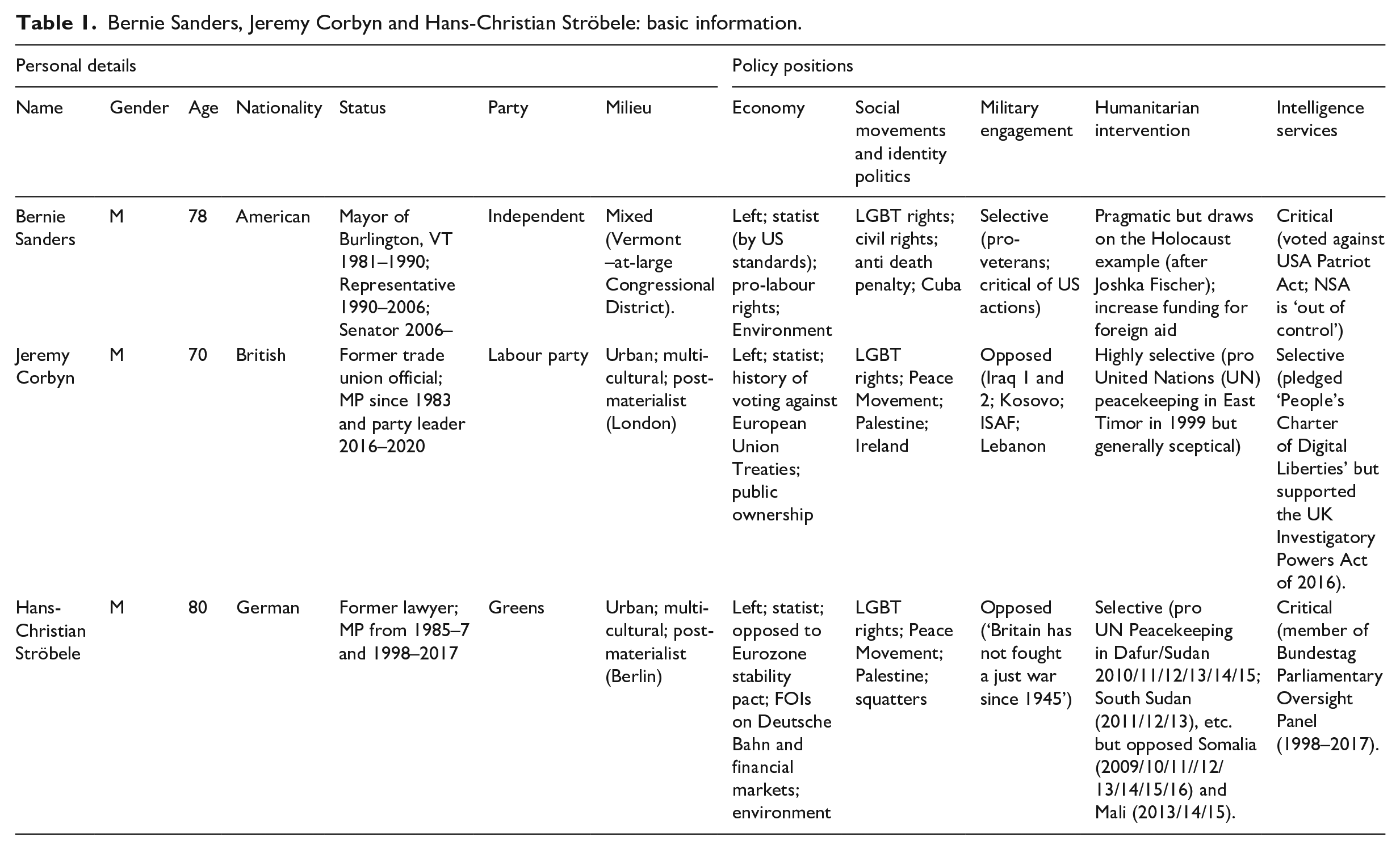
So, taken in the round, we have three distinct cases of a relatively old, male, strongly left-of-centre political figure. We now operationalize our experiment to assess how young voters feel about older candidates.
Research design, data and methods
We constructed a multi-step experimental design. We recruited almost 1000 research participants and collected data on various issues related to the electoral support of young voters towards older candidates. The data collection process allowed us to run two separate experiments (experiment 1 and experiment 2) looking at this issue from different perspectives. The main goal of experiment 1 was to understand young voter attitude towards older candidates in relation to their ideology. More specifically, we tested whether young voter support for older candidates increases if they are aware of the progressive policy platforms of these older candidates. The goal of experiment 2 was to understand if the young voter’s attitude changes when they are presented with candidates of different age and gender. We specifically tested whether young voters are more willing to support, instead of the three older candidates, an older female candidate, a younger male candidate or a younger female candidate.
Data collection
We recruited 938 research participants enrolled in first year courses at a constituent college of a university in one of the eastern states of Australia. 6 The university is a comprehensive institution founded in the 1960s, with over 26,000 students drawn from the local area as well as interstate and internationally. We provide more information on the composition of the student sample below. Each student-participant was provided a paper-based questionnaire containing 11 different questions. These included questions about the research participant (year of birth, gender, family income, etc.) and questions relating to one of six politicians whose colour photo was included in the first page of the questionnaire. The six politicians included in the questionnaires were the three older candidates Jeremy Corbyn, Bernie Sanders and Hans-Christian Ströbele, as well as three additional candidates whom we selected 7 to vary in both age and gender from each other and from the three older candidates. We also compiled a list of general policy statements that summarizes some of the most relevant policy stances of each of the three older candidates. In selecting these policy statements, we deliberately tried to find stances that the three have in common, choosing to leave out more controversial positions that would have been completely impossible to reconcile between the three (e.g. Corbyn’s and Ströbele’s support for the Palestine Liberation Organization (PLO) or Sanders’ historic refusal to back gun control legislation). We also ascribed Corbyn’s policy stances to the older female, the younger male and the younger female candidates, as we only used these candidates to control for gender and age.
We chose to use Australian research subjects to evaluate German, British and American politicians as we assumed it would be quite unlikely that Australian individuals were able to recognize the politicians in question and consequently be biased by their own prior knowledge of these individuals.
8
Choosing to collect data by using the photos of prominent politicians such as Corbyn or Sanders presented a clear risk that even our Australian respondents would be able to recognize some of our candidates. On the other hand, however, a significant body of literature demonstrates that there is a causal nexus between the facial features of successful politicians and their electoral success (e.g. Jäckle and Metz, 2017; Jäckle et al., 2020; Rosar et al., 2008, 2012; Stockemer and Praino, 2017, 2019), and these features are virtually impossible to replicate using stock photos. Therefore, we chose to use photos of real politicians and we made sure that we knew with a high degree of certainty whether or not each respondent recognized the candidates they were evaluating by adding two distinct questions at the end of the questionnaire. The first (Q10) was the simple yes/no question ‘Did you recognize the person in the photo?’ The second (Q11) was ‘If you answered
Table 2 shows that over 95% of our research participants were young voters. For this analysis, we define as ‘young’ all individuals born after 1980; that is, people who were under 40 years of age in 2019. This definition of young voter classifies as ‘young’ all millennials and the younger generations that came after millennials. This definition is consistent with recent research on young voters (e.g. Stockemer and Sundström, 2018). Our youngest research participant was 17 years old at the time of our data collection, while the oldest participant was 82 years old. For the purposes of this article, we only include in the analysis data collected from those we classified as ‘young’ research participants.
Research participants recruited by generation group.
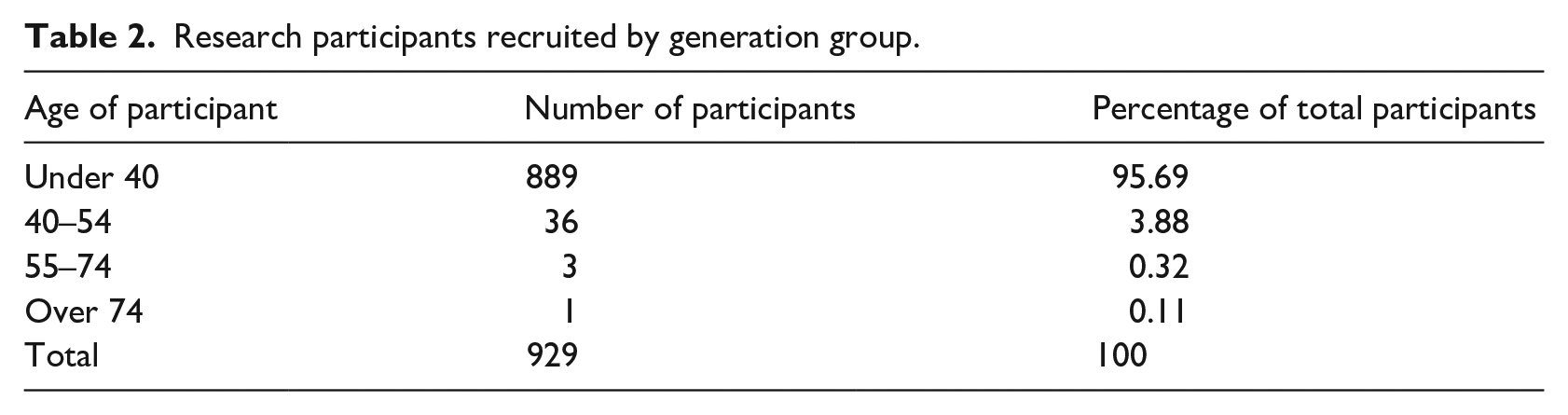
Among our young research participants, 65% were females. The vast majority (65.6%) declared that they have Australian or Anglo-Saxon ancestry/ethnic background, followed by 15.7% of participants declaring to be ‘other European’ and 13% Asian. About 33% of respondents declared that they live in a household with yearly income higher than the Australian median of A$90,000, while a little over 13% come from a household with an annual income of less than A$30,000.
Variables and operationalization
We used the data collected to compute several variables of interest. Our dependent variable is the likelihood of vote for a specific candidate expressed by our research participants. Respondents were asked how likely it is on a scale from 1 to 10, with 1 being the least likely and 10 being the most likely, that they would vote for the person in the picture.
We were also able to compute several independent variables that relate to each individual respondent. Age is a continuous variable coded as the age of each respondent at the time when the data was collected (April 2019). Females is a dichotomous variable coded 1 for female respondents and 0 otherwise. Family income is an ordinal variable coded 1 for respondents with annual household income of less than A$10,000, 2 for respondents in households with annual income between A$10,001 and A$30,000, 3 for respondents living in a household with annual income between A$30,001 and A$60,000, 4 for respondents with annual household income between A$60,001 and A$90,000, and 5 for respondents whose annual household income is over A$90,000. Ideology is an ordinal variable capturing the personal political ideology of respondents in a left–right continuum. It is coded −2 for respondents who self-identify with the left, −1 for respondents in the centre-left, 0 for respondents who identify with the centre, 1 for centre-right respondents and 2 for respondents who self-identify with the right. Finally, we created a series of dichotomous variables recognized candidate for each of the six candidates, coded 1 for respondents who can correctly name the candidate whose photo is included in the questionnaire and coded 0 otherwise.
Experiment 1: young voters and left-wing policies
In our first experiment we distributed the questionnaires to our research participants, randomly dividing them into a treatment group and a control group. Participants in the treatment group were given a questionnaire that contained in the first page not only the colour photo of a candidate, but also a summary of generic policy positions associated with that candidate. Participants in the control group were given only the photo of the candidate. We tried to obtain the same number of respondents for each candidate and a very similar number of participants in the treatment and control groups. Table 3 summarizes the total number of participants for each group.
Number of research participants per candidate and treatment/control group.
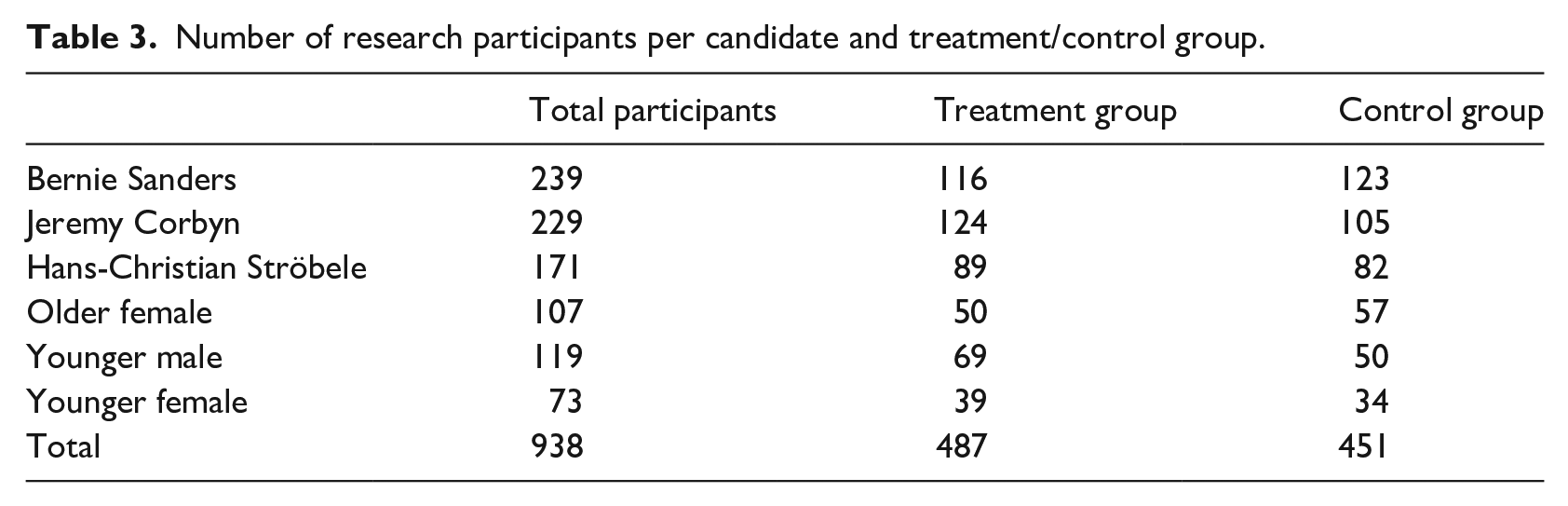
We performed a series of two-sample t-tests comparing the answers to this question obtained in the treatment group and the results obtained in the control group. We then performed a multivariate analysis by running a series of analyses of covariance (ANCOVAs) that controlled for the research participant’s age, gender, family income, ideology and whether they recognized the candidate in the photo. We ran one overall ANCOVA with all candidates to test the overall design of the experiment, a separate ANCOVA for the three older candidates and the three other candidates and separate ANCOVAs for each candidate. Comparing the average support obtained by each candidate by research subjects in the treatment group and research subjects in the control group allows us to understand whether or not young voters are significantly more likely to support an older candidate if they know that the older candidate in question champions left-wing policies.
Experiment 2: young voters, older candidates and younger candidates
In our second experiment, we randomly distributed the questionnaires to our research participants, and we used the older female candidate, the younger male candidate and the younger female candidate to control for differences in young voter support across candidate age and gender.
We ran two different one-way analyses of variance (ANOVAs) testing for differences between groups. The first ANOVA assessed mean differences in vote likelihood between candidates for respondents who were given only the candidate photo. The second ANOVA did the same for respondents who were given both the candidate photo and the candidate policy stances. Comparing the average support given by young voters to the three older candidates with the support given to candidates of a different age group and/or gender allows us to understand if voters are significantly more or less likely to support an older candidate in relation to a younger candidate.
Results: experiment 1
We ran a series of independent two-sample t-tests comparing the means of our dependent variable likelihood of vote between the treatment group (that is, respondents who were provided with both the photo and the policy statement of candidates, or ‘photo and policies’ group) and the control group (in other words, respondents who were provided with only the candidate’s photo, or ‘photo only’ group). Figure 1 shows the results of the t-tests separately performed for all candidates, for the three older candidates only and for all other candidates (that is, the older female, the younger male and the younger female). The t-tests suggest that young voters were significantly more likely to support candidates when they were aware of their progressive policy stances. This holds true for all candidates, the old male candidates and the other candidates.
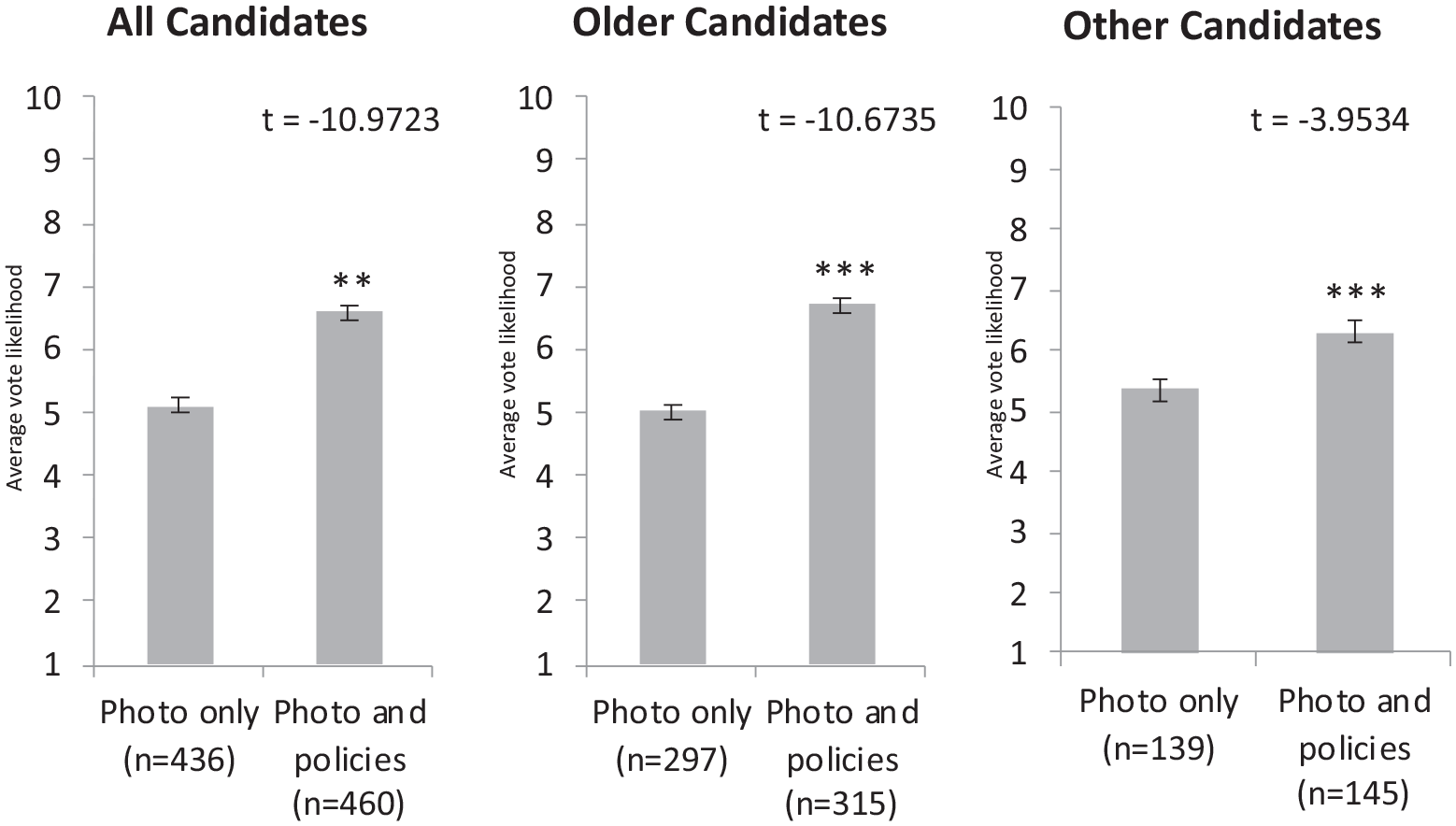
Results of t-test of average vote likelihood comparing ‘photo only’ group and ‘photo and policies’ group for all candidates, older candidates and other candidates.
Interestingly, the data in Figure 1 also seem to suggest that young voters tend to be less supportive of the older candidates than of the other candidates when they are provided only with their photo, but more supportive of older candidates than of the other candidates when they are provided with a photo and short policy stances.
Figure 2 shows the results of the two-sample t-tests comparing for each candidate in the treatment group (photo and policy group) and the control group (photo only group). The results suggest that young voters are significantly more likely to support older candidates once they are aware of their progressive policy stances than when they only have access to their photo. Interestingly, Figure 2 also shows that when it comes to the other candidates, the differences in the mean dependent variable between the treatment groups and the control groups are smaller and less statistically significant. In the case of the younger female candidate, the difference in likelihood of voting between the group that had access to photo and policy stances and the group that had access to the candidate photo only is negligible and statistically non-significant.
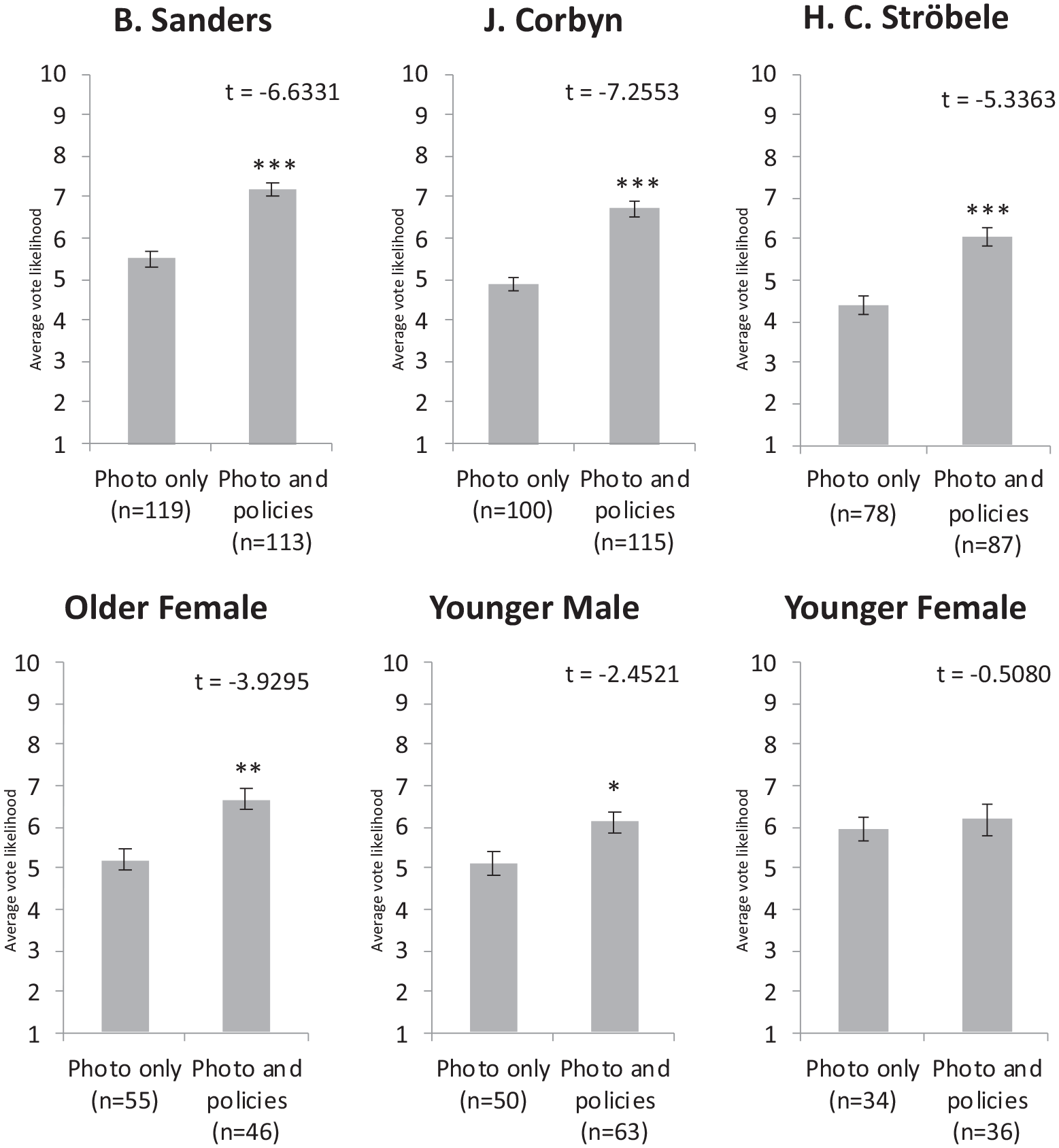
Results of t-test of average vote likelihood comparing ‘photo only’ group and ‘photo and policies’ group for each candidate.
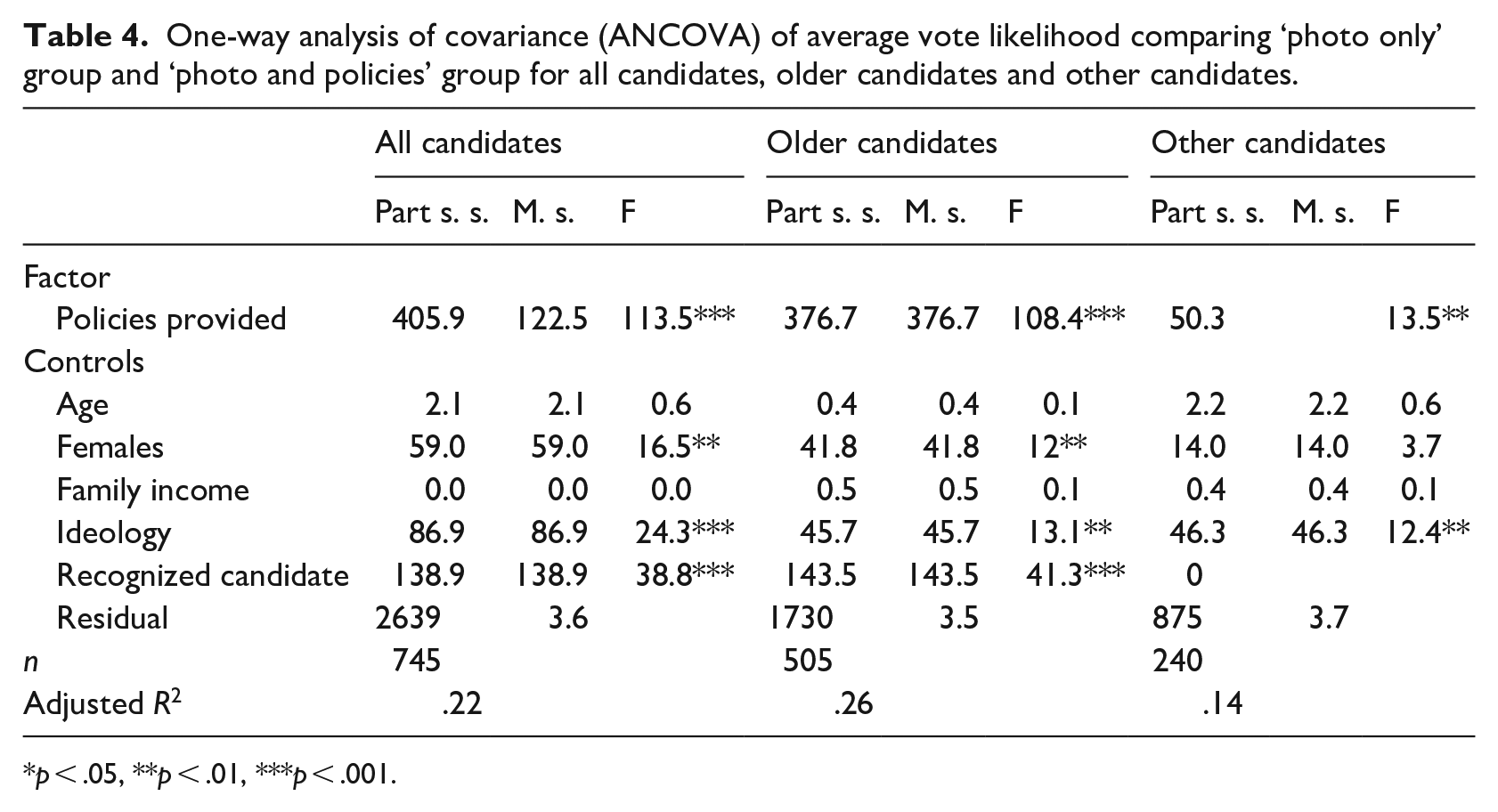
Our multivariate analysis largely confirms what we found in the univariate analysis. Table 4 gathers the results of three separate one-way ANCOVAs of average vote likelihood comparing our treatment group (photos and policies group) and our control group (photos only group). The first ANCOVA shows the overall performance of experiment 1 by focusing on all candidates. The second ANCOVA is centred on the three older candidates, while the third is run with data relating to our ‘other candidates’.
One-way analysis of covariance (ANCOVA) of average vote likelihood comparing ‘photo only’ group and ‘photo and policies’ group for all candidates, older candidates and other candidates.
p < .05, **p < .01, ***p < .001.
As is clear from Table 4, even controlling for age, gender, family income, personal ideology and the fact that some research participants recognized some of the candidates, young voters are more likely to vote for a candidate whose progressive policy stances are known to them and clearly stated.
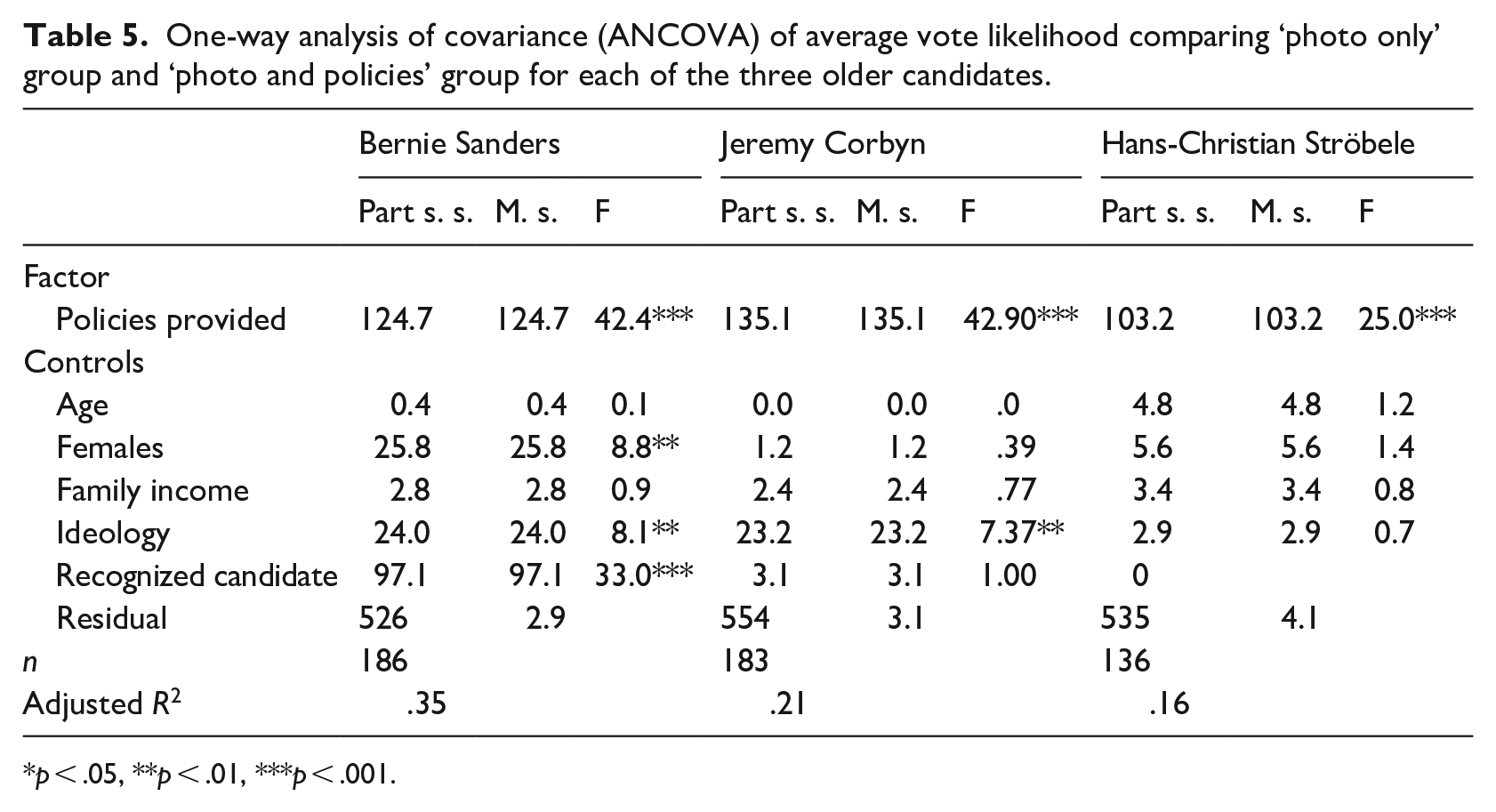
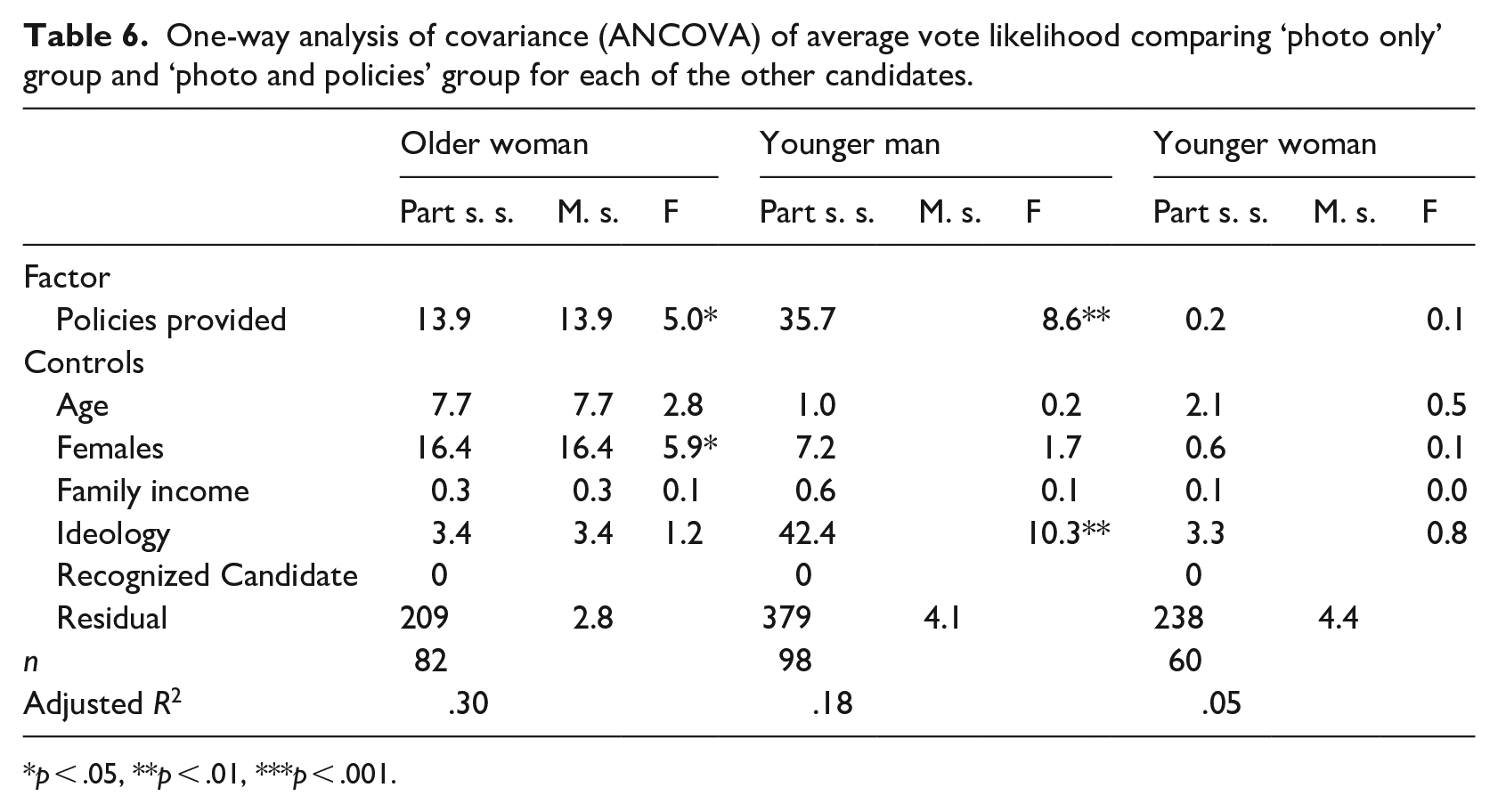
Tables 5 and 6 show the results comparing between the treatment and the control groups for each one of the six candidates whom we have included in our data collection. Table 5 shows that young voters are significantly more likely to support Corbyn, Sanders or Ströbele once they know about their progressive policy stances, even controlling for age, gender, family income, ideology and the fact that some research participants recognized some of the candidates. Interestingly, while the same is true for most of our other candidates, the ANCOVAs in Table 6 indicate that this relationship is weaker when it comes to the other candidates. In fact, young voters are not significantly more likely to support the younger female candidate once they learn about her progressive policy stances. They are significantly more likely to support the older woman and the younger man, but the magnitude of the difference is weaker than what we find for the three older candidates and the level of statistical significance is also lower.
One-way analysis of covariance (ANCOVA) of average vote likelihood comparing ‘photo only’ group and ‘photo and policies’ group for each of the three older candidates.
p < .05, **p < .01, ***p < .001.
One-way analysis of covariance (ANCOVA) of average vote likelihood comparing ‘photo only’ group and ‘photo and policies’ group for each of the other candidates.
p < .05, **p < .01, ***p < .001.
Results: experiment 2
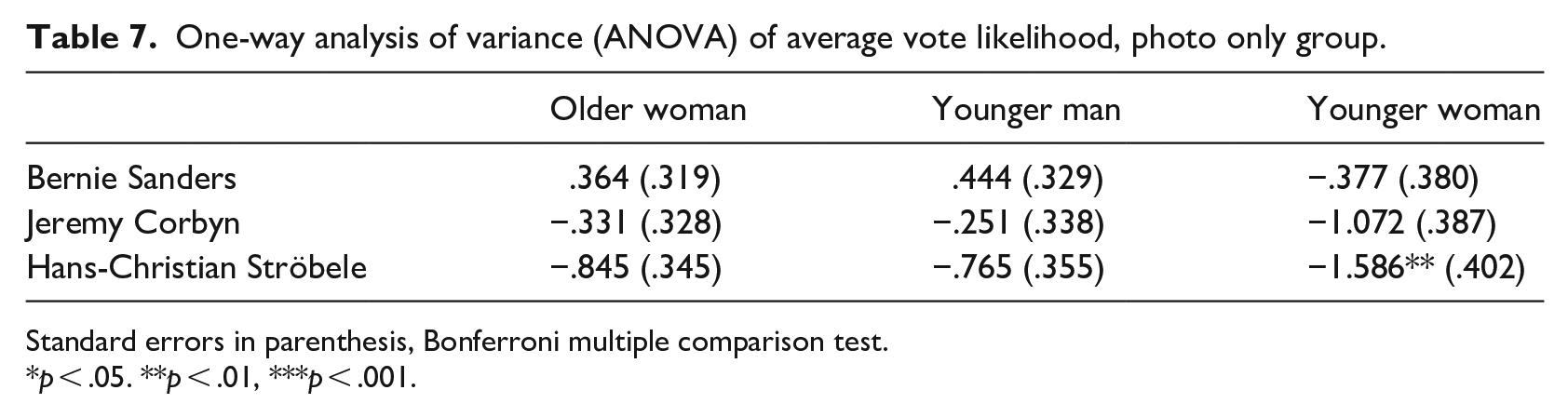
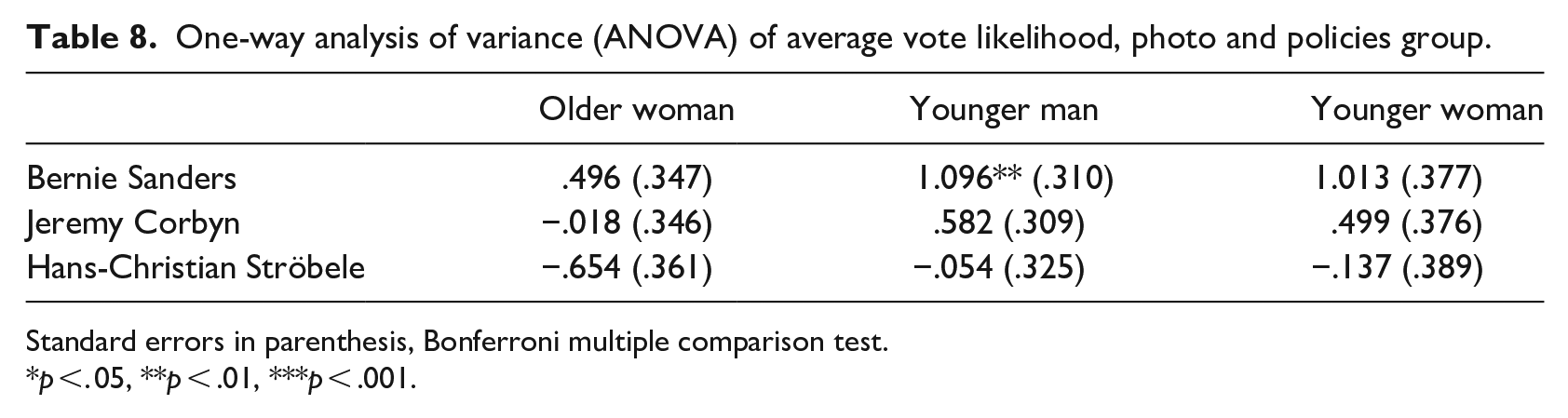
We ran two distinct one-way ANOVAs, focusing especially on the results of a Bonferroni multiple comparison test. We looked independently at the results associated with research participants who were in possession of only the photo of a candidate (Table 7) and of research participants who were given both a candidate photo and a description of the policies he or she supports (Table 8).
One-way analysis of variance (ANOVA) of average vote likelihood, photo only group.
Standard errors in parenthesis, Bonferroni multiple comparison test.
p < .05. **p < .01, ***p < .001.
One-way analysis of variance (ANOVA) of average vote likelihood, photo and policies group.
Standard errors in parenthesis, Bonferroni multiple comparison test.
p <. 05, **p < .01, ***p < .001.
Tables 7 and 8 gather the results of two Bonferroni multiple comparison tests. Given that we are interested in comparing the older candidates to the other candidates to control for gender and age, we only report the results of the relevant comparisons (i.e., we omit from the tables the comparisons between the three older candidates and the comparisons between the three other candidates). Tables 7 and 8 show the mean difference in the levels of the dependent variable likelihood of vote between the candidate in each row and the candidate in each column.
Our one-way ANOVAs show that young voters express no difference in the likelihood of support based on the gender and on the age of the candidates. Research participants who are only in possession of a candidate photo are significantly less likely to support Ströbele than they are to support our younger female candidate (see Table 7). Similarly, young voters in possession of both the candidate photo and the policy stances are significantly more likely to support Sanders than they are to support our younger male candidate (see Table 8). Other than that, no other differences in support are statistically relevant, which suggests that young voters have no problem in supporting older men.
Discussion and conclusions
Our experiments show that young voter support for older candidates comes from a combination of ideological alignment around their distinctly left-wing policies and a lack of any preference towards younger candidates. Young voters are more likely to support both older and/or younger candidates once they know that these candidates champion left-wing policies. Interestingly, we also find that once voters learn about these policies, the largest and most statistically significant increase in support is registered in favour of the older candidates. The increase in support registered in favour of the young candidates is much smaller and even not statistically significant when it comes to the young female candidate. In addition, our experiments also show that young voters do not seem to display any sort of intergenerational bias towards older candidates or any kind of preference towards young candidates.
On the one hand, these findings provide some comfort in that they allow us to reconcile and explain the significant young voter support received by the likes of young leaders such as Ardern and the equally strong support shown by young voters to much older figures such as Corbyn or Sanders. They also partially explain young voters snubbing young candidates such as Sebastian Kurz or even Emmanuel Macron in favour of much older left-leaning opponents. On the other hand, however, our experimental evidence is somewhat problematic when it comes to our expectations about descriptive representation and some emerging theories of age being used as a heuristic device (see Webster and Pierce, 2019).
While our analysis cannot exclude that young voters use candidate age as a heuristic device in contexts of low information, as argued by Webster and Pierce (2019), our experiments seem to point towards a slightly different set of conclusions. The fact that young voters are significantly more likely to support older candidates when they know that these older candidates champion the left-wing policies that young voters typically prefer is consistent with Webster and Pierce’s (2019) model and further stresses differences in voter behaviour due to different levels of information. Our analysis also shows, however, that when young voters are simply asked how likely they would be to support a candidate without being provided with a choice between an older and a younger candidate, they do not prefer younger candidates over older candidates, as the existing literature suggests. In light of the findings by Pomante and Schraufnagel (2015), this could mean that young voters do not have a bias towards older candidates, as long as these older candidates are not running against a very young candidate. Future research should try to disentangle these issues by using observational and survey data, looking simultaneously at the age of voters and all candidates running for elections in multiple constituencies to shed further light on the political behaviour of young voters.
When it comes to descriptive representation, while our findings suggest that young voters are not particularly interested in being represented by young candidates, it also shows that they do respond to policy preferences. In other words, they are quite interested in substantive representation. This creates several issues that future researchers should focus on, especially the fact that a lot of empirical works show that descriptive representation leads to substantive representation. Borrowing Mansbridge’s (1999) language, if blacks should represent blacks and women should represent women, then the young should also represent the young. If, as social identity theory strongly suggests, individuals prefer candidates of their same age group (see Ben-Bassat and Dahan, 2012; Cary et al., 2013; Hogg, 2001) but young voters do not support young candidates, then young individuals will have problems getting elected. This can have a tremendous impact on substantive representation of the young that, in turn, can further reduce the level of participation of young voters. Stockemer and Sundström (2018) call this phenomenon ‘the vicious cycle of political alienation of the young’. Future works should try to replicate our design using young candidates and old voters in order to understand if older voters show a bias in favour of older candidates and/or against younger candidates. Should that be the case, Stockemer and Sunström’s (2018) ‘vicious cycle’ would appear even more vicious and harder to break.
The major limit of our work presented here is the fact that it only tells one side of the story of the relationship between political representation, age and ideology. In fact, by designing our experiment around largely left-leaning young voters and left-leaning older candidates, the conclusions we can draw are obviously limited. Future research should expand the scope of the work we presented here by designing a much larger experiment that includes: (a) voters belonging to a more varied ideological affiliation; (b) older voters; and (c) right-wing older candidates. While this is all beyond the scope of the research presented here, together with our study this would enhance even further our understanding of the political behaviour of young voters towards older candidates.
Our findings are important and have significant implications for both the practice of politics and for its analysis. They show that young voters are particularly strongly moved by policy issues (see Norris, 2004). This could have profound implications for real-world politics, in terms of the kind of issues that will be contested, the language in which these issues are framed and the choice of electoral strategies that are deployed. In fact, even though young voters are often described as disengaged and disinterested in conventional political participation, they are known to be able to mobilize in remarkable, non-conventional ways (see Blais and Loewen, 2011; LaCombe and Juelich, 2019). In terms of the practice of politics, this means that political parties should consider the age of candidates running for office in conjunction with the age makeup of electoral districts. In terms of analysis, scholars should investigate some of the underlying assumptions about political behaviour and representation. The descriptive representation of young voters, their substantive representation and their willingness to trade off one in favour of the other is a behavioural trait that should be explored in much more detail – not least because this behavioural trait has potentially profound implications to the political representation and participation of the young.
Footnotes
Appendix 1: Questionnaire
Acknowledgements
The authors wish to thank the two anonymous reviewers for a number of very thoughtful comments and suggestions.
Funding
The authors received no financial support for the research, authorship and/or publication of this article.
