







Abstract
This article explores the relationship between religiosity, denominational homogamy, religiosity homogamy, and marital adjustment. Using a statewide sample of spouses in first marriages (N = 1,394) and remarriages (N = 601), the authors find that within-group differences in religiosity, denominational homogamy, and religiosity homogamy are not as prevalent for spouses in remarriages. Overall, husbands and wives in first marriages who are very religious have significantly higher marital adjustment scores than spouses who are less religious. Similarly, husbands and wives in first marriages who share the same religious denomination report higher marital adjustment scores than spouses who report different denominations. For spouses in both first marriages and remarriages, those who report that they are “both religious” have higher marital adjustment scores than spouses where both partners are not religious, or where only the wife is religious. Possible reasons for the within-group similarities and differences are explored, particularly for spouses in remarriages.
Incorporating religious variables into the study of marriage and family has been a relatively recent occurrence. Thomas and Cornwall (1990) have detailed the exponential growth of integrating religion into social science research in recent decades. Some of this growing body of research centers on the relationship between religiosity and marital satisfaction, with some findings indicating that higher levels of reported religiosity are related to happier and more stable marriages (see, Mahoney, Pargament, Tarakeshwar, & Swank, 2001, for a review of the research in the 1980s and 1990s). However, other research has described the link between religiosity and marital satisfaction as weak and inconsistent (Booth, Johnson, Branaman, & Sica, 1995; Sullivan, 2001). Furthermore, some suggest it may be the level of agreement in religiosity and/or denominational homogamy within couples that contributes to marital stability (Chinitz & Brown, 2001). Although mixed findings exist, there is a growing consensus that a limitation of previous research on religiosity exists related to the “scant sampling of family diversity” (Dollahite, Marks, & Goodman, 2004, p. 422). Chatters and Taylor (2005) have called for an “exploration of different family forms” (p. 526), and encourage the examination of within-group variation related to studies of religiosity and families. The present study is the first known examination of the associations between aspects of religiosity and marital adjustment that includes a specific focus on a sample of couples in a remarriage. Using data collected as part of a statewide newlywed study consisting of 699 wives and 695 husbands in first marriages, and 303 wives and 298 husbands in remarriages, our study explores within-group similarities and differences in religiosity, denominational homogamy, religiosity homogamy (i.e., similarity in level of religiosity between spouses), and marital adjustment.
Empirical Background
Religiosity, Denominational Homogamy, and Marital Satisfaction
The majority of research in the area of religiosity and marriage indicates that religion has a positive influence on the couple relationship. Compared with less religious/nonreligious couples, couples who attend church on a regular basis typically report higher levels of marital satisfaction (Heaton, 1984; Wilson & Musick, 1996) and are less likely to divorce (Brown, Orbuch, & Bauermeister, 2008). Religious couples also tend to be happier (Anthony, 1993; Mahoney et al., 1999), have more stable marriages (Call & Heaton, 1997; Lehrer & Chiswick, 1993), and experience increased commitment and fidelity (Lambert & Dollahite, 2008; Thomas & Cornwall, 1990). Lehrer and Chiswick (1993) also found that religious interfaith marriages are more stable than relationships between nonreligious spouses.
Although a substantial body of the empirical research on religion and relationships supports the idea of a consistent moderate association between religiosity and marital quality, mixed and contradictory results have also been reported. For example, Schumm, Obiorah, and Silliman (1989) found virtually no relationship between marital quality and church attendance. Furthermore, Booth et al. (1995) found no relationship between increases in religiosity and a subsequent improvement in marital quality. They summarized their findings by noting, “in general, the link between religion and marital quality is both reciprocal and weak” (Booth et al., 1995, p. 661). In yet another study, Sullivan (2001) assessed two samples of newlywed couples and found only a weak positive influence of religiosity on marital satisfaction over the first 4 years of marriage. Conflicting results such as these indicate the need for further research examining the association between religiosity and marital satisfaction.
Findings from other areas of research indicate that same-faith marriages are more stable than interfaith marriages (Bahr, 1981) and those spouses in same-faith marriages report higher levels of marital satisfaction (Glenn, 1982; Heaton, 1984). What might explain these associations? Kalmijn (1998) suggested at least three cultural resources to consider. First, if couples share similar knowledge and beliefs about religion this may encourage positive communication, interactions, and mutual understanding. Second is the likelihood that similar values and opinions shared by spouses lead to similar behaviors and worldviews, which are mutually confirmed and supported. Finally, similar religious views may promote joint activities, both religious and nonreligious, which can strengthen the relationship bond. Curtis and Ellison (2002) add that religious and denominational similarity among couples may facilitate a greater likelihood for consensus when it comes to family matters and joint decisions on these issues. Attending a church also provides a close network of support. Taylor and Chatters (1988) observed that the more involved people are in their church networks, the greater the support they typically receive. They further note that “marital and family events such as divorce and separation may be stigmatized occurrences that may curtail support from church networks” (Chatters & Taylor, 2005, p. 525). However, research related to divorced and remarried individuals and religiosity and church network support is lacking.
Family Structure and Remarriage
Although the empirical work examining religiosity and marital and family life has expanded in recent decades, there is much to be learned about the role religion plays in the lives of couples in diverse family structures, including remarriages. National statistics indicate that approximately half of all marriages entered into today in the United States are a remarriage for one or both partners (U.S. Census Bureau, 2000). As a result, remarriages are becoming one of the most common family forms in America (Fein, Burstein, Fein, & Lindberg, 2003).
Remarriages are unique in that they are formed due to a loss of a relationship through separation, divorce, or death. Research indicates that compared with couples in traditional first marriages, remarriages are more likely to end in separation and/or divorce (Bramlett & Mosher, 2002; Kreider, 2005). Several studies have provided explanations for the higher rate of dissolution among remarriages. Booth and Edwards (1992) analyzed data collected from multiple phone interviews with 2,033 married individuals and concluded that remarriages are more fragile because they are less likely to have positive social supports, they are more likely to see divorce as a solution, and there are fewer available partners with whom they have similar values to choose from. Others suggest that although first-married couples and remarried couples have some common relationship problems, couples in remarriages experience an increased risk of divorce due, in part, to the immediate onset of complexities and stressors that are often associated with trying to build and strengthen their couple relationship while simultaneously negotiating relationships with former partners and in-laws along with obligations and relationships with children and/or stepchildren (Prado & Markman, 1999).
Similar to the empirical work examining religiosity and marital functioning, the body of literature exploring issues related to the marital quality of couples in remarriages has increased in recent decades. To date, however, empirical work associated with the role of religiosity in remarriages remains woefully understudied. Few research efforts have explored issues related to religiosity heterogamy or interfaith marriages with spouses in remarriages, despite the vast numbers of remarriages occurring each year. Although some religious studies have included couples in remarriages, either the results were not reported specifically for them (e.g., Williams & Lawler, 2003), it was controlled for in the analysis (Call & Heaton, 1997), or they were purposefully excluded (e.g., Curtis & Ellison, 2002; Lehrer & Chiswick, 1993; Sullivan, 2001). Since nearly one out of every two marriages in the United States is a remarriage for one or both partners, there is a conspicuous need to examine the association between religiosity and marital adjustment for spouses in remarriages.
Theoretical Background
There have been numerous theoretical and conceptual frameworks proposed in recent decades that aim to provide greater understanding of the linkages between religion and family life. A common framework that guides many studies related to religiosity and marital functioning is role theory. Chatters and Taylor (2005) indicate that “role theory concerns the ways in which roles define and regulate social life and relationships and give meaning to individual self-conceptions and actions” (p. 519). Various roles have accompanying expected patterns of behavior and proscribe norms for interpersonal interactions. Religion can have a powerful influence on roles, behaviors, and social interactions. Religious institutions often provide a framework of beliefs and practices that reinforce role identities such as what it means to be a parent or spouse (Ellison, 1994). However, compared with couples in traditional nuclear first marriages, remarriages and family functioning in stepfamilies can be complex, with spouses and children establishing multiple relationships and taking on multiple roles that are often neither well defined nor understood.
Mahoney et al. (2001) identify two overarching themes related to a general theoretical framework associated with religion. First, the functional element is the psychological or social purpose of religion, which provides individuals, couples, and families with opportunities to become more integrated into their local community. Religious institutions and activities provide a mechanism to receive social support from people with similar attitudes and values. Mahoney et al. (2001) emphasize that “such benefits of church membership could occur regardless of particular religious beliefs about family life” (p. 585). Second, the substantive element of religion is the combination of beliefs and practices promoted by religious institutions that shape the attitudes, beliefs, and behaviors of individuals. One substantive element of religion is the assertion that marriage should be a lifelong commitment and, therefore, in most situations divorce is not justifiable. Mahoney et al. (2001) further note that religious beliefs can often create unique barriers to divorce:
First, more religious individuals may anticipate as well as experience added cognitions or feelings of guilt and failure if a divorce occurred (e.g., I am violating a vow I made to God), compared to less religious individuals who may be more likely to view divorce as an acceptable solution to deal with unrewarding marriages. Second, more religious individuals may risk greater external disapproval if they divorce because their friends and family members object to divorce on religious grounds (e.g., divorce represents a serious spiritual failure). (p. 586)
For spouses in a remarriage the research is unclear as to how the functional and substantive elements of religion influence their lives and the roles they perform in their marriage. In some cases, individuals may have been less religious to begin with and subsequently more likely to divorce and remarry. For others, a feeling of guilt, failure, or shame may prevent them from returning to a religious institution. Although religious teachings often provide substantive elements in the form of specific guidelines for spousal roles that shape identities, attitudes, and behaviors, spouses in remarriages and complex family structures may find it difficult to fulfill the roles and expectations that are defined and set forth by religious institutions. Chatters and Taylor (2005) suggest that “problems in enacting marital and parental roles (e.g., differences in marital role definitions) may have direct negative influences on family outcomes (e.g., marital satisfaction)” (p. 520). It is possible that spouses in a remarriage may feel unsure about their roles and may not immediately feel like they “fit” in a religious setting, which may add additional stress and feelings of not belonging because of the implicit or explicit message about divorce and remarrying they may receive from a religious institution and from society more broadly.
These perceptions and feelings of insecurity and unrealistic standards and expectations often add stress to the family, particularly for couples in a remarriage (Bray & Kelly, 1998; Visher & Visher, 1993). Taylor and Chatters (1988) observed that divorce and separation may be stigmatized processes that may cause church networks to withdraw support. Conversely, although research findings indicate that couples in first marriages who have similar levels of religiosity and share the same faith are happier, this may not be true for couples in remarriages. Simply stated, religious issues may not be as important to spouses in a remarriage compared with other issues they may be experiencing. Perhaps spouses in a remarriage sense a barrier that many religions implicitly or explicitly impose regarding divorce (Levinger, 1976). As the current study is exploratory in nature, this is a first attempt to examine religiosity with spouses in remarriages.
It is imperative to note that in the present study we adopt a normative–adaptive perspective as we explore similarities and differences within first marriages and remarriages (Ganong & Coleman, 2004). This approach focuses on the strengths in remarriages and views them as a legitimate family form. Much of the early empirical work on remarriages and stepfamilies used a deficit-comparison perspective that focused on the ways remarriages and stepfamilies were deficient compared with nuclear families (reviewed in Coleman, Ganong, & Fine, 2000; Ganong & Coleman, 2004). Therefore, rather than compare samples of couples in first marriages and remarriages, we examine within-group similarities and differences to explore religiosity, denominational homogamy, religiosity homogamy, and marital adjustment.
Research Questions
Although research related to remarriages and religiosity has separately received increased attention in recent years, there have been limited efforts at examining the associations between the two constructs as they relate to marital adjustment. Furthermore, with the exception of the study by Sullivan (2001), little research has examined newlyweds and religiosity or within-group differences for newlywed couples in first marriages and those in remarriages. One purpose of this study is to examine within-group variations in family structure, as recommended by Chatters and Taylor (2005). This study seeks to advance scientific knowledge by exploring the following three research questions. First, are spouses who report a higher level of religiosity more likely to have higher marital adjustment scores than spouses who report a lower level of religiosity? Are the findings similar for spouses in first marriages and remarriages? Second, do spouses who share the same faith (i.e., religious denomination) report higher marital adjustment scores than spouses who affiliate with different denominations? Although there is some evidence that denominational homogamy is positively associated with marital satisfaction for spouses in first marriages (Glenn, 1982; Heaton, 1984), it is unclear whether this relationship is also evident for spouses in remarriages. Finally, do religiously dissimilar couples have lower marital adjustment scores than religiously homogamous couples? That is, do spouses who report high levels of religiosity report lower levels of marital adjustment when their spouses report low levels of religiosity, compared with spouses who both report similar levels of religiosity? Are the findings similar for spouses in first marriages and remarriages? Are there differences related to gender?
Method
Participants and Procedures
As part of a newlywed study, a 38-item survey was mailed to a random sample of 2,823 newlywed couples in a western state. The sample of newlywed couples were chosen by selecting every fourth marriage license on file at the state’s Department of Health, spanning a period of 7 months. Each couple was mailed a husband and wife version of the 38-item survey along with a $2.00 bill as an incentive for completing the survey. After 10 days, a reminder card was mailed to all couples who had not responded to the survey. Of the 2,823 surveys mailed, 282 were undeliverable, 12 couples refused to participate, 1,529 did not respond, whereas 1,002 wives and 993 husbands completed and returned the surveys. The total response rate was 39%. The overall purpose of the survey centered on obtaining a greater understanding of newlyweds’ transition to marriage. The majority of the 38 items assessed methods of marriage preparation/education, problem areas in the relationship, areas of change, marital satisfaction and adjustment, and demographic characteristics.
Participants included newlywed husbands and wives who had been married from 2 to 9 months (5 months on average). Of the 1,002 wives, 699 indicated that the current marriage was a first marriage for both them and their husbands, whereas 695 husbands reported being in their first marriage. For the remaining 303 wives and 298 husbands, the current marriage was a remarriage for either one or both of the spouses. Ages of wives in first marriages ranged from 16 to 54 years (M = 23.42, SD = 4.06), whereas ages of husbands in first marriages ranged from 17 to 55 years (M = 25.39, SD = 4.19). Ages of remarried spouses (where it was a remarriage for at least one spouse) ranged from 19 to 87 years. Specifically, ages of wives in a remarriage ranged from 19 to 85 years (M = 37.85, SD = 13.64), whereas ages of husbands in a remarriage ranged from 20 to 87 years (M = 40.22, SD = 13.71). Participants in their first marriage reported their ethnicity as primarily Caucasian (91%), with 4% identifying themselves as Hispanic/Latino, with the remaining 5% of spouses in first marriages identifying themselves with other ethnic groups. Spouses in a remarriage were also primarily Caucasian (88%), with 5% indicating they were Hispanic/Latino, 2% reporting “multiracial,” with the remainder of the sample identifying themselves with other ethnic groups.
Measures
The Revised Dyadic Adjustment Scale (RDAS; Busby, Crane, Larson, & Christensen, 1995) was used to assess marital adjustment among the newlywed sample. The RDAS is described as “an improved version of the Dyadic Adjustment Scale (DAS) that can be used to evaluate dyadic adjustment in distressed and non-distressed relationships” (Busby, Crane, Larson, & Christensen, 1995, p. 305). The RDAS is a shorter version of the original DAS developed by Spanier (1976). Relatively high correlations have been established between the Kansas Marital Satisfaction Scale and the RDAS, and the RDAS and DAS, with Pearson correlation coefficients ranging from .78 for the RDAS and Kansas Marital Satisfaction Scale, to .97 for the RDAS and DAS (Crane, Middleton, & Bean, 2000).
Since religiosity was not the central focus of the newlywed survey, subjective religiosity was assessed with a single item: “All things considered, how religious would you consider yourself?” Five answer options were offered: 1 = very religious, 2 = fairly religious, 3 = somewhat religious, 4 = slightly religious, or 5 = not at all religious. Other studies have used a single item to measure religiosity with results exhibiting significant effects (Brown et al., 2008; Stanley, Whitton, & Markman, 2004).
There were two wives and five husbands in first marriages and two wives and one husband in remarriages who were excluded from analyses because they did not answer the religiosity item. We collapsed the somewhat religious and slightly religious items together after a series of analyses of variance (ANOVAs) for husbands and wives in first marriages and remarriages indicated that there were no differences between the groups. This resulted in the religiosity measure having four categories, which also increased the cell size for each of the four groups.
Homogeneity of religiosity was assessed by creating a “religious” variable. Respondents who indicated that they were either very religious or fairly religious were combined and were labeled religious, whereas respondents who self-reported that they were either somewhat religious, slightly religious, or not at all religious were combined and labeled not religious. Spousal data were then added to create a variable with four categories: 1 = both spouses religious, 2 = both spouses not religious, 3 = only wife religious, and 4 = only husband religious.
Last, homogeneity of religious affiliation was assessed by creating a “denomination” variable. Respondents were asked to indicate their religious denomination from several categories: “Latter-day Saint” (wives, first marriage, n = 553, remarriage, n = 182; husbands, first marriage, n = 531, remarriage, n = 176), “Catholic” (wives, first marriage, n = 22, remarriage, n = 24; husbands, first marriage, n = 32, remarriage, n = 19), “Evangelical Christian” (wives, first marriage, n = 6, remarriage, n = 8; husbands, first marriage, n = 6, remarriage, n = 11), “Protestant” (wives, first marriage, n = 5, remarriage, n = 6; husbands, first marriage, n = 1, remarriage, n = 6), “No formal religious affiliation” (wives, first marriage, n = 70, remarriage, n = 53; husbands, first marriage, n = 73, remarriage, n = 61), and “Other” (wives, first marriage, n = 40, remarriage, n = 28; husbands, first marriage, n = 44, remarriage, n = 23). After careful consideration, spouses who both indicated “Other” (19 couples in first marriages, 7 couples in remarriages) were excluded from analyses with this variable, as it was impossible to determine whether their religious affiliations were the same. The “denomination” dummy variable was created (0 = No, 1 = Yes) to differentiate between spouses who were either the “same denomination” or “different denomination.” Because the sample consisted of a high percentage of participants who indicated their religious denomination as The Church of Jesus Christ of Latter-day Saints, we created a dummy variable (0 = not Mormon, 1 = Mormon) and controlled for denomination in specific analyses that will be described.
Results
The first purpose of this study was to examine the associations between religiosity and marital adjustment. A series of one-way ANOVAs were calculated on spouses’ level of religiosity and marital adjustment. The one-way analysis of covariance (ANCOVA) comparing mean marital adjustment scores as a function of the four levels of religiosity produced statistically significant results for both wives—F(3, 647) = 17.52, p < .001, partial η2 = .08—and husbands in first marriages—F(3, 636) = 10.10, p < .001, partial η2 = .05. Identical statistical procedures were carried out for husbands and wives in remarriages, but mixed results emerged. For newlyweds in a remarriage, the one-way ANCOVA comparing mean marital adjustment scores as a function of the four levels of religiosity produced statistically significant results among husbands’ marital adjustment—F(3, 269) = 6.72, p < .001, partial η2 = .07—but not for remarried wives—F(3, 273) = 1.07, p = .36.
Post hoc comparisons were then performed for both husbands and wives in first marriages and husbands in remarriages to determine whether specific pairwise differences existed (see Table 1). To address the first research question, these comparisons revealed that husbands and wives in first marriages who indicated that they were “very religious” had significantly higher marital adjustment scores than husbands and wives who reported the other three levels of religiosity. Post hoc multiple comparisons for husbands in remarriages revealed that those who indicated that they were “very religious” had statistically significant higher marital adjustment scores than those indicating that they were somewhat/slightly religious (see Table 1). Furthermore, husbands who reported that they were “fairly religious” and “not at all religious” had significantly higher marital adjustment scores than husbands who indicated that they were “somewhat/slightly religious.” Post hoc multiple comparisons were not analyzed for remarried wives as no statistical differences were produced from the initial ANCOVA.
Post Hoc Multiple Comparisons on Husbands’ and Wives’ Religiosity and Marital Satisfaction and Marital Adjustment Scores for First Marriages and Remarriages
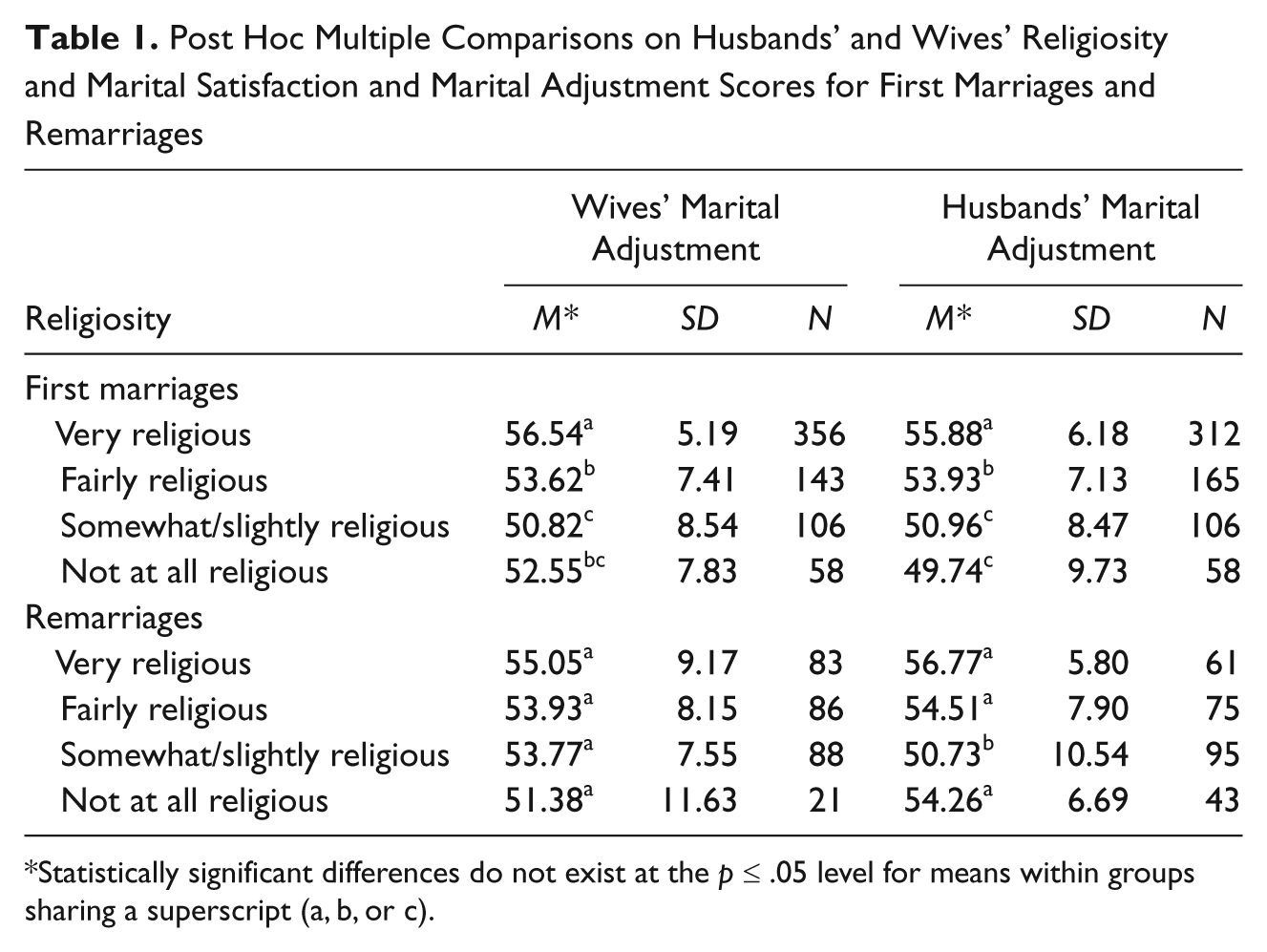
Statistically significant differences do not exist at the p ≤ .05 level for means within groups sharing a superscript (a, b, or c).
The second research question inquired whether denominational homogamy of spouses is associated with marital adjustment. That is, do newlywed spouses who belong to the same religious denomination have higher levels of marital adjustment than spouses who belong to different denominations? For this analysis, we did not control for denomination (i.e., Mormon) because the purpose of the analysis was to examine denominational homogamy. For spouses in their first marriage, one-way ANOVAs comparing mean adjustment scores as a function of denominational homogamy produced statistically significant results among husbands’ marital adjustment scores— F(1, 672) = 51.45, p < .001, Cohen’s d = .64—as well as wives’ marital adjustment scores—F(1, 673) = 56.14, p < .001, Cohen’s d = .71. Similar analyses were carried out for remarried husbands and wives, respectively, with results unlike those for spouses in first marriages. There were no significant within-group differences in marital adjustment scores for either remarried husbands or wives who belonged to different denominations. A summary of mean marital adjustment scores for husbands and wives in both first marriages and remarriages is displayed in Table 2.
Summary of Mean Scores of Marital Adjustment on Denomination Homogamy for Wives and Husbands in First Marriages and Remarriages
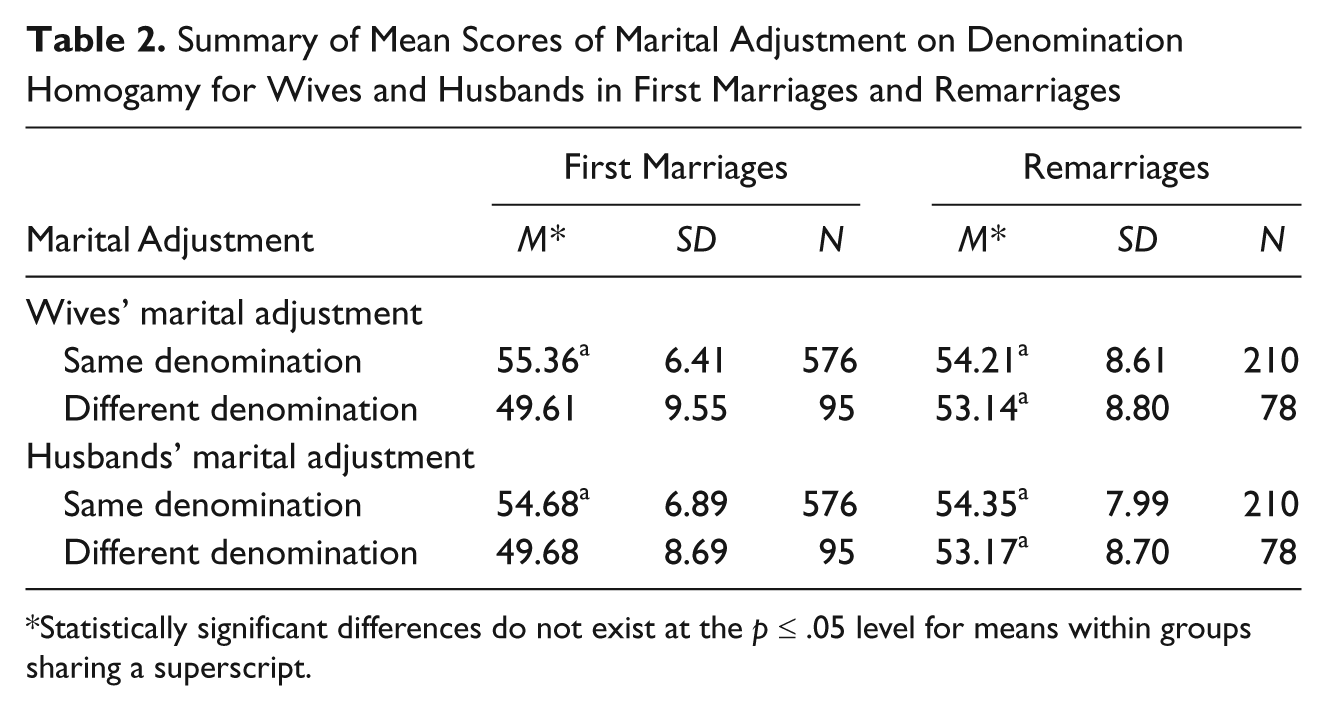
Statistically significant differences do not exist at the p ≤ .05 level for means within groups sharing a superscript.
The third research question in this study was to examine whether newlywed couples who shared similar levels of religiosity had higher marital adjustment scores than husbands and wives who differed in their levels of religiosity. A husband or wife was considered “religious” if they indicated they were “very religious” or “fairly religious” on the survey. For spouses in their first marriage, after controlling for those who were “Mormon,” one-way ANCOVAs comparing mean marital adjustment scores as a function of religious similarity revealed statistically significant results among husbands’ marital adjustment scores—F(3, 597) = 9.07, p < .001, partial η2 = .04—as well as wives’ marital adjustment scores—F(3, 609) = 16.46, p < .001, partial η2 = .08. Post hoc comparisons were then performed for husbands and wives in first marriages to determine where specific pairwise differences existed. A summary of mean marital adjustment scores for husbands and wives in first marriages and remarriages, and for each of the groups of religiosity is provided in Table 3. These comparisons revealed that for wives in first marriages, where both spouses indicated that they were religious, wives had significantly higher marital adjustment scores than wives where both spouses were not religious, only the wife was religious, or only the husband was religious (see Table 3). For husbands in first marriages, where both spouses indicated that they were religious, the husbands had significantly higher marital adjustment scores compared with husbands when both spouses were not religious and when only the wife was religious. Moreover, in marriages where only the husband was religious, husbands had significantly higher marital adjustment scores than husbands when both spouses were not religious.
Summary of Mean Scores of Marital Adjustment on Husbands’ and Wives’ Four Categories of Religiosity
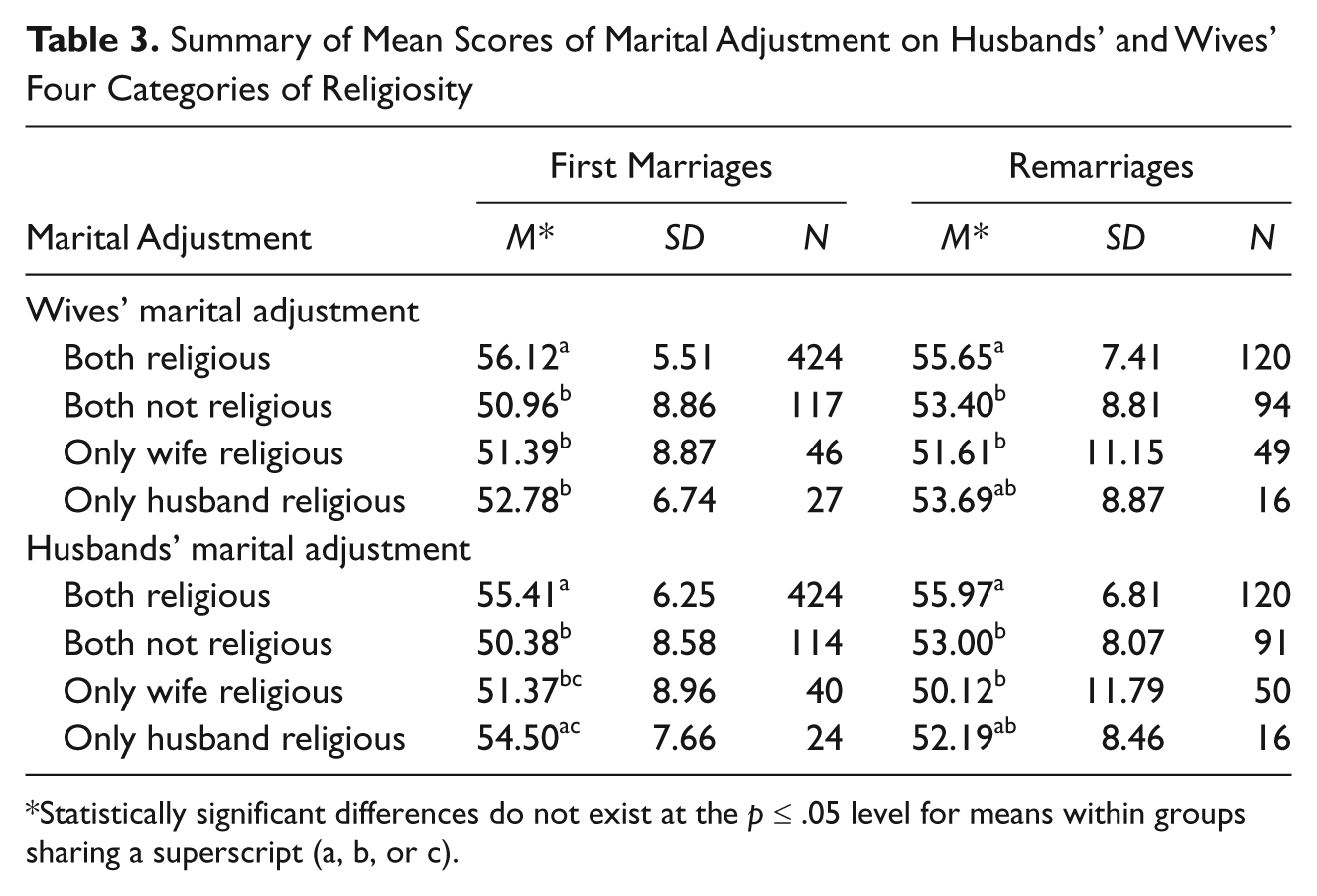
Statistically significant differences do not exist at the p ≤ .05 level for means within groups sharing a superscript (a, b, or c).
For spouses in a remarriage, a one-way ANCOVA comparing mean marital satisfaction and marital adjustment scores as a function of the four categories of religiosity produced statistically significant results for husbands’ marital adjustment scores—F(3, 272) = 6.19, p < .001, partial η2 = .06—and wives’ marital adjustment scores—F(3, 274) = 3.06, p < .05. Post hoc comparisons were performed for husbands and wives in remarriages to determine where specific pairwise differences existed (see Table 3). These comparisons revealed only a few notable differences in the four categories of religiosity. First, when remarried husbands and wives indicated that they were “both religious,” or that only the “husband was religious,” they had significantly higher marital adjustment scores than remarried wives and husbands where only the wife indicated that she was religious or neither spouse was religious. In other words, when either remarried wives or husbands indicated that the wife was religious but the husband was not, the wives had significantly lower marital adjustment scores than spouses where both were religious.
Discussion
Many studies have examined the associations between religiosity and facets of couple relationships. Our research adds to this body of literature as it explores variations of religious similarities and differences and marital adjustment for a sample of newlywed spouses in first marriages and remarriages. We examined three research questions related to individual levels of religiosity, denominational homogamy, religiosity homogamy, and their association with marital adjustment.
The first research question explored whether spouses who report higher levels of religiosity are more likely to have higher marital adjustment scores than spouses who report lower levels of religiosity. There was generally a consistent pattern for husbands and wives in first marriages of higher levels of religiosity being associated with higher levels of marital adjustment. Furthermore, even husbands in first marriages who reported that they were “fairly religious” had higher marital adjustment scores than husbands and wives who were “somewhat/slightly religious,” or “not at all religious.” These findings provide support for previous research that suggests that religious individuals are happier in their marriages (Anthony, 1993; Mahoney et al., 1999), and for husbands in first marriages, the results indicate that the more religious the husband, the higher the marital adjustment score. For spouses in a remarriage, a somewhat different pattern emerged. First, for wives in a remarriage, there were no differences in marital adjustment scores, regardless of the level of religiosity. Trends, however, were evident that were similar to the results for spouses in first marriages. Smaller cell sample sizes, particularly with remarried wives who were “not at all religious” likely influenced the power to detect a significant effect. For husbands in a remarriage, those who indicated that they were “somewhat/slightly” religious had significantly lower marital adjustment scores than spouses with other levels of religiosity.
Results for spouses in remarriages in this sample suggest that religion may not be a significant factor in their lives, as it relates to marital adjustment, compared with other issues they may be faced with as newlyweds. However, it is plausible that a selection effect may be present. That is, persons in a remarriage may be more liberal and more willing to divorce and/or less religious to begin with, compared with spouses in first marriages. Alternatively, the experience of going through divorce and experiencing feelings of estrangement from their religion may lower religiosity in some remarrieds. Although not a research question in this study, an independent samples t test was conducted to compare levels of religiosity for spouses in first marriages and remarriages. There was a significant difference in the scores for both spouses, with wives in first marriages reporting, on average, higher levels of religiosity (reverse scored; M = 1.94, SD = 1.25) than wives in remarriages (M = 2.41, SD = 1.25); t(927) = 5.23, p < .001; Cohen’s d = .38. Husbands in first marriages also reported, on average, higher levels of religiosity (M = 2.10, SD = 1.34) than husbands in remarriages (M = 2.75, SD = 1.38); t(917) = 6.71, p < .001; Cohen’s d = .48. These results provide preliminary evidence that religiosity may not be as important to some spouses in remarriages, and therefore, is not a strong predictor of marital adjustment. However, it should also be noted that there were no significant differences in levels of marital adjustment between husbands and wives in first marriages and those in remarriages, which may suggest that spouses in a remarriage are just as happy as newlyweds but other factors are likely predictive of their level of marital adjustment.
Interestingly, for husbands and wives in a remarriage, there were no significant differences in marital adjustment scores between those who were “very religious” and those who were “not at all religious.” This finding aligns with Anthony’s (1993) research indicating that in many cases, “nonreligious” individuals had marital satisfaction scores similar to “very religious” individuals. In our study, overall, it was only the husbands who reported being “somewhat/slightly” religious who had the lowest marital adjustment scores. For these husbands, the lower marital adjustment scores may reflect an inner conflict between knowing what they believe, but not always acting according to that belief. Furthermore, this inner strife may precede or result from, religious differences with their spouses. Whatever the cause, religiously “in-between” husbands in remarriages tended to experience lower levels of marital adjustment in our sample. Although differences were exhibited for spouses in first marriages and remarriages, it should be noted that husbands’ and wives’ mean marital adjustment scores for both first marriages and remarriages were all in the mid-to-high range and were not close to the distressed levels of the RDAS (i.e., scores of 47 or less).
The second research question, stemming from previous empirical work on denominational homogamy and marital stability (H. M. Bahr, 1981; Heaton & Pratt, 1990 Lehrer & Chiswick, 1993), inquired whether newlywed husbands and wives who share the same religious denomination have higher marital adjustment scores, on average, than spouses who do not share the same denomination. Our research specifically aimed at determining whether this finding was evident for newlywed spouses in both first marriages and remarriages. The results were unmistakable for husbands and wives in first marriages, as findings confirmed previous research, indicating that spouses who shared the same denomination had significantly higher marital adjustment scores than spouses in first marriages who reported differing religious denominations. The effect sizes were medium to high for both wives (Cohen’s d = .71) and husbands (Cohen’s d = .64), respectively, suggesting that for first married newlyweds in this sample, sharing the same religious denomination is an important factor for many couples. Although it is unknown in this sample whether those who shared the same denomination were always of that denomination or whether they converted to perhaps join their spouse, some research concludes that the relationship stability is similar to that of naturally homogenous couples (Lehrer & Chiswick, 1993).
For spouses in remarriages, there were no significant differences in marital adjustment scores for denominational homogamy. These results imply that denominational homogamy neither appears to be as critical of an issue for spouses in a remarriage nor does it seem to affect their levels of marital adjustment to the degree it does for spouses in a first marriage. This likely reflects the differences seen in the first research question, as spouses in remarriages who are very religious report similar levels of marital adjustment as spouses who are not religious. These findings suggest that the greater importance an individual places on religion, the more important it becomes to marry someone of the same denomination. There also exists the possibility that individuals become less religious as a result of experiencing a divorce, and perhaps feeling that they do not conform to their faith’s expectations. These questions merit future empirical attention, however.
The third research question centered on religiosity homogamy, meaning similarities in levels of religiosity between spouses, and aimed to explore whether spouses who shared similar levels of religiosity had higher marital adjustment scores compared with spouses whose levels of religiosity were dissimilar. The first notable finding is that the majority of spouses, regardless of it being a first marriage or a remarriage, shared the same level of high religiosity (i.e., “both religious”). Examining within-group differences revealed that when both spouses were religious, wives in first marriages had significantly higher marital adjustment scores compared with when only one spouse was religious, or if both spouses were not religious. Similarly, husbands in first marriages had significantly higher marital adjustment scores when both spouses were religious, compared with husbands where both spouses were not religious or only the wife was religious. For spouses in remarriages, the findings were similar to spouses in first marriages. Within-group differences indicated that both wives and husbands in a remarriage who were “both religious” had significantly higher marital adjustment scores than wives and husbands who were “both not religious” or when only the wife was religious.
Taken as a whole, results from the remarriages have notable implications. Marital adjustment scores for remarried husbands and wives were lowest when either spouse indicated that the wife was the only religious partner in the marriage. This finding may be related to Call and Heaton’s (1997) results that showed the risk of divorce to be 2.9 times greater when the wife attended religious services weekly, whereas the husband did not attend at all, suggesting that remarried husbands’ levels of religiosity are more important to the overall stability of the marital relationship than the wives’. Similarly, findings reported by Brimhall and Butler (2007) indicate that differences in religiosity significantly decreased satisfaction for husbands but not for wives. Recent research using three waves of data from the Fragile Families and Child Wellbeing Study also provides evidence that religious participation by fathers is associated with more satisfying couple relationships (Wolfinger & Wilcox, 2008). Further research is needed to examine in greater detail the religious beliefs and practices of husbands in remarriages and subsequent marital quality and stability.
The findings in this study that religiosity and homogeneity of religious denomination are not related to marital adjustment for husbands and wives in remarriages has a number of possible explanations. Role theory posits that everyday activities, including religious beliefs, behaviors, and public activities are engaged in according to socially defined norms and expectations. Because religiosity and subsequent religious activities are often molded by the expectations of others, spouses in remarriages (and stepfamilies) may have a feeling of ambiguity regarding their religious roles. Furthermore, role theory may operate differently in first marriages compared with remarriages. Individuals in a remarriage may feel pressure and experience dissatisfaction in at least two ways related to role theory. First, social roles are guided by social norms, which are commonly known and are related to the internal and external expectations for suitable behavior in social roles. For spouses in a remarriage, the social roles and expectations are often unclear and individuals may struggle to conform to traditional expectations that may not adequately fit with their life experiences. Second, when it comes to religion, divorced individuals may feel stigmatized in religious settings (i.e., church, synagogue, etc.) and, therefore, limit their public religious practices and/or their private religious activities. Call and Heaton (1997) point out that the religious experiences of couples in remarriages may be different from those in a first marriage because “divorce may lead to questions about the value of religious involvement, particularly if religion reinforces the importance of marriage” (p. 384). It is unclear whether spouses in remarriages feel stigmatized around religious groups, or whether they are less religious to begin with.
Newlywed spouses in remarriages are simultaneously bombarded with role conflicts, role changes, unclear family boundaries, ambiguous role expectations, and lack of self-role congruence (Whitsett & Land, 1992). Perrone, Webb, and Blalock (2005) note that “Satisfaction in life is related to role congruence, which is the amount of congruence between the level of participation in each life role and the level of commitment to and valuing of that role” (p. 226).
Prior research indicates that an inconsistency between role commitment and role participation may be associated with lower levels of marital quality (Voydanoff & Donnelly, 1999).
With regard to the multiple demands facing remarried couples, Whitsett and Land (1992) indicate that “the remarried family is continually engaged in loosening its boundaries to meet the needs of its members, while simultaneously tightening boundaries to maintain its own integrity” (p. 80). The demands of the roles and flexibility of spouses in remarriages are likely to compound the stresses already inherent in establishing a new couple relationship. Participating in religious activities may be viewed as falling toward the bottom of the list of commitments associated with the several roles remarried spouses are faced with. However, when both spouses are religious, regardless of whether it is a first marriage or remarriage, marital adjustment scores tend to be higher.
Limitations and Conclusion
Although we have explored and gained a greater understanding of the association between religiosity and denominational homogamy with newlywed spouses in first marriages and remarriages, there are limitations that should be noted. The purpose of this study was exploratory in nature, as very little is known about religiosity and its role in the lives of spouses in remarriages. Our study is limited by the fact that although differences were examined, the “how” and “why” questions related to religiosity and remarriages are unattainable with this cross-sectional sample. Although this study provides answers to initial research questions regarding associations between religiosity and marital adjustment for spouses in first marriages and remarriages, future research—both qualitative and quantitative—that identifies the mechanisms and explores the perceptions of religiosity for spouses in remarriages is needed.
Another limitation of the study is that a husband and wife were considered to be in a “remarriage” if it was a remarriage for at least one spouse. Thus, we were unable to ascertain differences in couples where it was a remarriage for only the wife or the husband or a remarriage for both partners. Furthermore, we failed to include the number of times a person had been married and divorced.
Although there is a research precedent for using a single item to measure religiosity (Brown et al., 2008; Stanley et al., 2004), the present study may be limited by its use of a single item to measure religiosity. Mahoney et al. (2001) point out that single-item measures result in a restricted range of scores and subsequent statistical associations are prone to be attenuated. Dollahite et al. (2004) have emphasized that religion is composed of at least three dimensions: faith communities (active participation and involvement in a congregation, synagogue, mosque, etc.), religious practices (prayer, rituals, study of sacred texts, etc.), and spiritual beliefs. They further argue that all three dimensions require attention if we are to develop a meaningful picture of how religion and religious practices influence couples and families. Exploration of these dimensions of religion for couples in remarriages is warranted.
Finally, this sample consisted of individuals who were predominantly Mormon—78% of those in a first marriage and 60% of those in a remarriage. Although the generalizability of the results and the overall findings should be interpreted with caution, a number of prior studies have shown that Mormons share more similarities than differences in relation to marriage and marital behaviors (Bahr, 1994; Heaton, Goodman, & Holman, 1994). Results from a study examining only highly religious Mormons, Catholics, and Protestants found that although Mormons have different values and beliefs about marriage and family life, they were very similar with regard to strong commitment to marriage, high levels of relationship satisfaction, and relationship stability (Carroll, Linford, Holman, & Busby, 2000). Thus, regardless of specific religious affiliation, similarities related to religiosity and satisfaction exist and likely reflect the notion of being committed (or not) to a religious lifestyle. However, future studies are needed with a more religiously diverse population to generalize the findings more broadly and to better understand the complex interactions between religiosity, homogamy, and marital satisfaction for couples in first marriages and remarriages.
Despite the noted limitations, the results from this study are a first step in shedding light on the role and influence of religiosity on the early beginnings of marital relationships for spouses in first marriages and remarriages. For this sample of newlyweds in first marriages, the results largely replicate previous research—higher levels of religiosity and homogamy are associated with higher levels of marital adjustment. For couples in remarriages, the picture is less clear. Does divorce somehow cause a person to become less religious? Or are couples in remarriages less religious to begin with? More research is needed to explore the relationship between religion and spouses’ attitudes and behaviors in remarriages and connections to the roles spouses in remarriages perform. Despite the fact that, in this study, religiosity and denominational homogamy were not related to marital adjustment for newlywed couples in remarriages, these factors may be related to the lower marital stability of remarriages. Helping remarried couples appreciate the value of religiosity in their marriage may be an area for marriage educators and clergy to focus on. Understanding the similarities and differences in the role religiosity plays within first marriages and remarriages is critical, since religiosity can be a foundational part of many couples’ marital relationships and may influence marital stability throughout the life-course. The area of religiosity and various family structures merits careful exploration in the future. Taken together, our results underscore the complexity of the relationships between religiosity, homogamy, and marital adjustment for newlywed spouses in first marriages and remarriages.
Footnotes
A previous version of this article was presented at the 2004 Meeting of the National Council on Family Relations in Orlando, FL.
The author(s) declared no potential conflicts of interest with respect to the research, authorship, and/or publication of this article.
The author(s) received no financial support for the research, authorship, and/or publication of this article.