







Abstract
This study examined the psychological welfare associated with gay men couplehood (being in relationship) and gay fatherhood. From a sample of 204 Israeli gay men (age range 19-79), we compared 45 gay fathers (55.6% of them being in a steady relationship) with 45 individually matched gay men who were not fathers on indicators of psychological welfare, namely, subjective well-being, depressive symptoms (a reverse indicator), and meaning in life. In line with the study hypothesis, the results indicated that couplehood and parenthood were both associated with higher psychological welfare. Whereas the previously reported heterosexual “parenthood paradox” relates parenthood to decreased levels of subjective well-being along with increased levels of meaning in life, the current study suggests that gay fathers have elevated levels of both subjective well-being and meaning in life. We discuss possible interpretations of the findings.
The developmental tasks of couplehood and parenthood were found related with people’s emotional responses and judgments of life satisfaction, commonly referred to as subjective well-being (e.g., Nomaguchi & Milkie, 2003; Waite, 1995). Heterosexual married adults, or adults in cohabitating relationships, usually reported lower psychological distress and higher subjective well-being in comparison to single adults (e.g., Kamp Dush & Amato, 2005). Similar findings were found among gay men couples and lesbian couples (Riggle, Rostosky, & Horne, 2010). The transition to parenthood among heterosexuals was presented with both joys and tribulations. Decrease in sleeping time, changes in daily routine, and the potential increase in conjugal conflicts among new parents may be associated with lower subjective well-being (Mcklanahan & Adams, 1987). However, becoming parents may also relate to stronger sense of personal growth and purpose, commonly referred to as meaning in life (MIL). These opposite trends of decreased subjective well-being along with increased meaning in life define the “parenthood paradox” reported among heterosexual parents (e.g., Nomaguchi & Milkie, 2003; Umberson & Gove, 1989).
Studies on lesbian, gay men, and bisexual families mainly focused on the developmental processes of the children raised in such families, whereas less attention was directed to the psychological status of the parents themselves (Stacey & Biblarz, 2001). Even less attention was given to gay fathers, who constitute a growing population but not an easy one to sample by researchers (Patterson, 2004; Peplau & Fingerhurt, 2007). In this study we address this population, seeking to explore whether the “parenthood paradox” exists also among gay fathers. This exploration could shed more light on the nontrivial intersection between sexual orientation and fatherhood. Moreover, it could help examine whether a potential impairment in subjective well-being prevails among a minority group that is already in risk for depression and negative circumstances.
We term the targeted outcome in this study as psychological welfare. This overarching term combines the notions of hedonic and eudaimonic well-being: while the former mainly refers to the conventional subjective well-being dimensions of satisfaction with life, positive and negative affect, the latter mainly refers to the MIL pursuits of a personal purpose and self-growth (Ryff & Singer, 1998; Shmotkin & Shrira, 2012). Both subjective well-being and MIL are often interwoven into the larger context of mental health, which traditionally includes negative indicators such as depression.
Concepts related to psychological welfare have been applied in research on heterosexual fathers (e.g., Condon, 2006; Simon, 1998). The scarce research on gay fathers has focused mainly on their ability to come to terms with a homosexual identity and to negotiate with the stressors associated with living in a homophobic and heterosexist society (Armesto, 2002; Tornello, Far, & Patterson, 2011). We may expect that the psychological welfare of gay fathers would highlight contradictory trends. On the one hand, minority stress theory predicts that stigma, prejudice, and discrimination create a stressful social environment that can lead to impairment in psychological welfare among minority groups such as gay fathers (Meyer, 2003). Gay fathers may even bear an additional minority stigma because the majority of the gay men’s community does not include parents and may not necessarily treat gay fathers favorably. On the other hand, fatherhood among gay men is often a premeditated task generating new meanings out of the surmounted difficulties in creating an unconventional pattern of family. Among heterosexuals, surmounting similar difficulties (as in the case of adoption) was shown to result in a possible increase in psychological welfare (Ceballo, Lasnford, Abbey, & Stewart, 2004).
The Israeli context of this study may also contribute to the prediction that gay fatherhood relates to elevated psychological welfare because the Israeli society highly esteems childbearing and parenting (Ben-Ari & Weinberg-Kurnik, 2007). The common saying in the Israeli culture, “kids are joy,” represents these attitudes. Being a parent (of any kind) is a main road to be accepted by a society that sanctifies family values and continuity. A recent study among Israeli lesbian mothers revealed that they did not differ much from heterosexual mothers on subjective well-being and sometimes even achieved higher subjective well-being compared with heterosexual single mothers (Shechner, Slone, Meir, & Kalish, 2010). In another vein, Israel is largely characterized as a patriarchal society that still sticks to masculine stereotypes that are further strengthened by the continuous warfare conditions (Sion & Ben-Ari, 2009). According to these traditional masculine roles, along with the reliance of the Jewish religion on the biblical law that firmly denigrates homosexuality, a prediction that connects gay fatherhood with elevated psychological welfare appears challenged. This study will try to shed some light on this complex climate.
In this interface of developmental and sociocultural determinants of psychological welfare among gay parents, the current study examines the relative psychological welfare of gay fathers versus childless gay men as also contoured by their couplehood status (the participant’s report as to whether or not he was in a steady relationship). We hypothesized that, compared to gay men who were not in relationship and gay men who were not fathers at the moment, gay men in relationship and gay fathers (whether being in either condition or in both together) would present higher subjective well-being, lower depressive symptoms, and higher MIL.
Method
Participants
Two hundred and four gay men aged 19 to 79 years (M = 36.0, SD = 11.90) were sampled from group sessions of gay men held in several cities throughout Israel and organized mainly by the Israeli Gay, Lesbian, Bisexual and Transgender Association (“The Aguda”). Some of these sessions formally focused on specific activity (e.g., education, support, theater) whereas others were meant to provide informal social gathering. In this sample, 45 participants identified themselves as fathers: 25 (55.6%) were in relationship and 20 (44.4%) were not. Out of the other childless participants, 43 (27.04%) were in relationship and 116 (72.96%) were not. Among the father participants, 39 were biological fathers (25 had become fathers during a previous heterosexual relationship and 14 through shared parenting conducted in agreement with a heterosexual or lesbian woman). Six participants became fathers through adoption (three by a formal adoption conducted abroad and three by an informal adoption of their gay partner’s child). The father participants had a mean number of 2.14 children (range 1-4), and the mean age of their children was 13.76 years. Almost half of the fathers (46.7%) reported that their children lived with them more than 3 days a week.
To achieve a sound comparison between father and non-father gay men, we used the “nearest neighbor matching” technique (Stuart, 2010), by which we systematically selected, out of the original sample mentioned above, non-father participants who were most similar to the father participants on four sociodemographic variables: origin, education, marital status, and couplehood status (Table 1 presents the variables’ categories). Descriptive characteristics of the study’s matched groups are presented in Table 1. As seen, a comparison between the fathers and the counterpart non-fathers did not yield significant differences on the following matched variables: origin, education level, and couplehood status. Significant differences were found on marital status (the fathers’ group included more ever-married). On the unmatched variables, no significant differences were observed regarding economic status, occupational status, family religion, self-rated religiousness, self-rated health, and visits to physician. A significant difference was found on age (the fathers’ group was older than the non-fathers’ group).
Sociodemographic Characteristics of the Matched Groups.
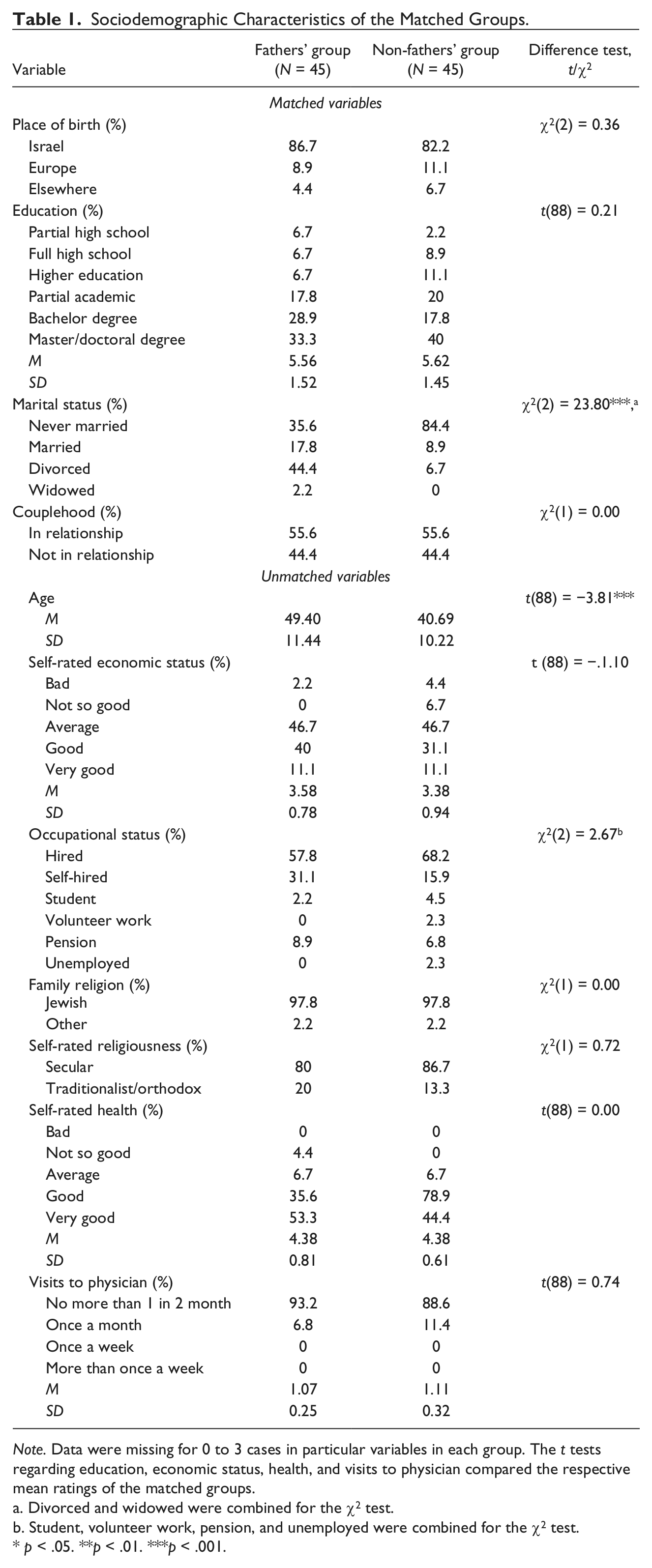
Note. Data were missing for 0 to 3 cases in particular variables in each group. The t tests regarding education, economic status, health, and visits to physician compared the respective mean ratings of the matched groups.
Divorced and widowed were combined for the χ2 test.
Student, volunteer work, pension, and unemployed were combined for the χ2 test.
p < .05. **p < .01. ***p < .001.
Measures
Sociodemographics
Assessment of sexual orientation was made on a 7-point self-rating scale (Kinsey, Pomeroy, & Martin, 1948) ranging from 0 (exclusively heterosexual) to 6 (exclusively homosexual). By this measure we confirmed that participants defined themselves as predominantly or exclusively homosexual. No exclusion of participants from the sample was required as no participant rated himself below the rank of 4 (predominantly homosexual, but more than incidental heterosexual). The few participants who rated themselves on rank 4 were categorized as homosexual even though showing some bisexual tendencies. Other sociodemographic queries addressed details about current couplehood and fatherhood, origin, age, marital status, education level, economic status, occupational status, family religion, self-rated religiousness, self-rated health, and visits to physician.
Subjective Well-Being
Subjective well-being was assessed by three instruments. First, Satisfaction With Life Scale (SWLS) measured life satisfaction (Diener, Emmons, Larsen, & Griffin, 1985). This measure included five items (e.g., “the conditions of my life are excellent”) rated by respondents on a scale ranging from 1 (strongly disagree) to 7 (strongly agree). The score was the items’ mean rating. Cronbach’s alpha coefficient of SWLS in the present sample was .83. Second, Affect Balance Scale (ABS) measured positive and negative affect (Bradburn, 1969). This measure included five items for depicting positive affect (PAS) and five for negative affect (NAS), rated for frequency of occurrence in the past week on a scale ranging from 1 (never) to 4 (often). The scores of the PAS and NAS were the respective mean ratings of the two sets, with higher scores indicating, respectively, higher positive and negative affect. The respective alpha coefficients of PAS and NAS in the present sample were .77 and .63. Third, the Happiness Scale (HS) was used as a crude indicator of avowed happiness (Campbell, Converse, & Rodgers, 1976), consisting of one rating scale ranging from 1 (very unhappy) to 5 (very happy).
Center for Epidemiological Studies–Depression Scale (CES-D)
This measure assessed self-reported symptoms of depression (Radloff, 1977). Participants were asked to rate for each of the 20 items how often they had felt or behaved this way in the past week. Ratings ranged from 1 (rarely or none of the time) to 4 (most or all of the time). The ratings of four items were reversed. The score was the items mean rating, with a higher score indicating more depressive symptoms. The alpha coefficient of CES-D in the present sample was .89.
Meaning-in-Life (MIL) Scales
MIL was assessed within the conception of psychological well-being formulated by Ryff (1995), delineating six dimensions of basic existential challenges of life. In this study, we used two scales that presented evident affinity with common definitions of MIL. First, Purpose in Life (PL), which included eight items measuring goals in life, objectives for living, and a sense of self-directedness. Second, Personal Growth (PG), which included eight items measuring feelings of continued development and self-improvement, a sense of realizing one’s potential, and openness to new experiences. Items from Ryff’s full scales were chosen according to an Israeli pilot that looked for reliability data. The respective alpha coefficients of these two scales in the present sample were .80 and .70.
All the above-mentioned psychological welfare measures produced ample evidence of validity (McDowell, 2010; Stanbury, Ried, & Velozo, 2006). The Hebrew adaptations of these measures were employed in various Israeli samples (e.g., Shenkman & Shmotkin, 2011; Shmotkin & Lomranz, 1998).
Procedure
Questionnaires were administered during February to June 2008 following the group sessions described above. Participants were asked to complete questionnaires dealing with concomitants of gay identity and hand them out to the experimenter. They were told that the questionnaires were anonymous and that participating was completely voluntary. Six participants who did not agree to complete the questionnaires were not included in the sample. The study was approved for ethical requirements by the institutional review board at Tel Aviv University.
Results
To examine our hypothesis that gay men couplehood and gay fatherhood would be correlated with higher psychological welfare, multivariate analysis of covariance (MANCOVA) was performed with couplehood (being vs. not being in relationship) and fatherhood (being vs. not being a father) as independent variables; subjective well-being (SWLS, PAS, NAS, HS), depressive symptoms (CES-D), and MIL (PL, PG) as the dependent variables; and age as a covariate. In Analysis 1, the dependent variables were subjective well-being and depressive symptoms, and in Analysis 2 the dependent variables were those of MIL. This separation reflects the conceptual division between hedonic and eudaimonic well-being. It should be noted that observations in the MANCOVA are assumed to be independent. Although the matched-pair technique created a certain extent of dependence between the two study groups, we opted to a conservative approach and did not resort to dependent-group analysis.
According to the MANCOVA analysis and in line with our prediction, the measures (except PAS) indicated higher levels of subjective well-being and a lower level of depressive symptoms among gay men who were in relationship compared with gay men who were not (see Table 2; Wilks’s Λ = .782, p < .01). When comparing the fathers’ group with the non-fathers’ group, the measures (except NAS and CES-D) indicated higher levels of subjective well-being (Wilks’s Λ = .809, p < .05) among the fathers’ group. The fathers’ group was higher on SWLS, F(1, 83) = 10.99, p < .001; PAS, F(1, 83) = 4.52, p < .05; and HS, F(1, 83) = 8.07, p < .01.
Multivariate Analysis of Covariance of Couplehood (in Relationship vs. Not in Relationship) by Fatherhood (Fathers vs. Non-fathers) for Psychological Welfare (Age Controlled).
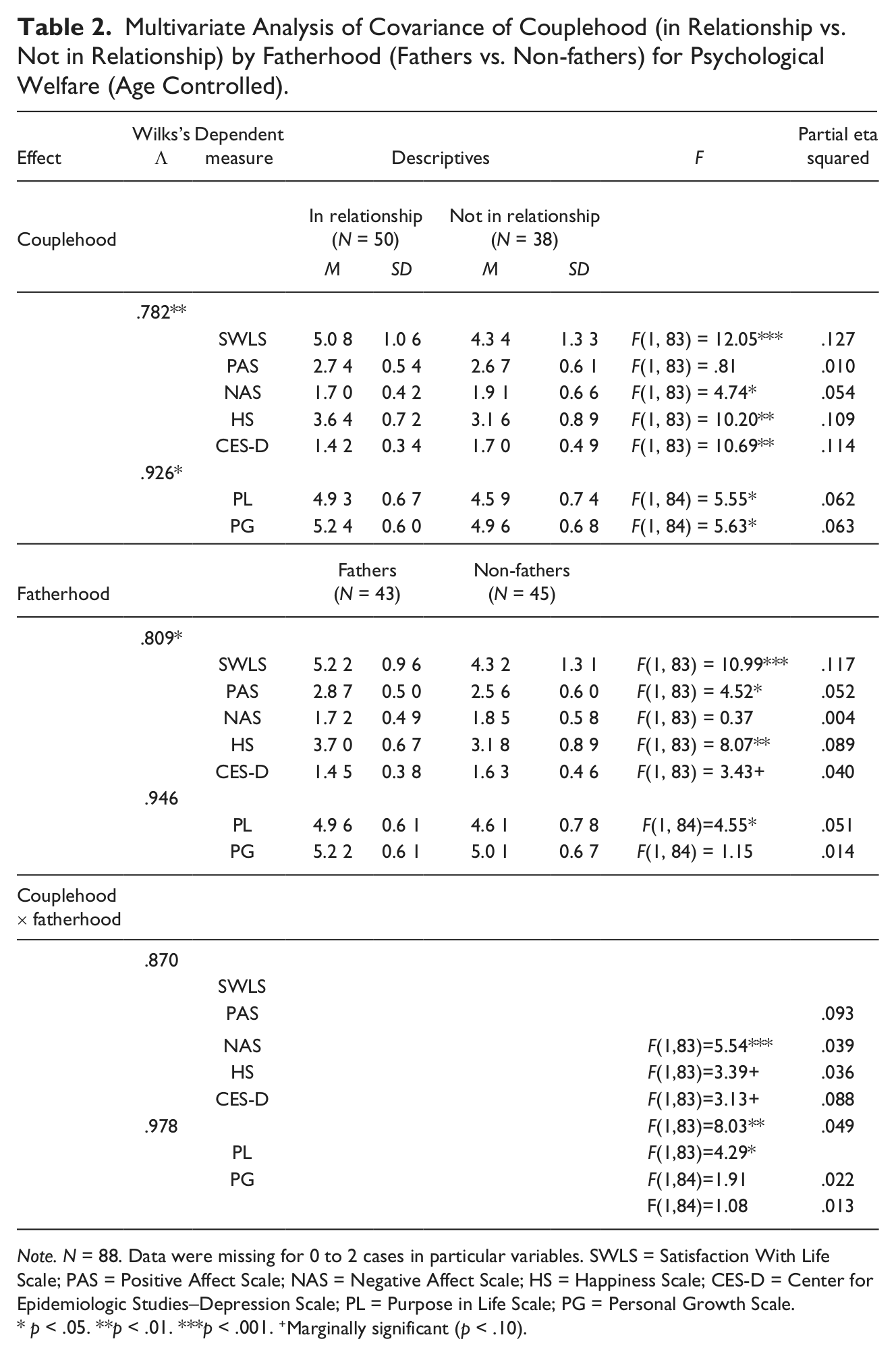
Note. N = 88. Data were missing for 0 to 2 cases in particular variables. SWLS = Satisfaction With Life Scale; PAS = Positive Affect Scale; NAS = Negative Affect Scale; HS = Happiness Scale; CES-D = Center for Epidemiologic Studies–Depression Scale; PL = Purpose in Life Scale; PG = Personal Growth Scale.
p < .05. **p < .01. ***p < .001. +Marginally significant (p < .10).
As shown on Table 2, significant interaction effects were found regarding SWLS, HS, and CES-D. Although Wilks’s Λ was not significant, the univariate effects were significant. These interactions had an ordinal pattern, indicating that the combination of couplehood with fatherhood presented higher levels of subjective well-being and a lower level of depressive symptoms on the aforementioned indices.
As also shown on Table 2 and in line with our prediction, higher levels of PL and PG were found among gay men who were in relationship compared with gay men who were not (Wilks’s Λ = .926, p < .05). Higher levels of PL were also found in the fathers’ group compared with the non-fathers’ group (although Wilks’s Λ was not significant, the univariate effect was significant). No significant interaction effects were found regarding PL and PG.
Discussion
In line with our main prediction, higher psychological welfare was found among gay men who were in relationship (compared to gay men who were not) as well as among gay fathers (compared to gay men who were childless). The data also showed that gay men being both in relationship and fathers might be more likely to be highest on satisfaction with life and happiness and lowest on depressive symptoms. These findings suggest that the “parenthood paradox” may not necessarily represent the psychological welfare characterizing gay fathers, as elevated levels of subjective well-being (positive emotions, judgments of life satisfaction, and happiness) were found among gay fathers compared with gay men who were not fathers. This is contrary to findings among heterosexual fathers, showing that subjective well-being is usually lower or not different from non-fathers (e.g., Nomaguchi & Milkie, 2003).
The results indicating more subjective well-being, less depressive symptoms, and more MIL among gay men who were in relationship, compared with those who were not, are consistent with prior findings showing similar patterns among heterosexuals (e.g., Diener, Gohm, Suh, & Oishi, 2000) as well as among gay men and lesbian women (Riggle et al., 2010). A common explanation for these findings suggests that a close relationship is likely to facilitate stronger self-esteem, more competence, and a stronger sense of meaning, which are all associated with higher psychological welfare (House, Umberson, & Landis, 1988; Kamp Dush & Amato, 2005).
The current research findings showed that being father was associated among gay men with higher subjective well-being and higher MIL. Hence, the aforementioned “parenthood paradox,” involving decreased subjective well-being among heterosexual parents, was not replicated in our data of gay fathers. We suggest that among heterosexuals, parenthood is a well-defined life developmental task. However, due to heterosexist and homophobic norms, this task is not a common default choice among gay men. Therefore, the very choice to become a gay father raises tough questions as to how this is to be realized (whether by adoption, surrogacy, shared parenting with a woman, or a gay framework to fatherhood obtained through a prior heterosexual relationship). Hence, the transition to fatherhood among gay men appears to require certain maturity, a resolute motivation, and a special meaning construction, and may be experienced as a huge triumph over the widespread message that gay men are not supposed to become parents (Armesto, 2002). Among heterosexual parents, this challenge of overcoming special difficulties in creating a family may also boost subjective well-being (Ceballo et al., 2004).
Another possible explanation for the results relies on literature suggesting that being fathers may increase social support and help-seeking and decrease risk-taking behaviors, especially among men with low traditional masculinity ideology (Berger, Levant, McMillan, Kelleher, & Sellers, 2005; Rochlen, McKelley, Suizzo, & Scaringi, 2008). We assume that these beneficial outcomes may be correlated with high psychological welfare as appeared in our study. Also, conformity to the heterosexual mainstream, traditional gender role of becoming a father may enhance a sense of belongingness and social acceptance (Kama, 2011), which could increase psychological welfare as well.
It seems that the saying “kids are joy” has not necessarily gained support from research on heterosexual parents, as reports about higher subjective well-being among these parents, compared with counterpart non-parents, are scarce (e.g., Galatzer-Levy, Mazursky, Mancini, & Bonanno, 2011). Interestingly, support for this popular saying now emerges in our gay fathers’ sample.
Limitations and Conclusion
Although the current method of individually matching gay fathers with controls provided a comparative design that was relatively less bound to prevalent confounders such as sociodemographic factors, several methodological limitations should be considered. First, the study groups were not based on a random or systematically representative sampling as the participants were sampled in group sessions mainly organized by the Israeli GLBT Association, and the participants’ readiness to take part in an academic research might also involve certain biases. Second, the study’s measures were self-reports, thus being exposed to self-presentational and self-observational biases. A third limitation concerns the variety of ways by which gay men became fathers in our sample and the variability among the fathers regarding the time their children lived with them (full-time vs. part-time fathers). As the number of participants in each of these subgroups was quite small, we could not address the differential implications of these different paths of gay fatherhood. Other limitations concern the design of this study, which could not examine causality and did not use a comparison group of heterosexual fathers. Overall, the above limitations reflect widely prevalent difficulties in investigating gay populations at large (Meyer & Wilson, 2009) and same-sex families in particular (Meezan & Rauch, 2005). Hopefully, future research will attempt to overcome these limitations and will also explore the generalizability of the present findings across other cultures as well as across bisexual parents on which data is scarce.
In conclusion, this study identified higher psychological welfare among gay men who were in relationship or who were fathers as compared with gay men who were not in these life conditions. An application of these findings appears relevant to clinicians and counselors working with gay men who wish to become fathers and yet feel ambivalent due to stereotypes or homophobic norms. Also, the findings may encourage both researchers and practitioners to further explore the positive psychological concomitants of parenthood among gay men. Such an approach may enlarge our view on the resilience exercised by a minority group that is often encountered by hostile-world scenarios.
Footnotes
Declaration of Conflicting Interests
The author(s) declared no potential conflicts of interest with respect to the research, authorship, and/or publication of this article.
Funding
The author(s) received no financial support for the research, authorship, and/or publication of this article.