







Abstract
This study uses data from the first three waves of the National Longitudinal Study of Adolescent Health, from 8,019 adolescents and their mothers, to examine links between multiple dimensions of family structure and instability over adolescents’ life courses, family functioning, peer contexts, and teenage cohabitation. Investigated explanations include an instability model, socioeconomic-stress model, and intergenerational transmission. Results from logistic regression models link single-mother and stepfamily residence during adolescence to frequent family transitions, weakened maternal bonds, teenage dating, and, ultimately, teenage cohabitation. Moreover, single motherhood and maternal cohabitation fail to predict teenage cohabitation among those living in stable households. Individual poverty and residence in a neighborhood marked by family disruption account partially for the influence of single motherhood. In addition, maternal bonds moderate the influence of maternal cohabitation on adolescent cohabitation, yielding support for an intergenerational transmission effect.
Cohabitation has become a normative part of adult relationship trajectories (Sassler & Cunningham, 2008; Smock & Greenland, 2010), but it is considered an off-time transition among teenagers with negative consequences for life-course outcomes, including relationship conflict and unplanned, nonmarital pregnancies (Booth, Rustenbach, & McHale, 2008; Houseknecht & Lewis, 2005; Manning & Cohen, 2010). Nonetheless, cohabitation may provide benefits to young people from disadvantaged backgrounds who seek to escape a less-favorable home environment, particularly when relations with mothers are strained (Booth et al., 2008).
Regardless of whether cohabitation is beneficial or detrimental, it has replaced early marriage as a transition to adulthood for many people, including teenagers (Bumpass & Lu, 2000). Using National Survey of Family Growth data, Manning and Cohen (2010) found that 30% of women had cohabited by age 20, and about 20% had by age 18. Despite contemporary levels and potential consequences of early cohabitation, only a handful of studies examine the effects of family structure and parenting on this off-time transition (e.g., Amato et al., 2008; Houseknecht & Lewis, 2005; Manning & Cohen, 2010; Meier & Allen, 2009; Ryan, Franzetta, Schelar, & Manlove, 2009).
Antecedents of teenage cohabitation include single motherhood and family instability (Musick & Meier, 2010; Teachman, 2003), yet mediating processes remain underanalyzed (for an exception, see Amato & Kane, 2011), particularly in comprehensive studies of family structure histories. Researchers propose—but do not test—a model that links family structure, instability, and disadvantage to parenting practices (i.e., weak parental bonds and lax monitoring) that predict deviant peers associations, teenage dating, and, ultimately, teenage cohabitation. Furthermore, some posit that intergenerational transmission accounts for family structure effects, yet these links may be because of shared structural locations rather than socialization (Amato & Kane, 2011; Barber, 2001). Examining the moderating effects of parental bonds on intergenerational transmission represents an underutilized strategy for addressing socialization and ruling out selection effects.
In this research, I use the first, second, and third waves of National Longitudinal Study of Adolescent Health (Add Health) data to construct and analyze the effects of comprehensive family structure histories on family processes, deviant peers and teenage dating, and, in turn, teenage cohabitation. In doing so, I investigate the extent to which instability, structural disadvantage, and intergenerational transmission characterize pathways to early cohabitation.
Family Structure and Family Instability
Recent demographic shifts in marriage and childbearing have transformed the contexts in which Americans rear children. Increases in divorce, nonmarital births, and parental cohabitation produced a substantial rise in the number of youths who grow up with single or cohabiting parents or who experience family disruptions (Bumpass & Lu, 2000; Cherlin, 2009). Indeed, nearly half of U.S. children spend time in a single-parent household before age 18, two fifths with cohabiting couple, and a third with a stepfamily (Kennedy & Bumpass, 2008).
This changing family landscape is marked by increased instability within individual families. Nearly two thirds of children born to cohabiting parents and 28% born to married parents are likely to see the dissolution of their parents’ relationship by age 10 (Manning, Smock, & Majumdar, 2004), which can mark the beginning of a series of additional family transitions. Giving the name “the marriage-go-round” to the contemporary situation, Cherlin (2009) reports that nearly half of children whose married or cohabiting parents split see a parent’s new partner join the household within 3 years.
Dimensions of Family Structure History
Family structure is fluid, often changing over a child’s life course, rather than a static condition that can be assessed at a single point in time. Many children born to single mothers experience the entry of a new partner, and many born to married parents experience a divorce and new family structures as parents negotiate single, dating, and partnered lives (Amato, 2010; Cherlin, 2009). As such, family sociologists identify multiple dimensions of family structure history, including the family structure into which a child is born and the family structure that immediately precedes or is concurrent with adolescent behavior (Fomby & Cherlin, 2007). Family structure at birth may matter to the extent that it shapes parenting circumstances. Single parenthood or cohabitation at birth may set the stage for parenting styles adopted during early childhood because of parenting stress (Cooper, McLanahan, Meadow, & Brooks-Gunn, 2009; Wu & Martinson, 1993). Alternatively, family structure at birth may only matter to the extent that it predicts subsequent family structure and instability during later childhood, or initial family structure may simply identify selection characteristics (Cavanagh, 2008).
Duration of years spent in a particular family structure constitutes another dimension of family structure history (Hao & Xie, 2002; Ryan et al., 2009). Longer durations in any family type may produce a consistent parenting and interaction style as family members have had time to adapt. For example, the entry of a stepparent is stressful and disruptive in early months and years, but is less problematic once they are integrated into the family system (Hetherington, 1989). Alternatively, longer durations in family structures associated with weak supervision, reduced investment of parental figures, and financial hardship may lead to poor adolescent outcomes. In other words, the influence of duration may vary by family type. It is possible that not all family structure stability is equally beneficial for youth.
Family structure instability is an additional dimension (Fomby & Cherlin, 2007; Hao & Xie, 2002). Researchers posit that frequent transitions generate stress that undermines effective family functioning. In addition, adolescent outcomes may vary based on the timing of transitions (Lansford, 2009). Hetherington (1989) posited that earlier divorce may be particularly detrimental given young children’s lesser capacity for understanding the reasons for the dissolution, abandonment anxiety, and their inability to draw on coping resources external to the family. However, earlier transitions are often followed by long durations of stability, which may promote adolescent well-being. Later transitions may be particularly disruptive in that the adolescent has not yet adapted to the new partner or the loss of a parent or parental figure.
Family Structure, Instability, and Teenage Cohabitation
The risk of teenage cohabitation is higher among those who have lived outside of a married, biological-parent family. Using National Education Longitudinal Study data, Houseknecht and Lewis (2005) found that living with a single or stepparent during adolescence increased girls’ risk of teenage cohabitation by 64%. Manning and Cohen (2010) identified a similar pattern among a female sample from the National Survey of Family Growth. Using Add Health data, Meier and Allen (2009) found that living with single or stepparents during adolescence increased the risk of ever cohabiting by the mid-20s.
Existing research clearly indicates that family structure matters for teenage cohabitation, yet these studies are limited in several ways. First, most measure family structure at only one point in time, failing to capture the range of family structure experiences over the course of childhood, often because family structure is a control rather than a focus of study. Second, as a result, the family structure types examined are limited, with cohabiting and widowed-parent families disregarded or considered only as “other” (e.g., Meier & Allen, 2009). Moreover, instability is typically missing from these analyses (see Ryan et al., 2009, for an exception).
Research on other domains of adolescent behavior suggests that family structure effects may be due, in part, to frequent transitions, supporting an instability model that posits that changes in family structure, rather than family structure, per se, lead to risky adolescent behavior (Cavanagh, Crissey, & Raley, 2008; Fomby, Mollborn, & Sennett, 2010). Testing this claim requires an evaluation of the effects of transitions (i.e., instability) while controlling for family structure. The instability hypothesis receives support to the extent that transitions predict teenage cohabitation net of the effects of particular family forms. Few analyses of teenage cohabitation investigate this possibility, and those that do test it do not address directly the family and peer processes said to mediate instability effects (Ryan et al., 2009; Teachman, 2003).
Consistent with the instability perspective, Goldscheider and Goldscheider (1998) found that leaving home to cohabit was more common among those who had transitioned to a single-parent home during childhood. Teachman (2003) tested the instability model using National Survey of Family Growth data, finding that frequent transitions account for some family structure effects. Ryan et al. (2009) used Add Health data to examine family structure histories—including duration and the frequency and timing of transitions—and teenage cohabitation. They found that heightened instability and longer durations in single-mother households contribute to early cohabitation, which they interpret as evidence of stressful family environments and a socialization effect.
Research on adolescent romance speaks to the potential effects of instability on teenage cohabitation, as dating is a step in the transition to cohabitation. Cavanagh et al. (2008) found that family structure instability increases the likelihood of adolescent romantic relationships, as well as the extent of dating histories, and instability accounts partially for the effects of family structure during adolescence.
The instability model is one of several stress models offered to explain the influence of family structure on youth behavior. A socioeconomic-stress model suggests that adolescents fare worse in some family types (e.g., single-mother and cohabiting) than married, biological-parent families because of the structural deficits associated with those family structures. Indeed, women from low socioeconomic status families are particularly likely to enter into cohabitation at young ages (Amato et al., 2008). Parents in these families are posited to be less able to control youth behavior because of financial constraints that reduce supervision and strain parental coping resources, potentially undermining emotional bonds between parents and their children (Cooper et al., 2009).
In addition, youth from advantaged backgrounds may delay entry into adult family statuses, including cohabitation, because of high expectations for educational attainment and career development. The timing and sequencing of adult transitions for college-oriented youth are such that family transitions—cohabitation, marriage, childbearing—are normative only after the completion of education and the securing of employment (Furstenberg, 2010). For less-advantaged young people whose education ends during the teenage years, this sequencing of events occurs at a younger age, and insecurity regarding the eventual possibility of economic independence reduces the perceived costs of non-normative transitions (Furstenberg, 2010).
Neighborhood disadvantage—both economic- and family-based—is an additional conduit in the socioeconomic-stress model, with children of single and cohabiting parents at increased risk of residing in neighborhoods marked by financial hardship and female headship (Hoffmann, 2006). Poor neighborhoods and those characterized by family instability may lack sufficient resources for collectively controlling youth (Browning, Leventhal & Brooks-Gunn, 2005). In addition, nonnormative family transitions may become normalized in communities with high levels of family disruption (Edin & Kefalas, 2005).
Family Processes and Teenage Cohabitation
It remains unclear whether histories of family structure instability influence teenage cohabitation through altered conditions of childrearing or a process of intergenerational transmission/socialization, as the most comprehensive studies of family structure histories and early cohabitation do not empirically assess these mechanisms (Ryan et al., 2009; Teachman 2003). Family sociologists offer multiple family process mechanisms linking family structure and instability to adolescent behavior, including reduced maternal well-being, weakened parental bonds, and a lesser degree of control over children’s activities (Cavanagh, 2008; Wu & Martinson, 1993). Stress models suggest that family structure is linked to adolescent outcomes through its direct or indirect influence on these family processes.
Empirical studies yield support for the effects of these family processes on teenage cohabitation (Amato & Kane, 2011; Amato et al., 2008). For instance, a positive family environment—measured as family warmth, understanding, fun, and attention—is associated negatively with the odds of daughters’ cohabiting transitions (Amato and Kane, 2011). Booth et al. (2008) found that mother–child relationships are predictive of youth cohabitation but only among female adolescents. Amato et al.’s (2008) used latent class analysis to identify a typology of women’s pathways to adulthood. Weak parental bonds predicted pathways marked by off-time, early cohabitation transitions, suggesting that youths with shallow stores of emotional resources seek out relational intimacy in other forms (see also Edin & Kefalas, 2005). Notably, these models do not consider the possibility that close relationships with mothers may facilitate intergenerational transmission among adolescents with cohabiting mothers.
Maternal Bonds and Intergenerational Transmission
Intergenerational transmission represents another conduit through which family structure histories may shape adolescent cohabitation (Amato & Kane, 2011; Thornton, Axinn, & Xie, 2007). In this perspective, family circumstances shape not just the environment of stress and control to which youths are exposed, but also socialization of values and meanings assigned to social behaviors. Indeed, mothers who give birth as teenagers, marry young, and cohabit tend to have children who follow similar life-course paths (Barber, 2001; Wildsmith, Manlove, Jekielek, Moore, & Mincieli, 2012). Similarly, Manning, Cohen, and Smock (2011) found that parental modeling shapes young people’s attitudes toward cohabitation.
Maternal attachment is typically assumed to prevent nonnormative adolescent behavior, including teenage cohabitation. This assumption fails to incorporate Giordano’s (2003) insights regarding the nexus of attachment and reference behavior: Any explanation that emphasizes attachment is limited to the extent that it ignores the behavior and values of the person to whom one is attached. Close maternal bonds may fail as a preventative feature when youths are close to mothers whose own behaviors model and signal an acceptance of cohabitation. Among adolescents with cohabiting mothers, close bonds may, in fact, increase the likelihood of teenage cohabitation, as bonds facilitate the transfer of norms. At a minimum, close bonds may fail to prevent teenage cohabitation because of the mixed messages youth receive regarding appropriate behavior, with mothers discouraging cohabitation while simultaneously modeling it.
Findings of intergenerational transmission must always be interpreted with caution as these effects may be spurious. Similarity in the behaviors of mothers and their adolescent children may be because of shared social locations and experiences with constrained opportunities rather than to a socialization process (Barber, 2001). The problem of unobserved sources of spuriousness can be avoided by examining the moderating effects of maternal bonds on the intergenerational transmission of behavior.
Families, Peer contexts, and Teenage Cohabitation
Family systems and life-course frameworks recognize that the family is part of an interconnected system of social contexts (Browning et al., 2005). Peer contexts, including dating, may be particularly salient for adolescents, as this developmental period is marked by increased time spent outside of the family home and with friends (Aquilino, 1997), and peer influence increases during adolescence (Bogenschneider, Wu, Raffaelli, & Tsay, 1998). Friendship groups enforce rules regarding appropriate behavior for members, often contradicting parental expectations (Clark & Lohéac, 2006). Research on adolescent problem behaviors indicates that deviant peers are among the strongest predictors of youth behavior among those identified by social scientists (Haynie & Osgood, 2005; Miller, 2010). Although studies of teenage cohabitation rarely include peer effects, evidence of peer influence on other domains of adolescent romance suggests that peers may be relevant for teenage cohabitation. For instance, perceived peer norms strongly predict adolescent sexual behavior (Kinsman, Romer, Furstenberg, & Schwartz, 1999). Moreover, early involvement in dating may operate as a stepping stone to teenage cohabitation, with romantic partners encouraging or, at the very least, providing an avenue to early home-leaving (Manning et al., 2011; Raley, Crissey, & Muller, 2007).
Gender and Pathways to Teenage Cohabitation
Previous research identifies gender differences in the effects of family structure and instability on adolescent behavior, often yielding mixed results (Cavanagh et al., 2008; Davis & Friel, 2001; Ryan et al., 2009). Studies also find stronger evidence of intergenerational transmission among mothers and daughters relative to mothers and sons (Whitbeck, Simons, & Kao, 1994). Although the present research does not focus specifically on gendered pathways, I perform supplementary analyses in which I examine whether adolescent gender moderates the effects of family structure history on early cohabitation. I also investigate whether intergenerational transmission processes are gender-specific.
Conceptual Model
I provide a conceptual model that links family structure-, family process-, and peer-based predictors in a coherent pathway to teenage cohabitation. Specifically, following an instability model, I contend that high levels of instability mediate the effects of family structure experiences (i.e., single motherhood, cohabitation, and stepfamilies) on early cohabitation, with altered conditions of childrearing—maternal well-being, maternal bonds, parental control—mediating the influence of instability on exposure to deviant peers and teenage dating, which ultimately predict teenage cohabitation. Structural disadvantage—individual poverty and neighborhood economic- and family-based disadvantage—also mediates the link between family structure histories and teenage cohabitation, with family processes, deviant peers, and teenage dating mediating also the influence of disadvantage, consistent with a socioeconomic-stress perspective. I investigate an alternative perspective—intergenerational transmission—by analyzing the moderating effects of maternal bonds on maternal cohabitation, expecting that close bonds to cohabiting mothers will fail to deter cohabitation among teenagers.
Method
Data and Sample
The data come from the first three waves of the Add Health, a school-based, nationally representative survey of adolescents who were in Grades 7 through 12 at the first wave in 1994-1995 (Harris et al., 2008). The data contain in-school interviews with all students attending 132 junior and senior high schools, whose selection was stratified by region, school type (public/private), ethnic composition, urbanicity, and size, yielding a sample size of approximately 90,000 students who attended school on the day of administration. The in-school survey contains peer network data that can be used to assess friends’ self-reported deviance. The first-wave data also contain in-home interviews with a subsample (stratified by sex and grade) of 20,745 youths randomly selected from the in-school sample, as well as 17,700 of their parents. Parent surveys entail yearly data on family structure ranging from 1977 to 1995. Additionally, the data include census data linked to individual respondents’ place of residence. Wave II in-home survey data were collected in 1996 from 14,738 first-wave respondents, and Wave III in-home survey data were collected in 2001 and 2002 from 15,170 first-wave respondents. I merge in-school and in-home data from the three waves, as well as parent in-home data and block-level census data, 1 to yield complete data on variables of interest. I include respondent weights, as well as weights by region and strata, to correct for over-sampling and clustered sampling design.
I confine analyses to a sample of youths who—along with their parents—completed the in-home Wave I and III surveys, in addition to the Wave I in-school survey (n = 13,130). 2 I further restrict the analyses to adolescents who had a parent in-home survey completed by a biological or adoptive mother with whom they lived since birth (n = 10,609). 3 This ensures that family structure histories provided by respondent parents are applicable to the adolescent respondent, and it is consistent with previous Add Health research (Fomby et al., 2010). I restrict analyses to maternal reports as too few biological or adoptive fathers, particularly single fathers, completed the interview, limiting my ability to make comparisons on the basis of parental sex. Only adolescents whose mothers provide information on marriage/cohabitation histories since the year of the youth’s birth are included (n = 10,221). Those missing sample weights and data on the dependent variable are excluded, yielding a final sample size of 8,019, including 4,288 females and 3,731 males. I use multiple imputation in the case of missing data on independent variables. 4
Measures
Dependent Variable
During Wave III, when all respondents were in their late teens or early 20s, they reported if they had ever lived with someone in a marriage-like relationship for more than 1 month and, if so, the date at which they began living together. Teenage cohabitation is a binary variable with respondents who had cohabited by age 19 coded 1 for teenage cohabitation; respondents who had not cohabited by age 19 were coded 0.
Family Structure History
During the first wave, parents reported all marriages, coresidential marriage-like relationships, and periods of singlehood experienced in each year from 1977 to 1995. I create a family structure variable for each year of the child’s life using these data. Using the adolescents’ birth dates and the mothers’ reports of family structure by year, I assess the adolescent’s family structure at birth, which comprises a series of binary variables indicating if the family was a married-parent, cohabiting, or single-mother family at birth. I combine parental reports of family structure and youth reports of biological relationships to household members to create family structure during adolescence, which includes married, biological- or adopted-parent families, stepfamilies (mother/stepfather), cohabiting (mother/cohabiting partner), single-mother, and widowed-mother families. I utilize youth reports of family structure at birth and during Wave I in cases of missing parental data, and I defer to parental reports when parental and youth reports do not correspond (see Brown & Manning, 2009, for more on accuracy of parental reports). I measure cumulative duration of years in several family forms: married-parent, cohabiting, and single-mother households. 5 Frequency of transitions is a continuous variable indicating the number of changes in family structure from birth to adolescence. I combine transition data with adolescent birth date data to determine the age at most recent transition, comprised of a series of binary variables that differentiate between most-recent transitions occurring between birth and age 5, ages 6 and 12, and age 13 or older. I use mothers’ reports of maternal dating, coded 1 if they reported currently dating and 0 if not.
Family Process Mechanisms
Mothers who report during Wave I that they are happy in general are coded 1 for maternal happiness; otherwise, they are coded 0. I measure maternal bonds using adolescent Wave I reports of how close they feel to their residential, biological mothers, how much they feel their mothers care about them, how warm their mothers act toward them, how well they communicate with their mothers, and how satisfied they are with their relationship with their mothers (α = .860). 6 Adolescents were also asked to report whether their parents allow them to make their own decisions about a variety of daily activities, including curfews, the persons with whom they hang out, what they wear, how much television they watch and which programs, what time they go to bed, and what they eat. Adolescents responded yes (they are allowed to make their own decision) or no (they are not allowed to make their own decision). I measure instrumental parental control over adolescents’ daily activities with a summed sale of these seven items (reverse coded).
Peer Contexts
I use the in-school friendship network data to construct a measure of exposure to deviant peers. Adolescents who completed the in-school survey reported the names (linked to IDs) of up to five of their closest friends, each of whom reported their involvement in series of deviant behaviors over the past 12 months, including how often they smoked, got drunk, lied to parents, and skipped school, with responses ranging from “never” to “nearly every day.” Deviant peers are indicated by the mean level of deviance in the adolescents’ friendship send-network (see Carolina Population Center, 2001). During Wave II, respondents were asked whether they had been in a romantic relationship during the previous 18 months. Those who answered yes were coded 1 for teenage dating and 0 otherwise.
Family and Neighborhood Disadvantage
I use maternal reports of income and family size to calculate family poverty status. Wave I household incomes below the 1994 federal poverty line (by family size), are coded 1 for poverty status, and 0 otherwise. The neighborhood economic disadvantage scale includes median household income, proportion households living below the poverty line, total unemployment rate, and proportion Black (α = .733). 7 The neighborhood family disadvantage scale includes proportion ever-married men who are divorced or separated and proportion of households that are female-headed (α = .582). Values are standardized and summed to create the scales. Previous studies include scales that combine these indicators of disadvantage (e.g., De Coster, Heimer, & Wittrock, 2006), yet these neighborhood characteristics may operate in distinct ways: limited community resources for the control of adolescents (economic and family) versus the normativity of family disruption (family only).
Controls
Control variables include adolescent race/ethnicity, adolescent age, maternal age at birth, and maternal education. I use adolescent reports to measure race/ethnicity. Responses are recoded into four categories: non-Hispanic White, non-Hispanic Black, non-Hispanic other, and Hispanic. Adolescents who reported more than one race/ethnicity were also asked with which race/ethnicity they most identify. In cases of multiracial adolescents, their main racial/ethnic identification is used. For adolescents who failed to report race/ethnicity, I rely on interviewer reports of the adolescent’s race. Adolescent age is their age in years. Teenage motherhood is coded 1 if the adolescent’s mother was 19 or younger at the time of the birth, and 0 otherwise. Maternal education is the mother’s report of highest level of education attained.
Analytic Technique
I use logistic regression to model the effects of family structure history, family process, and peer context mechanisms on the odds of teenage cohabitation. Logistic regression is the most appropriate analytic technique for studies with binary outcomes (Agresti, 1996), and it is consistent with techniques used in existing research on family formation transitions (e.g., Booth et al., 2008). The equation for the logit is expressed as follows:

I report BIC (Bayesian information criterion) values, which are calculated as follows: BIC = df(ln N) − χ2, where df is the degrees of freedom, N is the sample size, and χ2 is the likelihood ratio of the estimated model relative to a null model with no covariates. BIC values that are more negative indicate a better model fit than BIC values that are less negative (Ward, 2008). Although there are no significance tests when comparing BIC values, Raftery (1995) suggests that differences of 10 or more indicate strong evidence of better model fit.
Results
Table 1 presents means and standard deviations. Half of the sample was female, 8.1% had a teenage mother, 12.4% lived below the poverty line, 70.7% were non-Hispanic White, 13.6% were non-Hispanic Black, 11.4% were Hispanic, and 4.3% identified as another race/ethnicity. Respondents had a wide range of family structure experiences. At birth, 78.2% lived with married parents, 20.4% with a single mother, and 1.3% with cohabiting parents. At Wave I, 60.3% resided with married, biological parents, 8 19.7% with a single mother, 10.4% with a mother and stepfather, 6.0% with a cohabiting mother, and 1.5% with a widowed (single) mother. Although the majority of adolescents had not experienced instability by the first wave of data collection (63.9%), 19.6% had faced one transition, 10.8% two transitions, and 5.7% three or more transitions. One in 10 respondents had a dating mother. Respondents were about 14.5 years old at Wave I, 54.3% reported having had a dating relationship during the previous 18 months at Wave II, and 17.27% cohabited during their teenage years, as reported at Wave III.
Descriptive Statistics (n = 8,019).
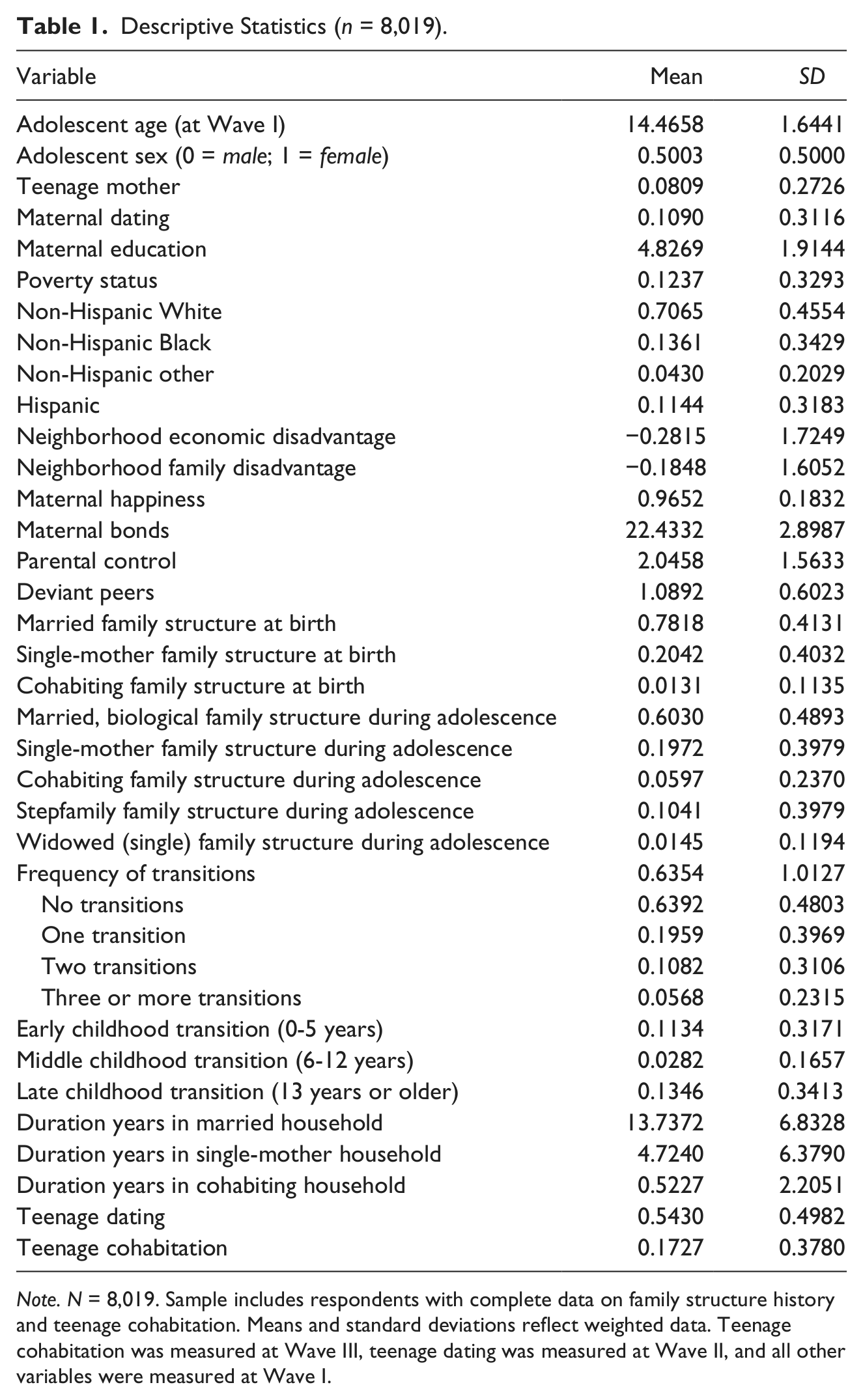
Note. N = 8,019. Sample includes respondents with complete data on family structure history and teenage cohabitation. Means and standard deviations reflect weighted data. Teenage cohabitation was measured at Wave III, teenage dating was measured at Wave II, and all other variables were measured at Wave I.
Table 2 displays odds ratios from the logistic regression models. Model 1, which includes the family structure variables and controls, indicates that girls are 84.8% more likely than boys to cohabit as teenagers, and youth with teenage mothers are 59.1% more likely than other youth to cohabit. Higher maternal education predicts lower odds of teenage cohabitation (0.833), as does Black racial status (0.486). Family structure at birth is nonsignificant but more proximate family structure matters: the odds of teenage cohabitation are 67.0% higher among adolescents in single-mother families relative to adolescents in married, biological-parent families; the odds are 59.5% higher among those in stepfamilies. Longer durations of years spent in any family type are not associated with the odds of teenage cohabitation. 9
Odds Ratios From Logistic Regression Models Estimating Risk of Teenage Cohabitation.
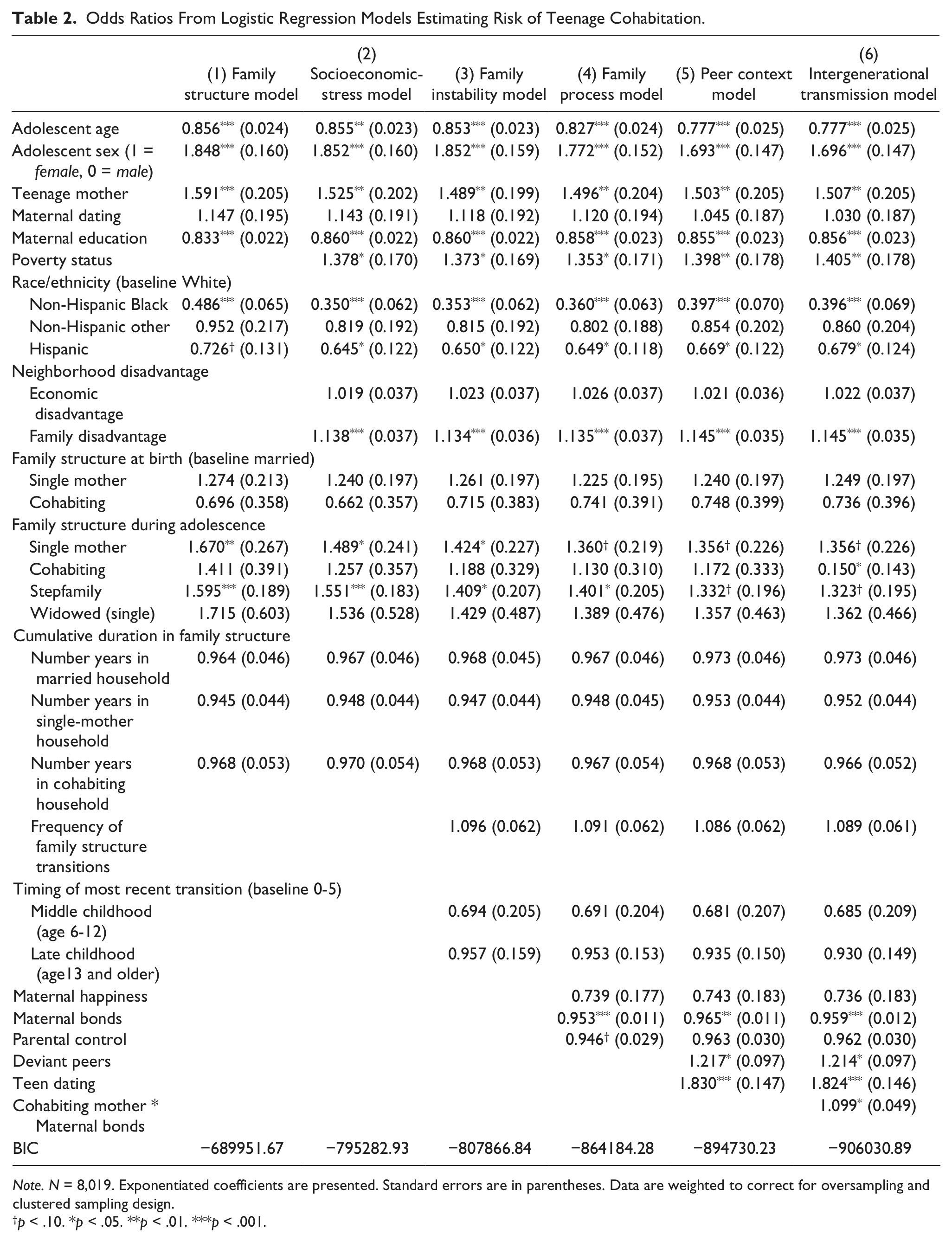
Note. N = 8,019. Exponentiated coefficients are presented. Standard errors are in parentheses. Data are weighted to correct for oversampling and clustered sampling design.
p < .10. *p < .05. **p < .01. ***p < .001.
Model 2, the socioeconomic-stress model, introduces the disadvantage variables. Living below the poverty line increases the odds of teenage cohabitation by 37.8%. Neighborhood economic disadvantage is nonsignificant, but neighborhood family disadvantage (i.e., high proportion of female-headed households and single men) increases teenage cohabitation risk (1.138). The inclusion of poverty status and neighborhood disadvantage accounts for some of the effect of single motherhood, and their inclusion improves the model fit substantially (Model 1 BIC = −689951.67 and Model 2 BIC = −795282.93).
The third model, the family instability model, introduces the frequency and timing of family structure transitions. The frequency of transitions does not reach statistical significance. Nonetheless, the inclusion of instability partially mediates the effects of living with a stepfamily (odds ratio drops to 1.409 with p < .05 in Model 3 from 1.551 with p < .001 in Model 2), and improves the overall model fit (Model 2 BIC = −795282.93 and Model 3 BIC = −807866.84). Among youth living with a single mother during adolescence, the relative odds of teenage cohabitation decreases 6.5 percentage points with the inclusion of instability. 10 The life-course timing of the most recent transition is nonsignificant. Thus, the instability hypothesis is not supported generally, except with regard to mediational processes. An alternative way to test the instability hypothesis is to examine the role of family structure among adolescents from stable households (i.e., families with no transitions). The results from this analysis indicate no effect of single motherhood or maternal cohabitation on teenage cohabitation among adolescents in stable households (available on request). Supplementary analyses investigating the moderating effect of adolescent gender on family structure history predictors indicate that only stepfamily residence during adolescence has a greater effect on female than male cohabitation (3.101, p < .001). Instability and all other family structure variables influence—or fail to influence—male and female cohabitation similarly.
Model 4 introduces the family process mechanisms. Maternal bonds operate in the expected direction: adolescents who report close relationships with mothers have lower odds of cohabiting (0.953). In addition, parental instrumental control over daily activities is marginally significant in the direction anticipated (0.946). Maternal happiness is nonsignificant. The inclusion of family processes reduces the effect of single motherhood to only marginal significance and improves considerably the model fit (Model 3 BIC = −807866.84 and Model 4 BIC = −864184.28).
Deviant peers and teenage dating are introduced in Model 5. The level of deviance in the adolescent’s peer network is associated with teenage cohabitation, with youth embedded in deviant groups more likely to cohabit than youth with more-conventional peer networks (1.217). Teenage dating also strongly predicts teenage cohabitation, with dating adolescents 82.4% more likely to cohabit than those not reporting a dating relationship at Wave II. Peer contexts partially mediate the influence of living in a stepfamily household and maternal bonds, and they fully account for the marginal effect of parental instrumental control. Additional analyses indicate it is teenage dating, rather than deviant peers, that operates as a mediator.
Model 6, the intergenerational transmission model, introduces the interaction between maternal bonds and maternal cohabitation. The interaction is significant at the .05 level (1.099; partial slope of .0942). Attachment has a weaker effect on the odds of teenage cohabitation among adolescents close to mothers who cohabit. When models are run separately for cohabiting mothers, maternal attachment fails to predict teenage cohabitation (available on request). The three-way interaction between bonds, maternal cohabitation, and adolescent sex was in the supplementary gender analysis was nonsignificant.
Conclusion
A substantial proportion of teenagers report living with a romantic partner yet few studies examine the precursors to teenage cohabitation. The present research seeks to fill this gap by examining the processes by which family structure history influences cohabitation during the teenage years. Specifically, this research asks: Do instability, structural disadvantage, and/or intergenerational transmission characterize pathways to this off-time transition?
This research contributes to the literature on family structure and teenage cohabitation in several ways. First, it tests several mediating processes often proposed, but not typically assessed empirically, in existing comprehensive studies of family structure history and teenage cohabitation. In doing so, it shows that adolescents with histories of single motherhood and stepfamily living are particularly likely to cohabit, in part because of instability, family poverty, residence in neighborhoods marked by family disruption, and weakened maternal bonds. Parenting, in turn, impacts early cohabitation through its effects on teenage dating. In other words, the results of this study yield support for stress models emphasizing the disruptive effects of structural disadvantage and turbulence in family composition.
Further evidence in support of the instability model comes from the analysis of stable households. Single motherhood is irrelevant when predicting teenage cohabitation among adolescents from stable homes, providing evidence that it is instability, rather than family structure, per se, that matters for early cohabitation. Stability acts as a protective barrier against premature movement into co-residential relationships in single-mother households. Despite this support, instability fails to predict teenage cohabitation when controlling for family structure in the main model even though instability mediates much of the stepfamily effect.
A second contribution of this study arises from its treatment of neighborhood economic- and family-based disadvantage as distinct influences. The robustness of neighborhood family disadvantage is noteworthy, particularly given the nonsignificance of neighborhood economic disadvantage. If both indicators of disadvantage mattered, it would suggest that adolescents in these communities are leaving home early and entering into cohabiting relationships because of the high costs of prolonged adolescence and the low costs associated with premature adoption of adult statuses. Neighborhoods in which many residents have few years of schooling and poor job prospects may alter youths’ willingness to take on adult roles (see Edin & Kefalas, 2005; Furstenberg, 2010). The failure of economic disadvantage to predict teenage cohabitation suggests that it is instead community norms regarding appropriate family living that guide patterns of teenage cohabitation. Distinguishing between economic- and family-based forms of community disadvantage may allow future studies of teenage sexual and family formation behavior to more accurately assess causal processes.
Of the family processes examined, only maternal bonds strongly predicted teenage cohabitation and accounted for the influence of single motherhood. This is not especially surprising, as direct control efforts are unlikely to limit opportunities for cohabitation. Teenage cohabitation necessarily entails movement away from the parental purview. Indeed, the marginal effect of parental instrumental control appears to operate through limited opportunities to establish romantic relationships that provide the basis for cohabitation. Weak bonds also affect early cohabitation through an increased risk of dating.
An alternative stress model may provide insight regarding the effects of family structure. Cherlin (2009) contends that poorly defined obligations among adults in step- and cohabiting families produce heightened stress arising from difficulties in negotiating expectations and organizing and maintaining effective parenting. Past studies show that stepfathers and cohabitating men invest less—both financially and socially—in their partners’ children than do married, biological fathers (Berger, Carlson, Bzostek, & Osborne, 2008). Additionally, children and adolescents also sometimes actively reject parenting efforts by stepparents and cohabiting partners, and relationships with biological parents may suffer as a result of the youth’s emotional distancing (Hetherington, 1989). Although I do address some of the parenting variables invoked by this model, I do not address the negotiation process, disagreements between partners regarding parenting expectations, or adolescent rejection of mothers’ partners. More research is needed to determine whether negotiation of family roles contributes to family stress and early cohabitation.
Remaining marginal effects of family structure may result also from heightened risk of sexual behavior among youth in single-mother and cohabiting households (Brauner-Otto & Axinn, 2010), as sexual relationships—both romantic and non-romantic—are predictive of cohabitating transitions (Raley et al., 2007). Supplementary analyses bear this out partially, indicating that early sexual debut fully accounts for the remaining effects of single motherhood but not stepfamilies.
An analysis of intergenerational transmission that considers the interactive influence of maternal behavior and maternal bonds represents a third contribution of this research. The influence of maternal bonds on teenage cohabitation is contingent on whether the adolescent is attached to a cohabiting or non-cohabiting mother. Specifically, close bonds to cohabiting mothers fail to act as a deterrent, supporting a mixed-messages interpretation in which mothers discourage teenage cohabitation while simultaneously modeling cohabiting behavior. By examining whether maternal bonds moderate intergenerational connections, I am able to conclude that a socialization process—rather than a selection process—is operating. However, I do not address socialization processes directly in this research. Previous work demonstrates that positive attitudes toward pregnancy and sex are strong predictors of early cohabitation and nonmarital childbearing (Amato & Kane, 2011). Findings that show that these types of positive attitudes are strongest among youth who are close to mothers who model these behaviors would bolster the claim regarding the intergenerational transmission of norms.
Supplementary analyses investigating gender differences in the influence of family structure histories on teenage cohabitation yield little support for gendered pathways, with only one noteworthy difference: Stepfamily residence during adolescence has a greater effect on female than male cohabitation. Prior research identifies the same gendered effect of living with a stepfather, indicating that stepfathers present a challenge to mother–daughter relationships, leading to stronger reactions among girls than boys (e.g., Aquilino, 1991). All other findings indicate gender-similarity in the impact of family structure history on early cohabitation. In addition, adolescent gender failed to moderate the interaction between maternal cohabitation and maternal bonds, suggesting that daughters and sons receive and respond similarly to mixed messages about cohabitation.
A final contribution of this study is the inclusion of peer contexts. Deviant peers and teenage dating strongly predict teenage cohabitation, and supplementary analyses indicate that teenage dating, alone, mediates family process effects. This may be because only romantic peer contexts provide the necessary combination of incentive and opportunity for cohabitation. The weakness of deviant peers as a mediator may be due also to adolescents coming into contact with peers who support nonnormative behavior at school, rendering parental control efforts irrelevant. Regardless of the source of deviant friendships, their influence constitutes a potential direction for future research. Cohabitation, itself, may not be celebrated in deviant peer groups but rather home-leaving may be encouraged with cohabitation providing an avenue to independence for dating youth. Direct measures of attitudes are necessary for addressing this possibility. Questions also remain regarding the partner’s support for living together and the negotiation between partners prior to their cohabiting. These questions may be best answered with future qualitative research.
Taken together, this research provides some support for the conceptual model proposed. Recent single-mother and stepfamily structure matters for teenage cohabitation, though only partially through its influence on family structure instability. In addition, adolescent family structure affects teenage cohabitation only through diminished expressive rather than instrumental controls. In turn, teenage dating links parenting to teenage cohabitation. Individual poverty and neighborhood family disruption also account for some of the impact of single motherhood on teenage coresidential romance. Moreover, not all attachments are equally effective at deterring early cohabitation, with strong bonds to cohabiting mothers failing to decrease teenage cohabitation.
Footnotes
Acknowledgements
Special acknowledgment is due Ronald R. Rindfuss and Barbara Entwisle for assistance in the original design. Information on how to obtain the Add Health data files is available on the Add Health website ( ). I thank Stacy De Coster, Toby Parcel, Steve McDonald, and Charles Tittle for helpful comments on earlier drafts of the article.
Declaration of Conflicting Interests
The author(s) declared no potential conflicts of interest with respect to the research, authorship, and/or publication of this article.
Funding
The author(s) disclosed receipt of the following financial support for the research, authorship, and/or publication of this article: This research uses data from Add Health, a program project directed by Kathleen Mullan Harris and designed by J. Richard Udry, Peter S. Bearman, and Kathleen Mullan Harris at the University of North Carolina at Chapel Hill, and funded by Grant P01-HD31921 from the Eunice Kennedy Shriver National Institute of Child Health and Human Development, with cooperative funding from 23 other federal agencies and foundations. No direct support was received from Grant P01-HD31921 for this analysis.