







Abstract
Previous individual-level research on the association between the status of divorce and suicide risk has been marked by two recurrent limitations: (a) it is not clear if the timing of divorce (recent vs. distal) affects risk of completed suicides and (b) it is not clear if the association between divorce and suicide completions will withstand controls for a series of risk and protective factors including psychiatric morbidity. The present study addresses these two gaps in the literature. Data are from the National Mortality Follow Back Survey and refer to 13,897 deaths including 1,169 suicides. A model is estimated that controls for major alternative predictors of suicide completions including psychiatric predictors (depression scale) and sociological risk and protective factors (job loss, job demotion, and religiosity). The results of a multivariate logistic regression analysis determined that, controlling for the psychiatric, social, and economic predictors of suicide completions, recent divorce increases the odds of death by suicide 1.6 times, compared with 1.3 times for distal divorce. The study provides the first systematic, U.S.-based results that show that the timing of divorce influences risk of completed suicides independent of depression.
Durkheim (1897/1966) demonstrated that married persons had a lower risk of suicide completions than single persons in 19th-century France. Married persons were thought to be higher in social integration and higher in ties and mutual responsibilities to a spouse than nonmarried persons. Such bonds, in turn, lowered suicide risk.
Following up on this insight, investigations from the 20th century explored individual-level data on suicide rates among marital status groups (for reviews, see Agerbo, Stack, & Petersen, 2011; Lester, 1992, 2000; Stack, 1982, 2000b). A systematic review of the literature from 1880 through 1994 on suicide completions found 37 such studies based on individual-level data, and all supported Durkheim’s basic premise of the protective effect of marriage (Stack, 2000b). Work since 1994 continues to demonstrate a link between divorce and completed suicide at the individual level (e.g., Agerbo, 2005; Agerbo, Sterne, & Gunnell, 2007; Kposowa, 2000; Luoma & Pearson, 2002; Yeh, Xirasagar, Liu, Li, & Lin, 2008; Yip & Thorburn, 2004). This association has persisted in a variety of social contexts through time and space. That divorced people are at a risk for completed suicide that is greater than that of age matched, married peers is close to a sociological law.
However, there are two recurrent limitations of this body of research: (a) little is known about the timing of the impact of divorce on risk of completed suicide. Specifically, are the recently divorced at the same, more, or less risk than the long-term divorced? Does the influence of divorce affect suicide completions among the divorced only in the short term? (b) Does the status of being divorced have an independent effect on suicide risk? According to the selection hypothesis (e.g., Wade & Pevalin, 2004), mental disturbances precede marital disruption. Such mental disturbances select people out of marriage for divorce. Rates of major depression among the divorced are reportedly as much as nine times higher for men and three times higher for women compared with their married counterparts (Wade & Pevalin, 2004). It is important to control for psychiatric problems such as depression to determine if the stresses of occupying the role of a divorced person affect suicide risk independent of depression. Once controls are introduced for the covariates of divorce such as psychiatric morbidity and economic strain, will the bivariate association between divorce and completed suicides hold up? Does depression, in particular, cause both divorce and suicide?
The present article contributes to the literature by addressing these two relatively neglected issues. As such, it integrates a sociological with a psychiatric perspective. Such integrated models have been advocated by writers such as Kposowa and Glyniadaki (2012). It employs data from the National Mortality Follow Back Survey (NMFBS), a national, in-depth study of 13,897 deaths including 1,169 suicides. This allows for the testing of two central hypotheses.
Hypothesis 1: The suicide risk of the recently divorced is greater than that of the long-term divorced.
Hypothesis 2: The impact of divorce on suicide risk is independent of psychiatric and social covariates.
Background and Theoretical Framework
Literature Review
Much of the sociological literature on divorce and suicide is based on aggregate data on suicide rates and divorce rates (e.g., Barstad, 2008; Gundlach, 1990; Lester, 1994; Trovato 1986, 1987; for reviews, see Lester, 2000; Stack 2000b). In contrast, the present investigation focuses on individual-level research where there is a clearer link between divorce and suicide. Research that is based on concrete, individual-level data has demonstrated that divorced people have an elevated risk of suicide. A review of 37 such studies, containing 493 findings and published from 1880 through 1994, found that 426/493 findings (86.4%) showed that divorced people had a higher suicide risk than their married counterparts (Stack, 2000b). The magnitude of the difference between the suicide rates of the married and the divorced is often substantial. For example, in Austria the suicide rate of divorced persons was 128.6/100,000 compared with 30.5/100,000 for married persons. The ratio of these two rates, the coefficient of aggravation (COA), was 4.22. In the United States, the COA varies mostly between 3.0 and 4.0 (Stack, 2000b).
A systematic epidemiological study by the World Health Organization (WHO; 1968) still provides the largest single set of relevant cross-national data. In circa 1960, the COAs for males, by nation, include the following: Denmark 6.2, Finland 4.2, France 2.2, West Germany 5.0, Italy 3.6, Netherlands, 5.1, Norway 3.6, the United States 4.2, Sweden 3.8, Switzerland 4.5, England 3.8, and Australia 4.2. Corresponding female COAs were Denmark 4.6, Finland 2.9, France 1.9, West Germany 3.1, Italy 17.0, Netherlands 3.6, Norway 2.9, Sweden 3.4, Switzerland 3.4, England 2.6, and Australia 4.1 (WHO, 1968). These figures are summarized in Table 1. In most nations, the divorced have a suicide rate that is at least double that of the married population. There is substantial variation in the COA across nations, but the COA is always greater than one.
Selected Findings From Previous Investigations on the Relationship Between Divorce and Suicide.

Note. In some cases the year of the data being analyzed is the midpoint of a range (e.g., for N. Ireland, 2000, for 1996-2005). Control variable: D = physical disability; Ed = education level; ES = employment status; O = occupation; R = race; $ = income; U = urban vs. rural residence. None: no economic, religious, psychiatric, and related control variables. Age and gender suicide rates may be explored. For space considerations, in studies with many suicide rates for various age groups (e.g., Luoma and Pearson, 2002), one from the midlife range (which typically includes most suicides) is provided.
Longitudinal study based on 1979-1989.
While Stack (2000b) provides a systematic review of the evidence from 1880 through 1994, to assess any new fundamental change, a search was done through databases (Sociological Abstracts and MEDLINE) using the subjects “suicide” and “divorce,” and years “1995-2011.” The search was further limited to studies meeting two additional criteria: (a) suicidality was defined as suicide completions. Other forms of suicidality such as suicide ideation and attempts were omitted. (b) The completed suicides had to involve divorced persons themselves. Studies exploring the impact of divorce on other groups (such as the children of divorced persons) were not included. Another 24 relevant investigations, based on individual-level data, were found. Adding these to the 37 from Stack (2000b) brings the total to 61 studies. Individual-level research done after 1994 has found the same general pattern. Table 1 includes descriptions of representative suicide rates and risk ratios from many of these additional investigations. It lists the investigations in order by nation. Suicide rates, when available, are given for divorced versus married persons. The coefficient of aggravation (ratio of the suicide rates of divorced/married or the relative risk ratio), and a list of control variables, if any, that are employed by the researchers are listed in Table 1 as well.
Findings from Europe and North America continue to document that the divorced have a higher suicide risk than the married. For example, in England and Wales between 1982 and 1996, divorced males were 2.7 times and divorced females 2.5 times more apt to die through suicide than their married counterparts (Yip & Thorburn, 2004). In Denmark, divorced males between 41 and 60 years old are 3.9 times more apt than married males to die through suicide, while the COA for Danish women, 41 to 60 years, is 3.7 (Agerbo et al., 2007). In a longitudinal American study, Kposowa (2000) found that divorced men at baseline in 1979 were 2.4 times more apt than married men to suicide by 1989. Divorced women at baseline were not at significantly elevated risk for suicide. However, this finding is tenuous given a rather small number of divorced female suicides (n = 10; Kposowa, 2003).
Available data from developed nations in Oceania also confirm the divorce–suicide linkage. For example, in Queensland, Australia, a study of 6,062 suicides between 1994 and 2004 found high coefficients of aggravation. The median relative risk of divorced persons relative to married persons was 6.1 (Wyder et al., 2009).
Eastern nations tend to have a similar pattern. Divorce places both males and females at higher risk of suicide. In an over time, longitudinal study in Taiwan, being divorced at baseline was associated with a greater risk of suicide by follow-up. For example, divorced persons aged 35 to 50 years in 1997 were 2.7 times more apt to die through suicide by 2003 than their married counterparts. The relative risk ratios for divorced men and women of this age group were similar, being 2.7 for men and 2.9 for women (Yeh et al., 2008). In Hong Kong, a study of suicide rates between 1981 and 1993 by Yip (1998) determined that divorced men had a suicide rate of 18.9, 1.4 times greater than that of married men, 13.7. Divorced women had a suicide rate 1.4 times higher than their married counterparts (17.9 vs. 13.2). In India, the suicide rate of divorced men is quite high, 346/100,000, fully 20 times that of their married counterparts. The gap between divorced women and married women in India is also substantial, being 126 versus 11.9/100,000, and the corresponding COA is 10.6 (Mayer & Ziaian, 2002).
The last column of Table 1 presents a summary of control variables in the various studies. It is noteworthy that very few investigations of individual-level data on divorce and suicide incorporate control variables. Many are epidemiological or descriptive studies. A few of the 61 studies reviewed included controls for alternative predictors of suicide (e.g., Agerbo et al., 2007; Kposowa, 2000; Yeh et al., 2008). None of the 61 studies included a control for depression.
It is noted that two articles not listed in Table 1 do examine the long-term impact of parental divorce on the risk of suicide attempts among the children of divorced parents (Lizardi, Thompson, Keys, & Hasin, 2010a, 2010b). These articles do control for depression. However, they differ from the thrust of the present analysis in two ways. First, the present article is concerned with the intragenerational impact of divorce on the divorced persons themselves, not their children. Our analysis is not dealing with very long term, intergenerational impacts of divorce on the children of divorced. Second, our analysis concerns suicide completions, not attempts. To the extent that the predictors of suicide completions are different from the predictors of attempts (Lester, 2000), for example, men have higher rates of the former but lower rates of the latter than women, it is important to study these suicidal behaviors separately.
Theoretical Interpretations
Several sociological theories offer explanations for the connection between suicide and marital status (Cutright & Fernquist, 2005; Cutright, Stack, & Fernquist, 2006; Gibbs, 2000; Stack, 2000b). The most often cited explanation is Durkheim’s idea that marriage protects against suicide because of its promotion of social integration or bonds between husband and wife (e.g., Agerbo et al., 2011; Shiner, Scourfield, Fincham, & Langer, 2009; Stack, 2000b). In this vein, bonds to a spouse reduce suicide through mechanisms including the giving and receiving of social support, companionship, and validation. The loss of these bonds through divorce contributes to suicide risk. Generally the literature on marital transitions finds that psychological distress increases after divorce (e.g., Strohschein, McDonough, Monette, & Shao, 2005), which is consistent with the social integration view of divorce and suicide. Second, there is Gibbs and Martin’s (1964) marital status integration hypothesis. Basically, statistically infrequent status sets, such as being divorced and male relative to married and being male, are assumed to be inherently stressful and, as such, contribute to suicide risk. However, as the status sets such as divorced male become less infrequent, we would anticipate a corresponding decline in suicide rates among persons in such status sets. As divorce became more commonplace between 1960 and 1980, the gap between the suicide rates of the married and divorced narrowed (Stack, 1990). As divorce became more commonplace, the stigma associated with being divorced lessened and new institutions developed such as personal ads that facilitated finding a new mate. A third perspective focuses on marital status differences in suicide acceptability, with married people more likely than divorced persons to regard suicide as a morally unacceptable act (Cutright et al., 2006). Groups with negative attitudes toward suicide tend to have lower suicide rates (Stack, 2000a). These explanations are not mutually exclusive. Divorced persons lack ties to a spouse, are in a statistically infrequent status configuration, and can have higher levels of suicide acceptability simultaneously. In related work, marriage is also associated with better physical health and enhanced economic resources (Stack, 1994, 2011). Each of these, in turn, is known to contribute to lower suicide risk for married persons relative to divorced persons (Stack, 2000a, 2000b).
Limitations: Timing of Divorce
One recurrent limitation of the 61 concrete, individual-level studies is that the recency or the timing of suicide after divorce is largely unexplored. This is often not the fault of the investigators, since some of the research is based on secondary analysis of existing data, and the existing archival data simply do not have any information on the timing of divorce (e.g., Kposowa, 2000; Stack, 1998, 2004). Such investigations generally have no alternative but to lump together all divorced persons who suicide regardless as to how long they have been divorced. Persons who experienced divorce and suicided in the weeks following the divorce generally are grouped with persons who suicide 1 year, 2 years, 3 years, and longer after their divorces (e.g., Dzurova et al., 2006; Mayer & Ziaian, 2002; Phillips et al., 2002; Yip & Thorburn, 2004). A key question is: Is the link between divorce and subsequent suicide time dependent? Are the recently divorced any more apt to suicide than persons who divorced long ago?
A case can be made that the recently divorced may be most at risk for suicide. One might contend that the initial social, psychological, and economic shocks of divorce would place the recently divorced person at high risk. The initial strains of divorce such as the creation of two households where there had been one, the financial pressures, strains with old in-laws, and custody issues may fade with time. People need time to adjust to disruptions in their social and economic relationships. To the extent that divorce happens too quickly, it can produce sociological anomie (Durkheim 1897/1966; Kposowa, 2000). Possibly the subsets of divorced persons most prone to suicide include those whose personalities make them less adaptable, with fewer ties to extended family and friends for social support, and with meager financial resources. With time new intimate others can be found, possibly cohabitation can be initiated, expenses shared with a roommate or mate, and so on. Over time divorced persons can adjust to their new station in life and suicide risk can decline. Given such considerations, divorce would have its strongest impact on suicide in the near term (Roskar et al., 2011).
On the other hand, a case can be made for distal effects of divorce on suicide. It may take a long time for the stresses associated with the role of the divorce to wear down the divorced person before they give up the struggle and suicide. Suicide risk can increase over time due to the cumulative effect of strains such as many false starts in dating relationships that ultimately fail, the loss of physical attractiveness—often a key asset in mate selection, diminished hopes for finding a new partner, the grind of years of loneliness, pressures from single parenting, and economic downward mobility often brought about by inability to replace an affluent spouse (Stack, 1994, 2011). It may simply take many divorced people a long time to give up after enduring many years of adversity.
Only one study was found that assessed the recency of divorce on suicide risk. Its findings need to be taken with some caution for at least two reasons. It is based on Slovenia, a less-developed nation with a small population of two million people, and one of the lowest divorce rates in Europe (Roskar et al., 2011). It is not clear if the results based on this type of social and economic context can be generalized to the contemporary United States. Furthermore, a limitation of this investigation is that it restricted the sample to persons who died within 5 years of their divorce. Persons who were divorced and suicided, but who had been divorced for more than 5 years, were excluded. Hence, this precluded the detection of very long term (more than 5 years) distal impacts of divorce on suicide. Nevertheless, the distribution for those suiciding within 5 years of their divorce by the timing of their suicide was as follows: 37% less than 1 year, 22% 2 years later, 19% 3 years later, 11% 4 years later, and 11% 5 years after the divorce. This distribution suggests that the recently divorced (e.g., 1-3 years) are at greater risk of suicide than those who have been divorced for 4 to 5 years.
In a related research stream, the timing of widowhood on suicide is explored. Ajdacic-Gross et al. (2008) found that the annualized suicide rates in widowed people were highest in the first week after bereavement and that in the first months after bereavement, the suicide rates decreased, first rapidly and then gradually. Also, Erlangsen, Jeune, Bille-Brahe, and Vaupel (2004) noted a significant increase in the suicide risk during the first year after a bereavement, especially for men.
Limitations: Model Specification
A second limitation of the individual-based research on divorce and completed suicide is that it tends not to control for the covariates of divorce such as psychiatric morbidity and economic strain (Stack, 2011). It should be noted that it is very difficult to come upon data that is publicly available that contain both measures of divorce and psychiatric morbidity (e.g., Kposowa & Glyniadaki, 2012). It is not the fault of researchers who use secondary data analysis. Some previous such work is based on data sets that simply do not have measures of psychiatric constructs (e.g., Kposowa, 2000; Stack, 1998, 2004). This is due, in part, to a relative lack of a generalized integration of psychiatric and sociological models of suidicidality (Kposowa & Glyniadaki, 2012). Psychiatric morbidity is of particular concern. Completed as well as attempted suicide is related to depression (e.g., Lester, 2000; Lizardi et al., 2010a). According to a meta-analysis of 23 relevant studies, persons suffering from major depression are, for example, fully 20.4 times more apt to die through completed suicide than nondepressed persons (Stack, 2009). In turn, divorced persons have a relatively high incidence of depression and related psychiatric disorders.
The reader should note that there is a related literature, not fully reviewed here, on suicide attempts among the children of divorced parents, which has some relevance to the issues at hand. Lizardi et al. (2010a) analyzed suicide attempts using the National Epidemiological Survey on Alcohol and Related Conditions (NESARC) and determined that depression affected the risk of suicide attempts. In addition, parental divorce affected the risk of attempted suicide of the subjects (children of divorce) in the survey. While the constructs of both suicidality and divorce in Lizardi et al.’s (2010a) research (attempts, parental divorce) differ from those in the present study (completed suicides, divorce of subjects, not parents of subjects), they add additional evidence for links between divorce and suicidality independent of depression.
It is plausible that there are selection effects that influence both divorce and suicide. There has been a long-standing debate between the selection and social causation perspectives concerning marital transitions (e.g., Stack & Eshleman, 1998; Wade & Pevalin, 2004). The social causation thesis argues that marital disruption leads to poor mental health, while the social selection hypothesis argues that poor mental health leads to marital disruption. For example, being difficult to live with, depressed individuals would be expected to have a higher rate of divorce as well as a higher incidence of suicide.
None of the 61 individual-level studies to date on divorce and suicide completions control for either predivorce or postdivorce depression. Hence, individual-level analyses of divorce’s impact on completed suicide generally do not control for such selection biases; that is, they do not control for depression and related psychiatric disorders that may cause both divorce and completed suicide (e.g., Mayer & Ziaian, 2002; Trovato, 1991; WHO, 1968; Yeh et al., 2008). Many investigators who use secondary data are simply not able to control for psychiatric morbidity since measures of that construct are not available in the data source (e.g., Kposowa, 2000; Stack, 1998, 2004). The present investigation is the first to be able to add a measure of depression. However, while in a related literature on suicide attempts among the children of divorce, there has been a control for depression (Lizardi et al., 2010a), no one to date has been able to explore the impact of divorce on the risk of suicide completions among the divorced persons themselves. It should be noted, however, that we cannot fully test the selection hypothesis since we lack data on pre-divorce depression levels.
While they omit depression as a control, a few of the 61 previous studies have been able to control for some covariates of divorce that contribute to suicide risk (see Table 1). For example, using the data in the National Longitudinal Mortality Study, Kposowa (2000) was able to control for socioeconomic status indicators (education and household income), but not psychiatric morbidity. Stack (1998) was able to control for education, but not income. Such analyses of secondary data are necessarily limited to the availability of measures of important constructs in such datasets. Using data from the NMFBS, the present investigation is able to add a control for depression in order to sort out the independent effects of divorce on suicide risk.
Although in principle many suicide researchers accept the value of a psychosocial or biopsychosocial model, in practice most studies are discipline-specific (e.g., Kposowa & Glyniadaki, 2012). The consideration of both sociological and psychological variables is not common, and Kposowa and Glyniadaki (2012) call for such integrated models. While there is some relevant work on suicide attempts among the children of divorce (e.g., Lizardi et al., 2010a), there is no such work on suicide completions among the divorced themselves. The present article fills this gap in the literature. We include both a measure of depression as well as a structural social factor, the timing of divorce.
Methodology
All data are from the NMFBS (U.S. Public Health Service, 2000). The NMFBS is based on psychological autopsies of a representative sample of deaths in the United States. Significant others of the deceased were contacted and interviewed by trained professionals. Standard questions regarding the psychiatric, medical, treatment-centered, and other issues regarding the deceased were asked of the significant others. Some questions regarding the social context of the deceased were also included. The NMFBS is the largest, publicly available psychological autopsy data set on suicide. Complete data were available on 13,897 deaths including 1,169 suicides.
Some caution needs to be exercised in interpreting the results of the present study since it uses psychological autopsy data. Such data rely on retrospective opinions of informants about the deceased. In this line of work, the opinions cannot be directly measured from the deceased person themselves, as in typical social science survey research. While psychological autopsy studies of suicide have their limitations, they are considered by many suicide researchers as the gold standard in the investigation of completed suicides where the subject is not available for interviews (Connor et al., 2011, 2012).
The dependent variable is a dichotomy where 1 = death by suicide and 0 = deaths from all other causes. Since the dependent variable is a dichotomy, logistic regression techniques are appropriate (Menard, 2002).
Marital status and the timing of marital transitions are measured by four binary (0, 1) dichotomous variables. Two measures of the timing of divorce are included. The first is the experience of a recent divorce before death. A recent divorce is defined as one that occurred during the year of the survey (1993) and/or during 1991-1992. It is coded either 0 (before 1991) or 1 (1991-1993). Long-term divorce is defined as one that occurred prior to 1991. Widowhood status is also coded as two variables in relation to the recency of that status. Recent widowhood refers to deaths of spouses that occurred between 1991 and 1993, and long-term status as a widow refers to cases where the death happened before 1991. All four measures are binary variables (0, 1). The benchmark or comparison marital status category consists of person in all other marital statuses including married and single (never married). The benchmark group, then, consists of persons who have not lost a spouse through divorce or death.
Several additional sociological concepts are incorporated into the model. They relate to the religious and economic spheres of social life. Religiosity level, a protective factor (see Stack, 2000b; Stack & Kposowa, 2011), is measured in terms of the extent of religious activities, as indexed by the NMFBS item: “How often did the deceased participate in religious activities.” The responses to this survey question ranged from never (0) through every day (5).
Economic strain is measured by two constructs. These measures refer to job loss (0, 1), and job demotion during the last year of life (0, 1). While job loss (unemployment) has received attention in previous investigations (for reviews, see Platt & Hawton, 2000, or Stack, 2000a), job demotion is an unstudied area in suicide studies. Platt and Hawton (2000) have called for new measures of economic strain, in addition to unemployment, a much studied measure. We answer this call.
A key psychiatric factor, depression, is measured using a scale of 8 items that are available in the NMFBS. These items tap feelings of worthlessness, withdrawal, problems in concentrating, a wish to die, changes in sleep patterns, changes in weight, crying spells, and sluggishness of the deceased. A distinction is made between the response category where the deceased reportedly had a condition often (=1), and all others (=0). Scores were summed and ranged from 0 to 8. The alpha reliability coefficient for the index was .7414. Finally, controls are entered for two key demographic factors: gender, where male = 1 and female = 0, and age in years.
Results
Table 2 provides the results of the multivariate logistic regression analysis. Controlling for depression and the other variables in the equation, from the odds ratio, persons who were recently divorced were 1.60 times more apt to die through suicide than the reference group. In addition, persons who had been divorced longer were 1.29 times more apt to die through suicide than the reference group. Turning to relationship loss through widowhood, persons who had experienced the recent loss of a spouse through death were 1.7 times more apt to suicide than persons without a loss of a spouse. Long-term widowhood was associated with reduced risk of suicide.
The Association Between Proximal and Distal Relationship Loss and Suicide Risk, Controlling for Other Social and Psychiatric Factors, National Mortality Follow Back Survey (N = 13,897 Deaths, Including 1,169 Suicides).
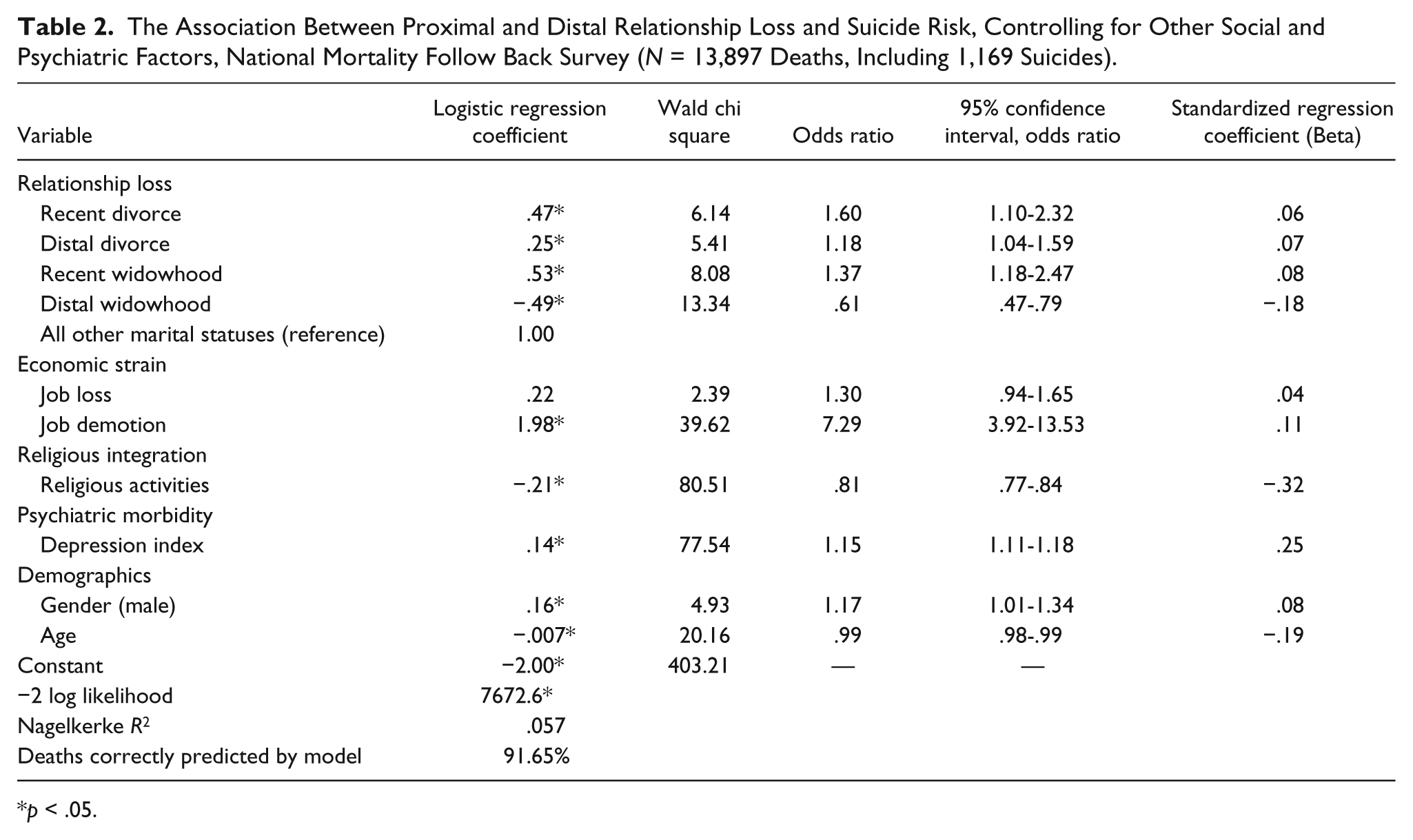
p < .05.
The findings provided mixed support for economic strain constructs. Persons experiencing loss of a job during the last year of life were not significantly more apt than others to die through suicide (Wald = 2.39, p = .06). However, persons experiencing a demotion at work during the last 12 months of life were fully 7.29 times more apt to die of suicide than persons not experiencing such an employment setback.
Religiosity served as a protective factor. Controlling for the other independent variables, the higher the religiosity, the lower the suicide risk. From the odds ratio (.81), a one unit change in the five-level religiosity index was associated with 19% drop in the odds of death by suicide ((100 ∗ (.81-1)); De Maris, 1992).
Strong evidence for a psychiatric perspective was found. Controlling for all other risk and protective factors, depression increased the risk of suicide (odds ratio = 1.14). A one unit change in the depression index was associated with a 14% rise in the risk for death through suicide ((100 ∗ (1.14-1)). Further analysis determined that a majority of persons who had perfect scores (index score of 8) on depression died through suicide.
To estimate the relative importance of the predictors of suicide, standardized coefficients were assessed (Walker & Maddan, 2013) and are shown in the last column of Table 2. The variable with the largest absolute value of its standardized coefficient is religious activities (−.32) followed by depression (.25).
The model provided a reasonable fit for the data. The Nagelkereke R2 indicated the presence of an adequate model. Importantly, using the model to predict death, the model correctly classified 91% of the deaths as either suicide or nonsuicide deaths.
Conclusion
While there have been 61 previous individual-based studies on the relationship between divorce and suicide published between 1880 and 2010, they have been marked by two recurrent limitations: (a) neglect of the timing of divorce and (b) neglect of incorporating psychiatric control variables into the analysis, including depression.
Only one study based in the small, Eastern European nation of Slovenia has explored the timing of divorce (Roskar et al., 2011). The previous investigation limited the analysis to persons divorced less than 5 years, thus leaving the effects of very long-term distal effects an open question. It also lacked a control for a major determinant of both divorce and suicide: depression. The present article explores the timing of divorce in a substantially different social context, the United States, a developed, large nation with a much higher incidence of divorce. We also include all divorced persons, not just ones divorced in a 5-year window, to fully test for distal impacts of divorce on suicide. Finally, we introduce a series of control variables including depression.
In both social settings, Slovenia and the United States, it is the recently divorced who are at the greatest risk for suicide. While one might anticipate distal effects, where the will to live may be ground down only after many years of post divorce stress, the greatest risk, in fact, involves those who are recently divorced. Professionals involved in suicide prevention might wish to direct a disproportionate amount of their resources toward this particular, at-risk group.
An important issue running though virtually all the 61 existing studies on divorce and suicide completions among the divorced themselves is that typically, often due to the unavailability of data in secondary data sets, they are unable to control for the respondent’s depression (as well as other dimensions of psychiatric morbidity). This leaves selection effects unaddressed. Depression may cause both divorce and suicide. A meta-analysis of 13 overtime studies, where psychiatric and personality variables were measured before divorces took place, determined that neuroticism (e.g., depression, anxiety) was a significant predictor of who eventually became divorced (Roberts, Kuncel, Shiner, Caspi, & Goldberg, 2007). In a similar vein, analyses using the National Comorbidity Surveys have determined that 11 out of the 14 psychiatric disorders investigated were predictive of ultimate divorce (Kessler, Walters, & Forthofer, 1998; Stack, 2011). For example, the manic disorder increased the odds of divorce by 3.2 times, while major depression enhanced the risk of divorce by 1.7 times that of the general population. Both these disorders, in turn, are known, from other research, to increase suicide risk (Lester, 2000; Wasserman & Wasserman, 2009).
The present inquiry controlled for depression levels and still found that recent divorce increased the risk of suicide. Depression had, as expected, an independent impact on the odds of suicide. However, to fully assess the merits of the social selection and social causation hypotheses, measures of predivorce depression are needed.
The findings on several control variables are noteworthy. Judging from the relative sizes of the standardized logistic regression coefficients in Table 2, religious activities were the strongest predictor of suicide, more important than recent divorce, depression, and other independent variables. While divorce is the more commonly index of social integration, religion is the next more commonly used index of bonds to a social group (Stack, 2000b). Unfortunately, religious activities are the only measure of religiosity in the NMFBS. Religious activities can include time spent with coreligionists as well as time spent attending religious services. Specific measures of each type of activity are needed to test the religious integration and religious networks perspectives on religion and suicide. Future work is also needed to weight this factor against measures of still other constructs including commitment to core religious beliefs (Stack & Kposowa, 2011).
The traditional indicator of economic strain, unemployment, did not exert an independent impact on the odds of suicide. However, a new construct, job demotion, was also highly predictive of suicide. The article also answers the call of Platt and Hawton (2000) for the exploration of new measures of economic strain in research on suicide.
Over the last 130 years, there have been 61 studies on subject’s divorce and completed suicide at the individual level, but they represent a tiny fraction of research on suicide. Since 1980 alone, there has been more than 30,000 works on suicide published (Web of Science, n.d., March 1, 2011). Emanuele (2009) noted this neglect and called for research on the role of romantic disruption as a widespread, neglected contributing factor to suicide. An analysis of recently released data on 30,593 completed suicides in the recently released data set termed the National Violent Death Reporting System found that at least 27% of the suicides involved intimate partner problems including divorce, separation, and custody battles (Stack & Bowman, 2011). The present investigation answers the call of Emanuele (2009) for work on relationship loss, a key social factor.
The present article, by including indicators from both the psychiatric and social models, the gap is bridged between those two paradigms on suicide. It finds, as expected, that they complement each other. There is strong evidence for including both a link between depression and suicide, and divorce and suicide as well. While psychiatric factors are clearly important predictors of suicide risk, they need to be combined with social factors in order to fully understand suicide (Kposowa & Glyniadaki, 2012).
The question of the timing of relationship breakdown could be explored with respect to interaction effects with a character trait, impulsivity. Impulsivity is a known risk factor for suicide (Corruble, 1999; Kotler, Iancu, Efroni, & Amir, 2001; Lester, 2000). Perhaps the odds of suicide among divorced persons in the immediate period following divorce would be relatively high among persons with impulse control problems. If so, persons involved in suicide prevention efforts might be able to fine-tune a definition of the population most at risk of suicide following divorce, those with impulse control disorders.
The present article is focused on the strains associated in the post–legal divorce period. Future work is needed on “psychological divorce” or the stressful period of separation that precedes legal divorce. Divorce is not a single event but can be viewed as a culmination of strains that end in a legal divorce. Possibly the most painful period of persons enduring the suffering of divorce is the psychological divorce that develops before any legal adjudication for ending the marriage (Ide, Wyder, Kolves & DeLeo, 2010).
Footnotes
Declaration of Conflicting Interests
The author(s) declared no potential conflicts of interest with respect to the research, authorship, and/or publication of this article.
Funding
The author(s) received no financial support for the research, authorship, and/or publication of this article.