







Abstract
Couples generally move to accommodate men’s, rather than women’s, career opportunities. Using Swedish panel data including 1,039 married or cohabiting individuals, this study examines the importance of traditional gender ideology and behavior in explaining this pattern. Two dimensions of gender and migration are examined: (a) the willingness to move for a partner’s career and (b) the likelihood of couple migration for one’s own work or educational opportunities. Findings show that women are more willing to move for their partner’s career. Childless women are more likely to move with their partners to pursue their own work or education than childless men, whereas mothers are less likely to report this than fathers. Gender ideology and division of household responsibilities do not explain the gender differences in migration behavior. They are more important for individuals’ willingness to move for their partners, with particularly pronounced gender differences among nonegalitarian respondents.
Couples’ migration is more likely to accommodate the man’s career opportunities than the woman’s (e.g., Cooke, 2008a). This pattern of male-led migration has been attributed to gender differences in bargaining power (Lundberg & Pollak, 2003) and greater opportunity for advancement in men’s occupations (Halfacree, 1995). Yet while bargaining power and occupational characteristics indeed emerge as significant predictors of gender difference in couple’s migration, they do not fully account for male-centered migration (Boyle, Cooke, Halfacree, & Smith, 1999; Shauman & Noonan, 2007).
The remaining difference could be the result of gender traditional beliefs and behavior (Bielby & Bielby, 1992). To date, only a handful of studies have examined how couples’ migration decisions are shaped by gender ideology and behavior, measured by notions of separate spheres, or division of housework (Bielby & Bielby, 1992; Cooke, 2008b; Jürges, 2006; Markham, Macken, Bonjean, & Corder, 1983). No study has been conducted in a context where egalitarianism is widely embraced, women are as active as men on the labor market, and men have started to enter the family sphere, that is, a context in the second stage of the Gender Revolution (Goldscheider, 2012).
Sweden is a leader in gender egalitarianism and has been viewed as being in the Gender Revolution’s second stage and therefore provides a theoretically informative context for understanding the role of gender ideology and behavior in couple migration. The study reported here is based on the Swedish Young Adult Panel Study (YAPS), a three-wave panel survey with waves in 1999, 2003, and 2009. Gender ideology and behavior are observed in 2003 and migration decisions and behavior are observed in 2009, thus increasing the potential for understanding the extent to which gender ideology or behaviors can account for male-centered moves.
Couple Migration Theory and Research
The neoclassical economic theory of couple migration asserts that couples take decisions to increase the total couple utility rather than the individual utility of each partner. From this perspective, a couple is expected to move when the joint couple utility is greater by moving than staying (Mincer, 1978). This means that if one of the partners is likely to gain from moving whereas the other would lose, the couple may still move if the combined gain of the two partners is greater from moving than staying. Lundberg and Pollak (2003) argue to the contrary that it is not the total couple utility that the two partners consider but rather their own individual gains and losses. The partner with the higher resources is the one who tends to dominate the couple’s decision on where to live, even if her or his partner loses. A third explanation for male-centered migration is offered by Halfacree (1995), who argues that it is important to consider the different kinds of occupations held by men and women. Male and female dominated occupations differ in possible gains from migration (Halfacree, 1995). If men’s jobs encourage and reward migration more than women’s, dual-earner couples may be more willing to move for the man’s than for the woman’s job, given that men’s jobs tend to encourage and reward migration more than women’s jobs.
Gender ideology and behavior may also play a role in couples’ assessments of the gains and losses of moving (Bielby & Bielby, 1992). Gender traditional ideology views women’s family responsibilities as more important than their work responsibilities, whereas the reverse is true for men (Davis & Greenstein, 2009). Gendered behavior is emphasized by the theory of doing gender (West & Zimmerman, 1987). Gender is created in the behavior of women and men, and especially so in the division of housework and child care. Although the division of domestic work is a gender creating process, it does not necessarily correspond with partners’ gender ideologies (Hochschild & Machung, 1989). Therefore, it is important to examine both attitudes and behavior for understanding the link between gender and couples’ migration.
Gender traditional ideology and behavior may mean that couples are more likely to move to accommodate the man’s job, because men’s paid work is seen by both men and women as more fundamental to the family and to men’s identity. Relative work–family commitment is likely to be important because perceived gains from moving are dependent on an individual’s priorities and interests (Goldthorpe, 1998). If women generally consider family life to be more important than a career, moving for a partner may make more sense for women. Similarly, if men consider career responsibilities their primary family responsibility, moving to pursue career advancement may make more sense for men than for women. This is not to suggest that gender differences in commitments (if any) are in any way inherent, rather they are part of our social construction of gender (Barnett & Hyde, 2001).
Empirical evidence for male-centered migration is extensive, with clear economic and occupational losses for women associated with the couple’s moves (Cooke, 2008a). This is particularly true for women with children (Boyle, Cooke, Halfacree, & Smith, 2003). Men’s socioeconomic characteristics often affect couples’ geographic mobility more than women’s characteristics (Jacobsen & Levin, 2000; Shihadeh, 1991). Attempts have been made to adjust for gender differences in bargaining power (Boyle et al., 1999) and occupational characteristics (Shauman, 2010; Shauman & Noonan, 2007), but the gender disadvantage remains. Even in Sweden, where gender ideology and behavior is closer to egalitarianism than in any other context, men gain more from family migration than women (Åström & Westerlund, 2009) and these differences are especially pronounced for individuals with children (Nilsson 2001). On the other hand, women’s and men’s occupational career possibilities have equal effects on couples’ migration (Brandén, 2013), consistent with the second stage of the Gender Revolution.
Only a few studies have examined gender ideology and behavior as explanations for male-centered migration. Bielby and Bielby (1992) used U.S. data from 1977 and found dual-earner couples to be more prone to relocate to benefit the man’s career than to benefit the woman’s and that the pattern was much stronger for couples with gender traditional views on men’s and women’s work and family roles. Markham et al. (1983) found that female white-collar employees were less willing to move than their male counterparts. The difference was explained in part by gender traditional attitudes: women with relatively egalitarian attitudes were more willing to move than women with gender traditional attitudes, though they were still less willing to move than men (Markham et al., 1983). Jürges (2006) found that among German couples who did not share housework equally, couple mobility was more affected by the man’s job-related characteristics than by the woman’s. In egalitarian couples no such gender difference was found. Cooke (2008b) found that among U.S. couples, couples who shared egalitarian gender beliefs were less likely to move when the wife was employed and wanted to continue working, whereas for nonegalitarian couples the wife’s work status had no impact on couples’ likelihood to move.
In this study, gender differences in couples’ migration are measured along two dimensions: (a) women’s and men’s willingness to move for a partner’s hypothetical career advancement and (b) women’s and men’s likelihood to report a move for their own work or education. Despite overall gender egalitarian attitudes in Sweden, most research finds male-centered migration patterns, in terms of couples moving to accommodate the man’s career rather than the woman’s. Two hypotheses are initially formulated to examine patterns of male-centered migration.
The explanatory power of gender differences in relative work/family commitment and gender traditional ideology are tested as follows:
Data and Method
Analyses are performed using panel data from the Young Adult Panel Study (YAPS; www.suda.su.se/yaps). YAPS is a longitudinal data set, based on surveys conducted in 1999, 2003, and 2009. The sample includes only those individuals who participated in both the 2003 and the 2009 waves, in order to observe gender attitudes and behavior in 2003, prior to potential migration between 2003 and 2009. Only 36% of the initial 2003 sample was surveyed again in 2009 (this is 67% of those who participated in 2003). This attrition could pose a problem, if it is also systematically associated with migration behavior or gender attitudes/behavior. Among the participants in 2003, there are only small differences in gender attitudes/behavior by participation in 2009. Furthermore, the mobility rates for the working sample differ little from the overall mobility rates of the population of the same cohorts (Switek, 2012).
After excluding respondents who were not in a cohabiting or married relationship in 2003, the final data set consisted of 1,039 respondents. All individuals who were either cohabiting or married in 2003 are included, regardless of whether they remained a couple until the next wave in 2009. This is because migration increases the risk of union dissolution (Boyle, Kulu, Cooke, Gayle, & Mulder, 2008), and therefore, including only couples who remain together creates a selection bias. Instead union dissolution is included as a possible separate outcome, and multinomial logistic regressions are used for studying migration propensities. Union dissolution is measured by partner biographies, provided by the respondents in 2009, including start and end dates (year and month) of all cohabiting and married relationships. If separation occurs prior to migration or before 2009 the outcome will be “union dissolution,” and the respondent is hence no longer at “risk” for couple migration.
Dependent Variables
Willingness to move for the partner’s potential career advancement is measured by a question asked in 2003, “What do you think would happen if your partner was offered a stable, well-paid job in another locality?” with predefined alternatives as specified in Table 1.
Willingness to Move for the Partner in 2003.
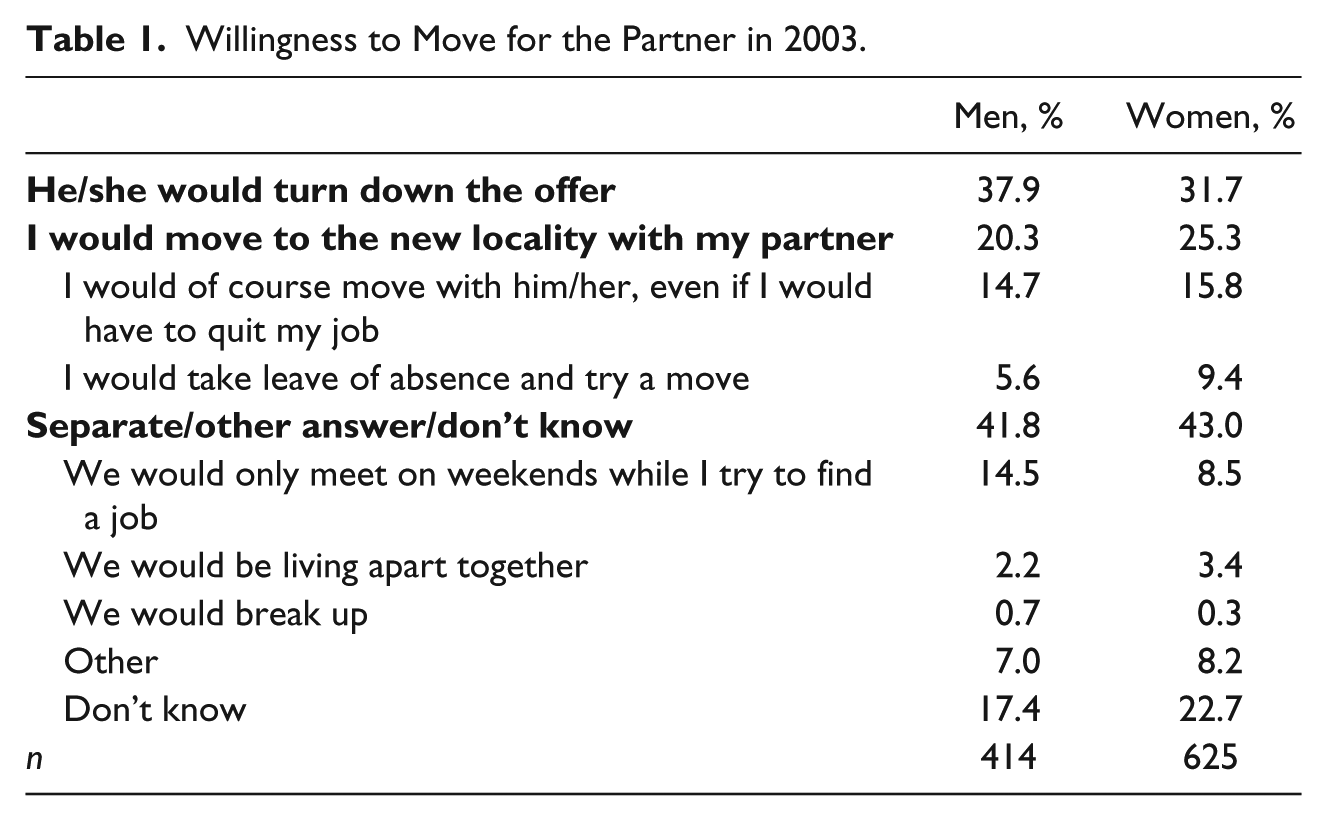
Table 1 shows that men more often believe that their partner would turn down the offer and that the couple hence would stay. More women believe that their partner would accept the new position and that they would quit their job or take a leave of absence to move to the new locality with their partner. Men are more likely than women to state that the couple would separate while he attempts to find a new job in the new locality (14.5% of the men, compared with 8.5% of the women). So whereas women more often believe they would move with their partner even before they found a job, men more often expect to live in a temporary separation arrangement in the interim until securing employment. This pattern is interesting, as it indicates that men’s paid labor is less affected by external factors than women’s. Men may believe they need to find a suitable job prior to moving, whereas women are more willing to move first and then find a job.
The willingness to move is the response to a hypothetical scenario and not the same as actually moving (Markham & Pleck, 1986). Studying the willingness to move, however, makes it possible to address the issue of tied stayers, that is, couples who do not move, even when one partner is offered the possibility, as well as those who may never experience the hypothetical situation but for whom the propensity to move could still be linked to gender ideology or behaviors. In multinomial logistic regression models, I distinguish between (a) partner would turn down the offer, (b) respondent would move to the new locality with the partner, and (c) couple would (temporarily) separate/other answer/don’t know.
Having moved for one’s own work or education between 2003 and 2009 is derived from a question asked in 2009; “When was the last time you moved a long distance, to another locality? (Year and month)” and “What was the main reason for the move?” The predefined response alternatives were specified in the same order as in Table 2.
Distribution of Migration and Type of Migration 2003-2009.
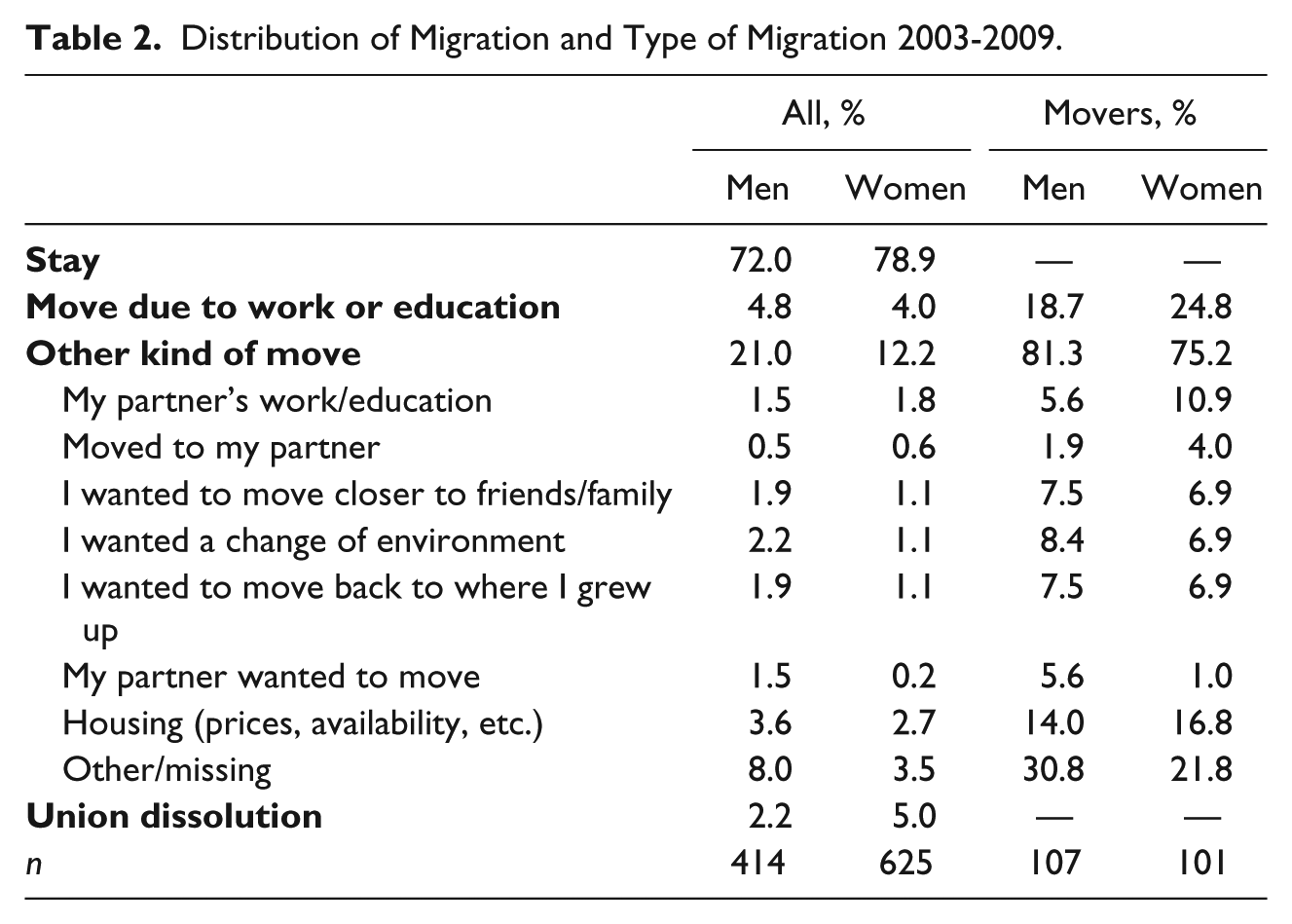
Five percent of the men and 4% of the women report having moved for their own work or education during the 6 years under study. Note that this category only includes respondents whose partner moved with them; otherwise they would have ended up in the union dissolution category. It is uncommon to move for the sake of a partner’s work or education; less than 2% of all respondents report having made such a move. Given the low frequency of migration due to partner’s work or education, it is not possible to examine it as a separate outcome in later analyses. In later multinomial logistic regressions, the outcomes are (a) stayed (in the same place with the same partner), (b) moved for work or education, (c) moved for other reasons, and (d) partners separated prior to any move.
Three remarks need to be made regarding the measurement of long-distance migration. First, it measures self-reported long distance, and not a specified distance or the crossing of an administrative border. To make sure results are not skewed by this method of measuring migration, I have linked register data on region of residence in 2003 and 2009 to the data and examined whether factors commonly found to affect migration propensities affect self-reported long-distance migration propensities, change of municipality, and change of functional local labor market similarly. Results are similar regardless of the method for measuring long-distance migration (results are available on request). Second, it is only possible to assess the last move, implying that the respondent may also have made moves for other reasons earlier during the studied period. Given limitations of the data, it is not possible to examine the first move after measurement of gender ideology and behavior. Third, because all partnerships did not remain intact until 2009, I only have access to one of the partner’s motives for moving, which is not the same as the couple’s motivation for moving. For the 238 couples who lived together at the time of their last long distance move, and who remained together until 2009, 51% agree on the reason for their last move (Brandén, 2011). The respondent’s reason for moving hence needs to be interpreted as only the respondent’s, and not the couple’s, reason for moving.
Independent Variables
Respondents were asked to respond on a 5-point scale to several statements about the importance of work and the importance of family life (Table 3). Exploratory principle component factor analysis produced two dimensions, commitment to work and commitment to family. A measure of each is the average score (1-5) for the items loading on the respective factors. In the event of missing responses on three items or fewer, the measure is constructed based on the number of valid responses.
Principle Component Factor Analysis on Work and Family Commitment.
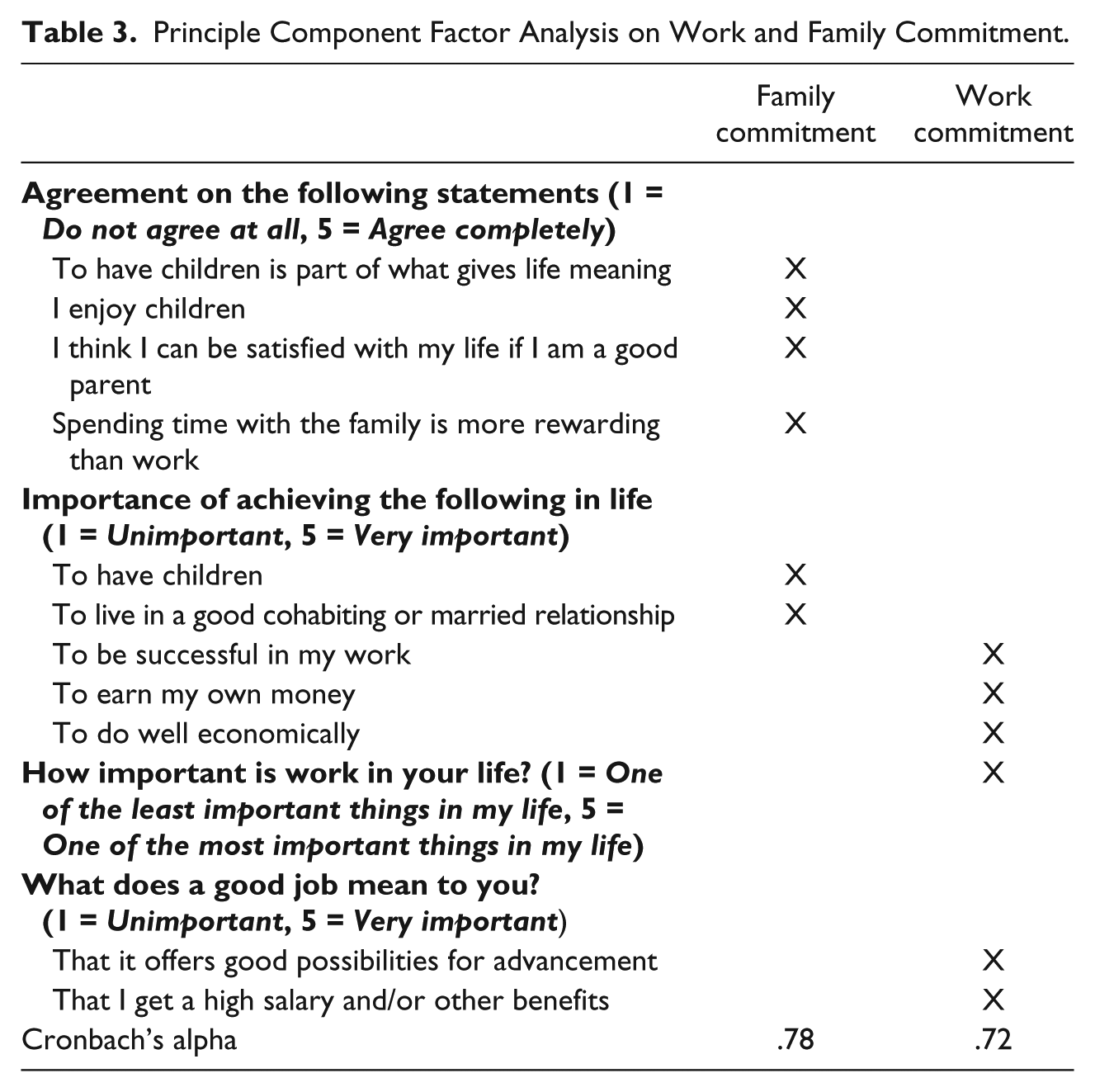
The respondents’ scores on work commitment are subtracted from the scores on family commitment, generating a variable on work commitment relative to family commitment for each individual. Positive scores indicate a higher work commitment and negative scores indicate a higher family commitment. (The results remain similar if the regression models include the two variables separately.) Table 4 includes descriptive statistics for the two indexes and relative work–family commitment.
Mean Family and Work Commitment, Two-Sample t Tests With Equal Variances.
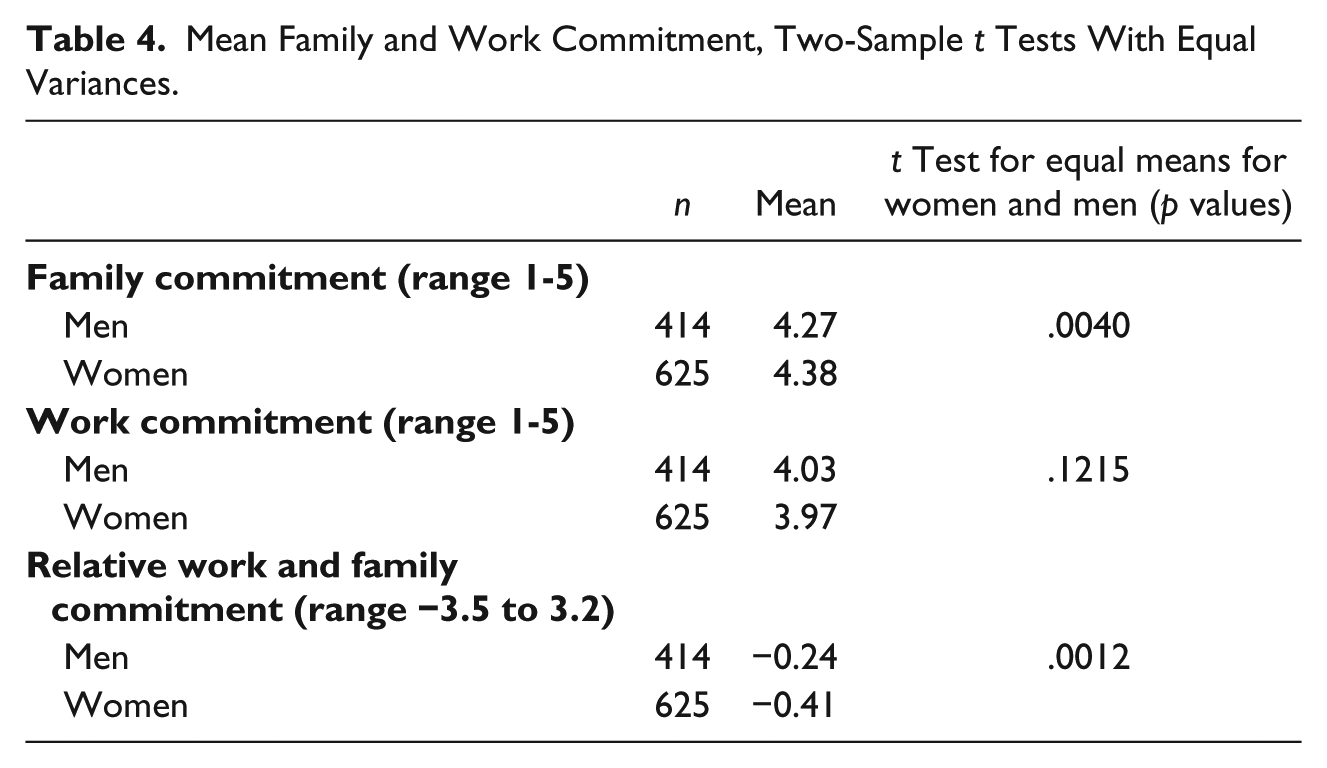
Women report a slightly higher family commitment than men, whereas for work commitment there exist no significant gender differences. Both women and men have lower work commitment than family commitment, also shown by the overall negative values on relative work–family commitment. The value men assign to work relative to family is slightly higher than the value assigned by women.
Gender role attitudes were measured by responses to the question below:
a) Only the man works, while the woman assumes responsibility for the home and the children
b) Both work, but the woman works part time and assumes greater responsibility for the home and the children
c) Both work, but the man works part time and assumes greater responsibility for the home and the children
d) Both parents work about as much and assume the same responsibility for home and children
The alternatives have been grouped into a dichotomous variable, indicating egalitarian (Alternatives c and d) or nonegalitarian (Alternatives a and b) individuals. Strictly speaking, the two respondents arguing in favor for alternative “c” do not hold egalitarian attitudes. They however hold a nontraditional view on men and women’s roles in the family, which is why they are grouped with egalitarian respondents.
Gender role behavior is measured by the respondents’ reports about sharing household work:
a) I do most of the housework
b) My partner does most of the housework
c) We share housework equally
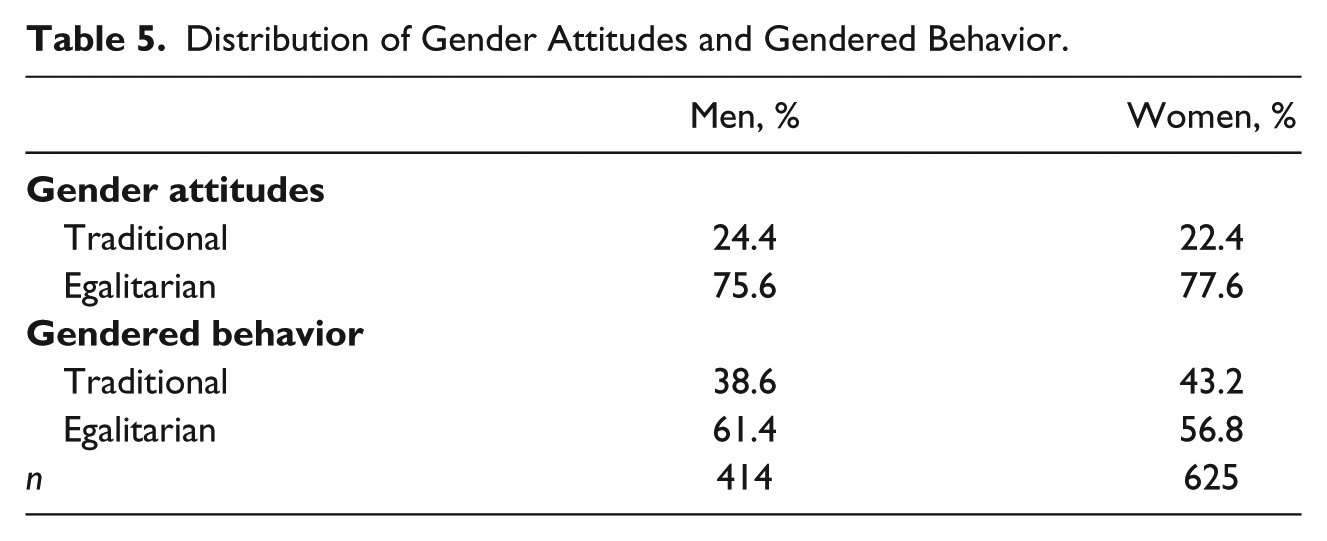
An individual is considered as behaving in an egalitarian fashion if it is a man who has answered Alternative A or C, or if it is a woman who has answered Alternative B or C. Again the variable is measuring nonstereotypical housework sharing behavior, rather than the two partners sharing it equally. Table 5 shows that more than three fourths of all women and men hold egalitarian gender role attitudes, whereas 61% of the men and 57% of the women report sharing housework equally or in a gender atypical way.
Distribution of Gender Attitudes and Gendered Behavior.
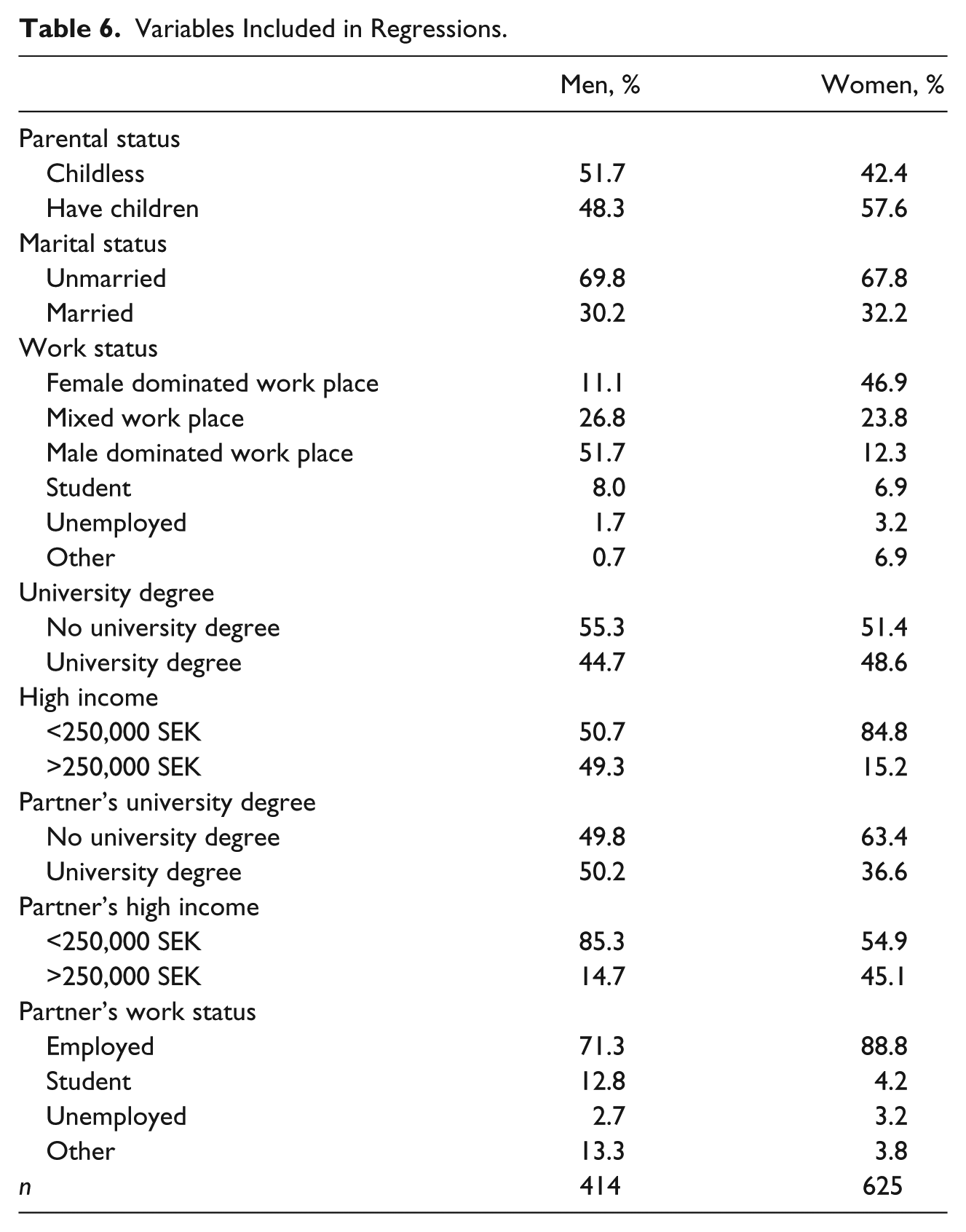
The sociodemographic variables that are included in regressions (all measured in 2003) are parental status, marital status, work status (work at female-dominated work place, work at mixed work place, work at male-dominated work place, student, unemployed, other), university degree, a high income (earning more than 250,000 Swedish Kronor [SEK] per year, before taxes but after social insurance fees are deducted), university degree of partner, partner’s high income (same categorization as for respondent), and partner’s work status (employed, student, unemployed or other). The sex composition at the respondent’s work place is measured by a question asking respondents about their work place’s sex composition, and distinguishes between (a) mostly women, (b) mixed, and (c) mostly men. The variable is intended to adjust for how women and men are crowded into jobs with different migration possibilities (Halfacree, 1995; Perales & Vidal, 2013). Unfortunately, the question is only asked about the respondent’s work place, and no such information exists for the partner. Table 6 includes the distribution of the control variables.
Variables Included in Regressions.
Results From Multinomial Logistic Regressions
Table 7 includes results from multinomial logistic regressions on the willingness to move if one’s partner was offered a good job in another locality, compared with answering that the partner would turn down the offer (estimates for separate/other answer/don’t know as compared with answering that the partner would turn down the offer are available on request).
Willingness to Move for Partner’s Job Compared With the Partner Would Turn Down the Offer. Multinomial Logistic Regressions. Odds Ratios.
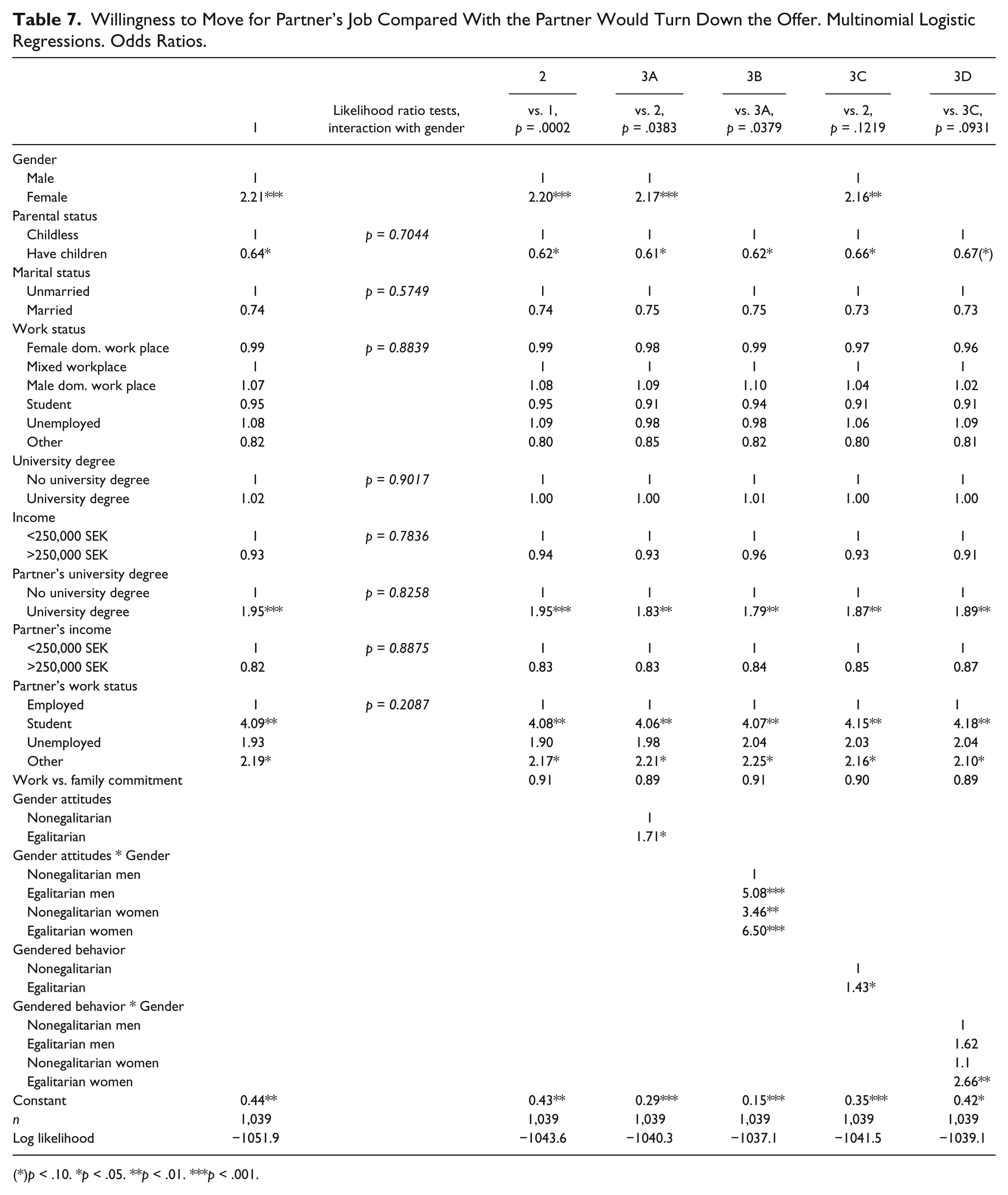
p < .10. *p < .05. **p < .01. ***p < .001.
Model 1 shows that women are more willing than men to move with their partner rather than to answer that their partner would turn down the job offer. Having children decreases the willingness to move for the partner’s sake, whereas the partner’s university degree and the partner being a student increase willingness to migrate. To examine whether one’s own and one’s partner’s economic potential have the same impact on women’s and men’s willingness to move for a partner, I performed likelihood ratio tests for interactions between gender and each of the other included variables. No gender interaction adds to the fit of the model—all the studied characteristics are similarly associated with women and men’s willingness to move for a partner. Adding a variable on relative work–family commitment (Model 2) improves the model fit, and although the coefficient is nonsignificant it is mildly negative. This negative relationship indicates that higher work commitment relative to family commitment, lowers the willingness to move for a partner’s career. Even after adjusting for gender differences in relative work/family commitment, women remain more willing than men to move if their partner was to be offered a job in another locality. In Models 3A to 3D, indicators of gender attitudes and behavior are added. Model 3A shows that holding egalitarian attitudes increases the willingness to move for the sake of a partner. As is visible from Model 3B, there exists an interaction effect between gender and egalitarian attitudes where men’s willingness to move for their partner is more influenced by gender role attitudes than are women’s. This results in gender differences in the willingness to move for a partner being particularly pronounced for individuals with non-egalitarian attitudes. Adding egalitarian behavior does not add to the fit of the model (Model 3C), although there appears to be an interaction between egalitarian behavior and gender (Model 3D). The coefficients are in the same direction as for egalitarian attitudes. So although women are more willing than men to move for the sake for their partner’s career advancement, this gender difference is not as large for individuals with gender egalitarian attitudes or behavior as it is for individuals with less egalitarian attitudes or behavior.
In Table 8, the likelihood of individuals reporting having moved for the sake of their own work or education between 2003 and 2009 is examined, using multinomial logistic regressions. The different outcomes are (a) moved for work or education, (b) moved for other reason, and (c) union dissolution, compared with staying in the same place with the same partner. Only estimates for having reported a couple move for own work or education, as compared with having stayed in the same place with the same partner, are presented in Table 8 (other estimates are available on request).
Move Due to Work or Education Compared With Staying in Same Place With Same Partner, Multinomial Logistic Regressions, Odds Ratios.
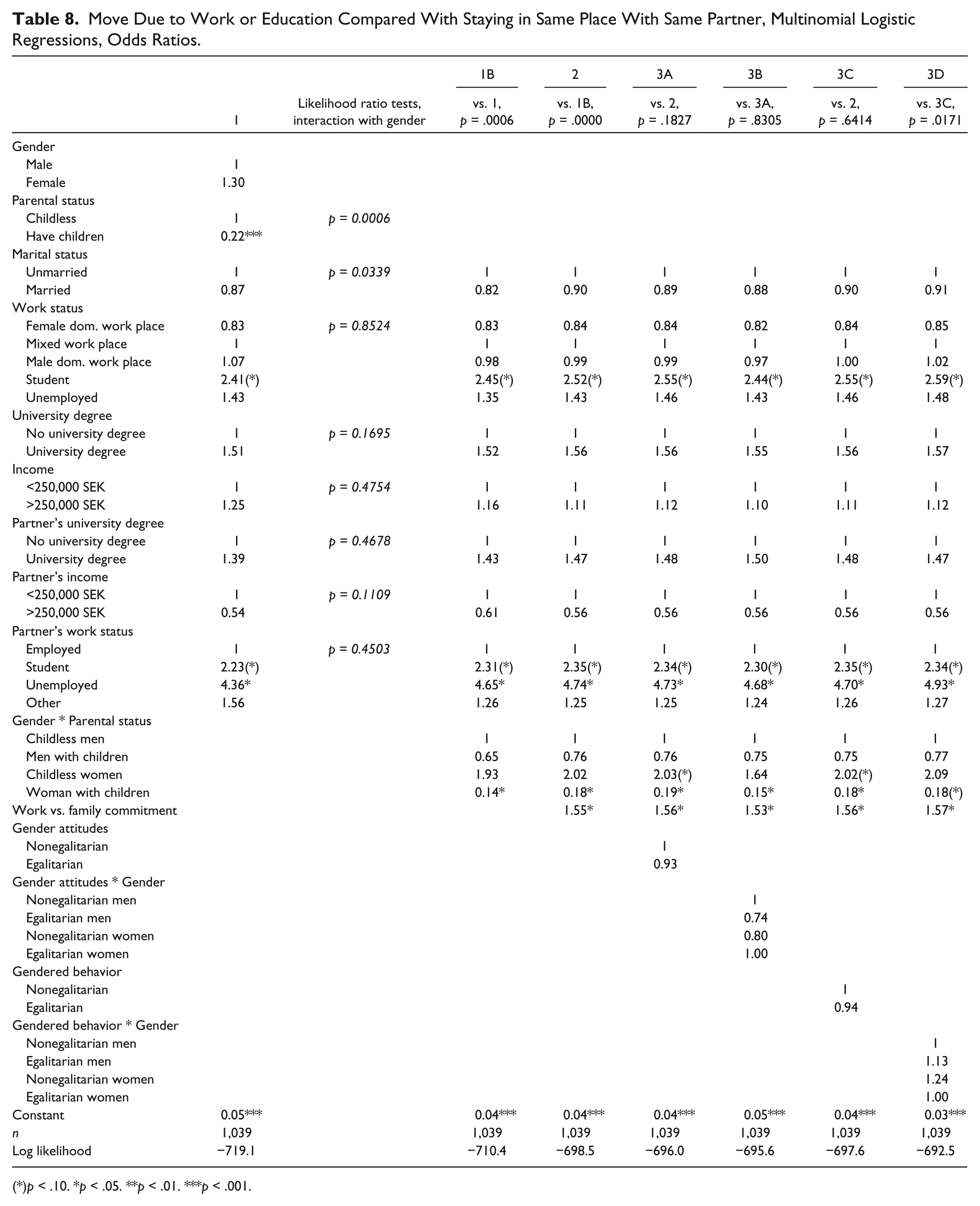
p < .10. *p < .05. **p < .01. ***p < .001.
Model 1 includes simple effects from sociodemographic characteristics on migration propensities. All results are consistent with expectations with the surprising exception of gender, where women seem to have an increased (although nonsignificant) likelihood of migration due to work or education, compared with men. This is contrary to what we would expect with regard to commonly found patterns of men driving families’ migration decisions. Being a parent is associated with a decreased likelihood of migration due to work or education, whereas being a student or having a partner who is a student or is unemployed is associated with an increased likelihood. To examine whether the man’s economic potential drives migration propensities more than the woman’s, I performed likelihood ratio tests on the interactions between gender and the included variables. I expected own characteristics to be more important for men’s likelihood to move for work or education, and partner’s characteristics to be more important for women. Two interaction terms improve the model fit—those of gender with parental status and marital status, respectively. However, the interaction effect between marital status and gender is caused by marital status and parental status being highly correlated. Adding an interaction of marital status and gender to a model that already includes parental status and gender does not add to the model fit, consequently I only add the interaction between gender and parental status to Model 1B. The interaction term shows that that when childless, women are more mobile than men to pursue work or educational opportunities. However, for couples with children, the pattern is reversed and it is more common for men to report a couple move due to their own work or education.
Model 2 examines whether gender differences in relative work/family commitment account for gender differences found in Model 1B. Relative work/family commitment improves the model fit; the higher the respondent’s work relative to family commitment, the more likely she/he is to report a move for the own career, as expected. The combined effect from parental status and gender does not change, however, after adjusting for relative work/family commitment. This indicates that the gender differences found in Model 1B do not result from women prioritizing family over work more than men, nor do they result from women becoming more family-oriented after becoming a parent.
Models 3A to 3D test whether mothers are less likely to move for work or education than fathers because of traditional gender attitudes that decrease women’s migration propensities and increase men’s. The addition of gender attitudes does not improve model fit (Model 3A), and there are no differential effects by gender (Model 3B). Egalitarian women and men were expected to be more similar in terms of migration behavior than nonegalitarian women and men, and this was found for the willingness to move for the sake of a partner’s potential career advancement. However, no such evidence is found for the likelihood to report a move for work or education. From Model 3C we see that egalitarian behavior does not add to the fit of the model. Adding an interaction term between gender and egalitarian behavior improved the fit of the model as compared with a model that includes only egalitarian behavior (Model 3D). However, the results in Model 3D are the opposite of the hypothesized outcome. Women who do most of the housework are slightly more likely to report a move for their own work or education than women whose distribution of household labor is more equitable. Even after adjusting for the potential mediators, mothers remain being less likely to move for work or education, as compared with fathers, whereas for childless individuals women are more likely to move for work or education as compared with men.
Note that the number of cases in each cell is small, as only 45 of the 1,039 respondents report moving due to work or education. The small sample size leads to a larger number of nonsignificant coefficients. To account for this, I performed a number of robustness checks. I repeated the analyses with much reduced models, and also tested with more specific measures of income, satisfaction with current occupation, year of birth, and age difference between respondent and partner. All tests produced similar results.
Discussion and Concluding Remarks
The findings from this study show that among Swedish young adults living with a partner, migration decisions are male-centered in two respects: (a) women are more willing than men to follow their partner in the hypothetical event of a partner’s career opportunity and (b) mothers’ likelihood of migration for their own work or education is less than that of fathers’. No evidence is found for gender differences in the likelihood of having moved for the partner’s job. And childless women are even more prone than childless men to report a move for their own work or education. Also, own and partner’s economic potential have the same effect on women’s and men’s reporting a move for their own career and their willingness to move for a partner’s career.
Men’s slightly higher levels of work relative to family commitment do not mediate the observed gender differences in willingness to move nor actual migration behavior. So although gender, and especially entry into motherhood, matters for migration behavior, evidence suggests that this is not because of gender differences in work and family commitment. Gender attitudes and the gendered division of household work have no clear impact on the likelihood of having moved for work or education. Gender attitudes however are important in determining individuals’ willingness to move for the partner’s potential career advancement, where particularly pronounced gender differences are found for respondents with nonegalitarian attitudes. However, even for individuals with egalitarian attitudes, women are more willing than men to move for the sake of a partner’s potential career advancement.
Willingness to move is analyzed based on answers to hypothetical statements. As a result, we do not know if respondents would act in accordance with what they expect. Also, if the individual answered that the partner would turn down the offer, we do not know why she/he would do this; if she/he is uninterested in career advancement or if she/he is a tied stayer, staying in the current region for the sake of the respondent. What we do know, however, is that women are systematically overrepresented in the group that believe they would move for their partners’ job, and that this is especially true for those women who believe that women should assume primary responsibility for the care of children whereas men assume responsibility for paid labor. The finding that women are willing to move for a partner even prior to having a secure employment at the destination, whereas men want to have a secure employment prior to the move, is likely to be important for understanding why women’s earnings often suffers from family migration.
In conclusion, women seem to adapt more to men in family migration decisions, and this cannot be fully explained by gender ideology or behavior. The fact that the existing gender differences remain calls for attempts to explain gendered patterns in couples’ regional mobility in a more structural manner, such as with regard to policies and labor market characteristics (Goldsheider, 2012; McDonald, 2000). Mothers and fathers may for instance face different career opportunities (Halfacree, 1995), and in this study, I only have the possibility to adjust for this by a crude proxy indicating the sex composition of the work place. It is likely that more elaborate measures of occupational and labor market characteristics are needed to truly capture existing differences in women’s and men’s labor market opportunities. Differences in labor market opportunities could also be addressed through research comparing patterns of gender and migration between different welfare state and labor market contexts.
Footnotes
Acknowledgements
I am grateful to Gunnar Andersson, Eva Bernhardt, Frances Goldscheider, and Elizabeth Thomson for valuable advice and guidance on my work with this study. I also thank the several discussants and participants at the Young Adult Panel Study meetings, as well as two anonymous reviewers, for helpful comments.
Declaration of Conflicting Interests
The author declared no potential conflicts of interest with respect to the research, authorship, and/or publication of this article.
Funding
The author(s) disclosed receipt of the following financial support for the research, authorship, and/or publication of this article: This research has received financial support from the Swedish Research Council for Working Life and Social Research (FAS), Grant 2008-0489, and the Swedish Research Council (Vetenskapsrådet) via the Swedish Initiative for Research on Microdata in the Social and Medical Sciences (SIMSAM): Register-based Research in Nordic Demography, Grant 839-2008-7495.