







Abstract
Research has established that families in developed countries commonly combine multiple sources of child care. Yet, families’ packages of child care and their effect on maternal labor force participation are underresearched, and the few existing empirical studies are primarily descriptive or use cross-sectional data. We add to the existing literature by theorizing and testing the relationships between family type, child care arrangements, and mothers’ work hours using Australian panel data and panel regression models. We find that employed mothers of young children who use a mixed child care package complete more hours of paid work than do employed mothers of young children who use other child care packages, but the reasons for this association are different among single and partnered mothers. For single mothers the most important characteristic of mixed child care packages appears to be their flexibility, whereas for partnered mothers mixed child care increases employment hours by maximizing the hours of child care available to them.
Debates about child care policy have traditionally focused on regulated formal child care (Brennan, Cass, Himmelweit, & Szebehely, 2012; Brennan & Mahon, 2011). State investment in this type of child care, in the form of payments to parents or providers, has been historically promoted on the grounds that low-cost formal child care enables mothers to work thereby supporting gender equity. More recently, subsidized formal child care has been justified as a social investment whereby well-regulated high-quality care supports good child development (Bryson, Purdon, Brewer, Sibieta, & Butt, 2012; Hansen, Joshi, & Verropoulou, 2006). In some countries this new social investment discourse appears to have largely crowded out the gender equity rationale for state subsidies of child care (Mahon, Anttonen, Bergqvist, Brennan, & Hobson, 2012). Academic research has largely followed suit by focusing on the relationship between child care and child development and assessing the relative impact of formal versus informal care (Hansen & Hawkes, 2009). Few researchers have sought to compare the impact of different forms of child care on maternal employment, and those who have done so have largely focused on regulated formal child care.
Despite the overwhelming academic and policy emphasis on formal care, many parents continue to rely on informal care from grandparents, other family members, and friends, and some states have introduced small subsidy programs supporting informal, unregulated care at home. There is some pressure in Australia, New Zealand, and the United Kingdom to expand this support (Peatling, 2012; Skinner & Finch, 2006), and in the Netherlands the government has gone as far as providing income-related child care credits to relatives who engage in informal care (Rutter & Evans, 2011). Some are hostile to moves in this direction, citing concerns about the quality and safety of the care and the conditions under which in-home carers work. In the process, they largely ignore key factors that lead families, and mothers in particular, to seek informal, home-based care.
We add to the current literature and debate by taking up the neglected issue of child care and maternal employment and reconceptualizing the child care choices that families face. A major shortcoming of existing studies and debates is that they dichotomize child care options into formal and informal, ignoring that a significant proportion of families simultaneously access formal and informal child care, that is, use mixed child care (Baxter, Gray, Alexander, Strazdins, & Bittman, 2007; Bittman, Craig, & Folbre, 2004; Hansen et al., 2006). In this article, we focus on these three possible ways in which families can package child care and label them formal-only, informal-only, and mixed child care packages. This distinction is meaningful as existing evidence indicates that hours of maternal employment vary across groups of mothers using each package. For instance, descriptive analyses show that Australian single mothers who use mixed child care packages have higher labor force participation rates and work more hours than those who use other child care packages (Baxter et al., 2007; Mance, 2005). However, no studies have scrutinized these relationships in a multivariate framework or devised theoretical explanations for why they emerge. In this article, we develop three theories of the relationships between child care packages and maternal labor supply and test them using data from the Household Income and Labour Dynamics in Australia (HILDA) Survey and panel regression models.
While any final assessment of the merits of different child care types should consider both mothers’ outcomes (e.g., work hours) and children’s outcomes (e.g., socio-cognitive development), the focus of this article is on maternal labor supply. In this regard, associations between families’ child care packages and maternal labor supply have important implications for ongoing policy debates. Evidence that use of informal or mixed child care packages increases mothers’ work hours would support arguments for subsidizing alternative forms of child care. In support of this, our results indicate that employed mothers using mixed child care packages work more hours per week than do employed mothers using any other child care package ceteris paribus. Before outlining the theoretical concerns that motivate our analysis and describing our findings, we first present a brief overview of the Australian child care policy context.
Child Care Policy in Australia
To understand the child care choices that Australian families make it is important to be aware of the country’s current policies around early childhood care and education. Australia is usually categorized as a liberal welfare state, and its early childhood education and care policies are largely consistent with a liberal regime’s emphasis on leaving care of the young and the elderly to family, charities, and the market. Care for children under 5 years is primarily provided by for-profit organizations and to a lesser degree by not-for-profit organizations and family day care (childminders). However, in recent years Australia has committed to a new quality framework for child care and to making sure that every child has access to 15 hours of preschool education from a university qualified teacher one year before starting compulsory schooling. In Australia, the minimum age at which children can commence compulsory full-time schooling varies from state to state, ranging from 4 years and 7 months to 5 years. In recent decades the state’s role has shifted from subsidizing the supply of child care to providing child care payments directly to parents. In the 1990s the Australian Government replaced a 20-year policy of providing capital and operating grants to not-for-profit center-based child care provided by qualified staff, with a new family income-tested Child Care Benefit. This subsidy on average covers 69% of the cost of child care but is still insufficient given the relatively expensive cost of toddler and infant care in Australia (Mahon et al., 2012).
Child Care Use and Maternal Employment
Three sets of theoretical concerns provide background to our analyses. These cover (a) the diversity of nonparental child care practices among families with young children, (b) the association between child care arrangements and maternal labor supply, and (iii) theories that may explain the association between child care package used and maternal labor supply.
Use of Child Care Packages by Family Type
The majority of families with young children use some form of nonparental care (Baxter et al., 2007). This literature increasingly differentiates child care by type—formal and informal—and package—informal modes only, formal modes only, and a mixture of informal and formal modes (Baxter et al., 2007; Bittman et al., 2004; Hansen et al., 2006). Use of informal-only child care packages is widespread. In Australia 25% of working families with children aged 0 to 6 years exclusively use informal-only child care (Mance, 2005). The same applies to 69% of working mothers with infants of 9 months of age and 24% of all families with children aged 0 to 2 years in the United Kingdom (Hansen et al., 2006). Mixed child care packages are also very common. In Britain, it is estimated that between 37% (Hansen et al., 2006) and 50% (Rutter & Evans, 2011; Wheelock & Jones, 2002) of working families used mixed child care, whereas in Australia 17% of working families with children aged 0 to 6 years did so (Mance, 2005). In Australia, child care arrangements vary by family type. For instance, single-parent households with young children (age 0-5) are twice as likely as couple households to use mixed care (13% vs. 29%) but equally likely to use formal or informal-only child care packages (Craig, 2004), and employed single parents of infants are almost three times as likely as dual earner parents to use a mixed child care package (21% vs. 8%; Baxter et al., 2007). Together these findings suggest that families use a diverse range of child care packages, and thus it is necessary to understand if and how different packages influence maternal labor force participation.
Child Care Packages and Maternal Labor Supply
Little research focuses explicitly on the relationships between families’ child care packages and maternal labor supply, though some Australian studies have indirectly shown evidence of an association. For instance, results in Baxter et al. (2007) suggest that single mothers using mixed child care have substantially higher employment rates than single mothers using other child care packages, whereas findings in Mance (2005) suggest that they work twice as many hours. However, the evidence available from these studies is limited for three reasons: (a) it was uncovered in the process of answering different research questions and was not scrutinized further, (b) no theorization was made of the observed associations, and (c) the analyses relied on simple descriptive analyses. Almost all existing studies have focused on the relationship between maternal employment and a single type of child care. Studies of formal child care find that low cost and widely available formal child care enhances mothers’ work prospects, particularly single mothers’ (Doiron & Kalb, 2005; Schofield & Polette, 1998). Recently, a number of studies have focused specifically on the relationship between grandparent care and maternal labor force participation, and found it to be positively associated with maternal employment in some countries but not in others (Gray, 2005; Maurer-Fazio, Connelly, Chen, & Tang, 2011; Posadas & Vidal-Fernández, 2012; Zamarro, 2011). Few studies have looked at informal child care, though Buddelmeyer (2007) finds that this enables mothers to increase their hours of work, particularly mothers recieving income support. No study has systematically compared the relationships between different child care packages and maternal labor force participation.
Theorizing the Association Between Child Care Packages and Maternal Employment
Given that the literature has not explored why different child care packages are associated with distinctive employment patterns among mothers, it is not surprising that it has also failed to elaborate convincing theoretical explanations for these associations. The predominant economic literature frames the relationships between child care and maternal labor supply in terms of economic costs, which has perhaps hindered the emergence of a wider range of theoretical understandings. However, the broader sociological literature on child care provides useful insights. Here, we synthesize such knowledge to elaborate three different explanations for the associations between child care package and mothers’ work hours.
Our first theory for the associations between child care package used and maternal labor supply is that there is a correlation between the child care packages families use and mothers’ characteristics, and it is these characteristics—rather than the child care package itself—that increase labor supply. It is well established that women’s educational attainment, marital status, country of birth, and number and ages of their children affect their labor force participation. There is also some evidence that these characteristics are distributed unevenly across mothers using different child care packages. In Australia, mothers who use mixed child care are more likely to be single, highly educated, have English as their first language, and live in middle-income households than mothers who use other child care packages (Mance, 2005). There is also evidence that families who use an informal-only child care package are more likely be low-income and poorly educated than families using formal-only child care (Bryson et al., 2012; Rutter & Evans, 2011). Therefore, differences in sociodemographic traits across mothers using different child care packages may drive any associations with usual hours of work.
Our second theory for the associations between child care package used and maternal labor supply is that some child care packages may provide coverage for more hours or involve a greater number of delivery modes, which in turn increases the time available to mothers to participate in the labor market. In particular, families who use mixed child care might have access to greater number of hours of nonparental care or many modes of informal child care including relatives, friends, and neighbors. Existing research shows that families in Australia who use mixed child care access more hours of nonparental care than families using other child care packages. The difference in hours is substantial, with couple families who use mixed child care accessing an average of 20 hours more child care than couple families using formal-only child care (Bittman et al., 2004). Single mothers using mixed child care packages also access more hours of nonparental care than single mothers using formal-only child care, but the difference is substantially smaller—approximately 5 hours (Bittman et al., 2004). The literature suggests two reasons for these associations: child care costs and cultural values around child care. Even where the government subsidizes formal child care, as it does in Australia, this is usually relatively expensive. In contrast, family and friends, who provide the vast majority of informal child care in Australia (around 90%), do so at little or no cash cost to the parents (Cobb-Clark, Liu, & Mitchell, 1999), although parents may be expected to reciprocate by providing other care or favors (Skinner & Finch, 2006). Therefore, informal care could be used as a cheap way to “top up” any formal child care received and maximize the time mothers can allocate to paid work. Cultural beliefs about good parenting are another explanation. In Australia (Hand & Hughes, 2005) and Britain (Skinner & Finch, 2006) many mothers of young children prefer not to use extended hours of formal child care on the grounds that it does not take place in a “family environment” and thus is not as protective and nurturing. In contrast, informal care is often provided by relatives who live close by (Baxter et al., 2007) and who have a greater attachment to the child and stronger incentives to invest in her development (Hansen & Hawkes, 2009). By supplementing the “tolerated” number of hours of formal child care with hours of informal child care, mixed child care packages allow families to access a high number of hours of nonparental child care while managing their anxiety. Existing empirical evidence supports this. For instance, single mothers with young children in Australia are more comfortable using a high number of hours of nonparental care in the context of a mixed child care package (Brady, 2010).
A third theory for the associations between child care package used and maternal labor supply is that variations in the usual hours of work of mothers using different child care packages emerge from the structural properties of child care packages. In particular, we argue, mixed child care packages have one important feature: enhanced flexibility. Wheelock and Jones (2002) argue that families use “complex jigsaws” of child care, where informal child care acts as a strategic complement to formal child care. Skinner and Finch (2006) conceptualize the role of the informal care component of a mixed child care package as the “glue” that “binds formal arrangements together and aids employment” (p. 821). The manifestations of this “gluing” role can be diverse and range from being used to transport children from a kindergarten (or school) to a formal care center, to being used as emergency “back up” care when usual arrangements break down (Rutter & Evans, 2011; Skinner & Finch, 2006). The flexibility of mixed child care packages is particularly important for single mothers, as they do not have a partner who can assist with these frequently brief but critical care tasks. Thus, a mixed child care package allows mothers to circumvent the weaknesses of both informal and formal child care, while exploiting their advantages. Mothers access the flexibility of informal care but avoid its unreliability and lower care hours. At the same time they enjoy the extended coverage of formal care but avoid its inflexibility. Mixed child care may thus be more than the sum of its parts and effectively contain “the best of both worlds.” In the following section, we derive testable hypotheses based on these postulations.
Research Hypotheses
Our focus is employed mothers of young children, and our goal is to analyze the relationship between their partnership status and the package of child care they use, and their usual weekly hours of work. More specifically we aim to test (a) whether there are differences in hours of work between single and partnered mothers using different child care packages, and (b) which of the three theories outlined before best explains any association. Based on our discussion, we propose the following research hypotheses:
Since the literature suggests that there are no differences in the number of hours worked between partnered mothers using different child care packages we do not elaborate an analogous hypothesis for them. If Hypothesis 1 is supported, the reasons for an association between child care package used and mothers’ labor supply should be further scrutinized. Three theories will then be tested. In turn, these suggest that such an association is due to . . .
Data
To test our research hypotheses we use data from the HILDA Survey. This is a multipurpose nationally representative panel survey, which covers the period 2001 to 2010 and contains information from annual interviews with around 15,000 adults living in 8,000 households in Australia (Summerfield et al., 2011). We use information from the first 10 waves, which allows us to carry out robust multivariate analyses of a sufficiently large subsample of single mothers. Additionally, the HILDA Survey collects rich information on the outcome variable of interest (usual hours of work), the key explanatory variables (partnership status and child care arrangements), and important contextual information (e.g., education, ethnic background, and number and age of children).
The outcome variable of interest is the usual number of hours spent in paid work per week. Specifically, the measure used is the number of total hours usually worked in the main job each week, where total hours include paid and unpaid work as well as work undertaken outside the workplace. We operationalize employed single mothers with young children as respondents who are female, are not in a relationship (neither married nor cohabiting), responded to the questions on employment related child care for children not yet at school, have a youngest dependent child aged 0 to 5 years, and work for pay at least 1 hour per week. Conversely, partnered mothers with young children are respondents who are female, are in a relationship (either married or cohabiting), responded to the questions on employment-related child care for children not yet at school, have a youngest dependent child aged 0 to 5 years, and work for pay at least 1 hour per week. Our final analytical sample consists of 3,339 observations from 1,218 partnered mothers and 536 observations from 275 single mothers. Only partnered mothers whose partners are employed are considered here, for three reasons. First, the HILDA Survey only collects information on child care arrangements when all resident parents are employed, on the (realistic) assumption that nonemployed resident parents will undertake the bulk of child care. Second, fully employed households have a greater need for nonparental care and are thus of particular interest. Third, child care dynamics will be substantially different in couple families with two employed parents compared to families with only one employed parent. This means that the role of child care arrangements in promoting transitions into or out of paid employment is not considered here, and our focus is on a selected sample of mothers who are in paid employment. Hence, our findings will relate exclusively to the latter.
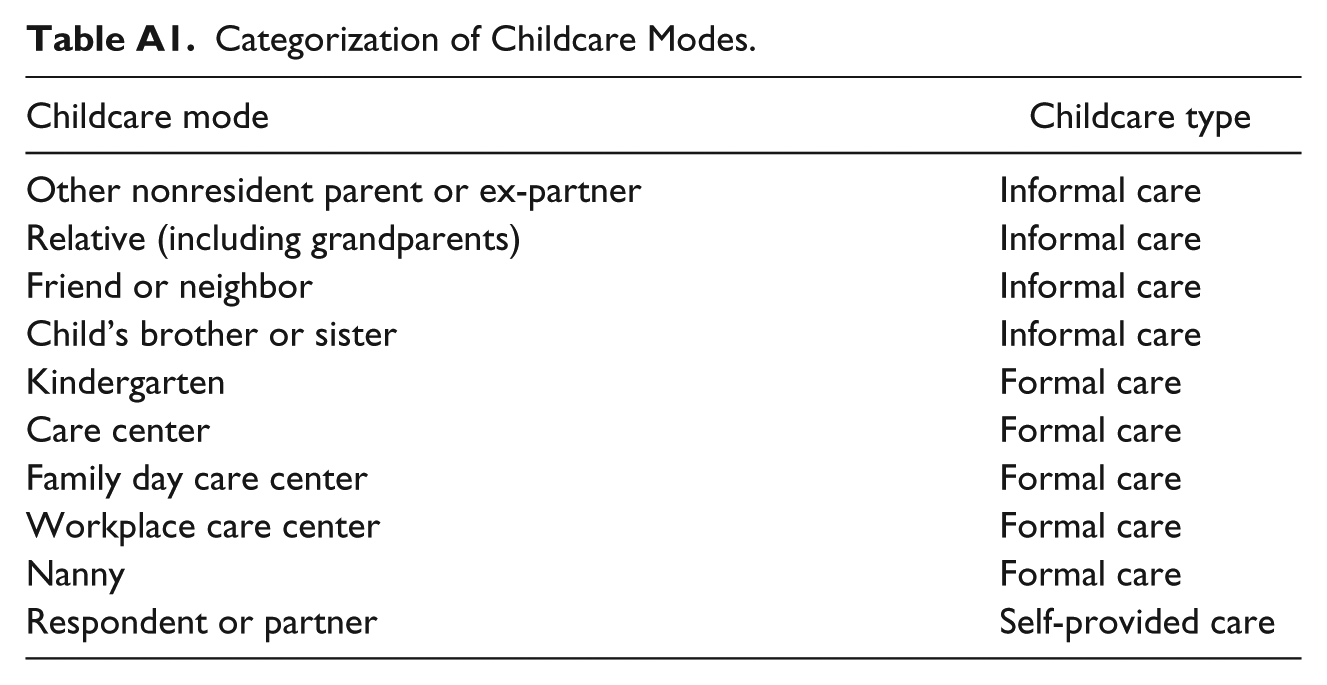
Several variables are created to summarize the child care arrangements that respondents use while both themselves and their partners are at work. First, information in the dataset is used to create a set of 10 child care modes that respondents can report using. These include (a) a kindergarten, (b) a child care center, (c) a family day care center, (d) a workplace care center, (e) a nanny, (f) the child’s other nonresident parent or an ex-partner, (g) relatives (including grandparents), (h) a friend or neighbor, (i) the child’s brother or sister, and (j) the respondent or his/her current partner. For each mode of nonparental care, the number of weekly hours used was also calculated. Modes were then categorized into two types: informal and formal, where informal child care is defined as care provided by family, friends or neighbors and formal child care is care provided by a professional child care worker or educator. In this way, care provided by nonresident parents, ex-partners, relatives, friends, neighbors, and the child’s brother(s) or sister(s) is considered informal care; whereas care provided by kindergartens, care centers, family day care centers, workplace care centers, and nannies is considered formal care (see Table A1 in Appendix A). This categorization is used to create our key explanatory variable: child care package. This captures whether in a usual week the family uses (a) only formal modes of child care (formal-only), (b) only informal modes (informal-only), (c) a mixture of formal and informal modes (mixed), and (d) exclusively self-provided care. Two additional indicators of child care arrangements are used: the total number of child care modes and the total number of weekly child care hours.
Methodological Framework
To exploit the longitudinal structure of the HILDA Survey (i.e., person-year observations nested within individuals), we estimate panel random-effect regression models. These constitute an improvement over standard cross-sectional regression models, as they include individual-specific intercepts to account for unobserved heterogeneity—that is, person-specific unmeasured factors that increase or lower individuals’ work hours. We model usual weekly hours of work as a function of partnership status, child care arrangements, and other contextual factors. Our main (full) model can be represented as

where subscripts i and t denote individual and time, respectively; H represents usual weekly work hours; P is a dummy variable indicating partnership status; C is a vector of dummy variables capturing child care packages; X is a vector of sociodemographic control variables including age, education, ethnicity, number of children aged 0-4 and 5-14, age of the youngest child, and state of residence; I is a vector of variables capturing child care intensity including the number of modes and hours of child care used; v is the person-specific intercept (i.e., the random effect); e is the usual stochastic error term; and b1 to b4 are coefficients or vectors of coefficients to be estimated. The latter capture the associations between the explanatory variables and weekly work hours controlling for observed and unobserved factors, but because standard regression techniques cannot control for reverse causation they cannot be readily taken as evidence of causal impacts. This caveat should be borne in mind when interpreting the model results.
To explore which factors contribute to any association between child care package used and usual hours of work, we estimate nested models of progressive complexity that add subsets of explanatory variables. First, we fit base models that include only an indicator of partnership status and dummies for different child care packages as explanatory variables. These provide estimates of the relationship between child care package used and usual hours of work without any controls. Second, we add sociodemographic control variables. If their inclusion moves the original coefficients on the child care package variables toward zero, we would conclude that the association between child care package used and mothers’ usual hours of work is (at least partially) due to differences in the sort of mothers who use different child care packages. Third, we add a second set of control variables capturing child care intensity. Once again, if their inclusion moves the coefficients on the child care package variables toward zero, we conclude that the association between child care package used and mothers’ usual hours of work is (at least partially) due to differences in child care intensity across child care packages. Finally, we interpret any remaining statistically significant coefficients on the child care package variables in the full model as an indication of unobserved, advantageous properties of child care packages that promote maternal labor supply (e.g., flexibility). All models are estimated first for the whole sample of mothers and then separately for single and partnered mothers to examine whether the relationships of interest vary by the mother’s partnership status.
Child Care Arrangements and Sociodemographic Characteristics by Family Type
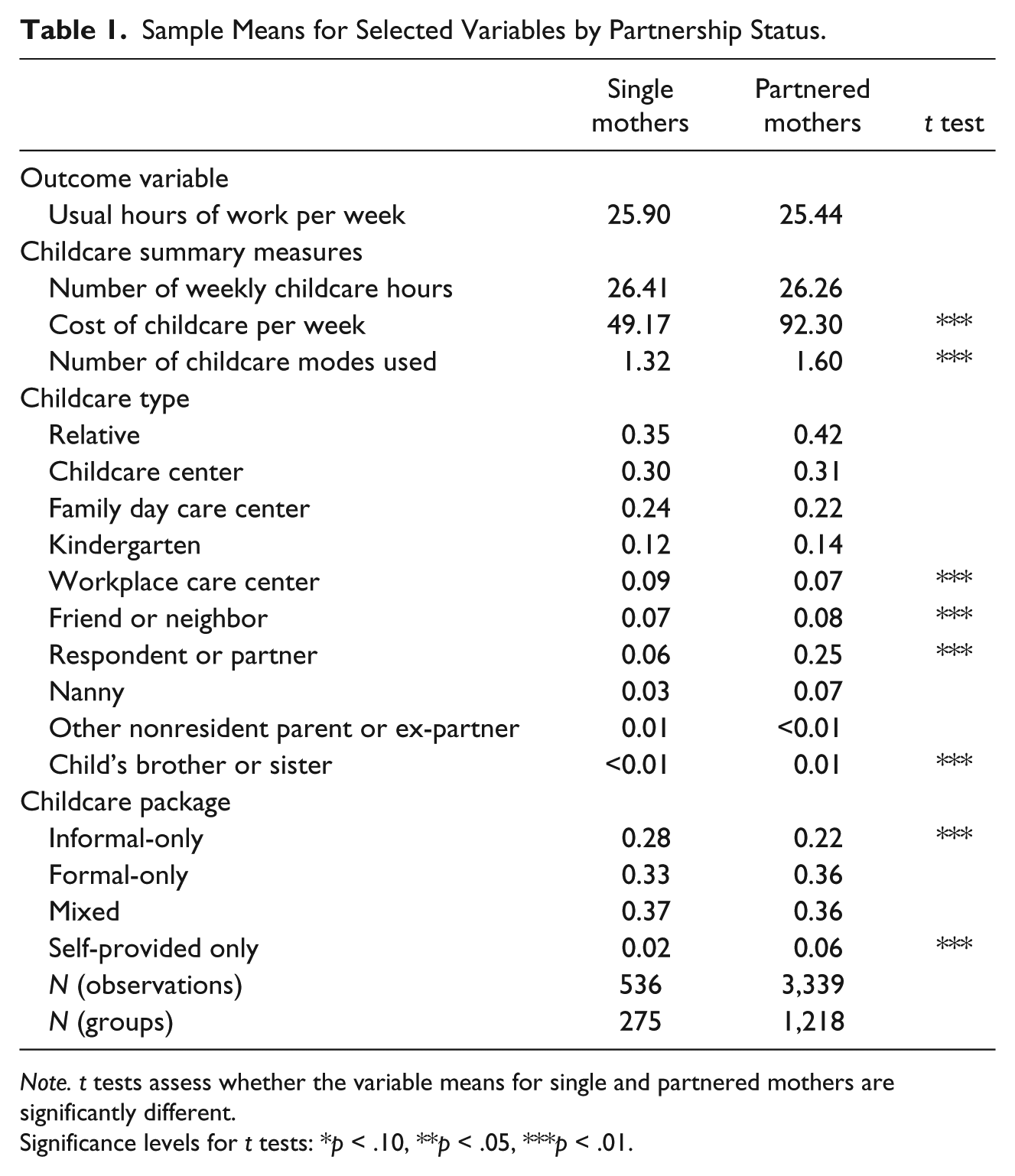
As previous research has shown, descriptive evidence presented in Table 1 indicates that single and partnered mothers of young children have different sociodemographic characteristics and make different child care arrangements. In reviewing these patterns it is important to keep in mind that our sample includes only couple families where mothers and their partners are both employed. Both single and partnered mothers use around 26 hours of nonparental care, but partnered mothers report using more modes (1.6 vs. 1.3 modes) and spending more money ($92 per week vs. $49). The latter is the net result of the family-based means testing for the existing Child Care Benefit subsidy and the ability to pay high prices for child care (Doiron & Kalb, 2005). For both single and partnered mothers the most commonly used child care modes for their preschool-age children are relatives (about 40% of all respondents), care centers (about 30%), and family day care centers (more than 20%), while ex-partners (1%) and a child’s sibling (1%) are not commonly used. There are also statistically significant discrepancies in the prevalence of child care mode usage by partnership status. Not surprisingly partnered mothers are substantially more likely to exclusively use care by a resident parent or step-parent (respondent or partner) than single mothers (25% vs. 6%). Partnered mothers also use nannies (7% vs. 3%) and relatives (42% vs. 35%) significantly more often than single mothers. 1
Sample Means for Selected Variables by Partnership Status.
Note. t tests assess whether the variable means for single and partnered mothers are significantly different.
Significance levels for t tests: *p < .10, **p < .05, ***p < .01.
Concerning the use of child care packages, mixed and formal-only child care are the most prevalent among all mothers. Thirty seven percent of single mothers and 36% of partnered mothers use mixed child care, while formal-only child care is used by 33% and 36%, respectively. Single mothers are significantly more likely to use only informal modes (28% vs. 22%), whereas partnered mothers are more inclined to use self-provided care exclusively (6% vs. 2%). The high prevalence of mixed child care strategies among families highlights the importance of moving beyond the formal/informal dichotomy and taking this child care package into account when examining the relationship between child care and maternal employment.
Child Care Packages and Weekly Hours of Work
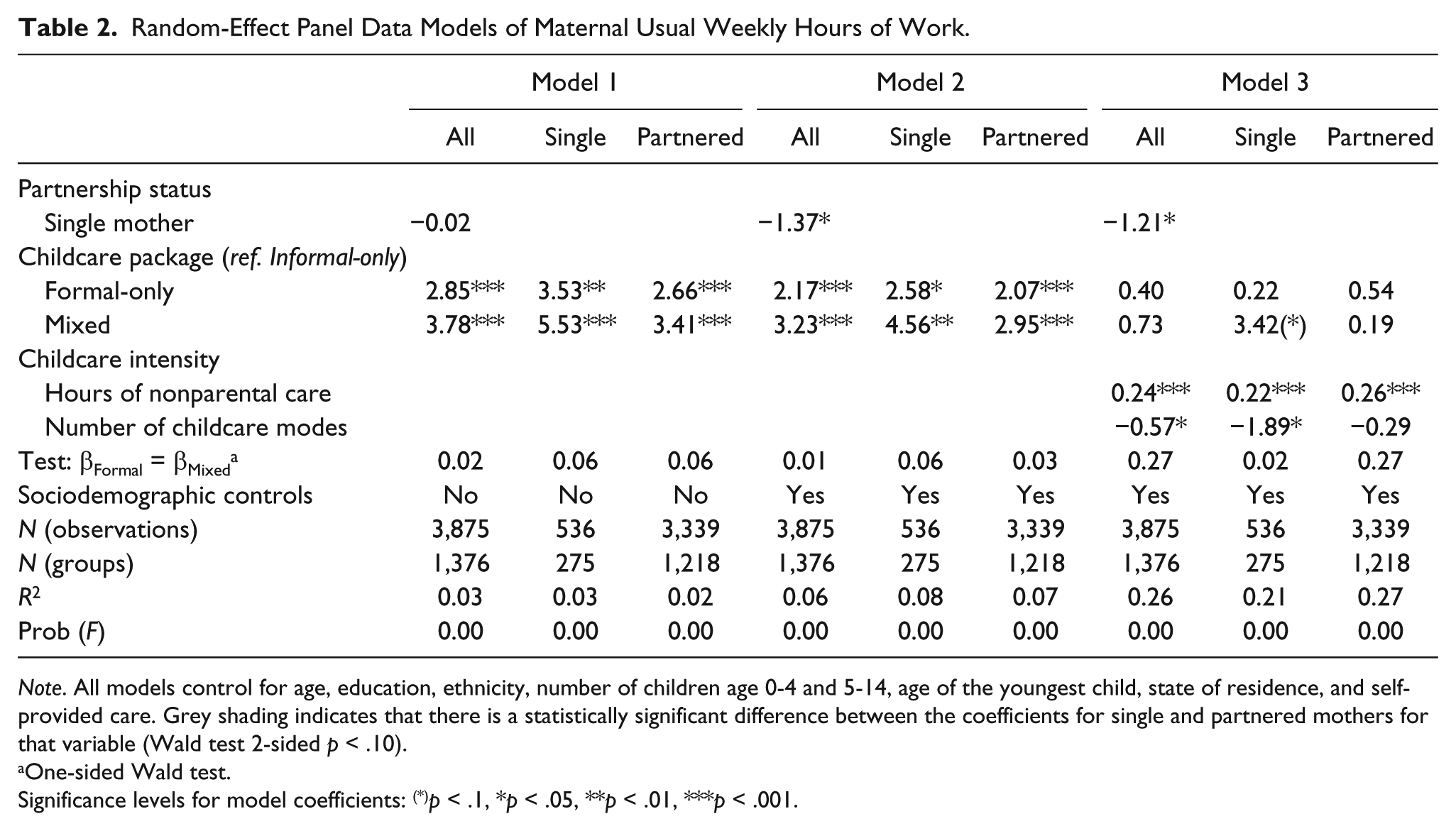
Having demonstrated that child care arrangements differ by partnership status and that the use of mixed child care packages is widespread, we now analyze the relationships between child care package used and the mother’s weekly hours of paid work. Panel random-effect regression models allow us to assess these relationships in a multivariate framework while accounting for person-specific unobserved heterogeneity. Our outcome variable is usual hours of paid work, and the key explanatory variables are partnership status and child care package—with informal-only as the reference or omitted category. 2 Model 1 in Table 2 presents the estimated coefficients from our initial models, which include only these explanatory variables and no other statistical controls. Coefficients give the raw change in the dependent variable for a 1-unit increase in the explanatory variables, controlling for all other variables in the model and for person-specific unobserved heterogeneity. The R2 statistic in these models is approximately 0.03, which suggests that child care package and partnership status explain around 3% of the sample variance in weekly hours of work.
Random-Effect Panel Data Models of Maternal Usual Weekly Hours of Work.
Note. All models control for age, education, ethnicity, number of children age 0-4 and 5-14, age of the youngest child, state of residence, and self-provided care. Grey shading indicates that there is a statistically significant difference between the coefficients for single and partnered mothers for that variable (Wald test 2-sided p < .10).
One-sided Wald test.
Significance levels for model coefficients: (*)p < .1, *p < .05, **p < .01, ***p < .001.
As predicted, this model shows that the use of mixed child care is associated with higher average hours of paid work. Mothers using a formal-only child care package work an average of 2.9 hours more each week than those using an informal-only package, whereas mothers using a mixed child care package worked an average of 3.8 hours more than those using an informal-only package. The difference between the informal-only and mixed packages is statistically significant and greater among single mothers than among partnered mothers (5.5 vs. 3.4 hours), and so is the gap between the formal-only and mixed packages (5.5-3.5 = 2 hours vs. 3.4-2.7 = 0.7 hours).
Results are thus consistent with Hypothesis 1: There are differences in the number of hours worked between single mothers using different child care packages. Additionally, although the Australian literature suggests that partnered mothers’ work hours should not vary by package of child care used, our results indicate that using a mixed child care package is associated with them working a higher number of hours. Subsequent analyses are devoted to shedding light on the mechanisms that lie behind these relationships and testing the remaining hypotheses.
Unpacking the Relationships Between Child Care Packages and Hours of Work
We begin now test whether differences in hours worked by mothers of young children using different child care packages are due to differences in the kind of people who use each package. To achieve this we add controls for relevant sociodemographic characteristics to the base models. We include traits known to affect Australian mothers’ labor supply including age, ethnicity, education, and children’s ages (Baxter & Renda, 2011).
Results are presented in Model 2 in Table 2. The estimated coefficients of using different child care packages on usual hours of work are smaller in these models, suggesting that differences in the sociodemographic characteristics between mothers using different child care packages explain some of the variation in their work hours. Among single mothers, the coefficients on formal and mixed child care packages are 2.6 and 4.6, whereas in the base model they were 3.5 and 5.5. Among partnered mothers, the coefficients on formal and mixed child care packages are 2 and 3, whereas in the base model they were 2.7 and 3.4. Despite this, the differences in work hours between (a) mothers in the formal and mixed child care categories and mothers in the informal category and (b) mothers in the formal category and mothers in the mixed category remain large and statistically significant.
The addition of sociodemographic variables modestly increases the models’ fit, as denoted by R2 statistics that now range from 0.06 to 0.08. The estimated coefficients on mothers’ weekly hours of work of sociodemographic variables (not shown, but available on request) are for the most part consistent across specifications and with previous literature.
Overall, these results offer partial support for Hypothesis 2a by indicating that around one fifth of the observed association between child care package used and hours worked by mothers of young children is due to group differences in the characteristics of mothers using each package. However, large and statistically significant coefficients remain, and further exploration of the mechanisms producing these is required. Specifically, it remains to be tested whether the association between child care package used and employment hours remains when we control for the “intensity” of child care provided by different packages. To do so, we add two variables to the previous models that together capture the underlying “intensity” of child care: the total weekly hours of nonparental child care received and the number of child care modes used.
Results are presented in Model 3 in Table 2. The addition of the total hours of nonparental care and the number of modes of child care used substantially improves the predictive power of the models, which now explain around a quarter of the variance in usual hours of work (R2 ranges from 0.21 to 0.27). As expected, the coefficients on total hours of nonparental care are positive and statistically significant across models indicating that each additional hour of child care is associated with an increase of around 0.25 in mothers’ weekly hours of work. However, one must bear in mind that this variable is clearly endogenous. In contrast, the coefficient on the total number of child care modes used in the model for single mothers is negative, suggesting that other things being equal, using a higher number of child care modes is associated with working fewer hours for them. This may be due to the difficulty in arranging and coordinating multiple child care modes. Alternatively, a large number of modes may be indicative of single mothers’ dependence on an unreliable patchwork of care.
Most important, the significant associations between usual hours of work and child care package used among partnered mothers disappear with the inclusion of the child care intensity variables. This suggests that previously observed differences in the weekly hours of work of partnered mothers who use different child care packages are mostly due to such packages involving different degrees of child care “intensity.” However, the coefficient on the mixed child care package for single mothers remains statistically significant and large: Single mothers who use a mixed care package work on average 3.4 hours more than single mothers who use an informal-only care package and 3.2 hours more than single mothers who use a formal-only care package. This suggests that for single mothers a mixed child care package increases labor supply not just by enhancing the number of child care hours and child care modes used. Such a finding is consistent with our proposition that mixed child care provides an opportunity to augment labor supply by offering enhanced flexibility to combine work and family responsibilities. As single mothers are particularly challenged in this respect—they lack a partner who can take over child care during brief though strategic periods of time—the flexibility of the mixed child care package should be particularly helpful for them.
How do these findings fit with the remaining hypotheses? Hypothesis 2b stated that differences in the hours worked by mothers of young children using different child care packages are attributable to package differences in child care intensity, whereas Hypothesis 2c proposed that these were instead due to other unobserved characteristics of child care packages. Both propositions receive partial support: Hypothesis 2b is consistent with the results observed for partnered mothers, whereas Hypothesis 2c is consistent with the results observed for single mothers.
Discussion
This article addresses a significant gap in the literature by examining the full range of child care packages that families use, their association with maternal employment, and the mechanisms driving these relationships, using Australian panel data and panel regression models. This furthers previous research focused exclusively on formal-only and/or informal-only child care packages and based on cross-sectional data and methods. Our findings are consistent with existing descriptive research reporting a relationship between child care package used and maternal usual hours of paid work. In particular, we find that mixed child care packages are associated with higher maternal labor supply, especially among single mothers. This finding is relevant because families commonly use mixed child care packages, but policymakers and researchers rarely consider the merits of this approach.
Further analysis helped us determine which of our three theories best explains the observed associations. Our first theory suggested that the child care package used is correlated with sociodemographic factors that predict labor market supply, and it is these factors, rather than the child care package itself, that matter. Our results provide little support for this postulation. Single and partnered mothers using formal-only and mixed child care packages work more hours than mothers using an informal-only package, and this association persists when we control for relevant sociodemographic factors. However, the estimated coefficients on work hours of formal-only and mixed child care packages do change when we add controls for sociodemographic characteristics. The size of this change suggests that sociodemographic factors explain around 20% of the observed associations between child care package used and maternal hours of work. Mothers of young children with sociodemographic characteristics who favor working more hours tend to use formal and mixed child care packages, but this is not sufficient to “explain away” the positive association between these child care packages and usual hours of work.
Our second theory was that the association between the child care package used and mothers’ employment hours occurs because different child care packages generally provide a different intensity of child care. In other words, use of certain child care packages may be positively associated with mothers’ work hours by virtue of maximizing the hours and modes of child care available to them. This proposition was supported for partnered mothers: once the number of hours and modes of nonparental care are controlled for, the remaining associations between child care package used and employment hours disappear for this subgroup. However, this does not occur for single mothers, for whom the relationship between using a mixed child care package and weekly hours worked remained statistically significant and large. Yet such an association is 25% smaller than in the previous model, indicating that there are small differences in the intensity of different child care packages used by single mothers too.
Our third theory postulated that certain child care packages may have other advantageous properties that cannot typically be observed in survey data but facilitate maternal labor supply. In particular, we suggested that mixed child care may provide other benefits (e.g., flexibility), which help reduce the work–family strain experienced by mothers of young children and subsequently increase the number of hours they work. This theory was tested indirectly by assuming that any associations between child care package used and work hours that remain after controlling for relevant factors are due to these unobserved package-specific advantages. We gathered evidence in support of this theory for single mothers using mixed child care packages but not for single mothers using other child care packages or partnered mothers. Therefore, single mothers who use a mixed child care package work longer hours, and this can be attributed neither to the sociodemographic characteristics of single mothers who use this package nor to the increased intensity of child care this package generally provides. This suggests that mixed child care packages are not just the sum of formal and informal modes of child care. Instead, we argue, they retain the advantages of formal and informal child care and avoid some of their disadvantages.
Informal care has the advantage of flexibility, including availability outside standard working hours and the possibility to extend care hours at short notice. This flexibility in the context of a mixed child care package appears to be particularly important for single mothers who lack a partner who can take over child care for brief but critical periods of time (Brady, 2013). However, when informal care is used in isolation its strengths are outweighed by its weaknesses. A key weakness is its limited coverage. Most families cannot access sufficient hours of informal care, often because their relatives are not able or willing to supply it. Grandparents are the main source of informal child care in Australia (Baxter et al., 2007). However, younger grandparents who are physically able to provide long hours of informal care may themselves be employed and thus have limited free time, whereas older grandparents who are retired may have ample time to provide long hours of care but be physically incapable of doing so (Backett-Milburn, Airey, McKie, & Hogg, 2008). Aside from these constraints, many relatives may be simply unwilling to offer long hours of child care or they may live in a different geographical location.
Formal child care provides a range of benefits: it is available for long hours (often 10 hours a day, 5 days a week) and it has significant benefits for children’s cognitive and social development. However, formal care also has important weaknesses including its high cost and inflexibility. Most forms of formal child care are not available outside standard working hours, and schedules cannot be changed at short notice. Complete reliance on formal care is particularly challenging for families who have children of different ages. Formal child care is typically segregated by children’s age, and these families may be forced to use different providers for each child. This implies that they need to spend a longer time travelling to and from child care premises.
Our results suggest that mixed child care packages offer “the best of both worlds” whereby the formal care component enables access to a high number of hours of nonparental care, whereas the informal care component plays a “gluing” role in families’ child care arrangements (Brady, 2013; Skinner & Finch, 2006). This “gluing” role is crucial for single parents because they do not have a resident partner to provide emergency back-up care or assist with “wrap-around” care for children attending kindergarten.
Conclusion
Research on the relationship between maternal employment and child care has overwhelmingly focused on the availability and costs of formal child care. This is restrictive because there are widespread alternatives to using formal child care, including informal-only and mixed child care packages. We have argued and demonstrated that it is important to examine child care practices from a broader perspective, considering the relative merits of formal-only, informal-only, and mixed child care packages in shaping the labor supply of mothers of young children.
As in many other countries, Australia has recently placed more stringent work requirements on single parents in receipt of income support. In this context it is crucial to understand the factors that constrain and support single mothers’ labor supply. Our research finds that employed mothers who use mixed child care packages on average work a higher number of hours than employed mothers using formal-only or informal-only child care packages. This is particularly true for single mothers. The finding provides strong grounds for arguing that policymakers should promote access to mixed child care packages by enabling those families using a formal-only or informal-only package to move into mixed care.
Naturally, it must be kept in mind that child care that facilitates maternal employment does not necessarily promote or support child well-being. Unfortunately, due to the overwhelming tendency to dichotomize child care options into formal and informal (Hansen & Hawkes, 2009), we have little evidence on the impact of mixed care packages on children. However, there are conceptual reasons to believe that mixed care packages would be beneficial for a child’s development, or at least not harmful, as well as preliminary evidence that this is the case (Harrison, Ungerer, Smith, Zubrick & Wise, 2009). Further research on this area is needed.
If mixed care packages support child development as well as, or perhaps even better than, formal-only care then there are very strong grounds for promoting the use of mixed care. For those families using a formal-only child care package, this could be achieved by subsidizing informal child care through income-related credits. For those families using an informal-only child care package, a reduction of the cash cost of formal child care (especially for older preschool age children) could be considered. Additionally, our results suggest that promoting flexibility in formal child care provision, for instance by broadening opening hours, extending coverage to weekends, and allowing short-notice bookings, may enable single mothers to work additional hours.
However, we are far from having the kind of robust understanding of the relationships between child care package usage and labor supply that would be necessary to inform innovative policy initiatives. First, future research should be devoted to establishing whether the associations unveiled in our analyses are causal. Our models assume a specific direction of causation between our key explanatory variable and our outcome variable, that is, that the child care package used by families affects maternal labor supply. While this is a reasonable assumption and theoretically founded, it is possible that the direction of causation runs the other way, that is, the hours of work of mothers may simultaneously affect the child care package used. More advanced methods (e.g., instrumental variable regression or simultaneous equation models) could be used to further our research. We expect our findings to be robust to such tests. Second, our results provide novel and consistent insights into such relationships but also lead to a range of related questions for which we still have no answers: What influences the child care packages that families use? Are these genuine choices or coping strategies? What are the dynamics of child care arrangements for different types of families? Further research that contributes to building up this body of knowledge is urgently required.
Footnotes
Appendix A
Categorization of Child Care Modes.
| Child Care mode | Child Care type |
|---|---|
| Other nonresident parent or ex-partner | Informal care |
| Relative (including grandparents) | Informal care |
| Friend or neighbor | Informal care |
| Child’s brother or sister | Informal care |
| Kindergarten | Formal care |
| Care center | Formal care |
| Family day care center | Formal care |
| Workplace care center | Formal care |
| Nanny | Formal care |
| Respondent or partner | Self-provided care |
Acknowledgements
The authors would like to thank Janeen Baxter, Hielke Buddelmeyer, Tak Wing Chan and two anonymous reviewers for helpful comments and suggestions on earlier versions of this article.
Authors’ Note
This article uses data from the Household, Income and Labour Dynamics in Australia Survey, funded by the Department of Social Services and managed by the Melbourne Institute of Applied Economic and Social Research at the University of Melbourne. The data can be accessed by applying for a license. For full details, see 
Declaration of Conflicting Interests
The author(s) declared no potential conflicts of interest with respect to the research, authorship, and/or publication of this article.
Funding
The author(s) received no financial support for the research, authorship, and/or publication of this article.