







Abstract
This study investigates the influence of family context and community context on children’s social reasoning about parental negotiation of the gendered roles of breadwinner and caretaker. Participants included 272 seven- and ten-year-old children from traditional and nontraditional parental employment situations, who lived in either a U.S. east coast metropolitan area or in a military-minded community. Children provided judgments and justifications about a parent’s desire to switch roles, the other parent’s opposition, and the use of stereotypes to defend their opposition. Children’s judgments were affected by the gender of parent wanting a new role, age of child, and both personal contexts. The current study provides evidence that children, not just adults, are aware of, and can reason about, parental roles and that it is important to investigate community norms in addition to direct family contexts.
A child’s social environment, beginning in the home, has been shown to affect children’s conceptualization of appropriate roles for men and women (Tenenbaum & Leaper, 2002). Although mothers and fathers share the roles of breadwinner and caretaker, women are found to spend more time in the role of caretaker (Milkie, Mattingly, Nomaguchi, Bianchi, & Robinson, 2004). Parental negotiation of roles in the home is highly influenced by the community in which a family lives, with some having more freedom to break traditional standards (Cotter, DeFiore, Hermsen, Kowalewski, & Vanneman, 1996). Parental roles, stratified by gender, have a strong impact on children and their understanding of gender equality and family and work balance (Levy, 1989; Tuck, Rolfe, & Adair, 1994). Although several studies have shown that negotiation among parents exists (Craig & Mullan, 2011; Ehrenberg, Gearing-Small, Hunter, & Small, 2001; Mannino & Deutsch, 2007), few have examined children’s awareness of or response to these negotiations. The present study investigated children’s reasoning about hypothetical parents who are in conflict about their roles in the home. Additionally, this study examines how children’s reasoning is affected by their age, family, and community context.
Social domain theory is a valuable resource in understanding individuals’ cognition about gender roles as it focuses on the reasoning made by individuals about social contexts (Stoddart & Turiel, 1985; Turiel, 1983). The theory proposes that children actively participate in their environment and construct their understanding of the social world through interaction (Nucci & Turiel, 1978; Piaget, 1932/1997). Domain theorists have demonstrated three distinct domains of social life—moral (justice, welfare, and rights), social conventional (rules and regulations as well as uniformities of a social unit), and personal (preferences and choices)—that influence individuals’ judgments (Nucci, Killen, & Smetana, 1996; Smetana, 2006). Knowledge in all three domains has been found to affect children’s reasoning about gender roles and expectations. However, recent studies looking at children’s reasoning about the parental role of caretaking note that this role is still highly differentiated by gender. Children judge that caretaking is a more appropriate role for women based on conventions and that it is not fair to give too much caretaking responsibilities to fathers who need to make money for the family (Sinno & Killen, 2009; Sinno & Killen, 2011). The present study is grounded in social domain theory as it examines children’s social reasoning about the context of parental roles, but also extends the literature by examining parental conflict and negotiation of roles.
While there has been little literature examining children’s reasoning about parental roles, there has been much research showing that children observe gendered behaviors in parents’ interactions, including division of labor in marriage relationships (McHale, Crouter, & Whiteman, 2003). For example, children of parents with egalitarian approaches to marriage, meaning that they make a stronger effort to negotiate for equality in roles, have been found to also follow such behaviors (Leaper, 2002). Research focused on fathers in the caretaking role has shown that children and young adults whose fathers took on more childcare are less stereotypical about careers available to both men and women and gender roles in the family, compared with those raised in more traditional homes, with dad employed and mom staying home (Deutsch, Servis, & Payne, 2001; Williams & Radin, 1999). Research to this point has shown that expectations of long-term employment and family plans based on an individuals’ immediate family do affect behaviors and choices by at least early adulthood, but there is a need in the literature to understand reasoning behind these expectations much earlier in development (Hoffnung, 2004).
The strength of family influence on children’s perception of gender roles is even more complicated by wider social expectations. Social role theory (Eagly & Wood, 2012) contends individuals maintain traditional gender roles because of community and societal expectations. For instance, employment for a mother when it is a non-necessity perpetuates the idea that there are negative outcomes for children (Gottfried & Gottfried, 2008). While gender inequalities in the home have been declining across some groups in the United States, research has noted that community norms of differing locations of the United States (Rice & Coates, 1995) as well as different religious groups (Wilcox, 2002) inform gender standards and might perpetuate gender inequalities within their immediate community.
Military communities provide a unique opportunity for investigating the impact of social expectations on children’s reasoning about gender roles. Military communities, which are often male-dominated (Boyce & Herd, 2003), have begun to work more intentionally to accommodate families. Although in recent decades more women have become employed and male members of the military have been called on to be more active members of their family (Bourg & Segal, 1999), there continues to be a skewed gender distribution in the military, with only 14% female members out of the approximately 1,430,985 personnel worldwide (Department of Defense, 2010).
Being a member of the military is a highly respected occupation that is often associated with traditional views (Bourg & Segal, 1999; Dunivin, 1997). Being part of a military community often encompasses an adherence to conservative norms such as males being more authoritarian and the community being less open to women in ranks of leadership (Kurpius & Lucart, 2000). Similar to many U.S. families, mothers are typically involved in more caretaking than fathers; however, the lives of military families are also connected to institutional structures and norms of the military (Taber, 2009). There is an expectation of the whole family to be supportive of military efforts. With the threat of deployment or long-term training, which causes families to be apart for great lengths of time, the idea of negotiation between mothers and fathers in divvying up caretaking responsibilities (Saxbe & Repetti, 2008) may not be possible. However, this negotiation of family obligation and military commitment is pivotal as it helps predict spouse satisfaction with the profession (Britt & Dawson, 2005). Military communities that allow for more work and family balance would benefit families in the long-run, yet questions remain as to the persistence of traditional military views and how these affect children growing up in families and communities which are heavily influenced by military values.
These dynamics of family and community norms permeate life, heavily influencing what children are exposed to and shaping their opinions (Liechty, 2008). While parental participation in counter-stereotypic roles has been shown to affect children’s gender attitudes, little research has moved past ideology to inquire about children’s social reasoning. The purpose of the current study was to extend research on children’s understanding of parental roles by examining how children reason about a conflict among parents with regard to which parent should be the primary caretaker or the primary breadwinner of the family. Children in the age groups of 7 and 10 years old were chosen because social domain theory has shown that complexity in reasoning capabilities increases with age, such that children become more aware of broader social context and use this knowledge to coordinate social domains (see Smetana, 2006, for review). The secondary aim was to investigate the influence of family and community context on children’s reasoning. Increasing knowledge of how children reason about parental negotiation can offer important insight into how they process family dynamics.
This study extends gender development research by explicitly examining children’s social reasoning about parental negotiation. Our hypotheses are based on related research from the social domain and social role theories, which have examined more broadly the roles of breadwinner and caretaker. Based on social domain research (Stoddart & Turiel, 1985), for all questions asked about parental negotiation, we hypothesized age-related differences. It was expected that 10-year-olds would be more flexible about gender roles and would think it was acceptable for both mothers and fathers to desire counter-stereotypical roles in the home. Additionally, it was expected that 7-year-olds would be more likely to rely on gender norms and therefore use more social conventional reasoning or gender stereotyped reasoning to justify their responses.
Based on research from the social domain theory that has found that children are more likely to place mothers in the caretaking role (Sinno & Killen, 2009; 2011), it was hypothesized that children would think it unacceptable for a dad to want to be the primary caretaker and that they would use social conventions or gender stereotypes to justify his inability to take on this role. Additionally, since there has been a rise in mothers in the workforce (Bureau of Labor Statistics, 2012), it was hypothesized that children, particularly those from nontraditional and metropolitan communities, would rate it as acceptable for a stay-at-home mom to want to get a job and would use personal choice reasoning for their justification.
When examining children’s judgments and justifications of one parent’s opposition to the other’s desires, it was hypothesized that there would be an influence from family background and community norms. First, based on the social role theory research (Kaufman, 2005), it was expected that children would think it acceptable for mom to oppose dad in the caretaker role since young adult women do not expect men to want to be as involved in the home. For dad’s opposition to mom wanting to take on a breadwinner role, it was expected that children from traditional and military-minded communities would be more likely to judge this opposition as acceptable based on the conventions of fathers being the decision makers and breadwinners in these communities (Kurpius & Lucart, 2000).
Finally, we were also interested in children’s judgments and justifications of parental use of stereotypes when the parent opposed a role change. Based on social domain research (Sinno & Killen, 2011), it was hypothesized that children would negatively rate the use of stereotypes by either parent but would rate it as more negative for dads to say moms belong at home than moms to question dad’s ability at caretaking. We expected there to be an interaction of family context such that children from more nontraditional families would use more moral reasoning overall, noting the unfairness of stereotyping either role as they are accustomed to negotiation in the home (Williams & Radin, 1999). Last, an interaction of community norms was expected. Since there is often less flexibility in military situations (Saxbe & Repetti, 2008), it was hypothesized that children from military-minded communities would reason from social conventional perspective to note that parents can defend their positions with stereotypes.
Method
Participants
There were 272 participants, including 131 seven-year-olds (M = 7.13, SD = 0.39; 64 girls and 67 boys) and 141 ten-year-olds (M = 10.43, SD = 0.57; 78 girls and 63 boys). All the participants were from the East Coast with 114 located in a metropolitan area and 158 located in a military-minded community. Although the selected schools in the military-minded community were not located on military installations, each school was less than 10 miles from the naval station in Norfolk, Virginia, which is one of the largest military bases on the East Coast. While all the children in the military-minded community did not have a military affiliation, the community at large centers on a culture that is largely influenced by issues such as frequent relocations, family separations, and deployments.
To assess participants’ family context, children were asked separately if their mom and dad were employed and if so if they worked full-time or part-time. While it would have been advantageous to have access to the school data about parental employment (and to validate the children’s responses), the researchers did not have access to this information. Based on the children’s responses regarding parental employment, there were no statistical differences in analyses between mothers who worked full-time compared with part-time and very few fathers who only worked part-time. Therefore, traditional families were categorized as having a mother who was not employed and a father who was. There were 77 children who were from traditional families (41 from metropolitan community; 36 from military-minded). Nontraditional families had either only an employed mother or both parents were employed. There were 195 children from nontraditional families (73 from metropolitan community; 122 from military-minded).
All the participants attended schools in middle-income neighborhoods as indicated by school records. In the metropolitan sample, there were approximately 18% of students in the schools who were eligible for free/reduced lunch and 15% of students eligible in the military sample schools. All participants were also from schools that represented the ethnic diversity of the communities they lived (based on school demographic data). In the metropolitan community, the ethnic breakdown is 47.8% White, 18.3% Black, 17.9% Hispanic, and 14.7% Asian. In the military-minded community, the ethnic breakdown is 40.6% White, 49.9% Black, 5% Hispanic, and 2.4% Asian (U.S. Census Bureau, 2014).
Procedure and Design
Letters detailing the research study were sent home with all the children in the targeted age/grade level, and those children who received parental consent and gave verbal assent were interviewed. A female researcher conducted one-on-one interviews with all participants in a quiet setting on school grounds. Interviews were recorded and participants were told that there were no right or wrong answers, and that all answers would be held confidential and anonymous. A within-subjects design was used and participants responded to all questions. Between subjects variables included age, community, and family contexts. Power analysis revealed that the sample size was sufficient for a medium effect size at the .05 significance level (Cohen, 1992).
Interview Protocol
Children were presented with two hypothetical family scenarios, randomly ordered by participant. In both scenarios the parents are negotiating their roles. In one scenario, there is a stay-at-home mom, who wants to get a job but the dad wants her to stay at home. In the other scenario, there is a dad who is employed full-time but wants to switch to a stay-at-home dad, but the mom wants him to continue to work. Three assessments followed each scenario: (a) children were asked to make a judgment and provide a justification about the acceptability of a parent desiring to change their role; (b) children were asked to judge and justify the acceptability of the other parent’s opposition; (c) children were asked to judge how good or bad (8-point Likert-type scale, 1 = very, very, bad to 8 = very, very, good) it would be for the opposing parent to use a gender stereotype as their defense and provide justification for their choice. An 8-point Likert-type scale represented by pictures of faces with frowns and smiles was used since previous research with children validated their understanding and effective use of such a scale (Sinno & Killen, 2009). See Appendix A for scenarios and interview questions.
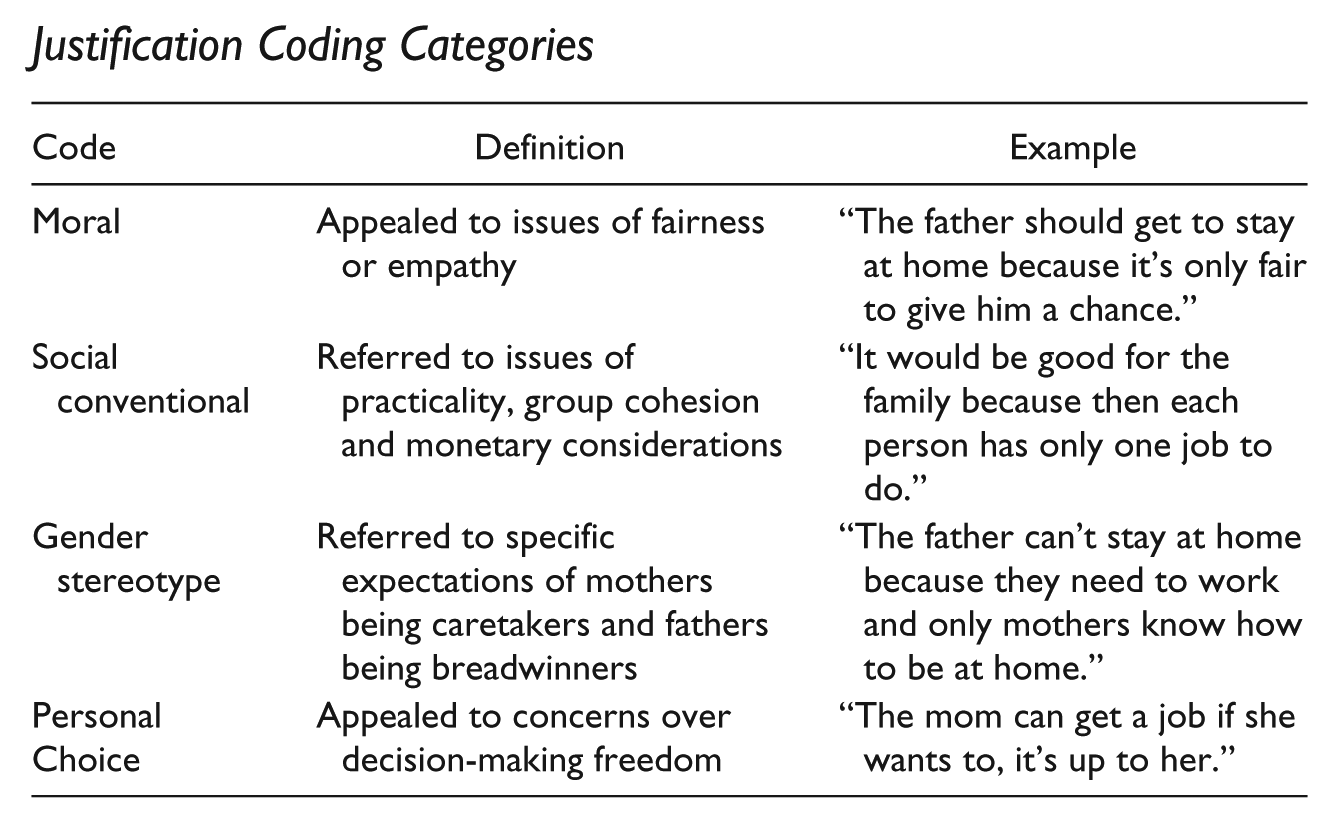
Codes for children’s justifications were based on categories of social domain theory, and included moral, social conventional, gender stereotyped, and personal choice reasoning (see Sinno & Killen, 2009; Smetana, 2006). Responses were coded as moral if they appealed to issues of fairness or empathy. Social conventional responses took into account issues of practicality, group cohesion, and monetary considerations. Gender stereotyped responses were recorded when participants mentioned specific expectations of mothers being caretakers and fathers being breadwinners. Responses were coded as personal choice when they appealed to concerns over decision-making freedom. See Appendix B for sample domain justifications used by children.
Coding for justifications, which were open-ended qualitative responses, entailed assigning a 1 if a social domain was used and a 0 for those not mentioned. If participants used more than one social domain in their response, each was assigned a numerical value so that the total for the assessment would equal 1 (i.e., if two categories were used each would receive a .5). Researchers using the social domain theory to analyze justification data have successfully used similar data analysis procedures in their studies (see Killen, Lee-Kim, McGlothlin, & Stangor, 2002; Turiel, 1998; Wainryb, Shaw, Laupa, & Smith, 2001).
Reliability was calculated separately for the justification responses of each sample, and in each case, 2 raters independently coded 25% of the justification responses for agreement. For the metropolitan sample interrater reliability was 89% (Cohen’s κ = .87). For the military-minded community, the overall agreement was 91% (Cohen’s κ = .86). Disagreements over codes were resolved through discussion and decision rules were made based on these discussions.
Results
Hypotheses for judgments were tested using MANOVAs. Justification data were calculated as proportions and analyzed with repeated measures ANOVAs (see Smetana, 2006; Posada & Wainryb, 2008). A recent review of analytic procedures for this type of data indicated that ANOVA-based procedures are appropriate compared with log-linear analysis for this type of within-subjects design (see Wainryb et al., 2001, Footnote 4). For all ANOVAs conducted, in cases where assumption of sphericity was not met, corrections were made using the Huynh–Feldt method. Follow-up tests to examine interaction effects were conducted using t tests.
There were no order effects found for scenario presentation, therefore, results are organized by the three main assessments. Although there were no specific hypotheses with regard to gender of participant, preliminary analyses were conducted with gender of the participant since the study focuses on gender roles. There were no gender of participant differences found; therefore, data was collapsed for this demographic. Effects of participant age, family context, and community context, are included in the main analyses of each evaluation.
Evaluation of Parent’s Desire to Change Roles
Judgments
Participants first rated the acceptability of a hypothetical parent wanting to switch their role. As hypothesized, children from the metropolitan community (M = .83, SD = .38) were more likely than those from the military community (M = .73, SD = .44) to think it was acceptable for a Mom to want to get a job (F[1, 271] = 7.40, p = .007, η p 2 = .03). Additionally, children from nontraditional families (M = .85, SD = .36) rated a Mom’s desire to get a job as more acceptable than those from traditional families (M = .60, SD = .49; F[1, 271] = 24.31, p = .001, η p 2 = .08). There were no age differences or interaction effects for a Mom’s desire to want a job. Unexpectedly, there were no significant differences for a Dad’s desire to want to stay at home as most children rated this desire as acceptable (M = .75, SD = .43).
Justifications
Participants provided rationales for their ratings, and a 2 (age) × 2 (community) × 2 (family) × 2 (gender of parent desiring new role) × 4 (reasoning: social conventional, moral, personal choice, gender stereotyped) ANOVA revealed a significant main effect for reason, F(3, 801) = 86.62, p = .001, η p 2 = .25. Regardless of the gender of the hypothetical parent desiring a new role, children used mostly social conventional reasoning (M = .54, SD = .49), followed by concerns for a parent’s personal choice (M = .23, SD = .43), ps < .05.
As hypothesized, the main effect for reasoning was qualified by a significant three-way interaction effect for reasoning by community and family, F(3, 801) = 3.32, p = .02, η p 2 = .02. Post hoc analyses revealed that a child’s community most influenced whether or not they used moral reasoning in their response to a parent desiring a new role, F(1, 269) = 10.99, p = .001, η p 2 = .20. Not expected, regardless of hypothetical parent wanting to change roles, children from a metropolitan community (M = .10, SD = .22) were more likely to use moral reasoning than those from a military community (M = .03, SD = .12). A child’s family context only had a marginally significant effect in that children from nontraditional families were more likely to use personal choice reasoning than children from traditional families (F[1, 269] = 3.441, p = .06, η p 2 = .11; Mnontrad = .26, SD = .33, Mtrad = .20, SD = .29). There were no age differences for reasoning about parent desire to switch roles.
Gender of hypothetical parent who desired to change roles also interacted with reasoning, F(3, 801) = 8.72, p = .001, η p 2 = .32. Children, regardless of their own community or family context, were more likely to use personal choice reasoning when the Mom wanted a job (M = .32, SD = .46) than when a Dad wanted to stay at home (M = .19, SD = .39), t(270) = 3.86, p < .001. Surprisingly, since many children were accepting of Dad wanting to be home, they still brought up more stereotyped thinking about him in this role than when Mom wanted a job (Mdad= .22, SD = .40; Mmom = .08, SD = .23) (t[270] = 3.57, p < .001; t[270] = 4.98, p < .001, respectively). But some children focused more on the fairness of him wanting to be with his baby than they did for the fairness of Mom getting a job (Mdad = .10, SD = .28; Mmom = .02, SD = .15).
Evaluation of Other Parent’s Opposition
Judgments
Participants next judged if it was all right or not all right for the other hypothetical parent to oppose the desired role change. As hypothesized, overall, children were more likely to think that it was all right for Mom to oppose Dad wanting to stay at home than for Dad to oppose Mom’s desire to seek employment, t(270) = 4.98, p = .002. When Mom wanted to get a job and Dad opposed this, children from the metropolitan community were less likely than those from the military community to rate his opposition as acceptable (F[1, 271] = 5.35, p = .02, η p 2 = .02). Furthermore, children from traditional families rated Dad’s opposition as more acceptable than those from nontraditional families (F([1, 271] = 8.68, p = .004, η p 2 = .03). There were no age differences or interaction effects for Dad’s opposition to Mom wanting a job. There were no significant demographic differences for Mom opposing Dad wanting to stay at home (M = .40, SD = .50). See Table 1 for means and standard deviations.
Proportion of Judgments for Evaluation of Other Parent’s Opposition.
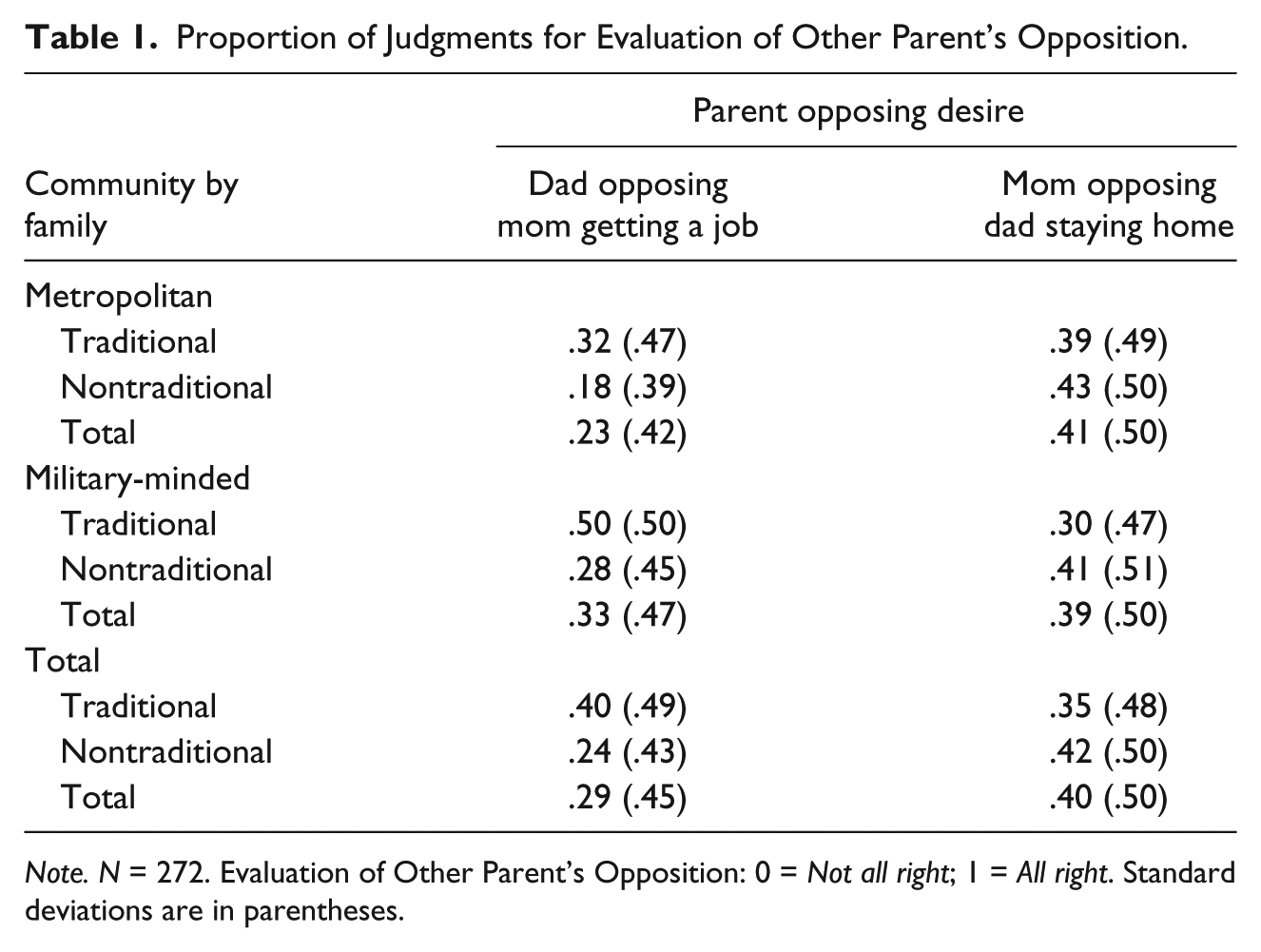
Note. N = 272. Evaluation of Other Parent’s Opposition: 0 = Not all right; 1 = All right. Standard deviations are in parentheses.
Justifications
When providing a rationale for parental opposition to roles being changed, a 2 (age) × 2 (community) × 2 (family) × 2 (gender of parent in opposition) × 4 (reasoning: social conventional, moral, personal choice, gender stereotyped) ANOVA with repeated measures on the last two factors revealed a main effect for reasoning showing that participants overall used significantly more personal choice reasoning (M = .49, SD = .49) than social conventional (M = .32, SD = .46), gender stereotyped (M = .12, SD = .31), or moral (.07, SD = .26; all ps < .01), F(3, 795) = 64.36, p = .001, η p 2 = .20.
This main effect was qualified by an expected interaction effect for reasoning by community, F(3, 795) = 3.65, p = .01, η p 2 = .02, indicating that regardless of parent in opposition of role change, children from military-minded communities are more likely to use social conventional reasoning (M = .36, SD = .48) than those from metropolitan communities (M = .27, SD = .43). In turn, those from metropolitan communities were more likely to use personal choice reasoning (M = .53, SD = .48) than those from military-minded communities (M = .46, SD = .49). Additionally, there was an expected interaction effect by age of participant (F[3, 795] = 10.715, p < .01, η p 2 = .02), such that 7-year-olds focused their reasoning more on the social conventional domain (M7 = .41, SD = .39; M10 = .25, SD = .33) while 10-year-olds focused more on personal choice reasoning (M7 = .37, SD = .39; M10 = .58, SD = .38). There were no significant interactions with family context of the children.
Evaluation of Using a Stereotype in Defense of One’s Opposition
Judgments
Last, participants judged how good or bad it was for one hypothetical parent to use a stereotype about the other’s capabilities to defend their opposition to role change. Overall, as hypothesized children gave relatively negative ratings to the use of stereotypes. However, unexpectedly, children judged that it was more acceptable for a Dad to say that “Moms belong at home” than for a Mom to say that “Dads can’t take good care of babies,” t(270) = 2.55, p = .011. Closer to the hypothesis, analyses revealed that children from nontraditional families thought it was worse for a Dad to say that “Moms belong at home” compared with children from traditional families, F(1, 271) = 5.05, p = .03, η p 2 = .02. Additionally, 7-year-olds were more likely to think it was acceptable for Dad to say “Moms belong at home” compared with 10-year-olds, F(1, 271) = 4.35, p = .04, η p 2 = .02. There were no community differences or interaction effects for a Dad’s use of a stereotype when defending his opposition to Mom wanting a job. Further there were no significant differences based on community or family context for a Mom’s use of a stereotype when Dad wanted to stay at home. See Table 2 for means and standard deviations.
Ratings for Evaluation of Using a Stereotype in Defense of One’s Opposition.
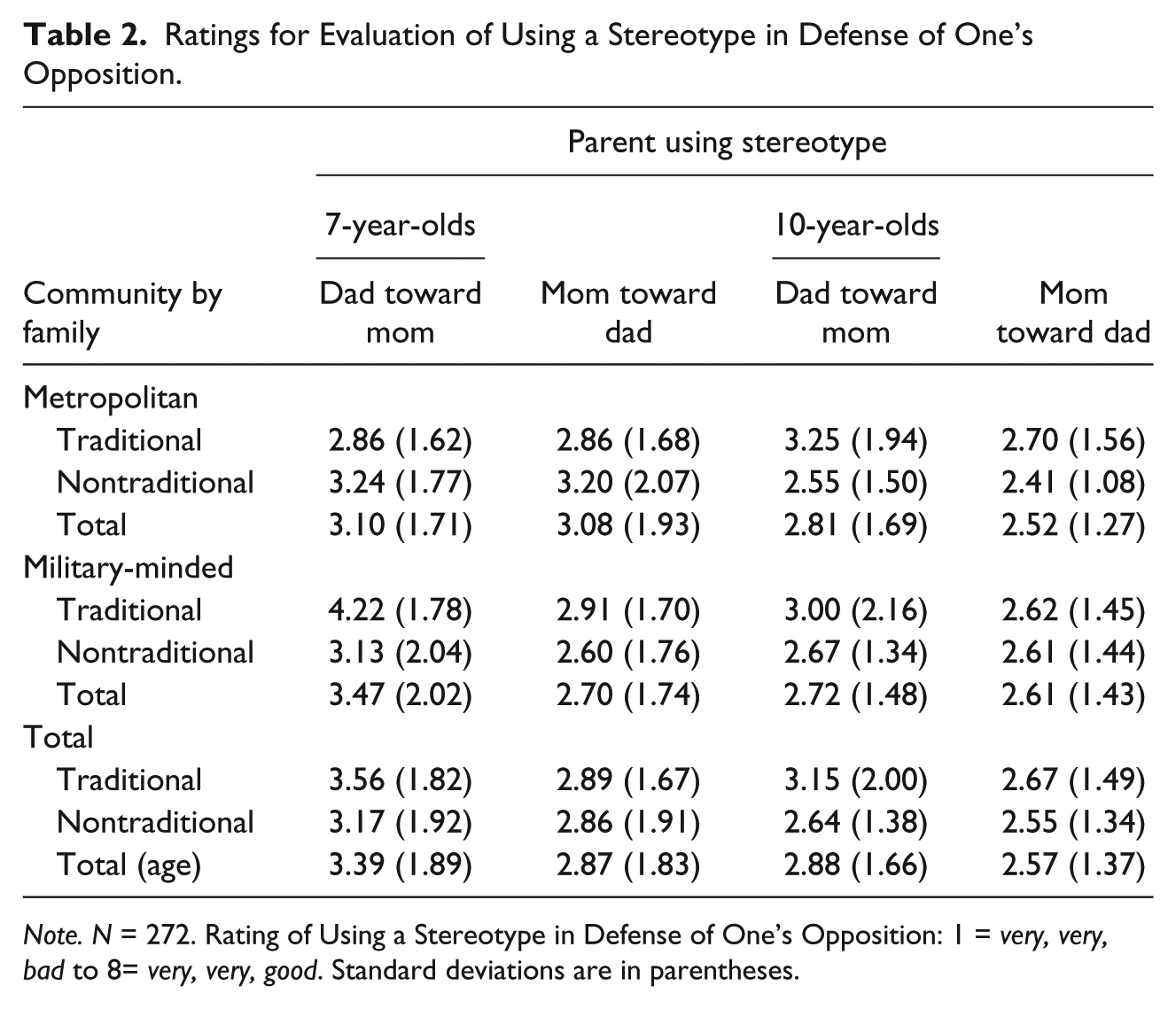
Note. N = 272. Rating of Using a Stereotype in Defense of One’s Opposition: 1 = very, very, bad to 8= very, very, good. Standard deviations are in parentheses.
Justifications
Analyses of participants’ reasoning behind their judgments in a 2 (age) × 2 (community) × 2 (family) × 2 (gender of parent using stereotype) × 4 (reasoning: social conventional, moral, personal choice, gender stereotyped) ANOVA with repeated measures on the last two factors again revealed a main effect for reasoning, F(3, 798) = 34.52, p = .001, η p 2 = .12, showing that many children used moral reasoning (M = .45, SD = .47) regardless of which hypothetical parent used a stereotype about gender roles.
Three significant interaction effects qualified the main effect. First, children’s reasoning about parents’ use of stereotypes was qualified by which parent was using the gender role stereotype. A majority of children used more moral reasoning (M = .61, SD = .49) when a Mom said that “dads can’t take good care of babies;” however, children used more personal choice reasoning (M = .33, SD = .47) when a Dad said that “Moms belong at home” (F[3, 798] = 35.05, p = .001, η p 2 = .12). Children’s reasoning also interacted with community, F(3, 798) = 14.64, p = .001, η p 2 = .05, indicating that children from military-minded communities used more social conventional, as hypothesized, and unexpectedly more personal choice reasoning than those from metropolitan communities (F[1, 269] = 24.17, p = .001; F[1, 269] = 13.67, p = .001, respectively). Children from metropolitan communities used more moral reasoning than those from military-minded communities (Mmetro = .58, SD = .47; Mmilitary = .33, SD = .43, F[1, 269] = 9.72, p = .002). Finally, the main effect found for children’s reasoning was qualified by age of participant such that 10-year-olds (M = .57, SD = .34) used more moral reasoning than 7-year-olds (M = .31, SD = .34). In turn, as hypothesized, 7-year-olds used more social conventional reasoning (M = .30, SD = .35) and gender stereotypes (M = .21, SD = .30) than 10-year-olds (Msc = .13, SD = .25; Mgs = .10, SD = .21, F[3, 798] = 15.13, p = <.01, η p 2 = .05).
Last, there was a significant interaction between reasoning, parent using a stereotype, and community, F(3, 798) = 3.89, p = .01, η p 2 = .01. When it was a Dad who said “Moms belong at home,” children from metropolitan communities used more moral reasoning than those from military-minded communities (Mmetro = .47, SD = .49; Mmilitary = .15, SD = .36, t[269] = 5.92, p = .001) while children from military-minded communities used more personal choice reasoning (Mmetro = .21, SD = .40; Mmilitary = .42, SD = .49, t[269] = 3.79, p = .001). When a Mom said that “Dads can’t take good care of babies,” most children used moral reasoning but those from military- minded communities (M = .26, SD = .44) used more social conventional reasoning than those in metropolitan communities (M = .07, SD = .25), t[269] = 4.20, p = .001.
Discussion
Although past research has noted that adults are aware of and think about negotiations in achieving work and family balance (Craig & Mullan, 2011; Ehrenberg et al., 2001), the results of this study add to the literature by revealing that children are not only affected by parental gender roles (Galinsky, 2005), but that they are also able to reason about situations in which there is parental conflict about gender roles in the home. This study found that children’s age, family context, and community context influenced social reasoning about parental negotiation.
A child’s age was only influential in terms of social reasoning. As hypothesized, children in early childhood relied on social conventional and stereotyped reasoning, while children in middle childhood used more personal choice reasoning when justifying parental opposition to gender role changes and the use of stereotypes to defend this opposition. Family context, on the other hand, affected mostly children’s judgments of a hypothetical parental conflict rather than social reasoning. As hypothesized, children from nontraditional families were more accepting of a mother who wanted to get a job, were less accepting of a father who opposed this desire, and thought it was less acceptable for a father to say mothers belong at home compared with children from traditional homes.
Most interesting and novel is that community context had the most impact on children’s judgments and justifications of parental negotiation. Similar to family context, children from the metropolitan community were more accepting of a mother who wanted to get a job and were less accepting of a father who opposed this desire. Community context also though affected social reasoning about the hypothetical parental conflict. Children from the metropolitan community used more moral reasoning about either parent’s desire to switch gender roles. Children from the military-minded community used more social conventional reasoning when justifying why a parent might oppose a gender role switch compared with the greater use of personal choice from metropolitan children. Finally, when reasoning about a parent who used a gender stereotype to defend their position, children from the metropolitan community again used more moral reasoning, while children from the military community used more social conventional or personal choice reasoning.
The age and family context findings match with previous research. Children become more flexible about gender roles with age (Liben & Bigler, 2002) hence focusing more on individual personal choice. Nontraditional families, in which mothers are employed, expose children to more gender-role flexibility (Bohannon & Blanton, 1999), most likely leading children from these families to be more accepting of a mother who wished to switch her role in the family. What was somewhat unexpected was that age and family did not affect both children’s judgments and justifications; community context, on the other hand, affected both.
In terms of judgments, children from the metropolitan community were more accepting of a mother seeking employment and less accepting of a father opposing this change compared with children from the military-minded community. It is possible that children in a metropolitan community perceive that women have more choice in whether to stay-at-home with their children or seek employment (Williams, 2000), so a mother’s desire might reflect their notion of “flexibility” for mothers that is not as common for children in a military-minded community.
When examining the effect of community context on social reasoning, children from the military-minded community were more likely to rely on the importance of conventions or family functioning when reasoning about parental negotiation. Although past research has not examined the influence of community on social reasoning, this finding compliments research with adults in or associated with the military showing the importance of adherence to group cohesion (Soeters, Winslow, & Weibull, 2006). Children from the metropolitan communities were more likely to focus on moral reasoning when a parent desired another role, and relied on this reasoning, even more so when parents used stereotypes to support their opposition.
When parents used stereotypes to support their position, children from military-minded communities differed in their reasoning based on who was using the stereotype. If a father said that moms belonged at home, children from this community used more personal choice reasoning; but if a mother said dads could not take good care of babies they used more social conventional reasoning. It is quite possible that the focus of conversations about family dynamics with children in each of these communities is different. Children from military-minded communities might be involved in more discussions about the importance of the family staying united and the implications of one parent leaving for deployment (Taber, 2009). There are more men in the military and therefore more fathers than mothers (Bureau of Labor Statistics, 2012), and children might reason that it is more conventional for mothers to take on the role of caring for children and that it is acceptable for fathers to believe that mothers, in turn, belong at home. Additionally, even if children in these families have dual-earning parents, they may observe that their parents as well as the surrounding environment, emphasize commitment to the goals of the community and the nation more than the individual (Taber, 2009).
Although it is more common in the United States for children to have a working mother than for children to have a stay-at-home father (Bureau of Labor Statistics, 2012), an unexpected finding was that children overall judged that it would be acceptable for a father to want to stay at home. Children were more likely to use stereotyped thinking about caretaking fathers compared with employed mothers and thought it was more acceptable for a mother to oppose his staying home than for a father to oppose her employment. However, most children thought that it was not fair for a mother to say that dads cannot take good care of babies. It is compelling that some children focused on fairness, rather than stereotypes, when a father wanted to stay at home. Fathers have been found to be involved in more play activities with their children when they are in the caretaking position (Paquette, 2004) and children might value this interaction more than societal norms of caretaking. In this finding as well is an interesting call from children for the increase in father’s presences in the home, or at least for his right to try to be more involved in the home. There has been some cultural shift in the paradigm of father involvement (McGill, 2014), including concern from military fathers who are frequently deployed (Willerton, Schwarz, Wadsworth, & Oglesby, 2011).
This study offers a beginning to examining the development of children’s understanding of parental role negotiation, but there is still much more research needed to fully appreciate how individuals will eventually use their social reasoning from childhood to impact their future family decision making. As has been discussed by other researchers examining families (Bartoszuk & Pittman, 2010), it is also important to consider that this study examined children from heterosexual two-parent households and therefore should not be generalized to all family models. Within these households, there might be more of a distinction on the breadwinner and caretaker roles as suggested by social role theory (Eagly & Wood, 2012). It is certainly important to consider if there are differences in children’s reasoning based on being raised in single-parent homes, divorced or mixed families, and LGBT parent families. Within these diverse family models, there might be more exploration of gender roles (Kurdek, 2005).
Furthermore, children’s perceptions of parent employment might be influenced by whether parents work full time or part-time (or the number of hours that parents are employed outside of the home). For instance, it is possible that children might see a parent’s part-time job as less essential and therefore that parent should take on more caretaking responsibilities. A limitation of this study was that we were unable to confirm children’s accounts of parental employment, so future research should explore if/how a parent’s work schedule affects children’s reasoning about work/family balance. Additionally, not all children in the military-minded community had family members in active service. Research with spouses of deployed reserve troops reported stressful increases in household responsibilities (Lapp et al., 2010), so it would be interesting to examine the impact of having a parent in active service on children’s reasoning about parental roles in the home. It is possible that children might expect one parent to take on more caretaking and household responsibilities if in their own home there is only one parent present during deployment of the other. Finally, although we chose the scenarios to be more reflective of typical gender role conflicts in the home, it is possible that the comparison of scenarios was not equal in the minds of children in the sample, particularly in terms of the importance of caretaking. A father who wants to stay at home with a new baby might be seen by children to be sacrificing more for the family (Bartley, Blanton, & Gilliard, 2005) compared with a mother who seeks employment. Future research should examine the counter-gender norm scenarios to see if children’s focus on nurturance might be influencing their judgments and social reasoning about parental roles. Despite these limitations, the strength of community context on children’s social reasoning should encourage future research to take all systems into account (Bronfenbrenner & Ceci, 1994).
The results of this study are important for family dynamics research since marital conflict has been linked to child maladjustment and ineffective parenting (Kaczynski, Lindahl, Malik, & Laurenceau, 2006). One major place of conflict among parents is often the roles of caretaker and breadwinner. Gender role standards affect the perceived sense of fairness in distribution of parental roles in the home and in turn affect marital satisfaction (Mickelson, Claffey, & Williams, 2006). A continuing problem in the United States is that many communities are still situated or designed for the breadwinner–caretaker dichotomy and do not accommodate the reality of dual-earner families (Gareis & Barnett, 2008). Although family policies, such as the Family Medical Leave Act of 1993, exist in both the military and civilian corporations, they are often underused due to social norms and willingness of granting these benefits (Bourg & Segal, 1999). Children are both observing these family dynamics and cognitively working through their understanding of gender and family norms (Sinno & Killen, 2009, 2011). This research extends the literature on children’s perspectives of family dynamics research (Hostetler, Desrochers, Kopko, & Moen, 2012) by showing that children are actively processing family dynamics and that it is crucial to consider the influence of not only child age and immediate family context but also broader expectations of their surrounding community. The findings of this study have important implications for how and when children themselves begin to think about parental conflict and the balancing of fairness for individuals’ personal desires, gender socialized norms, and family functioning.
Footnotes
Appendix A
Appendix B
Justification Coding Categories
| Code | Definition | Example |
|---|---|---|
| Moral | Appealed to issues of fairness or empathy | “The father should get to stay at home because it’s only fair to give him a chance.” |
| Social conventional | Referred to issues of practicality, group cohesion and monetary considerations | “It would be good for the family because then each person has only one job to do.” |
| Gender stereotype | Referred to specific expectations of mothers being caretakers and fathers being breadwinners | “The father can’t stay at home because they need to work and only mothers know how to be at home.” |
| Personal Choice | Appealed to concerns over decision-making freedom | “The mom can get a job if she wants to, it’s up to her.” |
Declaration of Conflicting Interests
The author(s) declared no potential conflicts of interest with respect to the research, authorship, and/or publication of this article.
Funding
The author(s) received no financial support for the research, authorship, and/or publication of this article.