







Abstract
Exposure to physical and psychological intimate partner violence, victimization (IPV) at age 18 has several consequences for relationships at age 23 among a diverse community-based sample of young people, transitioning to adulthood in Chicago (N = 276). We find exposure to physical IPV increases the likelihood of being single and not involved in relationships in the transition to adulthood among young women. Furthermore, we find evidence of both continuity and change in intimate violence exposure over the early life course. Young men who were exposed to physical and psychological violence at age 18 are likely to be involved in violent relationships compared with nonviolent relationships in young adulthood. However, some young women and men transition out of violent relationships by young adulthood, supporting patterns of change. Our findings of both relationship dissolution among women and relationship continuity in terms of further violence exposure among men warrant further policy consideration.
Keywords
This article addresses intimate partner violence (IPV) with a particular focus on victimization among young men and women during the transition to adulthood. 1 Our goal is to understand whether IPV during late adolescence (age 18) has implications for forming relationships, which we refer to as relationship status, in the early 20s (age 23). We examine the following relationships—being in a dating relationship, being single and not dating, and being married or cohabiting. Of particular interest is whether adolescent IPV is associated with different young adult relationship status patterns for men and women.
We add to previous literature on IPV and relationships in a variety of ways (Carbone-Lopez, Rennison, & Macmillan, 2012; Cherlin, Burton, Hurt, & Purvin, 2004). Our research adds a unique focus on IPV and relationship status in the early life course which addresses a current gap in research. We also use longitudinal prospective data on young men and women from the Project on Human Development in Chicago Neighborhoods (PHDCN), a socioeconomically and racially and ethnically diverse sample. The 18-year-olds who we study are representative of this age group in the city of Chicago from 1995 to 1996 when the study was initiated. Our study includes attention to physical violence as well as psychological violence. We further include a second outcome of violence status at age 23 indicating whether young men and women are experiencing violence in their relationships, are abstaining from intimate relationships altogether, or are involved in nonviolent relationships. We add to life course perspectives on revictimization by examining stability and change in IPV exposure over different relationships from late adolescence to early adulthood. 2
From a life course perspective, having experienced IPV in adolescence may predispose individuals to experience IPV in adulthood or conversely, prior IPV may lead individuals to select different types of partners or choose not to date (Carbone-Lopez et al., 2012). It is important to explore IPV in late adolescence and early adulthood as this is a peak period of IPV (Rennison & Welchans, 2000; Romans, Forte, Cohen, Du Mont, & Hyman, 2007). Unlike previous studies, we control for IPV perpetration in our analyses as it often co-occurs with victimization in general community samples (Archer, 2000).
Often two types of IPV are distinguished in the literature—physical and psychological (the latter also being called verbal aggression). About one third of young adult females and males experience physical IPV in intimate relationships (Magdol et al., 1997; Munoz-Rivas, Grana, O’Leary, & Gonzalez, 2007) with about 12% of adolescent females and males (ages 12-21) reporting these experiences (Halpern, Oslak, Young, Martin, & Kupper, 2001). Males are more likely to report physical IPV (contrary to stereotypes) although they are less likely to sustain injuries than are women (Archer, 2000). Psychological IPV is much more prevalent as over 80% young people report experiencing it (Magdol et al., 1997; Munoz-Rivas et al., 2007), although rates are much lower in young adolescents (with prevalence levels of 29% among females and 28% among males; Halpern et al., 2001). Yet across samples, percentages tend to show gender similarities in psychological victimization. Less research exists on psychological than physical IPV. Since psychological victimization is so prevalent, we focus in this article on chronic psychological IPV victimization and perpetration (i.e., upper 25% of the distribution on the Conflict Tactics Scale score compared with all others) to capture a relatively severe threshold of exposure (Straus & Sweet, 1992). In this article, we examine both physical and psychological IPV as they relate to relationship status and violence status.
A group of studies have focused on IPV influences on relationship status, mostly looking at physical violence. Some of these studies support a relationship dissolution pattern. For example, in the Fragile Families study (a birth cohort of unmarried and married couples), physical abuse by fathers toward mothers at the child’s birth or when the child was 1 year of age led to a lower likelihood of mothers’ marriage, cohabitation, or being in a romantic relationship when children were aged 3 years, compared with having no relationship (Waller & Swisher, 2006). However, in contrast to patterns of relationship dissolution found with women, several studies suggest that men exposed to women’s physical IPV are likely to continue in their intimate unions when looking within relationships. For example, some evidence suggests that men exposed to IPV stay in their relationships longer, while women terminate these unions more quickly (Laroche, 2005). Furthermore, a study by Anderson (2007) found that among women victimized by physical IPV, financial independence increased the chances of dissolving their relationship. However, men who were financially independent but victimized by physical IPV were less likely to dissolve their relationship. Together, these studies suggest relationship dissolution may occur when women are victimized by male physical violence, but may show some level of relationship stability when men are victimized by female physical violence.
Only one study on relationships has taken a multidimensional approach in research on victimization in adult relationships inclusive of verbal aggression (Carbone-Lopez et al., 2012). Our analyses include psychological IPV victimization sequelae, extending what is known about this phenomenon.
We know of only two studies that have examined IPV in one relationship as it influences IPV in subsequent relationships. One of these is a multimethod study of predominantly minority female caregivers and their children from a low-income sample in three cities (Cherlin et al., 2004). This research found that a lifetime measure of physical IPV exposure is associated with women’s noninvolvement in intimate relationships, pertaining to relationship status. The cross-sectional survey component of Cherlin et al.’s study found women who had experienced physical abuse in adulthood were more likely to be currently single than married. Longitudinal ethnographic data over 5 years also revealed a connection between adult physical abuse and a pattern of “union abatement,” or a situation where women were not only single but were also not looking for intimate relationship involvement.
Carbone-Lopez et al. (2012) further expanded research on IPV and relationship patterns across relationships by including men as well as women, and a range of IPV victimizations (including verbal aggression). Using retrospective data, findings showed that males and females exposed to physical aggression in former relationships have high probabilities of transitioning to nonviolent relationships supporting some changes in violence exposure over the life course. Furthermore, change explanations were also supported where women who experienced multifaceted violence were likely to transition to not being in current relationships, as were men. In addition to change explanations, continuity explanations of IPV over the life course are also supported among men and women; both similarity and difference by gender in continuity patterns were observed where violence in some cases continued. Net of controls, men exposed to physical aggression in former relationships were slightly more likely than women to experience conflict and aggression in current relationships. However, women and men exposed to multifaceted violence were equally likely to be victimized by conflict and aggression in their current relationship.
Various factors may explain differences by gender in both relationship status and violence status patterning following IPV including gender roles and differential meanings of violence. Some research shows men may experience women’s IPV as a form of intimate terrorism or systematic abuse with severe consequences (Hines & Douglas, 2010; Johnson, 1995). Men in these situations report staying in relationships because they have minor children about whom they are concerned, or because of a commitment to love and marriage (Hines & Douglas, 2010). Furthermore, men may also be more inclined than females to stay in relationships following IPV due to male gender norms and perceptions that they had to be “the strong one in the relationship” and that they had to stay to protect their partner (Eckstein, 2011). Differential meaning explanations are also reflected in research finding that girls’ and women’s physical IPV perpetration is sometimes trivialized and seen as ineffective, whereas boys’ and men’s is seen as more threatening (Miller & White, 2003; Romito & Grassi, 2007), again anticipating gendered responses to IPV.
Considering the consequences of IPV is also relevant to potentially gendered patterns of relationships. Following physical IPV exposure, research on physical consequences indicates women are more likely than men to be hurt in terms of injuries and pain sustained, although both women and men suffer negative consequences (Romito & Grassi, 2007; Stets & Straus, 1990a; Straus, 2009). Finally, a study using vignettes found that fear was higher in male-on-female physical violence due to perceived physical size and strength differences (Hamby & Jackson, 2010). Thus, a range of factors may be involved in understanding gender differences and relationship patterning following physical IPV exposure for both men and women.
Research is needed also on the consequences of psychological IPV for relationships and this study also addresses that issue. If young adults react to psychological violence in a way similar to physical IPV, women may be more likely than men in terms of relationship status to terminate relationship involvement following psychological exposure as was found with physical violence. Yet pertaining to violence status, it may be that young men exposed to psychological violence in prior relationships may be at a greater risk for further exposure in young adulthood as found for physical IPV which has not yet been investigated.
Variables that may be influential on IPV in adolescence, adult relationship status, and violence status include age, race/ethnicity, gender, socioeconomic status, IPV perpetration, depressive symptoms, having children at age 18, and being married or cohabiting in late adolescence which are included here as control variables. As rates of physical IPV increase in young adulthood from ages 16 to 19 to 20 to 24 (Rennison & Welchans, 2000), age may increase IPV in late adolescence and young adulthood, as well as increase the likelihood of being in married and cohabiting relationships. Furthermore, higher socioeconomic resources may decrease the likelihood of IPV violence exposure (Rennison & Welchans, 2000), and also decrease the likelihood of marriage and cohabitation in the transition to adulthood (Meier & Allen, 2009). Little research exists on how IPV perpetration affects relationship status and violence status; thus, further research is needed and is part of this study.
Earlier depressive symptoms increase exposure to IPV in the transition to adulthood among young women (Lehrer, Buka, Gortmaker, & Shrier, 2006), while some psychiatric disorders may also influence intimate relationships with a decrease in the likelihood of on-time first marriages and an increase in early marital unions (Forthofer, Kessler, Story, & Gotlib, 1996). Among young adults, having a child is also positively associated with early marriage (Raley, Crissey, & Muller, 2007). African American women may be at higher risk of IPV exposure than White women and women of other races/ethnicities (Lehrer et al., 2006; Rennison & Welchans, 2000). Furthermore, African American youth are less likely to cohabit or enter marital unions in the transition to adulthood than are Whites (Meier & Allen, 2009). Gender is also a predictor of relationship status and IPV in the transition to adulthood. Females are more likely to have ever cohabited or married in the transition to adulthood than are males (Meier & Allen, 2009). In some samples, males may be at a higher risk of IPV than females due to gender differences in perpetration (Archer, 2000).
Also those who are married or cohabiting in late adolescence may be more likely to be married and cohabiting in young adulthood. Regarding physical assaults in intimate relationships, research finds higher levels among cohabiters and slightly higher levels among daters than those in marital relationships (Stets & Straus, 1990b). Therefore, prior relationship status should be associated with later IPV exposure.
Drawing on the above research, we will test four hypotheses. Our first three hypotheses concern the effects of IPV, controlling for perpetration. Our fourth hypothesis examines how IPV perpetration relates to relationship status and violence status.
Method
Sample
These analyses use an ethnically and socioeconomically diverse sample from Waves 1 (1995-1996) and 3 (2000-2002) of the PHDCN. The overall PHDCN study design includes the Community Survey and the Longitudinal Cohort Study. The former included a survey of residents in 343 neighborhood clusters formed from all 847 census tracts in the city of Chicago. These neighborhood clusters were cross-classified by racial and ethnic composition and socioeconomic status forming 21 strata. The Longitudinal Cohort Study used a stratified probability sample to select 80 neighborhood clusters from the strata identified in Chicago. This component of the study then sampled children from these 80 neighborhoods that were within the targeted cohort age categories of 0, 3, 6, 9, 12, 15, and 18 years. Self-reported data gathered by in-person interviews was used from 18-year-olds. Physical and psychological IPV was uniquely measured with this age group at both Waves 1 and 3. Telephone interviews were conducted with those refusing in-person interviews and abbreviated telephone interviews were conducted with respondents aged 18 who lived outside of the nine-county metropolitan area to which research assistants were able to travel for interviews. The response rate for 18-year-olds at Wave 1 was 70.3% and 67.4% at Wave 3 (Inter-University Consortium for Political and Social Research, 2009a, 2009b).
Attrition analyses were conducted to determine characteristics differentiating those who were 18-year-olds and participated at Wave 1 with data on all study variables at that time point who did not participate at Wave 3, compared with those participating in the study at both waves. Differences between these groups were not statistically significant on the following variables from Wave 1: any physical IPV, any physical IPV perpetration, psychological IPV, psychological IPV perpetration, levels of education, age, race/ethnicity, and levels of depressive symptoms. However, women comprised a larger portion of the group completing both waves of the study (55%) compared with 45% among noncompleters (F = 4.03, p < .05).
Measures
Physical IPV Victimization (Wave 1)
A scale was created from nine items from the Conflict Tactics Scale (CTS1-Form R; α = .80) from respondents at age 18 (Straus, 1979; Straus, Hamby, Boney-McCoy, & Sugarman, 1996). When respondents had an argument with their partner in the past year, they were asked how many times: (a) has he or she thrown anything at you? (b) pushed/grabbed/shoved you? (c) times has he or she slapped you? (d) has he or she kicked, bit, or hit you with a fist? (e) tried to hit you with something? (f) beat you up? (g) choked you? (h) threatened you with a knife or a gun? (i) used a knife or fired a gun? A six category response scale was used with answers corresponding to never (0), once (1), twice (2), 3 to 5 times (3), 6 to 10 times (4), 11 to 20 times (5), more than 20 times (6). A binary measure was constructed to indicate any physical IPV.
Psychological IPV Victimization (Wave 1)
A scale of psychological victimization was created from six items from the Conflict Tactics Scale (CTS1-Form R;α = .81) from respondents at age 18 (Straus, 1979; Straus et al., 1996). They were asked when they had an argument with their partner in the past year, how many times: (a) has he or she insulted or sworn at you? (b) has he or she sulked and/or refused to talk about an issue? (c) has he or she stomped out of the room, house, or yard? (d) has he or she said something to spite you? (e) has he or she threatened to hit or throw something at you? (f) has she or he thrown, smashed, hit, or kicked something? A six category response scale was used with answers corresponding to never (0), once (1), twice (2), 3 to 5 times (3), 6 to 10 times (4), 11 to 20 times (5), more than 20 times (6). Midpoints were assigned for the response categories chosen by respondents where 0, 1, 2 are coded as is and for Category 3, the midpoint used is 4, for Category 4, the midpoint is 8, for Category 5 the midpoint is 15 and for Category 6, the recommended score of 25 is used as the midpoint (Straus et al., 1996). A dichotomous form of this scale score was also created to indicate “chronic” psychological victimization, by partitioning those in the upper 25% of the distribution into the chronic category compared with all others (Straus & Sweet, 1992).
Physical IPV Victimization (Wave 3)
To measure physical IPV, a scale was created from seven items from the Conflict Tactics Scale (CTS-2) from respondents at age 23 (Straus et al., 1996). Respondents were asked when they had differences with their partner in the past year, how many times they did the following: (a) I kicked my partner, (b) I slapped my partner, (c) I punched my partner with something that could hurt, (d) I slammed my partner against a wall, (e) I threw something at my partner that could hurt, (f) I used a knife or gun on my partner, and (g) I pushed or shoved my partner. The seven questions listed were also asked whether “my partner did this to me.” The latter questions were used to create a physical IPV victimization variable at Wave 3 (α = .87). An eight category response scale was with these items with answers corresponding to this has never happened (0), once in the past year (1), twice in the past year (2), 3 to 5 times (3), 6 to 10 times (4), 11 to 20 times (5), more than 20 times (6). Those responding not in the past year but happened before (7) were set to missing. Responses to each item were dichotomized to indicate any physical violence victimization. A binary score of “any” physical violence victimization at age 23 was created from affirmative responses to these items.
Psychological IPV Victimization (Wave 3)
A scale of psychological IPV victimization was created from four items from the Conflict Tactics Scale (CTS-2) from respondents at age 23 (Straus et al., 1996). They were asked when they had differences with their partner in the past year, how many times they did the following: (a) I insulted or swore at my partner, (b) I shouted or yelled at my partner, (c) I destroyed something belonging to my partner, and (d) I threatened to hit or throw something at my partner. The four questions listed were also asked whether “my partner did this to me.” The latter questions were used to create a psychological IPV variable at Wave 3. An eight category response scale was used with these items with answers corresponding to this has never happened (0), once in the past year (1), twice in the past year (2), 3 to 5 times (3), 6 to 10 times (4), 11 to 20 times (5), more than 20 times (6). Those responding not in the past year but happened before (7) were set to missing. Midpoints were assigned using the response categories chosen by respondents where 0, 1, 2 are coded as is and for Category 3, the midpoint used is 4, for Category 4, the midpoint is 8, for Category 5, the midpoint is 15, and for Category 6, the midpoint of 25 is used (Straus et al., 1996). The psychological IPV scale score measure at Wave 3 had reliability score of α = .71. A dichotomous form of each of these scale scores were additionally created to indicate “chronic” psychological IPV, by partitioning those in the upper 25% of the distribution into the chronic category (1) and all others as the reference group (0) (Straus & Sweet, 1992).
Relationship Status (Wave 3)
To determine the respondent’s relationship status at Wave 3, responses from several items were used. First, respondents were asked “What is your current marital status?” with a response scale of single (1), separated (2), divorced (3), widowed (4), married (5), and living with someone as a partner (6). Respondents who were not married or not living with a partner were asked further questions about their relationships in the introductory section to the CTS-2: (1) “Over the past year, have you dated someone or been involved in any relationship?” If respondents indicated they were single, separated, or divorced and responded negatively to the latter question they were coded as singles. Those in dating relationships at Wave 3 were those who were not married or not living with a partner but responded affirmatively to relationship involvement in the past year. Married relationships were determined by a response of “married” to the marital status question or if the respondent indicated they were involved with someone in the past year and in response to the question “Were you married to, engaged to, or dating this person?” they indicated they were married. Cohabiting relationships were determined by a response to the marital status question of living with someone as a partner, or if the respondent indicated was in a relationship in the past year and were living with this person. There were no widowed respondents.
Violence Status (Wave 3)
Four variables were used to indicate forms of violence status: physical victimization relationship type, psychological victimization relationship type, physical perpetration relationship type, and psychological perpetration victimization type. First, using the above information, respondents were classified as in an intimate partner relationship at age 23 or not (relationship abstainers; 0). Those in intimate partner relationships who also reported “any” physical intimate partner violent victimization at age 23 were classified as being in a physically victimizing relationship (2). Those in intimate partner relationships not reporting any physical IPV were assigned to the category of being in a nonphysically violent relationship (1). Second, a similar procedure was followed to classify individuals at age 23 into relationship abstainers (0), those in a relationship with chronic psychological IPV victimization in the relationship (2), and those in a nonviolent relationship in terms of chronic psychological IPV (1). Third and fourth, similar measures were also created for physical and chronic psychological IPV perpetration in intimate relationships at age 23. Variables were created for those in young adulthood who abstained from relationships (0), were involved in psychological or physical violence perpetration (2), or were involved in nonviolent relationships without IPV perpetration (1).
Controls
The nine questions asked of the respondent at age 18 about physical IPV were also asked of the respondent in terms of perpetration toward their partner (α = .79). A binary score of any physical perpetration was created from affirmative responses to these items. At age 18, six items regarding psychological IPV perpetration were also asked of the respondent to form a binary measure of chronic psychological perpetration toward one’s partner (α = .83). At age 23, a binary measure of any physical IPV perpetration was formed following the procedure described for the victimization measure. Also at age 23, a psychological perpetration scale score was formed similar to the construction of the victimization measure and had a reliability score of α = .72. A “chronic” psychological IPV perpetration dichotomous measure was also created.
Gender was coded dichotomously to indicate being female (1). Chronological age was coded in years as reported at Wave 1. Race and ethnicity of the respondent was self-reported as Hispanic, African American, non-Hispanic White, and other with the latter two groups forming the contrast category for the race and ethnic indicator variables. Education levels were determined from responses to questions on high school completion. If respondents indicated they had not finished high school, the last grade completed was recorded. These respondents were coded as either having no high school (1) or less than high school (2); respondents who indicated they completed high school but were not studying beyond high school were coded as (3); whereas respondents indicating they had completed high school and had done some studying beyond high school were coded (4).
At Wave 1, 16 items were used from the Adult Self-Report scale intended for use with adults aged 18 to 59 to measure a mean score of anxiety and depressive symptoms (Achenbach & Rescorla, 2003; α = .86). The response scale ranges from not true (0), somewhat or sometimes true (1), to very true or often true (2), where higher scores indicate higher levels of depressive symptoms. This scale shows reliability and validity in the measurement of depressive and anxiety symptoms (Achenbach & Rescorla, 2003). Marital status at Wave 1 was measured by several questions asked about a range of types relationships in the administration of the Conflict Tactics Scale. Respondents indicating they were in a cohabiting or married relationship were grouped together as married or cohabiting. At age 18, respondents were also asked “Do you have any children?” A positive response was coded (1).
Analytic Strategy
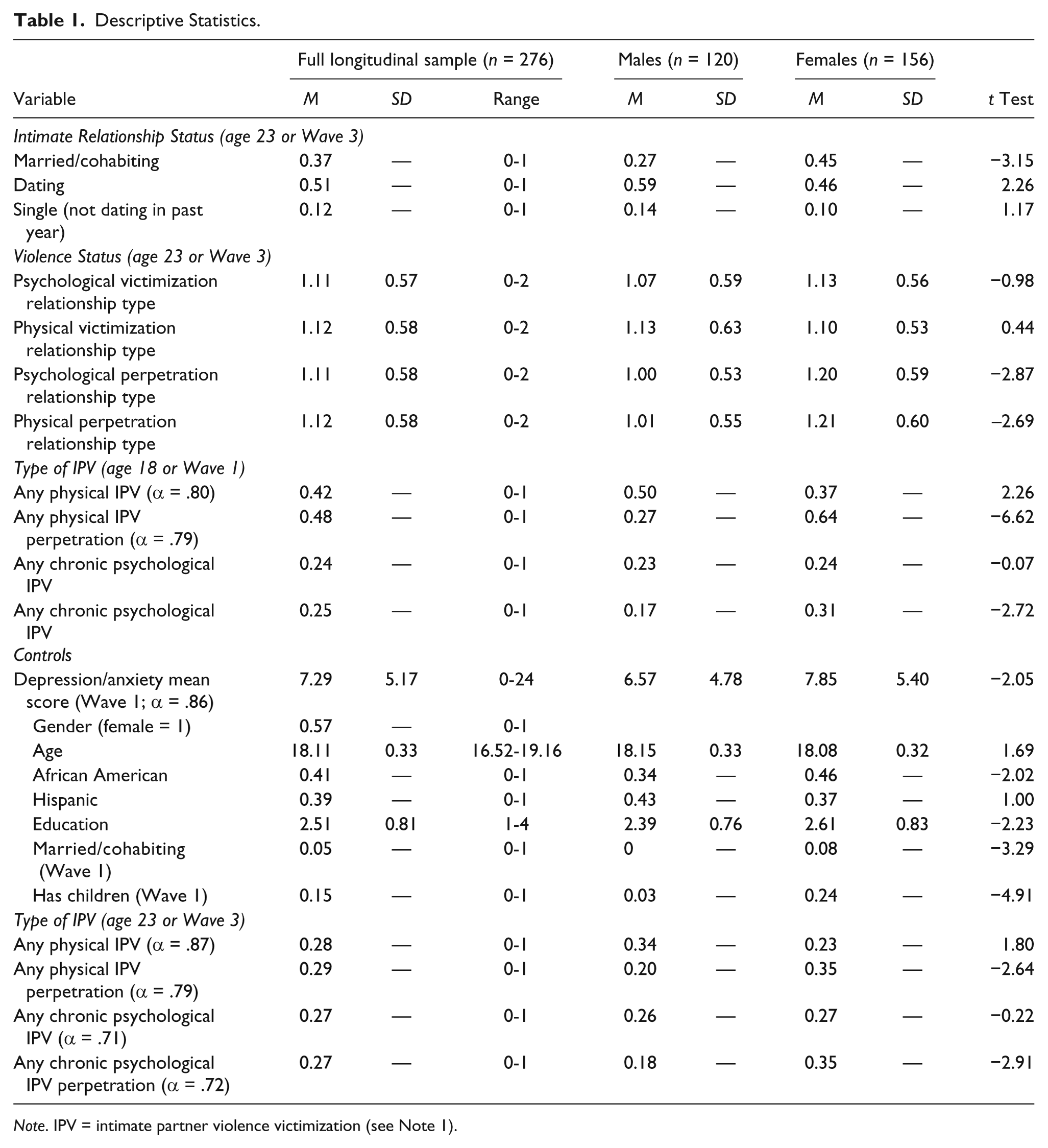
Given the research focus of this article, individual level analyses with Stata 13.1 using robust standard errors were conducted to take into account the clustering of respondents in neighborhoods in Chicago (StataCorp, 2013). Descriptive statistics (Table 1) and gender comparative analyses will address the questions on prevalence of types of IPV at ages 18 and 23. Research questions two through four will be answered through multinomial logistic regression analyses to analyze IPV at age 18 in association with (a) relationship status (i.e., single, dating, and married/cohabiting) and (b) violence relationship status (i.e., relationship abstention, involvement in nonviolent relationships, and involved in a violent relationship) at age 23. Initial models of relationship status will test for gender interaction effects in IPV influences. Subsequent models will then add relevant control variables, including IPV perpetration and sociodemographics. Final models are presented for the analyses of violence status. The influences of physical IPV will first be examined followed by psychological IPV. Predicted probabilities from the results of the multivariate models will be computed to interpret model findings (Long & Freese, 2006).
Descriptive Statistics.
Note. IPV = intimate partner violence victimization (see Note 1).
Results
Prevalence of IPV by Gender in Young Adulthood
In late adolescence, at age 18, 50% of males and 37% of females reported any physical IPV in their relationships, a statistically significant difference (t = 2.26, p < .05). Furthermore, psychological IPV was highly prevalent and equally common among males (93%) and females (87%). A quarter of each group was classified as chronically psychologically victimized in their intimate relationships (the top 25% of the full sample; Straus & Sweet, 1992).
By young adulthood, at age 23, 34% of males and 23% of females reported being physically victimized in intimate partner relationships, showing gender similarity in prevalence (t = 1.80, p > .05). Physical IPV decreased from ages 18 to 23 in the transition to adulthood. Any psychological IPV in intimate relationships also declined from late adolescence to similar prevalence levels early adulthood with 82% of males and 74% of females reporting these experiences. However, levels of psychological IPV remain high at age 23, with a quarter of those experiencing high levels of IPV categorized as chronically victimized.
Other Descriptive Information
Females were more likely than males to perpetrate physical IPV at age 18, with 27% of males and 64% of females reporting these acts, a significant difference (t = −6.62, p < .05). Psychological perpetration at age 18 was also high and equally prevalent among males (92%) and females (94%). At age 23, physical IPV perpetration was statistically significantly higher among females (35%) than males (20%; t = −2.64, p < .05). Psychological IPV perpetration was also high at age 23 as reported by 79% of males and 83% of females, where these levels indicate gender similarities.
Forty-one percent of the sample are African American, 39% are Hispanic, and 20% are White or of other race/ethnicities. Few of the respondents were married or cohabiting at age 18 at about 5%. Fifteen percent had children at age 18. Fifty-seven percent of the sample are female respondents. In terms of relationship status at age 23, 37% are married or cohabiting, 51% are dating, and 12% are single and not dating in the past year.
In terms of violence status at age 23, 22% of the sample is involved in psychologically violent relationships, 66% are involved in relationships without psychological violence, and 12% are not involved in intimate relationships in young adulthood. In terms of physically violent victimizing relationships, 23% of the sample is involved in physically violent relationships, 65% are not involved in violent relationships, and 12% are single and not involved in intimate relationships at age 23. Finally, 24% of the sample is involved in relationships with physical violence perpetration, while 23% of the sample is involved in relationships with psychological violence perpetration.
IPV at Age 18 and Relationship Status at Age 23
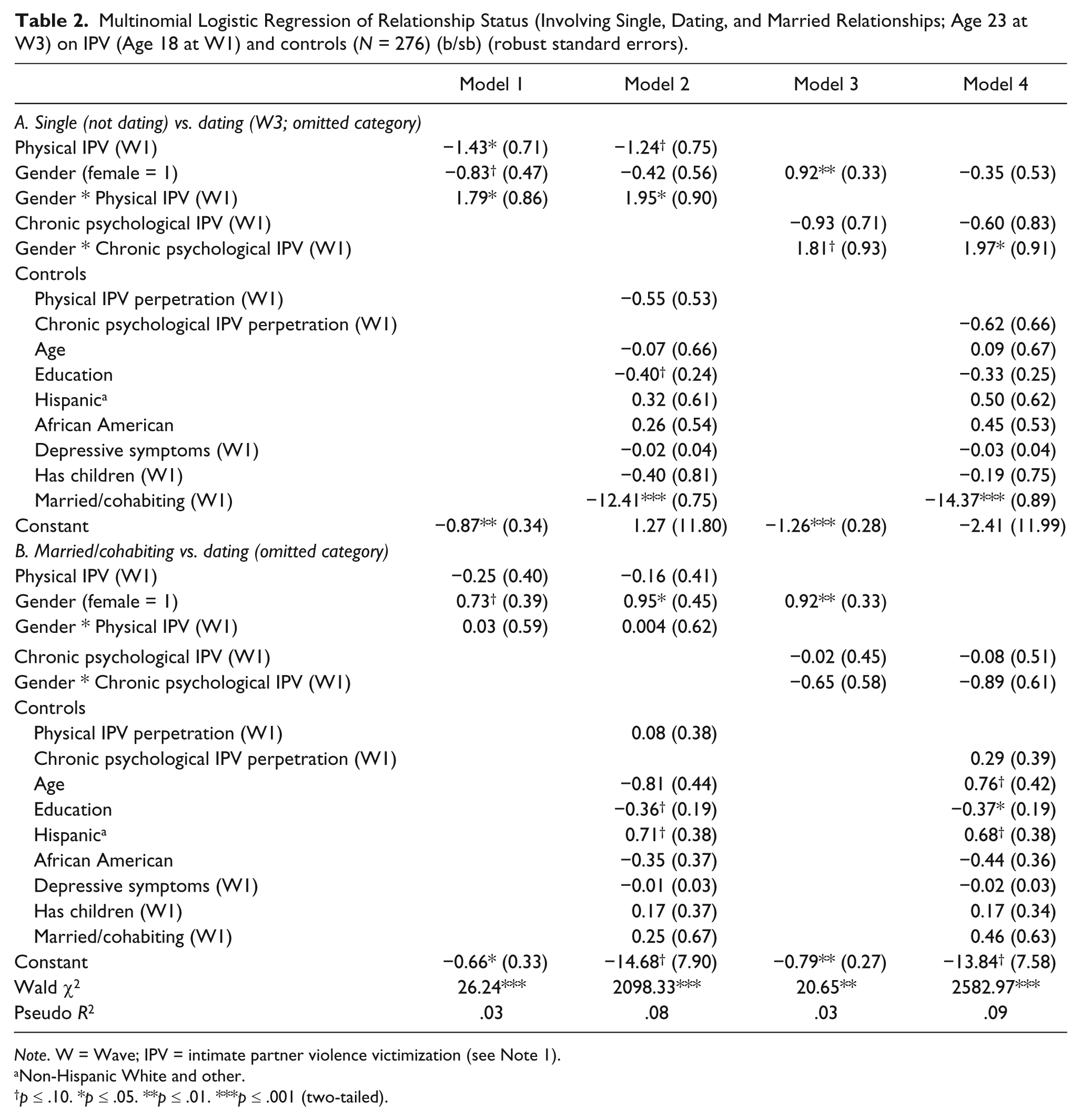
The results of multinomial logistic regression analyses of relationship status are presented in Table 2. The models in this table present the log odds of being single and not dating compared with dating, as well as the log odds of being married or cohabiting compared with dating, as predicted by exposure to physical IPV at age 18 in intimate relationships. As seen in Model 1 of Table 2, females who have been physically victimized in adolescent intimate relationships are more likely to be single and not dating at age 23 compared with being in a dating relationship. This association holds net of multiple control variables as shown in Model 2.
Multinomial Logistic Regression of Relationship Status (Involving Single, Dating, and Married Relationships; Age 23 at W3) on IPV (Age 18 at W1) and controls (N = 276) (b/sb) (robust standard errors).
Note. W = Wave; IPV = intimate partner violence victimization (see Note 1).
Non-Hispanic White and other.
p ≤ .10. *p ≤ .05. **p ≤ .01. ***p ≤ .001 (two-tailed).
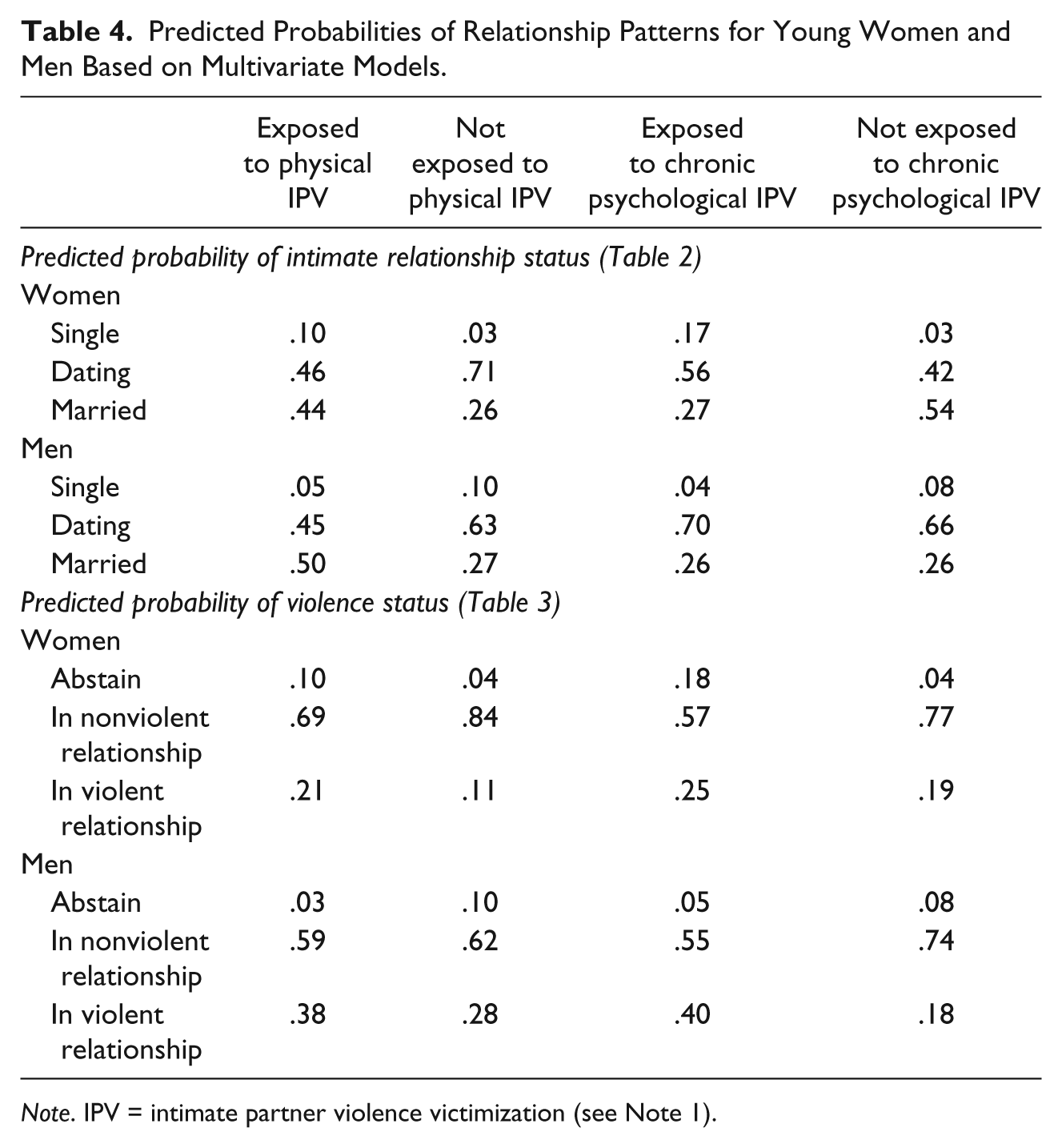
These results are further clarified with reference to the predicted probabilities derived from the results from Model 2 (presented in Table 4; Long & Freese, 2006). Women exposed to physical IPV at 18 had a probability of .10 of being single and not dating at age 23, while those who were not exposed to physical IPV had a lower probability of .03. On the other hand, men exposed to physical IPV at age 18 were less likely to be single and not dating (probability of .05) compared with those who were not exposed to physical IPV (probability of .10). Among those not exposed to physical violence, men (probability of .63) and women (probability of .71) were predicted to be in dating relationships in young adulthood.
The results of multinomial logistic regression analyses of relationship status in young adulthood on chronic psychological IPV are presented in Models 3 and 4 of Table 2. In terms of chronic psychological IPV, there is a trend toward females who have has this experience to be more likely to be single and not dating at age 23 than dating as seen in Model 3 for physical violence. These results are strengthened net of controls (Model 4 of Table 2), where females who have been chronically psychologically victimized are significantly more likely to be single and not dating in young adulthood.
As shown in Table 4, the predicted probability of females exposed to chronic psychological IPV at age 18 of being single and not dating in the age 23 is .17 which is higher than the predicted probability (.03) among those not exposed to chronic psychological IPV. In contrast, males exposed to chronic psychological IPV have a slightly lower probability of being single at age 23 (.04) compared with a predicted probability of .08 of being single in young adulthood if not exposed to chronic psychological IPV. This overall pattern of results by gender are similar in direction to those found for physical IPV. Together, the results support some degree of gendered relationship abstention or a higher likelihood for females compared with males of being single in young adulthood after exposure to physical or psychological IPV in late adolescence.
IPV at Age 18 and Violence Status at Age 23
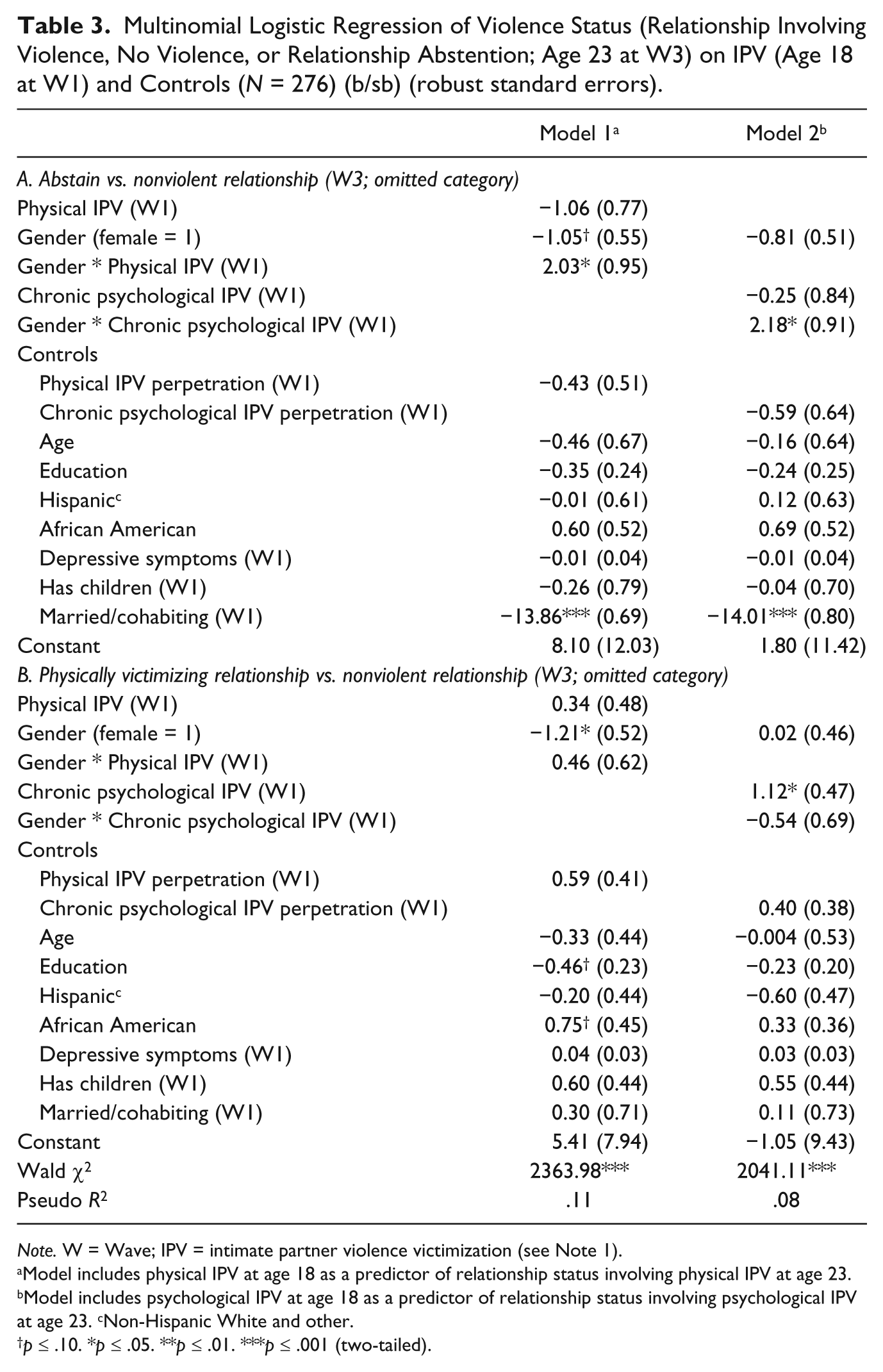
The results of multinomial logistic regression analyses of violence status at age 23 on physical IPV at age 18, net of multiple control variables, are presented in Table 3. Females exposed to physical IPV at age 18 are more likely to abstain from intimate relationships in young adulthood than they are to be involved in a physically nonviolent relationship. Furthermore, females in general are less likely than males to be in physically victimizing relationships at age 23.
Multinomial Logistic Regression of Violence Status (Relationship Involving Violence, No Violence, or Relationship Abstention; Age 23 at W3) on IPV (Age 18 at W1) and Controls (N = 276) (b/sb) (robust standard errors).
Note. W = Wave; IPV = intimate partner violence victimization (see Note 1).
Model includes physical IPV at age 18 as a predictor of relationship status involving physical IPV at age 23. bModel includes psychological IPV at age 18 as a predictor of relationship status involving psychological IPV at age 23. cNon-Hispanic White and other.
p ≤ .10. *p ≤ .05. **p ≤ .01. ***p ≤ .001 (two-tailed).
The predicted probabilities in Table 4 further show that women exposed to physical IPV have a higher probability of abstaining from relationships in young adulthood (.10) than women not exposed to physical IPV (.04). These results support change explanations of violence over the life course. Change explanations are also supported where women exposed to physical IPV in late adolescence had a high probability (.69) of being in a nonviolent relationship at age 23. However, the probability of being in a nonviolent relationship at age 23 was more likely among those women not exposed to earlier violence (.84). As well, continuity explanations also receive support where women exposed to physical IPV at age 18 have a higher predicted probability of being in a violent relationship at age 23 (.21) than women not exposed to physical violence in late adolescence (.11).
Predicted Probabilities of Relationship Patterns for Young Women and Men Based on Multivariate Models.
Note. IPV = intimate partner violence victimization (see Note 1).
Among men, the predicted probabilities in Table 4 show those exposed to physical IPV are less likely to abstain from relationships (probability of .03) than are men not exposed (.10). These results suggest men exposed to violence in intimate relationships are less likely to abstain from relationships at age 23. In support of change explanations, young men exposed to physical IPV are most likely to be in a nonviolent relationship in young adulthood (probability of .59), which is similar to the probability among those not exposed to physical violence (.62). However, continuity explanations are also supported where men exposed to IPV in adolescence have a moderate predicted probability (.38) of also being in a physically violent relationship in young adulthood. Men not exposed to physical IPV at age 18 have a lower predicted probability (.28) of being in a violent relationship at age 23, although there is still a risk at this stage of the life course.
The results of multinomial logistic regression analyses of violence status at age 23 on exposure to chronic psychological IPV at age 18 are presented in Model 2 of Table 3. As was found for exposure to physical IPV in late adolescence, females exposed to chronic psychological IPV are more likely to abstain from relationships in young adulthood than to be in a nonviolent relationship in support of gendered change patterns in violence exposure over the life course. Yet there is also evidence of continuity that is not gendered in a general pattern of psychological IPV positively predicting involvement in a young adult chronically psychologically aggressive relationship at age 23 rather than being in nonviolent relationships.
These results are further explicated in terms of predicted probabilities presented in Table 4. The predicted probability of women exposed to chronic psychological violence at age 18 abstaining from relationships at age 23 is .18. The predicted probability of relationship abstention among young women not exposed to chronic psychological IPV is lower at .04. Again, these results support change explanations of violence exposure. Change explanations of violence over the life course are also supported by probabilities of those women being exposed to chronic psychological violence transitioning into nonviolent relationships in young adulthood (.57). However, this probability is lower than the probability of being in a nonviolent relationship among women not exposed to earlier violence (.77).
Men exposed to psychological IPV at age 18 (.05) or not (.08) show similar low predicted probabilities of abstaining from relationships at age 23. Change explanations are supported with the predicted probability that young men exposed to previous chronic psychological IPV will be in nonviolent relationships in adulthood of .55. However, this probability is lower than that for men not exposed to previous violence (.74). Furthermore, there is evidence for continuity among men. Young men exposed to chronic psychological IPV at age 18 have a fairly high (.40) probability of being in a psychologically violent relationship at age 23 compared with men who were not exposed to psychological violence at age 18 (.18). Women exposed to chronic psychological violence at age 18 have a slightly higher predicted probability of being in a psychologically violent relationship at age 23 (.25) than women not exposed to chronic psychological intimate violence in late adolescence (.19). However, the evidence for continuity is also gendered, where the probabilities of continuity in psychological IPV are higher among males (.40) than females (.25).
Perpetration and Links to Relationship Status and Violence Status
In results not shown (available on request), we further analyzed the associations between perpetrating physical IPV and relationship status as well as violence status as per our fourth hypothesis. Regarding relationship status, we found no statistically significant association between being physically aggressive toward one’s partner on being single compared with dating, or on being married or cohabiting compared with dating. Predicted probabilities from these models show women who perpetrated physical IPV were similarly likely to be single and not dating (.07) than those not involved in physical IPV (.05). Among women, those not involved in physical perpetration were similarly likely to be in dating (.47) and married or cohabiting relationships (.49) at age 23. Women involved in physical perpetration also had similar predicted probabilities of dating at age 23 (.45) and being married or cohabiting (.48).
Among men, there was almost no chance of being single at age 23 if the individual perpetrated physical IPV perpetration toward one’s partner, but a probability of .09 of being single if not physically perpetrating IPV. Men involved in physical perpetration had moderate probabilities of dating (.56) and being married or cohabiting (.44), while those not involved in physical perpetration had a higher predicted probability of being married (.69) than dating (.22).
Physical violence perpetration as a predictor of violence status was further examined in results not shown (available on request), where this experience was positively associated with being in a physically perpetrating relationship at age 23, and these results were not contingent on gender. There is continuity then in physical IPV perpetration across relationships in the transition to adulthood. Among women, the probability of being involved physical perpetration at age 18 and being in a violent relationship in young adulthood is .35. The probability of being in a violent relationship at age 23 among females not involved in perpetrating physical IPV at age 18 is lower at .16. This pattern holds among males: The probability of young adult men involved in physical IPV perpetration at 18 also being in physically aggressive perpetrating intimate relationship at age 23 is .35, while men not involved in late adolescent physical perpetration toward their partners have a predicted probability of .10 of being involved in a subsequent violent relationship.
Finally, in results not shown (available on request), women who perpetrate chronic levels of psychological violence are at a slightly higher risk than men of abstaining from relationships at age 23. However, there is no significant association of chronic psychological violence perpetration at age 18 on perpetrating psychological IPV at age 23 compared with being in a nonviolent relationship among either men or women.
Discussion
These results yield information on the prevalence of IPV in young adulthood with a diverse community based sample adding to extant research. As per our first hypothesis, we found that physical IPV is common in the transition to adulthood. We found prevalence levels decreased over the 5 years of this study. Our results show higher levels in the United States than among those found with a national sample of generally younger respondents largely in adolescence (Halpern et al., 2001). However, our diverse sample also has higher proportions of racial and ethnic minorities and socioeconomically disadvantaged groups who are at higher risk of IPV exposure (Lehrer et al., 2006; Rennison & Welchans, 2000).
We also find that psychological IPV is quite common in late adolescence with the vast majority of females and males reporting these experiences (Magdol et al., 1997; Munoz-Rivas et al., 2007). As was the case for physical IPV violence, the prevalence of psychological IPV decreased by age 23, with well over two thirds of the sample reporting these experiences. More gender similarities were seen in psychological IPV than for physical IPV.
Our results on relationship status in young adulthood (i.e., being single and not dating, dating, and being married or cohabiting) and violence status (i.e., relationship abstention, involvement in nonviolent relationships, and involvement in violent relationships) support both continuity and change in relationship dynamics in this phase of the life course in association with IPV exposure. In support of our second hypothesis, we see prior IPV is associated over time among females with being single and not dating in the transition to adulthood or relationship abstention, a pattern of relationship change. These patterns with young people are in keeping with research on adult women exposed to violence (Cherlin et al., 2004) and more recent research on both men and women (Carbone-Lopez et al., 2012). Carbone-Lopez et al. (2012) also show evidence for the relationship abatement pattern, with stronger probabilities shown for women than for men.
This pattern of relationship dissolution is a particularly important finding for research on relationships in the transition to adulthood. Intimate relationships are a source of social support, love, and social integration (Furman & Winkles, 2012). Early relationships influence cognitive representations of relationships that may shape future relationship involvement (Furman & Winkles, 2012). Young people exposed to physical and psychological violence may be at risk of being without important sources of relational foundations that may assist with successful transitions to adulthood. These findings suggest that further professional efforts around developing positive intimate relationships may be especially important with young women exposed to prior intimate violence in late adolescence.
Our findings, in conjunction with other research (Carbone-Lopez et al., 2012), suggest relationship patterning following IPV is a gendered issue. While females are more likely to retreat from intimate relationships, males are more likely to remain in relationships after exposure to IPV. We found males are also more likely to experience continuity in IPV from late adolescence to young adulthood. Socialization experiences that encourage upholding societal masculinity norms may lead males exposed to IPV to downplay the violence sustained, or be afraid of seeking help for fear of system responses (Douglas & Hines, 2011). This research suggests particular attention is needed on the part of educators and practitioners to assist young males in recognizing IPV occurrence and to have their concerns heard and responded to in ways that empower young men not to endure violence exposure in their intimate relationships.
In addition to the relationship dissolution pattern, our results more broadly support another pattern of change in violence exposure over the early life course. We found some young men and women exposed to physical IPV were moderately to strongly likely to transition to nonviolent relationships in young adulthood. Carbone-Lopez et al. (2012) show higher transition probabilities among men than women in moving from physically aggressive relationships to nonviolent relationships. We find, however, that the probabilities were slightly stronger among females than males in young adulthood. We find very similar probabilities among young men and women exposed to psychological violence of moving into nonviolent relationships. Also, comparatively in our results, the probabilities of transitioning to nonviolent relationships were higher among those exposed to previous physical IPV than psychological IPV. Perhaps these findings represent building working models conducive to change, where “ . . . an individual with experience of IPV may be better able to identify a propensity toward violence and shy away from such people as intimate partners” (Carbone-Lopez et al., 2012, p. 323). It is possible that young women exposed to IPV may be better socialized toward detecting the risk of physical violence from new partners than are young men.
Consistent with life course perspectives and our third hypothesis, our results also support a pattern of continuity in exposure to violence in intimate partner relationships over the transition to adulthood consistent with research on revictimization which has been largely developed in the realm of sexual violence. Both males and females exposed to physical violence at age 18 had moderate risks of being exposed to physical IPV at age 23. However, there is a gendered patterning to these findings: Results were stronger among males than females for continuity in physical violence exposure. Similarly, for exposure to psychological IPV, both males and females are moderately at risk of further exposure in young adulthood, but again the risk is even higher among young men than women. While explanations for gender differences include differential meanings where women’s violence is seen as less threatening than men’s and may therefore lead to further exposure among young men (Miller & White, 2003; Romito & Grassi, 2007), it is also important that men exposed to IPV explain their continued involvement in violent relationships in terms of male gender norms, commitment to the relationship, along with a role of minor children (Eckstein, 2011; Hines & Douglas, 2010). These findings on continuity show clear risks for revictimization over the early life course, and that interventions and preventions are needed for both young men and women.
Our main focus in this research was on IPV and intimate relationship patterns. As per our fourth research question, we further included investigation of the consequences of violence perpetration on which there has been little research pertaining to relationship patterns. In keeping with Archer’s (2000) review, we find higher levels of IPV physical perpetration among females than males, but we see additionally see gender similarities in psychological IPV perpetration among females and males. In contrast to our fourth hypothesis, there was no association between physical IPV violence perpetration and relationship status in terms of being single, dating, or married/cohabiting. Yet there was an association between chronic psychological violence perpetration and being single and not dating compared with dating relationship involvement among females compared with males. Therefore, these results extend findings on IPV and relationship dissolution (Carbone-Lopez et al., 2012; Cherlin et al., 2004) to additionally relate this relationship pattern to chronic psychological violence perpetration among females. In terms of our other outcome of violence status, we find physical IPV perpetration at age 18 increases the likelihood of being in a relationship at age 23 where the respondent physically perpetrates violence. This pattern is supported among both males and females showing moderate probabilities of being in a relationship where respondents perpetrate physical violence in the transition to adulthood if they also perpetrated physical violence in adolescence. Prior psychological IPV perpetration at age 18 is not a predictor of being in a relationship where the respondent perpetrates psychological violence at age 23.
While multivariate research with adults on IPV and relationship patterns has taken into account childhood abuse experiences (Carbone-Lopez et al., 2012; Cherlin et al., 2004), we are unable to control on these factors as they were not measured in 18-year-olds in the current study. This limits our research. However, strengths of our study include the use of prospective longitudinal data on both males and females in the transition to adulthood among a diverse sample, inclusive of other relevant control variables. Our findings contribute an investigation of IPV and relationship patterns in the transition to adulthood period which has not yet been previously investigated. Our approach further operationalizes relationships in a developmentally sensitive manner among those transitioning to adulthood building on research on union status (i.e., married, single, cohabiting).
These findings support the importance of developing life course perspectives on victimization experiences (Carbone-Lopez et al., 2012; Macmillan, 2001). Both evidence of stability and change in violence exposure are found. Our work points to some gendered patterns in this phase of the life course. Prior IPV exposure can lead to refraining from forming intimate relationships particularly among females. Furthermore, some young adults are able to transition to nonviolent relationships following late adolescent IPV, but others are at risk for continuity in violence exposure in the transition to adulthood, with this pattern being particularly salient for males. Special attention is required for young men and women exposed to adolescent IPV in navigating relationships in this key phase of the life course.
Footnotes
Acknowledgements
We extend our gratitude for use of the PHDCN data to Felton Earls (PI), Stephen Raudenbush, and Robert J. Sampson. We appreciate early comments by Christopher Browning and Margo Gardner.
Authors’ Note
The findings reported in this article are the responsibility of the authors and do not necessarily represent the views of the funders of the PHDCN or the others acknowledged.
Declaration of Conflicting Interests
The author(s) declared no potential conflicts of interest with respect to the research, authorship, and/or publication of this article.
Funding
The author(s) disclosed receipt of the following financial support for the research, authorship, and/or publication of this article: We appreciate very much the support for this research through NICHD Grant #R01-HD049796-01. The PHDCN was supported by the John D. and Catherine T. MacArthur Foundation, the National Institute of Justice, and the National Institute of Mental Health.