







Abstract
This study assessed the mediating pathways of observed couple communication on the dyadic associations between experiential avoidance (EA) and relationship quality. A sample of 228 military couples following combat deployment participated in a conflict discussion and completed self-report measures to assess EA and relationship quality. Results of an actor–partner interdependence model using structural equation modeling indicated that for both dyad members greater EA was associated with their own lower relationship quality. Higher EA in men was associated with more observed negative communication, as well as lower relationship quality in their female partners. Positive couple communication was associated with higher relationship quality in men and in women. Overall, EA demonstrated associations with relationship quality above and beyond couple communication skills. This study points to the importance of EA for the marital system and suggests that interventions targeting EA and positive couple communication skills may strengthen military marital relationships following deployment to war.
Introduction
“Experiential avoidance” (EA) entails the unwillingness to engage with unpleasant feelings, physiological sensations, and thoughts, as well as the actions being taken to modify these experiences (Hayes, Wilson, Gifford, Follette, & Strosahl, 1996). For example, EA involves engagement in cognitive–behavioral avoidance strategies, such as emotional suppression (Chawla & Ostafin, 2007). EA is rooted in the basic human motivation to avoid painful experiences, either external (e.g., stressful situations) or internal (e.g., emotions, thoughts, and memories) (Blackledge & Hayes, 2001). EA strategies often provide emotional relief in the short term (Hayes et al., 1996), but ongoing and inflexible use of EA may result in negative consequences in the long run (Hayes & Wilson, 2003). When EA is used rigidly, excessive energy is invested to control unpleasant subjective experiences and thus it can become maladaptive (Hayes, Strosahl, & Wilson, 1999). Gross and John (2003) further explain that repeated efforts to suppress emotions are cognitively taxing, leading to less emotional clarity, and consequently to dysregulated mood, increased negative emotions, and depleted experience of positive emotions. Studies have shown that EA is linked with elevated psychological distress and limited ability to experience pleasurable emotions (Kashdan, Barrios, Forsyth, & Steger, 2006). Moreover, EA has been found across studies to intensify psychopathology (see Chawla & Ostafin, 2007, for a review).
Although considerable attention has been given to the link between EA and intrapersonal functioning (Chawla & Ostafin, 2007), theorists posit that EA may also disrupt interpersonal functioning in close relationships. The context–trait–process model suggests that personal vulnerabilities, such as EA, may impair effective communication, placing couples at risk for relationship dissatisfaction (Karney & Bradbury, 1995). Successful intimate relationships rely on the ability of partners to communicate effectively with one another (Gottman, 1994; Karney & Bradbury, 1995). Constructive communication is important because it helps couples handle everyday conflicts and problems (Gottman, 1994). Couple communication has been repeatedly identified as a key predictor of stable and happy marriages. Several literature reviews have shown that negative communication skills predict declines in marital satisfaction over time (Gottman, Coan, Carrere, & Swanson, 1998; Karney & Bradbury, 1995; Kelly, Fincham, & Beach, 2003).
Gross and John (2003) further explain the link between emotional avoidance and communication skills. They postulate that close relationships involve stimulation of strong positive and negative emotions, but the tendency of emotionally avoidant individuals to hide their emotional experience inhibits emotional closeness and intimacy, which may lead to restricted emotional support. Likewise, other scholars suggest that avoidance of negative emotions and experiences can disrupt couple communication. Specifically, EA may result in avoidance of uncomfortable but necessary marital discussions and disagreements, leading to more tensions and conflicts, as well as restricted intimacy between partners (Erbes, Polusny, MacDermid, & Compton, 2008).
Self- and peer-reports as well as observational data have indicated a direct link between EA and communication skills. For example, emotional suppression is linked to restricted expression of positive and negative emotions with peers, less closeness in social interaction, and reduced responsiveness with romantic partners (Butler et al., 2003; Gross & John, 2003). Additionally, EA has been found to be associated with self-reported communication, including more aggressive behaviors by men who were exposed to interpersonal violence (Tull, Jakupcak, Paulson, & Gratz, 2007). Lastly EA was linked with more self-reports of aggressive behavior and lower marital satisfaction among combat veterans (Reddy, Meis, Erbes, Polusny, & Compton, 2011).
The literature outlined above suggests that couple communication might account for the relationship between EA and relationship quality. To date, the vast majority of research on EA and communication skills has been conducted with nonintimate partners; only one study has investigated associations between EA and marital relationships. Reddy et al. (2011) tested direct associations among EA and marital outcomes (i.e., aggressive behaviors and relationship quality) in a sample of military couples. This study, though, did not test for the mediating role of couple communication in the relation between EA and relationship quality. Therefore, the aim of this study was to expand the current literature by exploring whether couple’s communication mediates the association between EA and relationship quality. Moreover, we sought to fill this scientific gap by addressing several limitations of prior research. First, despite their theoretical connection, few studies have demonstrated the link between EA and couple communication. Reddy et al. (2011) investigated a related concept, aggressive behavior, using self-report data from 49 military couples. To address the issue of attributional biases in self-report data (Bradbury & Fincham, 1990), we employed observational data to assess couple communication. Second, we were interested in testing our research question with a larger sample of reintegrating couples following deployment to a war.
Observed Communication Behavior in Intimate Relationships
Research spanning over four decades has recognized a clear association between observed couple communication and couple’s reports of marital quality (see Heyman, 2001; Kelly et al., 2003, for reviews). Extensive research has investigated communication between intimate partners using the conflict paradigm (Heyman, 2001). In this approach, couples are asked to discuss an issue they have identified as an area of conflict for a limited amount of time in a private setting. These interactions are videotaped and coded by trained coders who evaluate specific couple behaviors using verbal and nonverbal cues, such as facial expression, body posture, tone of voice, and affect (Kelly et al., 2003). A large body of research gathered in the past 40 years has established the external validity of the conflict paradigm. For example, distressed couples were found to differ from healthy couples in terms of verbal and nonverbal communication, physiology, and interactional patterns during conflict interactions (Gottman, 1979, 1994; Gottman et al., 1998; Kiecolt-Glaser, Bane, Glaser, & Malarkey, 2003). Overall, hundreds of studies using diverse coding systems have converged on the finding that the quality of couple communication, positive or negative, predicts relationship satisfaction over time (see Gottman et al., 1998; Heyman, 2001; Kelly et al., 2003, for reviews).
The extant literature indicates that distressed couples tend to display more negative communication patterns during conflict discussions (Gottman & Levenson, 1992; Johnson et al., 2005; Kiecolt-Glaser et al., 2003; Rogge & Bradbury, 1999). Specifically, longitudinal research has identified four patterns of negative behaviors that predict divorce over time: defensiveness (i.e., blaming the partner), contempt (i.e., disgust or derision), criticism, and withdrawal (i.e., maintaining silence, looking away, leaving the room; Gottman et al., 1998; Gottman & Notarius, 2000). Studies have also revealed that distressed couples tend to display more negative behavioral cues, including, disengaged body posture (e.g., stiff body, less eye contact, and less smiling), interruptions during discussions, and negative affect, as well as less agreement, acceptance, interest, and empathy toward their partner (see Gottman & Notarius, 2000; Heyman, 2001; Kelly et al., 2003, for reviews).
Distressed and healthy couples differ in their use of positive communication. Healthy couples tend to display more positive behaviors during conflicts, including empathy, humor, affection, and engaging body posture (e.g., eye contact, smiles). Furthermore, they are more likely to show positive involvement including interest when their partner is speaking (see Heyman, 2001; Kelly et al., 2003, for reviews). Such positive behaviors during conflict discussions are believed to de-escalate conflict, improve problem solving, and promote survival of the marital system (Gottman, 1979). Indeed, positive communication has been found to predict higher marital satisfaction over time (Gottman et al., 1998; Graber, Laurenceau, Miga, Chango, & Coan, 2011; Johnson et al., 2005). In line with this literature, we examined both positive and negative communication skills in an effort to assess couple communication.
Interdependency Between Intimate Partners
A strong test of our research question requires a dyadic approach to data analysis. Dyadic data analysis is based on an interdependence framework, which postulates that the thoughts, emotions, and behaviors of each dyad member can influence the outcomes of the other partner (Kelley & Thibaut, 1978). Statistically, actor–partner interdependence models (APIM) account for interdependency by concurrent estimation of actor effects (i.e., the effects of each dyad member on his or her own outcomes) and partner effects (i.e., the effects of each dyad member on his or her partner), while accounting for the shared couple-level context (Cook & Kenny, 2005). The model was designed to provide a reliable method to handle dyadic interdependency, and it has been commonly used in the study of interpersonal relationships over the past several decades (Fincham & Beach, 2010).
Previous data have shown empirical evidence for actor and partner effects in the study of EA, couple communication, and relationship quality. For example, self-reports of hostile communication in men and women have been found to be associated with partner’s marital satisfaction (partner effect) as well as self-reports (actor effect; Segrin, Hanzal, & Domschke, 2009). In addition, empirical findings have lent support to the view that EA in one partner can affect both members of a dyad. Specifically, EA in the form of emotional suppression has been found to heighten physiological markers of stress in both suppressors and in their social or romantic partners (Ben-Naim, Hirschberger, Ein-Dor, & Mikulincer, 2013; Butler et al., 2003; Peters, Overall, & Jamieson, 2014). Among romantic partners, attempted affective suppression was associated with self- and partner-increased expression of negative affect including disgust and contempt during a conflict discussion (Ben-Naim et al., 2013). It should be noted that these studies explored expressive suppression, in which participants were instructed to hide emotional expression in response to negative content. Behavioral suppression of emotions does not overlap entirely with EA, which is a stable personal characteristic with cognitive and emotional components. To our knowledge, only one study has specifically tested the dyadic association of EA and marital functioning and found that EA in veterans and their wives was associated with veteran’s marital satisfaction (Reddy et al., 2011). Given data suggesting possible dyadic associations between EA, couple communication, and marital quality, we applied APIM to test our research questions.
Reintegrating Couples After Deployment
Since 2001, more than 2 million American soldiers (almost half of whom are partnered) have been mobilized for overseas deployment to the Middle East (i.e., Operations Iraqi Freedom, Enduring Freedom, and New Dawn; Department of Defense, 2013). Following the deployment period, which often lasts more than a year, deployed partners may need to adjust from being physically absent to being present partners and parents (Huebner, Mancini, Wilcox, Grass, & Grass, 2007). In this process, couples may need to renegotiate house rules and expectations about family roles and responsibilities, such as reestablishing a united parenting front (Pincus, House, Christenson, & Adler, 2001). Soldiers who were exposed to combat stress may experience trauma-related symptoms, including posttraumatic stress disorder (PTSD), depression, and anxiety (Milliken, Auchterlonie, & Hoge, 2007). Researchers have suggested that the use of EA to manage transitional and traumatic stress related to deployment may lead to marital difficulties. Specifically, suppression or avoidance of stressful emotions and memories associated with combat deployment can impair open communication, create distance and isolation, and deplete intimacy between partners (Gottman, Gottman, & Atkins, 2011). In light of these stressors, reintegrated couples have been found to be at increased risk for marital difficulties and lower relationship quality (Galovski & Lyons, 2004; Monson, Taft, & Fredman, 2009). Despite the relevance of EA to marital adjustment following deployment, this topic has rarely been studied. Understanding how EA contributes to relationship quality following deployment may provide an empirical foundation for interventions designed to strengthen marital functioning of reintegrated couples. Hence, we tested how couple communication mediates the link between EA and marital quality among reintegrated military couples.
The Current Study
In this study, we evaluated two dimensions of couple communication (positive and negative communication during observed conflict discussions) as potential mediators of dyadic associations between self-reported EA and relationship quality in reintegrated couples. On the basis of both theory and prior findings, our hypotheses were as follows:
Method
Participants
Our sample included 228 married or cohabitating couples in which the male partner had deployed to the recent conflicts in Iraq or Afghanistan. Participants in this study represent a subsample drawn from the baseline assessment of a prevention study for reintegrated military families following deployment to war. The majority of couples in this sample were married (97.8%), with only a few couples cohabitating (2.2%). The mean length of relationship to the current partner was 9.96 years (SD = 5.3), and ranged from 1 to 28 years. Number of children in a household ranged from 1 to 5 with a mean of 2.4 (SD = .92). Participants were predominantly White (88.6% of men and 95.9% of women). Women’s ages ranged from 23 to 51 years (M = 35.5, SD = 5.86), and men’s ages ranged from 23 to 58 years (M = 37, SD = 6.56). Household incomes ranged from $39,999 or less (11.5%) to $120,000 or more (15%), with most families reporting income between $40,000 and $79,999 (32.2%) and between $80,000 and $119,999 (41.4%). About half of participants (49.1% of husbands and 51.3% of wives) reported completing at least a Bachelor’s degree.
Most deployed partners were affiliated with Army National Guard (60.1%). The rest were affiliated with the Army Reserve (11.8%), Air National Guard (10.1%), Navy Reserve (3.9%), Air Force Reserve (3.9%), or other military units (10.1%). Participants reported one to ten combat deployments during recent conflicts (M = 2.01, SD = 1.2). Total number of months deployed were 1 to 6 months (6.1%), 7 to 12 months (26.8%), 13 to 24 months (32.9%), 25 to 36 months (24.6%), or longer than 3 years (9.6%).
Procedure
Couples were recruited using multiple methods, including, events for NG/R personnel, letters from the Minneapolis Veterans Affairs Medical Center, traditional and social media, and word of mouth. Couples who were interested in participating in the study were referred to an online screening survey. Participants who met eligibility criteria to participate in the study (i.e., at least one partner deployed to recent conflicts and a child aged 5 to 12 years old) and submitted their consent form were asked to complete a confidential online self-report survey. Following this, an in-home assessment was scheduled, where additional self-report and observational data were obtained.
Couple communication was assessed at the in-home assessments using a conflict discussion paradigm adapted from Bullard et al. (2010) for the Family Interaction Tasks procedure (Forgatch & DeGarmo, 1999). Partners were asked to rate in order of severity current conflicts from a checklist of frequent co-parenting conflicts related to deployment (e.g., getting back on the same page after deployment). The conflict that was ranked as most severe was selected for discussion by the interviewer. In the next phase, couples were instructed to attempt to solve the conflict in 5 minutes. Couples were left alone during the interactions, which were videotaped. Each couple received $50 for completing the in-home assessment, and each partner received an additional $25 for completing the online questionnaires
Measures
Experiential Avoidance
Both partners completed the Acceptance and Action Questionnaire (AAQ-II; Bond et al., 2011), a single-factor 7-item self-report measure that assesses EA (e.g., “I’m afraid of my feelings”). The scale is rated on 7-point Likert-type scale from 1 (never true) to 7 (always true). Higher total sum scores reflect greater EA. The AAQ-II has demonstrated satisfactory discriminant and structure validity. Internal consistency and test–retest reliability of the AAQ-II have been found acceptable (Bond et al., 2011). Cronbach’s alpha for the present sample was .92 for each gender.
Relationship Quality
To assess relationship quality, each spouse completed the Dyadic Adjustment Scale (DAS-7; Hunsley, Best, Lefebvre, & Vito, 2001), a short version of the original 28-item DAS (Spanier, 1976). This seven-item scale includes three items assessing (a) degree of agreement on a scale from 0 (always disagree) to 5 (always agree), (b) three items assessing degree of dyadic cohesion on a scale from 0 (never) to 5 (more often), and (c) one item assessing global dyadic satisfaction from on 6-point scale from 0 (extremely unhappy) to 6 (perfect). The scale score was an equally weighted mean of response scores for all the items. The DAS has well-established criterion validity and discriminant validity (Hunsley et al., 2001). Cronbach’s alpha for the present sample was .86 for men and for women.
Couple Interaction
A trained group of observers rated each partner’s positive communication and negative communication during the parenting conflict discussion task. Communication was rated with a macro-coding system that assesses verbal and nonverbal behaviors (i.e., facial expression, body posture, tone of voice; see Table 1) (Kelly et al., 2003). Coding scales for positive and negative communication were specified based on an extensive review of the main coding systems for observations of couples’ conflict, including the Marital Interaction Coding System (Weiss & Summers, 1983) and Specific Affect Coding System (Gottman, 1994).
Couple Communication Categorized by Positive and Negative Communication.
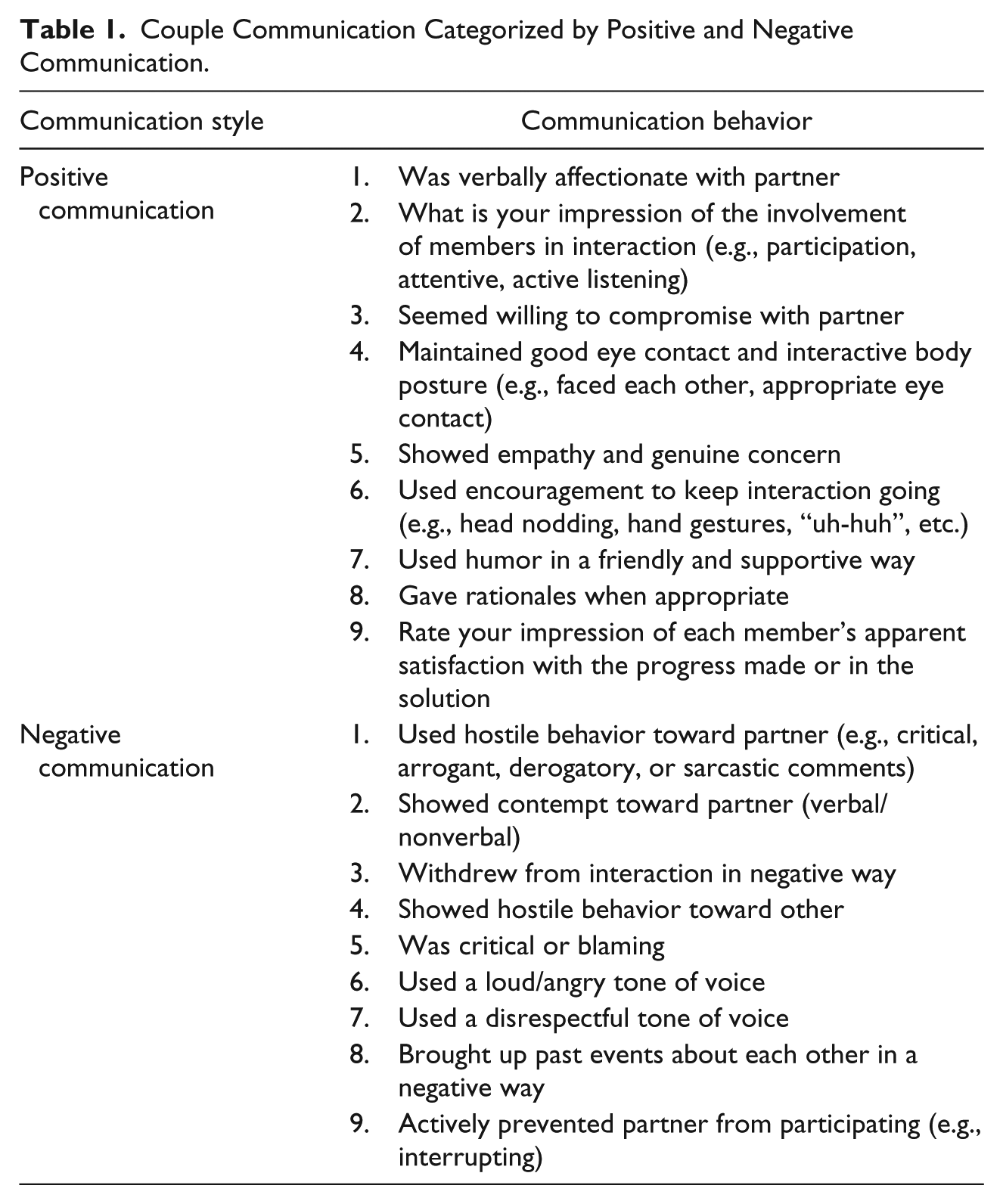
Trained coders were given a detailed coding manual with specific descriptions of each behavioral code and were instructed to take into account the frequency, intensity, and duration of the behaviors across the entire discussion. Positive and negative communication of both partners were rated on 6-point Likert-type scales (1 = never 6 = always). Items were averaged to create summary scores of positive communication and negative communication, such that higher scores indicated more positive communication and more negative communication, respectively.
The positive communication scale included nine items measuring positive engagement in couple interaction, including humor, affection, empathy, interest in the partner, agreement, positive affect, positive involvement, and engaging body posture (Table 1). The negative communication scale included nine items describing negative behaviors during couple interaction, including verbal aggression, withdrawal from the interaction, criticism, contempt, negative tone of voice, and interruptions (Table 1).
Observers were trained for a total of 60 hours and underwent bi-weekly recalibration meetings to continue training and minimize observer drift. Interrater reliability was assessed for 15% of the videos. ICC’s for summary scales were very good for men’s (.92) and women’s (.91) positive communication as well as for men’s (.86) and women’s (.89) negative communication. In addition, Cronbach’s alphas indicated good internal consistency for men’s (.77) and women’s (.76) positive communication, and for men’s (.77) and women’s (.79) negative communication.
We used a priori scales and psychometric methods to confirm our theoretically derived constructs of positive and negative communication (Thompson, 2004). We ran a series of four exploratory factor analyses in which a one-factor solution was imposed. Analyses were conducted separately for men and for women as well as for positive communication items and negative communication items. The average item loadings of the positive communication factor were .57 for men and .58 for women. The average item loadings of the negative communication factor were .58 for men and .53 for women. Overall, factor analytic results supported our theoretical model.
Analytic Strategy
Preliminary analysis was conducted with SPSS 22 (IBM, 2013). Mediation analyses were conducted using structural equation modeling (SEM) with Amos 22 (Arbuckle, 2013). To account for interdependency between couples, we used APIM following the recommendations of Kenny, Kashy, and Cook (2006).To test the hypothesized mediation we followed procedures recommended by MacKinnon (2008) assessing (a) the direct effect of EA on relationship quality; (b) the mediating link between EA and communication, and in turn, communication to relationship quality; (c) whether the direct effect is rendered zero; and (d) the indirect effect using recommended Bayesian estimation (Bolstad, 2004). This technique allows the testing of indirect effects with full-information maximum likelihood (FIML). In this approach, confidence intervals are calculated based on the posterior distribution of the indirect effect as obtained through computerized simulation. These confidence intervals indicate a significant indirect path if zero falls outside of the 95% confidence interval (Markov chain Monte Carlo; Gamerman & Lopes, 2006).
Missing Values
All participants completed baseline assessment; however, some variables had missing values. In total, 4.2% of the values in the study were missing, and 4.8% of the participants had at least one missing value. There were no more than 6.6% missing values for each variable and only 1.8% missing values for the independent variable (relationship quality). Models were estimated with FIML, which uses all available information from the observed data to generate parameter estimates (Enders, 2010).
Results
Preliminary Analysis
Descriptive statistics and zero-order correlations for all study variables are presented in Table 2. For both men and women, higher EA was negatively correlated with their own relationship quality. EA in men was negatively correlated with lower relationship quality in women. In addition, there was a positive association between partners in levels of EA, relationship quality, and negative and positive communication. Among men, greater EA was positively associated with their own negative communication. Men’s negative communication was inversely correlated with women’s positive communication. For both men and women, positive communication was linked with higher relationship quality, whereas negative communication was linked with lower relationship quality. Positive communication was associated with partner relationship quality in both genders, and women’s negative communication was associated with lower relationship quality in men.
Means, Standard Deviations, Cronbach’s Alphas, Intraclass Correlation, and Zero-Order Correlations.
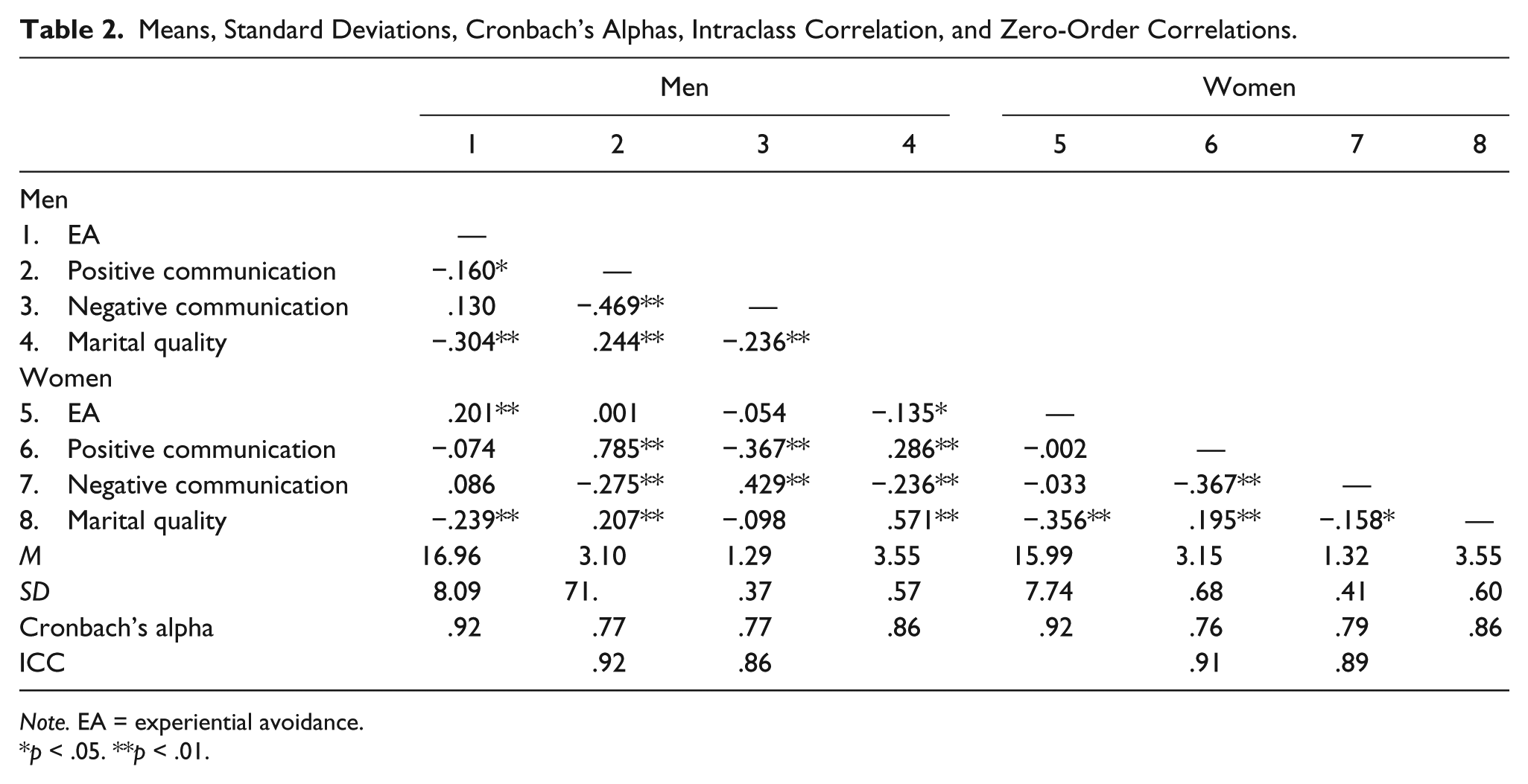
Note. EA = experiential avoidance.
p < .05. **p < .01.
Due to the strong correlation between partners’ positive communication (r = .78, p < .05), and in order to avoid multicollinearity (tolerance = .31 for each variable), subsequent analyses average men and women’s positive communication to create a dyad-level composite of couple positive communication. Negative communication was sufficiently empirically distinct to be examined separately.
Actor–Partner Mediation Models Between EA, Communication, and Relationship Quality
To test the dyadic associations between EA and relationship quality (Hypothesis 1), we ran an APIM analysis via SEM. This model included actor and partner associations going from men’s and women’s EA directly to their own and their partner’s relationship quality. This model was saturated (i.e., df = 0). The Model indicated that EA was negatively associated with both men’s (β = −.287, p < .001) and women’s actor relationship quality (β = −.322, p < .001). Men’s EA was negatively associated with women’s relationship quality (β = −.178, p < .01), but partner association from women’s EA to men’s relationship quality was not significant (β = −.075, p = n.s.). In total, the model explained 9.7% of the variance in men’s relationship quality and 15.9% of the variance in women’s relationship quality.
In the next stage, we tested whether positive and negative communication mediate the actor and partner associations of EA and relationship quality (Hypothesis 2), using an APIM analysis via SEM. Figure 1 illustrates the estimated SEM model. This model included actor and partner associations going from men’s and women’s EA directly to men’s and women’s relationship quality, and all possible actor and partner associations going from men’s and women’s EA through each partner’s negative communication and dyad-level positive communication to men’s and women’s relationship quality. This model was saturated.
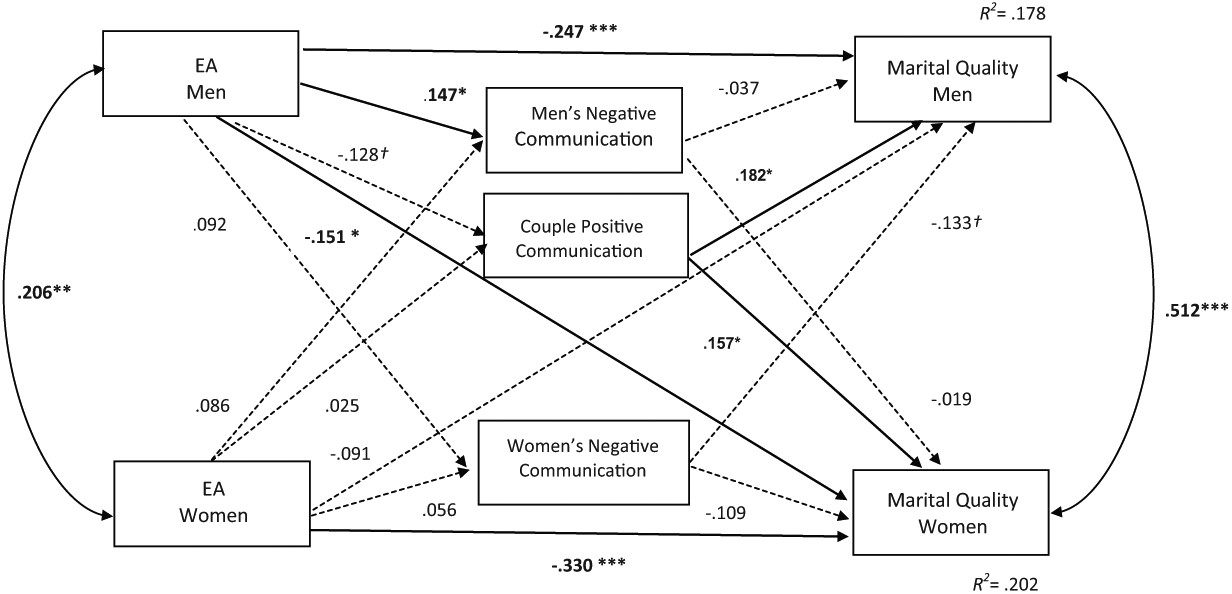
APIM mediation analysis of positive and negative communication on the actor and partner associations of experiential avoidance and marital quality.
Model results indicated that EA was negatively associated with both spouses’ actor relationship quality, and men’s EA was negatively associated with women’s relationship quality (Figure 1). EA in men was positively associated with men’s negative communication and marginally associated with couples’ positive communication. Couples’ positive communication was associated with relationship quality in men and in women, such that greater positive communication was associated with higher levels of relationship quality of men and of women.
In this model, the actor and partner associations between negative communication and relationship quality, and between EA and positive communication were not significant. Thus, estimation of mediating effects was not warranted. In total, the model explained 17.8% of the variance in men’s relationship quality and 20% of the variance in women’s relationship quality.
In conclusion, the analysis revealed actor associations between EA and relationship quality, but partner associations for men’s EA only, indicating Hypothesis 1 was partially supported. Contrary to Hypothesis 2, couple communication does not appear to mediate actor and partner effects of EA on relationship quality.
Discussion
This study was designed to examine actor and partner associations between EA and relationship quality among reintegrated military couples and to evaluate mediating pathways through couple communication. The study sought to expand the scope of the existing literature by employing observational data to assess couple communication. Our hypotheses relied on seminal theory and research identifying couple communication as a focal predictor for successful marriages (Gottman & Notarius, 2000; Karney & Bradbury, 1995; Kelly et al., 2003). In addition, we built on the premise that personal vulnerabilities such as EA can disrupt couple communication (Karney & Bradbury, 1995), and on theories (Gottman et al., 2011; Gross & John, 2003) and research linking avoidance of emotions and interpersonal functioning (Ben-Naim et al., 2013; Butler et al., 2003; Peters et al., 2014; Reddy et al., 2011).
In accordance with our first hypothesis, we found that EA is associated with lower relationship quality in men and women, and that men’s EA is associated with lower relationship quality of their wives. Our data did not support the mediation hypothesis. Nevertheless, several key findings emerged from our analysis. The first key finding is the direct link of EA with relationship quality in men and women above and beyond couple communication. Perhaps the tendency of EA to diminish the experience of positive emotions (Gross & John, 2003) can explain the direct connection between EA and the subjectively reported experience of relationship quality above and beyond expressed behavior.
In addition, men’s EA was found to be associated with decreased relationship quality of their wives, but not vice versa. Though Reddy et al. (2011) found the opposite (i.e., men’s and women’s EA were negatively related only to the men’s relationship quality), discrepancies between the findings may be attributed to differences in sample size (the current study included a much larger sample size). The current data highlight the importance of EA in men for the marital quality of nondeployed wives following the partner’s return from combat deployment. Two alternative models offer possible explanations for this trend. First, stressors related to a long-term separation can produce relational uncertainty—that is, the ambiguity spouses experience about their own and their partner’s participation in a relationship—which accounts for dyadic distress in the reintegration phase (Knobloch & Theiss, 2010). The second model posits that ambiguity about a loss experienced by a loved one (e.g., combat trauma) may provoke distress in the partner (Boss, 2007). Perhaps in the reintegration period, when both the family and the returning spouse may have changed (e.g., children have aged, husbands have been exposed to combat), the transitional stressors related to these changes combined with the tendency of individuals engaging in EA to inhibit emotional disclosure (Gross & John, 2003), reinforce relational uncertainty and/or loss ambiguity. Thus, the returning partner’s avoidance may affect the at-home partner more than vice versa.
The second key finding is that men with higher levels of EA exhibited more hostile communication. Our findings corroborate existing data showing that emotional suppression can impair social interaction (Ben-Naim et al., 2013; Butler et al., 2003; Peters et al., 2014), and that EA in men (but not in women) is associated with aggressive behaviors (Reddy et al., 2011). Thus far, much research has been focused on expressed negative and positive affect during couple interaction (e.g., anger, humor, and affection). Such studies have laid important groundwork regarding the explanatory mechanism for marital outcomes (Johnson et al., 2005). However, the question of how emotion regulation relates to communication skills is as yet understudied (Kelly et al., 2003). Particularly, not much is known about how avoidance of negative emotions, thoughts, and sensations (i.e., EA) interferes with the capacity to interact effectively with a partner. The observational data in our study expand the current literature by showing that men who tend to engage in EA are more likely to use coercive communication. Interestingly, the same was not true for women. It could be that men’s tendency to experience more distress and react more aggressively in response to stress during conflicts (Gottman, 1994; Gottman et al., 1998), men’s greater propensity for using EA in response to stress (Gross & John, 2003), and men’s unique experience of combat in this sample combine to elicit a stronger link between EA and hostile communication by men compared with women.
Contrary to expectations, positive communication was not found to be associated with EA. This finding is in line with a previous study indicting associations between emotional suppression and observed negative affect, but not positive affect (Ben-Naim et al., 2013). There are not enough data to draw strong conclusions about these results, but perhaps attempts to avoid negative affect in the context of conflict generate negative behaviors, such as hostility or withdrawal, as means of regulating unpleasant emotions (Reddy et al., 2011; Tull et al., 2007), and/or diminishing the negative behavior of the other person. In contrast, positive communication during conflicts may be predicted by other factors, such as the level of expressed positive affect by the other partner (Gottman et al., 1998; Julien, Brault, Chartrand, & Begin, 2000).
The third key finding revealed associations between couple positive communication and relationship quality. Our findings support theory and research about the benefits of positive communication for the marital system (Gottman et al., 1998; Johnson et al., 2005). Positive communication was assessed in the current study as a couple-level composite due to high correlations between levels of positive communication within dyads. Such high correspondence is unsurprising given that expression of positive affect by one partner during conflicts is likely to encourage positive communication by the other partner (Julien et al., 2000). This pattern of positive reciprocity predicts marital happiness over time (Gottman & Notarius, 2000). Conversely, coercive communication was not found to be associated with relationship quality. Though this finding was unexpected, it is compatible with longitudinal studies showing that expression of anger during conflicts does not predict marital satisfaction over time (Cohan & Bradbury, 1997; Smith, Vivian, & O’Leary, 1990). Rather, our data support prior findings indicating that what accounts for relationship quality is the ability to express positive affect during conflicts because it helps de-escalate tensions and promote the survival of the relationship (Gottman et al., 1998; Gottman & Notarius, 2000).
In sum, the present study offers evidence for the central role of EA in relationship quality in deployed men and their nondeployed partners. Men’s EA seemed to be particularly damaging to the dyadic system: men’s EA was related directly to their own and their wives’ lower relationship quality, and it was linked with more coercive communication in men. Positive communication, on the other hand, was not affected by EA and was beneficial for the relationship quality of both partners. The data may point to a possible protective mechanism through which positive communication skills help sustain relationship quality when coping with reintegration stressors, and when engaging in maladaptive strategies (e.g., EA) in an effort to manage stress.
Implications and Future Directions
The current study emphasizes the importance of EA for the marital system, showing how avoidance of unpleasant experience as a general coping strategy has broad implications not only for the individual but also for the intimate partner. These findings speak to the need for further research on EA and marital functioning. Future research should address some of the methodological limitations of this study. First, our sample included a mostly high-functioning, well-educated, middle class, Caucasian population; more research is needed with clinical and representative community samples. Although similar results regarding EA and interpersonal relationships have been found among civilian populations (Tull et al., 2007), generalizability of the results of this study should be limited to military populations dealing with the specific challenges identified with reintegration (i.e., trauma-related symptoms, transitional stressors), which may intensify the use of EA (Gottman et al., 2011). It is also possible, that communication patterns in our sample were in some way affected by the long-term separation, during which communication between partners was somewhat constrained. It could be that nonmilitary couples will exhibit indirect effects between EA and marital quality through communication. Replicating our study with civilian couples will reinforce generalizability of our model.
Second, though observational data is considered a preferred method to assess communication behavior (Heyman, 2001), it may limit our findings. First, the null mediation finding in actor effects may be a result of a common method variance, such that self-reported EA and relationship quality showed stronger association than the objective assessment of observed behavior (Podsakoff, MacKenzie, Lee, & Podsakoff, 2003). Testing our research constructs over time may address this and also support the inferred causality of the model, which is currently restricted by our cross-sectional design. Second, couples tend to express less negativity in observed contexts compared with naturalistic settings (Heyman, 2001). On the other hand, self-report measures represent more general perceptions of overall interaction patterns, but they may be subject to attributional biases (Blanchard, Hawkins, Baldwin, & Fawcett, 2009). Therefore, multi-informant methods, including self and observer (other partner) reports as well as observational coding, are preferred strategies for measuring couple interaction.
Last, our results offer clinical implications for couples in general and for those affected by deployment in particular. Interventions designed to address EA, such as mindfulness-based interventions, target the tendency to avoid unpleasant emotions (Hayes & Wilson, 2003), by training individuals to purposely and nonjudgmentally pay attention to the present experiences (Kabat-Zinn, 1994). For example, Mindfulness-Based Stress Reduction training has been validated as an effective way to enhance relationship quality (Carson, Carson, Gil, & Baucom, 2004) and may be beneficial for reintegrating couples. Another direction for intervention would be to reinforce positive communication skills. For example, psychoeducational programs to improve couple communication are effective to prevent marital difficulties among newlyweds and remarried couples (Bullard et al., 2010; Shapiro & Gottman, 2005). In addition, the Prevention and Relationship Enhancement Program for Strong Bonds has already been implemented successfully with military couples. Results from a large randomized controlled trial of the program indicated that couples who received the intervention had significantly lower divorce rates than those allocated to the control group 2 years postintervention (Allen, Rhoades, Markman, & Stanley, 2015).
Footnotes
Declaration of Conflicting Interests
The author(s) declared no potential conflicts of interest with respect to the research, authorship, and/or publication of this article.
Funding
The author(s) disclosed receipt of the following financial support for the research, authorship, and/or publication of this article: This research was funded in part by a grant from NIDA’s prevention branch to the second author (R01DA 030114).