







Abstract
This article examines the prevalence of partnership formation at different life stages and analyses whether the determinants of partnership formation change over the life course. Data were obtained from the German Socio-Economic Panel for the years 1992 to 2014. Event history analyses were used to examine 13,871 periods of being single, of which 8,551 ended with the beginning of an intimate relationship. The results show that the formation of intimate relationships becomes increasingly unlikely after the fourth decade of life onward, particularly for women. At the same time, several predictors of partnership formation vary substantially with age. Economic resources accelerate partnership formation particularly in midlife, whereas good health accelerates partnership formation only in later years. These results remain similar when the transition into cohabitation is examined.
Introduction
The formation of intimate relationships is decreasingly restricted to young adults in the context of an aging population and high divorce rates. This can be observed in official statistics regarding marriage. In Germany, for example, the average age of marriage (including first and higher order marriages) for women has risen from approximately 25 years in 1970 to approximately 35 years in 2013 (Federal Statistical Office of Germany, 2016). In the same period, the average age of marriage for men increased from approximately 28 years to approximately 38 years (Federal Statistical Office of Germany, 2016). In comparison with other Western countries, Germany takes a middle position with respect to the prevalence of marriage, divorce, and cohabitation (Kalmijn, 2007; Stevenson & Wolfers, 2007). However, despite the increasing prevalence of partnership formation at older ages, little is known about partnership formation in later life (Sassler, 2010; Vespa, 2012; Wu, Schimmele, & Ouellet, 2014).
Only a few studies on partnership formation have focused, at least implicitly, on later phases of life by examining the determinants of repartnering after divorce (e.g., de Graaf & Kalmijn, 2003; Shafer & James, 2013) or widowhood (e.g., Wu et al., 2014). Other studies examined the probability of marriage or cohabitation in samples of older adults (Brown, Bulanda, & Lee, 2012; Schimmele & Wu, 2016; Vespa, 2012). However, these studies did not consider nonresidential relationships, which have increased substantially in Germany (Asendorpf, 2008) and in other Western countries (De Jong Gierveld, 2004; Levin, 2004; Reimondos, Evans, & Gray, 2011), particularly among older people (Asendorpf, 2008; Brown & Shinohara, 2013; Karlsson & Borell, 2002). In Germany, approximately 30% of adults not married or cohabiting are in a nonresidential relationship (Asendorpf, 2008), compared with about one third in the United States (Strohm, Seltzer, Cochran, & Mays, 2009).
There are several reasons why the determinants of partnership formation may vary over the life course. First, de Graaf and Kalmijn (2003, p. 1460) note that the first marriage is primarily a matter of “when” because most people marry at least once, whereas remarriage is also a matter of “if.” Social factors therefore may better predict partnership formation in older adulthood than in young adulthood. Moreover, the marriage market conditions (e.g., the supply of suitable partners) deteriorate with increasing age. A major hypothesis of this study is that individual resources, such as income or health, improve the chances of finding a partner, especially in life stages in which marriage market conditions are poor. Finally, the purposes of intimate relationships (e.g., to raise children) and the desire to start a new relationship change with increasing age (Mahay & Lewin, 2007). Some of these factors also differ by gender. The deterioration of marriage market opportunities with rising age is more pronounced for women, partially because men die earlier than women. In addition, several studies indicate that older women are less interested in repartnering than older men (Carr, 2004; Davidson, 2002; Poortman & Hewitt, 2015). Therefore, the determinants of partnership formation and their age dependence also may differ by gender.
The aim of this study is to examine whether the predictors of partnership formation change from young to old age. We focus on socioeconomic status and health, which can be considered individual resources that may affect the formation of partnerships in different ways. In contrast to previous studies regarding whether the predictors of partnership formation differ by age (Brown et al., 2012; Schimmele & Wu, 2016; Vespa, 2012), we consider adults of all ages, not just middle-aged and older adults. In addition, we look at the transition into a romantic relationship and not at the transition into cohabitation or marriage. This has an advantage in that we do not miss relationships that do not transition to cohabitation. Consequently, only one transition is observed (i.e., the transition from being single to being in a partnership), rather than observing the result of several transitions (e.g., starting a partnership and moving in together, as would be the case if only residential relationships were considered).
The following sections start with a description of our theoretical model for the formation of intimate relationships. We then summarize recent research and discuss why socioeconomic status and health may have different impacts on the likelihood of partnership formation at different stages of life. The data and methods used in this study are described next. We present and discuss our results in the last two sections.
Theoretical Framework
The formation of intimate relationships usually has been discussed in the context of marriage market theories (Becker, 1993; Oppenheimer, 1988). Although these theories were used originally to explain marriage formation, their basic assumptions can also be applied to nonmarital relationships (Moorman, Booth, & Fingerman, 2006). In this view, people are supposed to start a partnership if they expect to increase their benefit compared with that benefit available while staying single (Becker, 1973). At the same time, the formation of relationships depends on the conditions of (local) marriage markets and individual resources, such as income and prestige.
Individual resources affect the formation of intimate relationships in different ways. First, they determine the “mate value” of an individual (Skopek, Schmitz, & Blossfeld, 2011, p. 273; Todd & Miller, 1999); that is, they determine the attractiveness to the opposite sex. It stands to reason that commonly desired attributes, such as high physical attractiveness or high social status, make it easier to find a partner. Second, individual resources affect the gain from a relationship compared with that available when remaining single. Greater economic independence reduces the economic penalties associated with being single (Oppenheimer, 1988), whereas people with little income may benefit more economically through pooling their resources (Chevan, 1996). In addition, people with little resources may be more willing to compromise to avoid protracted and costly searching (Shafer & James, 2013). To summarize, it is theoretically unclear whether the amount of individual resources will increase or decrease the probability of starting an intimate relationship.
Marriage market opportunities depend on macrolevel structures, such as the size of social groups (Blau, 1977), and on the integration into social activities and interactions, such as workplaces (Feld, 1981). The rise of dating websites in recent years may have reduced the importance of local partner markets (Rosenfeld & Thomas, 2012). This might be particularly important for people who meet few potential partners, such as older people. However, Internet dating does not solve the problem of an unbalanced sex ratio. For example, some women must remain single if there are more women than men in the marriage market.
Finally, the formation of intimate relationships may depend on the normative approval of third parties and on individual preferences. While third parties, such as church members, have lost importance in the course of modernization and secularization (Abdul-Rida, 2016), individual preferences may have become even more important. In this regard, it usually is assumed that most people desire an intimate relationship (e.g., for Germany: Monyk, 2007; Peuckert, 2008), although this desire seems to decrease with age (Poortman & Hewitt, 2015). Individual preferences therefore particularly may affect which partner is chosen. In general, individuals may prefer a partner with similar traits, or they may be looking for the most attractive partner, as might be the case, for example, with someone of high economic status (Kalmijn, 1994, 1998). The respective preferences affect the formation of intimate relationships in two different ways. First, they limit the supply of suitable partners. Second, the preferences of the opposite sex determine the attractiveness of individual resources on the marriage market.
In summary, partnership formation depends on individual resources, marriage market conditions, and preferences. All these factors vary depending on age, and it therefore is to be expected that the determinants of partnership formation change with age.
The Influence of Age on Partnership Formation
Apart from the first years of adulthood, almost every study found that the probability of marriage decreases with age, particularly for women. The same was found for the probability of cohabitation (Jaschinski, 2011; Lampard & Peggs, 1999) and dating (Brown & Shinohara, 2013; Bulcroft & Bulcroft, 1991). To explain this decline, it was argued that the supply of single individuals is smaller at older ages (Bumpass, Sweet, & Martin, 1990). In Germany, however, the proportion of men and women who live without a partner is lowest in the fourth decade of life and then increases steadily (Lengerer, 2011). Moreover, because men die earlier than women, there are many more elderly single women than men (Lengerer, 2011). Consequently, macrostructural changes of the marriage market may contribute to the declining probability of union formation with age for women, but not for men.
Some additional factors may explain the decreasing probability of partnership formation with age. First, several studies indicate decreased interest in repartnering among the elderly, particularly among older women (e.g., for Germany: Rapp & Klein, 2017). Second, older people have fewer social activities where they may meet potential partners (de Graaf & Kalmijn, 2003). Third, men (but not women) express an increasing preference for younger partners with rising age (Alterovitz & Mendelsohn, 2009; Buunk, Dijkstra, Kenrick, & Warntjes, 2001; Kenrick & Keefe, 1992; Klein & Rapp, 2014), which is also reflected in the age differences between partners in newly formed partnerships (England & McClintock, 2009). These age-related gender differences in age preferences may have their root in evolution as well as in sociocultural conditioning (England & McClintock, 2009). As a result, this worsens the chances for older women to find a partner and, to a lesser degree, also worsens the chances for older men. This is because men with a preference for a substantially younger wife have to compete with younger men and therefore do not benefit from the increasing number and proportion of single women of their age.
The association between age and the likelihood of partnership formation also might differ by cohort. It has been shown that the attitudes of older adults toward cohabitation have become increasingly favorable among succeeding cohorts of older people (Brown & Wright, 2016), and the same may apply to the attitudes toward repartnering at older ages. In addition, rising divorce rates and the rise of dating websites may have improved marriage market opportunities, particularly for individuals in middle and older age. Therefore, our first hypothesis is that younger cohorts of older adults are more likely to repartner than older cohorts of older people.
Interactions Between Age and Socioeconomic Characteristics
Becker (1973) argued that high education and high earning potential increase the attractiveness of men but not of women because women with high earning power impede an efficient (i.e., a complete) division of gainful employment and housework between the partners. However, it is very doubtful that specialization is still a reasonable strategy because labor force participation and wages of women have increased and because women play an important role in their family’s economic welfare (Kraft & Neimann, 2009; Oppenheimer, 1997). Women depend less and less on a male breadwinner for the same reason. Nonetheless, studies on mate preferences usually indicate that women place greater emphasis on financial prospects of men than vice versa (Buss, 1989; Buss, Shackelford, Kirkpatrick, & Larsen, 2001; Fales et al., 2016). Against this background, it is not surprising that many studies observed higher marriage and cohabitation rates for highly educated men, whereas the findings for highly educated women are more mixed (for Germany, see Brüderl & Diekmann, 1994; Jaschinski, 2011; Klein, 1990; Lankuttis & Blossfeld, 2003; Wirth & Schmidt, 2003). As most previous studies on partnership formation are based on retrospective data, they usually do not contain information on income and employment status at the time of partnership formation. Based on the preceding arguments, similar associations can be expected for these factors.
The absence of specialization gains of a traditional division of work and their greater economic independence may dissuade highly educated and high earning women from marriage and perhaps also from cohabitation but rarely from starting a nonresidential relationship. Therefore, it is reasonable to assume that both men and women with a higher socioeconomic status are more attractive to potential partners and therefore are more likely to find a partner.
There are several reasons why the effects of socioeconomic status on partnership formation may vary with age. To begin with, it has been argued that financial insecurity is more difficult to bear in later life, because older adults have fewer chances to improve their economic situation (Vespa, 2012). Moreover, income and employment status in midlife are more meaningful for long-term socioeconomic potential than income and employment status at an early stage in the occupational trajectory (Sweeney, 1997). Also for this reason, socioeconomic resources may be more important for partnership formation in middle and later life than at a younger age. Finally, high social status may help prevail against rivals particularly in middle and later life when marriage market opportunities deteriorate. Against this background, we suggest that socioeconomic resources have a stronger positive impact on partnership formation in middle and later life than at a younger age.
The Role of Retirement
Retirement is related closely to socioeconomic status and occurs almost exclusively in later life. In Germany, the average retirement age was 62 years for both women and men in 2014 (German Pension Insurance, 2015). Therefore, and because previous research on partnership formation has usually focused on young and middle-aged adults, retirement hardly ever has been considered as a predictor of partnership formation. An exception is the study by Vespa (2012), who found no significant associations between labor force participation (e.g., being retired) and the likelihood of union formation.
One of the most obvious changes associated with retirement is having much more free time (Bildtgård & Öberg, 2015). Retired people have more time to search for a partner and have more time for activities such as volunteering that may create opportunities for meeting people. In addition, having more time also may increase the desire to have a partner who protects against loneliness (Koren, 2014). Moreover, because income usually decreases after retirement, retired people may have a greater need for the additional economic resources of a partner (Vespa, 2012). However, retirement also may be accompanied by lower expenses and by relatively stable income, which also might reduce the importance of the additional resources of a partner (Fales et al., 2016). In Germany, pensions depend directly on lifelong earnings. As a result, the decline in income after retirement is rather limited for men but is markedly larger for women, who receive approximately 50% less retirement income than men (Haan, Hammerschmid, & Rowold, 2017). Retired women especially, therefore, may benefit economically from a new relationship, but this also may decrease their attractiveness to the opposite sex. Additionally, retired people lack a workplace, which is an important place to meet potential partners (de Graaf & Kalmijn, 2003); therefore, they may have lower chances of finding a partner. To summarize, retirement may affect the likelihood of partnership formation, but there is no clear prediction for the direction of the effect.
Interactions Between Age and Health
The influence of health on partnership formation previously has been discussed in terms of “health selection” versus “health protection.” On average, people in a relationship are healthier than their single contemporaries (Carr & Springer, 2010), and the health selection hypothesis suggests that this is because healthier people are more likely to find a partner. In this view, health can be considered a resource that makes people more attractive to potential partners (Treas & VanHilst, 1976). Additionally, poor health may reduce some opportunities to meet potential partners. Contrary to these arguments, it has been argued that ill people may have a greater desire for a relationship because they benefit more from a partner and supporter (Lillard & Panis, 1996). However, previous studies mostly found that poor health reduced the probability of marriage and cohabitation (Cheung & Sloggett, 1998; Guner, Kulikova, & Llull, 2014; Mastekaasa, 1992; Unger, 2007; Waldron, Hughes, & Brooks, 1996). Nonetheless, there are also some studies that found no effects (Joung, Van De Mheen, Stronks, Van Poppel, & Mackenbach, 1998) or adverse effects (Lillard & Panis, 1996) of health on marriage.
The aforementioned mechanisms may play a different role in young and old age. First, health may become increasingly important for partnership formation with rising age because good health may help prevail against rivals when marriage market opportunities deteriorate. Moreover, health is likely to matter more at higher ages when health problems tend to emerge and when health becomes increasingly salient (Karraker, Sicinski, & Moynihan, 2017). Finally, poor health may discourage potential partners particularly in later life, because they might shy away to avoid the consequences of long-term care (Bulcroft & Bulcroft, 1991; McWilliams & Barrett, 2014; Talbott, 1998). This might be more relevant for women because caregiving traditionally is regarded as a female domain. Based on these arguments, our third hypothesis is that good health has a stronger positive effect on partnership formation at higher ages than at lower ages.
Method
Data
Our data were drawn from the German Socio-Economic Panel, a random sample of individuals aged 17 years or older who were questioned every year. The German Socio-Economic Panel started in 1984 and was supplemented by additional samples every few years (Wagner, Frick, & Schupp, 2007). The current study’s analysis of partnership formation used longitudinal data for the years 1992 to 2014 because nonresidential relationships had been recorded for the first time in the preceding year. In total, 12,593 individuals became single for at least one time period between 1992 and 2014 or joined the panel as single individuals below the age of 17 years with a total of 17,036 periods of being single. Single episodes of people who joined the study after the age of 17 years that had started before the first interview are not included in the analysis. In these cases, the duration of the single episode is unknown. If a person missed one or more of the annual interviews, their single episodes are considered until the date of the last interview before the gap. Observations with missing values for any analyzed variable were excluded. We also excluded single episodes of people who started a same-sex partnership. This is reasonable because most hypotheses referring to marriage market opportunities apply only to heterosexual single individuals and because there are too few cases for separate analysis. The remaining sample contained 10,272 individuals and 13,871 periods of being single of which 8,551 ended with the beginning of an intimate relationship.
Measures
Our dependent variable is the transition rate into a partnership and is measured on a monthly basis. This information is primarily based on questions about a respondent’s current relationship status at the time of the annual interviews and on partnership events between the interviews. Relationship status was measured with several questions. First, marital status was determined. Second, all respondents who were not married or were separated permanently from their spouses were asked if they were in a serious relationship (in German, “feste Partnerschaft”), irrespective of whether the respondents’ partners live in the same household. The timescale begins at the time of the dissolution of a former relationship or at the age of 17 years, and it ends with the beginning of a new intimate relationship or censoring. If the exact date of a change in relationship status was not reported, and if we only know that the relationship status changed between two consecutive interviews, we placed the event in the middle between these two interviews. As a robustness check, we also examine to what extent the results differ when the transition into cohabitation is examined. For these analyses, the timescale ends with the beginning of a coresidential relationship.
Explanatory variables include several components of socioeconomic status. First, educational attainment indicates whether a person had no college entrance certificate and no vocational training (“low education”), a college entrance certificate or vocational training (“middle education”), or graduated from college (“high education”). Second, employment status is considered through a set of dichotomous variables indicating whether an individual is “employed,” “in education,” “unemployed,” “retired,” or “otherwise not employed.” Those who never worked are included in the “otherwise not employed” group, even if they have already reached retirement age. Third, income is measured as “net equivalent household income” in thousands of Euros per month, adjusted to household size using a square root equivalence scale and adjusted to prices from 2010. Finally, the dichotomous variable “home ownership” indicates whether an individual lives in an owner-occupied dwelling or has to pay rent.
“Self-assessed health” status is analyzed as a continuous variable, ranging from 1 (bad) to 5 (very good). We also tried a set of dichotomous variables, indicating that there is an approximately linear association between health and the likelihood of partnership formation.
Control variables include year of birth, children, migration status, and relationship history. All of these variables can be expected to affect the need for a partner or the marriage market opportunities or the attractiveness to the opposite sex and, consequently, the likelihood of partnership formation (e.g., Andersson, Obucina, & Scott, 2015; Ivanova, Kalmijn, & Uunk, 2013; Poortman, 2007). These variables also influence health and socioeconomic status and must therefore be considered when examining the effects of health and socioeconomic status on partnership formation. Children are measured with a dichotomous variable, indicating whether an individual had “coresidential minor children” up to the age of 16 years. The individuals in our sample were not necessarily the parents of the children. Because in Germany minor children are much more likely to stay with their mother than with their father after separation, this variable is only considered for women. Migration status is measured with two dichotomous variables, indicating whether an individual has a “direct migration background” (if a person immigrated by himself or herself) or an “indirect migration background” (if only one’s parents immigrated). Two further dichotomous variables indicate if the previous relationship was “dissolved by the death of a partner” or if an individual had “no previous relationship.” The reference group is people whose previous relationship was separated. As an individual may have more than one time period of being single during the observation period, the variable “number of the single episode” indicates if it is the first period of time of being single, the second period of time, and so on.
Analytical Approach
This study uses an event history analysis to examine the formation of intimate relationships. First, we provide life table estimates of the time to a new partnership for women and men of different age groups. Second, we estimate piecewise exponential hazard models (Allison, 1995) to test our hypotheses about whether the determinants of partnership formation change over the life course. We chose a piecewise exponential model because we expect a nonmonotonic hazard rate that may differ between young and old people. Remarriage and the formation of coresidential unions have been shown to be more likely in the first years after dissolution than in later years (Jaschinski, 2011; Klein, 1990), and the same may apply to the formation of intimate relationships. However, the rate of partnership formation may also increase for a certain period of time because people, especially at a young age, may take some time to explore the marriage market. We split the timescale (i.e., the duration of being single) into six intervals: 0 to 12 months, 13 to 24 months, 25 to 36 months, 37 to 48 months, 49 to 60 months, and 61 months or more.
We expect that the determinants of partnership formation may vary in a nonmonotonic way with age. Therefore, we estimate separate models for the following three age groups: 17 years to less than 30 years, 30 years to less than 50 years, and 50 years or older. This classification is a compromise between the need for a sufficient number of cases in each age interval and the orientation to different stages of working life (i.e., training and starting working life, middle stages of a career, later stages of a career and retirement). All models are calculated separately for women and men. Because an individual may have more than one time period of being single, we estimate cluster-robust standard errors.
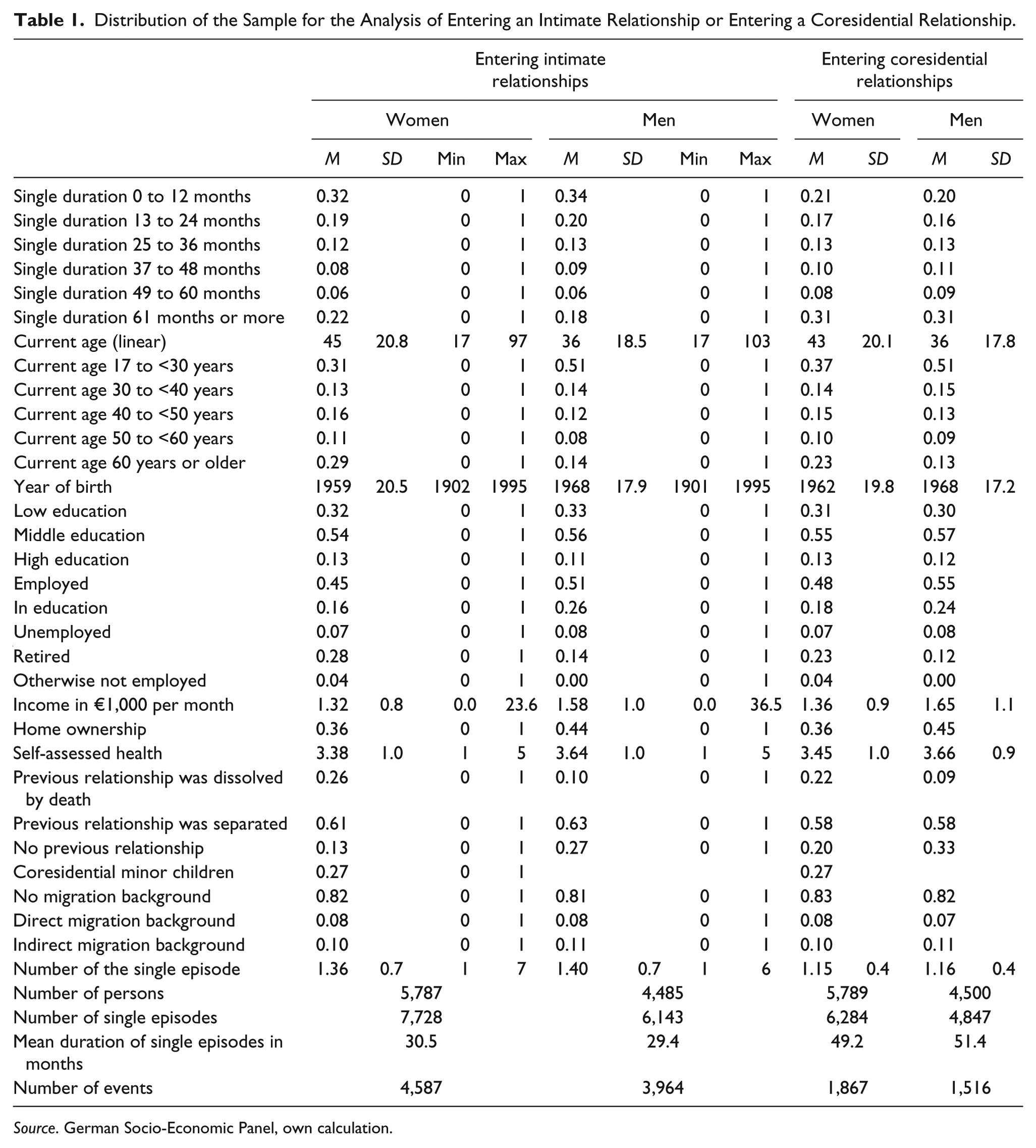
Table 1 presents the distribution of the sample for the analysis of entering an intimate relationship by gender. Overall, the women in the sample started 4,587 intimate relationships during the observation period, while the men in the sample started 3,964 intimate relationships during the same period. The distribution of the sample remains similar when only coresidential relationships are considered, with the exception that there are considerably less new partnership events (see the right-hand columns of Table 1).
Distribution of the Sample for the Analysis of Entering an Intimate Relationship or Entering a Coresidential Relationship.
Source. German Socio-Economic Panel, own calculation.
Results
Descriptive Analysis
Figure 1 presents life table estimates for women of the time until starting a new intimate relationship for different age groups. Among single women aged 17 to 29 years, 86% started an intimate relationship within a period of 5 years. This proportion decreases steadily with age and reaches 80% at the age of 30 to 39 years, 65% at the age of 40 to 49 years, 44% at the age of 50 to 59 years, and 18% from the age of 60 years and older.
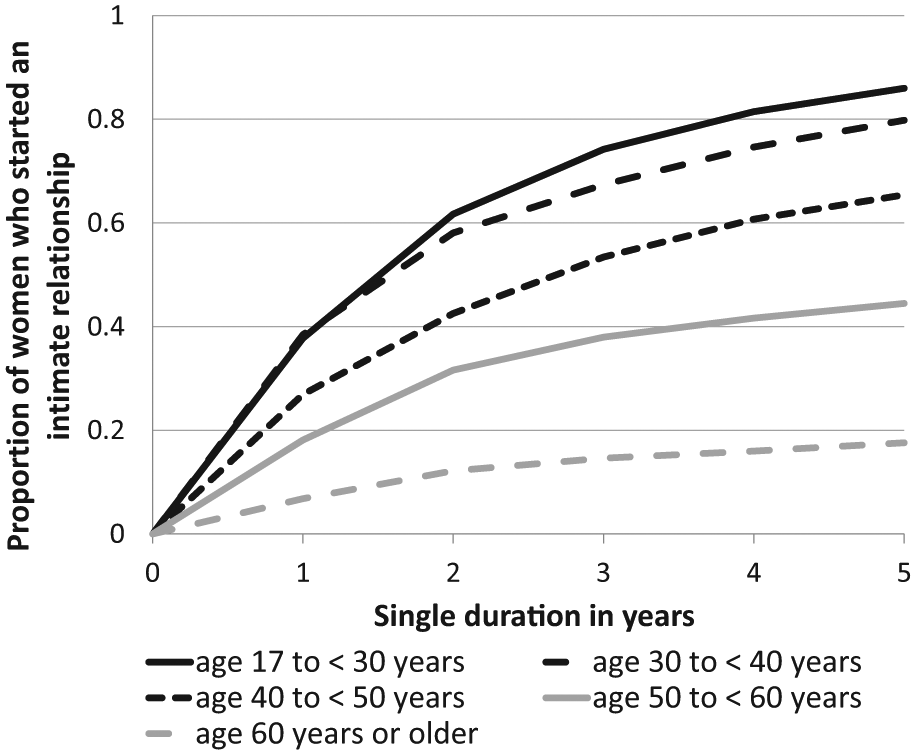
Proportion of single women who started an intimate relationship after 1 to 5 years after separation or death of partner (life table estimates).
In contrast to Figure 1, which considers all newly formed partnerships, Figure 2 presents life table estimates for women of the time until starting a coresidential relationship. By comparing Figures 1 and 2, it can be seen that the formation of a coresidential relationship is less likely than starting an intimate relationship in all age groups. This is logical because not all partnerships transition to cohabitation. In addition, Figure 2 shows that the formation of a coresidential relationship is more likely at the age of 30 to 39 years than in earlier years and declines thereafter. Remarkably, only 2% of women from the age of 60 years and older start a coresidential relationship within 5 years (compared with 18% of women of the same age group who start an intimate relationship).
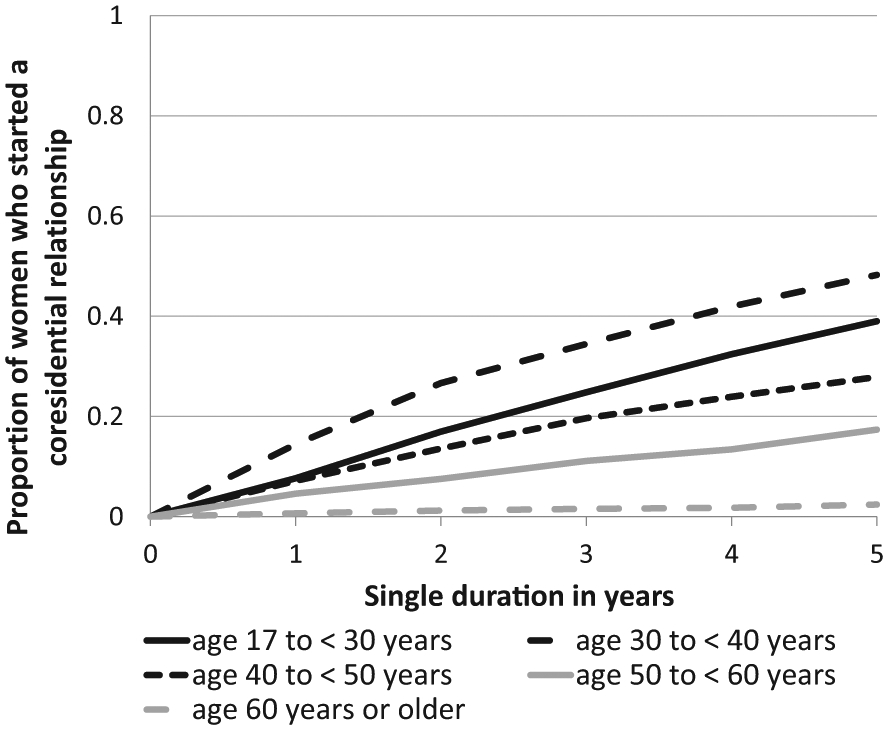
Proportion of single women who started a coresidential relationship after 1 to 5 years after separation or death of partner (life table estimates).
Figure 3 presents life table estimates for single men of the time to a new intimate relationship. The proportion of men who started a partnership within 5 years is highest at the age of 30 to 39 years (81%). This share is lower among younger men (75% of men aged 17-29 years remained single after 5 years), as well as among somewhat older men (72% of men aged 40-49 years and 73% of men aged 50-59 years). Similar to the case for women, men from the age of 60 years and older are least likely to start an intimate relationship (47%).
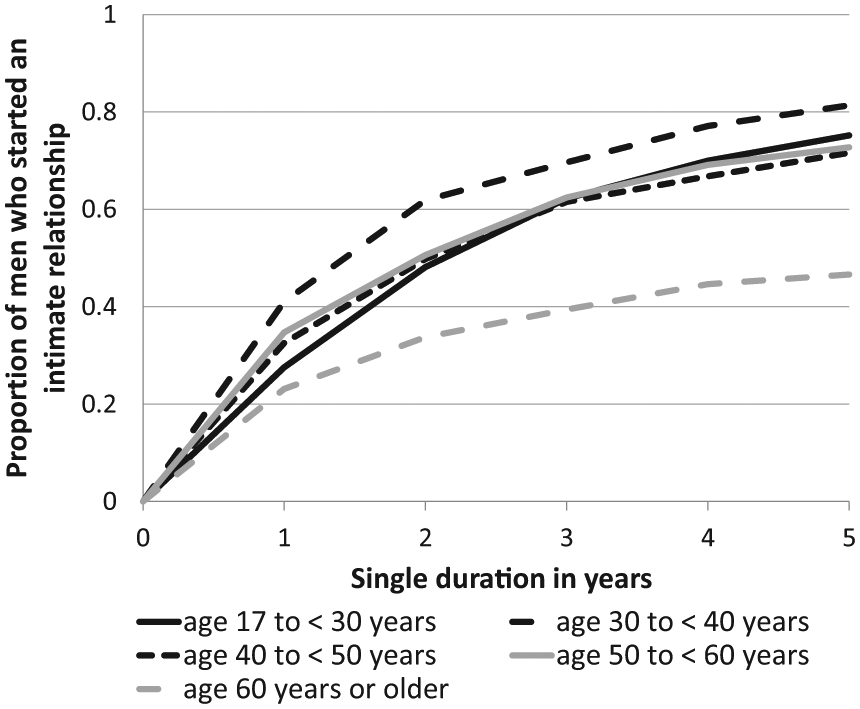
Proportion of single men who started an intimate relationship after 1 to 5 years after separation or death of partner (life table estimates).
Figure 4 only considers coresidential relationships for men and shows similar associations with age. The proportion of men who started a coresidential relationship within 5 years is highest at the age of 30 to 39 years (53%) and lowest from the age of 60 years and older (15%).
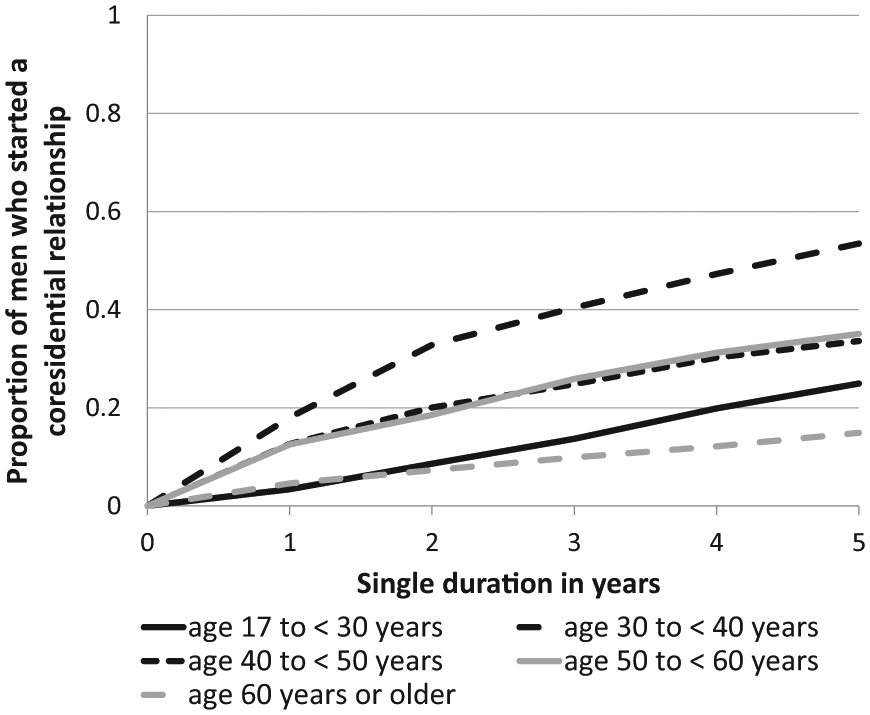
Proportion of single men who started a coresidential relationship after 1 to 5 years after separation or death of partner (life table estimates).
When comparing women and men, both log rank and Wilcoxon tests showed that young women (aged 17-29 years) are significantly more likely to start an intimate relationship or a coresidential relationship than young men (in each case, p < .001). In contrast, men are significantly more likely to start an intimate relationship or a coresidential relationship than women in all age groups from the age of 40 years and older (in each case, p < .001).
Multivariate Analysis
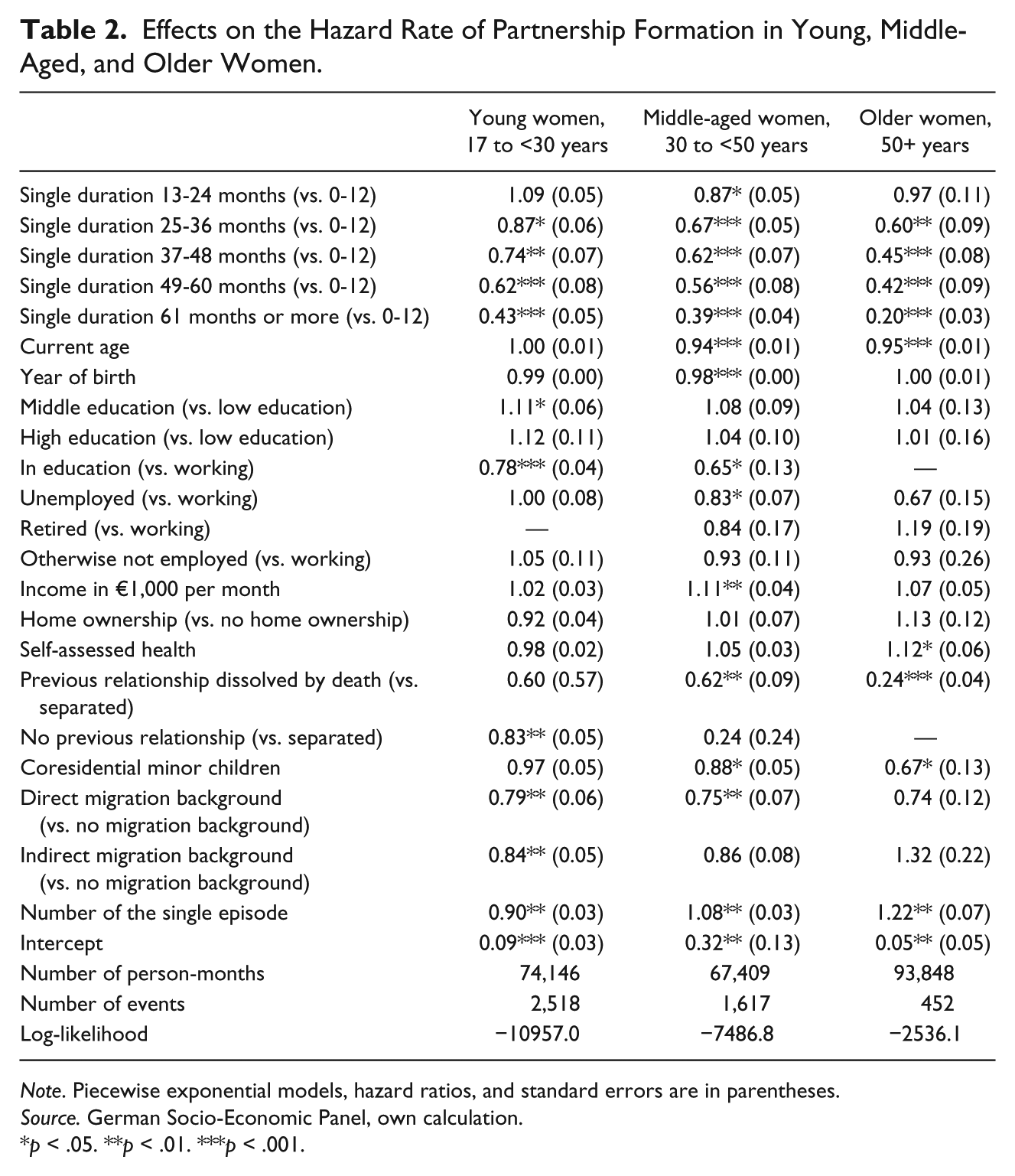
As a next step, we examine whether the determinants of partnership formation change from young to old age. Table 2 presents the results from the piecewise exponential models for young women (Model 1), middle-aged women (Model 2), and older women (Model 3). The reported coefficients are hazard ratios. Values greater than 1 represent an increased likelihood of starting an intimate relationship and values less than 1 represent a reduced likelihood.
Effects on the Hazard Rate of Partnership Formation in Young, Middle-Aged, and Older Women.
Note. Piecewise exponential models, hazard ratios, and standard errors are in parentheses.
Source. German Socio-Economic Panel, own calculation.
p < .05. **p < .01. ***p < .001.
Among young women (17 years to less than 30 years), the transition rate into a partnership is highest in the first 2 years of being single and then declines monotonically. In addition, partnership formation is less likely during education than during working years, if women had no partner in the past and if there is a direct or indirect migration background.
Among middle-aged women (30 years to less than 50 years), the transition rate into a partnership is highest in the first year of being single and declines steadily thereafter. The rate also declines with age and with year of birth. Training and unemployment are associated with a lower likelihood of partnership formation compared with working, whereas income is positively associated with partnership formation. Moreover, a relationship is less likely to start if the previous relationship was dissolved by the death of a partner, if there are coresidential minor children, or if there is a direct migration background.
For older women (50 years or older), starting an intimate relationship becomes less likely with increasing duration of being single and with increasing age. Better health is positively associated with partnership formation. The termination of the last relationship by the death of a partner and having children are negatively associated with partnership formation. Interestingly, there is no effect of year of birth on the transition rate into a partnership among older women, which is in contrast to our first hypothesis.
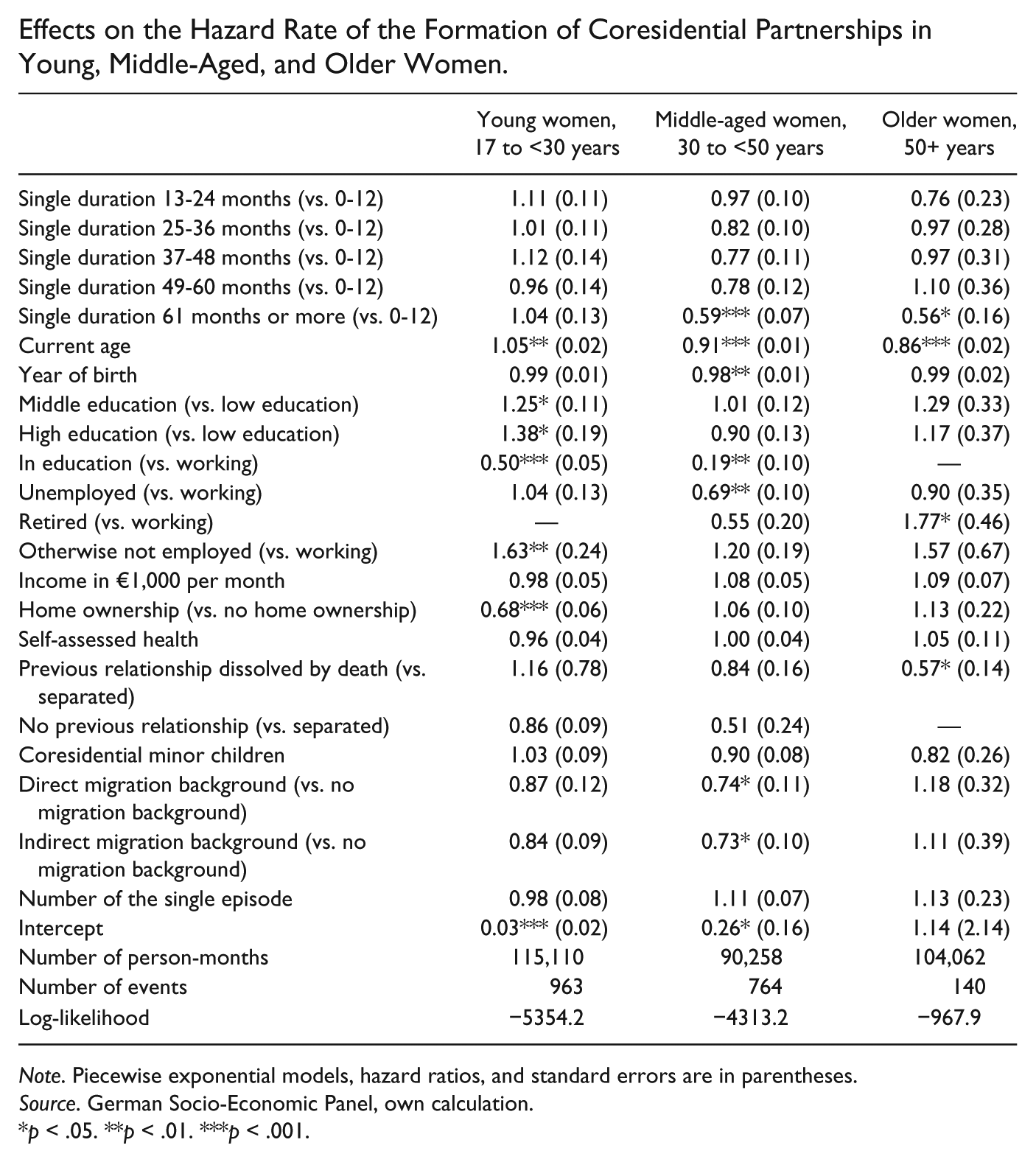
Similar patterns can be observed for employment status and income (see Appendix A) when only coresidential relationships are considered. Again, unemployment reduces the transition rate into a coresidential relationship only among middle-aged women, whereas higher income tends to have a positive (but nonsignificant) effect among middle-aged women. A similar pattern can also be observed for health, which does not accelerate the formation of coresidential relationships among young and middle-aged women and tends to have a positive (but nonsignificant) effect among older women.
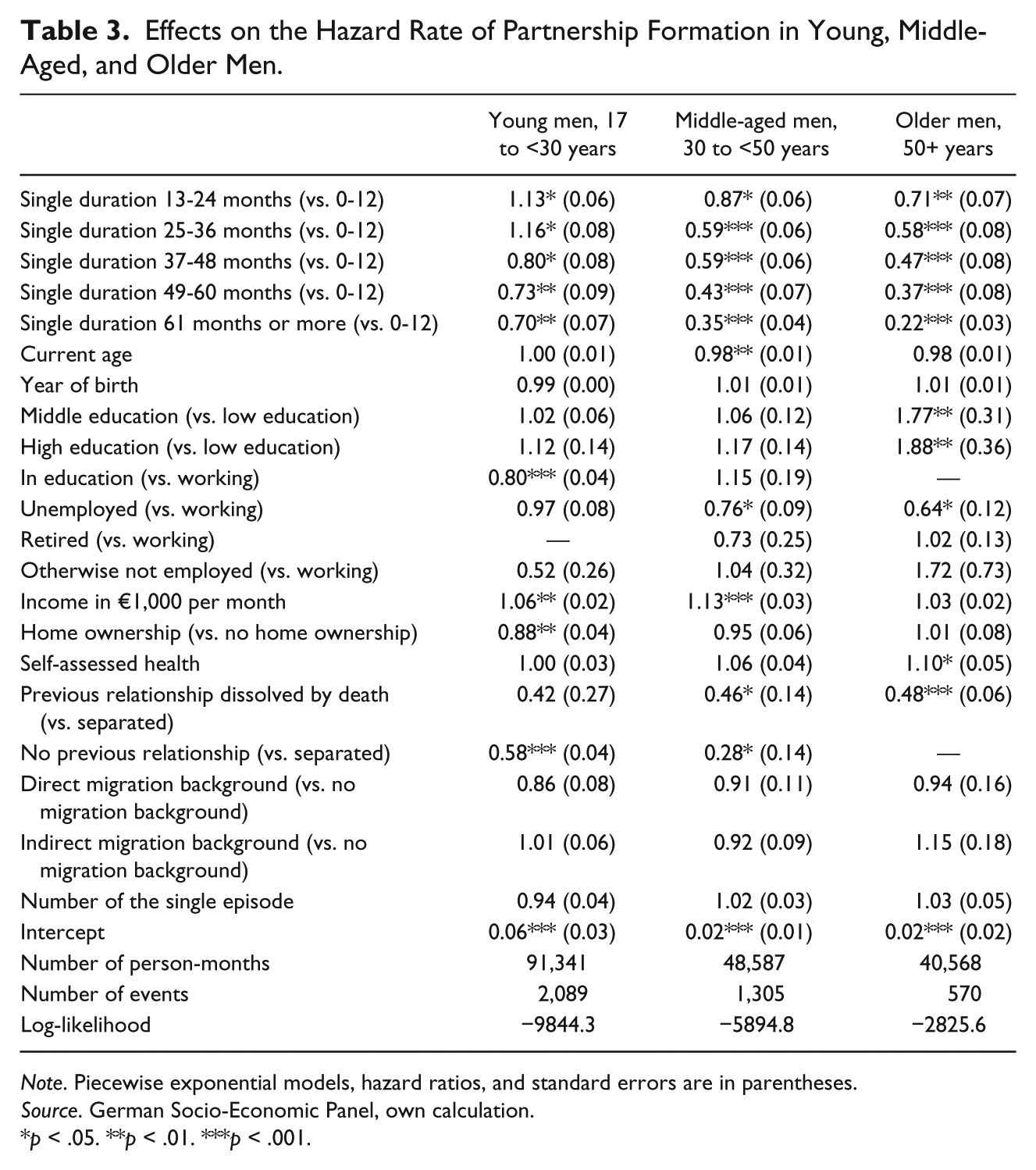
Table 3 presents the results for partnership formation for young men (Model 1), middle-aged men (Model 2), and older men (Model 3). Partnership formation is less likely during education than during working years among young men. Higher income is associated with a higher transition rate into a relationship, whereas living in an owner-occupied house is associated with a lower rate. In the case of middle-aged men, unemployment is negatively associated with partnership formation, whereas higher income is positively associated with partnership formation. Among older men, the middle and highly educated are more likely to start a relationship than the low educated. Unemployed men are less likely to start a partnership than working men, and better health is associated with a higher transition rate into a partnership. In contrast to our first hypothesis, there is no effect of year of birth on the transition rate into a partnership among elderly men. We also examined effects of historical year on partnership formation among older men and women and did not find significant differences (results not shown).
Effects on the Hazard Rate of Partnership Formation in Young, Middle-Aged, and Older Men.
Note. Piecewise exponential models, hazard ratios, and standard errors are in parentheses.
Source. German Socio-Economic Panel, own calculation.
p < .05. **p < .01. ***p < .001.
The results for the formation of coresidential relationships for men (see Appendix B) differ to some extent from the results for partnership formation. For example, older men with a middle or high education compared with older men with a low education are not more likely to start a coresidential relationship. Higher income tends to have a positive (but nonsignificant) effect on the formation of coresidential relationships among middle-aged men, as is the case for partnership formation but has a negative effect among young men. Unemployment reduces the transition rate into a coresidential relationship among middle-aged men, as is the case for partnership formation but also among young men, albeit to a lesser extent. Similar patterns can be observed for health, which does not affect the formation of a coresidential relationship among young and middle-aged men and tends to have a positive (but nonsignificant) effect among older men.
Discussion
The aim of this study was to investigate whether the determinants of partnership formation vary from young to old age. In contrast to most previous studies, we examined the hazard ratio of starting an intimate relationship, regardless of whether the partners live together. To consider that some effects may not increase or decrease monotonically with age, we estimated separate models for young, middle-aged, and older women and men. Additionally, we tested to what extent the results differ when the transition into cohabitation is examined.
In accordance with previous studies, descriptive results show that the likelihood of partnership formation decreases in middle and later life, particularly for women (e.g., Brown & Shinohara, 2013; Jaschinski, 2011; Schimmele & Wu, 2016). Older women are considerably less likely to start a partnership than older men, whereas young women are more likely to start a partnership than young men. The present study shows that this applies to both the formation of intimate relationships and the formation of coresidential relationships. A remarkable finding of the present work is that single women from the age of 60 years and older rarely start a coresidential relationship (only 2% within a period of 5 years), whereas starting an intimate relationship is much more frequent for women of the same age group (18% within a period of 5 years). These results emphasize that it is important to consider nonresidential relationships, particularly when examining partnership formation in later life.
The result that older women are less likely to enter a partnership than older men can be explained with several factors. Older women have poorer marriage market opportunities (there are more elderly women than elderly men) and they are less interested in repartnering than older men (Carr, 2004; Davidson, 2002; Poortman & Hewitt, 2015). In addition, older men express an increasing preference for younger partners with rising age (Alterovitz & Mendelsohn, 2009; England & McClintock, 2009; Klein & Rapp, 2014). The latter may also explain why young women are more likely to start a partnership than young men. Furthermore, the result that older single women very rarely start a coresidential relationship, even when they have a nonresidential partner, corresponds with a recent study by Lewin (2017) that showed that older women with a nonresidential partner have low intentions to cohabit.
The first hypothesis of this study was that partnership formation at a higher age has become more likely among successive cohorts of older people, partly because successive cohorts have higher divorce rates than older cohorts and therefore have better marriage market opportunities, particularly in later stages of life. However, our results do not support this hypothesis, neither for women nor for men. One reason why partnership formation among older adults is not more frequent among successive cohorts of older people may be that successive cohorts have a lower need for a partner. Women depend less on a male breadwinner, and men may be more able to care for themselves.
The second hypothesis was that socioeconomic resources increase the likelihood of partnership formation particularly in middle and later life, especially because high social status may help prevail against rivals when marriage market opportunities deteriorate. In line with this hypothesis, our results show that socioeconomic status hardly affects the likelihood of partnership formation at a young age and generally is associated positively with partnership formation among middle-aged adults. For example, being unemployed and having lower income protracts partnership formation for both middle-aged women and middle-aged men. For older women and men, however, socioeconomic factors again are relatively unimportant for the likelihood of partnership formation. In line with a study by Vespa (2012), our results indicate that retirement does not affect the likelihood of partnership formation.
One reason why socioeconomic factors are rather unimportant for partnership formation at an early stage of life may be that the supply of potential partners is large, and therefore, the competitive pressure on the marriage market is low. Additionally, socioeconomic status is more meaningful in midlife than at an early stage of a career (Sweeney, 2002). However, these factors cannot explain the declining importance of economic resources in later life. One explanation may be that older people with more resources are not only more attractive as a partner but also more selective when choosing a partner. Another possible explanation is that older people may have a lower need for the additional economic resources of a partner, for example, because in later life, there are no longer minor children to support.
The third hypothesis of this study was that good health accelerates partnership formation particularly in later life. Previous studies mostly found that healthier people are more likely to start partnerships (e.g., Cheung & Sloggett, 1998; Unger, 2007; Waldron et al., 1996). Our results show that self-assessed health does not affect partnership formation at a young age, but it becomes positively associated with partnership formation at a higher age for both women and men. Several factors may explain why self-assessed health is a better predictor of partnership formation among older adults than among younger adults. First, health may be more important for partnership formation at an older age than at a younger age because marriage market opportunities deteriorate with age. Moreover, poor self-assessed health may reflect more severe health restrictions in later life than in early life. Finally, poor health may discourage potential partners particularly in later life because potential partners may fear the consequences of long-term care (Bulcroft & Bulcroft, 1991; McWilliams & Barrett, 2014).
The current study has some limitations. We examined the likelihood of starting an intimate relationship, irrespective of whether the partners live together. This has the advantage that we do not miss relationships that do not transition to cohabitation. However, this also has the drawback that there is, in contrast to cohabitation, no clear starting point for an intimate relationship. Consequently, the definition of an intimate relationship was left to the participants. Moreover, previous research on nonresidential relationships showed that these relationships are a heterogeneous category (Coulter & Hu, 2017; Duncan, Carter, Phillips, Roseneil, & Stoilova, 2013; Lois, 2012), and the definition of an intimate relationship may vary with age. As a robustness check, we also have examined the transition into coresidential relationships, and the main conclusions remain unchanged. Another restriction of the current study is that our data provide rich information on individual resources but lack information on preferences. Consequently, it is not clear whether a low transition rate into a partnership is attributable to the fact that people cannot or do not wish to start a partnership. Finally, it remains to be seen whether the results can be generalized to other countries.
Our results indicate that the influences of socioeconomic status and health on partnership formation vary over the life course. Therefore, future studies on the determinants of partnership formation should consider that these determinants may vary with age. Moreover, future research on partnership formation would benefit from longitudinal data with detailed information on meeting opportunities and preferences.
Footnotes
Appendix A
Effects on the Hazard Rate of the Formation of Coresidential Partnerships in Young, Middle-Aged, and Older Women.
| Young women, 17 to <30 years | Middle-aged women, 30 to <50 years | Older women, 50+ years | |
|---|---|---|---|
| Single duration 13-24 months (vs. 0-12) | 1.11 (0.11) | 0.97 (0.10) | 0.76 (0.23) |
| Single duration 25-36 months (vs. 0-12) | 1.01 (0.11) | 0.82 (0.10) | 0.97 (0.28) |
| Single duration 37-48 months (vs. 0-12) | 1.12 (0.14) | 0.77 (0.11) | 0.97 (0.31) |
| Single duration 49-60 months (vs. 0-12) | 0.96 (0.14) | 0.78 (0.12) | 1.10 (0.36) |
| Single duration 61 months or more (vs. 0-12) | 1.04 (0.13) | 0.59*** (0.07) | 0.56* (0.16) |
| Current age | 1.05** (0.02) | 0.91*** (0.01) | 0.86*** (0.02) |
| Year of birth | 0.99 (0.01) | 0.98** (0.01) | 0.99 (0.02) |
| Middle education (vs. low education) | 1.25* (0.11) | 1.01 (0.12) | 1.29 (0.33) |
| High education (vs. low education) | 1.38* (0.19) | 0.90 (0.13) | 1.17 (0.37) |
| In education (vs. working) | 0.50*** (0.05) | 0.19** (0.10) | — |
| Unemployed (vs. working) | 1.04 (0.13) | 0.69** (0.10) | 0.90 (0.35) |
| Retired (vs. working) | — | 0.55 (0.20) | 1.77* (0.46) |
| Otherwise not employed (vs. working) | 1.63** (0.24) | 1.20 (0.19) | 1.57 (0.67) |
| Income in €1,000 per month | 0.98 (0.05) | 1.08 (0.05) | 1.09 (0.07) |
| Home ownership (vs. no home ownership) | 0.68*** (0.06) | 1.06 (0.10) | 1.13 (0.22) |
| Self-assessed health | 0.96 (0.04) | 1.00 (0.04) | 1.05 (0.11) |
| Previous relationship dissolved by death (vs. separated) | 1.16 (0.78) | 0.84 (0.16) | 0.57* (0.14) |
| No previous relationship (vs. separated) | 0.86 (0.09) | 0.51 (0.24) | — |
| Coresidential minor children | 1.03 (0.09) | 0.90 (0.08) | 0.82 (0.26) |
| Direct migration background (vs. no migration background) | 0.87 (0.12) | 0.74* (0.11) | 1.18 (0.32) |
| Indirect migration background (vs. no migration background) | 0.84 (0.09) | 0.73* (0.10) | 1.11 (0.39) |
| Number of the single episode | 0.98 (0.08) | 1.11 (0.07) | 1.13 (0.23) |
| Intercept | 0.03*** (0.02) | 0.26* (0.16) | 1.14 (2.14) |
| Number of person-months | 115,110 | 90,258 | 104,062 |
| Number of events | 963 | 764 | 140 |
| Log-likelihood | −5354.2 | −4313.2 | −967.9 |
Note. Piecewise exponential models, hazard ratios, and standard errors are in parentheses.
Source. German Socio-Economic Panel, own calculation.
p < .05. **p < .01. ***p < .001.
Appendix B
Effects on the Hazard Rate of the Formation of Coresidential Partnerships in Young, Middle-Aged, and Older Men.
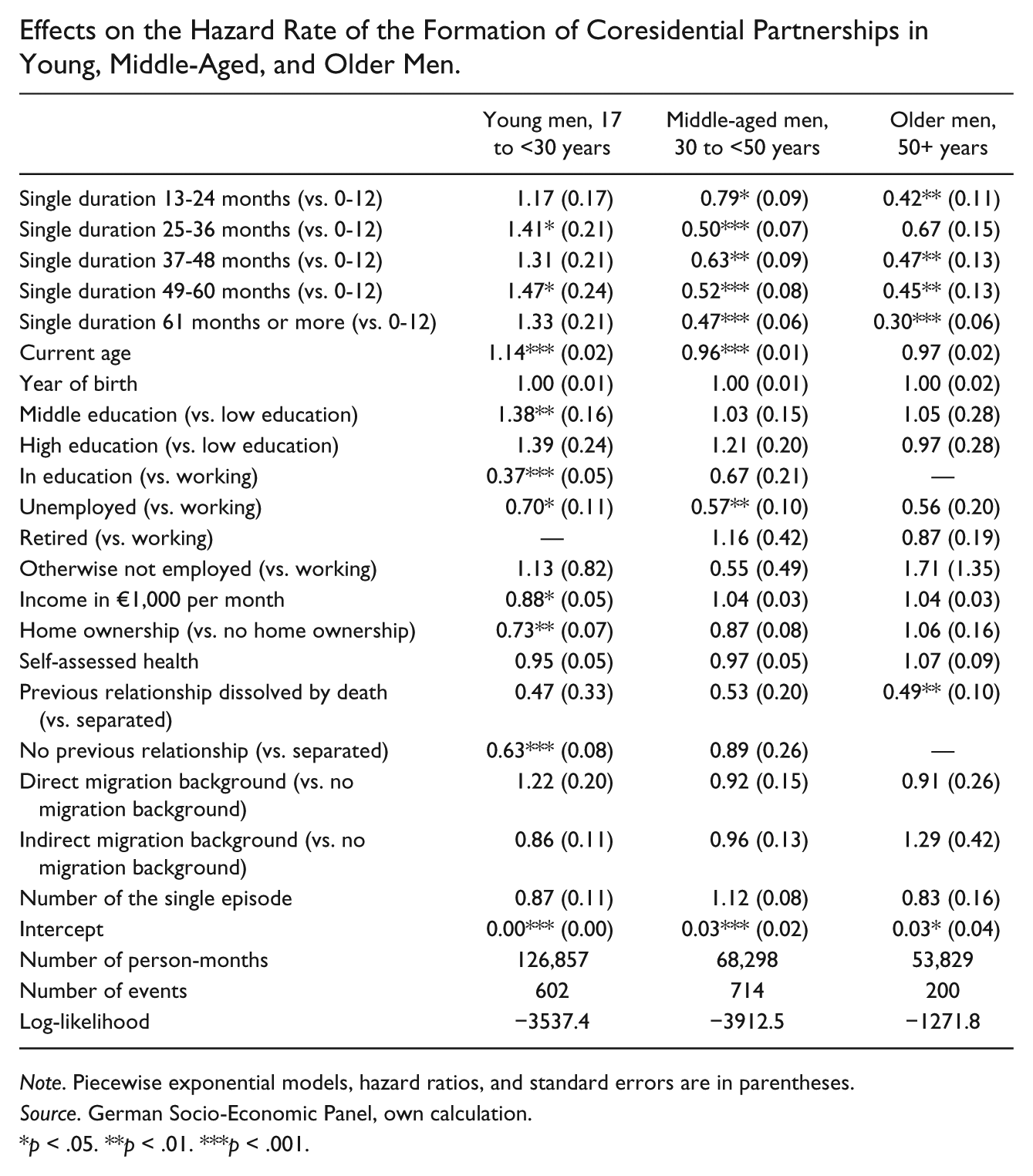
| Young men, 17 to <30 years | Middle-aged men, 30 to <50 years | Older men, 50+ years | |
|---|---|---|---|
| Single duration 13-24 months (vs. 0-12) | 1.17 (0.17) | 0.79* (0.09) | 0.42** (0.11) |
| Single duration 25-36 months (vs. 0-12) | 1.41* (0.21) | 0.50*** (0.07) | 0.67 (0.15) |
| Single duration 37-48 months (vs. 0-12) | 1.31 (0.21) | 0.63** (0.09) | 0.47** (0.13) |
| Single duration 49-60 months (vs. 0-12) | 1.47* (0.24) | 0.52*** (0.08) | 0.45** (0.13) |
| Single duration 61 months or more (vs. 0-12) | 1.33 (0.21) | 0.47*** (0.06) | 0.30*** (0.06) |
| Current age | 1.14*** (0.02) | 0.96*** (0.01) | 0.97 (0.02) |
| Year of birth | 1.00 (0.01) | 1.00 (0.01) | 1.00 (0.02) |
| Middle education (vs. low education) | 1.38** (0.16) | 1.03 (0.15) | 1.05 (0.28) |
| High education (vs. low education) | 1.39 (0.24) | 1.21 (0.20) | 0.97 (0.28) |
| In education (vs. working) | 0.37*** (0.05) | 0.67 (0.21) | — |
| Unemployed (vs. working) | 0.70* (0.11) | 0.57** (0.10) | 0.56 (0.20) |
| Retired (vs. working) | — | 1.16 (0.42) | 0.87 (0.19) |
| Otherwise not employed (vs. working) | 1.13 (0.82) | 0.55 (0.49) | 1.71 (1.35) |
| Income in €1,000 per month | 0.88* (0.05) | 1.04 (0.03) | 1.04 (0.03) |
| Home ownership (vs. no home ownership) | 0.73** (0.07) | 0.87 (0.08) | 1.06 (0.16) |
| Self-assessed health | 0.95 (0.05) | 0.97 (0.05) | 1.07 (0.09) |
| Previous relationship dissolved by death (vs. separated) | 0.47 (0.33) | 0.53 (0.20) | 0.49** (0.10) |
| No previous relationship (vs. separated) | 0.63*** (0.08) | 0.89 (0.26) | — |
| Direct migration background (vs. no migration background) | 1.22 (0.20) | 0.92 (0.15) | 0.91 (0.26) |
| Indirect migration background (vs. no migration background) | 0.86 (0.11) | 0.96 (0.13) | 1.29 (0.42) |
| Number of the single episode | 0.87 (0.11) | 1.12 (0.08) | 0.83 (0.16) |
| Intercept | 0.00*** (0.00) | 0.03*** (0.02) | 0.03* (0.04) |
| Number of person-months | 126,857 | 68,298 | 53,829 |
| Number of events | 602 | 714 | 200 |
| Log-likelihood | −3537.4 | −3912.5 | −1271.8 |
Note. Piecewise exponential models, hazard ratios, and standard errors are in parentheses.
Source. German Socio-Economic Panel, own calculation.
p < .05. **p < .01. ***p < .001.
Author’s note
Ingmar Rapp is currently affiliated with University of Kaiserslautern, Kaiserslautern, Germany.
Declaration of Conflicting Interests
The author declared no potential conflicts of interest with respect to the research, authorship, and/or publication of this article.
Funding
The author disclosed receipt of the following financial support for the research, authorship, and/or publication of this article: This article was created in the context of the project “Determinants of partnering in middle and older age” (RA 2591/2-1), which is funded by the German Research Foundation (DFG).